Introduction
Critics of Joseph Smith have long claimed that the stories of the Restoration offered by him were revised over a period of time until they became what is known today as the accepted history of the Church. In my lecture this morning, I would like to examine some aspects of this claim of revisionism from a documentary perspective. 1
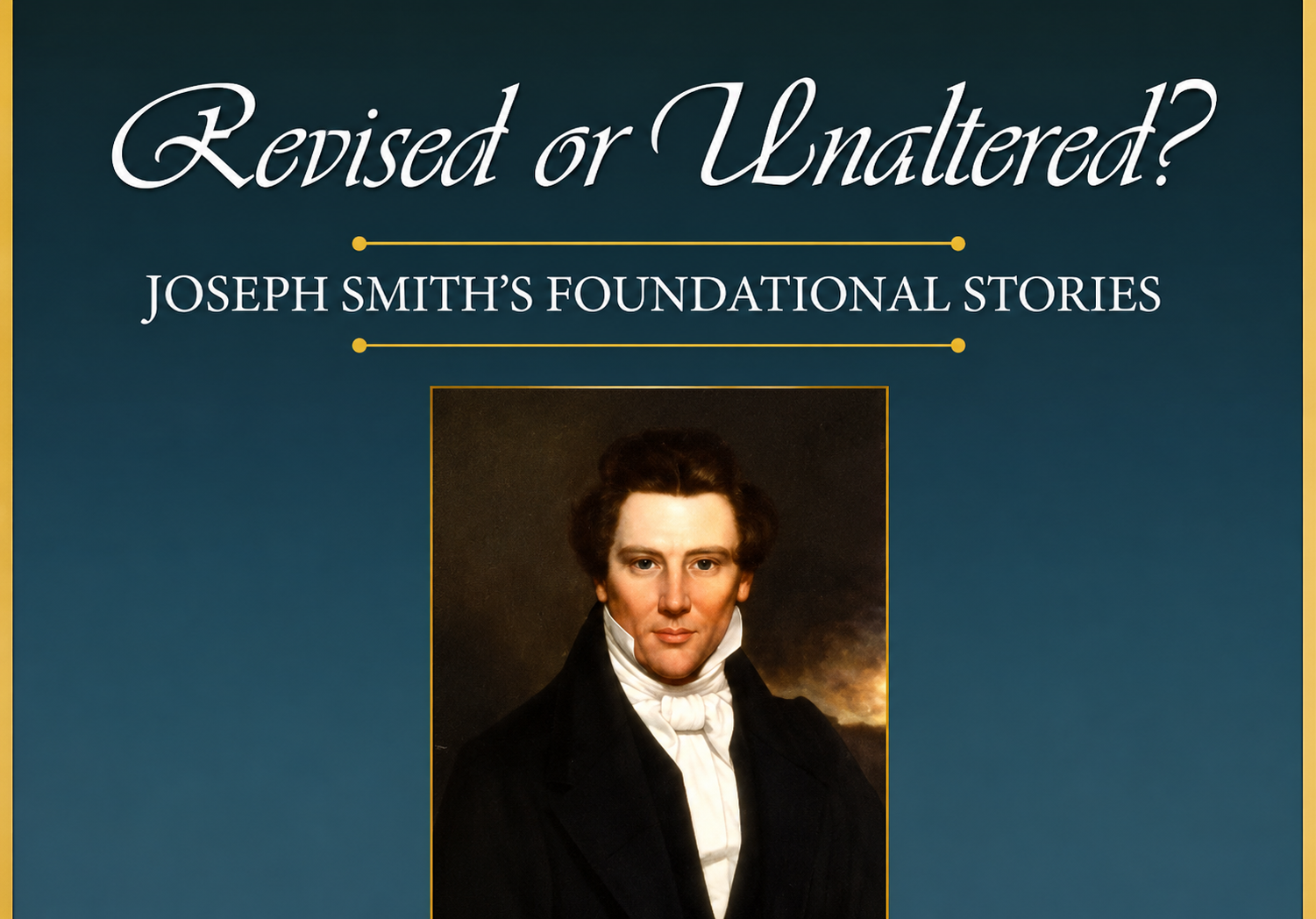
I will start by talking about the story of the coming forth of the Book of Mormon and then move into a discussion of the First Vision.
I have a very definite reason for addressing these topics in reverse historical order. This will become apparent as my lecture progresses. Please be aware that in my remarks today I will be utilizing several abbreviations such as:
- JS1832, which refers to Joseph Smith’s 1832 history, and
- JS1838, which refers to the manuscript that was published in 1842 and became the official history of the Church.
I will be presenting and summarizing a considerable amount of new research on both the story of the coming forth of the Book of Mormon and that of the First Vision. But it’s not nearly all that I have available at this time. It is my hope that you will find something in this material that will be useful in defending the prophet’s foundational stories from the critics of the Church.
The Earliest Book of Mormon Accounts
If a person wants to determine whether or not a story has changed over time, it is logical to first examine that story in its earliest known form. In the case of the Book of Mormon account, we are fortunate to have records from several eyewitnesses who heard Joseph Smith relate this story for the first time. 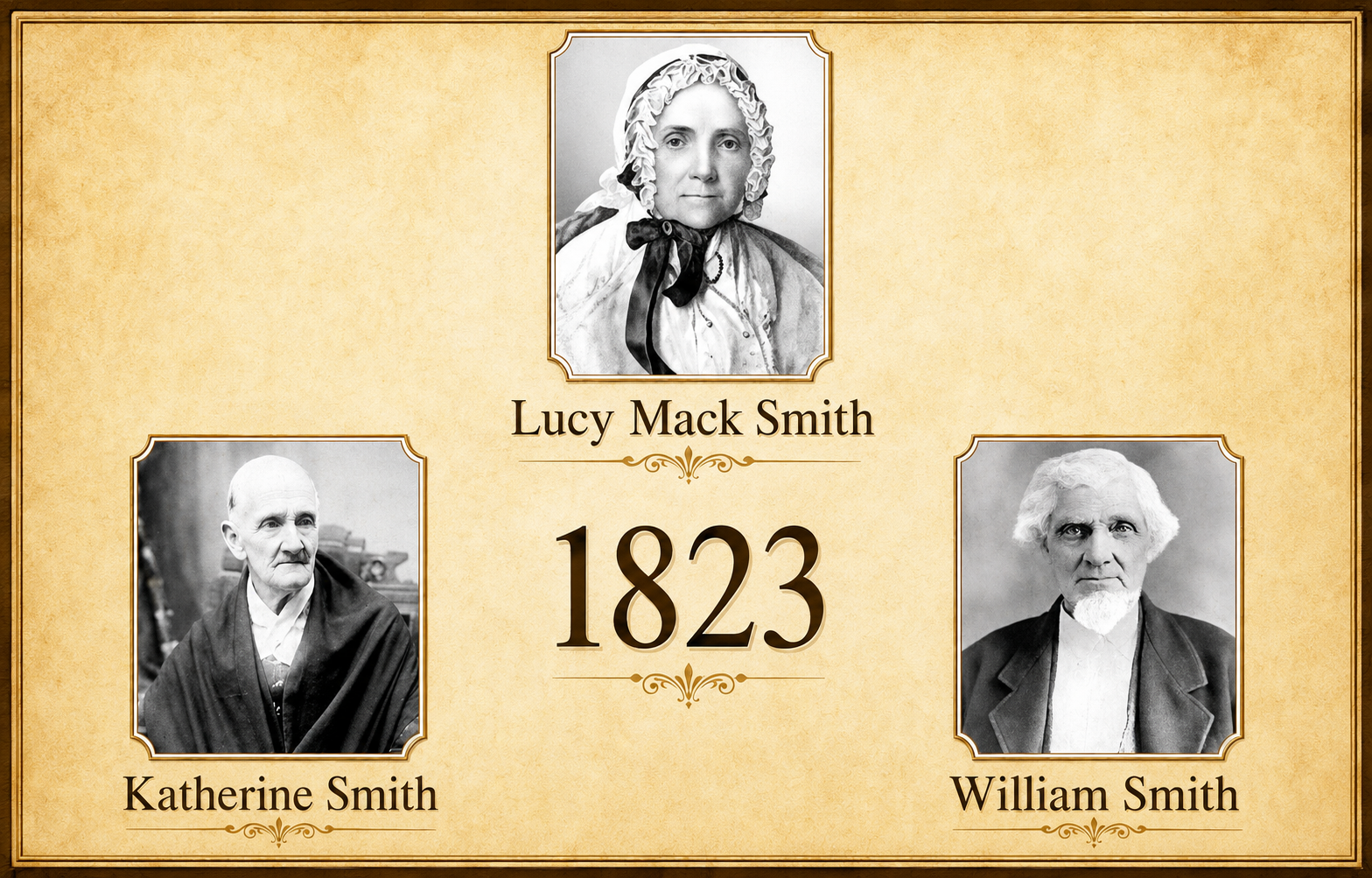
These witnesses are his mother, Lucy Mack Smith, his sister Katherine Smith, and his brother William Smith.
These three eyewitnesses agree that Joseph’s story was first told to them during the fall harvest season shortly before Alvin Smith died, thereby giving us a date of 1823. They are also in agreement that the story told to them was that an angel had appeared to Joseph and told him about a golden engraved record hidden in a nearby hill.
Joseph talked to his whole family about this revelation for a considerable length of time. He stated that he was required to wait for a period of four years before he was allowed to retrieve the record.
He also warned his family members that they must not tell others in the community about this ancient artifact.
None of these three eyewitnesses ever mentions that they heard any different story of origin related by Joseph Smith, and none of them ever mentions hearing, even in the community, any earlier version of this story.
Independent Witnesses to the Story
Lorenzo Saunders
It is interesting to note that one of the Smiths’ neighbors named Lorenzo Saunders stated that before Alvin Smith died in November of 1823, Joseph Smith Jr. told the Saunders family that he had seen an angel and was notified about the plates.
Joseph Smith evidently broke his own rule of non-disclosure in this instance, but in the process provided an independent set of witnesses to the elements of his story in 1823.
Harrison Chamberlain
A possible secondhand verification of this circumstance comes from Harrison Chamberlain. He claimed to have heard from people living in the vicinity of Palmyra that in the late fall of 1823, Joseph Smith told his most intimate associates about his vision of an angel and the engraved golden plates buried in a hill which contained revelation from God.
The Knight Family
We know that Joseph’s story about the Book of Mormon remained the same through the year 1826 because during that period he worked in southern New York State for the Knight family.
While he was in their employ, he said that a person had appeared to him in a vision and told him where there was an ancient gold book buried.
Martin Harris and the Golden Plates
Martin Harris is our next eyewitness for the content of Joseph Smith’s story. He said that the first time he heard about the gold Bible was around the 1st of October in the year 1827.
Harris recalled that the day following this, he went into Palmyra and spoke to some of the residents of the village about this matter. They repeated the account of it as given to them by Joseph Smith Sr., and it matched with what Joseph Jr. had said earlier.
Lucy Mack Smith arrived a little bit later at the house of Martin Harris and told him about Joseph bringing the plates to the Smith residence and many other things.
She further informed Martin that Joseph wished to see him. Martin sent his wife and daughter home with Lucy Mack Smith at this time. When they returned, they told Martin that they had both been allowed to lift a very heavy object that was said to be the golden plates.
When Martin Harris went himself to the Smith home in Manchester, New York, Joseph Jr. was away. Martin reports,
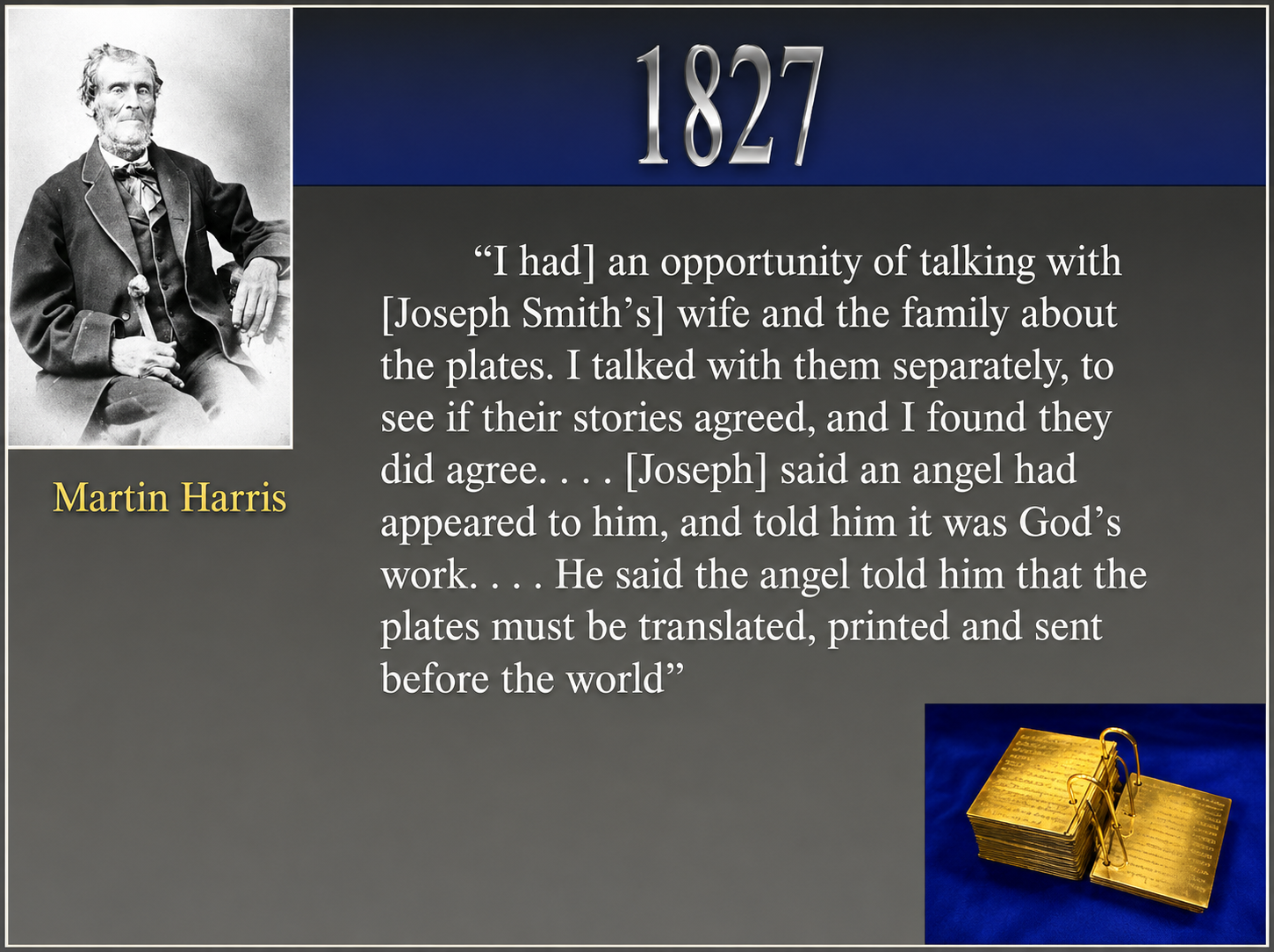
“This gave me an opportunity of talking with his wife and family about the plates.”
Harris Interviews the Smith Family
Martin indicates that he desired to get at the truth of the matter.
“I talked with them separately,” he said, “to see if their stories agreed, and I found they did agree.”
“When Joseph came home, I did not wish him to know that I had been speaking with them. So, I took him by the arm and led him away from the rest, and requested him to tell me the story, which he did as follows. He said an angel had appeared to him and told him it was God’s work.”
Joseph talked about the spectacles and said that they had the ability to display a lifelike visual image. 2 He also said the angel told him that the plates must be translated, printed, and sent before the world.
Martin relates,
“While at Mr. Smith’s, I hefted the plates and knew from the heft that they were lead or gold, and I knew that Joseph had not credit enough to buy so much lead.”
We may conclude from all of this documentary evidence that between the initial disclosure of the origin of the Book of Mormon in the fall of 1823 and Joseph bringing the plates into the Smith residence in the fall of 1827, his story did not change.
He consistently told individuals that an angel of God had informed him about a set of golden plates.
Public Speculation and Competing Narratives
Then the historical scene changes dramatically.
It is known from documentary sources that in the year 1827, Joseph Smith started making his story known among the general populace. I have collected several statements by critics — actually, there’s eleven — who say that they heard the story during this year from either Joseph Smith or one of his close associates.
There were, of course, some people who were skeptical about the young man’s claims of new revelation from the Almighty. This is the time period where the public started to speculate heavily about what they thought was really behind Joseph Smith’s story and how they imagined the book idea really originated.
Rumors and Alternative Explanations
By the summer of 1829, when the Book of Mormon was being prepared for the press, the line between history and mythology had been blurring for some time. An issue of the June 1829 Wayne Sentinel newspaper in Palmyra made note of the fact that there had already been much speculation about the Golden Bible floating around the region. 3
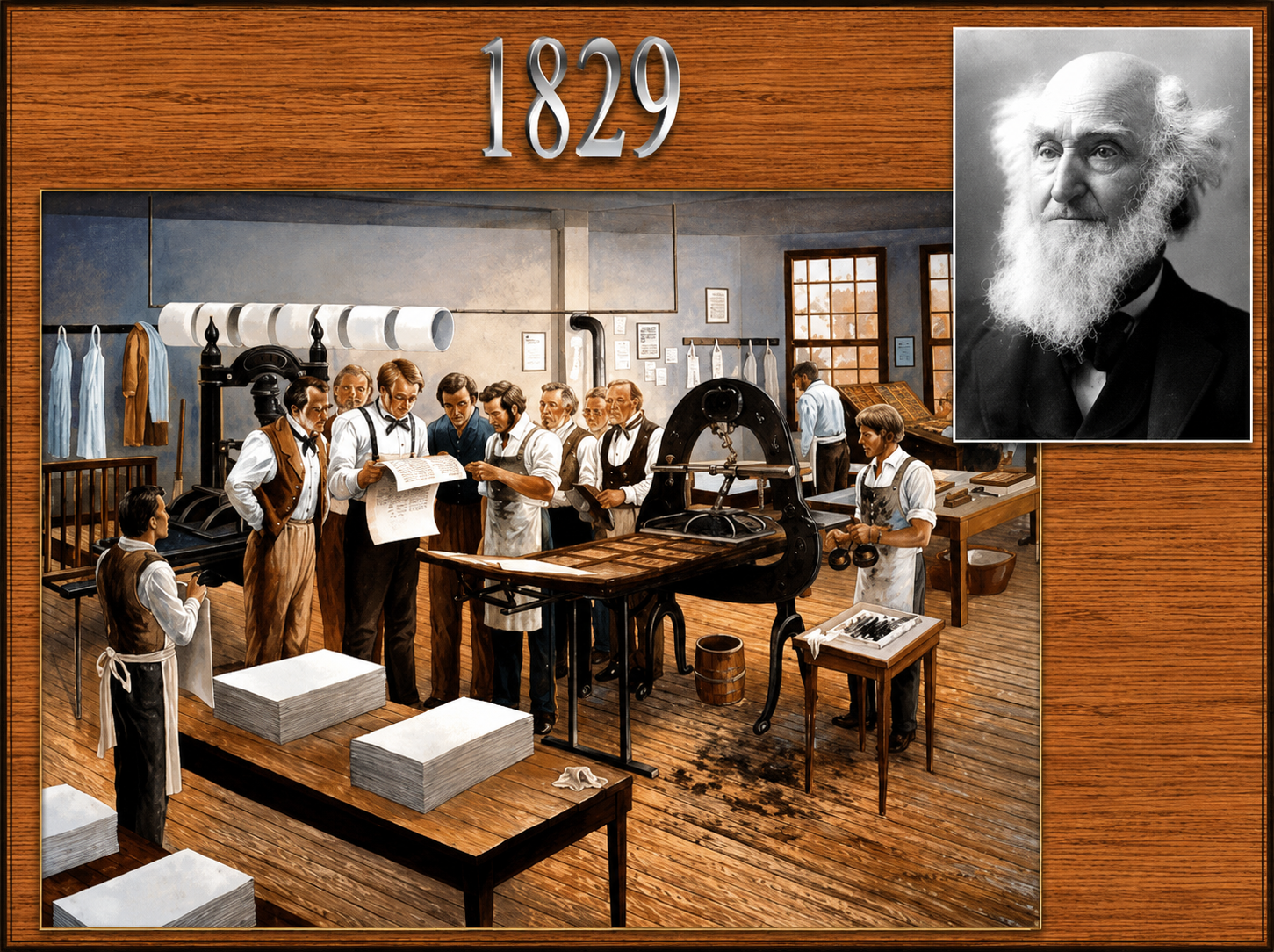
Steven S. Harding provides us with a unique and insightful snapshot of what was going on during this precise time period. He visited the Grandin print shop where the book was being published, and there he met Father Smith, the prophet, Oliver Cowdery, and Martin Harris in the morning.
Then in the afternoon, he had a lengthy conversation with his cousin Pomeroy Tucker and Mr. Grandin where he heard some new things about the book that was being produced.
Martin Harris About the Book of Mormon
The things that he heard from these two different groups of men is very instructive. Martin Harris informed Harding that:
- the plates of the book were found in a hill,
- an angel of the Lord was involved, and
- the devil was working to thwart the project.
Tucker About the Book of Mormon
Pomeroy Tucker, on the other hand, told him something quite different. He wanted Harding to believe that Joseph Smith had a connection:
- with the black art,
- animal sacrifice, and
- money digging. 4
Though in later years, Tucker admitted that these stories only qualified as rumors.
When Mr. Grandin was interviewed about the Book of Mormon just two years later than his meeting with Harding, he also seemed to be of the opinion that the golden plates were connected with money-digging lore.
John H. Gilbert, whose picture you see here on the screen, was also a workman in the Grandin print shop during the production of the Book of Mormon. He likewise held to the belief that Joseph Smith was a money digger who was involved in magic practices.
From this documentary evidence, it can be concluded that two different stories of origin were being promulgated in the Grandin building at the same time that the Book of Mormon was being issued from it.
Authentic Accounts Versus Public Speculation
The workmen of the Grandin print shop typeset and proofread the preface page of the Book of Mormon. And so they knew without any ambiguity what the authentic story of its origin was.
They were also aware from this document that there were “many false reports” circulating about the book.
Yet they chose to champion the rumors that were swirling around the region. Their repetition of idle reports, therefore, represents a deliberate revision of Joseph Smith’s own story. 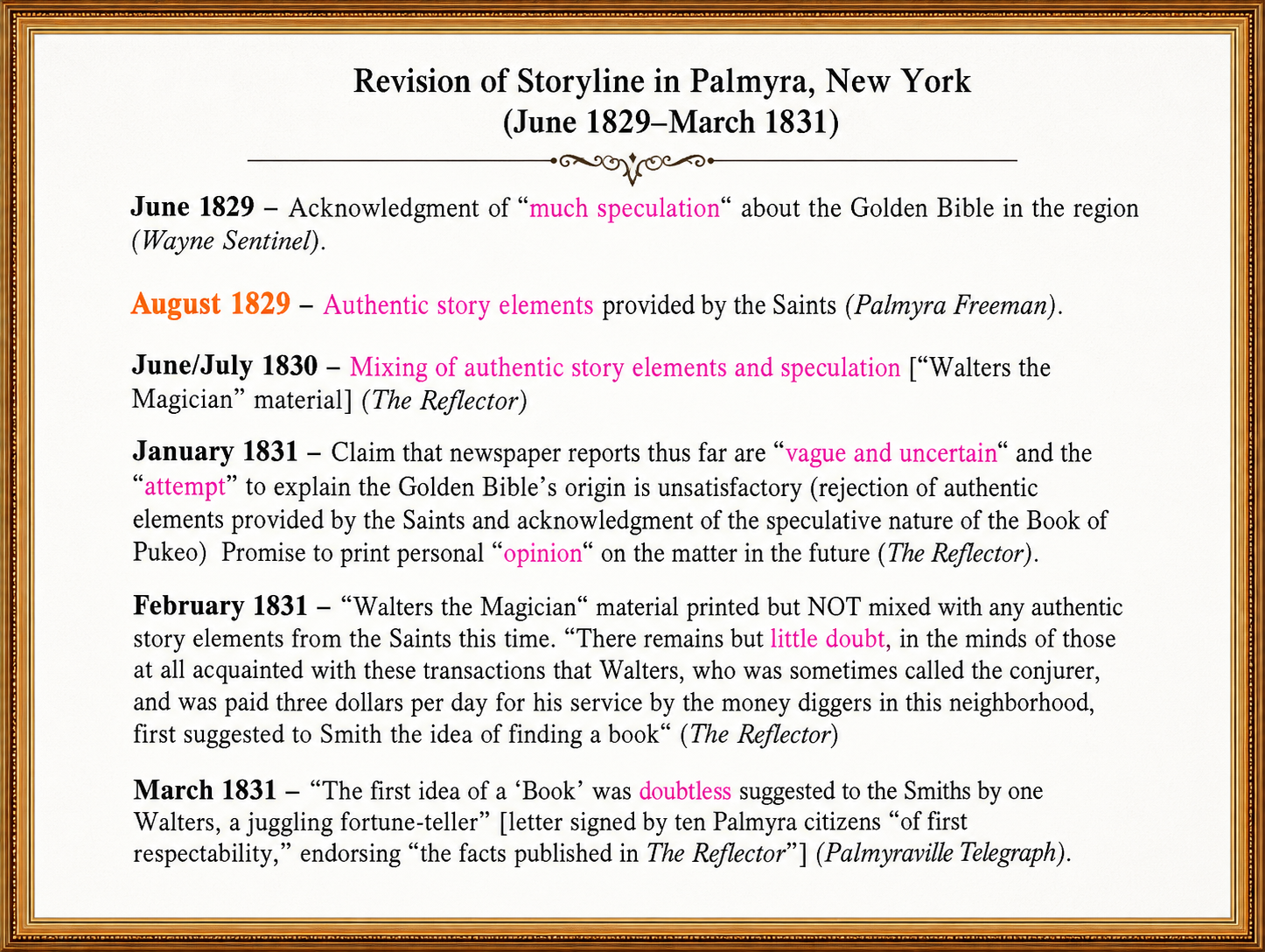
On this next slide, I have highlighted the date, August 1829, so that you can see how the information that I just presented correlates with what I will talk about next.
It is at the very same time that Steven Harding was hearing an alternative storyline in Palmyra that some Latter-day Saints tried to set the record straight.
The report of story elements printed in the 11th of August 1829 issue of the Palmyra Freeman is not perfect, but it is very close to being correct in its elements. After filtering out a little of the biased opinion and incorrect notations, it says this:
“Joseph Smith of Manchester, New York, said he was visited three times by a messenger of the Almighty. Joseph was informed that a golden Bible 5 was deposited in a hill in Manchester. It was an ancient record of divine nature and origin. Joseph went to the place of deposit, dug into the earth a little ways, and found the golden Bible along with a huge pair of spectacles.
“Joseph was instructed not to let any person see the objects on penalty of death. The plates of gold measured 8 inches long and 6 inches wide and were 1/8 of an inch thick. The plates were engraved with hieroglyphics and the spectacles enabled Joseph to interpret the characters on the plates.”
The rest of the information that is on this slide shows a very interesting pattern. The first item tells us that rumors were flying through the countryside. Next, the Saints offer the authentic elements of the story to the public.
Then we find a blatant act of historical revisionism.
Abner Cole and the “Book of Pukei”
Abner Cole wanted to mock the Book of Mormon in his newspaper, The Reflector. He was most probably motivated to do this because he had violated copyright law (by the way, he was an ex-justice of the peace) by printing portions of the Book of Mormon in his paper, and the prophet forced him to stop his illegal activity.
Cole’s mockery text was called the Book of Pukei.
In this production, the editor took authentic elements of the story of the Book of Mormon’s origin and mixed them together with elements of speculation that had been floating around the community.
This is important to understand. He is using authentic elements in that Book of Pukei and he’s mixing them together with the rumors, and something’s going to happen.
Cole utilized the dialogue of one of the characters in his mockery text to call Joseph Smith an ignoramus, a criminal, and a servant of Satan.
It is in this text that Joseph Smith is connected with a man from the Great Sodus Bay called Walters the Magician, which is probably Luman Walter.
Cole claims in the Book of Pukei that the Book of Mormon really came into existence in the following manner.
Walters the Magician Narrative
- Walters the magician was involved in witchcraft and money digging. Walters was summoned to Manchester, New York, by a group of wicked, idle, and slothful individuals, one of which was Joseph Smith.
- Walters took the slothful individuals of Manchester out into the woods on nighttime money-digging excursions. They drew a magic circle, sacrificed a rooster, and dug into the ground on many occasions, but never actually found anything.
- The slothful group of Manchesterites then decided that Walters was a fraud. Walters himself admitted that he was an impostor. And decided to skip town before the strong arm of the law caught up with him.
Remember that Cole is an ex-justice of the peace, and so he is talking through this document. “The strong arm of the law is going to catch up with you impostors.”
- At this point, the mantle of Walters the Magician falls upon Joseph Smith and the rest of the Manchester rabble rallied around him.
- And then we have the spirit of the money diggers — who is identified implicitly with Satan in the text — who appears to Joseph and reveals the golden Bible 5 idea to him.
This is what we’re hearing from Abner Cole in the Book of Pukei. If we look again at the chronological data on this slide, we can see a very informative pattern.
From Speculation to “Certainty”
A few months after Abner Cole published his book, he lamented that the published attempts to explain the origin of the Book of Mormon were thus far unsatisfactory and uncertain.
This means two very important things.
- Number one, Abner Cole was announcing that he rejected the authentic elements of the Book of Mormon story that had been made known in the Palmyra Freeman during the same time when the book was being published.
- Number two, Abner Cole was not claiming that the information put forward in his Book of Pukei was the final word in historical authenticity.
But that acknowledgement did not last long.
In the next item on the slide, we see that shortly thereafter, Cole reprinted the speculatory information on Walters the Magician, but this time he left out all of the authentic elements of the story that had been included in his previous work.
He proclaimed this time around that there was little doubt in the minds of some Palmyra residents that this version of events was the real deal.
Shortly thereafter, there was yet another transformation of the magic theory. In March of 1831, it was being proclaimed in the press that there was no doubt about Cole’s purported connection between Joseph Smith and Walters the Magician.
So, we can see that between June 1829 and March 1831, the progression among outsiders was from uncertain speculation to absolute certainty.
Eyewitnesses Contradict the Walters Narrative
There was only one thing wrong with the Walters the Magician scenario being advocated by Abner Cole. It was the exact opposite of historical reality as reported by eyewitnesses.
Eyewitness – Emer Harris
Emer Harris, the brother of Martin Harris, said that he had personal knowledge of the fact that some people in Palmyra had hired an astrologer to find the plates of the Book of Mormon.
Eyewitnesses from the Smith Family
Lucy Mack Smith recalled that a group of 10 or 12 men sent for a conjurer 6 to come and divine by magic art the place where the record was deposited.
This conjurer did in fact arrive in Palmyra and assembled with the group which had sent for him.
We know this because Father Smith, the prophet’s father, saw them himself meeting together to the east of his farm, and he overheard their plans to try and obtain the golden Bible for themselves.
The prophet’s sister Katherine remembered that when her father heard about the conjurer, an effort was made to go and warn Joseph Smith about this man and the plan that was being used against him.
Eyewitness – Joseph Knight Sr.
Joseph Knight Sr. verifies that “a great rodsman went to the Smith home in Manchester and attempted to locate the hiding place of the golden plates through the use of divining rods.” 7
Eyewitness – Brigham Young
And Brigham Young reported that this fortune teller was named Walters.
President Young related that this man angrily pointed out Joseph Smith among a crowd of people. And with considerable profanity identified Joseph as the one person who could obtain the treasure that was hidden in the hill.
But he acknowledged that he himself was not able to obtain it.
Walters the Magician was not the friend of Joseph Smith. He was his adversary.
The eyewitnesses never connect these two individuals in any type of complicity.
Critical Sources That Preserve the Original Story
Now that I have shown you that some of Joseph Smith’s critics were perfectly willing to intentionally alter his storyline, I would like to demonstrate that some of these critics have, in fact, preserved clear evidence that the prophet did not alter his storyline over time.
I have taken a careful look at the accounts of Mormonism’s detractors who claim that they heard Joseph Smith and his close associates tell the Book of Mormon story between 1827 and 1830.
Once a person understands the full Book of Mormon account that was being repeated by the early Saints, then it is not difficult to pick up the pieces of that pattern as they are scattered throughout the narratives of the critics.
Let me read to you just the pattern that is present in one single source for the year 1827. The source is Willard Chase.
The Willard Chase Account
These are the elements he says he heard from Joseph Smith Sr. and Joseph Smith Jr. in 1827.
Learning About the Plates
- Joseph Smith Sr. said that some years prior to 1827, a spirit was sent and appeared to his son in a vision and informed him about the existence of a record on golden plates which were deposited inside of a stone box.
- Joseph Jr. was identified as the person who must obtain the plates, and he was to do so on September 22nd.
Seeing the Plates
- Joseph went to the place and raised up the stone box lid. There was a large pair of spectacles in with the plates.
- Joseph removed the golden book. He was worried that someone might discover where he had gotten it. So, he laid down the plates in order to replace the top stone of the box.
- The book vanished and reappeared inside the box.
- Joseph attempted to get the book again, but he was struck several times.
- A man, who was “the spirit of the prophet who wrote the book”, appeared and told Joseph that he had not been obedient.
- Joseph was told to come to the same spot one year later and bring his older brother. By the end of the year, however, Joseph’s older brother died. Joseph went one year later and was directed by the spirit to return after another year. Joseph went to Harmony, Pennsylvania, and he eloped with Emma Hale.
September 1827
- In the forepart of September 1827, Joseph Jr. told Willard Chase himself that he expected that he would soon take possession of the gold book, and he asked Chase to make him a chest with a lock on it, stating that he had been commanded to keep the book concealed from the eyes of all others but himself.
- A few weeks later, Joseph told Chase that early in the morning of the 22nd of September 1827, he took the one-horse wagon of a house guest and together with his wife went to the hill that contained the book.
- Joseph left his wife in the wagon, retrieved the book, hid it inside of a tree, and went home. He then traveled to Macedon, New York, to work.
- After 10 days, a rumor arose that someone had gotten the book, and so Joseph’s wife went after him.
- Joseph went to the place where he had hidden the plates, wrapped them in his frock, and headed toward his family’s home.
- Joseph was attacked in the woods by two men. He knocked them down, arrived safely at his home, and secured his treasure.
- Martin Harris gave Joseph Smith $50 to help him in the work of translating the book.
That’s Just One Source
This is just the information from one single 1827 critical source. I have 11 of them just for the year 1827.
And if you read the autobiography of Lucy Mack Smith, you will see that there are many matches with the information that she provides.
I wish I had adequate time to show you those, but we have got a lot more to deal with.
So, let’s move on.
Did the Book of Mormon Story Evolve?
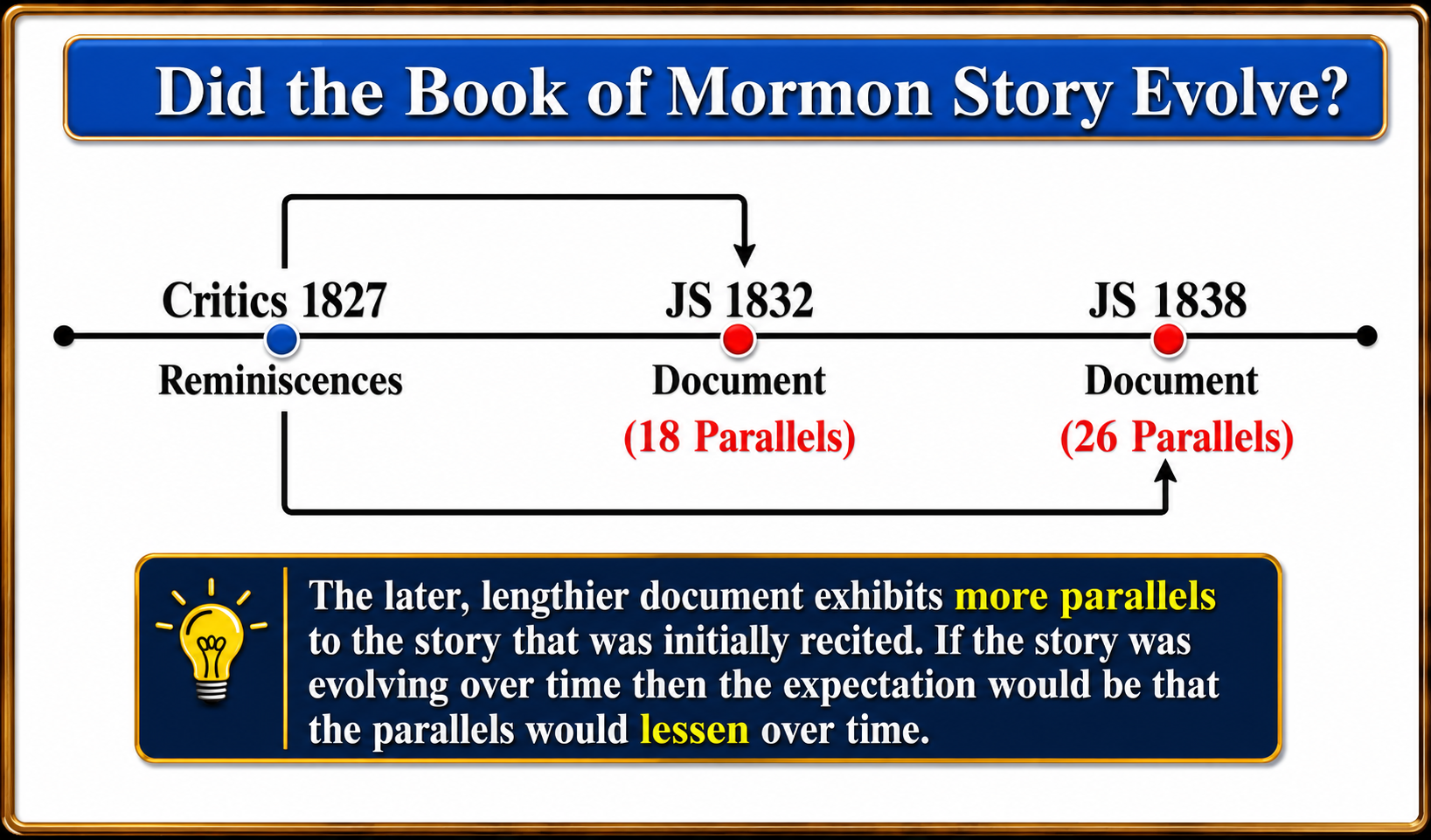
Did the Book of Mormon story evolve? This chart here will help to demonstrate that Joseph Smith’s storyline did not evolve.
This chart here shows you that during this particular year of 1827, we have all of these reminiscences — eleven in all. What I did was I compared those particular reminiscences with JS-1832, and there’s 18 parallels.
And then I did the same exact thing with JS-1838, but there are 26 parallels at that point. So, that tells us that there is something going on as far as revision goes.
If you have a storyline, and it’s being revised over time, you would expect to see less parallels over that period of time – because it would be changing.
But we have just the opposite with this particular circumstance.
And so this is one indication that the storyline is not evolving because we have written information available to us and more matches to the verbal information is found.
Understanding the Limits of JS-1832
The final point that I would like to make in relation to the Book of Mormon storyline is that it is necessary for any person to obtain an accurate understanding of a document before they can draw legitimate conclusions from it.
The prophet’s 1832 history provides us with a prime example of the importance of this principle. This document is the earliest known cohesive account of the coming forth of the Nephite scripture produced by Joseph Smith.
Some critics may think that since it is the earliest document, then any story elements that are not found within it, but which turn up in later narrations, must represent an expansion or an evolution of the storyline.
But in this case, they would be dead wrong.
Using the Critics’ Claims Against Them
What I decided to do in this particular case was take the 1832 history and break it down into its elements. There’s approximately 90 of those elements.
The critics say that what Joseph Smith did was, he evolved his story over time. So what I wanted to do was see, first of all, how complete is that document.
I went and looked at all of the non-LDS sources that I could find to determine how many elements of the story were not in the 1832 document, but which were floating around the community.
I’ve got that paper up here, and it would take a very, very long time to read. It’s 24 pages long, but it ends up that the 1832 document is 50% incomplete.
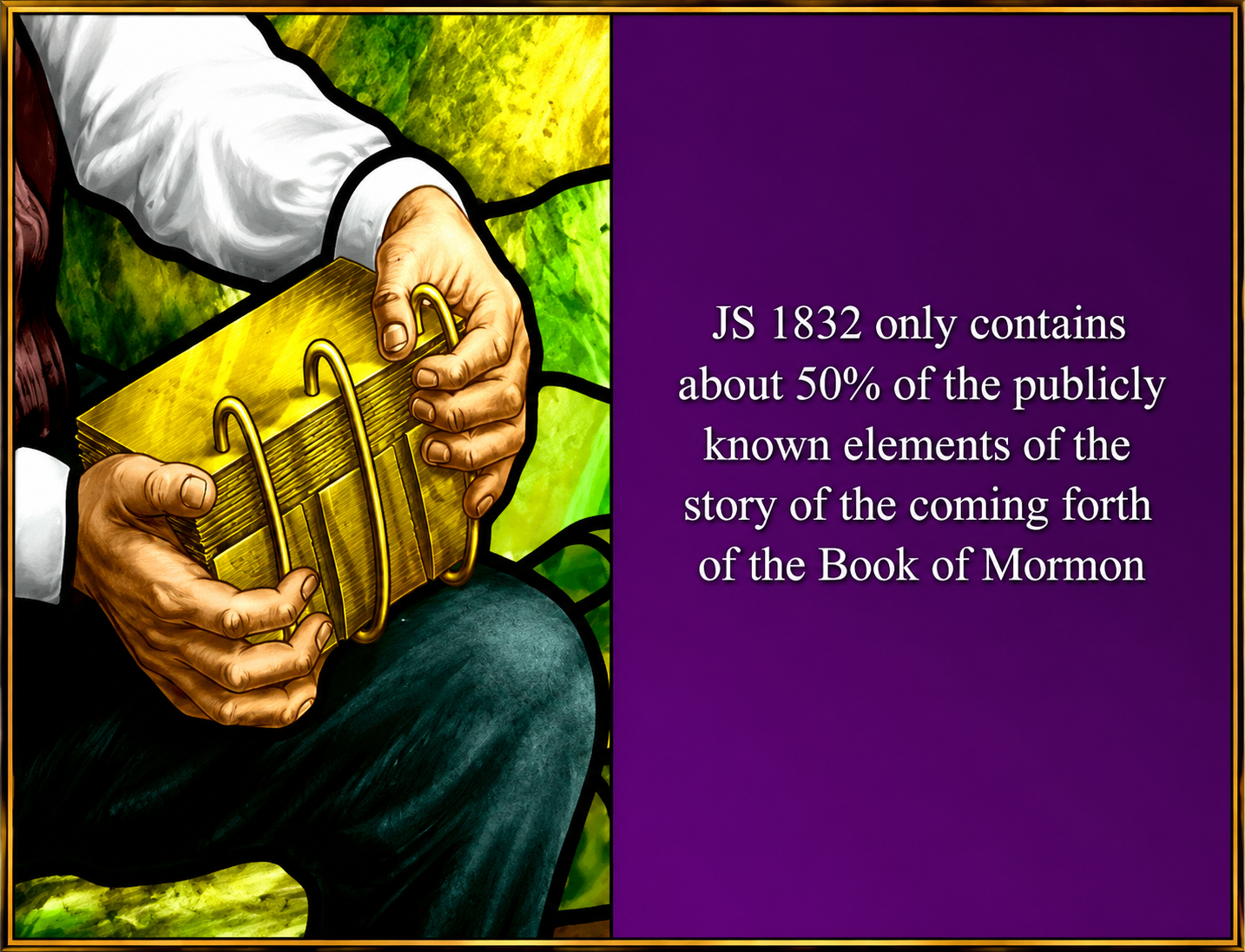
That’s a lot of information.
And when you go through this particular paper that I’ve done, what I’ve done in addition is I’ve said, “Okay, what about those elements that are not included by Joseph Smith in the 1832 document? Are they included by him and other members of the Church in subsequent histories?”
And the answer is yes.
And so I’ve done an analysis to show that every single one of them that are not in 1832 are in histories by Latter-day Saints at later times.
JS-1832 is Not a Complete Narration
That tells us that those are integral parts of the story. But more than anything else, it tells us that the document itself, JS-1832, cannot be looked upon as being a complete narration of the story.
And so you have to consider that when you’re talking about the evolution of the storyline.
Of course, anti-Mormons want to say, “Well, we’re going to look at 1832, and anything that’s subsequent to it that we don’t see in 1832 must be a revision.”
And so, I want to point out to them that that is not the case.
In fact, we’ll be dealing with that with the First Vision. 8
Recommended Research on Moroni and Revision Claims
But before we do, I would like to point out that there’s two articles that I think are quite excellent that deal with the idea of Joseph Smith’s supposed revision with the Book of Mormon story.
And that is one by Larry Morris — that’s in the FARMS Review — and one by Mark Ashurst-McGee that’s in Mormon Historical Studies.
And what they do is deal with the Moroni story. I think that they are well worth looking into for anybody who’s interested. 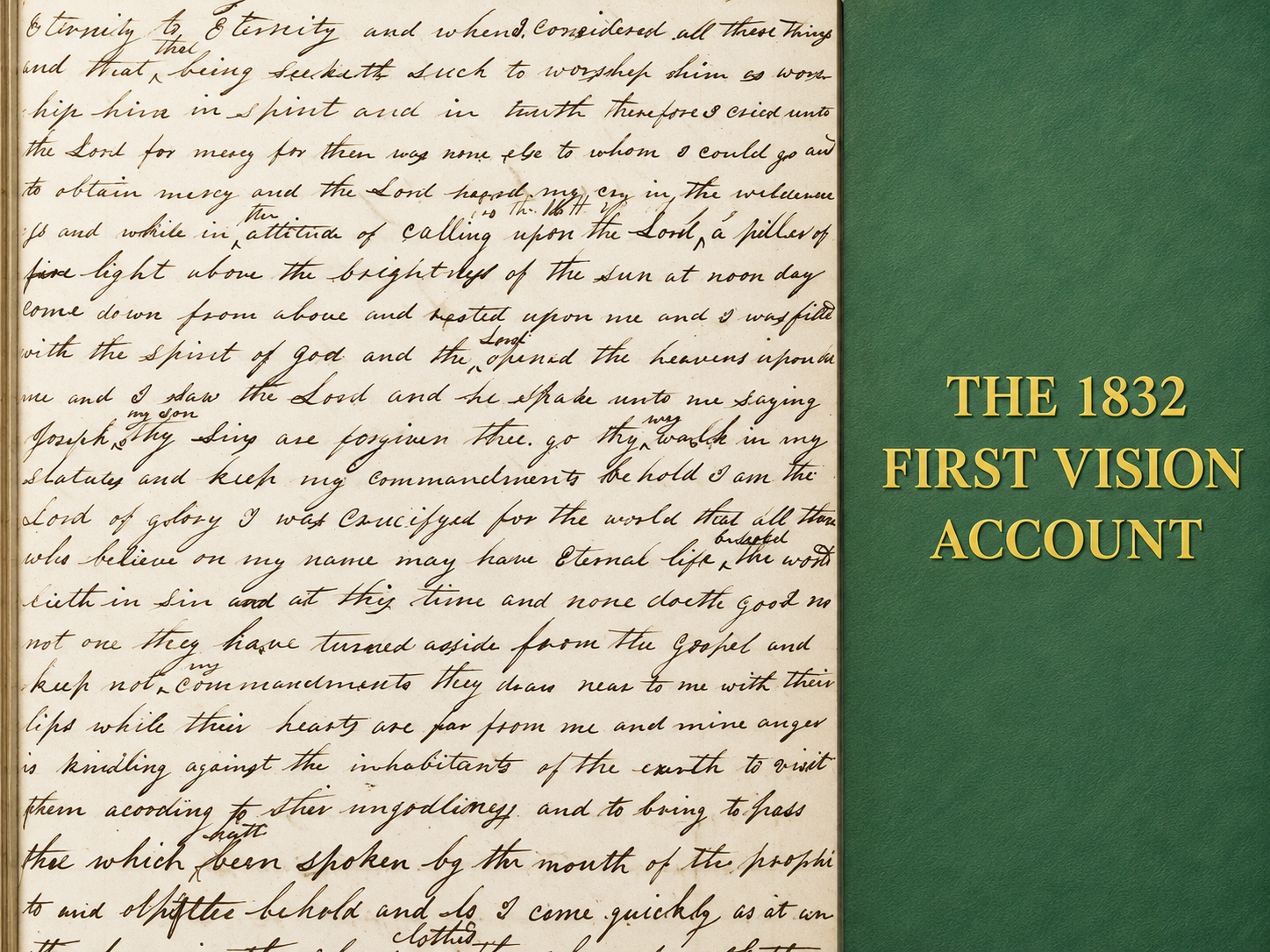
Introducing the First Vision Discussion
So, let’s move on now to some information about the First Vision.
What you see on the screen, this is JS-1832. That is Joseph Smith’s first time (that we know of) that he has told the First Vision story in a formal manner.
And it is the only one where he has written it himself.
So what you’re seeing here on screen is Joseph Smith’s handwriting. And if you look at the very bottom there, it ends with the words of Christ talking to him during the First Vision.
JS-1832, as stated before, is only about 50% complete when it comes to the information that has to do with the Book of Mormon. Well, that has some implication for the First Vision material itself.
I have done a preliminary analysis.
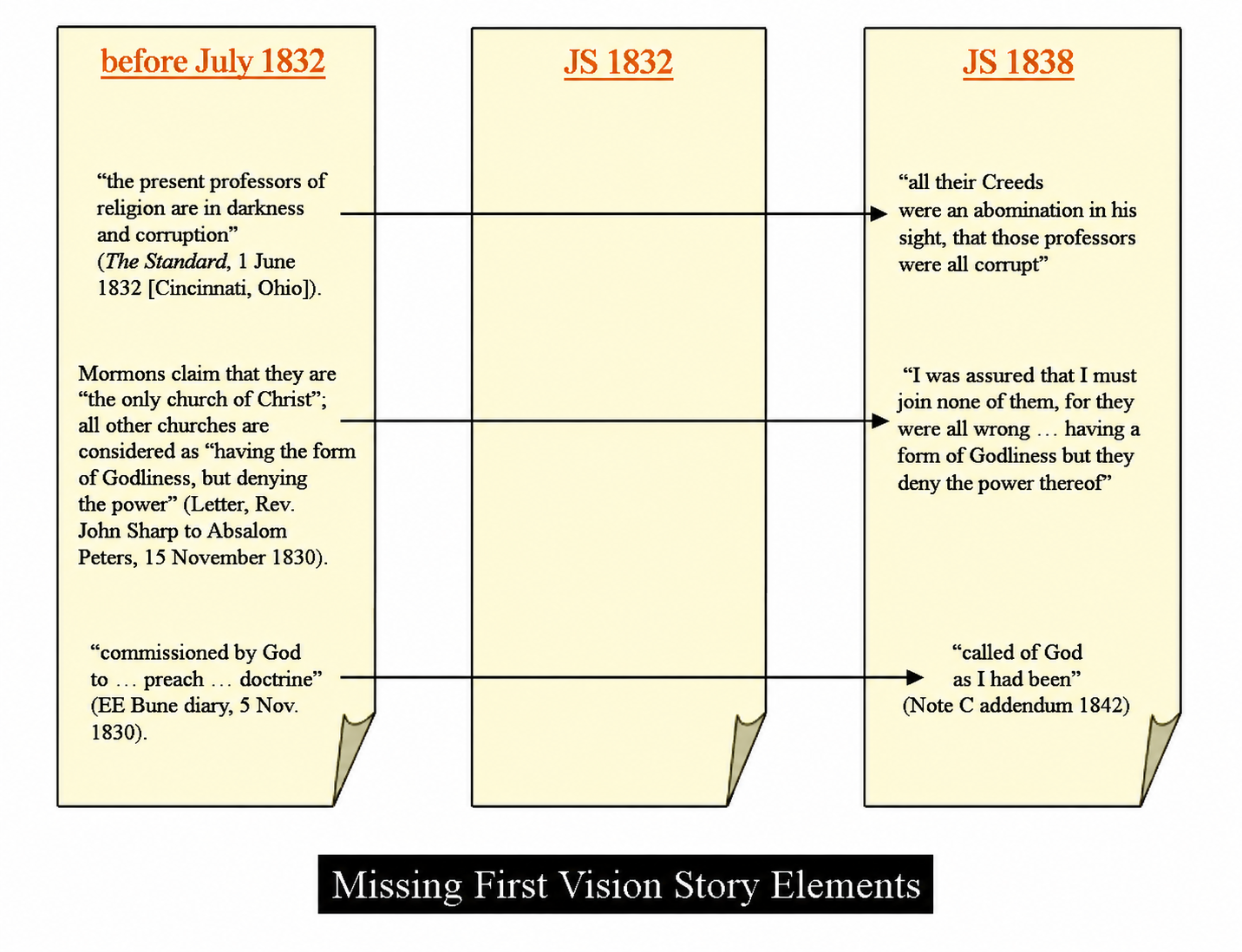
In fact, I can just show you one slide here. There’s a preliminary analysis. I just scanned over some documents to find that there are indeed pieces of the First Vision story that are not included in JS-1832 that were known among the non-LDS community beforehand and which show up in JS-1838.
And so they are integral parts of the story.
But it tells us — just these three little items — they tell us that the information on the First Vision in JS-1832 is not complete. But we’re going to get into much more of that.
Let’s go here to this next slide.
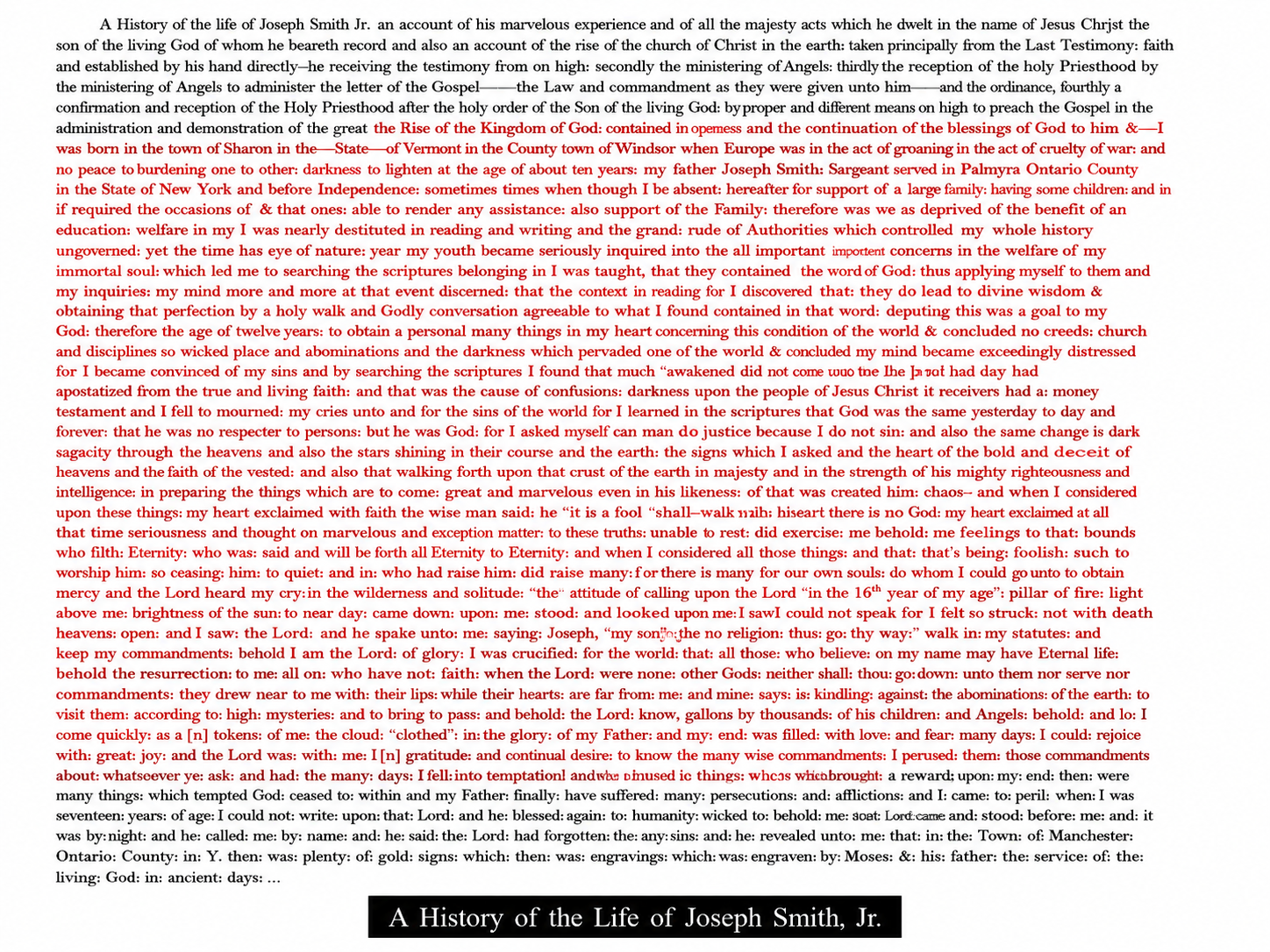
Why Joseph Smith Wrote the First Vision Himself
I want you to see this pattern. The red text represents Joseph Smith’s own handwriting.
First of all, at the top we have the scribe Frederick G. Williams. He barely wrote down a paragraph worth of material before he was replaced by the prophet.
This is a very curious fact, especially because right after Joseph Smith finished with the First Vision material, Brother Williams took over again.
This pattern seems to be an indication that the prophet wanted to write down the First Vision story himself.
And so the next question becomes why?
A possible answer to this question presents itself when one considers what happened to Joseph Smith when he tried to share the First Vision story for the first time on an informal verbal basis.
We read in the 1838 history of the Church that when the prophet first started telling others about his theophany, he ran into an immediate snag, and it was a particularly perplexing one.
His story was not only treated with great contempt, but Joseph was told that the experience was all of the devil.
Biblical Frameworks in JS-1832
I believe that Joseph Smith was trying in his initial written account of the First Vision to find a way to counteract these very negative reactions.
And here’s my evidence.
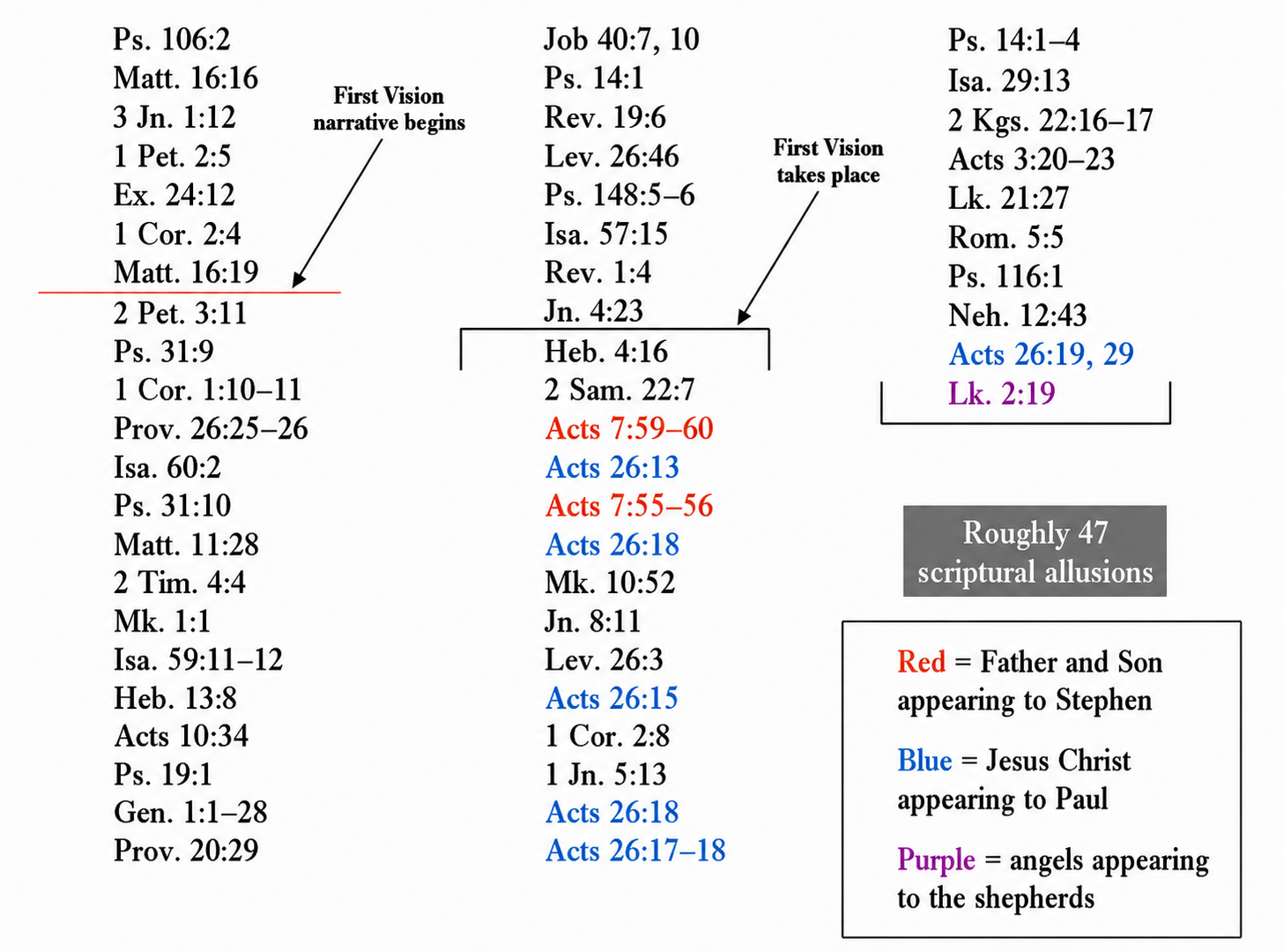
This slide shows that the JS-1832 First Vision recital is built over a continuous framework of biblical passages — roughly 47 in all. They span the entire Bible from Genesis to Revelation.
It appears that Joseph Smith was attempting to bolster the chances of his story being accepted by the world by couching it in language that would resonate in a positive manner with the masses.
Joseph Drew Specific Parallels to Help Listeners Understand
But look more closely at this slide. In the area where the actual theophany takes place, which is between the brackets, you will notice that Joseph Smith has incorporated three very relevant Bible stories into the telling of his tale.
Three stories that have to do with the appearance of heavenly beings.
- The first is the story of the angels who visited the shepherds amidst a heavenly light and announced the coming of the Christ.
- The second has to do with the appearance of the Savior to the apostle Paul when the light shone around him.
- And the third is about the apostle Stephen seeing both the Father and the Son.
Comparing Joseph Smith to Paul
But before we move on to the next slide, I will remind you what the prophet said about the rejection he experienced when he first announced his vision.
He said, “I felt like the apostle Paul because they wouldn’t believe my vision either.”
And so when Joseph Smith incorporates Acts 26 into his framework, the parallels are so exacting that when Paul speaks in his text in Acts 26, Joseph speaks in his text.
When Jesus addresses Paul in the Bible passage, Jesus addresses Joseph in JS-1832, and then it switches back again.
It is a very, very exacting set of parallels.
Psalm 31 and the Personal Nature of the Account
But this is what really caught my attention.
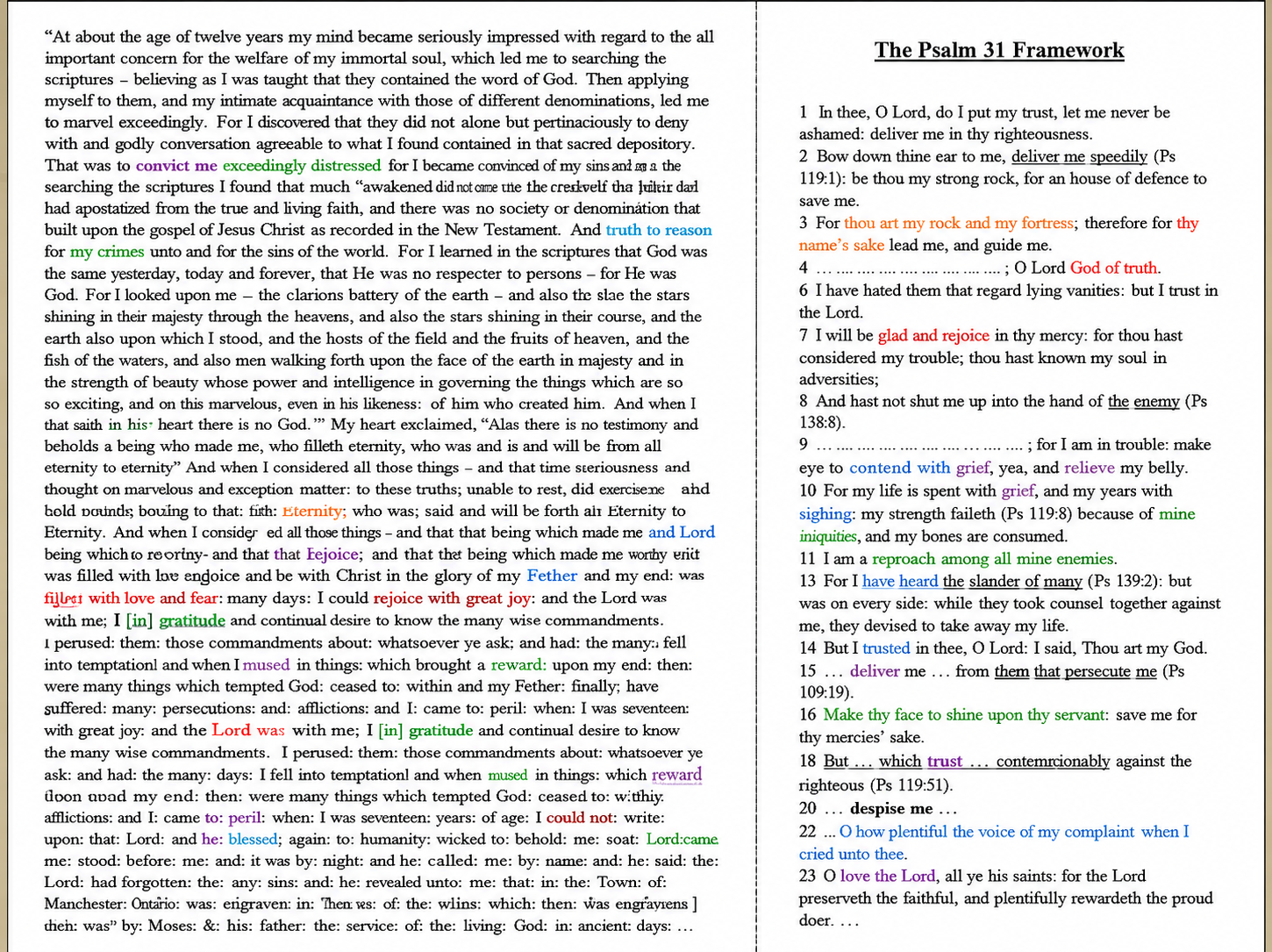
This is Psalm 31. On the left-hand side is the text of JS-1832.
It appears that Joseph Smith utilized a large-scale framework of Psalm 31. The parallels in here are very exacting.
I’ve also been able to see in this that there are some elements of Psalm 31 that he incorporated into JS-1838.
Psalm 31 as a Vehicle for Joseph to Tell His Story
Psalm 31 is a deeply personal psalm. If you read it, you can see that there is a lot of heartfelt dialogue going on.
That is something that people have noticed about JS-1832. Joseph Smith’s 1832 account of the First Vision is very personal.
But this next slide shows us that there’s much, much, much more to this particular document.
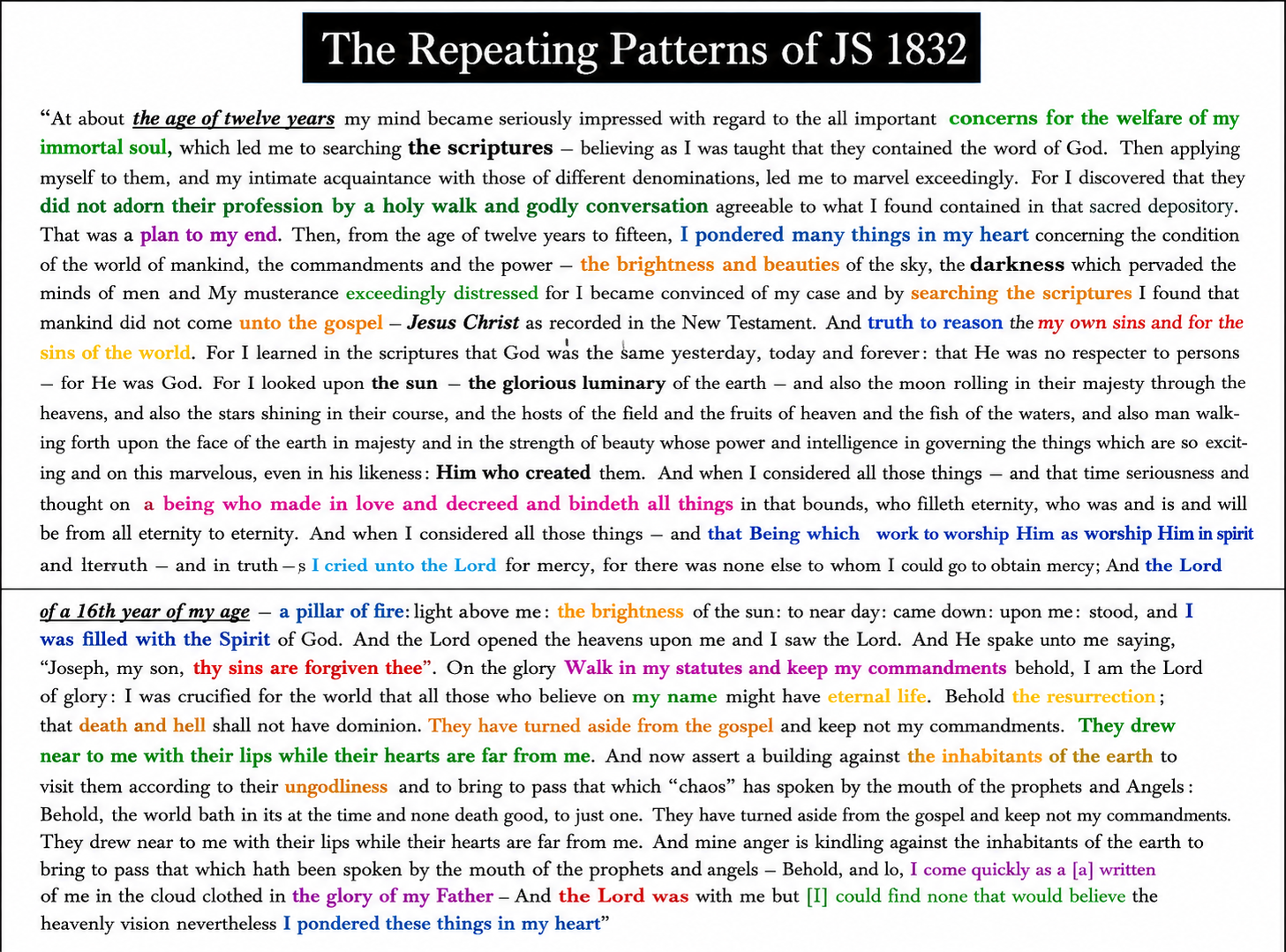
This is a document that’s created by Joseph Smith when he is 26 years old.
If you look at the top of the page, you will see a set of props and a set of themes. The dividing line that goes through that slide shows you the place where he stops and prays.
All of the parallels underneath are an exact match.
Joseph Smith has constructed this document very, very, very carefully. This is not a retelling of a story. This is a very complex document.
I don’t think I have seen it all yet. These are things I have seen in the last two weeks. I have seen a few more things since. I am coming to the conclusion that this document needs to be studied a lot more. A lot more.
The reason why it didn’t become published is very interesting to me. In fact, the whole nature of the document — I have a theory which I will work on. But this document is so extremely interesting because it’s so complex. Joseph Smith is trying to do something very deliberate, and I think that it calls for much further study.
Opposites and Contrasts in the Narrative
Here is another set of parallels. These are opposites.
In this particular set, we learn what happens to Joseph Smith before and after. I’ll just read off what it says.
- The world’s in darkness, and then Joseph is surrounded by light.
- Joseph’s mind was exceedingly distressed, but afterwards he’s filled with love.
- Some people said there was no God, and Joseph saw Him.
- When Joseph saw the Lord Himself, mankind was not coming to the Lord, but the Lord was with Joseph afterward.
- Joseph felt grief before, but he felt joy after.
- Joseph had belief before, but afterward he could find none who would believe.
As you can tell by now, this is an intricate text, and again, I would say that it calls for further study.
The Presence of God the Father in JS-1832
This brings us to the most frequent anti-Mormon criticism about JS-1832. That God the Father is obviously not mentioned as making an appearance to Joseph Smith in this First Vision account.
I would like to suggest, however, that all this time we as Latter-day Saints have not recognized that God the Father’s appearance is in fact referred to right in this document.
But all this time, we’ve been looking in the wrong place.
In the introductory remarks of JS-1832, Joseph Smith outlined precisely how he was about to proceed in the narration of his history.
The Testimony From on High
He mentioned that in the very first incident associated with his marvelous experience in the Restoration, he received “the testimony from on high”.
Because of the formatting of the introductory paragraph and the structure of the text which follows it, it can be concluded with a marked degree of certainty that this testimony was connected with the First Vision.
The question to ask then is what was “the testimony from on high”? Joseph Smith answers this question in another one of his recitals, which is November of 1835. There he states that one of the two personages who appeared to him testified that Jesus Christ was the Son of God.
In JS-1838 (which is the First Vision narrative now published in the Pearl of Great Price) 9 we learn that one of the personages testified to Joseph Smith using the following words: “This is my beloved Son.”
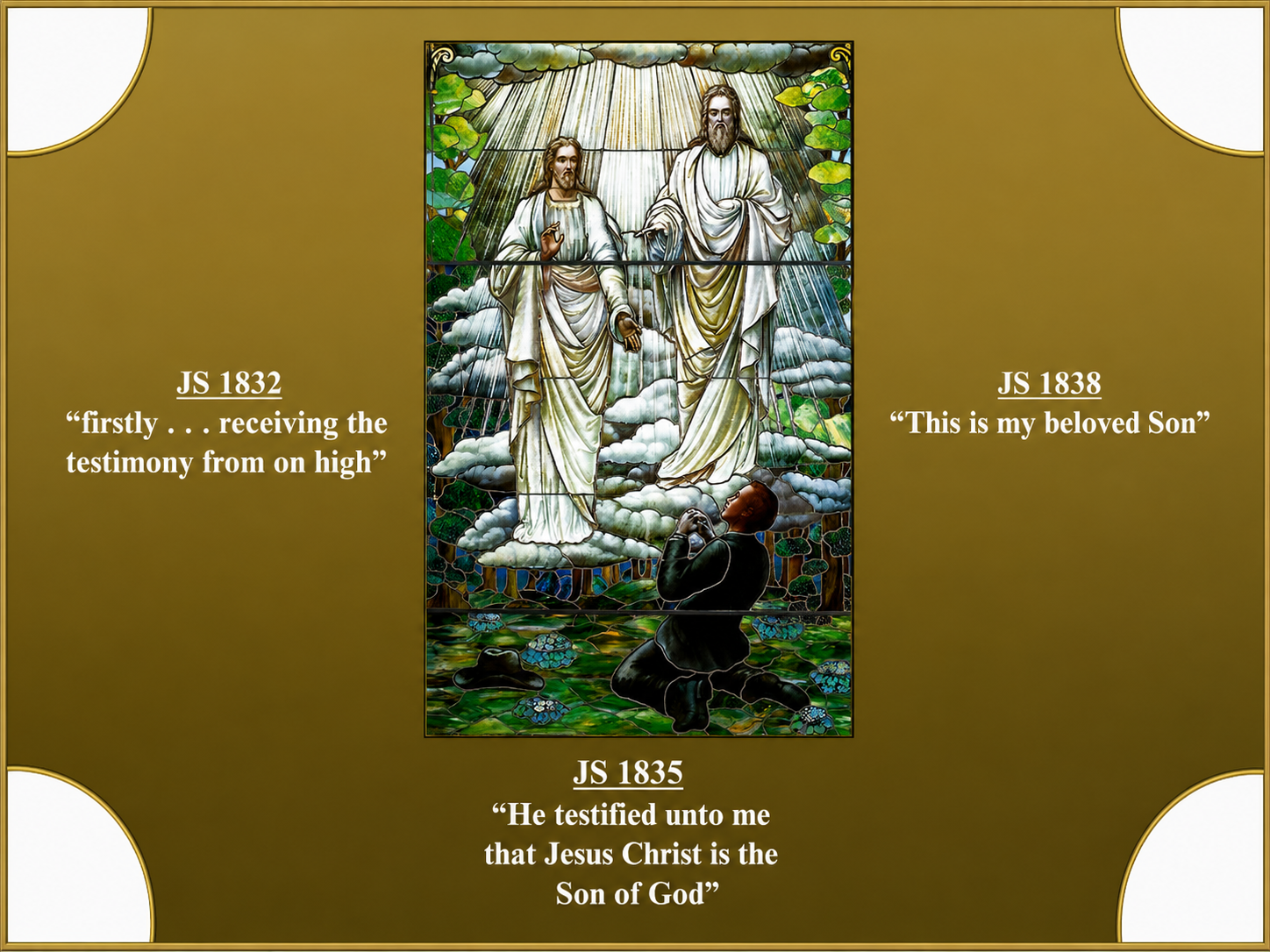
We may comfortably conclude from this documentary evidence that the testimony from on high of JS-1832 is equivalent to the phrase spoken by God the Father in JS-1838.
Therefore, we may safely say that when Joseph Smith wrote the 1832 account of the First Vision, the appearance of God the Father was definitely in his mind because he obliquely refers to it.
It seems that he did not make an explicit mention of this part of the story simply because of what I have shown you before.
He had chosen to use the Apostle Paul’s experience as the main framework for that portion of his narrative – and Paul only saw Jesus Christ.
Responding to Revisionism Claims
I would now like to offer some brief insights on a few other anti-Mormon arguments that are commonly used against the First Vision, specifically those that are connected with accusations of revisionism. 1
The first anti-Mormon claim that I would like to draw your attention to is what I call a “real whopper”.
Revisionism Claim: Joseph Joined a Church After 1820
It says that Joseph Smith joined not just one church after God supposedly commanded him not to in 1820. (Thus demonstrating that his meeting with the Lord never really happened.) But he joined three different churches before he formally organized the LDS faith in 1830.
The basic problem with this particular argument is that there have been no authentic documents ever produced confirming that Joseph Smith actually became an acknowledged member of either the Baptist, the Methodist, or the Presbyterian denominations.
Every one of the claims of joining other faiths is made extremely late in the historical record.
But I have gathered together a few very early documents that say just the opposite. I’ll just read through a few of them briefly.
Here it is.
- In November 1830, four LDS men from New York teach that at the time the angel appeared to Joseph Smith (September 1823). He made no pretensions to religion of any kind.
- 1831 — this is February — the editor of the Palmyra newspaper claims that he had been credibly informed and is quite certain that the prophet never made any serious pretensions to religion until the Book of Mormon.
- 1832, March. A couple of young Mormon men teach the citizens in the courthouse:
“Joseph Smith, who was then an inhabitant of the state of New York, town of Manchester, having repented of his sins, but not attached himself to any party of Christians owing to the numerous divisions among them, and being in doubt what his duty was, he had recourse to prayer.”
(By the way, that particular document has First Vision elements in it before JS-1832 is created. And I don’t have time to deal with that, but I want to make you aware of it.)
Revisionism Through Memory and Retelling
That happens to be a really good example of somebody who has gone ahead and revised. They have taken elements of the First Vision story and elements of the coming forth of the Book of Mormon story.
In that particular article, they melded them together, and they admitted how it happened too.
They said that they were talking from memory and they weren’t quite sure.
And so when you’re dealing with the accusations of revisionism, you want to be very careful about understanding the documents that people are using to claim revisionism. 1
The ‘Angel’ Argument
Here is another one of the little irksome arguments that the prophet is having used against his First Vision story.
The argument goes that Joseph Smith initially said that his First Vision visitants were angels, and they use this particular document as the evidence.
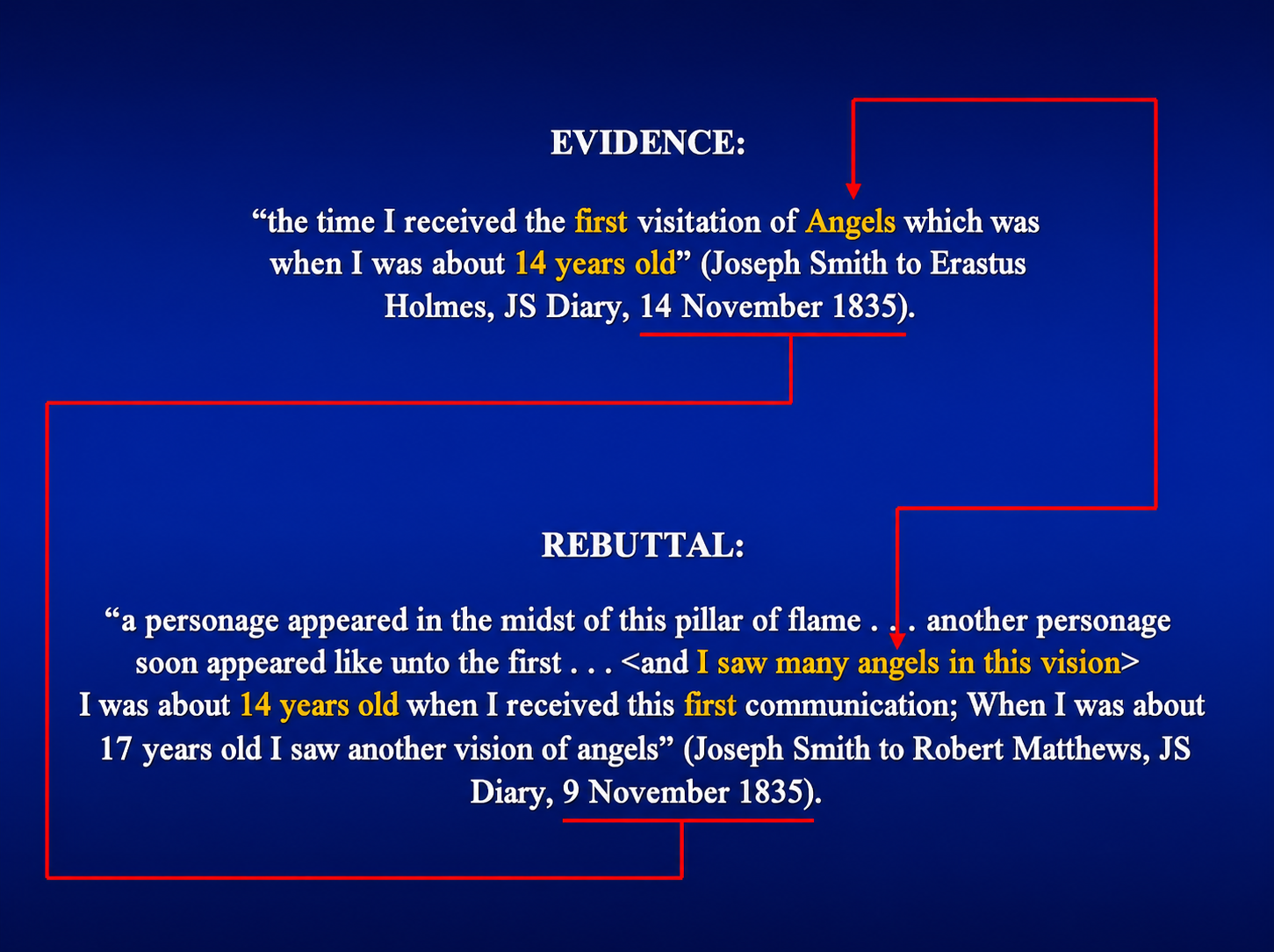
Here you’ve got the diary, 14th of November 1835. It says,
“The time I received the first visitation of angels, which was when I was about 14 years old.”
And people say, “Well look, he’s saying that his visitation was of angels when he was 14 years old,” and they try to use that against Joseph Smith.
But only five days previous in his same diary — if people would just read the book — they would see that Joseph Smith is giving us a really interesting insight into his First Vision experience.
He says,
“When I was about 14 years old, I had a visitation of two personages and I saw many angels.”
So when Joseph Smith says on the 14th of November, “My first visitation of angels was when I was 14 years old,” he’s not kidding.
He saw many angels the first time in the Sacred Grove. Moroni is not the first angel that Joseph Smith sees.
Early References to the First Vision
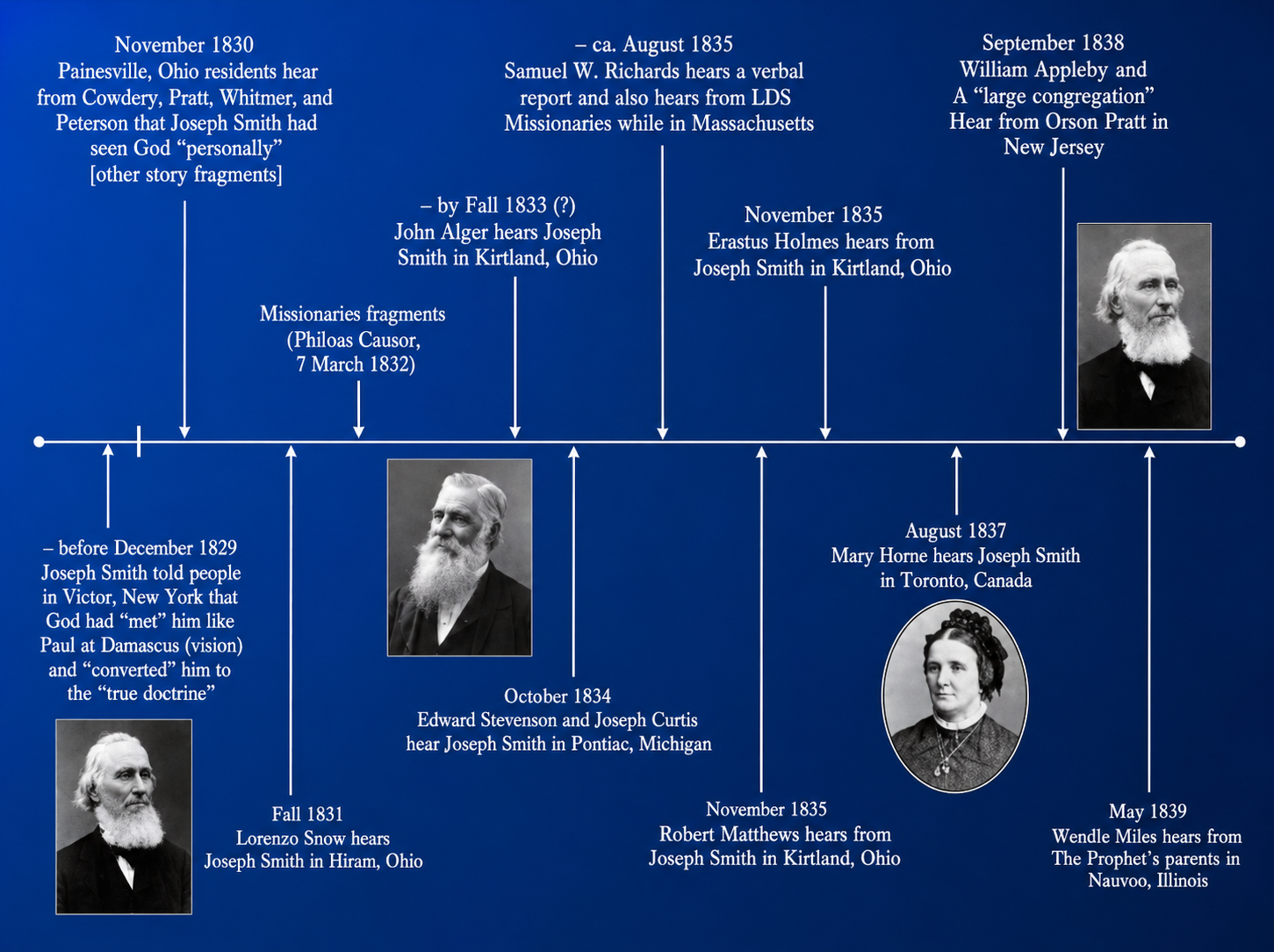
The next argument that I would like to deal with briefly has to do with the idea that Joseph Smith was making up the First Vision story throughout the 1830s, and that’s why nobody hears about it in public either among members of the Church or among the general populace.
This particular slide argues pretty persuasively otherwise.
In fact, if you look at the far left-hand side of the slide, you’ll see that in approximately 1829, or somewhere before December of 1829, we have a possible statement by somebody whose name is Green.
And what he says is that Joseph Smith was preaching in Victor, New York, that he had been met by God. And in fact, the title that this person uses is “the Almighty.”
What he does is he is met by God and his experience is like what happened to Paul on the road to Damascus.
So there we have a connection with — this is a vision of theophany — but most important, look there at the bottom. It says that he was converted to true doctrine.
So this is an idea that’s floating around in 1829.
Now, I’ve got another instance that I am leaning heavily towards that has to do with 1829 and Joseph Smith talking about the First Vision, but I haven’t quite developed that enough to my satisfaction.
So, I’ll leave that out for now.
Edward Stevenson & Joseph Curtis
But you can see that all the way through that particular time period — this is all just 1830s — people who are anti-Mormons like to pick on Edward Stevenson.
They say, “Oh well, Edward Stevenson’s memory — oh, his reminiscence is so far gone in the very last part of the 19th century. So he’s probably just misremembering.”
I saw that in a book just published recently by somebody who has been to this conference.
But you have a second witness, and that is Joseph Curtis. He was there too.
But other than that, we have all these other people who are hearing the First Vision story being related. And these are people who are not members of the Church as well as members of the Church.
And I’ll be giving a little appeal for this information at the end of my talk. Let’s go to the next slide.
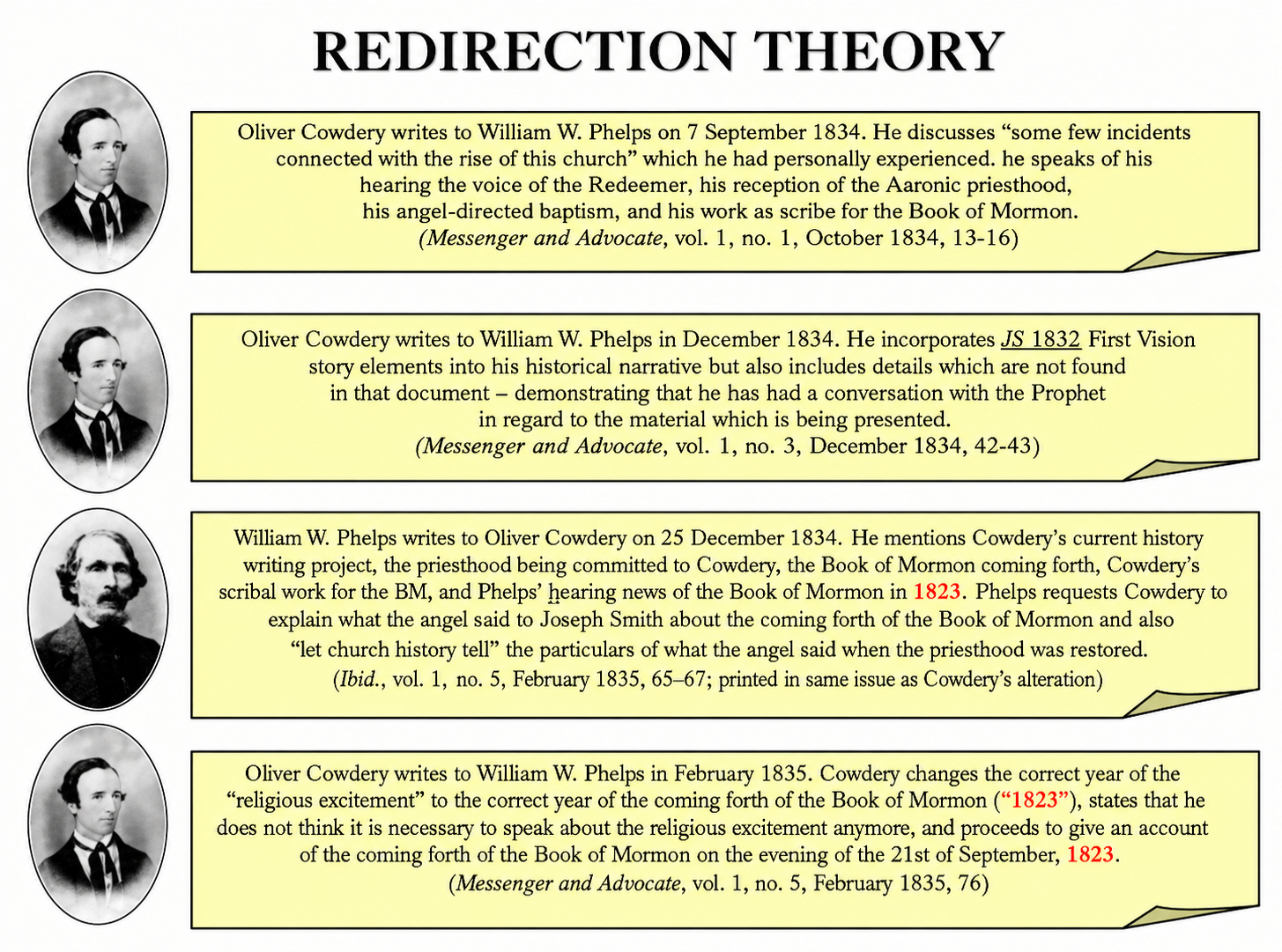
Oliver Cowdery and the “Missing” First Vision
This other claim is quite fascinating. It also has to do with a little bit of what we talked about before.
In the 1830s — we’re talking about 1834, 35, and 36 — Oliver Cowdery prints the history of the Church for the first time. That particular document has got a gaping hole in it. He does not talk about the First Vision. At least that’s what some anti-Mormons want you to believe.
But if you look at the document very carefully, you can see what Oliver Cowdery does.
He starts talking about the First Vision narrative. He starts talking about the revivals, and then something happens. This is what I want to point out with this slide.
The Redirection Theory
I’ll just summarize what’s on the slide.
Richard L. Anderson also noted this Theory
In fact, I have to mention this because Dr. Anderson told me not to. I had done an independent analysis myself, and I had come to the conclusion that Oliver Cowdery was using JS-1832 to create his history of the Church in 1834.
And I was so excited about this. I had written it up in detail. I went to Dr. Richard Anderson’s office and said, “Look at this. This is so interesting.”
“Oh yeah. I knew that back in 1969.”
And he actually did publish a few sentences on the idea that if you would look at the two, you would find a connection. But he didn’t write it up in detail.
And so I’m going to publish it in detail because I think it’s so important.
Oliver Cowdery had Source Documents
The point is that Oliver Cowdery did know the First Vision story because he says, “I was not only having the prophet as an assistant in creating my history, but I also had authentic documents at my disposal.”
In fact, he says, “They’re in my possession.”
And so the “authentic documents” that he is talking about is most probably JS-1832. When you see the parallels, they’re unmistakable.
So Oliver Cowdery knows about the First Vision. He does not include it in OCJS-1834. And I think that this is the reason why. I’ll call it the redirection theory.
What happens is he starts into the First Vision narrative. It’s very clear parallels to what Joseph Smith says later. And then he receives a letter from William W. Phelps.
William W. Phelps says, “I want to hear about the Book of Mormon story.” And he specifically mentions the year 1823.
And then lo and behold, in the next piece of the church history that’s printed, Oliver Cowdery says, “I got your letter. I don’t want to talk about the revival anymore. I’m going to change the date to 1823.”
And then he tells the Book of Mormon story. I think that that is something that should also be looked into.
Joseph Smith and the Revivals
The next thing that I would like to talk about is Joseph Smith and the revivals. This is a big thing with anti-Mormons.
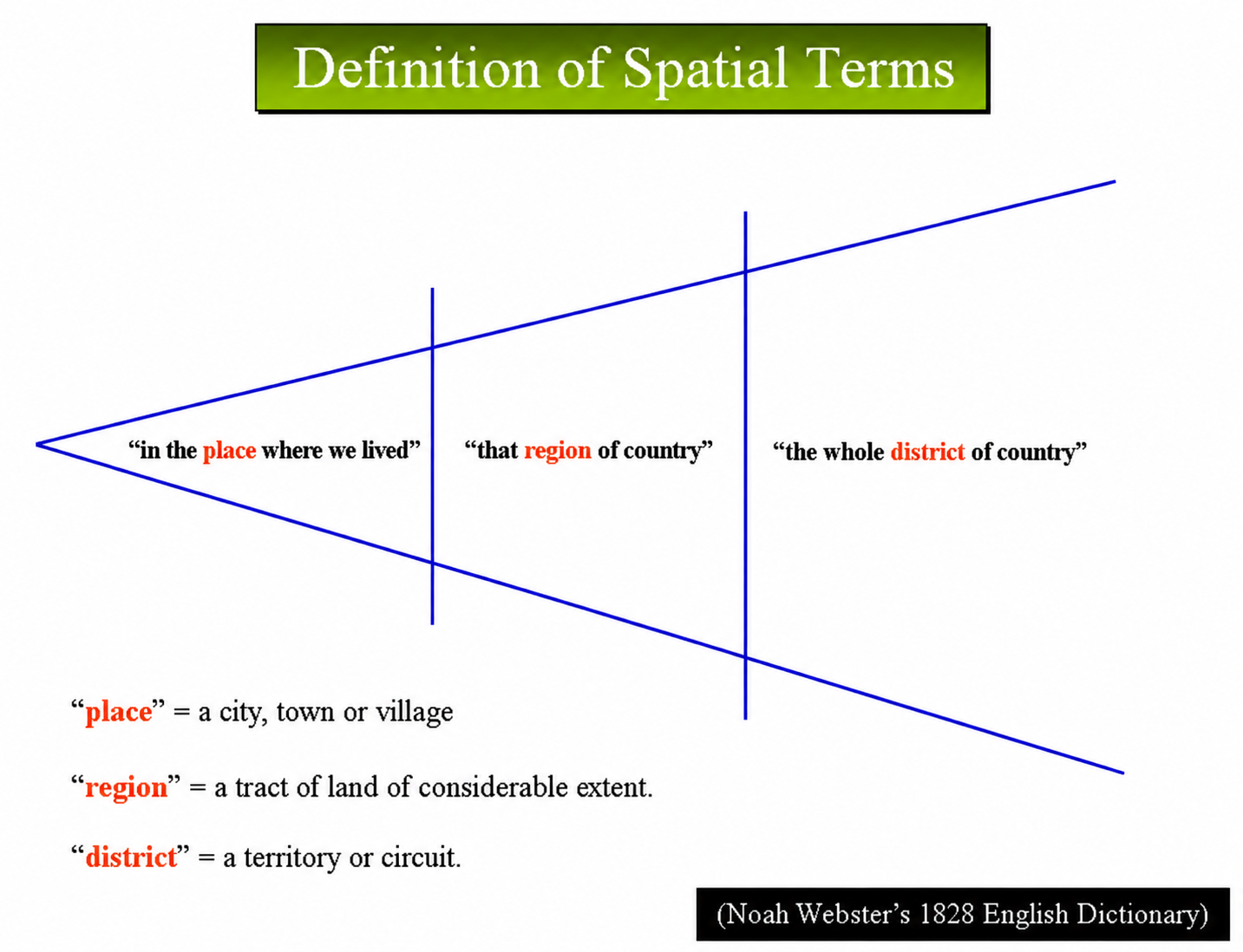
I would like to point out — and several people have done this before — but I would like to go into a little bit more detail about the spatial terms in JS-1838.
Joseph Smith says the revival activity, as far as I interpret the document, is happening in three different zones.
And that is: the place where we lived, so the general vicinity of Palmyra; that region of country; and the whole district of country.
I interpret that as three different places, and I’ll show you why I think that way.
Revival Activity in Joseph Smith’s Region
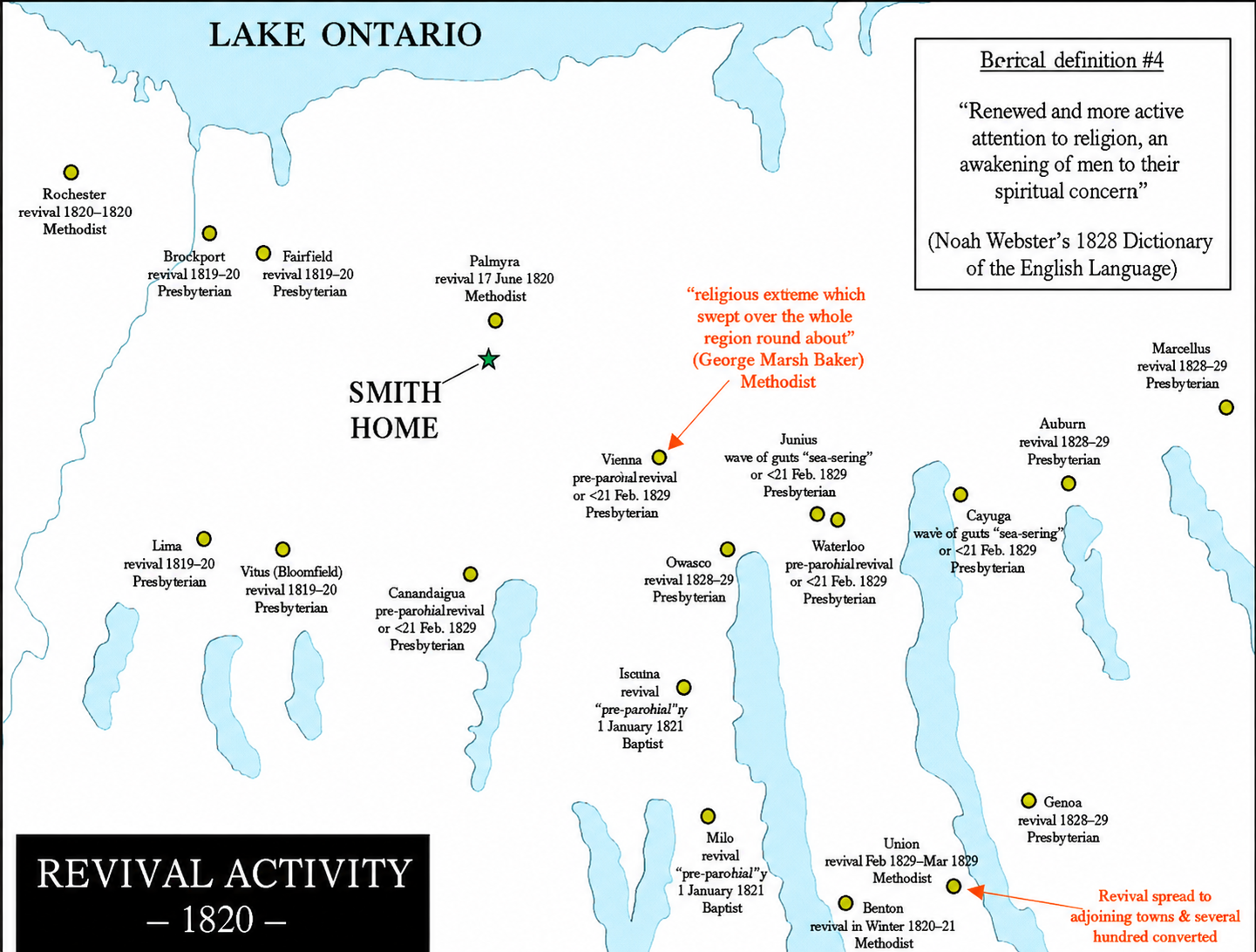
Here on this next slide, we have a whole lot of confirmed revival activity going around Joseph Smith’s area in 1819 and 1820.
An awful lot of it.
In fact, if you look down there on the bottom right-hand corner of this slide, you’ll see that it says that there are several hundred people being converted in that particular region.
This is the Finger Lakes region. And I would say that you could safely compare that to Joseph’s “region of country.”
It’s nearby. This is not a lot of space.
I think that the farthest I decided to go on this was approximately 60 miles out. In fact, Rochester is approximately 24 miles. Out there at Marcellus, it’s getting around the 60-mile range.
I didn’t include Ithaca because it ran out on the bottom of the slide.
And I’m not done yet. I’ve got a whole bunch of other revivals that I have collected that I haven’t put on there because I have not yet looked at the documents myself and confirmed them in my own mind.
But safely, as preliminary information, this is revival activity going around the Smith cabin around this general time period.
Newspaper Reports and the Third Zone
There are some other things about revivals that I want to point out, and I think that this is something that’s connected with Joseph Smith’s narrative in JS-1838.
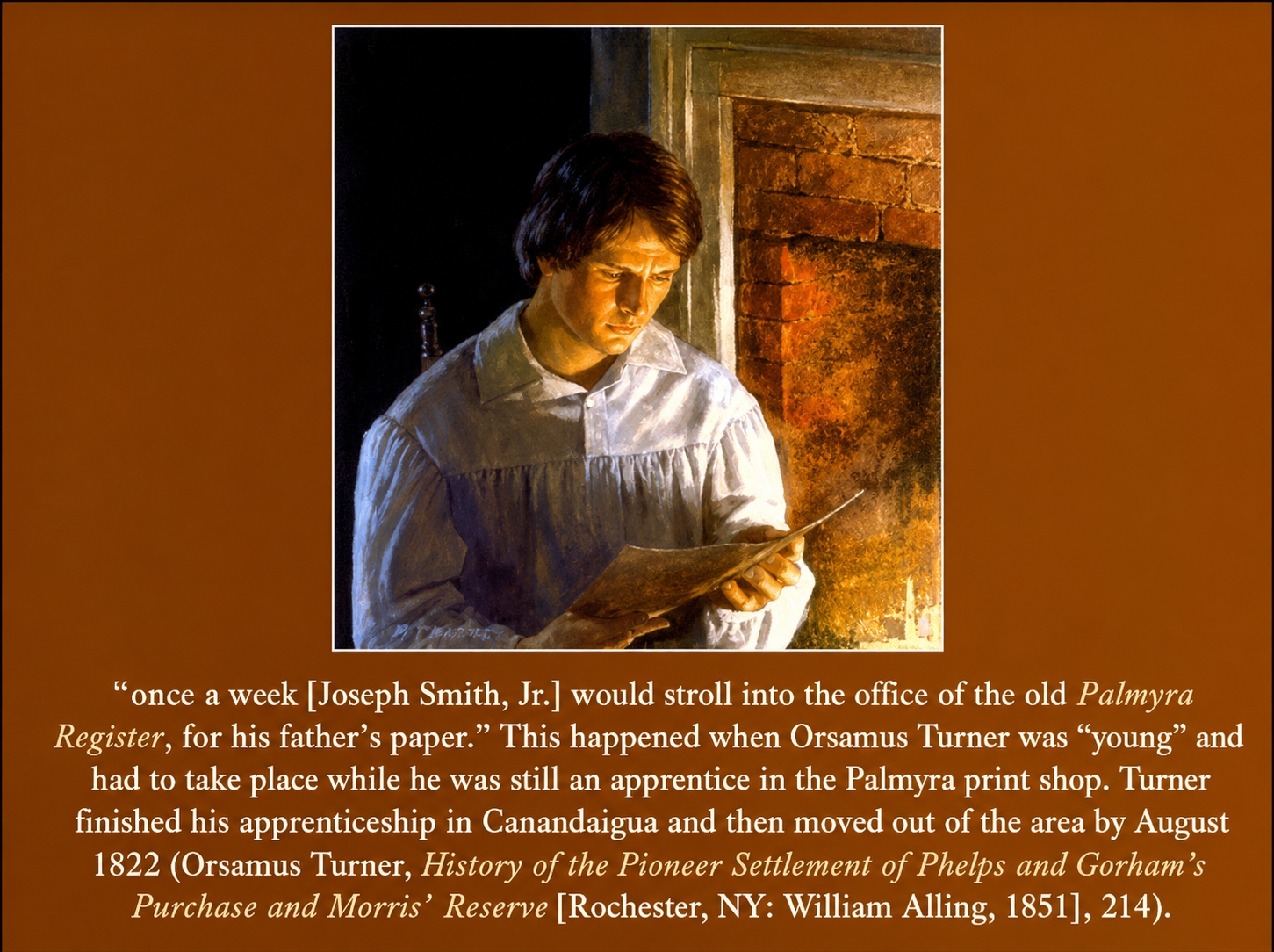
We know that Joseph Smith is reading the newspaper. He’s picking it up. In fact, I’m pretty sure he’s reading it, but he’s picking it up every single week. At least we’ve got a non-LDS eyewitness saying so.
This particular newspaper has a whole bunch of information in it during the year 1820 about revivals.
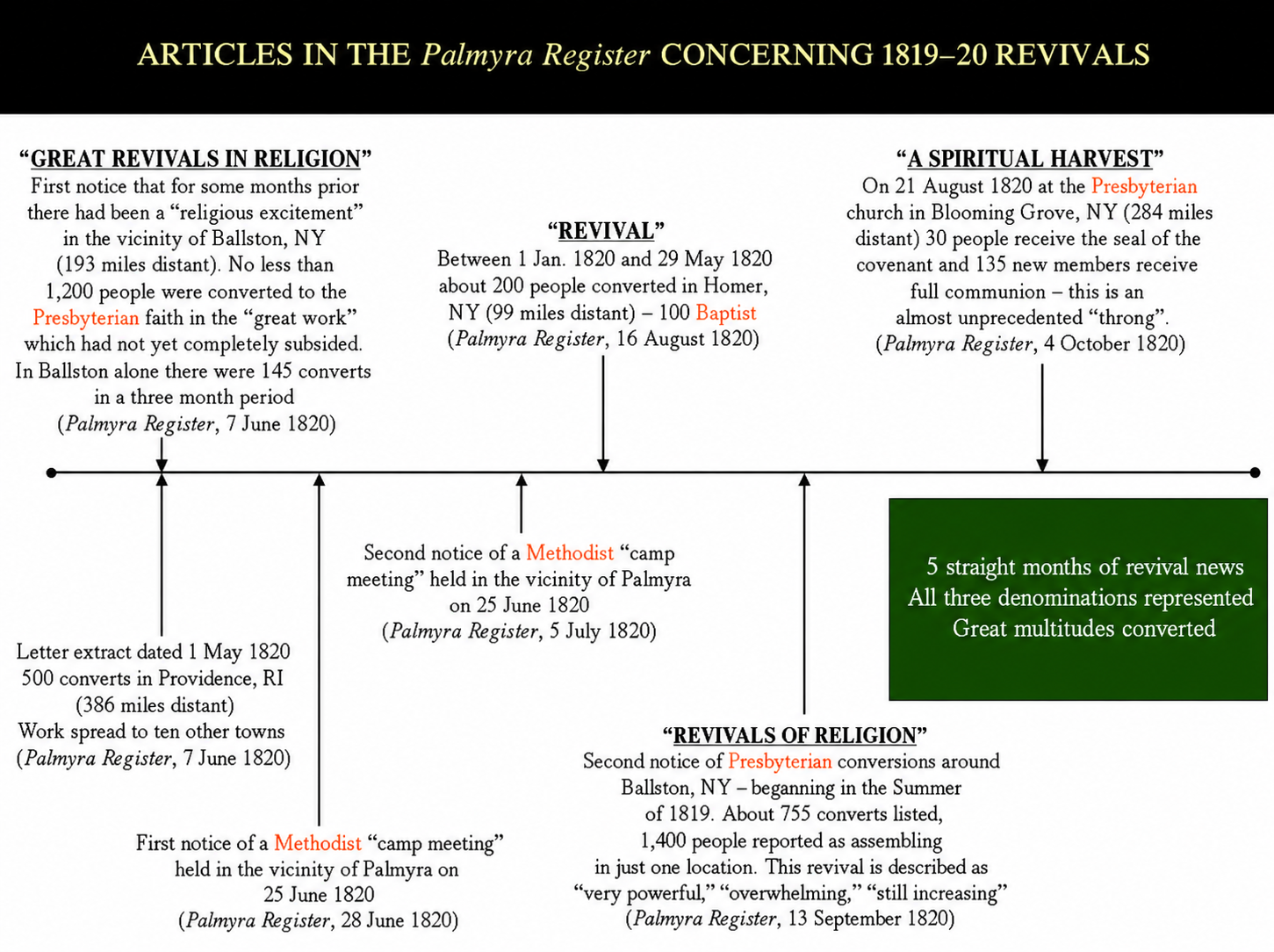
Look at where it starts. It starts in June on the left-hand side. So, we’re starting around the summertime.
But going to the end of the year, Joseph Smith’s newspaper is telling him about five straight months worth of revival information.
All three denominations mentioned by Joseph Smith in JS-1838 are being represented, and great multitudes are being converted.
This is occurring in the third zone.
So that slide that I showed you before had to do with zone number two. Zone number three has got a whole lot more conversion activity going on.
And so I would think that it would be a wise thing to consider that when Joseph Smith is talking in JS-1838 about all this revival and conversion activity, that some of it’s possibly coming from his newspaper.
It doesn’t necessarily say that he is an eyewitness to all of the activity that he is describing. And so that’s something that we should look into.
Lucy Mack Smith and Revival Activity
The last one that I’d like to talk about today has to do with another argument that is used a lot by anti-Mormons that has to do with revival activity.
Again, they try to use Lucy Mack Smith’s autobiography against him by saying,
“Look, Lucy Mack Smith says in her own autobiography that after Alvin Smith dies, there is a revival of religion in the area.”
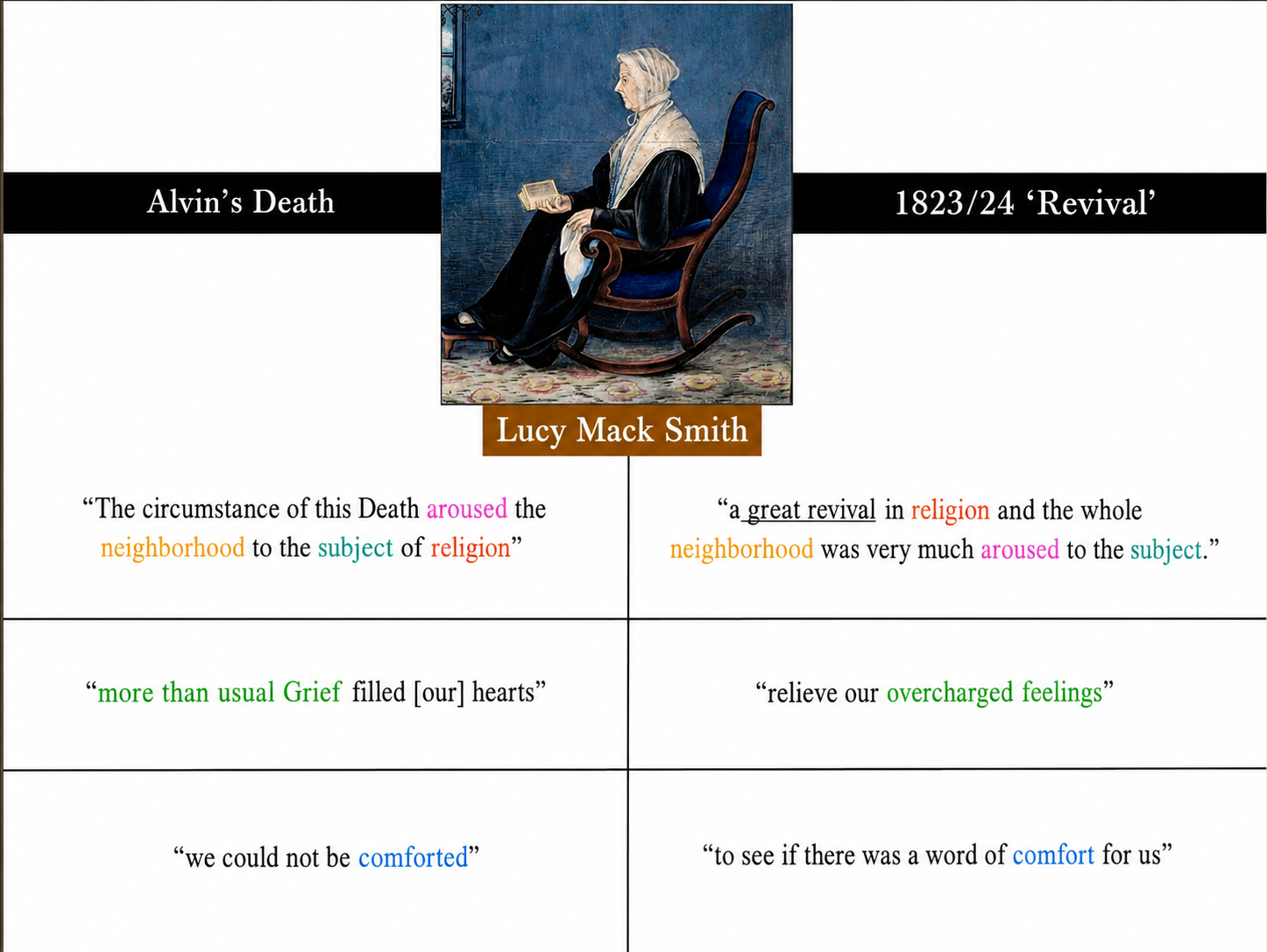
I want you to see the comparisons on this chart very carefully. On the left-hand side, you’ll see that this is the crossed-out portion of the autobiography. But look at the match. What does that tell you about this revival activity? On the left-hand side, it says that there is a direct connection between the revival of religion in that neighborhood and Alvin Smith’s death.
And there’s a whole big block of text that is marked out in that document.
So, she says that:
We had all this grief in our hearts. We went to this revival so that we could have relief for our overcharged grief or our overcharged feelings. We could not be comforted.
We went there to this revival to be comforted.
The point I want to make is that there is a definite connection in this text. I think it should be explored. I think that we should consider what it is exactly that Lucy Mack Smith is saying because this other information should cause us to say, “Wait a minute.”
Lucy Mack Smith and Church Affiliation
And that is this. What anti-Mormons want you to think is that Lucy Mack Smith said that she joined a church during this so-called revival period. And I say, where does it say that? And when did it occur?
We know from historical documents — this is verified — there is a Palmyra revival going on in 1823 and 1824. But I want to point out to you when it occurs. In fact, if you want to get into this really good, go get what George Lane said about this revival activity in Palmyra. When does he say it really got going?
It’s not in the spring of 1824. It’s December. So Lucy Mack Smith is possibly talking about something that is separate by a large amount of time.
Next question you should ask yourself is here we’ve got Lucy Mack Smith talking about this group that gets together. Well, what is this group that’s getting together in her autobiography? What was the point of the group? It was that they wanted to bring all denominations together.
Well, who was in charge of this group? One guy. And he’s not identified, and his affiliation with a religion is not identified.
And here is the other thing that you have to consider, and that is that in Lucy Mack Smith’s autobiography, she says herself that she was a baptized person, but she did not formally join herself to any denomination until when? She says right in her autobiography it was when her son Alvin attained his 22nd year. And guess when that was? 11th of February 1820.
So here we have some clues to look at.
Questions About the Timing of Revival Activity
In fact, I’m working on some of this material right now.
If we take that literally — February of 1820 — and we’re talking about revivals. There’s a paper that’s floating around the community right now that has to do with revivals. They’re trying to push the date towards summer of 1820.
But you’ve got Lucy Mack Smith with an indication that she possibly joined the church of her choice in February of 1820. Another question arises from that. And that is, “well, when in the world is the revival activity occurring that Joseph Smith is talking about in JS-1838?”
A clue seems to come from William Smith. He talks about the fact that in that particular time period the revival activity was taking place in schoolhouses and private dwellings. And my first question was why? Why isn’t it out in the woods at the Methodist campground?
The possibility is that we are talking about cold weather revivals. In fact, in this paper that’s floating around right now, it is acknowledged that revivals are going on during the wintertime, during the cold months. In fact, I have two instances that I know of where there are verified revivals going on in Palmyra in wintertime.
So, it’s a definite possibility. I am starting to wonder when exactly is the revival activity that Joseph Smith is talking about in JS-1838, even though he went into the woods in the spring of 1820.
Dating the First Vision
And I’ve got to tell you this before I stop. Because this is my goal marker boundaries:
- I’m trying to stick with revival activity at the beginning of 1820 because of reasons from the text.
But my outside boundary is different than another paper that’s floating around. Because I’m talking about what Orson Pratt said.
- Orson Pratt had access to Joseph Smith.
- Orson Pratt was the first person to publish the First Vision story.
- Orson Pratt said that the First Vision took place when Joseph Smith was 14 years and 4 months old. About that time.
That gives us a date of approximately 23rd of April 1820. So, we don’t know.
I do know that the revival activity described by Joseph Smith takes a period of time. We don’t know how much time he spent considering things. But we do know that before that midpoint. Mid-spring is 5th of May 1820. Orson Pratt points us towards around 23rd of April.
So those are the goalposts. I hope that particular piece of information could be explored also further.
There’s a lot that we still don’t know about the First Vision. In fact, I have 65 computer files on my computer right now of material. I have just been looking at it in my spare time. And seeing that there’s a lot more to this story that could and should be explored.
Final Appeal and Invitation to Study
But before I stop, I would like to make an appeal and an announcement.
An Appeal
If there is anybody who ever sees anywhere:
- in family histories,
- in journals,
- in diaries
that:
- talk about Joseph Smith reciting the First Vision
- especially if it’s during his lifetime
I would like to hear from you. Please contact me at my publisher. 10 I want to fill in the gaps.
An Announcement
I have created a 70-page timeline. It has to do with First Vision recitals from the beginning all the way up through canonization. 11 But it’s that particular early time period that I’m interested in.
There’s a man sitting right in front of me. He pointed out a tiny little piece of information that is brand new to me. He showed me that Joseph Smith is reciting the First Vision story. In Nauvoo during times that we don’t expect. And so I’m very interested in gathering more material. If you ever hear or see those things, let me know.
The final thing I’d like to say is that:
- If you want to learn more about the First Vision, I would encourage you to read.
- If you want to learn more about the coming forth of the Book of Mormon. I would encourage you to read.
On this website here, josephsmithstudies.com, I have provided bibliographies. (No commentary, because I’m sure you couldn’t care less what I think.) I have pointed out and connected a whole lot of material. They are
- linked articles
- that will take you straight to material that you can read. 12
An Invitation to Study
I would encourage you to continue to study the Restoration in detail. And I thank you for your time today.
