Carl Trueman discusses the concepts of cultural amnesia, expressive individualism, and their contributions to the sexual revolution. He explores how modern society’s emphasis on personal identity and fulfillment has led to a shift in moral and cultural norms, particularly regarding sexuality. Trueman critiques this evolution, highlighting the consequences of disconnecting from historical and communal values.
This talk was given at the 2021 FAIR Conference on August 5, 2021.

Carl Trueman is a distinguished scholar with degrees from Cambridge and Aberdeen, a professor at Grove City College, and a prolific author on culture, identity, and religious thought.
Transcript
Carl Trueman
Introduction
That’s great. It’s great to be here. I’d like to thank a number of people. Cassandra for suggesting my name as a speaker. Scott and Sheri for being wonderful chauffeurs and also introducing me so kindly. Then, DeLayna for all of the logistics, right down to getting me to the appropriate couch behind the curtains just a few moments ago.
The Speed of The Sexual Revolution
My topic today is to talk about my book. It sounds like a shameless commercial plug. My topic is to talk really on the issues that I raise in the book I’ve written recently. If you listen to my lecture, it saves you having to buy and to read the book, of course. The book is entitled simply The Rise and Triumph of the Modern Self: Expressive Individualism, Cultural Amnesia, and the Road to Sexual Revolution.
The driving force or the intention behind this book was to try to get at the question of why it is that particularly the sexual revolution seems to have happened so fast. It’s hard to believe that President Obama had to distance himself from gay marriage in order to get elected. It’s hard to believe that Obergefell v. Hodges, the Supreme Court case that found gay marriage protected by the constitution, was only in 2015. Every week seems to bring an acceleration of the sexual revolution and I think for many conservative people, particularly for many religiously conservative people, it’s very disconcerting, especially when we see our own children and our grandchildren growing up and thinking in ways that are virtually incomprehensible to us.
The speed is disconcerting. The dramatic nature of the change is disconcerting. And what I wanted to do in this book, and what I want to do more briefly in this lecture, is to try to help us understand some of the forces that have come into play in order for this to take place.
Understanding What it Means to be a Human Self
I could summarize my argument in this way. I could say that the sexual revolution, or all the debates about sexual and gender identity that we are now experiencing in our society, are functions or symptoms of a much deeper transformation in the understanding of what it means to be a human person or a human self, changes that have been a long time in the making, three, four, five, six hundred years. I start my book with Jean-Jacques Rousseau, the 18th-century Genevan philosopher.
People emailed me and said, “Why didn’t you start the Reformation? Why didn’t you start with late medieval Catholicism?” One person emailed and said, “Why didn’t you start with Eve in the garden?” To which the answer is, I didn’t want to write a hundred thousand page book. Four hundred pages is enough of a stretch without going back too far. One has to start somewhere. But I think we can see from the 18th century onwards that the world in which we now inhabit has been gaining force and gaining power. And that’s the story I want to reflect upon today.
Defining Terms
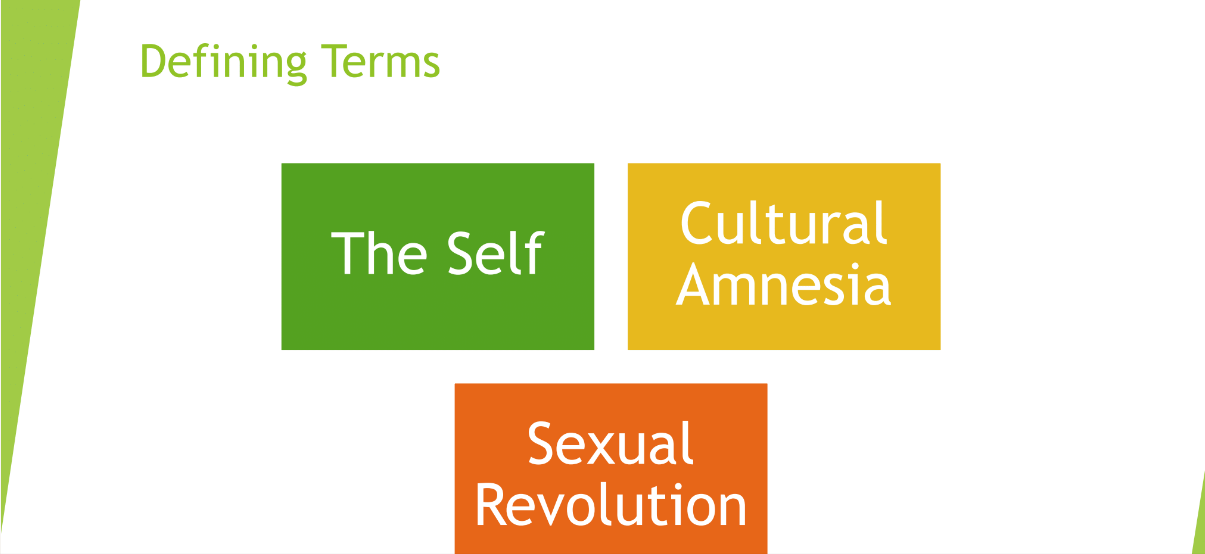
First of all though, let’s define some terms. The book title contains a number of terms, the meaning of which may not be obvious to everybody. First of all is the self. I think we all have a broad sense of the self in terms of self-consciousness. I am aware that I am not Scott Gordon. I hope he’s aware he’s not me. If he thinks he’s me, we have a word for that, we call it ‘mad’.
The idea of being a center of self-consciousness is something that’s very commonsensical to us. I’m not using the term in quite that common sense way. I want to use it more in the way that Jeff was using it in terms of worldview in the last lecture. By the way, I was very worried at points in Jeff’s lecture that he was actually going to give my lecture better than me before I gave it. We did not compare notes beforehand, so there will be some overlap.
But what I mean by self is we might say the way I understand myself in relation to others, in relation to the world around me. How I think of my identity, how I think of what it is to flourish, what I think of as the purpose of my life, particularly the purpose of my life in relation to others. So when I talk about the rise and triumph of the modern self, I’m really, you know, to use Jeff’s terminology, we might say the rise and triumph of a modern worldview, or the way of thinking about my existence relative to the existence of the world and other people. That’s the notion of self that I’m going to be using in this lecture.
Cultural Amnesia
Secondly, cultural amnesia. I’m not going to speak so much about this, but I think it’s an important, what I would call cultural pathology of which we should be aware in our current climate. Cultural amnesia, as the name implies, connects to a forgetting, but whereas when we think of amnesia in a medical sense, it’s often an involuntary forgetting, somebody’s involved in a car crash or experiences some significant physical or mental trauma and finds that their memory is completely or partially erased or inaccessible to them. We call that amnesia, and it’s something that the person is rather passive in. When I use cultural amnesia, I’m thinking about something that our culture is very active in, and that is the erasure of the past.
I think of the incident in the Old Testament, if you remember, when Ahab becomes king and one of the things that Ahab does is he brings back the old gods and somebody rebuilds Jericho. Remember, the Lord had cursed the land where Jericho was built, nothing was ever to be built there, and if anybody built on it again, they would do so at the cost of two of their children. And somebody rebuilds Jericho. I preached on that passage numerous times, and the point I make is he’s not just building a city, he’s erasing the past. He knows what he’s doing, he’s erasing the past, he’s erasing the story of Israel’s entry into the Promised Land.
The Past
We live in a world where the game of our cultural elites now is often cultural amnesia, the erasure of the past, or the complication of the past, in such a way that the past ceases to have any real positive authority over us in the present. And that, I think, according to the sociologist Philip Reeve, and I would agree with him, that’s the dominant mode of higher education today.
Higher education is iconoclastic at its core, and it’s anti-cultural in the sense that it’s trying to erase the past. We could expand that and say, you know, to take the trans issue, for example. What is the trans issue? Well, the transition from male to female is the erasure of that individual’s past. Germaine Greer, the feminist critic, says it’s the erasure of motherhood actually, that the trans issue does more damage to mothers than to anybody else—a radical feminist, not a crazy conservative like me, saying that. That’s a radical feminist. So, cultural amnesia is that general cultural attitude that tends to regard the past, we might say, as a source of oppression, not a source of wisdom, let alone liberation.
Sexual Revolution
And the third one is the sexual revolution. Here, I think a lot of religious conservatives often think that we know what that means, but I want to suggest that it’s often more radical than we give it credit for. Often, when we think of the sexual revolution, we think correctly in terms of chronology—we think of the 1960s and the massive expansion, we might say, of the range or the canon of sexual behaviors that are acceptable in wider society.
I still remember my mom when I was growing up—my mum’s not religious really in any shape or form, but she would talk about couples who were living together without being married, as living in sin. There was that idea that that wasn’t quite acceptable. And often, as religious conservatives, we can tend to think of the sexual revolution as being this increasing of the boundaries of legitimate sexual behavior and sexual expression. I want to suggest that the sexual revolution is more radical than that. The sexual revolution is not about the expanding of what is and is not acceptable; it’s about the rejection of the idea that sexual activity in itself has any intrinsic moral value.
Complete Transformation
When you think about how it plays out judicially in this country now, what is it that makes a sexual act moral or immoral? It’s not actually the act; it’s whether it takes place in the context of consent or not. Of course, consent is an extremely complicated issue to establish in law, as we now know—power relations make it very complicated. But I think when we think about the sexual revolution, we make a mistake if we think that what we’re up against is simply an expansion of legitimate sexual behaviors. What we’re actually up against is a complete transformation in how people think about sex, period. And that really means that what we’re up against is a complete transformation of how people think about what it means to be a human being. So, those are the three terms I wanted to clarify at the start.
I only started using PowerPoint 18 months ago. I always eschewed technology, and for some reason, I decided to start using PowerPoint in January 2020. We went online in March 2020 for six months at my college. It was very good that I had gained some basic skills. It’s going very well today—everything’s come out in order so far, probably because I didn’t load them up to the database.
Expressive Individualism
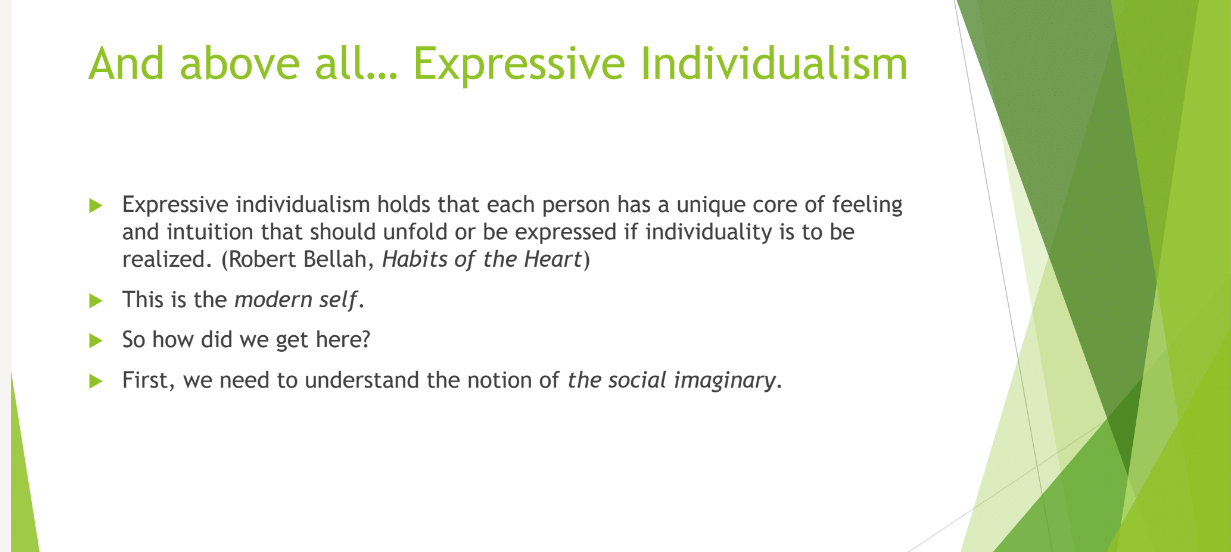
Above all, expressive individualism—Jeff has already talked about this at some length. I’m going to give you another person’s definition. It’s entirely compatible, consistent with what Jeff was saying earlier. This comes from Robert Bellah, the great philosophical sociologist. This is Robert Bellah’s definition from his book Habits of the Heart, which is where I think the term was coined. So, Robert Bellah is the first man to sort of spot this, or at least give us the terminology to talk about it.
Expressive individualism holds that each person has a unique core of feeling, an intuition that should unfold or be expressed if individuality is to be realized. That’s very much what Jeff was saying last time, and it connects very much to that term authenticity.
Authenticity
Authenticity is a relatively new word applied to the self, but again, like the Joshua tree Jeff referred to, once you’re aware it’s there, you see it everywhere. I would recommend that you look at Bruce/Caitlyn Jenner’s interview with Diane Sawyer for “60 Minutes.” I think there’s a transcript online. And when you read that interview, what’s interesting is that Jenner is saying things like, ‘you know, all my life I’ve lived a lie, finally I’m free to be myself, finally I’m liberated from the role that society made me play.’ It’s a great example of expressive individualist language, it’s a great example of the language of authenticity.
‘Finally,’ Jenner is saying, ‘I can be authentic, I no longer have to conform to standards that render me inauthentic.’ Rather like the contrast that Jeff was drawing between Greg and James. I thought, by the way, the silhouette of the guy with the long hair would be on the other side. I was sort of thrown by the image. I’m glad there was no stereotyping going on there. It’s the modern self, and this is where I’m going to sort of start. I’m not deviating from Jeff, in terms of contradicting what he said at all, but this is where I want to start looking at, ‘Okay, so where did this come from? How did we get here? Where and why did this become so dominant?’
Social Imaginary
But the first thing we need to do in this is understand what I call the social imaginary. Again, it sort of connects to what Jeff was saying about worldview in the last lecture. I’ve drawn this definition from Charles Taylor, Canadian philosopher. He’s sort of a liberal Roman Catholic, I think, in terms of his own convictions. He’s one of those authors—his books, most of them are about 800 pages or so long. I would say he could do with a decent editor. That’s my first thought when I see a book that long—it could be two-thirds of the length and twice as powerful. Good editors are absolutely vital.
Definition
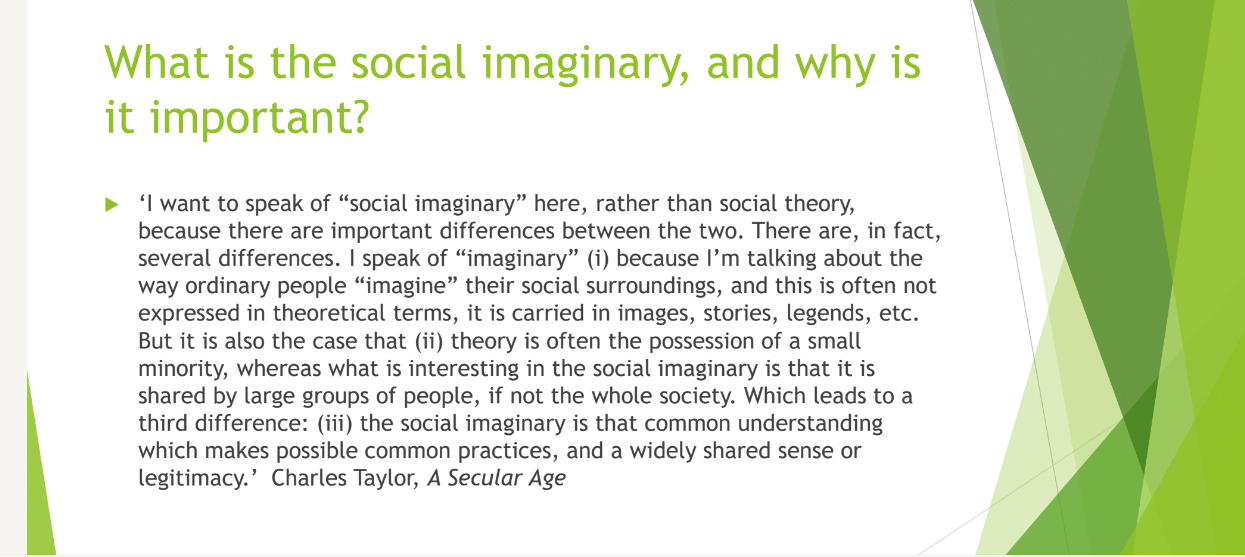
But here, he gives a good definition of the social imaginary. It’s an awkward term because for most of us, “imaginary” is an adjective, and he’s actually using it as a noun here. And when I quoted this in my book, one of my editors came back to me and said, “Don’t you mean ‘imagination’?” I said, “Well, if it was me, I would say that, but I’m quoting him.” And he uses this rather awkward term. It’s wonderful—academics are always good at making fairly straightforward ideas seem rather obscure when they talk about them. But here, he says this:
“I want to speak of the social imaginary here rather than social theory because there are important differences between the two. There are, in fact, several differences there.”
You see, an editor would have just knocked that last theoretical terms. It’s carried in images, stories, legends, etc. But it’s also the case that ii) theory is often the possession of a small minority, whereas what is interesting in the social imaginary is that it is shared by large groups of people, if not the whole society—permeates culture, really, here—which leads to the third difference iii) the social imaginary is that common understanding which makes possible common practices and a widely shared sense of legitimacy.
The Way We Intuit the World
And what Taylor’s getting at there is he’s really saying the way most of us live is not based upon thinking back to first principles. It’s based upon the way we intuit the world we live in. Intuitively, how do we know most of what we know? We intuitively know it.
The last time I read a science book, I think I was 14 or 15, I have no idea about science at all. But I’m going to leave the room through the hole in the back called the door. I cannot explain to you the physics of doors. I cannot explain to you why walking through the door works and walking into a wall doesn’t. But I intuitively know that’s the case. And it’s not just the case for doors, of course, it’s also the case for many of the beliefs that we most cherish, particularly one might say, in the realm of morality.
Moral Beliefs
I remember my dad telling me, you know, when you date a girl and you’re walking her home, you walk on the outside of the pavements, or you would say the sidewalk. You don’t walk on the pavement in this country or you’re going to get killed. Back home, the sidewalk is called the pavement. You walk on the outside. And I said, ‘ why?’ And he said ‘well it’s so when people in carriages go past she won’t get sprayed with the muck they put in the gutters’. I said ‘Dad we don’t have carriages anymore’. He said ‘No but it’s a good habit anyway. It’s a standard.’ We just intuitively do certain things.
My mum and dad taught me to say please and thank you. I always do that, and it’s odd that when I’m at a table and somebody doesn’t say please and thank you they immediately drop down a notch in my estimation, not because they’re a bad person but intuitively it jars with me and it’s the case, isn’t it, for a lot of our moral beliefs. A lot of our moral beliefs are intuitive. We might well be able to provide chapter and verse on why they’re true if somebody really challenged us, but by and large, our thinking and moral thinking is based a lot on intuitions.
Example
If I look out of the window and I see an old lady being mugged, I don’t need to open my bible and find a verse on how I should behave. I don’t need to Google ‘what do you do if an old lady is being mugged.’ I intuitively call for help or go out and help if I’m capable of doing it myself. So what Taylor’s saying here, again very much like that sort of implicit worldview that Jeff talked about.
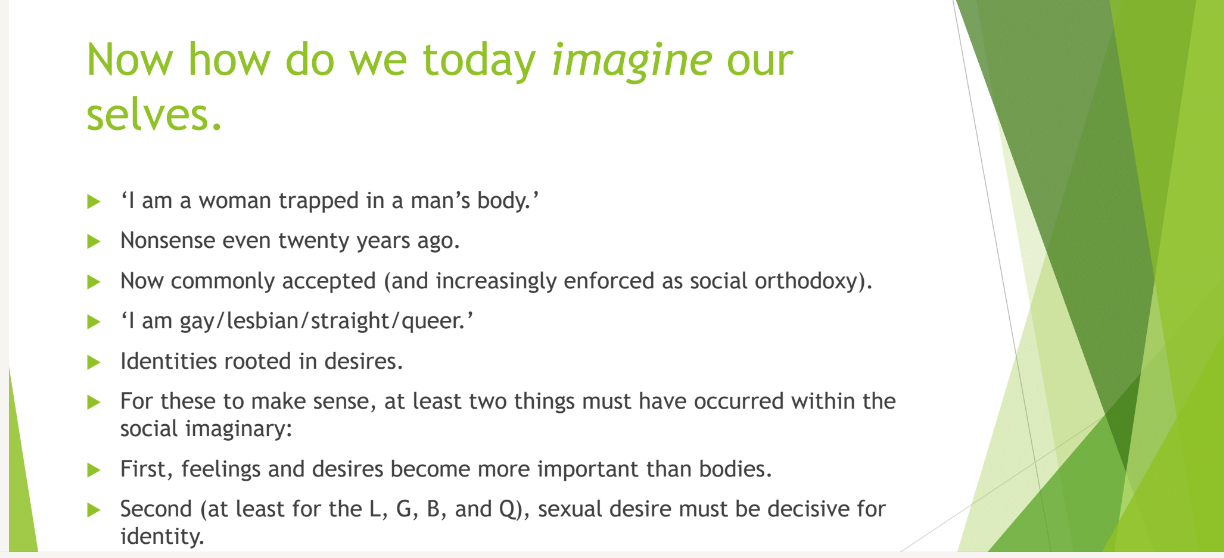
The way we think about the world is often, I hesitate to say unconscious, because that has all kinds of implications, but intuitive. We breathe it in with the air, the cultural air that surrounds us. So the question is, how is the cultural image, how’s the social imaging in the world we live, reached a point where a sentence like “I’m a woman trapped in a man’s body” makes intuitive sense to our children or our grandchildren or to so many of our neighbors and friends and peers? It would have been nonsense 20 years ago.
Changing Through Time
My grandad died in 1994, I think. Pretty sure that if I had ever said to him, “Grandad, what does the sentence ‘I’m a woman trapped in a man’s body’ mean?” Grandfather would have said, “That doesn’t mean anything at all. It’s nonsense.” And yet for my generation and younger, it makes intuitive sense now.
Notice here, I’m not saying whether that sentence is right or wrong. What interests me at this point is, how has the social imaginary tilted one way 30, 40 years ago, and now tilts another way today? What has shaped our thinking? As I say, it’s commonly accepted and increasingly enforced as social orthodoxy. We’re not just thinking about people who may have sat in Judith Butler’s queer theory classes at university being convinced of this stuff now; we’re thinking of ordinary, ordinary people. Most of the kids I teach come from conservative Christian homes, but I bet many of them don’t think as I do on this issue. Not that they’ve read gender theory; they’ve read no gender theory at all. But their intuitions have been tilted by the social imaginary to lean in a particular direction.
Sex as Identity
I think it’s also interesting about the way that sex has become identity. My first degree, my undergraduate degree, was in classics. I loved ancient Roman and ancient Greek history. And one of the books we all had to read in the mid-1980s was Sir Kenneth Dover’s book Greek Homosexuality, which was his study of the role of homosexuality in ancient Greece. What was interesting about homosexuality in ancient Greece? Well, there were two things.
One, it was everywhere. And two, nobody thought of it as an identity. It was an activity. It was an interesting political and cultural phenomenon, but it was not an identity. Now we live in a world where we instinctively think of identity in terms of sexual desires: gay, lesbian, you could think of yourself as a heterosexual. Isn’t it interesting that you might think of yourself as a heterosexual, that you might identify yourself by your sexual desires? That’s a pretty novel thing. And yet, it really does grip the social imaginary today. Identities are now rooted in desires.
If I’d asked my grandad, “Grandad, who are you?” he might have said, “Well, first and foremost, I’m the husband of your granny. I’m the father of two daughters. I’m a sheet metal worker.” He was a member of a trade union. He’d have had all kinds of identity markers, none of which would have anything to do with his desires and everything, we might say, would have had to do, in some ways, with his obligations towards others.
The Shift
For this shift to have taken place, for the social imaginary to have shifted in the way that it has done, at least two things need to have taken place. First, feelings and desires have to become more important than bodies. Think about it, 100 years ago, you go to a doctor: “Doctor, I’m a woman trapped in a man’s body.” The doctor’s response would be, “That’s a problem. It’s a problem of your mind. We need to treat your mind, to bring those feelings into line with your body.” Today, if you go to the doctor, the doctor will say, “That’s a problem. It’s a problem with your body. We need now to treat your body in order to bring it in line with your mind.”
Okay, not saying what’s right or wrong in this situation, just pointing to the fact that that shift indicates something, indicates that desires and feelings, psychological states, have come to have a profound authority, such that even the body must give way to it. And secondly, and this is, at least for the L, the G, the B, and the Q—I haven’t got time to talk about the interesting relationship between these and the T in LGBT—sexual desire must become crucial for identity. I don’t think the erotic, sexual desire plays quite the same role in transgenderism. I think the coalition is one, in some ways, of convenience. But certainly for those first letters, erotic desire, sexual desire, must become authoritative for identity.
How Did This Happen?
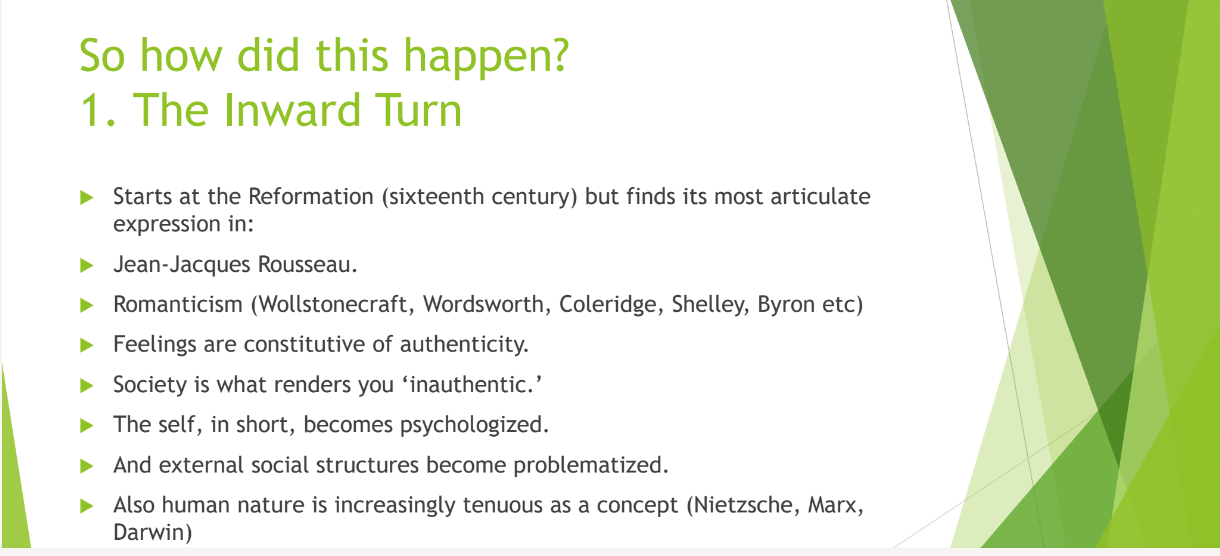
So how did it happen? I’m going to give you a very simplistic story at this point. I’ll give you the bare bones, and you can go away and read up yourself. Probably starts sort of at the Reformation, 16th century, the crisis in institutional authority in the church. The rise of the printing press tends to put more emphasis upon the responsibility of the individual to believe, so the individual begins to emerge, if you like, and the inner life of the individual, which has always been there but begins to become more important. Key figure though, after the Reformation is this Genevan philosopher, Jean-Jacques Rousseau.
Jean-Jacques Rousseau
Fascinating figure, abominable human being, sent all five of his children to an orphanage, which was a death sentence in those days, but very profound thinker. And Rousseau is really the man who first and most powerfully articulates the idea that the real you is your feelings, and it’s society that screws you up. It’s society that makes you compete. It’s society that imposes external standards of behavior upon you, and that’s what causes corruption. If we could all just be—the term is used of Rousseau, but I don’t think he ever used the term himself—if we could all be “noble savages,” if we could all just live according to our instincts, the world would be a much happier place, because everybody would be empathetic with everybody else. So Rousseau is really the man who places personal feelings at the center.
Some of you may be of that experience of, or you know, the notion of child-centered learning. The idea of child-centered learning tracks back to the educational philosophy of Jean-Jacques Rousseau. Education at my school was crushing individuality and forming you into a civilized member of society. That’s very institution-centered. Child-centered is getting out of the way and allowing the child to flourish on their own terms. And I’d have to say there’s truth in both sides of that. The key, I think, is always going to be the balance, but Rousseau is very important.
Romanticism
It achieves a popular expression through Romanticism: Mary Wollstonecraft, William Wordsworth, Samuel Taylor Coleridge, Percy Bysshe Shelley, Lord Byron. Musically, one could go to Franz Liszt, perhaps some of the later string quartets of Ludwig van Beethoven. There is an emphasis there in this artistic work on feelings. Why does Wordsworth write about ordinary people? Because he thinks ordinary rural folk are more authentic. They’re not shaped and corrupted by society to quite the same extent. Their feelings are not curbed and channeled by the need to compete in elite urban society. They’re more authentic and genuine. Feelings become constitutive of authenticity, and society therefore becomes sort of the enemy. Society is what renders you inauthentic.
Cut to Bruce/Caitlyn Jenner having to play the role of a macho Olympic athlete when inside she was really Caitlyn all along. That’s who she really was, even as she had to play this game to get on in society. The self, we might say in short, becomes psychologized. This connects to expressive individualism, of course. That inner core, a feeling, emerges as the most important thing about us.
Psychological Self
Often thought again, using my grandfather: if I were to ask my grandfather, “Granddad, did you have job satisfaction?” I think my grandad would be, first of all, confused by the question. And if I explained it to him, he would say, “Sure, because I put in an honest day’s work and I got paid a fair day’s pay. And that allowed me to put shoes on my children’s feet and bread on the table. It allowed me to fulfill my external obligations to those dependent upon me. What else could a man ask for in a job?” If you ask me the same question, I’m going to say, “I get a real kick out of teaching. I love it when I’m in a class and the light bulb goes on in a student’s mind.”
Have you noticed that people often say when the light and light bulbs went off in his mind? That’s the exact opposite, isn’t it? You know, the mind goes dark when a light bulb goes off. I see the light bulbs going on, and it gives me a warm buzz inside. That’s because myself is more psychologized than my grandfather’s, and what I’m looking for in a job is not the ability to meet my obligations to others but to meet my obligations to my psychological self. That’s what I want.
External Social Structures Problematized
External social structures become problematized, as we heard earlier in Jeff’s great lecture when he said, you know, those two attitudes to the BYU social code. The social code becomes problematized because it’s stopping somebody from being who they really are.
I’ve used this anecdote a few times recently, but I remember walking home from school one day and I had to wear a uniform, and I had my shirt hanging out, got a tie on, had my shirt hanging out and blazer on, and the vice principal, the second master, stopped and told me to tuck my shirt in because I’ve been bringing the name of the school into public disrepute. The problem there was me, not the institution.
Just yesterday morning, we were watching the news. There’s a debate somewhere in Utah on school uniforms, and one of the objections was, “We can’t have school uniforms because it will stop the kids expressing themselves,” to which my English grammar school background kicked in. Since when was school about expressing yourself? It’s about being crushed and made part of the machine. And that’s a good thing, by the way, for an English grammar schoolboy.
Human Nature Problematized
And also, this is more complicated, and I can’t go into this in detail, but human nature becomes increasingly problematized intellectually. We find figures like Nietzsche, Marx, and Darwin, in a different way, making human nature problematic. Now, none of these men thought human nature was imaginary. Nietzsche did not think that human beings, perish the thought, could mate with ducks and produce human beings with wings or ducks with human legs. They understood there was a sort of biological reality there. What they rejected was the idea that human nature carried with it a moral structure to which human beings needed to conform in order to flourish.
And that, of course, is the default intuition of the modern social imaginary. You have your truth, I have mine. I have very little experience with the Latter-day Saints, but I’m guessing when you’re doing evangelism, the same as when Protestants do evangelism, you may come across the, “Well, if it works for you, that’s great.” But in our different ways, we’re not in the game of helping people find something that works for them. Your church and my church, we think we’ve got the truth, and we’re in the game of communicating that truth to other people.
The Sexual Turn
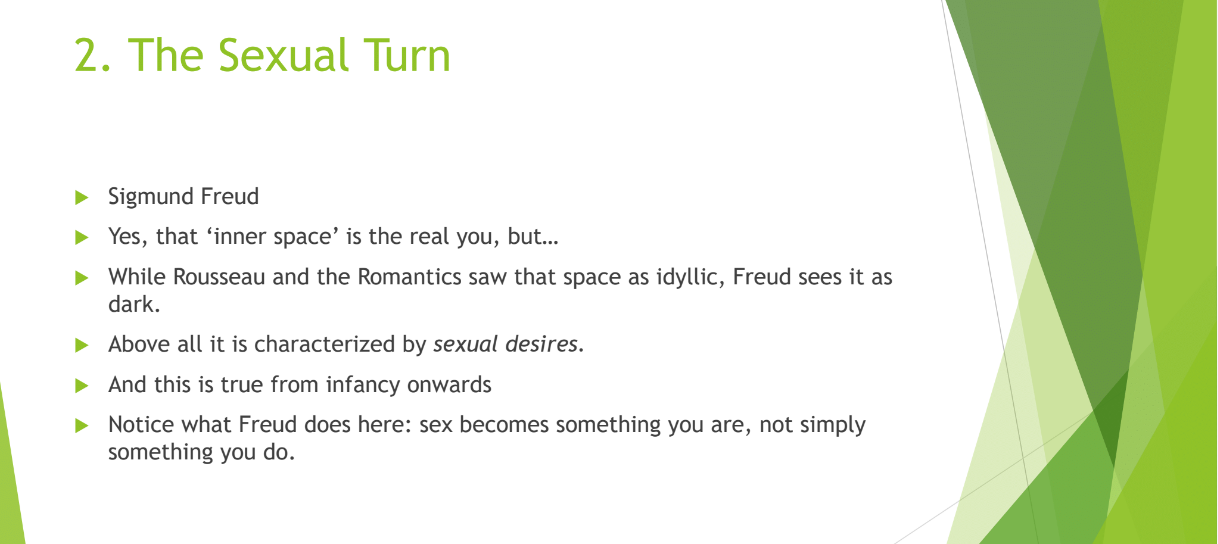
Secondly, there’s a sexual turn. Sigmund Freud is the key figure here. Sigmund Freud is the man who says in his three essays on sexuality he developed, that we can calibrate human development in terms of the nature and direction of sexual desires. So even the infant in the crib is shaped ultimately by sexual desires. For Freud, of course, that was love of the mother and fear of the father, the Oedipus Complex. Now what’s interesting about Freud is that most of his theories have been debunked, but that idea that the inner space is sexual continues to grip the imagination.
Rousseau and the Romantics saw that inner space as idyllic, I have to say, foolishly so. I think Freud is right on this point. Rousseau’s noble savage would not have been that noble. We’re all aware of the dark space inside us. Freud was the man who said, “No, it’s actually dark and destructive. It’s driven by sex and death, above all by sex.” And that’s true from infancy onwards.
And notice what that does. It shifts our understanding, not only of human beings, but of sex itself. Sex becomes identity. If you’re defined by your sexual desires, then you don’t actually have to have had any sexual experience to be defined by those desires. It makes sense today for somebody to say, “I’m gay” who may never actually have had a homosexual encounter. Some of you as parents may have heard those words from your kid who may be quite chaste in their practical lives, but they think of themselves as gay because that’s where their desires tilt. That comes from a social imaginary that has absorbed and been reshaped by this idea of Freud’s, that the thing that fundamentally identifies us is our sexual desire.
The Political Turn
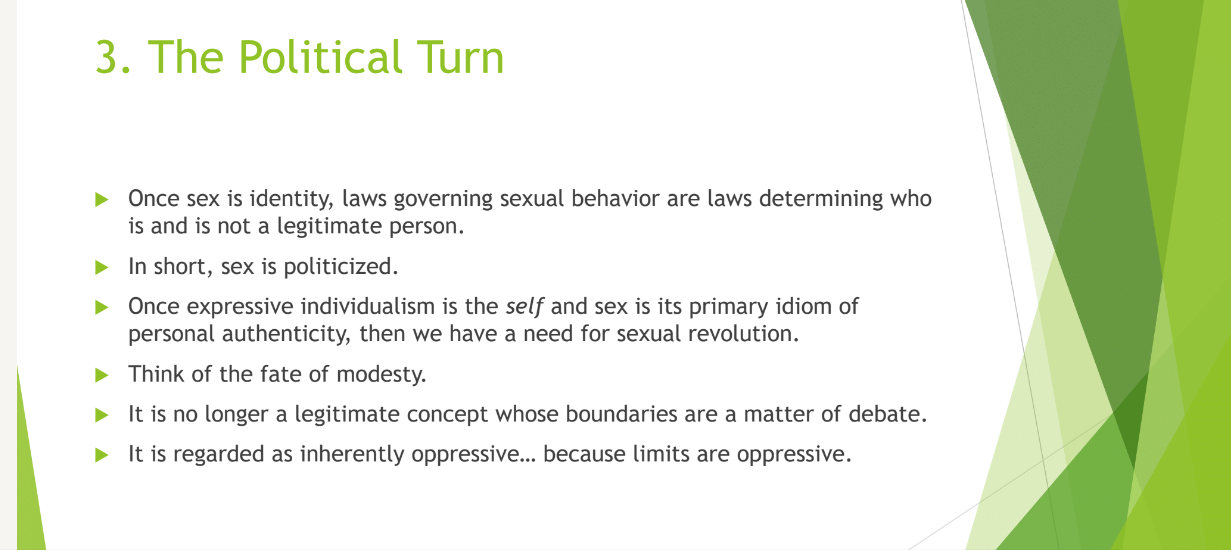
Thirdly, there’s a political turn, and this is where it’s starting to get uncomfortable for us, I think, today. If you think about it, once sex is identity, it’s inevitable that sex must become political. Because, to go back to Jeff’s examples earlier, not only is the BYU code oppressive in terms of corralling desires and stopping people from being what they want to be, it’s demanding that they be a certain kind of person, and it’s saying unless you’re willing to be this kind of person, then you have no status here. So when the person gets sexualized, sex gets politicized.
It’s why in 1968, the 1968 student revolution had sexual liberation very much at its heart. Not simply because people wanted to go off and sleep with whoever they wanted to sleep with, but in some ways, it made perfect sense because the liberation of the person is the demolition of sexual codes.
It goes back to my point about the sexual revolution. It’s not an adjustment of sexual morality. It’s the denial that there is such a thing as sexual morality; sexual limits are oppressive.
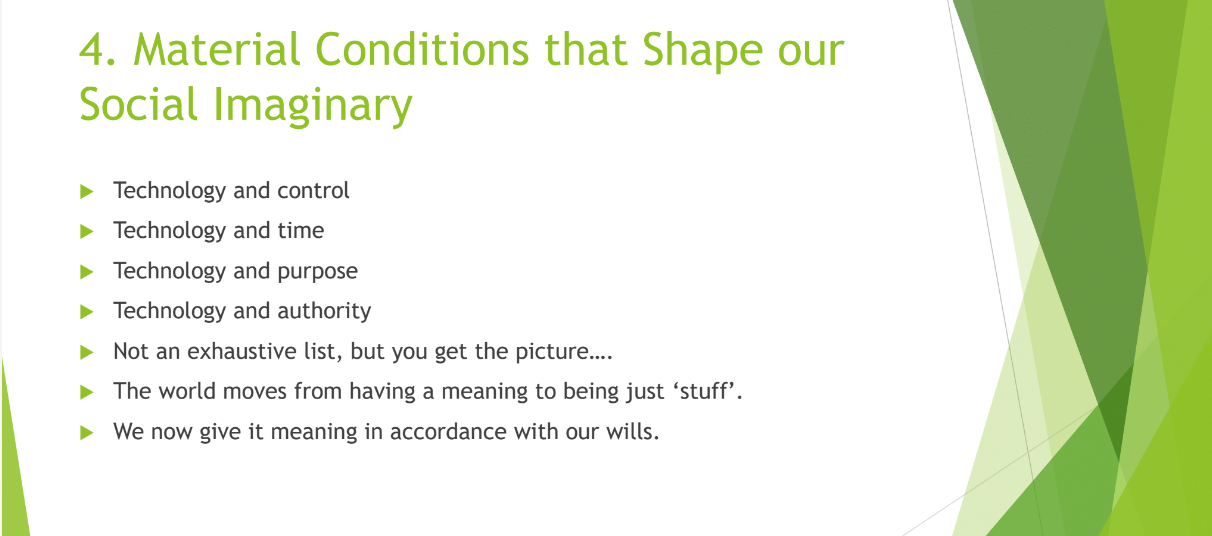
Technological Material Conditions That Shape Our Social Imaginary
And fourthly, there are technological material conditions. I can only focus here on technology, there are others. Think about how technology shapes the way we imagine the world. The more technology we have, the more power we imagine we have. If you’re a medieval peasant, as my ancestors almost certainly would have been, you’re pretty beholden to the elements. You’re going to be rooted in agriculture. You have to sow your seed at a certain time of the year, and you have to harvest it at a certain time of the year. You are very, very dependent upon nature.
Scott was telling me when Brigham Young decided to build Salt Lake City here, the women cried because it was so barren a place. Looks great now, by the way. I was looking forward to visiting it. Looks great. But of course, you have irrigation here. Think about it, what does irrigation do? Irrigation is technology. And irrigation means you start to bend nature to your will. And the more technology you have, the more nature gets bent to your will.
The more you can bend nature to your will, the more the idea that the world is just stuff and we can control it and shape it by sheer force of will begins to shape the social imaginary. Time and space become less significant once you have the locomotive, the automobile, the telephone, the internet. Technology doesn’t simply allow you to do the same things only better and faster; it fundamentally changes how you imagine your relationship to the world to be. It gives you this great sense of control and, paradoxically, it gives you a greater and greater fear of not being in control.
Control
The panic about COVID was fascinating. Suddenly our technological world was faced with an issue that it could not immediately control, and the result was total panic. Fascinating, fascinating, complete panic even though on any given—this is not a pro or anti-mask comment or anything—but on any given Sunday if you’d gather together as a church, your risk to life and limb would probably be less than what it would routinely have been in the middle of the 19th century before we really understood viruses, before we had antibiotics to help us heal our flesh wounds that we would no doubt have picked up on the farm during the week.
Control, the control of nature, dominates our imaginary now, and I’m wanting to move fairly fast, but think about how technology reshapes time, technology reshapes purpose. Purpose of life becomes control, domination, technology, and authority. My academic area is actually the Reformation. One way of reading the Reformation is it’s about a dramatic transformation in the nature of authority precipitated by a number of things, but by nothing more central than the printing press.
Reshaping Authority
Technology reshapes authority. It’s reshaping parental authority. My kids at college will say to me, ‘Well, my parents told me this, but I’m in this Facebook group.’ Parental authority is being reshaped by technologies that most parents don’t understand. Not an exhaustive list, but you get the picture. We could put this sort of in a rather naive way, but still a way that carries a lot of truth. We could say the world moves from having a meaning or a structure to which we must conform ourselves in order to flourish, to being raw material that we can shape and bend to our wills.
And again, not to pick on the trans lobby all the time, but I would say the trans issue is a great example of that. Well, my body is just stuff. If my feelings tell me I want to be somebody else, then we have the technology to do that. And that is not to belittle the agony that a lot of people struggling with body dysmorphia go through. It’s very real to those people. It is to say we can now imagine that it’s a problem with the body and not the mind in a way that would have been impossible 100 years ago.
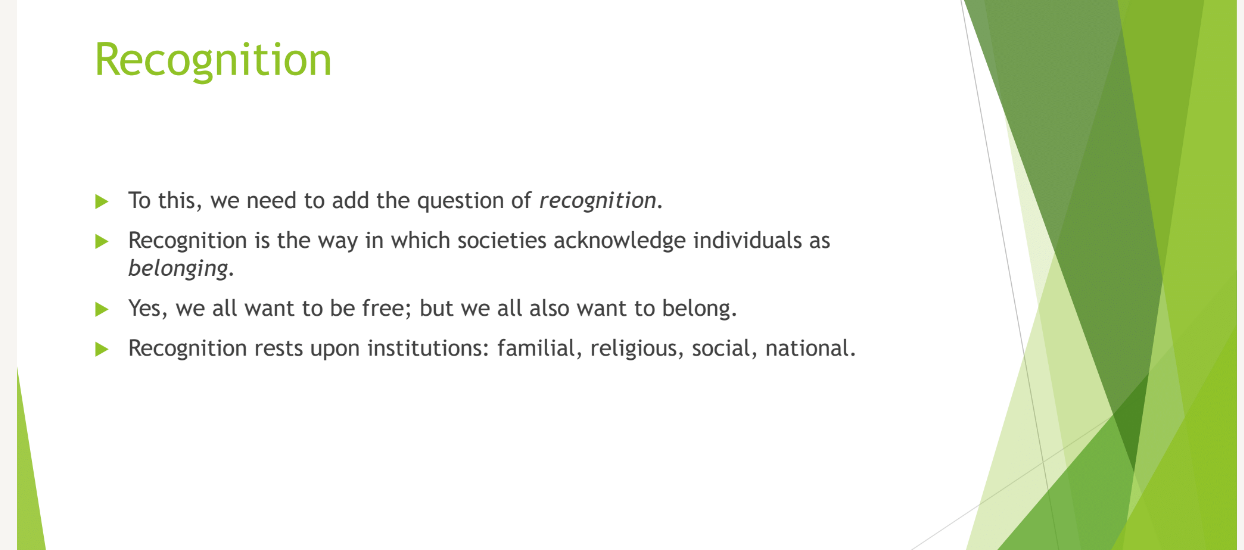
Recognition
To this, we can add the question of recognition. Well, what’s recognition? Is it me walking down the street and seeing Scott and Sheri and saying ‘Hi Scott and Sheri,’ recognizing them? No. That is a form of recognition. What I’m talking about here is recognition that comes from the set of rules that society has for acknowledging individuals as belonging.
All human beings intuit the world as free, we make decisions that shape who we are. We intuitively think we make those decisions freely, but we also want to belong. Very rare is the person who simply wants to be utterly alone and isolated. It’s where we get the English word idiot from. In fact, the person in ancient Greece who wanted to be a private person was the idioticos, the idiotic man. We all want to belong, we want to be part of a group. You’re here today because you enjoy being belonging to part of a group where you’re acknowledged as a legitimate person. And recognition rests upon institutions.
Institutions
For most of us, it’s a familial context. Our family is recognized. The great thing about families is you’ve got to behave in a pretty extreme way for your family to reject you. You’re always recognized in this sense by your family. Religious institutions do this. The Church of the Latter-day Saints, Orthodox Presbyterian Church recognize people, Jewish synagogues do it. Social institutions do it. The Boy Scouts, colleges, schools, they all have rules of behavior that sort of allow us to recognize each other as legitimate.
Nations do it as well. I’m British, you’re American. I hope you’re proud to be an American. I’m amazed at the number of Americans I now see on telly who don’t seem to like living in America. I’m not even American, I love living in America. It’s a great place to be, it’s been very kind to me and my family. I consider it an honor and a privilege to be here. Nations provide us with ways of belonging as well, but our institutions are now in flux.
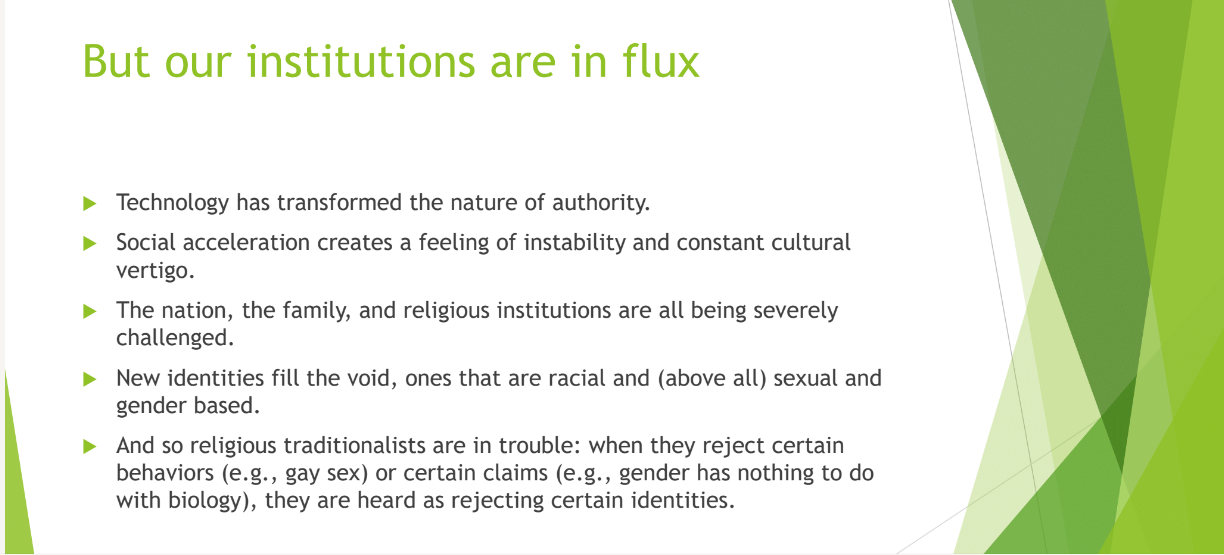
Institutions in Flux
Technology has transformed the nature of authority. ‘Well, a minister may have preached that, but I read this on the internet’.
Social acceleration has created a feeling of instability and constant cultural vertigo. What do I mean by social acceleration? It’s the German thinker Hartmut Rosa who coined this term. What he says is that technology is developing at such a rate that society and the institutions of society, whether family, workplace, nation, don’t have time to adapt to the new technology before the next wave of new technology comes along. And that means we have this constant feeling of instability and falling. Vertigo is our sort of default way of relating to the culture.
Everything seems to be happening so fast these days, the nation, the family, religious institutions all being severely challenged at this point. The very existence—again not to make a comment on the value or not of the 1619 project—the fact that it exists indicates the national narrative is in crisis. Who knows what a family is anymore? It’s just whatever you think it might be that works for you. Religious institutions are in trouble, and religious traditionalists are in trouble as well.
New Institutions and Identities
When we reject certain behaviors, we’re heard as rejecting certain identities, and what happens when institutions collapse, identities collapse. But that need for recognition and belonging remains, and so new institutions and new identities fill the void.
The LGBTQ community has become strong because it provided, I think, a sense of stable community at a point when traditional communities were becoming discredited and discounted.
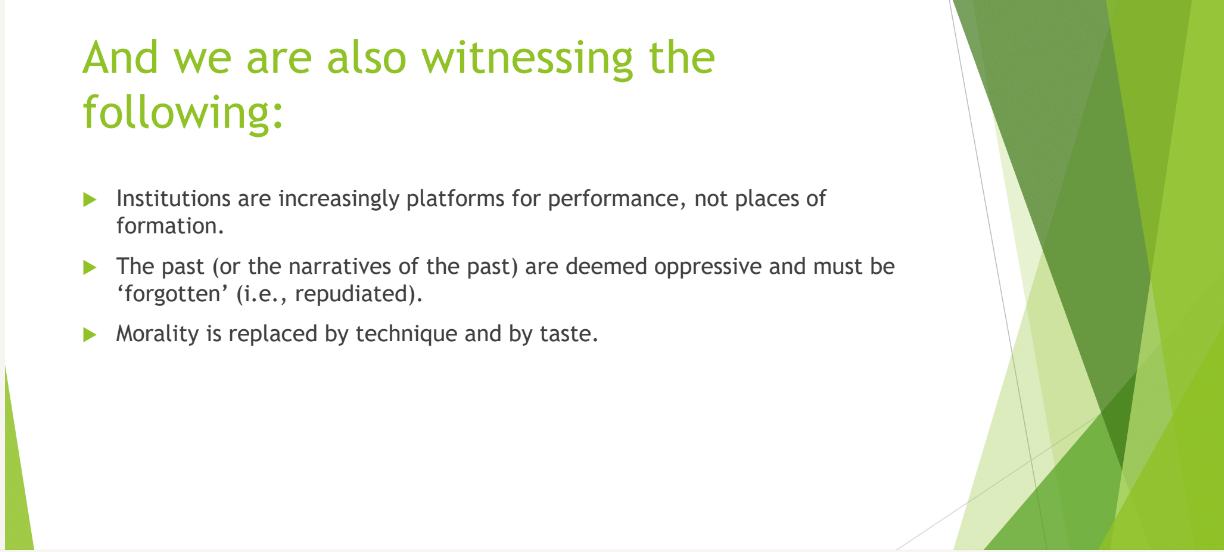
Institutions also increasingly become platforms for performance, not places of formation. You go to school to express yourself not to have your individuality crushed. I read somewhere recently that the army needs to allow transgender people to serve so they can express who they are. Since when was serving in the army about expressing individuality? If I’m on the battlefield I don’t want individuals, I want a bunch of people with me who act as a unit and everybody protects everyone. I don’t want any self-expression on the battlefield. Let’s follow orders.
Past Deemed Oppressive
The past becomes deemed as oppressive. Cultural amnesia and morality are replaced by technique and taste. Notice how much moral language now is taste language. ‘I find that offensive,’ ‘that was a tasteless comment,’ ‘that person’s a distasteful individual.’ That’s not language of right or wrong, that’s language of taste. I say to the students, ‘You can say Trueman is a bald guy with crooked teeth. That’s offensive and tasteless, but it’s true.’ Can’t deny the truth. But the default, particularly for young people today, is to allow taste to supplant truth when it comes to ethics and morality.
What Do We Do?
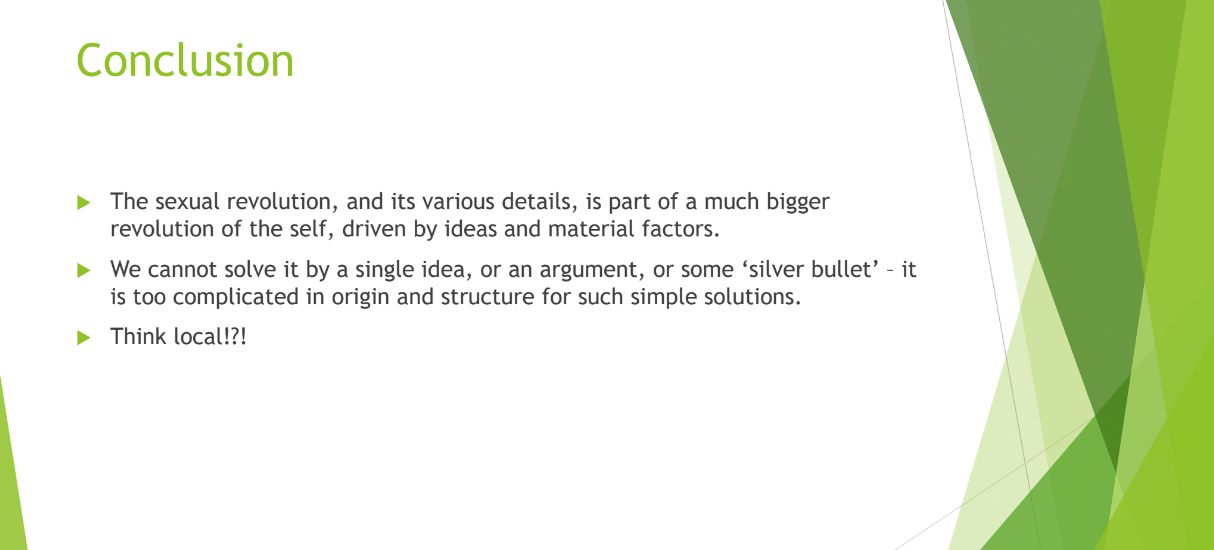
So what do we do about this? Well first of all, understand that the sexual revolution is part of this much bigger picture, this emergence of what I call plastic humanity lies behind the sexual revolution. It just happens that we live at a time when sex and sexual desire is the dominant way of expressing this stuff, but it’s been around for a long time and it’s doing more, it’s creating more social transformation now than at any point before because our institutions are in collapse.
That means we need to realize we cannot solve it by a single idea or an argument or a silver bullet. It’s great to get good Supreme Court appointments, that’s good, we want that, we want those who will create safe moral legal environments for our children to grow up in, that’s good, but it’s not going to solve the cultural problem because it takes more than a swing vote on the Supreme Court to do that. This is the social imaginary we’re talking about, and that leads me then to my final point.
Conclusion
Think local. I think the days when religious conservative people are able to shape the national picture in significant ways, they’re behind us, but where can we make a difference? In our families, in our religious gatherings, in our local communities. I think that the way we combat this stuff is, one, be aware of it as Jeff made that brilliant point at the end of his talk. Let’s be aware of it, but let’s spend our time focusing on the people we can influence at this point and build communities where this stuff is seen for the nonsense that it is.
That’s what they did in the church of the second century. And you don’t have to be a genius to know the second century’s followed by the third century. The church is a lot more powerful in the third century. And then we have the fourth century, and the church becomes the dominant cultural force in the empire. It started locally. We should not despise the local, that’s the area I think at the moment, where we can have the most influence. Thank you so much for listening.
Scott Gordon:
Everyone is so interested in your in your talk I actually didn’t get very many questions. I think they’re all just still contemplating it.
Carl Trueman:
Maybe they all fell asleep, that’s the alternative.
Scott Gordon:
No. I don’t believe so. So it seems the world is changing rapidly at this point and the idea that there might be a morality about sexuality is simply going away. Do you think that it’s going to lead to an environment where religious belief and religious people will be ostracized, or will the whole religious side be minimized?
Carl Trueman:
Yeah, I think undoubtedly, and that’s already happening in some places. My wife and I were at a conference just three weeks ago where Jack Phillips, the cake baker, and Barronelle Stutzmann, the florist, both spoke. And at the moment, you know, I only have to mention the names. Everybody knows who they are, because thankfully these situations are still quite rare at the moment. But I think all Christians, all religiously conservative people, are going to be faced with serious questions about our role in the public square and to what extent we can expect to be left alone. So one of the implications of recognition is that when you get hold of the importance of recognition, you realize that tolerance is not enough. You know I’m a Presbyterian. I could tolerate Latter-day Saints, but what that would mean is I still don’t treat you as a full human being, I still don’t acknowledge your full humanity, and you’re not going to like that. And I think that that’s why we see that at one point, a lot of conservative people thought ‘we don’t want the government policing bedrooms. Maybe tolerance is the way forward,’ but it’s not a question about what goes on in the bedroom, it’s a question about acknowledging a lifestyle as fully legitimate in the public square. It’s about recognition, and that really requires equality, legal equality, and that’s where I think it’s going to be very hard for churches, it’s going to be very hard for educational institutions. I think that places like BYU and Grove City College, we’re going to face some significant challenges and questions in the coming years, and I think every religiously conservative person, Jewish, Muslim, whatever, will find these questions popping up in their own communities.
Scott Gordon:
Do you see us turning the corner on this, of stopping this, or stopping the flood? What things can we do to mitigate what’s happening?
Carl Trueman:
I certainly think at a local level it’s possible because people can see how we live our lives, people can see how living chaste lives, living lives in accordance with biblical morality, actually that’s what our bodies are designed for. It doesn’t take 10 minutes on the internet to find the catastrophic health statistics on male gay lifestyle for example, so I think viewed locally, we stand a good chance of making our messages plausible.
Nationally I think it’s a different issue, because all of the levels of cultural power are really controlled by those who have a vested interest in marginalizing traditional values people.
People talk a lot about the January 6th Capitol Hill riots to me. You know, it was disturbing, but it was a dramatic show of impotence because the people who control the radio waves, the TV, the internet, social media, they weren’t there that day, they weren’t storming the capital. They don’t have to, they don’t feel they have to. So I think conservative people, even moderately conservative people are going to find themselves feeling the pinch in the near future.
Scott Gordon:
Well we really appreciate you for being brave and coming among the Latter-day Saints here. Thank you very much.
I’m going to give a plug for his book here because when we first said that Carl was coming to our conference, we had several of our FairMormon volunteers say ‘Oh, we’ve seen his book, we’re going to read it.’ And within a couple of days we got these same people saying, ‘you need to read this book, Scott, this is excellent.’ And it turns out that one of the people here at the conference said that they’ve put it on their BYU freshman reading list for one of their groups, so it’s an exceptional book.
He’s said he’s willing to sign a copy for you, but that presents a problem for me. It’s lunchtime and the last thing I want to do is send Carl away saying the Latter-day Saints were very nice, but they wouldn’t let me eat.
Carl Trueman:
You could have told me it was a fast day and I’d have believed it.
Scott Gordon:
So what we’re going to do is we’re going to excuse him first to go get his lunch and then there’s a table set up there where he’ll be happy to sign his book for you.
coming soon…
Why does society change so quickly?
The transformation of identity, driven by expressive individualism and technological advances, has accelerated social shifts beyond what previous generations experienced.
How do we respond to cultural amnesia?
By preserving and teaching history as a source of wisdom rather than viewing it as an obstacle to progress.
Understanding the deep philosophical shifts behind cultural changes.
Strengthening religious communities amidst secularization.
Upholding faith while engaging constructively in public discourse.
Share this article
