Jennifer Ann Mackley introduces the ambitious effort to transcribe, digitize, and publish all of Wilford Woodruff’s writings. As a historian and executive director of the Wilford Woodruff Papers Foundation, Mackley highlights Woodruff’s unique role in documenting 65 years of Latter-day Saint history, particularly in the development of temple doctrine. She underscores the project’s goal of providing unprecedented access to primary sources that deepen understanding of Church history and faith. Through personal anecdotes and historical insights, Mackley emphasizes the enduring relevance of Woodruff’s meticulous records, which serve as an essential thread connecting the Restoration’s early years to modern faith practices.
This talk was given at the 2021 FAIR Conference on August 5, 2021.

Jennifer Ann Mackley is a legal expert and historian specializing in Latter-day Saint history, with a focus on Wilford Woodruff’s contributions to temple work and continuing revelation.
📖 Wilford Woodruff’s Witness: The Development of Temple Doctrine 1
Transcript
Jennifer Ann Mackley
Introduction
I want to thank all of you for being here, the last one of the day. So, thanks for sticking it out. And also, to thank Scott for inviting me to come and introduce the Wilford Woodruff Papers Project.
As he stated, I’m the executive director, and I haven’t been out in public since March 1st of 2020 when we announced the beginning of the foundation. I’m a two-time transplant recipient, so I have been holed up and carefully hoping that the whole world would figure this out before I left my house again.
I have been astonished at the scholarship that I’ve heard over the last few days, and I mentioned to someone earlier, I feel like I’m wearing intellectual flip-flops at a black-tie affair. So, thank you for your patience with me as a non-academic but one who has studied the life of Wilford Woodruff for the past 25 years and has come to appreciate the work that all of you do.
Discovering Church History
To begin with, I would like to explain the title of my presentation, “Discovering Church History.” I think there are a couple of meanings to that word, and in this setting, I think the first is our own seeking in our own study to discover Church history and what we as a collective group offer to others who are seeking truth.
I also believe that the Wilford Woodruff Papers is a great asset to that body of scholarship and will provide more information and more documents and the ability to study more Church history to add to the great group that we already have. And the third is what Wilford Woodruff offers himself. It’s not just the words that he’s recorded but his example of living according to the truth that he knew and doing so completely from the very first day that he heard about the Church in 1833.
Story of Discovery
To begin with, I would like to share the story, a true story, of a young man who was searching for truth and began his study of the scriptures with his older brother at the age of 14. Okay, his approach was to study the scriptures, to pray, to look at the churches around where he lived to find one that mirrored the gospel that Jesus had taught but also the church that he had organized. And the two of them searched for ten years and weren’t able to find one that not only patterned after what Paul taught the Ephesians about apostles and prophets and evangelists and teachers, but one that believed in the gifts of the spirit and the miracles that follow those who are faithful.
So, after 10 years, he approached a local minister that he’d been talking to in the past and asked if he would baptize him by immersion, at least he could do that to follow the example of his Savior, and the minister agreed but was surprised that this young man then chose not to join his congregation because he felt the doctrines that were taught were not the same as what Christ had taught.
It was the following year when he was 25 years old that he first encountered anything about the Church of Jesus Christ of Latter-day Saints, and true to form, it was negative. It was an article written to ridicule the Church, to mock the origin story of the Book of Mormon and the idea that continuing revelation was possible.
Intrigue
Of course, this is preaching to the choir here but I think every one of us, those who are seeking truth, those who have found truth and then fallen away, or those who continue to do their best to follow the truths that they know, every one of us will find something that will stop us in our tracks, whether that’s a criticism, a quote out of context, a document that may rattle our world, and our reaction to it will determine whether we, I don’t know, pick up all our toys and go find a different sandbox. But in this case, this young man was not shocked by what he read. He was intrigued because it was exactly what he was looking for.
He was intrigued by the information on divine manifestations and continuing revelation and modern prophets. But there was no branch or ward within his area and so that’s as far as it went. Until 18 months later, two brand new missionaries knocked on these two brothers’ door, the first door that they’d knocked on and, there the reception of their message was immediate and both brothers chose to be baptized two days later.
Continue Seeking
Not all stories end in that way, that’s why there are organizations like FAIR and many of the others that we’ve heard about, to counteract the messages, to help others overcome the misunderstandings or the misinformation. And this could have happened to any of us today, my son, your cousin, your neighbor, me, and the criticisms haven’t changed much in 200 years and the resolution to misinformation is the same. We have to continue seeking, we have to continue studying, and the more information we have, the more truth we have, the easier it will be to understand those things in context.
Purpose of the Wilford Woodruff Papers
So our purpose in the Wilford Woodruff papers is to do just that. And the young convert that I spoke of wasn’t someone who read something in 2020 or 2021, it was in 1833, and his name was Wilford Woodruff. I’ve studied his life for 25 years and I have come to admire him and the faith that he’s taught me was the reason that I ended up writing the book that I did, partly because my husband encouraged me to share the 27,000 documents that I’d amassed in my research, maybe in part because he hoped that maybe I’d share all these things with somebody else instead of always bothering him.
But, it all started with my mother sharing with me the story of Wilford Woodruff’s experience in the Saint George Temple and my education, my legal training made me want to find the primary sources, not the books that other people had written about what he thought or what he said but what he actually wrote.
Daily Observations
And his records are remarkable because they’re not vague memories, they’re not recollections of a wonderful life, they’re his daily observations, his the ups and downs of the experience that he had joining a church of about three thousand run by a young man only two years older than he was and one that began and ended in very trying circumstances. And yet he didn’t falter, he experienced the same things that others did, he wasn’t unique in Church history but his record is unique and part of that is because he tells the truth and it’s unvarnished, it’s unfiltered and it’s contemporaneous, it’s personal.
So we’re all familiar with the oath a witness takes to tell the truth, the whole truth and nothing but the truth and the work that we’re doing together, all of these various organizations with incredible websites and incredible information is adding to that truth.
Searching for the Truth
Wilford Woodruff has been the thread that Church history has followed since the first compilation of Church history in the 1850s. And now with the recent publication of Saints, his record still provides that thread that ties all of this together, and he will get us exponentially closer to the whole truth.
When I first published my book, I was asked if it was an apologetic work. I didn’t know what that meant, first; I’m not apologizing for anything. But I now have learned some other languages, at least one word, that one, and understand for me anyway defending our faith isn’t an intellectual argument alone. To address the religious and doctrinal elements is one thing, but we also have cultural and philosophical ideas that we need to incorporate. And I think what we’re doing is a full-time and a lifetime pursuit. It’s not a casual job that we’ve undertaken.
So I think our personal conversion may be spiritual and intellectual. We’re supposed to know in our minds and in our hearts, but it’s an entirely different level of understanding to share those beliefs with someone else and to help them understand the truth that will counter the alternative versions that they’ve already been exposed to. I also think that defending our faith requires a constant mining of Church history. The Wilford Woodruff Papers Project is part of that new Church history.
What Woodruff Offers Us
I’m often asked, “haven’t his journals already been published? What else, you know, could we mine from his information?” He wrote or received over 32,000 letters, and only one percent of them have been transcribed, so the letters alone will provide a much more personal and much more intimate look at the daily lives of those he interacted with as well as himself and other Church leaders. He also has autobiographies; he wrote the histories of other apostles and experienced what they did. But again, his record is unique not just because he lived longer than them, but because of how he recorded it and what he recorded.
So his strength is to provide the truth, but also his example of living the truth. We can all find ourselves in his stories. We didn’t have to cross the plains to understand what it means to sacrifice and how obedience leads to faith. If we’re dealing with divorce or family relationships that are difficult, he knows something about that. He had 10 wives and 38 children and five of his wives divorced him. If we’re suffering from the loss of a loved one, he lost 13 of his children; his mother died when he was 15 months old and all six of his half-siblings died. The loss of his beloved wife, Phoebe, was a very difficult time for him, twice. Once he brought her back to life and the other time he had to stand and watch her funeral. So it’s not an unfamiliar story of faith, but it is a record that only Wilford Woodruff wrote and a story that only he can tell.
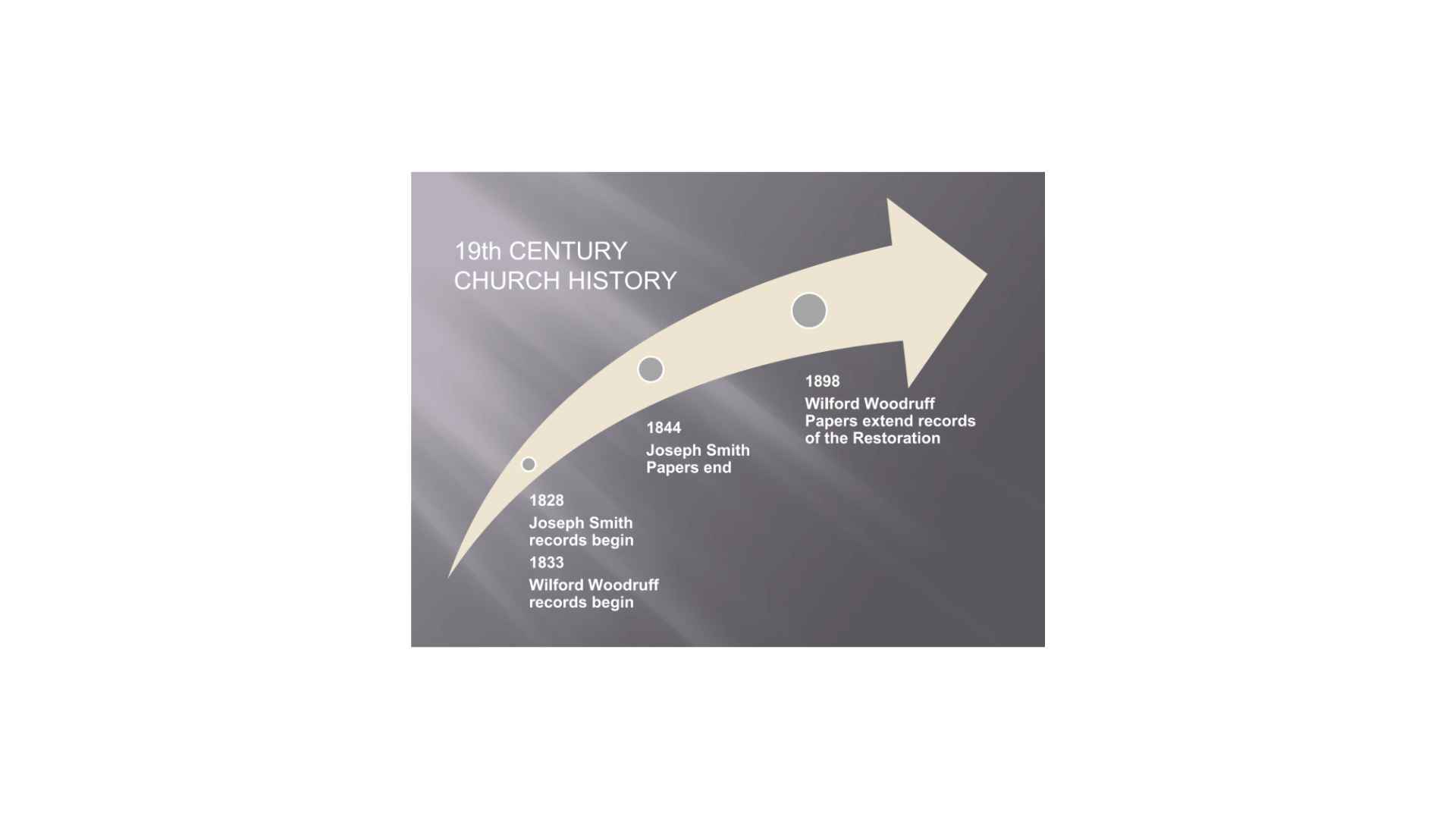
Wilford Woodruff’s Contribution to Church History
If you look at the records in Church history, the Joseph Smith papers are 16 years, 1828 to 1844. What Wilford Woodruff wrote is 65 years of history. Again it’s not important just because he outlived these other great men in history, but because his record is different.
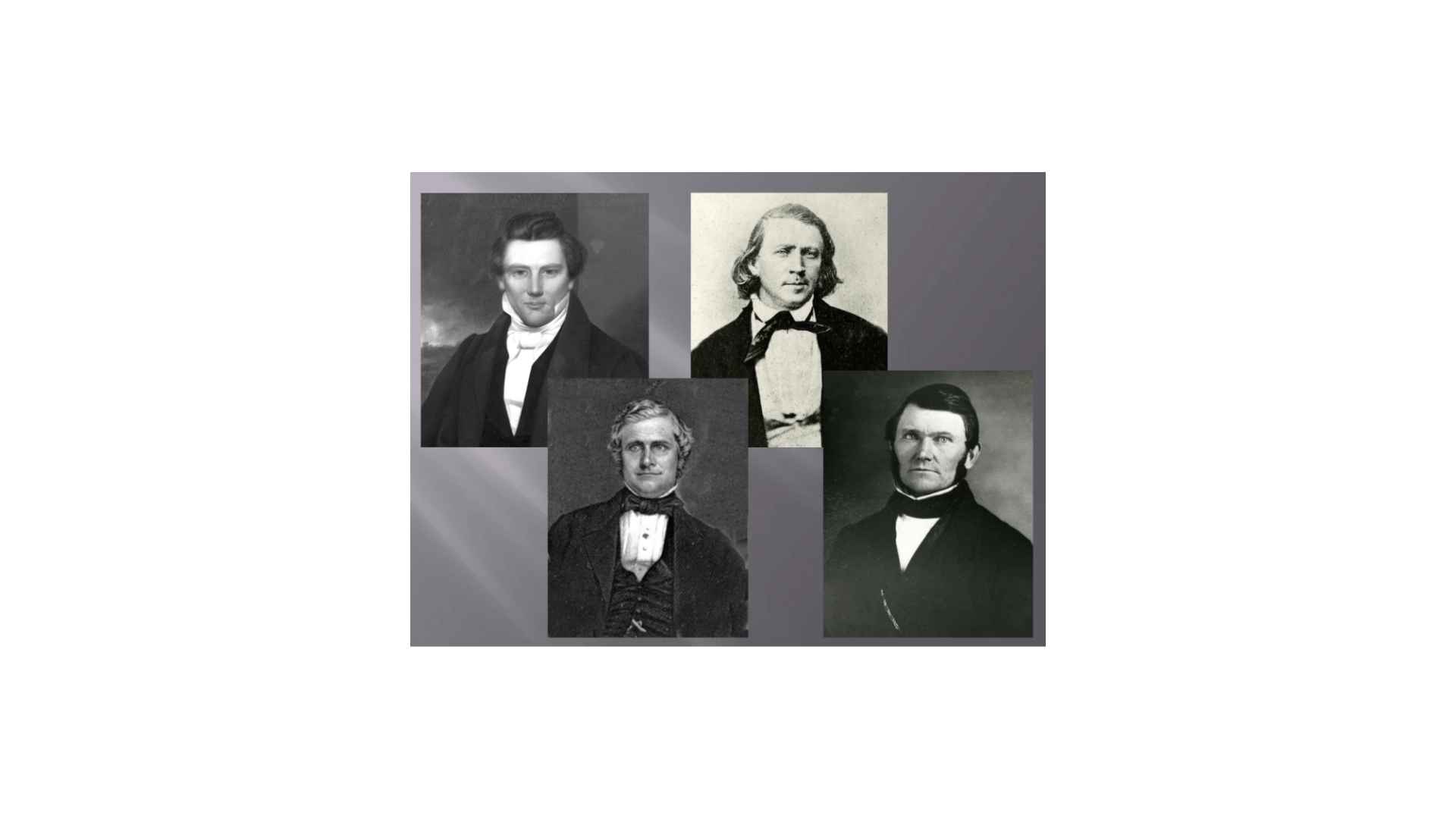
So the purpose that I understand of apologetics is again not to just defend the faith for the sake of winning an intellectual argument, but to help people understand the truth so they can embrace it and live it and be blessed by it. And there’s no greater blessing than the temple and there’s no more important thread that runs through Church history than the temple doctrine that Joseph Smith introduced but didn’t live to complete or carry out.
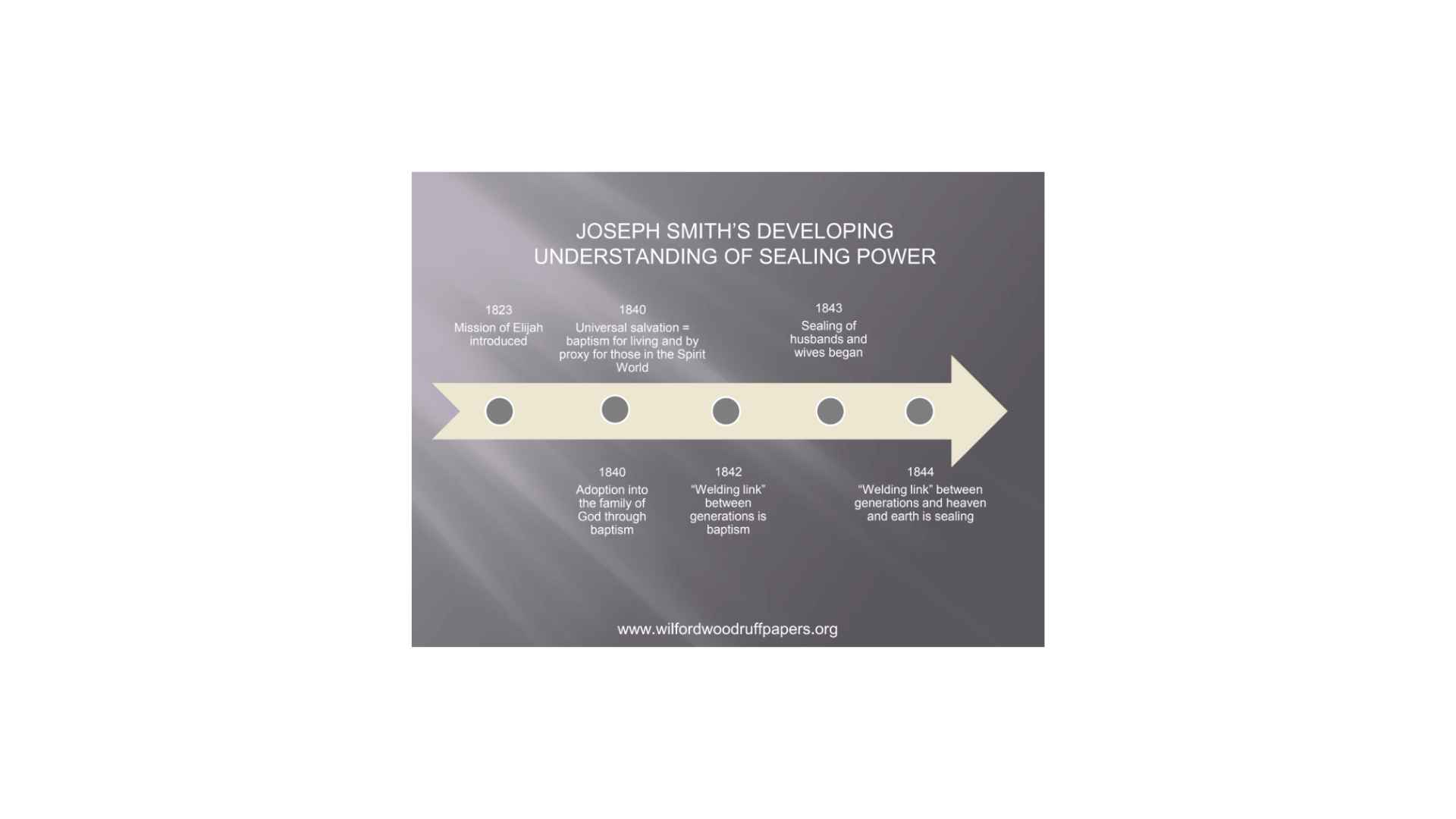
The Development of Temple Doctrine
So to briefly go through what it took me 450 pages to explain in my book, the understanding of sealing power developed over Joseph Smith’s lifetime. It took him 21 years to finally explain the mission of Elijah, and it began with the understanding that baptism was adoption into the house of Israel in the kingdom of God. And then as that understanding progressed, it wasn’t sealing just of ordinances or covenants but finally sealing of individuals to each other, that there could be a welding link beyond death.
One of the things that I remember from my mission is a gentleman who had a pamphlet called How to Testify to a Mormon and he wanted to talk about the Trinity, that God is a spirit without body parts and passions, and his evidence from the pamphlet was Christ’s statement recorded in Luke 24:39. Conveniently, however, the statement said, “A spirit hath not flesh and bones,” they left off the end of the statement “as you see me have.” So Church history in context means that those people who read that pamphlet, that never opened the Bible, will have a distorted picture of the truth and base their lives on something that isn’t true.
Evidence of God’s Mercy
The development of temple doctrine is astonishing to me, not only because of how mercifully the Lord introduced what needed to happen, but how each step through the temple organization, through the recording of the ceremonies, through the administration of all the ordinances, we got to step up. Members of the church were able to understand what it meant to be saviors on Mount Zion, that God’s work and glory depends on us, that we’re participants in that work. And every revelation that occurred, Wilford Woodruff would record the reaction, his personal feelings about the shaft of light he felt had descended from heaven, how universal salvation was more evidence of God’s mercy and justice than anything he’d ever understood in his life.
Missionary Work
He famously spent 10 of his first 15 years in the Church on missions but he spent 65 years teaching the gospel, sharing the gospel with those on both sides of the veil. And he understood Joseph’s role in that but also that it didn’t happen in Joseph’s lifetime.
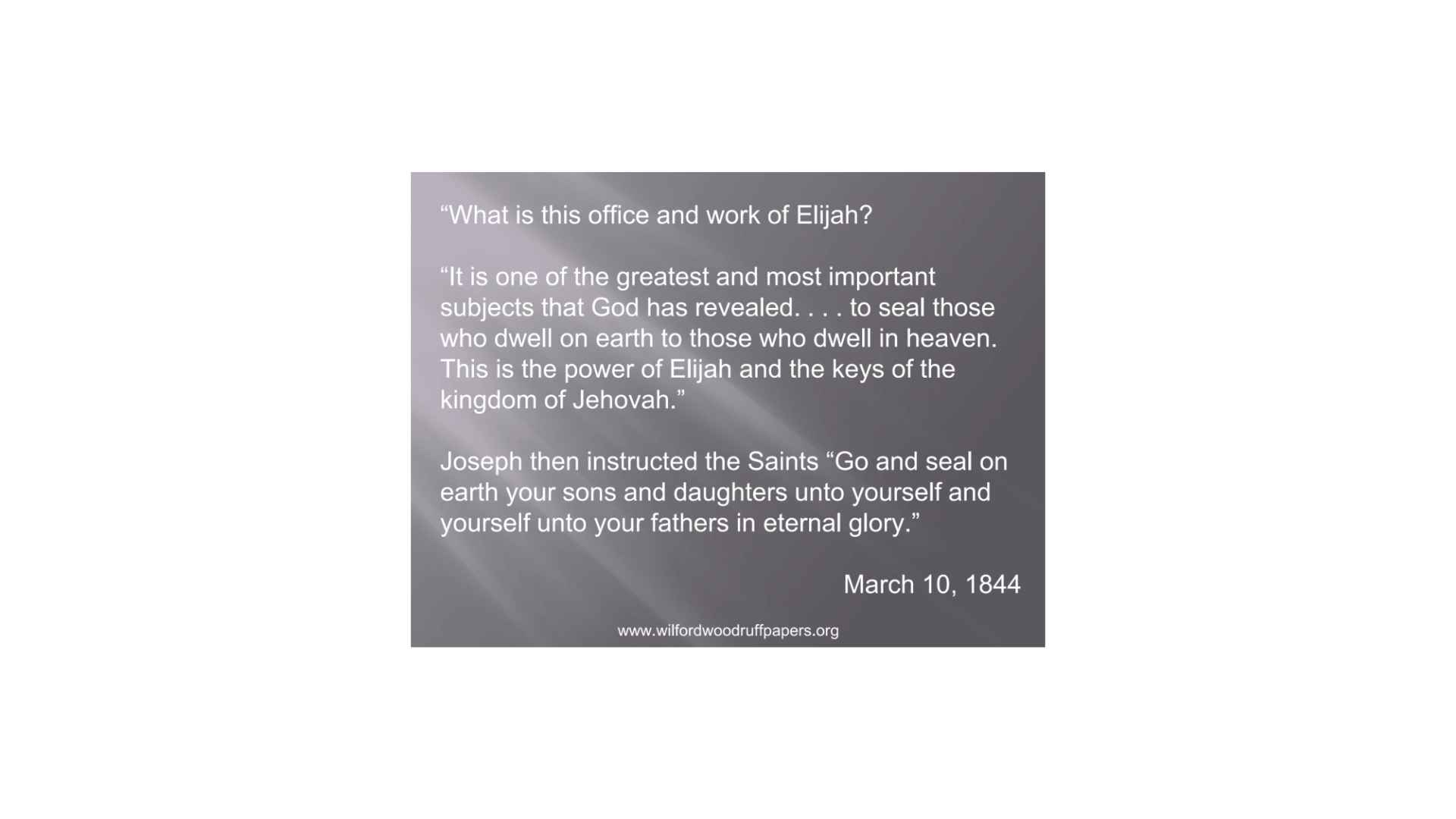
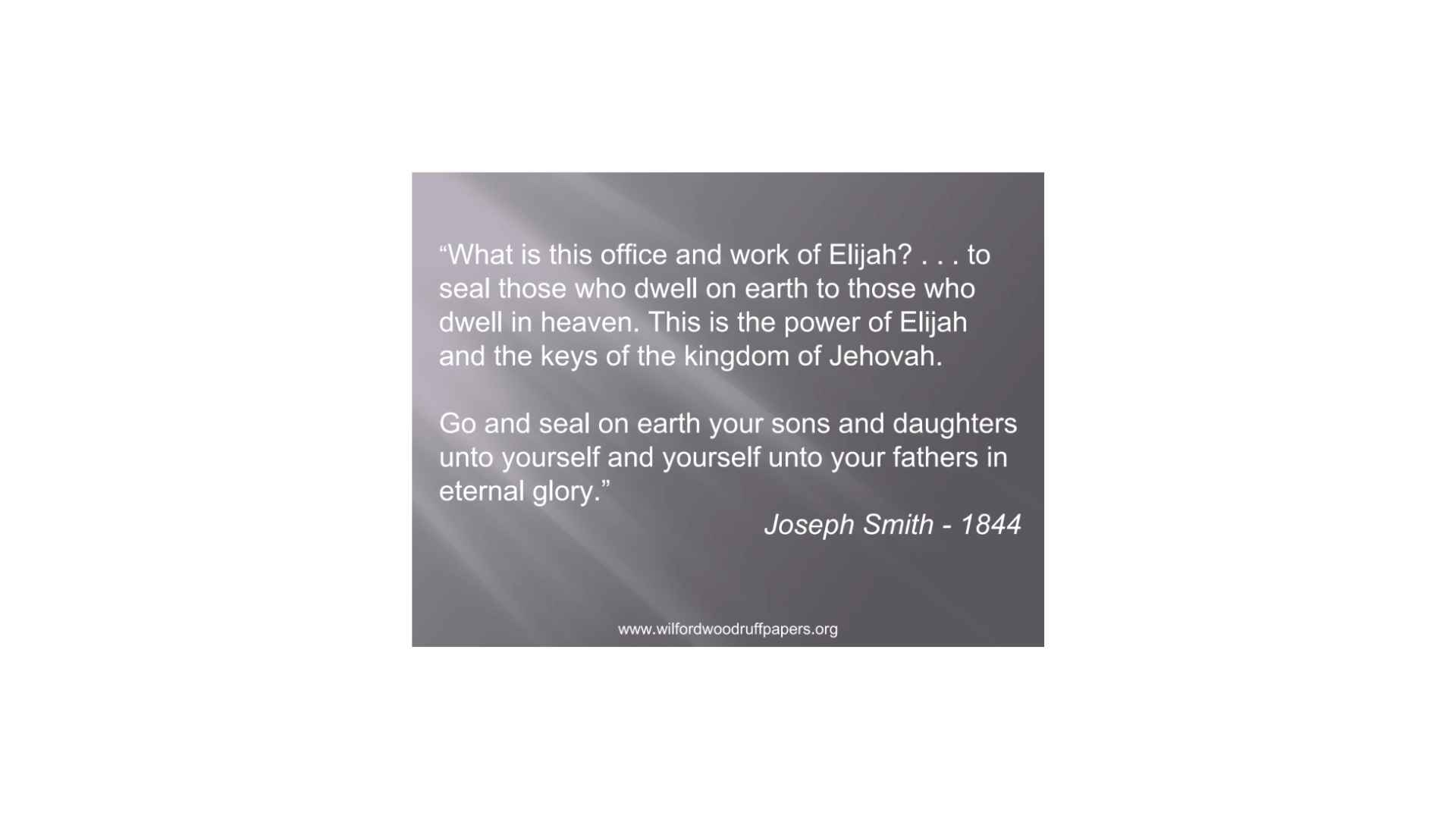
Three months before Joseph Smith was killed, when he was asked the question “What is the office and work of Elijah?” He said, “It is one of the greatest and most important subjects that God has revealed. . . . to seal those who dwell on earth to those who dwell in heaven.” And he said, “This is the power of Elijah and the keys of the kingdom of Jehovah. But his instruction to the saints was to go and seal themselves and their sons and daughters to their fathers in eternal glory.
Joseph Smith did not administer that ordinance in his lifetime.
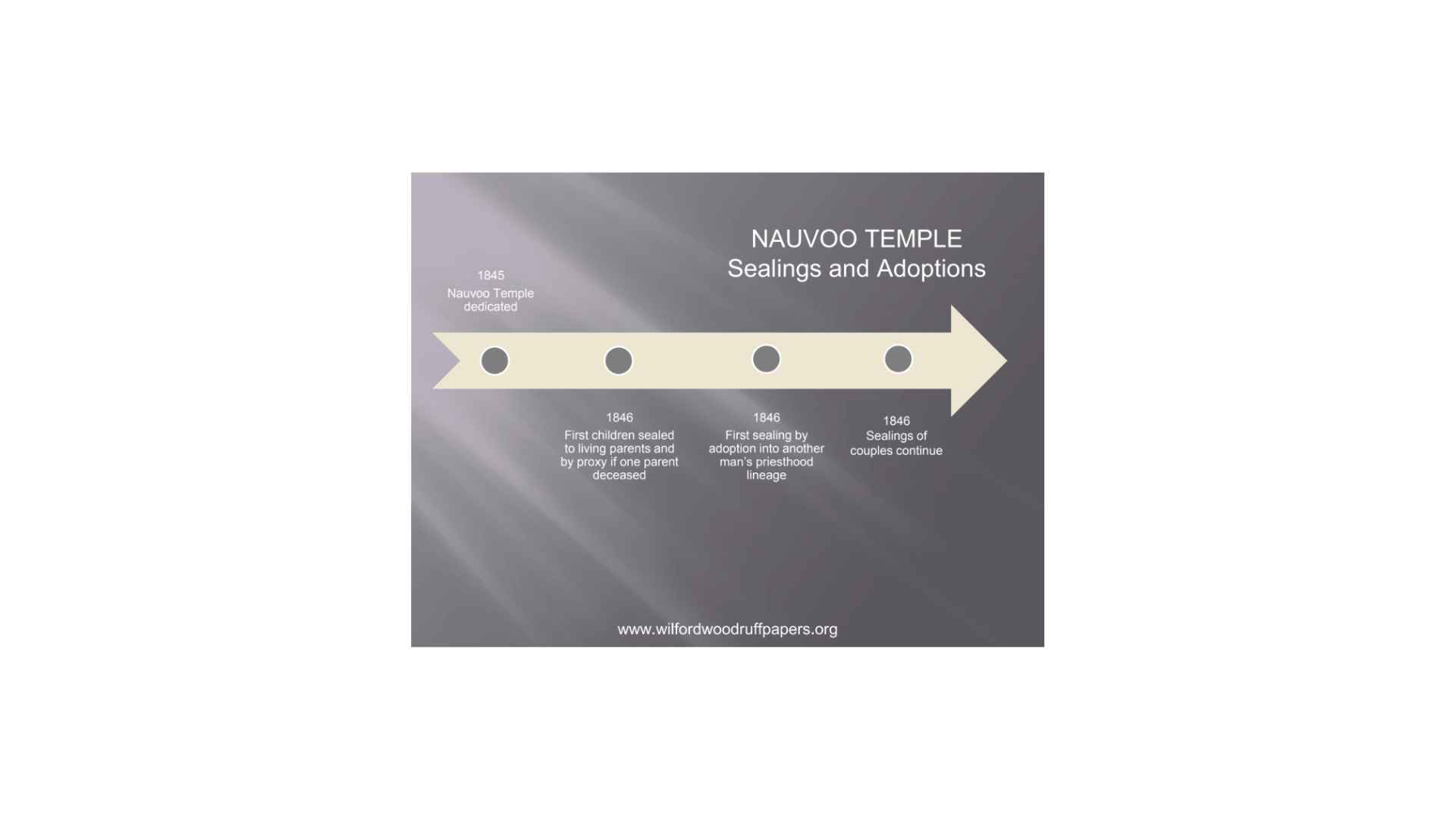
Brigham Young was the one who was able to first administer that ordinance, and in addition introduce the law of adoption, the sealing into another’s priesthood lineage, something that was part of temple ordinances until the revelation that Wilford Woodruff received in 1894.
Development of Temple Doctrine
So understanding this critical change in the development of temple doctrine and understanding Wilford’s role in it is life-changing is something that particularly the rising generation has lost sight of and many of us don’t understand. If we said the law of adoption to 90% of church members they may never have heard of it, and yet that is something that comes up in their family history work in their understanding of why their great-grandfather was sealed to George Q. Cannon instead of their great-great-grandfather.
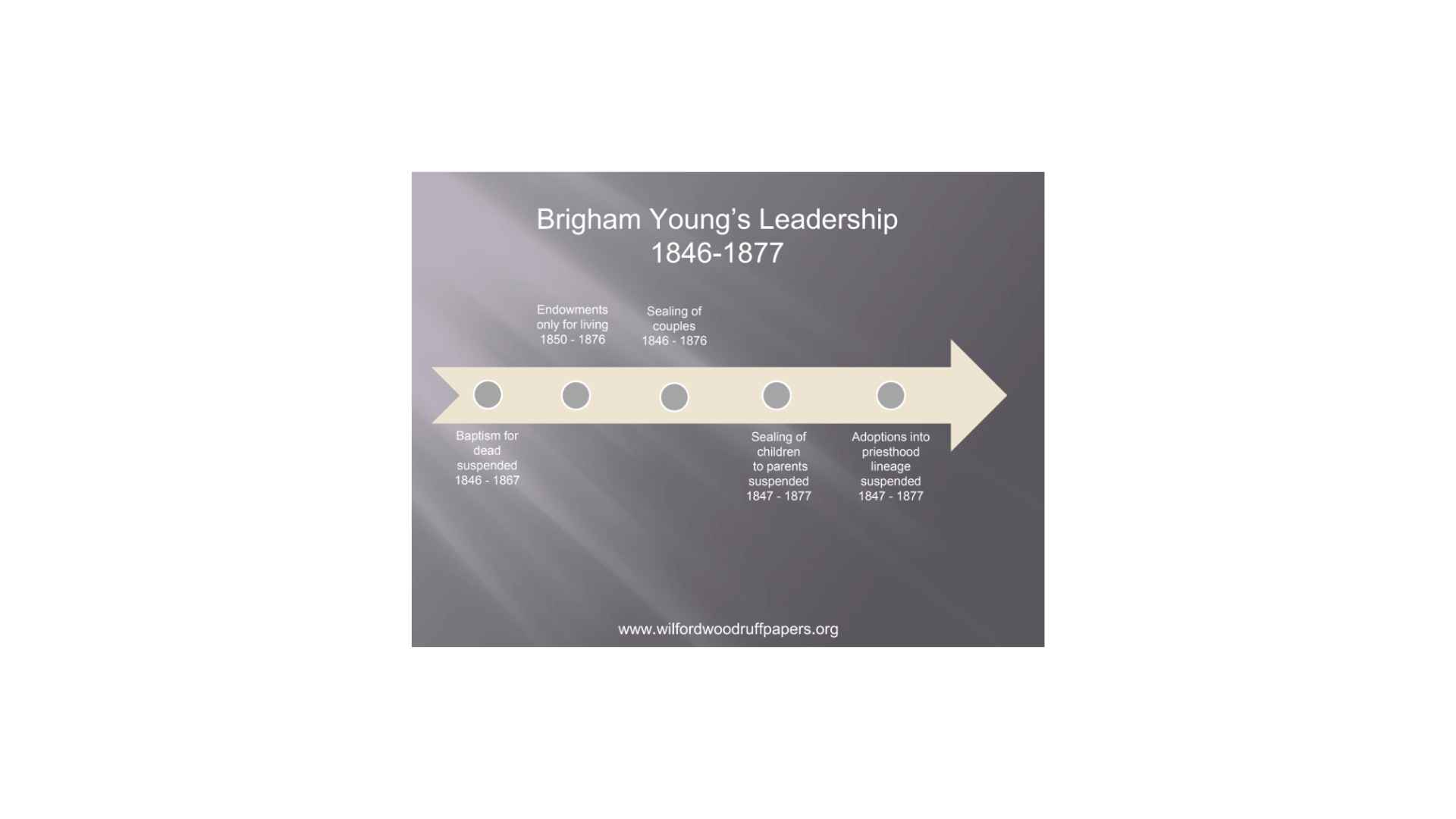
So the 30 years in between the Nauvoo Temple and the Saint George Temple was a difficult time for the saints but also a struggle to maintain the ordinances that had started in the Nauvoo Temple. So some ordinances were suspended, some were discontinued, and some were administered in various non-temple locations like the Endowment House or the Council House or Brigham Young’s office, even in members’ homes. And the highest ordinances, which was the sealing of parents to children and the law of adoption, were not performed in this interim period.
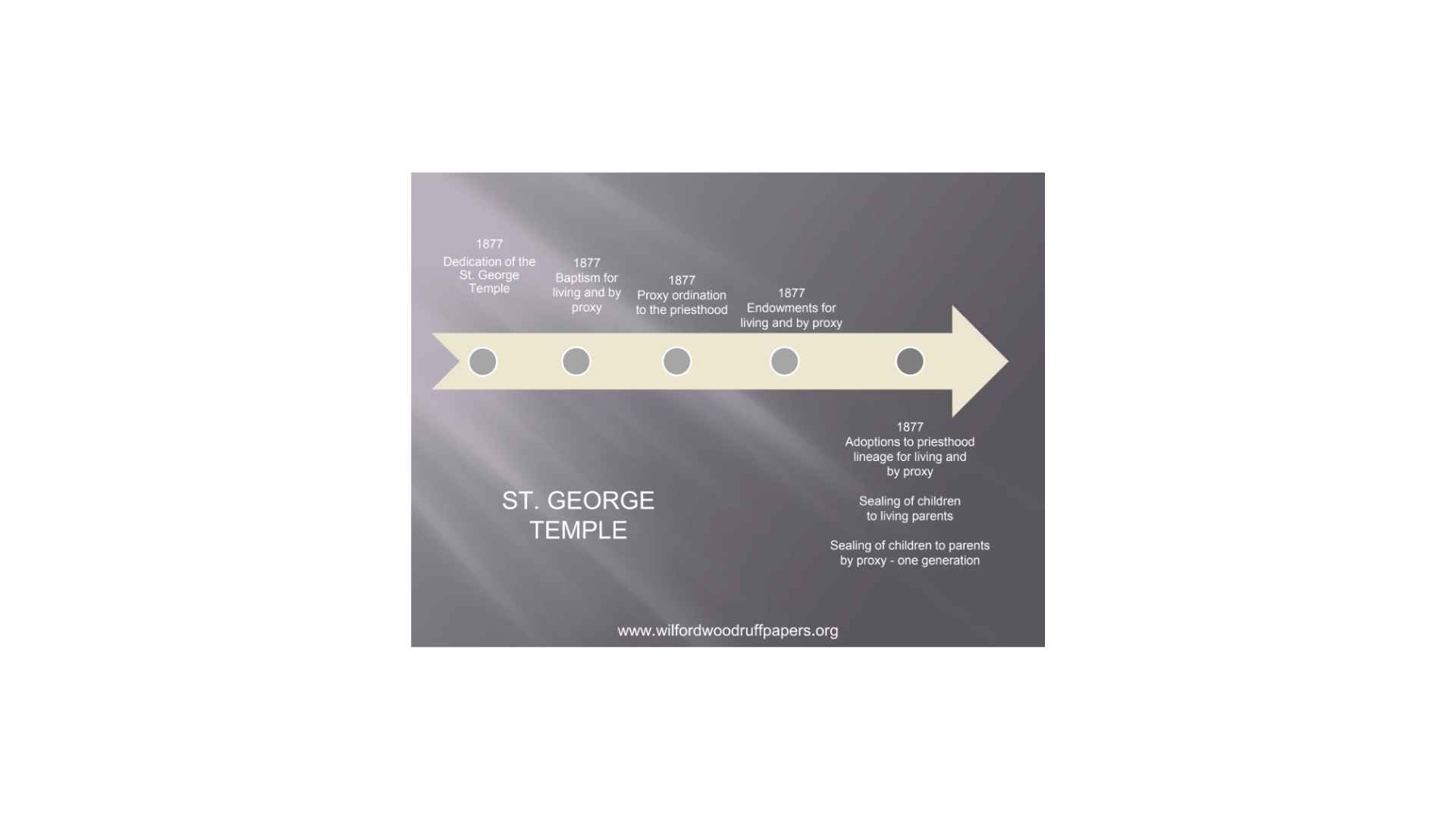
So it wasn’t until the St George Temple that all ordinances for both the living and the dead were administered, the first proxy ordinations, the first proxy endowments, and the first sealings, one generation. The feeling at that time was that you could only seal as Joseph had instructed in 1840; you could only do the ordinances for those who were worthy, and if it was for someone outside your family, then a ministering angel needed to come and authorize that.
50 Years Later
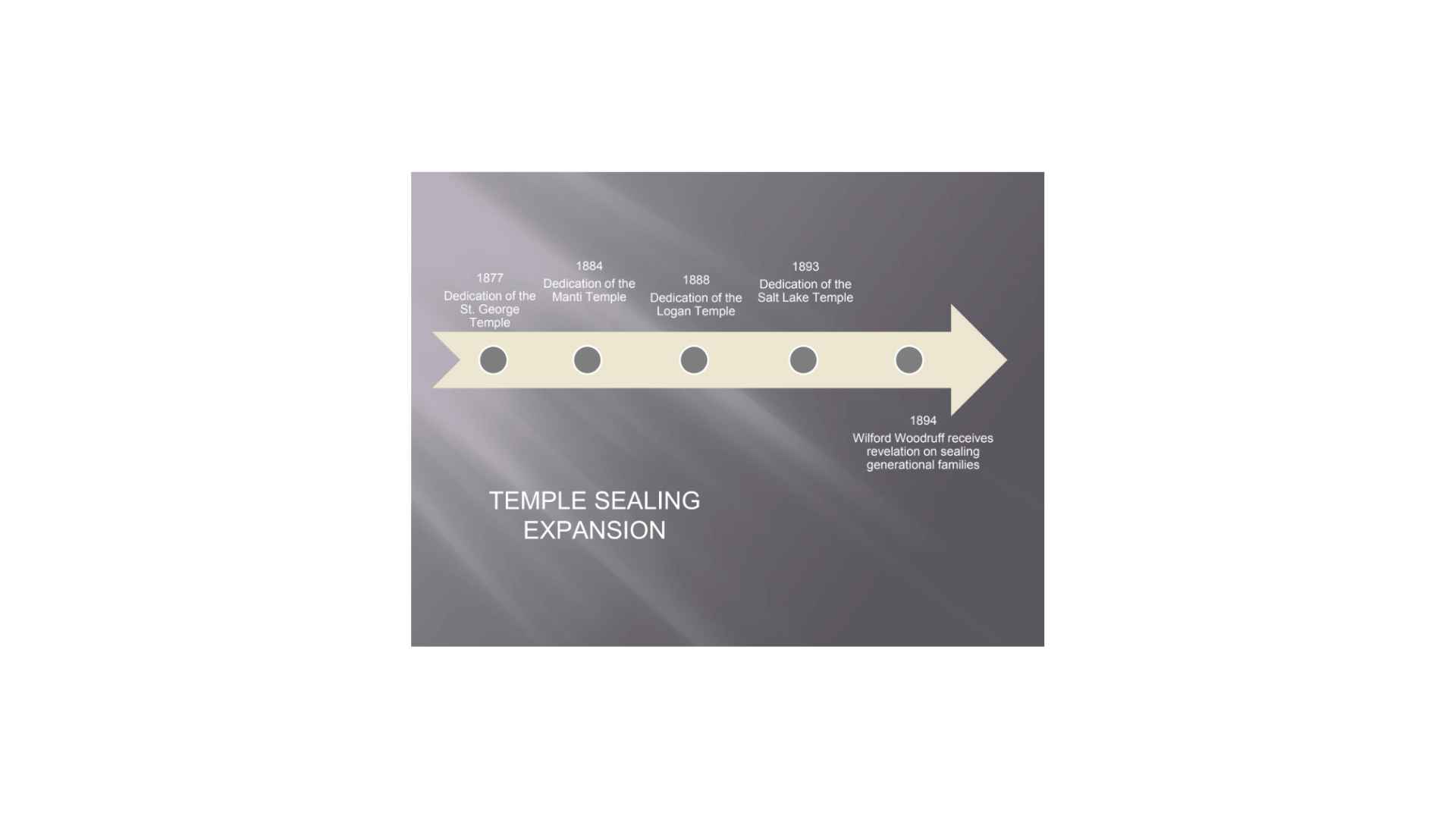
As Joseph Smith, Brigham Young only lived four months after these ordinances started in the Saint Church Temple, and he was unable to complete what Joseph Smith had explained as the mission of Elijah. And during this period, it was Wilford Woodruff who presided over first the St. George Temple, and then those trained in the St. George Temple trained those in the Logan and Manti and then Salt Lake Temples.
But Wilford would have presided over again, the ordinances that were adapted to new temple structures, the ordinances that were refined, the first written ceremonies, and the discontinuing of ordinances including re-baptism and adoption. And it was 50 years after Joseph Smith’s death, 50 years and one month after Joseph Smith explained what the office and mission of Elijah was about, when Wilford Woodruff received the revelation ending the law of adoption and beginning multi-generational sealings.
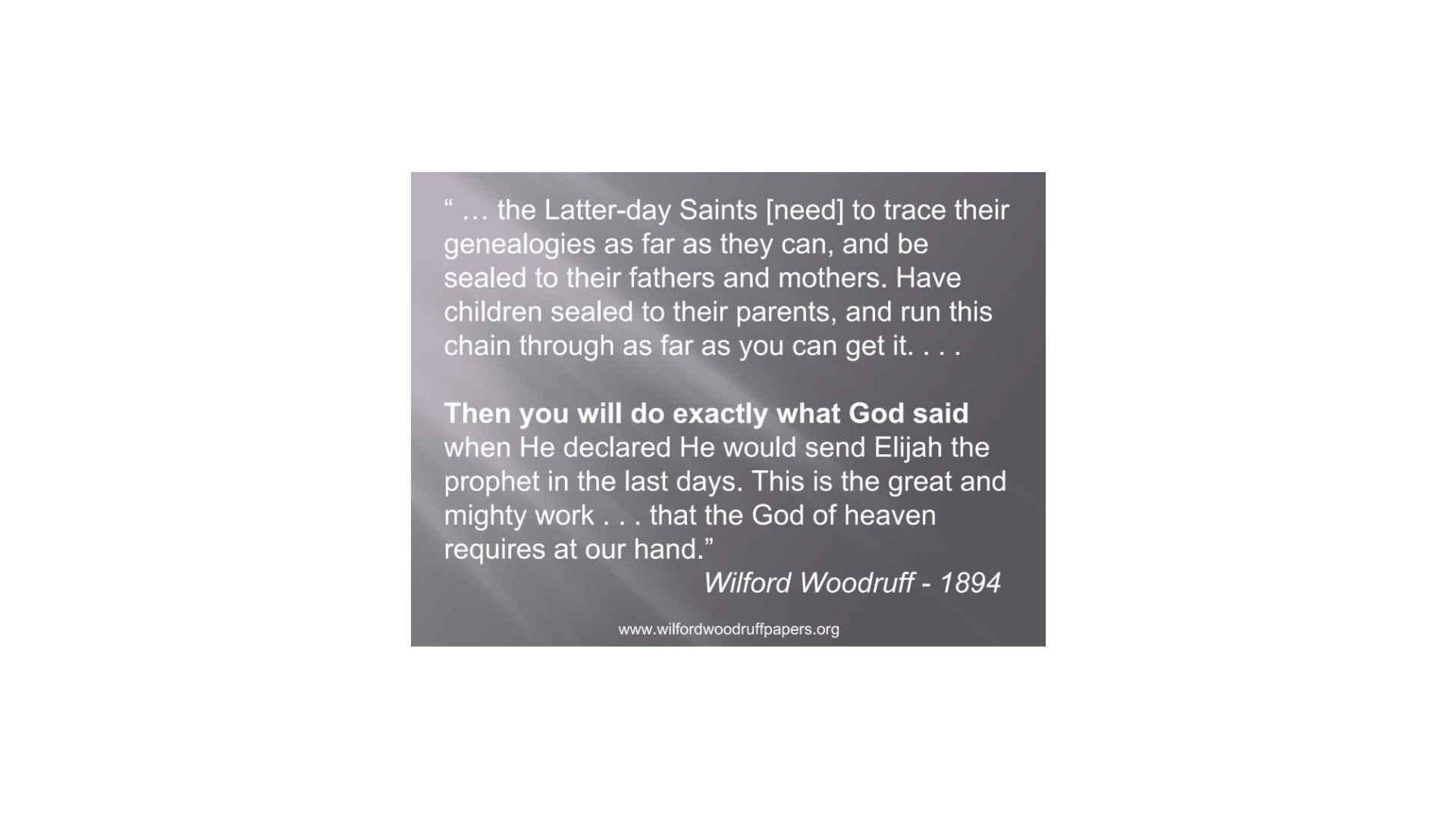
It was April 1894 conference, and he assured the saints that they had done well, that they had acted up to all the light and knowledge that they had, but there was more to be revealed. And it wasn’t just more to be revealed for them, but it was to satisfy God. He reiterated almost word for word what Joseph Smith had explained in March of 1844: that the saints needed to trace their genealogies as far as they could.
That meant gathering information on those who had died, even those who had perhaps disowned family members for joining the Church or being unfaithful during their lifetimes. He said it is only if we do this, to run this chain as far as we can, that then we will do exactly what God intended when he declared he would send Elijah in the last days.
Understanding
For many, it was a difficult thing. There were about thirteen thousand adoptions performed, and the understanding of what would happen or what needed to happen with those was a question. This is only one example of the unique account that Wilford Woodruff has that helps us understand truth to help us get closer to the whole truth, to understand truth in context, and to accomplish what Joseph understood but wasn’t able to do, what Brigham Young had an inclination of an understanding of and was not able to finish.
Why it took 71 years from Moroni’s introduction of Elijah’s mission to this revelation would take a book to explain, but it’s one of the most important topics that we can understand.
So the mission of the Wilford Woodruff Papers Foundation is to publish everything that Wilford Woodruff ever wrote that has survived. To share his eyewitness account of the restoration of the gospel of Jesus Christ for those 65 years.
But more important than his words are his stories, and to make those records universally accessible is with the hope that will inspire all people but especially the rising generation to study and increase their faith in Jesus Christ and better understand the temple.
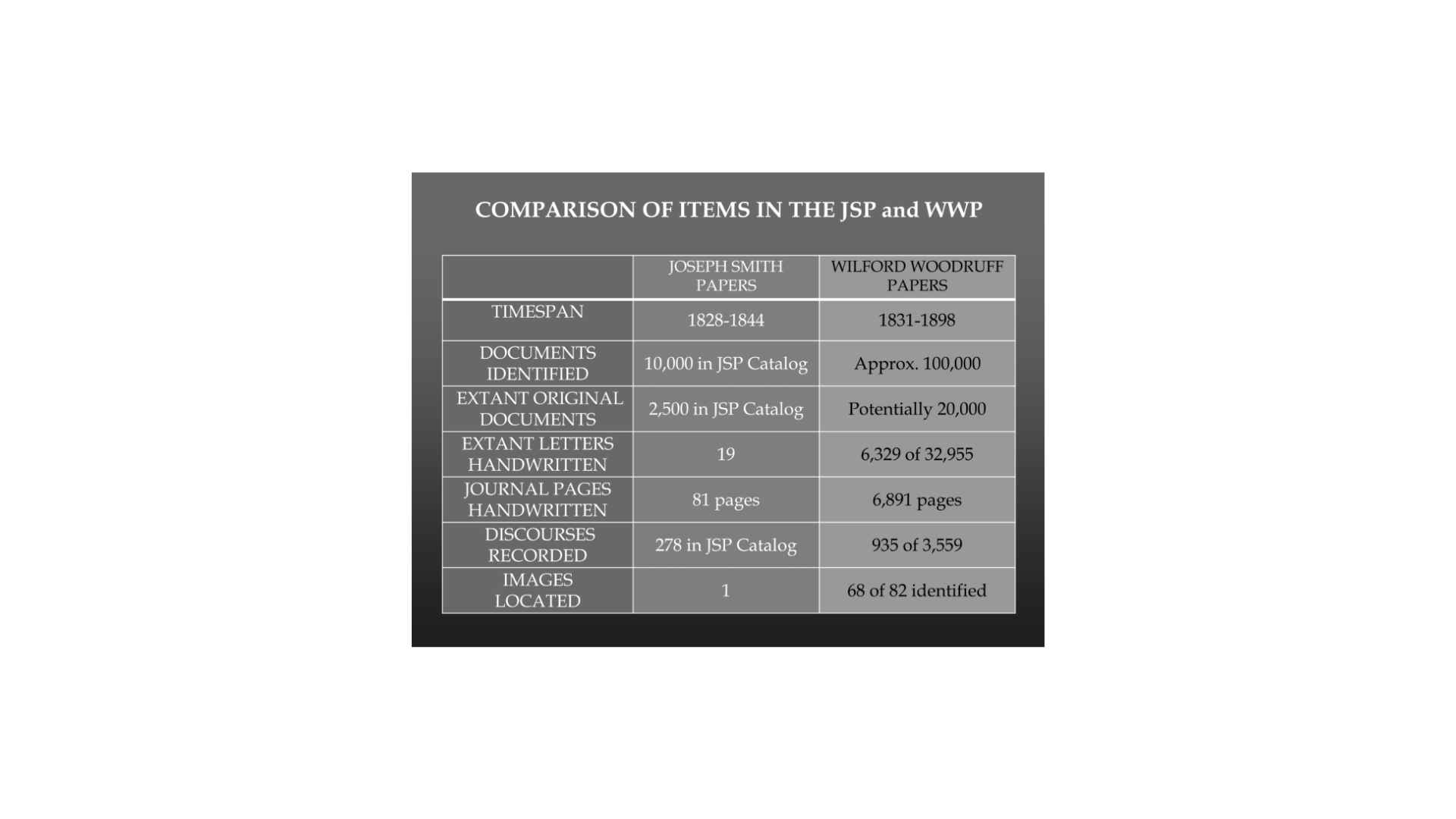
Comparison of JSP and WWP
This slide is because the first question I usually get is “How do you compare apples to apples with the Joseph Smith Papers and the Wilford Woodruff Papers?” When we met with the Church History Department to get their support, their access to records, their understanding of what we were doing, and to gain their knowledge of what they had done, they basically said, “Do you have any idea what you’re getting yourself into?” And the answer is yes.
The exponential difference in the number of documents between the Joseph Smith Papers and the Wilford Woodruff Papers is something we do understand because he wrote everything down. We know exactly how many letters he wrote, and we have found 6,329 of those. We know exactly how many discourses he gave, 3,995, and we’ve been able to locate 935 of those. The total number of pages is yet to be determined, but the way that the Joseph Smith Papers labels or categorizes their documents is an original document is one that was the first recording of it, not the one that was published in the newspaper or the one that was published in the Millennial Star, to try to get back to the original writing or the first record of it or the most complete record of it.
Just the Beginning
So we are just starting that process. The discourses won’t be started until March of 2022, but we do have a record of every letter. In fact, the catalog is about a million cells of data at this point. As I said before, the mining of that information to understand that it is actually new Church history that it’s never been published before is exciting.
I have seen the marketing of the amazing websites that other speakers have talked about, and I don’t know why anybody needs marketing when you get to read this stuff for free. It’s just, why would you need to convince somebody to do that? I get up every morning so excited that this is what I get to do. But as Evidence Central and those kinds of things, to make it accessible is one thing. It’s an open access website that we’ve set up, but that doesn’t mean people are going to come. And part of the beauty of technology is the context that you can put these things in.
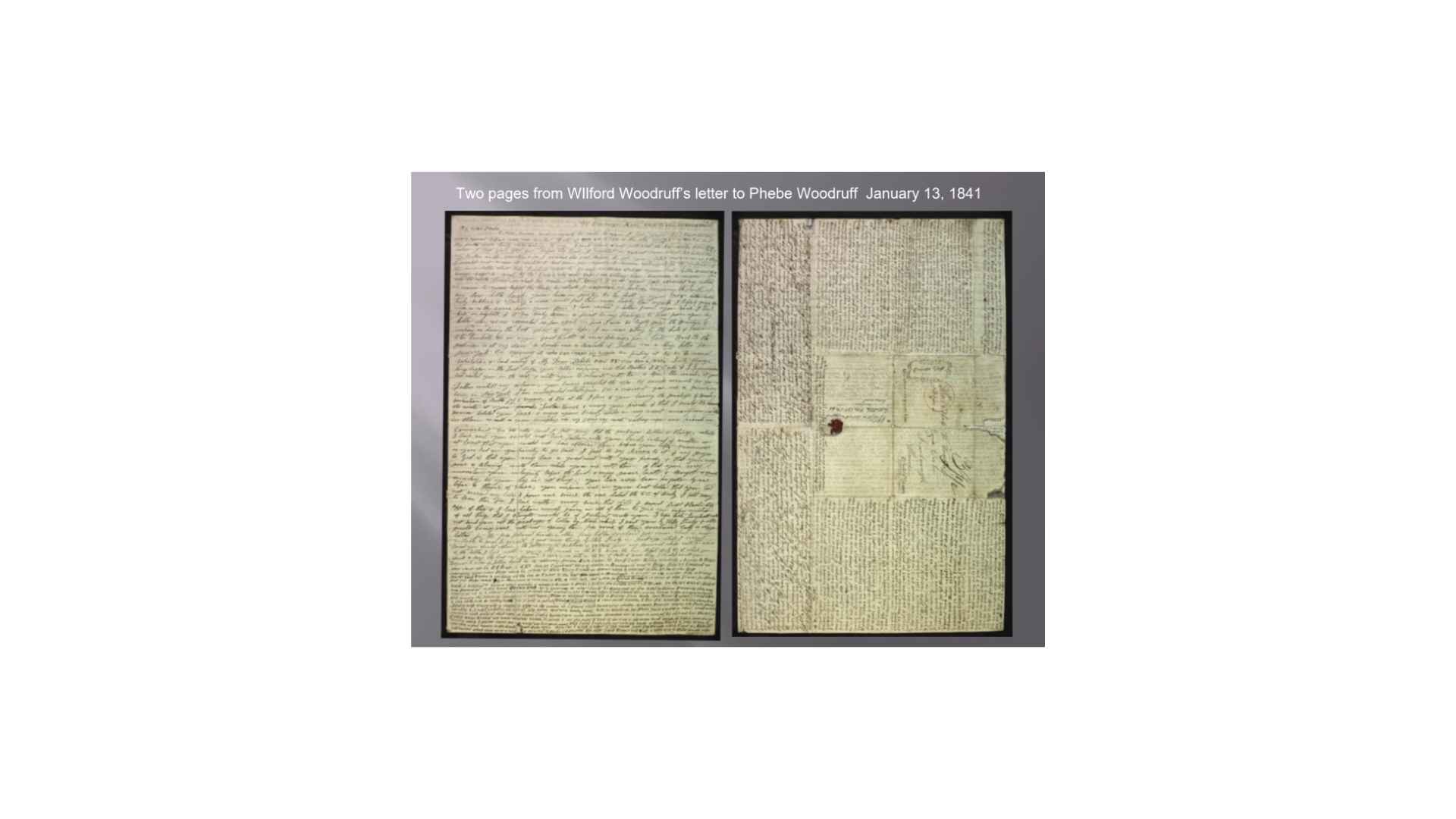
Approaching Wilford Woodruff’s Documents
So to give you a quick idea of how we’re approaching this, these are document samples that we’re working with. This is two pages of a four-page letter that Wilford Woodruff wrote. Some of this is impossible to read; we call it Wilfordish because it’s not really English. His spelling is so creative that there’s no way that any computer could follow it. Also, there’s no way to decipher it. We have people that have offered to use AI or something, but he includes Deseret alphabet, Pitman shorthand, Taylor shorthand, and his own version of all those. So it’s an adventure.
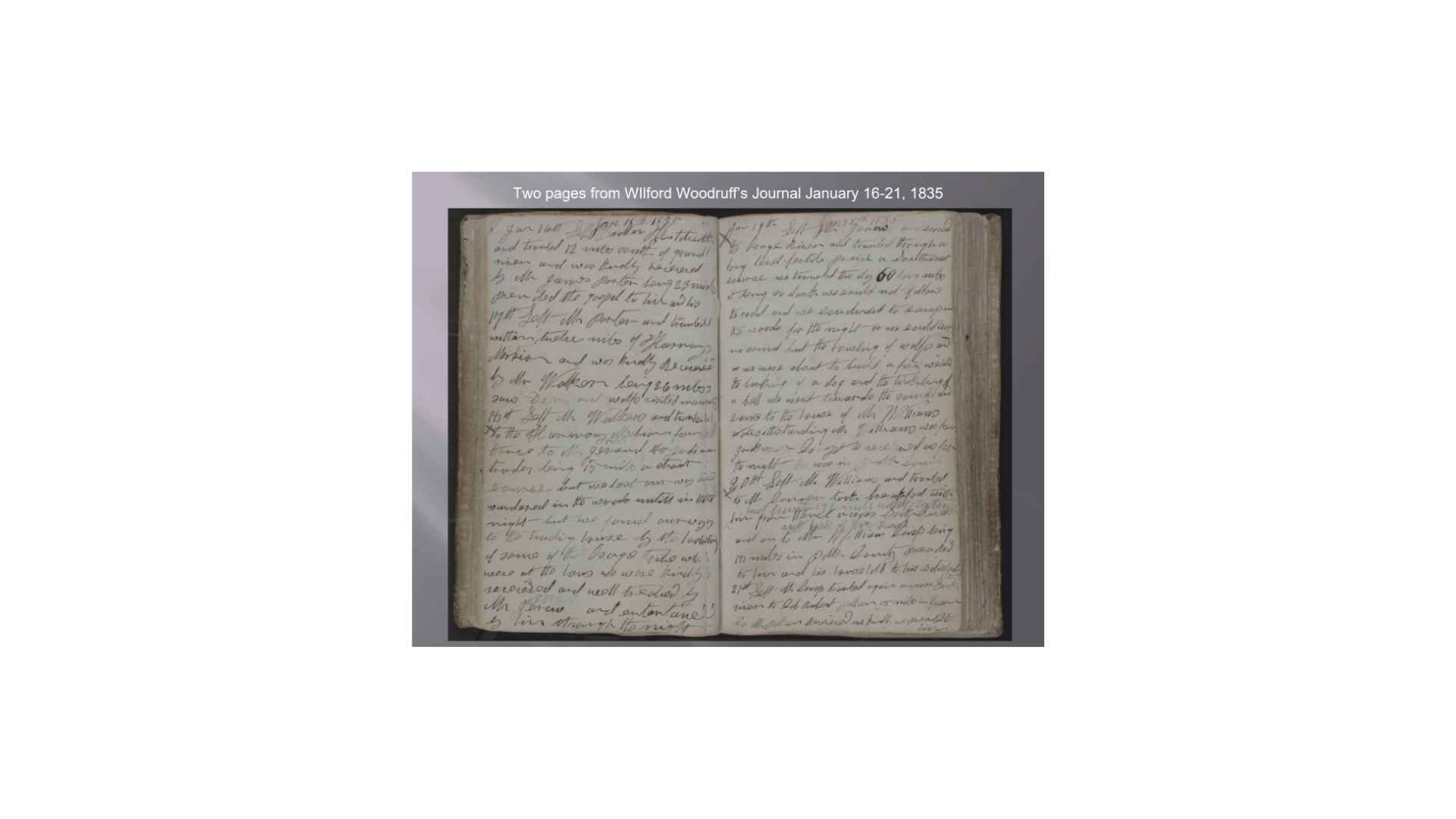
This is two pages of his journal again; you just have to kind of let your brain relax when you look at these things because if you try to decipher letter by letter it’s impossible.
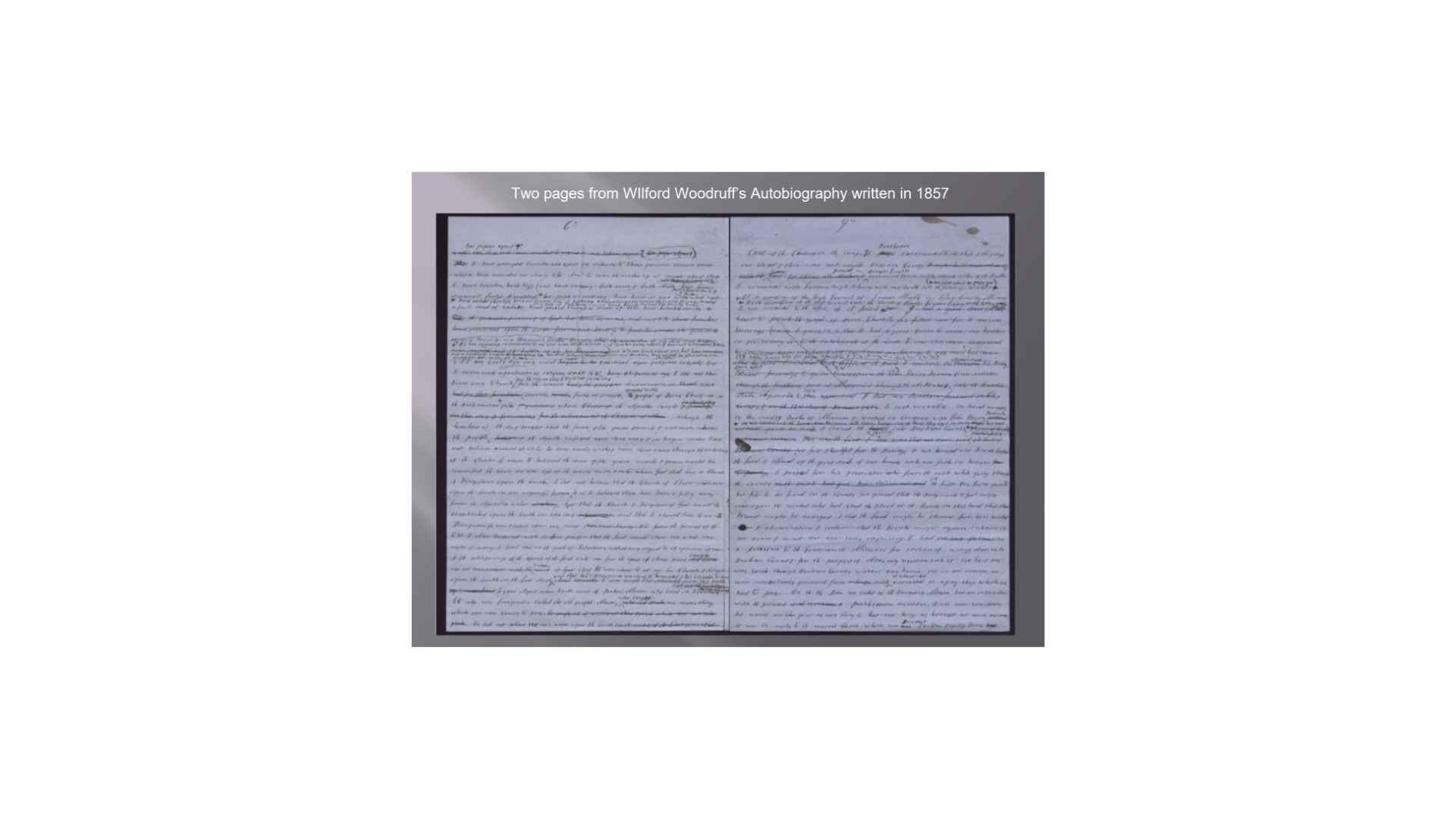
This is the first draft of his autobiography written in 1857. He’s famous for his near-death experiences and accidents, and this is the first writing of what happened.
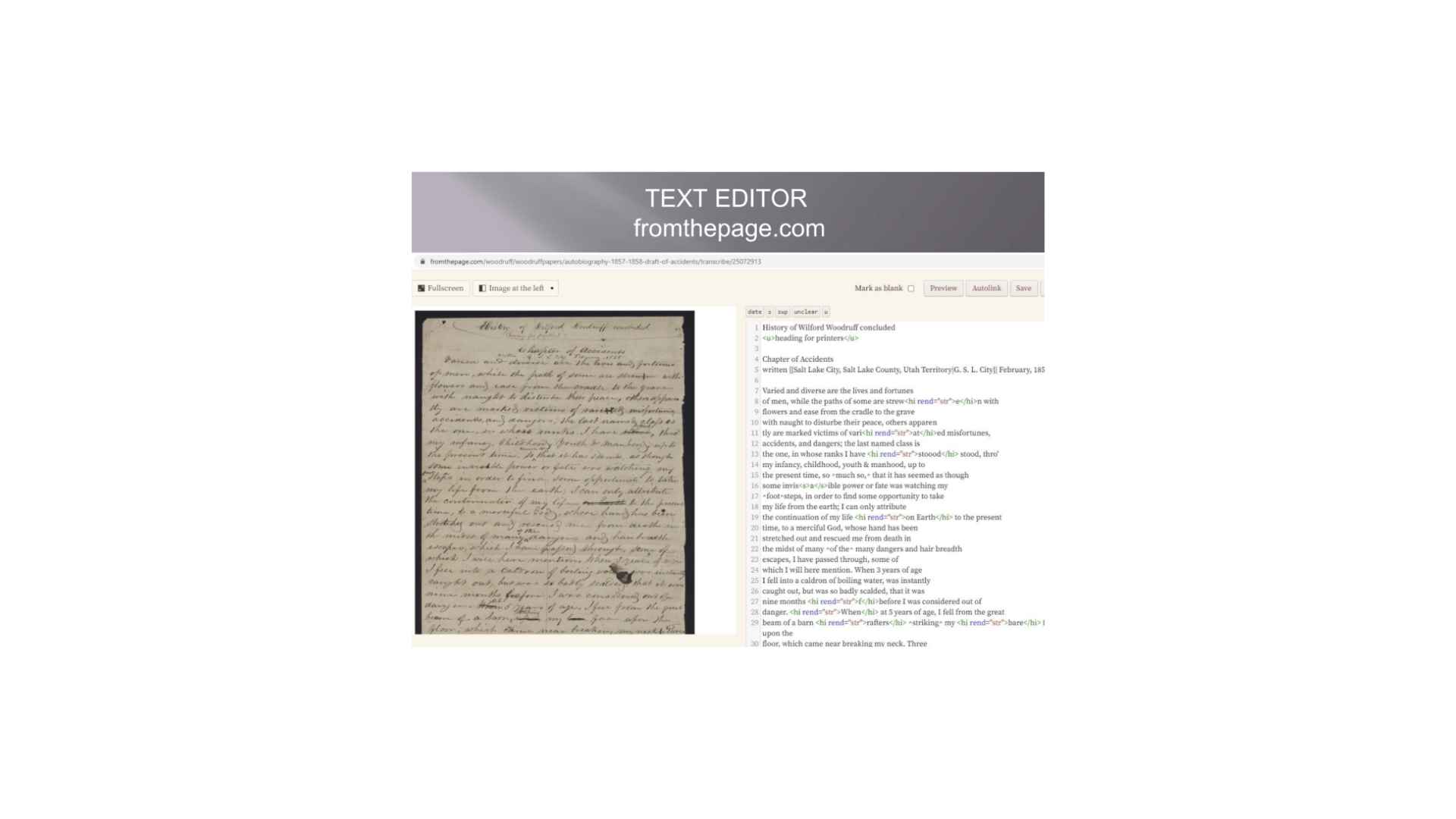
The text editor we’re using is fromthepage; it’s an open-access editing site, and there are hundreds of papers and other projects. Even the Library of Congress is doing crowdsourcing transcription of documents, which is what we’re using as well. So if any of you have an hour or two, or even 10 minutes, you can get a free account, sign up, and read a Wilford Woodruff document, be the first one to ever do it, and we’d be thrilled for your participation. The coding is HTML, and those kinds of things are built into the system so it helps very much. We have volunteers from the age of 15 to the age of 86 right now, and they’re incredible.
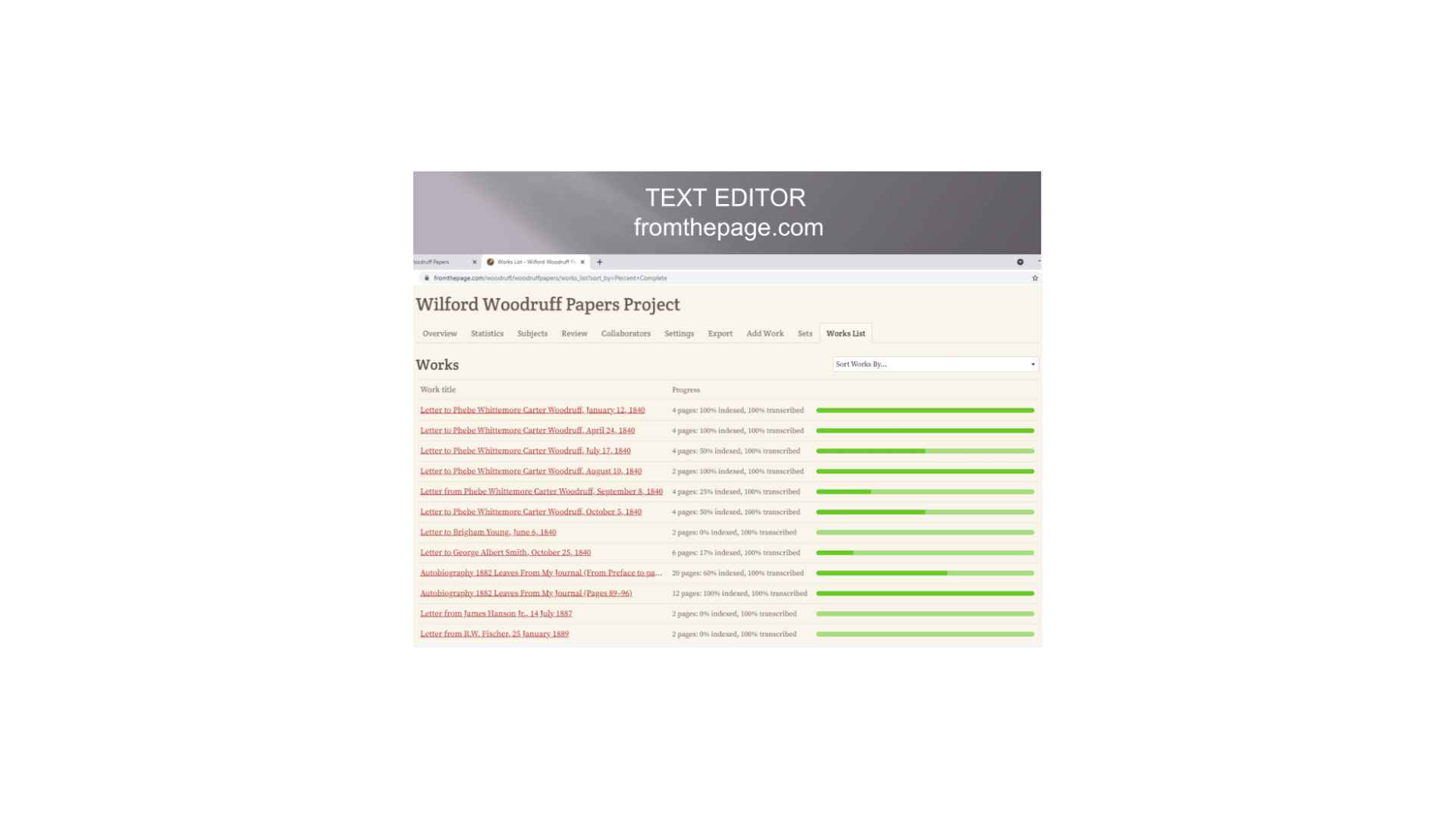
Utilizing the Text Editor
This is what the text editor produces for us, which is an understanding of which documents have things needed to be done, whether that’s transcription or verification. Our first upload was March 1st of this year, and we had 1500 pages, which only represented about eight documents.
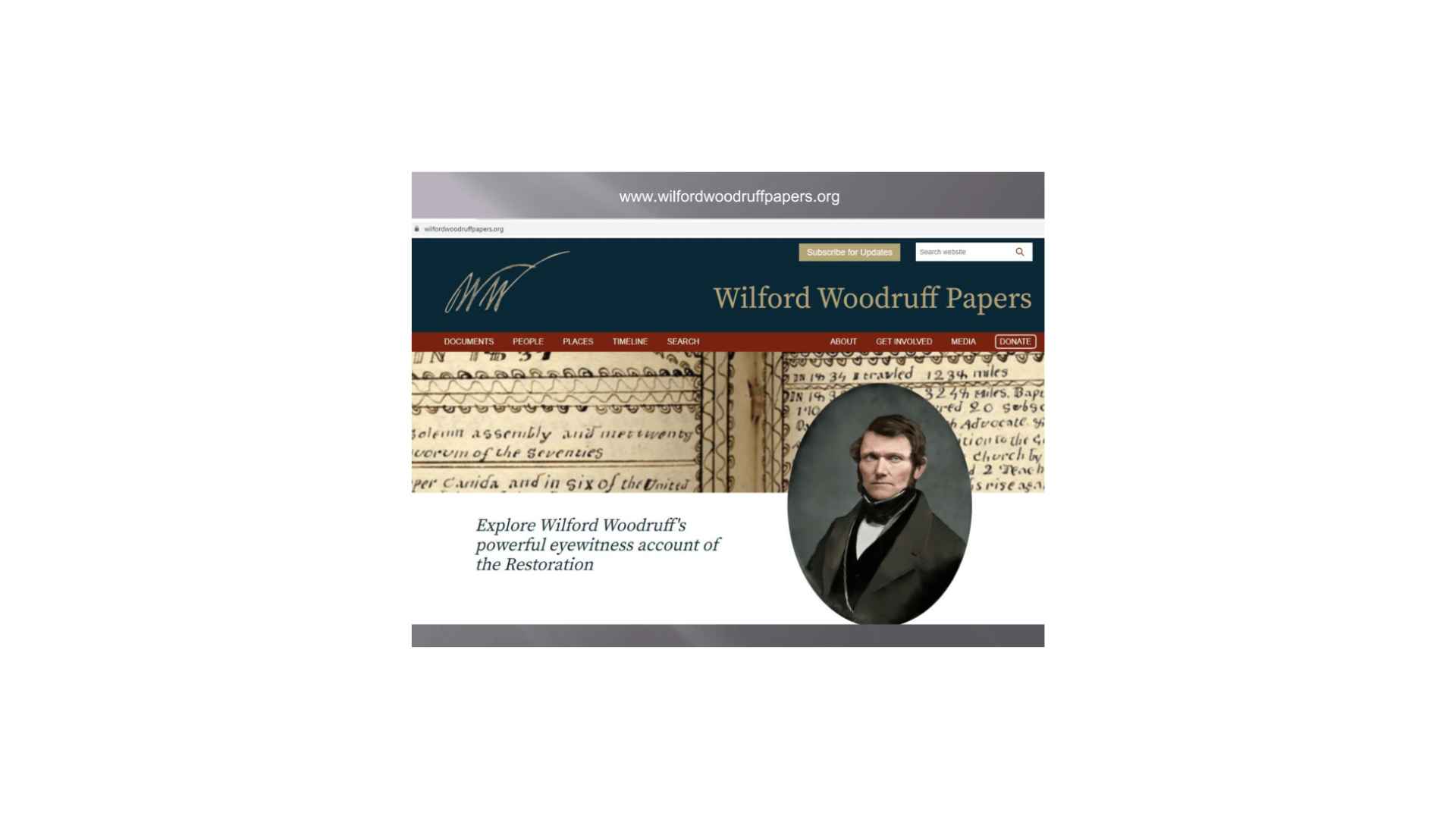
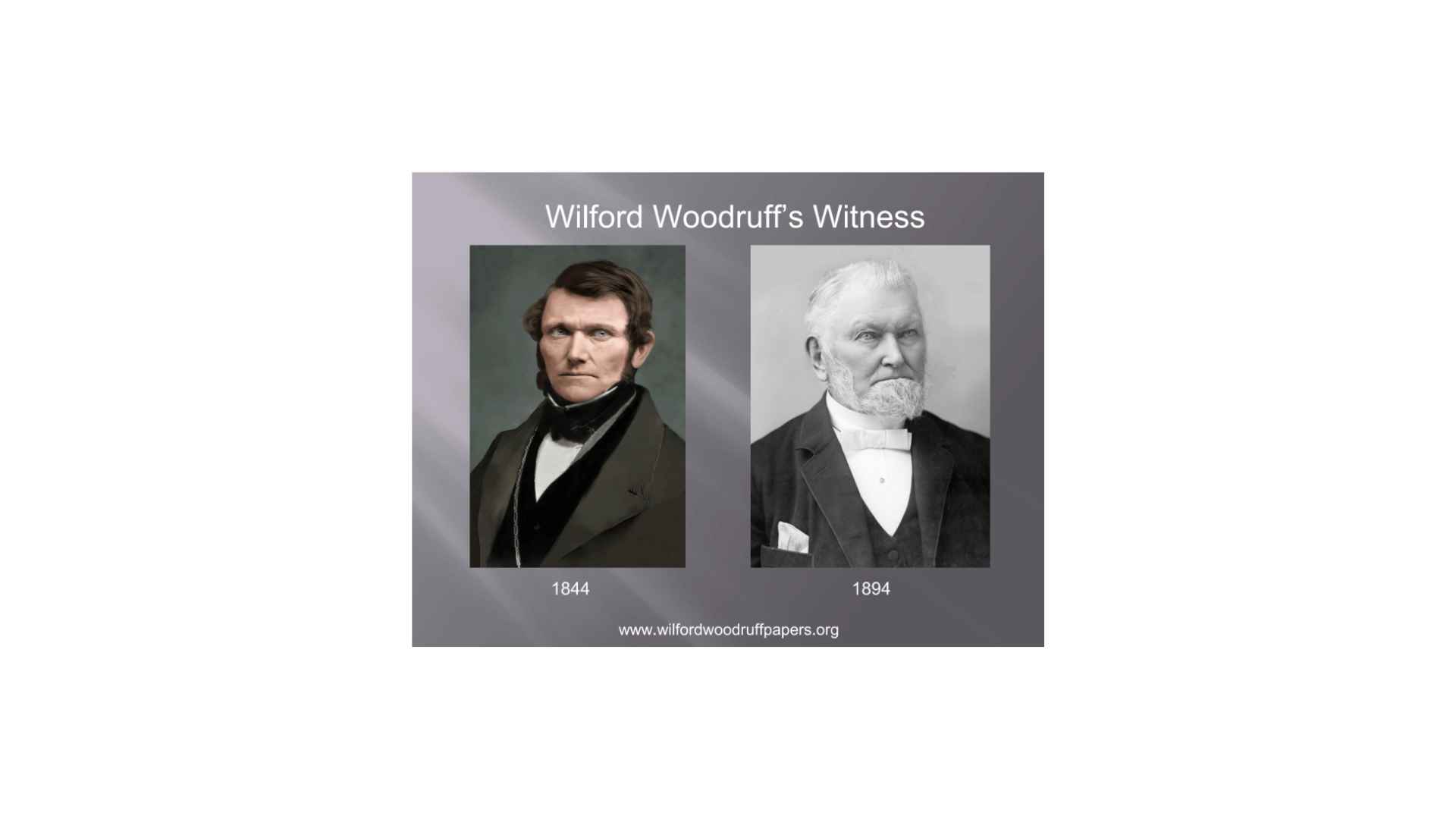
The website is beautifully designed, as it needs to be. Again, I don’t know why you need to ask anybody to read these things; they should just wake up wanting to. But this is a colorized image of Wilford Woodruff, and it’s the earliest image found of any of Cur church leaders.
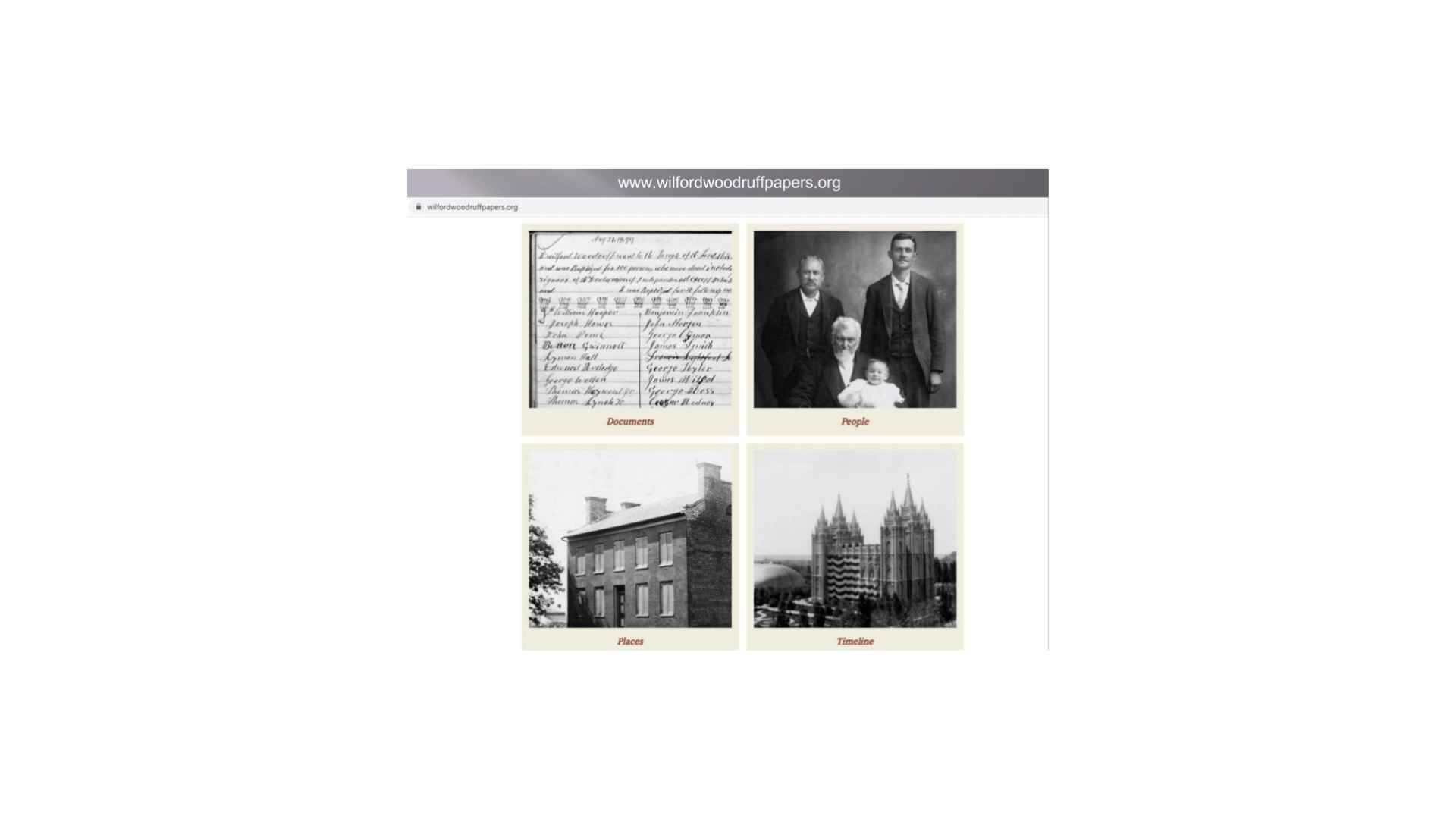
On the website, again it’s not just the documents, it’s the context for those documents, understanding the people he interacted with, their stories, their lives, their relationship with the Church.
The last speaker spoke of Joseph Smith’s candidacy for president of the United States, and his running mate could have been Solomon Copeland. Wilford Woodruff taught him, healed his wife, baptized his wife, and two other people in their household and wrote a letter asking him if he would be the vice-presidential candidate. You can find that information on the website.
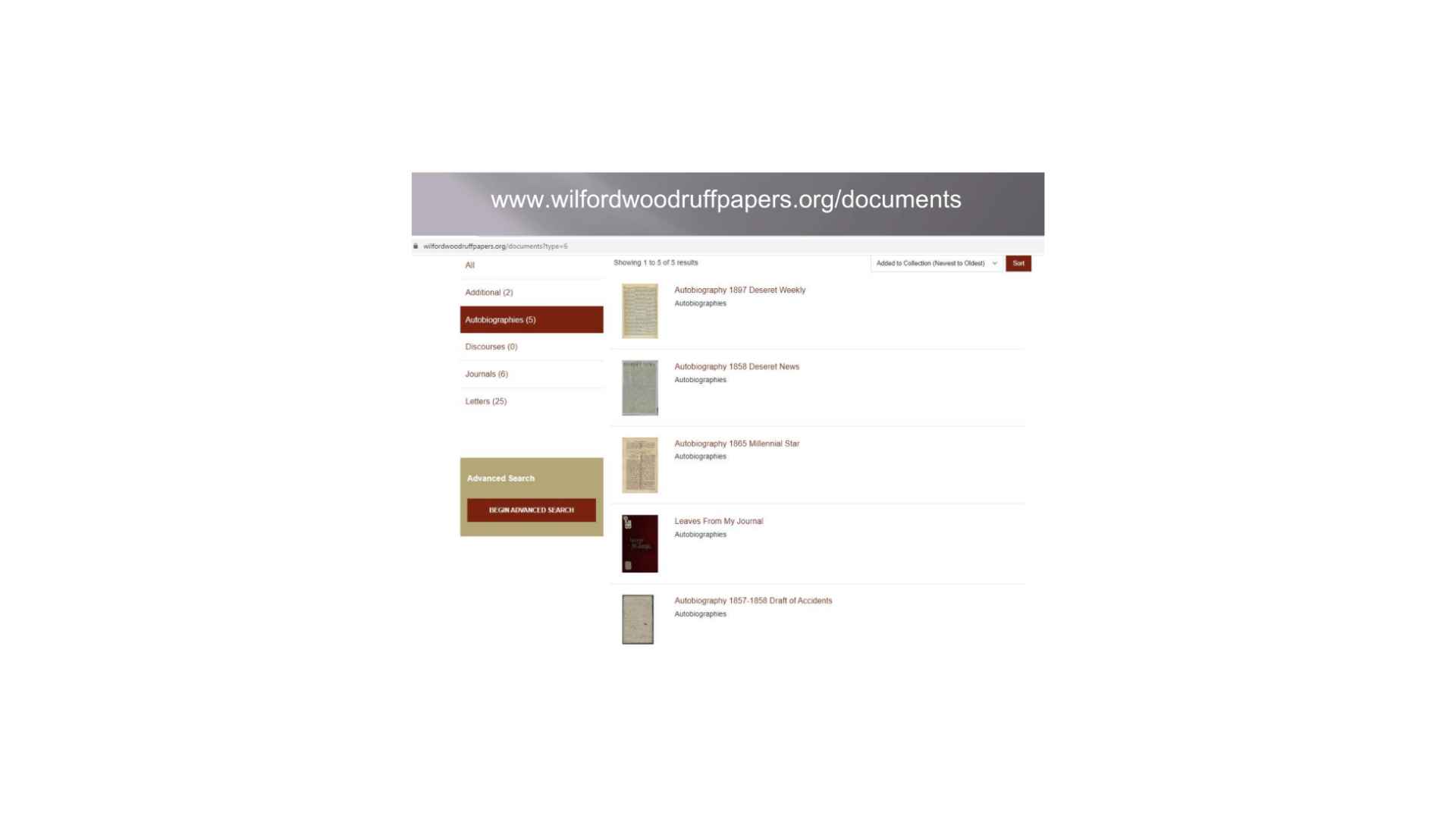
Once we transcribe a document, then it moves to the website, and you can see the five autobiographies here. On September 1st, the other six autobiographies will be uploaded, and we will have finished all of the autobiographies.
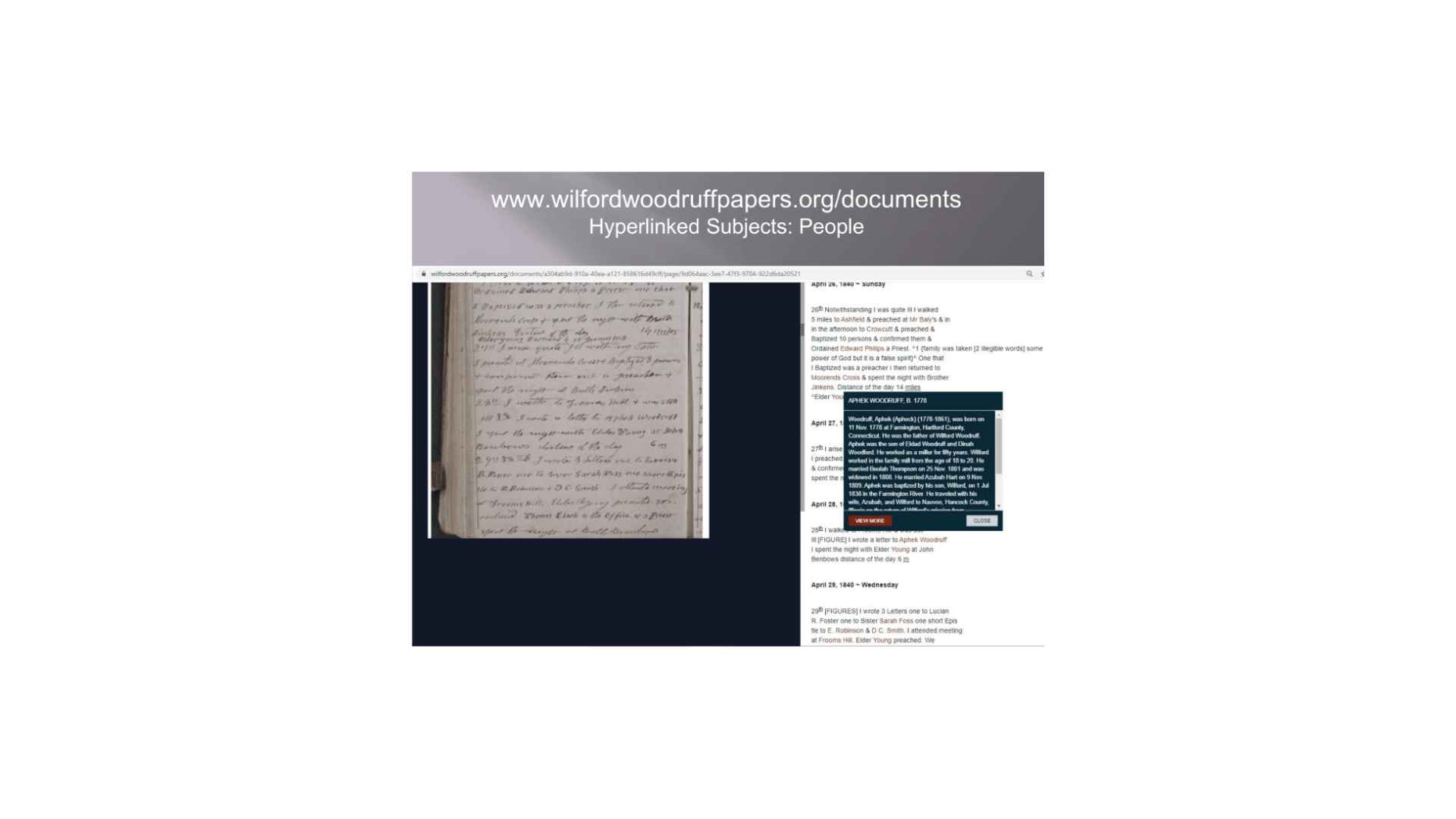
Hyperlinks
Through the amazing technology, you can then go to these documents and click on hyperlinked people, places, topics. This one, for example, is Wilford Woodruff’s father, Aphek Woodruff, and if you hover over the name, you can see the information, or you can click on the “view more” button and see the complete bio, the footnotes, and then the list of all 131 documents that he’s mentioned in.
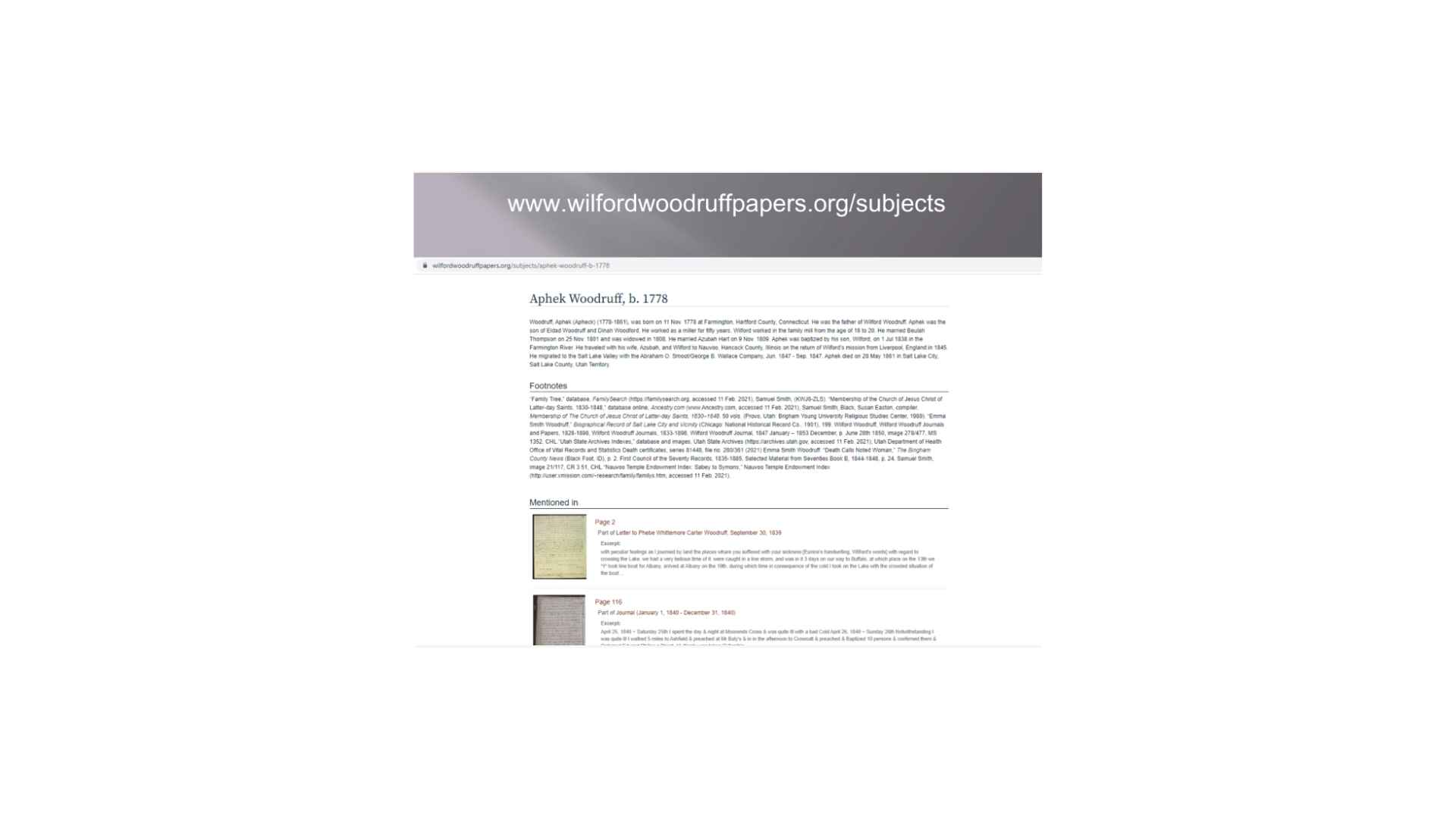
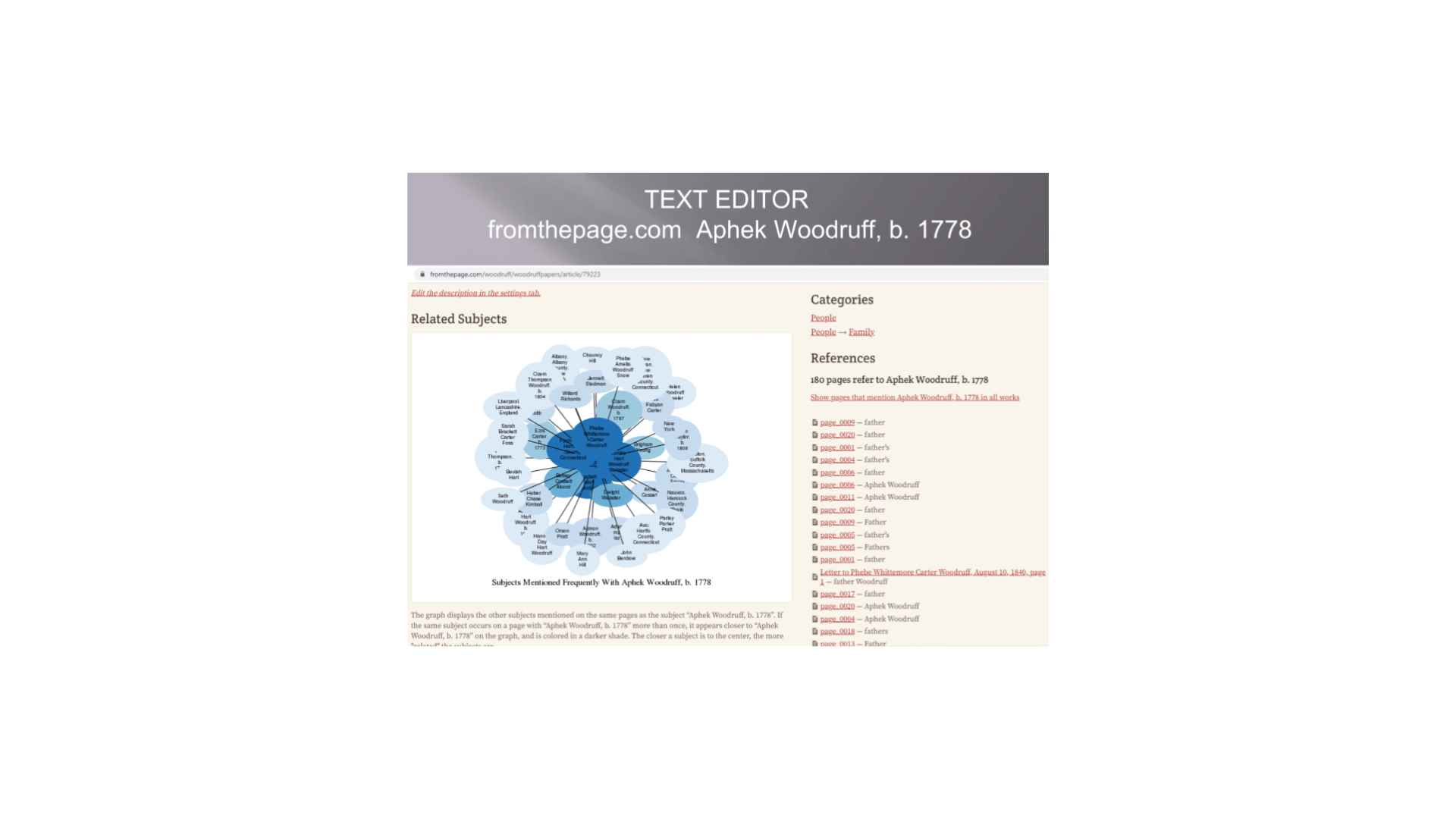
The text editor produces these connections and whether he’s referred to as “my father” or “Aphek” or “Father Woodruff,” it will go to the same person and connect him in any way that he’s referenced in the documents.
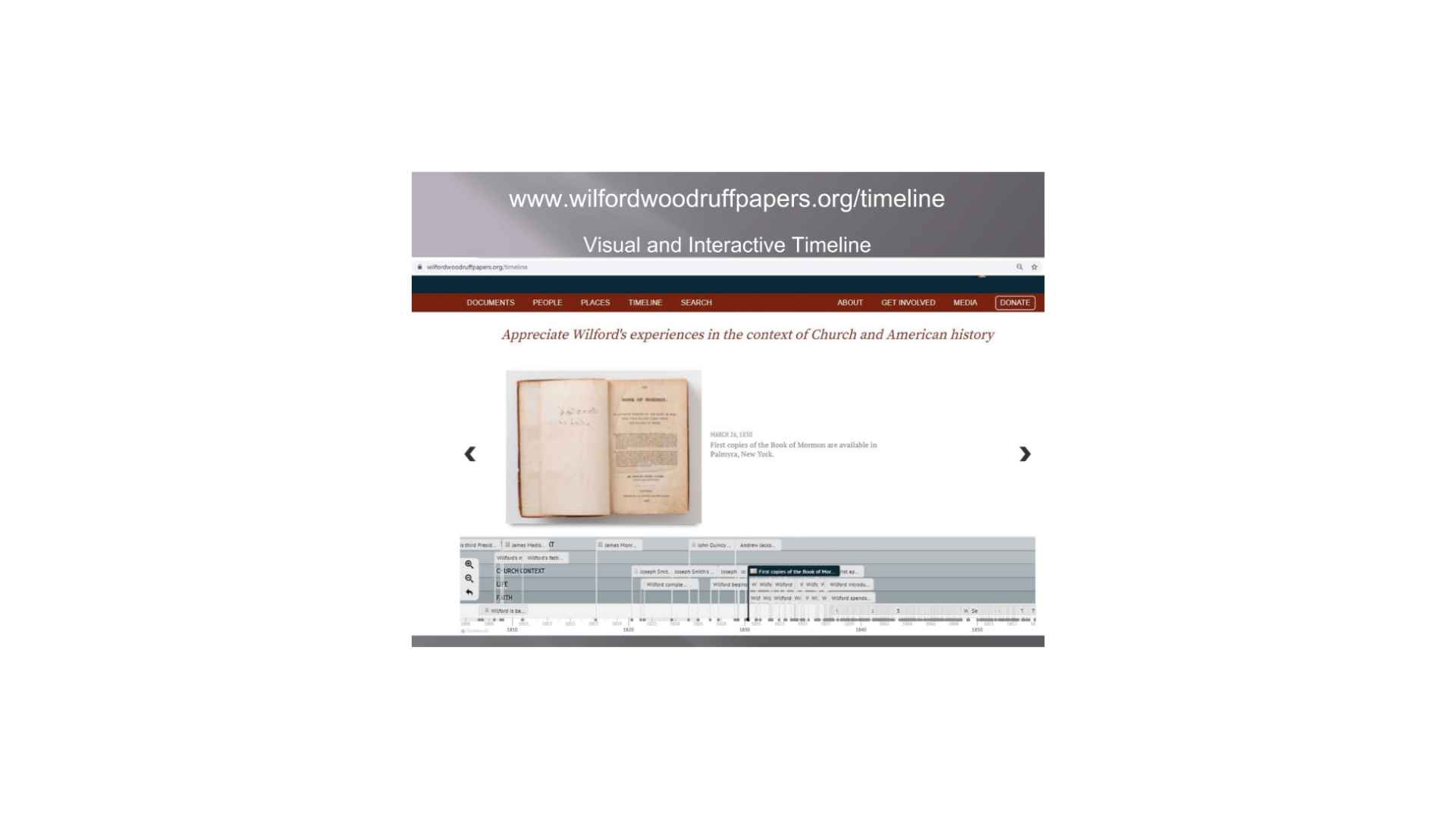
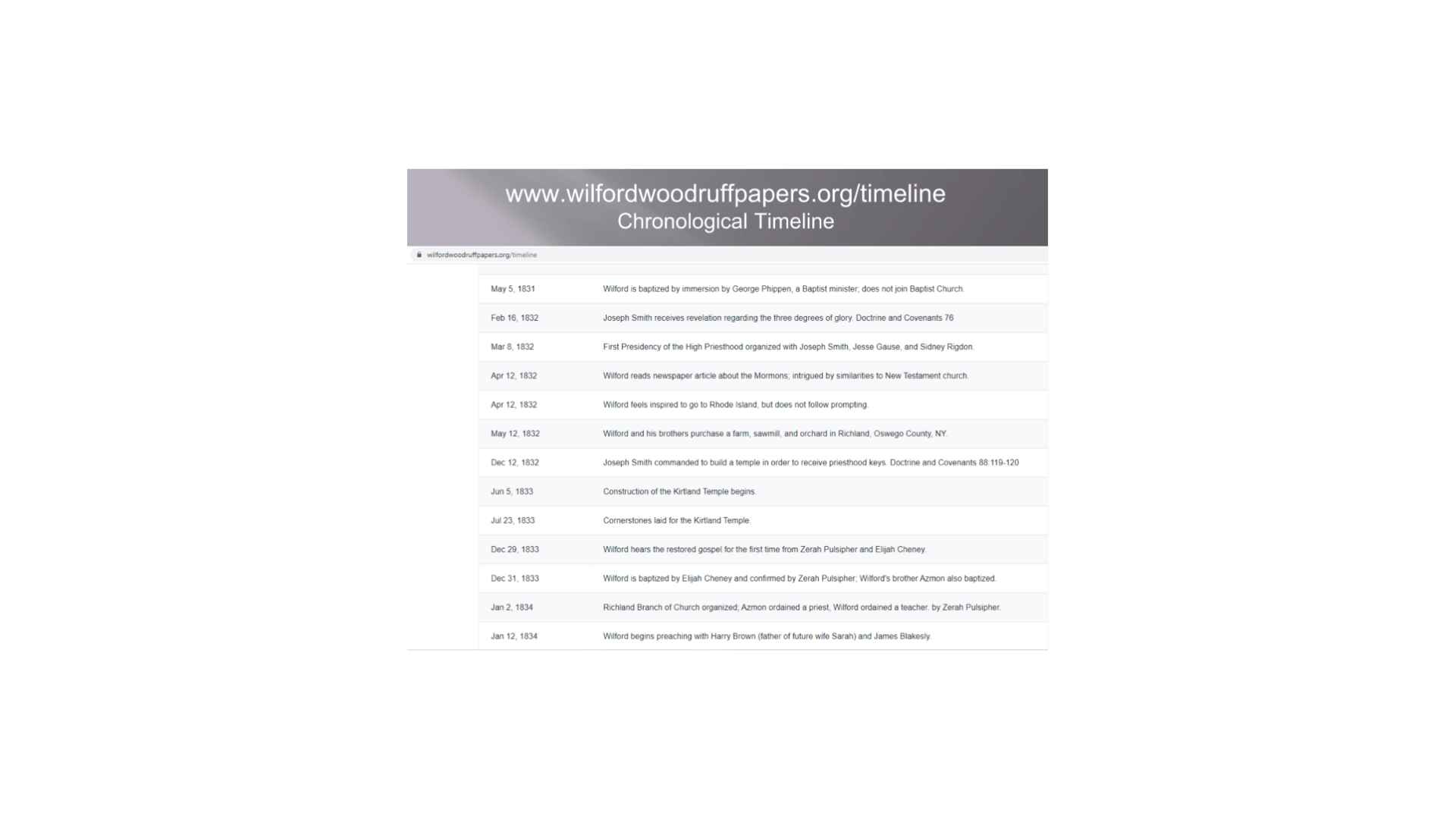
The other thing is a visual and interactive timeline. So when I was doing my research, I had to keep a notebook like when you read War and Peace; you have to write down all the different characters and try to keep them all straight. So the timeline became Wilford Woodard’s life in the context of Church in U.S. history. And not only can you click on the items throughout his timeline, but also we’ll be able to link directly to the documents that they reference. For example, in the journals, we’re only up to 1846, so the rest of the 50 years will be forthcoming. And this is just the chronological timeline.
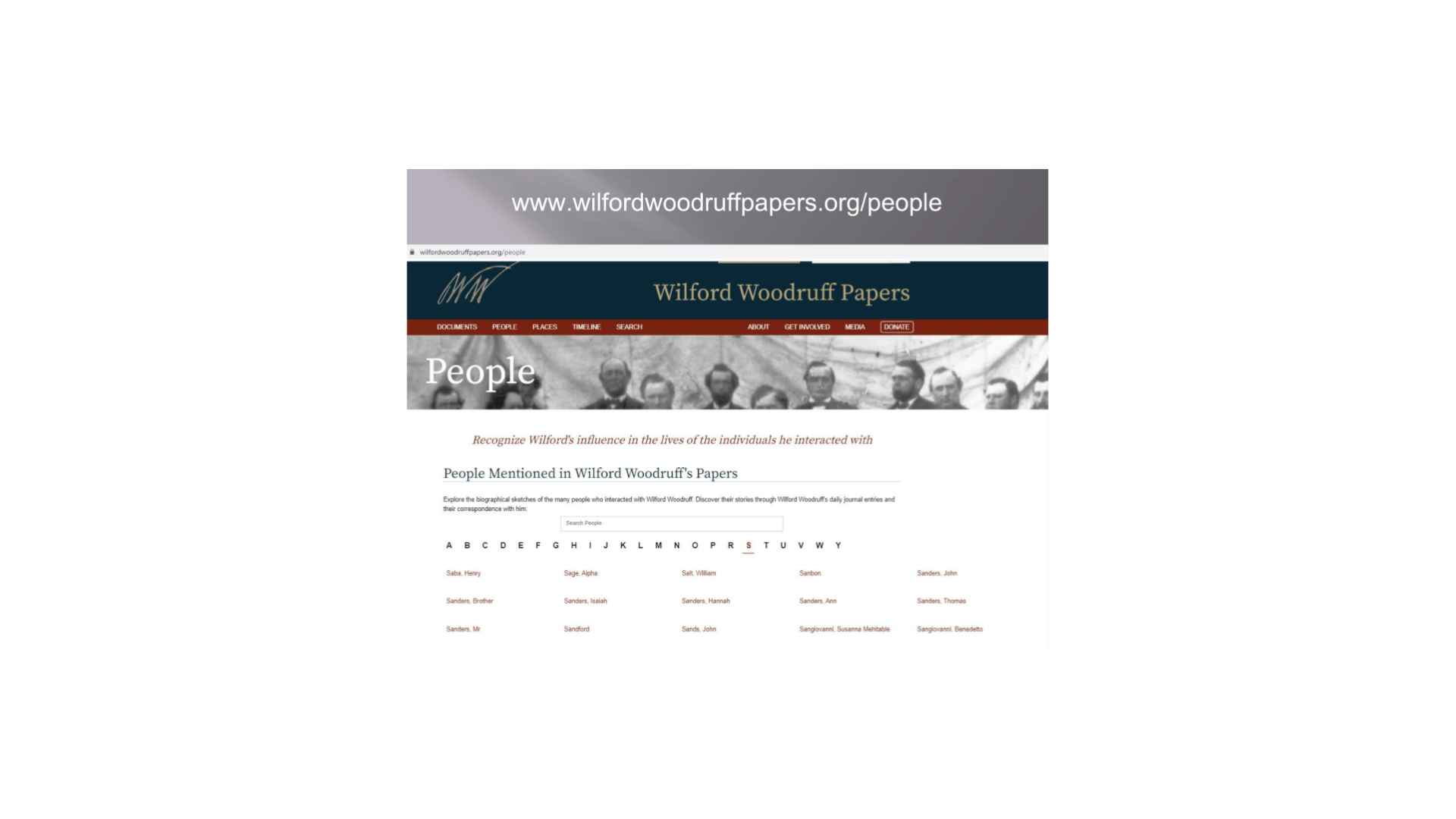
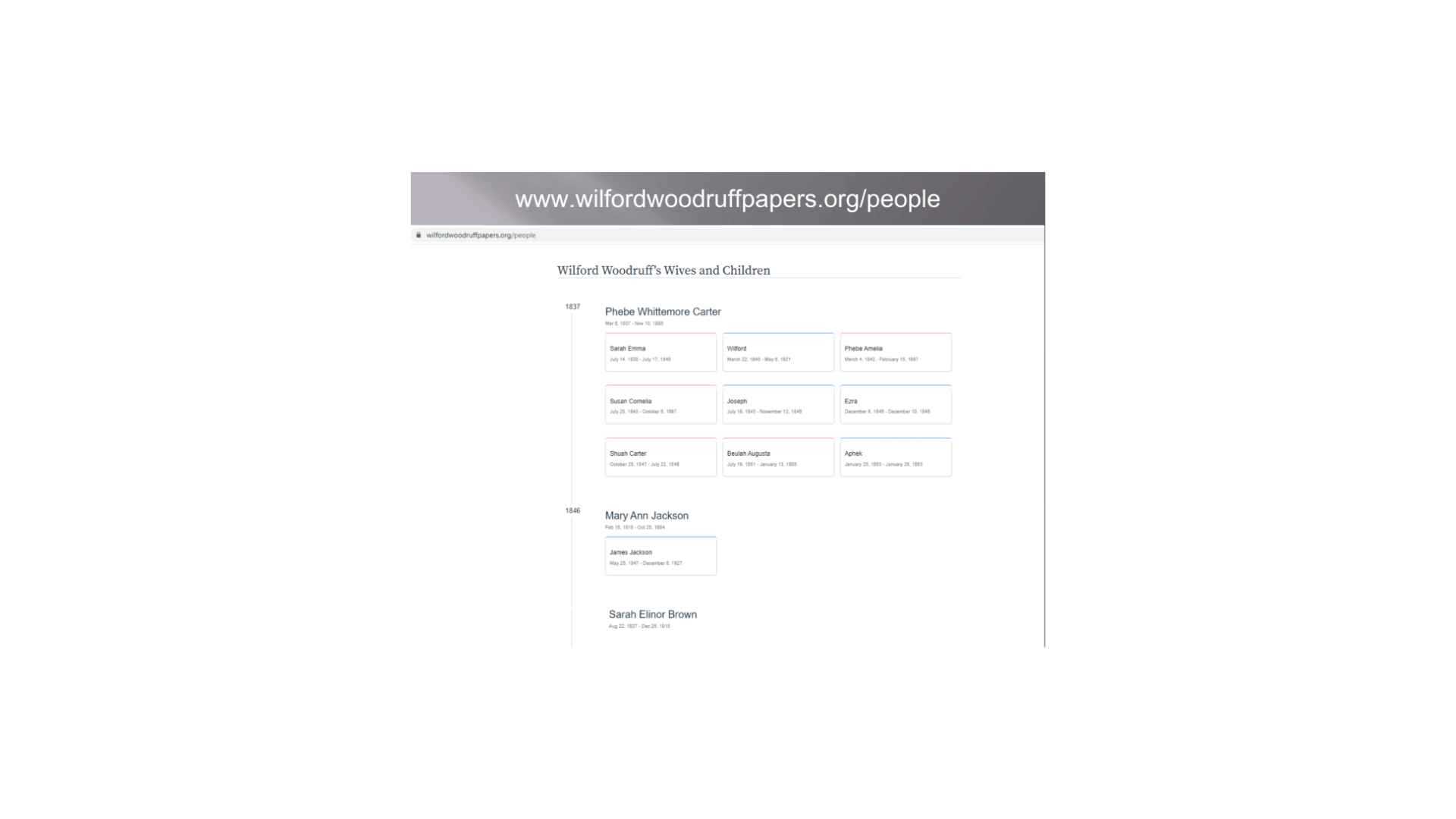
The people are divided alphabetically; we have over 5000 so far that he’s mentioned in his documents and then a special section for his wives and his children.
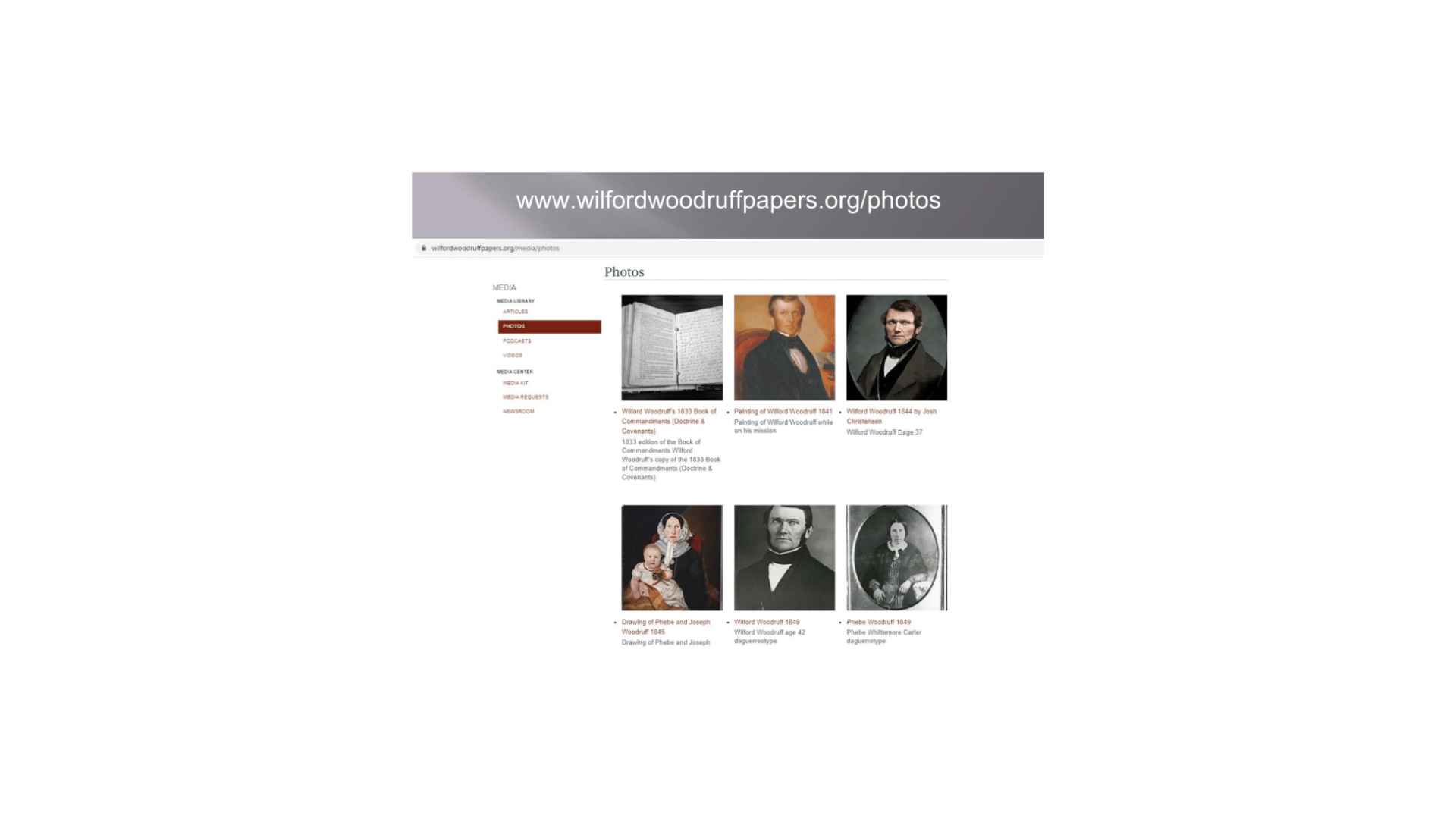
And finally, the images that we’ve been able to find. We’ve identified 82 and found 68 of them.
The Purpose
The work of transcription is not just to share his words but to share the stories in his records that build faith and to bring people to Christ by helping them understand how difficult family relationships can become eternal ones, and how our understanding of our relationship with our Heavenly Father, faith in ourselves as children of God, will lead ultimately to faith in our Savior and the salvation and exaltation that his Atonement can provide for us.
I have a testimony of the truth that has been revealed through the restoration of the gospel of Jesus Christ, and much of what I’ve come to understand is through the testimony in the life of Wilford Woodruff and his testimony of the Prophet Joseph Smith. So my interest in publishing the Wilford Woodruff Papers, my interest in defending my own faith and the truths that I know, is not to win an intellectual argument but to share with the hope that others will better understand the truth and like Wilford Woodruff, embrace it and live according to it. And I leave these things with you in the name of Jesus Christ, amen.
Scott Gordon:
Thank you, that was really interesting. You’re certainly doing a lot of work there; it looks like we can do a little bit of almost like indexing for family history. We could do that for the Wilford Woodruff stuff.
Jennifer Ann Mackley:
That’s exactly right.
Scott Gordon:
So a few questions we received from the audience: Wilford Woodruff’s revelation on temple doctrine is very significant in how we view the plan of salvation today. Why haven’t his contributions been canonized?
Jennifer Ann Mackley:
I’d vote for that. I don’t know. I don’t know why, for example, the official declaration is part of our scriptures but that revelation would, to me, rise to the level of Joseph F. Smith’s; however, he didn’t record the words of the revelation, just gave the instructions in general conference.
Scott Gordon:
Can you tell us more about the transference of sealings after March 28, 1894?
Jennifer Ann Mackley:
Well, I’ll guess about the difference between the law of adoption, the sealings to priesthood lineage, and the sealings to biological… or, yeah, in my case, I’ve adopted a daughter. Wilford Woodruff’s instructions were that if someone wanted to cancel that sealing, that was fine, but it was explained more like you’ve got two solid connections so there’s no need to undo those sealings. But you could also add the biological sealing.
Scott Gordon:
Will you be releasing a book series like the Joseph Smith Papers?
Jennifer Ann Mackley:
So our approach in that way is that our target audience is the rising generation and they don’t read books, they access online, and so although books are very important, we want to focus solely on the online publication so that everyone has access to it and no one has to buy anything.
But also, the ability to use technology to combine all of these things is a critical part of reaching the rising generation, and we hope that scholars and those of you who are superiorly intellectually and theologically educated more than I am, will build on this. That’s where the scholarship will come from. Publishing his books, there are plans to do that, selections like his words of wisdom to his children, but also just topical publications based on things like leadership, patriotism, honesty, or joy. So we are publishing those online, and ten years down the road when we finish the transcription, then perhaps that will be a focus.
We also have our first symposium coming up next year, and we’ll continue to share as much of the information as we can as quickly as possible.
Scott Gordon:
We’ll have to make sure we advertise your symposium on FAIR so please make sure you let us know all the information on that so our members can go.
With how idiosyncratic Wilford Woodruff’s writing system was, am I understanding your images correctly that his wife knew how to decode and read it, and did anyone else other than her know how to do that?
Jennifer Ann Mackley:
Truly, if you stare at it long enough it kind of jumps off the page. We have actually a Rosetta Stone that we use with our transcription. I have put all the images of all of the idiosyncratic writing into basically a spreadsheet but we use it with numbers and words. He consistently drops vowels if he uses a ‘y’ or a ‘g’ or a ‘d’, and so it is something that you can understand, but it’s truly like, I don’t know, hieroglyphics, that it’s a Wilford Woodruff letter, there’s nothing like it in the world. But they did correspond and must have understood each other because they’re answering each other’s letters.
Scott Gordon:
So this person is recommending that if you create an AI that can decode and read his writing that you name the AI program ‘Phoebe.’ Very nice, very good suggestion, I like that.
Can you elaborate on the story of Wilford Woodruff bringing Phoebe back to life?
Jennifer Ann Mackley:
Yes, they were asked to gather the saints from the northeast and bring them to Nauvoo, and Phoebe had had a very difficult year. When Wilford was injured in Winter Quarters, she was pregnant, and Wilford was almost crushed to death, didn’t finish building their cabin, their youngest son died shortly thereafter and she gave birth prematurely and that son died within a few hours. So the daughter that they had was about two when they were leaving Winter Quarters to go back east, they lost their daughter, as well.
Phoebe became ill with what is described as brain fever. And as they traveled, Wilford describes her basically dying in the wagon. They were able to revive her; they got to a house where they thought that maybe just getting her to a better environment, not the wagon or the carriage would help, but she died there and describes her spirit leaving her body and he felt that loss, and yet was able to give her a blessing and restore her to life. She remained weak and those who she was with, the women and the other people traveling with them, were very careful to care for her. And she did completely recover and lived another 40 years. But it’s a remarkable experience and for us to be able to read the intimacy of those kinds of things is incredible.
Scott Gordon:
How is The Wilford Woodruff Papers Project funded?
Jennifer Ann Mackley:
The Wilford Woodruff Papers project is funded primarily through private donations. We established the foundation as a non-profit, and I donated five thousand dollars to start. With my legal training, I was able to handle all the documents and related tasks. We formed a board, and the Wilford Woodruff family announced their support. This announcement was made on March first, which is Wilford Woodruff’s birthday. As we formed our board, each member donated, and we’ve received incredibly generous donations from those transcribing, donating online, family foundations, and more.
Our mission is to complete the Wilford Woodruff Papers by 2030, with a budget of about a million dollars per year. We’re ahead of schedule; for example, our goal for the first two years was to complete 600 letters, which we’ve already achieved. We’ll complete the journals by next year. The project is progressing faster than expected due to crowdsourcing and volunteers stepping forward. It’s not just about those who can write a check; many are personally investing themselves in it.
We don’t have a foundation like Larry and Gail Miller’s, nor do we have a hundred PhDs and talented historians like the Joseph Smith Papers. However, miracles have happened, and the level of scholarship is as high as any papers project. This is partly thanks to Steve Harper as our executive editor and the involvement of Rick Turley and others who worked on the Joseph Smith Papers, advising us and helping us avoid mistakes while capitalizing on assets and incredible people.
Scott Gordon:
What is the relationship with your organization and the Church, there’s obviously some close communication.
Jennifer Ann Mackley:
Our first in-person meeting was on June 24th, and Elder Cook spoke, along with Elder Curtis, the Church historian, and Matt Grow, the executive director managing director of the Church history department have been incredibly supportive.
I often get asked why the Church isn’t doing the Wilford Woodruff Papers, and there are probably three reasons. First of all, the Joseph Smith Papers has taken 20 years and consists of 2500 documents, so it would take a hundred years or more for the Church to do this. The Church history department has other priorities, and they feel like they’ve set the standard so high, no other papers projects will ever meet the Joseph Smith Paper standard. But it’s considered an inside job, and so they do have to do it at a higher level than other papers projects would need. But they want this to be done by a non-Church organization, meaning taking that to the level that we can without the burden of the bureaucracy or the funding or tying up all those other resources.
It’s also a legal issue, it’s not just a time and money issue, and it’s something that, like President Hinckley said, you know, there’s lots of good causes and good things to do. I know the Brigham Young Papers have already started, and sometimes referred to John Taylor, the “lost prophet,” his descendants are participating with us because of the close relationship between John Taylor and Wilford Woodruff. But hopefully, a great organization will start his papers as well.
Scott Gordon:
So, I picked up a copy of your book, “Wilford Woodruff’s Witness: The Development of Temple Doctrine,” and I went to one of my go-to people around here and said, “Have you read this book? What do you think about it?” And her comment was, “It’s the book I recommend to everybody.” And I’ve looked through it; it talks about the Book of Abraham in the use of the temple, it talks about masonry, and it talks about an interesting list of temple questions they had, like did you use irrigation water that you weren’t supposed to use? That’s one of your temple recommend questions now, by the way.
Jennifer Ann Mackley:
Have you bathed? And has your family bathed recently?
Scott Gordon:
We should put that one back in, since Covid. I admit I haven’t read it yet, sorry, but just in my brief perusal of the book, it really looks excellent. It seems complete, it seems interesting and well-written, and the prose seems easy to follow. So, this looks like an excellent, excellent book. And again, you have a great recommendation from the person I asked, who is someone I really trust on her book recommendations.
So, I know you’re immunocompromised a bit, are you willing to sign a few books if they wear masks where they come close to you?
Jennifer Ann Mackley:
Yes.
Scott Gordon:
We have the table right outside the door. Thank you so much.
coming soon…
Why did Wilford Woodruff end plural marriage if it was originally commanded?
Woodruff’s issuance of the Manifesto was based on revelation and the necessity of preserving the Church’s ability to continue temple work.
How can we trust prophetic leadership when policies change?
The principle of continuing revelation allows the Church to adapt to new circumstances while maintaining doctrinal integrity.
The necessity of continuing revelation in guiding Church leadership.
Understanding the historical context behind significant doctrinal shifts.
Strengthening faith by studying primary historical sources.
Share this article
