Summary
Hudson examines the concept of the “first political order” in societies, which she describes as frequently male dominant, and its impact on these societies. She compares this with the Latter-day Saint understanding of the first political order of heaven, emphasizing its gender equality and partnership. She explores the divine nature and powers of both the Priesthood and Priestesshood, arguing for a need to increase our understanding of these roles within religious and societal contexts to promote greater equality and spiritual growth.
This talk was given at the 2020 FAIR Annual Conference on August 5, 2020.

Valerie Hudson is University Distinguished Professor and George H.W. Bush Chair at Texas A&M University. Named among Foreign Policy magazine’s top 100 global thinkers and a Carnegie Fellow, she directs the Program on Women, Peace, and Security. Her scholarship explores how gender relations affect governance and national security. In this presentation, she connects that research with restored gospel principles.
Transcript
Introducing Valerie Hudson
Scott Gordon: Our next speaker is Valerie Hudson. She’s a University Distinguished Professor and holds the George H.W. Bush Chair in the Department of International Affairs at the Bush School of Government and Public Service at Texas A&M University, where she directs the Program on Women, Peace, and Security. Hudson was named in Foreign Policy magazine’s top 100 global thinkers for 2009. In 2015, she was recognized as a distinguished scholar of foreign policy analysis and awarded an integral Andrew Carnegie Fellowship, as well as the inaugural Fulbright Distinguished Chair in the Arts and Humanities and Social Sciences at Australia National University. There’s more in her bio you can read on your program. With that, we’re going to turn the time over to Valerie Hudson.
Valerie Hudson
The First Political Order and the PPriesthood
Presentation
Hello, I’m Valerie Hudson, and I am delighted to be here with you again. I haven’t spoken at FAIR in a few years, so it’s lovely to come back. Thank you, Scott, for your invitation, and thank you, DeLayna, for all your good logistical work in setting all of this up.
I am going to talk to you first as a scholar and then as a member of the Church, because what I found through the last several years of a research project that I’ve been working on, there are some very interesting implications of this research for our faith community. So I’m going to start there, but I think I’ll preface my remarks by suggesting that I hope all of you will check out our online journal, Square Two. We’ve been in existence for over a decade now and we publish three issues a year online—one in April, one in August, and one in November. So our next issue is coming out at the end of August. If you’ve never heard of Square Two, now is the time. Alrighty, let’s go ahead and get started.
So for the scholarly portion of this particular address, I want to reference a book that I’m a co-author on. It just came out in March from Columbia University Press, and it’s called The First Political Order: How Sex Shapes Governance and National Security Worldwide.
The First Political Order in Society
Today, I am talking about worldviews.
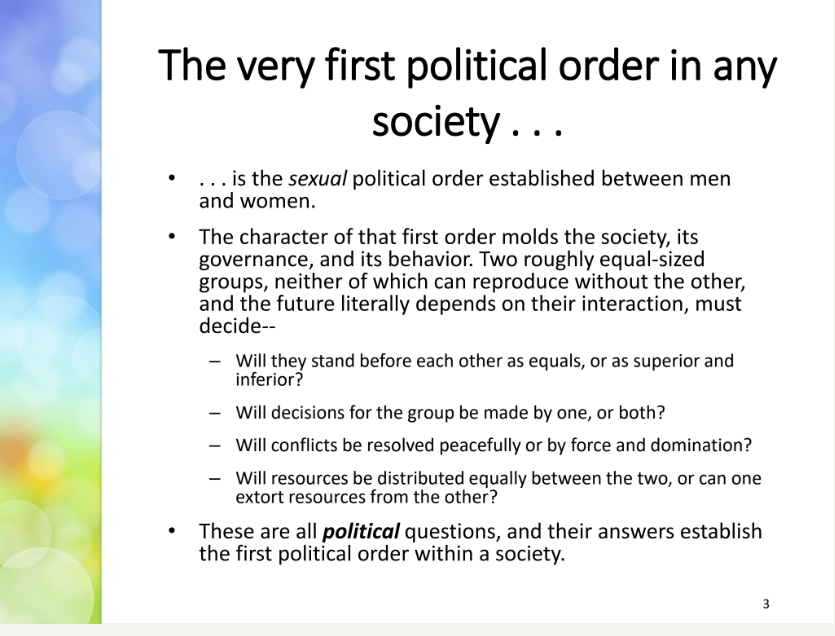
What we put forward in that particular volume, and this is not new by any means but we took it a little further than it’s been taken, is that if one is interested in what’s going on with, say, a collective, a group, even a nation-state, what is the origin of politics? What is the first political order in any society? We’ve put forward, along with many other philosophers who have preceded us, that the very first political order in any society is the sexual political order. That is the order established between men and women.
Sometimes when I’m giving this talk to my students, I say, “pretend that you’re a videogame designer and we’re in a video game design class, and I’ve given you an assignment to create a video game.” And I say “I’m only going to give you two parameters, okay? There’s two groups, each of which comprises about fifty percent of your characters in this game, and unless the two groups cooperate, there is no second round, it’s all over.” And at that point, my students say, “No, no, you’ve got to give us more than that, Professor Hudson.”
The Two Groups
They ask me things like, “Well, are these two groups equals, or does one stand before the other as a superior and one a subordinate? How are decisions between these two groups made? Are they made by one section of the society or the other, or is there a compromise and unanimity? How are conflicts resolved if the two groups disagreed on their interests? Is it resolved by force and domination, or is it resolved by dialogue and communication? And lastly, what about resource distribution between the two groups? Does one group have access to more of the resources and another group have access to less?”
So what my students are asking me are all deeply political questions about these two groups, and I think you can see then that the nature and the character of that first relationship between men and women is going to mold the society, its governance, and its behavior. Very deeply mold it.
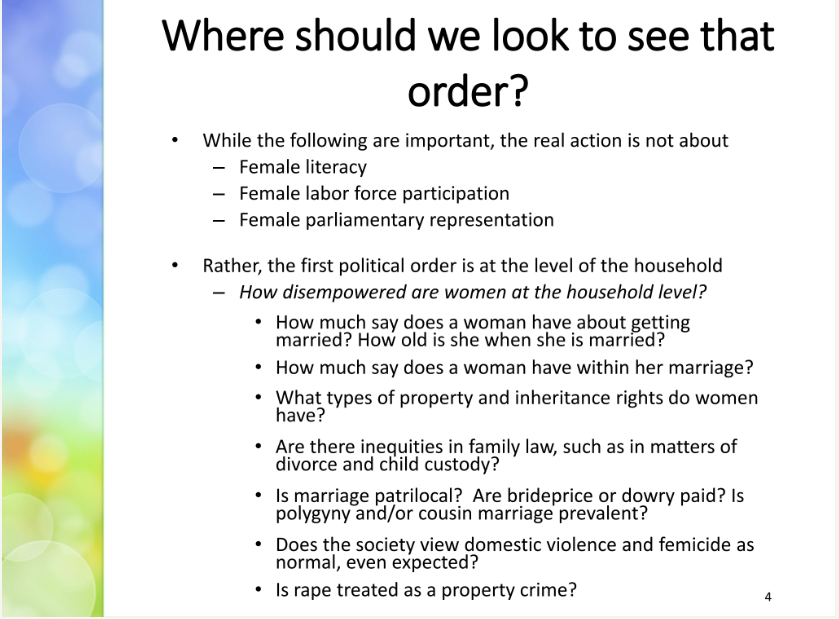
So where should we look to see what kind of order we have? Whether we have a first political order that is more of a partnership with resources and decision-making power distributed equally between the two groups, or one that is far more hierarchical with one group that is dominant. And what we’ve done in the past is look at indicators like female literacy, female labor force participation, female parliamentary representation, but about 15 years ago now, I had a crucial conversation.
In the Home
BYU was hosting a group of members of parliament, the first female members of parliament in Afghanistan, and I was tasked to be one of the hostesses for this visiting group. And so I was assigned to a particular woman, and at lunch, I was making conversation, and I said, “Oh, isn’t it wonderful here you are, you’re university educated, you’ve been working as a doctor, now you’re a member of parliament, you know, this is really the future of Afghanistan, alright, women’s empowerment.”
And she stopped me. She said, “Well, you don’t understand, Valerie. I could go home today and my husband could divorce me simply by saying ‘I divorce you’ three times. And if he did, I would have nowhere to live, I would have no assets, no right to any marital property. I would lose custody of my children because Afghan law gives fathers priority in custody.” And she said, “Even if my husband doesn’t divorce me, I may have very little say in whom my children marry and at what age they marry. So how empowered am I really, Valerie?”
Alright, a university-educated doctor, member of parliament in Afghanistan. So that’s when I realized that if you wanted to see the first political order, you needed to see it in the homes of the society that you are interested in.
Where Do We See That Order?
So, at the household level, the questions we would ask are: How much say does a woman have about getting married? How old is she on average when she gets married? What types of property inheritance rights do women have? How much say does a woman have once she is married? Are there inequities in family law such as in divorce and child custody that so upset this particular woman? Is marriage patrilocal? Do brides go to their husbands’ families’ compound? Is bride price or dowry paid? Are polygyny or cousin marriages prevalent? Does society view domestic violence and even femicide as normal, even expected, even salutary under certain circumstances? And is rape treated as a property crime against the father or the husband of the woman who’s been raped? This is where you will see the first political order in any given society.
So what you see here, and I’m sure they’re going to make the PowerPoint available to you later, are the variables that we’ve just talked about here we argue creates a syndrome, a syndrome of male dominance and fraternity. And so you can see the variables here creating kind of a straightjacket for women: high levels of violence against women matched by little access to resources, to property and inheritance rights, to son preference and sex ratio, and polygyny and so forth.
Exploitation of Women
What’s fascinating to me as a scholar is that I can see this syndrome across time and across space. That is, these means of keeping women subordinate, these means of keeping a first political order based on a hierarchy over, dominance over, exploitation of women can be found in every single region of the world even today and can be found throughout human history. It is absolutely remarkable how this is so prevalent.
And yet, where we’re going with this is that we’re arguing that this first political order of hierarchy and violence and exploitation of women is in fact a monster. It is a monster that traps not just women but men and children and whole societies. When you make women inferior, when you treat her with violence, when you exploit her, your entire society will suffer, and that includes the men who presumably profit from this type of first political order.

Fraternity-Based Governance Syndrome
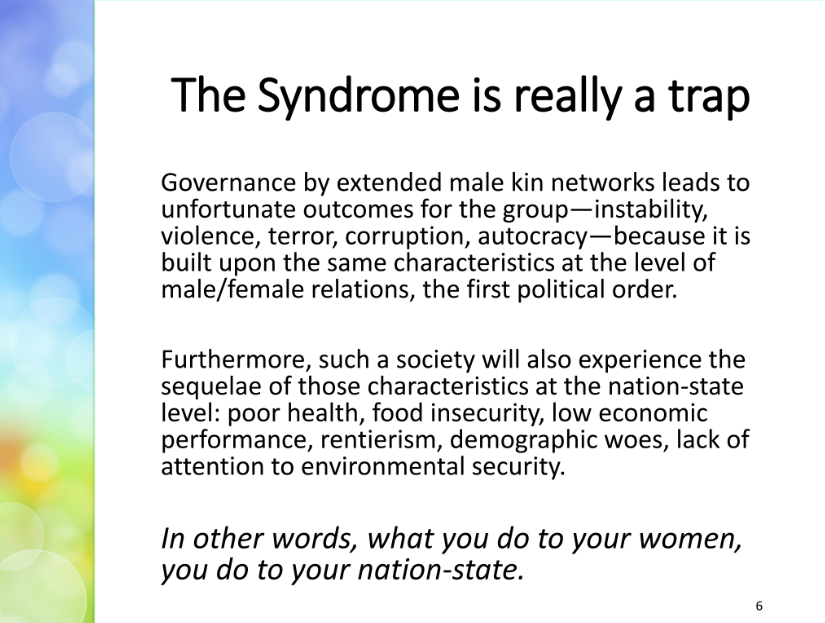
So we suggest that when you have this kind of fraternity-based governance, this kind of syndrome, that there will be unfortunate outcomes that can be visible at the nation-state level. So instability, violence, terror, corruption, and autocracy will be the fruit of this first political order. Why? Because it’s built upon the same characteristics as the character of male-female relations in the society.
We also think that there will be a lack of attention to things that women are tasked with taking care of. So for example, we believe that the health of a nation will be compromised to the extent that women are disempowered. Food insecurity, because women are often tasked with making sure there’s enough food for the household, demographic woes, lack of attention to environmental security, even low economic performance, we believe will be tied to the subordination of women. In other words, what you do to your women is what you wind up doing to your nation-state.
The Empirical Study and Data
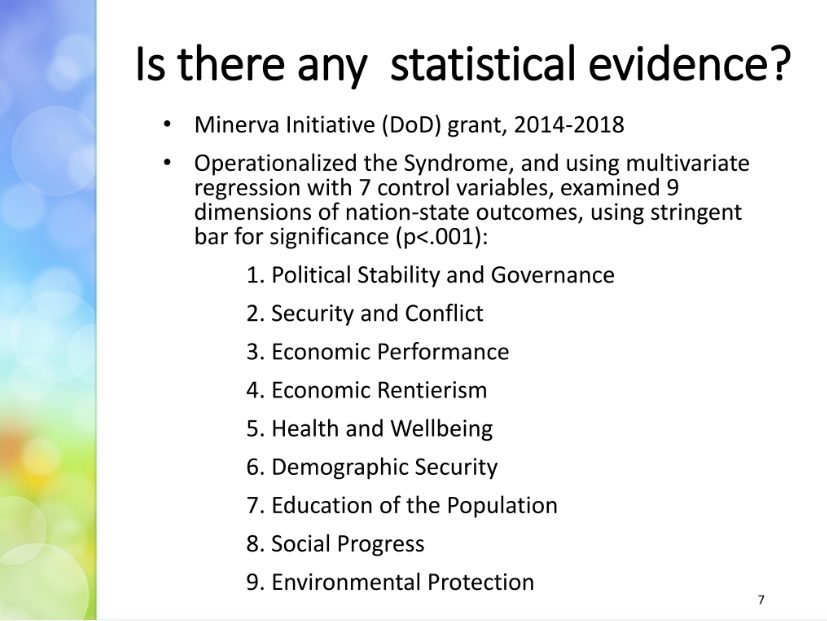
So is there any evidence for this proposition? Well, interestingly, some might even say ironically, we were given 1.3 million dollars by the US Department of Defense to find out whether there was any evidence for the idea that when you undermine the security of women, you also undermine the security of nation-states. The term of that grant was 2014 to 2018, and then it took us two years to write up the book. So that’s why the book was published earlier this year.
So in very typical academic, social science, research analysis, we operationalize the variables in the syndrome, and that’s mostly what we use that 1.3 million dollars for, was to go out and find data about variables that no one really was looking at, no one really cared about. For example, bride price and dowry levels within a country. No one’s got data on that. And we used standard multivariate regression with seven control variables. In fact, a professor of statistics is one of the co-authors on the book. And then we looked at nine dimensions of nation-state outcomes.
Significance
And because we were not interested in hearing that the evidence was weak, we chose, and for those of you who are familiar with statistics, will know, is a very stringent bar for significance, that is, rho less than .001. So we looked at dimensions such as political stability and governance, security and conflict including terror, economic performance, rentierism, health and well-being, demographic security, education, social progress, and environmental protection. My co-authors actually had to convince me to include the environmental variables because I was like, “So what’s the connection there?” And they very rightly, it turns out, said to me that the earth is always considered to be female, and so however you treat women is also how you’ll treat mother earth. And so in societies that subordinate and perpetrate violence against women, we would expect the same in terms of the environment.
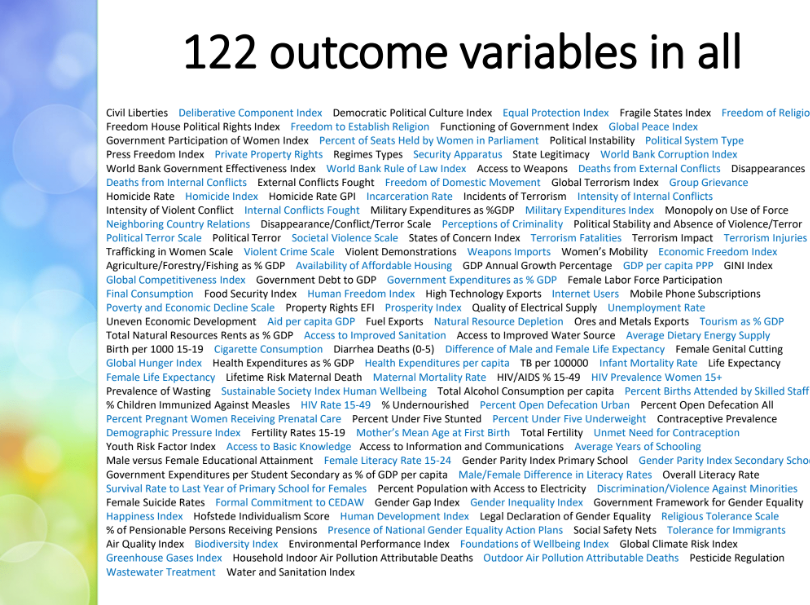
The next slide, which I’m certainly not going to read in any way, shape, or form, shows you all of the variables that we examined as outcomes, 122 of them in all. And we were very keen to use several different measures of economic performance, several different measures of security, several different measures of demographic security, and so forth, because again, we didn’t want to be accused of cherry-picking a particular variable because it fell in line with what we thought the results would be. We wanted to make sure that no one could say that we had cherry-picked at all.
Highly Determinant Predictor
Alright, I’m not going to bore you with the details because I really want to get to the second part of what we’re doing here, and you can certainly learn more by buying that book, which is also handy as a doorstop because it clocks in at 612 pages. One particular joker told me, “Well, if someone disagrees with one of your readers, they can just throw the book at them and do some serious damage.” So I thought, “No, I don’t think that’s why we did it.”
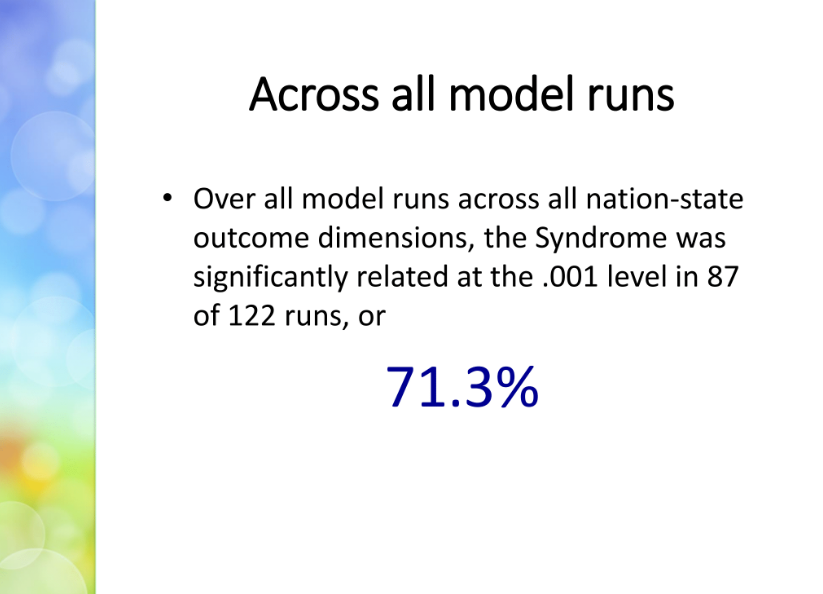
Across all the model runs, all the multivariate regressions that we ran with these outcome variables, we found that this syndrome of disempowering women, subordinating women, was significantly related to negative outcomes on those dimensions at the 0.001 level, 71.3 percent of the time. That means controlling for wealth, controlling for fractionalization, controlling for all sorts of things, even with controlling for all these other factors, whether you disempower women at the household level was a highly determinant predictor of how poorly your nation would do on these outcomes.
The Odds
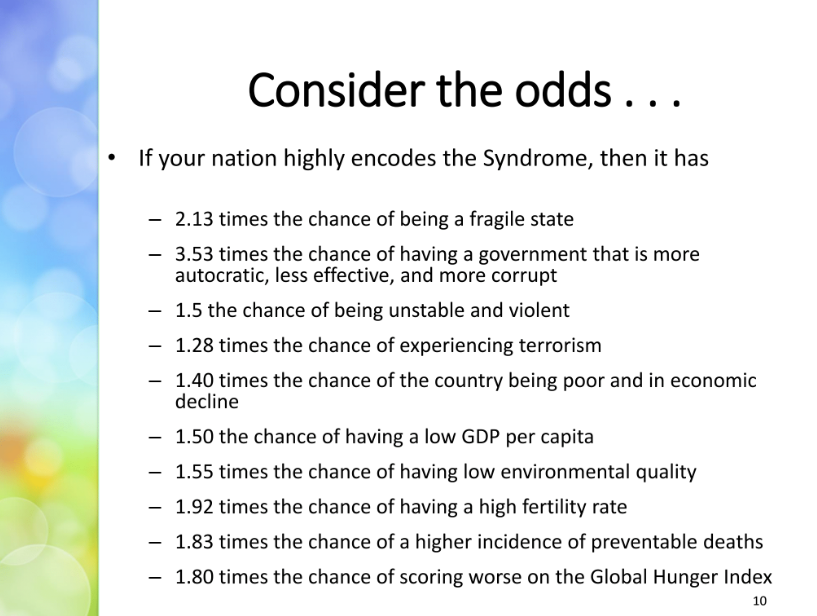
If you’re interested in odds, we can also calculate odds for you. So with each tick of an increase of you subordinating women in your society, you will have twice the chance of being a fragile state, three and a half times the chance of having a government that is more autocratic, less effective, and more corrupt, one and a half times the chance of being unstable and violent.
1.28 times the chance of experiencing terrorism, 1.4 times the chance of your country being poor and in economic decline, one and a half times the chance of having a low GDP per capita, one and a half times the chance of having low environmental quality, almost twice the chance of having an unsustainably high fertility rate, almost twice the chance of having a high incidence of preventable deaths, and 1.8 times the chance of scoring very badly on the Global Hunger Index.
What You Do to Your Women, You Do to Your Nation-State
So yeah, what you do to your women, you do to your nation-state. We feel we get these results for a variety of causal reasons. We believe that women’s household disempowerment contributes to insecurity in several ways.
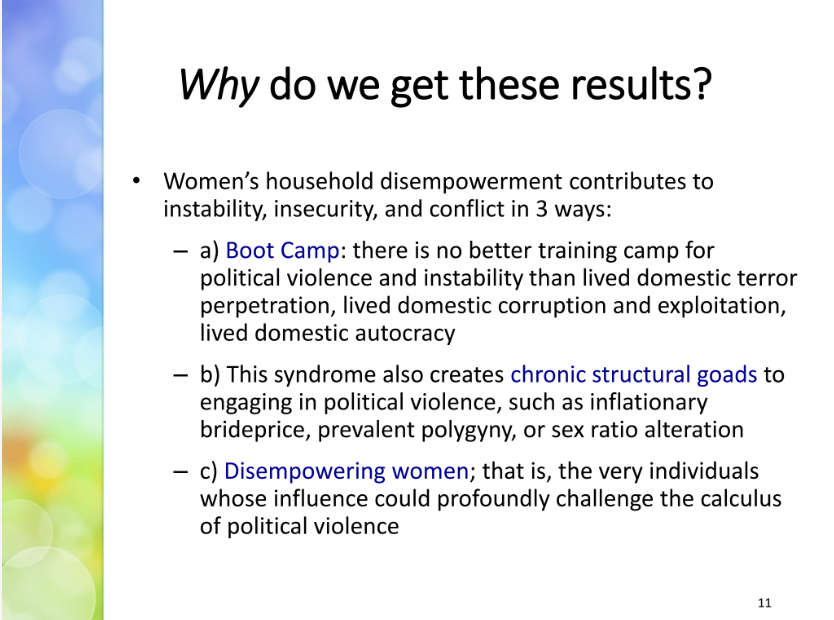
Boot camp–there is no better training camp for political violence and instability than lived domestic terror perpetration, lived domestic corruption and exploitation, lived domestic autocracy. When children grow up in those types of households, they are primed to seek to do these things and use these things and even be obedient to autocratic governments. It seems normal and natural to them that this is what the political world should look like.
Secondly, the syndrome also creates chronic structural goads for political violence. So while I’m not going to go into it here, for example, inflationary bride price rates or prevalent polygyny, which creates a class of low socioeconomic males who are not able to participate in the marriage market in their society, that is a real red flag for recruitment into terror and rebel groups. So these chronic structural instabilities are built into these kinds of systems.
And lastly, the third causal mechanism is that you’re disempowering women, you’re disempowering the very individuals whose influence could profoundly change the calculus, the cost-benefit analysis of political violence.
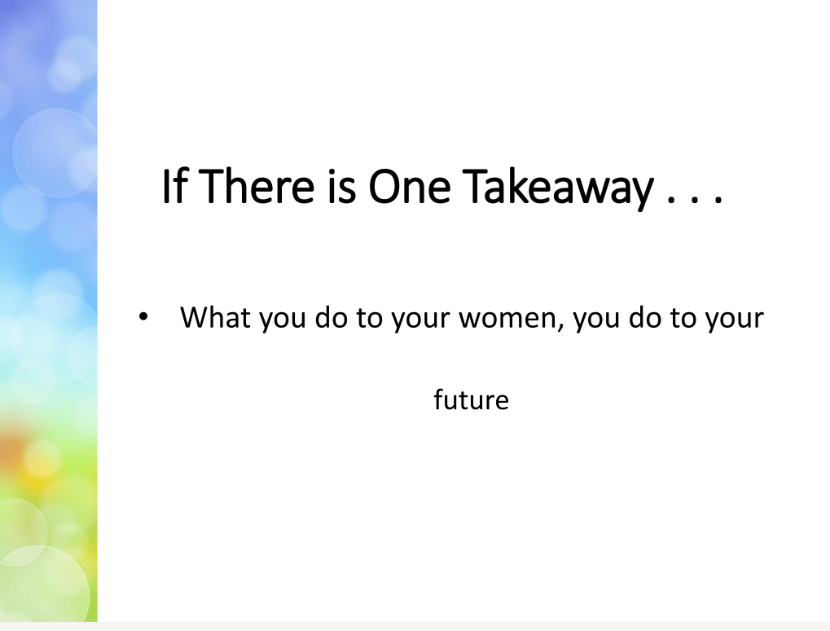
So if there’s one takeaway: What you do to your women, you’re going to do to your family, your community, and your nation and your future. That first political order, that relationship and its character between men and women really, really matters to your future, to your destiny, to your children’s future and your children’s destiny.

The First Political Order of Heaven
Okay, so what’s this got to do with the restored gospel of Jesus Christ? Well, I’m hoping that you’re already thinking that there is definitely a tie-in there. There’s a first political order of heaven too, and I would assert that the degree to which we emulate the heavenly political order here on earth will determine in large measure the degree of blessings our society will either enjoy or forfeit.
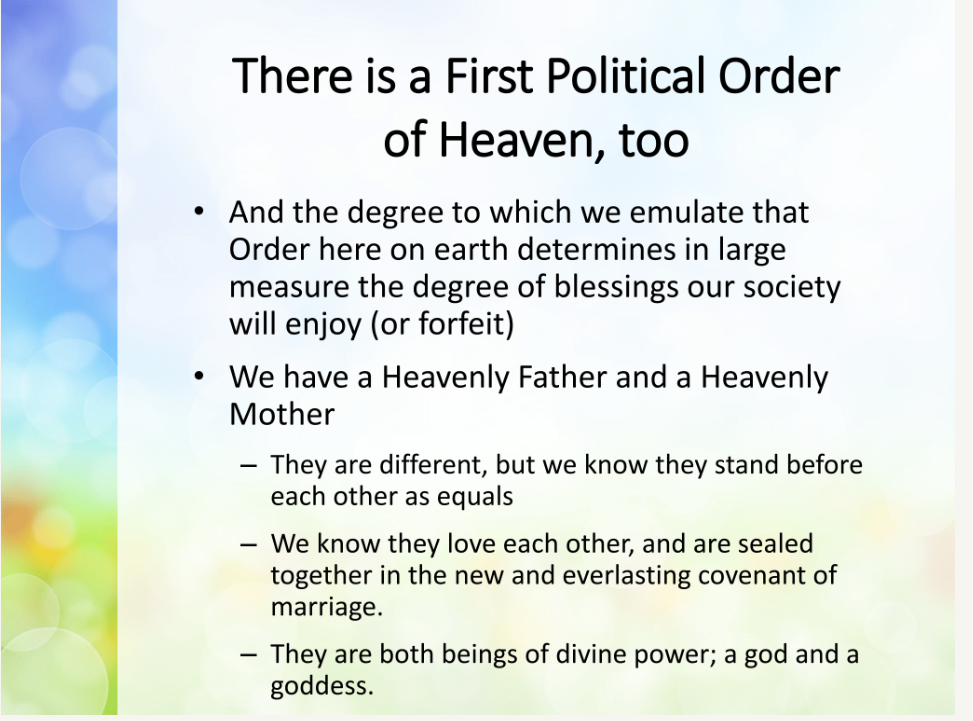
So what do we know about the first political order of heaven, that is, what do we know about our Heavenly Parents? Well, we know we have both a Heavenly Father and a Heavenly Mother. This is a core tenet of the restored gospel of Jesus Christ, that there is a divine feminine as well as a divine masculine. We know that they are different, but we know they stand before each other as equals. We know they love each other. That they are sealed together in the new and everlasting covenant of marriage. And we also know that they are both beings of divine power. Heavenly Father is a God and Heavenly Mother is a Goddess, and in fact, you can’t have a God unless you have an exalted man and an exalted woman united in the new and everlasting covenant of marriage.
Partnership
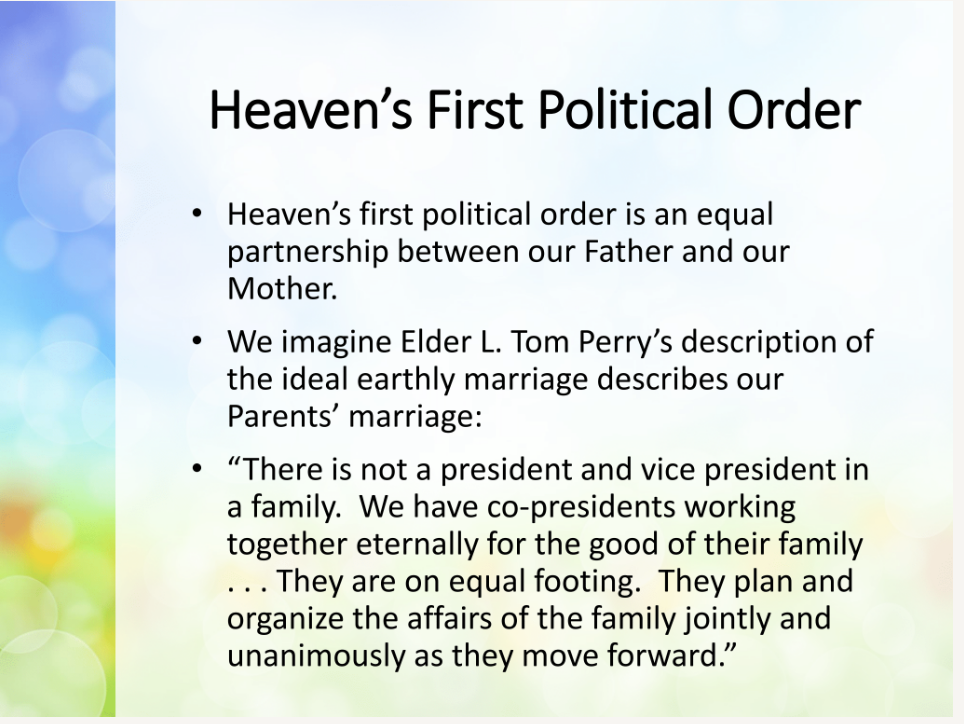
So what else do we know about heaven’s first political order? Well, from all that we know and all the exhortations that we have been given here on earth, such as the Proclamation on the Family, we have an extremely strong evidentiary base on which to claim that heaven’s first political order is a partnership, an equal partnership between our Heavenly Father and our Heavenly Mother. In fact, we can imagine that Elder L. Tom Perry’s description of the ideal earthly marriage describes our heavenly parents’ marriage.
He said, “There is not a president and a vice president in a family. We have co-presidents working together eternally for the good of their family. They are on equal footing. They plan and organize the affairs of the family jointly and unanimously as they move forward.” And I submit to you that if you have been privileged to live in a home where that is the first political order of your home, its emulation of heaven probably blessed that home experience for you.
Emulate our Heavenly Parents
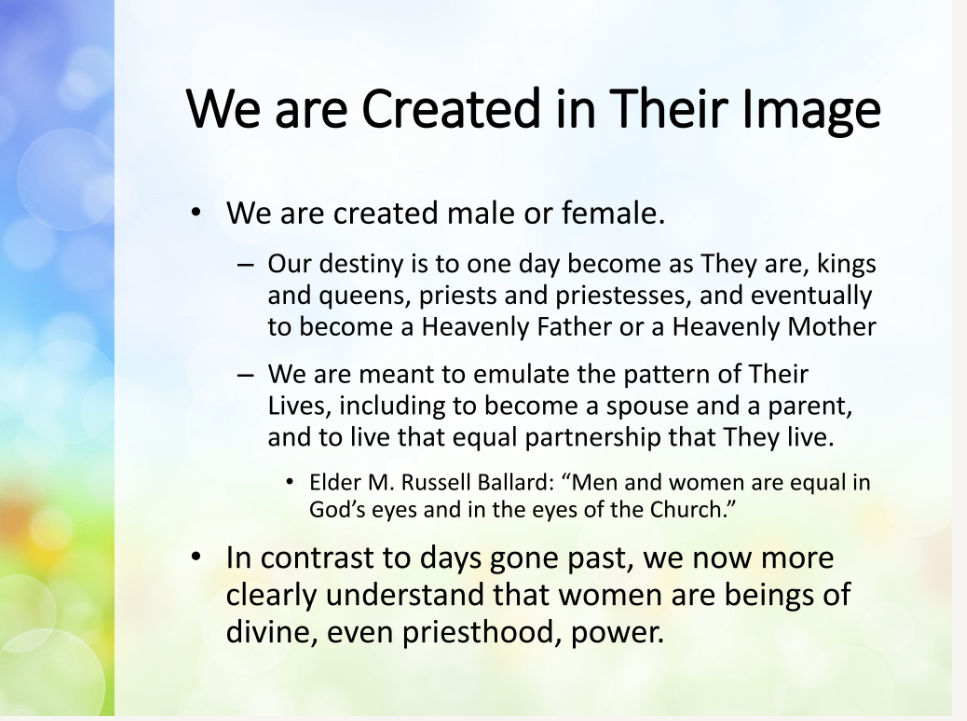
We also know that we are created in the image of our heavenly parents. We are created male or female. Our destiny is to one day become as they are: kings and queens, priests and priestesses, and eventually ourselves become either a Heavenly Father or a Heavenly Mother. So we are meant to emulate the pattern of their lives. We know that we are exhorted to become a spouse and a parent insofar as we are able in this life, or if we are not given that opportunity in this life, we will surely be given those opportunities in the next. And we’ve also been exhorted to live that equal partnership that our Heavenly Parents live, as Elder M. Russell Ballard has said: “Men and women are equal in God’s eyes and in the eyes of the Church.”
So the first political order that I found throughout space and time in the world is not the first political order that heaven wants us to live. The old ways of subordination and hierarchy and violence against women, resulting in their disempowerment, is not the way that heaven wants us to live. Furthermore, what has been really interesting to see in the last five or six years is that our own faith community is now more clearly understanding that women are beings of divine, even priesthood power.
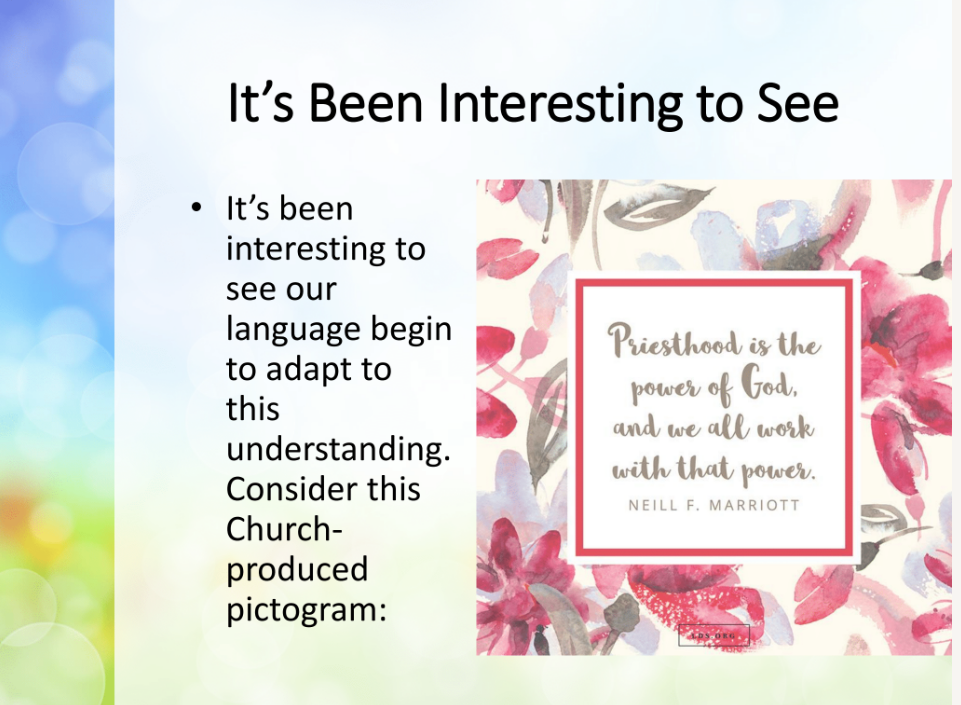
So, for example, it’s been interesting to see our language begin to adapt to this understanding, and I would like to reemphasize that this is not some new revelation. It was inherent in virtually everything that the Prophet Joseph Smith taught, but it was never brought to the fore. We did not live up to our privileges, but I think we are beginning to do so now.
Priesthood is the Power of God
Here’s, for example, a Church-produced pictogram, a quote from Neill F. Marriott: “Priesthood is the power of God, and we all work with that power.”
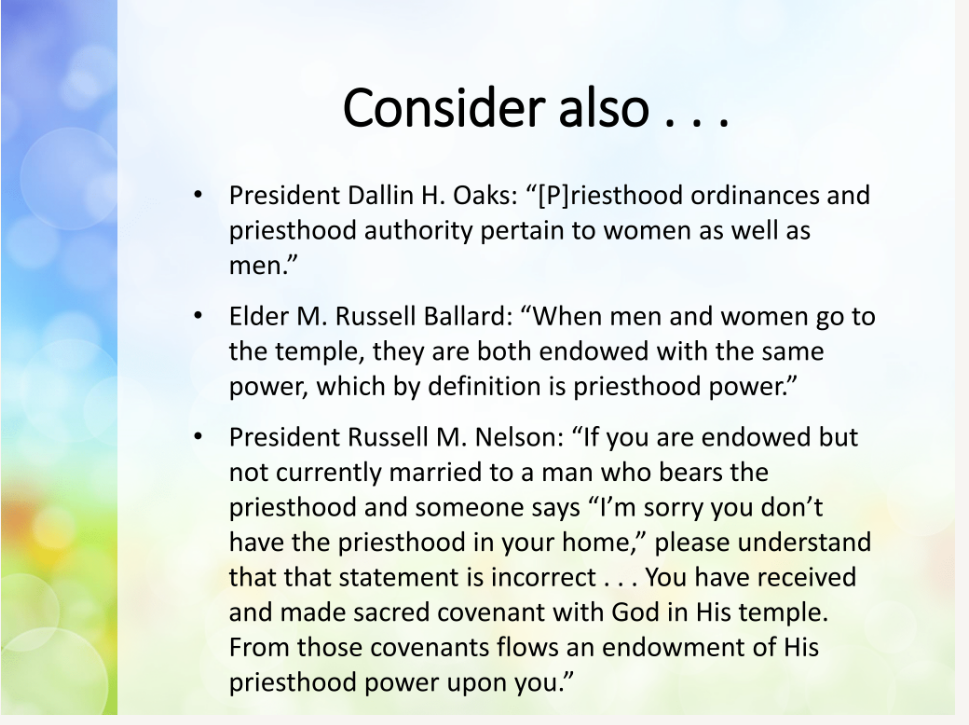
Here are some fascinating quotations: President Dallin H. Oaks, “Priesthood ordinances and priesthood authority pertain to women as well as men.” President M. Russell Ballard, “When men and women go to the temple, they are both endowed with the same power, which is by definition, priesthood power.” And President Russell M. Nelson: “If you are endowed,” he’s speaking to the sisters here, “if you are endowed but not currently married to a man who bears the priesthood, and someone says, ‘I’m sorry, you don’t have the priesthood in your home,’ please understand that that statement is incorrect. You have received and made sacred covenants with God in His temple. From those covenants flows an endowment of His priesthood power upon you.”
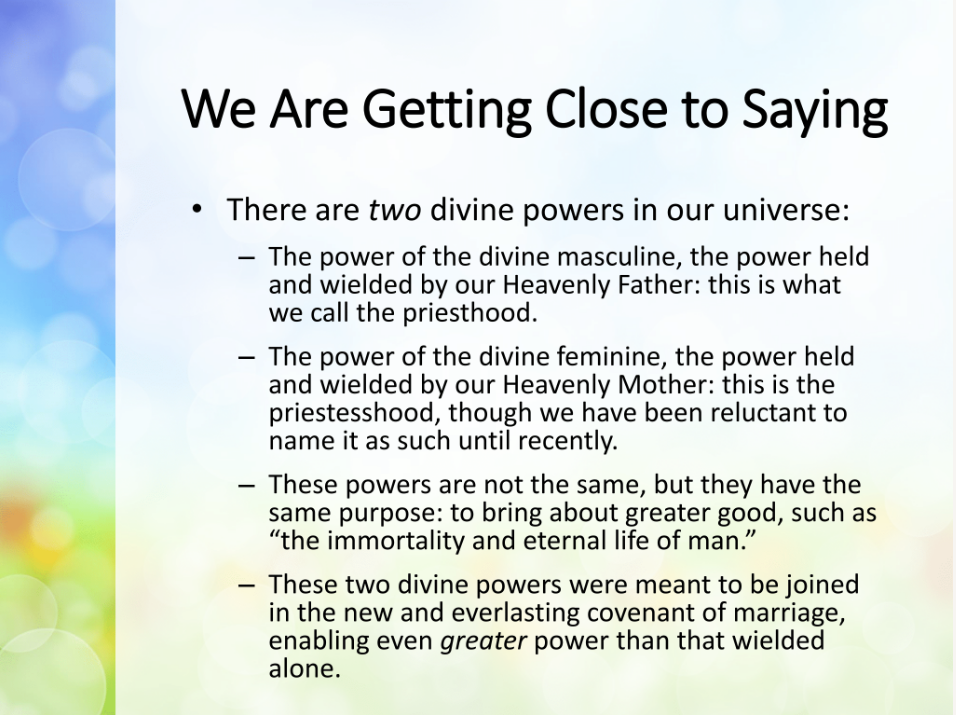
Okay, have you noticed this in the last five years or so? We are beginning to start to use this language concerning women. So we are getting close to saying something that I bet many of you already have kind of felt in your heart, that there really are two divine powers in our universe: that power of the divine masculine, the power held and wielded by our Heavenly Father, and this is what we call the priesthood.
Priestesshood
And then there is the power of the divine feminine, the power held and wielded by our Heavenly Mother, and this is the priestesshood that we have been reluctant to name it as such until recently. These two powers are not the same, but they have the same purpose: to bring about greater good, including the immortality and eternal life of man. These two divine powers were meant to be joined in the new and everlasting covenant of marriage, and that joining of those two powers enables an even greater power than that wielded alone.
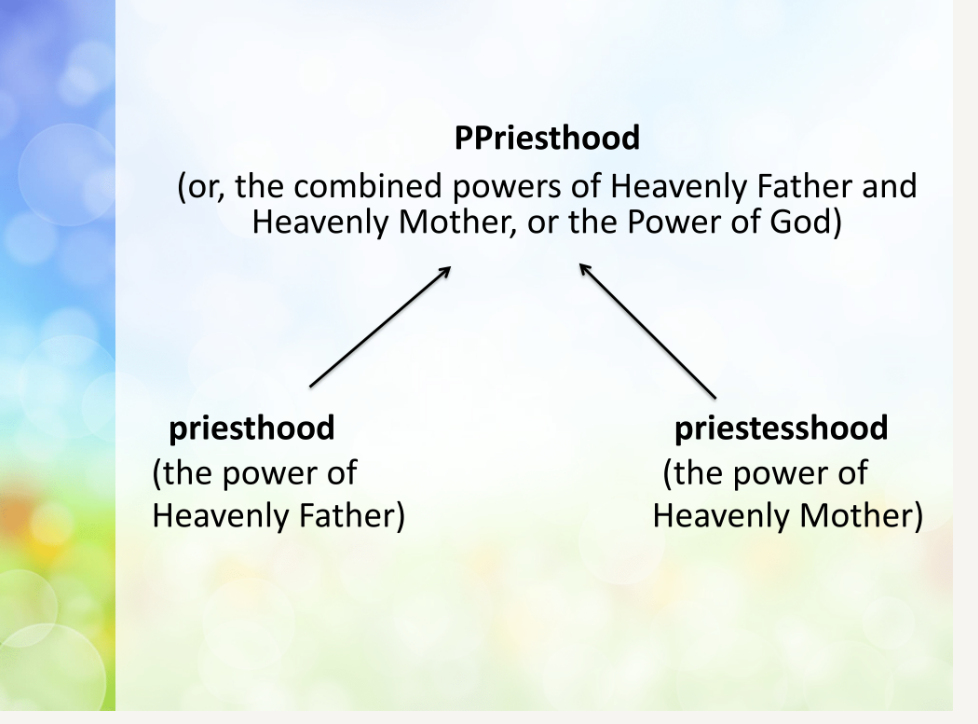
So probably when you saw the title of my presentation, you noticed that I used the word “priesthood” with two p’s, and you thought, “Oh, she’s got a typo in her title.” But now I think you can see that I meant it to mean something. If we start at the bottom of the diagram here, if we say that “priesthood” is the term that refers to the power of our Heavenly Father and His sons that are ordained to that power, and that the “priestesshood” is the power of Heavenly Mother, which is also delegated to the daughters of God here on earth.
Then when those two powers join in the new and everlasting covenant of marriage, what you get is the “ppriesthood” with two p’s, two capital priests, the combined powers of our Heavenly Father and our Heavenly Mother, or the power of God. I think we are beginning to see this understanding come to light.
Two Apprenticeships
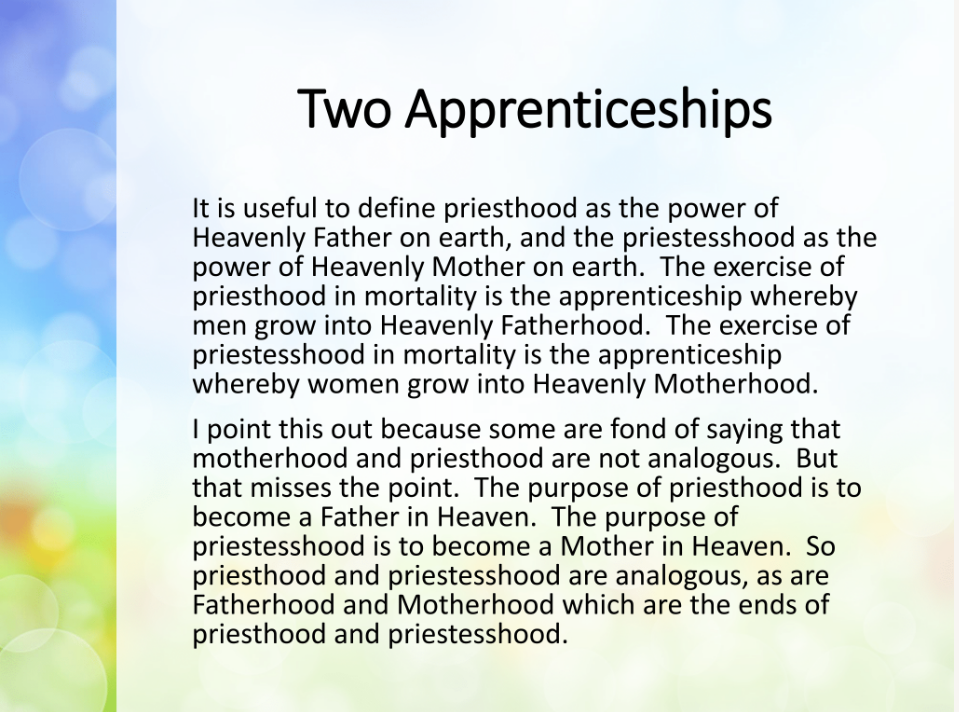
So, in a sense, then, there are kind of two apprenticeships that are going on here on earth, all right? I think it’s useful to define “priesthood” as the power of Heavenly Father on earth, and the “priestesshood” is the power of Heavenly Mother on earth. The exercise of priesthood in mortality is the apprenticeship whereby men, the sons of God, grow into Heavenly Fatherhood. The exercise of priestesshood in mortality is the apprenticeship whereby women grow into Heavenly Motherhood, whereby God’s daughters grow into that role.
I point this out because some are fond of saying that motherhood and priesthood are not analogous, but that misses the point. The purpose of priesthood is to become a father in heaven. The purpose of priestesshood is to become a mother in heaven. So priesthood and priestesshood are analogous, as are fatherhood and motherhood, which are the ends, the purpose, the telos of priesthood and priestesshood.
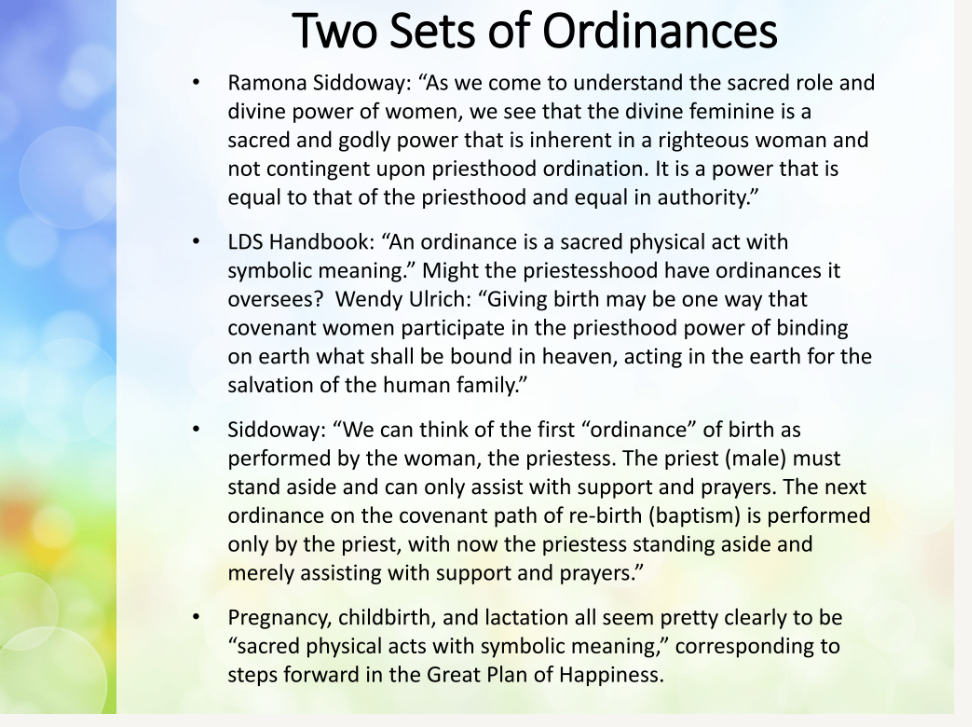
So perhaps then, if we had eyes to see, we would see that there’s kind of two sets of ordinances happening in our world around us. Let me quote a few LDS authors. Oh, not LDS authors, authors from The Church of Jesus Christ. I’m going to quote Ramona Siddoway, who’s recently penned a book for Cedar Fort called “We’re Adam” and Wendy Ulrich, who recently spoke at FAIR, I think just last year.
Sacred Roles
Here’s a quote from Ramona Siddoway: “As we come to understand the sacred role and divine power of women, we see that the divine feminine is a sacred and godly power that is inherent in a righteous woman and not contingent upon priesthood ordination. It is a power that is equal to that of the priesthood and equal in authority.”
From the LDS Handbook, we also learned that an ordinance is a sacred physical act with symbolic meaning. Might the priestesshood then have ordinances it oversees?
And here’s Wendy Ulrich’s: “Giving birth may be one way that covenant women participate in the priesthood power of binding on earth that which shall be bound in heaven, acting in the earth for the salvation of the human family.” That’s a very interesting thought, isn’t it?
Here’s Sidoway again: “We can think of the first ordinance of birth as performed by the woman, the priestess. The priest, male, must stand aside and can only assist with support and prayers. The next ordinance on the covenant path of rebirth, baptism, is performed only by the priest, and now the priestess, standing aside and merely assisting with support and prayers. What an interesting vision of two sets of ordinances along the path of the Great Plan of Happiness.”
PPriesthood
So I’ll just say it: Pregnancy, childbirth, and lactation all seem pretty clearly to be, “sacred physical acts with symbolic meaning,” corresponding to steps forward in the Great Plan of Happiness.
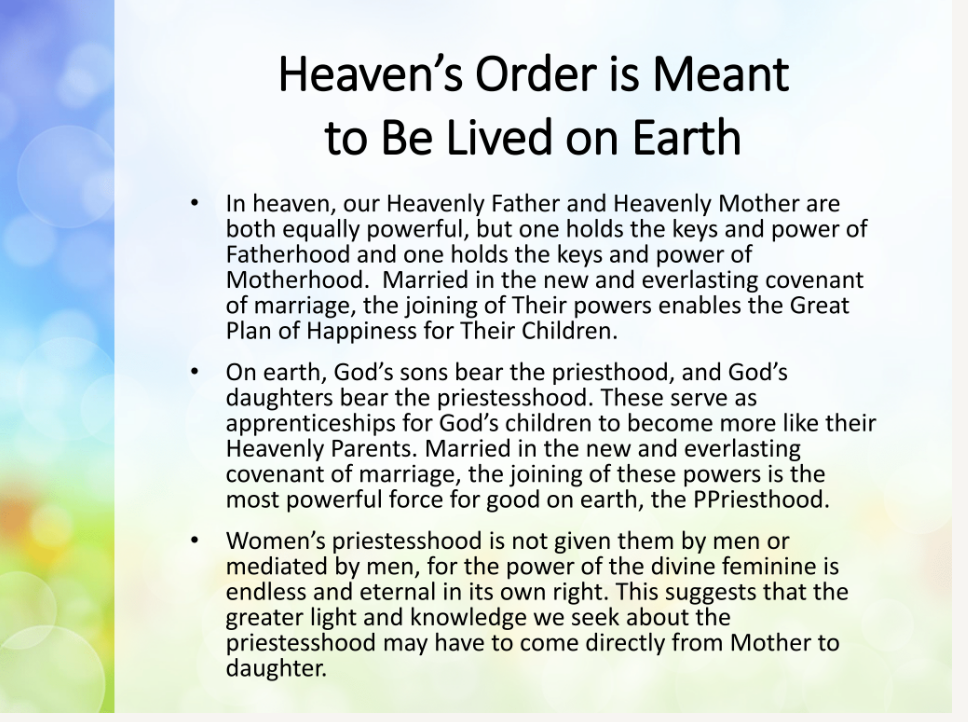
So heaven’s order is meant to be lived on earth. In heaven, our Heavenly Mother and Heavenly Father are both equally powerful, but one holds the keys and power of the fatherhood and one holds the keys and power of the motherhood. Married in the new and everlasting covenant, the joining of their powers enables the Great Plan of Happiness for their children on earth. God’s sons bear the priesthood, and God’s daughters bear the priestesshood. These serve as apprenticeships for God’s children to become more like their Heavenly Parents. Married in the new and everlasting covenant of marriage, the joining of these powers is the most powerful force for good on this earth, the PPriesthood, if you will.
Women’s priesthood is not given to them by men. It is not mediated by men, for the power of the divine feminine is endless and eternal in its own right. This suggests that the greater light and knowledge we seek about the priestesshood may have to come directly from mother to daughters.
How Are We Doing?
So as a faith community, are we making more than rhetorical progress toward this vision of equal partnership? And so, I wondered how I would look at that. And again, as a social scientist, I thought, well, the largest per capita population of members of the Church in the United States is in Utah, and certainly, the government of Utah has had a large share of members of the Church in official positions. So how’s Utah doing in terms of the first political order?
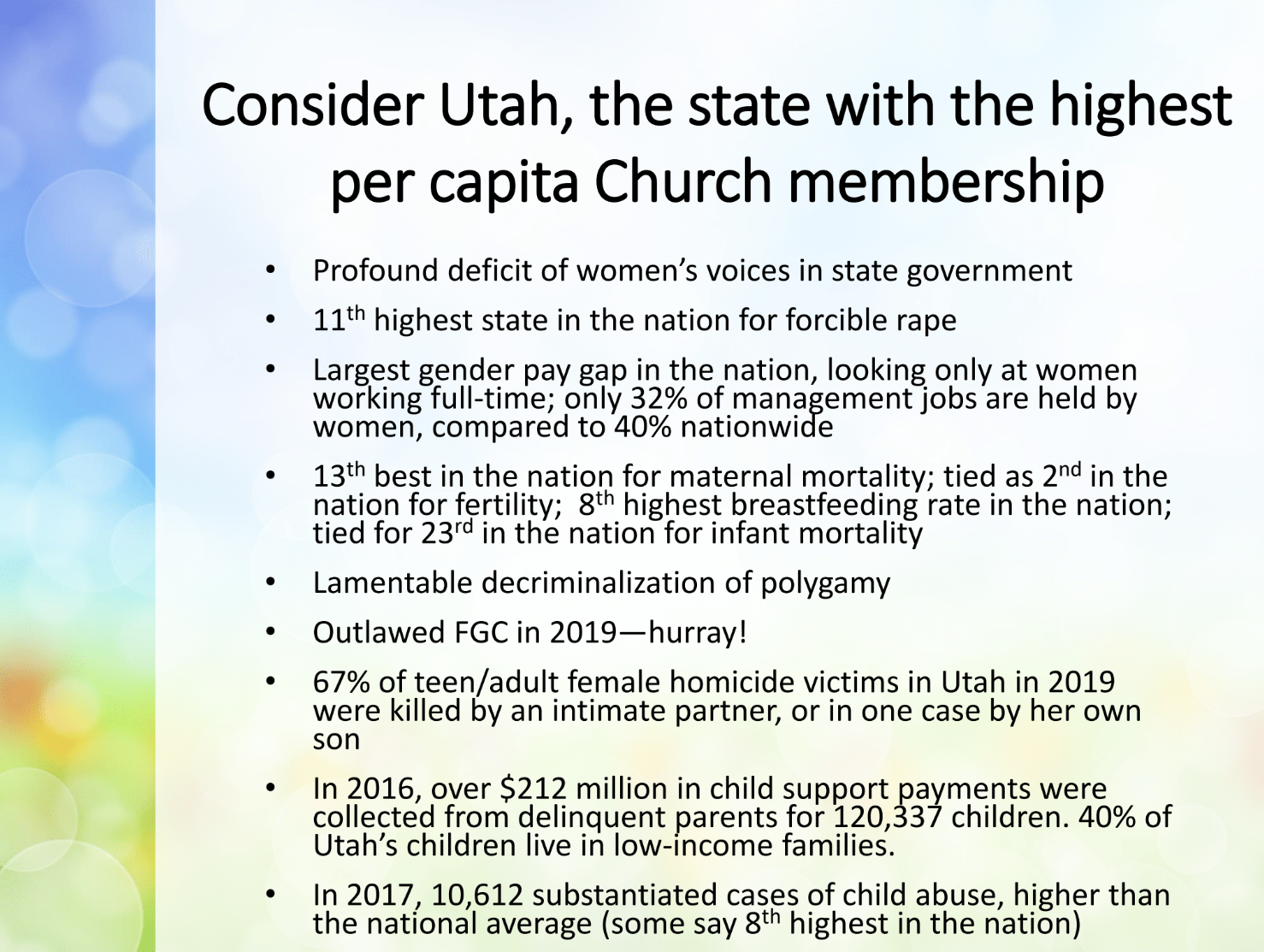
Well, alright, one of the things we see is that there is a profound deficit of women’s voices in state government. My friend Susan Madsen, who has just moved to Utah State University, has done some remarkable and interesting studies about the dearth of women in the Utah state legislature. So this is something that’s concerning and certainly does not reflect what we would consider that equal partnership.
It is the 11th highest state in the nation for forcible rape. That also is not very good, is it? And it has the largest gender pay gap in the nation, looking only at women working full-time. We’re controlling for whether working full-time or part-time. So if we just look at women working full-time and men working full-time, we have the largest gender pay gap in the nation. Only 32 percent of management jobs are held by women, compared to 40 percent nationwide, in Utah.
Work to Do
There’s some better news: it is 13th best in the nation for maternal mortality. It is tied as second in the nation for fertility. It is the eighth highest in the nation for breastfeeding. And it is tied, unfortunately, for 23rd in the nation for infant mortality. That’s a little problematic. I will tell you, and some of you already know this, that we recently had the lamentable decriminalization of polygamy in Utah, which is not a step forward. We did, or Utah did, outlaw female genital cutting in 2019, and that’s wonderful.
Sixty-seven percent of teen and adult female homicide victims in Utah in 2019 were killed by intimate partners or, in one case, by her own son, so we do have some violence here that needs to be examined. The latest figures I could find were in 2016, and in that year, over $212 million in child support payments were collected from delinquent parents for 120,337 children. Forty percent of Utah’s children live in low-income families. So are children receiving their child support benefits without coercion by the state? No. Are children in Utah at risk to live in poverty? Yes. That’s also something that we should look at. And then, lastly, in 2017, there were over ten thousand substantiated cases of child abuse, higher than the national average, some have estimated eighth highest in the nation. That’s also troubling.
These statistics suggest to me that we do have some work to do if we’re attempting to live the first political order of heaven, then I would argue these statistics should look, in some cases, much different than they do today.
Alright, that’s all I have to say, and I invite your questions. Thank you very much.
Audience Q&A
Scott Gordon:
Welcome to our socially distanced question area. We really appreciate you speaking, and you get your brownies, which is, I’m sure, great compensation for speaking at FAIR Mormon. Thank you, but we at FAIR really do appreciate you coming to speak to us. I have to say, those last statistics you showed, I found to be quite troubling actually. I thought a lot of them should be a lot better, and even, I know some people argue, well, we’re not all LDS or all members of The Church of Jesus Christ of Latter-day Saints here in Utah, but there’s still a significant proportion of people who belong to that group. So you would think that would have an influence, and yet other states do better than we do. How would you explain that to someone? Why do you think that is?
Valerie Hudson:
I’m not sure I want to explain it. If I explained it, then I would understand how it could be in a state that was predominantly peopled by members of The Church of Jesus Christ, and that would cause me pain, I think, to try to suggest to you good reasons for why these things are the way they are, I guess what I would simply say is, I really do think that we need more women’s voices in government. I think the research that I shared with you in the first half of my presentation suggests that when women’s voices, perspectives, insights, concerns, and priorities are not equally represented at the table, that you do get negative outcomes. And so that’s at least a first place I think that I would start.
Scott Gordon:
Excellent. So here’s a question: “What you do to your women you do to your state.” Joseph Spencer recently articulated that the destruction of the entire Nephite civilization in the Book of Mormon can be traced to their mistreatment of women. Would you subscribe to this idea?
Valerie Hudson:
Oh, absolutely. And someone forwarded me Joseph Spencer’s presentation on that, upon which I immediately emailed him and told him that I wish I could hug him because I see that also in the Book of Mormon. And then he reminded me that he was actually a former student of mine, and then I was very embarrassed, but wondered if maybe something had rubbed off in the class that we had together.
Scott Gordon:
Maybe you influenced him in his position. Okay, here’s another one: Would you be willing to comment on the political order of polygamy in early Church history?
Valerie Hudson:
Well, I think many of you know that it was here at Fair several years ago that I presented my own writing on polygamy, arguing that in theological terms it was an Abrahamic sacrifice like unto the commandment that was given to Abraham to sacrifice Isaac, and that in fact D&C 132, I think, substantiates that view. So rather than talk about polygamy, I think you then move the ground and say what is the theological purpose of an Abrahamic sacrifice. And I admit that’s a little bit above my pay grade, right? I’m not exactly sure why God commanded Abraham to sacrifice Isaac, but I do know that great good came from it, and I also know that Abraham never sacrificed, you know, ever after that. And where Abraham is right now, he’s not expecting to sacrifice any sons. In other words, what I’m suggesting to you is that whatever good an Abrahamic sacrifice does, it is temporally bounded. I don’t know if you saw the July Ensign, but if you did not, hidden in an essay by Elder Quentin Cook on Church history, you will find a remarkable two or three paragraphs about polygamy. In fact, if you log into Square Two at the end of the month when we have our new issue out, you’ll see my commentary on that, that Elder Cook suggests also it was an Abrahamic sacrifice, it was temporally bounded, and its purpose was accomplished.
Scott Gordon:
Thank you. I’m going to have to make sure I read that Square Two article. I will do that. So what are ways that we can better emulate the first political order of heaven in the Church and in our homes today?
Valerie Hudson:
Well, the homes I think is where it’s got to come from, because where do our Church leaders come from? Our Church leaders come from our homes. And so I think it’s incumbent upon every one of us, male and female, to build, if you will, a small Zion within our home. So an order of equal partnership, of unanimity, of mutual love and respect, the idea that no, husband and wife are not identical but they’re equal, and they should stand before each other as equals. They should both be participating in decision making as equals. One of the things that I think I would urge young people who are getting married is, I’m perfectly fine with the male as the breadwinner and the woman as the non-breadwinner in a family. I am fine with that, please don’t get me wrong, but I have seen too many marriages undermined when a woman feels that she is so economically dependent on her husband that she must put up with attitudes and behaviors from him that are not consistent with the first political order of heaven.
Scott Gordon:
I agree, that’s really good. Do you believe the Latter-day Saint temple liturgy emulates the first political order of heaven?
Valerie Hudson:
Oh, I’m so glad you asked that, whoever it was who asked that. I can tell you that when that big change was made, and of course none of us have seen the newest and latest changes, but when that big change was made, my inbox and my text messages were flooded with people wanting to make sure that I knew about it, and because I happened to be in Utah for the holidays on January 2nd, I went and I wept. I wept because I can tell you that for many years I’ve had this strange little cottage industry on the side, and it’s either mothers of daughters who are about to get their endowments, the old endowments, who called me and said “will you please talk to my daughter before she goes to the temple for the first time,” or I would get phone calls or emails from people I didn’t even know. I’ll never forget picking up the phone and there was a woman who was hysterical and crying on the phone. She said, “You don’t know me, but I just took out my endowments and I don’t think I can stay in this Church anymore. Will you talk to me?”Alright, my roommate has said that I need to talk to you.” So I wept when I saw the temple changes because I knew I would never have to be in that business of preparing young women for what they would find on what should be one of the very happiest days of their life. So all I can say is that was absolute, prophetic revelation and it was an answer to the fervent prayers of tens of thousands, if not millions, of women in the Church.
Scott Gordon:
Sharon Eubank here at FAIR Mormon made a compelling argument that this is a woman’s church. What evidence have you seen in the Church that backs this claim along the lines of what you’ve said?
Valerie Hudson:
Oh, I just love that talk that Sharon Eubank gave. And in fact, I talked about my friendship with Susan Madsen at Utah State. Well before she moved to Utah State, she was at Utah Valley University and just this past February she invited me and Sharon to give presentations on why we thought, you know, it was a woman’s church and what my scholarship would say on why that was so important. So she and I actually got to, it was pre-pandemic so we actually got to shake hands and exchange our views on these things. And I told her that her talk was magnificent and that I supported her views 110%. “This is a woman’s church.” Have we fully lived up to that? No. Are we so much further ahead than many other faith communities are? Absolutely. Absolutely positively.
Scott Gordon:
They say if you have a standard you’re striving for then eventually someday you may get there. But if you have no standard then you’re not even going in the right direction.
Valerie Hudson:
Well said.
Scott Gordon:
What can we do to better distill an understanding of the divine nature of motherhood and priestesshood to our rising generation?
Valerie Hudson:
Oh, I am so glad, these are brilliant questions. Well, obviously, anybody who’s listening to Fair Mormon livestream are going to be brilliant. Well, let me get on a little bit of a hobby horse of mine and suggest that our culture, and I think we all know that there’s a darkness in our culture that really comes from the dark side. There is in our culture something that wants women to hate their bodies. So that can range the gamut. It can range the gamut of our culture saying, you know, you don’t need to give birth, farm that out to a poor woman who’ll be your surrogate, or you don’t need to breastfeed, the formulas now are just wonderful, or you don’t need to be awake for your birth, just get yourself knocked out. In all of those things, I see the culture attempting to seduce women into thinking that their bodies are ridiculously inconvenient, are not a gift, and that to the extent that we can technologize the functions of our body, then we should do it.
There’s a new movement, for example, for women to completely turn off their menstruation, just never menstruate. And you can see that that comes from a mindset where menstruation has no value whatsoever, and where bodily birth has no meaning whatsoever, where breastfeeding has no meaning whatsoever. And I think that may actually play into the rash of young girls who wish to actually become men, wish to transition into becoming men. I think that that’s actually probably a rational response to a culture that suggests that a woman’s body is stupid.
So I think one of the first things that has to happen is for us to reinvestigate the meaning, the spiritual meaning, of a woman’s body. And I think this is not work that men can do. I think that this is work that only women can do, and we must do it among ourselves, and we must teach our daughters, and to the extent that we are able, teach our sons why motherhood, why women’s bodies are to be respected, in a way that emphasizes that these are priestesshood ordinances that have to have as much respect given them as priesthood ordinances are given.
Scott Gordon:
I’ve had a number of students these past two years who are transitioning and sometimes they come and talk with me. And these are sensitive students, these are kind, wonderful young people. And yet, I’ve even told them how sometimes it makes me sad that they feel like womanhood is not divine, that it’s not the thing to be, that they really want to be like men, and it’s, I just see that more and more. Luckily, they didn’t take offense. They knew where I was coming from, I was speaking from my heart, not from anything else, and they continued to come and support me as a teacher and talk to me and such. But again, wonderful, wonderful.
So, what would be a brief definition of unsustainably high fertility rate and is there a flip side of the coin which thrives in a similarly high fertility rate?
Valerie Hudson:
That’s a great question again. Yeah, and though I wasn’t able to elaborate on that in my presentation, I believe that there are unsustainably low fertility rates and I think there are unsustainably high fertility rates. What I mean by unsustainably high fertility rates is when a woman is giving birth to children that she knows she cannot feed, she knows that she cannot care for them, and that they may well die. And we only see that in cases where women have virtually no say over the conditions under which they have sexual relations. The marriage may be conceptualized in their society as one where a man has absolutely free entitlement to a woman’s body whether she wants to have sex or not. And so in those kinds of circumstances, we call it unsustainably high because no woman wants to give birth to a child she cannot actually feed.
But there is the opposite of unsustainably low. We now have nations whose fertility rate is so low that their distinctive culture may in fact disappear. I once stumbled across a website that predicted the day that the last Japanese person would die and it is early in the next century. That really gives one pause and suggests that there is a breakdown in the first political order between men and women in places like Japan but also in places where we see women forced to give birth to children they know they can’t care for.
Scott Gordon:
Wow. So, your statistical interpretations echo what Carol Lyn Pearson, among others, wrote about how sexism greatly contributed to the fall of the Lehite civilization. Was this intentional or coincidental?
Valerie Hudson:
Oh, and that’s very much like Joseph Spencer, although what I think Joseph Spencer added to that older article that Carol Lyn Pearson wrote, which is a classic in which, when I was at BYU for 25 years, I would have my female students read that. But Joseph Spencer’s, I think goes one further and talks about how Lamanite society was seriously different in terms of how it dealt with women and the influence and the authority that women had in that culture and the honor. So yes, I am a big fan of that lovely classic essay by Carol Lyn Pearson. Many, many moons ago, she and I had some phone conversations in which I was able to express how I thought that she was absolutely on target with what she said about the Nephites.
Scott Gordon:
Next question: Though unfamiliar to me, your usage of the term Priestesshood has very insightful connotations. Is this a new term or has it been around for some time? What experiences have you had with using this term in Church rhetoric and practice?
Valerie Hudson:
I’d love to meet the person who asked that question. It is inherent in our doctrine, and if you go back to the wonderful compilations that the Church historians have put together about the writings of early sisters in the Church, the term priestesshood is used all the time. And then it fell out of favor, but now I see the groundwork being laid for us to talk about priestesshood again. And let me suggest why this is so important. You and I just talked about how the culture is darkening and that many young women both outside of the Church but also within the Church kind of feel like a lesser creation. Our doctrine, our Church’s doctrine is the antidote for that. However, I believe that we are coming out of a period of many decades in which for some reason, and don’t ask me to speculate why, things having to do with women were kind of put by the side. But the only antidote for these young women and a lot of young men as well, is to resurrect the doctrine that we have a Mother in Heaven, that she is a being of power, that she is incredible, and her body is incredible and our bodies are incredible, and that there is a divine feminine power that is not given to us by men, but which we hold by right. You wait and see, as that which is inherent already in our doctrine begins to come forth, there will be a light that emanates from our Church that will be seen worldwide.
Scott Gordon:
Interesting. Okay, I’ve always been taught that the first political order was the family as in the Paleolithic era, perhaps living in a cave. You were describing, analyzing highly developed cultural expressions varying over a broad range from modern Swedish society to modern Afghani society. I see no similarity among them. You don’t have to respond but you can if you want.
Valerie Hudson:
I would simply recommend if you’re confused about what I meant by those things, please buy that book because we actually do spend several hundred pages talking about how the systems of subordination are ancient. So for example, marriage is an exchange of women between men that goes all the way back to the Paleolithic, but you can also find it in Afghanistan today. So, why don’t you take a look at that book and tell me what you think.
Scott Gordon:
Okay, let’s see. I have more questions than I think we’re going to get to. What would you suggest to be a first fix to implement?
Valerie Hudson:
Oh, if they’re talking about the Church, then I think we’re, we’re headed on the right path. We just need to be, well, we just need not to shrink from talking about Heavenly Mother. We shouldn’t shrink from talking about divine feminine power. We shouldn’t be afraid because this is our destiny. And I think as we walk into that destiny, you know, greater light and knowledge is going to come, hand over fist. If you’re talking about outside, if you’re talking about sort of the world and how do we fix the first political order there, I do have some suggestions for where we can start. And you start with the low-hanging fruit first. And so, though we have an entire section of our book that talks about fixes, one of the very first ones that you would want to work on is child marriage. If you could eradicate child marriage throughout our world by waving a magic wand overnight, many, many of the chronic and persistent ills of our, our poorest countries would also be eliminated.
Scott Gordon:
So, my apologies that we’re not going to get to all of these questions, but let me read one last one. Is the reason we do not know more about Mother in Heaven simply that in a patriarchal world men wrote the history, or is it the overly simplistic pat answer that God the Father does not want his wife abused as he has been?
Valerie Hudson:
Well, I’ve always rejected the ‘Heavenly Father is guarding her feelings’ kinds of things because when you look around, when you think about your own family, was your mother strong? Was she interested in her children? Did she really want to be locked away in a closet somewhere so she wouldn’t see what the kids were doing? Did your mother talk to you?
Scott Gordon:
All the time.
Valerie Hudson:
So you know, I’m just not gonna go with that one because it just is not mirrored in her daughters at all. So I think there must be some other explanation, and I’ve toyed with several in my own life, and maybe there’s something to all of them. One is, yes, certainly that in a very fallen world, such as we talked about with that hierarchical dominating, violent first political order, women are so subordinated that you can’t even see them, they are invisible, and that may explain part of it. Another thing that I’ve toyed about with is that if I, as a mother, came into a room and I saw my sons beating my daughters or otherwise abusing them, I think I would fry the planet. And maybe Heavenly Father saying, “Oh, just hold on,” but I think the explanations which suggest she is too tender and weak to understand what’s going on with her children, have to be rejected. That is just not the way the women in our lives are. The women in our lives are some of the strongest people you will ever meet.
Scott Gordon:
So, one of my non-member colleagues at work commented, and he used the word ‘Mormon’ here so I’m going to use it as well, said that those people who think that Mormon women are submissive and subjugated don’t know very many Mormon women.
Valerie Hudson:
That’s right, absolutely not. I think similar jokes were made about southern bells.
Scott Gordon:
That’s true. Well, thank you so much for your time. We really appreciate you spending time with us here. Your talks are always very good.
Valerie Hudson:
And I invite any of the people who didn’t have their questions addressed, if they’re polite questions, feel free to email me. You can just Google me and I’d be delighted to answer you with any comments I might have.
Scott Gordon:
That’s so kind. Thank you so much.
Endnotes & Summary
Jeffrey’s talk, What Do We Treasure?, explores how different worldviews shape our understanding of the gospel and influence what we see as the “good life.” He identifies four primary worldviews—the Expressive Gospel, Prosperity Gospel, Therapeutic Gospel, and Redemptive Gospel—each defining success and fulfillment in different ways. While Expressive Gospel prioritizes self-expression, Prosperity Gospel equates righteousness with financial success, and Therapeutic Gospel emphasizes emotional well-being, the Redemptive Gospel teaches that true success is found in reconciliation with God. By examining these perspectives, Jeffrey warns that misplaced values can lead people to misunderstand the gospel’s true purpose.
The talk highlights how Gospel Counterfeits arise when cultural influences subtly redefine gospel vocabulary and shift the focus away from Christ. He provides examples of how phrases like non-judgmental love and authenticity take on different meanings depending on the worldview, leading to confusion and potential spiritual drift. Many individuals, even those originally converted to the Redemptive Gospel, gradually adopt cultural values while still using gospel language. This process results in a faith that, while still appearing religious, may no longer align with the teachings of Jesus Christ.
Jeffrey concludes by emphasizing the need for spiritual discernment and doctrinal clarity. While Gospel Counterfeits persist because they offer comfort, validation, or worldly success, the Redemptive Gospel calls for transformation through Christ. Faithful discipleship requires prioritizing God’s values over societal expectations, measuring spiritual success by personal sanctification rather than external achievements. By recognizing and rejecting distorted versions of the gospel, believers can ensure their faith remains rooted in eternal truths rather than cultural trends.
All Talks by This Speaker
coming soon…
Talk Details
- Date Presented: August 9, 2024
- Duration: 26:31 minutes
- Event/Conference: 2024 FAIR Annual Conference
- Topics Covered: Redemptive Gospel, Prosperity Gospel, Therapeutic Gospel, Expressive Gospel, gospel counterfeits, authenticity, covenant-keeping, LDS worldview, personal fulfillment, character transformation, reconciliation with God, faith crises, gospel vocabulary, Maslow’s hierarchy, LDS apologetics
Common Concerns Addressed
LDS women lack priesthood.
Hudson shows doctrinal and temple-based affirmations of women’s access to priesthood power through covenants.
Women’s bodies have no spiritual significance.
She reframes childbirth, lactation, and menstruation as sacred priestesshood functions.
Apologetic Focus
Gender equality is not cultural accommodation—it reflects divine truth.
Restored doctrine affirms both masculine and feminine spiritual power.
LDS teachings on Heavenly Parents offer unique answers to modern identity struggles.
Explore Further
coming soon…
Share this article
