Summary
In this talk, geneticist Ugo Perego explores how scientific findings on human origins and DNA intersect with Latter-day Saint theology. He offers insights into evolution, creation, and recent developments in Book of Mormon DNA research.
This talk was given at the 2017 FAIR Annual Conference at the Utah Valley Convention Center in Provo, Utah on August 4, 2017.

Ugo A. Perego holds a PhD in Genetics and Biomolecular Sciences and is a population geneticist, educator, and researcher known for his work on DNA and human migration, with particular focus on Latter-day Saint history and Book of Mormon-related genetics.
Transcript
Scott Gordon:
Yesterday we had a speaker who came all the way from Hawaii to speak to us. Today, we have a speaker who came all the way from Italy to speak to us.
We’re very pleased to have Ugo Perego. Ugo has a BS and MS in Health Sciences from Brigham Young University, Provo, Utah, and a PhD in Genetics and Molecular Sciences from the University of Pavia.
He’s the director of the Rome Institute campus, the Seminary and Institute Coordinator for Central Italy and Malta, and a visiting scientist at the University of Pavia. He’s lectured on population migrations, ancestry, forensics, and history. There’s a lot more you can read in here about him. He’s eminently qualified, and he’s my friend. Ugo Perego.
Ugo Perego:
The Infamous Geneticist
It’s good to be here. I’m always a little anxious when I come to FairMormon. I know you guys are a smart crowd, so you should be accommodating toward me.
I am very grateful for what Ben talked about. I don’t know if it was purposely made that I would come after him. The only request I asked was to speak on a Friday because I couldn’t be here on Thursday. Ben has created and done a tremendous job. In fact, I’m sorry for you, that you have to listen to me because I think he would have done a much better job addressing this topic than I can. Ben is really a smart cookie.
So, I’ll just tell you a little story that happened a few weeks ago. We are here visiting from Italy with my family, attending a local family ward. On the first Sunday we were there, they asked us to introduce ourselves. Somebody came up to my wife and asked, “Is your husband some sort of famous LDS geneticist?” She looked at him and said, “Well, based on what people write about him on the internet, he’s quite infamous.”
The Purpose of This Talk
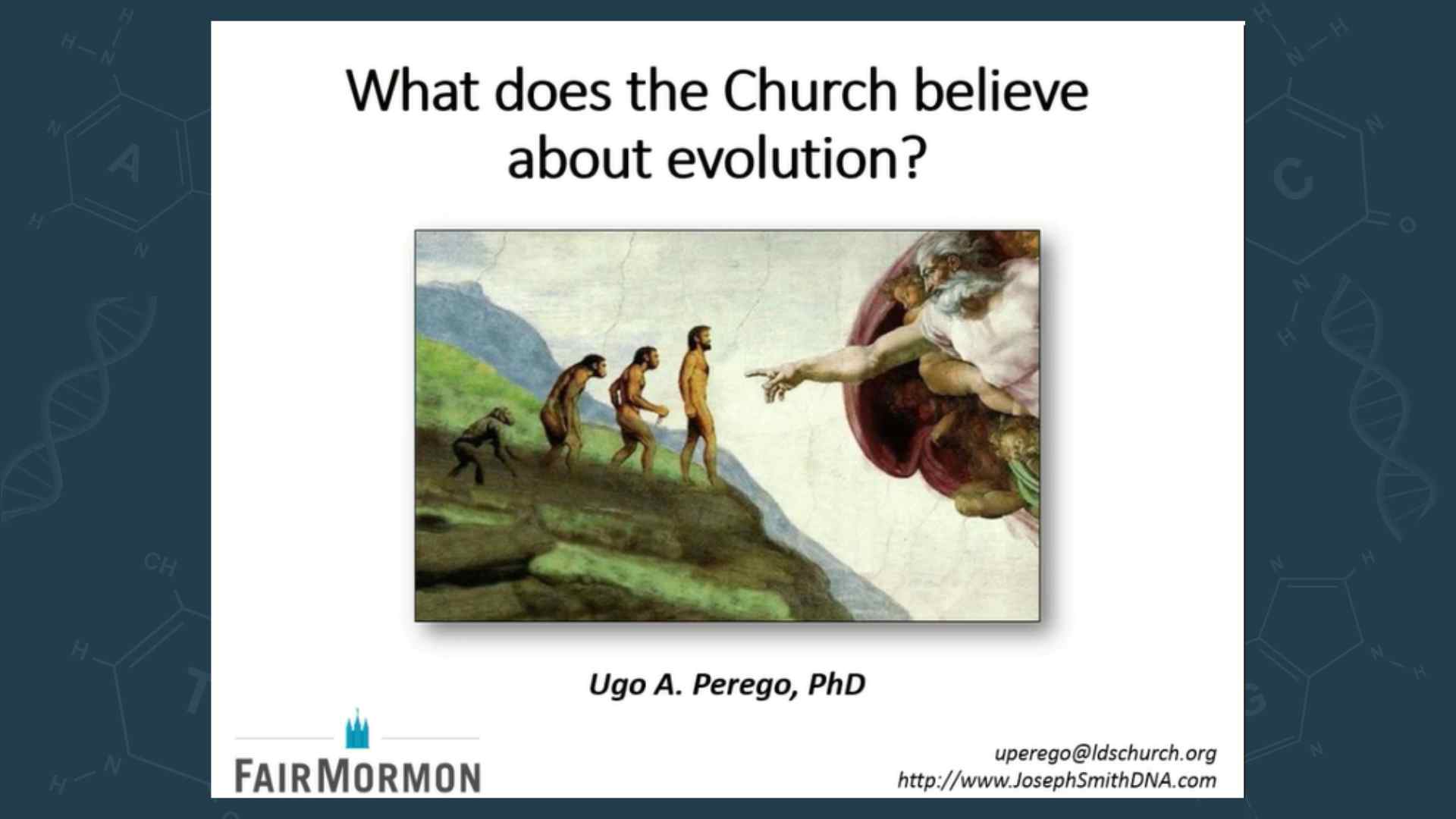
Hopefully today, I won’t make myself more infamous, but the things I’m going to share are my interpretation of things that the Church shares with us about this topic. My goal today is to explain what the Church believes about evolution.
I hope you fully appreciate what Ben has done in creating the right framework in scriptural interpretation, especially on the creation account. I will focus on the creation of man, particularly the evolution of man and the origin of man.
I’m doing this for a specific purpose, and that purpose is to tie it in with the second half of my presentation, which will deal with some issues related to the Book of Mormon and DNA.
Many events supported by genetics regarding the people in America predate the 6,000 years Adam. When you have preconceived notions that nothing existed before 6,000 years ago, you tend to dismiss a lot of genetic data that helps clarify certain issues regarding the Book of Mormon and DNA studies. Hopefully, I will connect them in a way that makes sense to you today.
Science or Religion?
So, a few things to ponder. For those of you who have heard me speak before, you will see and hear some of these concepts again. I learned as a teacher that repetition is a good thing.
Can they coexist?
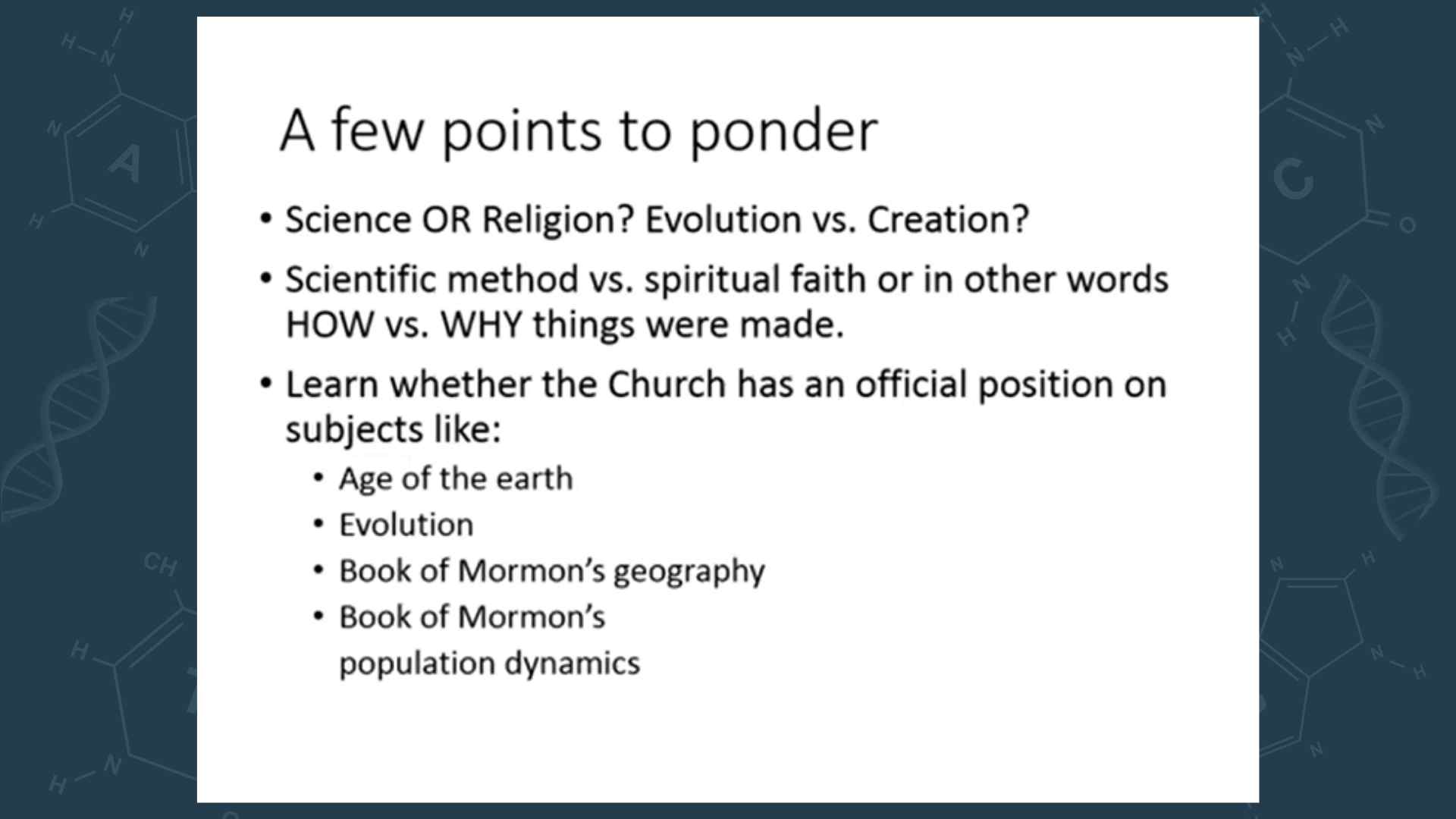
Science or religion—do we really have to choose between one or the other, or are they at the end of the same spectrum and can coexist?
Science may help us understand how things are made versus why things are made and what their purpose is and how we fit into that picture.
Teaching vs preaching
I taught human biology for a couple of years at a college in Utah, and about a third of my curriculum covered evolution. I always started with this disclaimer: in a Utah context, where there are a lot more religious people, more Bible readers, more people attending seminary, institute, and Sunday school, I told my students, “Look, I’m teaching about evolution, not preaching about it.”
There are many things we can understand and appreciate about it and think about it, but we don’t need to gain a testimony of it to be fine.
Aligning Science with Church Doctrine
In this context, it is important to understand what we believe about certain topics that deal with science and what the Church believes about them.
We need to ensure our approach aligns with the official teachings and doctrines of the Church. A lot of Church leaders have written or said things in the past regarding these topics. Our challenge is to understand which of these are official doctrines and what might be personal opinions.
When we discuss creation or evolution, we often say, “Well, Joseph Fielding Smith said this,” or “Bruce R. McConkie said that,” and we get into debates. But what does the Church officially teach?
What are the official teachings of the Church?
Does the Church have a stance on the age of the Earth, biological evolution of man and animals, and everything that has been created? What about Book of Mormon geography or population dynamics?
Were there people in America before Lehi arrived? How long had they been here, and how do we reconcile that with what we study in the Bible?
Understanding what the Church officially states can help us find peace and avoid contention, recognizing there is much we know and much we still don’t know.
Evolution and Creation: Opposed or Intertwined?
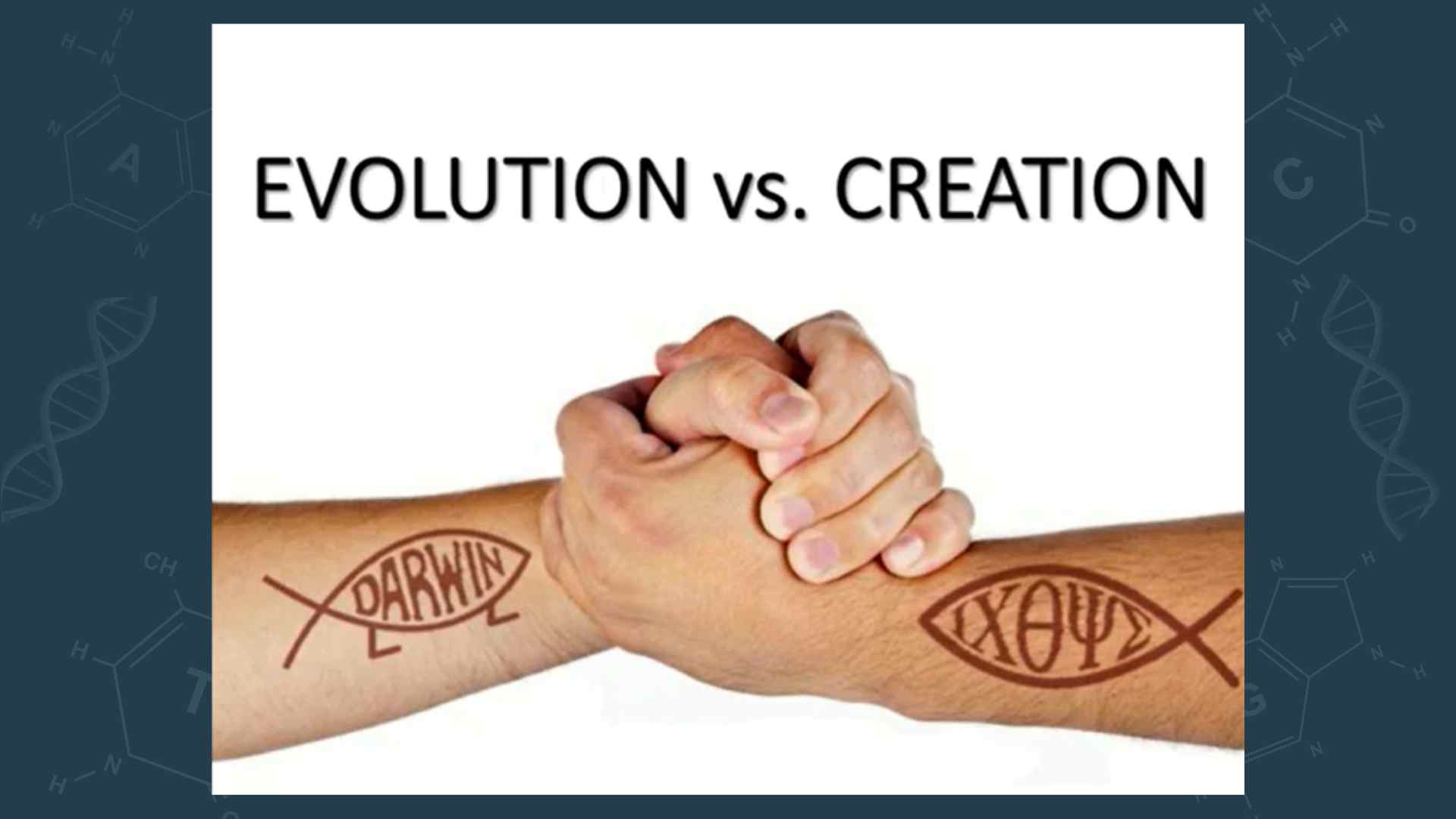
Let’s talk about evolution and creation—are they joined together or against each other?
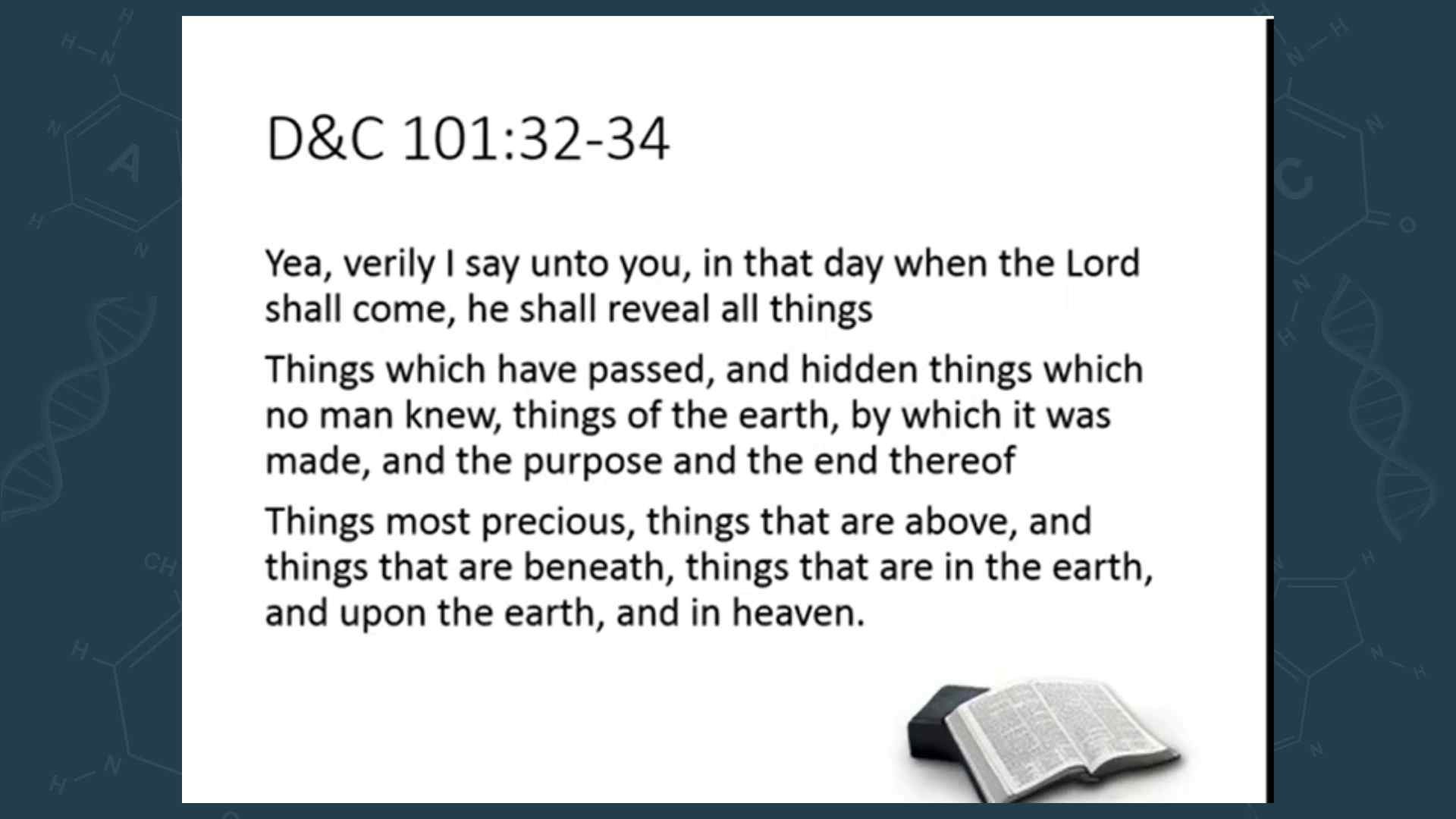
I love referring to the scripture in Doctrine and Covenants regarding Christ’s Second Coming and the big gathering at Adam-ondi-Ahman. Among all the other things that will happen that day, the Lord invites us to a fireside, which sounds like a science fireside to me. Bring your iPads, notebooks, and take a lot of notes.
I don’t think the Lord likes to waste time. He won’t call us to tell us things we already know.
What we’ll learn in that meeting
“Yea, verily I say unto you, in that day when the Lord shall come, he shall reveal all things–Things which have passed, and hidden things which no man knew, things of the earth, by which it was made, and the purpose and the end thereof–Things most precious, things that are above, and things that are beneath, things that are in the earth, and upon the earth, and in heaven.”
(D&C 101:32–34)
As I ponder this, it suggests to me that we do not currently have all the information. We have Genesis and the temple account, but they may not tell us everything we need to know.
Avoiding Contention on these points
We need the Lord to explain things. We can make educated guesses about how things happened, using science, personal inspiration, pondering, and training in specific fields. But we shouldn’t impose these conclusions as absolute truths when the Lord Himself says to wait for Him to reveal them.
This balance helps avoid contention. As a bishop and geneticist, I hear things in Sunday School that I don’t always agree with, but it’s not my place to create contention. We are there to feel the Spirit and give our best interpretation of scriptures with the tools we have.
And sometimes teachers follow the guidelines, sometimes they don’t, and maybe we focus more on teaching them to follow the guidelines rather [than] to tell them that they are wrong.
Official Church Statements on Evolution
THe Church’s first statement
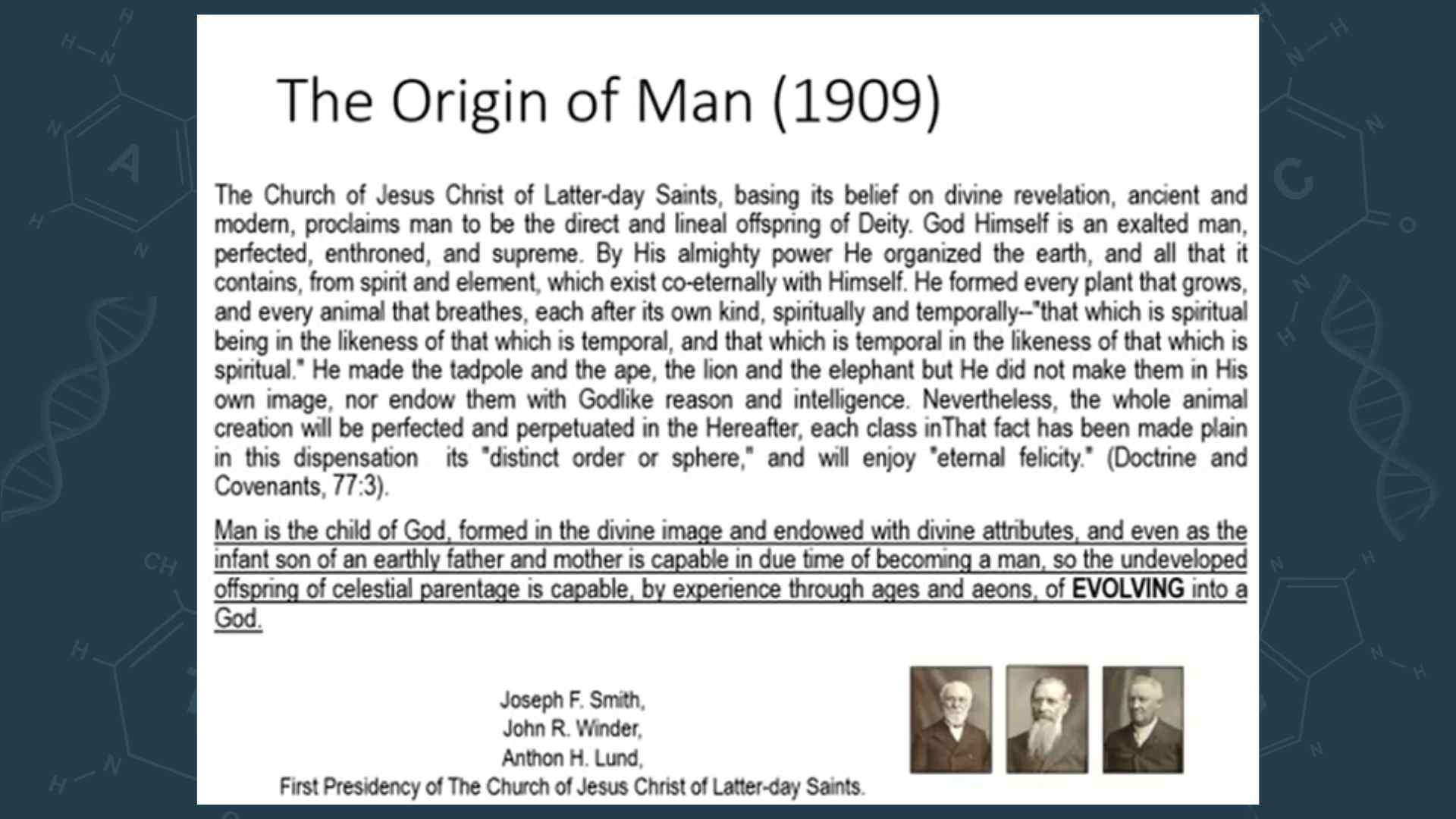
Now, the Church, in 1909, made an official First Presidency statement on the origin of man. I believe this is revelation from the Lord to the people who were in charge of leading the Church at the time.
1909 was a key date as it marked the 100-year anniversary of Charles Darwin’s birth and a lot of people in different venues were having some sort of evolutional revival based on this celebration. So there were concerns.
My understanding is the historical context of making this statement was to address what the members felt about the whole concept of evolution versus things that were taught in the Church. So they felt it was necessary to make an official statement.
Spiritual Evolution
Among all the things that are said here, I love the fact that they talk about a spiritual evolution. Why in the Church are we okay with the idea that we can evolve spiritually but not okay that we could have evolved physically?
We are born as infants from an earthly father and earthly mother–we are not born as adults. Poor mothers, right? Think about delivering an adult person. We start as a single-celled organism and we evolve inside our mother’s wombs for a period of nine months, and then we are born and continue to evolve into adulthood.
The whole process is accelerated, but couldn’t that process happen in other ways under God’s divine guidance over periods much longer, before Adam and Eve?
The Church’s Second Statement on the Origin of Man
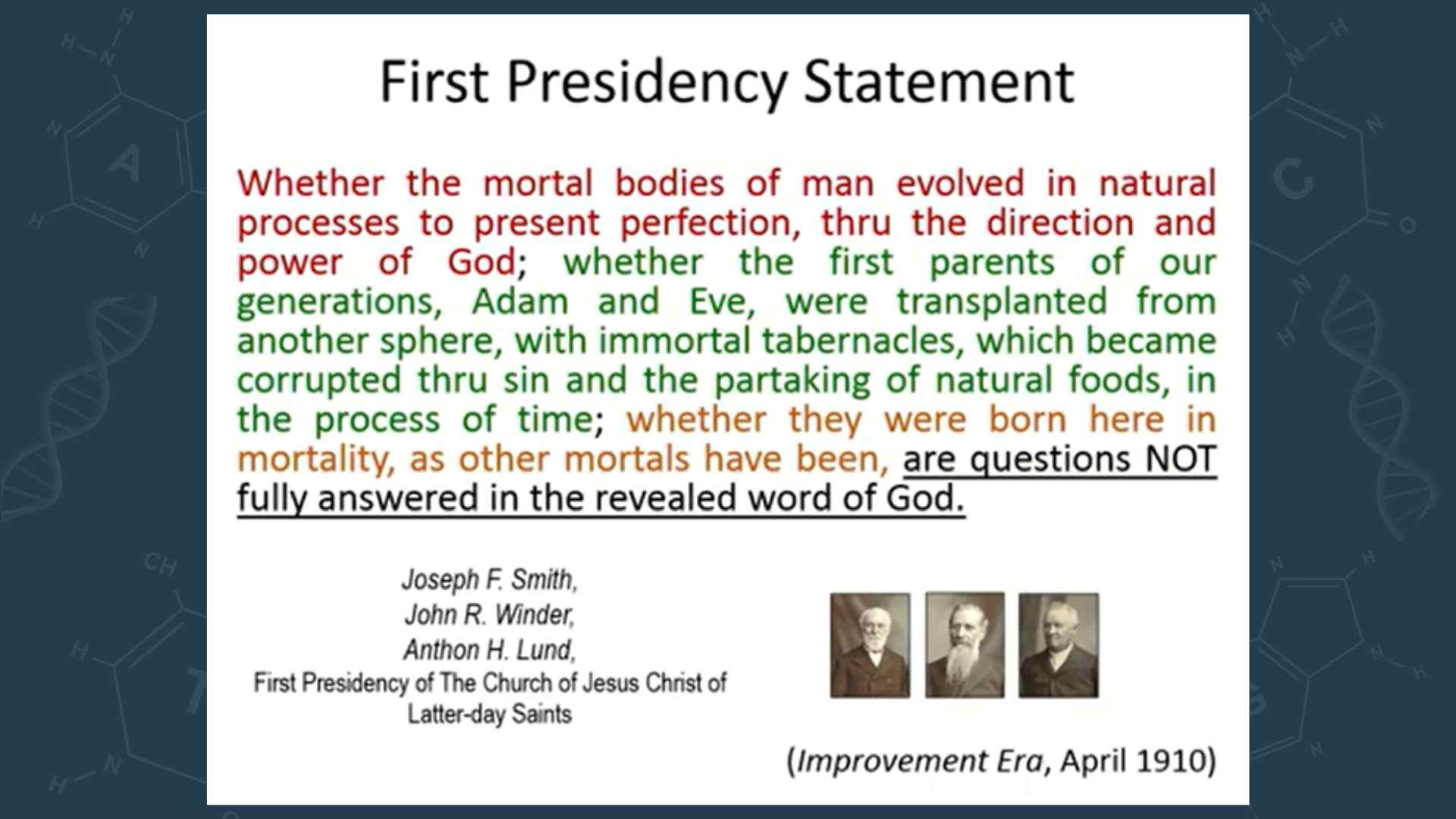
Because the Church sometimes tends to say things without being too precise or specific, it was necessary to make a second statement clarifying the first one. This second statement is not as popular as the first one, but it is also an official statement of the Church. It was published in the Improvement Era the following year.
My understanding is that this came as additional inquiries from members of the Church, who sent questions to the First Presidency asking if the 1909 statement was against biological evolution or if Adam and Eve were created six thousand years ago.
Open to the Possibilities
In response to that question, the First Presidency replied in this way, and I color-coded it because they are proposing three possibilities without choosing any of them. When the Church does that, I interpret it as a way of saying, “We don’t know,” and they leave the doors open to all these possibilities, or maybe even others.
We are waiting for the gathering at Adam-ondi-Ahman just as the whole Church membership is. Maybe some prophets from time to time have been shown things but have been commanded not to reveal these to the general membership, and that’s okay too.
So there could be people even among us today who know, but the Lord is expecting them to keep it to themselves and not share it as an official Church position.
Creation Accounts and the Possibility of Evolution
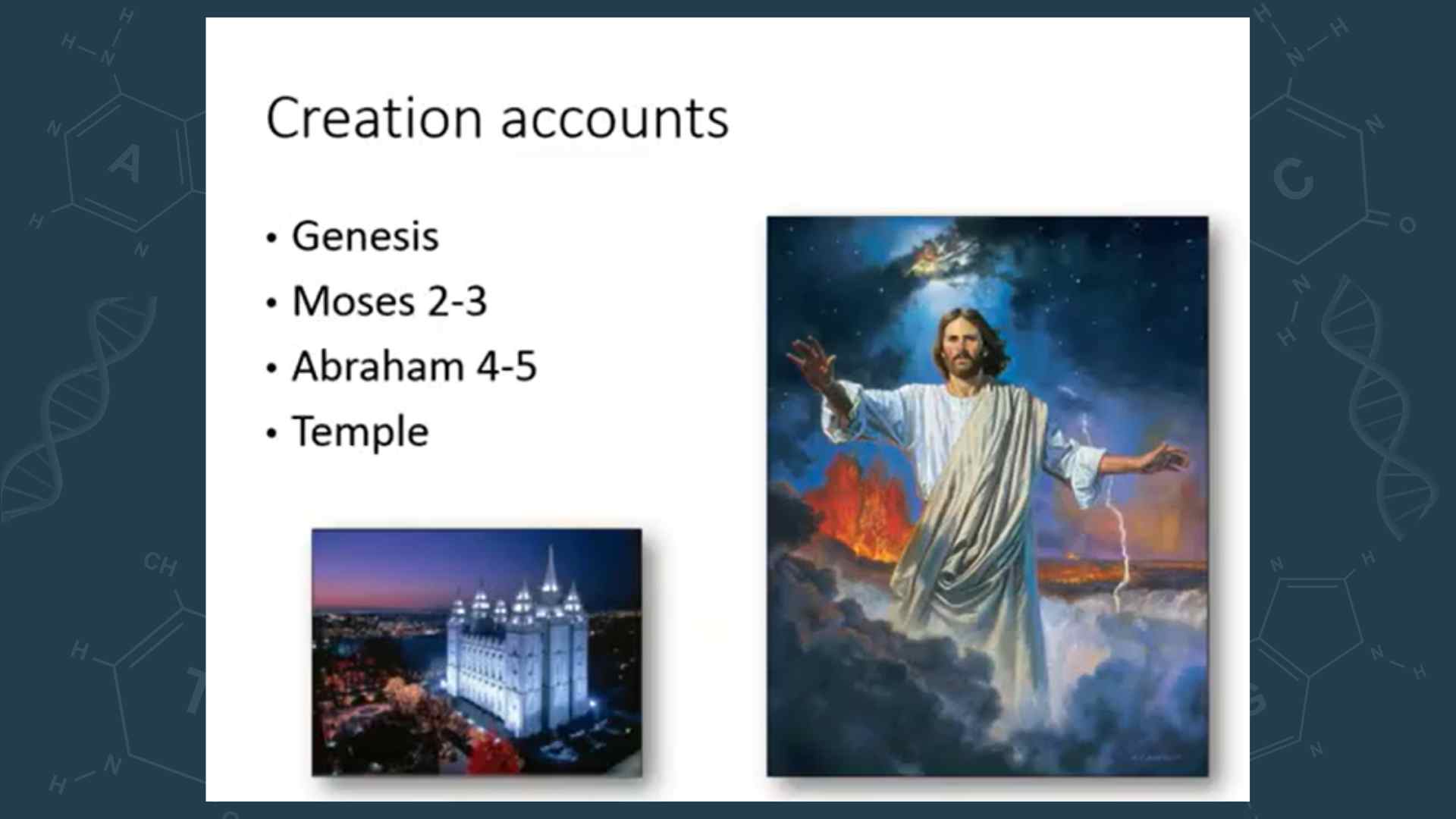
The first option here seems to include the possibility that evolution took place within God’s design of the creation.
The creation accounts we have are in Genesis, Moses, Abraham, and the temple. Ben has done a great job explaining how to read and understand these accounts, so I’m not going to take any time here on this one.
What is a “Day”?
He also spoke about the concept of “day” and how it can mean a real date for poetry or literature but not necessarily literally.
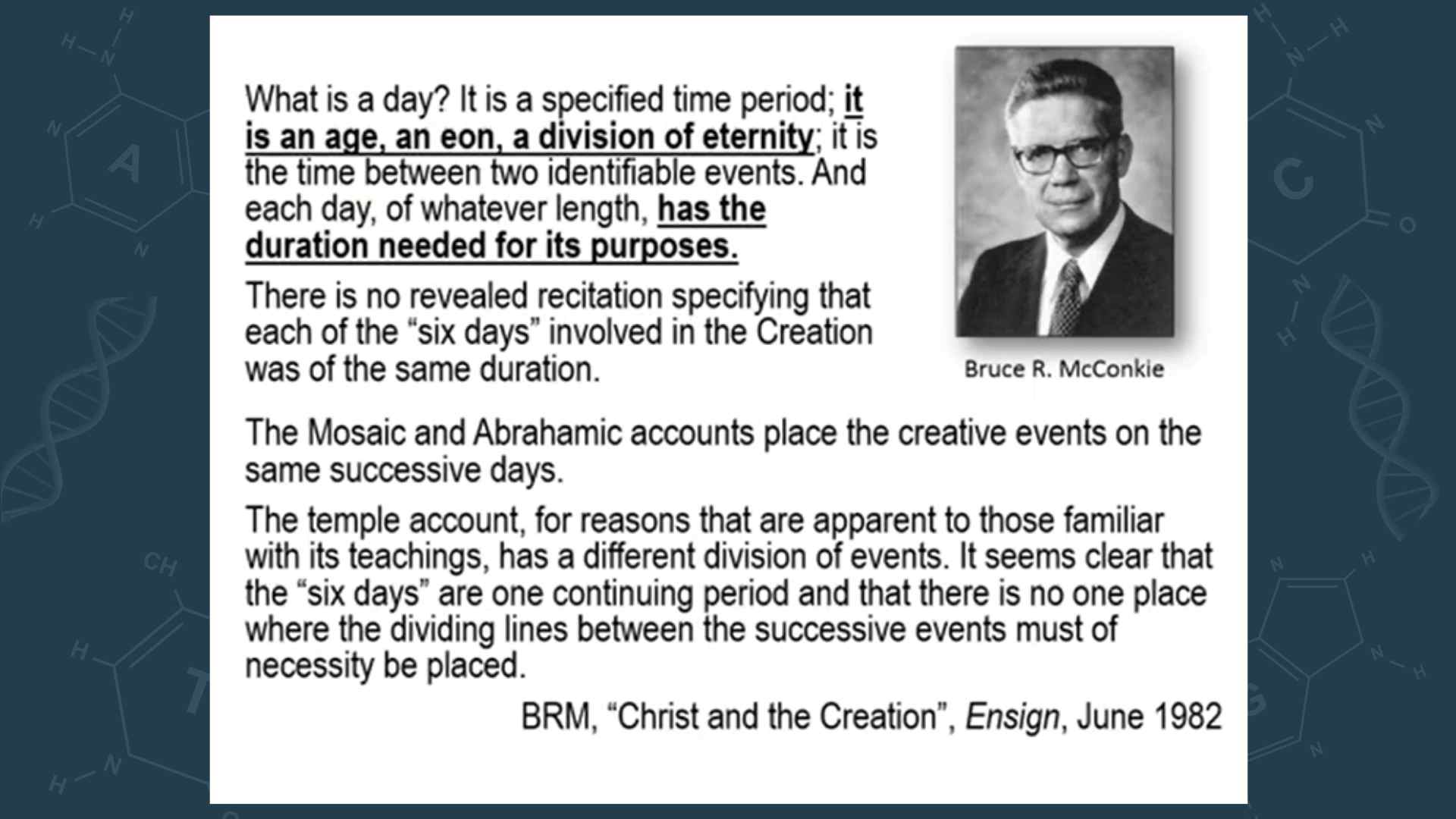
I always love to use this quote by Bruce R. McConkie, who is considered a more conservative individual when it comes to the creation. Yet, he himself understands that we don’t have to understand a day to be twenty-four hours as we read it.
He says that the writer of Genesis wanted us to understand it that way, but the reality is that the true meaning is that God took whatever time He needed to make what He did. He didn’t stop one day with one thing and then start the next day with a new thing. These periods of creation could have been created or evolved simultaneously and reached their fullness or completeness at different times as needed.
Science, Scripture, and Cultural Understanding
I remember a number of years ago when I was working in Salt Lake City. I was asked to go to the airport. We were having a collaboration with a university in China. One of their colleagues, who was important in China regarding genetic research, was coming. They asked us to pick him up, be cordial and hospitable, and show him around. We agreed, and I was sent to do that.
As we were driving, he told me that he did his PhD and postdoc here in the United States, so he was totally fluent in English and very familiar with American and Utah culture because his wife, while he was doing his PhD, was taking missionary lessons to learn English.
She wasn’t interested in the gospel but primarily wanted to learn English. She met with missionaries for two years, I think, probably setting up a lot of hopes in many missionaries writing home about teaching this great Chinese lady who was very interested. But really she just tried to learn English.
Reconciling the Old Testament with Science
Despite this confession, what he knew about Mormon culture and that Utah was a very religious state compared to other places in the world, he was puzzled by the fact that, in the 21st century, with everything we know about science and how things are made, we still hold on to things like the Old Testament. He couldn’t reconcile that.
When I explained to him that Genesis is a story, not science—it tries to teach us certain principles, and we don’t have to take “day” literally—when I told him these days could have been any amount of time, and he looked at me, “even billions of years?” his eyes sparkled, and we immediately broke down a wall between us. It made it easier for him to see that we are not just stupid people who don’t understand how things happen.
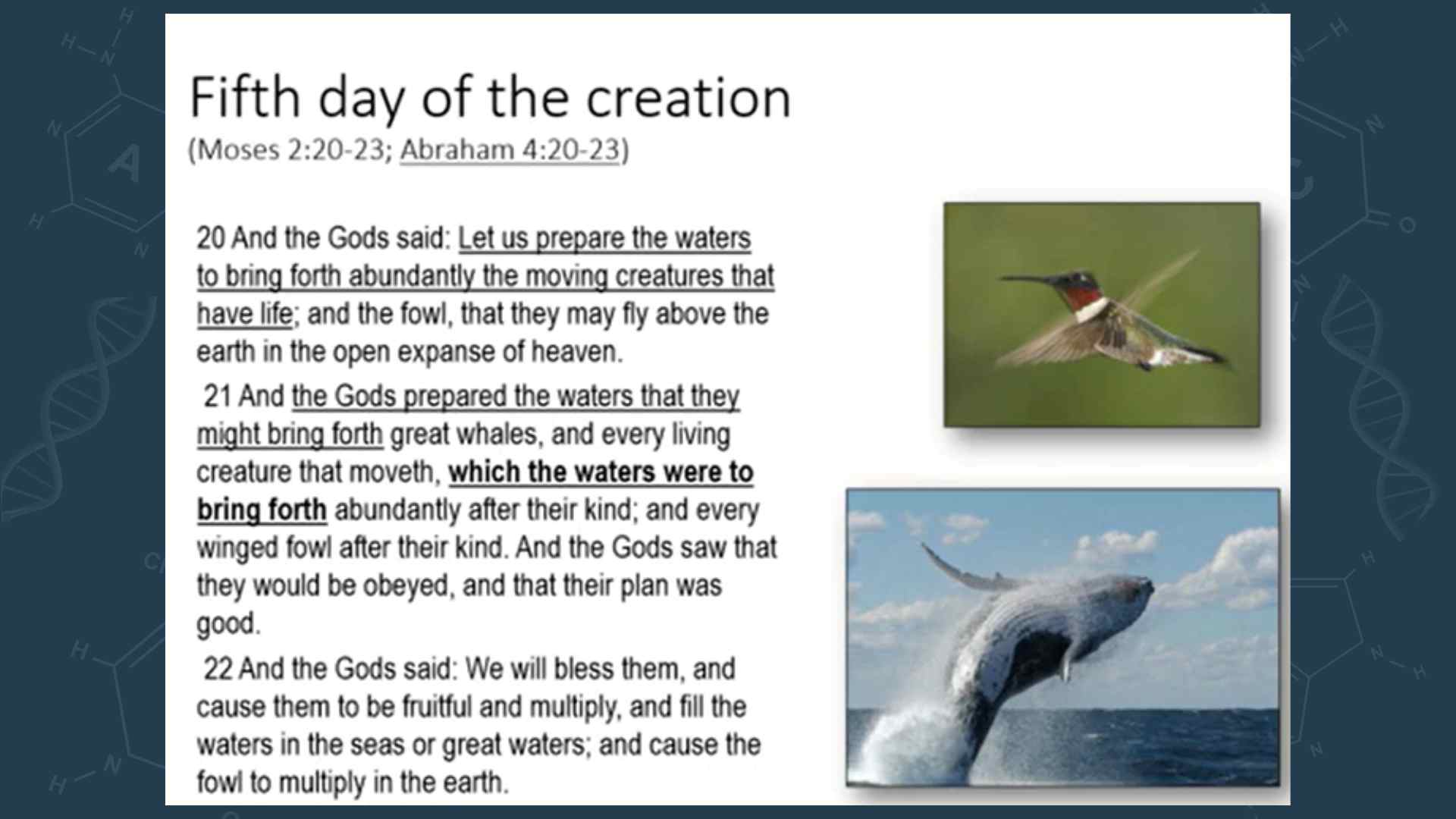
Prepared for Life: A Scriptural View
On the fifth day of creation, we see it not being consistent in the order and so on because of the fact that they are mostly teachings about these things and not scientific textbooks. I love the fact that in Abraham it explains that God prepared the waters to bring forth life, not God. So God prepared the waters and they are the ones responsible to bring forth abundantly, life of every kind.
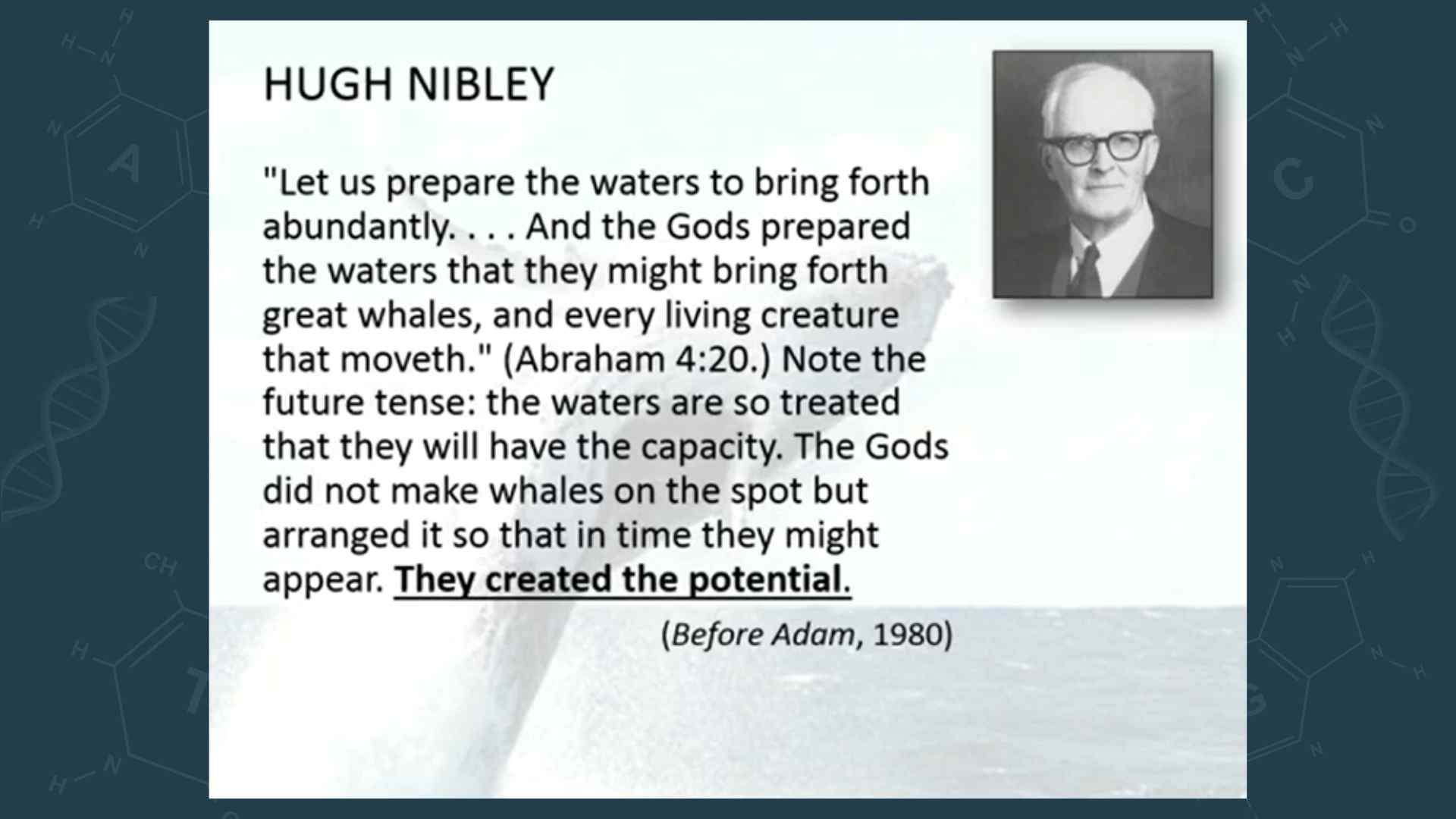
On this subject, Hugh Nibley, in his book Before Adam, says, first quoting from the Book of Abraham:
“‘Let us prepare the waters to bring forth abundantly. . . . And the Gods prepared the waters that they might bring forth great whales, and every living creature that moveth.’ Note the future tense: the waters are so treated that they will have the capacity. The Gods did not make the whales on the spot but arranged it so that in time they might appear. They created the potential.”
Now, Hugh Nibley is not speaking for the Church. The title of the presentation is “What Does the Church Believe About Evolution?” I’m not using Hugh Nibley as the spokesperson for the Church.
But the Book of Abraham is scripture and is canonized, so we read it as the Word of God. It seems that one way to read it is the way Hugh Nibley explains it.
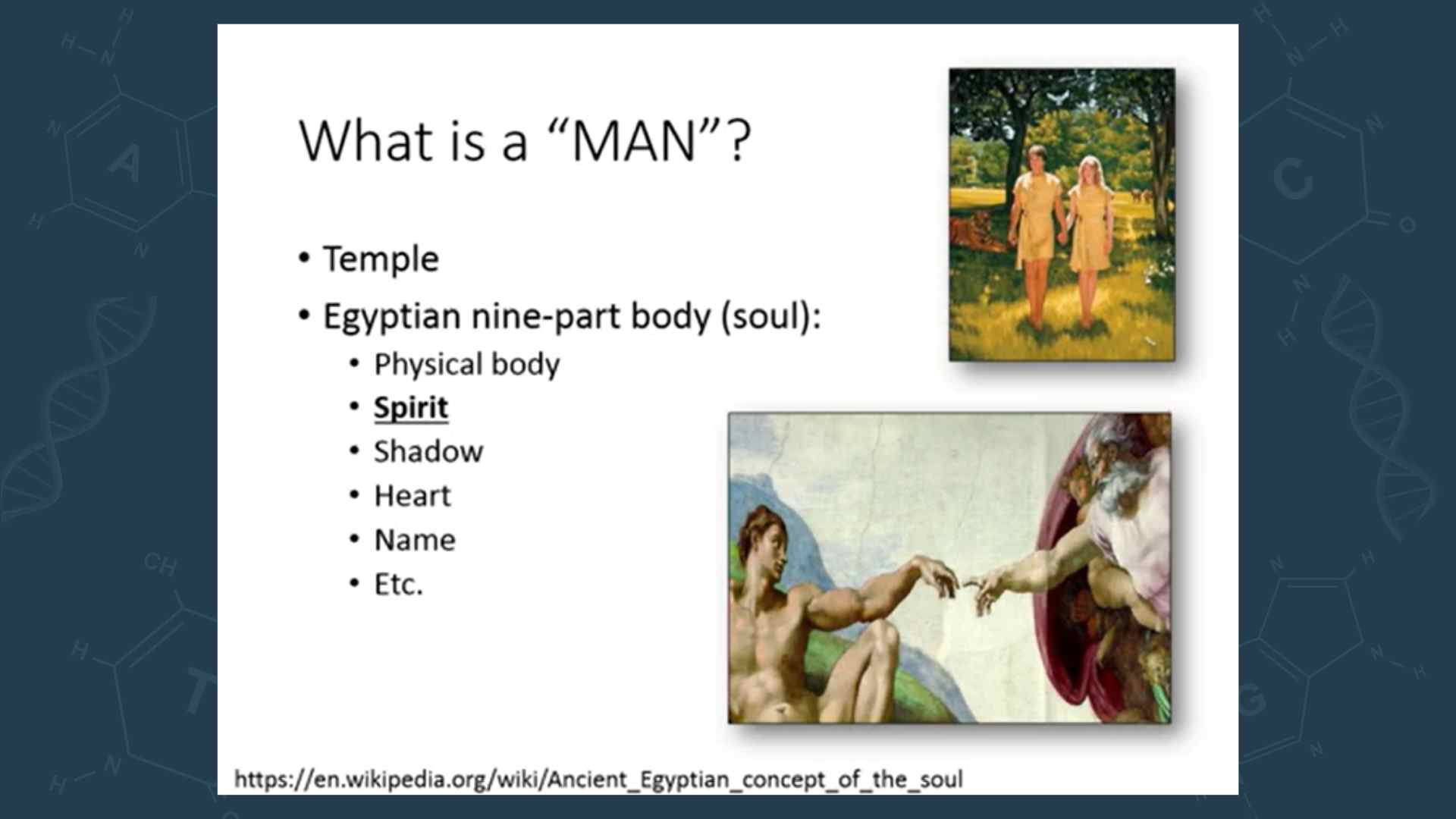
Temple Creation Account and Scientific Curiosity
For those who have been through the temple endowment, you know there is a question asked to the Savior and Adam by the Father: “Is man found on the earth?”
I wish I could go to the temple and just enjoy being at the temple for some time. I can’t help it, but I always look at the movie of the creation in a scientific context, trying to understand how we have more horses than two, is the grass dying or what are they eating and how it works with science. I know it’s all imagery, but I’m always trying to think of how it works with science.
The Father’s Direct Involvement in the Creation of Man
It puzzled me that Jehovah and Michael are asked to create everything, including animals, under the Father’s stewardship and instruction. Yet, when it comes to the creation of man, the Father has to intervene himself. It is the first time that He is actually taking a physical or first-person participation.
Physically the Savior could create the bodies of Adam and Eve. What would have been the difference? We’re made of the same chemical elements, we function pretty much the same ways with the organs, the blood system, the skeletal system, the brain. You know they kind of all work the same way.
DNA works the same way. We share 50% of DNA with bananas. If you can create a banana, you can create a man. We share 98% of DNA with apes, so if you can create an orangutan, you can create a man. (If you look at me, all you need to do is shave it a little bit, you know, not even that much, and you’ve got a human.)
But here there is something that Heavenly Father had to do, that the Savior at that time could not do, and that was to put a spirit into a physical body.
Egyptian Symbolism and the Soul
As we see that in the temple, something else comes to my mind: the Egyptian tradition of what constitutes a recipe for a human being.
For a human, you need a physical body, a spirit, a shadow, a heart, a name, intelligence, and so on. You can read all of that in Wikipedia, so it must be true. But it’s actually a true tradition.
The point is, can you have most of these elements, but let’s say no spirit, as in a spirit child of God, and still have some sort of functioning, living biological organism that looks like a man but is not human?
I don’t know, but I think that’s a good possibility.
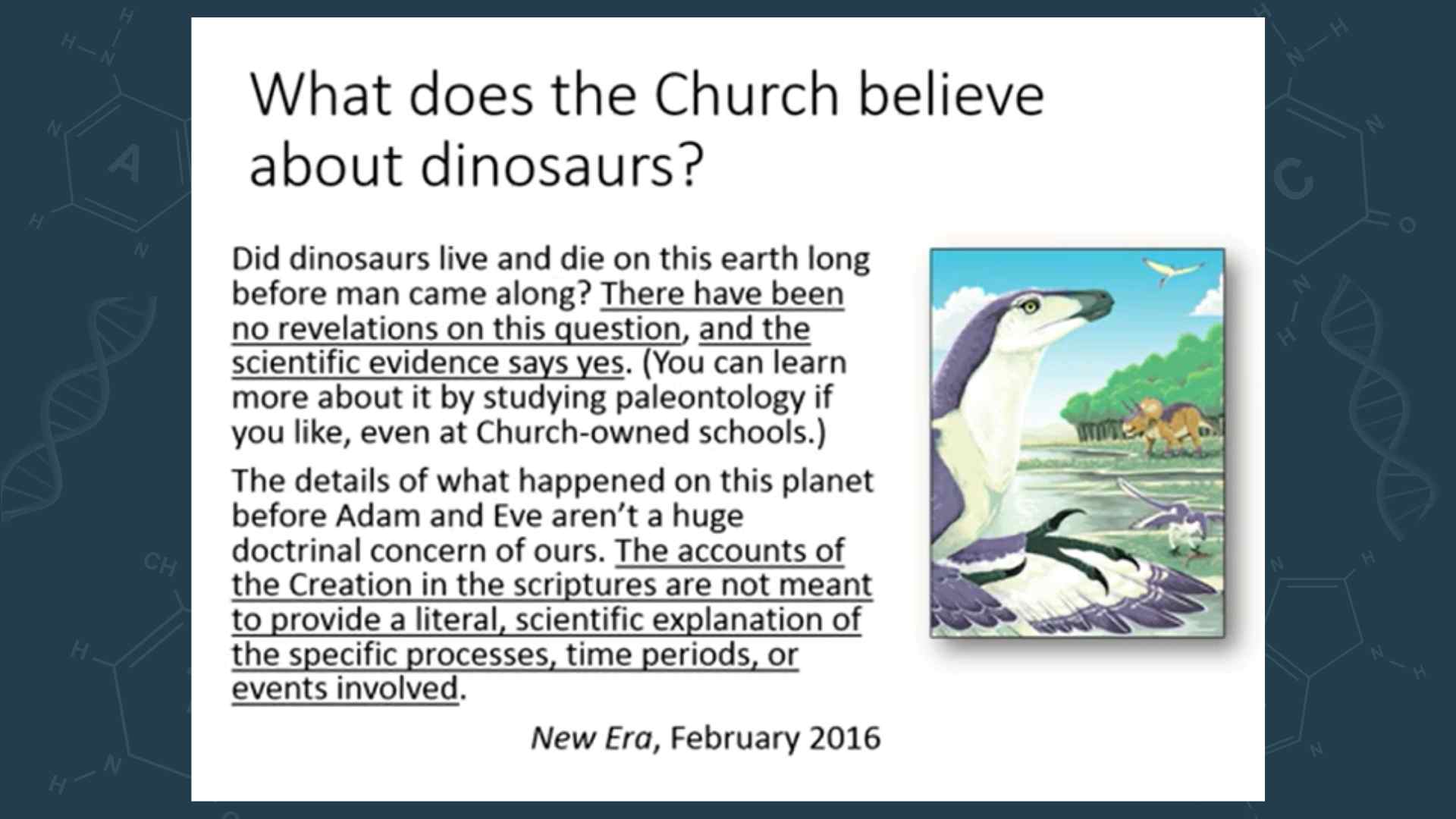
“What Does the Church Believe About Dinosaurs?”
So now let’s go into the official Church position. There were a couple of statements published last year in the New Era. They were not signed by anyone and were in a section called “To the Point.” This section deals with specific topics in a concise way.
When I saw the article called “What Does the Church Believe About Dinosaurs?“ in the index, I immediately turned to that page. This is the full article. I wanted more information, but it was a good start.
As I shared this with others, especially those who did not embrace the possibility that there could be anything older than 6,000 years old, or anything to do with evolution, they dismissed it because it was in the New Era and not the Ensign. They said it wasn’t official. And it’s not signed therefore it’s like no one wrote it, right?
So, I called the Church’s general number and they sent me to the magazine subscription department. I was like, “Sorry, that’s not who I needed to talk to.” So I had to rephrase my request better so I could talk with those people that actually write the stuff.
Inside Church Curriculum Approval
I eventually talked to the managing director for Church magazines. I told him who I was and the experience I had around this, and asked for some background information.
“Who writes these things, who approves them, and if the New Era is a second-class source of information in the Church?”
The answer was very clear: everything is written by staff, approved by a curriculum committee, and then sent to the general authority supervisors for final approval. So everything is screened and approved, and if there ever is some sort of mistake, which doesn’t happen often, there is some correction published later.
This statement has been out now since February 2016, so I think they’re pretty comfortable with it, and it also goes on LDS.org. The only difference is that they target a younger audience (12–18) with the New Era.
I didn’t want to say anything, but are they more receptive than adults? Are we hoping to reach the future generation because we have given up and have no hope for the current generation and we’re investing in the future one?
The Church’s Official Stance on Evolution
But I read these words, I tend to overanalyze things, but it says:
“Did dinosaurs live and die on this earth long before man came along?”
And the answer is: “There have been no revelations on this question and the scientific evidence says yes. (You can learn more about it by studying paleontology if you like, even at Church-owned schools.)”
My very first evolution class was taken at BYU.
It’s basically saying that the Church has no official position on the theory of evolution, and it doesn’t have anything to really add to that and if you want to learn about it, go to science.
Is science absolutely correct, or does it make mistakes, or does it have the full picture? I don’t think that is what they’re saying. They’re just saying that if you want to know something about it, that is the best we got. And it’s going to get better from here. So we know more than we knew in the past, and we will continue to learn more by relying on both personal revelation and Church revelation and scientific matter.
Creation: The “Why” Versus the “How”
“The details of what happened on this planet before Adam and Eve aren’t a huge doctrinal concern of ours.”
If it is not for the Church and the Brethren, why should it be for us individually? Meaning it could be something we’d like to understand, but why do we have to be obsessed about it? Why do we have to stress out about it? Why do we have to impose our views and create contention on something that the Church says is not a big deal?
Continuing from the New Era article:
“The accounts of the creation in the Scriptures are not meant to provide a literal scientific explanation of the specific processes, time periods, or the events involved.”
Okay, that is the Church’s official position right here.
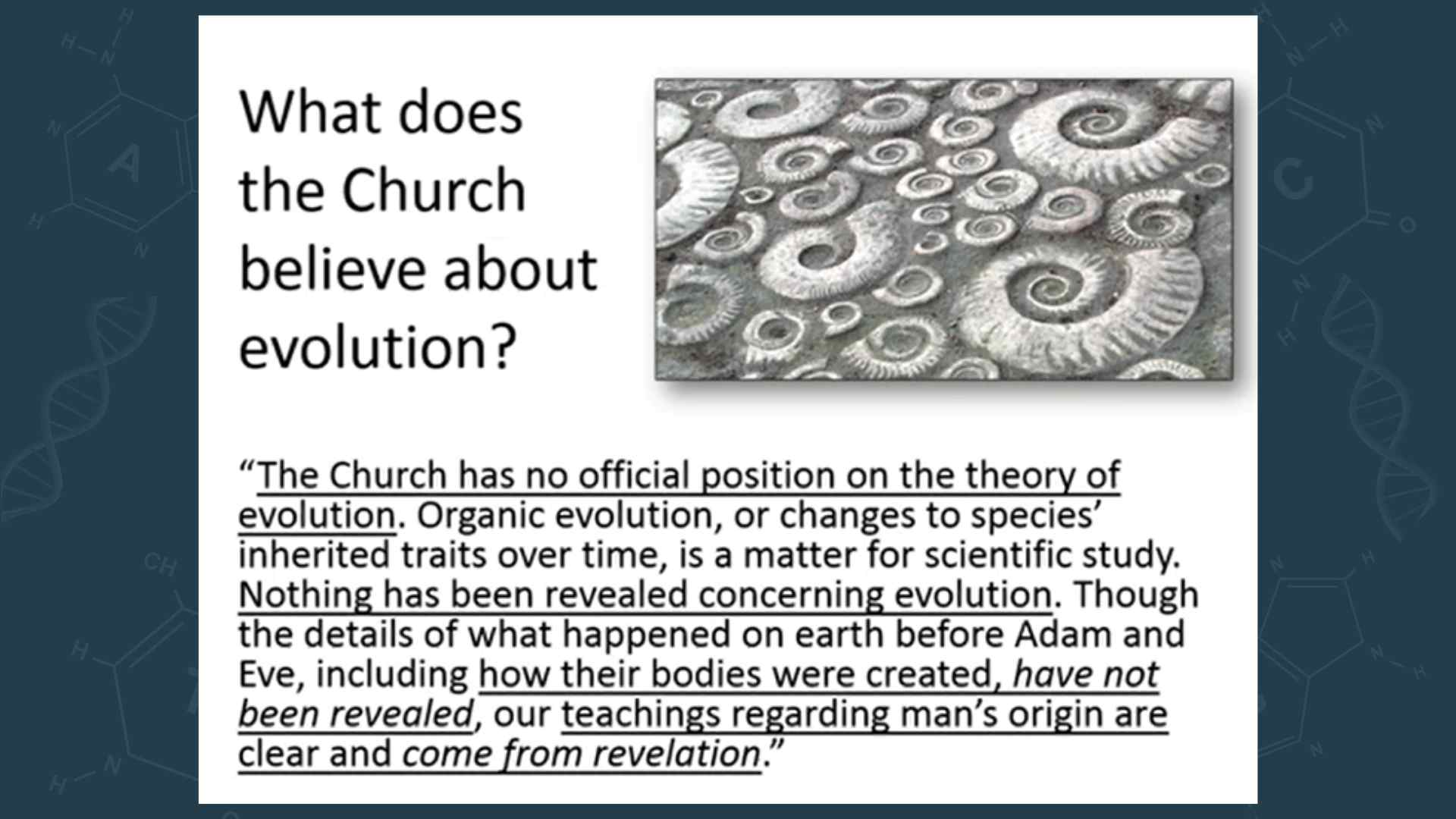
What Has—and Hasn’t—Been Revealed
As if that was not enough, in October in the New Era, there was this additional article. And I want you to know that they are copied and pasted word for word in their entirety, including the pictures. So there is nothing that I have added here.
“The Church has no official position on the theory of evolution. Organic evolution, or changes to species’ inherited traits over time, is a matter for scientific study.”
The How and the Why
That is the how, and the why is a matter for religious studies. It’s our theology—why we have the creation, why we have an earth, why we have a body and that there was a Fall. But how these things happen is a matter that science deals with and we don’t as a Church.
And then the article goes on to repeat the same sentence:
“Nothing has been revealed concerning evolution. Though the details of what happened on earth before Adam and Eve, including how their bodies were created, have not been revealed, our teachings regarding man’s origin are clear and come from revelation.”
Spirit vs. Body in Church Teaching
If you read that quickly it sounds like they’re either very confused, because they’re saying “well we don’t know how Adam and Eve were created, but we know how Adam and Eve were created,” right?
And like “okay, you know, make up your mind because I’m following you here.” But maybe they’re talking about two different things. Maybe, as they say, we don’t know how the physical body was created, and we have no revelation about it so you can say pretty much whatever you want about it and it could be just as true as wrong. And the best thing we have is the scientific approach.
But we know where men come from, or the purpose of the spiritual origin of it. That’s how I’m reading it.
Spirit Children and God’s Role
This is the second part of this article, the full text:
“Before we were born on earth we were spirit children of Heavenly Parents, with bodies in their image.”
This is a little clarification from the previous accounts that we have, whereas actually specifying that this is the spirit creation in the image of God, not necessarily the physical body.
Thinking of Joseph Smith and the First Vision (and this applies maybe to what Ben was teaching) is the question: “Is that the way they decided to present themselves to us so that we could understand their physical resemblance?” I don’t know, but the point is that here we’re talking about the spirit being created in the image of God, and then God directed the creation of Adam and Eve.
Creation Not Chaos
So it’s not chaos, right? It’s not a chaotic creation or evolution, but God is involved. Things are happening because He was in control.
Continuing on:
God directed the creation of Adam and Eve and placed their spirits in their bodies.”
So that is why He had to come to the earth and He’s the only one who could have done that at that time.
We are all descendants of Adam and Eve, our first parents, who were created in God’s image. There were no spirit children of Heavenly Father on the earth before Adam and Eve were created.”
He’s not saying there were no humanlike individuals, but there were no spirit children of Heavenly Father.
Do Animals Have Spirits?
As you look at all the animal creations of God, do horses or cows or dogs have spirits? Our theology teaches that yes they do. But are they children of our Heavenly Father? No they’re not. We’re the only ones, and only God can place one of His spirit children inside a physical body and He does that every time somebody is conceived.
At what point does a spirit enter the body? We don’t know, that’s not been revealed, but it does happen.
Book of Mormon and DNA
Okay, so in the few minutes I have left, I’d like to see, now that we know that the Church can accommodate or leave the door open for things that are older than 6000 years, let’s review a little bit about how that ties in with the Book of Mormon.
I’d like to clarify and go on the record with regard to a couple of things that are important. Remember, we have in ourselves something called mitochondrion and then in the mitochondria, DNA. We’re going to see how that is used.
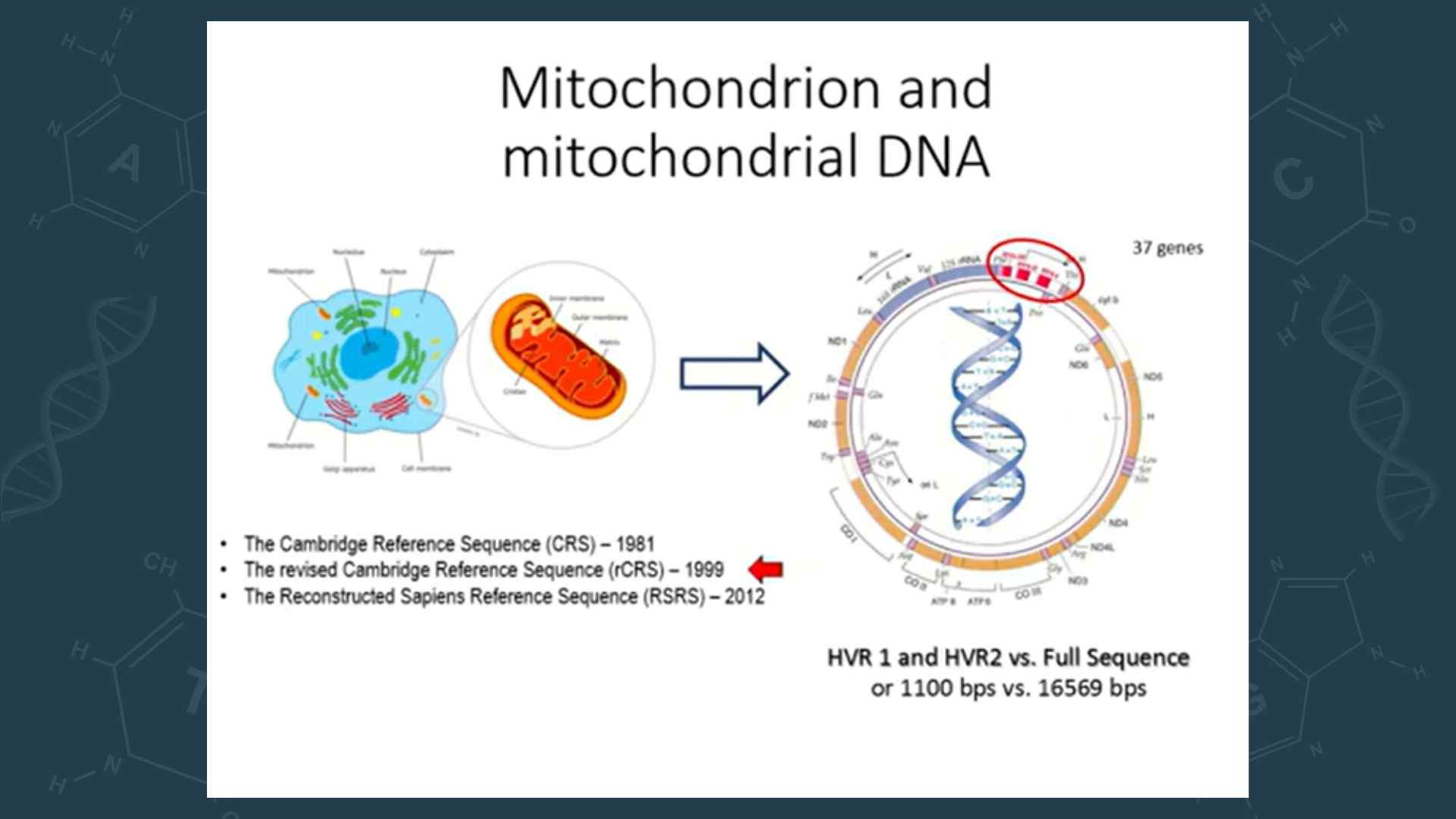
We don’t have a lot of time to go over this, but I’ve written a lot and I’m going to give you another reference for if you want to read more about it.
Mitochondrial and Y Chromosome DNA
And then we have in addition to the mitochondrial DNA in the mitochondria, we have nuclear DNA found in the nucleus of the cells.
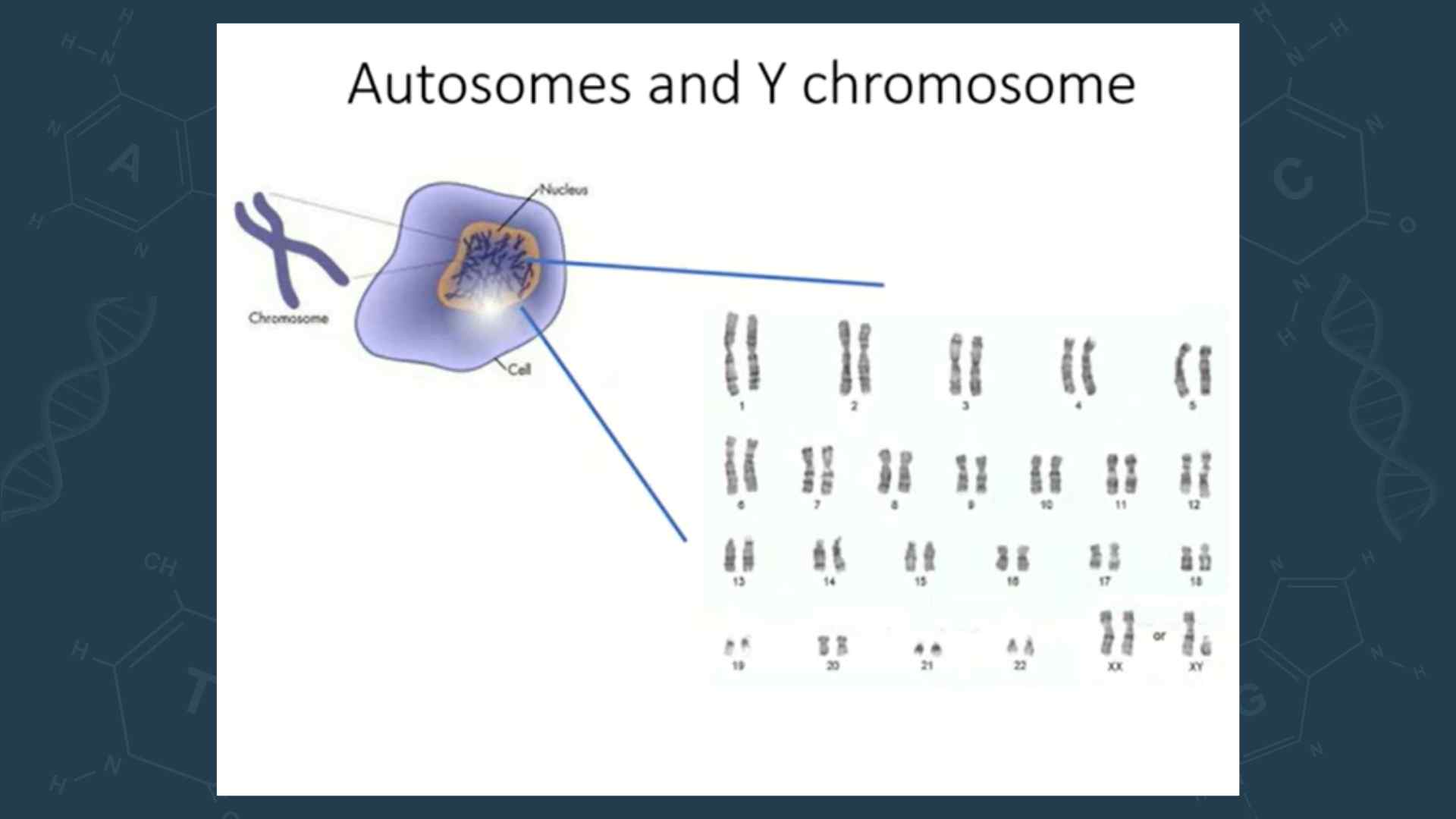
We have autosomal DNA, which is a chromosome pair from 1 to 22 and then we have the sex chromosome which is the 23rd pair of chromosomes, and that includes the Y chromosome which determines the gender of male.
We were created with the potential to become a female without any invention and then the presence of a Y chromosome turns the potential, naturally-developing female into a male. Okay, this is how the biology works, and we have features as males that are similar to females.
We don’t use them you know, like in our breasts for example, and that is evidence that we were on the same path as them, but then the Y chromosome comes in and changes stuff.
Phylogenetics and Human Migration
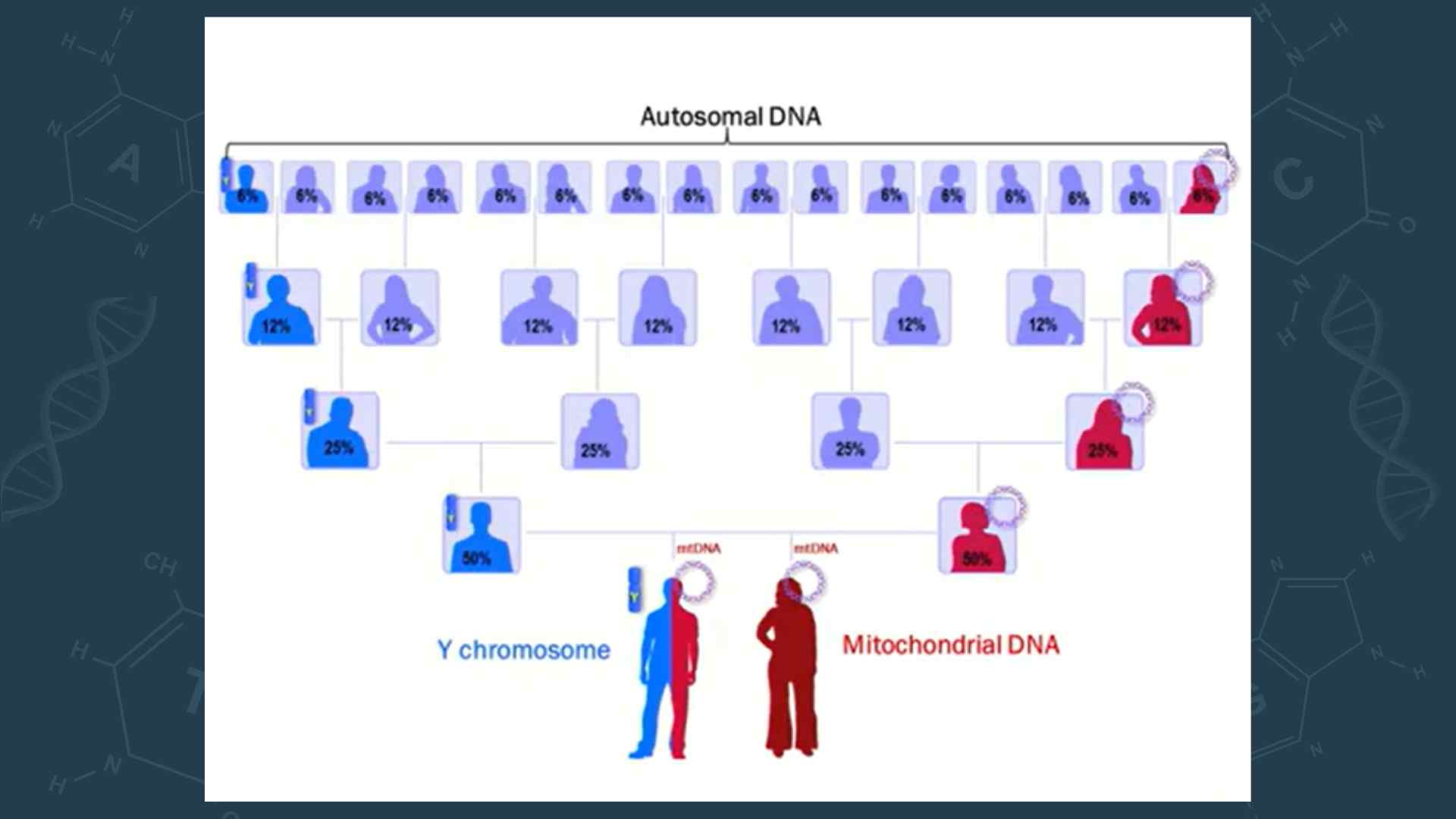
We have used both mitochondrial DNA and Y chromosomes and autosomal DNA with regard to study populations.
This is our tree right there, and we have the mitochondrial DNA which is what I’m going to focus on today because there’s been some developments in the last couple of years to help us understand issues with regard to those things that people are saying about the Book of Mormon.
And then the Y chromosomes follow the paternal line and the autosomal DNA is what comes from all our ancestors.
Phylogenetics
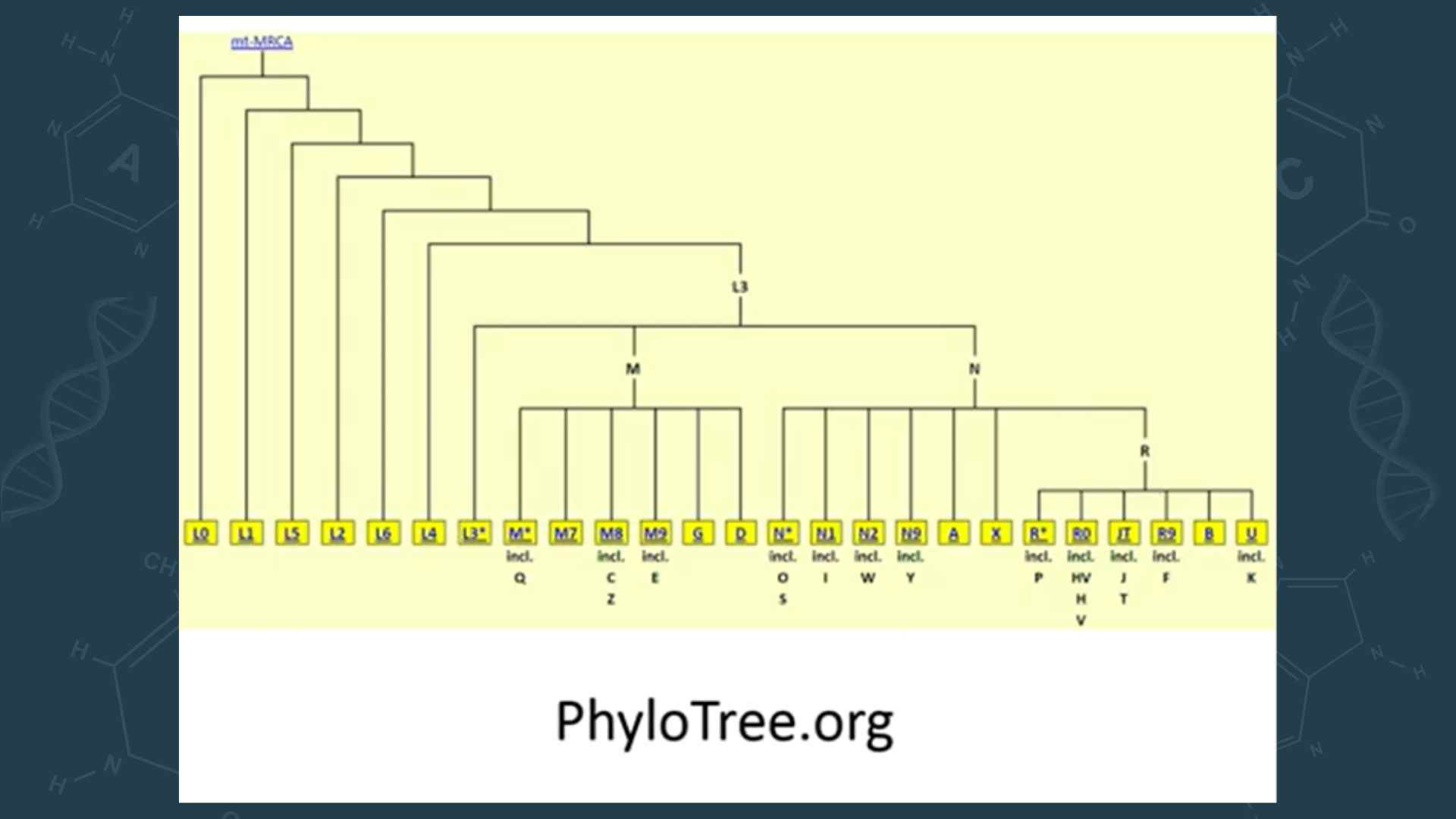
When we look at mitochondrial DNA we can create trees we call phylogenetic trees, but they are like family trees that show how everybody is related in the world around the maternal line.
And every one of these lineages is named after a specific letter and we’re going to see a little more about that.
World mtDNA
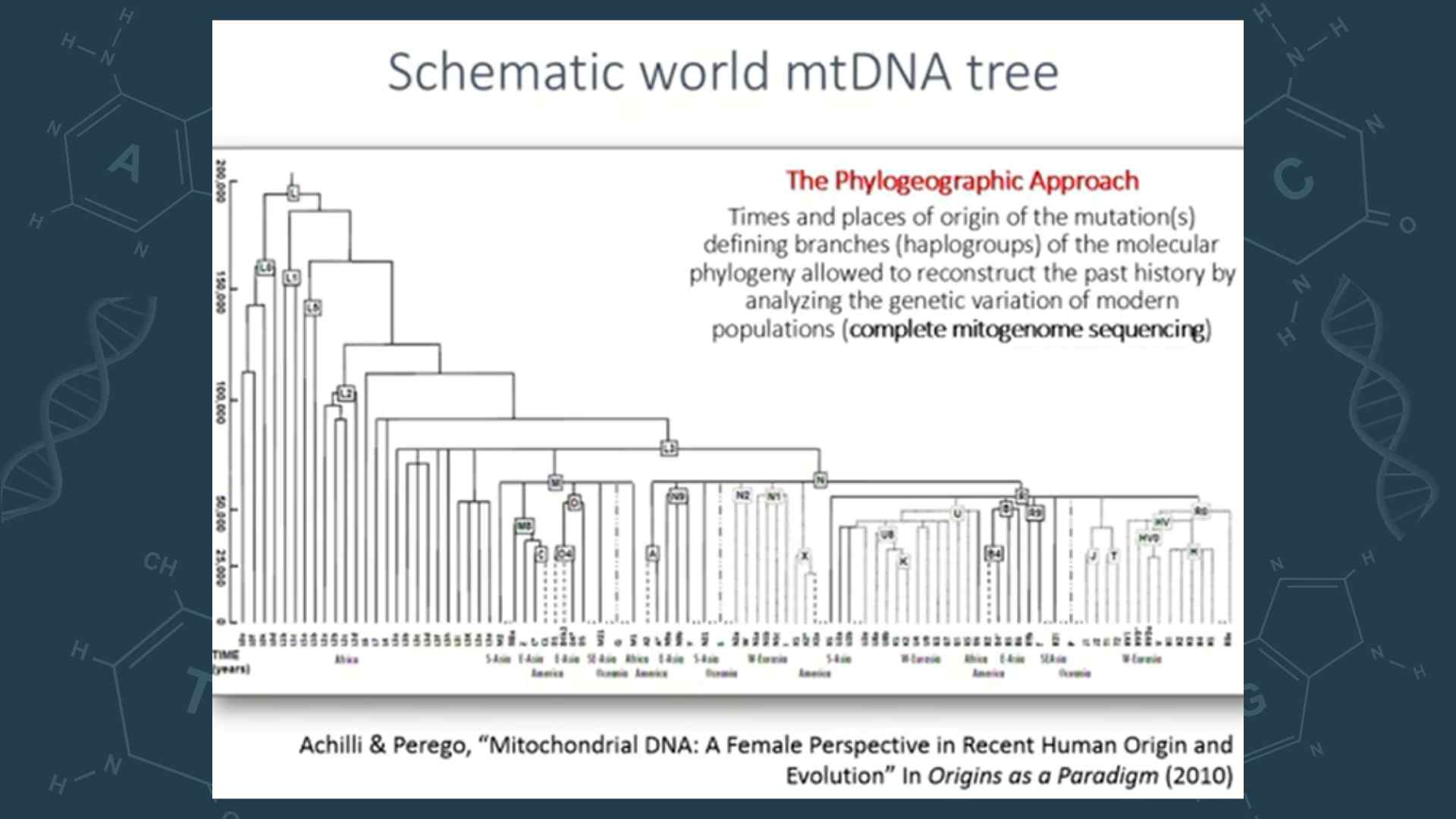
And then you can link these branches through history to specific geographic areas and say okay we see more of a specific lineage in Africa and more of another lineage in Europe and more of another lineage in Asia and then in the Americas, and how can we use these things and bring them together to understand the expansions and the migrations that took place.
Based on mitochondrial DNA and based on Y chromosomes, we believe as scientists that mankind has been around for about 200,000 years. They are listed as Homo sapiens. We’re talking about our species.
Reconstructing Migration with DNA
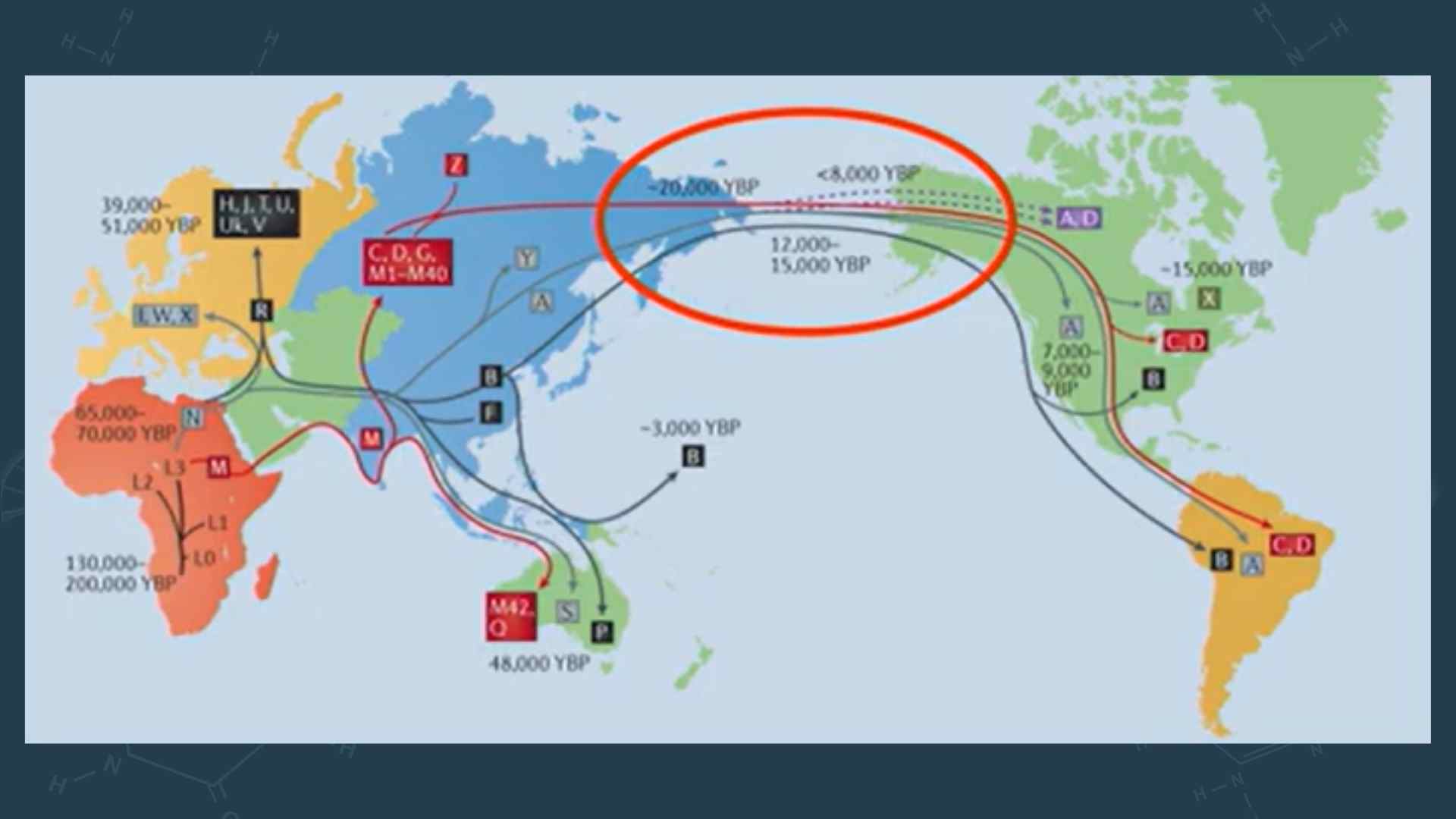
And based on the age of these branches in distribution around the world, we can reconstruct these migration maps that indicate how the continents were populated.
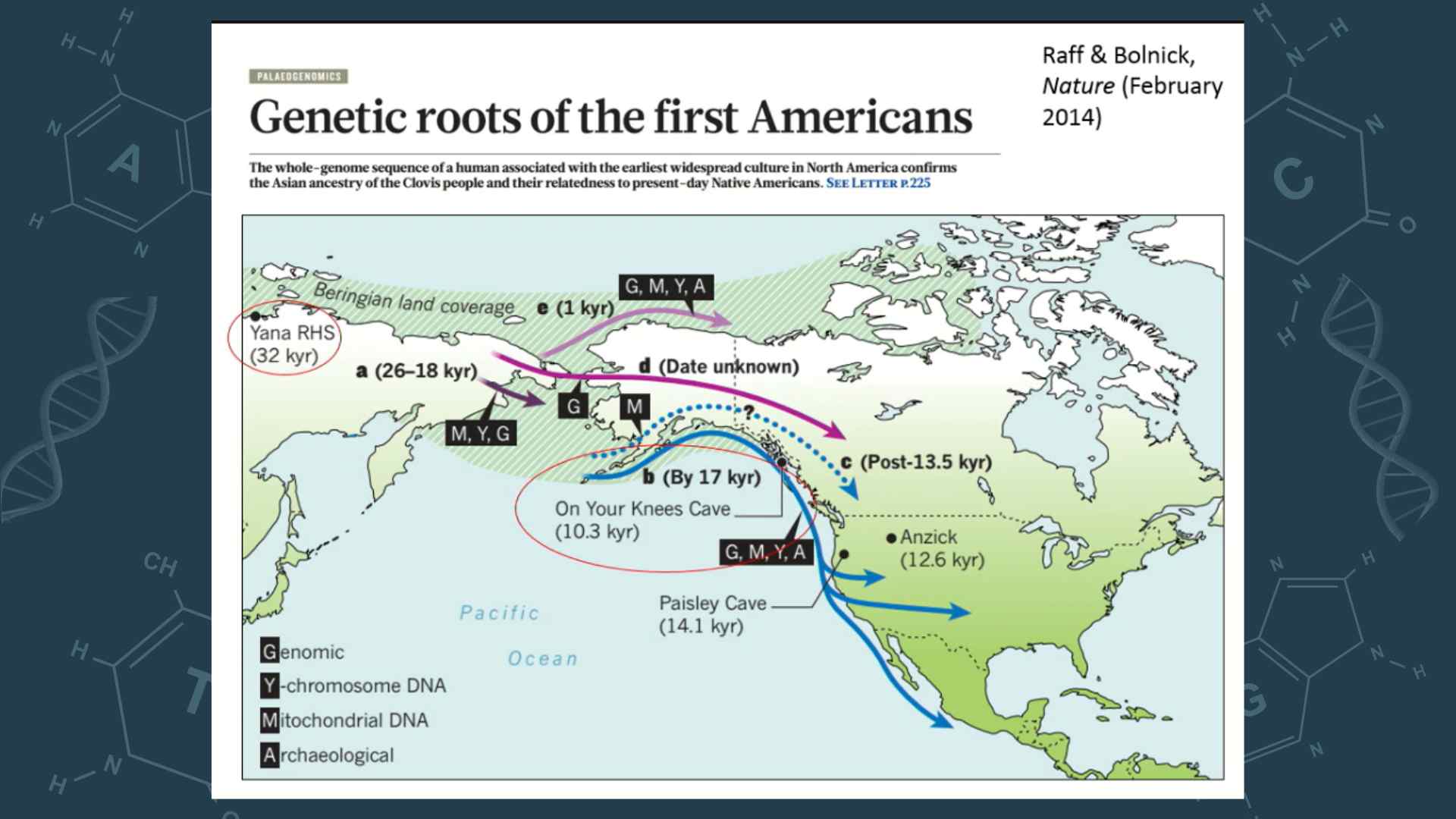
So mitochondrial Eve, Y chromosome Adam—that’s our reference that science came out of Africa, went into Southeast Asia, then into Europe, then into Eastern Asia, Oceania, and the American continent, which is the last one colonized. And that took place during the last Ice Age in the area that used to connect Northeast Siberia to Alaska. The area was called Beringia, which is now replaced by a body of water called the Bering Strait.
And all this happened about 15 to 18,000 years ago. And regardless of what anybody was saying before in the Church or outside the Church, scientific evidence is overwhelming that humans have been in the Americas for about that much time—about 15,000 years.
Ancient Americans and the Book of Mormon
By the time we read the Book of Mormon and we read about people coming here, there were probably millions of Asian-derived people that lived in the American double continent.
This is supported by genomic data, Y chromosome data, autosomal data, mitochondrial data, archaeological data. There are archaeological findings, carbon dating, found on both sides of the two continents. And nowadays they’re actually doing some digging in undersea areas in the Bering Strait as well and we’ll see if we can find anything. The water is not as deep and they’re getting soil samples to see if there is anything more we can learn about that.
But one of the things we understand about the water level rising and dividing into two continents is that you actually have mammals remaining on the Aleutian Islands, and so how did they get there if it wasn’t connected at some time? Similarly, humans came in about that time.
There were already people in the Americas
So we know there were people here. John Sorensen wrote about it when he wrote an article addressing the question, “When Lehi came here were there already other people?” That was before people were using DNA to question the Book of Mormon.
We accept that there were other people in the Americas, and then Lehi and his party arrived and found people already here.
Updates to the Book of Mormon DNA Essay
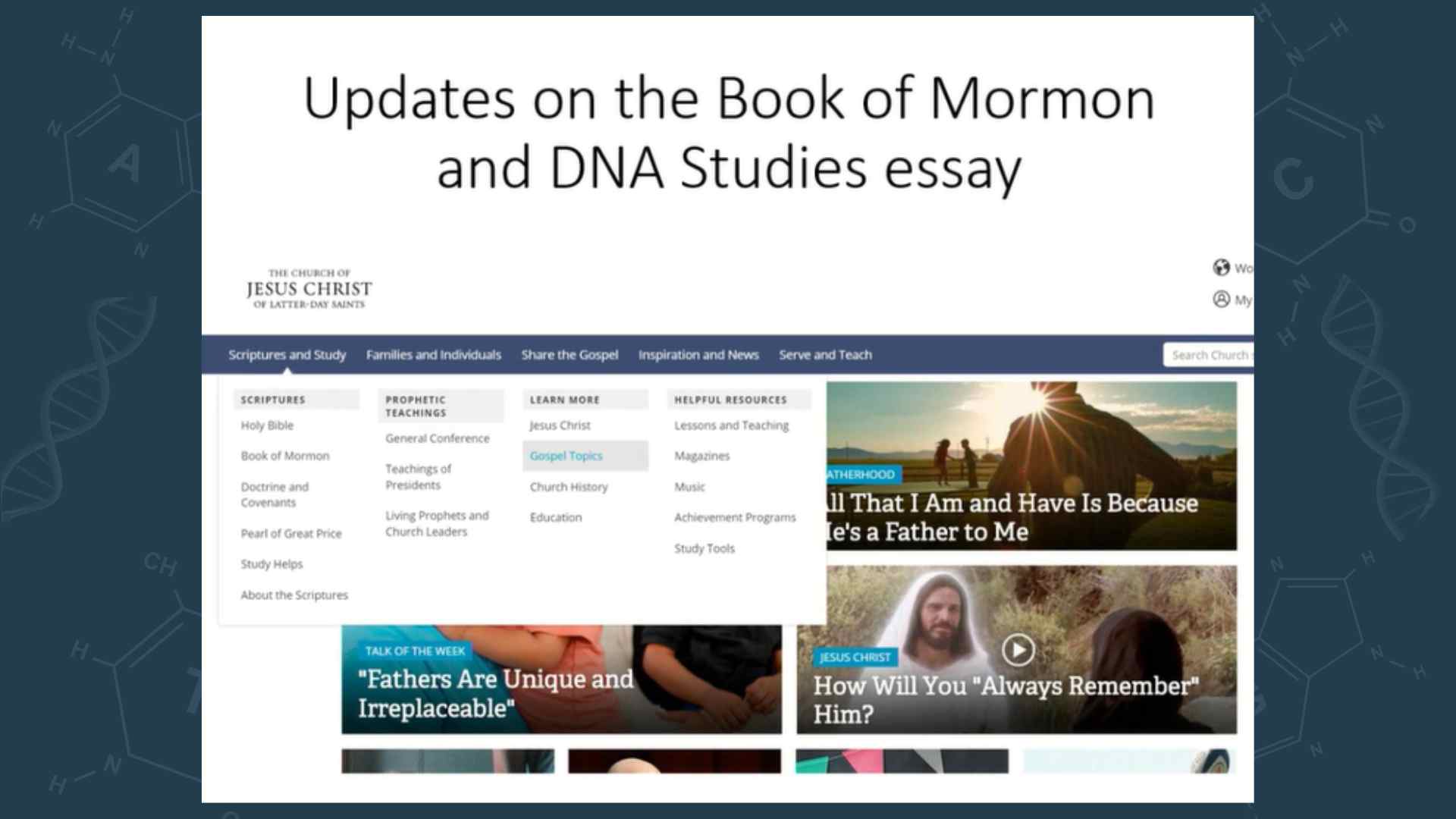
In this context I’d like to point out a few changes that have been made for the topic essay on the Book of Mormon. These changes have been made over the last couple of months. They’re small changes, but meaningful changes.
When I was asked to work together on this with other scientists for the Church I told them, you can probably write an article on Blacks and the priesthood or polygamy that will be good for the next 20 years, but when you write an article that deals with scientific things, you cannot leave references there that are five or ten years old and not touch them, because science discovers new things and changes. So I think we have to agree to make updates.
The original one was published I believe in 2013 or 2014, but already I felt like there was a need to clarify a couple of things.
Three Key Updates
There are three things that changed.
- There were slight changes to the text to clarify, but mostly they are in the references.
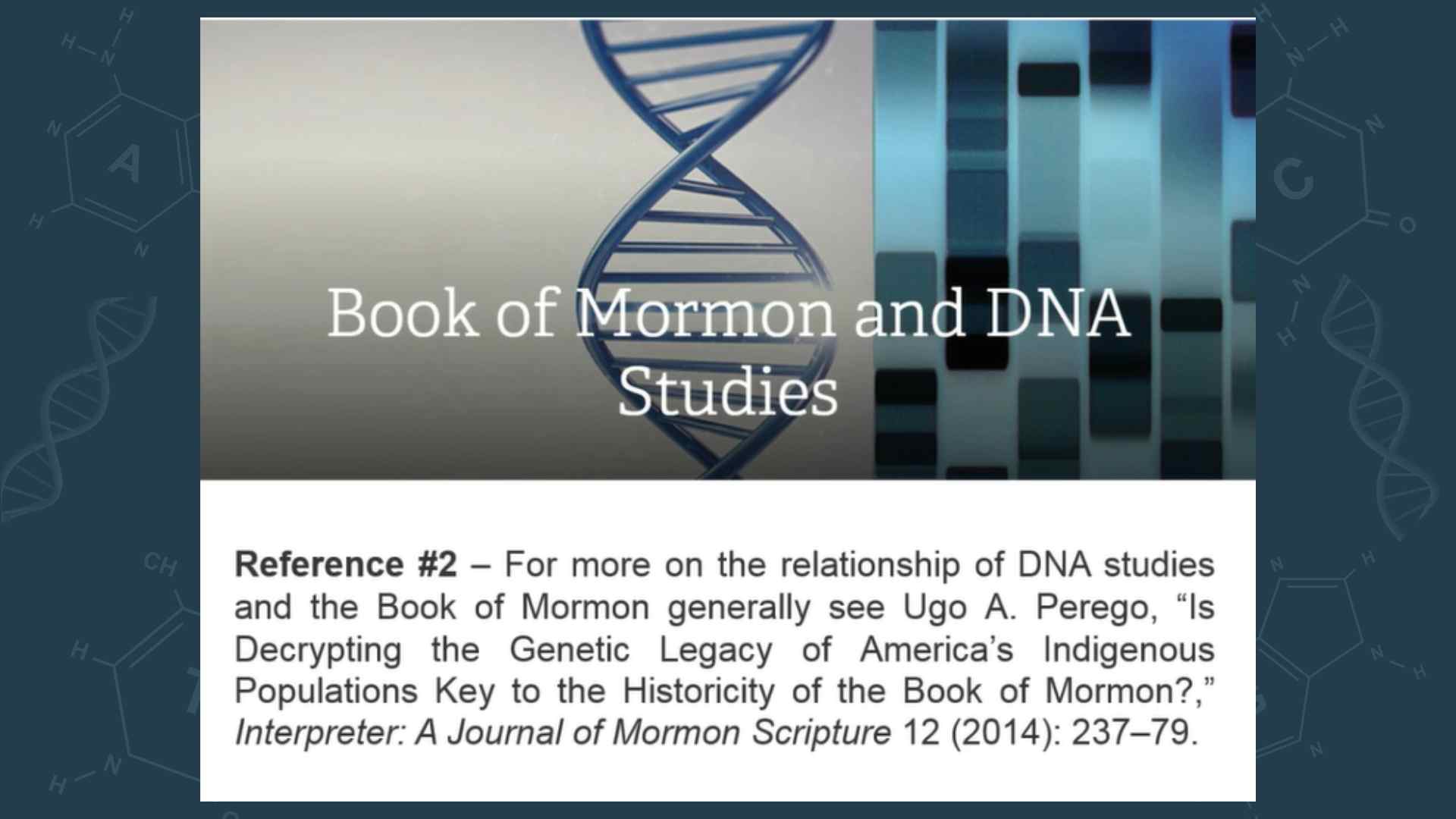
- Reference number two points to an article that I wrote that is a lot longer than is found in the Interpreter. It’s about 40 pages long compared to the shorter article that has been summarized for the gospel topic.
One Other Change
The second change has to do with this statement, which I think the Church is trying to be very clear and more vocal about.
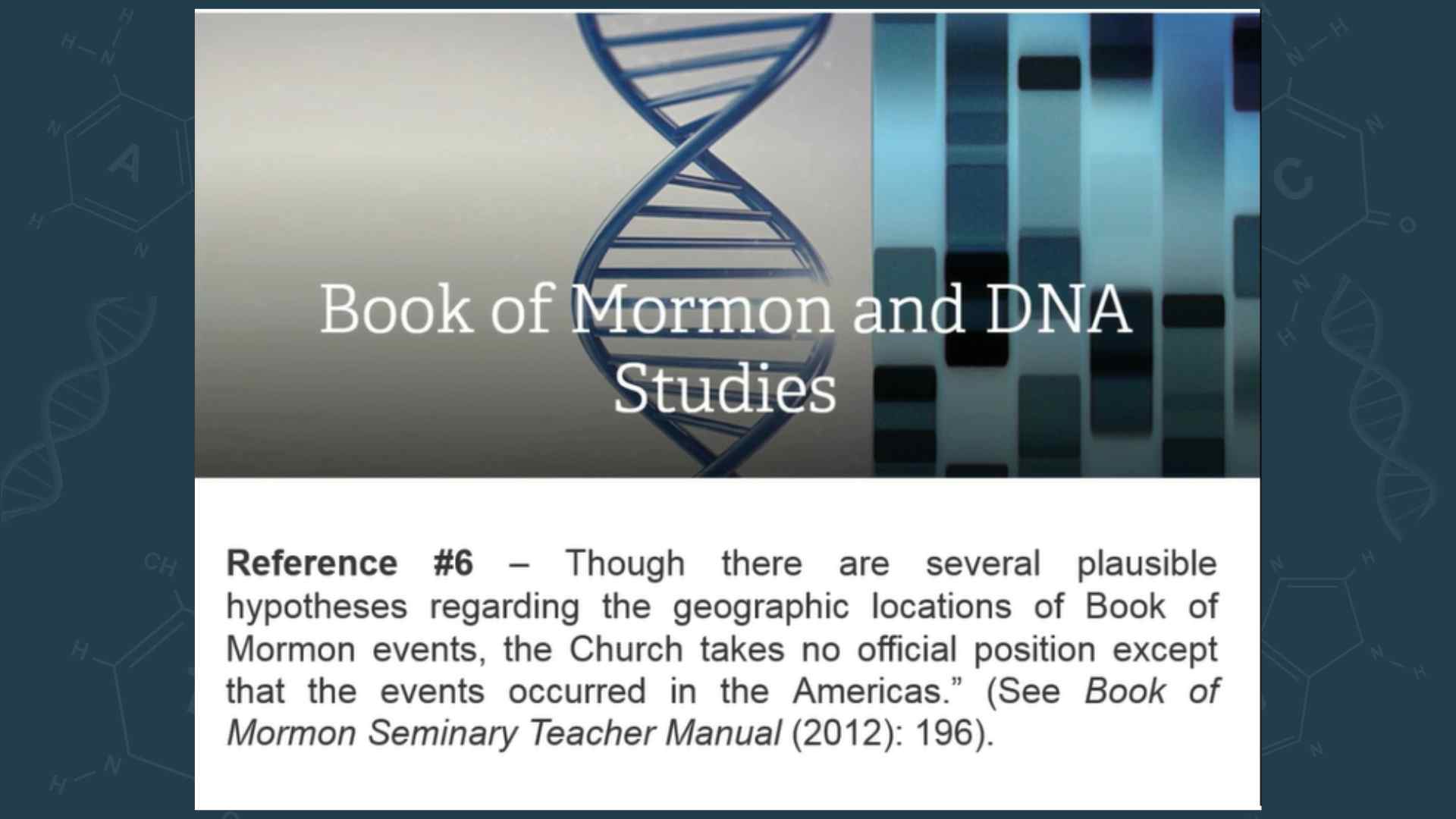
In reference number 6 they added two sentences that say,
Though there are several plausible prophecies regarding the geographic locations of Book of Mormon events, the Church takes no official position except that the events occurred in the Americas.”
Book of Mormon Geography
The Church is not taking a position on geography so neither should you. I mean, have your favorite thing, but don’t tell others that are wrong, okay?
Don’t tell others that you are better members if they don’t accept your geographic model, because the Church is taking no position on it. That is also found in the seminary manual that is given to our youth.
Again the Church is investing in the youth and is giving up on us. ‘Get the message’, right? They are receptive, they are listening.
DNA and the Heartland Model
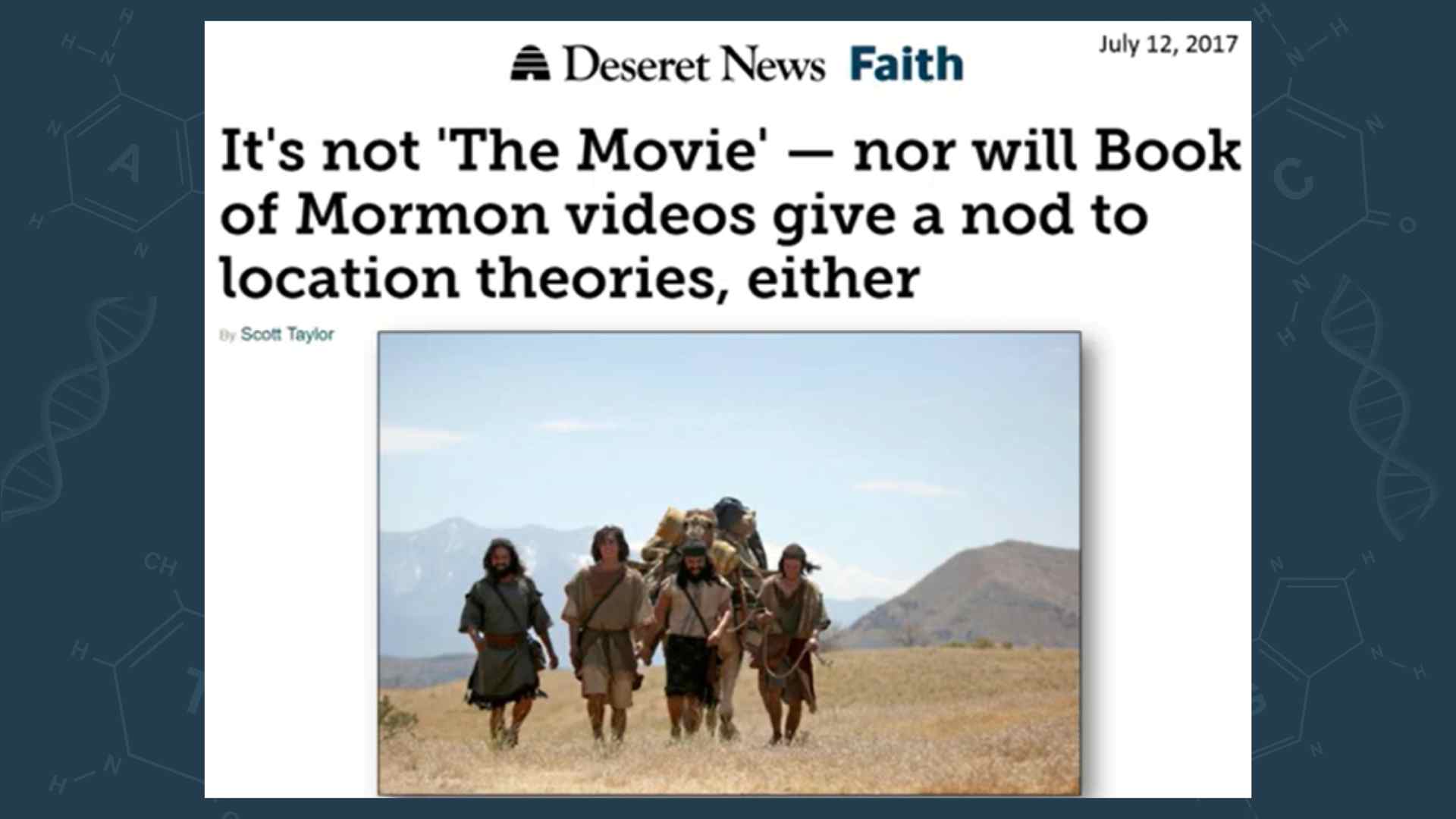
Even a few days ago, talking about the new videos that the Church is making with regard to the Book of Mormon, that had an article in the Deseret News, which is owned by the Church, and it says it’s not like the movie that was previously made on the Book of Mormon nor will it give a nod to location theories, either.
They are trying to keep it as neutral as possible. So very clearly the message is to stay away from it or you can like something but don’t fight over it.
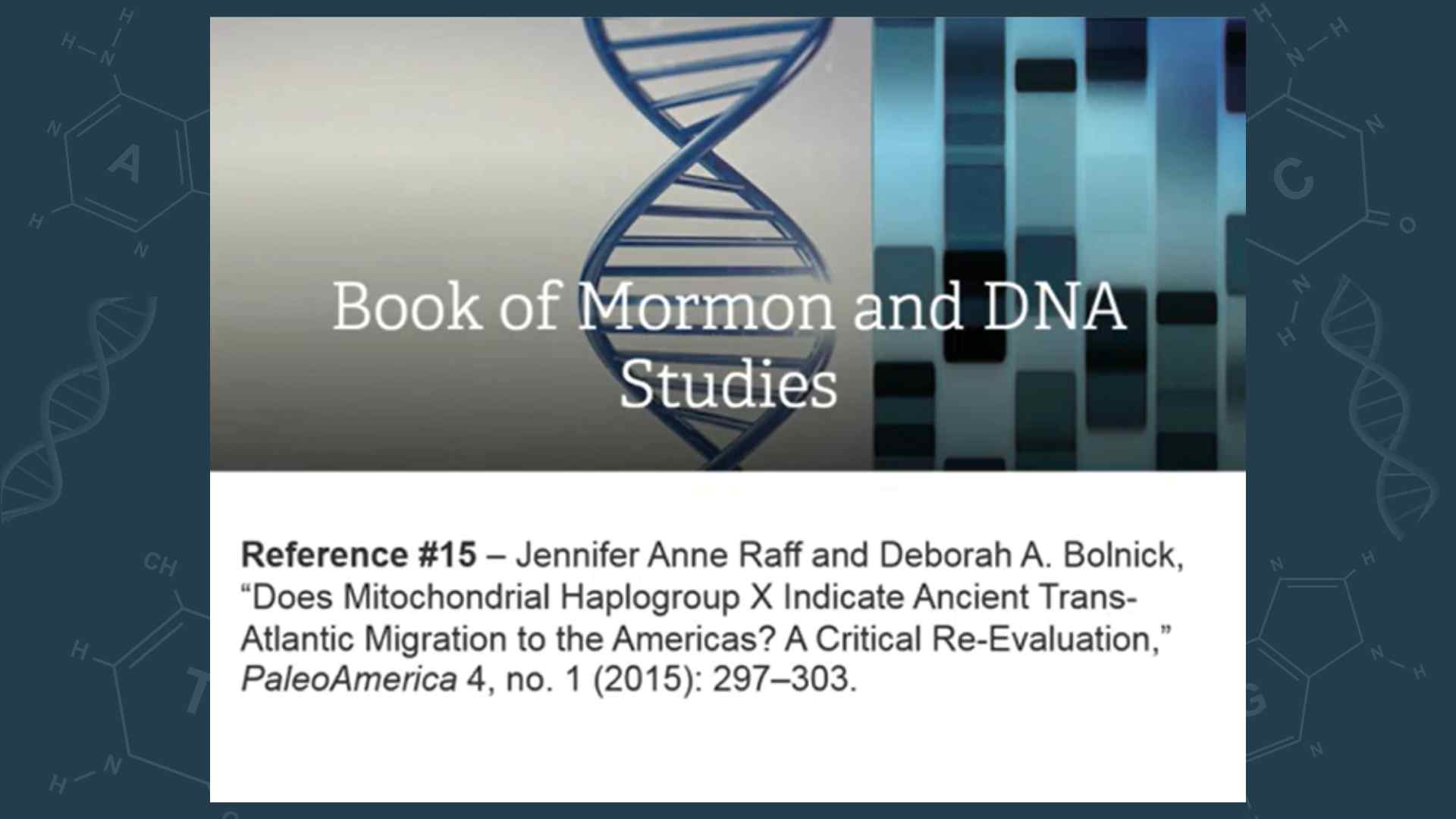
Reference 15 has a new article that came out after the original Book of Mormon DNA studies essay was published. This article is called “Does Mitochondrial Haplogroup X Indicate Ancient Transatlantic Migration to the Americas? A Critical Re-Evaluation.”
This is relevant because there was a video that came out last year.
This is the title of the video. I’m not going to say anything about any of the theories. I have my ideas, but I don’t have a preference. With regard to the North American model that you know as the Heartland model, you know they may even be right to me for what it matters to me.
But if they are using DNA as an evidence for them and that eventually we find out that they were right, it’s pure luck, because there is no genetic evidence for it.
Debunking “Incredible New Evidence”
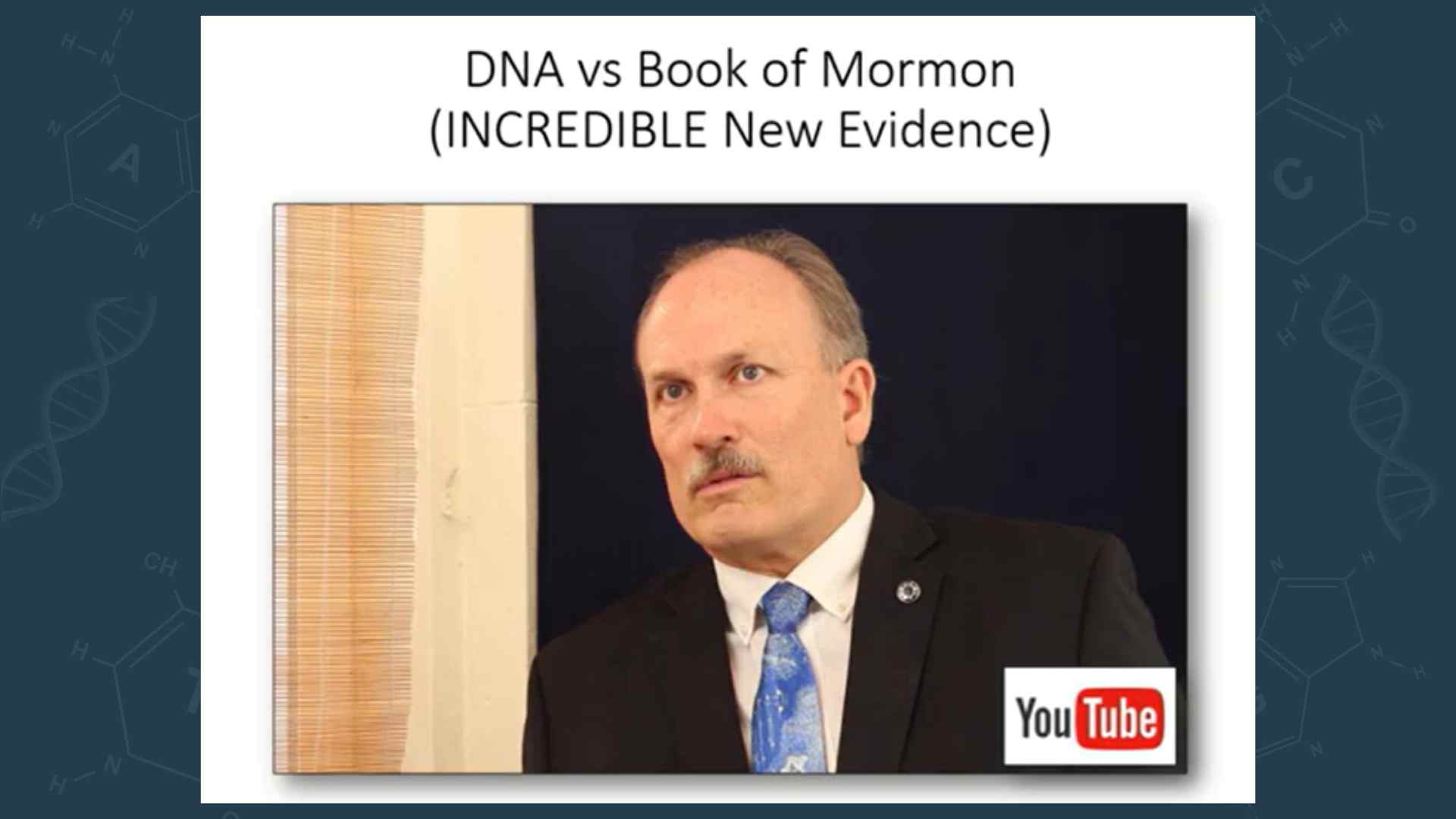
Okay I will spend the rest of the remaining time, the last three minutes, talking about that. The video title that went viral and was shared on Facebook—I would get five or six times a day people asking me if I had seen it.
And I had a copy and paste message for everybody, but that’s the title of the video: DNA versus The Book of Mormon – Incredible New Evidence
This screenshot is a copy and paste from YouTube, so that’s the capitalized word, Incredible New Evidence. Rod Meldrum is explaining why (to him) there is such strong evidence. And he uses his haplogroup as evidence for it.
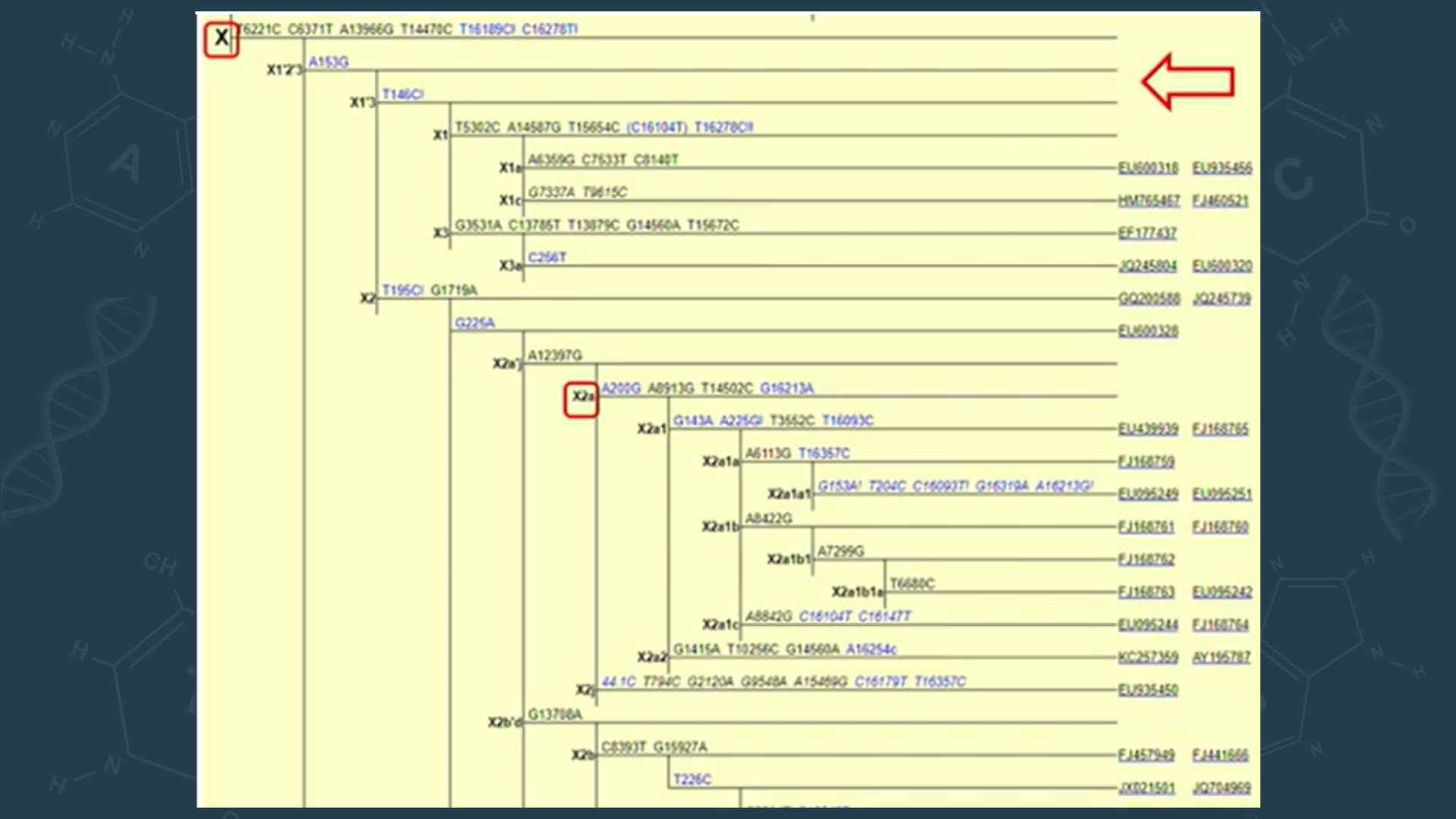
So this is where the haplogroup X is found on the tree we saw before and it does say that the haplogroup X is found in the Americas and is found in the Old World as well, so no problem up to this point.
And this is where haplogroup X sits on the detail trees of the world. There is a haplogroup X, but there is not a haplogroup X. Is that clear? (laughter)
Understanding Haplogroup X
So you notice on the right side of the screen there are some IDs and every sub branch of haplogroup X, every sub-lineage of haplogroup X, is represented by these IDs which are actually real people that have been tested. They have the mutation that you see listed there in blue and black that help determine which sub branch of haplogroup X you belong to.
But we have not found a single individual in the world that has only the characteristics for haplogroup X.
Compare this to Doing Geneology
It’s like you’re doing genealogy and you know your name, you know your parents’ name, and then you don’t know your paternal grandfather’s name because your father was adopted. That doesn’t mean that your paternal grandfather never existed, it’s just you don’t know who it is. And the same thing is here. We know the haplogroup X existed in the past, but there is no one in the world that carries only the mutation that identified that group.
So what we have is sub-branches or sub-lineages of haplogroup X. So the question we have to understand is: would the sub-lineages in the Americas correspond to the sub-lineages in the Middle East, and can we tell something about the relationship with these two groups of people that carry that mutation? So that is the question that we need to answer.
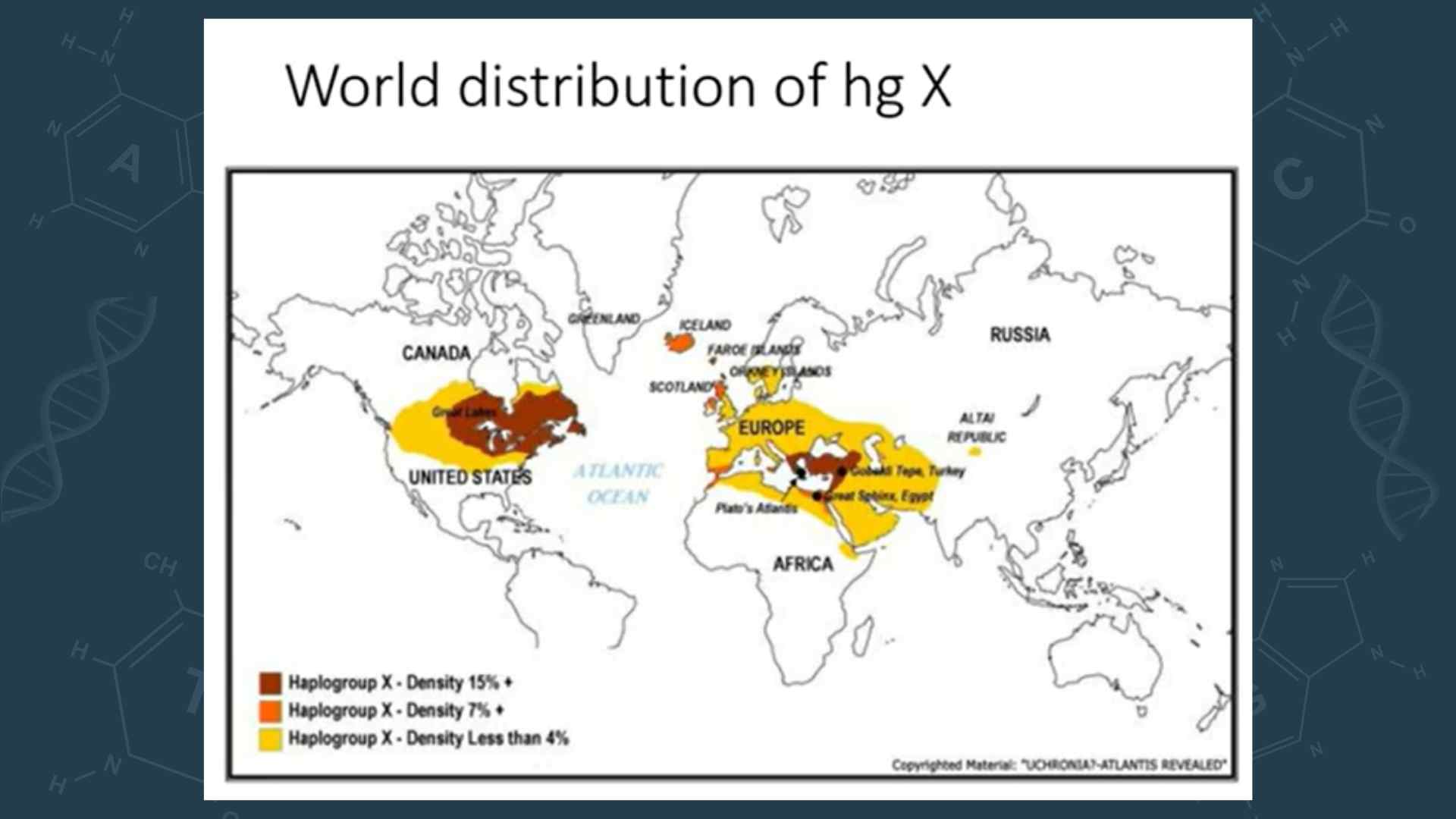
So when you look at the general haplogroup X, meaning everyone that fits under haplogroup X, we find them in the Americas and in the Middle East and in the Old World.
And scientists suggest that this is how the haplogroup X got to the New World—through the Bering Strait—that it has been in America for a long time.
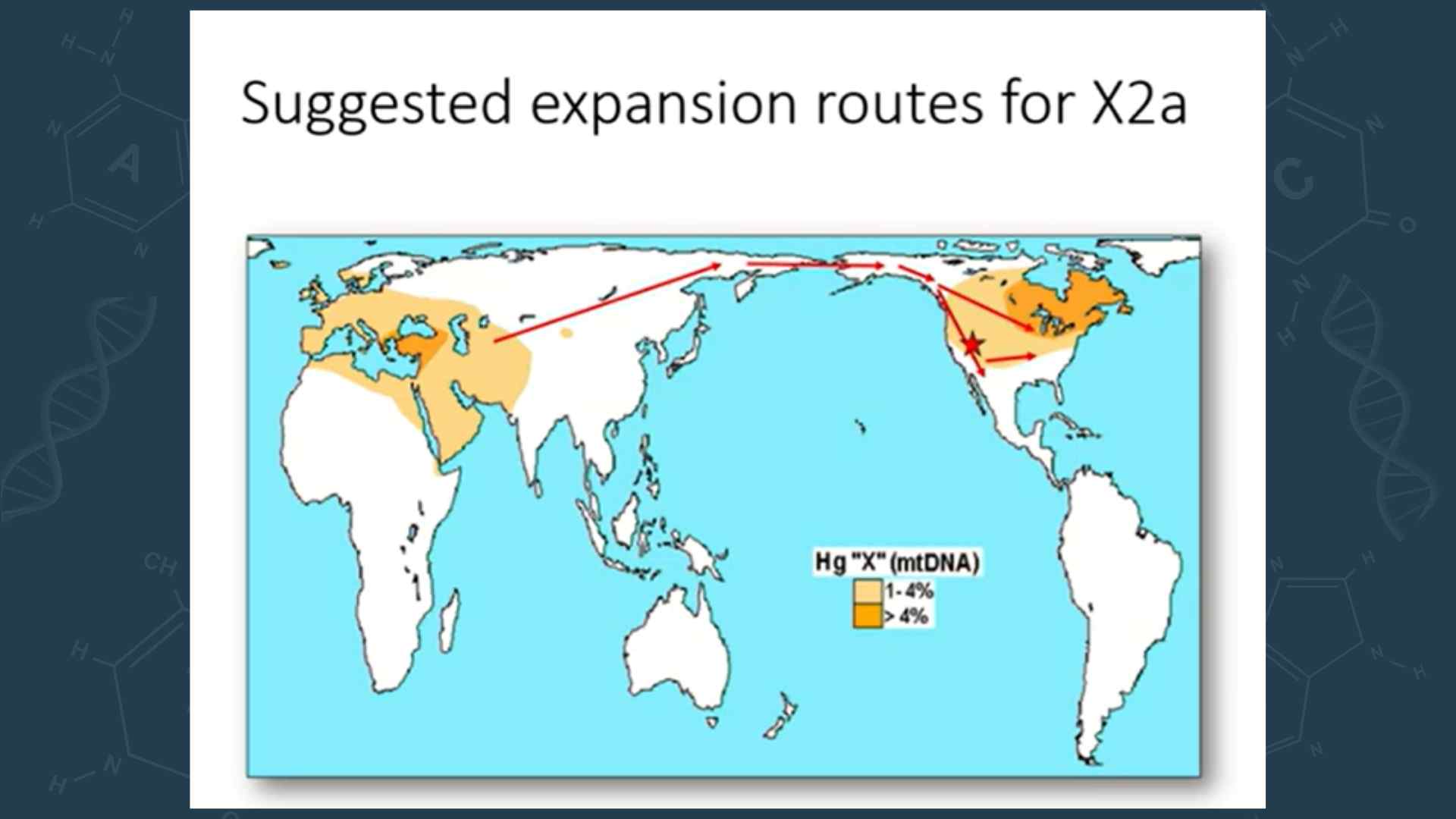
Kennewick Man and Ancient American DNA
But then Heartlanders say, this is not correct. We find it in the Middle East and we find it in America, so that is the Book of Mormon legacy. They came here with the ship, they came here in recent times.
And this is the point that I’d like to clarify, and I think this man is one of those to help understand the issue.
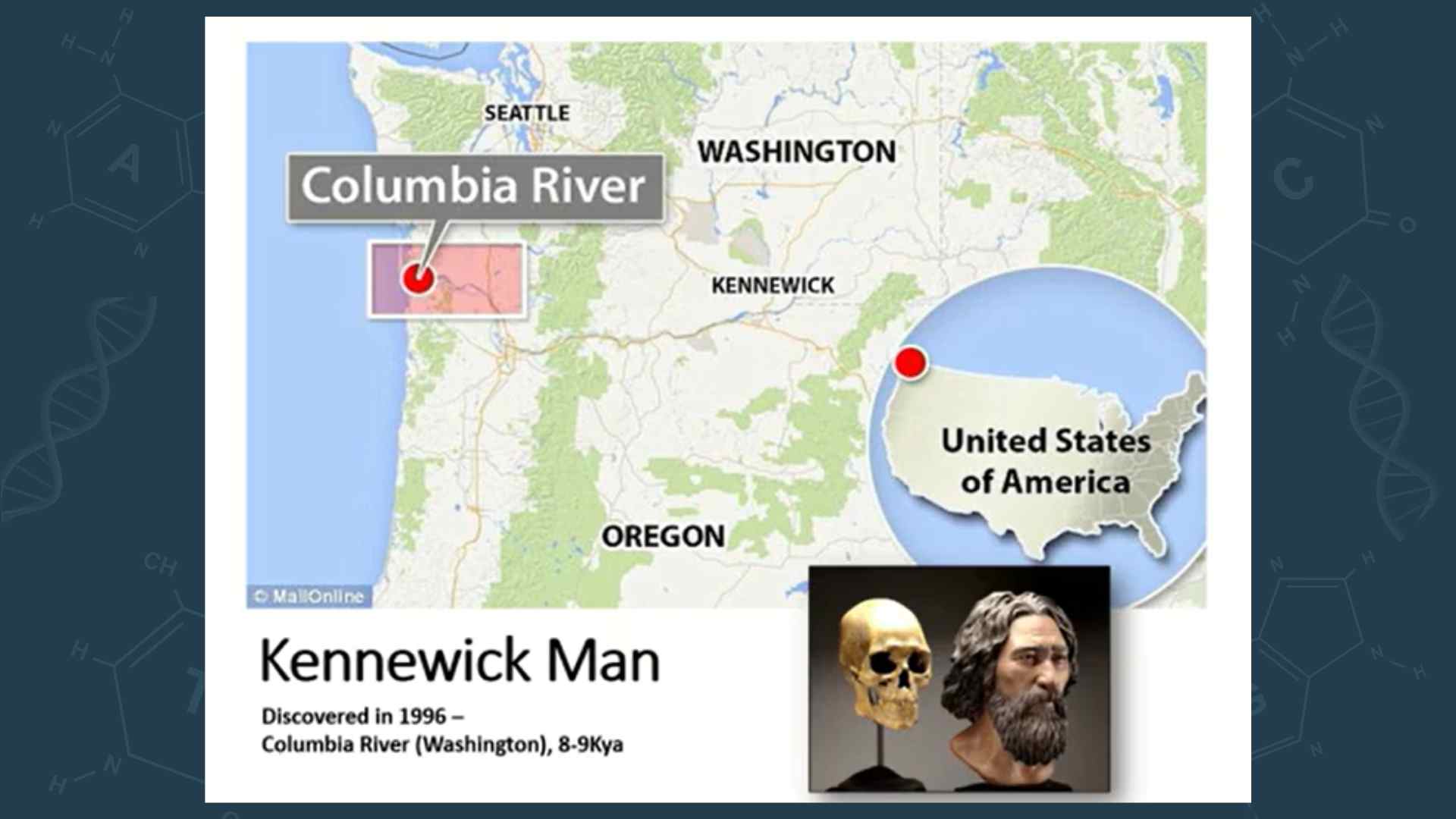
Who was the Kennewick Man
Kennewick Man was found on the Columbia River in the state of Washington in 1996, and very recently a full genome sequence was done on him: all autosomal DNA, Y chromosome, and mitochondrial DNA done. All the 3.2 billion base sequences for him, and we learned a few interesting things.
Key Insights from Kennewick Man
First of all, notice where he was found geographically—it is closer to the Bering Strait migration.
It’s also carbon dated to 8,000 to 9,000 years ago, which is before 6,000 years ago, right? So creationists would say that didn’t happen. Well I just showed you it could’ve happened. The Church is okay with that, so we should leave that door open.
Sub-lineage X2a
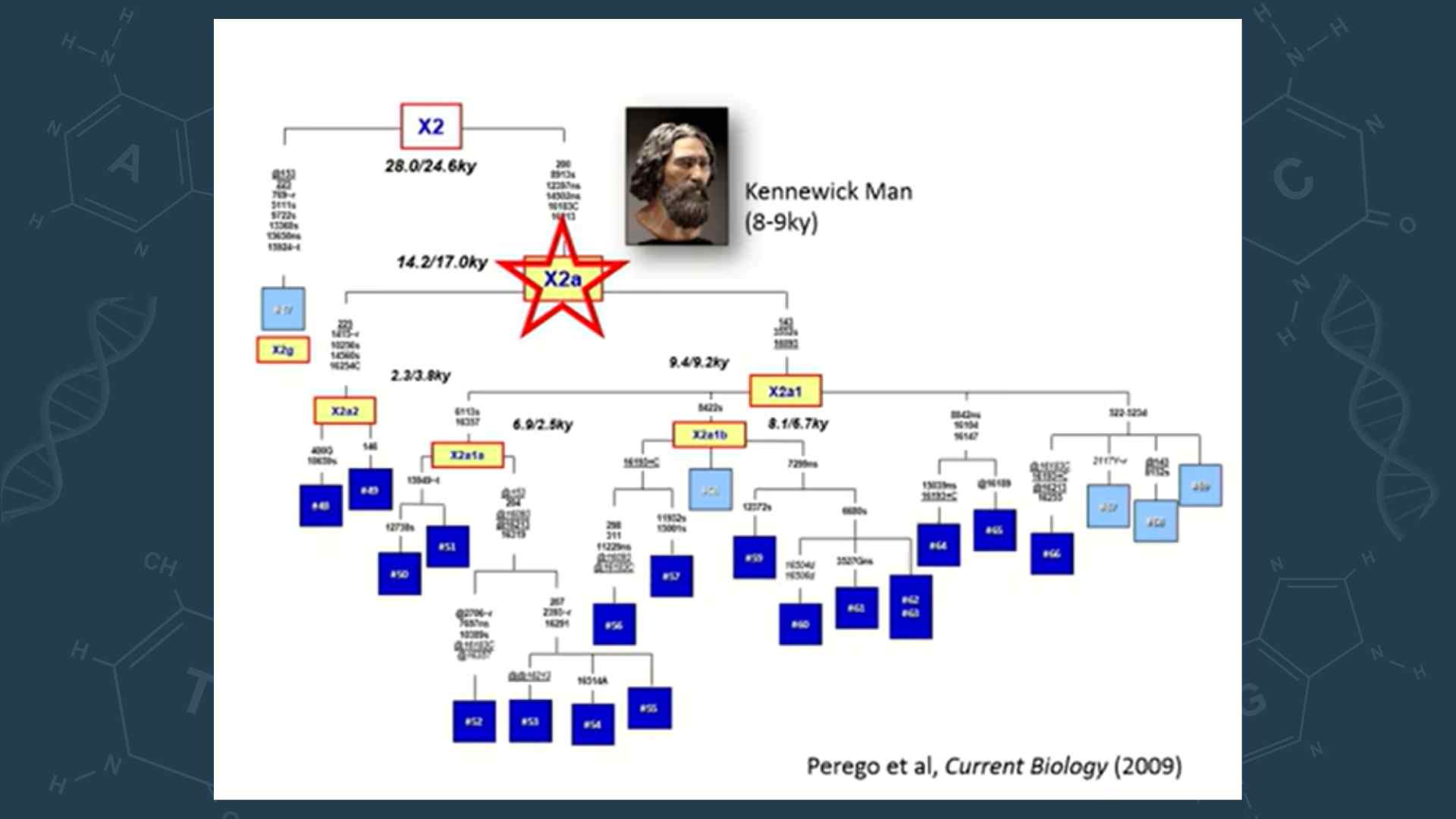
But when we look at the tree and every single light blue and dark blue square you see there, those are all the Native Americans that have been found and tested in the scientific literature belonging to the sub-lineage called X2a, which is only found in America. It is found nowhere else in the world—only in America, mostly in the Great Lakes area.
But here, where you put the Kennewick Man, is ancestral to every line that is found in the Americas.
X2a and the Case Against Book of Mormon DNA Proof
So when you look at X2a today, they all have additional mutations because they’re more recent. But when we go back 9,000 years ago, there was a pure X2a with no additional mutation that sits on the top of the tree.
He is ancestral, or the people that were with him, because he’s a man—he could not have passed there—but the people that were within him are the ancestors of the X2as that are found in the Great Lakes area. That’s where he comes from—not Book of Mormon peoples, but the group of people that came with Kennewick Man, or the ancestors of Kennewick Man.
Four Reasons X2a Cannot Support Book of Mormon Migration
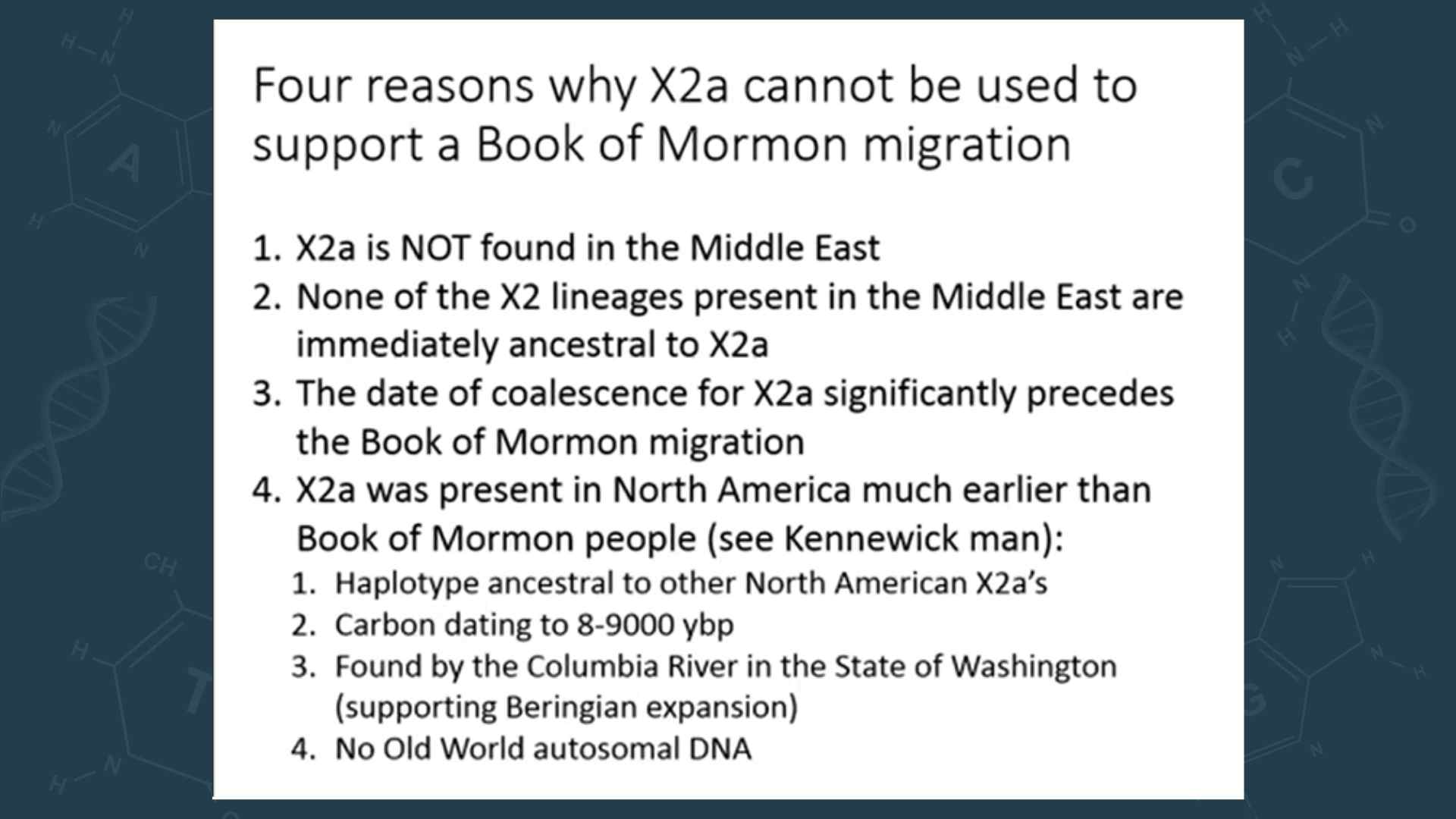
So, four reasons why X2a cannot be used to support Book of Mormon migration. Use anything else, but when you use DNA, you’re using science incorrectly. I’m not going to use other words, but you’re not being fully honest or you don’t fully understand how that works.
- Geography: X2a is not found in the Middle East.
There are other branches of X2 found in the Middle East—X2b, X2c, X2d—but no X2a.
So we don’t have the Middle Eastern branches in the Americas, and we don’t have the American branches in the Middle East. - Phylogenetics: They’re cousins with each other. They had their own development or phylogeny—branches of the tree. One is not above the other, which means that the lineages in the Middle East are not the ancestors of the one in America, and the one in America did not just come from the one in the Middle East.
- Chronology: The mutation considerably predates Book of Mormon events.
It places X2a in America several thousand years before the arrival of the Book of Mormon people. - Kennewick Man: When he came around, we learned four new things that are pretty much closing the subject at the moment:
- He stands at the top as the ancestor of all the X2as in America.
- Carbon dated 8,000–9,000 years ago.
- Found geographically close to the Bering Strait—supporting Beringian expansion.
- His autosomal DNA is not European or Old World. He has the same autosomal DNA as all Native Americans.
- He stands at the top as the ancestor of all the X2as in America.
So he is Native American, and not European or Middle Eastern. And it is his DNA that is being used by the Heartlanders.
So I want to go on record to say X2a mitochondrial DNA, as we know today, does not support the Great Lakes geography for the Book of Mormon. I hope that is clear.
Scientific Consensus and Open Questions
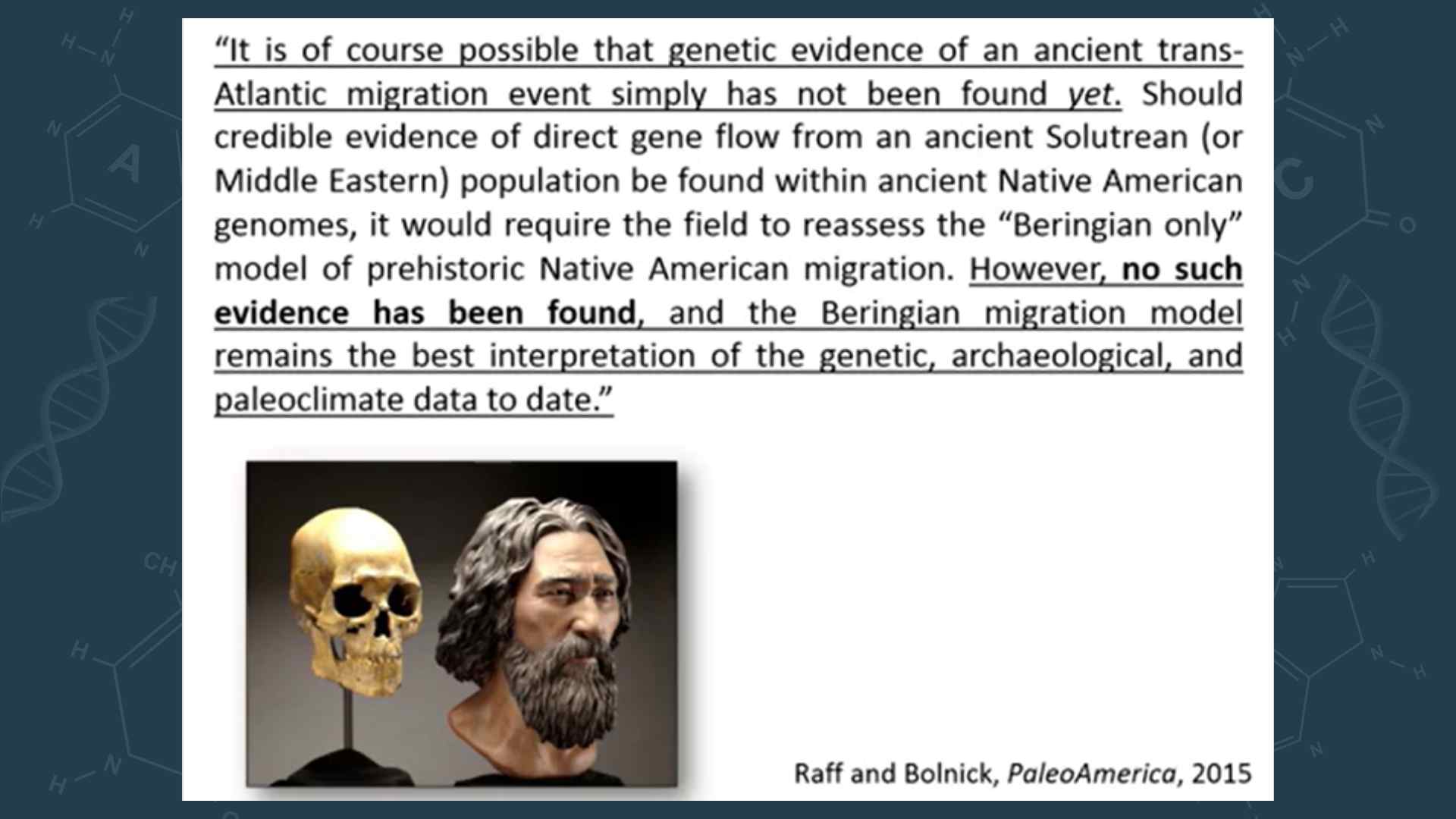
This is the concluding article that is referenced now in the Gospel Topics essay. It is a concluding statement, but it is from a researcher whom I actually know personally.
I was initially involved with the project and then I just let them run with it because I didn’t want people feeling like I’m biased toward us or just like, you know, ‘do your own thing.’ But I’m the one that has published more X2a sequences than any other personal scientist that I know.
If you do a Google search or a PubMed search, which is the national library for science, you would find about five articles on X2a, and I contributed to three of them. So I think I know something about the behavior of this particular marker.
Here’s what it says:
It is of course possible the genetic evidence of an ancient transatlantic migration event simply has not been found yet. Should credible evidence of direct gene flow from an ancient Solutrean (or Middle Eastern) population be found within ancient Native American genomes, it would require the field to reassess the ‘Beringian only’ model of prehistoric Native American migration.
However, no such evidence has been found, and the Beringian migration model remains the best interpretation of the genetic, archaeological, and paleoclimate data to date.”

Skeletal DNA and Misinterpretation
I don’t have any more time, but I was going to address a paper that was brought to my attention a couple of days ago about 38 Mayan skeletons.
I don’t really know how to address that. Let me just say this: there have been some critics of the Church that have jumped on this paper, saying it is further evidence that there is no Middle Eastern DNA in America and therefore the Book of Mormon is not true, because the skeletons that are found in the Mayas and they all have mitochondrial DNA—the maternal DNA that is typical of Native Americans.
But the point is, I actually wrote the authors and I asked them some background information on the research. And when you see a paper published, it’s nice, polished, and peer-reviewed. You don’t understand all the mess that went on to put that paper together.
Behind the Scenes in Scientific Publishing
If you have published scientific articles before, you know it’s like walking into a house of somebody and having a perfectly clean living room, and you assume that the whole house is just nice and tidy like that.
And then, you know, you ask to go to the bathroom, but they say no, go to the neighbor’s because it’s not clean, right?
So we only see the paper that’s published. We don’t know a lot of the things that went on.
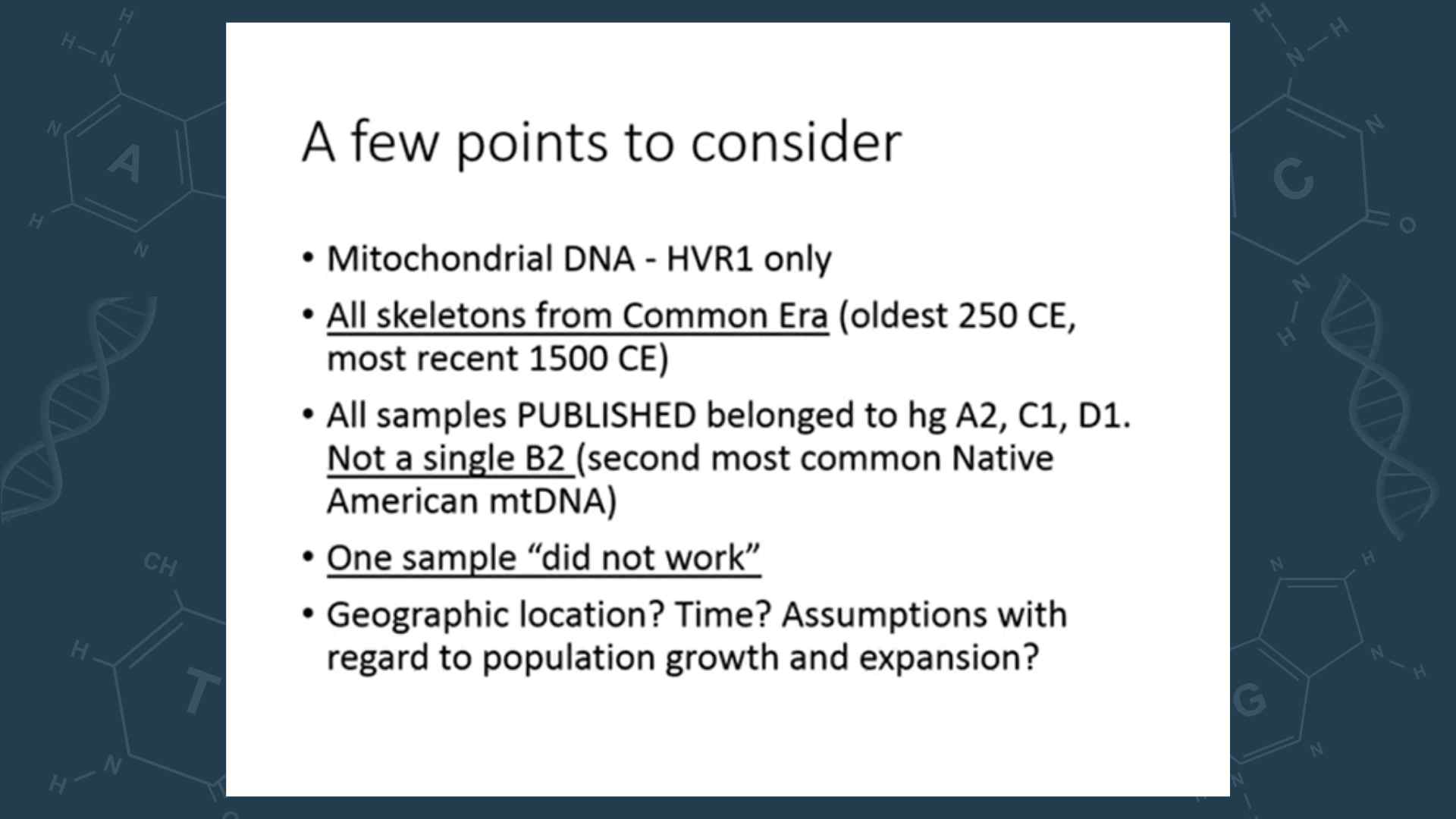
One thing that caught my attention was a sentence that said that one sample in the study did not work. And I wanted to ask the author, why did the sample not work?
Right? Simple question. Was it that the DNA was damaged like he says in the article or were there other issues about it?
The author said to me that well, the DNA that turned out wasn’t what we expected. I don’t know what it was, and she didn’t want to share. I understand why—because they might be using it for future publication, so you don’t want to reveal all your secrets. That’s how scientists work—you know, publish or perish.
Final Thoughts on Scientific Limitations
But I wondered if they tried to include that in their publication because sometimes they write that they’d include unusual data, and other times they just dismiss it because it didn’t look like what they expected.
She said they sent it with the original publication, but the reviewer told them to remove it.
I’m dying to see what the sample looks like, but she told me that it did not have the genetic characteristics of Native American mitochondrial DNA. I don’t know what that means.
It could mean nothing, or there are a lot of other reasons why these papers should not be interpreted the way that the critics have been interpreting them.
But this is just one simple example that not everything looks as perfect as we read it. Okay, there are some background stories.
A Word About Dating and Isolation
And most of the skeletons, by the way, are dated between 800 and more recent years, after Lehi’s arrival. So we’re not even looking at the same thing.
Again, we are making some assumptions based on geographic location, time, how the Book of Mormon people mixed with locals, how long they kept as a homogeneous population isolate, how soon did they mix with the local natives? A lot of these things we don’t know.
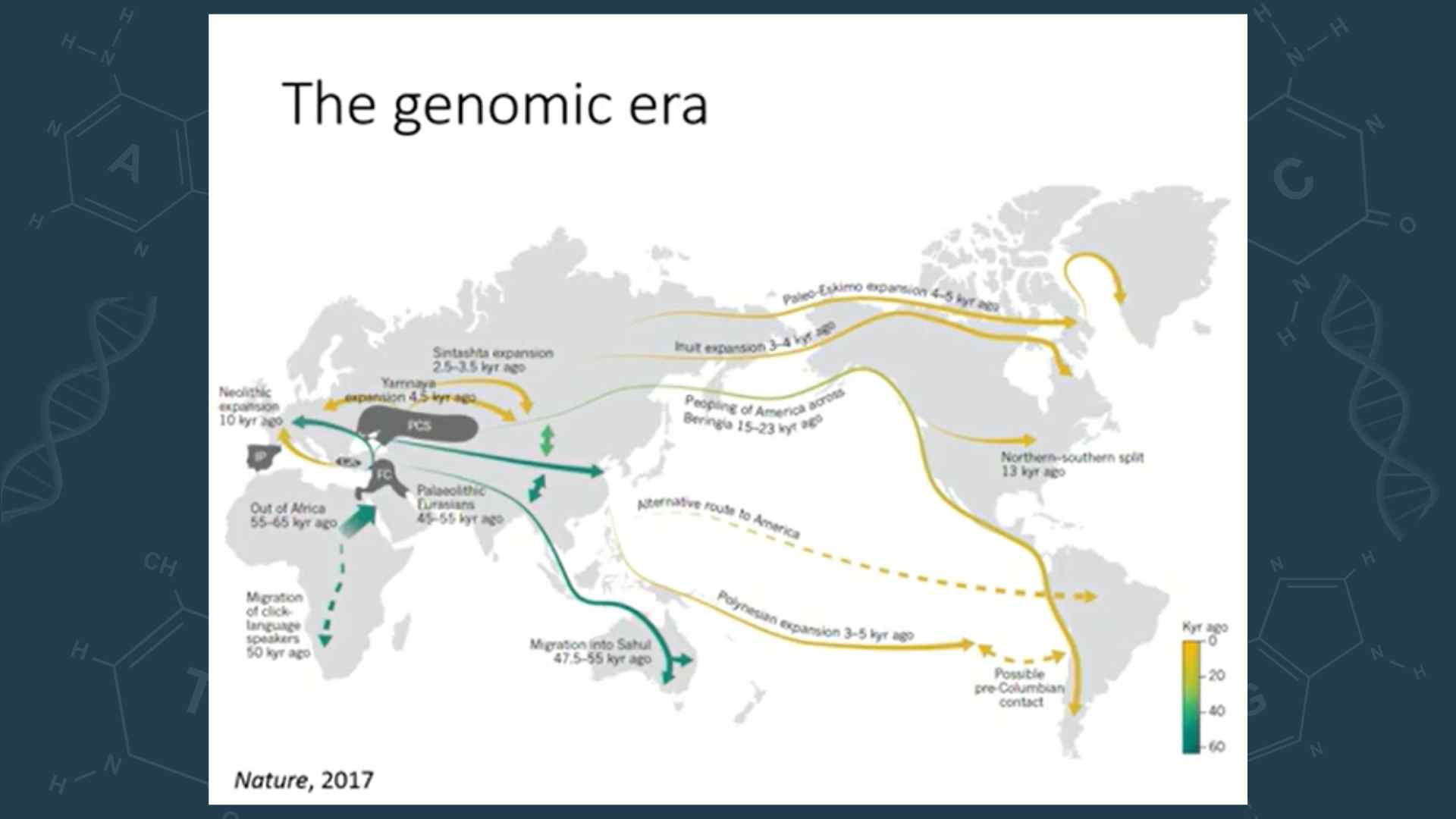
Ongoing Questions in DNA and Migration
I want to close with one thing, because we know these things right here—two things.
One is: this is autosomal DNA, Nature, 2017. Nature is the top-notch scientific journal.
And with autosomal DNA, they are actually now considering possible migrations that are not Beringian, that have happened, maybe, in more recent times in the Pacific Ocean between South America and Micronesia.
One of the studies actually found Native American DNA in the population of Easter Island.
So how did they get that? When? Did it go from America to Easter Island? Did it go from Easter Island to America? We don’t know. You see that the arrows go bidirectional.
So there’s still a lot to question. So when someone says DNA proves that there were no migrations to America other than the Bering Strait, there’s so many things that we still don’t understand.
Contributions From the Small Plates of Nephi
I am teaching a Book of Mormon class this summer at BYU, and I’m getting a new appreciation for the small plates that Mormon decides to include.
I think you all know when Mormon says these are included for a wise purpose, we immediately think about Martin Harris and the 116 pages.
I’m actually coming to understand personally that there is maybe a second wise purpose and it has to do with DNA—something Mormon would not have known.
But every reference that we read in the text that there were other people here are all from the small plates.
You know, 2 Nephi 5 talks about Nephi’s family leaving the place, and then others who also came. Who are these others?
Jacob chapter 2. Jacob admonishes the Nephites for having too many wives and concubines. Where are they getting them?
You know, there is some understanding that concubines may be based on the Old Testament reading of a concubine being someone that is not from your own ethnic group, like Abram and Hagar. She wasn’t an Israelite, and so she’s referred to as a concubine.
Immediate Cultural Contact in the Small Plates
And then we have Sherem approaching Jacob and having him be knowledgeable about the language and looking for an opportunity to meet with Jacob.
I was like, “wait a second, if he’s from the same family group, how long does it take him to do that?”
So what I’m saying is, we are getting a lot of little bits of information about this immediate mixing or contact with natives and we get all of that from the small plates.
Wars with the Lamanites immediately. Right there in the book of Omni, there are already wars. This is all the way to 150 B.C.
And we don’t know anything basically between Nephi’s time and Jacob and Mosiah. There are 350 years that we don’t know anything about, and all these things could’ve happened in those years.

Final Reflection
So I have a really difficult time as a scientist, as a geneticist, as a religious educator, to put my testimony of the Book of Mormon on genetic evidence—the lack of or the presence of—DNA.
I would much rather focus on other things because I think there are so many scientific unknowns to decide your eternal destiny and how your membership in the Church should be based on these things.
To me you’re taking a huge risk. And this is what I have to share.
Audience Q&A
Q&A
Q: As a bishop of Rome, doesn’t that make you infallible? (Laughter)
A: Of course! Ask my wife.
Q: If so, doesn’t that make you right on evolution?
A: No, I’m not gonna answer that question.
Q: In 2 Nephi 2, there are many points to refute evolution.
A: You know, I’m referring you to what Ben just said. Where does the 2 Nephi text come from? The brass plates. The brass plates are similar to the Old Testament – written, maybe, in a slightly different language – maybe more information, more details – but again, are we reading that as a scientific text? What did Ben say – was that how God is teaching us some principles, leaving a lot of the details out? I don’t believe 2 Nephi refutes evolution at all.
Q: What have you come to understand about Neanderthals, Lucy, and other early human discoveries?
A: And again, you know, there could have been human-like individuals before Adam and Eve, and that’s up to you to answer this question after the things that have been shared—between what Ben said and what he has written. He has written a lot more stuff, and in the books that he suggested, and also in the statements of the Church.
So yes, there could have been Neanderthals—there were Neanderthals. As of today, there is evidence that every one of us here with European origin carry about two to four percent of Neanderthal DNA in our genome. So not only did Neanderthals exist—they are in your family tree.
This is the current knowledge that we have. We have that because we have fully sequenced genomic data from the Neanderthal and we have fully sequenced genomic data for Homo sapiens. And we found introgression of DNA—unidirectional, coming from Neanderthal to Homo sapiens—and not going from Homo sapiens to Neanderthal.
One of the reasons that happened is that Neanderthals were genetically fit for the environment they lived in. So they had been living longer in Europe and living in those climate conditions and environments than Homo sapiens.
So when Homo sapiens arrived—that’s a theory, of course, we were not there to take pictures of what happened—then if crossbreeding took place, the genes of the Neanderthal would have had a better chance to become stabilized in future generations than the other way around.
It looks like Homo sapiens got rid of Neanderthals eventually by outcompeting them. You know, there was maybe better technology or other ways, and then they became extinct.
But we do have a genetic legacy of Neanderthals in us. Thank you.
[Applause]
Endnotes & Summary
In this talk, geneticist Ugo Perego explores how scientific findings on human origins and DNA intersect with Latter-day Saint theology. He offers insights into evolution, creation, and recent developments in Book of Mormon DNA research.
Faith and Scholarship
This talk exemplifies the faithful integration of spiritual conviction and scientific inquiry. Ugo Perego demonstrates that being both a believing Latter-day Saint and a professional geneticist is not only possible—it’s powerful. He models how to engage with scientific data without fear, viewing unanswered questions as opportunities for faith, patience, and continued revelation.
Rather than avoiding complexity, he invites listeners to engage it with confidence—anchored in both the gospel of Jesus Christ and a humble respect for evidence. This approach teaches that faith does not require scientific ignorance, and that spiritual understanding and scholarly expertise can strengthen, not undermine, each other.
All Talks by This Speaker
coming soon…
Talk Details
- Date Presented: August 4, 2017
- Duration: 63:07 minutes
- Event/Conference: 2017 FAIR Annual Conference
- Topics Covered:
- what does the Church believe about evolution
- LDS evolution
- Book of Mormon DNA
- Haplogroup X2a
- Ugo Perego
- Kennewick Man
- Church stance on evolution
- Heartland model
- DNA and the Book of Mormon
- FAIR Conference 2017
- what does the Church believe about evolution
Common Concerns Addressed
Concern: The Church rejects evolution or teaches against it.
Clarification: This talk reviews official Church statements on the origin of man, demonstrating that the Church has not taken a definitive stance against evolution. Ugo Perego highlights historical First Presidency statements, modern Church publications, and recent curriculum materials to show that members are not required to reject scientific understandings of human development.
Concern: DNA evidence disproves the Book of Mormon.
Clarification: The talk thoroughly explains why genetic data like haplogroup X2a cannot be used to disprove the Book of Mormon. Perego walks through population genetics, mitochondrial and Y-chromosome DNA, and explains that current genetic science shows no evidence of Book of Mormon peoples—but also doesn’t disprove them, due to the complexities of migration, intermixing, and data loss over time.
Concern: If the Americas were populated for 15,000 years, how could the Book of Mormon be historical?
Clarification: Perego affirms that the Americas were populated long before Lehi’s arrival and argues that this is entirely compatible with the Book of Mormon. He emphasizes that the text never claims to describe the first inhabitants of the land, and he shows how internal Book of Mormon passages hint at early cultural blending with existing populations.
Concern: The Church is not transparent about science, evolution, or DNA research.
Clarification: The talk provides detailed evidence of Church transparency—including how updates to Gospel Topics essays and articles in Church magazines are reviewed by curriculum committees and approved by General Authorities. Perego describes his own involvement in shaping some of these materials and how scientific integrity and doctrinal sensitivity are both valued in that process.
Concern: DNA or lack thereof should determine belief in the Book of Mormon.
Clarification: Perego warns against placing spiritual testimonies on the shifting sands of scientific data. He urges listeners to seek spiritual confirmation of sacred texts, reminding them that science changes and that salvation is not dependent on a haplogroup, but on faith in Christ and revealed truth.
Apologetic Focus
Topic: Scientific accuracy and human origins
Concern: Critics claim that belief in Adam and Eve is incompatible with evolution and modern science.
Clarification: This talk bridges the gap between faith and science by showing how pre-Adamite hominids, evolutionary biology, and the divine origin of the spirit can be held together without contradiction. Perego presents evolution as a physical process under divine guidance and highlights the Church’s openness to future revelation on the subject.
Topic: Historicity of the Book of Mormon
Concern: Some claim that lack of Middle Eastern DNA in Native American populations invalidates Book of Mormon claims.
Clarification: Perego explains why genetic evidence cannot trace every small migratory group, especially over thousands of years and amid widespread intermarriage. He also shows that the Book of Mormon itself allows for the existence of other populations in the Americas, reinforcing that its purpose is spiritual, not anthropological.
Topic: Reliability of Church materials and curriculum
Concern: Some members worry that magazine articles or youth materials are not authoritative sources.
Clarification: The talk clarifies the rigorous approval process for Church publications, showing that materials like New Era articles are reviewed by curriculum departments and authorized leaders. This helps restore trust in Church resources while encouraging readers to approach them thoughtfully and faithfully.
Topic: Book of Mormon geography models and scientific claims
Concern: Geographic theories about the Book of Mormon are sometimes treated as doctrine, dividing members.
Clarification: Perego affirms that the Church has no official stance on Book of Mormon geography and cautions against using DNA to support any specific location theory. He advocates for humility and warns against elevating speculative models above revealed truth or unity in the faith.
Topic: Interpreting scripture through a scientific lens
Concern: Some assume scriptural creation accounts must be read literally, causing conflict with science.
Clarification: Perego shares how scriptural “days” and creation narratives can be seen as symbolic or poetic without diminishing their truth. He encourages faithful members to use both revelation and reason, showing that deeper understanding comes from waiting on the Lord’s future explanations rather than rigid dogmatism.
Explore Further
Quick Reference Summary
- 📌 Main Question Addressed:
What does the Church believe about evolution? - 📚 Church Position:
The Church has no official stance on the theory of evolution. Revelation addresses spiritual truths, while science is left to study physical processes. - 🧬 On DNA and the Book of Mormon:
- Haplogroup X2a is not found in the Middle East
- Kennewick Man predates Book of Mormon timelines and is ancestral to Native American populations—not Lehi’s descendants
- DNA cannot be used to prove or disprove the Book of Mormon
- Haplogroup X2a is not found in the Middle East
- 🧭 On Geography:
The Church takes no official position on Book of Mormon geography. Members are encouraged to avoid contention and respect multiple models. - 📖 On Scriptural Interpretation:
Creation accounts in scripture are not scientific textbooks. They are spiritual teaching tools, and timing/details are not fully revealed. - 🔍 Scientific Worldview Compatible with Faith:
Evolution may be part of the physical development of humankind. The spiritual identity of God’s children remains central and distinct. - 🙏 Final Takeaway:
Our testimonies should be rooted in revelation and the Spirit, not in fluctuating scientific data. DNA is not destiny—discipleship is.
Share this article
