“The Covenant Path in the Bible and the Book of Mormon” by Taylor Halverson from our 2020 conference
The Covenant Path in the Bible and The Book of Mormon
Taylor Halverson
August 2020
Summary
Taylor Halverson explores the concept of the covenant path as it is presented in both the Bible and the Book of Mormon. It highlights the significance of covenants in the lives of believers. He discusses how these sacred agreements are central to spiritual growth and salvation. He delves into specific scriptural references and teachings. Taylor emphasizes the continuity and importance of covenant relationships with God across different dispensations.
Introduction
Scott: Our first speaker today is Taylor Halverson; he calls himself an aspiring master learner. He’s currently an entrepreneurship professor at BYU Marriott School of Business. There’s more information in the program about in his bio. With that, we’re going to turn the time over to Taylor Halverson.
Taylor: I’m Taylor Halverson, and I’m looking forward to sharing with you today my presentation on The Covenant path in the Bible and the Book of Mormon.
Why Talk about Covenants?
So why another presentation and yet another topic on covenants? I believe that covenants are one of the most significant things that we can discuss if we seek to understand the Bible, the Book of Mormon, the gospel, even the restoration. In fact, the Book of Mormon itself is a covenantal text. And the restoration itself is founded on covenants. Let’s consider this passage from the title page of the Book of Mormon,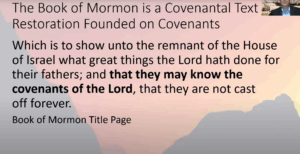
“Which is to show unto the remnant of the house of Israel what great things the Lord hath done for their fathers, that they may know the covenants of the Lord, that they are not cast out forever.” So, the Book of Mormon makes it very clear that its main point is to draw people to Jesus Christ by helping them to know more about covenants.

So what covenants are we talking about?
I believe if we take time to look at the Bible, we’ll see clearly what covenants God wants us to know.
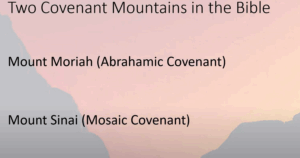
A Covenantal Text
In fact, the Bible itself is constructed as a covenantal text. We call it the Old Testament and the New Testament. And as many of you know, the word “testament” is a Latin word. It really comes from the old Hebrew word for covenant. So, you really have the Old Covenant and the New Covenant, and the New Covenant is Jesus Christ.
What are the old covenants that we find in the Bible? And there are two primarily that matter to understand the Bible, Book of Mormon, and God’s work with His children.
So let’s talk about each of these briefly.

The Abrahamic covenant, which I call Mount Moriah (Abrahamic covenant), the Mount Moriah covenant. And just as a side note, the background that I have is a picture of Mount Sinai at sunrise. Even though it is Mount Sinai, there are two mountain peaks. You can kind of see one on the left, one on the right. I use those symbolically to represent the two key covenantal mountains that we need to know about in the Bible to understand the covenant path. And I symbolically see the covenant path going right between these two mountains.
The Abrahamic Covenant
So let’s begin with the Abrahamic covenant, and again, symbolically, I imagine that happening at Mount Moriah (Genesis 15:17).
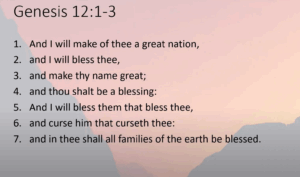
Well, it’s very interesting if we open up to the book of Genesis, chapter 12. It’s very significant because here God comes to Abraham. I’ve broken this out into the seven key promises that God makes to Abraham. “I will make of thee a great nation. And I will bless thee, and make thy name great. Thou shalt be a blessing. I will bless them that bless thee, and curse him that curseth thee. In thee shall all the families of the earth be blessed.” This is what God promised to deliver to Abraham and Abraham’s posterity. And I summarize that as posterity, property, priesthood, and prosperity. God is saying to Abraham, “I will do these things for you.”
Now, what’s interesting is as we get into the book of Genesis and into the Abraham stories, there’s a whole series of events that happen in Abraham’s life that seem to be tests for Abraham. And truly, God did test Abraham. But maybe it’s also a way for God to show Abraham that God is faithful and trustworthy. That God will fulfill these promises. I wonder if it’s not just Abraham being tested, but maybe it’s a bit of Abraham testing God. Will God truly fulfill the promises that He had made to Abraham?
Remaining Faithful
And just consider if we turn to continue to read in Genesis 12, what happens? Abraham leaves his homeland somewhere in the Chaldees, gets into the land of Canaan, and there’s a famine. Now, it’s very interesting, God had promised, “I’m going to give you a land of promise,” and when Abraham arrives, what’s there? A famine. So he goes down to Egypt, and his wife gets stolen. Now, it’s a little curious that God, who’s made all these promises about property and posterity, both of those are now in jeopardy or possibly even gone.
And we don’t have the full story, but it seems that Abraham and Sarah had remained faithful to God and trusted Him and believed that He would fulfill His promises. And sure enough, we do see that later in Genesis 12, that the Pharaoh realizes he’s made a great mistake and, to say his apologies to Abraham, he gives all this money and wealth to Abraham, returns Sarah to him, and they go back into the Promised Land, to Canaan, where the famine is gone, and they settle down.
So, this is one instance where God has demonstrated that He will bring prosperity and property to Abraham and Sarah, and these cycles of challenges continue to face Abraham and Sarah throughout the entire Abraham story.
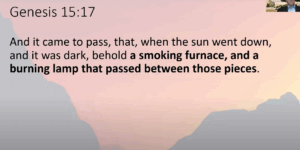
Now, what’s interesting is that Abraham seems to have attempted on his own to try to fulfill God’s promises. We see that in Genesis chapter 12, 1-3. And at one point, he queries God in Genesis chapter 15. He says, “Help me understand, God. When are you going to fulfill these things?” There’s a whole series of things God does for Abraham in Genesis 15.
Fulfilling Promises
For example, He takes him out at night and says, “Count the stars. If you can count the stars, that is the number of your posterity, and will be essentially innumerable.” There’s another area in the Abraham story where God tells him, “If you can count the sands of the sea, this is proof and this is evidence that I will fulfill this, and this is the number of posterity you will have.”
Still, God wanted to demonstrate to Abraham that He would fully fulfill His promises. Abraham apparently had some questions in Genesis chapter 15. He apparently wanted some reassurance or evidence. These are not the best words to use, but he wanted to know that God truly would fulfill these promises.
And then something very interesting happens, and I’ve been centered here on this verse, this verse here in verse 17. A little backdrop, God had asked Abraham to go gather some animals and then to sacrifice them. Cut them in half, and split them apart. In the ancient world, promises were often solidified through a sacrificial covenant. An animal was cut in half, and then the person who is responsible to fulfill the covenant passes through the middle of those chopped up animals. And the symbolic meaning was, “Let my life be like these animals if I do not fulfill my obligation to the promises and covenants that I have made.”
Covenantal Contract
Again, let’s reiterate that the person who passes through the chopped-up animals was the only one who was obligated to fulfill the promises of the covenant. And what’s very significant about Genesis chapter 15:17. It’s this kind of strange verse that sometimes is passed over, not fully understood. Let’s read it: “And it came to pass,” after Abraham had cut these animals apart, he actually fell asleep. And then this happens. “And it came to pass that when the sun went down, and it was dark; behold, a smoking furnace, and a burning lamp that passed between those pieces.”
Well, Abraham was asleep. Abraham was not the one who had made the promises, God made promises to Abraham. God is making a very solemn covenantal act right here, saying, “Abraham, I am fully and 100% responsible to fulfill those promises to you that I gave you back in Genesis chapter 12. And to symbolize my commitment to this covenant, let me be chopped in half, just like these animals have been cut in half if I do not fulfill the promises I’ve made to you.”
Walk Before Me
I pause on this verse because of its significance. It’s a verse I don’t think we spend enough time with in the Gospel. I think more of us should return to this verse and see that God has put Himself under a solemn covenant to fulfill the promises that He made to Abraham. And interestingly, we might make a claim, that only God is responsible for fulfilling the promises to Abraham. Those were promises that God made to Abraham. In Genesis 15:17, we see that God put Himself under covenantal contract to fulfill those promises.
Now, there were things that Abraham had to do. He needed to be faithful to God, and we see examples of that in the Abraham stories. For example, a few chapters later, verse 1, chapter 17: “The Lord appeared to Abraham and said unto him, ‘I am the Almighty God; walk before me, and be thou perfect.'”
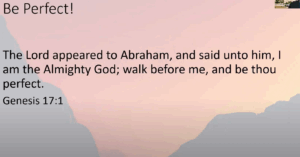
Really interesting, the phrase “walk before me,” really probably could be better interpreted as “walk with me.” If you think about a marriage covenant, there’s no expectation that the husband walk in front of or behind the wife. Or the wife in front or behind, but walk with. That is a good relationship. People are bound together and they walk together. And really the phrase here “walk before me” is better translated as “walk with me.” God wants to be in a covenantal relationship with, Abraham and Abraham’s posterity. He doesn’t want us out in front of Him or behind Him; He wants us to be with Him. That’s what this verse means.
Be Thou Perfect
There’s another interesting phrase we have in this verse; it says, “Be thou perfect.” Now, many of us know about Jesus telling us to be perfect. We get that in the New Testament, and we’ll deal with that in a little bit. Many of us may miss this similar command that was given to Abraham back here in Genesis chapter 17. Scholars who have studied ancient covenants have come to discover that the word “perfect” also has a covenantal meaning that means to be faithful. So, if we look at this phrase again, it is God telling Abraham, “I want you to be covenantally loyal, covenantally faithful to me.”
So, let’s use the metaphor of a marriage relationship again. Now, I’m sure most of us would love to be the perfect spouse or to be married to the perfect spouse. But it’s interesting what we all need is actually a loyal spouse. Perfect would be great, but loyal is what we’re really after. That’s what God’s looking for.
A Relationship with God
He’s not looking for perfection in the sense that we often consider it in the Gospel, that we are without sin, even though that does matter. We can achieve that through repentance and trust in Jesus Christ who has been the only perfect person to live on this earth. But there’s a covenantal meaning here, the word “perfect,” that actually can enliven our understanding of God’s desire to be in a relationship with us. He wants us to be loyal to Him, just as He has always been loyal to us.
And so, I want you to remember these phrases as we continue the presentation. Covenants are all about faithfulness, love, and loyalty. Being bound together in loving, faithful, loyal relationships. And that’s what these words and phrases mean.
Sacrificing Isaac
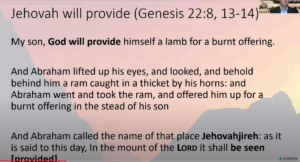
Now, let’s take one of the most interesting stories in Genesis, one that causes for some people some concern. Definitely an amazing metaphor or symbol of Jesus. Let’s look at it from a covenantal context. So in Genesis 22, God comes to Abraham and says, “Go sacrifice thy beloved son.” It’s very interesting if you look at the chapter carefully. It says, early the next morning, Abraham got up and went to go do this deed with Isaac. I don’t know about anybody else, but when I have a hard task in front of me, I typically procrastinate.
Maybe I shouldn’t say it, I am recording this video a few days before the conference. I probably should have done it weeks in advance. But I find a way to get other things done instead of what I should be getting done. I’m amazed that Abraham would just get up so quickly to go sacrifice his son. And it’s almost as if he had total and perfect faith in God.
Listen to what Abraham says here in response to Isaac saying, “Hey, where’s the lamb for the sacrificial offering?” Abraham says something that is beautiful on so many levels. He says to Isaac, “God will provide Himself a lamb for a burnt offering.” So definitely, Abraham is thinking about the current circumstances he was in. But he also seems to be symbolically alluding to the future, as well as God’s character. The third way of seeing this, that God will provide.
Jehovanjireh
In fact, I’m going to skip ahead. If you look down at the bottom, the verse says, “Abraham called the name of that place Jehovahjireh, as it is said to this day, In the mount of the Lord it shall be seen.” So, in the Old Testament and actually throughout scriptures, places often get names based on characteristics of something that happened with a person or something in the story. “Jehovahjireh” literally means God will see, or He will see to it, or He will provide. And as evidence, we’re to memorialize what God did for Abraham and Isaac at Mount Moriah. Abraham named the place “God will provide.”
And see this word play going on early on in the chapter. You have “God will provide,” then later you actually see it in the Hebrew translation. And what did He do? What did God do? Well, when Abraham was nearly at the moment to sacrifice Isaac, “Abraham lifted up his eyes and looked and beheld and behold, behind him a ram caught in a thicket by his horns. And Abraham went and took the ram and offered him up for a burnt offering in the stead of his son.”
Covenantal Context
Let’s go back to this idea that Abraham went to go do this deed that most of us would probably baulk at. Why would Abraham be willing to do this? I believe a covenantal context helps us understand Abraham’s motivations. If we look at the Abraham stories from Genesis 12 to Genesis 24, that Abraham has seen ongoing, steady, covenantal loyalty and love from God. Abraham had learned that God is totally trustworthy, that God will fulfill His covenantal promises that were made back in Genesis chapter 12:1-3. We might then imagine Abraham’s logic, even as difficult as it may have been for him to go forward with his son to the altar sacrifice.
Abraham knew God was loyal and faithful to the covenant and was required to raise prosperity up to Abraham. He knew God would have to find a way to fulfill the covenant. This may have been by stopping the sacrifice, which is what happened. Or by raising Isaac from the dead, or by bringing forth other posterity. God had made an inviolable covenant to give these promises to Abraham.
Abraham had learned to trust God, and that’s why these stories are preserved for us. So, we can look at ancient people who have learned to trust God and to trust His covenantal nature. These stories in the scriptures are preserved to teach us about the character of God and His loyal covenantal nature.
With Abraham, With Isaac, and With Jacob
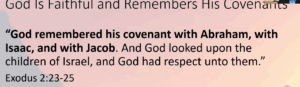
Now, this is significant because the promises to Abraham were renewed in covenantal contracts from God to Isaac and Jacob. Later, when the Israelites are in terrible Egyptian bondage, we have this very interesting phrase. The end of Exodus chapter 2 says, “God remembered His covenant with Abraham, with Isaac, and with Jacob.” That phrase lays the groundwork for what happens throughout the rest of the Torah. The Exodus story is founded on God remembering the covenant He had made with Abraham, Isaac, and Jacob.
And what did He remember? That He was going to provide property, priesthood, prosperity to Abraham and his children. That He was going to provide them opportunities to have those things. And so, it’s interesting if we look at the story of the Israelites in bondage, God actually was the one who was obligated to bring them out of bondage. He had made a covenant with their forefathers to do this thing for them.
And so, it wasn’t on account of the righteousness of the Israelite people that they were taken out of bondage. We don’t have much evidence that they even knew much about worshipping God or being righteous when they were in Egypt. Maybe they were, but the story, what we have in Exodus, doesn’t tell us. What it does tell us is that God saved the people because He had covenanted to do so. And had He not fulfilled His covenantal obligations, symbolically, He would have been cut in half and been cast out. But we know that God cannot lie, He cannot die, He cannot break His promises. And so, we can trust the God of Abraham, Isaac, and Jacob.
Mosaic Covenant

So, God does these incredible deeds, these miraculous deeds of salvation to bring the Israelites out of Egyptian bondage to fulfill His covenant to their forefathers. He brought them to Mount Sinai where we get the second most important covenant of the Bible. This happens at Mount Sinai under Moses. And other scholars in the Church have talked about this, but I think it bears repeating because, again, the scriptures are fundamentally founded on covenantal contracts, language, phraseology, logic, and thinking. So, it’s very useful for us to be reminded of the key covenants that God has entered into and has invited us to enter into. And be reminded how those have been expressed throughout scriptures.
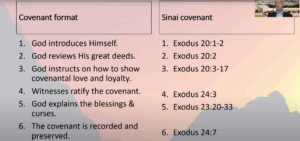
So, in summary, the Mosaic covenant, or the Sinai covenant, followed six key patterns that show up in other ancient contexts and covenants. These covenants usually follow the format of God introducing Himself and reviewing His great deeds. He then instructs the people on how to show covenantal love and loyalty. Then witnesses ratify the covenant, God explains blessings and curses associated with keeping or not keeping the covenant. And finally, the covenant is recorded and preserved in a sacred location.
Now, if we turn to Exodus 20, what do we find? That God has introduced Himself to the people. He reminds them of all the incredible mighty acts of miracles that He has done on their behalf to take them out of bondage. He has saved them because of His loyalty to them and His love of their forefathers, Abraham, Isaac, and Jacob. Now He’s inviting them to be loyal back. This now is going to be a two-way partnership where God is obligated to do certain things and His people are obligated to do certain things.
Expectations For Showing Covenantal Loyalty
So, God lays out expectations for how people will show covenantal fidelity, love, and loyalty to Him. And those show up in Exodus chapter 20, verses 3-17. If you look at those, those happen to be the Ten Commandments. What we know as the Ten Commandments actually are just the middle portion of a covenantal treaty God invited the Israelites–and by extension, all of us–into. If we want to know how to show loving loyalty to God, we just have to keep the commandments God reveals through prophets..
We’re not going to go through all these, but you can go review these passages on your own and see that there’s this covenantal structure that shows up in Exodus. In fact, the entire book of Deuteronomy follows this structure. It’s the key ideas that help us to understand how the Israelites prospered or when they failed. We might look at the Book of Mormon and ask how well the people keep the Ten Commandments. When they did well doing those things, God prospered. When they did not do well at showing covenant loyalty to God, they lost access temporarily to the Abrahamic promises.
Freely Offered
So, that’s how it works. God freely offers us the Abrahamic promises. There is nothing that we do to deserve the Abrahamic promises. God just made it gracefully and freely available to all of us. What He does ask us in return is show loving loyalty. Show faithfulness. The Ten Commandments are some of the easiest stipulations. Easy in the sense of the easiest way to construct the list of what God expects of us.
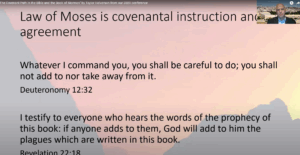
I might point out that the Law of Moses was written out in such a way that only God should be able to update the covenantal instructions. We have passages in the scriptures that have caused some contention among members of the Church and other Christian groups. But if we read these in a covenantal context, they make a lot of sense.
Covenantal Contract
In Deuteronomy 12, also in Revelation 22, God essentially said, “I have given you a covenantal contract. Don’t change the contract.” Let’s just imagine this from a metaphorical standpoint. If you go get a mortgage from a bank and they set up the contract, then you go home and you modify the contract without authorization, that would actually ruin the contract.
Now, is it okay for the bank to make changes and present them to you to sign? Yes. Metaphorically, this is what God is saying. “I’ve revealed this covenant contract. Don’t change it. It’s not your authorization to change the contract or the covenant.” God may send prophets from time to time who will update the contract with new revelation or clarification or perhaps new commandments. So, that’s what these covenantal phrases mean in scripture.
Obligations and Actions–God’s and Ours
 />
/>
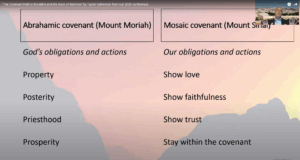
Now, let’s summarize what we’ve been talking about so far. The Abrahamic covenant at Mount Moriah or the Mosaic covenant, Mount Sinai, and I have a couple of screens here of some key ideas. So, the Abrahamic covenant is all about God’s obligations and actions. As you study the scriptures, if you look for God acting and where God has obligations, that is within the framework of the Abrahamic covenant.
And what does He offer? Property, posterity, priesthood, and prosperity. And by the way, in my study of the word prosperity, I’ve come to see that one of the key meanings of the word prosper is to have God’s spirit with us. If we look at the sacramental covenant and in the baptismal covenant, God wants His presence to be with us. And that’s one of the most powerful ways we can prosper, is having God’s presence with us.
So, the Mosaic covenant, that is a summary of our obligations and actions. Abrahamic covenant, God’s obligations, Mosaic covenant, our obligations. And what are we supposed to do? We’re supposed to show love, faithfulness, trust, and stay within the covenant.
Now, I’m really not advocating this, but in some ways, the phrase “Abrahamic Covenant” is slightly misleading because it’s not about Abraham. It’s actually about God. Abraham is not the one obligated in the Abrahamic covenant. It’s God. God is the one who covenantally obligated Himself to Abraham and Abraham’s posterity or anyone who has joined the Abrahamic family, whether by blood or by baptism. And so, in some ways, when we call it the Abrahamic covenant, we spend time thinking about Abraham instead of thinking about God and His trustworthiness and His promises to us.
Our Obligations
Mosaic covenant is our obligations to be faithful to God in order to have full access to what God has freely offered to Abraham’s descendants. Here are some other ways that there are differences between the Abrahamic covenant and Mosaic covenant:
Abrahamic covenant: God is the covenant maker and covenant keeper.
Mosaic covenant: God’s people, that’s us, we should be the covenant makers and keepers.
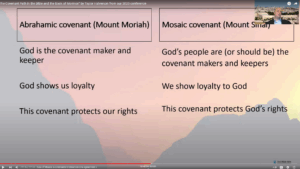
Abrahamic covenant: God’s the one who’s supposed to show us loyalty. And if you look at the story of the Exodus from Egypt, that was God’s demonstration that He was totally loyal to the covenant He had made to Abraham, Isaac, and Jacob. Well, we need to now follow in His covenant path and also be loyal to God. And it’s the commandments that show us how to be loyal. If you keep the commandments, you’re loyal.
The Abrahamic Covenant and Mosaic Covenant
And in the Abrahamic covenant, it’s the covenant that protects our rights. The Mosaic covenant protects God’s rights to us as His people. So, it’s interesting. God preserves our rights through the Abrahamic covenant. We preserve God’s rights to us as His people by keeping the Mosaic covenant.
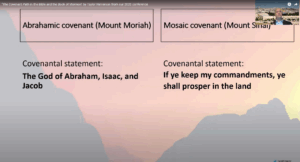
Now, here’s some other things that I think would help us as we study the scriptures. There are phrases that summarize these two covenants. Wherever you see these phrases throughout scriptures, they are consistently used in covenantal characteristic purposes.
The covenantal statement of the Abrahamic covenant: “God of Abraham, Isaac, and Jacob.” Anytime you see that phrase brought up in scripture, it is to call upon the memory that God is fully trustworthy. That He’s a covenant maker, a covenant keeper, and He will fulfill the promises made to Abraham. He will deliver His people from bondage so that they can have the opportunity to prosper in the land.
If Ye Keep My Commandments
There’s also this phrase and variants of it: “If ye keep my commandments, ye shall prosper in the land.” That statement is the summary statement of the Mosaic covenant, which summarizes our covenant obligations to God and His people. And what’s significant about this phrase is it’s actually far more common in the Book of Mormon than the “God of Abraham, Isaac, and Jacob” phrase, primarily because the Book of Mormon was written and preserved for our day to show us how we can be loyal to God. To thereby experience the promises that He made to Abraham and his posterity.
And also of interest, the Book of Deuteronomy, as I’ve mentioned before, essentially follows the Mosaic covenant format. Well, if you are a Book of Mormon prophet trying to remind people of their covenantal obligations, would you repeat the entire Book of Deuteronomy? Or might you just simply say this simple phrase that summarizes the Mosaic covenant obligations? “If ye keep my commandments, ye shall prosper in the land.” We might say this: “If you show covenantal love and loyalty, you’ll have my spirit in your life.”
Covenant Path in the New Testament
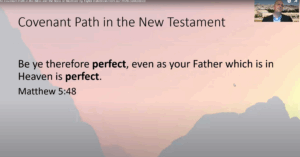
Let’s take this into the New Testament. We have a phrase that has been talked about a lot. I would like to offer a covenantal reading of this phrase I hope invites all of us to feel greater love from God and more devoted loyalty to Him.
Now, it is true that in the Greek, the word perfect, “telos,” means goal-oriented or end goal-focused. So, from a Greek perspective, that is all real. What I want to focus on is the covenantal meaning of the word perfect. And given what we talked about with Abraham before, we could actually read this to say this,
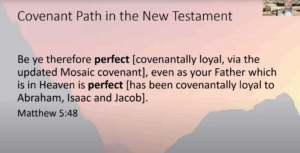
”Be ye therefore perfect, covenantally loyal, via the updated Mosaic covenant, even as your Father which is in heaven is covenantally loyal to Abraham, Isaac, and Jacob and their posterity.” Let me talk about that again.
Covenantally Loyal
Let me put this in context. Matthew 5 is the Sermon on the Mount. You might remember that Matthew 1 through 5 follows the pattern of the five books of Moses. Matthew 1 is patterned on Genesis. You have a bunch of genealogy. Matthew 2 is patterned on Exodus. You have Jesus going and leaving Egypt. Matthew 3 is like Leviticus. It tells the priesthood ordinances. Matthew 4 is wandering in the wilderness. Like in Numbers, where they wander for 40 years, Jesus wanders for 40 days in the wilderness. And then, what happens in Deuteronomy? Moses delivers again a description of the covenantal obligations to show love to God. And symbolically, he does this from a mountain. Well, what happens in Matthew 5? Jesus gets on a mountain as the new Moses to deliver an update to the covenantal expectations.
He essentially says, “Moses said, ‘Show love and loyalty in the covenant to God in these ways.’ I now say, ‘Do it like this.'” And after laying out a bunch of updated stipulations for covenant loyalty, Jesus then says, “Be ye therefore covenantally loyal, as I’ve described how to do it, even as your Father which is in heaven has always been covenantally loyal to the promises he made to Abraham, Isaac, and Jacob and their posterity.” Do you see how that covenantal reading puts this into a sharper focus. I think a far more compelling reading, that Jesus is asking us to be far more covenantly connected to God than perhaps we have been in the past.
The Just Shall Live By Faith
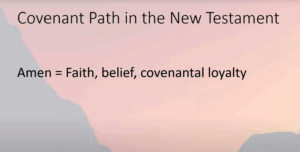
Let me take this a little bit further. The word “Amen” is a Hebrew word that comes from the word “faith and belief.” But “Amen” also has a covenantal context. When you say you believe, you have faith, you’re actually saying, “I’m covenantally loyal.” Very interesting. So, anytime you say “Amen,” you are also saying, “I’m part of a covenantal community that is pledging loyalty to God and trusting that God will be loyal to us.”
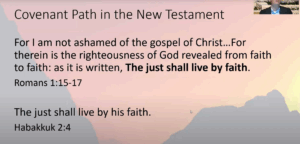
Let’s see how this plays out. Let’s take one of the greatest missionaries in all Christianity, Paul the Apostle, and listen to what he says. Probably his greatest epistle of all time is Romans. And here’s his main thesis statement right there in Romans 1, verses 15 to 17. He says, “I am not ashamed of the gospel of Christ, for therein is the righteousness of God revealed from faith to faith. As it is written, the just shall live by faith.”
Habakkuk
I decided to look up where Paul had quoted that particular phrase you see bolded here, “The just shall live by faith.” He actually was quoting from Habakkuk. And what’s interesting is that Paul didn’t correctly quote Habakkuk either. Maybe he had a different version or maybe wanted to slightly make a different case. But if you go back to Habakkuk, Habakkuk preaches this: “The just or the righteous or the covenantally faithful shall live by his faith.” Not simply by faith, but by his faith. And from the context of Habakkuk, who is the “his”? It is God. Now, this is crucial. This is amazing because God’s covenantal loyalty is expressed through the Abrahamic covenant, which is gracefully and freely given. None of us do anything to deserve it.
So what I am arguing here is that the grace and the faith that Paul was teaching was none other than the faith or the grace that we get from God through the Abrahamic covenant. In other words, when we read Paul and he talks about being saved by grace, being saved by faith, he’s essentially saying it’s the Abrahamic covenant that offers us salvation. Sure, we have to keep the Mosaic covenant or the updated version that Jesus has provided or later prophets to get access to that free gift. Ultimately the free gift is summarized by the Abrahamic covenant.
Covenant Path in the Book of Mormon
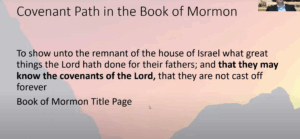
Now let’s turn to the Book of Mormon. I hope the clarity of understanding the Abrahamic and Mosaic covenants now becomes apparent throughout the Book of Mormon. We should be reading the Book of Mormon as a covenantal text. The title page tells us to do so. If we do not read the Book of Mormon as a covenantal text, we will not fully understand the Book of Mormon. We will misunderstand the book.
If we do not read the Book of Mormon through a covenantal lens, we will actually not help it fulfill its purposes. So the way for us to help the Book of Mormon fulfill its purposes is to read it as a covenantal text. I believe that the two covenants we’ve been talking about can better help us understand the Lord’s covenants that He’s preserved for our benefit.
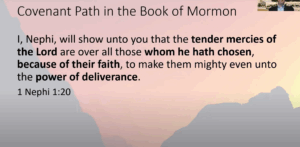
Let’s take a look at how the Abrahamic and Mosaic covenants may be at play in the Book of Mormon. Let me take, 1 Nephi chapter 1 verse 20, what others before me have called Nephi’s thesis statement. Noel Reynolds, I think, is the first person to mention that. I love that idea. Here’s what Nephi says: “I, Nephi, will show unto you that the tender mercies of the Lord are over all those whom He hath chosen, because of their faith, to make them mighty even unto the power of deliverance.” If we read this from a covenantal perspective, we will hear an echo of the two major covenants of faithfulness that we have been talking about.
Whom He Hath Chosen
Let’s look at this. “Whom He hath chosen” seems to echo the Abrahamic covenant because God chooses His people freely and gracefully. It’s nothing that we do. There’s nothing that we do to impact that. But notice that “because of their faith” or their covenant to loyalty is the Mosaic covenant. So, we can actually read Nephi’s thesis statement as mutually binding the Abrahamic and Mosaic covenant. We get full access to the Abrahamic covenant, which is freely offered as we show our faith by being loving and following the stipulations as revealed at Sinai. Or, as I’ve said before, through updated revelation.
When we do those things, we will be delivered just as God delivered the Israelites. And this is a theme throughout the Book of Mormon: that God’s covenantal role is to deliver us. But He can’t do that if we are faithless. He is covenantly bound to deliver us if we show loving loyalty to Him by keeping commandments. But He doesn’t have any obligation if we do not keep the faith.
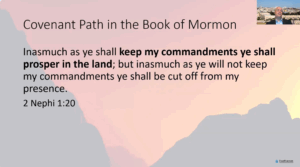
Now let’s consider this. We talked about this phrase a moment ago. This phrase shows up over the Book of Mormon. It seems to suggest a reminder of the covenantal stipulations God revealed through Moses to the Israelites at Mount Sinai. “Inasmuch as ye shall keep my commandments ye shall prosper in the land; but inasmuch as ye will not keep my commandments ye shall be cut off from my presence.”
As I mentioned before, and look at the parallels appearing here. God’s presence or His spirit or going back into Eden or being saved in God’s kingdom, that’s what prospering is. Prospering is having God’s presence in your life.
Trustworthy Nature of God
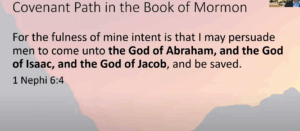
Notice if you actually looked up the phrase “the God of Abraham, the God of Isaac, the God of Jacob” throughout the Book of Mormon, it is consistently used to remind people of the fully trustworthy nature of God. And listen to what Nephi says. “The fullness of mine intent is that I may persuade men to come unto the covenant-making, covenant-keeping God who is entirely trustworthy and will never let you down, even the God of Abraham, the God of Isaac, the God of Jacob.”
And Nephi doesn’t say this here, but an intertextual reading would say, “Oh, I should go back to the Old Testament and remind myself of the stories where God proved His character to Abraham, Isaac, and Jacob and their posterity by saving them again and again and again and delivering them, especially when they kept the commandments.”
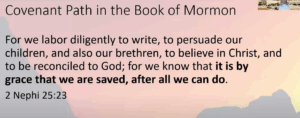
Here’s another powerful phrase from the Book of Mormon. I believe a covenantal reading provides amplified understanding of this phrase. Nephi says, “We labor diligently to write to persuade our children, and also our brethren, to believe in Christ, to be reconciled to God; for we know that it is by grace that we are saved, after all we can do.”
By Grace
Here’s what a covenantal reading would suggest about this. It is by grace that we are saved,”[the Abrahamic covenant] given to us before we are ever even born, after all we can do.” [the Mosaic covenant] which is showing loving loyalty to God as revealed through the Mosaic covenant or updated prophetic revelation. I hope that this covenantal reading provides deeper insight and clarity around a phrase that has caused much consternation among many readers.
So to summarize this again. I believe a covenantal reading that the Book of Mormon invites us to do. Those covenants are found preserved in the Old Testament primarily. The Abrahamic-Mosaic covenant clarifies a powerful phrase from Nephi. That we are saved by grace, the Abrahamic covenant, as we show our faith and our loving loyalty to God in the covenant revealed at Mount Sinai.
Sermon on the Mount
Now let’s see again as we fast forward through the Book of Mormon. 3rd Nephi, Jesus comes to the people and repeats essentially the Sermon on the Mount. Detractors have asked why the Sermon on the Mount is repeated. From a covenantal context, it is essential, necessary, and expected. If God, Jesus the Jehovah of the Old Testament, who would deliver the original stipulations for covenantal loyalty. He has come down to earth, fulfilled the obligations of the Mosaic covenant, and is now providing updates to the covenantal contract.
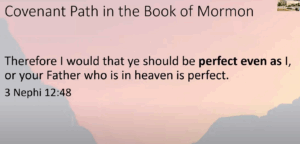
It’s only fair that as the people in the Old World got the update to the covenantal contract that Jesus gave the people in the New World the update. He uses the word “perfect” again. I think it’s interesting here that He says, “I would that you should be perfect even as I or your Father who’s in heaven is perfect.” This is a little bit different than we get in Matthew. In Matthew, Jesus does not include Himself in the word “perfect.”
Christ’s Life
Now, we know that Jesus had lived a perfect life in terms of sinlessness. If we look at it from a covenantal context, He had not yet fulfilled all the covenantal obligations when He was giving the Sermon on the Mount. He still had yet to do the Atonement. After He has died and been resurrected, my reading of this is that He’s saying, “I am now covenantally, I have been fully faithful to every obligation God has given me. I was sinless but also perfect in keeping all the covenantal expectations. And because now that I’ve fulfilled all those covenantal expectations, I, Jesus, can now include myself in the covenantal phrase ‘perfect’ even as Father in Heaven is also perfect or covenantally loyal.” So Jesus has been covenantally and totally loyal.
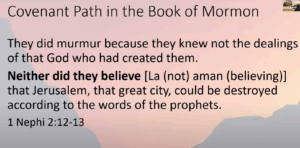
Now, this one. I want to say thank you to Matt Bowen from a presentation he did last year. He discussed a potential meaning of the word “Laman” coming from two Semitic words, “La Amon.” That was super mind-opening because the word “Amon” or “Amen” has to do with covenantal faithfulness.
Book of Mormon as a Covenantal Text
Now look at how that opens up the Book of Mormon as a covenantal text. Laman is the non-covenanting brother. Non-believing, non-faithful, not willing to keep the stipulations of the Mosaic covenant. Therefore, he doesn’t get access to the freely offered Abrahamic covenant. And the Lamanites, therefore, as a titular group, become the non-covenanters, the non-faithful, the non-willing to keep or make covenants. Of course, that breaks apart later on because we do have Lamanites who are willing to keep the covenant. From a word-play standpoint, it’s absolutely fascinating that the two major parties that break apart in the Book of Mormon. One are the Nephites. Our best understanding is the word “Nephi” is an Egyptian word that means good. Meaning he keeps the covenant, so he’s a good guy, and the non-covenant people.
And therefore, even the two groups of the Book of Mormon represent covenant keepers, covenant breakers. Again, the Book of Mormon asks us at the very outset to read as a covenantal text. When we do, we actually see greater understanding of the Book of Mormon, of the gospel. Particularly how we can apply it to our own lives.
Different Aspects of Covenants
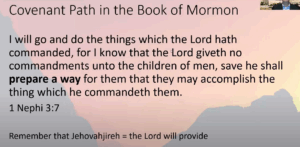
You get these little phrases popping up throughout scriptures that echo the different aspects of Abrahamic or Mosaic covenant. Consider this, Nephi, in one of his most famous statements where he’s asked to go do a very difficult thing. In fact, he’s asked to return to Jerusalem, not Moriah, to go do a very hard task. Just like Abraham was asked to do a hard task.
But Abraham knew that God would prepare a way, Jehovahjireh. I wonder if in the background of Nephi’s mind was the covenantal context that Abraham had trusted God. Nephi wanted to be like Abraham and would fully trust God, would prepare a way that they may accomplish the thing which He commanded them. So a covenantal reading of this expands our understanding of how Nephi was driven by a covenantal context in his actions.
Covenant Terms and Ideas
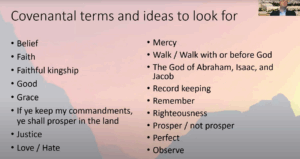
Here are some phrases of covenantal terms and ideas that are found throughout scriptures. Now these are all words that we’re all familiar with. They have their basic meanings that we know. They also have covenantal meanings. Let me just talk about them.
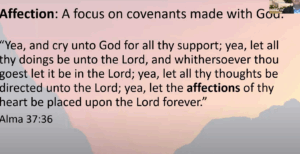
The word affection means to have a focus on covenants made with God. I’m going to go through these quickly just for the sake of time.
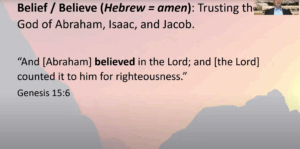
Okay, the word belief or believe comes from the Hebrew word “amen.” it means to trust the God of Abraham, Isaac, and Jacob. We see this with Abraham. It says, “Abraham believed in the Lord, and the Lord counted it to him for righteousness.” Abraham was willing to trust that God would be loyal to His covenants. Therefore the Lord counted that as loyalty from Abraham back to God. In fact, we’ll see in a minute, the word “righteousness” in a covenantal context means loving loyalty.
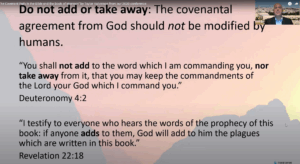
“Do not add or take away,” we’ve looked at this before, this simply means don’t change the covenantal agreement. Only God can change the covenantal agreement.
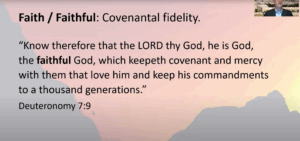
The word faith or faithful means to have covenantal fidelity.
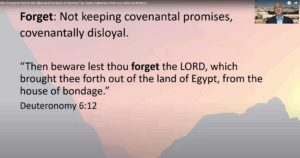
Terms and Ideas II
To forget, it means to not keep the covenantal promises, it means to be covenantally disloyal. Even in Deuteronomy, this great covenantal text tells the people, “Beware lest thou forget the Lord.” Meaning don’t stop keeping the covenant. Don’t stop being loyal to God.
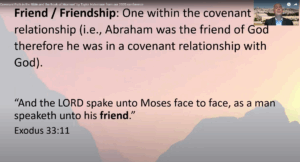
Friend or friendship is also a covenantal term. It actually means one who’s encountered a relationship with God. And that’s what we get with Abraham. It’s interesting we get this also with Joseph Smith. He’s mentioned as a friend of God. I think all of us would love to know that we are a friend of God. We see it also with Exodus 33. “The Lord spake unto Moses face to face, as a man speaketh unto his friend,” as someone he’s in a covenantal relationship with.
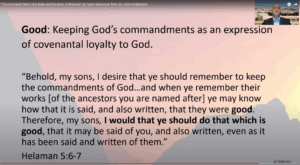
Good, keeping God’s commandments as an expression of covenant loyalty to God. We get this word play going on in Helaman, where Helaman names his sons Nephi and Lehi and says, “I would that you should do that which is good when you remember the names of these forefathers that I’ve named you after, because they were good.” That is also a covenantal expression.
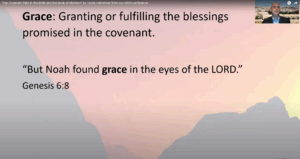
Grace, it’s a granting or fulfilling the blessings promised in the covenant. Noah found covenantal acceptance in the eyes of the Lord, or the word is grace. If you turn Noah backwards in Hebrew, is the Hebrew word “hen,” which means grace. So there’s actually two word plays going on with Noah’s name. One is rest because God rests from the wickedness. The other one is grace. The two key themes in the Noah story are rest and grace. They’re bound up in the word play of Noah’s name.
Terms and Ideas III
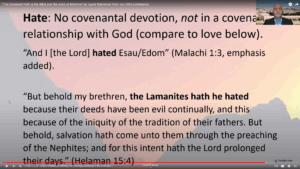
Hate, this is a tough one because people in the scriptures when we read them today are like, “Does God really hate people?” But it actually means there’s no covenantal devotion or someone’s not in a covenant. For example, God says, “I the Lord hated Esau or Edom.” Meaning Esau and Edom were not in a covenantal relationship with God. It’s not that God actually had some visceral angry action towards these people. This was a technical term meaning that these groups were not in a covenant with God.
It also shows up in the Book of Mormon, Helaman 15:4, “But behold, my brethren, the Lamanites hath he hated.” I don’t think God’s sitting around like keeping score like, “I hate these people.” It’s covenantally, the Lamanites had primarily not been in a covenantal relationship with God. And so the technical term “hate” simply means to not be in covenant with God.
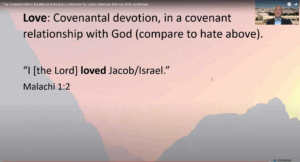
Love, the opposite of hate, means to be covenanted with God, and we can see that throughout the scriptures. A quick one is, “I the Lord loved Jacob,” or was in a covenantal relationship with him.
Terms and Ideas IV
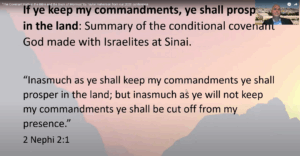
We’ve seen this one already, “If ye keep my commandments, ye shall prosper in the land,” found throughout the Book of Mormon. It is a summary statement of the covenant God invited the Israelites into at Sinai for them to show their covenantal fidelity and loyalty to him.
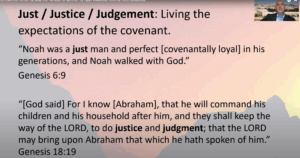
Just, justice, and judgment, this phrase from a covenantal standpoint means you’re living the expectations of the covenant. Look at Noah. He was a just man and perfect in his generations. Noah walked with God, meaning Noah was covenantally bound to God. We even see it later in Genesis 18:19. God says, “He knows that Abraham will do justice and judgment,” meaning that he will be covenantally loyal to God, to keep right.
Terms and Ideas V
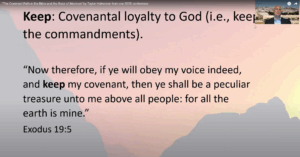
Keep–what does it mean to keep my commandments or to keep my covenant? It’s again about covenantal loyalty to God. So really, the covenantal loyalty to God can be expressed with probably 15 to 20 different words or phrases throughout scriptures. That’s what we’re seeing here.
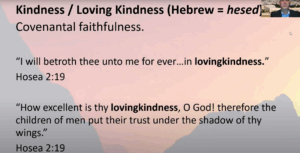
Another one of my favorites, kindness, loving kindness. This beautiful Hebrew word called “hesed,” it’s covenantal faithfulness. One of my favorite scripture passages, Hosea 2:19, “I will betroth thee unto me forever in loving kindness.” “How excellent is thy loving kindness, O God. Therefore, the children of men put their trust under the shadow of thy wings.” Again, you can just see the Abrahamic covenant seeping through this phrase.
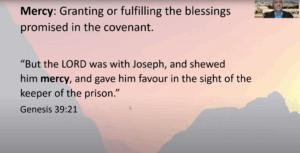
Mercy, we’ve talked about this, mercy is about fulfilling the blessings promised in the covenant. Particularly talking about God’s mercy, it’s what He freely promised to Abraham, His descendants.
Terms and Ideas VI
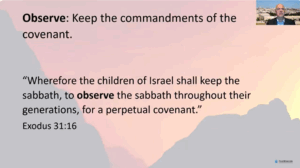
Observe. Also needing to keep the commandments of the covenant.
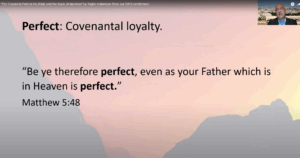
To be perfect means to be covenantally loyal. And I hope for all of us who may have any kind of perfectionist tendencies, we would throw that tendency out of our mind and just realize all that God really needs from us is our covenant loyalty. When you partake of the sacrament every single week, you are declaring once again that you will be covenantally loyal to God. If you do that with full purpose and not with emptiness—because if you do it with emptiness, that’s taking the Lord’s name in vain, that’s making a promise without purpose, without intent. if we do it with full purpose, then we have the promise of having His Spirit with us, which is prosperity. So perfection in a covenantal context leads to prosperity, which is God’s presence.
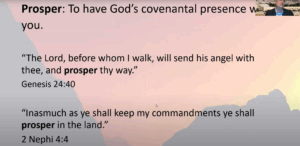
And being in His presence is to prosper, having God’s presence with us. And there’s some passages here to show that phrase can be well understood as having God’s presence with us.
Terms and Ideas VII
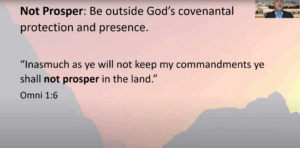
To not prosper means to be outside of God’s covenantal protection and presence. We see that throughout the Book of Mormon.
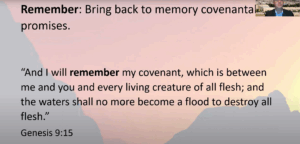
Remember, this is an important word because what are you supposed to remember? The covenantal promises or how to be covenantally loyal. And we are asked repeatedly throughout the scriptures to remember things, and God remembers stuff. Now, God, who actually knows all things, it’s interesting to me He’d use the word “remember.” I mean, how could God ever forget? He couldn’t because He knows all things. But He uses the word “remember” in a covenantal context to say, “I have covenantal obligations.” He expresses that by using the word “remember” we have covenantal obligations. When we hear the word “remember” in scriptures and it’s directed to us, it’s to remind us of our covenantal obligations to God.
Terms and Ideas VIII
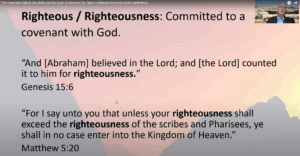
Righteousness means committed to a covenant with God. Love that one.
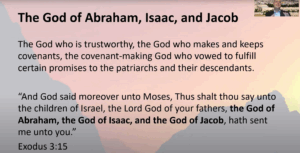
I’ve mentioned this before, the God of Abraham, Isaac, and Jacob. That is the key phrase to tell us that this is the God we can trust. He keeps covenants. He’s a covenant-making God. He’s vowed to fulfill certain promises. Remember, He walked through the chopped-up animals. God will never die. He will never allow Himself to be like those chopped-up animals. That being the case, we can have 100% certainty that He will always fulfill His obligations to Abraham, Isaac, and Jacob. All we have to do is show our love and loyalty back to Him, and we freely experience all His mercy and grace that He has already fully offered.
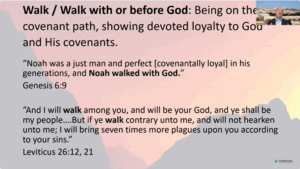
Walk/Walk With or Before God
And then this last one, “to walk with” or “walk before” God, it means to be on the covenant path. It’s showing devoted loyalty to God and His covenants.
Conclusion
I hope that this review of the covenant path has animated your desire to dig deep back into the scriptures. To see the covenantal context throughout the Old Testament, New Testament, and Book of Mormon. He shows up all over the Doctrine and Covenants, Pearl of Great Price, and the Restoration. I hope it encourages you to want to be back in the scriptures. I hope it empowers your vision of seeing God’s covenants in scriptures. More importantly, I hope it helps you feel greater love and loyalty to God and trust in Him that He’s always been loyal to you. That with your loyalty to Him, you will receive all the promises that He has ever offered.
Thank you for your time. I’d be happy to communicate with you through these means and many blessings to you in your future studies.
