Introduction and Personal Background
I greatly appreciate the opportunity to be with you today. It’s an honor to be able to address this group.
I have a lot of people who ask me, “Brian, why are you so interested in polygamy?” And then I have other people who ask me, “Brian, why were y’all so interested in…” And to this last group, I just say—I can’t monog very well. So you don’t need to worry about me trying to polyg.
My Reason for Researching Polygamy
There is a reason that I’m involved with this study, and it’s because a member of my family was excommunicated in 1989 for joining a polygamy group. 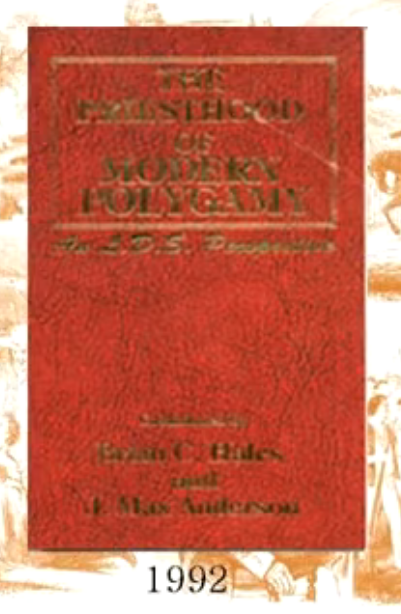
Three years later, I got with Max Anderson and we wrote this book. I did all of the writing, but he’s the expert on Mormon fundamentalism.
I tell people that my books are part of my full anesthesia services—I’m an anesthesiologist, and if ever that were true, this is an example of it. It’s hard-hitting, but it’s pretty dry.
Books I’ve Written
We—I have some other books, and I notice I stocked them in there. I’m not here to plug these things. The one I told them that I hope they would maybe look at is this one on light. It’s not light reading at all, but I’ve collected some really good ideas that I think this group might like to look at.
And then The Veil and Trials are kind of an eternal perspective of these things. But I also wrote these two books, and Scott mentioned that I also have a website— mormonfundamentalism.com —that I kind of wish FAIR would link to. It’s been up for many years.
But what I—and I’ve had some problems with this because I tried to write as objectively as I can. Maybe that’s the issue. But I get about half of the emails wanting to join the Mormon fundamentalists. So I’ve had to go in and doctor up the first sentence or two, but it still happens.
Motivation for Research on Joseph Smith’s Polygamy
What I found in all of this research and discussion is that over half of the questions that people would ask me had to do with Joseph Smith’s polygamy. I didn’t know the answer. I’d tell them, “that book has not been written yet,”— but I had my own questions.
So I dove back in, doing some research, and hired a research assistant. He logged over 1,500 hours going around finding every document we could find—either transcribing it or getting me a copy—that had to do with Joseph Smith’s polygamy. And we’re putting them—I’m putting them—together into two volumes. They’ll be out early next year.
It’ll be an exhaustive look at Joseph Smith’s polygamy—over 1,200 pages between the two volumes—and it’ll be new for everybody. I’m here to share just a few of the things that we’ve observed here.
I also have a website—josephsmithspolygamy.com– I uploaded this a couple of months ago. I did it myself, so it’s kind of homegrown—please forgive that—but there’s a lot of good information there. In fact, most of what I’m going to tell you today is on this website, and there are some good research tools up there too.
If you want to go there, I pick up the mail at the Mormon Fundamentalism email column. If you have concerns or questions or other things, go ahead and email me there.
Why Did Joseph Smith Practice Plural Marriage?
Now, the question comes up—why did Joseph Smith practice plural marriage? There are three different places we could go for answers. 
We can go to the naturalists—like Fawn Brodie—and the cynics, which are kind of in the same group. We can go to Latter-day Saint apologists, who gave us their own set of reasons. And then we can go to Joseph Smith himself. I’d like to look at these three sources.
The first source is the naturalist—and what I mean by that is somebody who is sure God’s not involved. Okay? It’s all natural processes—hormones, libido, job one—and sex. That’s what’s driving polygamy. That’s their answer.
And Fawn Brodie kind of codified this idea in her 1945 biography, which unfortunately is still probably the most influential book ever written on Joseph Smith. Brodie totally botched the treatment of his sexuality in polygamy. She didn’t even want to get it right—that’s my frustration.
The purest naturalistic view is found in George D. Smith’s 2008 novel, which he called “Nauvoo Polygamy: … but we called it celestial marriage.” I doubt there will ever be a purer naturalistic view written of Joseph the man.
Weaknesses in the Naturalistic View
The naturalistic view of Joseph Smith reflects a number of important weaknesses—five of them that we’re going to talk about today.
1- Lack of Credible Evidence
First, I will assert that credible evidence supporting their view—the naturalistic view—is lacking.
Now, that’s a bold statement. I’ve read hundreds and hundreds of narratives and accounts and accusations against Joseph Smith alleging sexual impropriety. This is a group of about a hundred.
And if you can see here, the far-left column is the year, then you have the accuser, the accusation exactly as it appeared in the original document, and then the reference. And these are accusations that are too generalized to really be analyzed—could this be true?
But in going through hundreds of these, I found 53 specific allegations of sexual impropriety that were leveled at Joseph Smith by 26 different accusers. This is the evidence the naturalists will use to support their position.
(And you can see this on the website—and you can almost read it here. I lost the color.)
But along the left side are all 53 accusations—you can click on them. The exact quote is there. It’s unedited. I haven’t pulled any punches.
Categories of Accusations Against Joseph Smith
It’s exactly the way it appears in the original document—and then you can read some of the discussion. You can also click on the accuser and find out a little bit about their background as well.
There are four categories of accusations of sexual impropriety of Joseph Smith: sex with non-wives, polyandrous sexuality—this is one wife with two husbands, and she’s sleeping with both of them during the same period. That’s polyandry.
There is a third category—the improper proposal—sixteen of those. And then four concerning Fanny Alger. Was that adultery, or was that a plural marriage? But you can go there and you can make your own assessments.
Six Observations About the Accusations
I’d like to make six observations of those fifty-three accusations.
1. Limited Contemporary Claims
Only six of the fifty-three accusations were published during the Prophet’s lifetime. There’s one in 1834, and it’s a secondhand accusation of an attempted seduction in a paragraph with blatant falsehoods that nobody repeated throughout the rest of the 1830s. Not real credible—but that’s the only published accusation of sexual impropriety against Joseph Smith published before 1842.
And then there are five by John Bennett. This is significant because the Tanners—some of you are familiar with them—wrote that the charge of sexual immorality was probably one of the most frequent charges made against Joseph Smith. This is not supported. I would invite the Tanners to produce some evidence to support this allegation.
We do have some rumors in Kirtland in 1837–38 dealing with Fanny Alger. None of them were picked up by the local papers—which tells you it was somewhat limited.
Beyond those two—the 1834 that I mentioned and these rumors in 1837—there is nothing to support this claim.
There are multiple evidences that show that John C. Bennett was not a polygamy insider. And I’m getting pushback on this from all different quarters, even Church historians—but I’m going to hold my course.
There is compelling evidence this guy was never once in Joseph Smith’s presence learning about polygamy. And so when you factor out all of his accusations and nonsense, a much more cohesive and believable story of Joseph Smith’s Nauvoo introduction of plural marriage emerges.
Timing and Reliability of Accusations
2. Late and Secondhand Sources
Second observation—most of the accusers leveled their charges years or even decades after Joseph Smith’s death. They were not participants.
Joseph Smith was sealed to thirty-four women—Compton’s thirty-three plus one more that Michael Marquardt found. How many complaints do we have from those wives? Zero.
The people who were participating in Joseph Smith’s polygamy are not complaining about it—even years later.
3. Lack of Firsthand Testimony
With one exception from the controversial Bennett, all of the accusations are at least secondhand, and some are thirdhand or so far removed a good scholar wouldn’t even use them. But that wouldn’t deter the anti-Mormon.
No woman left a record stating—literally or in content—“Joseph Smith seduced me to have sexual relations with him.”
Contradictory and Implausible Claims
4. Contradictory Evidence
In every case, contradictory evidence is available providing an opposing view to the given allegation. And that’s in the discussions with each of these on the website.
I believe that the contradictory evidence is far more compelling—but you can go there and make your own judgment.
5. Implausible Stories
Most of the accusations contain remarkably implausible claims.
You can go and look at these. And when I uploaded these a couple of months ago, I was worried, because you’ve got fifty-three documented accusations against Joseph Smith that some anti-Mormon could come along and extract and line up as one of the best anti-Mormon pamphlets you’ve ever seen.
And it’ll happen—you watch—and somebody’s going to do it.
So I went to one of my friends, a senior archivist with the Church Historian’s Office, and I said, “Should we do this? Is this a good thing?” And he said, “Yeah, we’re not afraid of these things. Let’s show that we can talk about them. Let’s get the evidence out there.”
But I worried that somebody in the past may have even extracted some of these accusations and lined them up as documented history.
Misuse of Sources in Historical Writing
And in fact, it has happened.
I don’t want to be too hard on Richard Van Wagoner, who wrote Mormon Polygamy: A History. Richard was the first person to attempt to write a chronological history of Mormon polygamy, and he did some good research—but the way he deals with Joseph Smith’s period of polygamy is very problematic, in my view.
For example, if we look at the 1832 to 1835 period, we find that he talks about “rumors and stories.” But he doesn’t tell us whether these rumors and stories are credible. Wagoner doesn’t contextualize them or doesn’t analyze them. He just tells us there are “rumors and stories.”
And then he quotes three of them—one written in 1884, one in 1889, and the other in 1886—very late accounts, but he doesn’t really tell us that. He just lines them up chronologically according to when he thought they happened and presents it to the reader as documented history.
To me, this is problematic. So I’ll leave these things for you to go to, and you can decide for yourself whether there’s any real credible support for the naturalistic view.
Problems with the Naturalistic Interpretation
2- Ignoring Joseph Smith’s Theology
The second criticism I have of the naturalistic interpretation is that it ignores Joseph Smith’s theology.
Joseph Smith’s theology—as it unfolded—was intertwined with his history. They went hand in hand. His theology was expansive, and his history followed right along. But by throwing away and ignoring his theology, authors can take his history any direction they want.
Now, in defense of the historians, they seek to explicate historical events—leaving theology to the theologians. We understand that. But I would argue that ignoring Joseph Smith’s theology, at best, creates incomplete histories—and at worst, inaccurate histories.
Would the Saints Have Detected Hypocrisy?
A fourth problem with it is that the Latter-day Saints, I argue, would have detected Joseph Smith’s alleged hypocrisy if he were doing all the things the naturalists say he was doing.
And I want to address one issue—
Public Denials and Conflicting Commandments
This is the naturalist historian. He wrote, “One cannot ignore Smith’s capacity to deceive. One of the clearest evidences of this is his repeated public denial during the early 1840s of his own and others’ plural marriages.”
And the antagonists and the naturalists get so much mileage out of this one issue that I want to mention it here. They don’t contextualize what was going on. See, Joseph Smith was facing three conflicting commandments:
- Not to bear false witness—don’t lie.
- To do missionary work and temple building.
- To practice plural marriage.
He couldn’t do all three.
If he openly practiced plural marriage, he’d be put in jail along with the other polygamists. There’d be no missionary work, temple building, or polygamy, for that matter. So what he did is he used carefully worded denials to publicly state obedience to the law of the land, even though he was privately disobeying a law of the land.
But I argue that there is no justification for believing that Joseph publicly feigned obedience to God’s laws while privately disobeying God’s laws. To allege Joseph Smith privately disobeyed his public doctrinal teachings requires specific evidence—beyond a single issue of polygamy denial.
Would the Saints Have Exposed Hypocrisy?
I also believe that if Joseph had behaved as hypocritically as the naturalists assert, Latter-day Saints like Brigham Young, John Taylor, Eliza Snow, and Zina Huntington would have exposed him.
When I was young, I grew up in Logan, and I used to love to go to Aggie basketball games up at the fieldhouse. But I used to hate it at the end of the game—if it was a close game—because all the adults stood up and I couldn’t see.
But I learned very quickly that I could tell how the Aggies were doing by watching those who were watching the Aggies. If they were cheering and shouting, we were winning. If they were sad and quiet—or booing (and yeah, they boo up there)—then the Aggies were not doing so well.
See, you and I can’t see what Joseph was doing, but we can see the reaction of people who were around him and who were involved—men like Brigham Young and John Taylor, women like Eliza Snow and Zina Huntington.
Fawn Brodie made this concession. She said, “The best evidence of the magnetism of Mormonism was that it could attract men with the quality of Brigham Young, whose tremendous energy and intelligence were not easily directed by any influence outside himself.”
Were the Saints Gullible?
I would also argue—and this is closely related to the last criticism—that the Latter-day Saints were not that gullible. You see, naturalists who claim that Joseph Smith was motivated strictly by libido imply that they are less gullible than the Nauvoo polygamists.
In essence, what they’re saying is that those Nauvoo polygamists were so doggone stupid they couldn’t figure it out—”but I could figure it out,” says the naturalist. Now, I don’t mean to be disrespectful or to misstate their position dramatically—but isn’t that really what they’re saying?
That they can look back through over a hundred years of history and say, “I got it. He just wanted sex.” But those Nauvoo polygamists who were around it—they couldn’t figure it out.
For me, that’s insufficient.
The naturalistic view is paradoxical. It claims that those who knew Joseph Smith best could not see, but those who know him least claim to know. 
External Perspectives and Historical Testimonies
George Bernard Shaw—and I didn’t know till I started researching that he had anything to say about the Mormons—but he said this:
“Nothing could be more frivolous than to imagine that this polygamy had anything to do with personal licentiousness. If Joseph Smith had proposed to the Latter-day Saints that they should live licentious lives, they would have rushed upon him and probably anticipated their pious neighbors who presently shot him.”
And I think that’s accurate.
So the question comes up: if the Latter-day Saints were not that gullible, why did twenty-nine men and eighty-five women join him in practicing plural marriage in Nauvoo? (These are my numbers from my research, but I think they’re the most accurate. George D. Smith has some inflated numbers—I think there are problems with those.)
But the question comes up—why did they do it?
Naturalistic Explanations and Their Limits
A historian—a naturalist—said this as their explanation:
“Smith exercised remarkable influence over his followers. He assured them that plural marriage was necessary for celestial afterlife glory, and that there was an urgent need to ‘raise up seed unto the Lord’ in this life promising them a world of spiritual splendor. This caught their imagination and drove them to feats of endurance and devotion.”
To me, this is inadequate. This is insufficient.
To say that Joseph was able to catch the imaginations of over a hundred men and women in Nauvoo—and thousands more later—and that that was what compelled them? That’s not enough.
Which brings us to the fifth criticism: there are many charismatic, or what we would call spiritual, experiences that are just disregarded by the naturalist.
Spiritual Experiences of the Early Saints
See, Fawn Brodie had to deal with this—there were too many of them for her to ignore. She said that “at an early age, Joseph Smith had what only the most gifted revivalist preachers could boast of—the talent for making men see visions.”
And there are accounts—Mary Elizabeth Rollins, one of Joseph Smith’s plural wives, said:
“I did not believe. If God told him, why did He not come and tell me? The angel told him; I should have a witness. An angel came to me—it went through me like lightning.”
Another of Joseph’s wives said this:
“I felt highly insulted, and he said that if I wanted to know whether the principle was true, I could go to God and find out. Finally, as I was praying the last time, an angel of the Lord appeared to me and told me that the principle was of God, and for me to accept it.”
So if we ask two questions of the naturalist—
- Why did Joseph Smith establish plural marriage?
Their answer is libido—okay, he wanted to expand his sexual opportunities. - Why did the other Nauvoo polygamists follow?
Well, because Joseph was charismatic and persuasive.
Why the Saints Accepted Plural Marriage
And he was charismatic and persuasive—he truly was. But I would argue, not sufficiently to get these individuals to go along.
If we were able to transport the Nauvoo polygamists here—let’s say we had a time machine—and we could line up all 115 of them right here in front with a microphone, and ask them these same two questions, I believe almost every one of them would answer the question “Why did Joseph establish plural marriage?” by saying, “He was a prophet—a restorer.”
And if we asked the second question, “Why did you go along with it?” they would relate to us their spiritual convictions. There would be dreams, there would be visions, there would be angels.
And then there would be testimonies—convictions that they knew Joseph was a prophet, or that polygamy was a correct principle. And that is why they went along.
Recap: Five Problems with the Naturalistic View
So, as we look at the naturalist view, to recap the five problems we’ve been talking about: 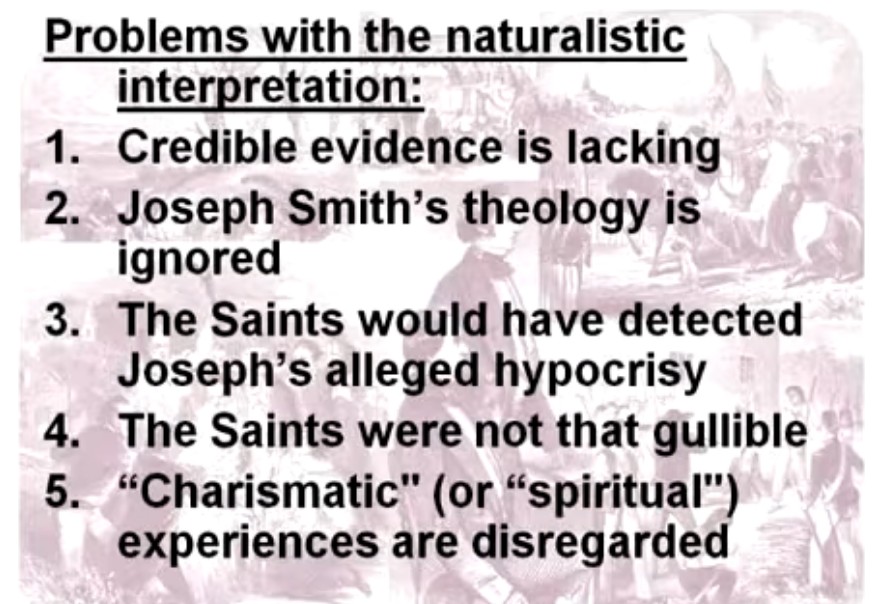
- I think the credible evidence is lacking.
- I think ignoring Joseph’s theology is problematic.
- I think the Saints would have detected Joseph’s alleged hypocrisy.
- I don’t think the Saints were that gullible.
- The charismatic—or spiritual—experiences are disregarded.
Turning to Latter-day Saint Explanations
So now we want to shift gears and start talking about what the Latter-day Saint apologists gave as reasons for Joseph Smith’s polygamy. And some of them are kind of entertaining.
The first is that women outnumbered men in the Church, both at Nauvoo and in Utah. (Quite honestly, the censuses don’t bear this out, and I’m convinced this had nothing to do with Joseph Smith’s introducing plural marriage.)
But it’s still talked about, and some Church leaders even promoted it in the 1850s and on as a reason—but it doesn’t seem to be supported by the censuses of that time.
Other Theories Suggested by Apologists
A second reason—and this has been suggested by Bruce R. McConkie and John A. Widtsoe—was that plural marriage brought needed trials and challenges. And it certainly did.
A third one is publicity value—that negative publicity is better than no publicity. I’m not sure I agree with that either, but B.H. Roberts declared this very plainly in one of his writings.
A fourth one is that polygamy would solve the world’s problems—that prostitution and things like that would disappear. I’m not sure that I believe that, but it was promoted by a number of authorities.
Then the fifth one—that medically is very difficult to defend—is that polygamy produces healthier parents and children than monogamy.
Going Back to Joseph Smith’s Teachings
The best place to go to understand why Joseph established polygamy is to go to people who remembered his teachings—and to go to Section 132.
But I wanted to make one comment—that Joseph Smith himself related that he was visited by an angel with a sword who commanded him to do this.
And I actually have an article coming out in Mormon Historical Studies—I don’t know if you’re aware of this; it’s a quarterly edited by a BYU professor, and it’s very good—but it’ll be out in the next issue or the one after that.
I found twenty accounts that talk about the angel and the sword, by nine individuals who knew Joseph Smith. The accounts are not contemporary, but the individuals knew him. And they’re actually quite interesting.
One of them says that Joseph pled with the angel—even got the Book of Mormon out and showed him Jacob 2, which says polygamy should not be practiced.
But I recommend that article to you—it’ll be out in the next few months.
Three Reasons Joseph Gave for Plural Marriage
Joseph also gave three other reasons why plural marriage needed to be practiced by the Latter-day Saints.
1. Restoring Old Testament Polygamy
First, that Old Testament polygamy needed to be restored—it’s part of the restitution of all things, found in Acts 3:21.
And if somebody comes up to you and says, “Why did Joseph do this?”—that’s the answer. It’s easy. If they’re believing in the Bible, it’s even easier—because Jacob and Abraham are clearly men of God, and they were polygamists.
And Joseph could just say, “They obeyed it; I restored it.” End of discussion.
2. Providing Faithful Families for Noble Spirits
Second, plural marriage creates more faithful families for noble premortal spirits to come to earth.
As you know—and there are probably people in this audience who know a lot more about this than I do—but one of the unique teachings of our religion is that we lived before we came here, for thousands of ages—perhaps millions of years—as spirit children of heavenly parents.
There we had identity, we had agency, and we had a spirit body. That’s a unique teaching among the major religions of this world.
We also underwent something of a probationary state there—and there were noble and great spirits. And this teaching was that they needed faithful families to come into on earth—and polygamy allowed for more of that.
3. Exaltation Requires Eternal Sealing
Third, Joseph Smith taught—and this is found in Section 132 and in a few other places—that all exalted beings must be sealed to an eternal spouse. 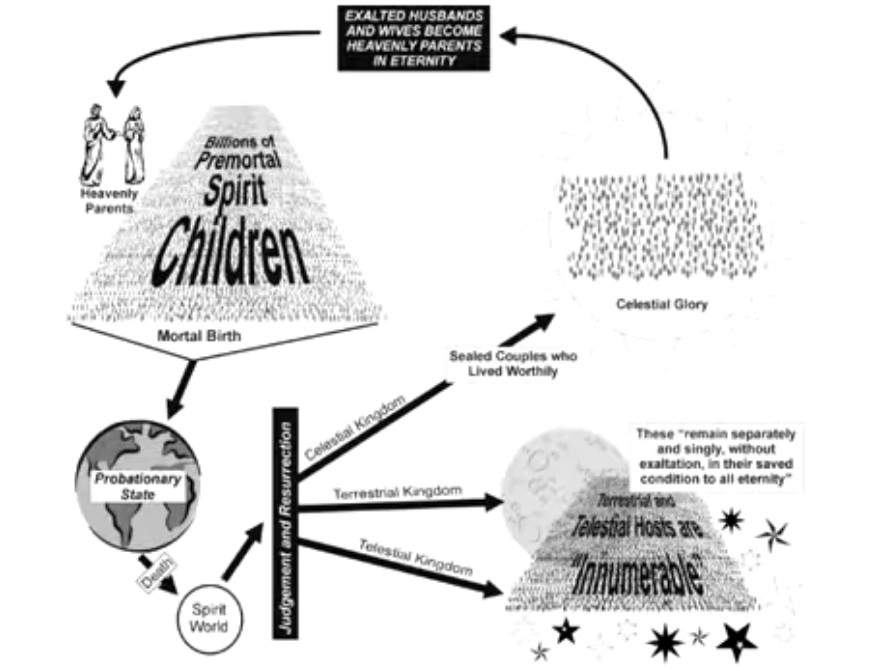
Now, you’ve all seen diagrams similar to this—you’ve probably drawn your own. This is mine.
It just shows that we start life in the pre-mortal world as spirit children. We go to a probationary state, and then there’s the judgment.
Those who go to the telestial kingdom and the terrestrial kingdom remain separately and singly, without exaltation, in their saved condition to all eternity.
And then those couples who have been sealed—for eternity—in a horizontal sealing, by using the sealing keys, go to the celestial glory where they progress and advance until they become exalted husbands and wives.
And eventually they become heavenly parents and enjoy a continuation of the seeds—or heavenly children—in the next life.
Eternal Implications and the Need for Plural Marriage
The problem is—if there are more worthy women than men, and apparently they knew this would be the case or were being taught that—that was so that some of the women would not be exalted without plural marriage.
It would look like this: they would be worthy of exaltation, but if monogamy were the only marital pattern in heaven, they would not have anybody to be sealed to. And so, with polygyny—which is one husband and several wives, a form of polygamy—they are able to be exalted.
And you can see there’s probably not going to be enough extra women to make every man a polygamist—but certainly, some of them are going to need to be polygamists in the next life.
The Complexity of Joseph’s Theology
Now, what’s interesting to notice is that if Joseph Smith simply wanted more sex, it’s curious that he devised such a complex theology to justify the practice. 
You see, there was no need for a theology to justify polygamy, because there’s no theology of polygamy in the Old Testament. All he had to say was, “They did it. I’m restoring it. I’m doing it.” End of discussion.
There could have been no criticism, because there was no reason given in the Old Testament for monogamy or polygamy—there’s no discussion about these things. There’s no discussion about marriage in the Old Testament.
And so Joseph Smith could have very easily just said, “Hey, you know, Abraham was a prophet—had more than one wife. I’m restoring that practice. Let’s be on with it.”
But that’s not what Joseph Smith did.
The Vertical Chain of Sealings
And this is kind of elaborated—and these are not on the website; you’re going to have to buy Volume Two of my books to get these diagrams (unless FAIR posts them up). 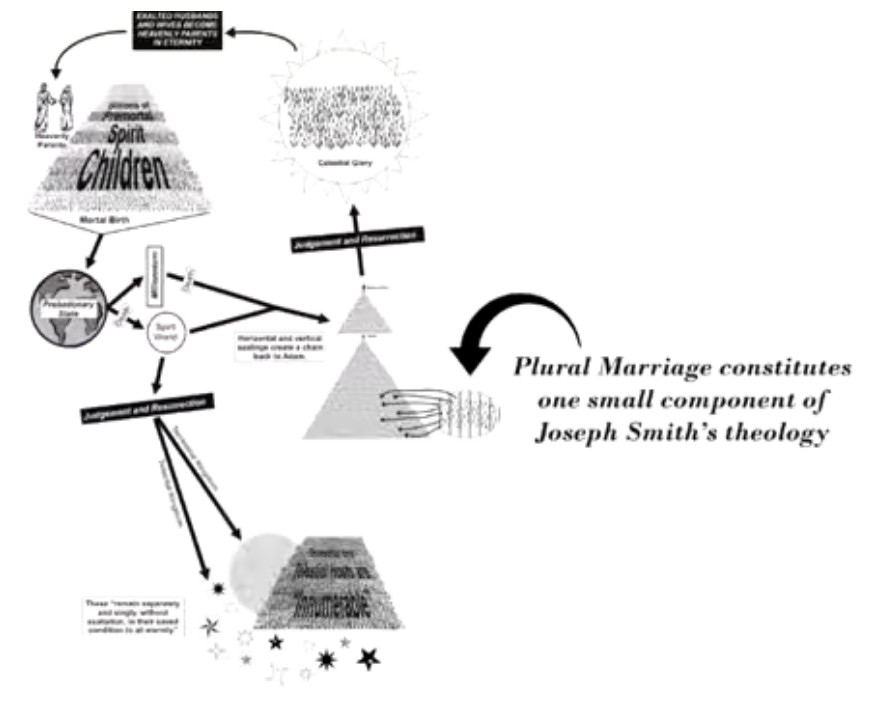
But if you’ll look at this entire process, this shows the vertical sealings from Adam to… well, it’s not keyed from Adam to Noah, down to the last generations.
And through polygamy, single women can be sealed into this chain.
It’s a vertical chain—starts with Adam, ends with the last generation—and then these single women who are worthy can be sealed into that so they can be exalted.
As you can see from this diagram, plural marriage constitutes just one small component of Joseph’s theology.
Without plural marriage, billions of couples could be exalted—but we need plural marriage as this element, as this component of the theology, in order to allow these single women to be part of exaltation.
One Eternal Round
This is one eternal round.
You’ve heard that saying—it’s in the Book of Mormon and in the Doctrine and Covenants. It’s not a Christian term—it’s not in the Bible. They would probably call it blasphemy. But that’s what we see here.
I’ve had naturalist historians tell me that they believe plural marriage is Joseph’s pinnacle teaching. And it works for the naturalists very well, because they’re convinced Joseph was empowered by libido. So, what they’re saying is that Joseph’s pinnacle doctrine is driven by a desire for sex. See, it works perfectly in their reconstructions.
But when they tell me that—and when this guy told me that—I said, “Well, based on what? Why do you think polygamy is his pinnacle doctrine?”
If we look at the theology—it’s eternal sealings, and this is what Brigham Young taught—it’s the thread that allows this to go around and around: couples being sealed, parents and children being sealed, and around it goes, generation to generation.
Concluding Reflections
My attempt to read every known document referring to Joseph Smith’s polygamy has generated a greater love and appreciation for him as a prophet.
I believe the scary thing about Joseph Smith’s polygamy is not Joseph Smith—not his choices and behaviors.
I believe the scary thing about Joseph Smith’s polygamy is simply polygamy—because he lived it, and he restored it as part of the theology of exaltation—worlds without end.
[Applause]
Q&A Session
Addressing the Church’s Silence on Polygamy
I was a little shorter—it was longer. I actually cut a little bit of it, but you’ll get so much if you buy my books—you won’t feel bad at all.
Question/statement: Our failure as a Church to address our polygamous past is problematic. Elder M. Russell Ballard, in the July Ensign, said, “Don’t touch plural marriage. It was a practice, and it’s irrelevant to any sharing of the gospel.” They don’t defend it, or use the patriarchal argument to justify it. Contemporaries said celestial marriage was Joseph Smith’s most important doctrine (I talked about that).
Do you think our failure to address plural marriage as a standing law today…?
Response: Excellent question.
“Polygamy Is Meat”
But the one thing that we all need to recognize—and the anti-Mormons don’t get it at all—is that polygamy is meat. It’s gospel meat. Section 19 says if you give meat to the milk drinkers, they’re going to choke.
I’m an anesthesiologist, and more than once I’ve been called into the operating room to give an anesthetic to somebody with meat in their throat. And if it gets into their trachea—boy, we’ve got a real emergency on our hands.
And the analogy holds totally true. Polygamy is tough.
Understanding – not defending – Joseph
You know, I envy Ron Esplin—he’s the editor for the Joseph Smith Papers Project—because he says very honestly that they’re not trying to defend Joseph; they just want you to get to know him better through his papers.
And he’s confident—Ron says—that Joseph Smith will do just fine. I’m confident too. And I feel kind of the same way—that the more we get to know about Joseph Smith’s polygamy, the better off he looks. But the problem is—it’s gospel meat. It’s tough.
And in this sexually saturated society that we live in, there’s only one way to understand it—and that’s, it’s driven by sex. The only way to understand it otherwise is to already—almost before you go into it—have a very strong testimony that Joseph Smith was a prophet.
Hopefully, by getting these new things out there, we can allow at least some talking. But I don’t think it’ll ever be discussed in Gospel Doctrine—and I’m not sure that it ever should be—because there’s going to be some ‘milk-drinker’ out there that’s going to be confused.
And I believe that if you got a room of a hundred people, ninety-nine can handle meat and one needs milk—the Spirit will only inspire the speaker to teach milk.
And that’s what we get over and over in our lessons. So if you’re going to want the meat, you’re going to have to look for it in other places.
I think this is a great venue, and I applaud FAIR for putting it together.
More Exalted Men Than Women?
Question: We can’t assume there are going to be extra women. What happens if there are more exalted men?
Response: That’s a good question—people ask it all the time.
God cannot control what happens at the end of the earth because that would be controlling our agency. But He can predict. And I would have guessed—well, He obviously knew on this earth—and Brigham Young taught this very plainly—that there would be an excess of women.
The idea of polyandry in eternity is insoluble so far as any of the doctrines that we have—it just couldn’t happen. So you can speculate all you want—have at it—but to say that we can’t assume that, I think, is inaccurate, because Brigham said it was going to happen, and it’s implied all the way through Section 132.
Not the best answer—but that’s the best I could come up with.
The Term “Spiritual Wifery”
SCOTT GORDON:
spiritual wifery.
BRIAN C. HALES:
Oh, good question—spiritual wifery. This is a term that was used even before the Saints went to Nauvoo. It was a label applied to any religious group that was doing something other than monogamy. Joseph Smith only used the term once, so far as we have any record—and it was in derision. He was making fun of it.
He did not use the term when John Bennett said that Joseph was wanting a spiritual wife. That’s all fabrication and I argue—there’s no evidence that Joseph ever introduced plural marriage using the term “spiritual wifery” or anything close to it.
It was celestial marriage, patriarchal marriage, eternal marriage—and this is a place that hopefully my books will clarify some of the stuff we need.
Spiritual wifery was not something Joseph ever taught.
It was adopted, however, by some of his plural wives—it was either Emily Partridge or Helen Mar Kimball who used it in one of her writings. So the Saints adopted it later on, but in Nauvoo, Joseph did not use it except in derision.
Why Don’t We Practice Polygamy Today?
Question:
If polygamy is necessary for single righteous women to be exalted, why are we not practicing it today?
Response:
Why would you want to? I saw a bumper sticker the other day—it said, “The punishment for polygamy is two wives.”
But quite honestly, one of the hard questions to answer—in fact, it may be the only question I can’t adequately get an answer for myself—is why did God command Joseph and the Saints to do it in Nauvoo?
I mean, permitting it was necessary theologically– and hopefully I’ve been able to offer that as a possibility—but why God commanded it, I don’t have a real good answer. I’ve got some possibilities.
I don’t think there’s a need for it today. The Millennium will be a time for all of these sealings to be taken care of—vertical sealings of parents to children, horizontal sealings of husbands and wives. By the end of the Millennium, I believe it’s all going to be sorted out using the sealing authority.
The Claim of “Sexual Polyandry”
Question: Please address the claim of Joseph Smith’s marriages to eleven already married women.
BRIAN C. HALES: Sexual polyandry is something that’s been… well, Fawn Brodie said it was for sure happening with Joseph Smith.
My position is that it never happened with Joseph Smith—and that the best evidence shows that that is the case. It’s something that we’re only in round one on this. George D. Smith and I—we’re going back and forth, because he’s sure that it happened and says I’m using proof texts, and I’m sure that it didn’t happen.
And I assert he’s using tabloid-level evidences and assumptions to get to it.
But we’ve also found some new things that supersede Todd Compton’s discussion of Sylvia Sessions Lyon, which places a whole different timeline on it—and that’s really the only case with any good evidence, and his timeline is very problematic.
Joseph Smith taught—and this is something that the naturalists just ignore—Joseph taught that sexual polyandry was adultery and that the woman should be destroyed (Doctrine and Covenants 132:63). And yet the naturalists portray him as this practicing sexual polyandrist—and nobody’s saying anything about it.
You know, he’s this arch hypocrite, and nobody seems to care at all. To me, that’s problematic—not adequate in explaining what’s going on.
Evidence Against Sexual Polyandry
More specifically though—in my book, I’ve got four chapters on this. There’s also a brief recap on the website. It’s a very complicated topic—and you have to almost look at all the cases.
I found thirteen women who had legal husbands at the same time they were sealed to Joseph Smith. Because I don’t think they represent one phenomenon, I went through and analyzed all thirteen.
I think six of them were eternity-only sealings, and despite what Quinn and Compton have said, there’s very good evidence that at least one eternity-only sealing occurred—and there’s no reason to believe others didn’t occur as well. So don’t believe that notion that there were none.
Yes, we found some new evidence—Don Bradley found it—it’s in the Andrew Jenson papers. And that’s probably all I can tell on this without really… well, it’s a whole lecture on its own—and maybe two or three.
But I believe—and I’ll say I’m willing to go the distance on this—Joseph Smith did not practice sexual polyandry. And I think we’re going to be able to persuade the majority of people that that is so.
There’s an article that I’ve written in a book edited by Craig Foster and the Brigham Young University Studies Association—that’ll be out, I think, next year, in September. That close. Whoa. Yeah—and anyway, that talks about it. It gives some more detail.
A Utah-Shaped Diagram?
Question: Is it a coincidence your diagram of the celestial, terrestrial, and telestial kingdoms is shaped like a map of Utah?
Response: I hadn’t even noticed that! I did it in CorelDRAW, and I’m not very good at that program. But I don’t think so. If I was inspired—what spirit was it that inspired me? And yes, I do have a degree from the University of Utah!
Old Testament Polygamy and God’s Approval
Question: Critics argue that Old Testament prophets were only allowed by God to practice plural marriage—that, in fact, God frowned upon the practice. How do you respond?
Response: Yeah. I’ve been going through the theology edits—Loyd Erickson is my editor for that volume, and Lavina Fielding Anderson is editing Volume One.
If you ask a Christian about polygamy, they start to squirm like this—because they can’t deny that Abraham was a friend of God and a great prophet. And they also can’t deny that he was a polygamist.
Usually, what they’ll do is say, “Well, God winked at it—He didn’t really like it, but He let them do it, and they shouldn’t have.” And then they’ll say it was mostly lost later on in the Law of Moses—it was mostly discouraged.
The other thing they do is observe the problems it caused—between Sarah and Hagar, or Elkanah and his wives, Hannah and Peninnah. There’s a lot of that.
Polygamy is Unfair to Women as an Earthly Practice
Polygamy is tough—because what it does is expand the husband’s sexual and emotional opportunities, while at the same time it fractionates the wives. You can’t call that fair. To me, it’s very sexist—it’s very unfair on earth.
Now, I have some ideas how it might be in heaven—that all of those problems might be resolved—but here on earth, I don’t know how you can defend it as being fair. So this is why I don’t think we’d want to practice it.
There’s no evidence that God frowned on its practice—none at all. He gave David, through Nathan, David’s wives. He approved of it. This is just Christians doing a little dance because they’re uncomfortable with it. It’s a very difficult issue for them to get around—if they want to condemn polygamy and yet accept Abraham as a prophet.
The Angels and Degrees of Glory
Question: The angels in the celestial kingdom are single and are single for eternity. They didn’t go to the telestial or terrestrial?
Response: Yeah, I didn’t include that carry-on in the diagram just for complexity reasons. There would be celestial beings who are single—and we don’t really understand the dynamics of it.
We only have, I think, one single reference—and I think it’s from Clayton’s journal—that there are three sections to the celestial kingdom. And Joseph said to get to that top section, you’ve got to be sealed.
Beyond that, I don’t think we have anything from anybody. I’ve searched. If you have something, share it with me—I’d love to see it.
Polyandry and Marriage Definitions
Question: Any idea why Joseph engaged in polyandry—with our stress on the sanctity of marriage? And did any of Joseph’s inner circle practice polyandry?
Response: Yeah. My position is—and we need to understand—Todd Compton did great work. I’m standing on his shoulders with our research, and there’ll be others who’ll come and stand on mine. That’s just how this works.
But the one problem he introduced with polyandry was that he defined “marriage” as anything that had a ceremony.
So you could show that a woman had a legal ceremony, and then she had a religious ceremony—and she is “ceremonially” a polyandrist. But that doesn’t say anything about sexual polyandry.
Ceremonial Polyandry
See, in Joseph Smith’s theology, ceremonial polyandry wasn’t that big of a deal—because marriages were ended much more freely than they are today back in that time. Getting a divorce sometimes required you to go to the state legislature—and in Nauvoo, they had to go over to Carthage to the circuit court, which only came around every so often. That was the only way to get a divorce.
A justice of the peace—and there were lots of them—could make a marriage. But to unmake it was a real baby challenge.
So Todd, I would argue, labeling it “ceremonial polyandry” just created a lot of confusion—because he would document ceremonial polyandry, and then the reader is left to think, “Oh yeah, I bet there’s sexual polyandry going on here, too.”
Not a Supportable Claim
But he doesn’t document that—which is a really difficult thing to document if you think about it. How can we document a woman sleeping with two men 150 years ago? We usually look at offspring to assume that the father is actually the father of the child—but that’s a very difficult thing to prove.
Scholars, historians, antagonists, and naturalists are very willing to assume lots of things and say Joseph was involved in this. Again—my position is that sexual polyandry was adultery. That’s what Joseph taught, and he did not practice it.
Joseph Smith’s Children from Polygamous Wives
Question: Why did Joseph not have children with women other than Emma—or did he?
Response: If you go to the website, I’ve identified two—and I shouldn’t say I’ve “identified” them; I mean, they’re out there, people talk about them—two offspring of Joseph Smith.
This is all we think we know about.
Children we Know About
One is Josephine Fisher—Josephine Lyon Fisher—you may have heard of her.
The second one is a child born to Olive Frost—and both Olive and the child died before they left Nauvoo. We don’t even know the gender.
Alleged Offspring
If you go to the website, I’ve got seventeen other alleged offspring to Joseph Smith.
I don’t think any of them are real. Some of them have been disproven by DNA testing—by Ugo Perego, who’s done great work—and others, there’s just no evidence to support them, or there’s contradictory evidence. But I do believe that he fathered two—and there are references, perhaps, to a third child.
And this is evidence that even though Joseph had thirty-four wives—and we do have evidence of sexual relations in nine of those cases, with some ambiguous evidence in five more—he wasn’t involved with the polyandrous wives—which were thirteen, I believe.
I would also argue that there’s not a lot of sexual relations going on anyway, or we would have had more offspring.
When the RLDS missionaries came out to Utah in 1866, 1869, and 1875, the Latter-day Saints were wanting to put right in their face that Joseph was a polygamist. Because David and Alexander didn’t think their dad was—and they eventually, I think, came to know that he was. I think Joseph Smith III knew right from the beginning.
But I think the leaders of the Church—Brigham Young and others—would have paraded some of these children to the earliest missionaries, showing, “Here, these are your half-brothers and half-sisters,” if they known about them.
What the lack of offspring tells us
The fact that we don’t have much offspring is very good evidence that Joseph wasn’t finding time to be with these plural wives. And it’s no surprise. Emma Smith accepted polygamy for a few weeks—the end of May and first part of June—and then for a month or two in September and October, and that’s it.
The rest of the time, she was on the warpath against polygamy—and she had spies out. She confronted Joseph’s wives. Once, she took a wash from one of them and stomped it in the dirt. She was aggressive.
And don’t judge Emma, okay? We don’t judge her. She had a really tough place, and my heart goes out to her.
But Emma was watching—and for Joseph to sneak away with one of his plural wives was not going to be a common occurrence. There were lawmen, there were unbelievers, and there were people wanting to condemn Joseph for his polygamy who were watching him. So I don’t think he was having a lot of sexual relations.
And of course, there are sensationalized claims that he had a harem and these types of things—not supported.
Why Did We Practice It Then?
Question: How do you handle the question today of why we lived it in early Church history?
Response: You know, I think I’ve kind of addressed that. There’s good theology showing that we needed it—but I don’t believe God commanded it. And if you’ve got some good ideas, share them with me if you would.
Avoiding Modern Confusion with Fundamentalists
Question: As a former Church curriculum writer, I can say we were requested not to write about polygamy—especially favorably—because of the 30,000 people who practice it today. We were not to indirectly promote their cause.
Answer: You know, my first introduction—as has been mentioned—was to Mormon fundamentalist polygamy.
I’ve tried to read everything there is on Nauvoo polygamy, and I can tell you even more strongly that these Mormon fundamentalists—and there are a lot of good ones out there, I’m friends with some of them—they are totally in error.
Line of Authority
Two evidences show that their lines of authority are nonsensical. First, Lorin Woolley had no authority. He was a storyteller. Their line of authority is very problematic. I believe the one verse that was given for the Mormon fundamentalists in Section 132 is verse 18, which says:
“If a man marry a wife and make a covenant with her for time and all eternity, if that covenant is not by me or by my word, which is my law, and is not sealed through him who is anointed and appointed unto this power, it is not valid neither of force when they are out of the world, because they are not joined by me.”
When you’re out of the world, it cannot be received there because the angels and gods are there—and now I’m messing up, but you get the idea. You have to have the authority of the one man—and they don’t have it.
Across the board—one hundred percent—their sincerity, their traditions, their burning bosoms cannot jump that lapse, that loss of authority.
Gathering Israel
Second, I would just offer for thought, is that the one man who holds the keys of sealing also holds the keys of the gathering of Israel. How many missionaries did the fundamentalist leaders send out to gather Israel?
Okay—see, the fundamentalist leaders say, “I have the keys of sealing,” so he also has the keys of the gathering of Israel. How many missionaries did John Woolley send out? Zero. Lorin Woolley? Zero. J. Leslie Broadbent? Zero. I can go down the line. See—how can you hold these keys and not use them?
So anyway, when it comes to the fundamentalists—and like I say, there are a lot of good ones, though some eccentrics too—most of them are very sincere. But they have no authority, and their vows and their marriages are not valid, in my view.
Sealing and Same-Sex Attraction
Question: Sealing is required for exaltation. How about those who have no attraction for the opposite sex?
Response: Well, that’s an easy question, isn’t it?
You know, I’ve written a manuscript on homosexuality and the restored gospel, and I was prompted to do this. It was after I read the fundamentalists’ big one, and I had some time before I started on this Joseph Smith work that’s now been published.
I studied this topic a little because there were people saying, “Look—we’ve got monogamy, we’ve got polygamy—why not same-sex marriage?” But I could never figure out how same-sex marriage could fit into the theology—it just… I just couldn’t find a place.
My experience at Sunstone
I gave a lecture at Sunstone last year on the eternal patriarchal order, and I used some of these same diagrams you saw here on the theology. Afterward, an elderly same-sex couple came up to me and said, “You know, I can see from what you said that there really isn’t any place in all of this for same-sex marriage in the next life.”
And I said, “Well, that’s my conclusion—and I’m not here to judge you—but that’s my conclusion as well.” And he said, “You know, I think I’ve got it figured out. I think all of those who are homosexuals in the next life all go to the ‘gay’ terrestrial kingdom, where they have the best clothing, the best decorations, and the best food of all.”
(Laughter.)
And he was sincere—and I was grateful that he came up to talk to me, because I didn’t want to offend anyone with what I’d said. But I think the theology shows that there are problems with the idea that God made anybody homosexual. Certainly, there are some with same-sex attraction—no doubt of that—but in our theology, they just have to deal with that.
Theologically Lawful Marriage
Because the only authorized sexual outlet is heterosexual, lawful marriage—lawful according to God’s laws. It’s a tough one—especially for family members of individuals who have declared themselves homosexual. No easy answers here. It’s really tough.
Thank you so much.
