https://www.youtube.com/watch?v=zUu6gpO7D6Q
Civil Discourse
Carol Rice
August 2024
Summary
Carol Rice uses the “Universe 25” mouse experiment as a metaphor for the dangers of exclusion, tribalism, and loss of meaningful connection in society. She emphasizes President Nelson’s call for peacemakers, outlining Christlike principles and introducing a new video series on respectful dialogue, urging Latter-day Saints to build Zion by fostering inclusivity, compassion, and civil discourse.
Presentation
Imagine a Utopia
Carol Rice: I’d love for you to imagine with me a world where every need is met. A utopia where food and shelter are abundant and safety is guaranteed. And now imagine this world slowly descending into chaos as its inhabitants turn against each other, losing all sense of community and purpose. This may sound like the plot of a dystopian novel, but it really is the reality of the Universe 25 mouse experiment. How many of you have heard of that?
The Universe 25 experiment offers valuable lessons for creating stronger, more connected communities. And although the findings of this particular experiment cannot really directly be applied to humans, there is a chilling reflection of challenges that we face in our own society today that we see in it.
The Universe 25 Experiment
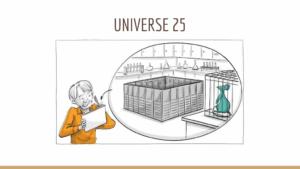
In the 1960s, a scientist named John B. Calhoun conducted an experiment known as Universe 25. In this experiment, Calhoun created a utopian environment for mice—unlimited water, food, and nesting material, and an absence of predators, which sounds like the best part, right? Initially, the mouse population thrived and grew exponentially. However, as the population increased, social behaviors began to break down. Eventually, the colony descended into chaos and ultimately extinction.
Calhoun’s experiment has often been used to highlight the dangers of overpopulation. But in his later years, Calhoun felt that the experiment revealed deeper insights into human nature, particularly concerning the need for meaningful ways to contribute and belong in society.
Tribalism
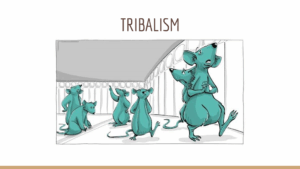
In Universe 25, the mice who were overwhelmed by their environment formed small, exclusive groups. Calhoun’s observations suggest that with a lack of meaningful roles or connections, forming exclusive groups becomes a means of establishing identity and security. In our society today, we can see echoes of these behaviors as communities grow and become much more complex. Some of us may feel the need to retreat into a tribe. It seems reasonable, perhaps even needful, and it feels good, after all, to be with the people who “get us.” One might even consider connecting with our own community as a form of gathering. And the gathering, as understood by members of The Church of Jesus Christ of Latter-day Saints, is the most important thing taking place on earth today. Right?
And if I’m honest, I imagine Zion as a place of safety with plenty of food, water, nesting material, and a lack of predators. I hope that doesn’t make me exclusionary.
So what are the underlying mechanisms that differentiate community building from tribalism? In other words, how can we gather as communities without slipping into exclusionary behaviors?
Gathering
I’d like to offer some distinctions for us to consider.
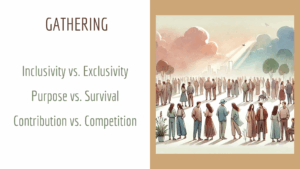
- Inclusivity versus exclusivity. Gathering seeks to include and embrace, while forming exclusive groups often isolates.
- Purpose versus survival. Gathering is driven by a higher purpose of unity and spiritual growth, whereas forming exclusive groups is a survival mechanism in response to perceived threats.
- Contribution versus competition. In a gathering, individuals are encouraged to contribute meaningfully to the community, fostering cooperation. Forming exclusive groups, on the other hand, can lead to competition and conflict over limited resources.
I had an experience this summer that illustrates some of these elements of gathering. I was, of all places, visiting Adam-ondi-Ahman, and after hiking around with my family, we came upon a group that was gathered. We could hear one particular gentleman, and we wanted to listen in. We heard just enough to really be intrigued. So we slowed down and attempted to be inconspicuous. But several in the group quickly noticed us, and I knew what was coming—you know that look to let us know that we needed to move on.
Making the Circle Bigger
But that isn’t what happened. Almost like they had choreographed it, a couple of them in the circle stepped to make the circle bigger and invited us to join in. We were, at first, “No, no, no, that’s okay.” But they were very insistent—very softly, but insistent. So we gathered in, and we all listened together.
Afterwards, we had a chance to visit with members of this group. They were new senior missionaries who were on their third day, having just been called to serve as missionaries at Adam-ondi-Ahman. We were invited to be part of their orientation.
I asked one of the sisters what a call to such a place meant, and she told me, “We’re called to beautify the area, to make friends, and to be good neighbors.” I said, “Well, you’re going to be amazing at that mission because you clearly know how to gather people in.”
It was in that moment, standing in the serene, sacred grounds of Adam-ondi-Ahman, that I realized gathering is not about just making room in a circle. It’s really about making room in our hearts—really wanting to create a space where everyone feels welcomed, valued, and connected. If we can approach our communities with the same spirit of inclusiveness and love, we can build Zion here on earth—one where tribalism gives way to true gathering.
Peacemakers Needed
President Nelson, in his talk Peacemakers Needed, offers some actionable steps, and I’ll read through these really quickly:

- Treat others compassionately. Emphasize kindness and understanding in all interactions, especially when opinions differ.
- Examine discipleship. Reflect on our behavior and make necessary adjustments to ensure that it’s ennobling, respectful, and representative of true followers of Jesus Christ.
- Model Christlike behavior. Build, lift, encourage, persuade, and inspire others, reflecting the behavior of true disciples of Jesus Christ.
- Eliminate contention. Recognize contention is evil and avoid it, choosing reconciliation and understanding instead.
- Exercise charity. Develop the pure love of Christ which helps to overcome selfishness, defensiveness, pride, and jealousy.
- Pray for guidance. Seek the courage and wisdom through prayer to act as Christ would in every situation.
- Respectful dialogue. Communicate virtuously. Manage differences. When we’re talking about respectful dialogue, we’re talking about managing differences of opinion with mutual respect and dignified dialogue, hopefully setting an example for others. And in communicating virtuously, ensuring that all communication, whether in person or online, is virtuous, lovely, of good report, or praiseworthy.
New Video Series

It’s these last two especially that have inspired a new initiative. I’m thrilled to announce a new video series that’s produced by Skyline Research hosts, as you heard yesterday Brent Andrewsen talk about at thefamilyproclamation.org. The series is inspired by President Nelson’s Peacemakers Needed and explores how we can cultivate respectful and virtuous communication.
I want to share with you one of the videos from our first series. And as I do this, I want to prepare you for a bit of a tone shift. This series was created by and for the rising generation. Some of you are in here—Matthew, Andrew, Ashton, like that. Some of you are in here, and thank you. It was created by the rising generation for them, and they have a different energy than I do. So, let’s give this a watch.
Discussing Important Topics
Have you ever seen a friend turn someone they don’t agree with into a villain? Maybe you’ve even done it yourself. Maybe you feel like you have to dance around social gatherings, avoiding the potential landmines of different personal opinions and political perspectives. Do you feel like all of your personal relationships are teetering on the edge of a cliff if you say the wrong thing or express how you really feel? Sometimes it feels like even with advanced communication tools like the internet and television, our ability to talk about important topics has devolved.
Our heart goes out to you because we feel that way too. We feel like there are a lot of people out there who want more peace in their lives and relationships. We wish we had some magic spell to solve everyone else’s anger issues, but that sort of solution doesn’t really exist. Individually, we have to take responsibility for the change. The best way to fix a massive problem like this is one interaction at a time. To that end, we’ve created a series of short videos containing tools that approach the way we talk to one another to create healthier relationships through perspectives and techniques of peacemaking.
Awesome. I’m excited about it. I think they’re fun.

We’re excited to announce that in collaboration with Public Square, we’ll be sharing this series, both in articles and videos, throughout the coming year. The use of these videos along with articles honors storytelling as the most ubiquitous of human activities—that form of complex discourse that is earliest accessible to children and by which they’re largely acculturated. Because even baby mice can learn to be nice. Right?
Conclusion
In conclusion, the Universe 25 experiment offers profound lessons about the dangers of exclusivity and the need for meaningful connections. We learned that even in a utopia, when individuals are starved of purpose and connection, society can unravel. By embracing the principles of gathering and following President Nelson’s call for peacemakers, we can create vibrant communities rooted in civil discourse and mutual respect. Unlike the mice in Universe 25, we possess the ability to choose our paths. Fortunately, we’re more than mice, and our capacity for compassionate communication far surpasses that of any rodent.
I have every confidence that the people gathered here at this conference, with our FAIR and Valiant Voices united in faith, that we will lead the way. Thank you.
