Introduction
You’ll not want to miss this next speaker, Matt Christensen. There’s a long bio with some explanation, but I’m going to cut it very short and just say that Matt is a master teacher. So, with that, I’m just going to turn the time straight over to Matt Christensen, who is taller than I am. So, that’s in his favor.
It’s good to be here.
Expectations and Humor
You guys have seen the memes where it says what you ordered online versus what you actually received online—and what you ordered looks high-quality and really nice and well-made, and then you see the opposite of what you actually received, and it’s less glamorous than the picture made it out to be.
If we’re talking faith crisis, then what you actually ordered for this FAIR presentation was probably Jared Halverson. And instead, what you’re getting is me—kind of the Temu version of Jared Halverson.
But it genuinely is very good to be with you.
 Previous FAIR Experience
Last year, FAIR gave me 25 minutes to speak about temples—kind of modernizing our temple preparation for youth and young adults to be more in alignment with current prophetic direction, right?
This year I graduated from the Thanksgiving kiddie table at FAIR. I’ve been given 50 minutes, I think. No—33 minutes, actually, now that I look at my actual timer. Okay, fantastic.
Next year I’m planning fully on receiving 100 minutes. Now, I guess 60 minutes. Okay.
Potential Future Topics
But I thought, what possible subject could need that amount of time? And so I came up with some potential topics for you guys. You guys can find me afterwards.
- “Ooh, sorry. That’s our bench”: The history of unofficial ward sacrament meeting seating arrangements in the late 20th-century Church. (That would be great.)
- What about “Legalized gambling and Pinewood Derby?: The scandal that rocked the Orem Cherry Hill 9th Ward.” (If you guys think The Secret Lives is juicy, wait till you hear about that.)
- Elders Quorum moving injuries: Should preventative deadlifts and squats be part of our Sunday second hour?
And so, you know, this is really a choose-your-own-adventure for next year. Come up and let me know what you would like to find out about.
Respect for FAIR
I do have a deep respect for FAIR as an organization and for the presenters and organizers of FAIR. At the core, I believe what FAIR is is—is all about is what Elder Neal Maxwell taught in his talk Discipleship and Scholarship, where he said this—and I think many of you are very familiar with this quote (from Austin Farrer):
“What seems to be proved may not be embraced, but what no one shows the ability to defend is quickly abandoned. Rational argument does not create belief, but it maintains a climate in which belief may flourish.” 1
And I think FAIR has a vital and important role of that kind of climate culture that we’re preserving here where faith can thrive and flourish.
 Fill-in-the-Blank Exercise
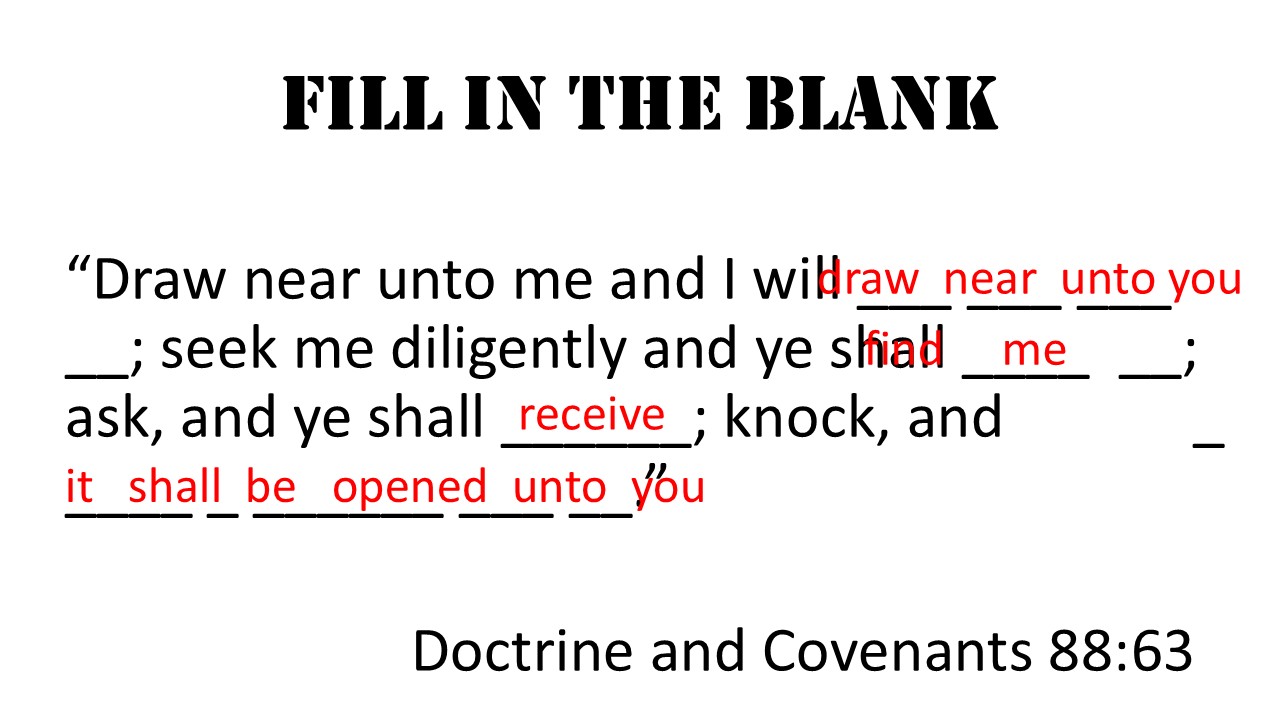
All right, we’re going to start off with a fill-in-the-blank, and I’m actually going to ask you guys to participate on this one if that’s okay with you. I know that might kind of jolt you out of your fourth-wall safety and security down there.
All right, are you ready? This is a Doctrine and Covenants passage, but it’s pretty familiar. The ideas are taught in other scriptures.
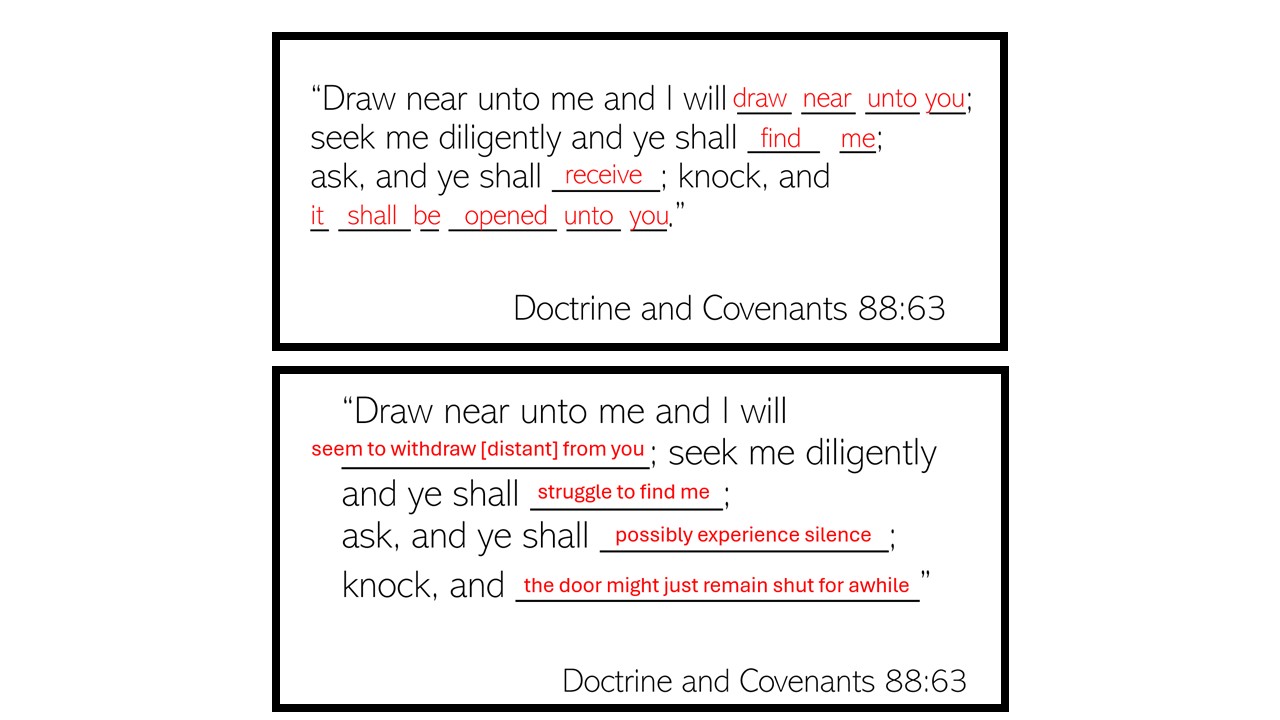
- “Draw near unto me and I will draw near—”
Whoa, we’ve got intelligent people here, right? Apparently my formatting got changed a little bit. That’s all good. It did look good when I had it going.
- “Seek me diligently and ye shall—”
- “Ask and ye shall—” (I gave you the answer on that one.)
- “Knock and it shall—”
Hey, that one worked great. Okay.
 Consecrated Discipleship and Growth
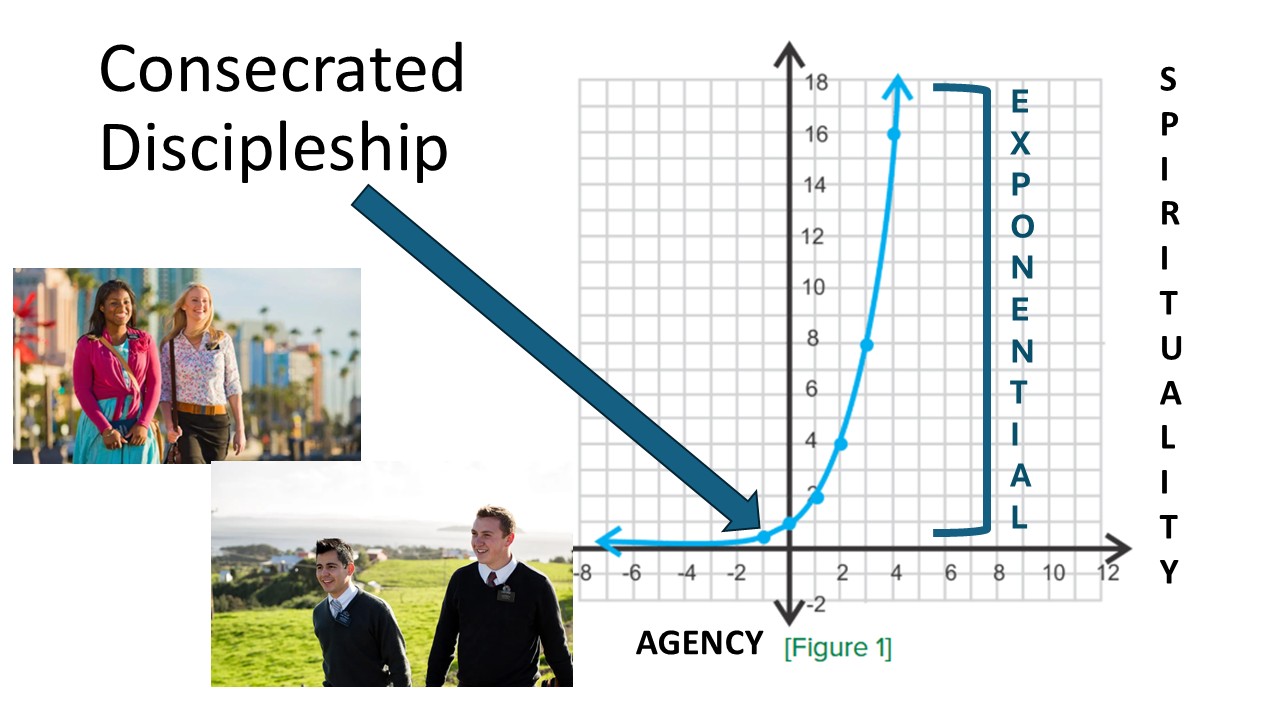
Imagine if you devoted your entire life to following God and serving others. What do you think would happen to the spiritual component of your life?
You have the agency quadrant and then you have spirituality, and all of a sudden you have a moment where you’re like, I’m all in in terms of consecrated discipleship. And then I think we all would imagine that you would see this type of exponential growth.
I’ve committed my life to following the Savior.
Well, we have an example of this in our church, and some of you have already identified it—people who devote their entire lives to following the Savior in our young sisters and our young elders. And this is typically what we see happening.
Missionaries and Transformation
I do teach seminary. I teach seminary and institute. And so around February, we start to receive mission calls. And then I start to receive their letters, and I watch the transformation happen over the course of those two years—that consecrated discipleship.
 Beyond Our Tradition: Mother Teresa’s Experience
But what if we looked for a second beyond our own faith tradition to someone like Mother Teresa, who spent the equivalent of 25 LDS missions going to the epicenter with her order, the Sisters of Charity of the Sacred Heart—identifying the epicenter of human suffering and human need and human want, the slums of Kolkata, India—and spent 50 years attending and meeting those needs and over the course of those 50 years becoming the personification of goodness.
And we see her just in terms of the ultimate poster child for a life devoted to God.
After Mother Teresa passed in 1997, her papers—including her diaries and her letters, her correspondence with several church fathers—went into the possession of the Catholic Church, into their archives where their scholars and their historians got access to her diaries. She actually requested that they be destroyed. She didn’t want anyone to have access to them, and they’re like, “We—we can’t do that. This is a treasure.”
And as they began to review her diary and these letters that she had written over the course of these 50 years, they found something that they weren’t expecting to find. And it actually—there were a couple years where they were even scared to publish what they were finding. I’m so grateful that they did.
 I found these in this book, Mother Teresa: Come Be My Light, where she said things like this:
“Jesus has a very special love for you,” she assured Vanderpet, one of the church fathers that she reported to. “But as for me, the silence and the emptiness is so great that I look and do not see, listen and do not hear. The tongue moves in prayer but says nothing.”
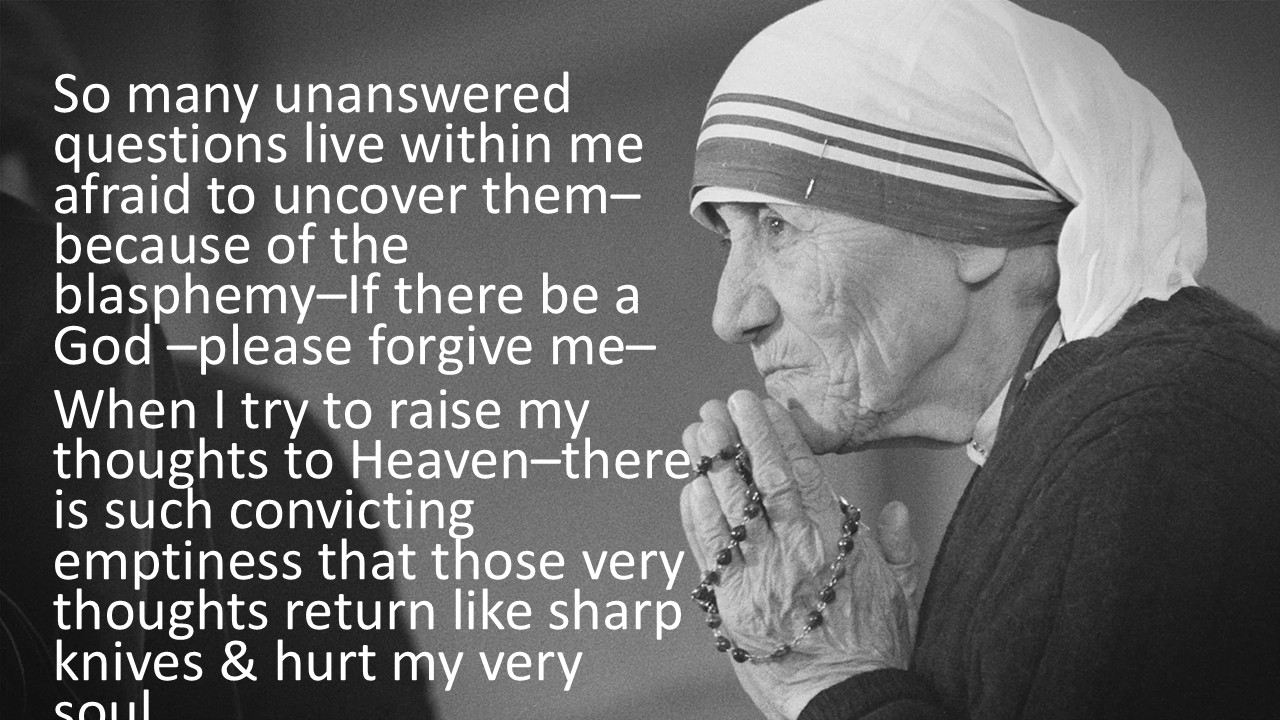 Mother Teresa’s Inner Darkness
This is after she received the Nobel Peace Prize in 1979.
“I spoke and—and of course gave a speech. I spoke as if my very heart was in love with God. Tender personal love,” she confided. “If you were there, you would have said, what hypocrisy.”
“So many unanswered questions live within me, afraid to uncover them because of the blasphemy. If there be a God, please forgive me.”
Even writing that—she can’t even write those words.
“When I try to raise my thoughts to heaven, there is such convicting emptiness that those very thoughts return like sharp knives and hurt my very soul. I’m told that God loves me and yet the reality of darkness and coldness and emptiness is so great that nothing touches my soul. Did I make a mistake in surrendering blindly to the call of the Sacred Heart?”
A Plot Twist in Mother Teresa’s Journey
“The more I want him, the less I’m wanted,” she wrote Perier, another one of her fathers. A year later, she sounded desolate.
Such deep longing for God and repulsed, empty, no faith, no love, no zeal. The saving of souls holds no attraction. Heaven means nothing. Pray for me, please, that I keep smiling at him in spite of everything.
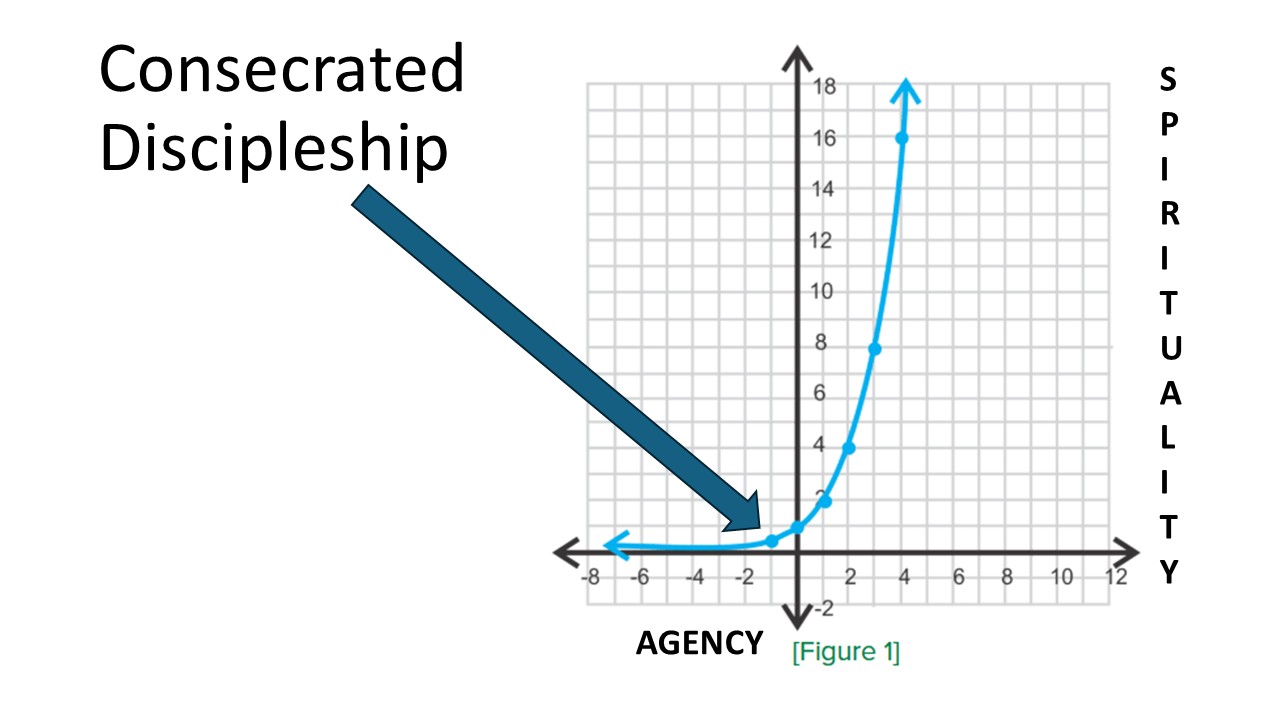 So, we see this chart that I showed you that we were all, I think, in agreement with. You’re like, “Oh, if you devoted your life, that’s what would happen.”
 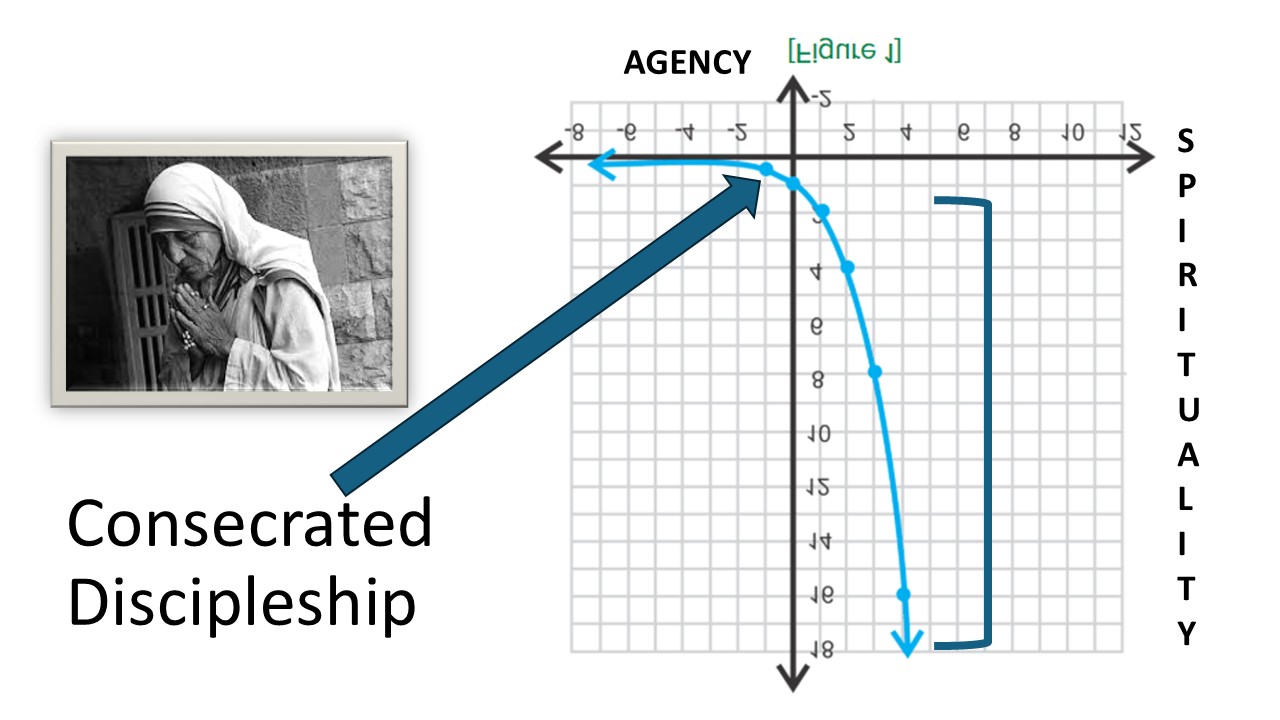 And yet, we see something with Mother Teresa, and we see the exact opposite.
Imagine a therapist hearing someone describe these dynamics in a marriage. What conclusions might they draw?
- The more I want him, the less I’m wanted.
- The more I speak to him, the more silent he becomes.
- The more I try to draw close to him, the farther he distances himself from me.
So, it’s a bit of a plot twist that we’re dealing with here, right?
 Reimagining the Scripture
I had you guys fill in the blank, but what if we had perhaps Mother Teresa up here?
- Draw near unto me, and I will seem to withdraw distant from you.
- Seek me diligently, and you shall maybe struggle to find me.
- Ask, and you will possibly experience silence.
- Knock, and the door might just remain shut for a while.
I believe that we all have a powerful testimony of this verse and the truths taught in this verse, but I think we also might have an interesting, unique testimony—maybe the kind that we don’t hear as much about on the first Sunday in our wards and chapels—of that reality as well.
 Ultra-Marathoners and Honest Expectations
My wife reads lots of books, for which I’m very, very grateful, and she got into a phase where she was reading books about ultra-marathons. These are the guys who will not just run 26 miles; they’ll run 50 or 100 or 150 miles, where they run for 36 hours straight.
And one of them was the LeBron James of ultra-marathoning. He wrote in his book—he said you’ll be out on a 300-mile run and you’ll be headed to a marker. And, he said,
“Inevitably, occasionally, you’ll run into fellow runners who are doing the same course. You always stop and talk to them because it’s so spread out. I’ve noticed that there are two types of runners out on the trail. You always ask—‘What am I looking at up ahead? Okay, how much farther until the next marker? What is it like?’ And I’ve noticed there are two types of people.”
There’s the person who will tell you, “It’s not that bad. You’re almost there.” Inevitably, when you hear this, there is just short-term relief and ecstasy. There’s another type of person who’s like, ‘Dude, it’s horrible. It’s ten miles straight uphill. Loose rock. It’s horrible.’”
That is so devastating short term.
But he said he’s come to really appreciate the second type of person, who will just give it to you straight—what you’re actually going to face out there.
He said, “The first type of person—you feel that short-term relief, but then when it keeps going for ten miles straight uphill, you—mentally—you’re not prepared for this.”
 Preparing the Rising Generation Better
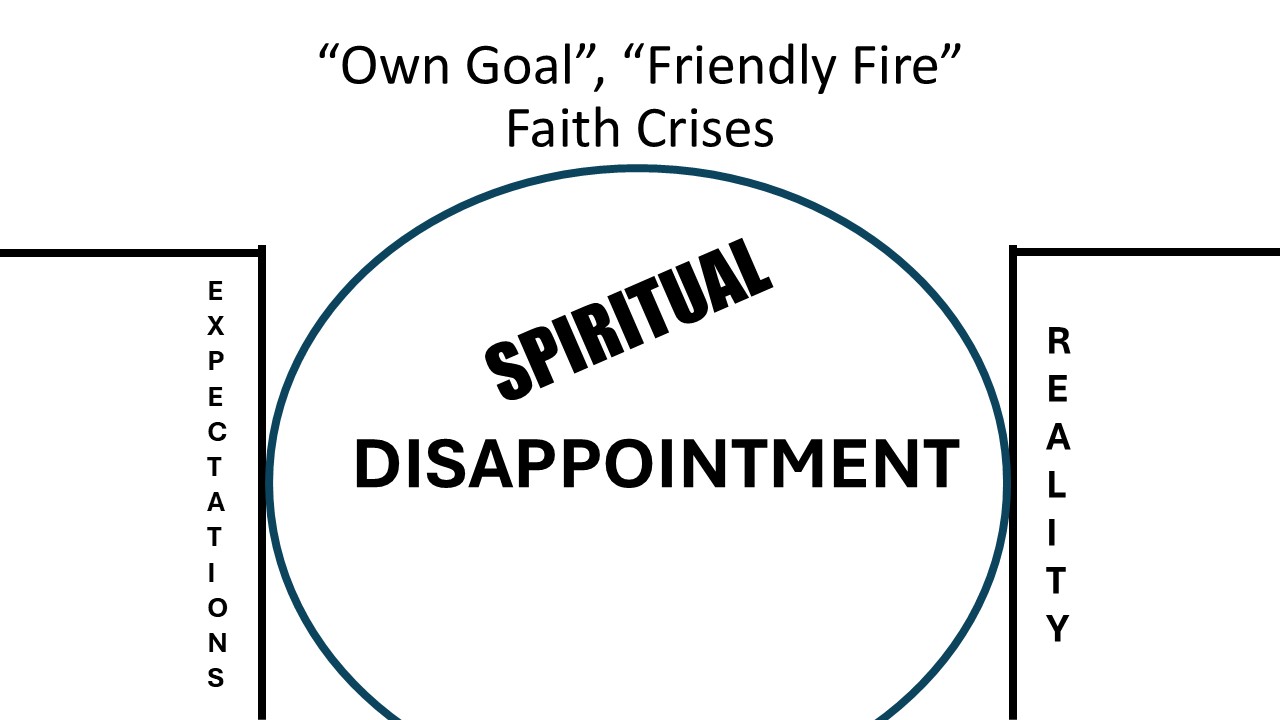
Working a lot with young adults in the last ten years, I’m trying so desperately to be—spiritually—to be the second type of person in what I’m preparing them for. Because unintentionally, we might be doing a little bit of an own-goal type situation—or friendly fire—that could be feeding into some of these faith crises that we’re seeing.
You guys have heard that disappointment is the gap between expectation and reality. And so what spiritual disappointment might we unintentionally be causing by not really trying to bridge that gap as much as possible?
 And to help them understand that along this faith journey, there are going to be peaks. You think about the peaks—the times where you feel so close to God, so connected to Him—and inevitably there will be valleys. This isn’t just a high plateau. It’s not the way that it works.
We find this in so many different places.
 Learning from C. S. Lewis
I love C. S. Lewis. I love The Screwtape Letters. It’s a correspondence between Screwtape, the master devil, tempter devil, and his newly assigned apprentice, Wormwood, who needs to destroy a Christian soul before he can become a master tempter as well.
And so, he has—in training—he has to report back to his uncle everything that he’s doing and receive guidance from him. And at some point as he’s trying to destroy this new Christian, he writes to his uncle and he says, ‘We got him. He’s ours. He doesn’t want to go to church anymore, he doesn’t want to pray anymore. Also he doesn’t want to read scripture anymore. He doesn’t want to keep commandments. It’s over. I’ve graduated. Start the ceremony. I’m ready. I’m ready to be a master tempter.’
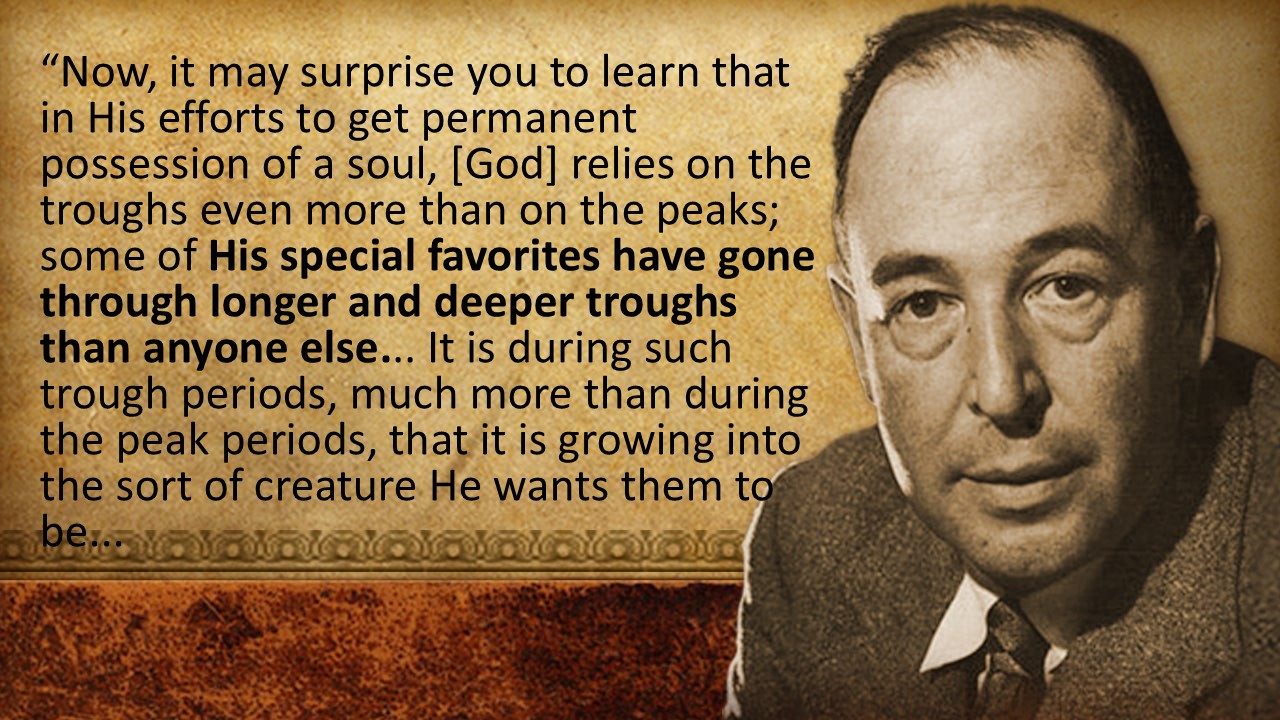 And his uncle writes back to him and says, “Whoa, whoa, whoa. Pump the brakes.” He says:
“Now it may surprise you to learn that in His efforts, ”(—so “His” would be, this is written from the perspective of devils, would be God’s—) “in His efforts to get permanent possession of a soul, God relies on the troughs even more than on the peaks. Some of His special favorites have gone through longer and deeper troughs than anyone else. It is during such trough periods much more than during the peak periods that it is growing into the sort of creature He wants them to be.”
Trough Case Studies in Scripture
I spent six months of my life studying examples of these “trough” case studies in scripture.
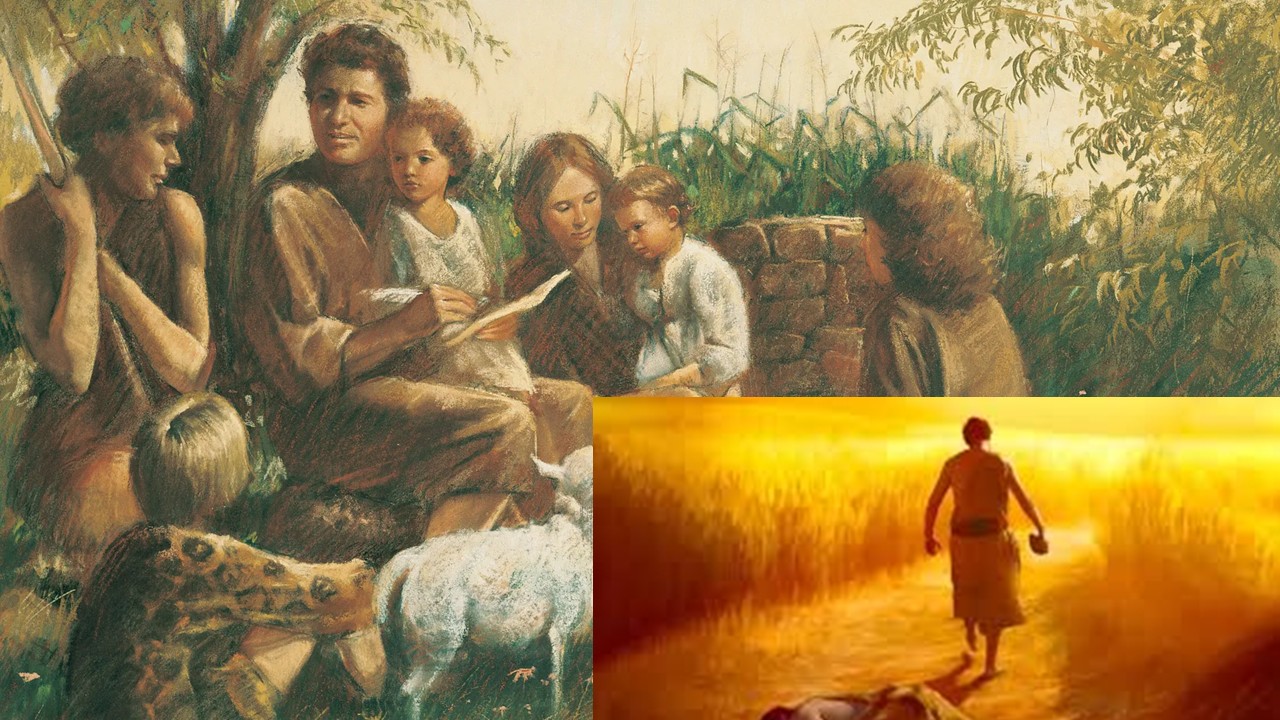 You think about the type of trough that our first parents, Adam and Eve, experienced. We love a picture like this, this perfect Adam and Eve ‘family home evening’. And then we realize that two of those kids could easily be Cain and Abel.
Think about that trough for Adam and Eve. Some of you in here have heart-wrenching situations with your kids, whom you love deeply, who have chosen to depart from the faith that you tried to instill in them. I think Adam and Eve can relate with you.
 Abraham, Moses, Elijah, and Jeremiah
Abraham
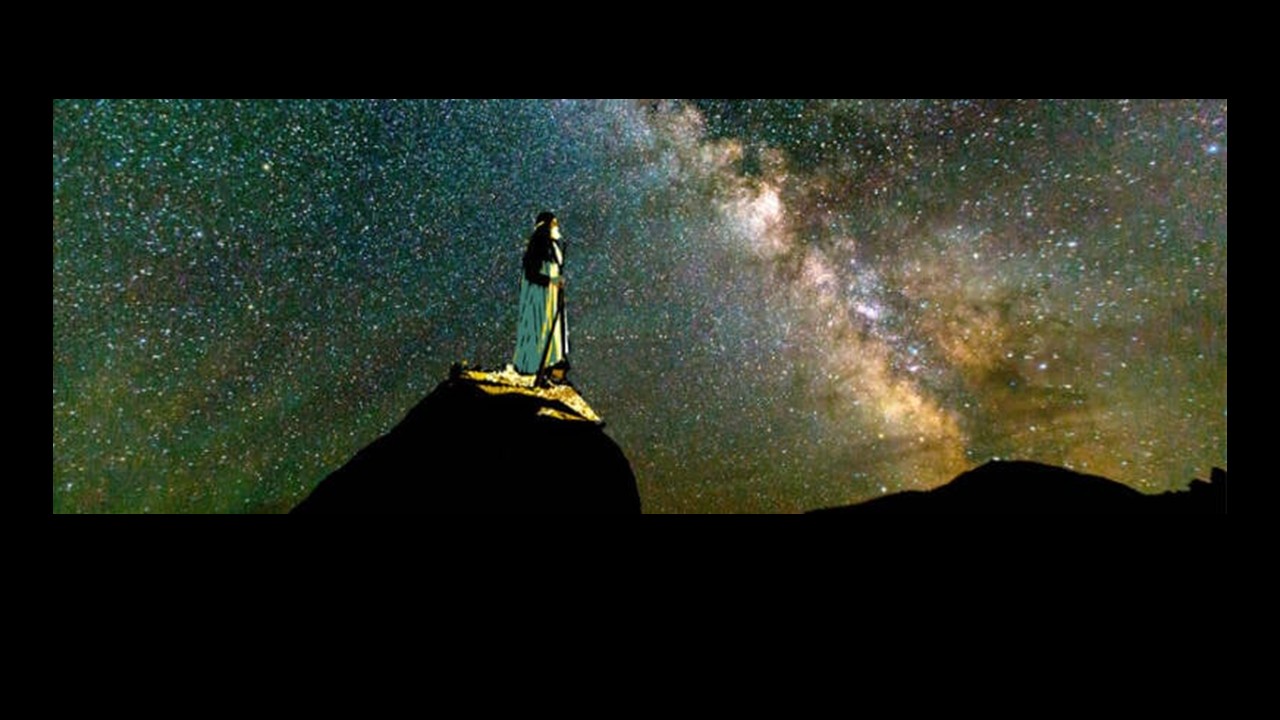
Think about Abraham receiving the promise that his posterity would be as numerous as the stars in the heaven and the sands of the sea. And then years pass, and years pass—over 25 years—and at some point can’t you just hear his prayer? Like, God keeps telling him about this numerous posterity and he’s like, God, can I just have one covenant child?

Moses
You think about Moses and all he did for his people, everything focused on to get them into the promised land—and then all of a sudden being informed, Moses, you’ll see it, but you’ll never inhabit it.
Elijah
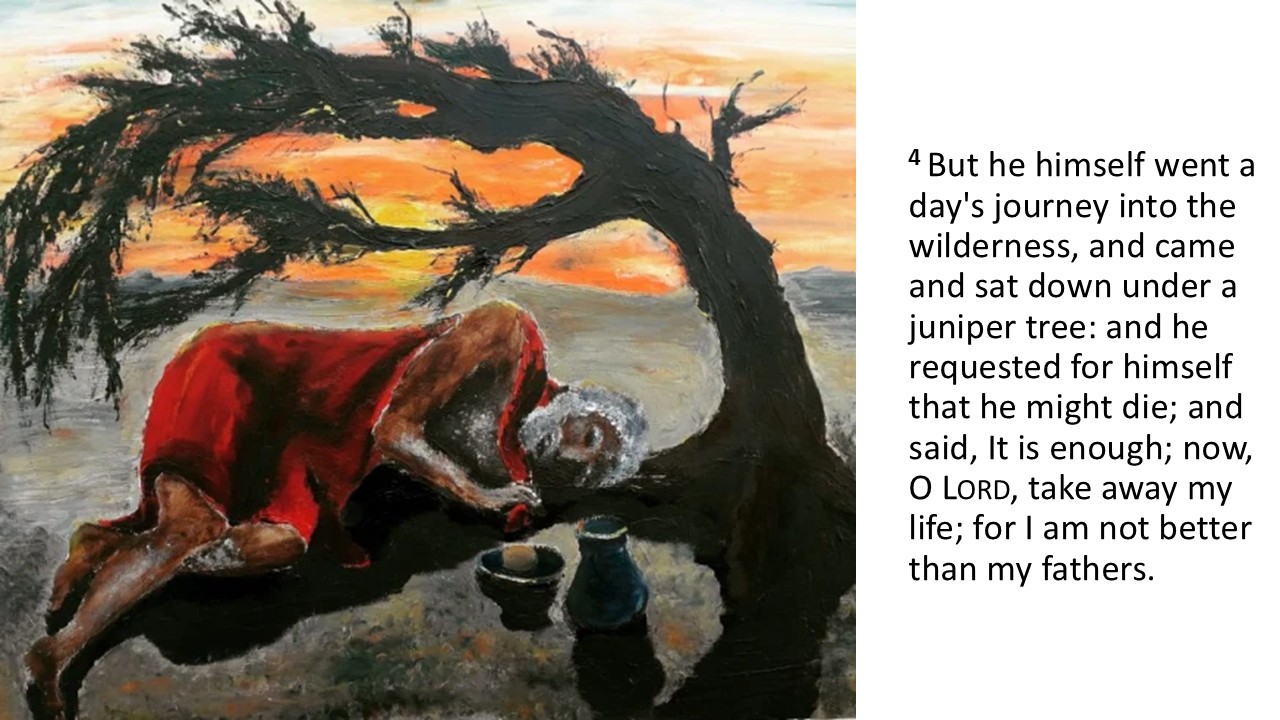
You think about Elijah after his showdown with Ahab and Jezebel on Mount Carmel, and he thinks that that showdown demonstrating the power of God is going to convert these people from their idolatry and their immorality—and it doesn’t.
“But he himself went a day’s journey into the wilderness and came and sat down under a juniper tree; and he requested for himself that he might die. ‘Now, O Lord, take me away. Take away my life, for I am not better than my fathers. I’m a total failure, God.’”
Jeremiah
What about Jeremiah? This one’s a great one.
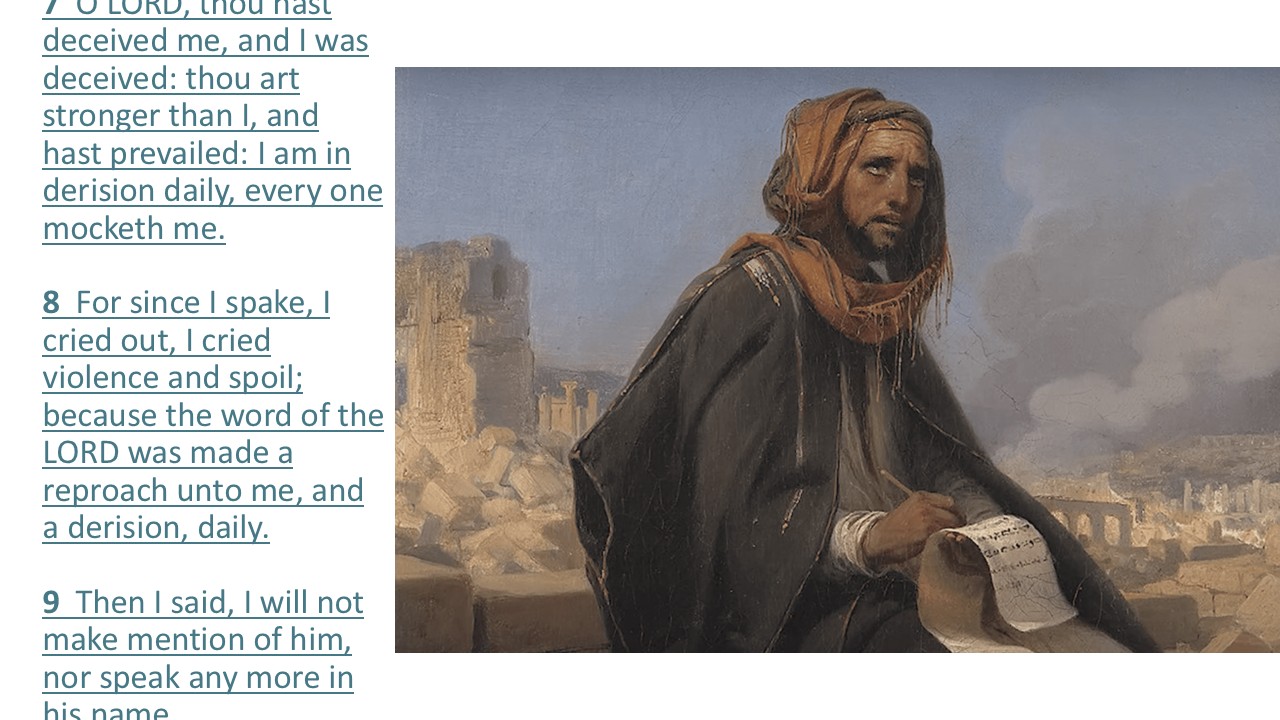
“O Lord, thou hast deceived me.” Persuaded. The Joseph Smith footnote says, “I was deceived.” “Thou art stronger than I. You convinced me to take this call and thou hast prevailed. I am in derision daily. Everyone mocketh me.”
I think about the people in this room, the way that you’re putting yourselves out there to defend this faith, and the way that that exposes you and how vulnerable that makes you.
“For since I spake, I cried out. I cried violence and spoil.”
He goes, I wish I could deliver happy news to these people.
“I can’t, because the word of the Lord was made a reproach unto me and a derision daily.”
Focus on verse 9:
“Then I said, ‘I will not make mention of Him, nor speak anymore in His name.”
I’m done. I can’t do this anymore.
And for a period, Jeremiah continued to keep his covenants but wasn’t actively functioning in his role as prophetic messenger. We know it changes—the “fire in the bones,” which is a great verse.
 The Ultimate Troughs
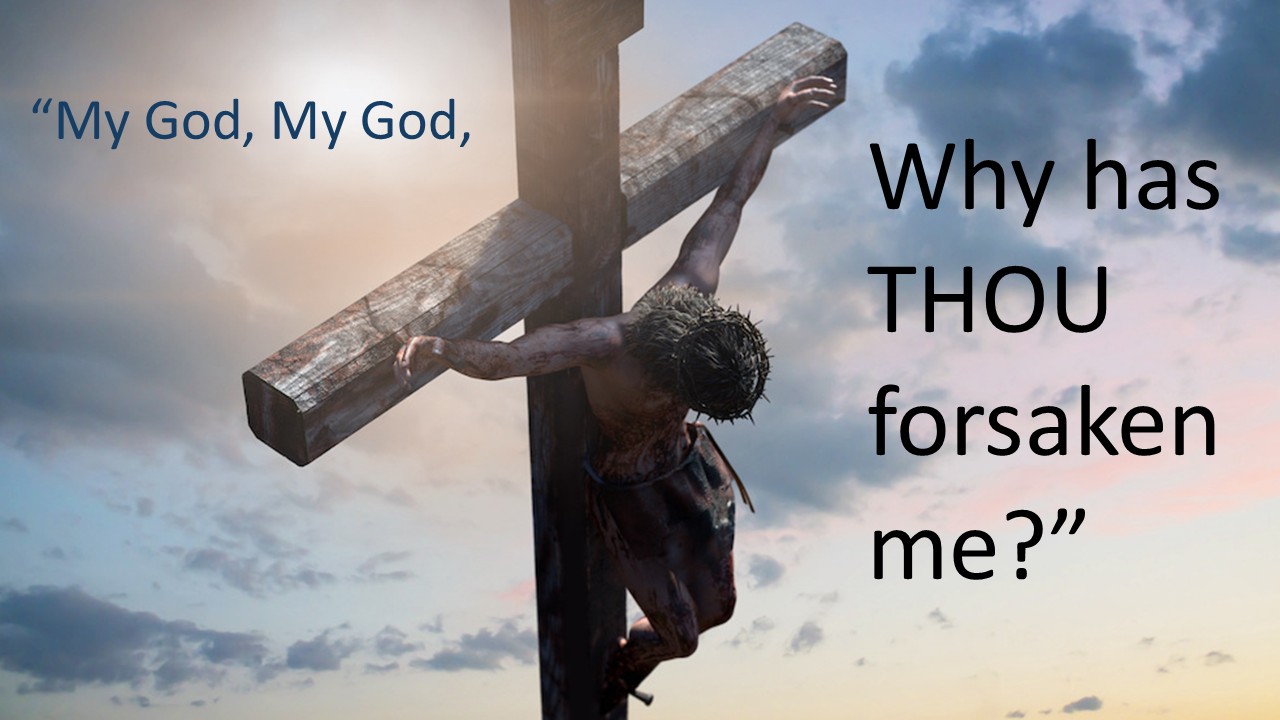
You think about the Prophet Joseph in Liberty. And you know where we’re headed—the ultimate example, the ultimate infinite trough of Gethsemane and Calvary:
“My God, my God, why hast thou forsaken me?”
St. John of the Cross, the 16th-century Spanish mystic—kind of a cool title, be cool to put on your headstone—he is the one who coined the phrase that’s very famous, the dark night of the soul. In fact, he wrote a lengthy poem about it. I’ve read it. It’s really good.
He said this:
“God leads into the dark night those whom He desires to purify from all these imperfections, so that He may bring them farther onward.”
That these dark nights are simply refining opportunities.
Look at this quote:
“Now that I no longer desire all, I have it all without desire.”
Kind of cool. It makes me think about Job. Stripped of everything, right?
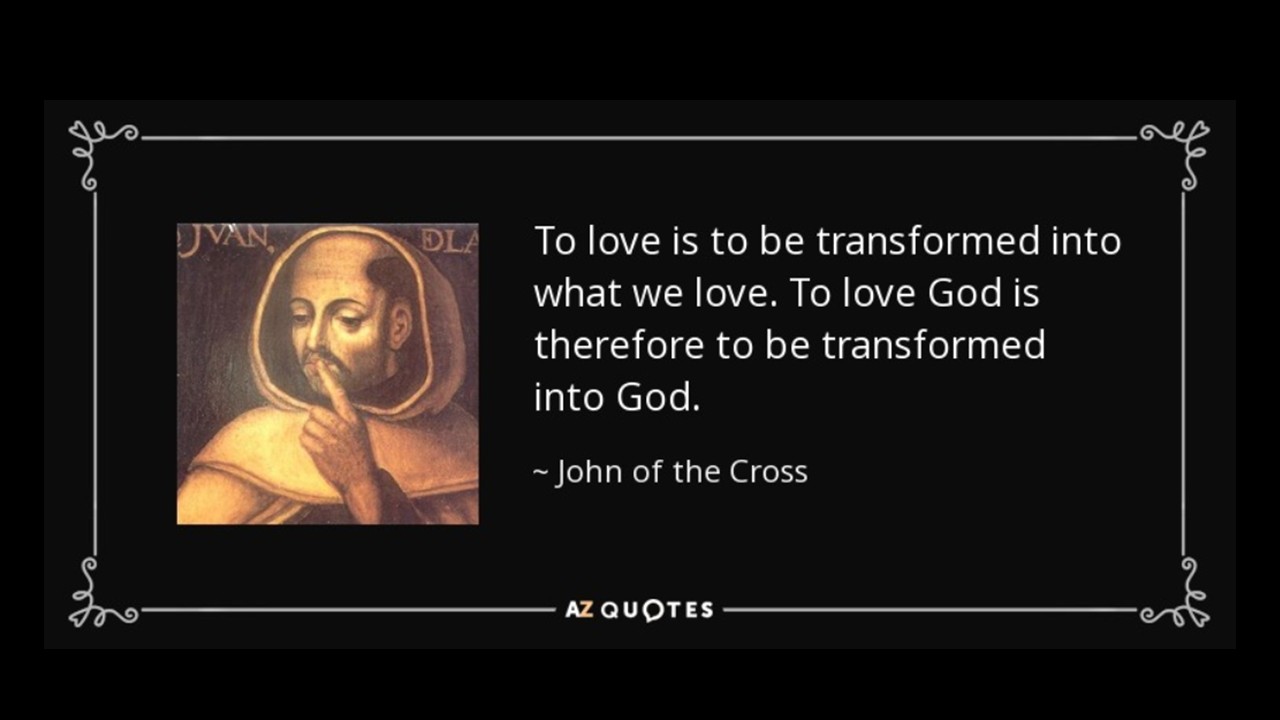 St. John of the Cross said:
“To love is to be transformed into what we love.
To love God, therefore, is to be transformed into God.”
That sometimes God has to strip things away so that only He remains.
I’m trying really hard to love God with those things intact so they don’t need to be stripped away from me. But inevitably that will be part of this beautiful—the reality of mortality and this refining process.
 Reframing Faith Crisis
So, we’ve talked about—we’ve adopted in the last decade this idea of faith crisis, and I think it’s probably reached its cultural saturation point. In fact, when you guys saw this, this wasn’t one of the presentations that you circled and thought, I’m really going to like that. I need to attend that one. Right? You’re like, I’m tired of hearing about this.
We talk about it so much, we’re probably causing it because we talk about it so much, right? Um, and crisis has such a negative connotation, right? You think about like a financial crisis, a health crisis, and you’re like, that—yeah, we don’t want that.
And so we think about faith crisis, and we think about things like hard questions, confusion, feeling lost, doubt, trials.
 I had this epiphany a few years ago with my institute students, with my college-age kids. I was like, we need to reframe this from this negative faith crisis into a simple faith journey that we’re all on.
Right?
Reframing faith crisis—unfortunate faith crises, “Ooh, I wish you—I wish that wasn’t happening”—into essential faith journeys.
God is Refining You
This is God refining you – this is the plan.
 Okay, which calls to mind the hero’s journey. You think about the hero’s journey. Your journey of faith is like any good hero’s journey—filled with periods of clarity and confusion, faith and fear, hope, despair, courage, cowardice, success and failure, sunshine, storms, light and darkness, excitement and apathy, joy and sorrow.
But in the end, the bitter provides contrast that makes the triumph even sweeter. These powerful stories of heroes’ journeys that have inspired you—can you imagine how uninspiring they would be if they were just static the entire way along?
 Brian McLaren’s Framework
This is Brian McLaren. Some of you are familiar with him. And however you feel about Brian McLaren—he’s one of our evangelical friends—he has given us a very, very useful framework for these stages of faith.
I’m going to outline these stages of faith very, very quickly. Some of you are very familiar with them. And this is what it can look like for ourselves and for people whom we love.
He says we typically, in our faith journey, begin in a place of simplicity. Think about the Shire. You think about Tatooine. You think about Kansas.
 Stage 1: Simplicity
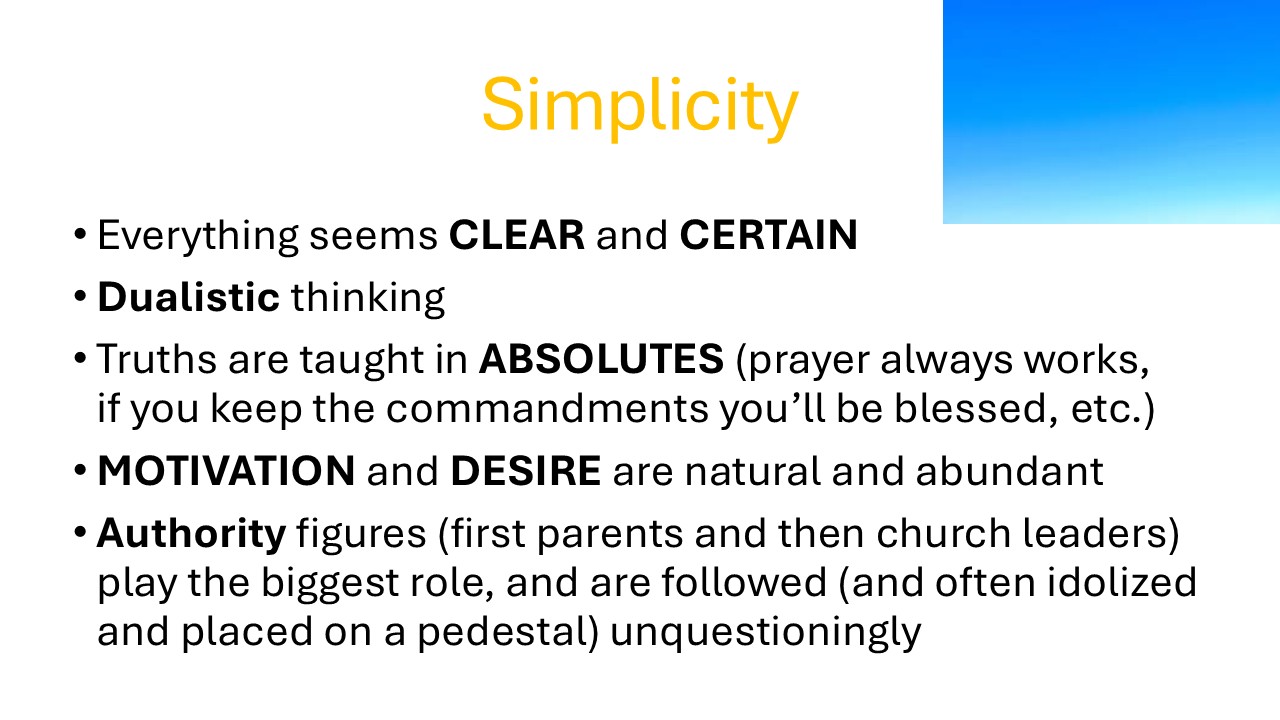
In simplicity, things seem very clear and very certain. They tend to be dualistic in nature.
And you think about when—maybe when you were a child—and all of a sudden someone moved in down the street and you found out that they were non-members and kind of what that meant to you as a child.
Truths are taught in absolutes.
Prayer always works.
If you keep the commandments, you’ll be blessed.
Motivation and desire are natural and abundant. We don’t have a lot of apathetic kids in the Primary. Ask the Primary teachers, right? There’s a lot of excitement and a lot of energy and wonder involved.
Authority figures—first parents and then church leaders—play the biggest role in this phase and are followed and often idolized and placed on a pedestal unquestioningly, which is the way it’s intended to be, designed to be, by divine design.
But inevitably we do move out of simplicity into more complexity, where hard questions may arise that make things a little less clear and a little less certain.
 Stage 2: Complexity
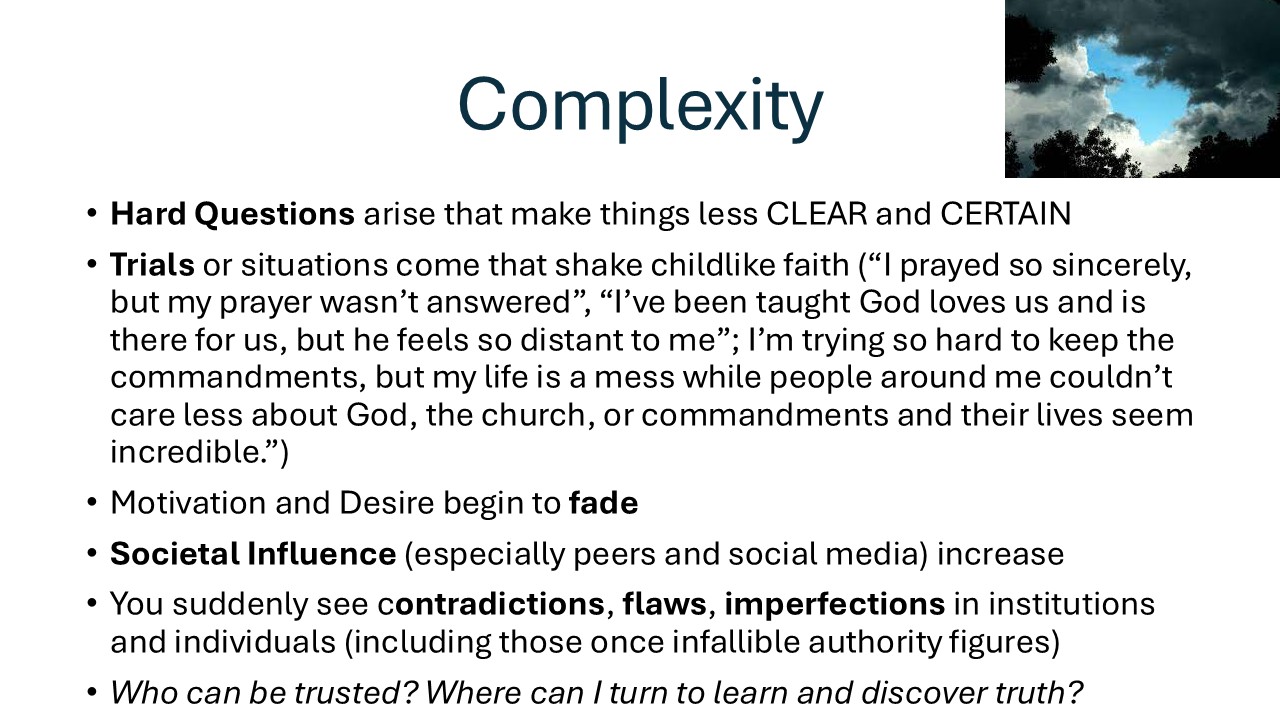
Trials or situations come that shake that childlike faith.
“I prayed so sincerely, but my prayer wasn’t answered.”
“I’ve been taught that God loves us and is there for us, but He feels so distant to me.”
“I’m trying so hard to keep the commandments, but my life is a mess—while people around me who couldn’t care less about God, the Church, or commandments, their lives seem abundant and blessed. How is that fair?”
Motivation and desire begin to fade.
Societal influence—especially peers and social media—now increase. So we’re having an inverse relationship between parents and leaders and now societal influence.
You might suddenly start to see contradiction, flaws, imperfections in institutions and individuals—maybe including those once infallible parental or leader figures—which then can introduce you into a type of perplexity.
 Stage 3: Perplexity
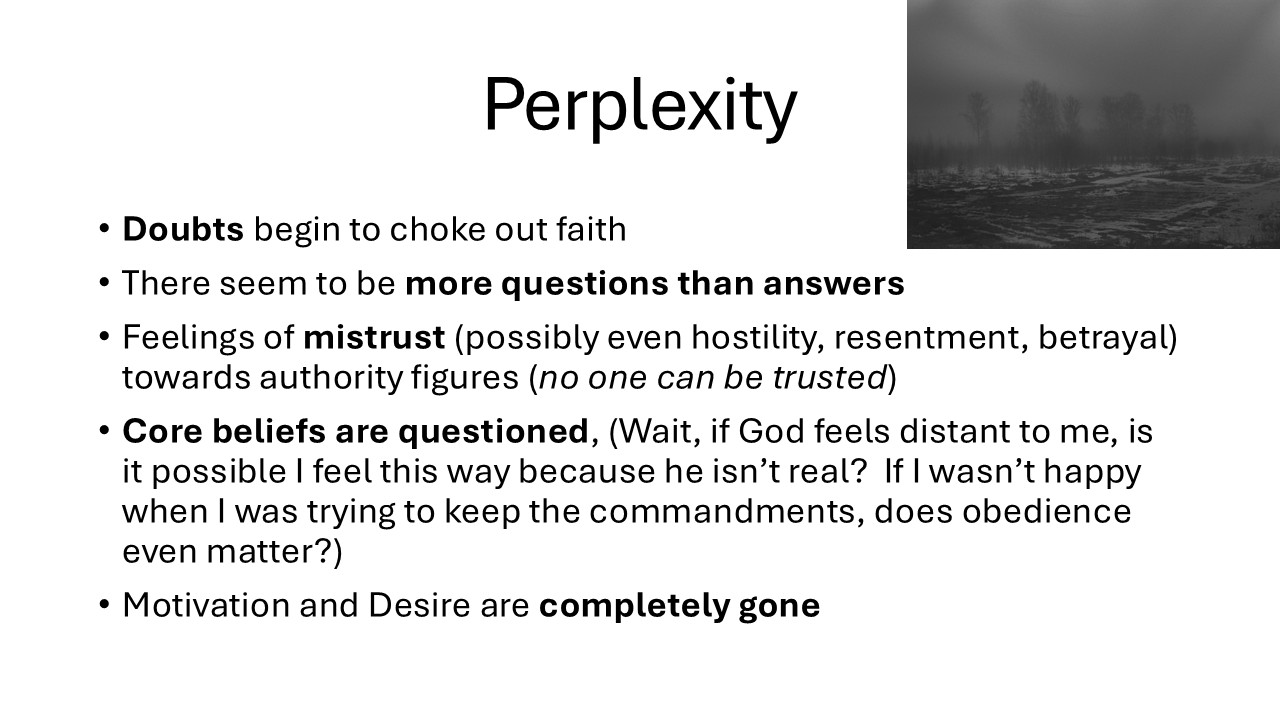
Now doubt begins to choke out faith. There seem to be more questions than answers.
Feelings of mistrust, possibly even hostility, resentment, betrayal toward authority figures. You start to wonder, No one can be trusted.
Core beliefs are questioned:
“Wait—if God feels distant to me, is it possible I feel this way because He isn’t real?”
“If I wasn’t happy when I was trying to keep the commandments, does obedience even matter?”
Motivation and desire are gone.
 Stage 4: Harmony
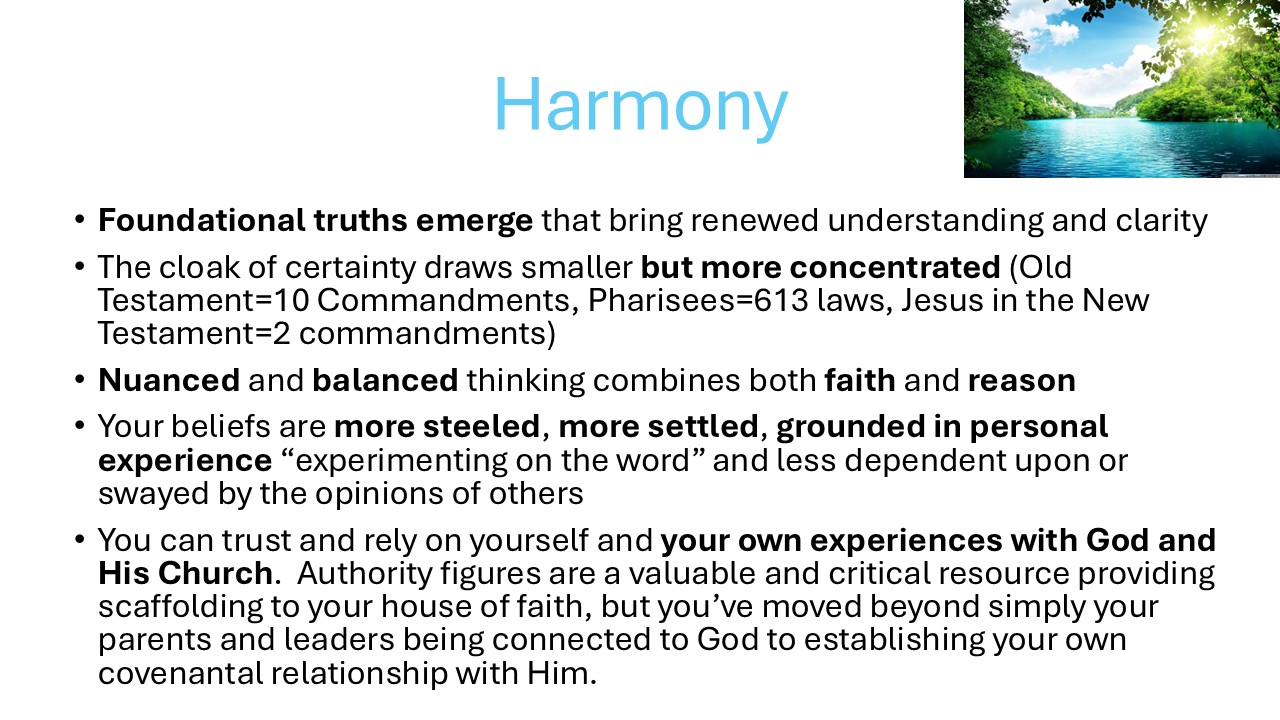
If an individual will have the courage—and this is where I’ll end up in a few minutes—to keep going, there is harmony. It might not seem like it in the depths of perplexity.
One of our—my wife and I’s—favorite places is southern Utah. And you think about central Utah. Sorry, central Utah people. This is no offense. Central Utah is not pretty. But you think about what it was like pressing through hundreds of miles of central Utah that seems barren wilderness—and then all of a sudden you get to something like Moab or St. George. That’s beautiful red rock.
And foundational truths reemerge that bring renewed understanding and clarity.
I—I love this. Pay close attention here:
The cloak of certainty draws smaller but more concentrated.
It’s fascinating that God gives Moses ten commandments. In New Testament times, the Pharisees amplify it into 613 subcommandments. And then Jesus in the New Testament says, “Actually, there’s only one. Okay—maybe one A and one B.”
Do you see what He’s doing there?
Nuanced and balanced thinking combines both faith and reason.
Your beliefs are more steeled, more settled, grounded in personal experience—experimenting on the word—and less dependent upon or swayed by the opinions of others.
So me with my college—I’m in an ecclesiastical situation now, a position with YSAs—and trying to, like, all of your roommates have this opinion about the Church. It’s okay. You can see things differently, right? You can trust and rely on yourself and your own experiences with God and His Church.
Hearkening back to the previous bullet point: authority figures are a valuable and critical resource that provides scaffolding to your house of faith. But you’ve moved beyond simply the simplicity of my parents and church leaders know that the Church is true—or that they have a powerful connection to God—to establishing your own relationship and connection with Him.
 Progression Through the Stages
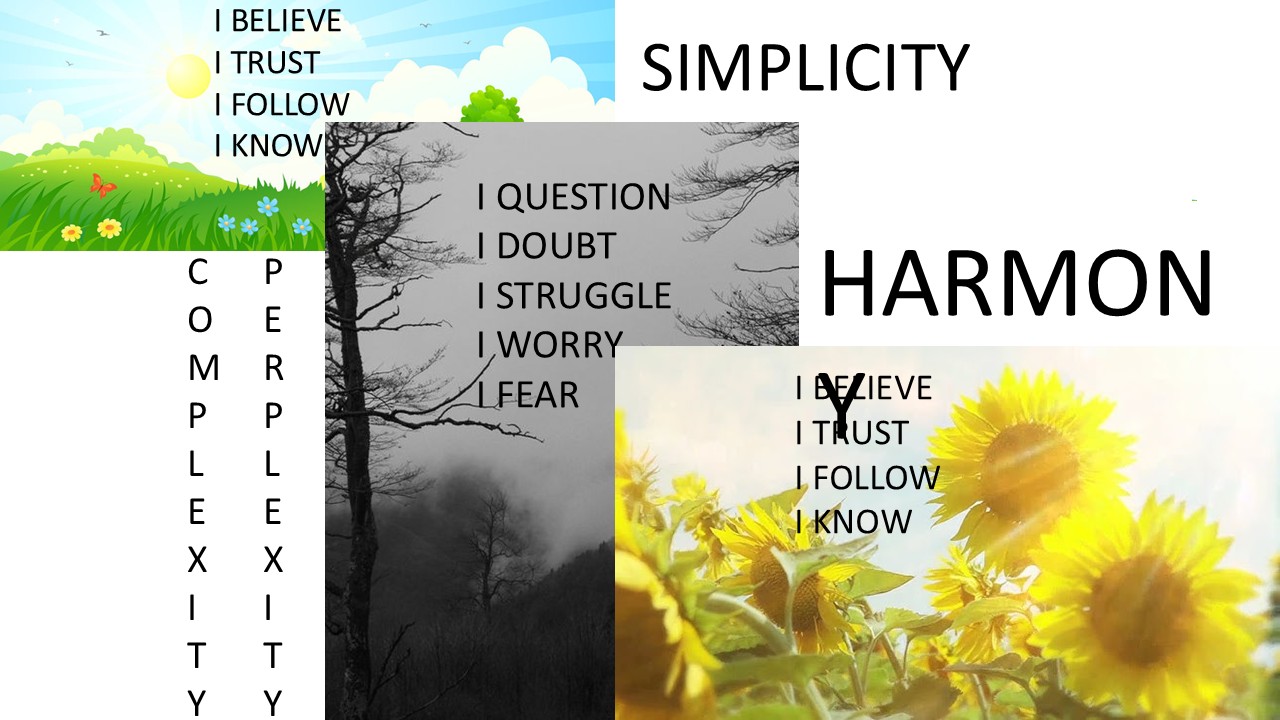
Okay. So in simplicity:
- I believe.
- I trust.
- I follow.
- I know.
In complexity and perplexity:
- I question.
- I doubt.
- I struggle.
- I worry.
- I fear.
And then in harmony, you return back to this—but it’s entirely different.
Frodo goes back to the Shire, but he’s changed. He sees things entirely different. In the hero’s journey, you’re returning to where you came—just changed. From the presence of God, returning to the presence of God. Harmony.
At first I taught this and conceptualized this as steps that you graduate from, and it’s not really. It’s much more like the rings of a tree: that you always have that simplicity inside of you, and then you have, like, a burn scar from that forest fire year, and then the year when there were the pestilence, and then the drought, and then the year of plenty.
 And this is—I’m looking out in this room right now and I just see these mighty trees of faith. But if you could dissect that, and if we could sit down and have an interview one-on-one with each of you and talk about your experiences with complexity and perplexity and how you continue to trust and continue to hang on, it would be so beautiful to see this dynamic faith that you have.
The Question Everyone Asks
Okay. The number one question that I get whenever I teach this to my college kids:
“Brother Christensen, how do I know if I’m moving towards developing harmony in this journey? I want harmony.”
 How Do You Know You’re Moving Toward Harmony?
How do you know?
I said my wife brings home a lot of books. She brought home Eat, Pray, Love like 15 years ago, and I was like, if you want to impress your wife, you’ve got to read books like Eat, Pray, Love. This is Elizabeth Gilbert. And I listened to an interview with Elizabeth Gilbert, and she said this—and I thought it was so fascinating.
She said:
“I do believe that it’s humanly possible for the mind to hold two completely opposing ideas as true at the same time, but it takes maturity and wisdom.”
When I think about our Church leadership—First Presidency, Quorum of the Twelve—those would be the two adjectives I would use to describe them: incredible maturity and incredible wisdom.
 Leaning Into Tension
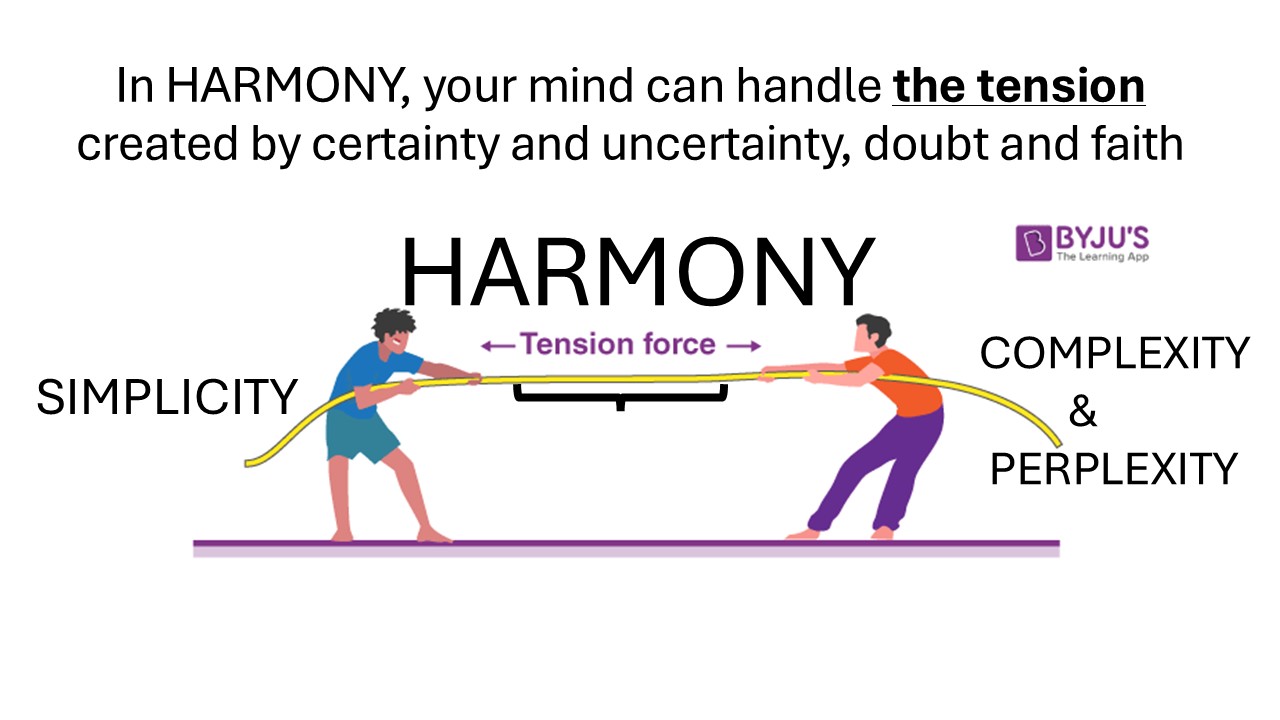
In harmony, your mind can handle the tension created by certainty and uncertainty, doubt and faith.
The key word—how do you know if you are experiencing harmony, or how can you help someone move into greater spiritual harmony? Have them lean into tension.
Simplicity over here. Complexity, perplexity over here. They’re all part of you. Remember the tree? This is harmony. That tension force.
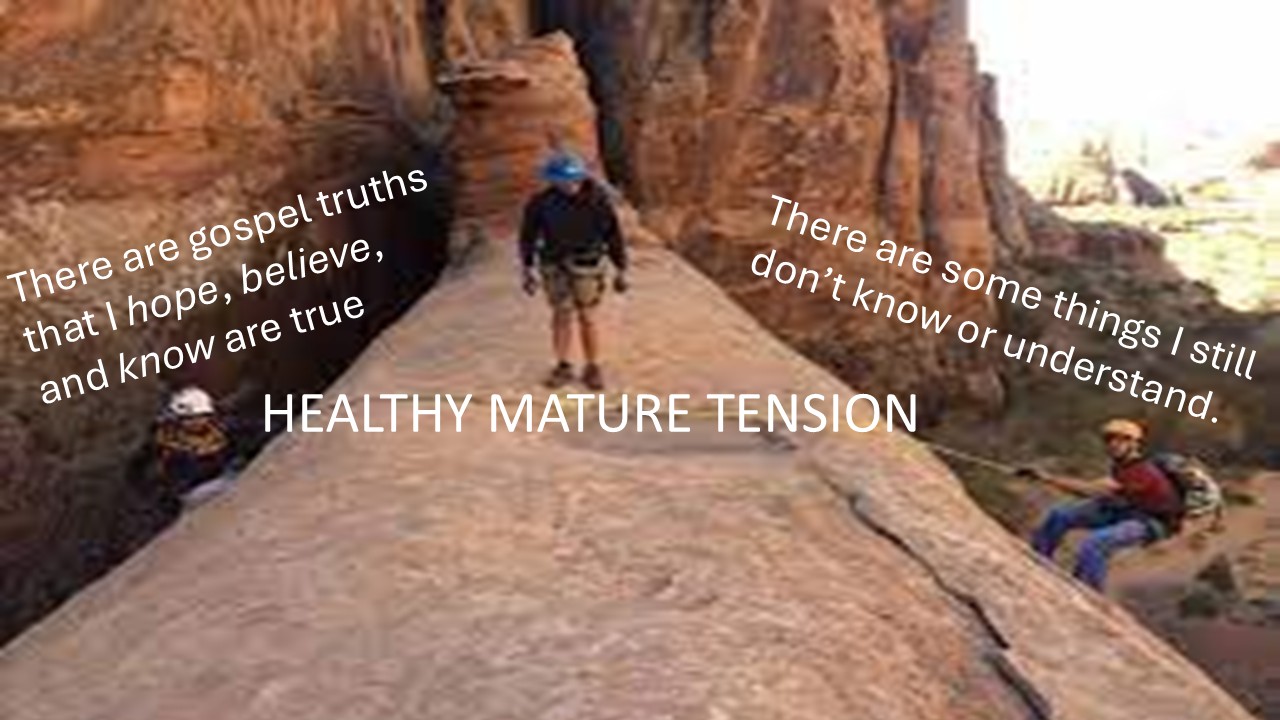 There’s an arch down in Moab called Bowtie Arch where you can do a tandem rappel off the top. You’re tied together, but you have to be roughly the same weight. You have to be at the same level, and you have to descend at the same speed, or else things get catastrophic. I think this applies perfectly to our faith journeys.
Right?
So take someone over here—this side’s going to be simplicity:
There are gospel truths that I hope, believe, and know are true.
Here’s complexity, perplexity:
There are some things I still don’t know or understand.
That’s the healthy, mature tension right in the middle.
Examples of Tension
So much beautiful clarity in this restored Church of Jesus Christ of Latter-day Saints—yet traces of frustrating confusion. The spot in the middle is the tension. That’s harmony.
I’m saved by the free gift of Christ’s grace.
My works are vital in the process of salvation.
Spot in the middle is the tension.
God’s love.
God’s law.
There’s the tension.
And by the way, actually this one’s not even accurate. I love what President Nelson, what President Oaks, what Elder Bednar have taught: that God’s law is simply the ultimate manifestation of His divine, infinite love for us.
God loves me and accepts me exactly as I am. That’s true.
God wants me to improve, grow, repent, and change.
This is what I’m teaching to my YSAs for four hours straight every Wednesday night in my interviews with them.
Healthy, mature tension.
Patience and progress.
Urgency—don’t procrastinate.
And perfection.
Prophets are inspired and essential—I testify that they are. They’re also imperfect. That makes me love them even more and sustain them even more.
My mind is governed by reason, logic, and intellect.
My mind believes in the supernatural and miracles and holds space for wonder and mystery.
That’s the tension.
You guys are like, “Does this go on forever?” No, I think I have two more.
God can intervene in powerful and dramatic ways to heal or to help us.
Sometimes He doesn’t.
If we could even teach this one, how many people do you know whose faith journey has gotten sidetracked because they didn’t understand this?
I love this Church.
This Church can occasionally be frustrating.
That’s okay. It’s a messy laboratory that’s helping us develop the nature and character of God.
 The Faith Journey Mirrors the Plan of Salvation
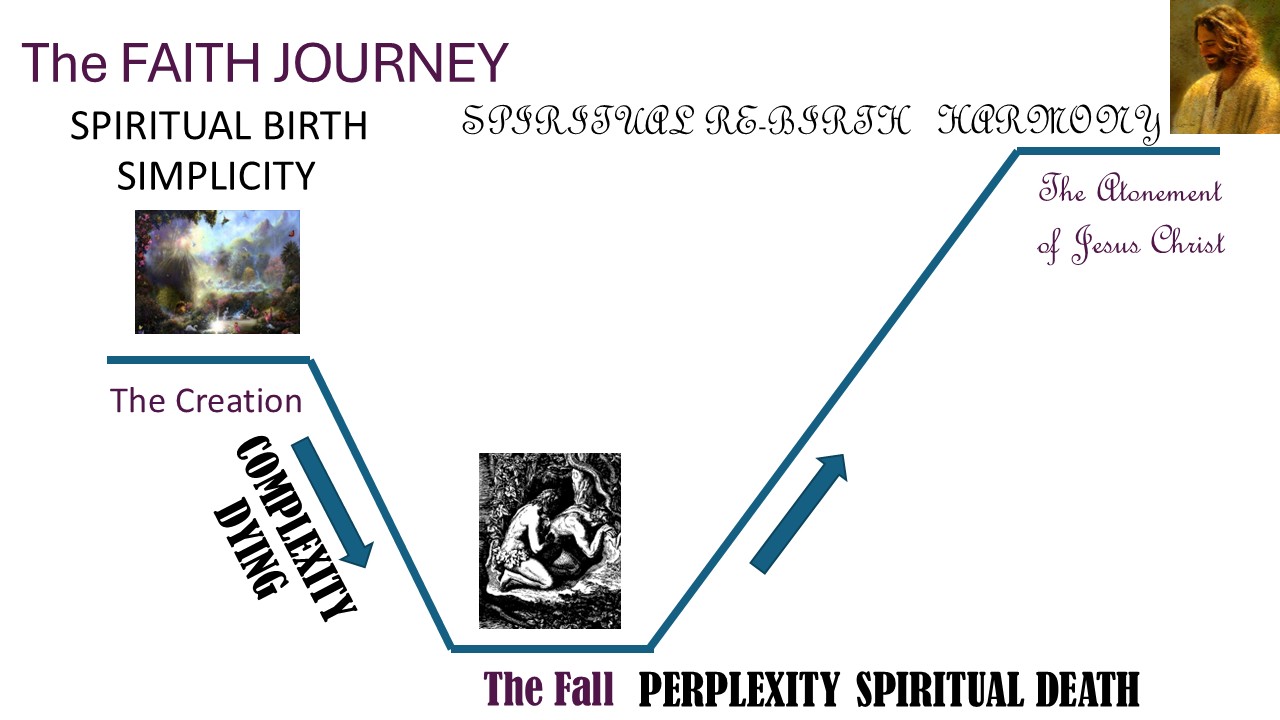
In many ways, this faith journey just mirrors the three pillars of eternity as taught by President Boyd K. Packer, where he said:
“We begin in creation.”
You think about Adam and Eve in the Garden of Eden, us in premortality.
And then there had to be a fall.
There’s simplicity.
And then all of a sudden—complexity.
How do we keep one commandment when it seems like we have to disobey another commandment to keep that commandment, right?
And then perplexity—the fallen state—which leads us right into the arms of Jesus Christ into harmony.
Spiritual birth.
lass=”yoast-text-mark” />>Spiritual dying.
>Spiritual death.
>Spiritual rebirth.
Joseph Campbell said:
“The dark night of the soul comes just before revelation. When everything is lost and all seems darkness, then comes the new life and all that is needed.”
 The Path Is the Path
Oftentimes—and I hope next year, well, I hope I’m not stolen by Pixar to work on some of their productions that they’re doing because this is—you can see the talent that I have that you’re dealing with here, right?
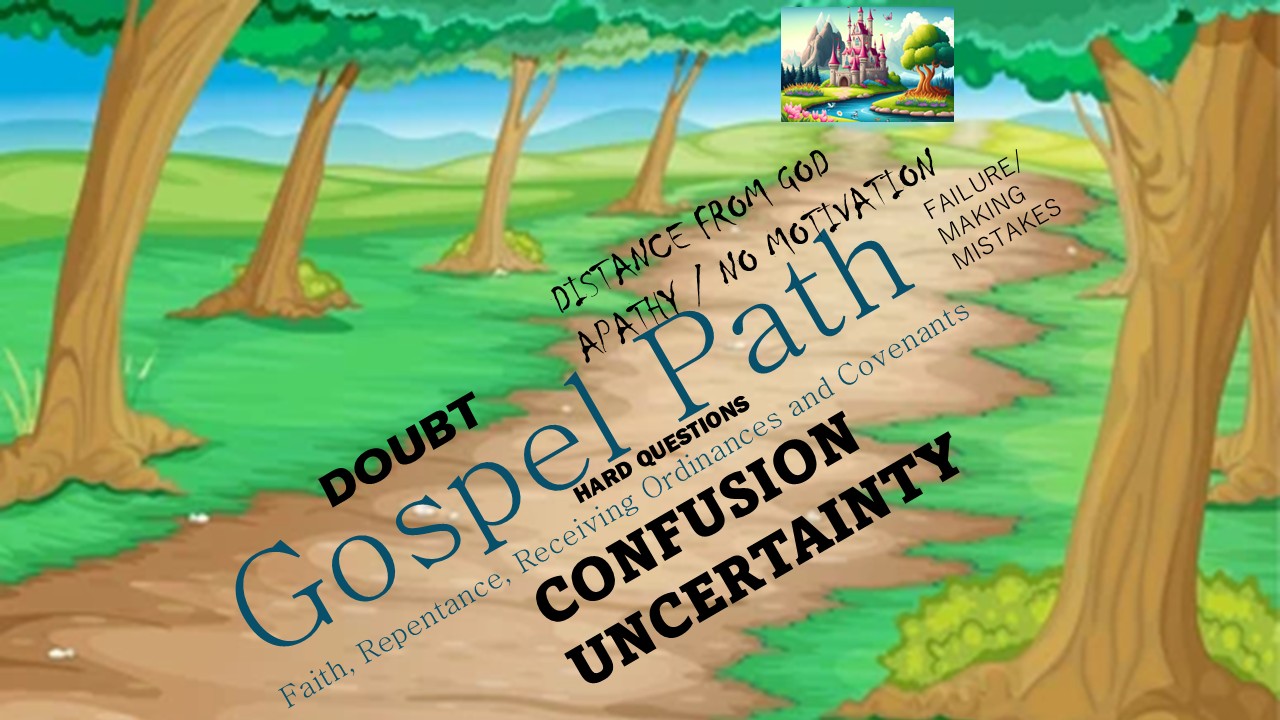
Sometimes we think about the gospel path as:
- Faith.
- Repentance.
- Receiving ordinances and covenants.
And then all of a sudden things like doubt, or things like hard questions, or things like confusion and uncertainty, or distance from God, apathy, no motivation, failure, making mistakes—as side trails where you have left the path.
What I’m trying to help my YSAs understand is that those are the path. This is the journey.
And I’ve had college students come up to me weeping from this dumb little slide being like, “That is so helpful for me—that I’m on the path.” The adversary is trying to deceive you.
Helping Someone in Complexity and Perplexity
What do we do when someone we care about begins to experience complexity and perplexity along their faith journey?
I love this from Sheri Dew in her BYU–Idaho address called Engage in the Wrestle. She said:
Four years ago, a marvelous young woman who had just graduated with honors from BYU called me distraught. Through sobs she blurted, ‘I’m not sure I believe the Church is true anymore, and I’m scared.’ I asked, ‘You want a testimony?’ Yes,’ she said. ‘Are you willing to work for it again?’ ‘Yes.’”
She and I began to meet for gospel study sessions. I told her, “Bring your scriptures and every question you have—questions are good. Let’s see what the Lord will teach us.”
She took me at my word and brought one thorny question after another. We searched the scriptures and teachings of prophets for answers. Little by little, she began to realize that just because she had questions didn’t mean she didn’t have a testimony. The scriptures are filled with accounts of prophets who had questions. And she began to recognize when the Spirit was bearing witness to her. Her testimony began to grow. In time, she passed. Then, about a year ago, she called me:
“I wanted you to be one of the first to know that I’m holding in my hand a temple recommend. Will you come when I receive my endowment?” Then she added:
“Do you know what you said that helped me the most?
You told me that questions are good. And that allowed me to see myself as a seeker rather than a doubter.”
How can we help our youth and young adults and adults see themselves as seekers rather than doubters?
Creating Space for Grace
I love this from Clark Gilbert. He said he was a teenager, and he said he brought a really hard question to his dad, who was this faithful, rock-solid spiritual man. And he said he was nervous. He asked his dad the hard question. And his dad said to him:
“Clark, I’ve had that question, too.”
And the impact that had on him.
I love what we find in the rest of that book about Mother Teresa where she says:
“I can’t express in words the gratitude I owe you for the kindness to me.
For the first time in years, I have come to love the darkness, for I believe now that it’s a part of a very, very small part of Jesus’s darkness and pain on earth.
You have taught me to accept it as a spiritual side of my following of Him today.
Really, I felt a deep joy that Jesus can’t go through the agony anymore, but that He wants to go through it in me.”
I just—I don’t think we would necessarily process harmony that way, but that’s how she did it, because of this space for grace that those Church fathers gave to her.
 When You Enter Complexity and Perplexity
What do you do when you begin to experience complexity and perplexity along your own faith journey—which I think all of us have in this room?
I love the anecdotal and maybe apocryphal story about Winston Churchill when a young man came to him and said, “It feels like I’m going through hell.” And he said this:
“If you’re going through hell, keep going. Keep going.”
It can be counterintuitive because fear, uncertainty, and doubt that accompany complexity and perplexity combine to create an immobilizing and paralyzing instinct in our mind, heart, and spirit.
And so the very thing that is so destructive in that fallen state of spiritual death is that we stop.
But the most spiritually perilous thing you can do is to stop.
Don’t Stop
- Don’t stop praying to God even when you doubt He exists.
- Don’t stop studying scripture even when you doubt it is inspired.
- Don’t stop keeping commandments even when you doubt they matter.
- Don’t stop following and sustaining prophets even when you doubt their prophetic call.
Don’t stop.
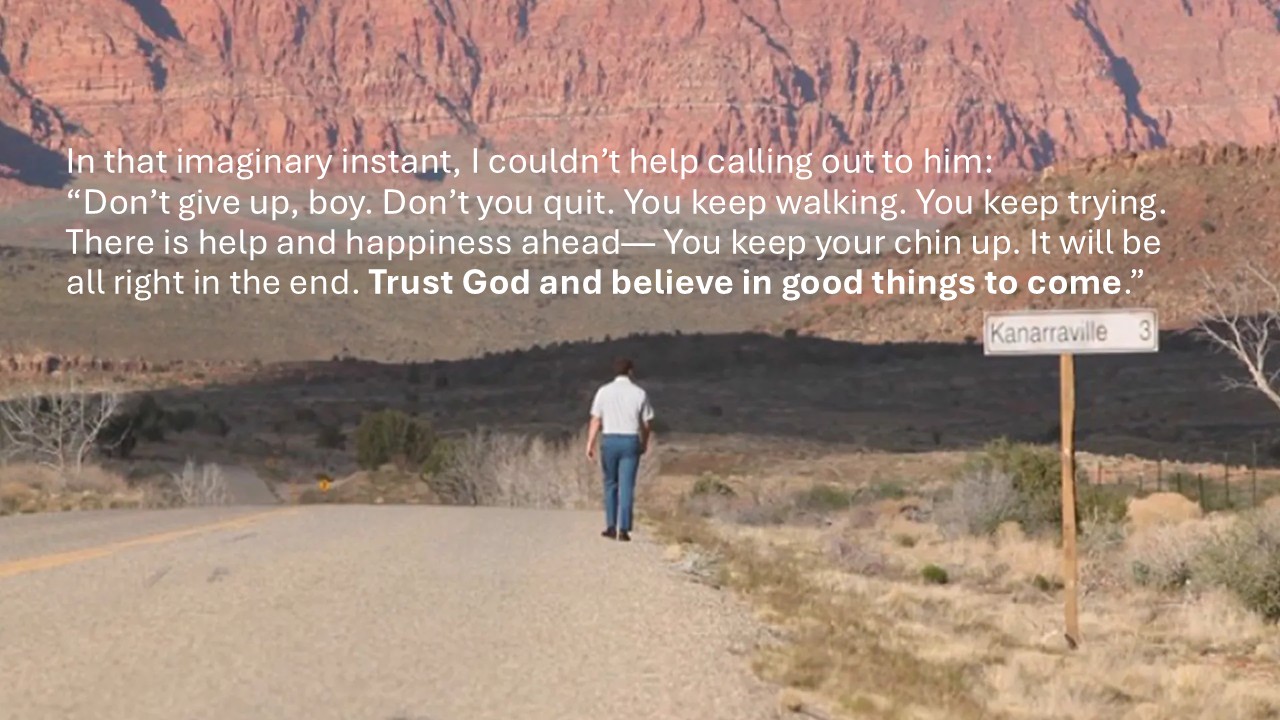 I love this from President Holland, in his famous story where his car kept breaking down, and he said:
“In that imaginary instant, I couldn’t help calling out to him—
Don’t give up, boy. Don’t you quit. Keep walking. Keep trying. There’s help and happiness ahead. And a lot of it. Keep your chin up. It’ll be all right in the end. Trust God and believe in good things to come.”
 Holding to the Covenants
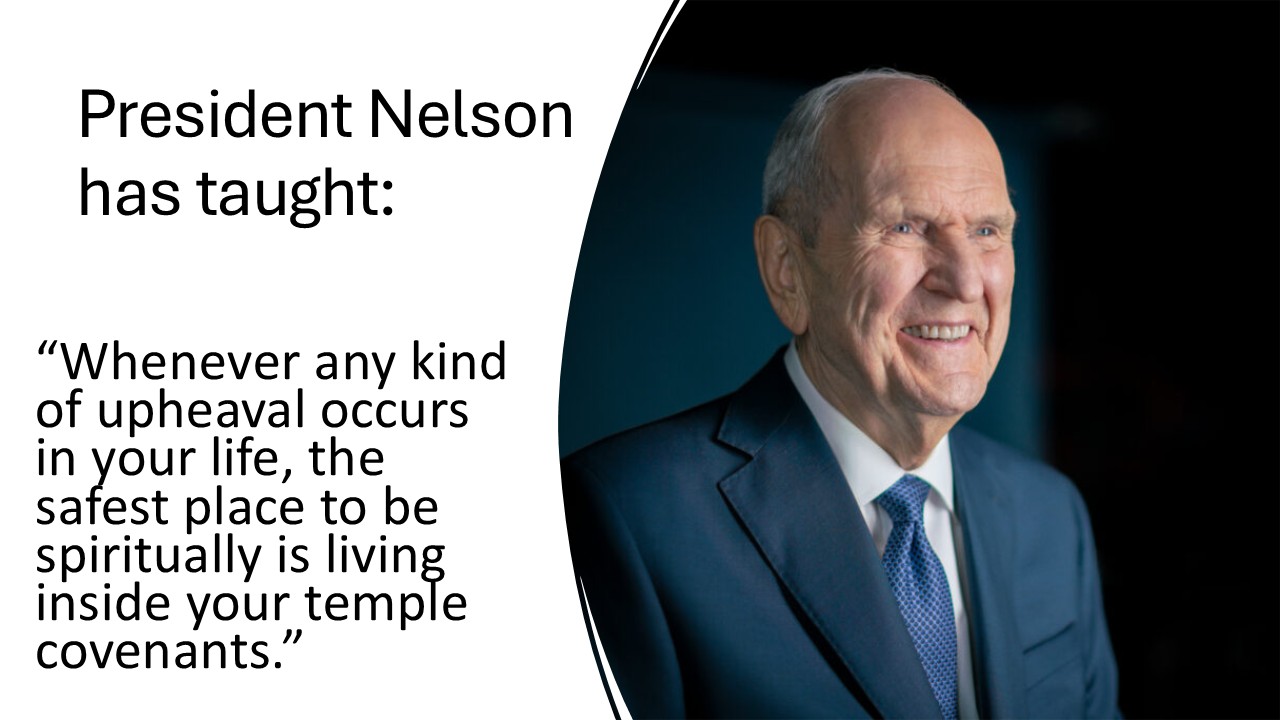
I love President Nelson. The power of teaching President Nelson’s words to our youth and young adults—wow.
“Whenever any kind of upheaval occurs in your life, the safest place to be spiritually is living inside your temple covenants.”
And that way, I think about in the darkness and despair of complexity and perplexity, the covenants we make—either baptismal or temple covenants—serving as that safety rope that we hold on to and keep moving forward.
In his first talk, “Revelation for the Church, Revelation for Our Lives”:
“In coming days, it will not be possible to survive spiritually without the guiding, directing, comforting, and constant influence of the Holy Ghost.”
 Finishing the Screwtape Quote
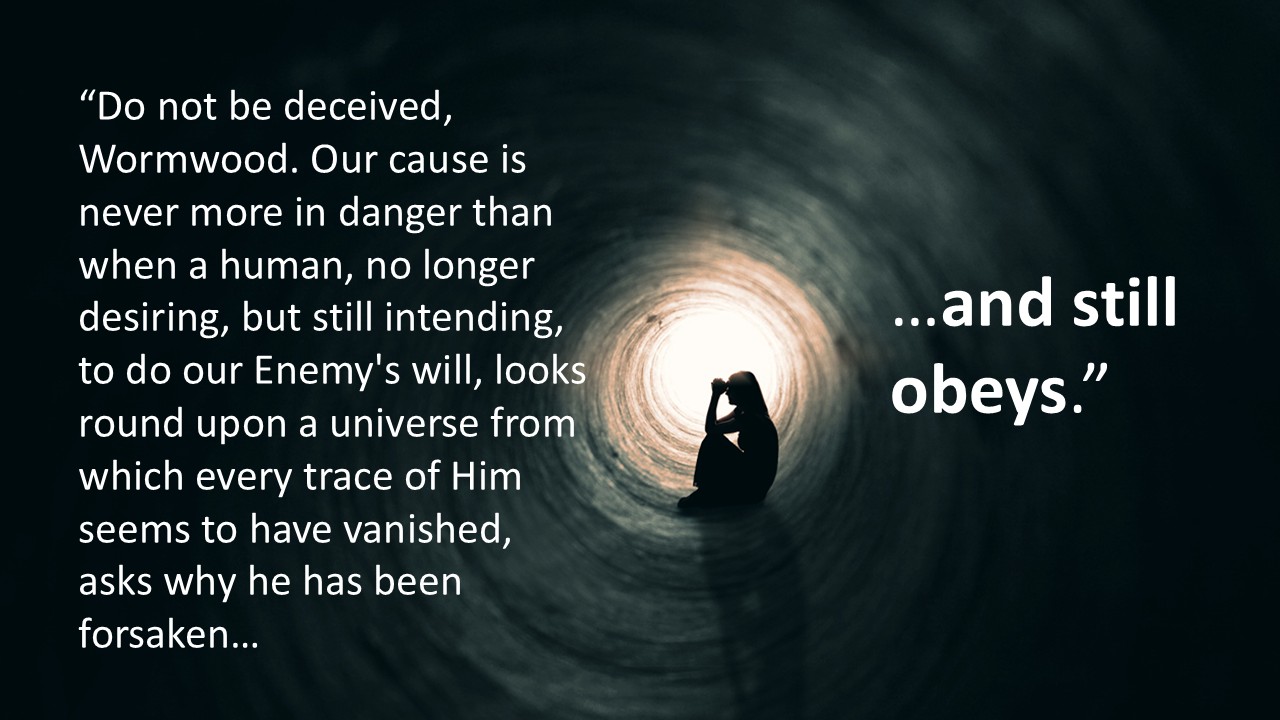
I shared this quote with you from C. S. Lewis from The Screwtape Letters. Let me finish it.
You remember where Wormwood is saying, “We’ve got this—we’ve got this Christian. He’s ours. He doesn’t want to go to church anymore, doesn’t want to pray anymore, doesn’t want to obey commandments anymore.”
And then his uncle writes—Screwtape writes this, in one of my favorite quotes:
“Do not be deceived, Wormwood. Our cause is never more in danger than when a human, no longer desiring but still intending to do our Enemy’s will”—that would be Jesus— “looks round upon a universe from which every trace of Him seems to have vanished, asks why he has been forsaken, and still obeys.”
If in those moments of complexity and perplexity, when God seems to have vanished from your universe—if you still follow Him—you will be bound to Him eternally forever.
I love that truth.
 Closing Remarks
I’ll skip this because of time. Although I do want to give a shout-out to my mission president and his wife, who are watching, participating through the webcast—President George and Kathy Jarvis. I love you two. So grateful for you.
What if in simplicity, at its core, is simply knowing that you can trust God?
And what if harmony is knowing that God can trust you?
I testify that the cost of that trust—and the associated light, peace, and power associated with it—can only be found and forged in the despair and darkness of complexity and perplexity.
And leave that with you in the name of Jesus Christ, amen.
