
FAIR is a non-profit organization dedicated to providing well-documented answers to criticisms of the doctrine, practice, and history of The Church of Jesus Christ of Latter-day Saints.
FAIR › Scripture Study Resources: Supplement Your Come, Follow Me Study › Study Resources for the Old Testament & Pearl of Great Price › Week 10 Let Got Prevail
Genesis 24-33
Her faith, generosity, and service prepared her to become part of the covenant family. This teaches us that God blesses marriages and families built upon selflessness and discipleship. (Genesis 24:18–20)
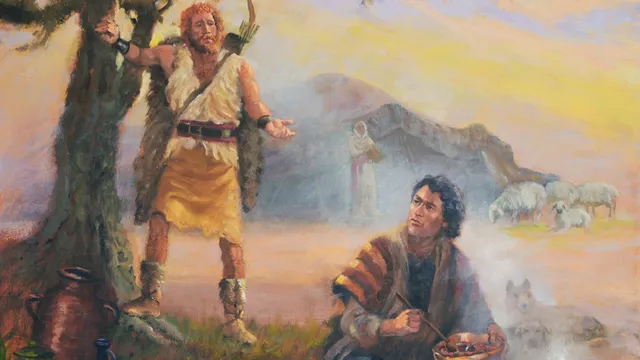
This tragic exchange teaches that prioritizing temporal desires over eternal blessings leads to regret and loss. God calls His covenant people to treasure eternal things above fleeting satisfaction. (Genesis 25:29–34)
His “ladder” dream symbolized the ascent toward God through covenant faithfulness. Like Jacob, we draw nearer to the Lord by valuing His covenants and worshiping in His holy house. (Genesis 28:16–17)
Jacob’s prayer and Esau’s forgiveness illustrate the power of God to heal family wounds. When we let God prevail, He can bring reconciliation, peace, and unity into broken relationships. (Genesis 33:4)
Jacob and Esau’s rivalry reflected cultural expectations that the firstborn son would receive the birthright, which included both property and spiritual leadership. Yet Esau’s disregard for the birthright (selling it for food) and Jacob’s later vision at Bethel showed that God’s covenant purposes are not bound by cultural norms but by faithfulness.
If you have questions on this week’s reading, please email your questions to us here.
Practical solutions for someone in faith crisis:
Action Step: Identify one “worldly distraction” that competes with your discipleship and choose to fast from it this week.
Esau’s choice to trade his birthright for a meal warns us against prioritizing short-term comfort over eternal promises. Choosing to step away from distractions helps us refocus on God.
Encouraging Thought:
Elder M. Russell Ballard taught, “Remember what matters most… Do not lose sight of eternal truths by being distracted by things that matter less.”
Action Step: Set aside one extended prayer session this week where you wrestle with God over a specific question, trial, or desire.
Jacob’s wrestle teaches that blessings often come after persistence and sincere effort. Wrestling with God strengthens faith, deepens humility, and brings greater spiritual clarity.
Encouraging Thought:
God is the source of all truth. You can learn for yourself—right now—how to receive personal revelation.
Jacob and Esau’s reconciliation shows that God can heal broken relationships when we approach others with humility and forgiveness. Allowing God to prevail brings peace and unity.
Encouraging Thought:
Objective: Teach learners to value eternal blessings over temporary gratification.
A bowl of stew (or picture), slips of paper, pens.
Activity Steps:
Follow-Up Question: What helps you keep eternal blessings at the top of your priorities?
Objective: Help learners see how persistence in prayer brings transformation and blessing.
A rope (for a light, safe “tug-of-war”), chalkboard/whiteboard.
Activity Steps:
Introduction (5 min): Have two volunteers do a brief tug-of-war. Ask: “What does it feel like to struggle with all your strength?” Relate it to spiritual struggles.
Scripture Discussion (5 min): Read Genesis 32:24–30. Discuss Jacob’s wrestle and the significance of his new name, Israel (“let God prevail”).
Application (5 min): Write “struggles” on the board (fear, unanswered prayers, doubts). Ask how persisting in prayer might invite God’s blessing in these areas.
Follow-Up Question: What does it mean for you personally to “let God prevail” in your wrestles?
Objective: Teach that God can help us reconcile and heal family relationships.
Two puzzle pieces or objects that fit together.
Activity Steps:
Introduction (5 min): Show two puzzle pieces apart and ask, “What keeps people from fitting back together after conflict?”
Scripture Discussion (5 min): Read Genesis 33:1–4. Discuss Jacob’s humility, Esau’s forgiveness, and how God prepared both hearts.
Application (5 min): Invite learners to think of one relationship where reconciliation is needed. Brainstorm possible steps to show humility, kindness, or forgiveness.
Follow-Up Question: How can the Savior help you take the first step toward healing a strained relationship?
President Russell M. Nelson, Let God Prevail (Oct. 2020 General Conference).
FAIR is a non-profit organization dedicated to providing well-documented answers to criticisms of the doctrine, practice, and history of The Church of Jesus Christ of Latter-day Saints.
We are a volunteer organization. We invite you to give back.
Donate Now