Presentation
Chris Blythe: I am so excited to be here with FAIR today. My talk is on the figure of Master Mahan, the first Master Mahan, Cain, and the legends of Cain in the Latter-day Saint tradition.
Who Was Cain?
In Genesis, Cain is the first murderer. He was cursed, exiled, and marked as a warning to others who might harm him. This was the end of his story in the Bible, but many additional readings of Cain, his crime, and his subsequent punishment developed over the course of centuries.
Cain became the father of monsters. In the words of the medieval Jewish text, the Zohar, “from [Cain] originate all the evil habitations and demons and goblins and evil spirits in the world.”
The Old English poem Beowulf identifies Cain as the progenitor of the monstrous Grendel—and, of course, Grendel’s mother too. That same era produced a tradition that Cain himself was not a son of Adam at all, but was the child of Eve and the serpent.
Retellings of Genesis are not uncommon in either the ancient or the modern world. In the Latter-day Saint Book of Moses, Joseph Smith’s expansion of the early chapters of Genesis, Cain murders his brother not out of jealousy, but at the behest of Satan.
In turn, Satan grants him the title of Master Mahan, placing him at the head of his mortal followers.
Cain in Early Latter-day Saint Thought
While Moses was the last of Joseph Smith’s scriptures to discuss Cain in any depth, Latter-day Saints quickly began exploring the significance of the first murder.
They did this by developing legends recounting Cain’s experience post-exile:
- wandering,
- the progenitor of a cursed race, and
- part of a satanic hierarchy in which he outranked Satan himself.
The early Latter-day Saint tradition was marked by this kind of scriptural innovation, both in the production of new texts and in oral speculation.
As literary critic Harold Bloom stated, Joseph Smith’s “religious genius” was his ability to be, “a great reader, or creative misreader, of the Bible.”
Scriptural Innovation and Institutionalization
This creative impulse toward traditional narratives has become rare among theologians and leaders in The Church of Jesus Christ of Latter-day Saints since about the close of the nineteenth century.
This is partly what Bloom meant when he wrote that “Mormonism no longer is Joseph Smith, but it was, from 1830 to 1890, the sixty years of its spiritual greatness.”
As the new religion became institutionalized, its founding “charisma routinized,” and, in sociologist Max Weber’s assessment, its creative and free-ranging interpretation of scripture likewise stabilized.
Those stories preserved in canonized scripture remain, but the faithful have come to view expansive scriptural interpretation skeptically.
This is not true of heterodox movements, particularly among those Latter-day Saints typically referred to as Mormon fundamentalists.
Purpose of This Paper
So, what am I doing in this paper?
First, I’m documenting the reception and expansion of Cain’s biblical narrative in early Latter-day Saint thought, and the later reception of this LDS Cain to the present.
Those of you familiar with my work will not be surprised to see that I include, and am eager to understand and document, schismatic Latter-day Saint communities and their interpretive traditions.
Nineteenth-Century Legends of Cain
The story of Cain is one of many singular expansions that held significance to early Latter-day Saints.
Cain first appeared in Latter-day Saint texts in the Book of Mormon, a scriptural work dictated by Joseph Smith and published in 1830. There, a shadowy conspiracy known as the Gadianton robbers initiates others into oaths and ceremonies which, according to Ether 8:15, “have been handed down even from Cain.”
Cain, Satan, and Secret Combinations
While in Genesis there is no discussion of the devil’s involvement in Abel’s murder—indeed, the devil is not even a central character in the garden narrative until later Christian readings—the Book of Mormon clarifies that “the devil did plot with Cain, that if he would murder his brother Abel, it should not be known unto the world.”
And “he did plot with Cain and his followers from that time forth” (Helaman 6:27).
Both of these threads—Cain as the founder of an ancient occult conspiracy, and Cain’s plotting with the devil—would become prominent themes in Smith’s second scriptural project, the “new translation” of the Bible.
Expanding Genesis: The Book of Moses
After completing the Book of Mormon, Smith revised and expanded major portions of Genesis with an eye toward clarifying difficult passages. He doubled down on questions of Mosaic authorship by inserting a preface presenting the creation account as a vision Moses had seen.
Moses resolved tensions between the two creation accounts of Genesis by explaining them as a spiritual creation followed by a physical one. Moses also placed seemingly anachronistic ideas about Jesus and the devil into the Garden narrative.
The Serpent, Satan, and the Fall
While the Book of Genesis provides no hint that the serpent was a devil or fallen angel, Latter-day Saints inherited a Christianized reading of the text.
Through the King James Version, they interpreted Revelation’s identification of Satan as “that old serpent” as an allusion to his role in the Garden of Eden.
The Book of Mormon echoes this language:
And because an angel of God had fallen from heaven and had become miserable forever, he sought also the misery of all mankind.
>Wherefore he said unto Eve, yea, even that old serpent who is the devil, who is the father of all lies, wherefore he said, partake of the forbidden fruit, and you shall not die, but you shall be as God knowing good and evil.
Satan’s Continued Influence in Moses
When Joseph Smith recorded an expanded version of Genesis, later called the Book of Moses, he made the devil’s presence in the Garden explicit, much as other rewritings of Genesis had done—the first of which seems to have been The Life of Adam and Eve, a text dating to sometime between the second and fifth centuries.
Unlike the Book of Mormon, Moses distinguishes the serpent from Satan:
“Satan put it into the heart of the serpent, for he had drawn away many after him. And he said unto the woman, yea hath God said, you shall not eat of every tree of the garden? And he spake by the mouth of the serpent.” (Moses 5:6–7)
In Moses, Satan’s involvement with humanity continued after the Fall.
While Adam and Eve sought to teach their descendants the messages they received from God, “Satan came among them saying, I also am a son of God. And he commanded them, saying, believe it not, and they believed it not. And they loved Satan more than God.”
Cain’s Offering and Satan’s Command
Cain, in particular, loved Satan more than God, and it was at Satan’s command that Cain brings his agricultural offering to sacrifice at an altar.
In both the original text and Joseph Smith’s expansion, Deity accepts an animal sacrifice offered by Abel, but rejects Cain’s offering.
Cain’s Offering and Divine Warning
The Book of Moses provides a new passage with an angel clarifying the importance of animal sacrifice to Adam, thus explaining the mysterious reason one sacrifice is deemed unacceptable while the other is well received.
In the words of Terryl Givens, “Cain’s offering is presented as a deliberate sacrilege rather than an innocent misstep.”
Joseph Smith’s retelling of the Genesis account expands on Deity’s short response following his rejecting Cain’s offering in the King James Version.
The relevant text reads simply:
If thou doest well, shalt thou not be accepted? And if thou doest not well, sin lieth at the door, and unto thee shall be his desire and thou shall rule over him.
Keeping in mind that Jewish commentators and scholars do not believe this passage alludes to a demonic figure, the Book of Moses pulls this initial text apart and stitches it together with additional language clarifying that God had referenced just such a supernatural being.
If thou doest well, thou shall be accepted, and if thou doest not well sin lieth at the door, and Satan desireth to have thee. And except thou shalt harken unto my commandments, I will deliver thee up and it shall be unto thee according to his desire and thou shall rule over him.
Moses’ expansion literalizes the passage.
For from this time forth, thou shall be the father of his lies. Thou shall be called Perdition. For thou was also before the world. And it shall be said in times to come that these abominations were had from Cain, for he rejected the greater counsel, which was had from God. And this is a cursing, which I will put upon thee except thou repent.
So this is God’s warning to Cain and the expansion of Genesis.
Cain’s Covenant with Satan
Genesis immediately moves from Deity’s criticism of Cain to the murder of his brother.
In Moses, Cain next encounters Satan, who he swears an oath of fidelity and secrecy, with the fallen angel promising him he would “deliver thy brother Abel into thine hands.”
And “Satan swear unto Cain that he would do according to his commands.”
Between this covenant and the murder of Abel, Cain declares his new position.
Truly, I am Mahan, the master of this great secret, that I may murder and get gain. Wherefore Cain was called Master Mahan, and he gloried in his wickedness.
Cain After the Murder of Abel
After killing Abel, God curses Cain with much the same wording as appears in Genesis. That is, with one fascinating interpolation.
Cain declares that:
Satan tempted me because of my brother’s flocks, and I was wroth also, for his offering thou didst accept and not mine.
His words echo Adam and Eve’s defense after eating the forbidden fruit—always blaming the other, right?
Interpreting Cain’s Pact with Lucifer
Latter-day Saints have offered two interpretations of the contract between Cain and Lucifer.
The first interpretation, championed by the theologian Hugh Nibley, held that Cain was making a typical Devil’s Pact, like Christopher Marlowe’s Dr. Faustus, or any number of other people who sold their souls.
Cain would “rule over the devil as his servant throughout his life in exchange for his immortal soul.”
Satan’s promise to “do according to Cain’s commands” and God’s warning that “Satan desires to have you” suggest this is a plausible reading.
(And I should confess, this is my preferred reading. This is what I think is being conveyed in this passage.)
A second, and vastly more influential, interpretation is that Cain outranked Lucifer in an infernal hierarchy by virtue of his having a body.
In the words of Joseph Fielding Smith—Latter-day Saint Apostle, and eventually Prophet:
As far as Cain is concerned, the information given is definite, that he became Perdition, and that Lucifer, who is Satan, became subject to him.
>It appears that the reason Satan desired to have him was due to the fact that Cain had obtained a body of flesh and bones, therefore had superior power, and Satan was willing to accept and be obedient to him because of that condition.
>The natural conclusion is therefore, that a devil with a body of flesh and bones has some power greater than one who is denied the physical body.
Ties to the Pre-Mortal Existence and the Plan of Salvation
This leads us to the essential Latter-day Saint mythology on the purpose of life, commonly called the Plan of Salvation.
The comment ties into the preexistence, right? Based on the teachings of Joseph Smith, Latter-day Saints believed that humans, angels, and gods are all one species in different states of development.
Before mortal birth, humankind existed as a vast family of spirits headed by a benevolent Heavenly Father and Heavenly Mother. These divine parents had already lived as mortals on a world sometime in the distant past. They had died, been resurrected, and after being deified now prepared their spirit children to become like them.
Joseph Smith on Becoming Gods
As Joseph Smith had declared only months before his death:
God himself, who sits enthroned in yonder heavens is a man like unto one of yourselves. That is the great secret.
You’ve got to learn how to be Gods yourselves, the same as all Gods have done.
During this premortal era, God announced that one of his children would serve as a savior to redeem the others.
In Moses 4, in a passage leading up to the Garden narrative—and without a parallel in Genesis—this scene is described:
Satan came before me saying, behold here am I send me, I will be thy son and I will redeem all mankind, that one soul shall not be lost. And surely I will do it. Wherefore, give me thine honor.
But behold, my Beloved Son, which was my beloved and chosen from the beginning, said unto me, Father thy will be done, and the glory be thine forever.
Wherefore because that Satan rebelled against me and sought to destroy the agency of man, which I the Lord God had given him, and also that I should give unto him my own power, by the power of mine Only Begotten, I caused that he should be cast down.
Bodies, Power, and Perdition
The most fundamental purpose of mortality was for spirits to obtain bodies. Lucifer, and those who sided with him instead of the premortal Jesus, would forever be deprived bodies.
On January 5th, 1841, Joseph Smith stated:
We came to this earth that we might have a body and present it pure before God in the Celestial kingdom. The great principle of happiness consists in having a body.
The devil has no body, and herein is his punishment. He is pleased when he can obtain the tabernacle of man. And when cast out by the Savior, he asked to go into the herd of swine, showing that he would prefer a swine’s body to having none. All beings who have bodies have power over those who have not.
The vast majority of what Latter-day Saints call the Sons of Perdition, those who ultimately don’t end up in any degree of heaven, are from this unbodied population of spirits. They chose Lucifer before this world. They were never born.
But it’s also a belief that one, such as Cain, might become a Son of Perdition after birth.
This theology is not wholly developed, but it is fairly consistent across various commentaries that even these beings will be resurrected and thus be embodied in the afterlife.
Neutral Spirits (Less Valiant Premortal Spirits) and the Offspring of Cain–Priesthood Ban
Traditionally, to identify the descendants of Cain is to allege that they share in his nature and in his curse. While the Book of Moses did characterize the descendants of Cain as black, there were no institutional restrictions on black members during the lifetime of Joseph Smith.
This changed in 1852, when Brigham Young first taught that the descendants of Cain would be deprived of the priesthood until after all of Abel’s descendants had the opportunity to receive it. This was the beginning of an LDS Church policy denying blacks ordination and temple rights that were so crucial to individual and familial practice within the tradition.
The End of the Priesthood Ban
This policy was officially ended in 1978, and the Church of Jesus Christ of Latter-day Saints has come to disavow the theology on race that existed in this early period.
Here’s from the Gospel Topics Essay today:
The Church disavows the theories advanced in the past, that black skin is a sign of divine disfavor or curse, or that it reflects unrighteous actions in a premortal life, that mixed-race marriages are a sin, or that blacks or people of any other race or ethnicity are inferior in any way to anyone else. Church leaders today unequivocally condemn all racism, past and present, in any form.
Premortal Neutrality as a Justification Narrative
One of the narratives that would be used to justify limits on black participation in the faith was a myth that people of African descent had sinned while still spirits in the premortal world. This story seems to have originated with the apostle Orson Hyde in the years after Joseph Smith’s death. He presented two versions of the story that year.
In a published version of a sermon delivered on April 27th, 1845, he wrote:
At the time the devil was cast out of heaven, there were some spirits that did not know who had the authority, whether God or the devil. They consequently did not take a very active part on either side, but rather thought the devil had been abused and considered he had rather the best claim to the government. These spirits were not considered bad enough to be cast down in hell and never have bodies, neither were they considered worthy of an honorable body on this earth.
Hyde then goes on to explain the idea of the curse of Canaan’s lineage based on his reading of Genesis 9.
Now, it would seem cruel to force pure celestial spirits into the world through the lineage of Canaan that had been cursed. This would be ill appropriate, putting the precious and the vile together. But those spirits in heaven that rather lent an influence to the devil, thinking he had a little the best right to govern, but did not take a very active part any way, were required to come into the world and take bodies in the cursed lineage of Canaan; and hence the negro or African race.
A Shift in Hyde’s Narrative
In a second telling of this narrative, Hyde abandoned the idea that blacks had been neutral in this primordial war. Instead, he posited that they had sided with Lucifer, but were not leaders in this cause.
They were not simply given black bodies, but were black spirits.
This is from Hyde:
In the council in heaven, when Satan rebelled, there were some who took an active part in the rebellion, but yet were too cowardly to be leaders in the rebellion with Lucifer and others.
You see that shift?
The leaders in the rebellion were hurled from heaven to hell and were doomed to remain without bodies, but the others whose crimes were not so great were cursed with blackness and became black spirits.
When Cain murdered his brother Abel on the earth, the Almighty cursed him and put a mark on him, or rather turned him black to give the black spirits a chance to come and take bodies like themselves. And the black spirits taking the black bodies made the negroes.
Both accounts make the same claim. Spirits with a sympathy or allegiance to Satan would be born in black bodies.
Disagreement Among Church Leaders
While this narrative was crucial for future stories of Cain, there was pushback among Church leaders and others.
For instance, Brigham Young openly rejected these ideas, insisting that it was not premortal behavior that deprived mortals of the privilege, but their descent from Cain.
We now know from the work of Paul Reeve, Christopher Rich, and LaJean Carruth that this was not necessarily a consensus opinion. Their new book quotes an Orson Pratt speech that declares:
We have no proof that the Africans are the descendants of old Cain who was cursed. And even if we had that evidence, we have not been ordered to inflict that curse upon that race.
What This Tells Us About Cain
Historicizing the priesthood ban and its justifying theology is interesting, and it’s important.
But I want us to pull back and ask what we can learn about the figure of Cain from this discussion started by Orson Hyde, and eventually largely accepted as an orthodox view in the 20th century.
Well, the answer is simple.
This myth positions Cain in his infernal leadership from before the world. Instead of focusing on secret societies, he is the natural ruler—the progenitor of Satan’s followers. Or at least these neutral spirits. These neutral spirits in this life.
Two Roles of Cain in LDS Thought
Now, I think Cain largely plays two roles in LDS thought:
- As Master Mahan, a Satanic leader; or
- As exile, cursed and suffering the penalty of God’s judgment.
Now, these are not contradictory images. Satan is also an exile and a leader.
While I want to spend most of my time fleshing out variants in the LDS story of Cain’s origins and destiny as a Satanic leader, we need to address this image of him wandering as an exile.
Cain as a Wanderer
Those of you familiar with my work, or who pay attention to LDS Legends, are going to be very aware that our earliest source of Cain as a wanderer in the Latter-day Saint tradition is the story of him appearing to David Patten.
This account is contained in The Life of David Patten, a little book that came out in the early 1900s. It includes a letter documenting a secondhand account of Patten’s experience coming back from a mission and seeing Cain along the road.
If you’re interested in that story, there is wonderful work done—certainly on our podcast, Angels and Seer Stones—but also Matt Bowman’s excellent article.
You can find it both in the Journal of Mormon History, where it first appeared, or in Between Pulpit and Pew, which collects stories that borrow from LDS Legends and provide historical context. A great book.
So that’s our earliest story of Cain as this sort of immortal wanderer. It’s definitely got a lot of legs and traction among Latter-day Saints. And there have been a variety of subsequent stories associated with him in that role.
Cain in the Satanic Hierarchy
Let’s return to the theme of Cain as a member of a Satanic hierarchy.
While the LDS Church has not done much with this idea, except to debate the meaning of the title “Master Mahan”, sectarian groups have continued to tug on this thread.
Mormon Fundamentalism and Cain’s Birth
I want to start by talking about how the tradition of Cain as leader has continued within the tradition of Mormon fundamentalism. We’re talking about communities that came together in the wake of the Manifesto—really, about thirty years after the Manifesto.
In the twenty-first century, most of the tens of thousands of contemporary adherents trace their beliefs to the ministry of Lorin Woolley. And this is important. In 1929, he organized a council to perpetuate plural marriage outside of the LDS Church.
The movement had already come to revere Woolley as a revealer of secrets and as a teacher of mysteries. Early fundamentalists considered one of Woolley’s stories so crucial that they referred to it simply as the Lorin Woolley story.
Lorin Woolley as a Revealer of Mysteries
As a young man, Lorin had served as a bodyguard for the president of the LDS Church, John Taylor, who was then in hiding from marshals eager to prosecute him for plural marriage.
He claimed to have been present in 1886 when a resurrected Joseph Smith, along with Jesus Christ, appeared to John Taylor and others to commission them to make sure that new children were born every year to plural families.
What we’re talking about today—creative interpretations of biblical history, specifically about Cain—and Lorin Woolley’s storytelling and biblical interpretation, were actually very expansive.
He frequently spoke as if he had knowledge of the personal lives of Church leaders and proceedings of the hierarchy’s confidential meetings. But he also talked about the Bible.
Woolley’s Expansive Biblical Storytelling
So, for instance, he told early fundamentalists that Adam had three wives and Jesus had eight.
He taught that Seth started the construction of the Great Pyramid (of course, this is the son of Adam, Seth). And that the son of Noah, Shem, completed the building of the Great Pyramid.
He told a story that Abraham had initially brought his son, Isaac, to be sacrificed as a penance for the treatment of Hagar.
“Serpent Seed” Doctrine
When it comes to the Cain narrative, Woolley also taught an idea that is typically referred to as the “Serpent Seed Doctrine.”
Most commonly today, it is associated with Christian Identity. This is, of course, a racist white supremacist movement who believes that true Jews are Europeans and other Jewish peoples are mere pretenders.
So this community has held onto the doctrine I’m about to talk about right now. But it’s actually an older idea that exists in less racist forms in other traditions, including early udaism—medieval Judaism, at least.
The idea usually suggests that Eve’s two sons, Cain and Abel, had two different parents. Whereas Adam had fathered Abel, the serpent in the garden had fathered Cain.
Early Fundamentalist Sources for Serpent Seed
The earliest allusion to this teaching among fundamentalists seems to be found in a special notebook of Joseph Musser titled The Book of Remembrance, in which he kept notes of Lorin Woolley’s teachings.
In an entry for January 23rd to 25th, 1933, he wrote simply: “nature of forbidden fruit—sexual.”
What does it mean for a serpent to give something sexual to Eve—a process that she then proceeds to give to Adam? They are imagining two sexual couplings.
Joseph Lyman Jessop’s Recollections
The next reference is from February 17th, 1938, and appears in a journal of Joseph Lyman Jessop. On that day, Jessop spent time with his “Uncle Rome,” who’s a man named Moroni, “and others, discussing points of remembrance of the sayings and instructions of John W. and Lorin C. Woolley.”
By this time, Lorin had been dead nearly four years, and his father—also an early fundamentalist leader, or at least a post-Manifesto polygamous leader—had been dead almost a decade.
Individuals like Moroni Jessop, who had known them both, were often asked to recall their teachings.
According to the journal entry:
“Uncle Rone retold us of Grandpa Woolley telling that Cain was a catch colt [illegitimate child]. Our thoughts are that Adam is not the father of Cain, nor does Abel and Cain have the same mother.”
Abel and Cain don’t have the same mother? That’s an interesting addition.
Arnold Boss Interviews Joseph Lyman Jessop
In 1942, Arnold Boss recorded an interview he conducted with Jessop. When he asked Jessop what the Woolleys had taught him about Father Adam, Jessop recalled that they both taught:
“Father Adam was the God of this earth.”
But then he recalled:
“On several occasions, grandpa told me, ‘Oh my boy, I would like to tell you certain things, but I can’t. I can’t. I expect that I’ll have to go over to the other side with my lips sealed.’ I was told, ‘When you once get the facts about the Garden of Eden, it will be all clear as mud. Did you ever hear about a catch colt?’ I said, ‘Yes.’ ‘Well,’ he said, ‘that is the kind of man Cain is. He was a catch colt. Father Adam was not the father of Cain. That devil was.’”
Joseph Musser on the Forbidden Fruit
A few years later, Arnold Boss—then incarcerated with other fundamentalists—asked prominent fundamentalist leader Joseph Musser to weigh in on this very issue.
He writes:
“In place of going outside after supper to walk around, I spent most of the time in Joseph’s cell. I asked him what the forbidden fruit was that Eve had partaken of.
I said some in early days claim it was the sex life. Others say it is not so. Joseph answered me saying, ‘It is the first.’ It’s about sex. And that Cain was not the son of Seth’s mother. He was another woman’s son. The father being the negative power.
As Adam and Eve came here, resurrected beings, and begat flesh and bones for their children, so the negative power (Devil—not Lucifer who fell) [we’re gonna talk about that], an immortal being, came and multiplied. Cain was a catch colt. There are two powers; there are two eternal powers, both over there and here. And so they exist upon all worlds. Two powers exert themselves to exalt and try man.”
All right—so we have this oral tradition going around for about fifteen years among fundamentalists that Cain is the descendant of the serpent.
That Eve—or perhaps one of the Eves—had a sexual relationship with a physical demon that produced this offspring that was Cain.
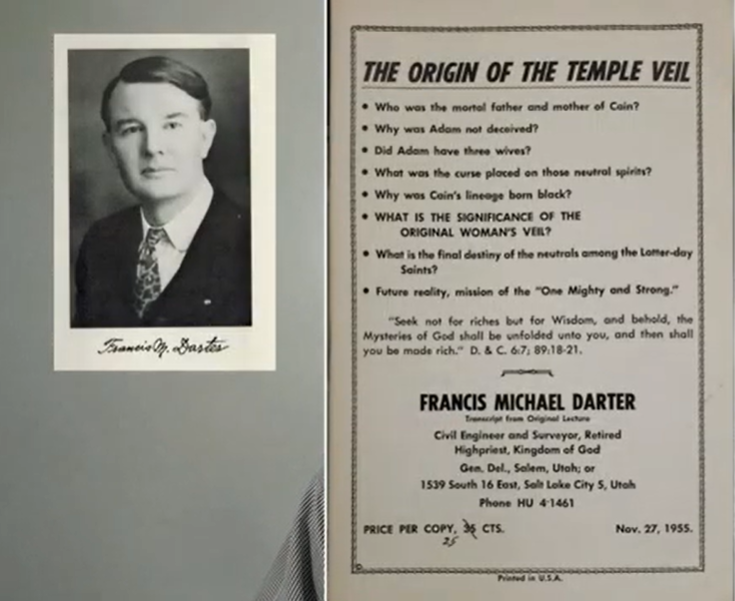
Francis M. Darter and Neutral Spirits
Francis M. Darter was a mid-century fundamentalist theologian. He wrote a fascinating pamphlet that claimed it would answer the question of “the identity of the mystery father and the mother of Cain.”
Darter believed that until his writing this pamphlet, “God had evidently seen fit to keep this story out of print.”
He pointed readers to the legend of neutral spirits who “truly loved Lucifer and his gospel plan of force as much as they loved their own Father Michael, if not more.”
After what Darter suggested was “tens of thousands of years,” which he said was according to Joseph Smith, “supporting and preparing them for their mortality . . . these neutrals to turn their faces towards Lucifer and their backs upon Him, withdrawing their love and support from their God Father, when he needed them most, and they Him, was truly enough to cause Him to lose all interest or desire to Fatherhood or to sire them into mortality.”
So, in other words, there are these neutral spirits, and God is so upset that they don’t have his back—in this language—that he says, “Well, I’m not gonna give them bodies.”
Remember, this is playing off of an Adam-God idea, where God himself is gonna provide physical bodies for them. And here he says, “No way.”
Reading from Francis M. Darter
So I’m gonna read a full page from Darter’s talk so you can get a feel for what he’s claiming.
So our Father conceived a way through his beloved Eve and her sister wives, Sarah and Lilith, who—i.e. Lilith—according to records, was the world’s most beautiful mortal woman. . . . Now, it was through Lilith that these neutral spirits were divinely planned to be born into mortality. In plain words, God gave them Satan and their co-father Lucifer, the so-called serpent, for their basic mortal father, the one they most honored.
But Lucifer, the devil, was greatly handicapped in his becoming their mortal father, for he too was only a spirit man in his first estate, unable to have children, having no tangible body.
So Lucifer is unable. He goes on to say, however—
. . . Lucifer can enter the body of a mortal or animal and can control their actions.
Therefore, spirit Lucifer and mortal Satan, knowing Father Michael Adam’s desire not to be the mortal father of these unworthy, neutral spirits, who later became the black race of our earth, sought a way, say holy records, through a very subtle, intelligent creature, also called the serpent. One who walked on legs and had hands and could speak the Adamic language. A creature that he, Lucifer, found favor with and greatly desired himself becoming the co-father with this creature of their proposed son, Cain, and his lineage.
Darter’s Logic Explained
So Lucifer is the spirit child of God who wants to influence and bring this lineage of the unfaithful to earth. Adam’s not interested in doing that.
Lucifer wants to do that, but he can’t find a way to do it, so he finds a physical creature that could, called the serpent—and this is Satan.
This creature was no other than Satan, the father mortal devil of the Elohim Kingdom, who still lived in mortality and was forced to roam about. His position was the same as the father devil of our earth—Cain—the Satan of our world, who still lives.
Hence: this mortal Satan of the Elohim Kingdom (that is the kingdom where Michael, the Archangel, father, God of Earth came from) is the actual father in person of Cain, and Lucifer the co-father.
We have co-pilots.
. . . Now, devils are not resurrected. When God makes full use of them—they eventually face death and dissolution.
Hence, it took this mortal Satan of the Elohim Kingdom to be the actual father of the devil of our world, known as Cain. And Cain will be forced to live until he becomes the father of devils of other worlds of Michael’s kingdom.
Adam–God Logic and Cain’s Previous Mortality
So this logic is based on Adam-God logic, right?
And ideas of Adam-God, as initiated by Brigham Young and continued through mainly fundamentalist theologians in the last hundred years, include the idea that part of deification is providing physical bodies for your future children.
So Adam received his exaltation. He had an exalted body, came to an earth, and then he partakes of this fruit. And it becomes a mortal body—enabling him to have offspring. But he came from another world.
And in this case, Lucifer is a spirit, but there is a figure named Satan who went through a previous mortality as Cain. He went through a previous mortality as Cain.
Because he was cursed with immortality, he didn’t die, and thus he can be brought from that previous world—brought right into the Garden of Eden as the serpent—thus able to procreate his lineage, or continue his lineage, through Eve, who’s brought from this other world as well.
Lilith, Eve, and the Serpent
According to Darter’s narrative, while Adam approved the relationship between the serpent and Lilith, one of his wives—and that it allowed him not to father neutral spirits—he was angered by the serpent’s subsequent attempt to beguile Eve.
This was the impetus of the serpent’s curse, in which he
“turned this mortal Satan spirit into the body of a crawling serpent, forcing death, in due time, upon Satan’s mortal body.”
That is, the actual curse given to the serpent is the dissolution of the body that he received in his previous mortality.
Darter on Lilith and Plural Marriage
Darter had more to say about the goddess Lilith. He argued that Genesis’ depiction of Adam and Eve as monogamous was intended to hide the practice of plural marriage from an unworthy world.
Darter identified Adam’s three wives as Eve, Sarah, and Lilith—replacing Woolley’s identification of Eve, Sarah, and Phoebe. Lilith was, of course, Adam’s wife in Hebrew folklore.
Lilith did not knowingly have an affair, but her
“divine mind was closed, leaving only mortality, and she could not see as clear in that certain mortal act.”
Curiously, Darter also claims that Cain was evidently the spirit child of Lilith.
It’s probable that Darter is implying what another Mormon fundamentalist theologian, Fred Collier, stated directly—when he proposed that Lilith had once been the bride of Satan.
Collier explained:
Of course, now for those of us in Mormon theology, we can believe that Satan lost his wife. Adam was God, so, you know, Satan lost his wife to Adam, and through that preserved this race on the earth for a purpose.
Lilith as Lucifer’s Bride
The idea is pulled from Mosiah Hancock’s vision in which all of the premortal spirits are created in pairs.
Everybody has a soulmate except the Sons of Perdition—and there were only male Sons of Perdition, not daughters of Perdition. Those daughters were then given new husbands.
And so the idea is that Lucifer’s bride is Lilith, given to God.
In this reading, Satan came to the garden as the serpent, in part to reclaim his wife. (Now, it’s a little different in Collier’s reading because Satan is the physical being from another world—not Lucifer.)
And it’s a little different because Satan (the serpent’s) wife is Lilith, and he’s able to come to this world with a physical body and try to reclaim his wife.
Reverse Trinity
It seems pretty common in fundamentalism for there to be these three beings—that there is Satan, Lucifer, and Cain.
- One of those is an unembodied being,
- One is the Cain from a previous world, and
- The third is the mortal Cain in this world.
And so it’s sort of a reverse Trinity.
- You have this disembodied figure—which for Darter was Lucifer—and that’s sort of the presiding rank in that one.
- Then you have a physical one named Satan.
- And then you have the alternative Christ, who is Cain.
(It’s different, though, because under Collier, Satan seems to play the role that Lucifer played in the other version.)
But it’s usually these three figures.

Alexander Joseph and the Two Cains
I’m gonna read you another quote that’s interesting about this. This is from another fundamentalist that was popular in the 1970s named Alexander Joseph.
Joseph used the language of “arc-angel” for Michael, explaining:
“Because he arced from another place to this earth” is why we call Michael an archangel.
He similarly called the serpent an “arc-devil,” who
“followed [Michael] to this earth.”
Joseph names the Serpent Cain, acknowledging his identity on this earlier world.
The Serpent Cain (who Darter had called Satan)
“seduced Lilith, who was an ‘Eve,’ and generated a child after his kind. Cain’s offspring received his father’s name (i.e. Cain).”
So Cain of our world is ‘Cain Jr’. By including two Cains in this version, Joseph was able to make sense of an accounting of Cain’s death in the Book of Jasher, in which Cain is mistaken for a wild animal and killed.
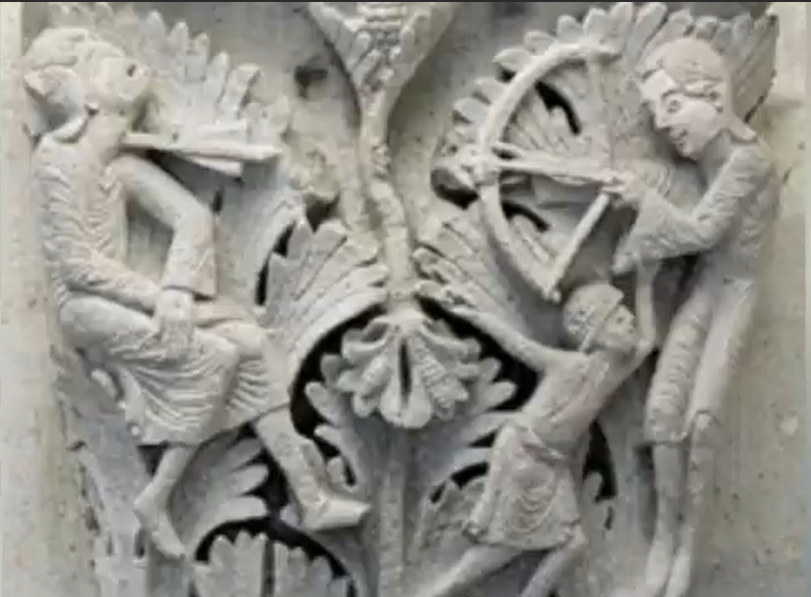
Cain, the Serpent, and Immortality
As in Darter’s telling, the serpent was able to die after the curse he received in connection with attempting Eve.

However, Alexander Joseph explained that the biblical Cain
“is still alive and mostly goes about at night and keeps his eye on the moon.”
While I’m uncertain why Joseph points out that Cain’s attention is to the moon. His nocturnal lifestyle clearly is pointing to a sort of monstrous nature. It’s werewolf-like. Right? And of course, the wanderer is that ongoing feature.
Almost like he’s a satanic leader-in-waiting for the next world. Unlike Cain Sr., who momentarily gets to do something in the Garden and then eventually be killed.
So this idea that Satan is from a previous world, and that Cain himself might be the origin of how a being from a previous world might have a body, shows up very frequently in fundamentalism.
The Reverse Trinity Revisited
The idea of this reverse Trinity is not uncommon—certainly in independent fundamentalism, certainly in early fundamentalism.
But mainstream groups, like the Apostolic United Brethren, hold to this basic idea that the devil is of a previous world, and that devils themselves have bodies—Sons of Perdition from before.
It is a fascinating idea, and as told as a story of Cain, certainly relates to our paper.
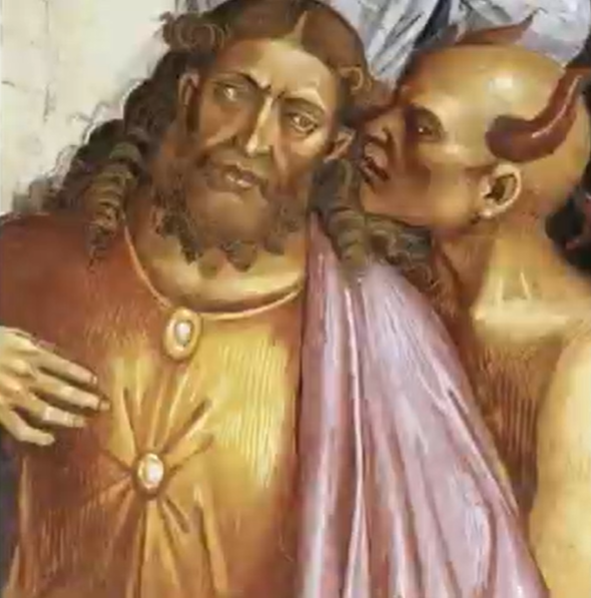
The Man of Sin
I want to conclude by just briefly mentioning Cain as the Man of Sin of Second Thessalonians.
Now, typically, any of the references to:
- the Man of Sin, or
- the Antichrist, or
- the Beast
Latter-day Saints are reading as symbolic of:
- Roman persecution,
- persecution in general, or of
- the Great Apostasy.
God revealing the Man of Sin is God revealing the apostasy—
- through the Book of Mormon and
- through prophets in our day
- through the Restoration.
But in a literal reading, looking for this Man of Sin, we have a variety of groups who have tried to identify this person as modern incarnations of Cain.
- Whether it’s through reincarnation, as the early Morrisites suggested.
- Whether Charles B. Thompson believed that Cain was the literal embodiment of the spirit of Lucifer allowed to be born on earth.
There’s a variety of ideas. But usually this leads to an immortal Cain eventually intruding on the temple to declare himself God—as a sort of emergence of the Antichrist. This is not an idea that’s caught on in mainstream circles.
But you can see this sort of Cain, as continuing head of a conspiratorial group, does show up occasionally.
Conclusion
Most of us—most Latter-day Saints—probably are of the idea that Cain died before the flood.
But documenting these different ideas, for me, highlights just how interesting our faith is. That the biblical record is open, both:
- as a text that can be added to through additional scripture,
- but also that speculative readings—and maybe unusual interpretations—have traditionally been invited. In the generation of Joseph Smith and thereabouts.
Thank you so much for your attention.
