Lessons on Doing Apologetics
John Gee: Thank you. I’m almost as surprised to be speaking to you, as you are to have me addressing you. If I’m looking over my shoulder a lot, it’s because I don’t have a screen to see what my slides are, and so I’m having to see. And I don’t have a written talk, so when they say to always be ready to have an answer, hopefully I’ve got one.
So my topic here is lessons on doing apologetics. There’s a little story behind this that will figure into what I’m doing. A couple months ago, my attention was drawn to a work by a novice apologist who is trying to do apologetics, and like many people who are new, he made some mistakes.
I am going to actually quote him to show that I’m not making this up, but I think there’s some lessons that we can learn. And so if you’re just starting out, then maybe we can give you some lessons on how to do things better. 
Lesson One: Why Are You Doing This?
So the first lesson that comes in doing apologetics is, why are you doing this? Now all of us have personal reasons that we may have for doing this. There are also some other reasons that we might have for doing apologetics.
The obvious one: 1 Peter 3:15, “To be ready always to give an answer”—and the Greek term there is apologia—“to every man that asketh you a reason of the hope that is within you with meekness and fear.” I can understand the fear a lot, because you don’t know necessarily how your answer is going to be received. 
Other ones: Doctrine and Covenants 123. I won’t go through all of it, but Joseph Smith says it is an imperative duty to do apologetics.
The famous quote by Austin Farrer:
Though argument does not create conviction, lack of it destroys belief. What seems to be proved may not be embraced, but what no one shows the ability to defend is quickly abandoned. Rational argument does not create belief, but it maintains a climate in which belief may flourish.”
You need to have an answer because if you don’t, it will be abandoned.
It is a Duty
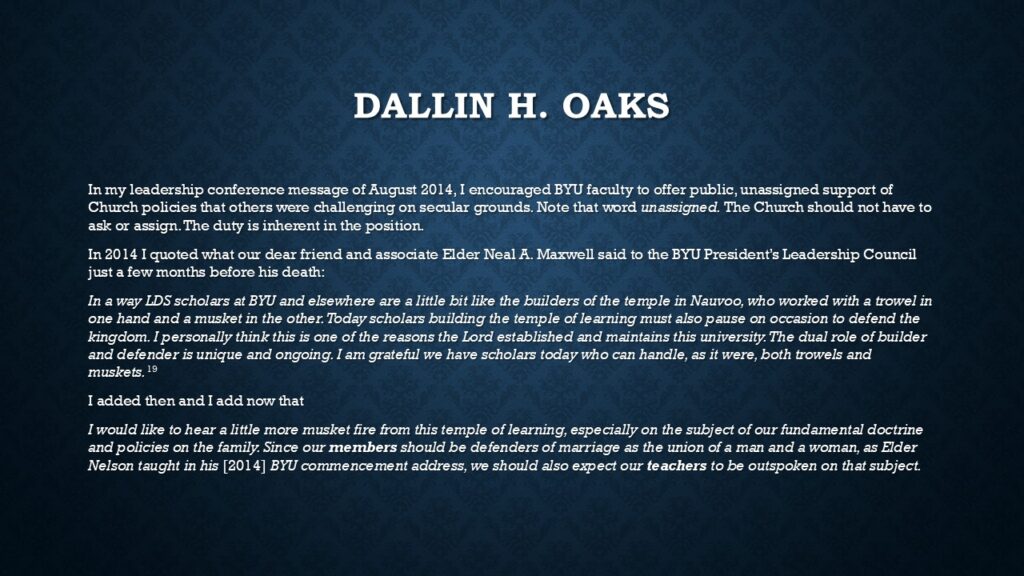
Elder Oaks also talked about how it is an unassigned duty. He was addressing this to BYU faculty and administrators, but says—I’d like to hear a little more—quoted Elder Maxwell that building the Nauvoo Temple, you needed both people who built and occasionally who wielded both trowels and muskets. And Elder Oaks, just before he became President Oaks, said, “I’d like to hear a little more musket fire.”
We ask you as part of a larger game plan to always keep a scholarly hand fully in the face of those who oppose us.”
 And this one from Christian Smith, who isn’t a member of the Church:
Sustaining belief commitments to ideas and practices that are difficult and costly requires an account or narrative that satisfactorily explains to neophytes and doubters the reality and reasons behind the belief commitments themselves.”
So discipleship is both difficult and costly, and we need to have an account of it to explain to people who are new, or to doubters, why we’re doing this.
So the novice whose work I’d picked up on picked up on this random fact: according to one survey, 36.5 percent of those who left the Church said that they left because they stopped believing there was one true Church. That’s the issue, and so we’ll deal with this issue as an example.
Lesson Two: Know What the Church’s Position Is
Lesson number two: know what the Church’s position is. So before you go in responding, make sure you know what the Church actually teaches about this.
1970s
So in this case, let’s go through a few quotes from the 1970s. Marian G. Romney:
Not only did the Redeemer personally name His Church The Church of Jesus Christ of Latter-day Saints, as recounted already, He also declared it to be the only true and living church upon the face of the whole earth, with which I, the Lord, am well pleased.”
Okay, so there’s this statement from the seventies.
1980s
From the eighties, Bruce R. McConkie:
At the direction of the Lord, Joseph Smith organized the only true and living Church on earth. The Church is an organized body of true believers. It is the congregation of those who have accepted the holy gospel, and the gospel is the plan of salvation. The higher priesthood administers the gospel. The Church is the vehicle through which the Lord’s affairs on earth are regulated and through which salvation is made available to all who believe and obey.”
It lays out some of the grounds, besides quoting the relevant scripture in Doctrine and Covenants 1.
Statements from the 1990s, 2000s, and 2010s
The 1990s
I wish that each of you would remember that tonight you heard me say that this Church is true. Other churches also do much good, but this is the true and living Church of the Lord Jesus Christ, whose name it bears. Be true to it. Cling to it. If you will do so, it will become as an anchor in the midst of a storm, you see. It will be a light to your lives and the foundation upon which to build them. I give you my solemn testimony that this Church will never be led astray.”
2000s
So in the 2000s, Elder Packer:
Each can receive assurance which comes through inspiration and testifies that Jesus is the Christ, the Son of God, that The Church of Jesus Christ of Latter-day Saints is just as declared to be the only true and living Church upon the face of the whole earth.”

Note this scripture keeps coming up.
2010s
And finally, the 2010s. To pick a sample, one of the junior apostles, Elder Gong:
The world is in commotion, but in His only true and living Church there is faith and no fear.”
There is a consistency in how the Brethren have interpreted this scripture.
So, this is the scripture where Jesus declares that this Church is the only true and living church upon the face of the earth, “with which I, the Lord, am well pleased,” speaking unto the Church collectively and not individually. 
Lesson Three: Be in Line with the Church’s Position
Lesson three: be in line with the Church’s position once you know what it is.
So, our novice claimed that the Church’s position seems to be “the hybrid epitome of naivety and arrogance,” and that it made others grow apprehensive and, if not amused, aggravated. And we might ask how this is in line with President Hinckley:
This is The Church of Jesus Christ of Latter-day Saints, the only true and living Church upon the face of the whole earth. A minister said to me, “It is egotistical to say that.” I said, “I didn’t say that. The Lord said it. I am only quoting.” “This is The Church of Jesus Christ of Latter-day Saints. We can and must recognize the good in other churches and in other people. We can disagree without being disagreeable. We must be tolerant. We must work with others who are engaged in good causes to bring about good results. But we must never lose sight of the fact that the God of heaven brought forth this work in this dispensation of the fulness of times and that His true Church might be upon the earth.”
Responding to the Novice Claim
The novice also claimed being the only church religion is implausible. After all, a considerable portion of the thousands of churches and religions of the world understand themselves to be the singular or best or most complete path to salvation or enlightenment.
Elder Packer:
They claim that one church is not really better than another, just different. Eventually the paths will converge. One is therefore quite as safe in any church as in any other. While this seems to be very generous, it cannot be true. While the convergent path idea is very appealing, it really is not reasonable.
Suppose schools were operated on that philosophy, with each discipline a separate path leading to the same diploma. No matter whether you study or not, pass the test or not, all would be given the same diploma, the one of their choice, without qualifying. One could choose the diploma of an attorney, an engineer, a medical doctor. Surely you would not submit yourself to surgery under the hands of a graduate of that kind of school.
But it does not work that way. It cannot work that way, not in education, not in spiritual matters. There are essential ordinances, just as there are required courses. There are prescribed standards of worthiness. If we resist them, avoid them, or fail them, we will not enter in with those who complete the course. Do you realize that the notion that all churches are equal presupposes that the true Church of Jesus Christ actually does not exist anywhere?”
Lesson Four: Be in Line with the Data
Lesson number four: be in line with the data. 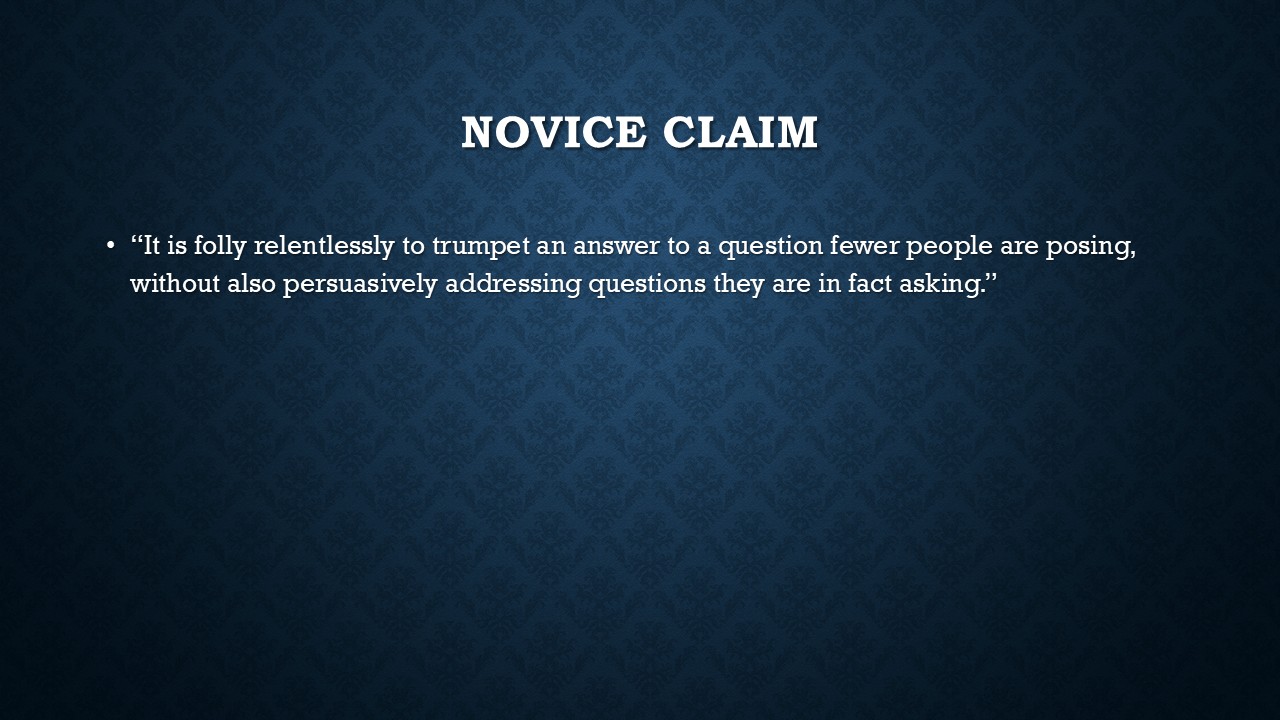
So the novice claims it is “false folly relentlessly to trumpet an answer to a question fewer people are posing without also persuasively addressing questions that they are in fact asking.”
Well, are they not posing this question?
Turns out there’s some data on this. This March, they released the fourth wave of the National Study of Youth and Religion, and so we can analyze that data. These are religious adherents by religion who believe in only one true religion. 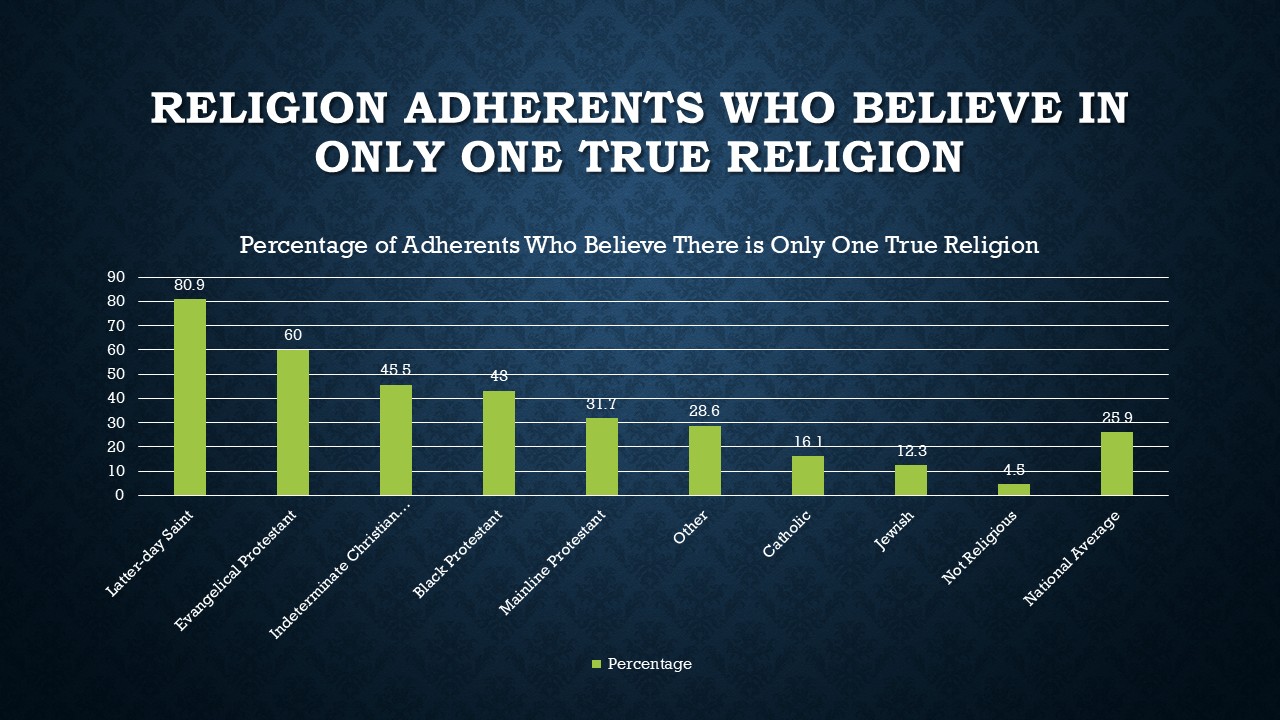
Of course, Latter-day Saints at the top is 81.9 percent, but evangelical Protestants—60 percent of them believe that they’re the only true religion. And even if you go look down at the Jewish number, one out of eight millennial Jews believe that theirs is the only true religion.
So still one out of eight are thinking about this issue in that way. It doesn’t mean that this is suddenly irrelevant. The data just doesn’t support that. 
Lesson Five: Remember That Christ Is the Head of the Church
Moving on to lesson five: remember that Christ is the head of the Church. 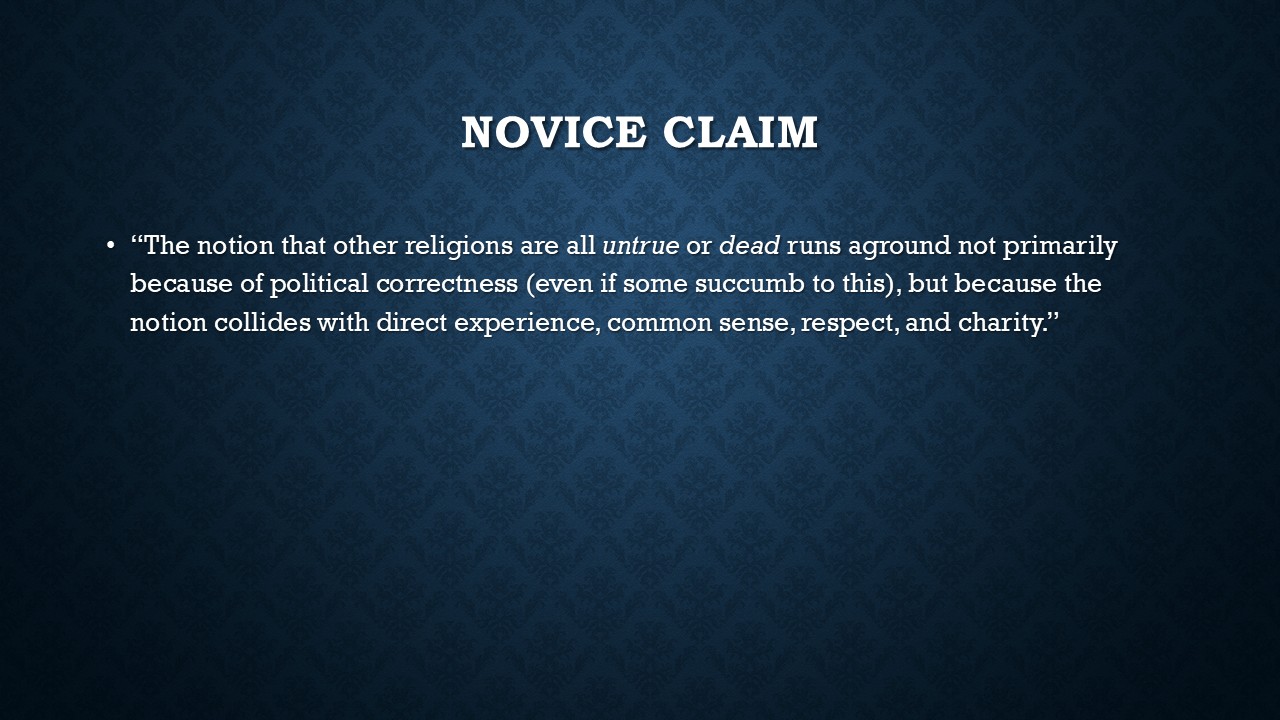
So the novice claims, “The notion that other religions are all untrue or dead runs aground, and not primarily because of political correctness—even if some succumb to this—but because the notion collides with direct experience, common sense, respect, and charity.”
Well, charity is the pure love of Christ, and it’s Christ who said that this is the only true and living Church.
Is this implying that this person has more charity than Jesus Christ?
I have a hard time swallowing that one.
Remember, this is what Jesus said in Matthew 10: “The disciple is not above his master, nor the servant above his lord. It is enough for the disciple that he be as his master and the servant as his lord.”
Remember that we want to get to the point where our lives approximate—where our character traits approximate—those of Christ. But we’re not going to outdo Him.
Lessons Six and Seven: Be Careful with Assumptions and Sources
Lesson six: be careful about your assumptions.
And along with this, lesson seven: understand your sources and use them properly. 
So our novice wants to explain the passage in Doctrine and Covenants 1—“this is the only true and living church”—by a passage in a letter from Joseph Smith to Emma in 1832, where Joseph Smith closes the letter saying, “You must comfort yourself knowing that God is your friend in heaven and that you have one true and living friend on earth, your husband Joseph Smith Jr.”
And that’s the Joseph Smith Jr. signature at the bottom of the letter.
You could punctuate this differently depending on your understanding of that, but Joseph Smith as the one true and living friend. 
So the assumption that the novice has made assumes that Joseph Smith, and not Jesus Christ, is the author of Doctrine and Covenants 1, even though Doctrine and Covenants 1 is pretty specific about that—even in this passage. 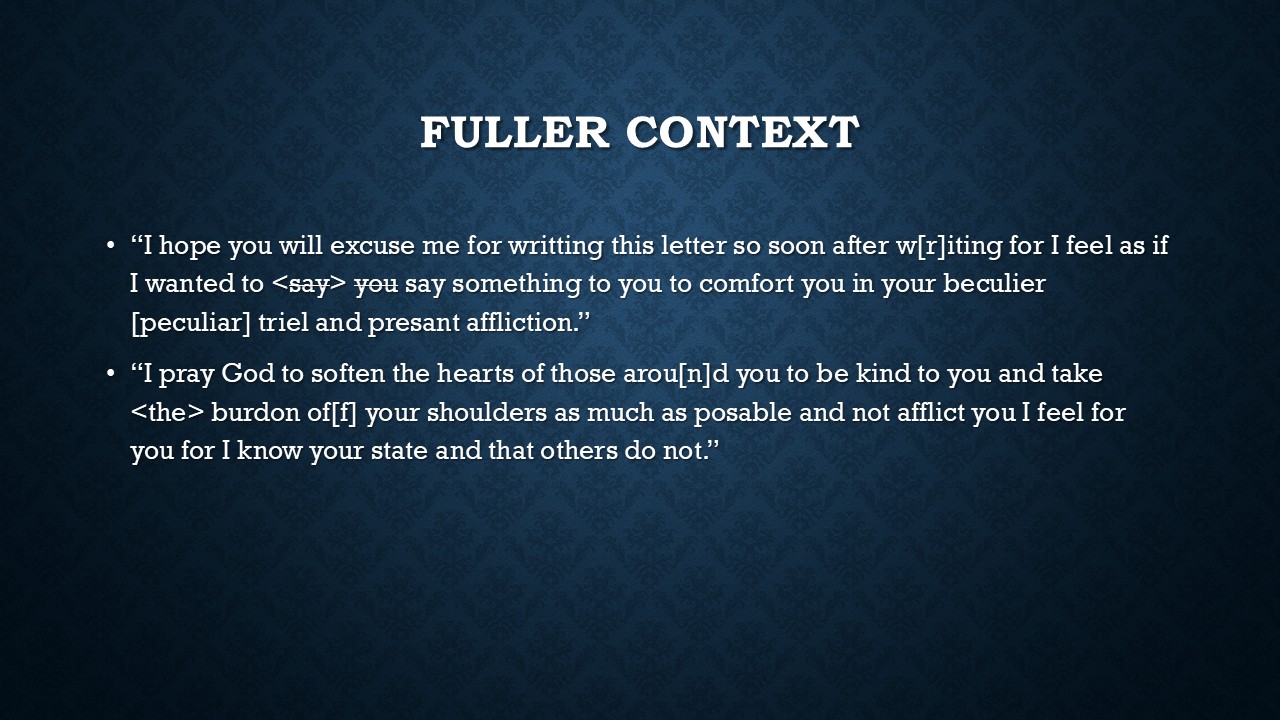
Understanding the Context of Joseph Smith’s Letter
If you look at the fuller context of this letter, Joseph writes to Emma: “I hope you will excuse me for writing this letter so soon after writing one.”
One of the things that’s interesting is we’re missing the previous letter, because the only letter that survives is months before this.
“For I feel as if I wanted to say something to you to comfort you in your peculiar trial and present affliction.”
Emma’s having a hard time.
He later says, “I pray God to soften the hearts of those around you to be kind to you and take the burden off your shoulders as much as possible and not afflict you. I feel for you, for I know your state and that others do not.”
So when Joseph Smith says that he is her “only true and living friend,” after mentioning God—God knows her troubles, and God can help her—but on earth only her husband knows the troubles that she’s suffering at that time. And so he is a true friend to her in that sense and would be there to comfort and help her if he could.
And “living,” (meaning in this case mortal) because while God knows her troubles and Joseph Smith does her troubles, he’s the only one who is in the mortal sphere at the time and thus can describe himself as living.
The Importance of Context
So Joseph Smith, in this letter, is using “true and living friend” very differently than the Lord is using it in Doctrine and Covenants 1 for “true and living church.”
So the assumption there about who is speaking in each case is important, and you need to make sure you know the sources and the context that they actually are giving. 
Lesson Eight: Where Will This Lead?
Lesson number eight: where will this lead?
Where will your efforts lead to? Can you predict some of that?
So our novice was arguing that the Church really isn’t the only true and living Church. Well, where does that lead?
As President Oaks says:
“As we see threats creeping up on persons or things we love, we have the choice of speaking or acting or remaining silent. It is well to ask ourselves, Where will this lead? Where the consequences are immediate and serious, we cannot afford to do nothing. We must sound appropriate warnings or support appropriate preventive efforts while there is still time.”
Using the National Study of Youth and Religion
Fortunately, the National Study of Youth and Religion asked the question: Which best describes your view of religion?
- There is one true religion.
- There are many true religions.
- There is no true religion.
So they ask the question, and because they’ve released the data, we can plow through this. We can look at how this interacts with other facets that they ask questions about.
We’re going to look at the effects of this on beliefs and then later behavior, because we have this very rich database that we can look at. I’ve gone through and analyzed the data on this material.
Just a little word of caution: what we’ll show are a lot of correlations. Correlations aren’t necessarily causation.
We’ll kind of look at this from two different angles. One of them is that teaching the Church is the only true Church—what effect that has—even though we don’t know if this is necessarily a cause-and-effect relationship.
So remember that caveat as we go through some of these numbers. 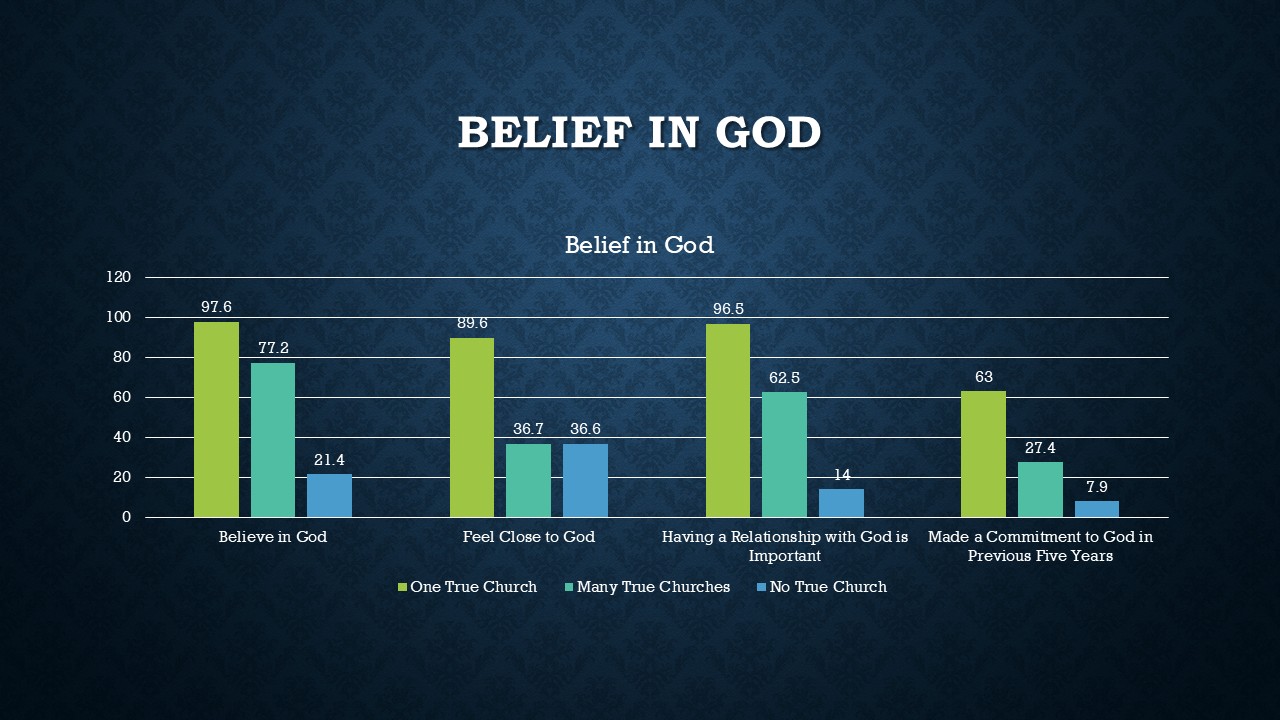
Effects on Belief in God
Let’s look at beliefs.
Belief in God: on each of these three bars, the one on the left is those who believe there is one true church, the one in the middle is those who believe there are many true churches, and the one on the right is the one that believes there are no true churches.
If we look at belief in God, 90 percent of those who believe there’s one true church believe in God. Whereas those who believe there are many true churches, it’s a little less true. And those who believe there are no true churches—not so much.
Whether they feel close to God—this is interesting, because if you don’t believe there’s one true church, it’s pretty much the same whether they view having a relationship with God as important.
And whether they’ve made a commitment in the previous five years to God—you can see that those who believe there’s one true church, the majority of them will have made a commitment to God in the previous five years, whereas those who don’t are most likely not to have.
If we’re looking at this from a causal point of view, if you change your belief on one true church—if that’s causal—then we can expect degradation on all of these stats if we abandon that. 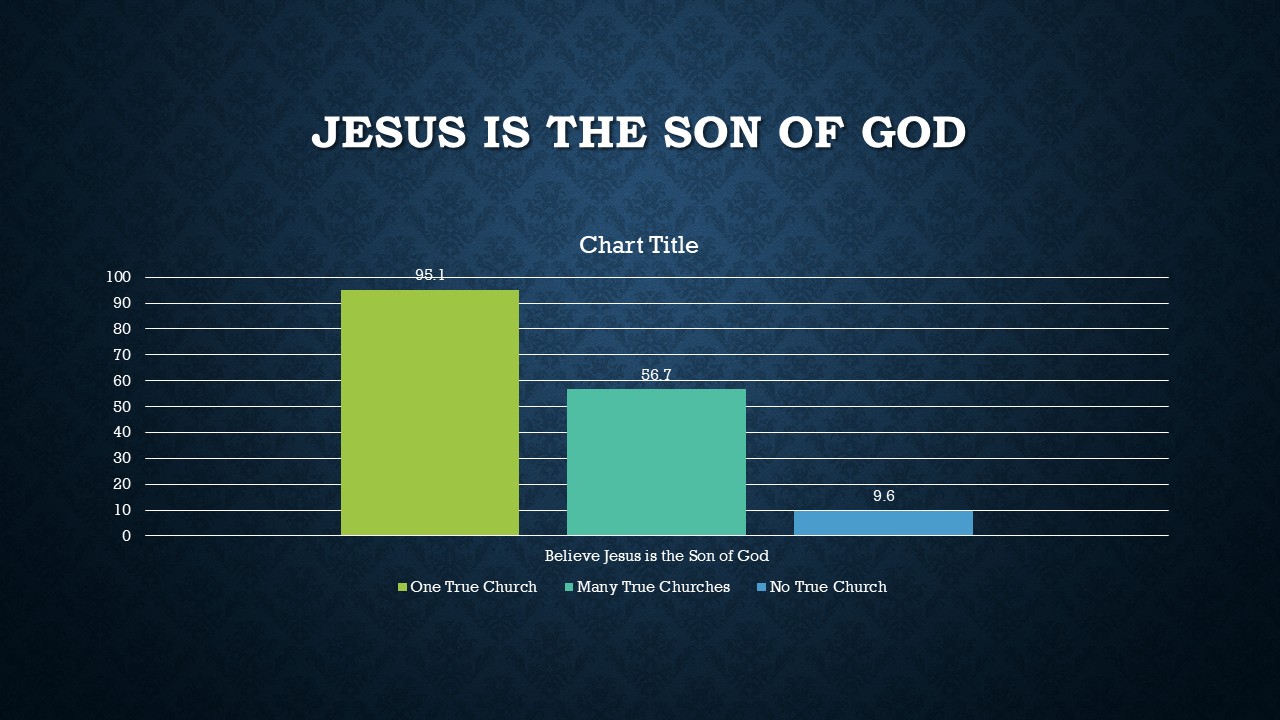
Beliefs About Jesus, Prayer, and Miracles
Is Jesus the Son of God?
Well, 95.1 percent of those who believe there’s one true church said yes, and there are significant drops if they don’t.
Belief in prayer and miracles: 79.6 percent of those who believe there is one true church experienced an answer to prayer in the previous five years. 91.5 percent believed in miracles, and 64 percent had witnessed a miracle in the previous five years. 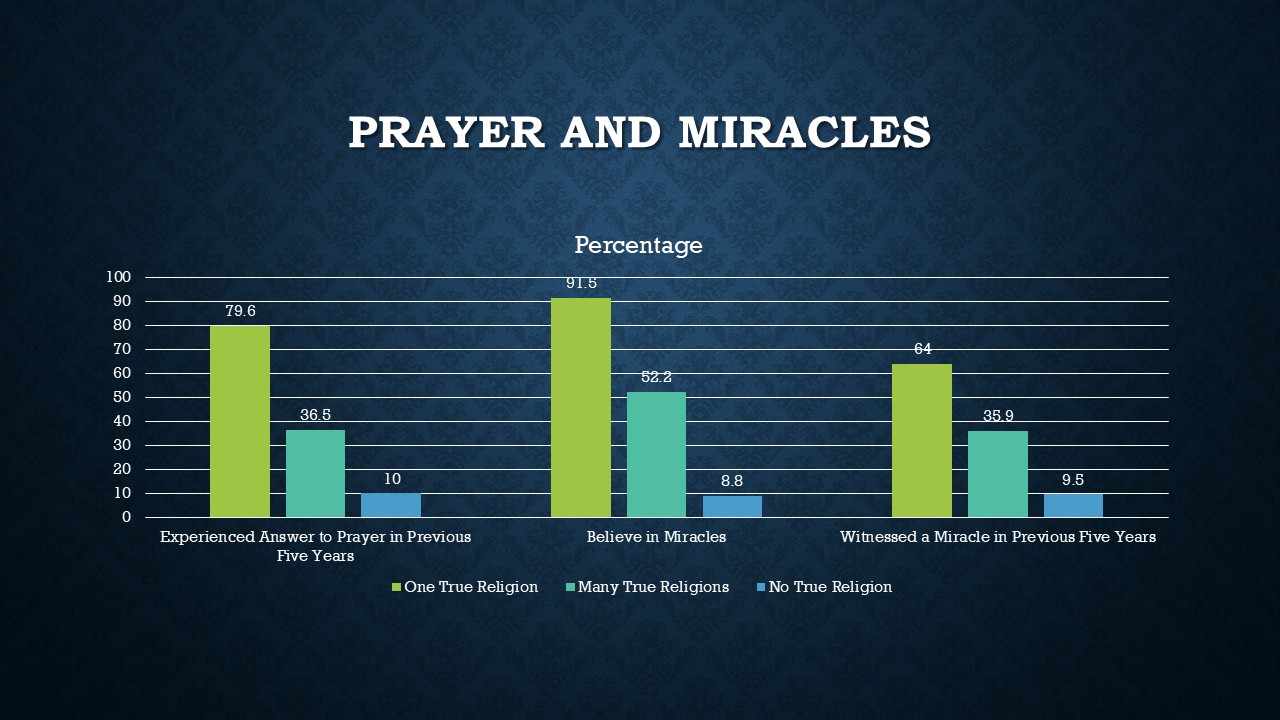
This brings up a really interesting note. If you look at that far-right column, there are actually more people who don’t believe there are any true religions who say that they’ve witnessed a miracle in the previous five years than actually believe in them.
If you look at your Book of Mormon in Alma, there’s a nice explanation for that. 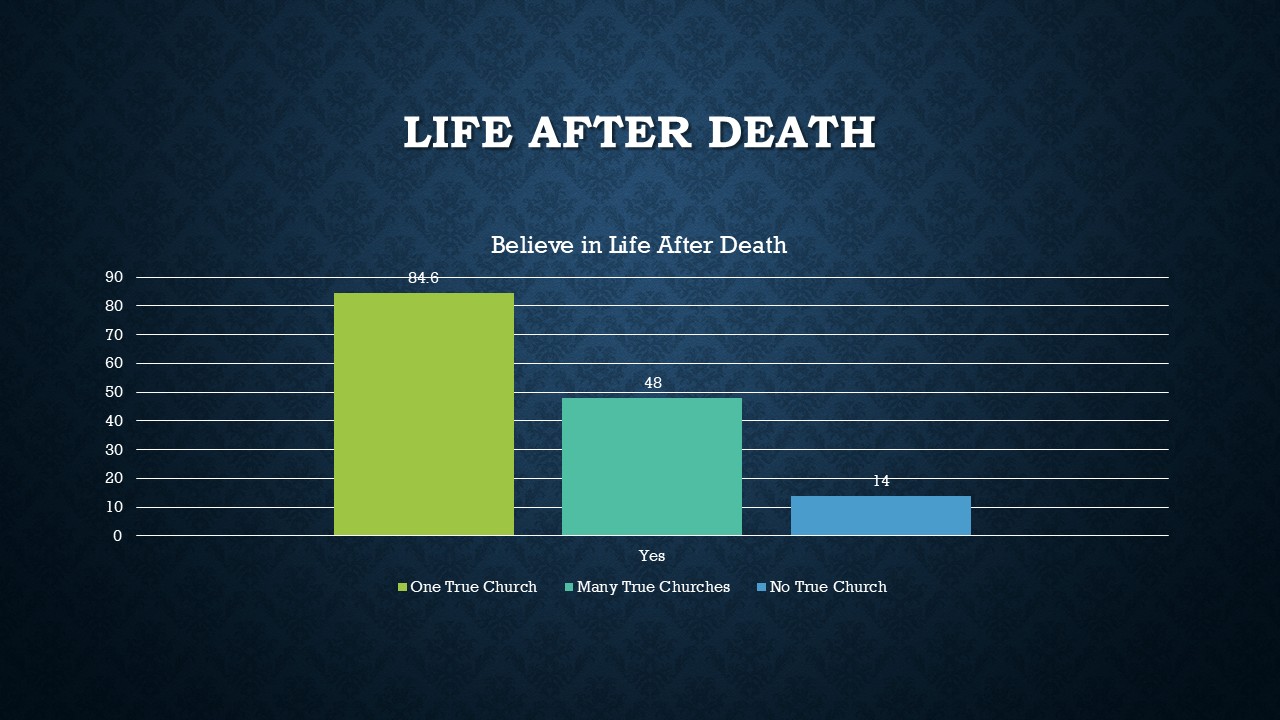
Beliefs About the Afterlife and the Supernatural
Is there life after death?
Well, if you don’t believe there’s only one true church, chances are you don’t believe there’s life after death. 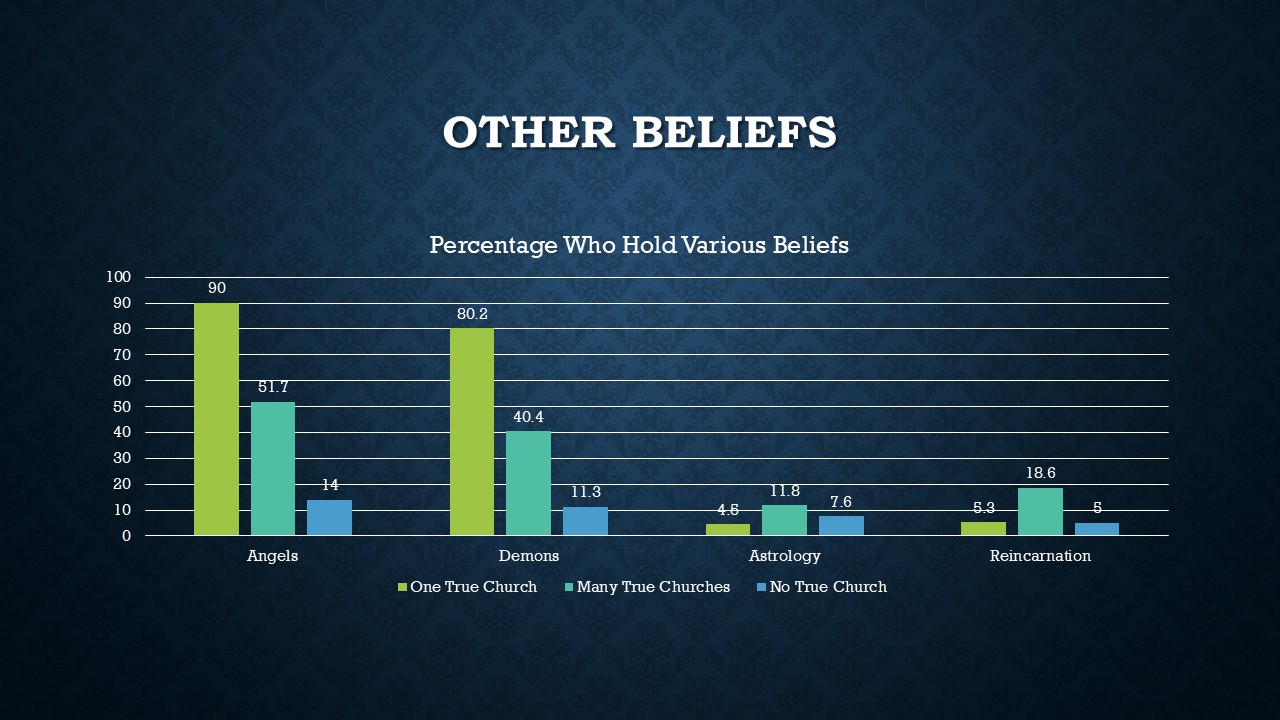
Other beliefs: belief in angels—you are more likely to believe in angels and more likely to believe in demons if you believe there’s only one true church.
If you don’t believe there’s one true church, you are more likely to believe in astrology or reincarnation. 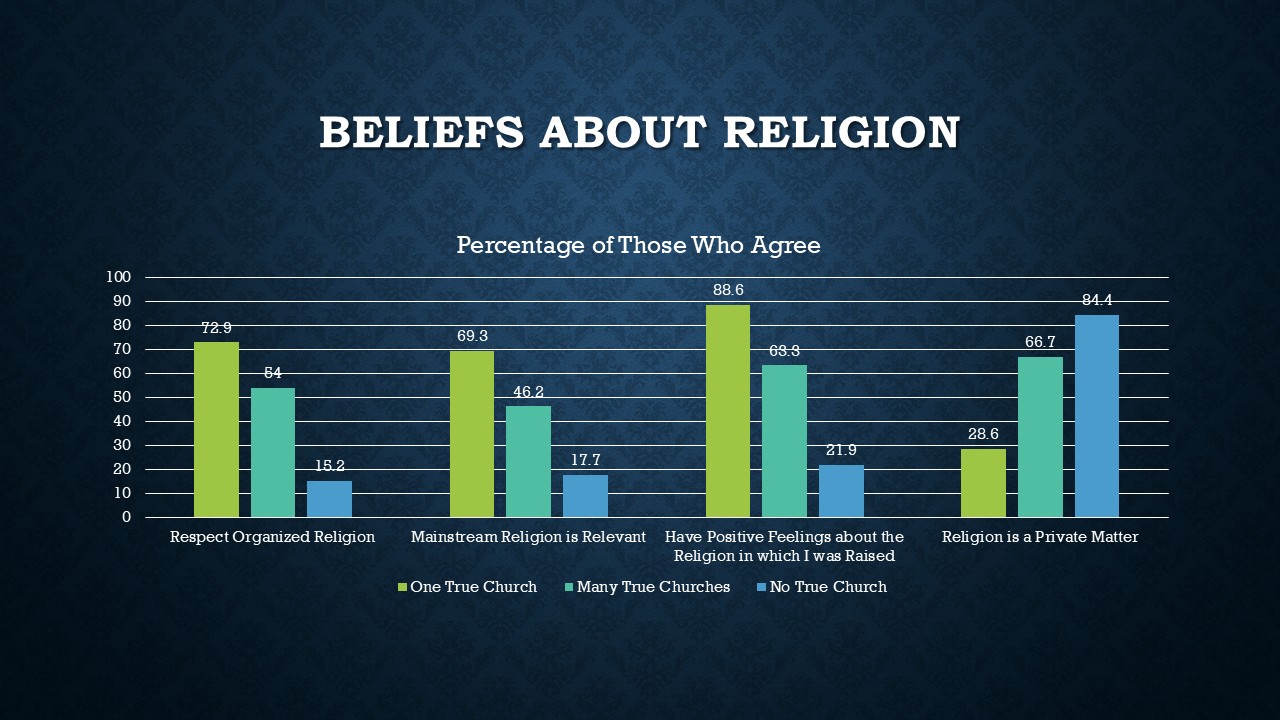
Attitudes Toward Religion
Beliefs about religion: those who believe there is one true church are more likely to respect organized religion, more likely to say that it is relevant, more likely to have positive feelings about the religion in which they were raised, and less likely to think that religion is solely a private matter.
Meaning: I’m just going to keep whatever I believe or don’t believe to myself, and no one else needs to know about it—or maybe I don’t want them to know about it. 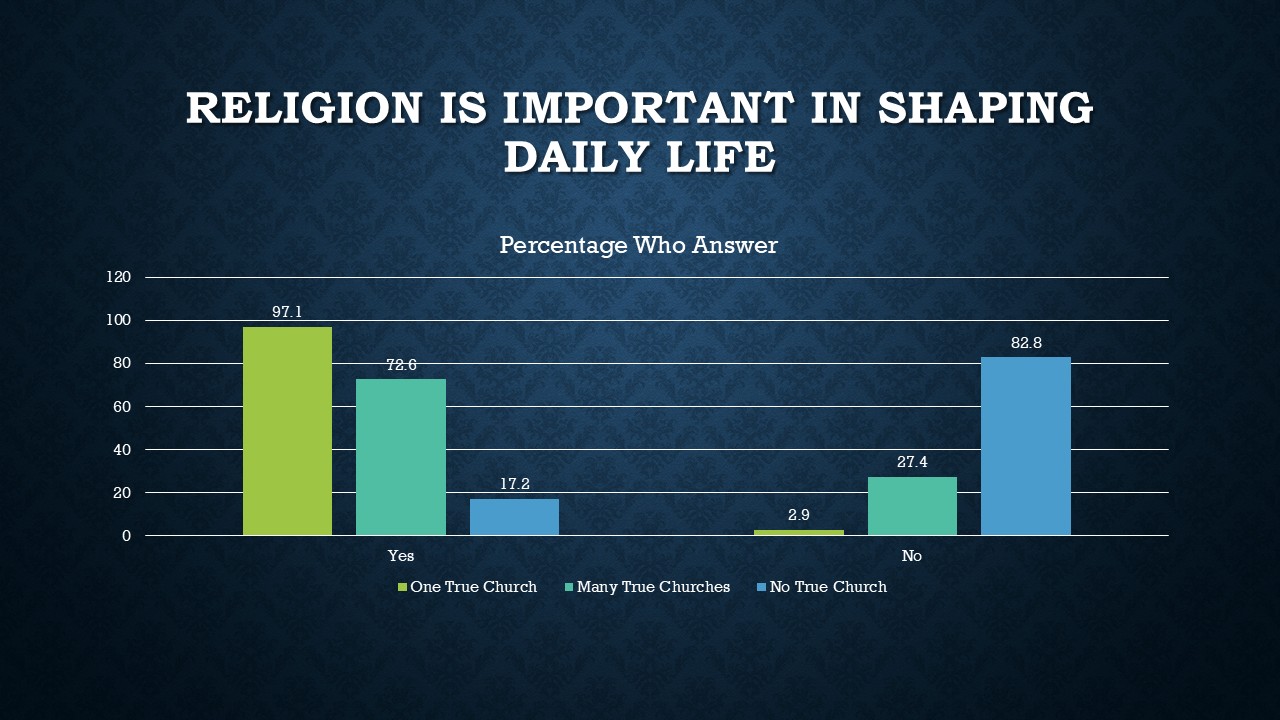
Whether they feel that religion is important in shaping daily lives—here we’ve got the yes and the no. You’ll notice those don’t add up to 100; some people weren’t sure.
But if you believe in one true church, religion is more important to you. 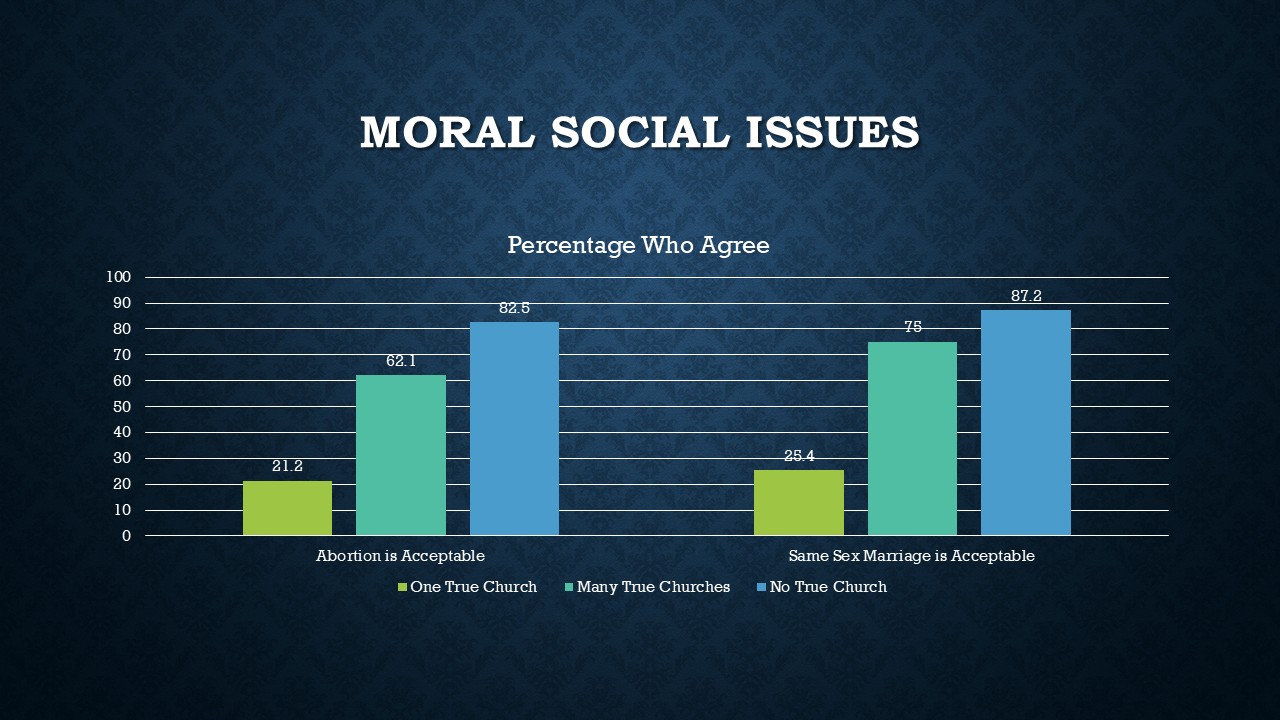
Moral and Social Issues
Looking at moral social issues—these are social issues that are also moral issues.
You’ll notice that those who believe in one true church are much less likely to think that abortion is acceptable or that same-sex marriage is acceptable, no matter what the Supreme Court says. 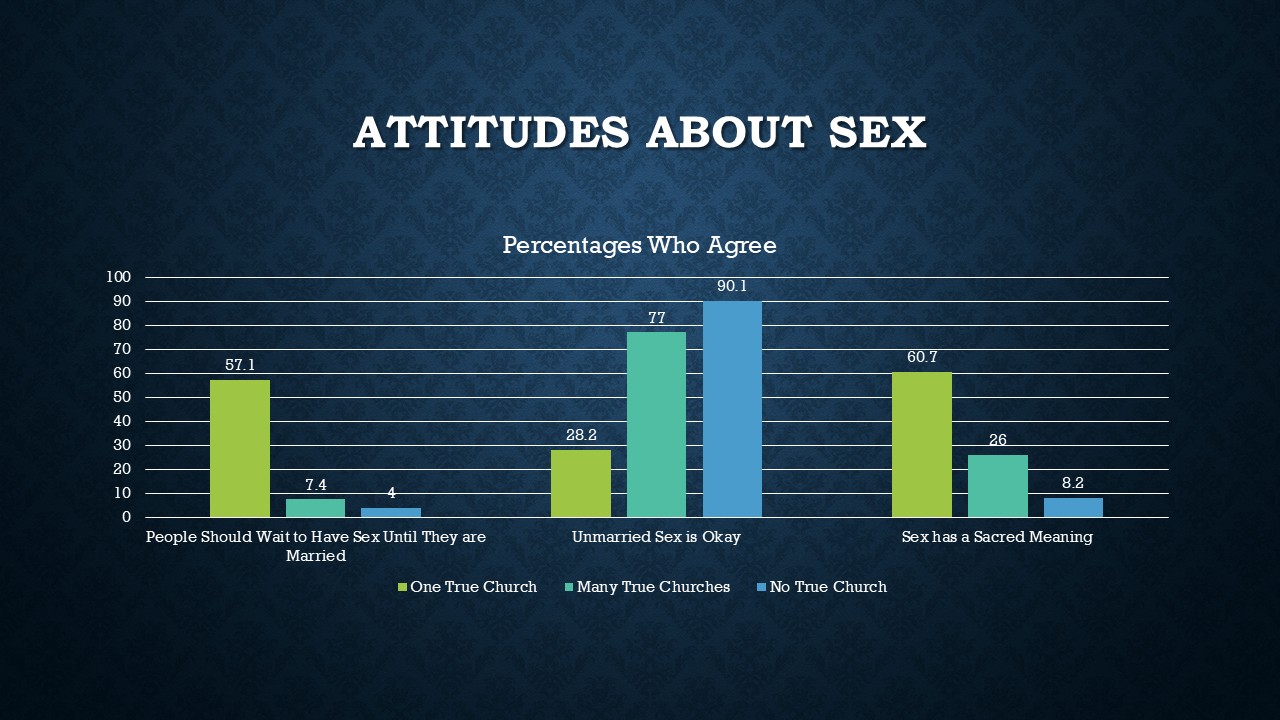
Attitudes about sex: if you believe there’s one true church, you’re more likely to think that people should wait until they are married to have sex. You’re more likely to believe there is one true marriage partner, I guess.
And that matches when they ask, “Is married sex okay?” later in a different spot in the survey. The numbers, of course, coincide.
But if you believe in one true church, you’re more likely to think that sex has a sacred meaning to you. 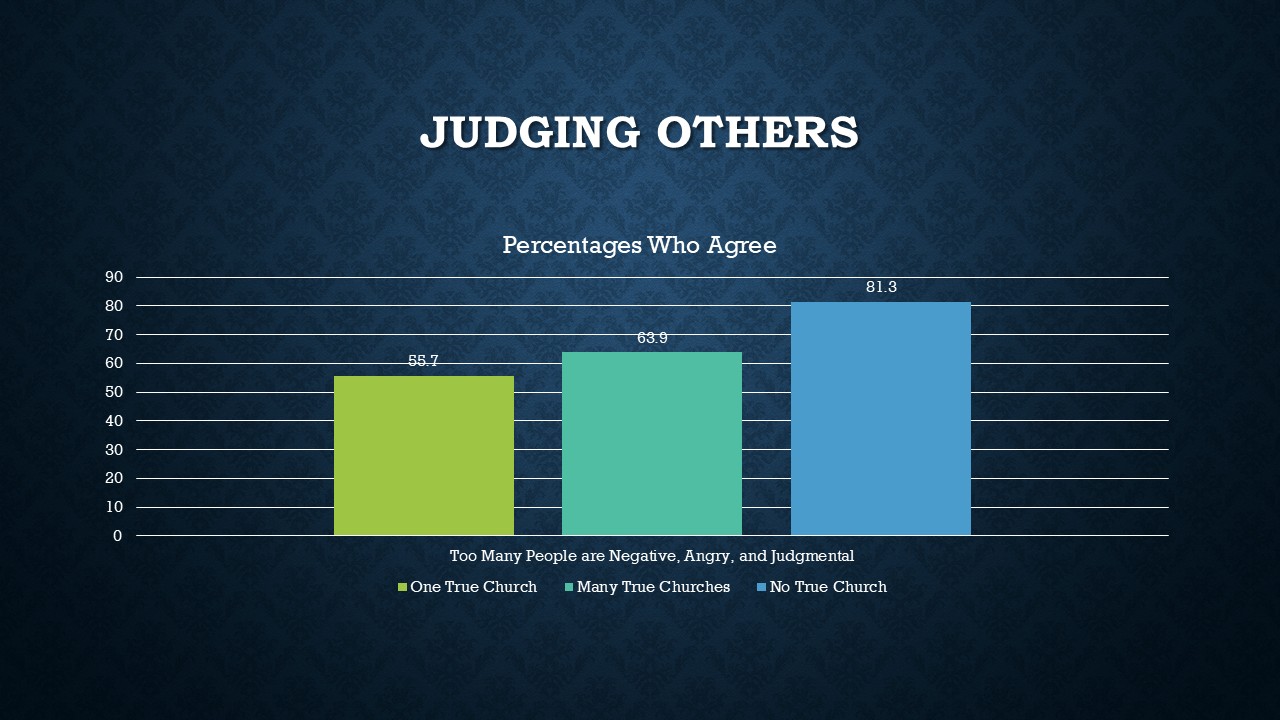
Judging Others
Judging others: well, most people think that too many people are negative, angry, and judgmental.
But if you don’t believe in one true church, you’re more likely to judge other people as judgmental than if you believe in one true church. 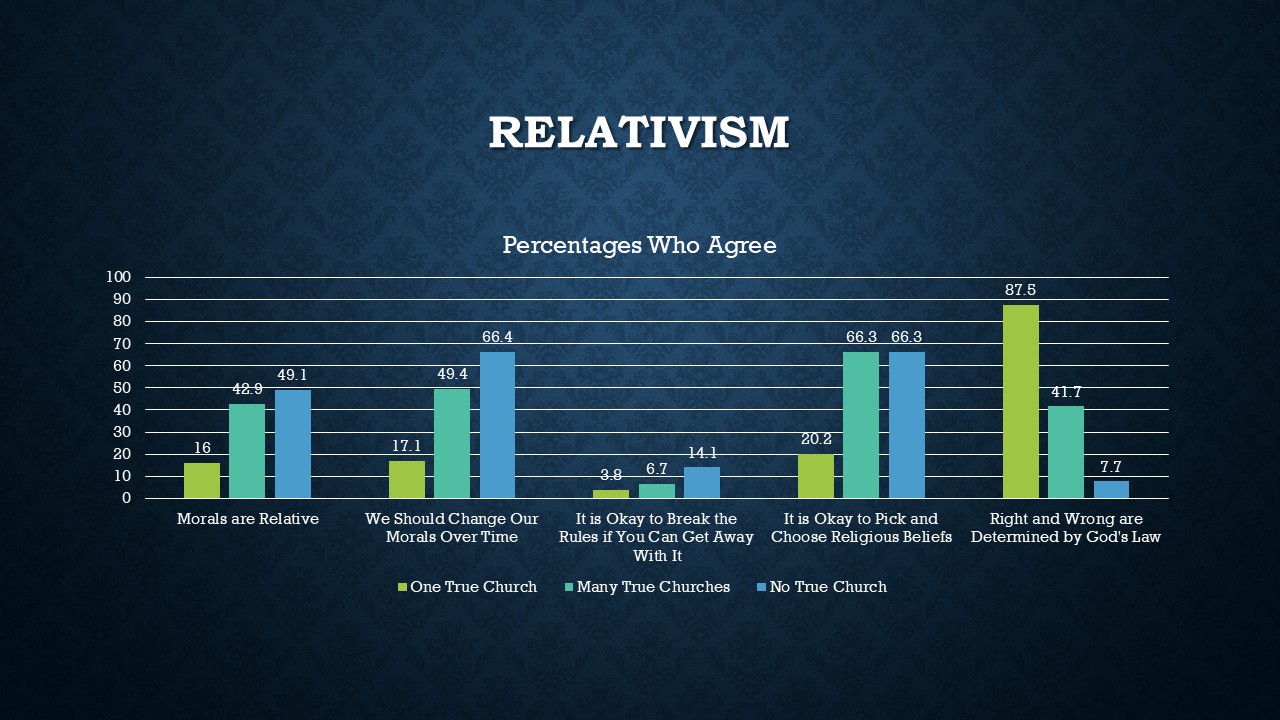
Relativism
Relativism: if you don’t believe in one true church, you’re much more likely to believe that morals are relative, or that we should change them over time, or that it’s okay to break the rules if you can get away with it.
It’s okay to pick and choose your religious beliefs.
But you’re less likely to think that right and wrong are determined by God’s law. 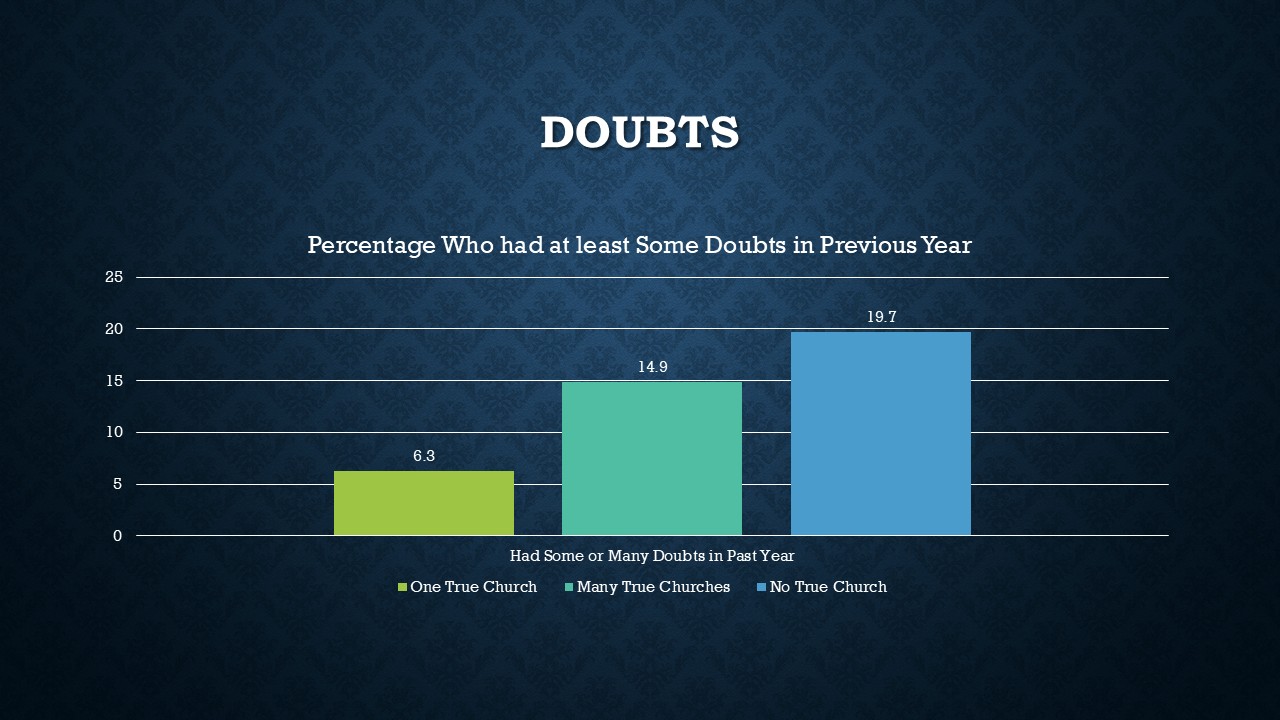
Doubts
Doubts: the percentage who had had at least some doubts about religion in the previous year—you’re much less likely to have had doubts if you believe that one church is true.
These are lumping together the categories some doubts and many doubts. But overall, if you believe that one church is true, you’re less likely to report doubts.
So that’s the beliefs.
Religious Behaviors
Let’s look at the behaviors. 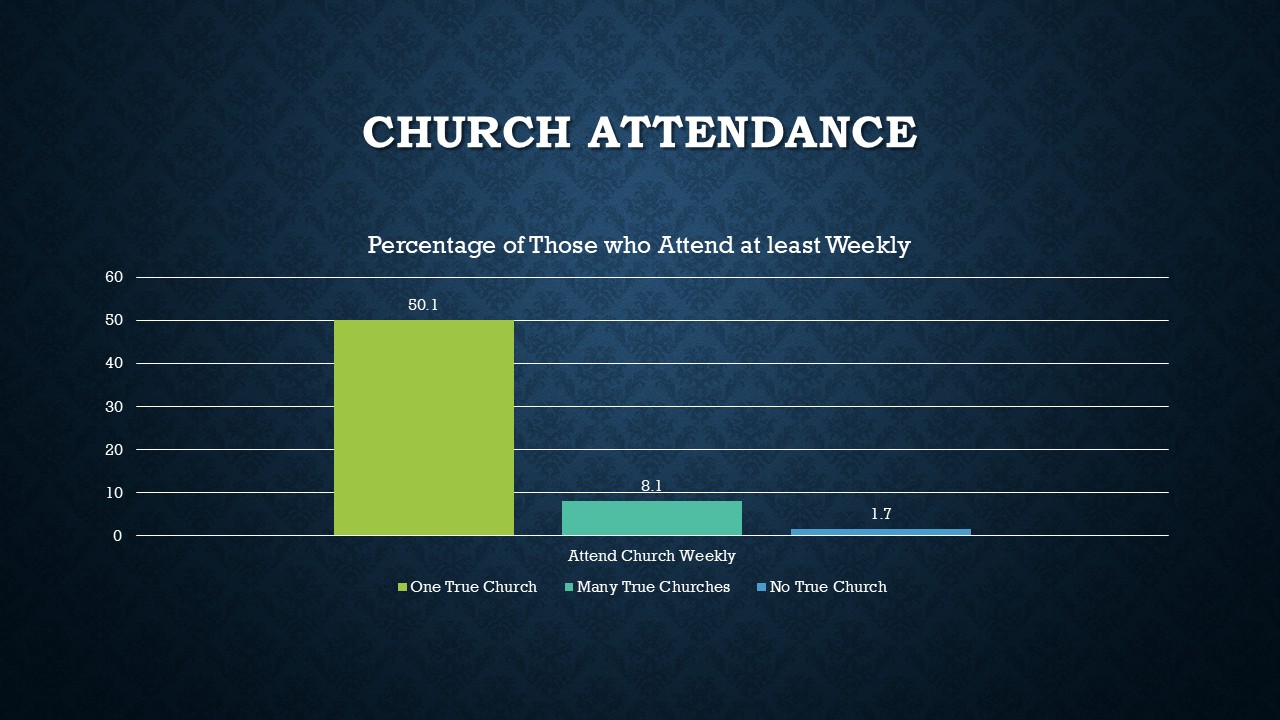
Percentage of those who attend at least weekly: if you believe that one true church is true, you’re just over 50 percent likely to attend weekly, and if you don’t, you’re a lot less likely to attend weekly. 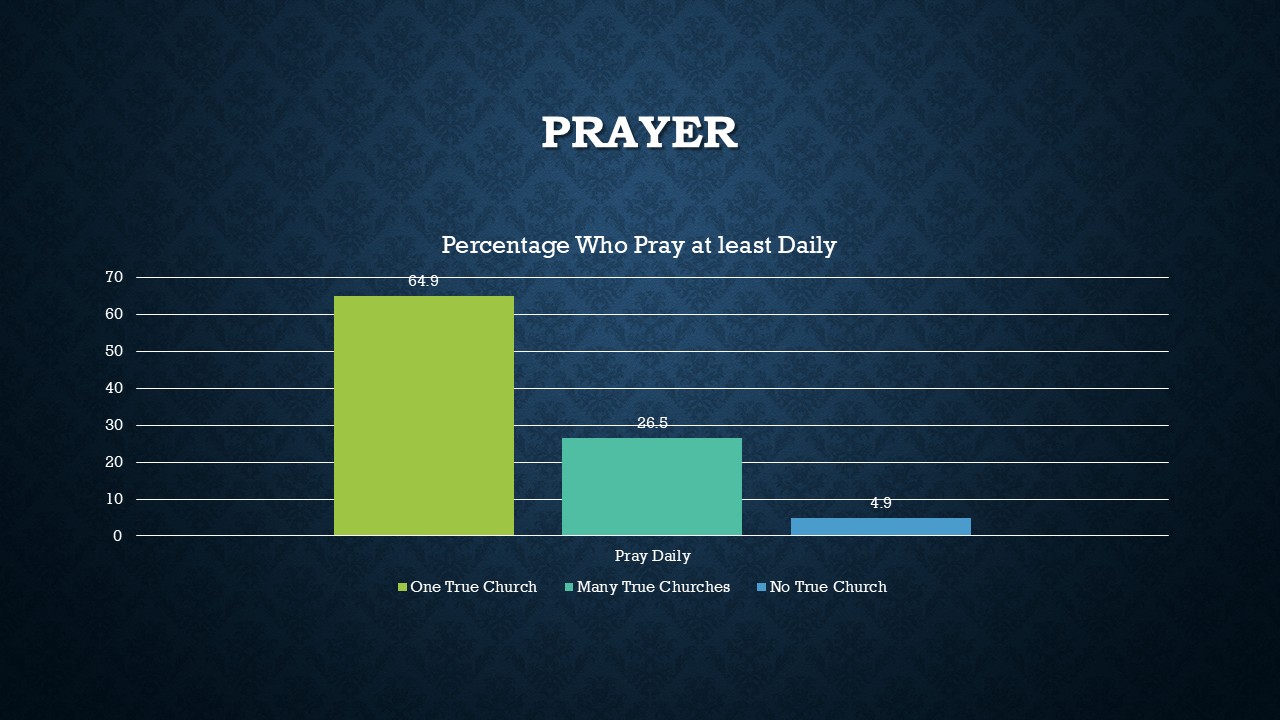
Prayer: those who prayed at least daily—almost two-thirds of those who believe that one church is true pray at least daily. But only about a quarter of those who believe many churches are true pray daily. 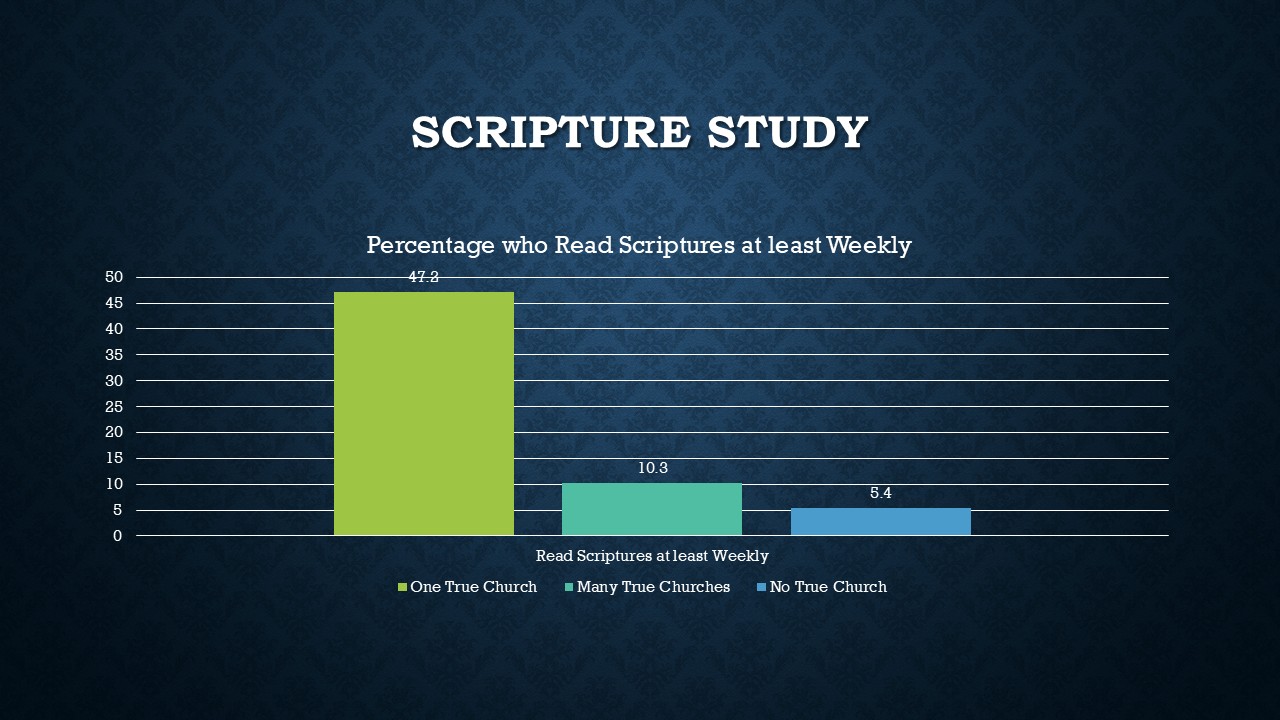
Studying scriptures: 47 percent, just under half of those who believe that one church is true, read their scriptures at least weekly. Much less likely if you don’t believe that one church is true. 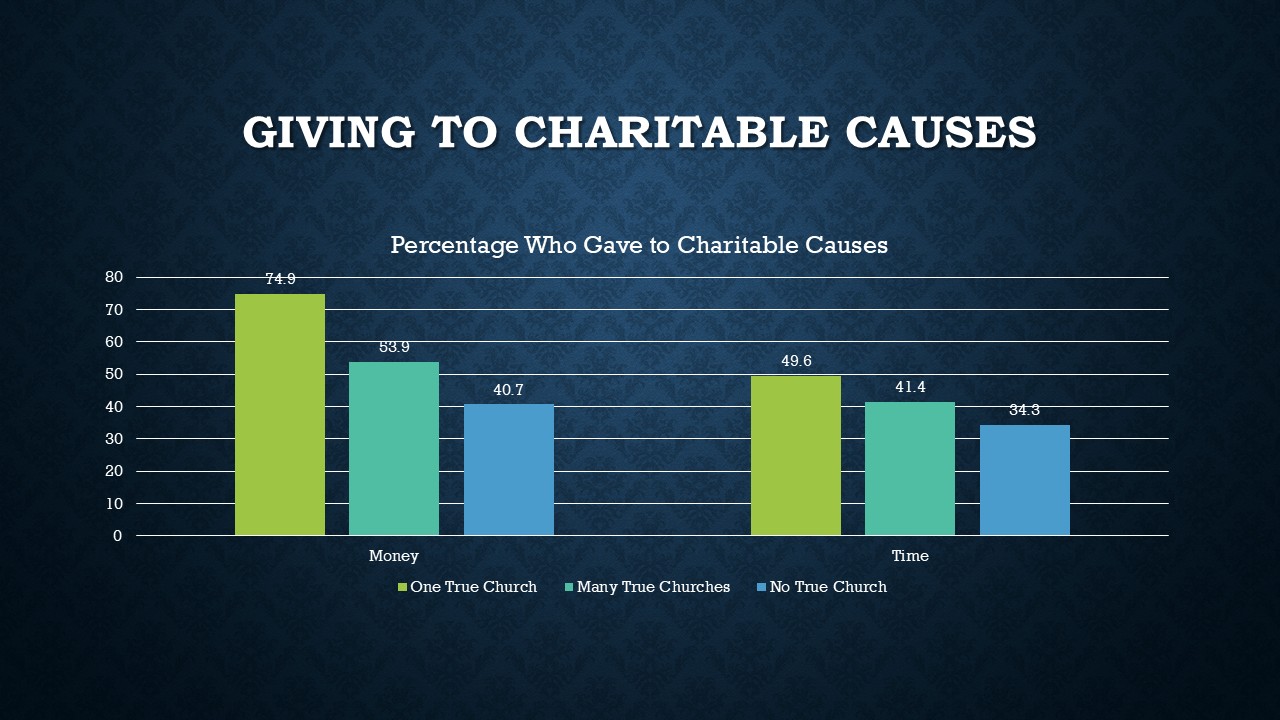
Charitable Giving
Giving to charitable causes: you’re much more likely to give money and time to charitable causes if you believe that there is one true church.
And these are charitable causes in general, not just religiously related ones. 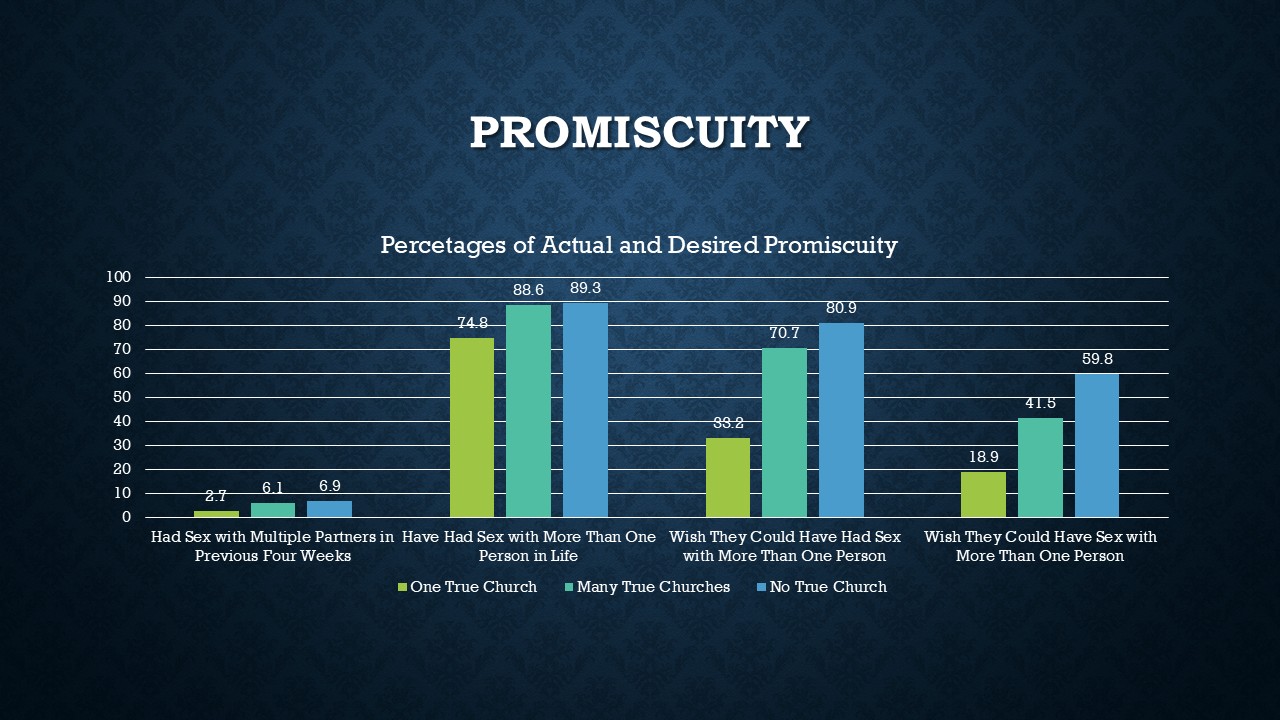
Promiscuity
Promiscuity—well, let’s start with a caveat here.
In modern terminology, sociologists have noted that people define promiscuous as having had sexual relations with more persons than the individual who is saying whether it’s promiscuous or not. A very relativistic line.
So for this case, and given the data and some of the problems with the data, I’m defining it as voluntary sexual relations with more than one partner.
The second graph there shows over the lifetime. Those who don’t believe one church is true are much more likely to have been promiscuous, in that definition.
On the far left is the number who have had sex with multiple partners in the previous four weeks. I think that one pretty well describes promiscuous. It’s much more likely if you don’t believe one church is true that that’s the case, even though this is a fairly small percentage.
When you compare the third graph over, they ask them: How many people do you wish you could have had sex with by this time in your life?
You can see that the numbers of what they wish had happened don’t quite match the reality of what’s happened. So there’s some regret. And you can see that those who believe that one church is true are more likely to feel guilty about what they’ve actually done.
Then the one on the far right—they said: How many more people would you like to have sex with over the course of your life?
I’ve put in everybody who said more than two people. At this point in the survey, a number of the people were married, so you have to be careful about how you define these. I’ve tried to be a little conservative on these numbers. 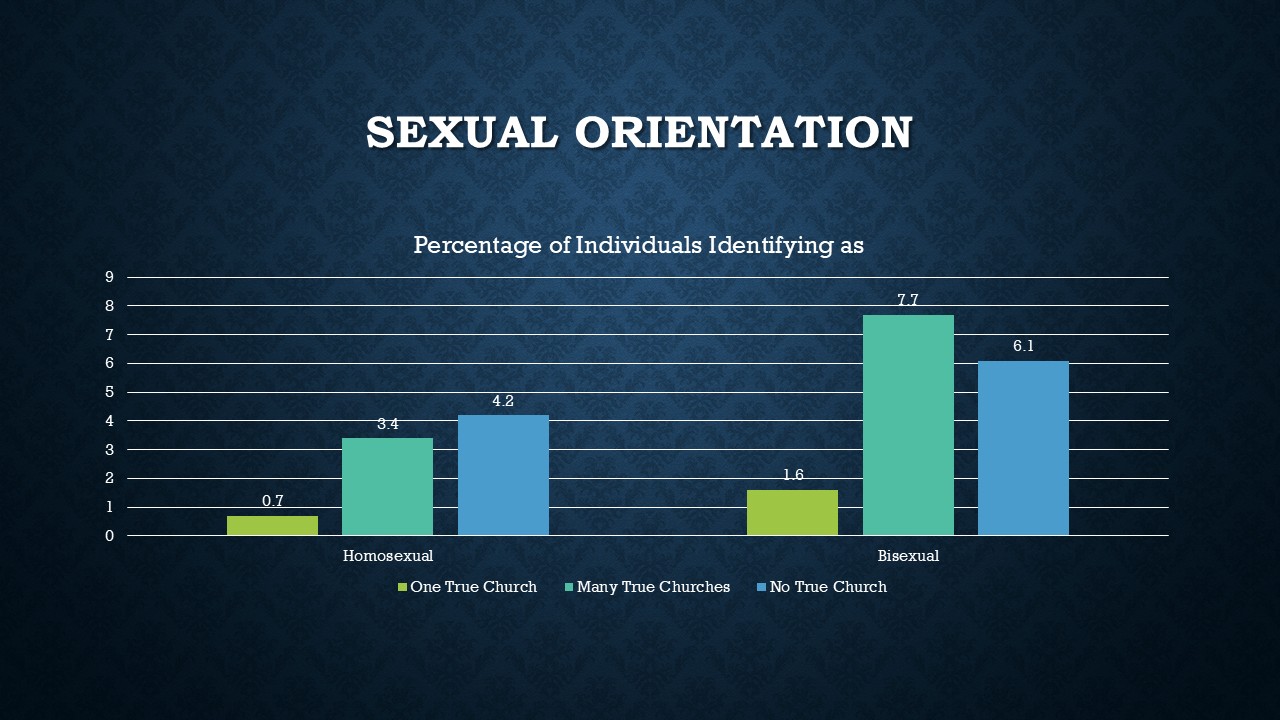
Sexual Orientation
Sexual orientation—sorry, I don’t make up the data. This is just what it says.
If you don’t believe one church is true, you are much more likely to either be homosexual or bisexual. That’s what the data says.
Now, this is all looking at it as if we changed our belief—what could we expect would happen to both beliefs and behaviors over time?
Because these are correlations that may not be right. And we’ve been running under the presumption from Elder Packer that teaching doctrine is more likely to change behavior than teaching behavior is.
But we’ll flip the argument here. 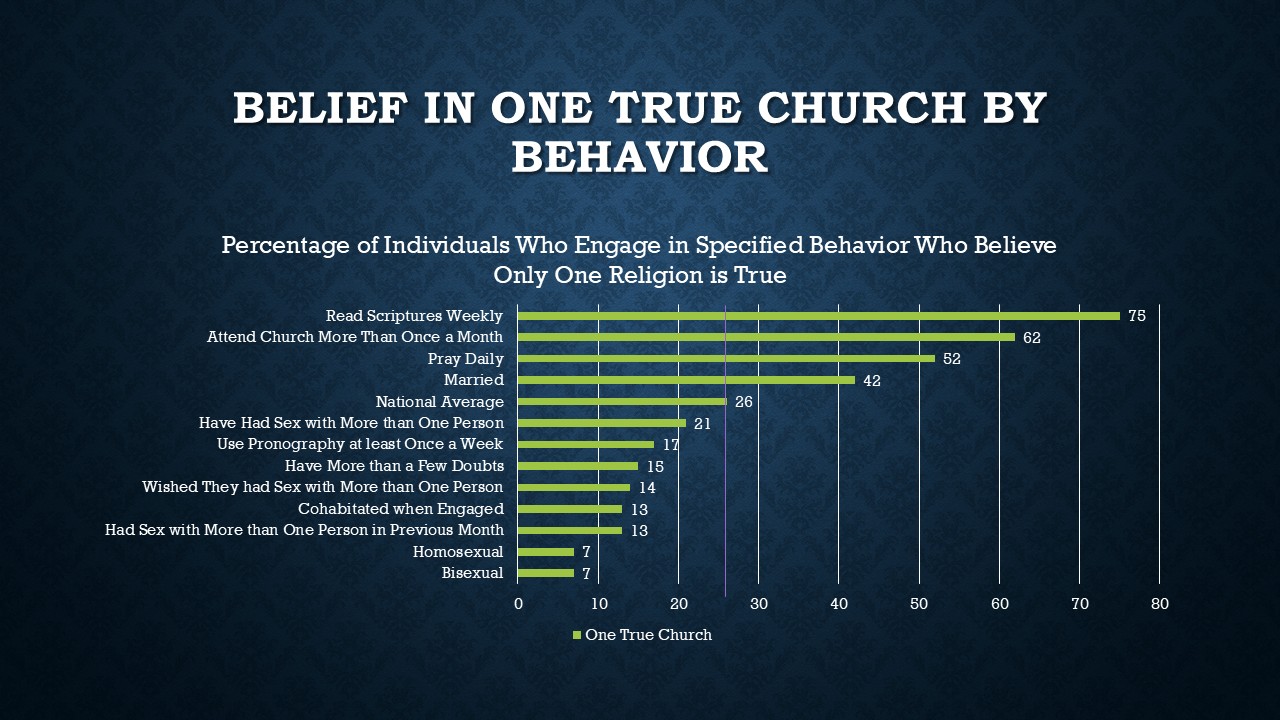
Reversing the Causation Question
Let’s say the causation runs the other way. Maybe it’s the behaviors that cause the belief in one true church.
That would be in line with the Savior saying that whosoever will do His will shall know the doctrine.
So this might need a little unpacking here.
There’s a line down the middle where, if we look at the percentage of those who are engaged in a particular behavior who believe that there is one true church, that’s what we’re showing here on the graph.
We’ve drawn a line at where the national average is. If you just take the national average—26 percent, rounding to the nearest percentage—that’s where it is.
People who read their scriptures weekly are more likely to believe there’s one true church—about three-quarters of them.
If you bump this up to daily, then it shoots even further to the right—around 82 percent.
Those who return to church more than once a month are more likely to believe in one true religion.
Those who pray daily are more likely to believe in one religion.
And those who are married—still 42 percent of those believe that there is one true church.
Behaviors Associated with Not Believing in One True Church
On the other hand, those who’ve had sex with more than one person are less likely than average to believe there’s one true church.
Those who abuse pornography at least once a week are less likely to believe there’s one true church.
Those who’ve had more than a few doubts, those who wish they’d had sex with more than one person, those who cohabited while they were engaged, those who’ve had sex with more than one person in the previous month, and those who are homosexual or bisexual—all of those are less likely to believe in one true church.
So our novice is arguing that the Church ought to change its position.
But if you look at this two ways:
- If you look at it as the cause, then changing the belief that there is one true church will cause deleterious effects across the board.
- If you look at it as the result, then it is usually the result of behaviors that are not approved by the Church.
Those who are doing the things that they ought to be doing are more likely to believe that there is one true church.
So whether you’re looking at it as a cause or as a sign of a problem, changing from believing in one true church to not believing in one true church is not a good thing.
We can see why those who don’t think that there’s one true church—what seems like a rather high number—would be leaving the religion. But when you look at some of these associated behaviors and beliefs, you can kind of see why. 
Lesson Nine: Check Your Overall Logic
This brings us to lesson nine: check your overall logic.
So this is the logic of the argument they’re responding to:
The Church teaches X.
I don’t believe X.
Therefore I’m leaving.
And the response to the argument is to say, Well, the Church is wrong to teach X.
This is a little bit like saying (and this is a counterfactual, I love Chinese food.)
This restaurant serves Chinese food.
I don’t like Chinese food.
Therefore I’m leaving.
If you went in and said, “Well, the restaurant should be serving Mexican food,” they’re still leaving. That doesn’t address the overall logic of the argument.
So you need to look at the overall logic of the argument. 
Lesson Ten: Don’t Give Up—Use Better Arguments
Finally, lesson ten.
I picked out this one novice’s argument. I haven’t said who it is. Please don’t go looking for it. It’s a bad argument, and we don’t want that. Truth is not well served by a bad argument.
We want better arguments.
I’d like this person to keep going—but make better arguments. So I’m not trying to attack them. Just don’t go looking for them.
Lesson number ten: don’t give up—use better arguments.
You can. There are better arguments out there. Maybe you can come up with better arguments. But use the best ones you can.
We don’t need to hold on to any apologetic approach that doesn’t actually work or that has flaws. We can come up with those that don’t.
And I know a lot of you are on the front lines.
Don’t give up.
Some recent studies that have come out show that the most important thing that you can do for your family members—whatever stage they are in their faith—is to keep talking to them about the Church in positive terms.
That is one of the best things that you can do: just bring it up naturally and talk about it.
I thank you for your time, your attendance, your dedication, and your willingness to listen to somebody who isn’t Stephen Mayfield.
I hope he gets better. He’s a fascinating person and an engaging speaker, and I’m sorry you didn’t get to listen to him.
But thank you for listening to me.
