Language of the Book of Mormon Record
You’re all aware that in First Nephi—I believe it’s the second verse of the whole Book of Mormon—Nephi says that:
…I make a record in the language of my father, which consists of the learning of the Jews and the language of the Egyptians.
And of course, they left Jerusalem where Hebrew was spoken. It’s been a matter of discussion and debate among LDS scholars whether they:
- spoke only Hebrew; or,
- Hebrew and knew something of Egyptian.
But that debate has never really been resolved. In fact, I’ve discussed it with a few of the LDS scholars at BYU and mentioned to them that the real way to solve that debate is to look at American Indian languages.
Approach to Linguistic Evidence
Now, let’s give you a little background.
We don’t have time to make you linguists, and we don’t have time to teach you Hebrew and Egyptian. But we’re going to try to give you an overview of some of the basics.
The Book of Mormon is an account of:
- the people of Lehi mainly, but others—
- the Jaredites and
- the Mulekites.
And of course, they came out of Jerusalem, presumably speaking Hebrew or something of the Northwest Semitic dialect, and came to the Americas. Their population increased in the Americas.
American Indian Languages and Criticism
Looking at American Indian languages, there are approximately 2,000 American Indian languages. Or there were, I should say. (There are) about a thousand now. About half of them have become extinct in the last few centuries.
The critics of the Book of Mormon say that no one has shown evidence of any American Indian language being descended from Hebrew or Egyptian, thus discounting the Book of Mormon. Or, no one has shown it to the satisfaction of the linguistic community.
Now, a linguist is a language scientist. They are the final word on whether two languages are related or not. 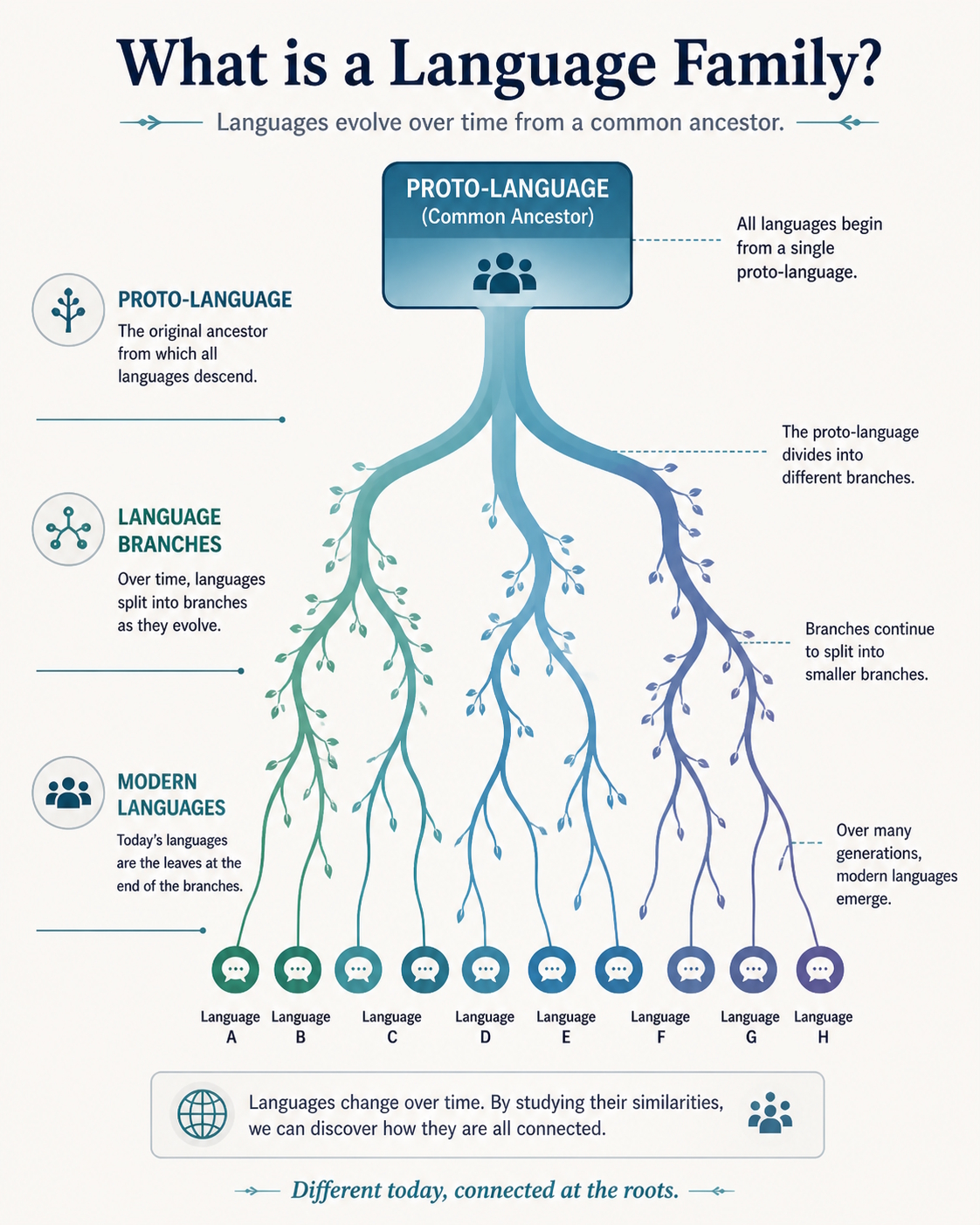
What Is a Language Family?
I am a linguist. I’ve been researching in a particular language family for the past 30 years, and we’re going to focus on that language family.
In fact, let’s talk about language families before we go any further.
A language family starts out some ancient time. They call this a proto-language—the original language, the old language. And from this are descended other languages.
How Languages Evolve Over Time
And interestingly, each of these languages, given time, will also separate. People move and go different places, and the language changes with time.
In fact, all living languages are always changing. So is English. Every living language changes. And from those, these become separate branches and other languages develop.
You get the picture. 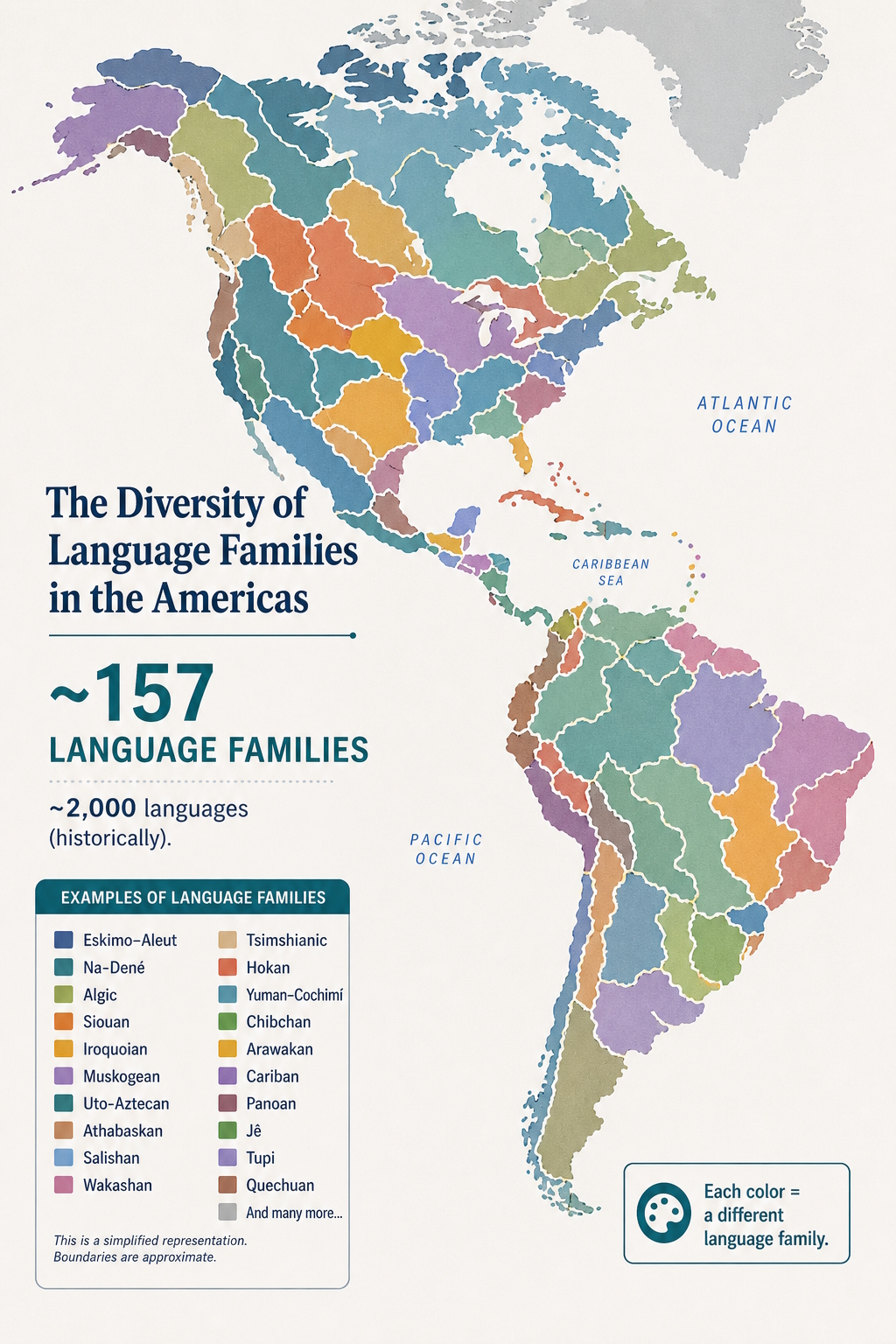
Language Families in the Americas
Anyway, in the Americas there are about 2,000 languages. And these languages are organized into about 157 different language families.
That means that there are 157 different groups of related languages, each group coming from its proto form. But these different groups are not necessarily related to each other.
Some proposals have proposed that, ‘hey, this group (or this group of groups) are related in a larger picture’. And some of those will inevitably be shown to be the case. But as of now, there are about 157 language families. That’s quite a few.
Comparing Time Depth: Lehi and Other Language Families
If we look at the time depth of Lehi—Lehi came to the Americas about 2,600 years ago. Only 2,600 years ago! If we look at other language families with a time depth of 2,600 years, for example:
- The Latin or Italic language family has descended from Latin.
- You have Spanish, French, Portuguese, and so forth descending from Latin over about the last 2,000 years.
- Germanic—that’s the language family that English belongs to, and also German and Dutch and many of the Scandinavian languages and so forth—all descend from Proto-Germanic, we call it, over about the last 3,000 years.
Expected vs. Observed Linguistic Patterns
So when you look at the similarities of languages descended from Latin, they’re very similar. There’s no problem seeing the relationship. Same thing with Germanic.
We should see something like that in the Americas—and yet it is problematic to see that.
First of all, if Lehi was the only one in the Americas, then there should only be one language family instead of 157. So we know that many other groups have come to the Americas besides Lehi.
Multiple Migration Sources
In fact, of these 157 language families, two of them are convincingly demonstrated to be from across the Bering Strait. Probably others were as well. But the language evidence suggests that at least two of these came from across the Bering Strait. A third one has some evidence for it.
The many sources of these language families would include Bering Strait people who entered the Americas.
Book of Mormon Peoples and Linguistic Diversity
You have Lehites or Lamanites and a few Nephites. You have the Mulekites.
Now remember, the Mulekites and Nephites mixed in the Book of Mormon about 200 BC or so—that’s just a guess. And that group of Mulekites might only be one of many.
I mean, the group of Mulekites that the Nephites mixed with would only be one of each of the branches.
Complex Population Mixing
In other words, you’d have many other Mulekite descendants, probably, and this one group mixed with the Nephites.
You’d also have other groups of Lehites, and only this one group mixed with the Mulekites.
You also probably have leftover Jaredites.
Jaredite Influence Hypothesis
My guess is that the Jaredites might be as prominent in the Americas as any, mainly because of 157 different language families.
And of course, the Jaredites date from about the Tower of Babel, which is basically the history of the earth. Since Noah, anyway.
Language Mixing in the Americas
There are probably many other sources besides those. And what happens is, when language groups get in contact with each other, the languages mix.
Many languages are mixtures of various languages. For example, English is very much a mixture. It comes from Old English originally, so it’s called a Germanic language.
However, at various points in time, English has borrowed a lot from Latin. And the two or three centuries after 1066, when the Norman French speakers conquered the British Isles and ruled for a couple of centuries, much French was borrowed into English.
English as an Example of Language Blending
So much French and so much Latin, and other times, that in an unabridged English dictionary, the Germanic part of our vocabulary is actually quite small compared to the Latin dimension of our vocabulary.
But we still call it a Germanic language.
Now, this kind of thing has probably been happening in the Americas.
- Bering Strait languages
- old leftover Jaredite languages
- Lamanite
- Nephite
- Mulekite languages
- and a lot of other things that have arrived in the Americas besides those
have been mixing.
And so it’s a very sticky mess.
Introducing the Uto-Aztecan Language Family
Nevertheless, there’s one language family that we’d like to focus on, and that is the Uto-Aztecan language family.
The Uto-Aztecan language family is a group of about 30 American Indian languages that linguists recognize as being one language family descended from a single proto-language called Proto-Uto-Aztecan. 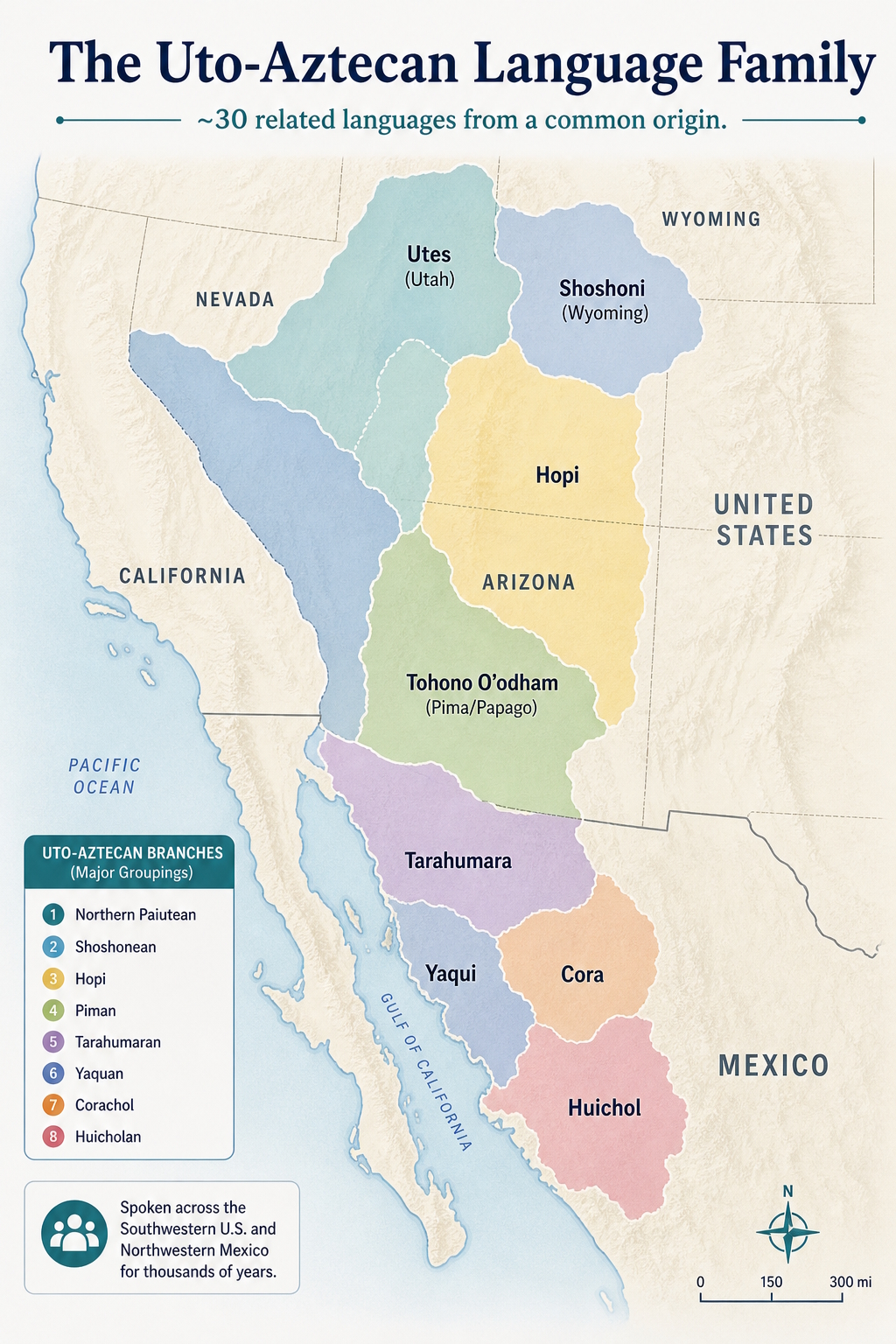
Geography and Structure of Uto-Aztecan
There are about eight branches of it. In other words, it was divided into about eight different groups. And then those groups had the other descended languages.
This language family exists in the southwest United States and in northwest Mexico.
The name “Uto-Aztecan” comes from:
- the Utes on the north here in Utah, and
- the branch related to the Utes—which includes
- the Shoshoni of Wyoming and
- other languages in Nevada and
- eastern California—and
- “Aztecan” because that’s the south end of the language family.
Examples of Uto-Aztecan Languages
The Hopi, for example, are a Uto-Aztecan language.
Pima and Papago (Tohono O’odham) in Arizona, the various Ute groups—there are about a dozen languages in southern California where the northern branch split and spread from.
There are about 15 languages in northwest Mexico: the Tarahumara (the great distance runners), and Cora and Huichol and Yaqui, and many of the Tepiman languages.
Scope and Significance of the Research
Anyway, we don’t have time to really go into a lot of detail about that. But the Uto-Aztecan language family is an American Indian language family that is one of the larger ones.
I mean, 30 languages is quite a few.
This is some research I’ve been working on for a number of years. It has not yet been published, but it will be. Give me another two or three years maybe.
Scholarly Feedback on the Research
However, I have shared it with a prominent Semiticist and a Uto-Aztecanist, and I’m a Uto-Aztecanist myself.
So I’ve shared it with my peers, and those whom I’ve shared it with privately are quite overwhelmed at the number of similarities and the closeness of them.
Morphemes and Plural Forms
For example—let’s see, let’s enlarge that a little bit. There we go. I know linguistics, but I’m technologically challenged.
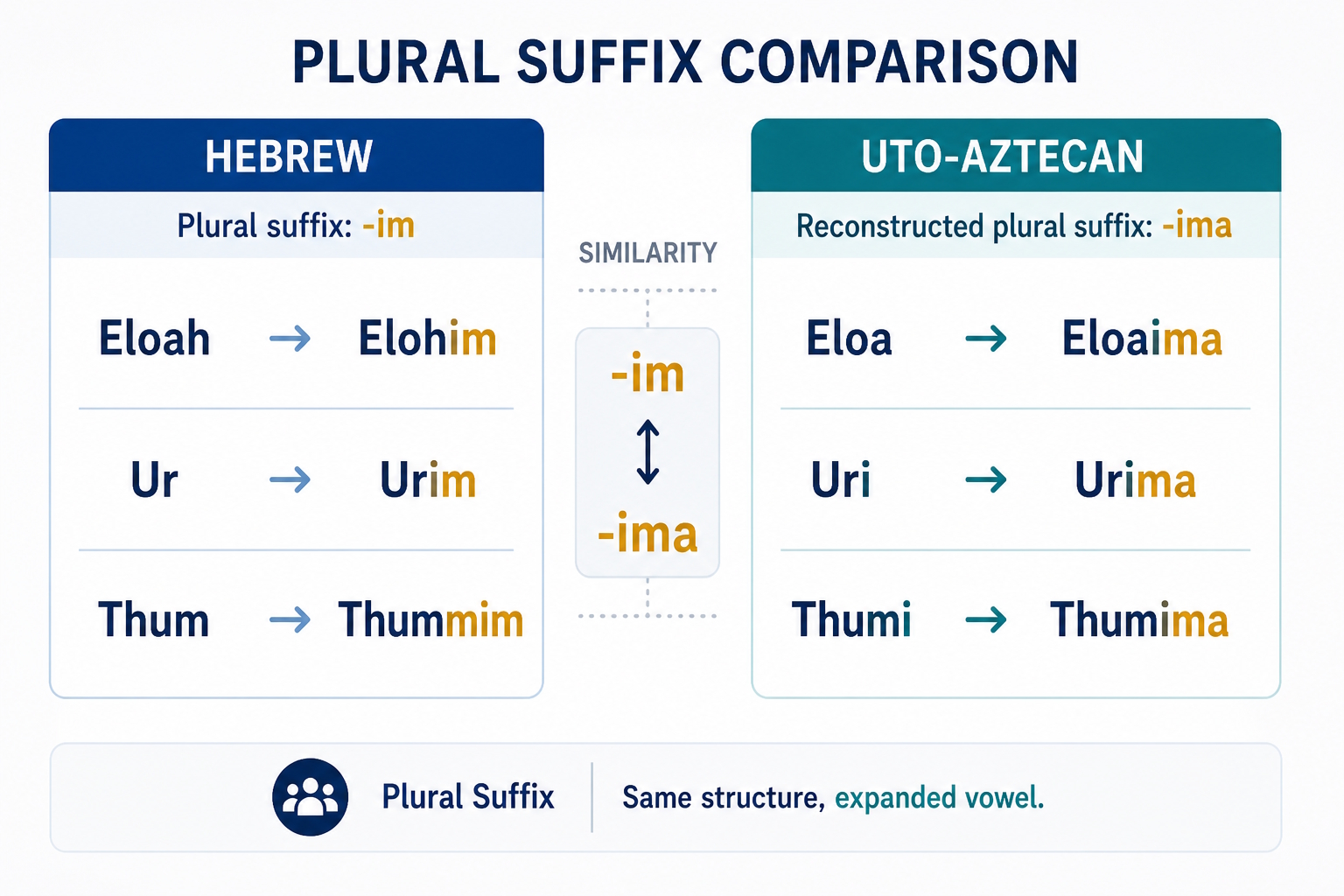
Here we have the Hebrew on the left. Three different words or morphemes—which is a unit of a word—with meaning.
The plural suffix in Hebrew is -im. It’s put on the end of words, just like in English we have -s:
- “dog” and “dogs” for plural.
In fact, this plural is in a number of words that you’re familiar with.
- Elohim, for example, is a plural. (Corresponding to Arabic Allah.) Eloah would be the singular; Elohim, the plural.
- Urim is a plural—ur, light; urim, lights.
- Thummim—thum, perfection; thummim, perfections.
Anyway, the plural suffix in Uto-Aztecan is reconstructed to be -ima.
Reconstructed Forms and Pronunciation
Now, some Uto-Aztecanists will argue with that. Nevertheless, there is good evidence for that.
They would argue about the vowel in front.
By the way, I need to tell you that we’re going to pronounce the vowels like you do in Spanish or most languages of the world. If you know Spanish or any other language besides English, it’s probably close to that. English changed them all.
Agreement Among Linguists
Anyway, the plural suffix in Uto-Aztecan is -ima.
And I talked with Wick Miller, the foremost Uto-Aztecanist, before his passing, and explained all the evidence suggesting that.
He agreed that that’s a decent reconstruction for that plural suffix in Uto-Aztecan.
Grammatical Parallels: Prefixes and Verbs
There’s also a passive prefix in Hebrew ni- that’s put on the beginning of verbs to make a verb passive. You know, “I ate the apple.” “The apple was eaten.”
(By the way, that is also reciprocal and reflexive. That just means “we did it to each other”—like “I fought him,” or “he was fought,” or “we fought each other.” Those are reciprocal and passive meanings that do overlap a lot in all languages.)
In Uto-Aztecan there is a prefix na-, which also makes verbs reciprocal and passive.
Verb Correspondences
There’s also a verb—it’s yāšab in later Hebrew, but originally it was yāšab with a b, and it means “to sit down.” It also means “to dwell or reside at a place.”
Well, in Uto-Aztecan there’s a verb yasipa, which also means “to sit down” and “to reside at a certain place.”
Historical Linguistic Reconstruction
Now, those are somewhat close.
However, when we consider the fact that the Hebrew plural suffix -im came from an older form. Ima is the original form. Linguists and Semiticists can figure out, looking at related languages, that the older original form was -ima.
Then we see that the plural suffix of the Near East—in Northwest Semitic—is identical to the Uto-Aztecan plural suffix.
Shared Linguistic Origins
Also, the Hebrew ni- came from an earlier na-—Semiticists know that and agree on that—identical to the Uto-Aztecan passive, reciprocal, and reflexive prefix.
Also, the Hebrew word yāšab changed its vowel at a certain time in the history of Hebrew, and it was originally yāšiba.
And the vowel pattern of the Uto-Aztecan verb is identical: yasipa, just a change from b to p.
Sound Change Patterns
Very interesting similarities. Now, these are only three similarities.
There are about a thousand such similarities between the Uto-Aztecan language family and Hebrew and Egyptian.
Now, trying to decide how many similarities—we have lots of them here. Let’s get into it a little bit further.
Systematic Sound Correspondences
There are three basic sound changes.
Now I need to explain here that linguists have found that sounds change in consistent patterns. So that this language changes this sound this way, and another language changes it another way—quite consistently within itself.
So that later this sound corresponds to another sound in the other related language. 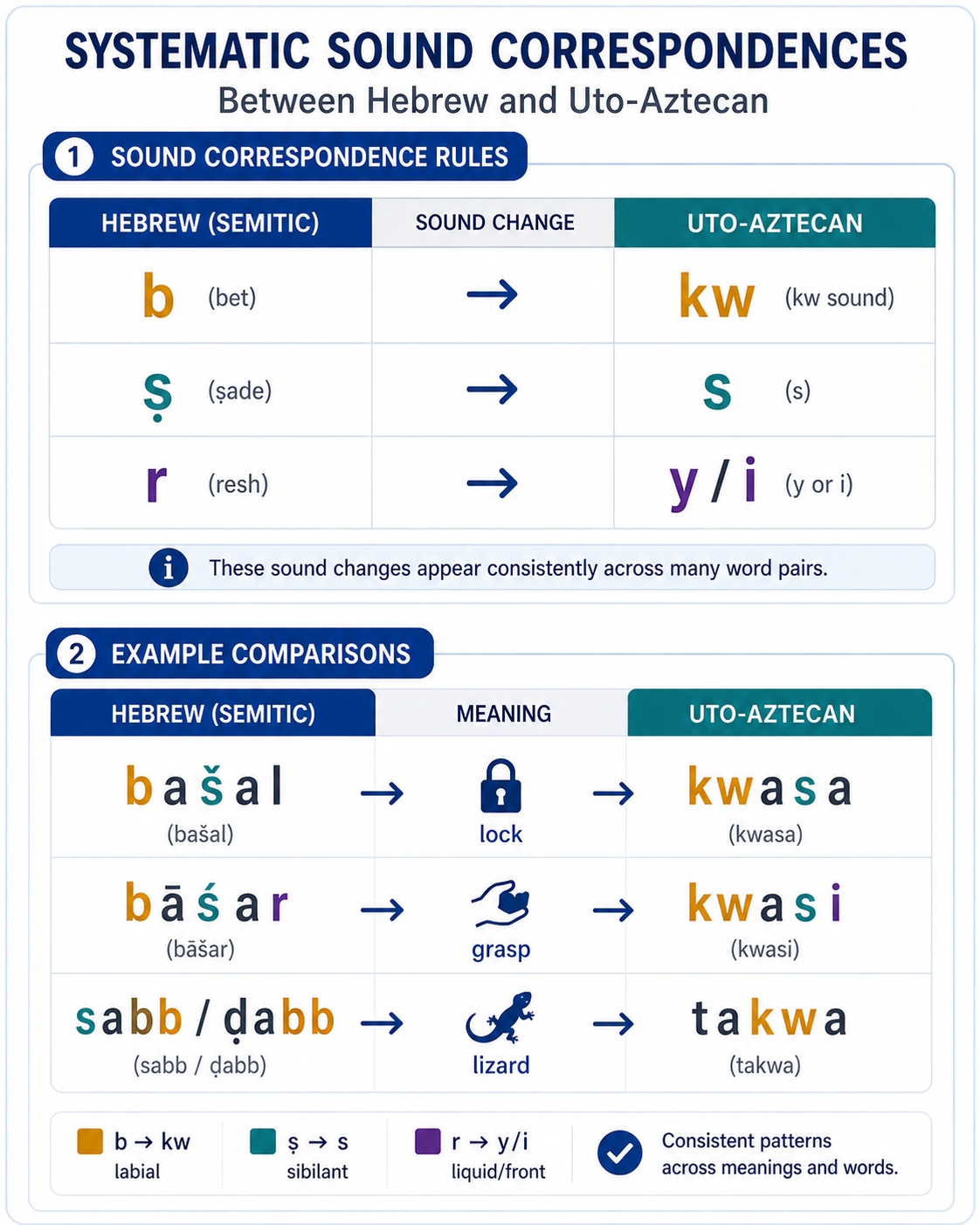
Examples of Sound Changes
For example, Hebrew b in dagesh positions (which means at the beginning of a word or in certain positions) changed to kw in Uto-Aztecan.
The emphatic or pharyngeal ṣ changed to s.
That “c” with a little hook under it we’re going to use to represent the ts sound. In fact, that’s how it’s pronounced now in modern Israel.
The r changed to y or i, another very common change in world languages.
Lexical Comparisons
Keeping those three sound changes in mind, look at these similarities between Hebrew words and Uto-Aztecan words.
For example, the Hebrew verb ‘to boil’ or ‘ripen’ is bašal. The corresponding word is kwasa.
It’s missing the final l, but the b corresponds to kw, and the š corresponds to s.
Semantic and Phonological Matches
The Hebrew word for ‘flesh’ or ‘meat’ is bāśar (and other meanings). In Uto-Aztecan it’s kwasi.
Again, you see the b change to kw, the š corresponds to s, and the r goes to an i or y sound. (In fact, in some of the languages, the Y actually shows up.)
The verb for babba in Arabic but ṣabba in Hebrew—means ‘to latch onto something, to grab’ —like a lizard.
Multi-Meaning Correspondence Example
Notice the double b. That would cause a kw in Uto-Aztecan.
And interestingly, this corresponds perfectly. In Uto-Aztecan, takwa means ‘to close or lock’, like it does in Arabic and Hebrew and other semitic languages. It also means ‘to catch or grasp’, like it does in Arabic.
Striking Lexical Parallel
And one of the nouns coming from that verb is a word for lizard.
Sabb—or in Arabic, ḍabb—means lizard.
And in Uto-Aztecan, takwa also means lizard.
So here you have an identical form that has all three meanings:
- to close or lock
- to grab
- lizard
They match phonologically—all the sounds match. They also have those same three meanings in Uto Aztecan. 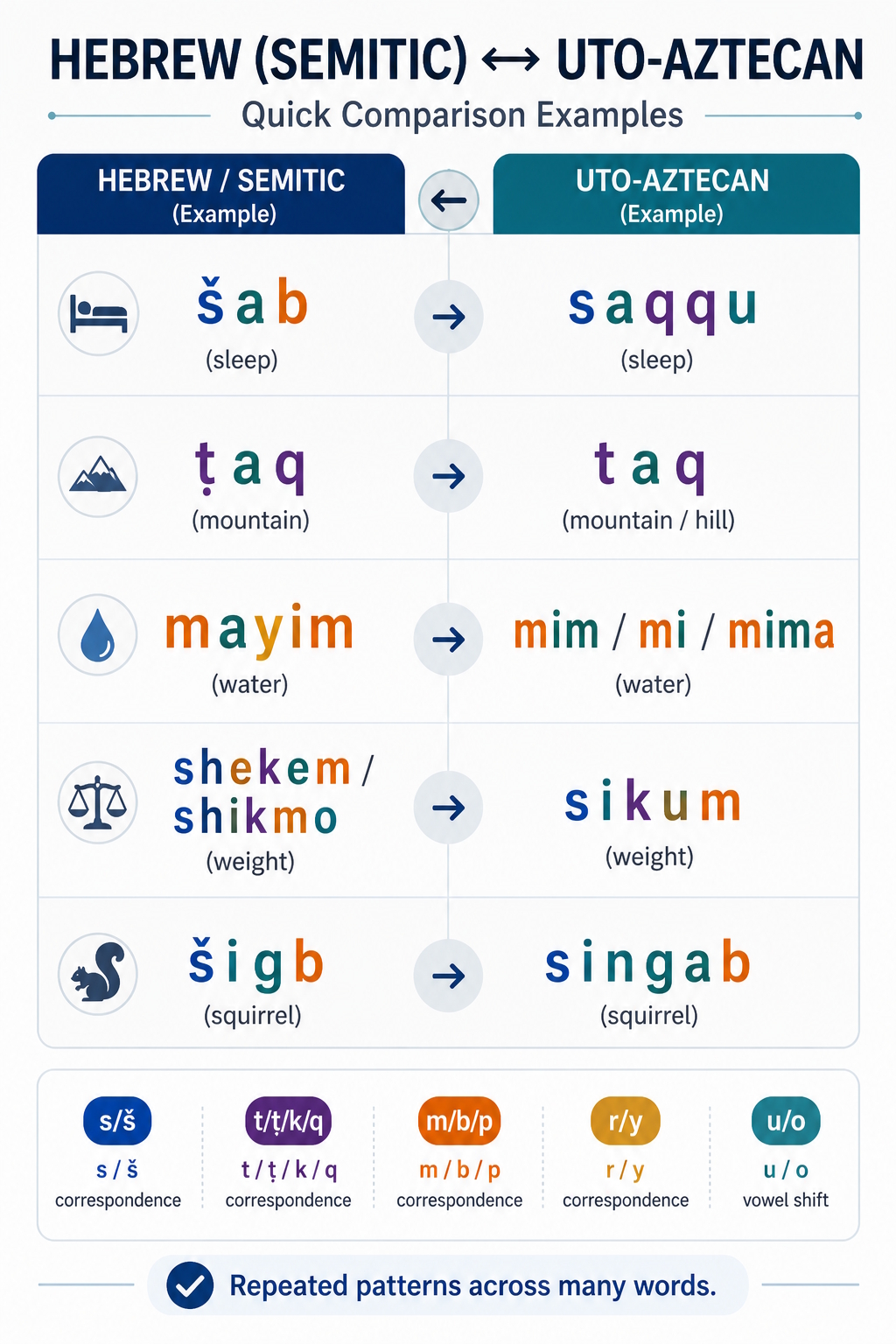
Additional Verb and Pattern Examples
In fact, here are a couple of more examples. Shāb is a past tense. Shābad is the imperfect form of the conjugation. Don’t worry if you don’t understand all the words I’m using—we don’t have time to explain it—but you can get the picture here.
Anyway, šab saqqu—you see the s lining up, the double b to the qua, and the r to the y. Same thing with ṭaq.
Here are a few others. Mayim is the Hebrew word for water. Mim, mi, mima is the word for ocean in a number of Uto-Aztecan languages. The word for shoulder is similar.
I’m just going to go real fast here.
The word for shoulder—shekem or shikmo—shikmo if it’s got a suffix. Sikum—actually with an m sometimes. The capital N just means any kind of nasal. It changes according to the letter following it.
Singab—word for squirrel. If this word existed in Hebrew, it would match Arabic in a form of shigb. We don’t have that word for squirrel in ancient Hebrew because there is no need to talk about squirrels in the Old Testament.
But the sound correspondence is among Semitic languages themselves.
Semitic Language Family Context
By the way, Semitic—I might need to explain that term—is the language family to which Hebrew, Arabic, Babylonian, Ethiopic and Semitic languages belong. Arabic is closely related to Hebrew. Oh, and Aramaic—that will be important in our discussion. 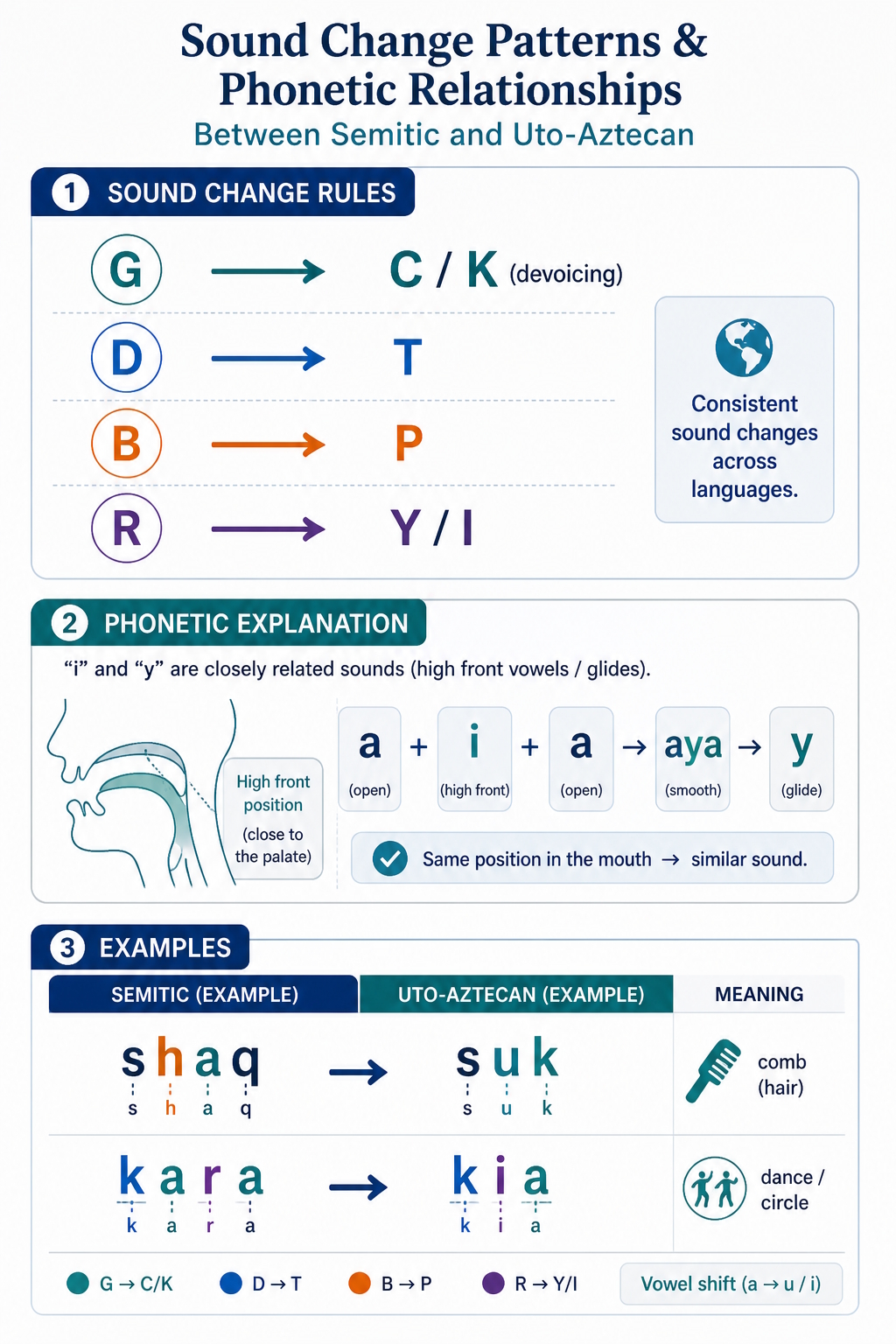
Sound Change Patterns
Anyway, šigb would be the word in Hebrew; kʷul with a silent consonant at the end is the word in Uto-Aztecan.
G changed to C—that devoicing of G and D to C and T—and B to P in other positions is also established with several examples.
Another verb—Aramaic—and by the way, yes, these are examples of r changing to y or i.
Phonetic Relationships (i and y)
By the way, those are basically the same letter. You don’t think of i and y being the same letter.
But say the vowel i between two a’s, for example aya, and if you make the vowel long, it’s ē. But if you make it short, i, then the i becomes a y.
They’re both pronounced in exactly the same place in the mouth. So whether you see an i or a y, they’re basically the same.
More Comparative Examples
Anyway, shaq, the word for comb the hair—which I don’t have too much of anymore—and in Uto-Aztecan, suk. You see the y corresponding to the y, and everything else matches fairly well.
Kara—to go in circles or to do dances. In Southern Paiute, kia—to have a round dance.
Semantic and Motion Verbs
mar, to go or flow or pass by in Semitic languages generally; in Uto-Aztecan, mia.
barr in Arabic, meaning field or land as opposed to water; kwa in Uto-Aztecan.
And there’s actually one language that has the ru, so they have three examples in a row of an r between vowels going to y in Uto-Aztecan.
Transition to Broader Examples
There are several others, but we don’t have time for everything. Let’s skip those.
Oh, here are some interesting ones. Let’s take a look at these. I’m watching my clock here.
So what we’re going to do is give a lot of examples—just look at them—and there are many very interesting ones. Then we’ll talk about what it all means.
“Adam” and Color Associations
One of the words for man in Hebrew is ʾādām. In Uto-Aztecan we have ʔitam.
Another word from that same root, ʾāḏōm, means red—and in fact the verb ʾāḏam means ‘to be red’.
In Arabic you’ve got ʾaduma, ʾadimal, and so forth. And in Uto-Aztecan, ʔitam is the word for brown. Red and brown are often associated. 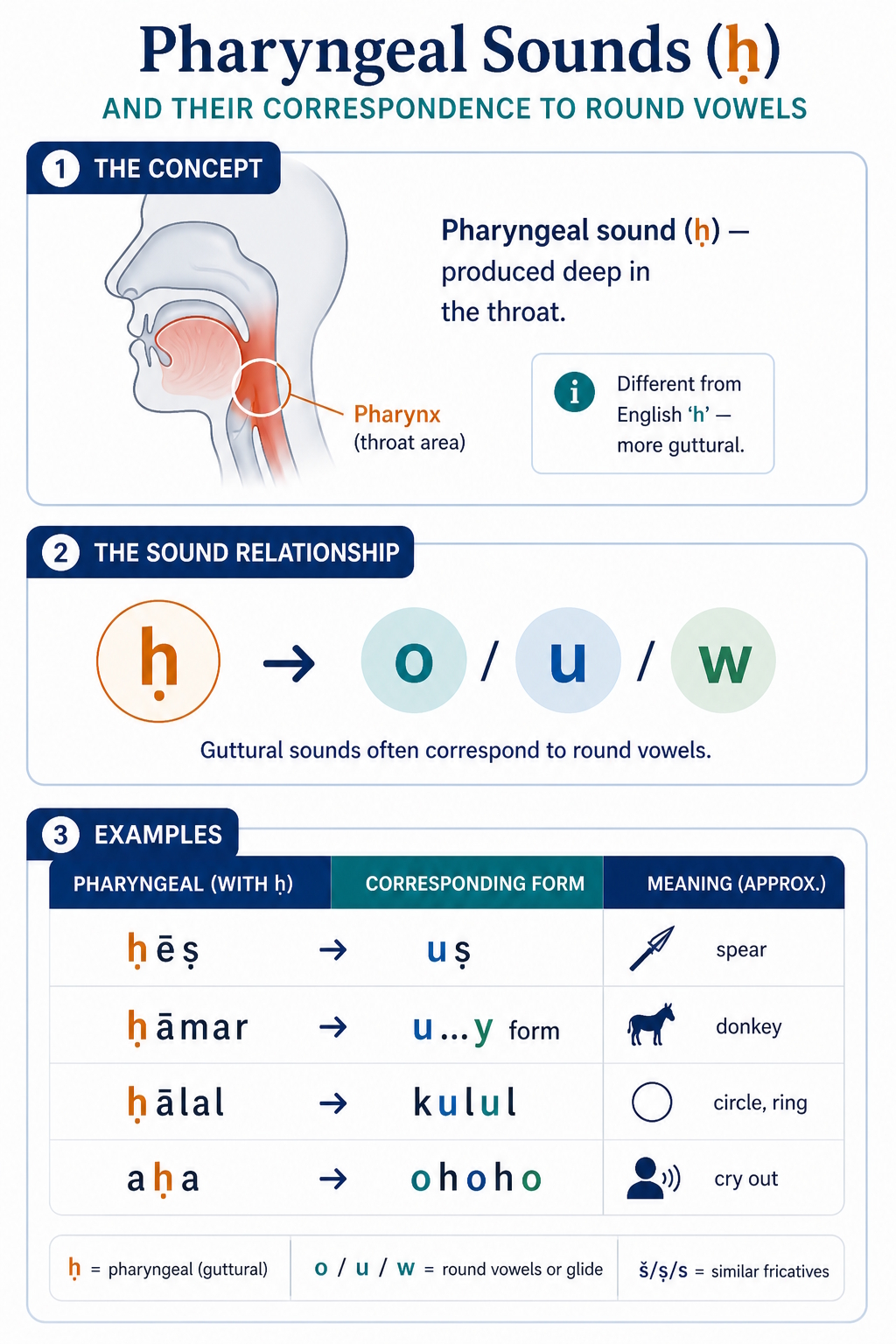
Pharyngeal Sounds and Vowels
Now, the pharyngeal Hebrew ḥ is reflected by o or u. The pharyngeal ḥ is different than our English h—it’s pronounced very gutturally in the pharynx.
For example, instead of “aha” with a regular h, it’s a very guttural sound.
And that gutturalness makes its tonality very similar to round vowels. In fact, it’s always associated with round vowels like o and u.
Pharyngeal Correspondences
So here we have—usually u is what it corresponds to in Uto-Aztecan. For example, ḥēṣ is the Hebrew word for arrow; in Uto-Aztecan it’s uṣ.
You’ve got that pharyngeal ḥ causing the vowel.
ḥāmar means to smear something—again you see the pharyngeal ḥ going to u, and the r going to y. ḥarak, same thing.
More Pharyngeal Examples
ḥālal, the verb to play the flute; in Uto-Aztecan, kulul. It’s missing the initial ḥ, but it’s got the round vowels and the two l’s. It’s very similar.
Aḥa—to cough—and ohoho, and so forth.
To cry—with that guttural ḥ—you’ve got the š corresponding to s, the r to y, and the w or u, which is also like a round vowel, corresponding to ḥ.
Relationship Between w, u, i, and y
In fact, w’s and u’s are like i and y. If you say awa, you make a u sound between two a’s, and say it faster and faster, then it becomes w.
So w’s and o’s and u’s are very similar. 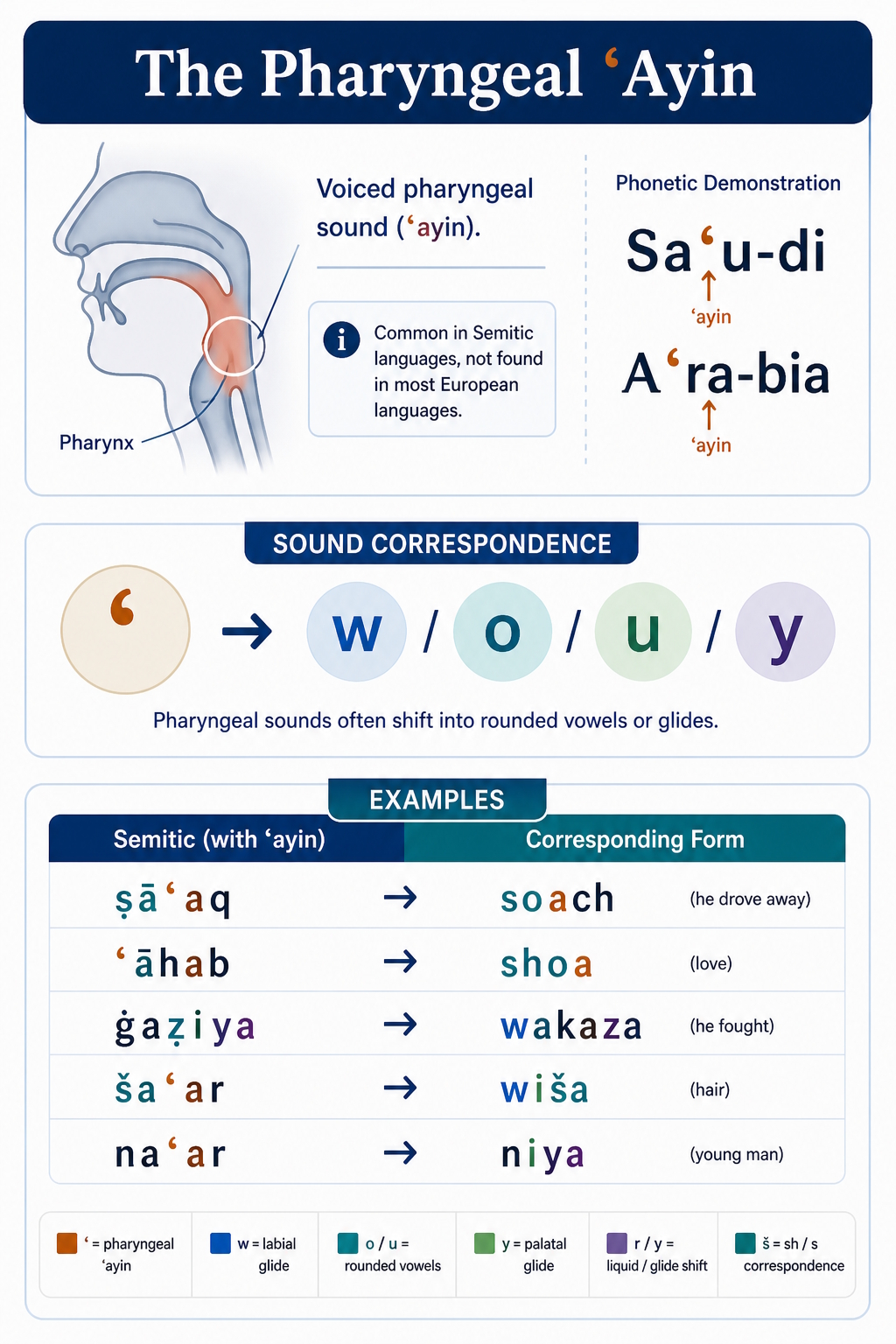
The Pharyngeal ʿAyin
The pharyngeal ʿayin is also a pharyngeal. But it’s voiced pharyngeal instead of voiceless. It’s a sound unique to Semitic languages, not in European languages.
In fact, in Saudi Arabia, you have two ʿayin’s. Saʿu-di—Aʿra-bia. There’s an ʿayin between Saudi and Arabia. There are consonants between those.
Anyway, the pharyngeal also goes to w or o or u. That pharyngeal behaves very much like the other pharyngeal.
Examples Involving ʿAyin
And here are some examples. For example, the verb ṣāʿaq is the word to cry—or “to cry out”—in Hebrew; in Uto-Aztecan, soach. You’ve got that “ooa” that shows the presence of a pharyngeal.
Šaʿa—ʿāhab, to delight in or love. In Uto-Aztecan, shoa.
Oh, this is a great one. In Arabic, there is a verb to grow old—specifically used for women. It’s not used for men or any other kind of creature. It means for a woman to grow old. Its consonants are ʿ, ġ, and z—ġ-z-y. ġaẓiya.
In Tarahumara, one of our Uto-Aztecan languages—identical. And it specifically means to grow old (only women): wakaza. For some reason, there’s not such a verb for men. There’s a little bit of chauvinism in ancient languages.
Anyway, you see the ‘ayin, corresponding to the W. ġaẓiya and wakaza, word for older woman.
Shelar—hair. Šaʿar in Arabic; in Uto-Aztecan, wiša.
You see the š corresponding, the pharyngeal ‘ayin to w, and the r to e.
More Word Comparisons
Word for boy: naʿar; in Uto-Aztecan niya.
Again, the pharyngeal ayin with the w/y, and the r going to e.
Enough of that one. Let’s look at a few more here.
Final Comparative Examples
The word for forest: yaʿar. yui
To swallow: bālaʿ; in Uto-Aztecan kʷu. Again, b corresponding to kw, l to l, and ʿ to u.
The word for ‘leech’ in Hebrew and Arabic—ʿalūq. In Uto-Aztecan, wak.
Glottal Stop Behavior
The Semitic ʾaleph (glottal stop) also acts like a pharyngeal. The glottal stop is like an “uh uh” catch in the throat—ʔ.
It often went to w. In fact, it does in Arabic; glottal stops sometimes go to w.
Final Linguistic Alignments
The word for lion in Hebrew—ʾaryēh; in Uto-Aztecan, warya.
The word for “believe”: yaʾamin, ʾāman—“he believes” in Hebrew. Yahwamin means “to believe” in Uto-Aztecan. Ya amino, amino—“he believes him” or “believes it”—is another Hebrew word from that verb.
Gabrielino: -o—I know it’s missing the m, but it’s actually got the -o meaning “him” or “it” as an object.
Probability Observation
The probability of those seven segments aligning perfectly like that—I figured out manually once—it’s one in several thousand anyway, the probability of it aligning by chance.
There are a lot of other interesting words—we don’t have time to go over all of them. Let’s run to the Egyptian.
Oh yes, and what’s interesting is in Uto-Aztecan, we not only find about 600–700 similarities between Hebrew and Uto-Aztecan, we also find about 300 similarities between Egyptian and Uto-Aztecan. 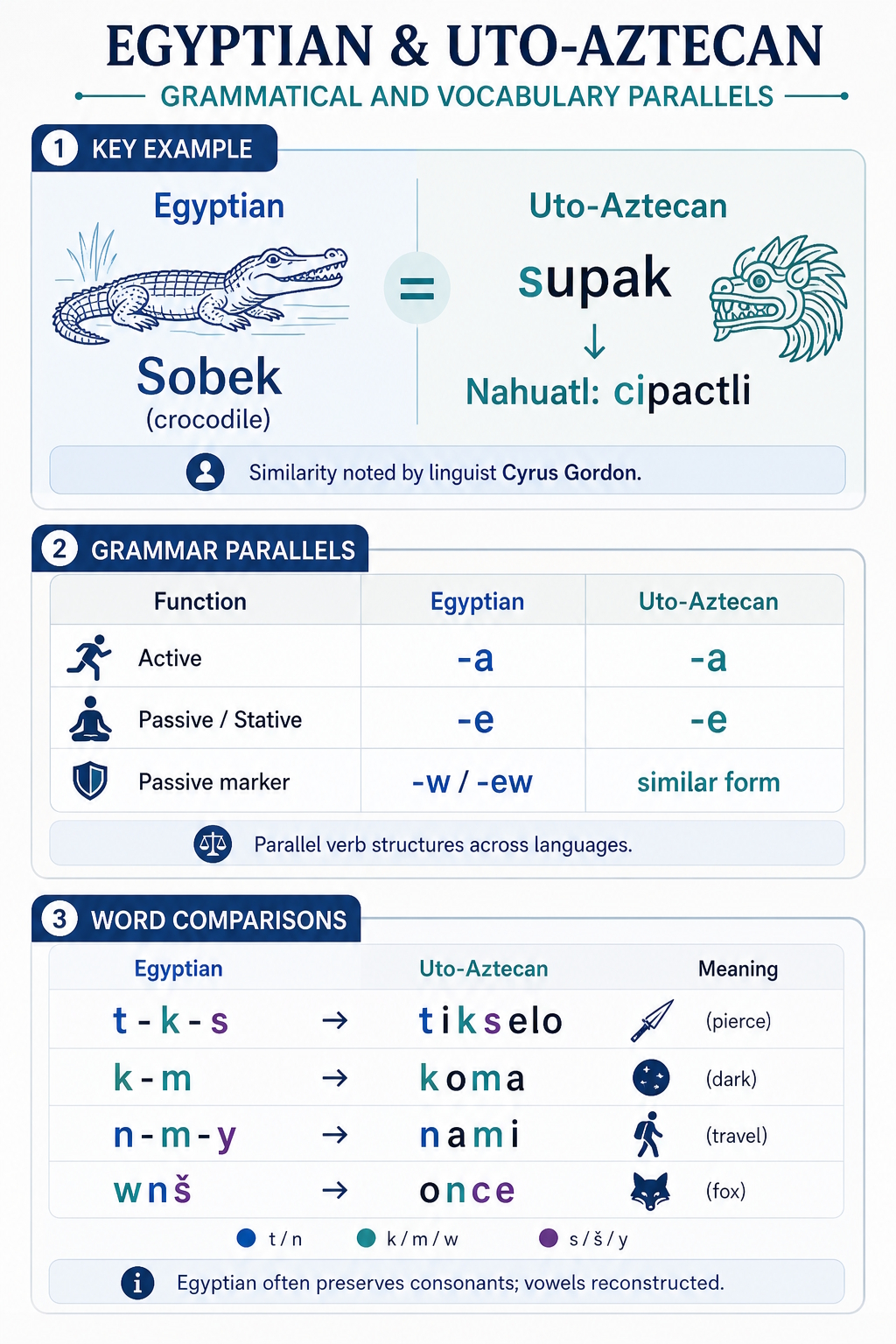
Similarities Between Egyptian and Uto-Aztecan
This first one was not found by me. It was found by Cyrus Gordon, an internationally renowned Semiticist, who happened to notice that the Aztec word—Classical Nahuatl—for crocodile, cipactli, which comes from Uto-Aztecan supak, was very similar to the Egyptian word for crocodile, Sobek.
Oh yes—and the old perfective in Egyptian has verbs ending in -e if it was past tense or passive/stative kinds of things. Interestingly, in Uto-Aztecan there’s a mechanism that has verbs ending in -a being active or transitive, and verbs ending in -e being passive, intransitive, and stative—exactly like it is in Egyptian.
The passive -w or -ew in Egyptian—exact same thing in Uto-Aztecan. In fact, there are four ways in Egyptian to make a verb stative or passive, and one in Arabic—and Uto-Aztecan has all five of them quite prominently.
This goes into pronouns—we don’t have time for pronouns. Let’s take a look at some Egyptian words.
Egyptian Consonants and Uto-Aztecan
By the way, in Egyptian we only have the consonants. We know a little bit about the vowels from Coptic, even though they’re debatable sometimes. We have a few vowels figured out by transliterations into other languages, but a lot of it is still quite unknown.
So the Egyptian consonants for a verb meaning “to pierce” are t-k-s. In Uto-Aztecan, tikselo is the verb meaning to pierce or poke.
k-m is the verb meaning black, brown—any dark color. In Coptic, kēme; in Uto-Aztecan, koma, meaning dark gray, brown, black.
n-m-y is the word for traveling or crossing something. In Uto-Aztecan, nami means traveling, walking around, crossing an area or a river.
Wnš—or wunish, whatever the vowels were—in Coptic, onch; in Uto-Aztecan, once, onceo, and onceu, the word for “fox.”
100 out of 1000 Examples
Let’s just pick out a few of each page. Like I say, there are about a thousand of these—we’re going to show you about a hundred or 150. If you want all of them, they’re in a book in the back. By the title of this, if you want the whole story and you’re interested in this kind of thing, you’ve got all the details in 110 pages back there. We’re just getting the tip of the iceberg here.
For example, šim in Egyptian, the word for “go” or “walk”; sema in Uto-Aztecan.
Another: sbk (Egyptian), calf of the leg or lower leg; in Uto-Aztecan sepika—same three consonants. Calf of the leg, lower leg.
Oh, by the way, Coptic is a later form of Egyptian that did put vowels into it. It existed about the time of Christ.
s-b-t in Coptic; sapi in Uto-Aztecan, meaning fence or enclosure.
k-b in Egyptian, meaning cool, calm, quiet; kopa in Uto-Aztecan, quiet and calm.
Similarities Between Egyptian and Uto-Aztecan
This first one was not found by me. It was found by Cyrus Gordon, an internationally renowned Semiticist, who happened to notice that the Aztec word—Classical Nahuatl—for crocodile, cipactli, which comes from Uto-Aztecan supak, was very similar to the Egyptian word for crocodile, Sobek.
Oh yes—and the old perfective in Egyptian has verbs ending in -e if it was past tense or passive/stative kinds of things. Interestingly, in Uto-Aztecan there’s a mechanism that has verbs ending in -a being active or transitive, and verbs ending in -e being passive, intransitive, and stative—exactly like it is in Egyptian.
The passive -w or -ew in Egyptian—exact same thing in Uto-Aztecan. In fact, there are four ways in Egyptian to make a verb stative or passive, and one in Arabic—and Uto-Aztecan has all five of them quite prominently.
This goes into pronouns—we don’t have time for pronouns. Let’s take a look at some Egyptian words.
Similarities Between these two languages
By the way, in Egyptian we only have the consonants. We know a little bit about the vowels from Coptic, even though they’re debatable sometimes. We have a few vowels figured out by transliterations into other languages, but a lot of it is still quite unknown.
So the Egyptian consonants for a verb meaning “to pierce” are t-k-s. In Uto-Aztecan, tikselo is the verb meaning to pierce or poke.
k-m is the verb meaning black, brown—any dark color. In Coptic, kēme; in Uto-Aztecan, koma, meaning dark gray, brown, black.
n-m-y is the word for traveling or crossing something. In Uto-Aztecan, nami means traveling, walking around, crossing an area or a river.
Wnš—or wunish, whatever the vowels were—in Coptic, onch; in Uto-Aztecan, once, onceo, and onceu, the word for “fox.”
Egyptian Article Prefixes as Proofs
Now, Egyptian has article prefixes. For a feminine noun, wꜣ means “a bee.” tꜣ means “the,” so you’d put that on the front, meaning “the bee.” And nꜣ is the plural “the” in Egyptian, meaning “the bees.” So you have wꜣ, tꜣ, and nꜣ as prefixes to the word.
And here we have in Uto-Aztecan: the Tarahumara language has three different variants for this word “bumblebee”: napara, tapara, and wapara.
The -para part is simply a vowel change. Since the last vowel is a, it tends to change the vowels in front of it to a. That happens often in English and other languages. So para becomes para. Intervocalic t becomes r often.
So para is the word for bee, and it has those same three prefixes for a feminine noun. In Egyptian, bit is a feminine noun. Boy, you can’t get a much better match than that. 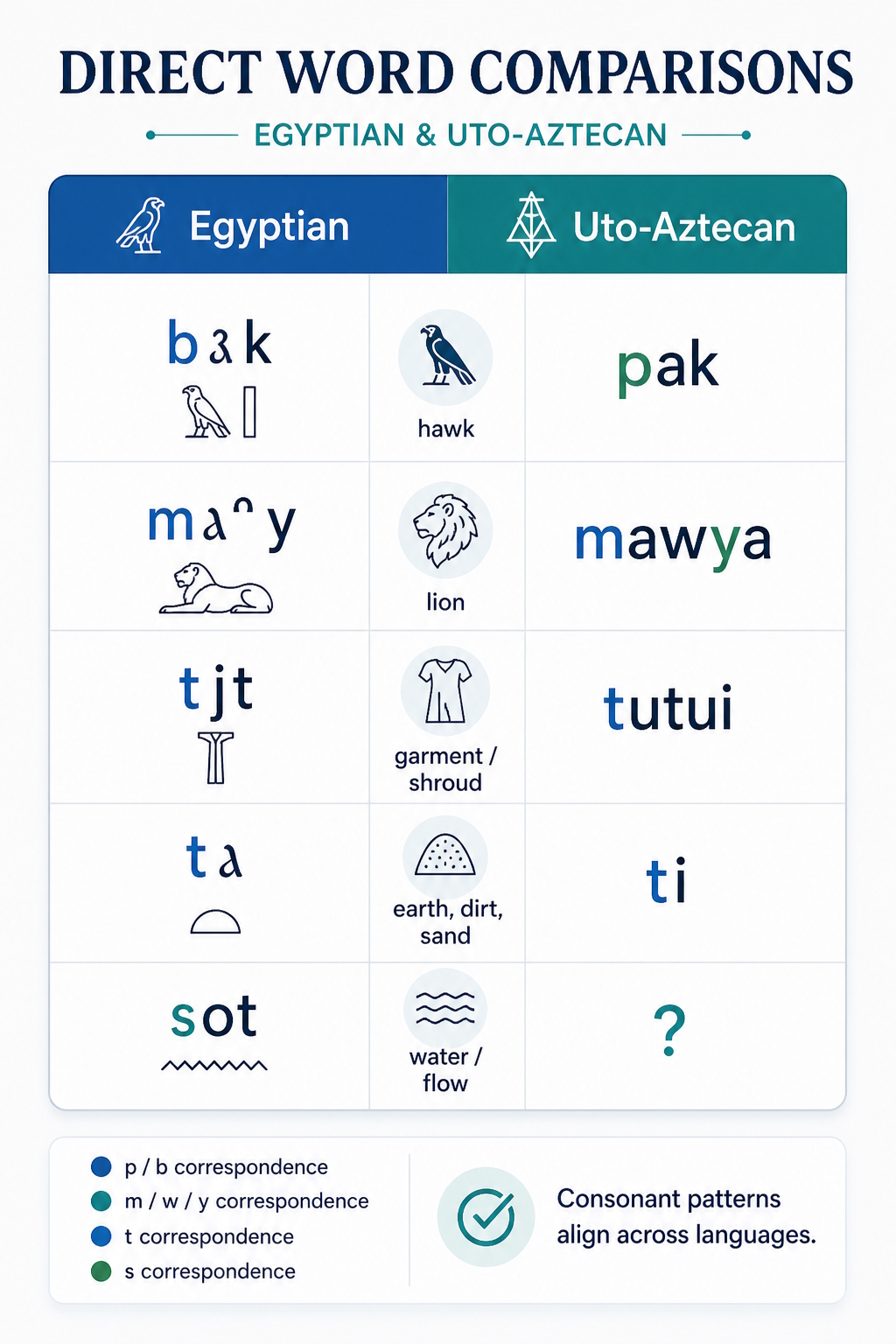
Egyptian–Uto-Aztecan Word Parallels
A few more: Egyptian bꜣk (hawk); in Uto-Aztecan, pak.
Now we have to show you these. The word for lion in Egyptian—mꜣꜥy (consonants m-ʔ-y). Remember, the glottal stop goes to w, and i is the same as y. In Coptic, it’s moui. In Uto-Aztecan, mawya—all three consonants showing perfectly.
tjt—a shroud or garment—in Egyptian; in Uto-Aztecan, tutui—all three consonants matching.
tꜣ is the Egyptian word for earth; in Uto-Aztecan, ti, meaning dirt, dust, sand.
Sot—the word for son.
Glottal Stop Correspondence and Shifts
The word for old man, or “to be old,” in Egyptian—that’s an i, glottal stop, w—iwꜣ; in Uto-Aztecan, yowa—again, the glottal stop showing with rounding and the w.
This is wonderful: sbꜣ. In Coptic, it’s sba. But Coptic has already lost the glottal stop of Egyptian—it only has the s originally from the Egyptian. Whereas Uto-Aztecan has all three consonants still showing. But the glottal stop jumped from the third consonant to the second. So seepo is the word for star in Uto-Aztecan.
And by the way, this is a consistent pattern—the glottal stop jumping ahead for certain words or kinds of vocalizations.
Transition to Hebrew Sound Correspondences
We’re not going to have time to show you all this. I’ve got to show you one other page, and then we’ll come to some conclusions.
Anyway, after I found all of these Egyptian words, the sound correspondences of Egyptian were a little bit different than what I had found for Hebrew.
The t goes to s, and the b to p, and so forth. Then I started noticing lots of words in Uto-Aztecan as well where the Hebrew b corresponded to p.
Hebrew “b → p” Correspondence Examples
Here’s a good list of them. The p-dialect of Hebrew, for example—the word in Hebrew for lightning is baraq; in Uto-Aztecan, peraq. The word for house, bēt; in Uto-Aztecan, pet.
The word also as a verb—“to spend the night”—in Uto-Aztecan means house, and pet as a verb also means to spend the night. Betach, petirach—that’s that pharyngeal ḥ behavior, and so forth.
Another example: bōʾ means “coming,” or also “the way,” in Hebrew; po, identical in Uto-Aztecan for road or path.
This is a good one: bāṣaʿ, to look or see; bassar, to open the eyes. In Arabic, baṣar for eye—the Hebrew voweling would be bosi, which matches Uto-Aztecan pusi. This is a bit strange, but it matches. We don’t have that word in Hebrew per se.
The word for daughter, bat; in Uto-Aztecan, pate.
Discovery of a “p-Dialect” in Uto-Aztecan
And so forth. Several hundred other words showed me that there is also a p-dialect of Hebrew in Uto-Aztecan. And it wasn’t until I found all three of these that it dawned on me—I’m a little slow and dense at times—that here we have one dialect of Hebrew, or Hebrew/Aramaic (it actually has a lot of Aramaic leaning).
Northwest Semitic Connections: Hebrew and Aramaic
This p-dialect of Northwest Semitic—shall we call it—Aramaic and Hebrew are both part of the Northwest Semitic branch of Semitic. Anyway, we have a p-dialect of Hebrew, and we have it matching Egyptian, and then we have a kw-dialect of Hebrew. 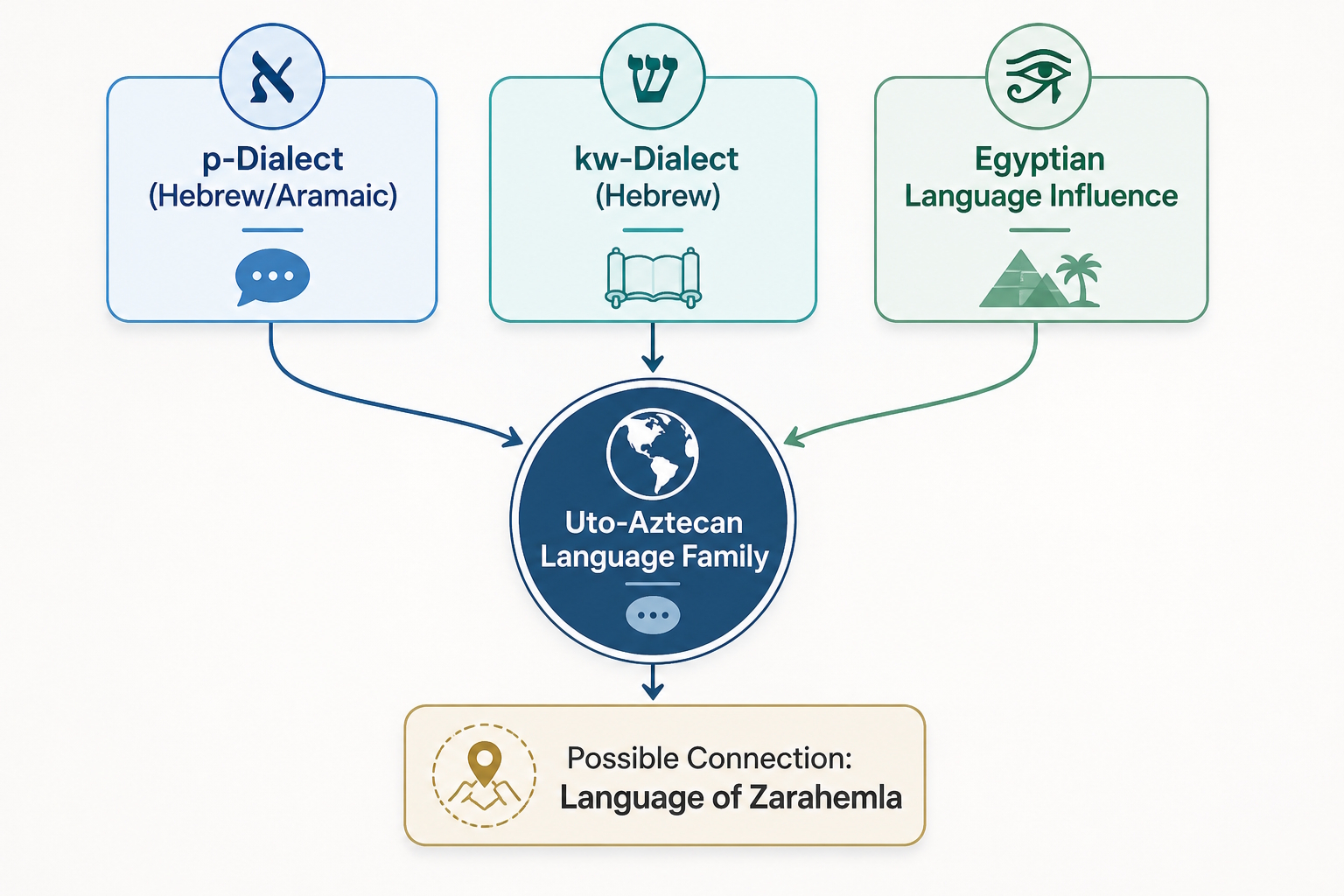
Possible Book of Mormon Connection: Zarahemla
And then it comes to mind, of course, the union of the Mulekites with the Nephites—Nephites who are dealing with both Egyptian and Hebrew uniting with the Mulekites. And it would appear, at first glance—in fact, there’s a whole bunch of other evidence that I don’t have time to show you—but this actually is a descendant of the language of Zarahemla, because you have all of them.
Reactions from Linguistic Experts
Now, of course, I’ve run this privately past a few Uto-Aztecan PhDs in linguistics that I work with—they’re non-LDS—and shown these similarities, and their jaws drop. They are really quite overwhelmed with the number and quality of the similarities. But it has not been published, so give me a little more time. I need to figure a few more things out and put some other things together first.
But from both LDS specialists, Semitic specialists and non-LDS Semitic specialists, and non-Uto-Aztecanists, it seems to be a very strong case.
And you know, this is only one of the 150 language families in the Americas. There are a lot of interesting things in other language families. So it’s all yet to be worked out, and it will all come out in the wash. 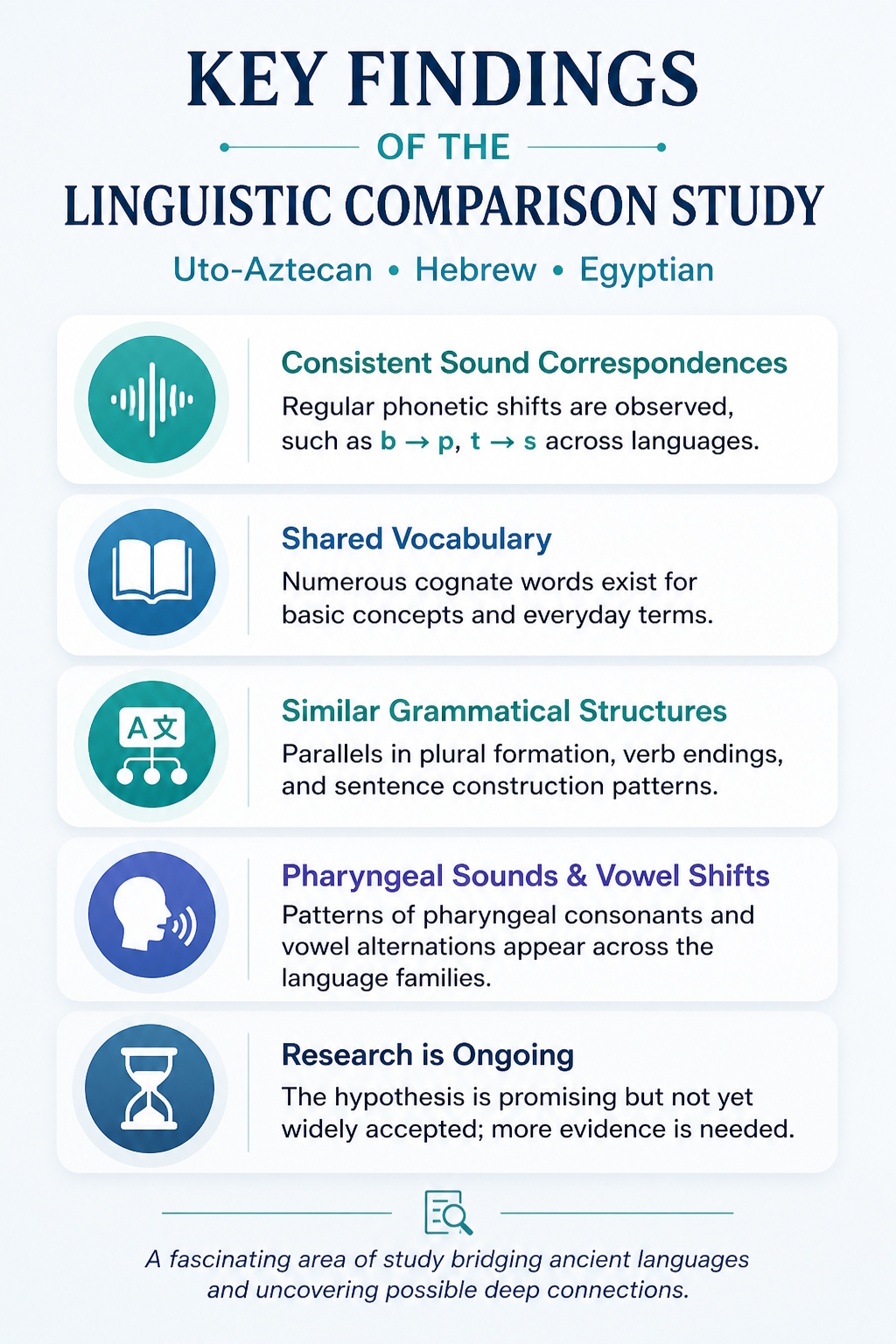
Responding to Critics
So when the critics say there is no language evidence for the Book of Mormon that has been accepted by the linguistic community, they are correct. There’s nothing yet that has been accepted by the linguistic community—but that doesn’t mean it’s not there.
The progress of Native American language study generally is slow. It takes about three to five lifetimes to really get a language family figured out.
Q&A
Anyway—hey, let’s take a few questions.
First question:
This asks about other language families besides Uto-Aztecan. There are people who have claimed, for example, Swadesh claimed something for the Zapotecan languages. There’s a handful of similarities with Hebrew—not enough that anybody’s really paid attention to them.
Another person has put together some similarities with Quechua in the south, and about half of those are really good and could be worked up according to linguistic methodology, but that has not been done yet. Half of them are spurious and do not work so well.
Others have claimed things for Plains Indians, Iriquoi and so forth. I’ve looked at those languages myself. In fact, the reason I focused on Uto-Aztecan is because I looked at a few dozen language families before focusing on this one. There are some interesting things in other language families, but none of them have been put together, written up, and presented convincingly to the linguistic community—not even close. And so that has not been done yet.
Second Question:
(You’re assuming I can read small print!) This talks about the Uto-Aztecans not arriving in Mesoamerica until after 900 AD. Yes, Aztecan came quite late to where it is now. They claimed to have come from the northwest of there, which is interestingly where all the other Uto-Aztecan languages are.
Not only that, but I think that with time I might figure out where they come from exactly by language comparisons and areas.
But that doesn’t mean they didn’t come from the south, go north, and then return southward—perhaps survivors of the destruction of the Nephites—while others were northward. The homeland of the Uto-Aztecans is somewhere in northwest Mexico or the southwest U.S.
Third Question
This talks about the Olmec. Yes, the Olmec are the archaeological entity in the Gulf of Mexico that might be Jaredite-related, and that the Michoacán language family is associated with the Olmec tradition. That’s probably true—I don’t doubt it at all.
And this is basically asking about Jaredite languages. Yes, I am very interested in that matter. I think a lot of American Indian languages are more Jaredite-descended than Lehite—but that’s about three more lifetimes of research.
If anybody wants to become a linguist and dive into that, they’re welcome. My life’s two-thirds over, and I’m going to focus on as many language families as I can with the Lehi problem.
Question: We see in your examples words written—do these languages have written forms?
Answer: Some of them do. Some are simply spoken languages that linguists record. Others have modern written forms—they borrowed the Roman alphabet, just like we English speakers did. 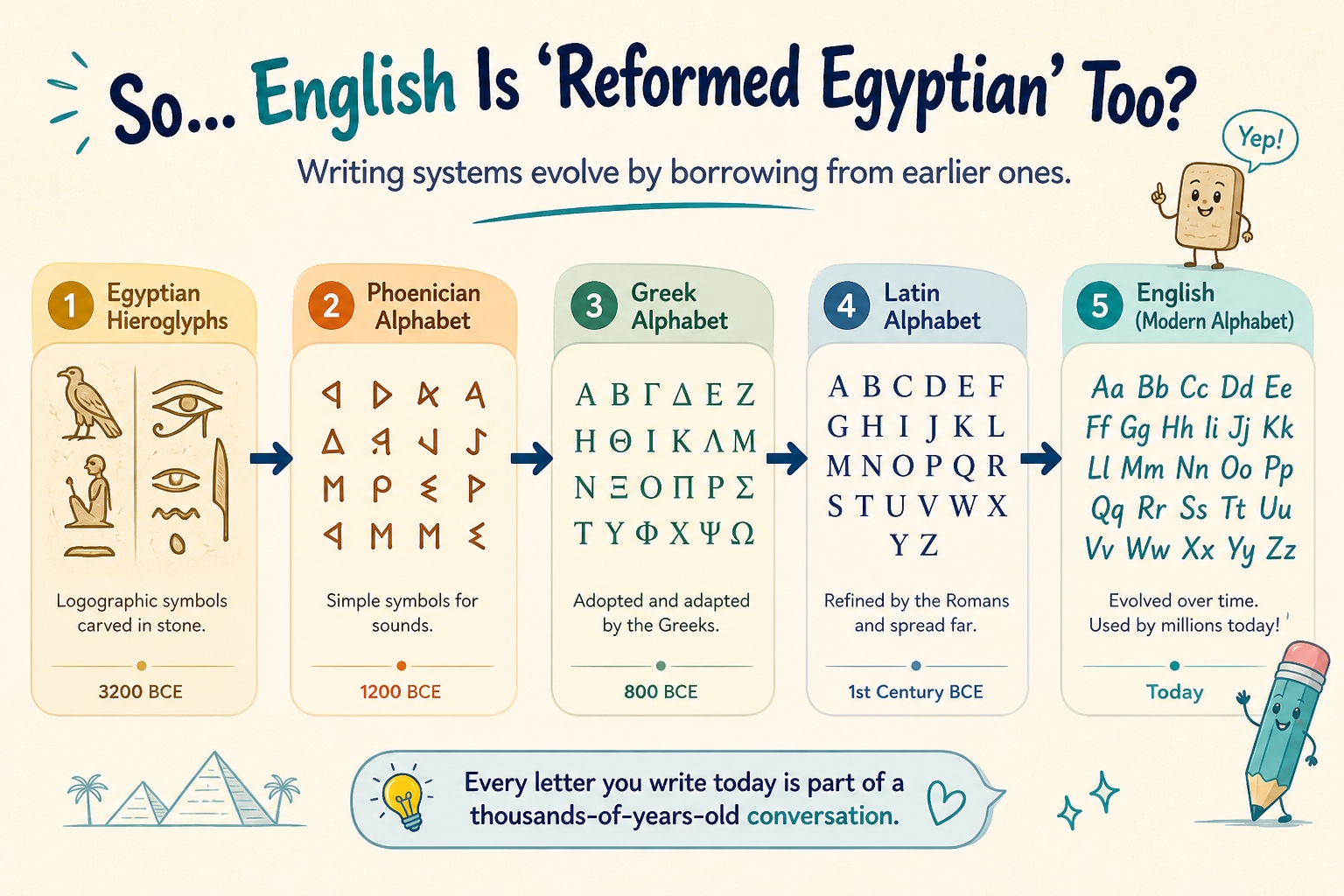
The Romans borrowed the Greek alphabet to write Latin. The Greeks borrowed the Phoenician alphabet, and the Hebrews and Phoenicians got many of their symbols from Egyptian. So English is “reformed Egyptian,” too.
Here’s a very good question, and I meant to touch upon it:
Question: There are a lot of word similarities—are there any grammatical similarities?
Answer: Yes, I have found a few, but not many. That’s my focus for the next few years—to learn Egyptian better and find some grammatical similarities.
With more research, I think we can identify time and place of Egyptian influence and so forth. That will be interesting and mostly still needs to be done.
Question: Have you made comparisons with Mesoamerican and Hebrew languages?
Answer: Yes, I’ve looked at Mesoamerican languages. There are a couple of language families I want to look into—Oto-Manguean is interesting, and Hokan is interesting—but I haven’t had time yet.
Question: Aztec being a dead language—how do we know how it sounded?
Answer: Well, Aztec is not a dead language. There are still about a million speakers of Aztecs in Mexico—different dialects descended from Classical Nahuatl. But yeah, to be sure, one of the larger languages, still about a million speakers.
The largest Native language in the United States is Navajo, about 200,000 speakers; second largest is Cherokee, about 50,000. Others are less than 10,000, some less than 100, some already extinct.
But in Latin America, you have a million speakers of Aztec, six million speakers of Quechua—lots of languages flourishing there.
They don’t insist on public education in the same way—where they must learn Spanish—so they retain their native languages more than in the U.S., where English dominates.
So I’m an English teacher and a linguist—I’m working against myself. But they pay English teachers more, so that’s what I do for a living, and I try to help Native languages stay alive by not forcing English too aggressively.
Question: Is 600–700 similar words significant?
Yes, because some language relationships are founded on 50 similarities or less.
When you get 300 for each group, that is significant. But linguists would not accept a tripartite relationship—each relationship would have to stand on its own merit.
By the time everything is sifted, there will probably be enough for each hypothesis to stand on its own merit. But—give us time.
