The Legend Becomes Fact
It says up here, “Smile, have fun, play nice.“
Not in my profession.
I had a paper planned, a great big paper planned for today, and then I noticed an article in the Salt Lake Tribune last Saturday about the FAIR conference in which Scott mentioned that we don’t attack people personally. We don’t deal with personal attacks. So you’re safe, George. I can’t give that talk, so I had to do something different.
My topic—and I’m going to go through some of these things very quickly because I think the more interesting part of this presentation is hearing from the man himself, George Throckmorton.
The Man Who Shot Liberty Valance
Over the years, George and I have had interesting conversations that we’ve talked about in reference to the Hoffman case and others. We like to quote statements out of movies, and our favorite one that relates to Hoffman, and what I think leads out in the mythmaking of the Hoffman case, is a statement made at the end of a movie called The Man Who Shot Liberty Valance, starring John Wayne and Jimmy Stewart. In my opinion, the greatest western of all time.
For those who don’t remember this movie, I’ll run through it very quickly.
The movie starts with Jimmy Stewart and his wife returning to a little town in the West called Shinbone. He has been a U.S. senator and an ambassador, and he’s returning with his wife to this little town to bury an old friend named Tom Doniphon, played by John Wayne.
As they come into town, the local reporter sees him, grabs the editor, and they come over and say, “What is this great statesman, this senator, doing in our little town of Shinbone?”
They said, “We’re here to bury a friend.”
The editor pushed the issue. “We need to talk to you. Who is this Tom Doniphon?”
The Story of Tom Doniphon
So Jimmy Stewart agrees to talk with them and be interviewed, and he relays the story about how, as a young lawyer, he came to town, got involved in the local politics, and came into conflict with a local outlaw named Liberty Valance, played marvelously by Lee Marvin.
During the conflict and the fight over becoming a state from a territory, he is challenged to a duel by Liberty Valance. At the same time, he’s in competition with John Wayne over the girl.
After the election for delegates, he meets Liberty Valance on the street and shoots and kills him. He now becomes a hero and is known as the man who shot Liberty Valance.
They go to the territorial convention, and he decides to leave when he’s pressured or accused of being a murderer. As he’s about to leave, John Wayne pulls him aside and explains to him, “You did not shoot Liberty Valance because during that shooting I was in the alley and I shot and killed him, not you.”
They reenact that scene.
He then proceeds to go back, becomes the delegate, they get statehood, and he becomes governor, senator, and wins the girl.
Well, after he’s explained this whole story and the reporter is writing all the notes, the editor takes these notes, tears them up, and throws them in the fire.
He’s asked, “Well, Mr. Editor, why did you do that?”
He got up, turned, looked at Jimmy Stewart, and said, “This is the West, sir. When the legend becomes fact, print the legend.”
This fits in perfectly for Mark Hoffman.
Early Examples of Hoffman Myths
Let me share quickly some of the examples I believe exist. Some of these are kind of fun. Some of these we’ve all heard.
First one is our friend Ed Decker from Saints Alive in Jesus. This is on his webpage. He has a book called Bearing Testimony of Truth, compiled and edited by Derek S. Harden. It’s been on there for a few years, and this morning it still was.
This is a personal manuscript written by this gentleman, and there’s some editorial notes that Ed Decker wrote at the beginning:
“This manuscript was completed and submitted during the brief time that the Mormon Church had accepted as true a fraudulent work generally called the White Salamander Letter by the infamous forger of Mormon manuscripts, Mark Hoffman. We have notified the author that this needs to be cleaned up and removed from the book and will make the correction as soon as we receive the corrected copy.”
Okay. It still is.
Interesting that the LDS Church created new doctrine to explain that a white salamander was really an angel, and when the hoax was revealed, just as suddenly undid the doctrine—all without an apology or a blush.
Wow.
That’s kind of—you know—to eliminate something that never was really there. But I find that kind of humorous, that we had a doctrine as such.
I must have missed that meeting.
The Jerald and Sandra Tanner Narrative
Next one is an article out of the Salt Lake City Weekly from March of 2003. It’s a story about Jerald and Sandra Tanner and Utah Lighthouse Ministry.
Reviewing the Hoffman case, it says here:
“While many were taken by the notorious document forger and bomber Mark Hoffman, Jerald, with typical uncompromising accuracy, was not bamboozled. Collectors of historical documents from the LDS Church to the Library of Congress and Sotheby’s were buying Hoffman documents as fast as he could manufacture them. Hoffman sold forged letters of famous Americana, and his major focus was forging early Mormon historical documents that were extremely damaging to LDS doctrine and early Church leaders. All the while, only Jerald Tanner remained unimpressed and unconvinced of their authenticity. In 1984, he publicly announced his misgivings, calling Hoffman a forger.”
Now we’re talking about 1984. This is a year before the homicides.
I wondered about this. Now, it’s pretty clear that Jerald and Sandra had some serious doubts and problems with the Salamander Letter, but not all of them.
Not too long after this article came out, I visited with Sandra Tanner at their home in their bookstore, and I asked her, “Is this a misprint? Is this a misunderstanding by the Weekly?”
This is what Sandra told me:
“No. No. Jerald did have doubts about all the documents and really believed that Mark was a forger, but he had no solid proof.”
Okay, this is eighteen years after the fact.
Now this is being revealed in this article, but I have some serious problems with that in the fact that, in some of the writings of the Tanners following the homicides—and let me make a little side note here because they made reference to the bombings and the forgeries of Hoffman.
Call Him What He Is
One thing that has amazed me over the years is that we always refer to Hoffman as a bomber, or the bomber-forger. We seem to be afraid to say what he is.
He’s a murderer.
The forgeries and the bombings are secondary to the fact that he killed two people.
So if I had my preference, we’d call him what he is—a murderer.
More Myths Surrounding the Hoffman Case
But anyway, I asked Sandra that, and she just said, “Well, he just didn’t have any proof.”
Following the homicides, in some of the writings they suggested that Mark wasn’t that good of a forger or writer, that he must have had help. They suggested there was another individual who was forging the documents, and Mark was the middleman. When this person either died or stopped doing the forgeries, Mark started doing them all himself. That’s when they became sloppy and so forth.
Even as of last October, at a conference sponsored by an organization George belongs to—the Southwest Association of Forensic Document Examiners—Sandra and Jerald were there, and she was even asking people if they had any ideas whether anybody was helping Mark.
So I’m getting two different stories here.
But the significance of this is the fact that you read a lot of the webpages and some of the chat rooms, and they always say Jerald was the only one who knew that Mark was a forger. Everybody else believed him.
That isn’t true at all. There were others who had doubts too, but I find that to be one of the myths that has started.
The Myth of the Hoffman Plea Bargain
Another one of the myths that is frequently read about is the idea that there was going to be no trial of Mark Hoffman because the Church did not want information passed out, and the fact that the leadership of the Church—whoever they are—forced a plea bargain.
The man that will be preceding me here, Mr. Throckmorton, has explained to me that on the day he was asked to leave employment from the Salt Lake County DA’s office investigating the case, he was there when District Attorney Yokum instructed Bob Stott, the lead prosecutor, that he would plea bargain the case.
I’ve also heard from the mouths of Jerry Doria, Dave Briggs, and a few other people involved with the case that the Church had nothing to do with the plea bargain.
This came strictly from Mr. Yokum.
Yet this is another story that you will read on webpages and chat rooms—that the Church forced the plea bargain because they didn’t want President Hinckley to testify, or have to, or any other General Authority.
The Solomon Spalding–Sidney Rigdon Document
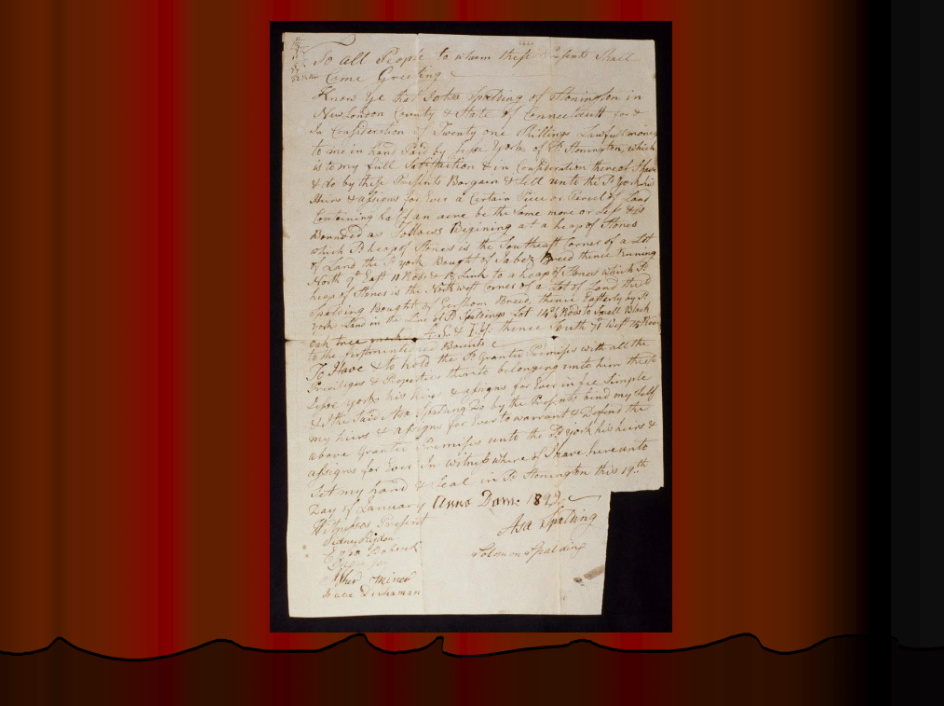
Now another fun one that I found interesting is this document here.
Here we go. This is the infamous Solomon Spalding–Sidney Rigdon land deed document that Mark came across.
Actually, it’s a legitimate old land deed where a gentleman named Asa Spalding is selling some land to his wife’s cousin, Jesse York. Well, Mark somehow got ahold of it.
Where? We don’t know.
But he proceeded to make some changes. Here you see, down at the bottom, the name Solomon Spalding. Over here you see the name Sidney Rigdon.
Now this is an interesting document because for years, on that Spalding issue, the claim was they didn’t know each other, and here would be some proof that they knew each other.
But it turns out these were added names. As you see over here on the date, it says 1822.
Well, the actual date is 1792.
Mark added the date at the top—1822.
This was a document that he showed Elder Oaks, and to where Elder Oaks went and signed for the $185,000 loan to possibly purchase the McLellin Collection.
In fact, Mark claimed this was part of the McLellin Collection.
A few weeks after showing it to Elder Oaks, he decided he needed some quick cash, so he took it down to Cosmic Airplane and sold it for $400.
Even though the guy who bought it, Steve Barnett, said, “There’s a problem with the dates because Spalding died in 1816.”
And if you went to the original date, 1792, Sidney Rigdon hadn’t been born yet.
But Mark convinced him.
He said, “Well, that’s not the same Solomon Spalding, but will you buy it for the Rigdon autograph?”
He paid the $400 for it.
Claims That the Church Purchased the Document
Now, a few years ago a book came out—I don’t know if you can see it—but it’s called Mormon Conspiracy by Charles Wood.
I got it at the Utah Lighthouse Ministry. 1
This is what he writes:
“The First Presidency was so impressed with Hoffman’s discovery of the Anton Transcript that they called the press conference at which they announced the new discovery and commended Hoffman for his efforts. Hoffman followed the Anton Transcript with several non-faith-promoting forged documents, which were quickly bought up by the First Presidency and hidden from the membership and the public. One of these forged documents included one that linked Sidney Rigdon, second to Commander Joseph Smith, to Solomon Spalding.”
Okay.
Provenance of the Spalding-Rigdon Land Deed
This document here.
Now in 2002, when I was reading this book, I had to read it a number of times.
I had to wash my eyes out to make sure I was actually reading it because, at that particular time, as I read this in my apartment, this document that you see in front of you was sitting on my table in my apartment.
See, because I owned it.
The Church never owned it.
At the time:
- It went from Cosmic Airplane,
- Was used and examined by George as part of the investigation,
- Then returned to Cosmic Airplane, at which time the owner, Bruce Roberts, sold it to Ken Sanders in 2000.
- I bought it from Ken Sanders in August of 2000.
- Right now—in October of 2004—I donated it to BYU so it’s preserved down there.
But here is a myth that this man is saying: the Church bought it as one of the documents they bought to hide.
The Church never owned it.
Correcting the Record
I again asked Sandra Tanner.
In fact, it was funny because not too long after that, I was on an airplane to Pasadena to speak at a Sunstone Symposium, again with George, and happened to get on the same flight with Jerald and Sandra Tanner and sat next to them on the plane.
So I asked them about this, since I bought the book from them.
I mentioned, “Well, you know, there’s an error in the book.”
Sandra said, “Oh, really?”
I showed it to her and said, “You know, this is wrong.”
“Well, how’s that?”
“You know who owns that document?”
Sandra says, “Who?”
I said, “Me.”
There was that long pause as she and Jerald looked at me, and she quickly recovered and said, “Well, you know, there’s so much information and material out there that he could have been mistaken or gotten bad information.”
Now think about it.
That is a very true statement.
Over the last twenty-one years now, that has been exactly the problem we’ve had with this case.
We have this idea that the Church was buying these documents to hide them.
Yet a book here by Dean Jessee, The Personal Writings of Joseph Smith, published in 1984—not 1884, 1984—has six of the documents listed in here.
The majority of the documents that Mark forged were not controversial. They were not testimony-shaking. They were simple little things.
There was no reason to hide them. No reason to suppress them.
Were the Documents Really Hidden?
Yet today you can read on some webpages, like our friends from Recovery from Mormonism, who have these great theories that the Church was buying these things to hide them, spending millions of dollars so that no one would ever see the light of day. 3
Now I’m thinking, okay, all these other documents were being bought by the Church and other collectors, very publicized in a lot of cases, but we do have two that could be questioned as having been hidden.
One being the Josiah Stowell letter, and the other one was the letter from Bullock to Brigham Young, referencing the Joseph Smith blessing.
There might—if you read Victims—be explanations on why these things were not immediately released.
But now we have people talking about the Church hiding these things.
I’m saying, well, if the Church is as evil and satanic as you make it, why would the Church buy documents at high prices just to hide them? That’s why man invented matches and paper shredders.
Yet they’re kept. Why is that?
I mean, if you’re going to give them credit… If we’re going to be sinister, let’s go all the way.
But we still have them. In fact, last year—or actually it’s been a few years—Kenny Sanders had a symposium in 2002 on it, and they had found another document in the Church archives that they realized had come from Hoffman.
These things are still out there.
So it’s, again, a myth that has just taken on a life of its own.
Evaluating Claims About the Hoffman Case
Let me give you some pointers on what to do when you hear various things and read them.
A lot of people here, if you’re like me, kind of browse the Internet and Recovery from Mormonism and all these places. The spiritual arm-twisting—that one claim this week they did on prominent rich Mormons buying these documents for them…
- First of all, consider the source. Consider the source of the person writing these things.
- Number two, realize that during this whole time, a lot of people were getting information about these documents and material, but the person they were getting it from was Mark. And Mark was very good at lying and telling stories. Just because you may have two persons who were closely involved with him and they tell different stories doesn’t mean these people are lying.
You’ve got to find out where they got their information. The same thing goes for other people who had information. Sometimes they got it from friends or acquaintances who got it from Mark.
The same thing happened during the police investigation. They were hearing stories from people who had talked to Mark, and they were passing them on, and they were confused sometimes because the stories weren’t clicking.
Or these people were told one thing, but other people, like the Church authorities, weren’t telling us the same story.
Be very careful about that.
Why Bad Information Spreads
Also, because of the nature of the case—the homicide—it made a lot of people nervous. And a lot of people didn’t know how to handle themselves or how to deal with it because you don’t usually, in your life, come across being involved in a homicide case. Sometimes people’s initial reactions weren’t what the police liked.
But, as George can tell you, after he was able to get in there, the Church became very cooperative. Although the story goes that the Church was not cooperative, and some people have claimed that even President Hinckley led a stalling of the case—that he was interfering with the investigation. George can probably give us some highlights on his feelings about that.
But be very careful about people who might take a story and embellish it.
An Example of a Story that was Embellished
I have a great one that relates here to FAIR—of people taking information and getting it misconstrued.
A few months ago, Scott and FAIR were kind enough to publish a letter that I wrote to Scott regarding some items on the Dead Sea Scroll—or rather, the Deadly Scroll—the lead plate that was found down in Page, Arizona, at Lee’s Ferry a few years ago.
I made a comment that I had thought was true about a document—I may even have it here someplace.
Here we go.
This was written by Mark Hoffman in prison, listing the forgeries that he had done. Now, I had always thought, and been told, that it was following a suicide attempt. When he was up at the hospital, that this is when they found it during a search of his cell. Well, rereading some of the books, I discovered that didn’t happen after his suicide attempt.
That happened a few months earlier. When he was being interviewed regarding some threats that he had made against George and some members of the Board of Pardons, they did a cell search and came up with this list.
So even I had bad information. I wrote a letter to the Deseret News on that, and I put it in the article. Now I’m going to have to change it.
It happens. I’ve seen this happen all the time. Bad information. No one intends to be deceiving, but:
- you just hear something, and
- your own mind regurgitates it, and
- it comes out differently.
So we have to be careful of that.
Oh, by the way… You’ll notice down here at the bottom the name John D. Lee. Okay…
Just a thought.
Anonymous Sources and “Secret” Information
Also be careful when people talk about the Hoffman case where they have information but they give you no names or sources. This is one of the things that Mark liked to play, and people were willing to go along with it.
“Keep secrets.”
We still have it. I got this all the time from George.
“I can’t tell you.”
Then I’d threaten to break his legs…
…and he still wouldn’t tell me.
Introducing George Throckmorton
So anyway, I’m going to turn the time over now to George so we can hear what he has to say.
But before I turn it over to him, I want to make some personal comments about Mr. Throckmorton. And these are nice things. So you don’t have to worry, Scott.
Back in 1991, I came over from Colorado because my career was going down the tube and my love life wasn’t there anymore. Through my good friend Van Hale, I worked in his business for a while. Then in 1994, I hired on to work in the crime lab with the Salt Lake City Police Department and got back into my chosen career.
A year later they changed the supervision of the crime lab from an officer or sergeant to a civilian, and they brought in George Throckmorton.
The thrill that I have had for the last ten years of working under his direction—literally sitting at his feet, hearing stories and information about the Hoffman case—has been one that has not only enriched my professional career, but also my avocation of things Mormon.
He has been kind enough to invite me into his life and his research and included me on things, even though he sometimes would play games like with the John D. Lee scroll. But that’s another story.
George Throckmorton as a Valued Friend
I want to tell you how much I have appreciated the opportunity to get to know him as a friend.
I care about him dearly. He is a dear friend, and I love him dearly. I hope that he’s here with us a long time because there is so much to share with us.
I want to close with this. As George comes up, I have a question for him regarding a statement that I read here in Mormon Murders, one of the greatest books on the case, I’m sure.
This is during the time that George and his associate Bill Flynn were examining the documents down at the Church archives.
It says:
“On the day Flynn left for Arizona”—Bill Flynn is from Phoenix, Arizona—”a Church delegation led by Gordon Hinckley visited the conference room. They looked suspiciously at all the equipment while Throckmorton and Flynn explained the process. They asked some questions, but, to Flynn’s astonishment, never asked the most obvious question of all: Are the documents genuine?“
George, as you come up here, I’d be very interested to hear about this experience.
What is it like to be in the middle of this—to have the leader of the Church, although at the time he was a counselor, but the man leading the Church who became the prophet? What was that experience like?
Maybe you can share with us, and what do you think? Why didn’t he ask that question when he was there and you were there in his presence?
George Throckmorton Responds
If I can respond to Mr. Mayfield’s question…
As I advance in age, I have a tendency not to remember certain things, and to remember other things even more than they actually happened, I guess.
But as President Hinckley came in to visit us that day…
I don’t remember it at all. Because it just never happened.
In fact, the closest association—and some of you may have heard this story, I’ve told it once before—the closest association I ever had with President Hinckley was because of my friends.
I’ve been in law enforcement, as was mentioned, almost forty years. My son used to work at the Church Office Building. It was his job to get the cars ready for the General Authorities to take to their various assignments. This is the story that I heard about President Hinckley, which took place several years ago.
A Story About President Hinckley
He liked to hot rod. Is that the right expression?
As he came to pick up a new car—they always have a chauffeur to drive around the First Presidency and some of the Apostles that can’t drive too well—but as he came and saw the new car, and his chauffeur was ready for him, he looked at it and said,
“I’ve always wanted to drive a new car. Is it all right if I drive?”
Well… What’s the chauffeur going to say? “No” ?
But the chauffeur said,
“Well, you know, I’ve always wanted to sit in the back seat, too.”
So they started driving down to Provo. President Hinckley’s foot got a little bit heavy. They were going a little too fast. As he looked in the mirror after hearing kind of an unusual noise, he saw some red and blue lights flashing behind him.
He pulled over to the right, and the highway patrolman came up and looked in the car. He went back, got on the radio, and called his dispatcher.
“I need to speak with my supervisor.”
The supervisor got on and said,
“What’s wrong?”
He says,
“I just pulled over a very important person.”
The supervisor said,
“Well, who is it? Is it Mayor Rocky?”
He says,
“No, more important than him.”
“Well, is it the governor?”
“No, more important than him.”
“Is it the President of the United States?”
The policeman says,
“No, more important than him.”
He said,
“Well, who is it?”
The policeman says,
“I really don’t know, but President Hinckley is his chauffeur.”
That’s the only story I know of President Hinckley. That’s the closest I’ve ever come to him.
George’s Role in the Hoffman Investigation
But I can say this. My involvement in this case, again, lasted for sixteen months. I entered the case about six weeks after the bombings took place.
I was working for the Attorney General’s office at the time as an investigator of white-collar crime with a background in forensic examination of documents.
There are many, many stories.
The one thing I learned, relating to what Steve said, is that even the investigators have different theories on what happened. There were eleven of us for sixteen months. If you talk to one investigator, he will say one thing. You talk to another one, he will say something else.
The reason being is we did different interviews. We spoke to different people. About every morning we would meet together as a group and discuss what had happened. I heard a lot of stories from the other investigators.
Then we would get our assignments, and we would go out to conduct our investigation. There are a lot of things that I heard and that I experienced firsthand that contradict so many things that are in the various books that are out there.
A Brief Overview Instead of a Full Presentation
What I have done today—I understand we’ve only got about twenty minutes left, if I understand how much time I have. There’s supposed to be some cards being passed around. Are those questions?
Okay.
I’m not going to tell you a whole lot about my involvement other than I’m going to answer questions that may be here. If anybody else has any, raise your hand now and do it because in about ten minutes I’ll be answering them.
Most of you know a lot about this case. As I’ve given talks in the past, I talk about the elementary things that happened, and I’m not going to do that today.
I’ll be happy to answer any questions. But what I have is a brief overview of many things. I took over seven hundred slides of different documents. I’ve never shown them. I never will be able to show them.
We spent three days once in our professional organization in Palm Springs, California, several years ago going over them, and I was unable to show them all then. What I have done is put a montage of slides together which will give you a brief—but more or less thorough—overview of the case itself.
I’m going to need some help up here on how to turn this light off so we can start the others going. Then, when we’re through, I’ll try and answer these questions.
You’ll just have to read these. I’m not going to say a whole lot.
