
FAIR is a non-profit organization dedicated to providing well-documented answers to criticisms of the doctrine, practice, and history of The Church of Jesus Christ of Latter-day Saints.
FAIR › Scripture Study Resources: Supplement Your Come, Follow Me Study › Study Resources for the Old Testament & Pearl of Great Price › Week 46 There Is No Other God That Can Deliver
Daniel 1-7
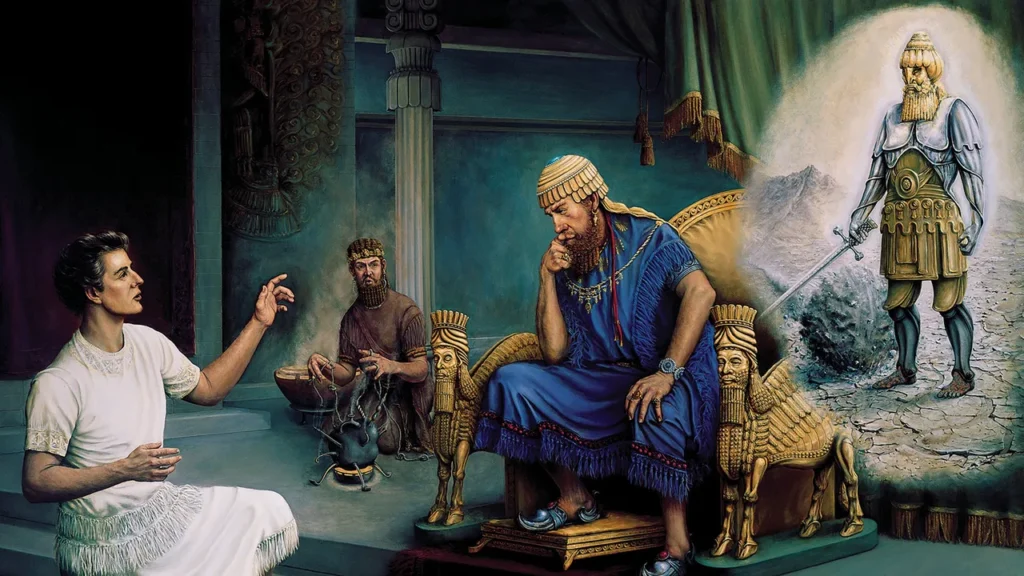
Daniel, Shadrach, Meshach, and Abed-nego lived in Babylon, a culture with values very different from their own, yet they remained faithful to God. Daniel 1:8 shows Daniel’s determination not to defile himself with the king’s provisions, while Daniel 3:15–18 demonstrates that Shadrach, Meshach, and Abed-nego trusted God even when they did not know whether He would deliver them from the furnace. Their example teaches that covenant faithfulness is not dependent upon knowing the outcome of a trial.
Daniel 6:10 shows Daniel continuing to pray even after a law was established specifically to prevent him from doing so. His willingness to pray despite the threat of death demonstrates that trusting God sometimes requires courageous consistency. The lesson resource connects these experiences with the Savior’s invitation, “Be not afraid, only believe” (Mark 5:36), reminding us that faith can give us courage even when circumstances remain frightening.
After receiving the revelation, Daniel did not claim credit for himself. In Daniel 2:27–28, he explained that the mystery could not be revealed by the king’s wise men but that “there is a God in heaven that revealeth secrets.” Daniel then used the revelation to help Nebuchadnezzar understand the dream (Daniel 2:29–45). His example teaches us to seek God’s wisdom humbly and to use spiritual knowledge in ways that strengthen the faith of others.
Daniel 7:13–14 describes “one like the Son of man” coming with the clouds of heaven and receiving an everlasting dominion, glory, and a kingdom. The lesson explains that many Jews understood the title “Son of man” as referring to the coming Messiah, and Jesus Himself frequently used this title during His mortal ministry (see Matthew 25:31; Mark 9:31; 10:45).
Daniel and his companions faced repeated attempts to pressure them into abandoning their religious convictions. Daniel 1 presents the initial challenge involving the king’s food and wine; Daniel 3 describes Shadrach, Meshach, and Abed-nego’s refusal to worship Nebuchadnezzar’s image; and Daniel 6 records Daniel continuing his prayers despite the king’s decree. These episodes are followed by accounts of divine revelation and deliverance, including Daniel’s interpretation of Nebuchadnezzar’s dream and his survival in the lions’ den.
If you have questions on this week’s reading, please email your questions to us here.
Practical solutions for someone in faith crisis:
Action Step: Identify one simple daily practice that will strengthen your relationship with God.
Daniel’s courage in major trials was supported by habits he had already developed. The lesson specifically identifies prayer, fasting, choosing good friends, trusting God, and being a light to others as “small and simple things” that helped Daniel and his friends remain faithful.
Encouraging Thought:
Daniel did not wait for the lions’ den to decide whether he would pray. His daily faith prepared him for his extraordinary trial.
Action Step: Take a specific question or concern to the Lord through prayer and scripture study.
Daniel 2 shows that when Daniel faced a problem beyond his own ability, he turned to God rather than relying solely on human wisdom. The lesson explicitly teaches that receiving revelation requires spiritual preparation.
Encouraging Thought:
Daniel’s friends did not know exactly how God would answer their crisis, yet they remained committed to Him. The lesson encourages us to consider how their example can change the way we approach our own trials, particularly when faith does not immediately produce the miracle we hope for.
Encouraging Thought:
Objective: Help learners understand that faith is developed through everyday choices before major trials arrive.
Activity Steps:
Follow-Up Question: What small choice can you make today that might give you greater spiritual courage when a larger trial comes?
Objective: Teach learners that receiving revelation involves preparation, prayer, seeking, patience, and acting on what God reveals.
Paper; pens; scriptures; a container or envelope labeled “What I Need to Know.”
Activity Steps:
Introduction (5 min): Give learners a question or puzzle they cannot reasonably answer without additional information. Ask how they feel when they lack the information needed to solve a problem.
Scripture Discussion (5 min): Read Daniel 2:16–23 and 27–30. Identify what Daniel did when human wisdom was insufficient. Emphasize that he turned to God with his companions and then gave God credit when the answer came.
Application (5 min): Invite learners to write one question they want to take to the Lord. Discuss practical ways to prepare spiritually, seek revelation, remain patient, and recognize answers.
Follow-Up Question: What can you change about the way you seek revelation so that you are more spiritually prepared to recognize God’s answers?
Objective: Help learners distinguish between trusting God and expecting God to give us a specific outcome.
Two signs labeled “God Can” and “I Will Trust Him”; scriptures; paper.
Activity Steps:
Introduction (5 min): Present a hypothetical situation in which someone prays for a difficult problem to disappear but it does not. Ask, “Does an unanswered prayer mean that faith failed?”
Scripture Discussion (5 min): Read Daniel 3:16–18. Focus on the distinction between knowing that God can deliver and knowing exactly what God will do. The Come, Follow Me lesson specifically asks learners to consider what happens when faith does not lead to the miracle they seek.
Application (5 min): Ask learners to write a difficult circumstance in general terms and complete the sentence: “I don’t know what God will do, but I know I can…” Discuss faithful actions that remain possible regardless of the outcome.
Follow-Up Question: How can trusting God remain an expression of faith even when He does not answer our prayers in the way or timing we hoped?
The existence of mortal weakness does not mean God has abandoned His people. Official Church materials acknowledge that Church leaders are not infallible and can make mistakes, while also teaching that God works through mortal prophets and corrects His servants when necessary. Daniel’s story reinforces the distinction between trusting God and expecting His servants to be flawless. Our ultimate faith belongs in Jesus Christ; prophets are called to testify of Him, teach His gospel, and guide the Church through revelation.
FAIR is a non-profit organization dedicated to providing well-documented answers to criticisms of the doctrine, practice, and history of The Church of Jesus Christ of Latter-day Saints.
We are a volunteer organization. We invite you to give back.
Donate Now