Does Isaiah 53’s Description of the Righteous Servant Refer to Jesus Christ?
The description of the righteous servant in Isaiah 53 is by far the most important and widely cited chapter in the New Testament and in modern scripture testifying of the life and atonement of Jesus Christ.
That said, it may be surprising to many Bible readers to know that the New Testament attests a climate of uncertainty and speculation at the time of Jesus regarding several prophetic figures whose comings were anticipated by his people. The cumulative effect of such well-known biblical uncertainties, combined with the modern tendency to doubt the possibility of prophetic foresight in general, threatens to erode confidence that Isaiah or any other Old Testament prophet could have known so much about Jesus Christ long before his birth.
I hope this presentation will help Latter-day Saints understand why their belief that Isaiah’s poignant prophecy as an authentic witness of Jesus Christ is well-founded in light of both ancient Jewish and Christian traditions of Bible interpretation and the best of modern scholarship.
The Crown Jewel of the Old Testament
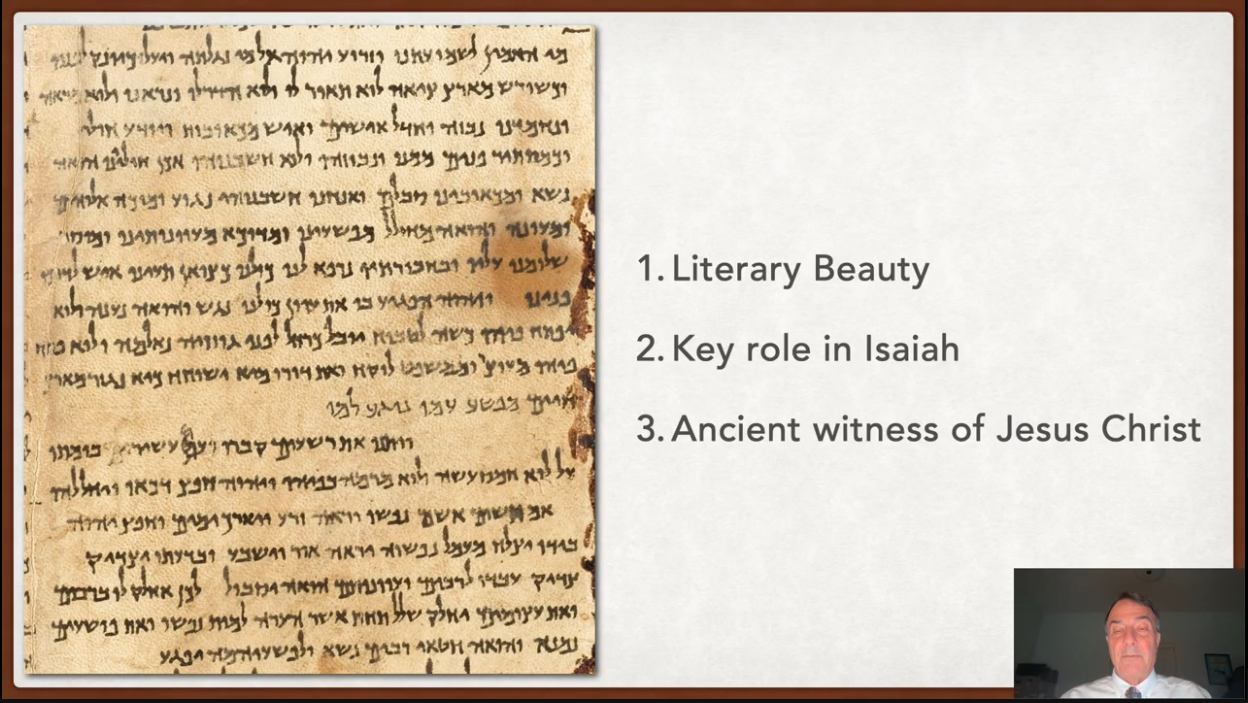
At left is the column of the manuscript of Isaiah 53 from the Great Isaiah Scroll that is housed at the Shrine of the Book, which is part of the Israel Museum in Jerusalem. Since I was a young boy, I have loved this chapter. There are three reasons I used to call it the crown jewel of the Old Testament.
One, its literary beauty, both in the original, sometimes obscure Hebrew text and in its magnificent King James Bible English translation. The latter best experienced musically in listening to Handel’s Messiah.
Two, its key role within the writings of Isaiah, the most important and widely cited prophet in the Old Testament, New Testament, and in modern scripture, as the last of his four servant songs. And most important, three, its unparalleled clarity and poignancy as an ancient witness of Jesus Christ long before his birth, a truth frequently affirmed in modern revelation.

The Fulcrum of the Plan of Happiness
As I have reflected since, I think there is a better image for Isaiah 53 than being merely a crown jewel of the Old Testament. In fact, its worth is much more crucial than all the crown jewels of the world put together.
Archimedes, the reputed inventor of the lever, is claimed to have said, “Give me a lever long enough and a fulcrum strong enough, and I will move the earth.” For him, of course, this was hyperbole. To do so, he would have also required a base for his lever’s fulcrum that was outside the cosmos.
By way of contrast, Jesus, being both human and divine, did something that neither Archimedes nor any other mortal could do. On the fulcrum of his atonement, he leveraged all that he was as a God and a man to lift the fallen world from sin and death and make real the possibility of immortality and eternal life.
Thus, in this vivid, detailed description of the atonement of Jesus Christ, we might best call Isaiah 53 a witness of the very fulcrum and base of the plan of happiness.
Three Questions About Isaiah 53
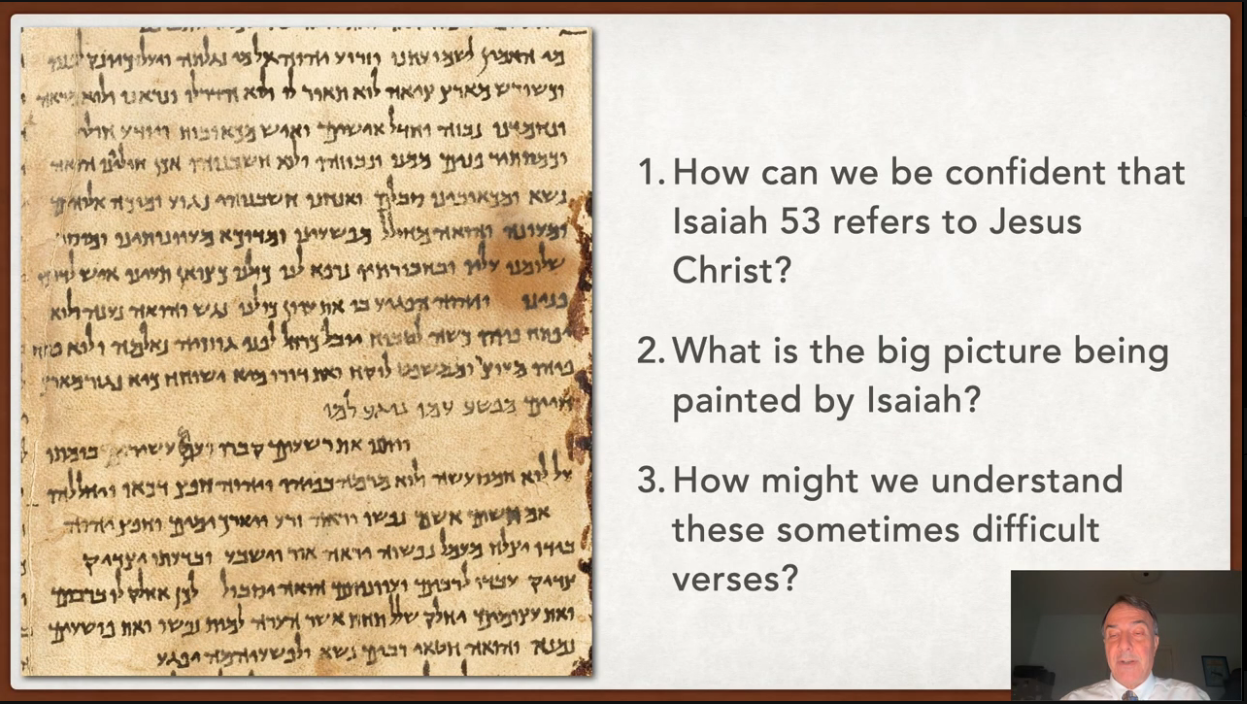
So much has been written and so much can be said about Isaiah 53 that I’ll need to be selective in this presentation. So, I will focus on just three questions.
One, why, in contrast to many who study this chapter, can Latter-day Saints be confident that Isaiah’s description of the righteous servant refers to Jesus Christ? Two, what is the big picture being painted by Isaiah? And three, how might we understand these sometimes difficult verses?
Of course, no one can prove that Jesus Christ was the righteous servant that Isaiah had in mind when he wrote these revelatory verses. But for those who believe that prophecy can reveal things far in the future, I think it can be safely argued that in light of ancient and modern scripture and teachings, the Latter-day Saint and Christian interpretation of these verses is not unreasonable. In fact, the preaching of Isaiah 53 was an important element in the conversion of many Jewish people to Christianity during and after the life of Christ.
Why Can Latter-day Saints Be Confident the Servant Refers to Jesus Christ?
So to our first question, why can Latter-day Saints be confident that Isaiah’s description of the righteous servant refers to Jesus Christ?
John W. Welch has mentioned some of the reasons that readers differ on the identity of the righteous servant in Isaiah 53. His thoughts on these difficulties can be summarized in the following three points.
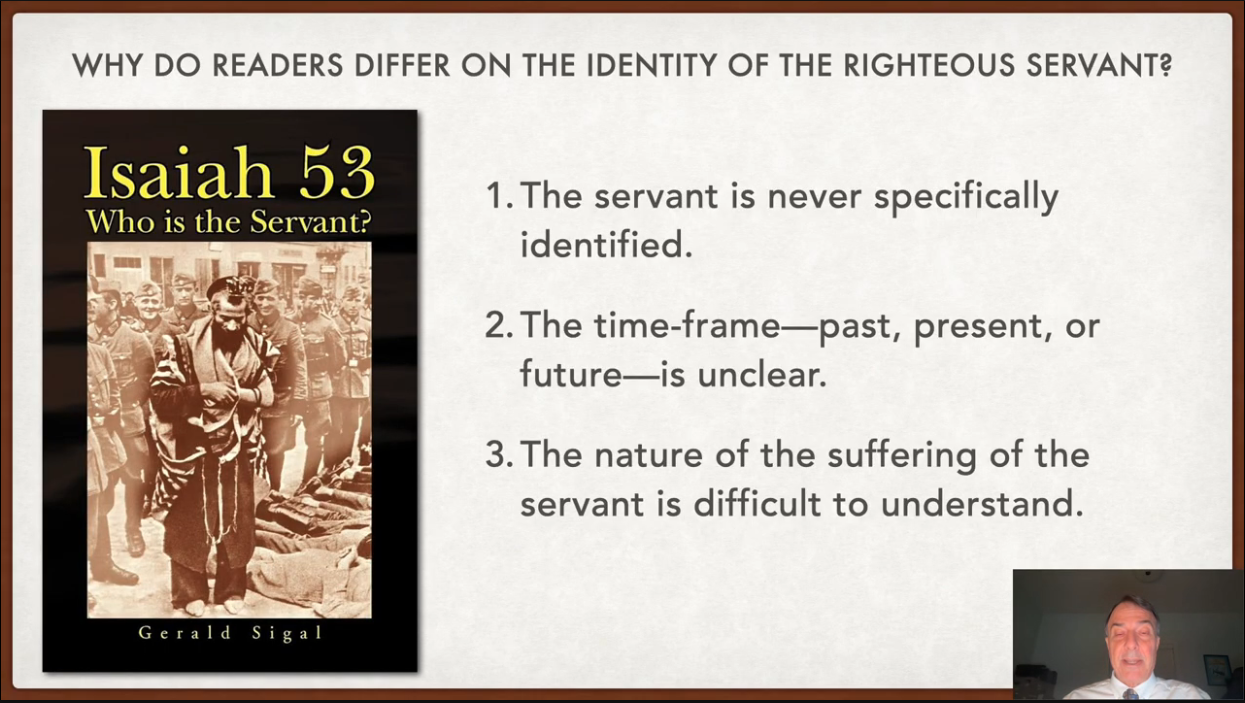
- One, the servant is never specifically identified. The pronoun he, as well as the we and our and thou, have all been variously interpreted. Fortunately, the Book of Mormon makes it clear that he refers to Christ. Abinadi says plainly, “I would that ye should understand that God himself shall come down among the children of men and shall redeem his people.”
- Two, the time frame, past, present, or future, is unclear. Again, the Book of Mormon helps us out, making it clear that the passage is written in the prophetic past tense. In other words, it is speaking of things to come as though they have already come.
- Three, the nature of the suffering of the servant is difficult to understand. At first, the people despise him, but later they conclude that he has borne their griefs.
Uncertainty About Prophetic Figures in the Time of Jesus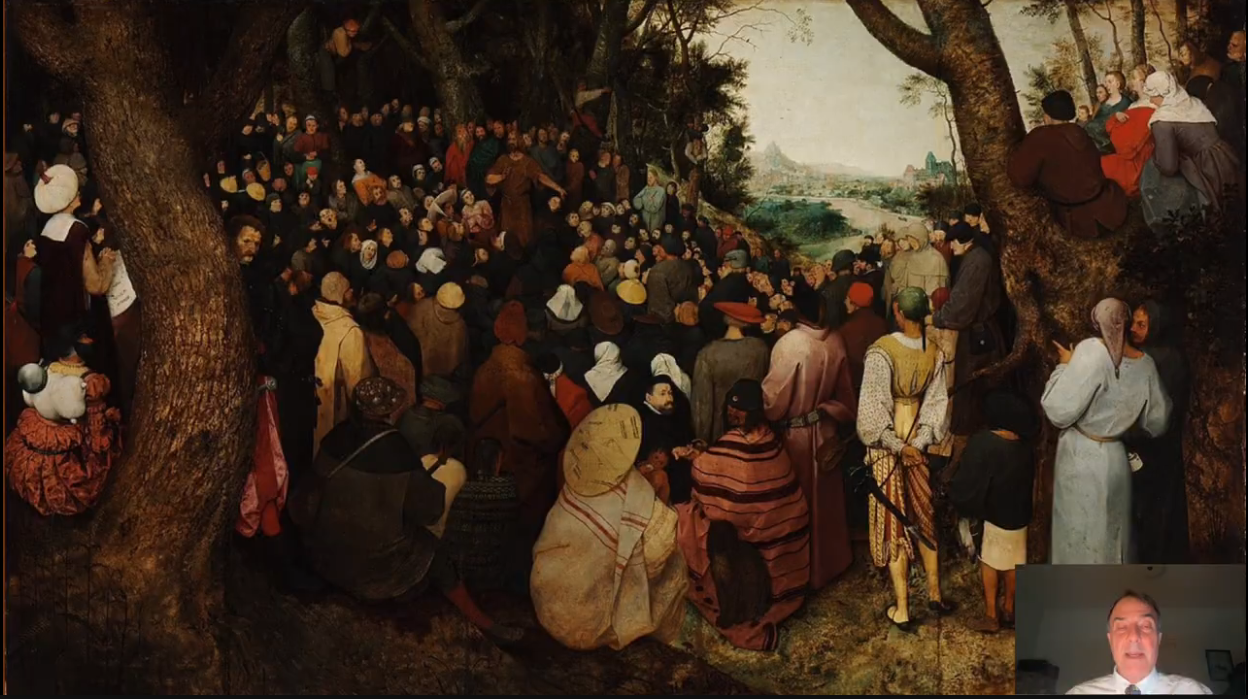
It may be surprising to some to learn that the New Testament itself attests a climate of uncertainty and speculation at the time of Jesus regarding several prophetic figures whose comings were anticipated by his people.
For example, the Gospel of John reported that, “priests and Levites from Jerusalem were sent to ask John the Baptist which one of three such figures he was: the Messiah, Elijah, or ‘that prophet,’ the latter usually associated with the prophet like unto Moses mentioned in Deuteronomy 18:15, or else with Moses himself.”
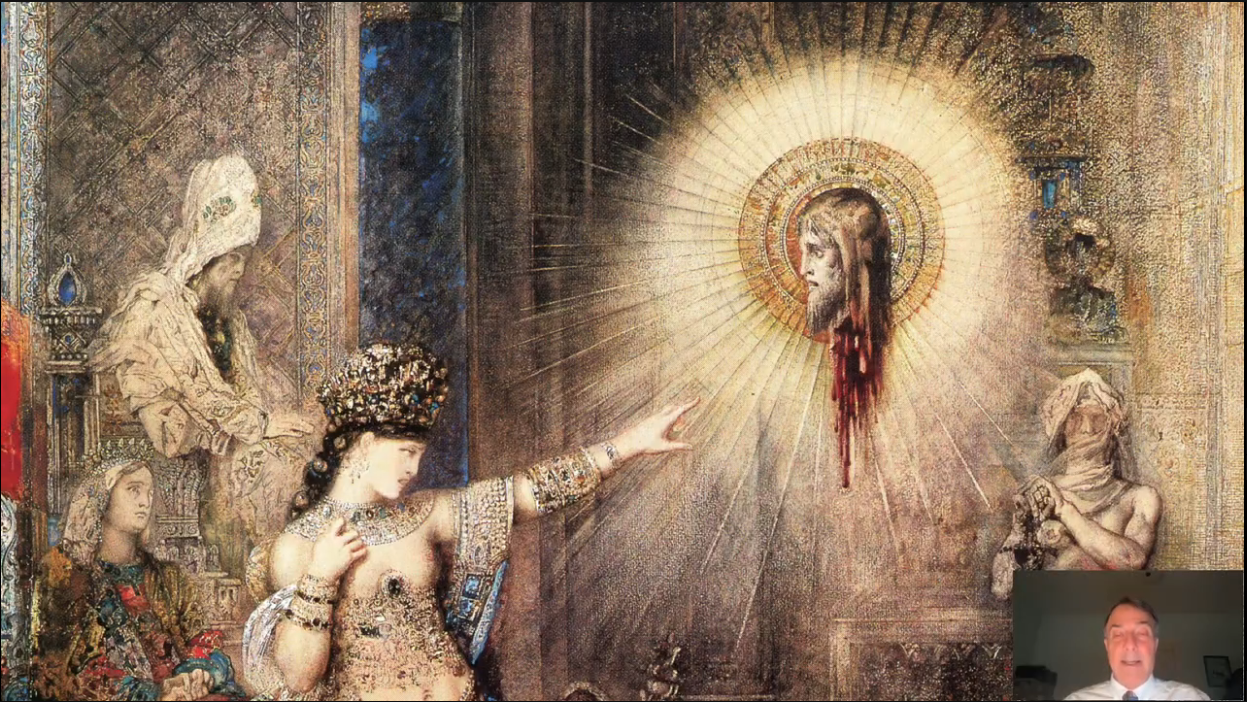
In another example, after Herod beheaded John the Baptist, he feared that Jesus might be John risen from the dead. Then, as now, mapping biblical prophecy to precise time frames, circumstances, and individuals is a notoriously risky business. As a Danish parliamentarian once obtusely opined, it is difficult to make predictions, especially about the future.
Who Is the Servant of Isaiah 53?
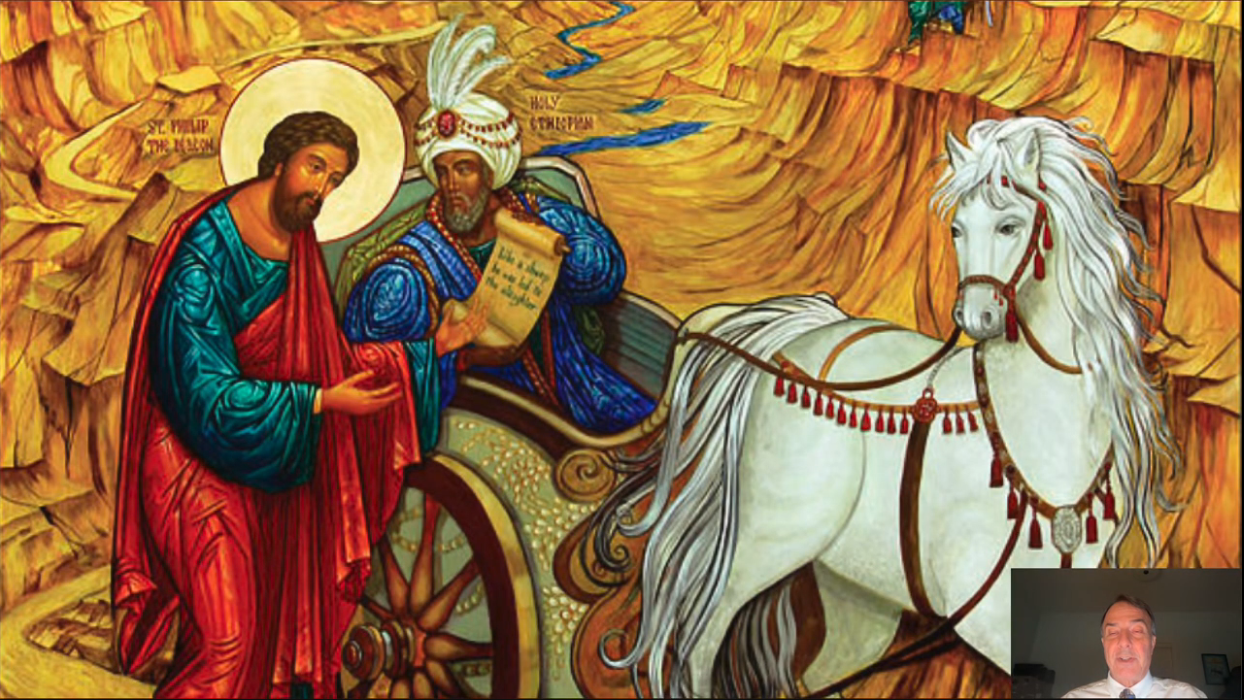
With specific respect to Isaiah 53, the lack of a settled interpretation at the time of Jesus for the identity of the righteous servant is witnessed in the question the Ethiopian eunuch asked Philip. “I pray thee, of whom speaketh the prophet this, of himself or some other man?”
Even Jesus’ disciples, to whom he explained that he must needs suffer many things and be killed and be raised again on the third day, failed to recognize these events as messianic necessities. When a horrified Peter rebuked Jesus, saying, “Be it far from thee, Lord. This shall not be unto thee,” the Lord was obliged to forcefully disavow his chief apostle’s error with these words, “Get thee behind me, Satan. Thou art an offense unto me.”
What were the different guesses about the identity of the servant of Isaiah 53 in Jesus’ day and afterward? Let’s summarize some of the common identifications from four perspectives.
First, the perspective of Judaism before and after the time of Jesus, who understood Isaiah’s servant in Isaiah 53 as the Messiah. Scholars have brought forth impressive pre-Christian evidence about his suffering and atoning Messiah.
Jewish Messianic Interpretations of Isaiah 53
However, the most impressive examples of the servant of Isaiah 53 being understood in Jewish tradition messianically come from the Targum, the Talmud, and the later rabbinic literature.
Targum of Jonathan ben Uzziel
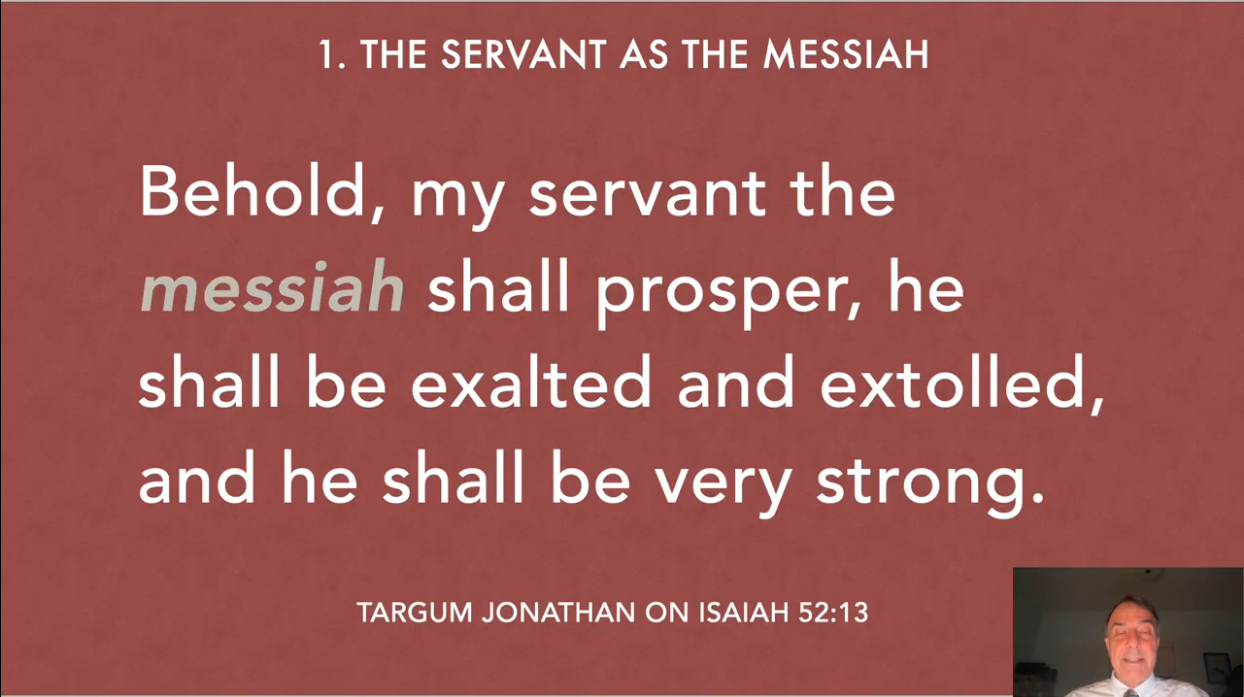
Some examples include the Targum of Jonathan ben Uzziel, composed between 70 and 135 A.D., for Isaiah 52:13 reads, “Behold, my servant Messiah shall prosper. He shall be high and increase and be exceedingly strong.”
Babylonian Talmud
The Babylonian Talmud, codified in the sixth century A.D., asks, “The Messiah, what is his name?” The rabbis say, “The leprous one.” Those of the house of the rabbis say, “The sick one, as it is said, surely he hath borne our sickness.” Quoting Isaiah, of course.
The Midrash Rabbah
Midrash Rabbah, speaking with reference to Ruth 2:14, explains, “He is speaking of King Messiah. Come hither, draw near unto the throne and eat the bread, that is the bread of the kingdom, and dip thy morsel in the vinegar. This refers to his chastisements, as it is said, ‘But he was wounded for our transgressions, bruised for our iniquities.’”
Tanhuma Midrash
Midrash Tanhuma applies Isaiah 52:13 and 53:3 to the Messiah. And in the Yalkut Shimoni, a 13th-century compilation of earlier commentary, it reads, “Who art thou, O great mountain? This refers to the King Messiah. And why does he call him the great mountain? Because he is greater than the patriarchs. As it is said, ‘My servant shall be high and lifted up and lofty exceedingly.’ He will be higher than Abraham, who says, ‘I raise my hand high unto the Lord,’ lifted above Moses, to whom it is said, ‘Lift up to thy bosom,’ loftier than the ministering angels of whom it is written, ‘Their wheels were lofty and terrible.’”
These rabbinic teachings clearly identify the servant described in Isaiah 52 and 53 as the Messiah, the anointed one. What was not settled among all Jewish believers anciently and is still not settled today is the nature and role of this prophesied Messiah.
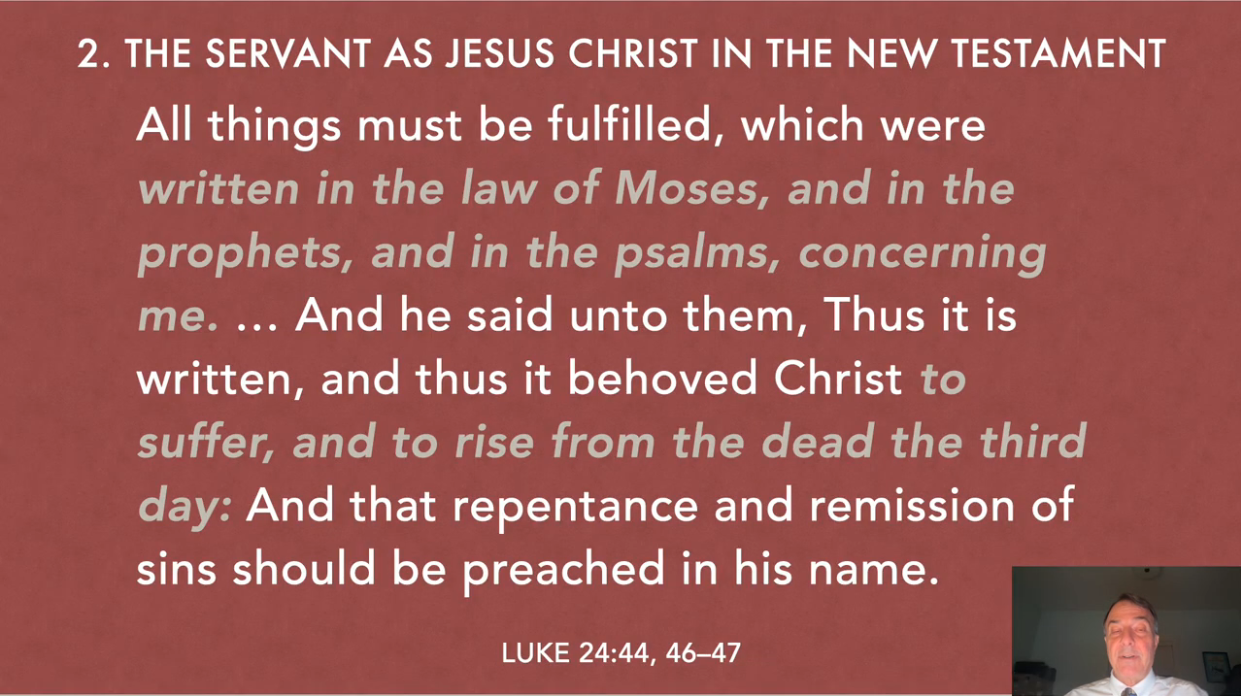
The Servant as Jesus Christ in the New Testament
Second perspective, the servant as Jesus Christ in the New Testament.
Though, as mentioned previously, mapping scriptural prophecies to specific events typically carries risks, both ancient and modern Christians have affirmed with confidence that Jesus Christ is the servant of Isaiah 53.
When the Ethiopian eunuch asked Philip, “Of whom speaketh the prophet?” the reply was unequivocal. Philip began at the same scripture and preached unto him Jesus.
Moreover, as Michael Parsons insightfully argued, Luke’s account of Philip’s reply to the eunuch in Acts 8 is given content by the precursor text in Luke 24. When the resurrected Jesus spoke to the disciples on the road to Emmaus, he was doubtless alluding in part to Isaiah 53 when he said, “O fools, and slow of heart to believe all that the prophets have spoken. Ought not Christ to have suffered these things and to enter into his glory?”
Likewise, when the Lord spoke to his apostles, he said, “All things must be fulfilled which were written in the law of Moses and in the prophets and in the Psalms concerning me.” And he said unto them, “Thus it is written, and thus it behooved Christ to suffer and to rise from the dead the third day, and that repentance and remission of sins should be preached in his name.”
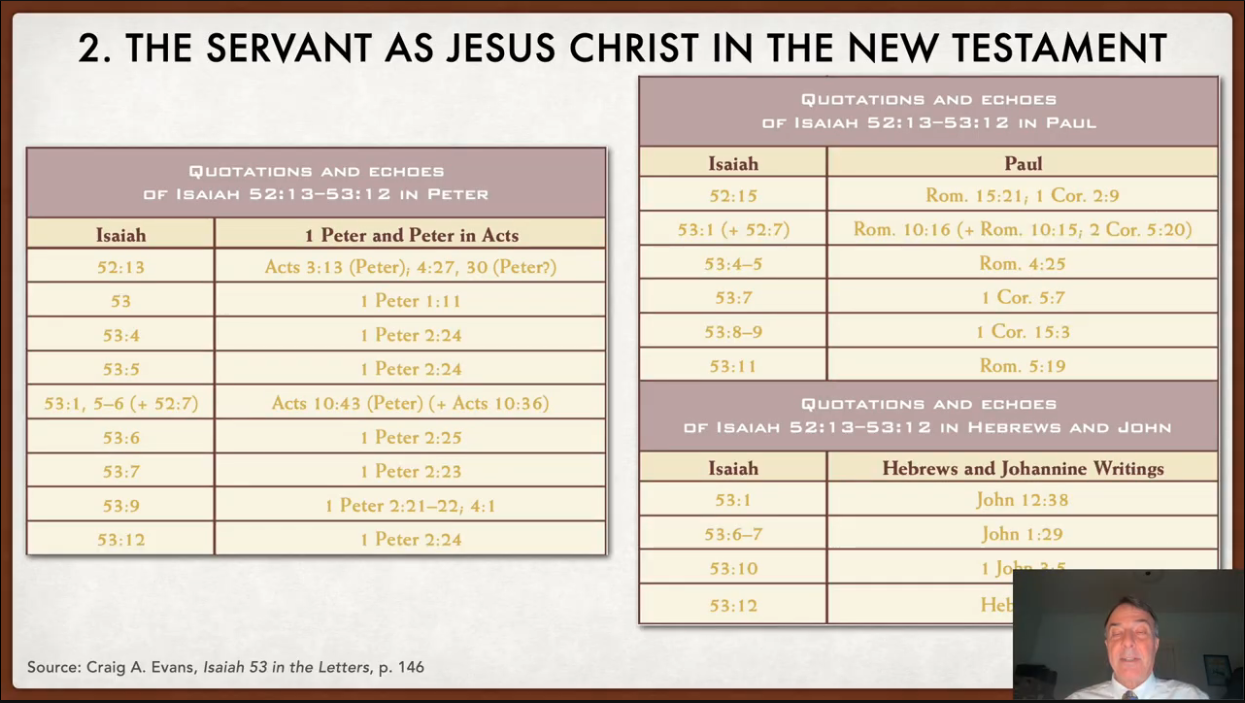
This figure from Craig A. Evans shows how Luke, Peter, John, and Paul also understood various verses of Isaiah 53 as applying to Jesus Christ.
The Servant in the Book of Mormon
Third perspective, the servant in the Book of Mormon.
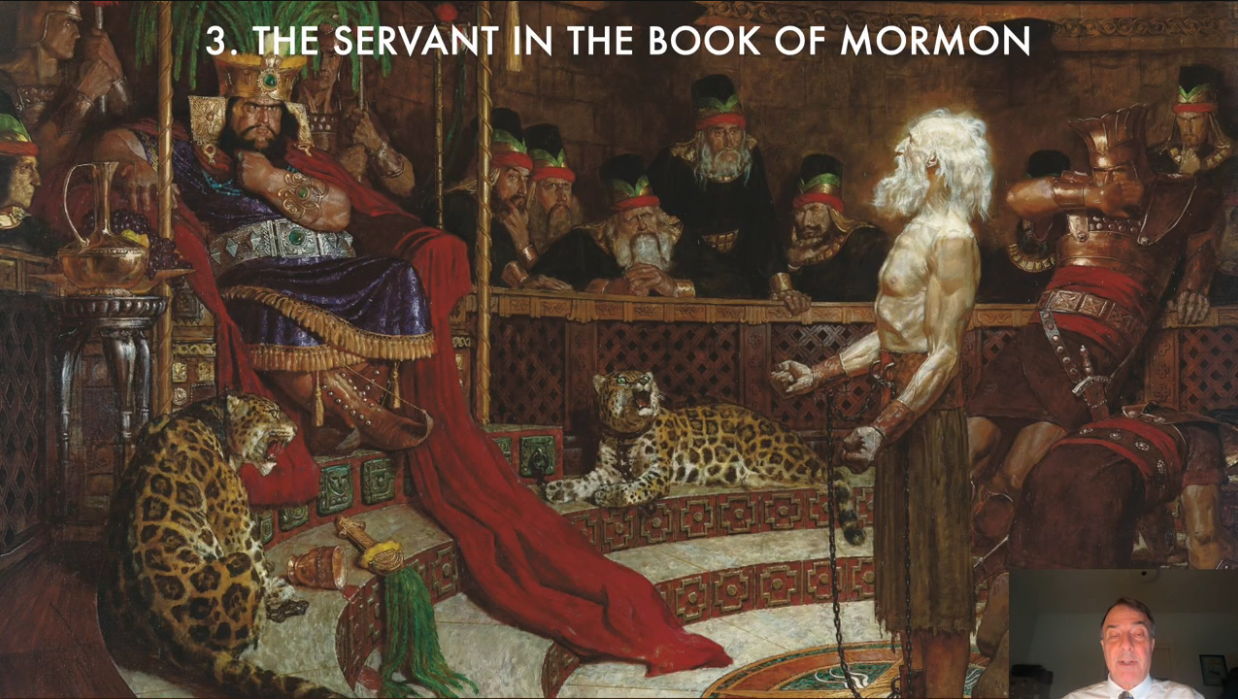
Abinadi’s exposition and commentary on Isaiah 53 in Mosiah 14 and 15 is one of the clearest witnesses that this prophecy refers to the life and atoning mission of Jesus Christ.
However, as Matthew Bowen argues, “The Jews, as the Messiah’s own people, described to Nephi as ‘my ancient covenant people,’ also fit the typology of Isaiah’s suffering servant.”
Going further, Bowen notes that, “Abinadi and his people’s fulfillment of the messianic suffering servant typology of Isaiah 53, Mosiah 14, which gave them experiential knowledge to stand as witnesses, helps us better appreciate how covenant Israel at other times fulfills this typology as well.”
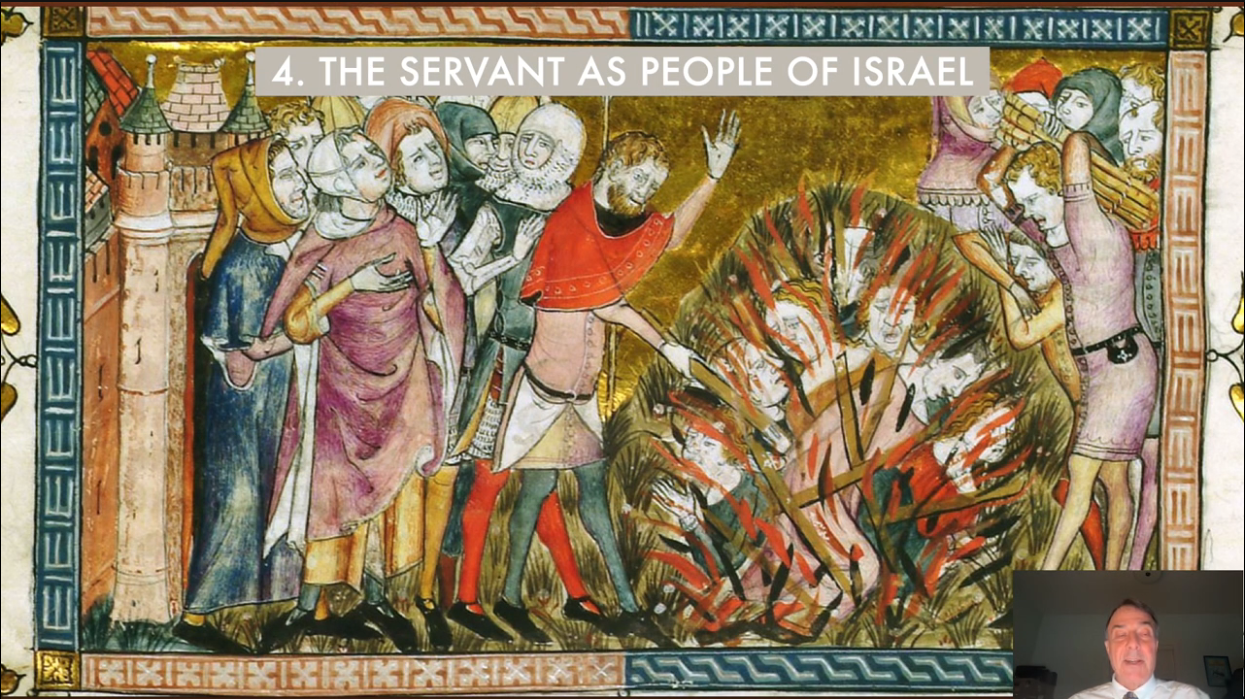
The Servant as the People of Israel in Rabbinic Judaism
Fourth perspective, the servant is the people of Israel in rabbinic Judaism.
Although the identification of the servant as the people of Israel is attested in one account from the early third century, there’s currently no evidence outside the Book of Mormon that this identification took hold firmly and eventually decisively among authoritative commentators until much later.
Indeed, Walter Zimmerli and Joachim Jeremias go so far as to say that:
“There is not to be found a definitively non-messianic exegesis of Isaiah 53 in the rabbinic literature of the whole first millennium.”
A Corporate Identity
Victor Buksbazen explains the historical context for the change from an individual, typically messianic, identity to a corporate identity of the servant in Isaiah 53 as follows:
“Behind this change lies the tragic Jewish experience during the Crusades. During the First Crusade in A.D. 1096, when the Crusaders in their misguided zeal attempted to wrest the Holy Sepulchre from the Muslims, they became aware that the infidels were not only the pagan Muslims in faraway Palestine, but also the so-called Christ-killing Jews who were living in their very midst in Christian Europe.
“Encouraged by their fanatical leaders and frequently incited by high-ranking clerics, the Crusaders committed massacres of the Jews, especially of those who lived in France, Italy, and Germany. Thousands were butchered, their synagogues burned, and their possessions pillaged.
“This horrible experience, which lasted for almost two centuries, left a traumatic impact on the Jews, comparable only to their later experience under Hitler. From that time on, their revulsion against everything that the Christians believed or represented became more violent and hostile than ever before.
“Since that time, the question of Isaiah 53 took on a heated polemical and emotional character. And since the Christians, in their frequent disputes with the Jews, used Isaiah 53 as one of their main arguments for the Messiahship of Jesus, the Jews felt impelled to reinterpret this prophecy in such a way as to blunt the Christian argument.
“Since that time, the question of Isaiah 53 took on a heated polemical and emotional character.”
The Jewish Exegetical Tradition
Of course, the brief overview and identifications of the servant of Isaiah 53 I’ve presented, with its overly sharp demarcations of Jewish historical interpretive trends, does not do justice to the spirit of the Jewish exegetical tradition.
Unlike traditional ways of Western thinking with which most members of The Church of Jesus Christ of Latter-day Saints are most familiar and comfortable, ways that usually hunger to find single, correct, unambiguous, and authoritative answers for complex doctrinal questions, generations of Jewish scholars are usually not troubled by multiplicity of rabbinic views on central theological questions.
On the contrary, they’re pleased to find differing viewpoints. It would mischaracterize the rabbinic tradition to say merely that such differences, including details of debates on questions such as the interpretation of Isaiah, are carefully documented, when the more complete truth is that they are, in addition, lovingly cherished and preserved so that future generations can wrestle as much with the results.
Jewish and Christian Dialogue About the Messiah
Sadly, the confluences and divergences of Jewish and Christian beliefs about the Messiah sometimes continue to lead to contentious misunderstandings.
In this regard, the scholarship of Shirley Lucass provides a helpful perspective on why the ideas discussed in this presentation may offer a path to continued respectful dialogue.
“If Jesus’ first coming is accepted as the inauguration of the messianic era based on the acceptance that his messiahship was authentically Jewish, and if at his second coming all the expected conditions of the age to come were to prevail, then there is nothing in this proposition that would jeopardize the integrity of Judaism as it now stands.
“Effectively, therefore, this invalidates the statement of Jacob Neusner: ‘Is Jesus the Christ? If so, then Judaism falls. If not, then Christianity fails.’ We hope that our broader conception of the issue will allow a move away from the assertion and denial that has plagued dialogue from the parting of the ways about 70 C.E., opening up fresh possibilities and a new foundation on which dialogue can be built.
“Admittedly, however plausible this may be, it cannot wipe out 2,000 years of persecution, mistrust, and hatred. Even so, if this premise is accepted, namely that the messiahship of Jesus as portrayed in the New Testament can be rooted in antecedent Jewish tradition, then I believe that this will provide a bridge to dialogue that has hitherto not existed.”
What Is the Big Picture Being Painted by Isaiah?
Now, let’s talk about the second question. What is the big picture being painted by Isaiah?
Zooming out to understand the context of chapter 53, we should understand it is only one part of the four passages in Isaiah that are classed by scholars as a part of the servant songs. As Kurt Nielsen has described the larger rhetorical structure that both surrounds and is found within Isaiah 53.
Using the theme from the preceding 49–52 block, which in turn is built upon the themes from chapters 40–48, Isaiah now summarizes and terminates the line of thought and symbolism of the intercessory servant with a block of four chapters which forcefully present the Lord as the epitome of Israel’s Savior and describe what he will do to redeem Israel.
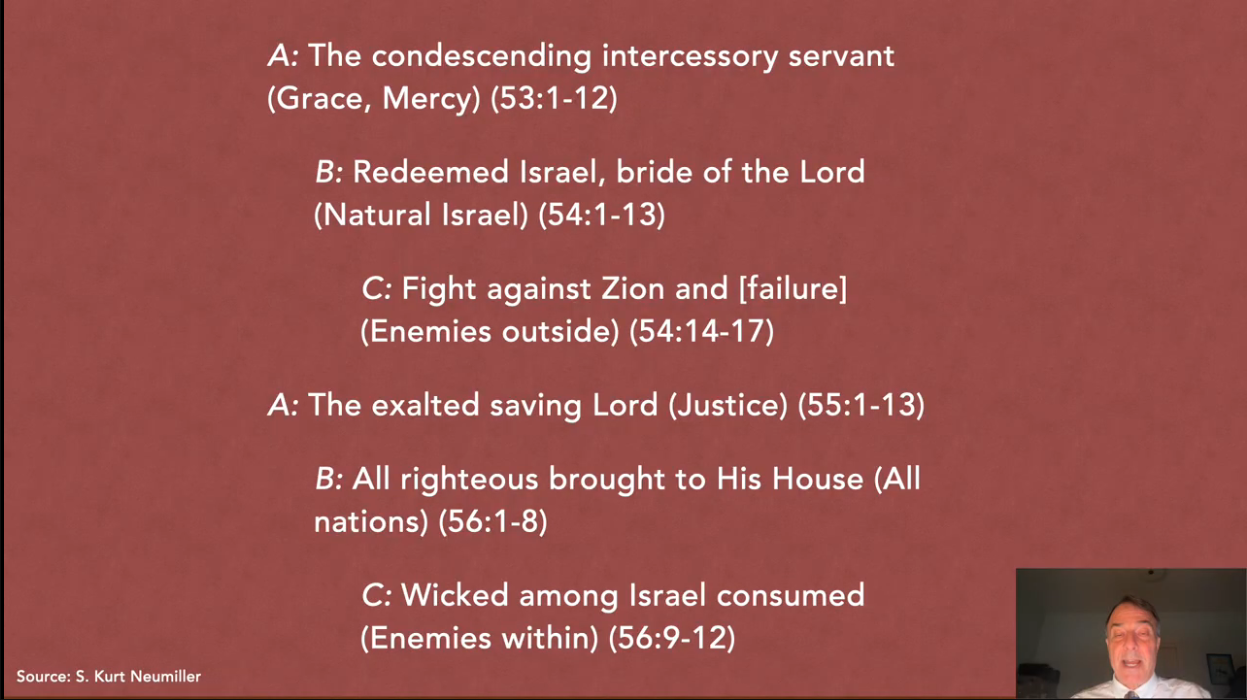
The four-chapter block is presented in an alternating ABC fashion based upon general subject, as shown here. The parallelism informs us of the unity of the Lord’s experience and mission, as well as the planning that took place long before. He is both the lowly suffering servant and the exalted powerful Lord. He saves both Israel and the Gentiles who worship him, and he destroys his enemies both inside and outside of Zion.
The Structure of Isaiah 53
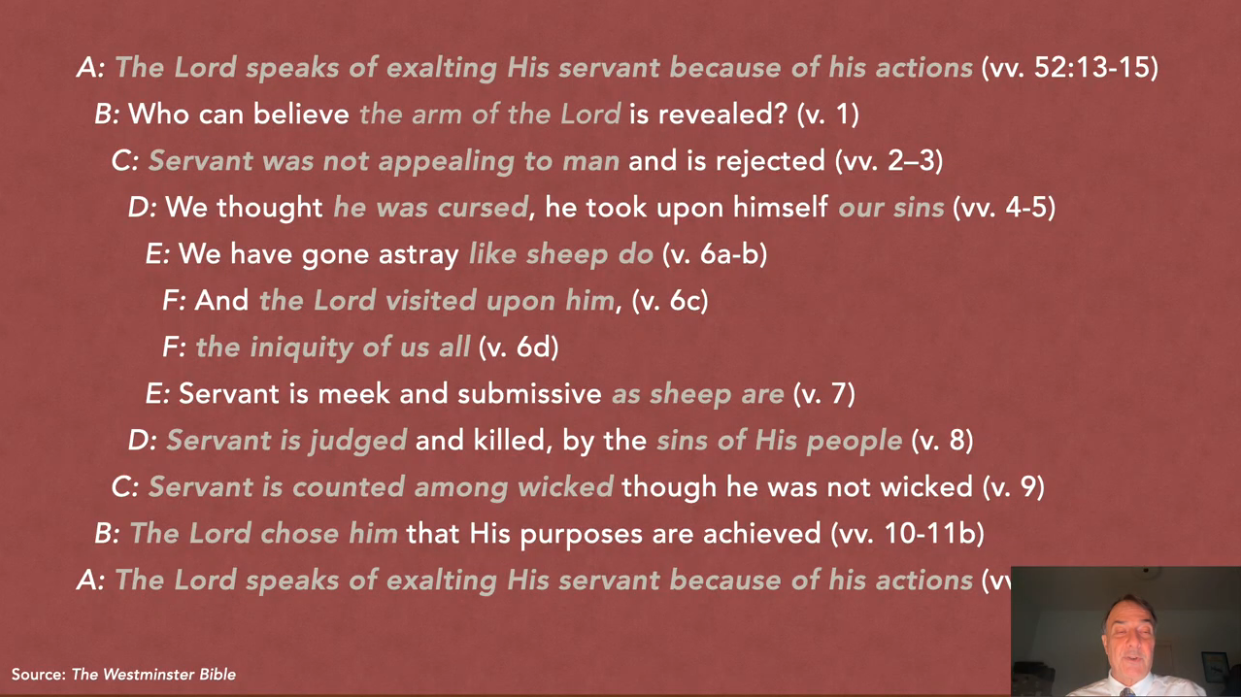
The textual structure of this chapter can be structured as a chiasm, starting with the last three verses from the preceding chapter. The structure is robust enough to be spotted and commented on by the author of the Westminster Bible Commentary, which normally does not give much regard to rhetorical structures.
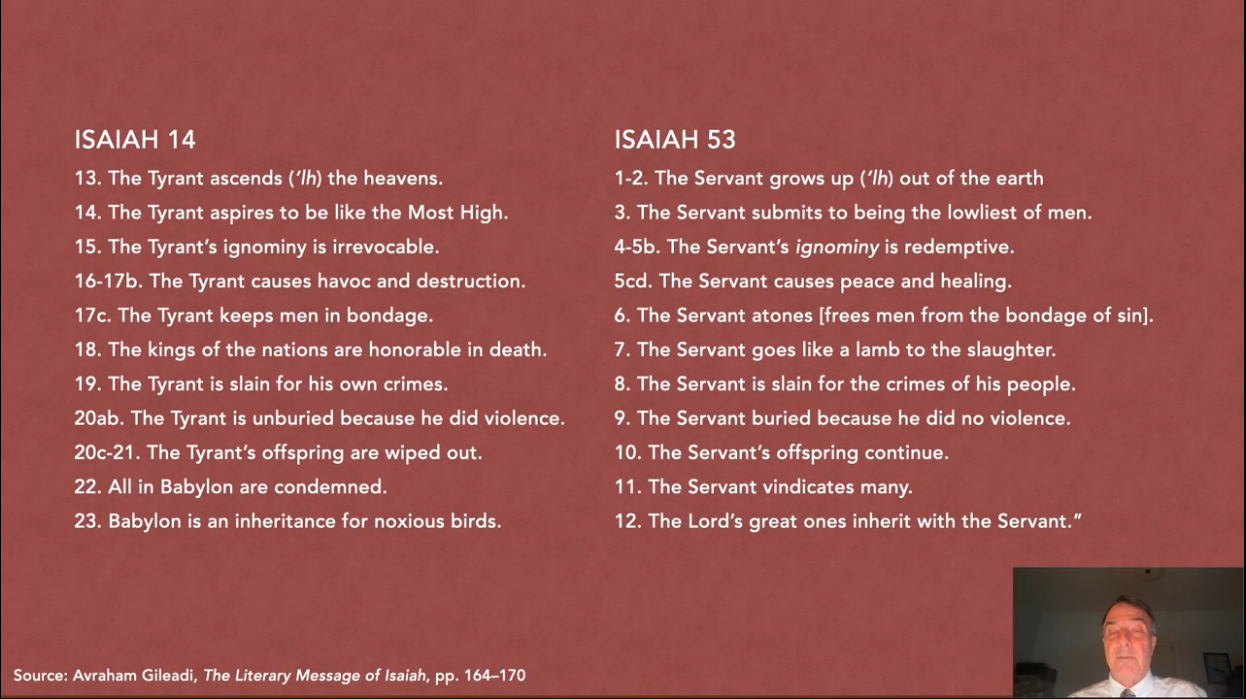
Also of interest are the specific parallels and contrasts that Avraham Gileadi found between Isaiah’s descriptions of the righteous servant in chapter 53 and the wicked servant in chapter 14. While Isaiah 53 traces a path from humiliation to exaltation, Isaiah 14 follows precisely the opposite course, from exaltation to humiliation.
Readers should keep these three structural aspects of the chapter just presented in mind for further study. However, for the purposes of examining the meaning of these verses in more detail, the four-part breakdown of Kurt Nielsen will be useful background.
As mentioned previously, Isaiah 52:13–15, which contains God’s proclamation of the servant’s exaltation, is of a piece with the chapter that follows. Here are the four parts of the big picture.
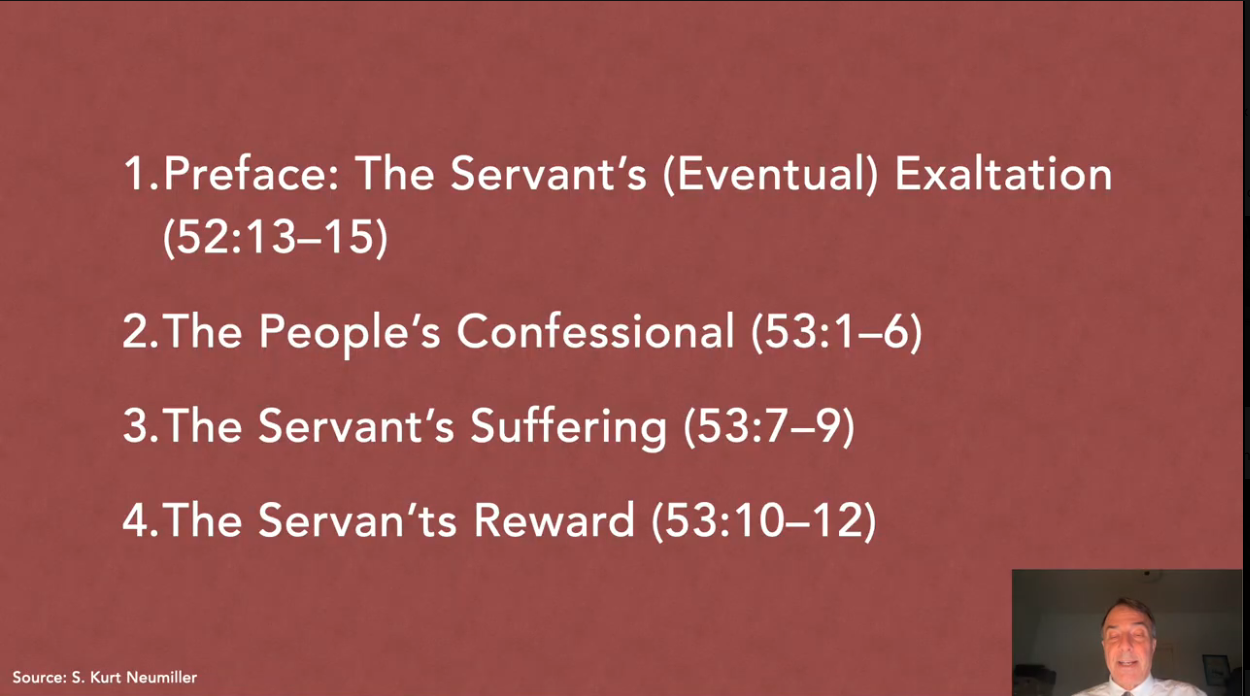
1. The Servant’s Success and Eventual Exaltation
One, the servant’s success and eventual exaltation. A summarizing preface to chapter 53 consisting of chapter 52:13–15.
These verses assure the reader upfront that God’s intent from the beginning is to end the suffering of the servant with a glorious finish. From the Book of Mormon, we learn that these verses apply not only to Jesus Christ, but also to the Lord’s prophetic servants. In other words, types of Christ, with their vindication being concurrent with the Second Advent.
Specifically, Moses is both a type of the Messiah and also of Joseph Smith. Some argue that the Book of Mormon is also personified as the servant described in these verses by Jesus Christ in 3 Nephi 21.
2. The People’s Confessional
Two, the people’s confessional, describing the events of Christ’s mortal life and atonement, verses 1–6.
Here, Israel is speaking in something of a confessional. They admit they wrongfully judged the servant and rebelled against God’s will. Now sorrowful for having despised and rejected the servant, they openly declare that his sufferings included not only their derision, but also, more poignantly, his atoning sacrifice on their behalf.
3. The Servant’s Suffering
Three, the servant’s suffering, describing Christ’s trial and crucifixion, verses 7–9.
The suffering that leads to the servant’s death is here described in a poignant series of images. He was oppressed and afflicted and at last brought as a lamb to the slaughter and cut off from the land of the living in company with the wicked.
Notwithstanding all this, and in pointed contrast to the evil tyrant, God assures the righteous servant a burial and the ultimate preservation of his spiritual offspring.
4. The Servant’s Reward
Four, the servant’s reward, describes Christ’s post-mortal glory in verses 10–12.
These verses present an answer to the question of why God would allow an innocent servant to be mercilessly and unjustly killed at the hands of oppressors. We learn that the Lord chose to bruise the servant as an offering for sin to redeem his offspring, grant life, and ultimately prosper the servant, thus revealing the arm of the Lord in the act of salvation.
Difficulties in the Text
Now, let’s look at some of the difficulties in these verses. We’ll only have time for a brief discussion of some of these difficulties. For a more extensive discussion, see the published paper.
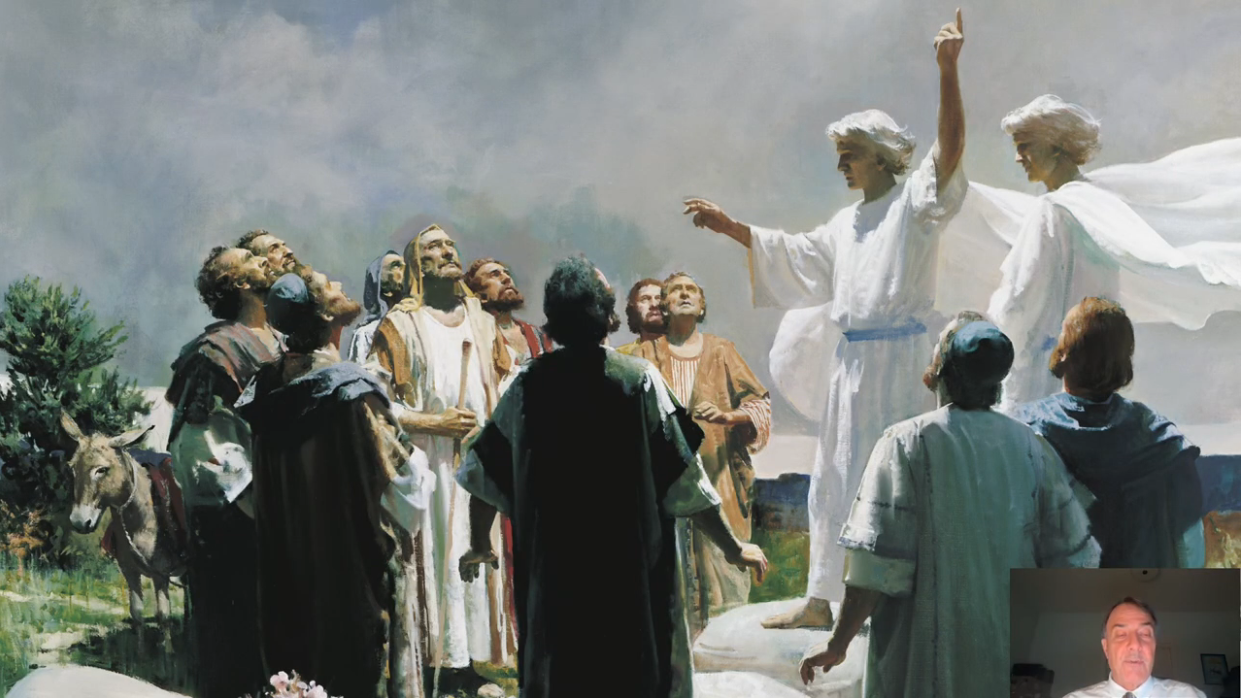
First, the description of the servant’s eventual success and exaltation in Isaiah 52:13–15.
“Behold, my servant shall deal prudently. He shall be exalted and extolled and be very high. As many as were astonished at thee, his visage or appearance was so marred more than any man, so shall he sprinkle or gather many nations.”
In verses 13 and 14, Isaiah describes both the suffering and exaltation of Jesus Christ. In addition, however, in the Book of Mormon, the resurrected Jesus Christ himself applies Isaiah’s description of a suffering servant to the Prophet Joseph Smith. And the Book of Moses applies similar language to Enoch.
Moreover, Moses is both a type of the Messiah and also of Joseph Smith. These examples make it evident that others, in addition to Jesus Christ, can also be lifted up, becoming sons of man and receiving everlasting life through unwavering faithfulness in the trial of their faith. As discussed previously, these verses can also apply generally to God’s covenant people.
“Many Were Astonished at Thee”
Many were astonished at thee. The people would gape in astonishment and disdain at the servant, just as the crowd had been filled with wonder and amazement and with anger at Abinadi.
His visage was so marred. Intriguingly, the Dead Sea Great Isaiah Scroll has a variant reading for this phrase, namely, “I have anointed him.”
Though there seems to be no disagreement that the transcription of this phrase of the scroll is correct, most scholars reject this variant and instead translate it as if it were identical to the Masoretic Text.
However, if the literal translation were to be accepted as a possibility, it would be consistent with the Targum Jonathan Isaiah’s reference in 52:13 to “my servant the Messiah,” that is, the anointed one, and to the description of his brightness as a holy brightness, that is, a brightness due to his divine anointing, the oil which would help his skin to shine.
The verse then would describe not a human being unrecognizable because he has been disfigured, but one whose appearance has changed because he has been exalted and made wise and the Lord has anointed him. This fits the context of the previous verses, where the theme is exaltation, not ruination.
Demonstrating that this interpretation is neither outlandish nor—Peter J. Gentry not only cogently argues for it on the basis of several considerations, but also cites the work of Dominique Barthélemy. Barthélemy discusses five Jewish interpreters from the 12th to 19th centuries who adopted anointing as the best interpretation, and two Christian interpreters in the 16th to 17th centuries who also held such a view.
“So Shall He Sprinkle Many Nations”
So shall he sprinkle many nations.
Margaret Barker observes that many versions of the Bible have substituted another word for “sprinkle” because they did not understand the context of the passage, and so they’ve obscured the meaning from all their readers. So what is the correct context for the puzzling phrase “sprinkle many nations”?
Remember that the atonement blood that was sprinkled was the blood sprinkled on the Day of Atonement to cleanse and consecrate, and also the blood sprinkled by the servant on many nations so that they would be able to see and understand.
Gentry also concludes that the priestly function of the term is plausible in context and convincingly addresses grammatical objections to the use of “sprinkle” and argues against alternative readings of “startle,” “astonish,” or “astound.”
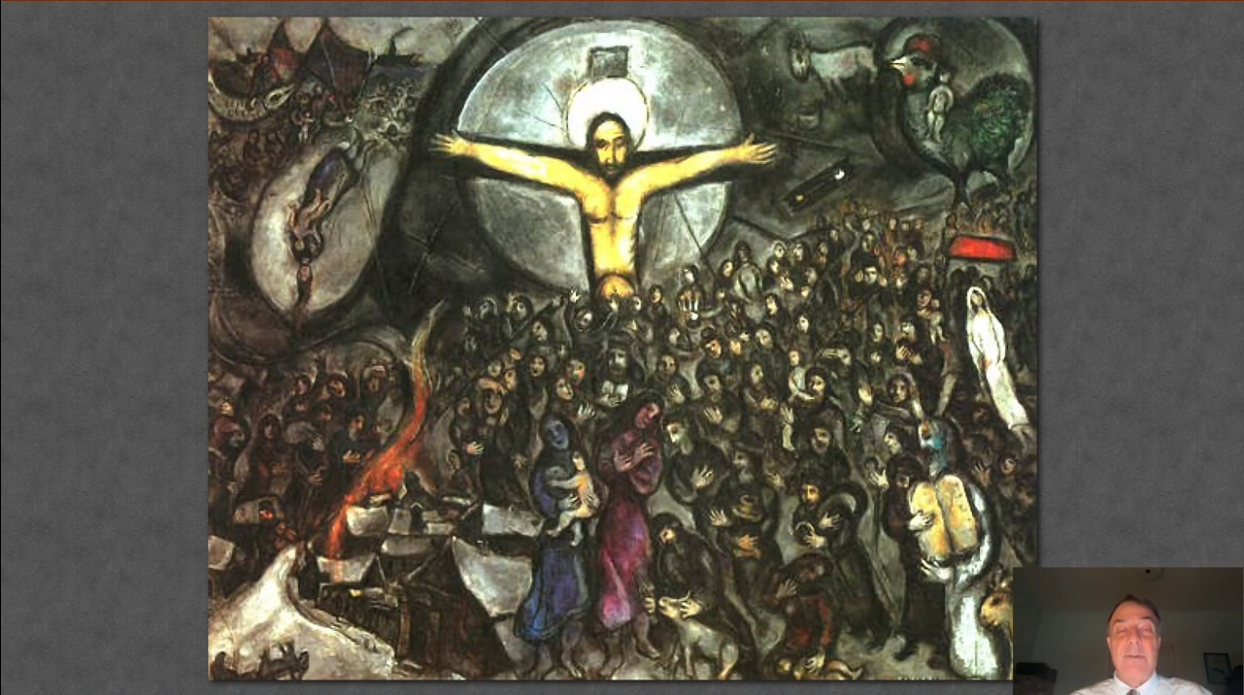
“So He Shall Gather Many Nations”
So he shall gather many nations.
As an alternative to “sprinkle,” the Joseph Smith Translation of this verse changes the phrase to
read, “So shall he gather many nations.” The Prophet’s translation is fitting in light of both Targum Jonathan, Isaiah 52:12, “The God of Israel is about to gather your exiles,” and John 12:32,“And I, if I be lifted up from the earth, will draw all men unto me.”
Bruce D. Chilton understands the Targum to mean that, “The gathering of exiles is associated with the victorious Messiah.”
While there is no obvious etymological connection between “sprinkle” and “gather” that would suggest the scribal error could have confused these terms, perhaps there is another kind of connection between them. Since the Messiah’s victory is spiritual as much as temporal, the gathering to the kingdom of God is accomplished by the sprinkling of atoning blood, is as real and essential as the literal gathering of Israel. I suggest that these two unrelated terms may be, in fact, telling us two different dimensions of one unified idea.
“The Kings Shall Shut Their Mouth at Him”
The kings shall shut their mouth at him. For that which they had not been told they shall see, and that which they had not heard shall they consider.
Both appalled by the servant’s debasement and astonished at his eventual vindication and exaltation, kings shall purse their mouths closed, left speechless in wonderment.
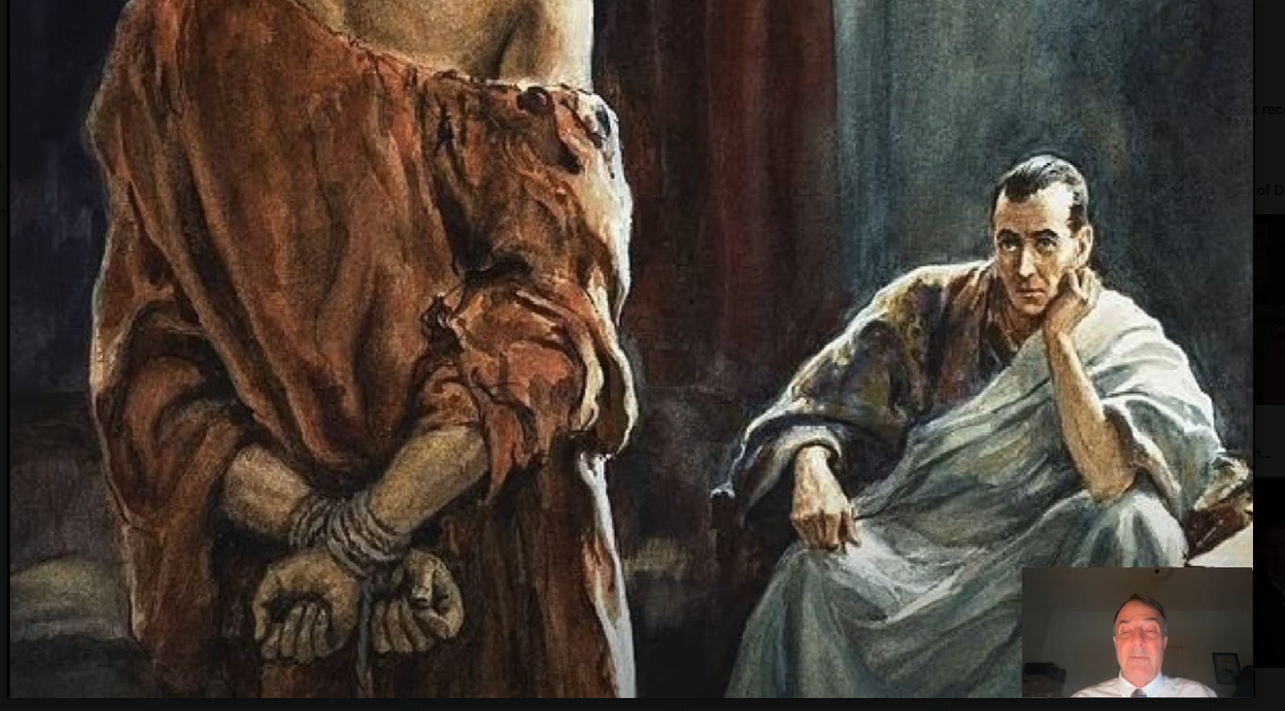
That which had not been told them, they shall see. The end of this verse introduces the theme of the unexpected humiliation of the servant described in verses 1–3. With closed mouths and opened eyes, the earthly elite will see a truth they had never learned.
How could they have imagined that the greatest of all would come as a servant, that he who would ascend up on high must first descend below all things?
The People’s Confessional
Now to the people’s confessional, verses 1–6.
“Who hath believed our report? And to whom is the arm of the Lord revealed?”
Who hath believed our report? The JPS version gives an alternate reading: “Who can believe what we have heard?” Like the kings and nations referred to in 52:15, the surprising form in which the Lord’s arm is revealed through Christ’s ministry results in general astonishment and unbelief.
“Behold, here is the agency of man, and here is the condemnation of man, because that which was from the beginning is plainly manifest unto them, and they receive not the light.”
“And the light shineth in darkness, and the darkness comprehendeth it not.”
The Arm of the Lord
The arm of the Lord. The faithful and observant among God’s people will recognize the arm of the Lord revealed in the report of his servants. The arm of the Lord is previously mentioned in 51:9 and 52:10 as the agent of salvation.
See also John 3:7 and 12:37–38 as reference to this prophecy’s fulfillment in Jesus’ mortal ministry, and in 1 Nephi 22:10–11 and Doctrine and Covenants 45:47 regarding its ultimate fulfillment in the Second Coming.

Margaret Barker notes that “arm” and “seed” or “son” are similar in Hebrew. Therefore, the phrase might be better read as, “To whom has the seed or son of the Lord been revealed?” This makes better sense of Isaiah 53:2, literally “sucking child,” not “young plant.”
“Despised and Rejected of Men”
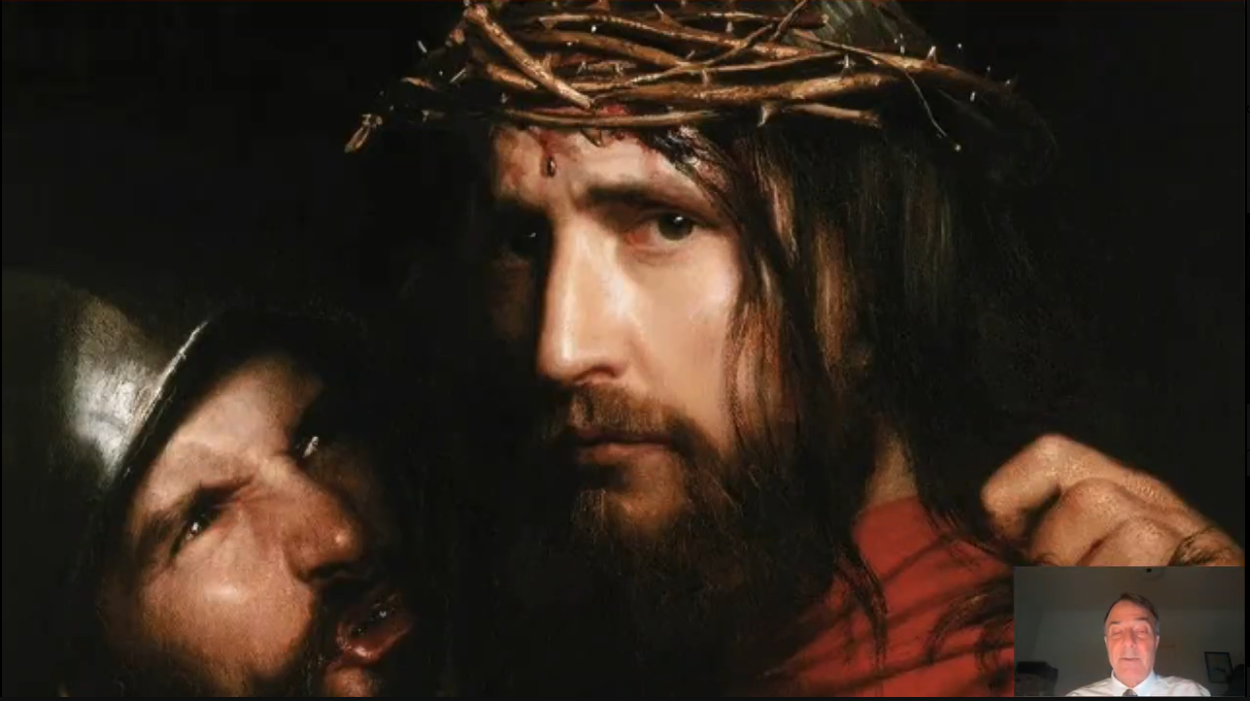
“He is despised and rejected of men, a man of sorrows and acquainted with grief. We hid as it were our faces from him. He was despised, and we esteemed him not.”
He is despised and rejected of men. Compare John 1:11: “He came unto his own, and his own received him not.” See also Isaiah 49:7.
We hid as it were our faces from him. The concept is the Semitic custom of not showing your face, that is, turning away from those whom you despise or reject. Not only did people refuse to follow him, they shunned him. The servant will be viewed with the same disdain as the Jews viewed a leper.
“Surely He Hath Borne Our Griefs”
“Surely he hath borne our griefs and carried our sorrows. Yet we did esteem him as stricken, smitten of God, and afflicted.”
Surely he hath borne our griefs and carried our sorrows. Matthew 8:16–17 applies this reference to Jesus’ healing of the sick. First Peter 2:24 applies it to the bearing of our sins.
Yet we did esteem him stricken. This statement recalls the story of Job, where the innocent man is afflicted and his friends consider him cursed by God. In that case, as in this one, the people judge him unrighteously.
Peter describes the situation in its true light. “For Christ also hath once suffered for sins, the just for the unjust, that he might bring us to God.”

“Wounded for Our Transgressions”
“But he was wounded for our transgressions. He was bruised for our iniquities. The chastisement of our peace was upon him. And with his stripes we are healed.”
He was wounded for our transgressions. Verses 5 and 6 are a clear reference to the intercessory act of vicarious atonement. Here we have a righteous one who delivers salvation to those who cannot save themselves, a type of all God’s servants whose mission it is to carry his message and his love to all nations.
In the Old Testament, we see prophets such as Moses, who pled on Israel’s behalf many times, and Abraham, who appealed for mercy on behalf of the possible righteous in Sodom and Gomorrah.
At the same time, though they were afflicted by the wicked and suffered as a result of them, none of these preceding intercessors actually participated in a vicarious expiation of sins. In this respect, Christ’s atonement was unique.
“With His Stripes We Are Healed”
With his stripes, we are healed. When Jesus was scourged by Pilate’s men, the whips left stripes on his back.
Paradoxically, we are healed by wounds, and our garments are made white by red blood. Blood ordinarily produces stains, even indelible stains. But acceptance of the blood of Christ symbolically and actually does just the opposite.
Our garments may be made white in the blood of the Lamb. As we learn from the Book of Moses, “By the blood of Christ, ye are sanctified.”

“All We Like Sheep Have Gone Astray”
All we like sheep have gone astray. The image of scattering sheep, each going his own way, shows how foolish the people were in rejecting the servant.
This depiction of the straying sheep is also meant to recall the wandering that preceded the entrance of the children of Israel into the promised land. This wandering about and failing to heed the law of the Lord was specifically warned of by Moses.
As Jesus was the incarnation of the law, the rejection of Jesus would be the ultimate rejection of the law.
“The Lord Hath Laid Upon Him the Iniquities of Us All”
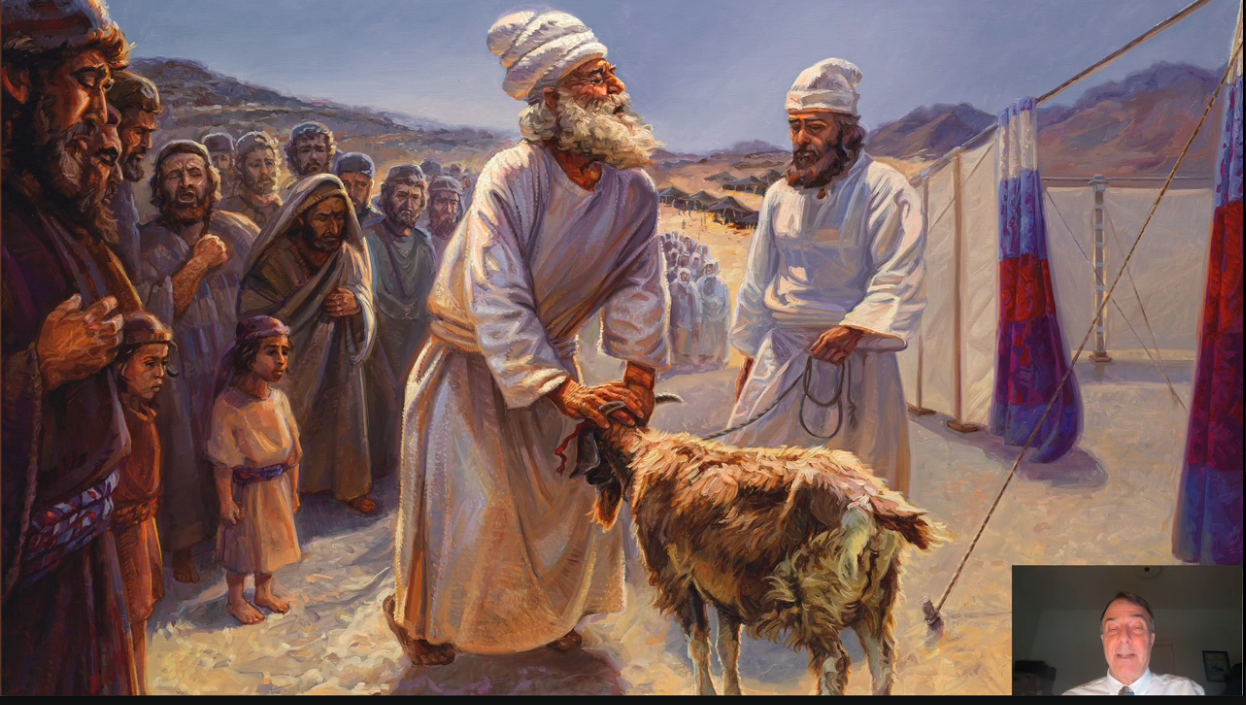
The Lord hath laid upon him the iniquities of us all. This passage harks back to the meaning of the ritual of the Day of Atonement in Leviticus 16, when the high priest laid his hand on the head of the victim and, in essence, transferred to him the sins of the people.
This phrase is the emotional center of the chapter and leaves no doubt that the subject here is the vicarious expiation of sins. Especially note the singular “him” and the very inclusive guilt of “all of us.”
Attempting to arrive at an interpretation that takes “him” as referring to anyone else besides Jesus Christ is most difficult, since no other single intercessor has suffered for all of us. Compare this with Isaiah 43:24 and 25, where it is stated that the Lord is forced into the position of servant because of Israel’s sins, and he must expiate them himself in order to vindicate his name.
“He Was Oppressed and He Was Afflicted”
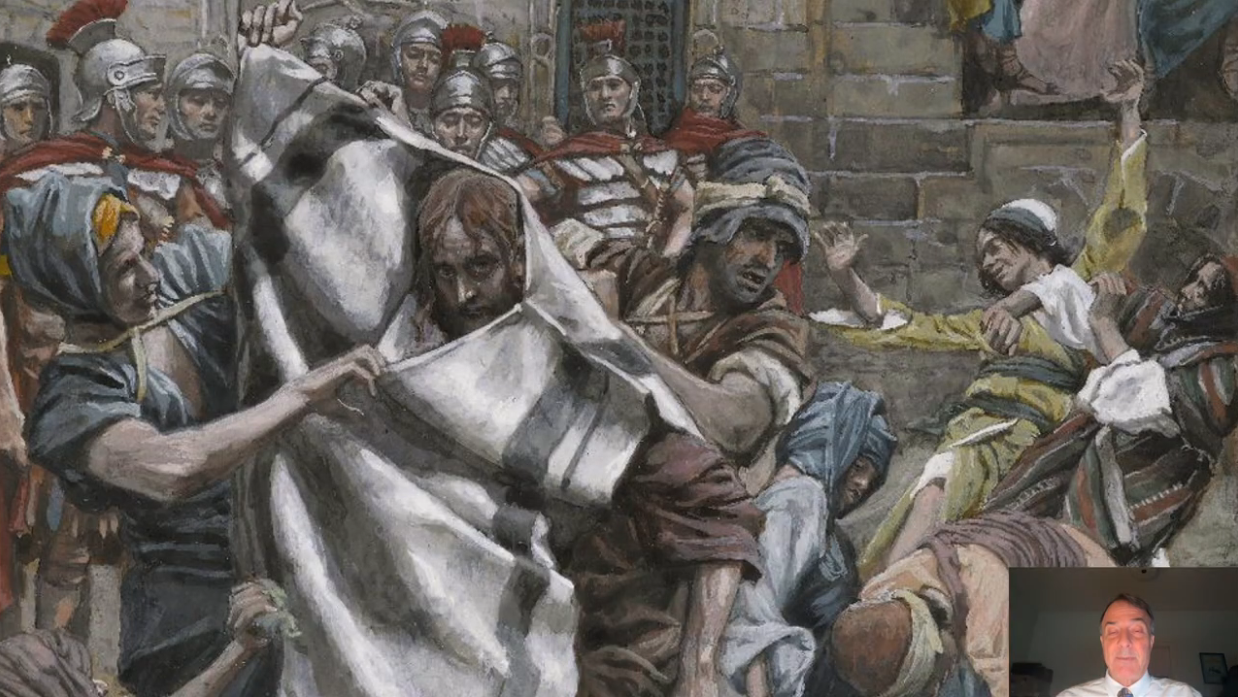
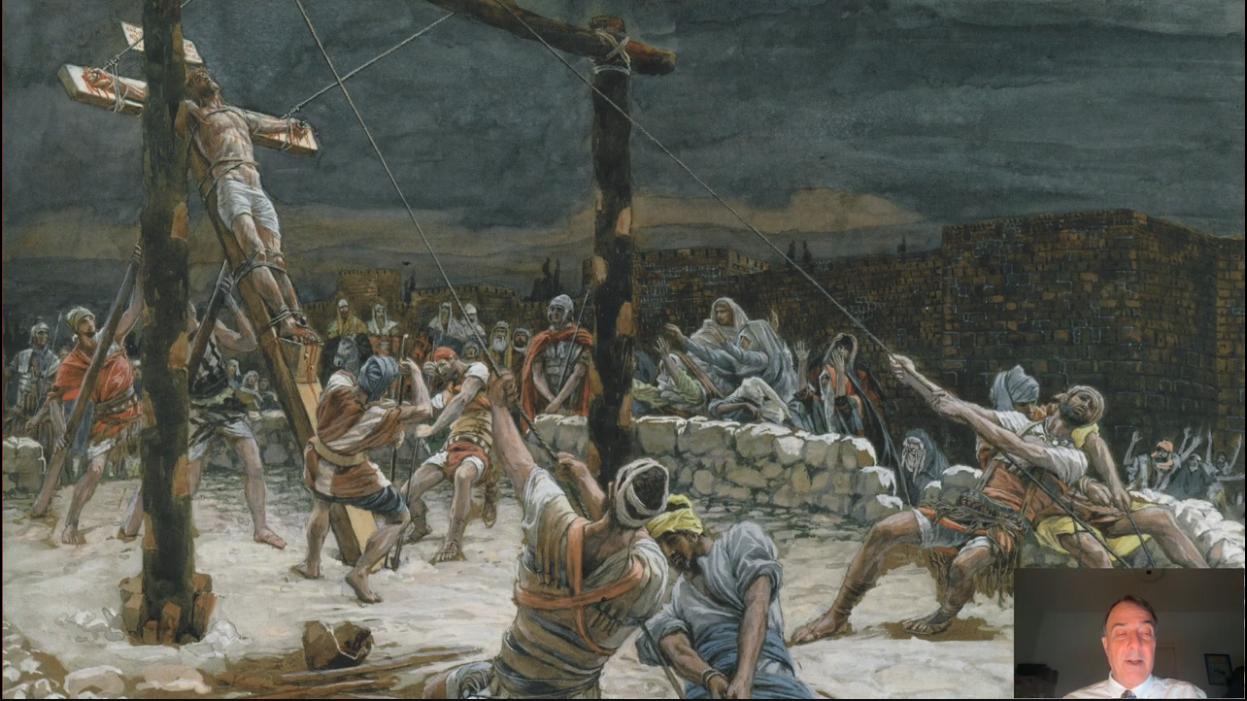
He was oppressed and he was afflicted. Jesus, of course, was oppressed and afflicted throughout his ministry. But this passage seems to refer particularly to the legal trials he suffered immediately before his crucifixion. The Hebrew nagas employed here implies the use of physical violence.
Yet he opened not his mouth. More than just a prophecy of the Lord’s refusal to speak to Herod, the phrase indicates the meek and submissive nature of the servant to the task he is to perform.
The servant does not return railing for railing to his oppressors. Nor does he submit to the temptation to curse God and die.
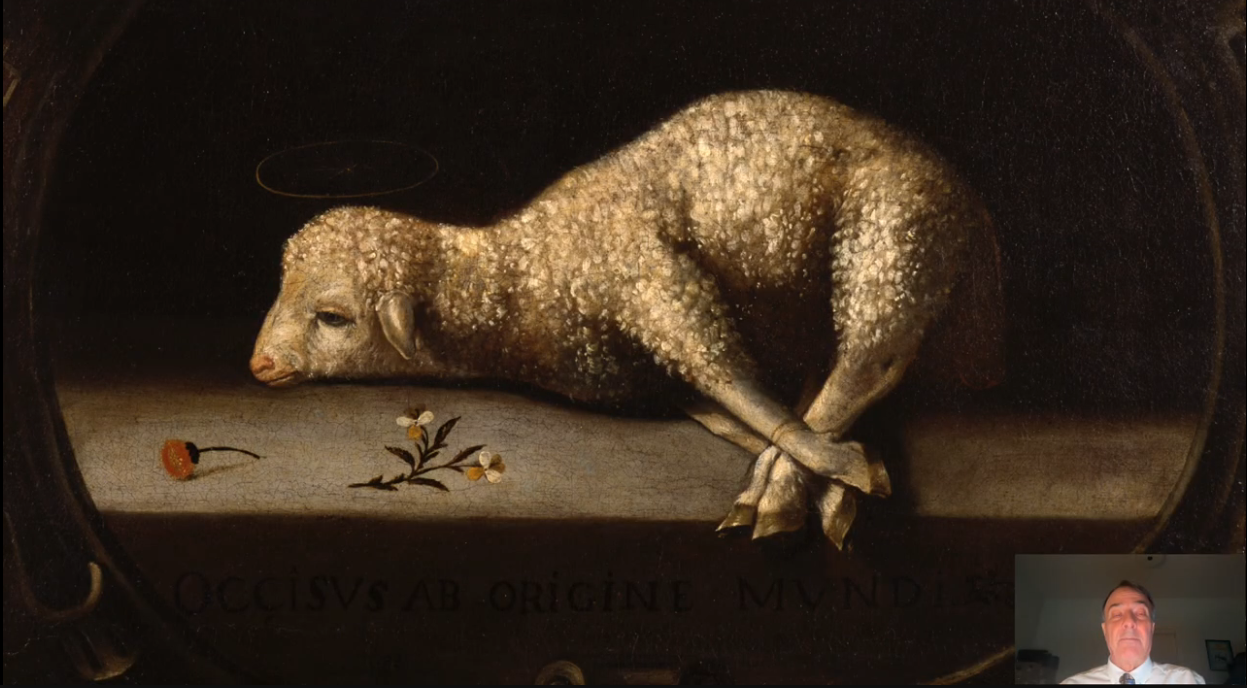
“He is brought as a lamb to the slaughter and as a sheep before her shearers is dumb. So he opened not his mouth.”
The sheep theme is altered from verse 6. Rather than a group of shepherdless, wandering sheep, we have here a single docile sheep that submits silently to its shearing and slaughter as a literal offering for sin.
“He Was Taken from Prison and from Judgment”
“He was taken from prison and from judgment. And who shall declare his generation, for he was cut off from the land of the living. For the transgression of my people he was stricken.”
He was taken from prison and from judgment. A plainer translation would be, “He was taken by force and without justice.” Hebrew mishpat.
Who shall declare his generation? The New International Version renders this phrase as, “Who can speak of his descendants?” implying that because he was cut off from the land of the living, he had none.
For the transgressions of my people, he was stricken. A version of Isaiah found in the Dead Sea Scrolls renders the term “of my people” as “his people.” Such a rendering would favor the servant as being the condescending Lord, as it would say, “The servant was stricken for his own people.”
Note the irony in the fact that the servant was killed as a result of the people’s sinning, and he was also killed for the people’s sins. The idea that the servant was not merely stricken, but rather stricken to death, is evident not only from the parallel to the slaughtered lamb in verse 7, but also is attested in the Septuagint, arguably the best extant textual witness for the meaning of this verse, according to John Day.
“He Made His Grave with the Wicked”
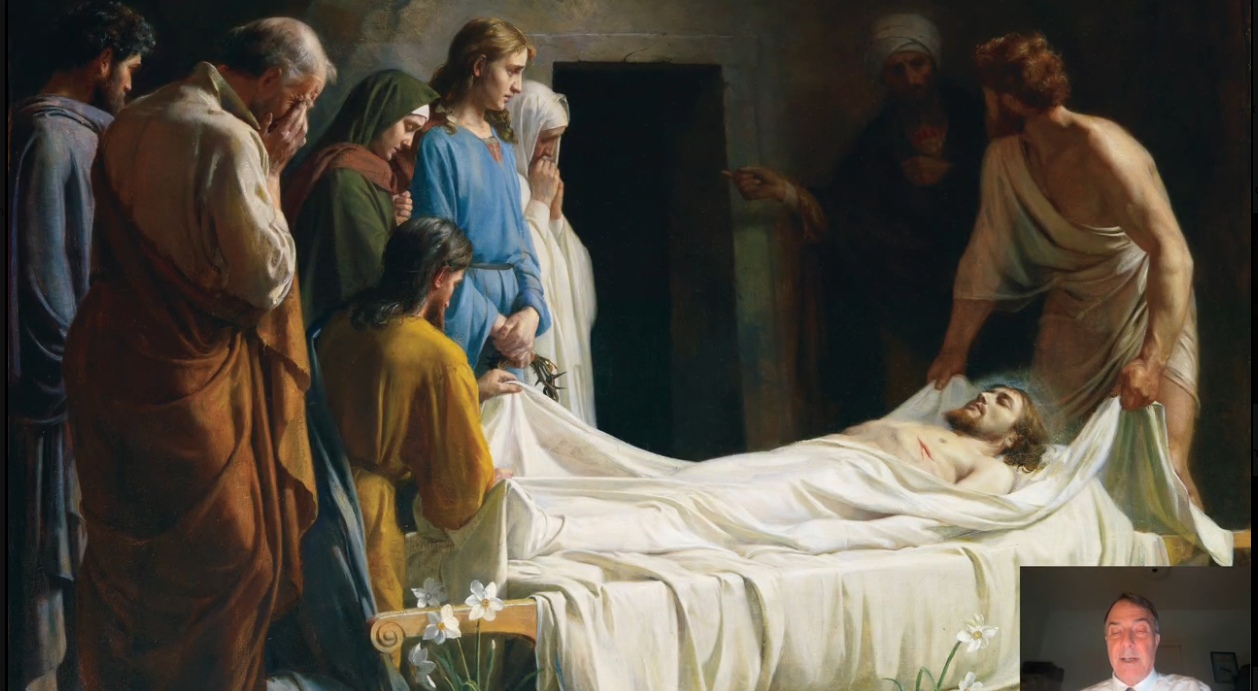
“And he made his grave with the wicked and with the rich in his death, because he had done no violence or evil, neither was there any deceit in his mouth.”
He made his grave with the wicked and with the rich in his death. In 1 Corinthians 15:3 and 4, Paul avers that Jesus Christ died and was buried according to the scriptures. No doubt Isaiah 53:9 was one of the scriptures he had in mind.
However, the King James Version wording of this verse is the reverse of what is expected: “His grave with the wicked and with the rich in his death.”
According to the New Testament, he was crucified in his death between two thieves, the wicked, and buried, his grave, in Joseph of Arimathea’s tomb with the rich, not vice versa. Avraham Gileadi gives additional arguments for this reading.
“Yet It Pleased the Lord to Bruise Him”
“Yet it pleased the Lord to bruise him. He hath put him to grief. When thou shalt make his soul an offering for sin, he shall see his seed. He shall prolong his days and the pleasure of the Lord shall prosper in his hand.”
Yet it pleased the Lord to bruise him. The term “please” can be interpreted simply to signify that the servant’s suffering was consistent with the Lord’s will. The JPS translation is, “But the Lord chose to crush him.” And the AB reads, “Yahweh decided to crush him.”
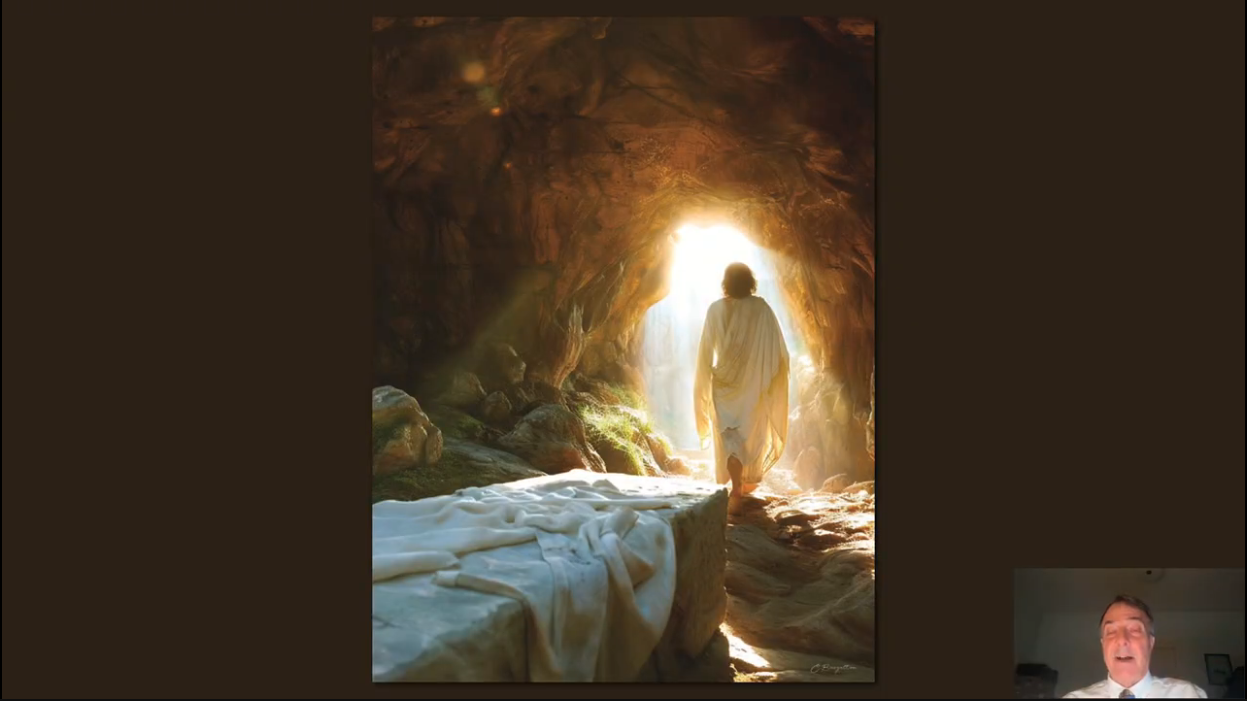
Certainly the Father took no pleasure in the suffering of his Son. But the Father was pleased that his Son would obediently offer such a sacrifice, meaning that the sacrifice was according to the Father’s wishes and his will. The Father was pleased further because of the love manifest by his Son, and also because of the blessings that would come to the rest of his children.
He hath put him to grief. The Dead Sea Scroll versions of Isaiah offer the reading that “he pierced him,” consistent with the piercing of his hand, side, and feet described in the Gospels and anticipated in the Psalms.
When thou shalt make his soul an offering for sin, one translation comments, “The guilt offering of Leviticus is a type of sacrifice intended to atone for involuntary ritual offenses.” The use of the term here has no particular reference to the rite of the guilt offering. The servant is compared to the victim of an atonement sacrifice.
“He Shall See His Seed”
He shall see his seed. Rather than being bereft of descendants, as it says in verse 8, “Who shall declare his generation?” the servant will enjoy a spiritual posterity without number.
Abinadi interpreted this expression in Mosiah 15:10–13, saying that the seed of Christ are the righteous who have heard the good word of salvation and believed and obeyed.
“These are his seed, or they are the heirs of the kingdom of God. For these are they whose sins he has borne. These are they for whom he has died to redeem them from their transgressions.”
Elsewhere, we learn that the seed of Christ are those who are spiritually begotten as his sons and daughters. Mosiah 5:7, born of water and the Spirit. Moses 6:64–68.
Beginning with this expression, we move from Isaiah’s prophecy of the Lord’s suffering to his prophecy of the Lord’s triumph.
He shall prolong his days. In a second unexpected reversal of fortune, the servant who is prematurely cut off from the land of the living will actually have his life lengthened as he exercises his power to break the bands of death.
The blessings of immortality through the resurrection and eternal lives through sealings to posterity, which are here promised to the righteous servant, are also extended to all the faithful who follow him.

“He Shall See the Travail of His Soul”
“He shall see the travail of his soul and shall be satisfied. By his knowledge shall my righteous servant justify many, for he shall bear their iniquities.”
He shall see the travail of his soul and shall be satisfied. The Prophet Joseph Smith promised, “All your losses will be made up to you in the resurrection, provided you continue faithful to Christ. By the vision of the Almighty, I have seen it.”
For the servant, as well as for all the righteous, the day will come when the sufferings of life and the pain of death shall be sweet unto them. Whereas for the unrepentant, not only death, but also the memory of life’s pleasures will be tainted with deep sorrow and bitterness.
Wrote C. S. Lewis:
Both good and evil, when they are full grown, become retrospective… Not only this heavenly valley, but all the earthly past will have been heaven to those who are saved.
“Not only the twilight in (the spirit prison), but all their life on earth too, will then be seen by the damned to have been hell. That is what mortals misunderstand. They say of some temporal suffering, ‘No future bliss can make up for it,’ not knowing that Heaven, once attained, will work backwards and turn even that agony into glory.
“And of some sinful pleasure, they say, ‘Let me but have this, and I’ll take the consequences,’ little dreaming how damnation will spread back into their past and contaminate the pleasure of the sin.
“Both processes begin even before death. The good man’s past begins to change so that his forgiven sins and remembered sorrows take on the quality of Heaven. The bad man’s past already conforms to his badness and is filled only with dreariness. And that is why, at the end of all things, when the sun rises here in the place of God’s glory and the twilight turns to blackness down there where Satan reigns, the blessed will say, ‘We have never lived anywhere except in Heaven.’ And the lost, ‘We were always in Hell.’ And both will speak truly.”
“He Shall See Light”
He shall see the travail of his soul.
According to Anthony Ferguson, the best textual witnesses to this phrase add the term “light” to the phrase. For example, “From the anguish of his soul, he shall see light and he shall be satisfied.”
In light of the servant’s death, the small addition is significant. This is because the Hebrew phrase “see light” is an idiom for describing life or the revival of life, while the phrase “not seeing light” is the idiom of death. Jesus Christ overcame death in his resurrection.
“He Made Intercession for the Transgressors”
“Therefore will I divide him a portion with the great, and he shall divide the spoil with the strong, because he hath poured out his soul unto death, and he was numbered with transgressors, and he bare the sin of many, and made intercession for the transgressors.”
In this context, the Hebrew verb denoting the process of intercession means “to intervene,” as in Isaiah 59:16.
Thus, this phrase does not mean, as some editors imagine, that he made prayers of intercession for the transgressors, but that with his life, his suffering, and his death, he took their place and underwent punishment in their stead.
Isaiah 53 and the Sacrament
That concludes our brief discussion of this incomparable chapter. For Latter-day Saints, reflecting on the redeeming sacrifice of Jesus Christ brings life-changing renewal each week when we take the sacrament.
Including Isaiah 53 as part of that reflection can enrich our understanding of his love and example. Indeed, my dear wife Kathleen silently repeats portions of Isaiah 53 in her mind, along with other verses and portions of the ordinances, each Sunday as part of her sacrament devotional, as well as at other times.
George Herbert, a Welsh poet, orator, and priest, has beautifully captured the unstinting invitation of the Lord that repeatedly calls us back to the sacrament table to feel his forgiveness and taste his goodness.
The central character in the verse below is Love, a profound personified virtue who, of course, represents the Savior. It has been set to moving music by Ralph Vaughan Williams.
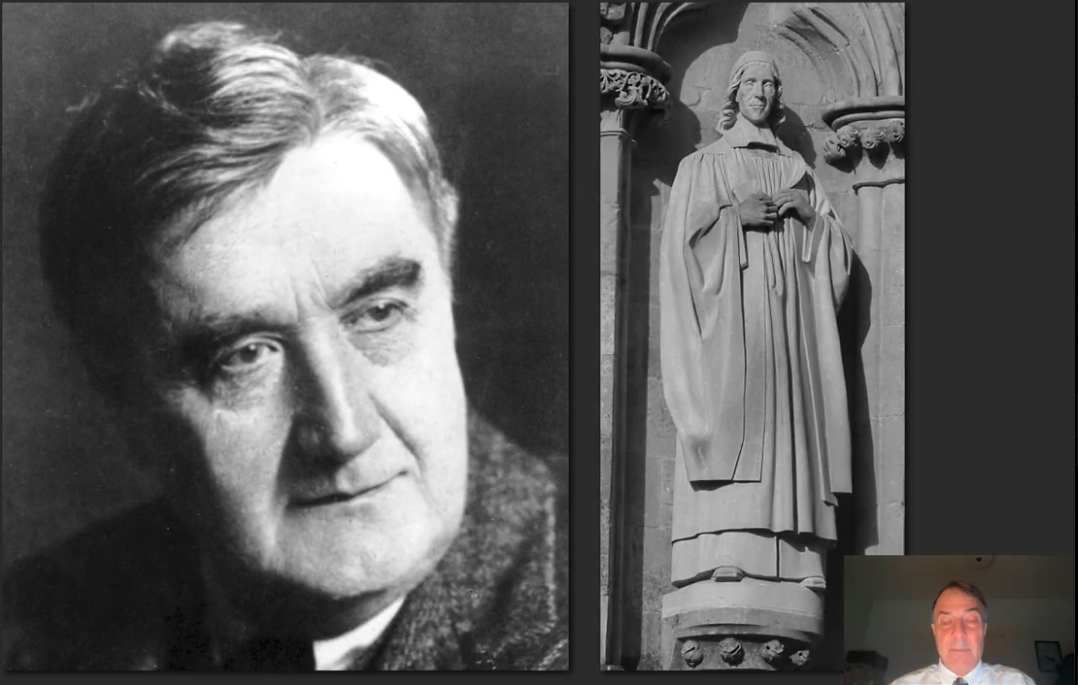
Christopher Palmer comments on the song as follows.
Both what Herbert said and the way he said it appealed to the Christian agnostic or disappointed theist in Vaughan Williams. ‘Love Bade Me Welcome’ looks both more inward and far further than the other songs. The rapt stillness at its center, at which point, in the traditionally Eden key of E, wordless voices intone the O sacrum convivium in the Latin liturgy on the sacrament of the Lord’s Supper, is one of the great moments in Vaughan Williams.”
Here is the poem, which invites us to think about the invitation to accept the atonement of Jesus Christ generally and specifically when we are given the privilege of taking the sacrament.
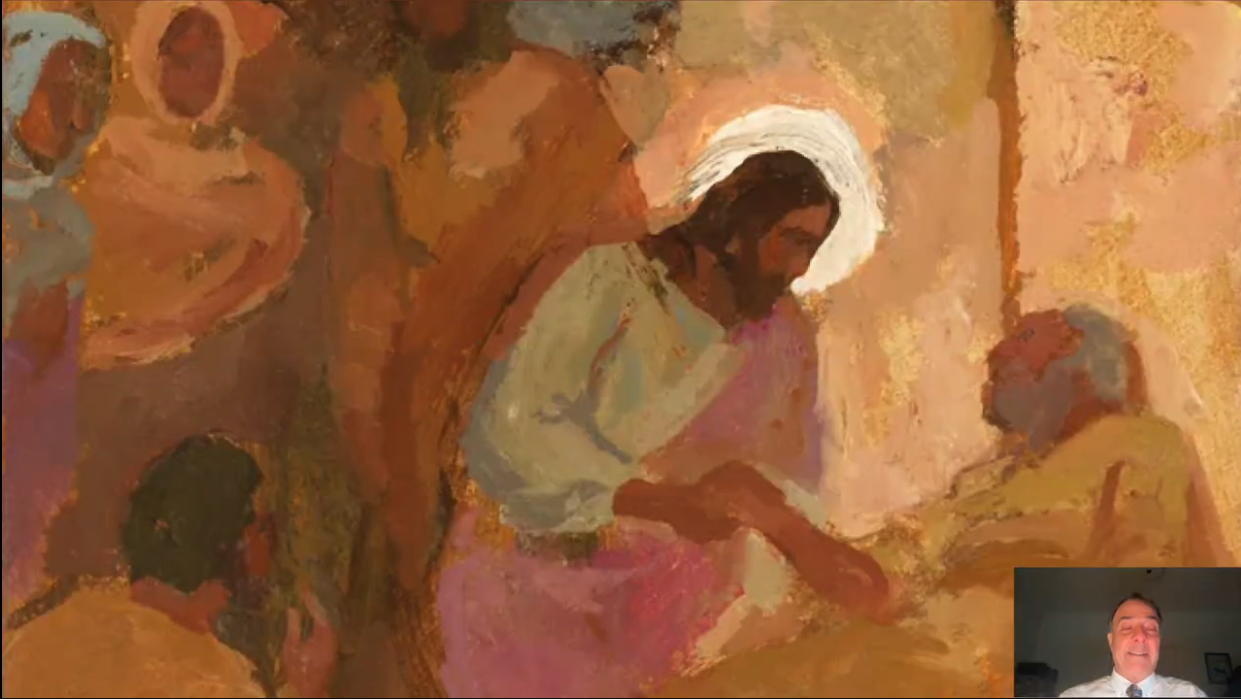
“Love Bade Me Welcome”
“Love bade me welcome, yet my soul drew back,
Guilty of dust and sin.
But quick-eyed Love, observing me grow slack
From my first entrance in,
Drew nearer to me, sweetly questioning
If I lacked anything.
“A guest,” I answered, “worthy to be here.”
Love said, “You shall be he.”
“I, the unkind, ungrateful? Oh, my dear,
I cannot look on thee.”
Love took my hand and smilingly did reply,
“Who made the eyes but I?”
“Truth, Lord, but I have marred them.
Let my shame go where it deserve.”
“And know you not,” says Love, “who bore the blame?”
“My dear, then I will serve.”
“You must sit down,” says Love, “and taste my meat.”
So I did sit and eat.
In the name of Jesus Christ, amen.
