Presentation by Mark Ashurst-McGee
A Thorny Historical Issue
Good morning. Good to be here with you.
So this year is the Back to Basics Conference, and so just trying to cover the basic issues that come up over and over again. As you look at the program, you see that represented.
In my humble opinion, Joseph Smith and treasure hunting actually is a thorny historical issue. So, I wasn’t surprised they asked me to talk about it. They asked me to cover all the major issues in 25 minutes…which is impossible, especially on this topic. But we’re going to try to cover a whole lot of stuff in the next 25 minutes. So, we’ll get going here.
I should say, I do think historically it’s a thorny issue for several reasons—some documentary reasons. Obviously, in terms of what’s out there on the internet, it is a problem—or a set of problems.
For me, these are not problems without solutions. You know, some problems have solutions and some problems don’t have any solution. I think these are all problems that need to be solved, I think they can be solved. And I’ll try to give you a feeling for some of that today.
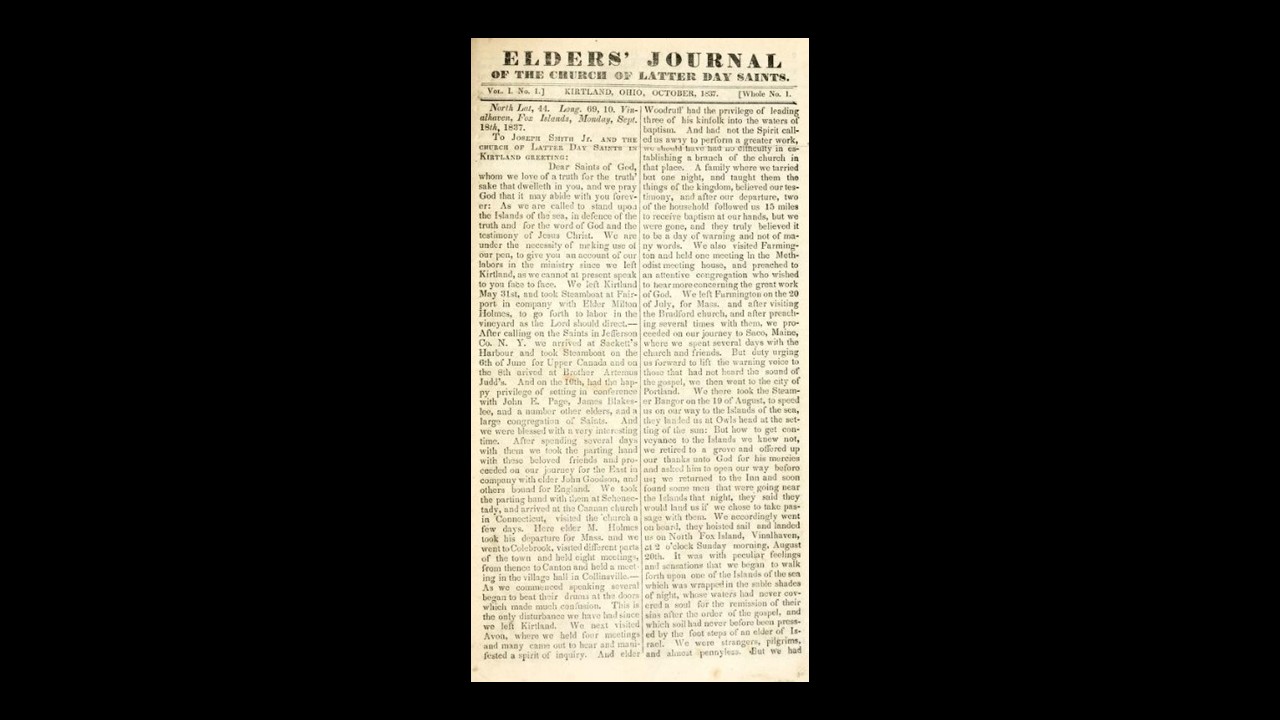
Joseph Smith’s Answer in the Elders’ Journal
Okay, let’s start with the Elders’ Journal.
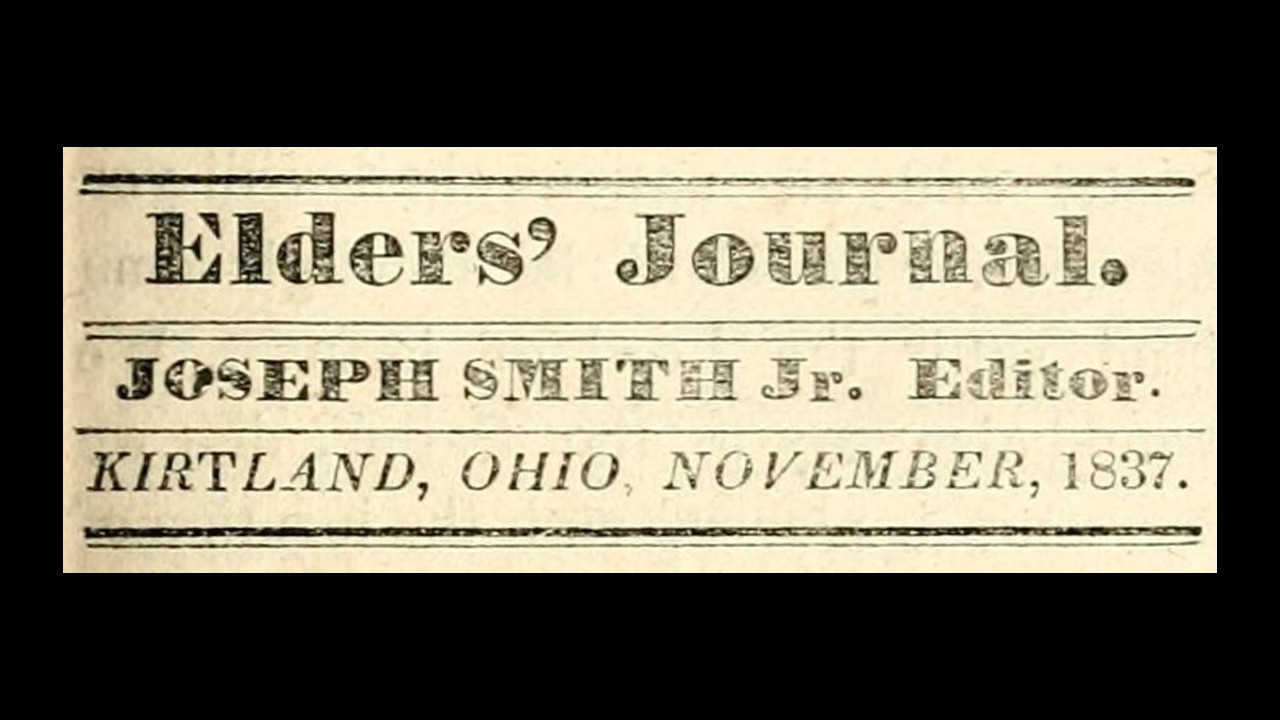
This is the official Church newspaper for the Church in 1837–1838. And I’m going to start by just trying to understand the problem that needs to be solved.
So, was Joseph Smith involved in treasure hunting? Because some people kind of want to just set that aside. So in terms of starting out, let’s face up to what the problem is.
We’ll start with the Elders’ Journal. Joseph is the editor. One of the issues says, “Hey, there’s these questions we get asked all the time. There’s these common questions that everyone has about the Church and the origins of the Church.” So I’m just going to address some of those.
We’re going to the July 1838 issue. This is where Joseph Smith says, “Okay, we’re going to answer these questions.”
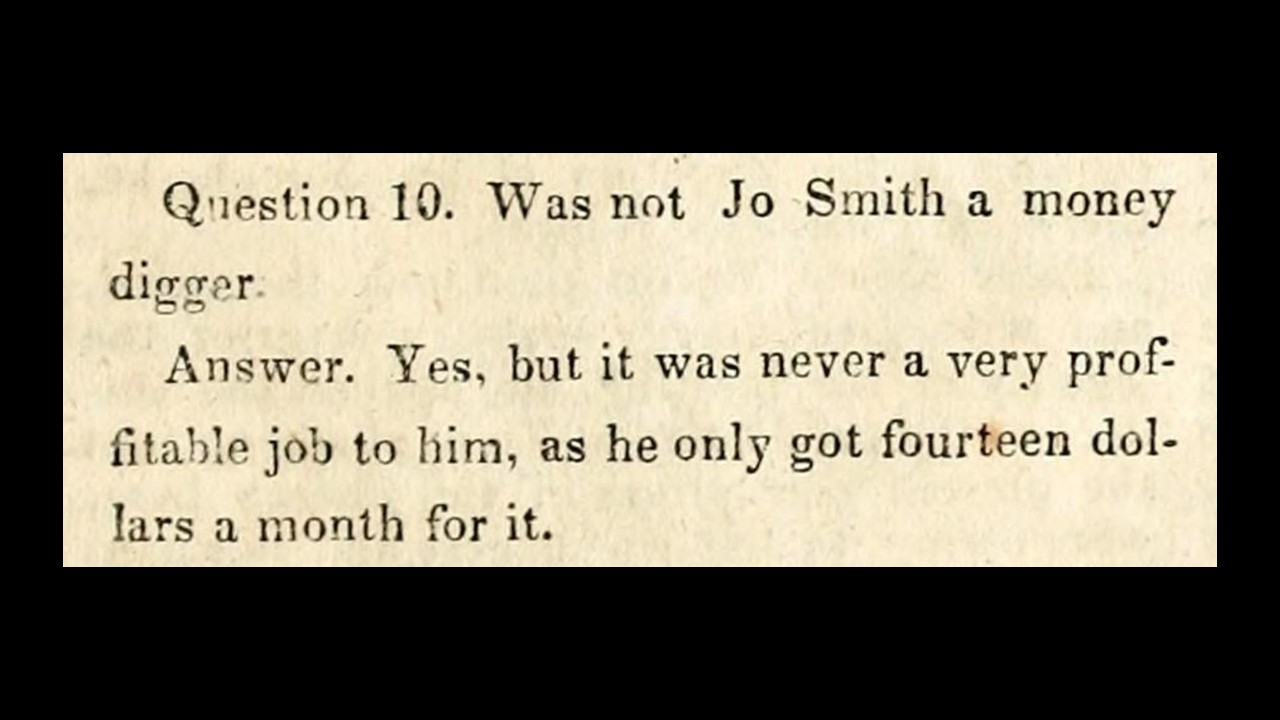
So one of the questions was, “Was not Joe Smith a money digger?”
And Joseph’s answer to this was yes, but he says something like, “But it was not a very profitable job,” because he only received fourteen dollars a month for it or something.
Of course, we also are very familiar with this as Latter-day Saints because it’s in our scriptures.
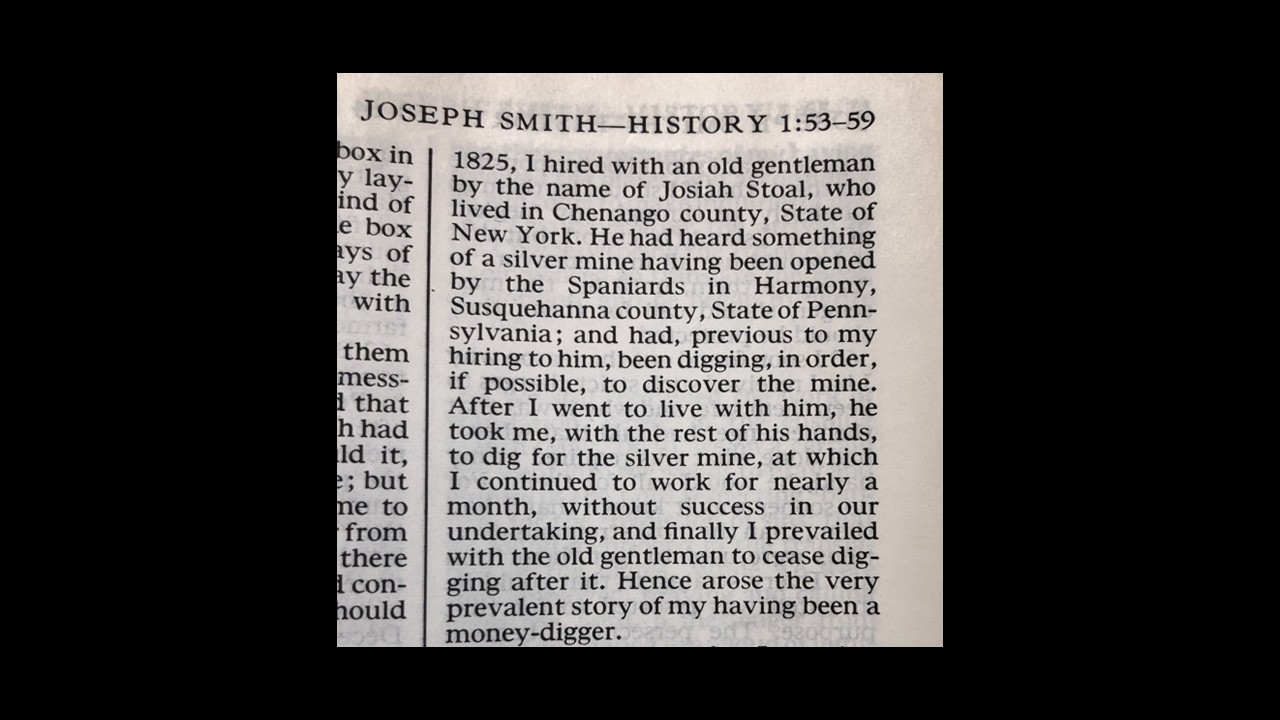
Josiah Stowell and the Search for a Silver Mine
In the scriptural canon of The Church of Jesus Christ of Latter-day Saints, we have the Pearl of Great Price, and in the Pearl of Great Price we have the Joseph Smith—History.
In the Joseph Smith—History, Joseph Smith tells us about when, in 1825, a man named Josiah Stowell from Pennsylvania came up to Manchester and hired him to help him find a legendary Spanish silver mine in Harmony, Pennsylvania.
And as you know, he hires him. Joseph Smith goes down there. They look for this treasure. They don’t find it. This is when Joseph Smith first meets Emma Hale, whom he later marries.
So we’re familiar with this. And Joseph Smith talks about his involvement in treasure hunting.
Now, a lot of critics will say, “Okay, he admits it, but he’s really downplaying it,” or “He’s massively downplaying it.”
He might be downplaying it a little bit. But, how much so?
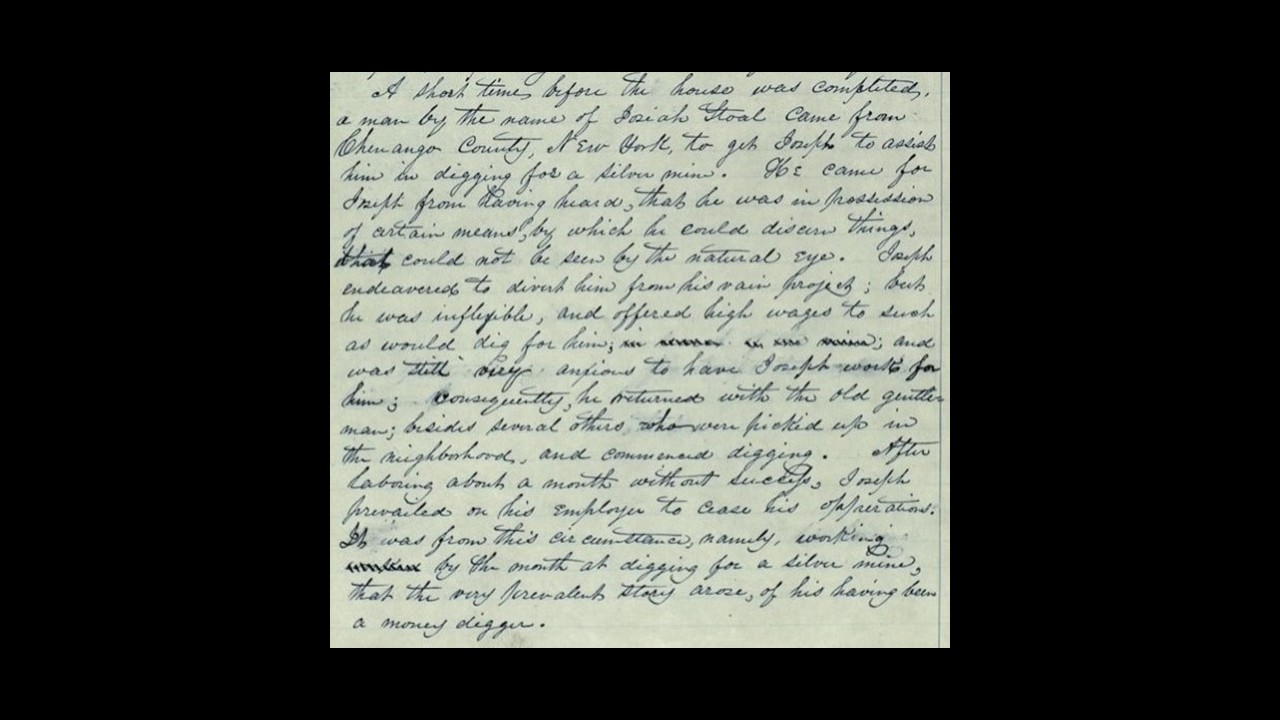
We also know about this from Lucy Mack Smith. She says:
“A short time before the house was completed, a man by the name of Josiah Stowell came from Chenango County, New York, to get Joseph to assist him in digging for a silver mine.”
“He came for Joseph from having heard that he was in possession of certain means by which he could discern things that could not be seen by the natural eye.”
Now, this is 1825. Joseph Smith doesn’t get the Urim and Thummim spectacles until 1827. So when Lucy says that Josiah Stowell wants to hire Joseph Smith because Joseph Smith has certain means by which he can see things not otherwise visible to the natural eye, he’s not talking about the spectacles.
This is talking about one or one or more seer stones.
Joseph Smith, Seer Stones, and the 1826 Court Proceeding
Now, as you probably know, a few months later Joseph Smith ends up in court in connection with this looking for this silver mine because one of Josiah Stowell’s nephews feels like this is fraudulent activity, because how could you ever find anything with a seer stone?
And so Joseph Smith ends up in court.
We have about a half a dozen sources on this. They say different things as to the outcome, so we actually don’t know exactly what the outcome is. But there’s good evidence that Joseph Smith is not convicted.
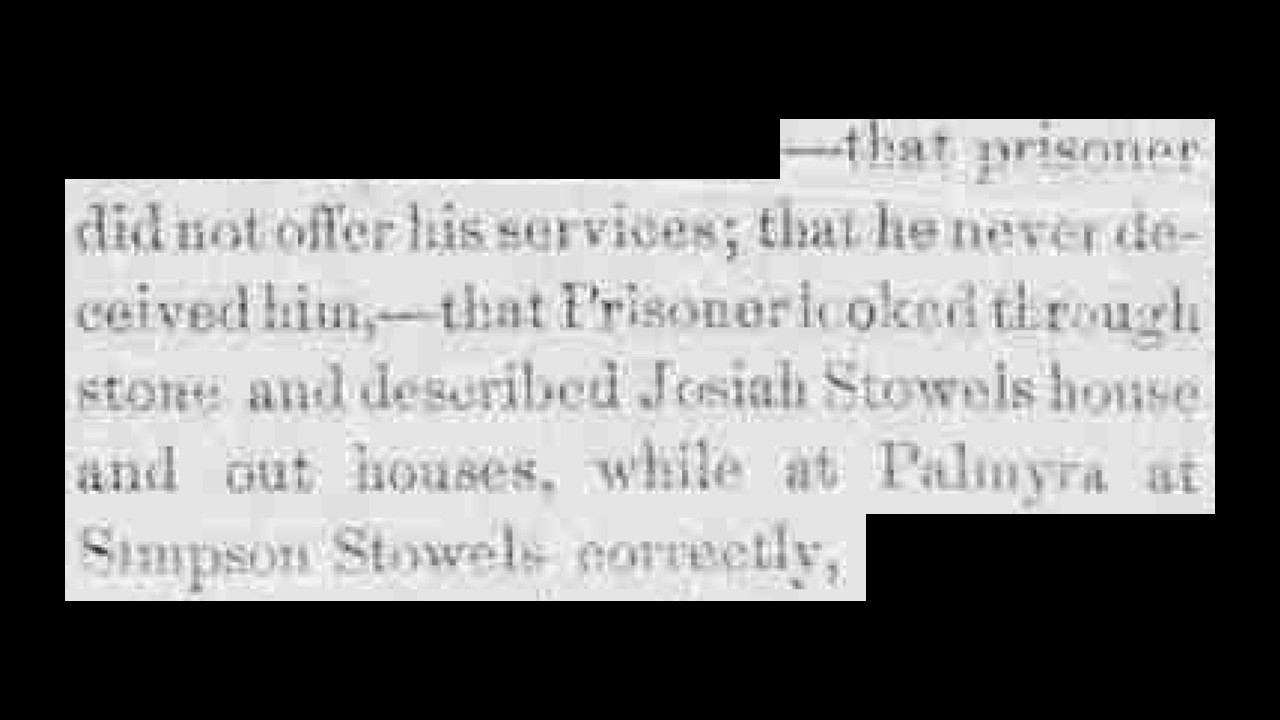
Part of the reason for that may be that Josiah Stowell himself testifies in this case and says that Joseph Smith is not trying to deceive him in any way.
In fact, he says:
“The prisoner did not offer his services. He never deceived him.The prisoner looked through the stone and described Josiah Stowell’s house and outhouses while at Palmyra, at Simpson Stowell’s, correctly.”
So here he’s talking about when he hired Joseph Smith. He’s from down in the Susquehanna River country. He’s up in the Manchester-Palmyra area. He talks to Joseph Smith at his relative, Simpson Stowell’s house in Palmyra, and Joseph Smith looks at his stone and is able to describe to Josiah Stowell his property, his house, and his outbuildings.
Joseph Smith’s Reported Testimony
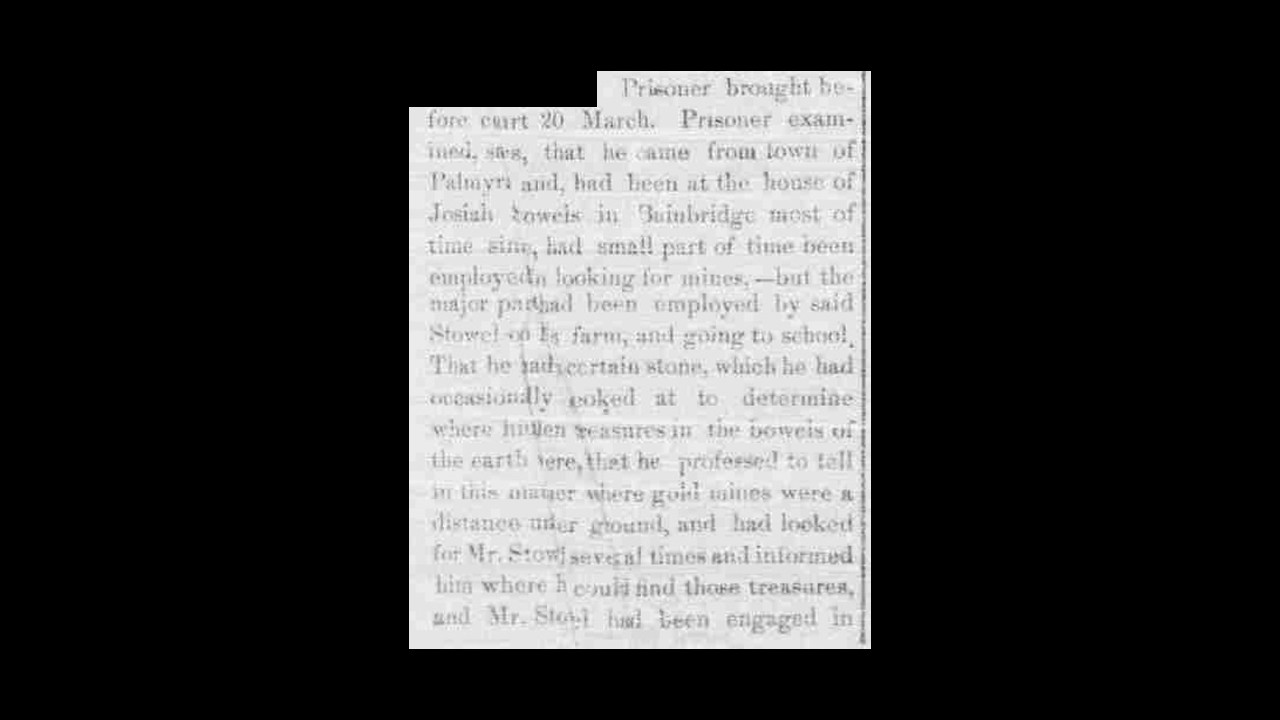
We also know some things from Joseph Smith’s own testimony from that same court procedure.
- We can’t know exactly what he said.
- We didn’t have court reporters taking dictation.
- We don’t have audiovisual recording.
But, for whatever it’s worth, we have this account where Joseph Smith talks a little bit about his participation in treasure hunting.
So let’s go through this really quick.
“Prisoner examined, says he came from the town of Palmyra and had been at the house of Josiah Stowell’s in Bainbridge most of the time since; had small part of the time been employed in looking for mines, but the major part had been employed by said Stowell on his farm and going to school.
“He had a certain stone which he occasionally looked at to determine where hidden treasures in the bowels of the earth were; that he professed to tell in this manner where gold mines were a distance under the ground. And he looked for Mr. Stowell several times and informed him where he could find those treasures, and Mr. Stowell had been engaged in digging for them.”
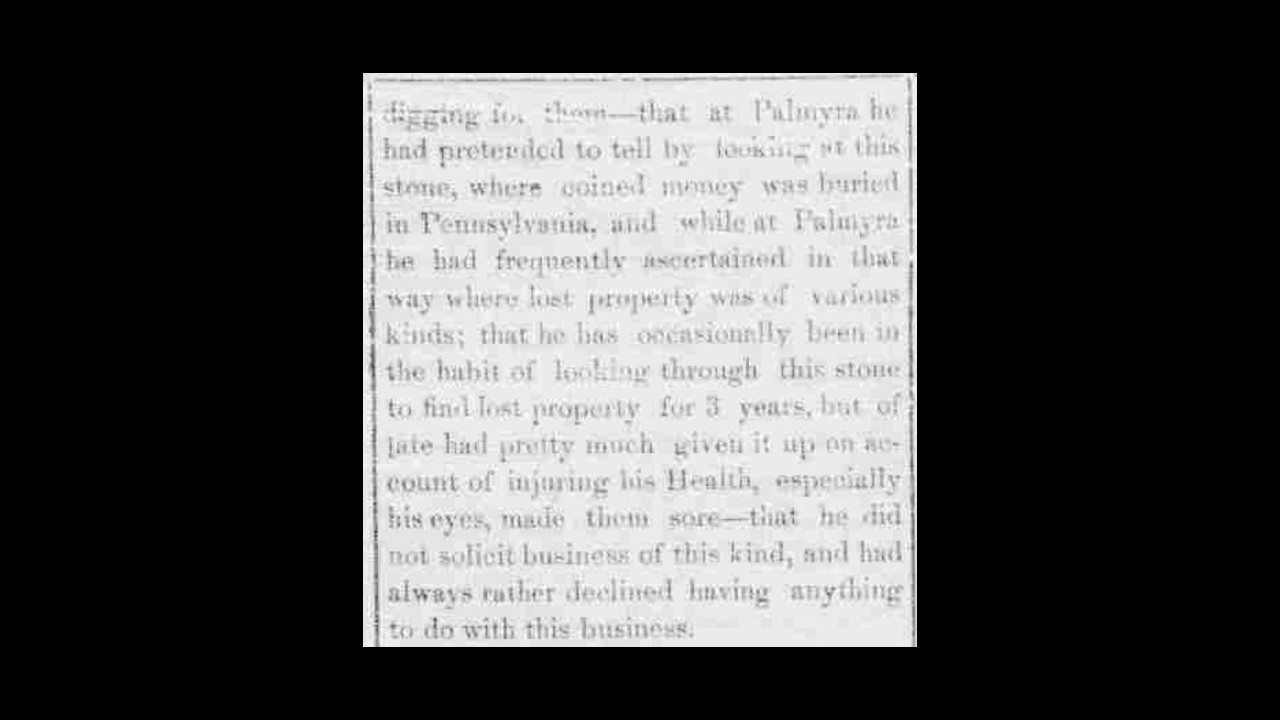
“At Palmyra, he had pretended”—this is the reporter’s version, not Joseph Smith’s language—”to tell by looking at this stone where coined money was buried in Pennsylvania. And while at Palmyra he had frequently ascertained in that way where lost property was of various kinds.”
This is actually more what village diviners do, is find stuff that’s lost or supposedly stolen. And buried treasure is like a subcategory of lost items that people are looking for.
And we have accounts of Joseph Smith Sr. and Joseph Smith Jr. helping people find stuff successfully.
“He’s occasionally been in the habit of looking through this stone to find lost property for three years, but of late had pretty much given it up on account of injuring his health, especially his eyes, made them sore. That he did not solicit business of this kind and had always rather declined having anything to do with this business.”
So it’s actually not like a seer for hire. Josiah Stowell did get him to come down and help with this treasure hunting, but that’s not part of the larger treasure hunting endeavor.
Accounts from New York and Pennsylvania
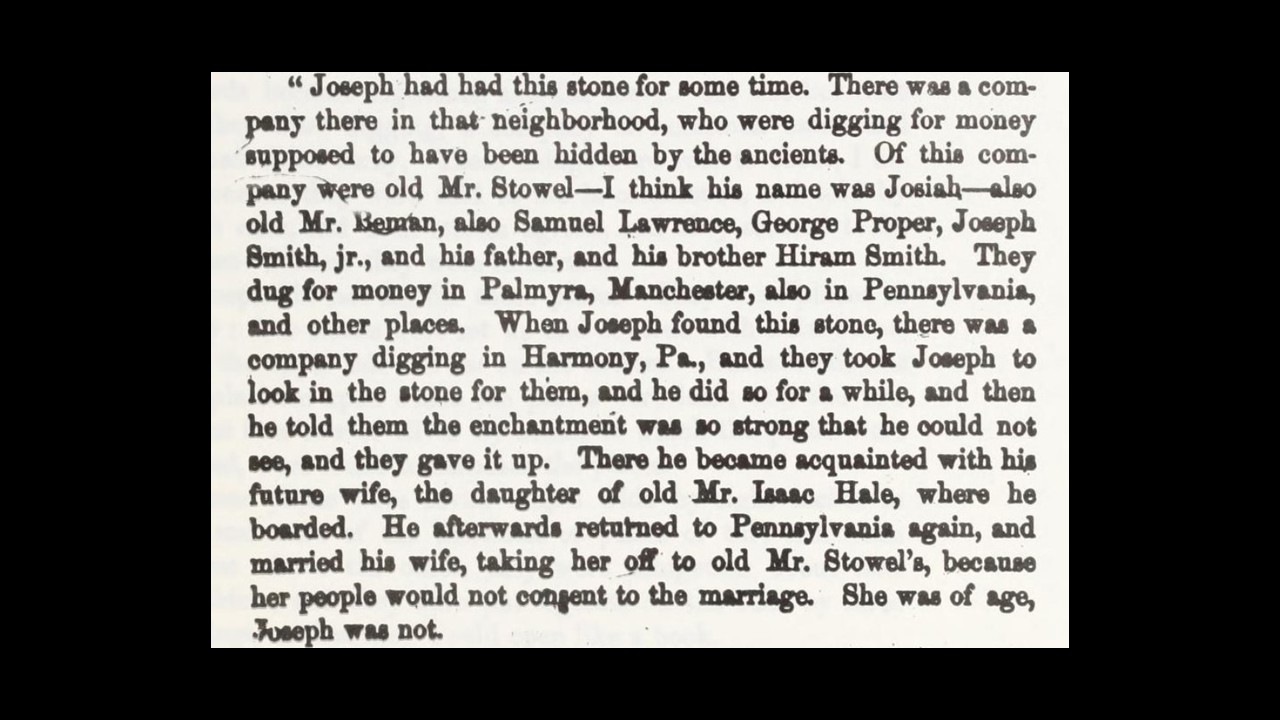
Here’s Martin Harris talking about Joseph Smith being involved not only in Pennsylvania but also in a few places in the Palmyra-Manchester area.
So it’s not just down in Pennsylvania; it’s also back home.
Summarizing real quick, there are lots of sources on treasure hunting related to Joseph Smith, both for New York and Pennsylvania—some friendly sources and many not.
And when I say “many not”, I mean all kinds of really condemnatory things about Joseph Smith and treasure hunting.
That stuff we just went over for the 1826 court—that’s going back to that time period. Almost everything else, basically everything else, is coming from later, after the Book of Mormon is published.
When the Book of Mormon is published and the Church is organized, that’s when people start telling stories about Joseph Smith. And when they’re going back, they’re not focusing on his ordinary life. They’re not talking much about his religious life or his spiritual life, or what kind of a person he was in general, or what kind of work he did in general, or even his helping people find lost things in general.
The focus is going to be on the treasure hunting because that’s a way you can try to make someone look bad.
The Historiography of Joseph Smith and Treasure Digging
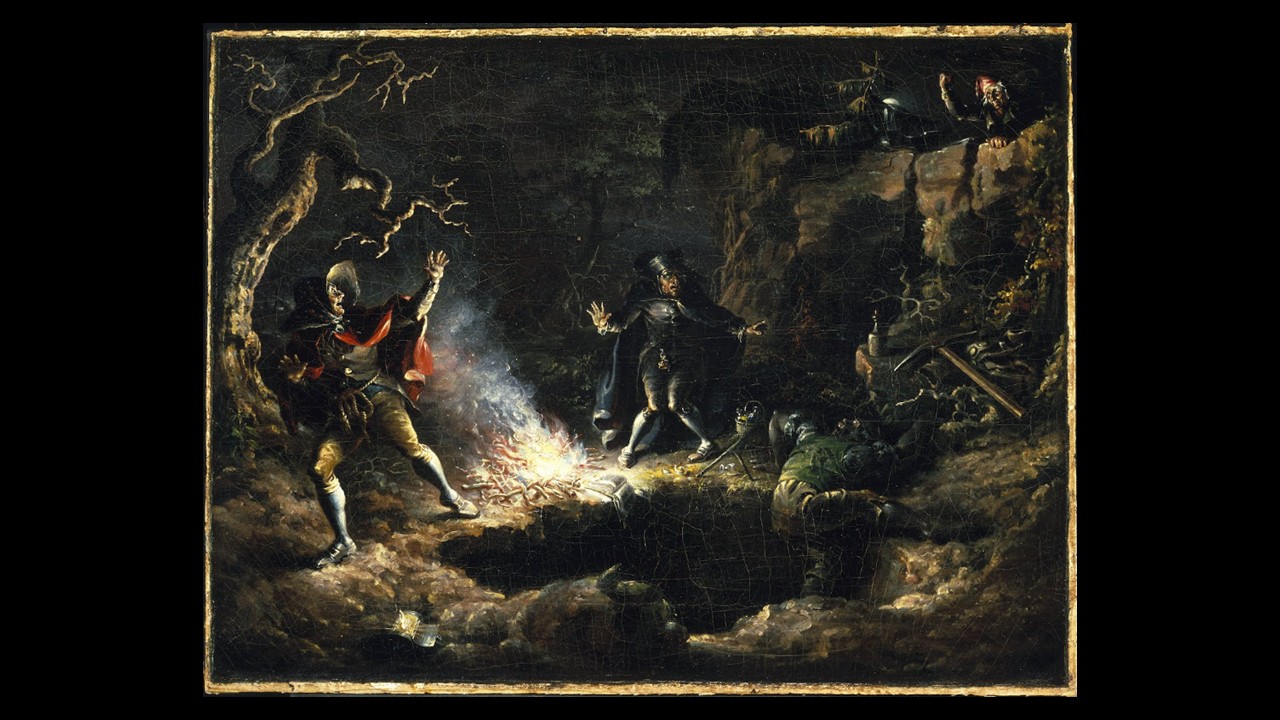
This is an 1832 painting called The Money Diggers.
Think about it like a painter. This is actually representative of an upper-middle-class, aspiring-gentility kind of world.
During this time period, you’re starting to have village elites looking down on the country bumpkins out in the village countryside.
If you study the history of treasure hunting, a lot of it is about socioeconomic class dynamics and how the people who are writing in newspapers and popular literature are looking down on this older, more traditional activity.
This painting kind of gives you a flavor of how people are seeing this.
But let’s quickly go through some of the historiography.
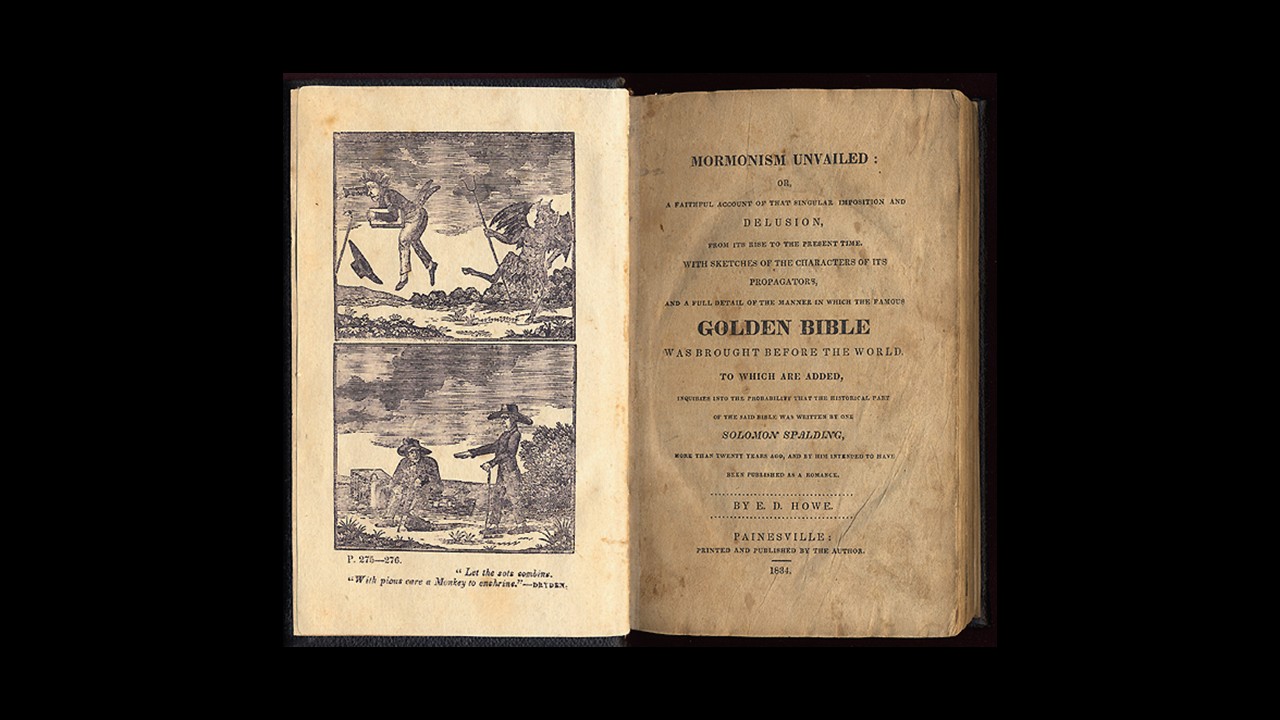
A lot of these stories are collected and published in Mormonism Unvailed in 1834.
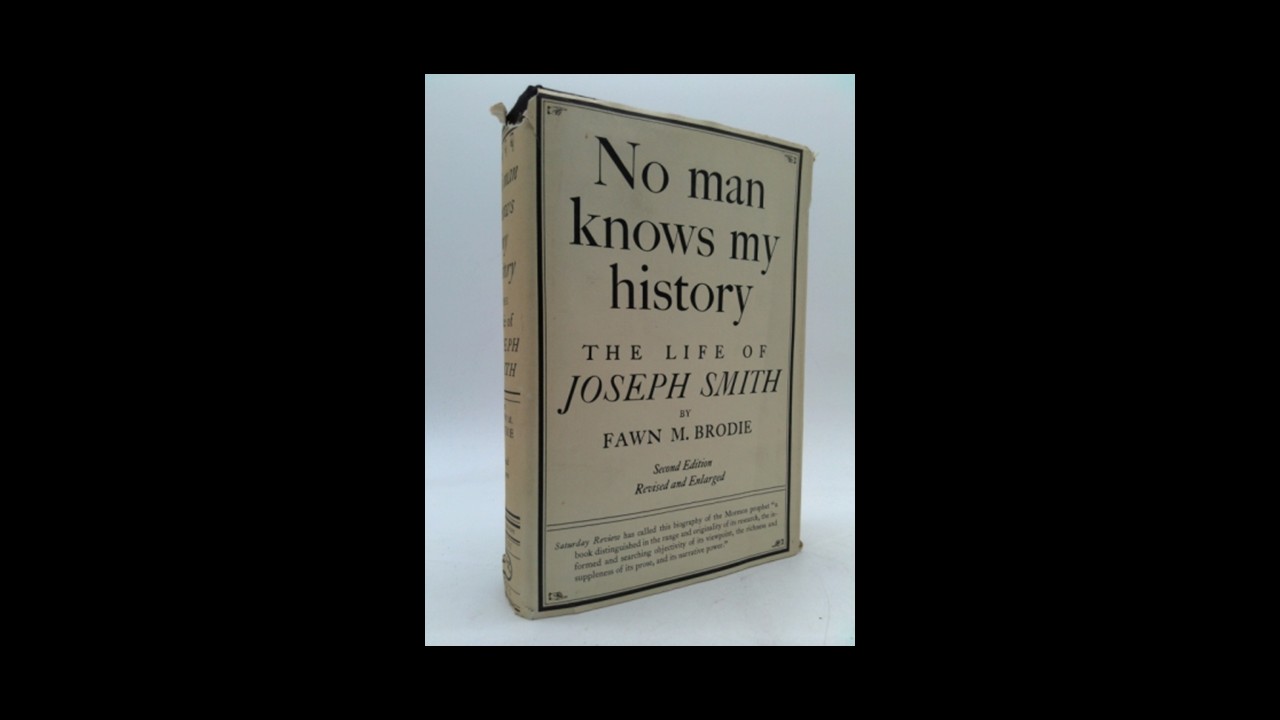
Fawn Brodie reproduces a lot of those in the back of her biography, No Man Knows My History, in 1945. So she kind of really brings these stories back into the popular imagination for Joseph Smith’s youth.
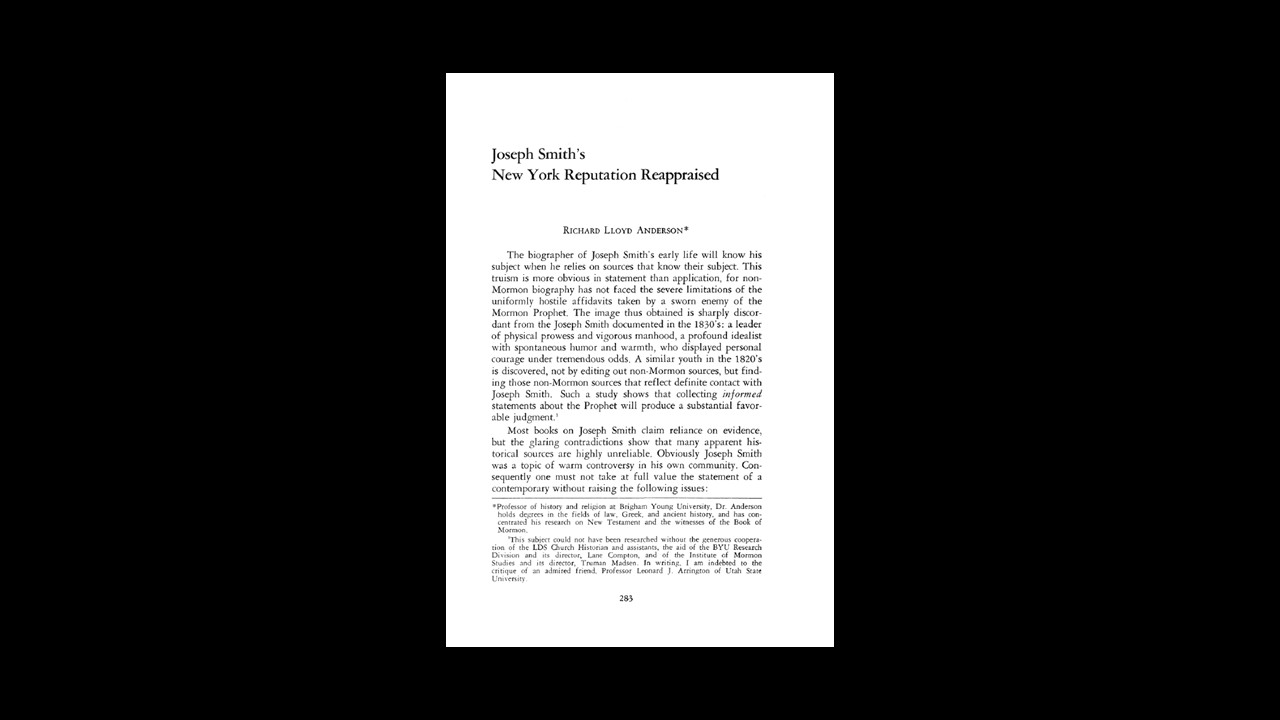
Richard Lloyd Anderson, a BYU professor, did this analysis, Joseph Smith’s New York Reputation Reappraised, where he went through all the sources and showed how very problematic they are, especially this very prominent set collected by D. P. Hurlbut in 1833, published in 1834.
Hulburt’s Work
He was hired to go and try to collect these stories, and there are lots of problems with how he went about doing so.
He’s the same one who collects all the statements on the Spalding theory of the Book of Mormon, which is now completely discounted. There are no serious historians that are following the Solomon Spalding thread anymore because it’s clearly wrong.
And yet Hurlbut is able to go out to the relevant area and get people to say things—or at least produce statements in their name—saying, you know, “We saw Sidney Rigdon here,” and all those things.
Anyway, so, you know, we’ve kind of taken that whole category of his work and thrown it in the dumpster, and yet some people are still taking very seriously what he gathered about treasure hunting.
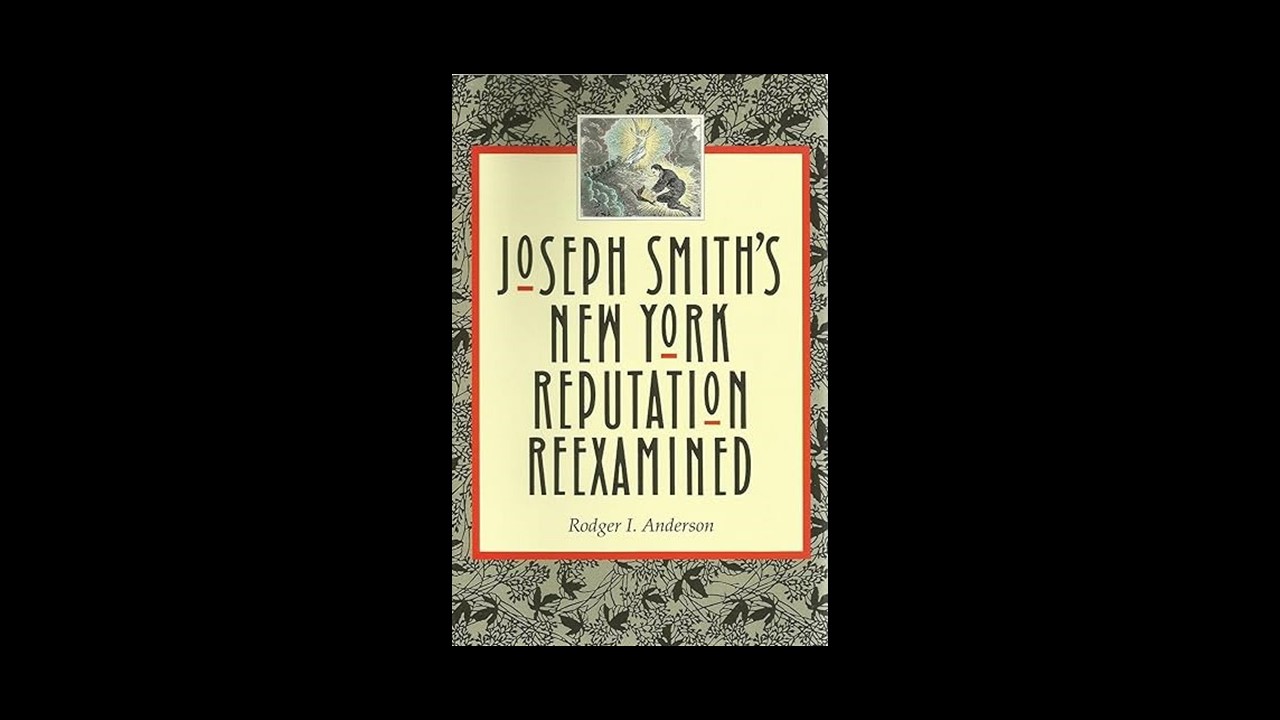
Roger Anderson’s book is a book-length rebuttal of Richard Anderson. So it goes back and forth.
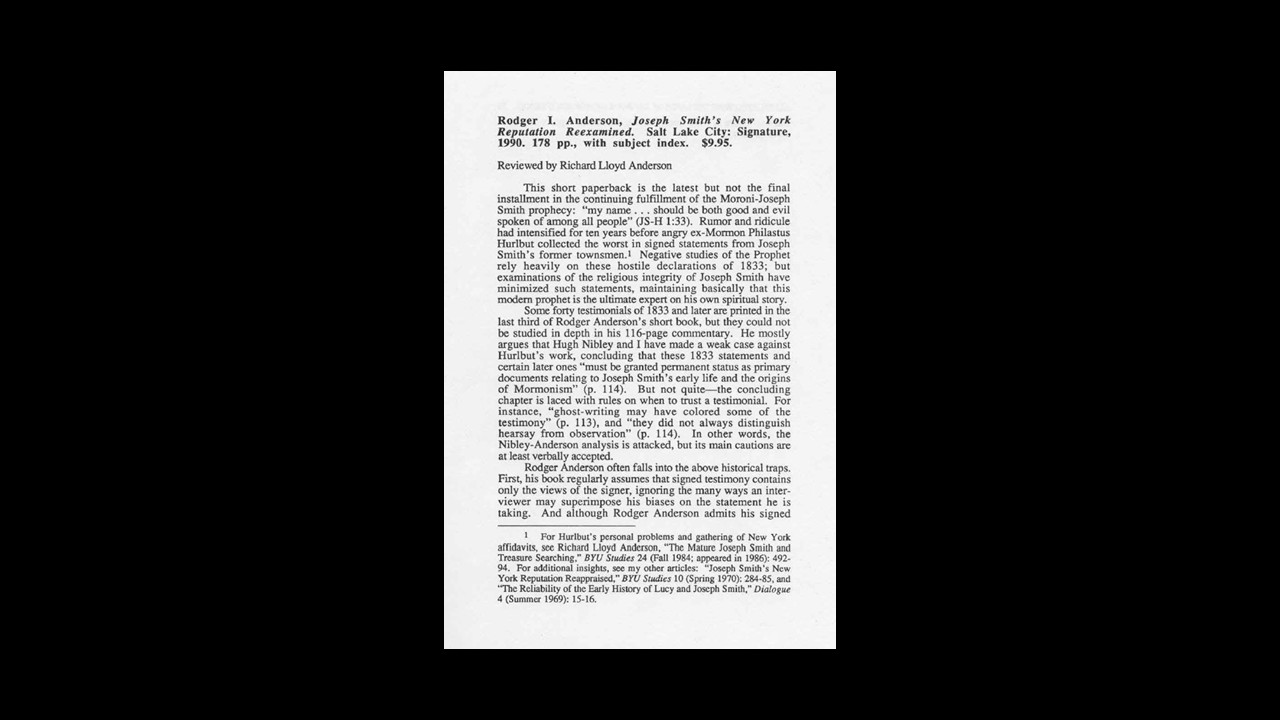
And then you get Richard Anderson’s response in the old FARMS Review, where he says, “Okay, maybe I kind of overdid it. I kind of overstated my case against Hurlbut, but we’ve still got major problems.” Which is absolutely true.
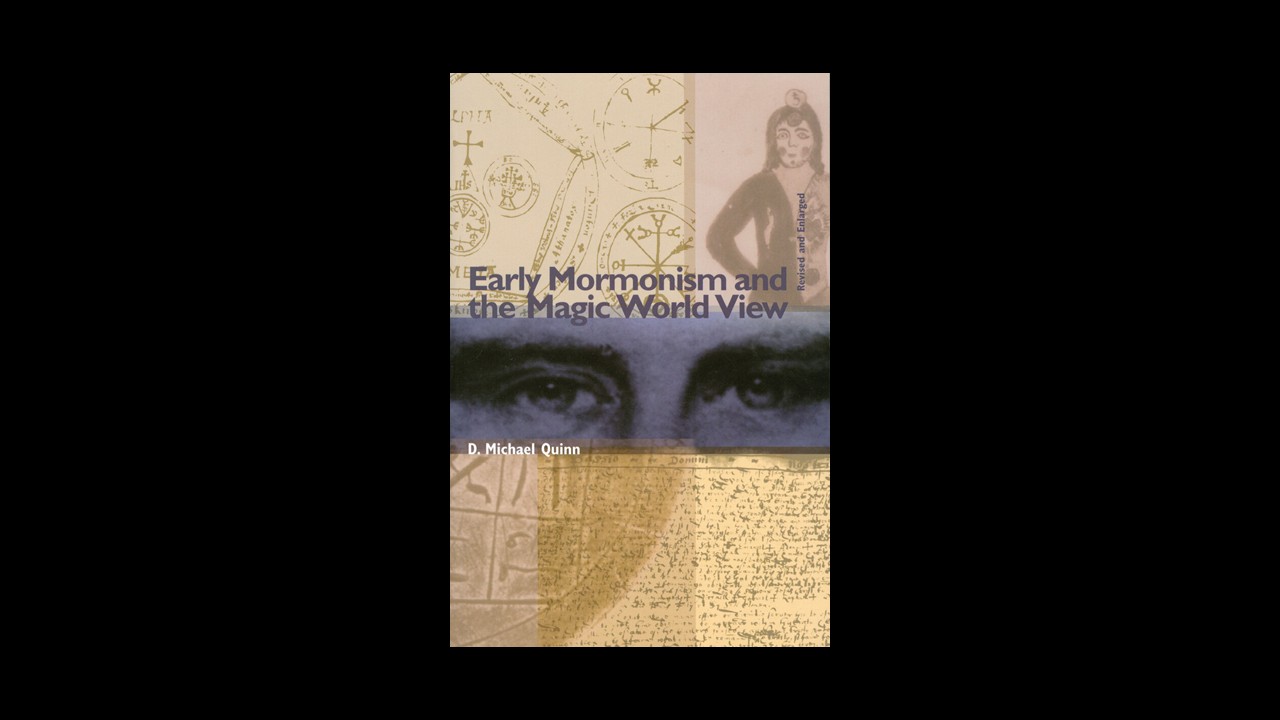
These are very widely used in Mike Quinn’s book Early Mormonism and the Magic World View.
You find them in Dan Vogel’s biography of Joseph Smith’s early years.
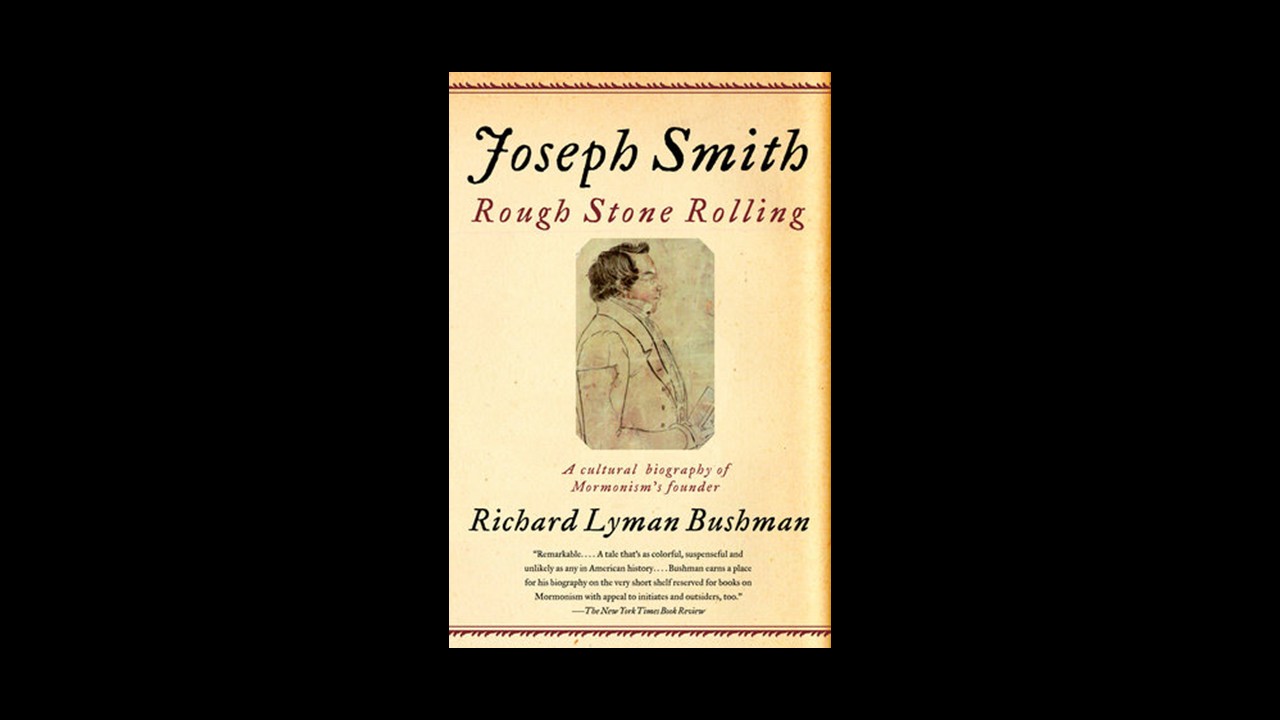
Richard Bushman wrestles with some of this material in Rough Stone Rolling.
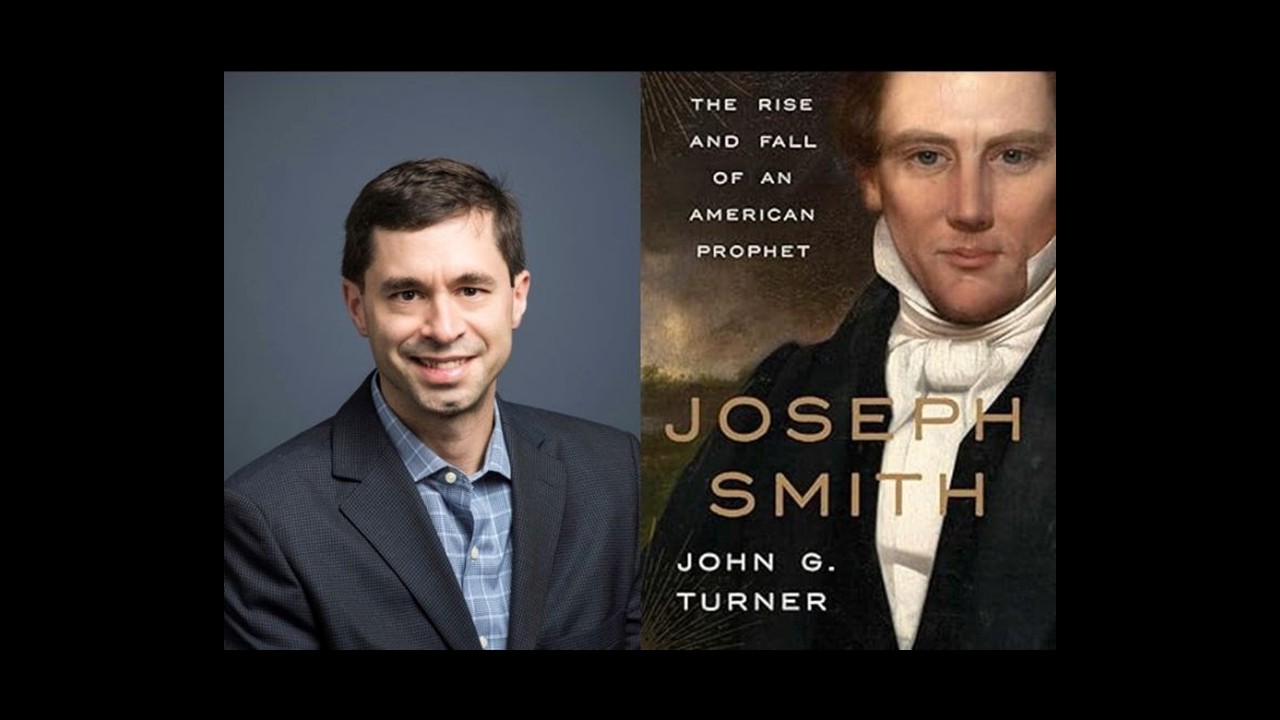
You find it in John Turner’s new biography of Joseph Smith.
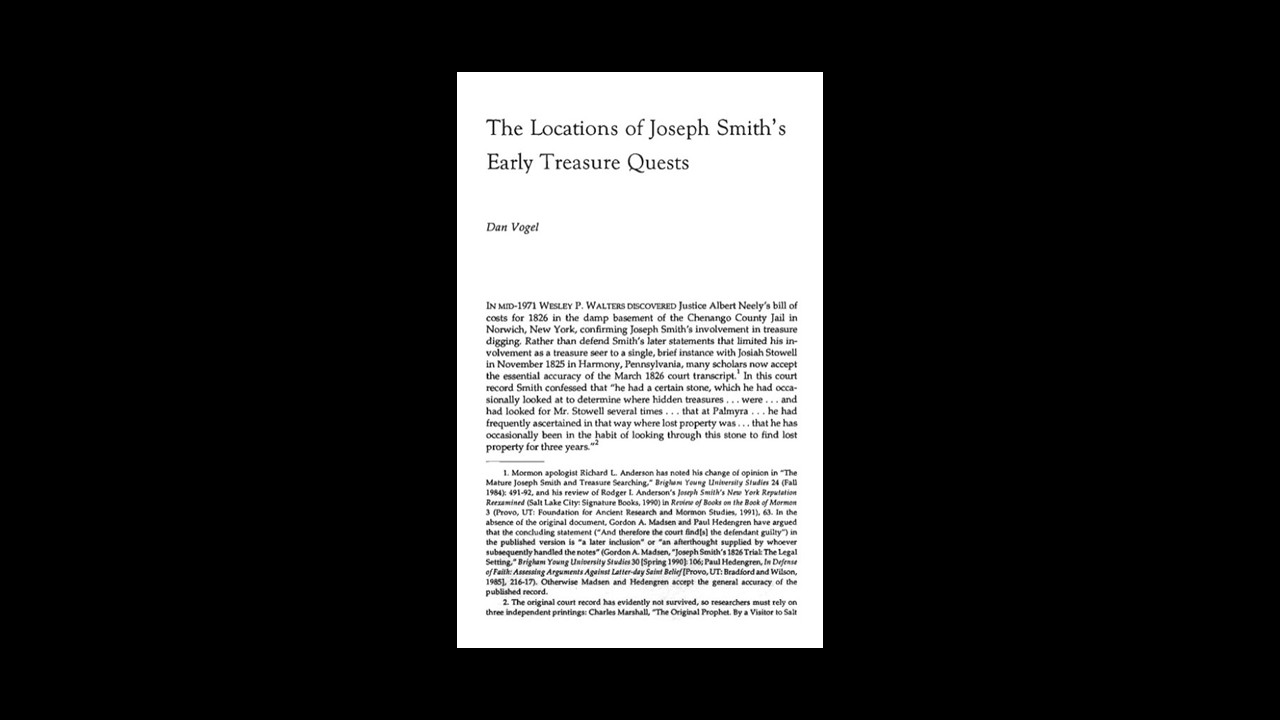
There’s an interesting article from 1994 by Dan Vogel on the locations of Joseph Smith’s early treasure quests. So he comes up with documentation for 18 different treasure digs.
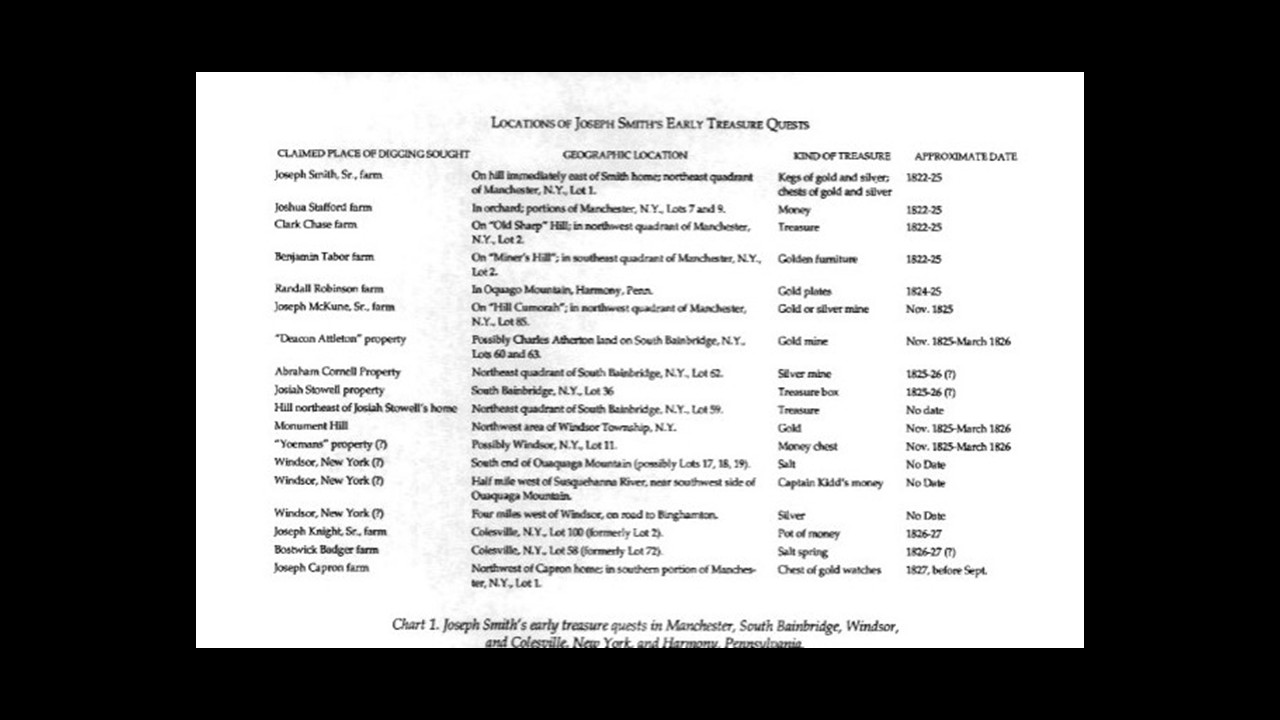
Now, he doesn’t evaluate the reliability of the documentation. Some of those digs probably never happened. And yet, you know, there are probably some digs that were never documented. So we really just don’t know.
I’d say maybe there were about a dozen or so digs, but that’s just a guess. We actually don’t know.
Treasure Hunting in Its Broader Historical Context
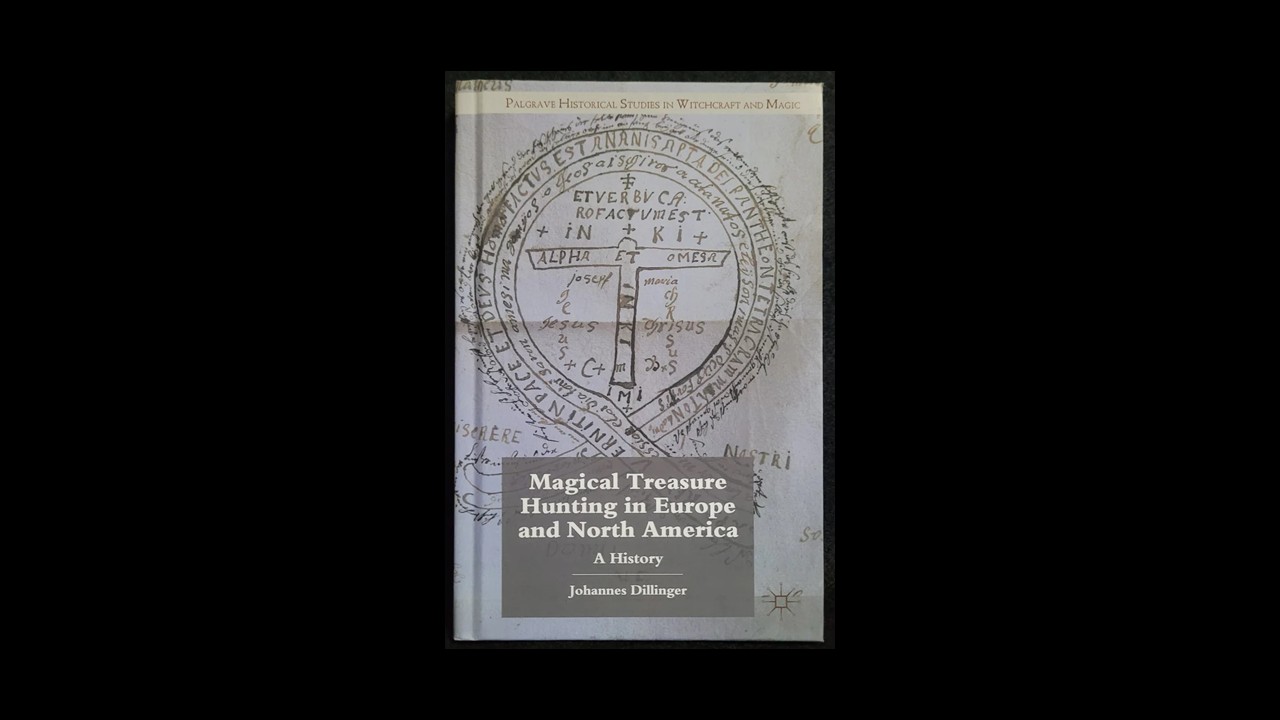
This is an important book. This really has nothing to do with Joseph Smith. This is just part of the wider literature on the treasure-hunting phenomenon in Europe and North America.
This guy covers half a millennium of history of treasure hunting in Europe and North America. That’s a great place to start if you want to study more, want to learn more about the historical context without all the polemics back and forth in terms of Joseph Smith.

So let’s just talk a little bit about treasure hunting. The phenomenon—how does this work?
You kind of start with origin stories. Where does this idea come from? And I’m just going to zip through this.
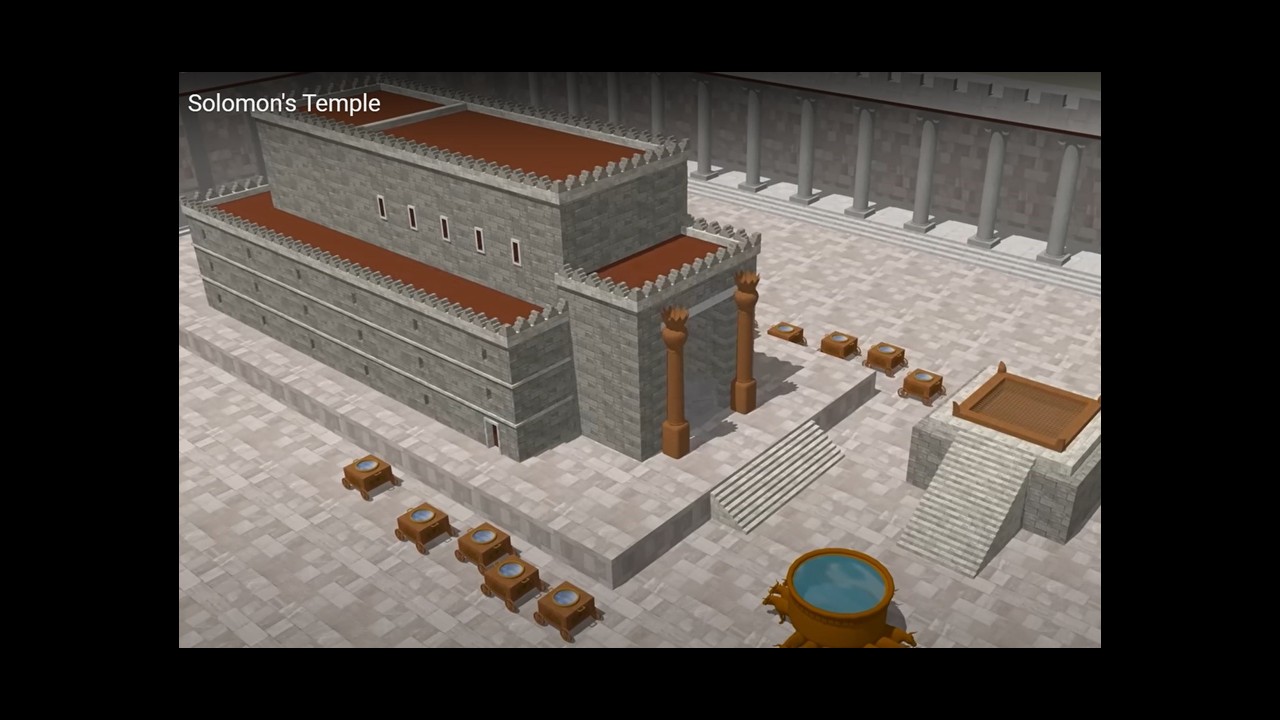
Ancient kings kept treasure in their palaces. Treasure was kept in temples. We know there was a treasury in Solomon’s temple.
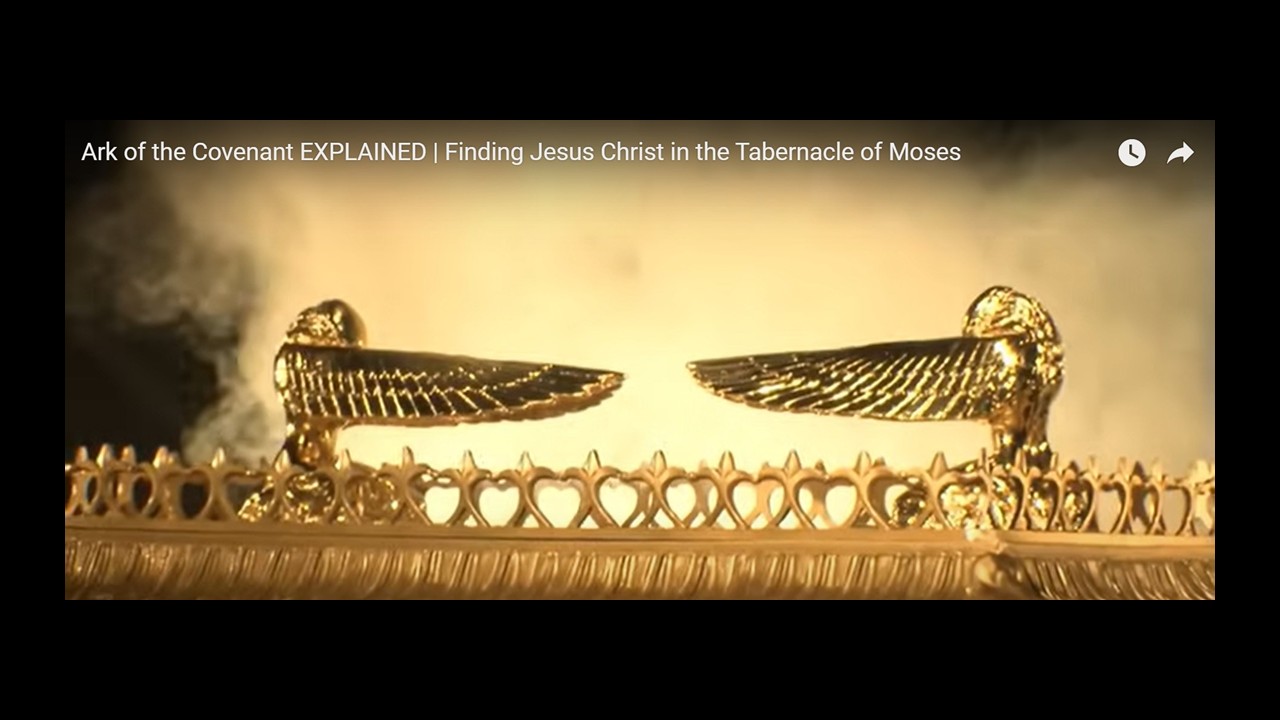
We know the greatest treasures of all are kept in the greatest treasure box of all, the Ark of the Covenant.
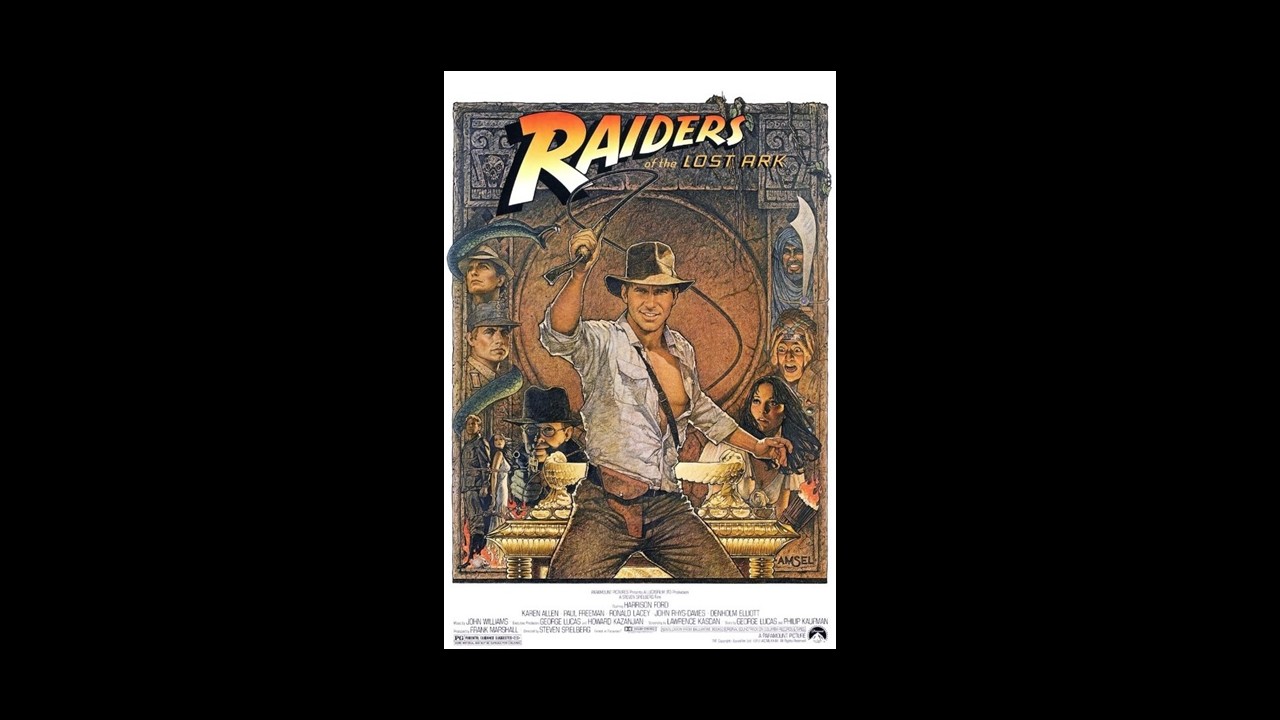
There is lots of popular media about these kinds of things.
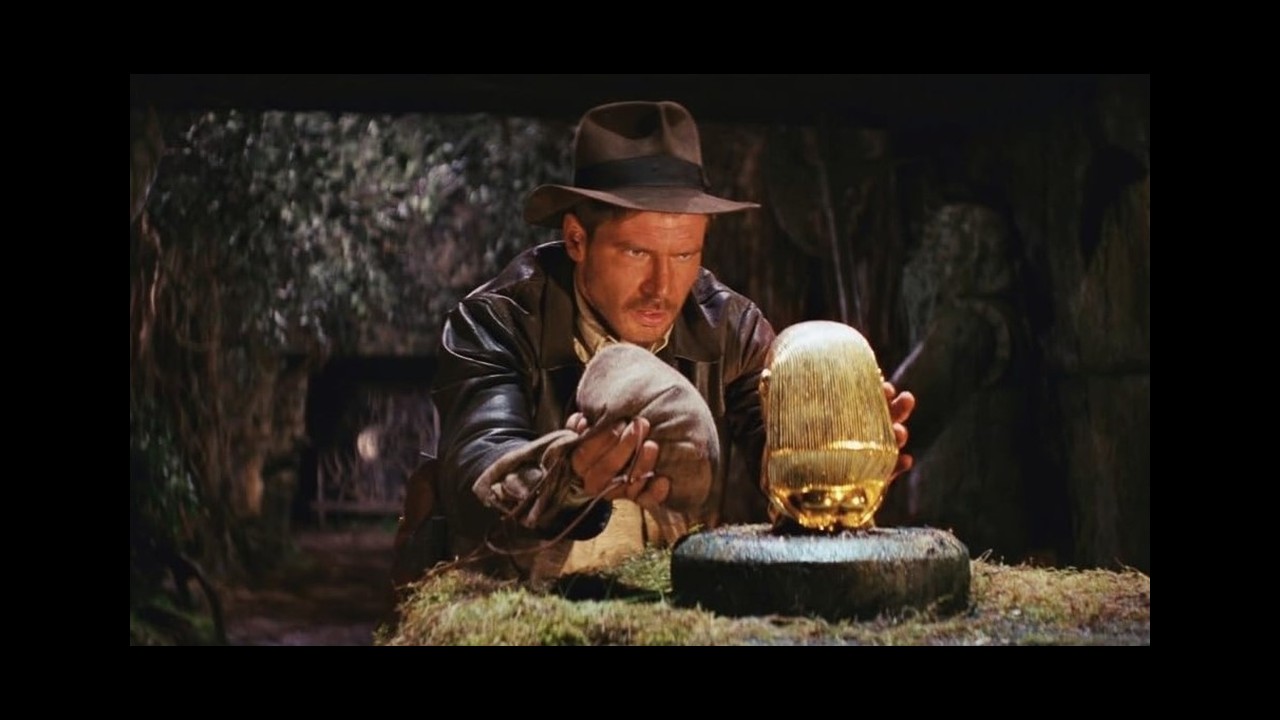


In The Temple of Doom, the treasures are these shining stones.
The Indiana Jones movies are great for this, right?
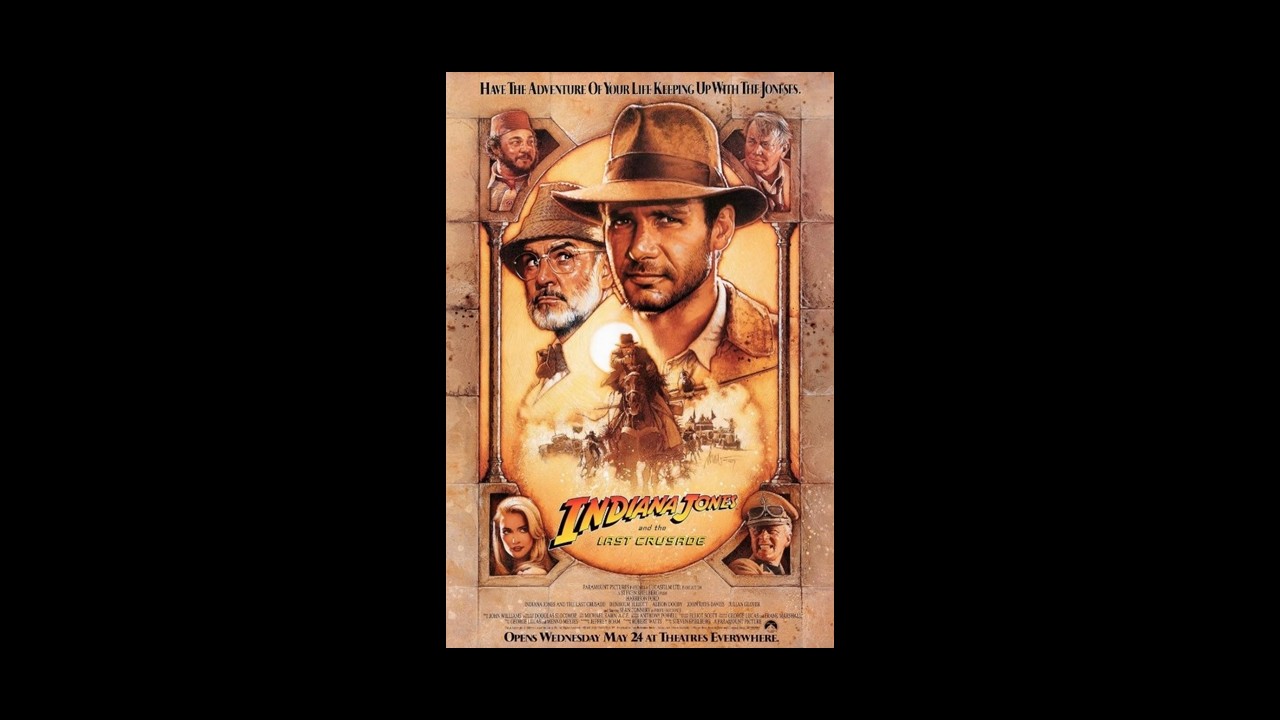
In the third movie, the treasure is the Knights Templar treasure.
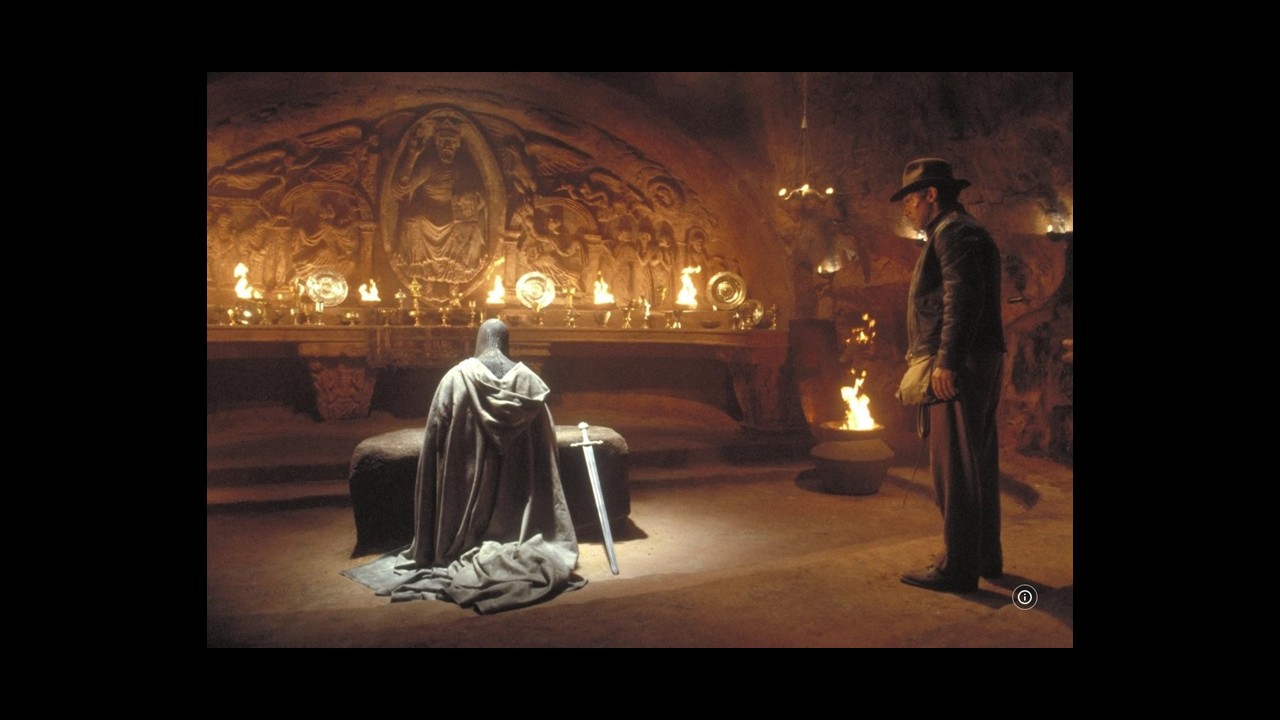
Treasure digging goes back for centuries, and we actually don’t even know how far back it goes.
Documentation of Treasure Digging Through the Law
But one of the places you can document it best of all is in the law, because when someone finds a treasure, now all of a sudden you’ve got interested parties. This can eventually lead to a legal dispute. And then, of course, you’ve got a third party that comes in at that point, which is the state, and they usually want their cut of the treasure.
So you have laws on the books from different countries and different times going all the way back to third-century Rome.
The Parable of the Treasure in the Field
That’s taking you almost all the way back to the days of Jesus of Nazareth, and it’s going to help us make a little bit more sense out of His parable of the treasure in the field.
This is Rembrandt’s painting of the parable of the treasure in the field.
This idea of people burying treasures because ordinary people didn’t have any access to banks of any kind. So where do you keep your valuables?
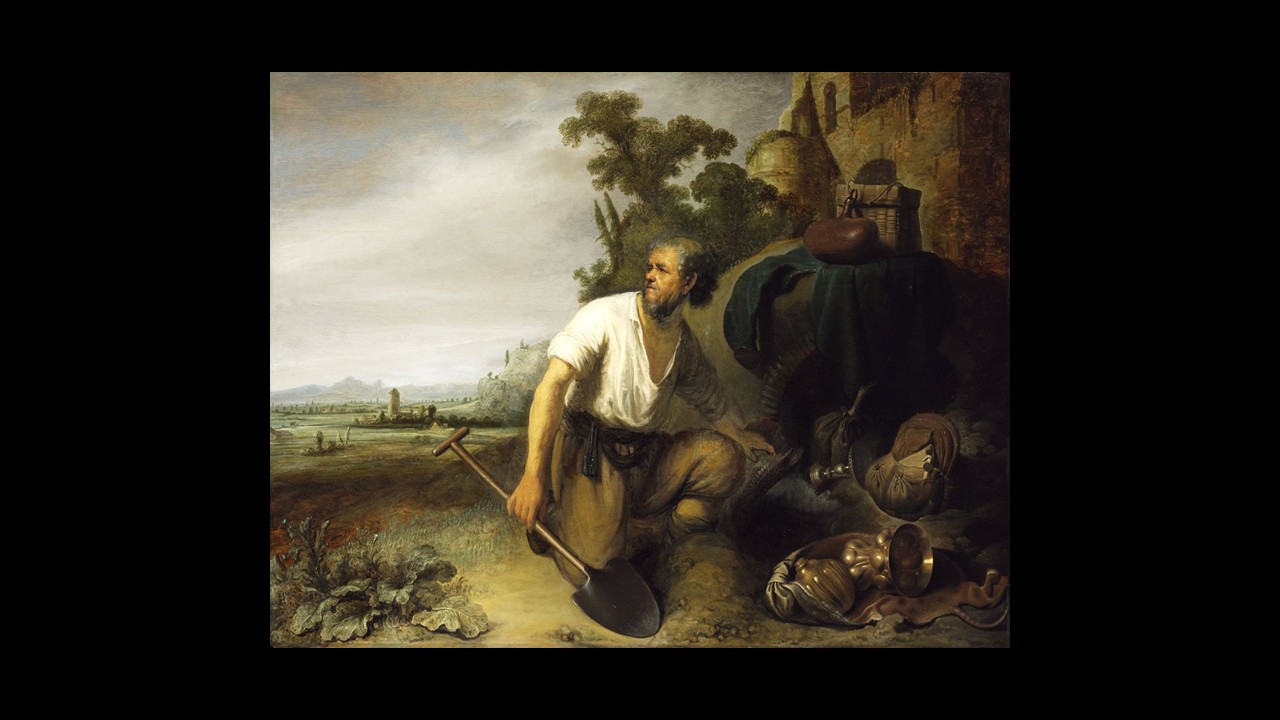
This is a common enough theme that you could use it for a parable, even though it’s really strange to us today. But we live in a strange time. We don’t even use money anymore, right? It’s all just kind of bits in the cloud now.
But you find this in Beowulf.
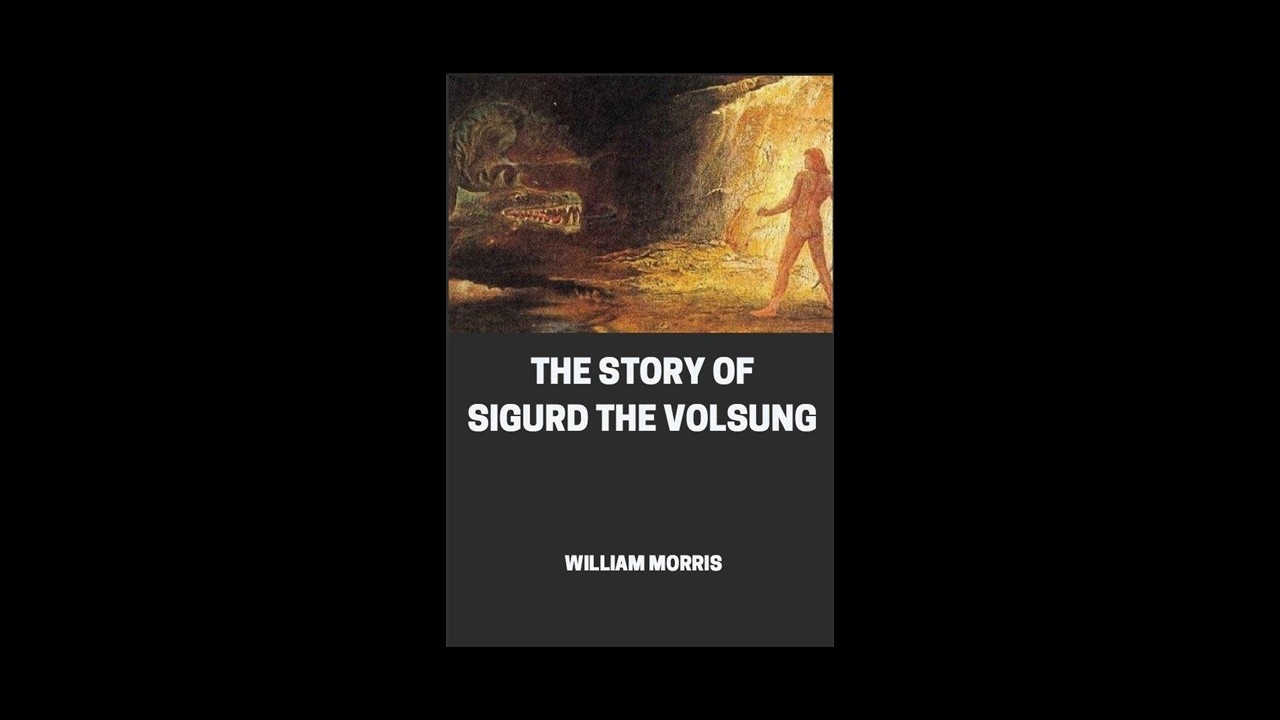
You find it in Sigurd the Volsung.
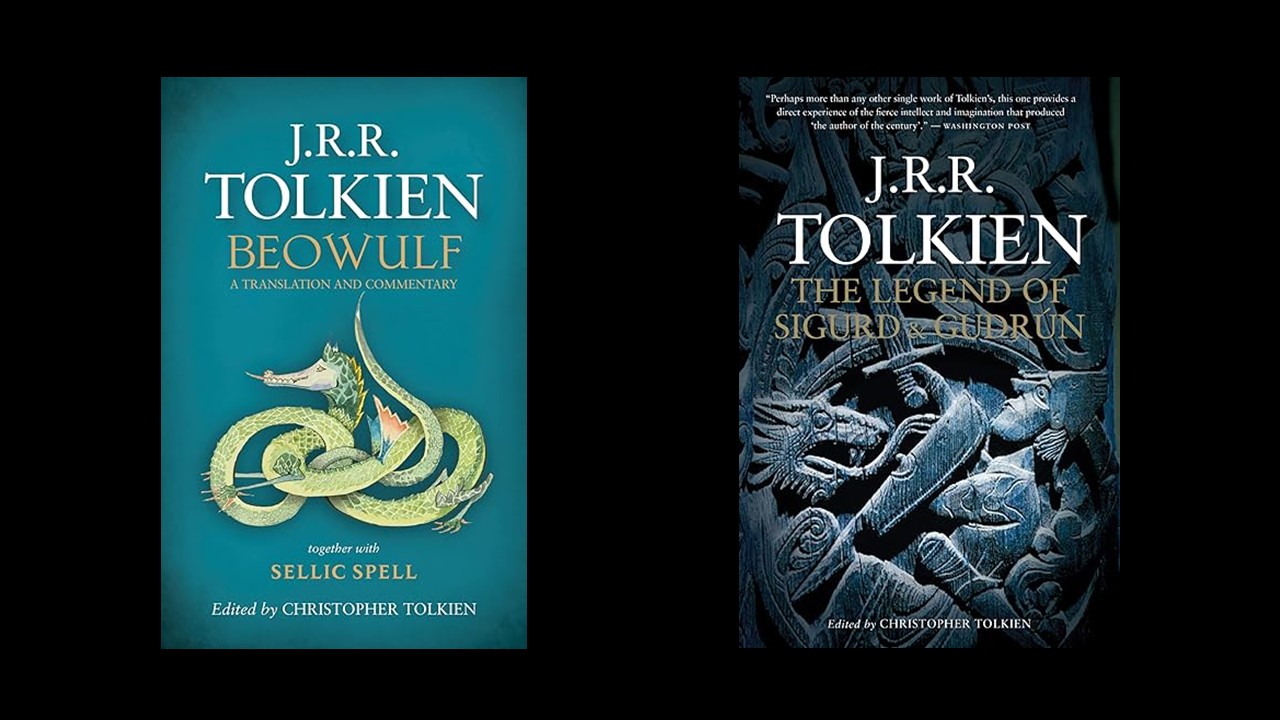
Tolkien actually did critical editions of both of those works,

and that’s why you see so much of that showing up in his work.
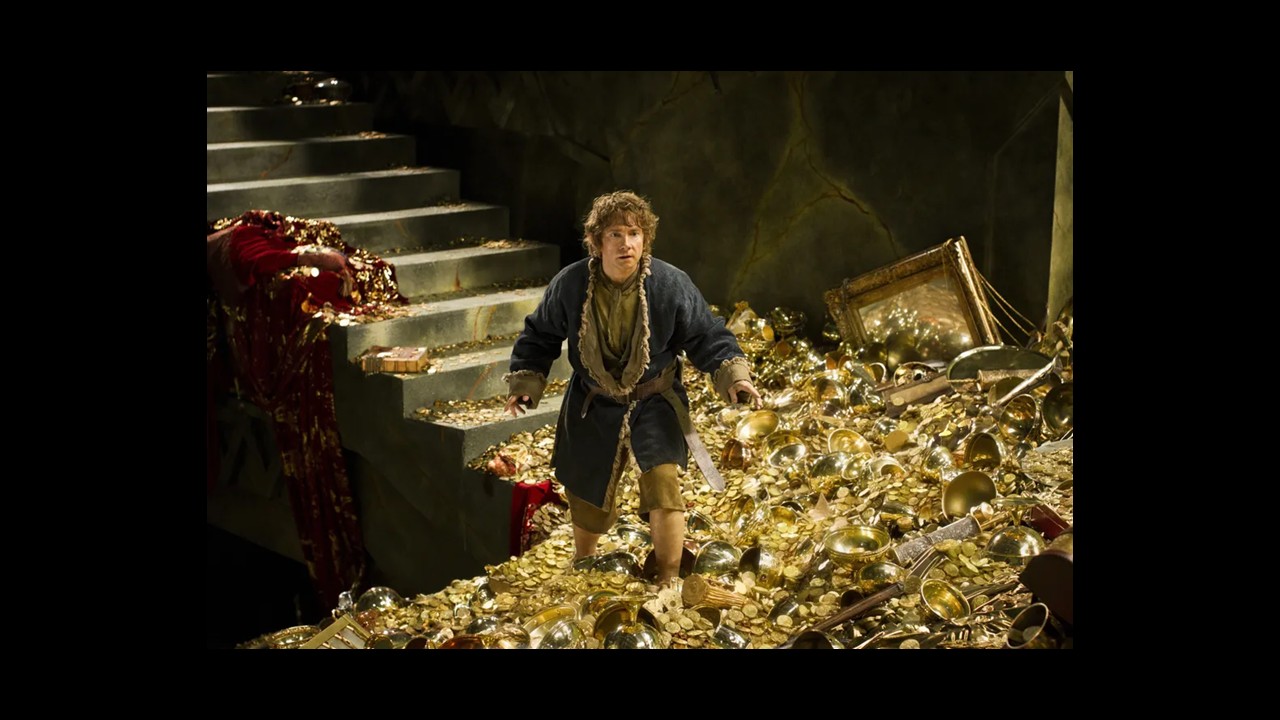
And then the New World really changes things because the Spaniards who plunder the Aztecs and the Incas just bring back these hordes of gold and silver treasure.
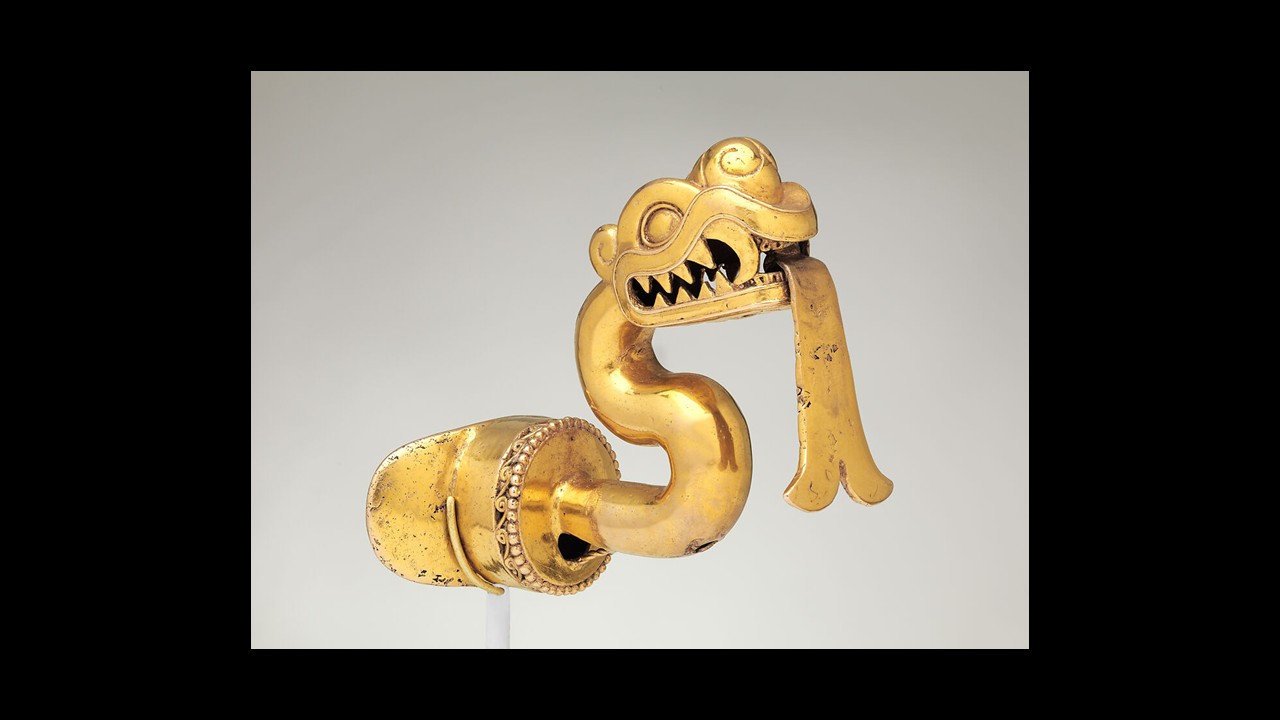
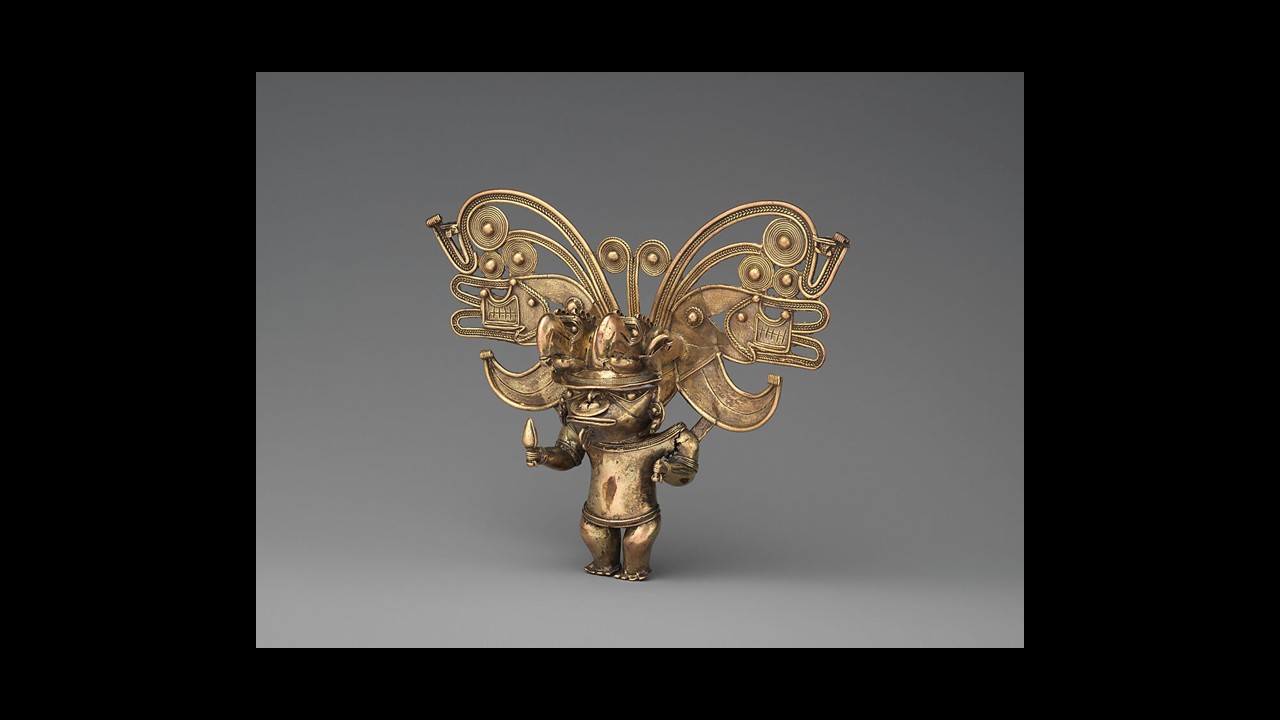
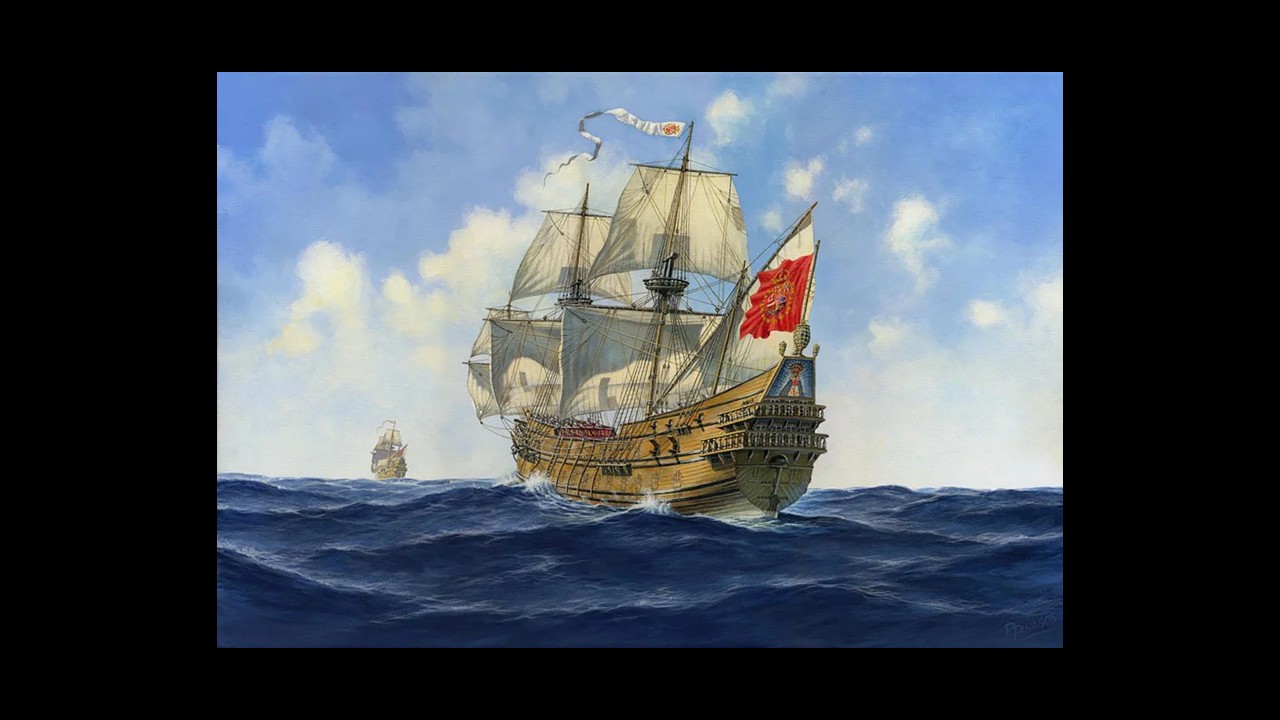
Now you’re carrying these back in your Spanish galleons, bringing them back home to the mother country,

And that’s where the pirates come in.
People have had all kinds of fun with that.

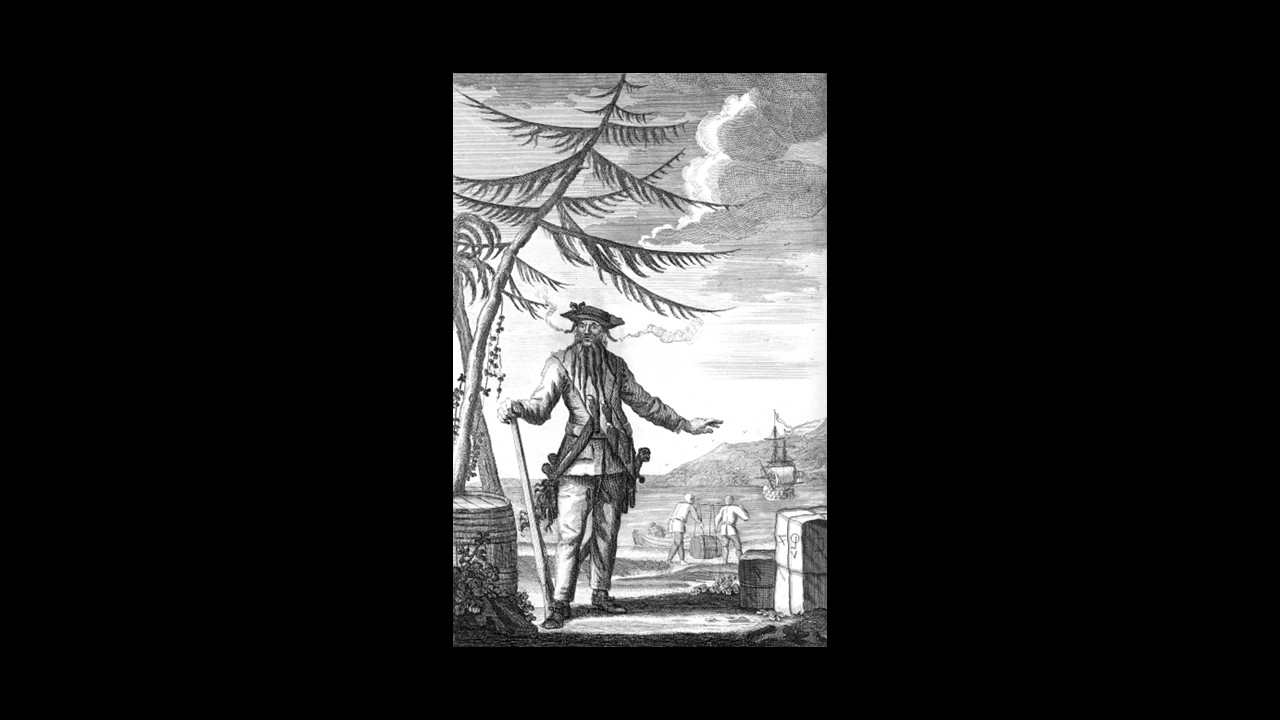
There is Blackbeard.
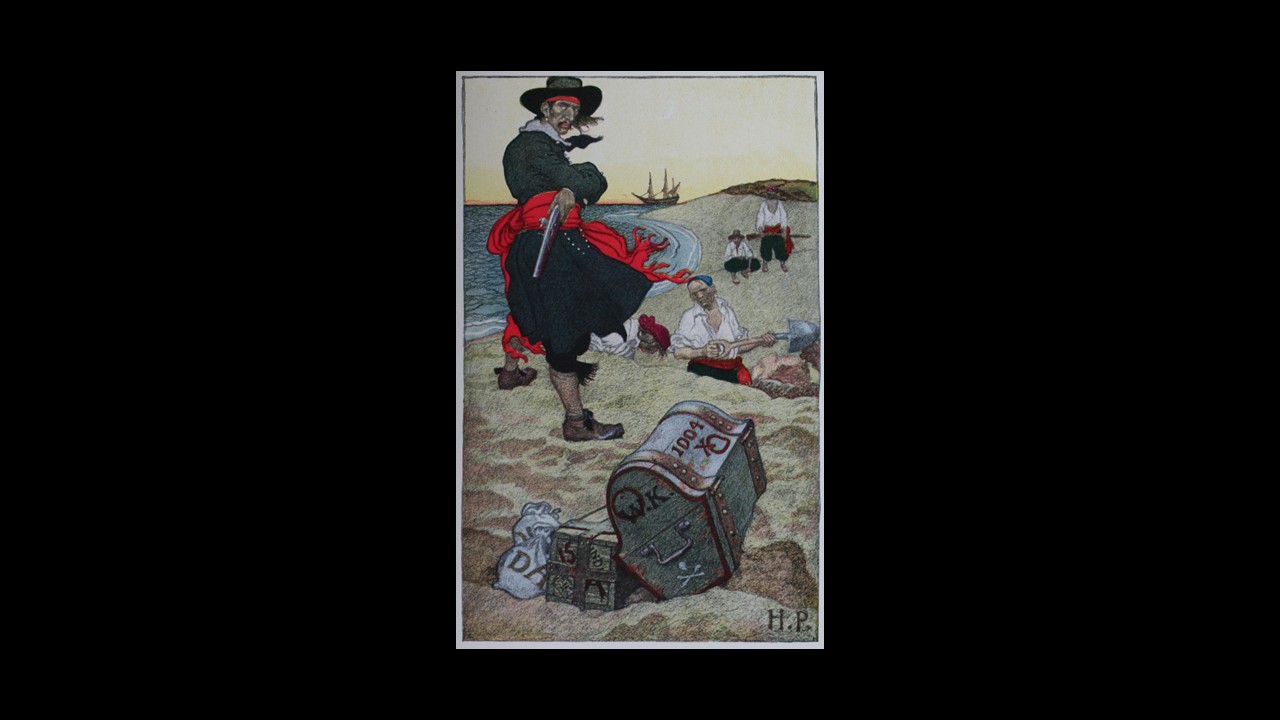
And there’s Captain Kidd.
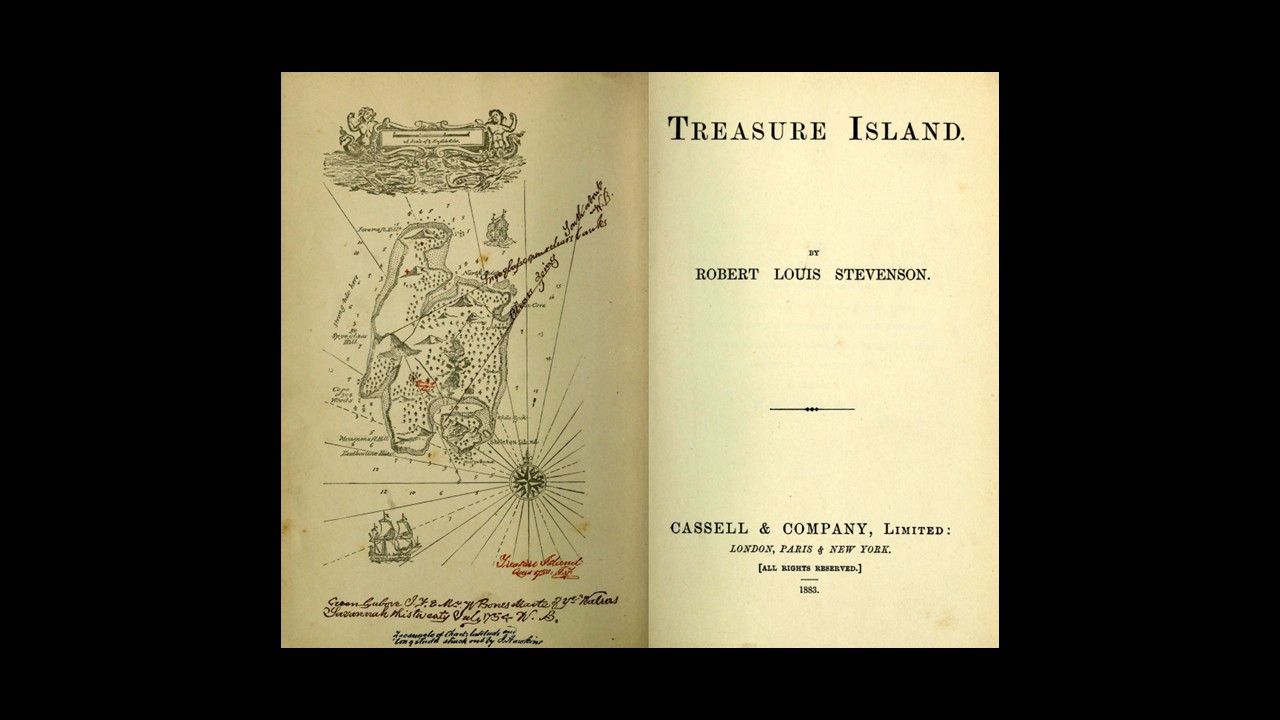
For example, there’s Treasure Island.
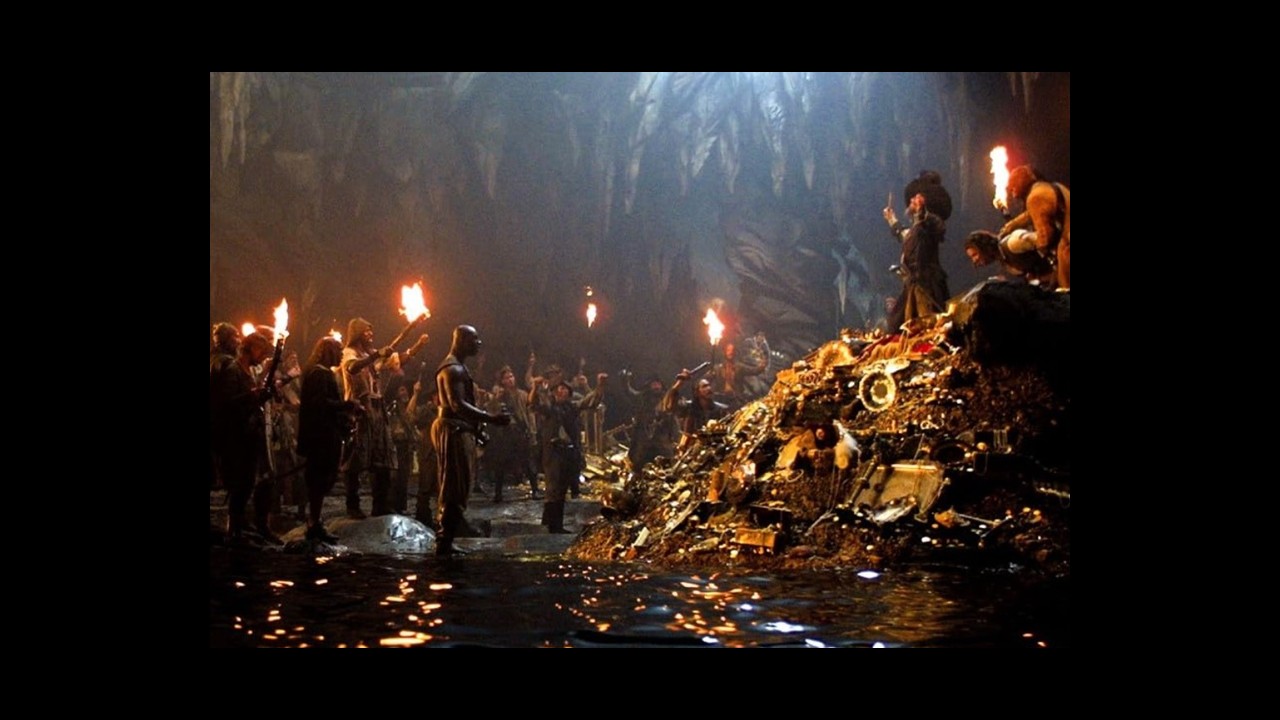
And Pirates of the Caribbean.

Seer Stones, Treasure Guardians, and Folk Practices
So there are different ways of finding treasure.
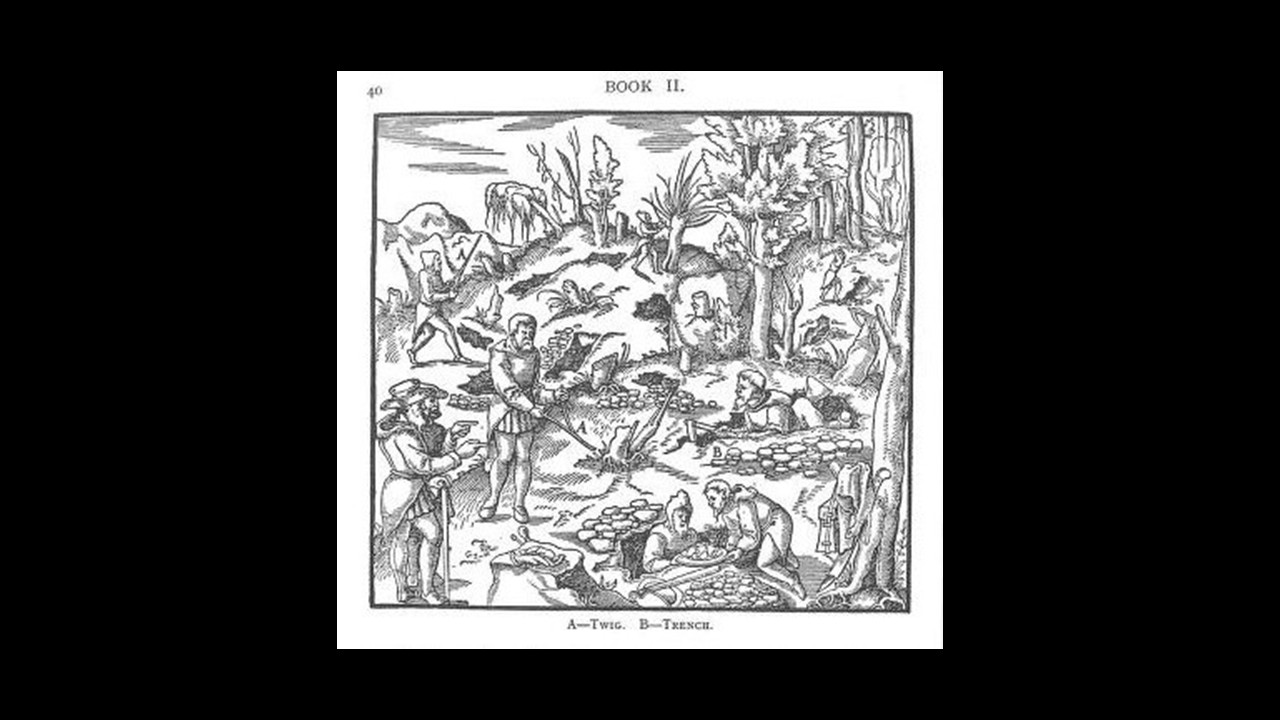
This is an illustration of dowsers from the Harz Mountains in Germany.
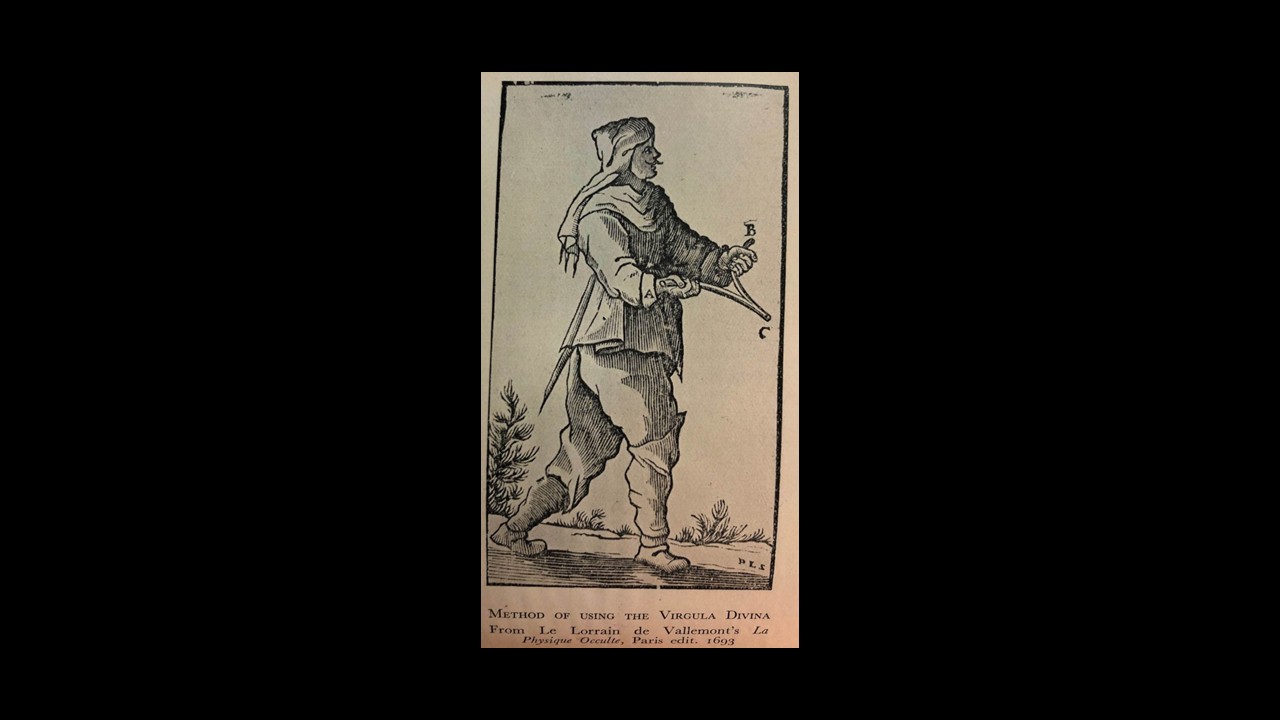
17th-century French.
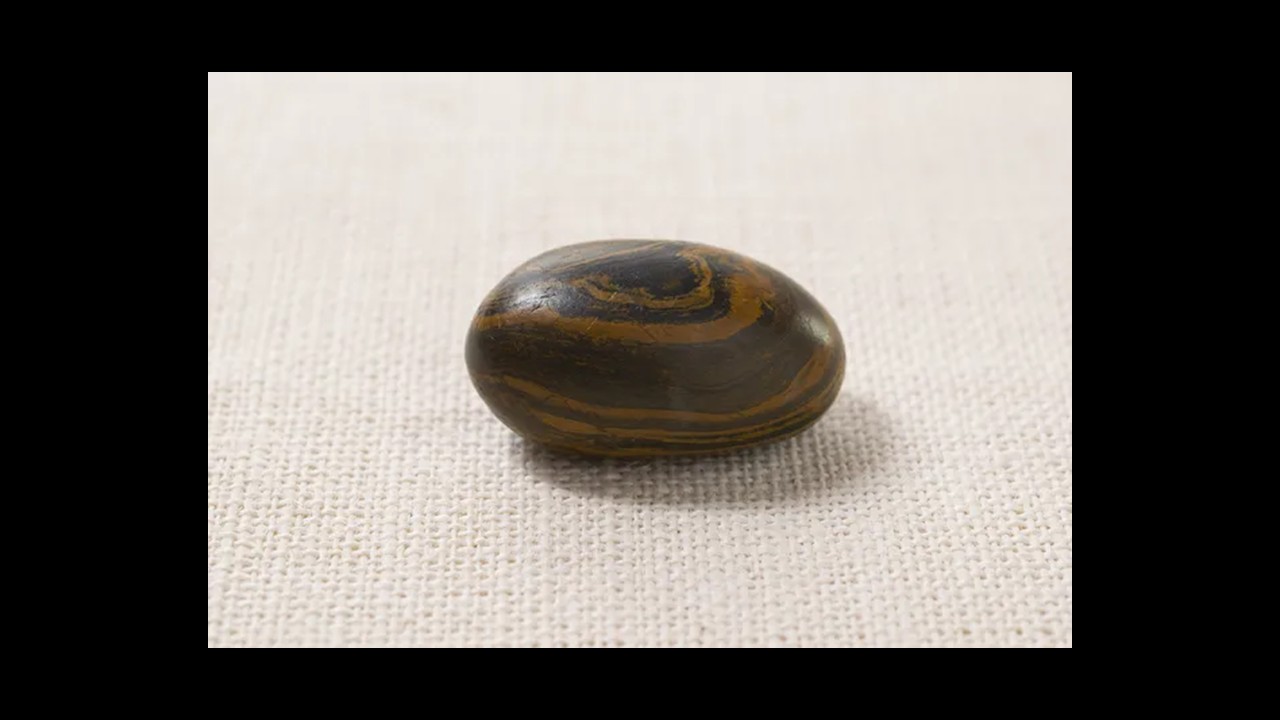
Seer stones.

Treasure Guardians
Let’s talk about treasure guardians real quick.

There are all these ideas about dragons guarding treasure,

going all the way back to Beowulf and

Sigurd Volsung.


Snakes are like super-dragons.

You’ve got gnomes, which become the seven dwarfs in Grimm’s fairy tales.

Disney has fun with that.
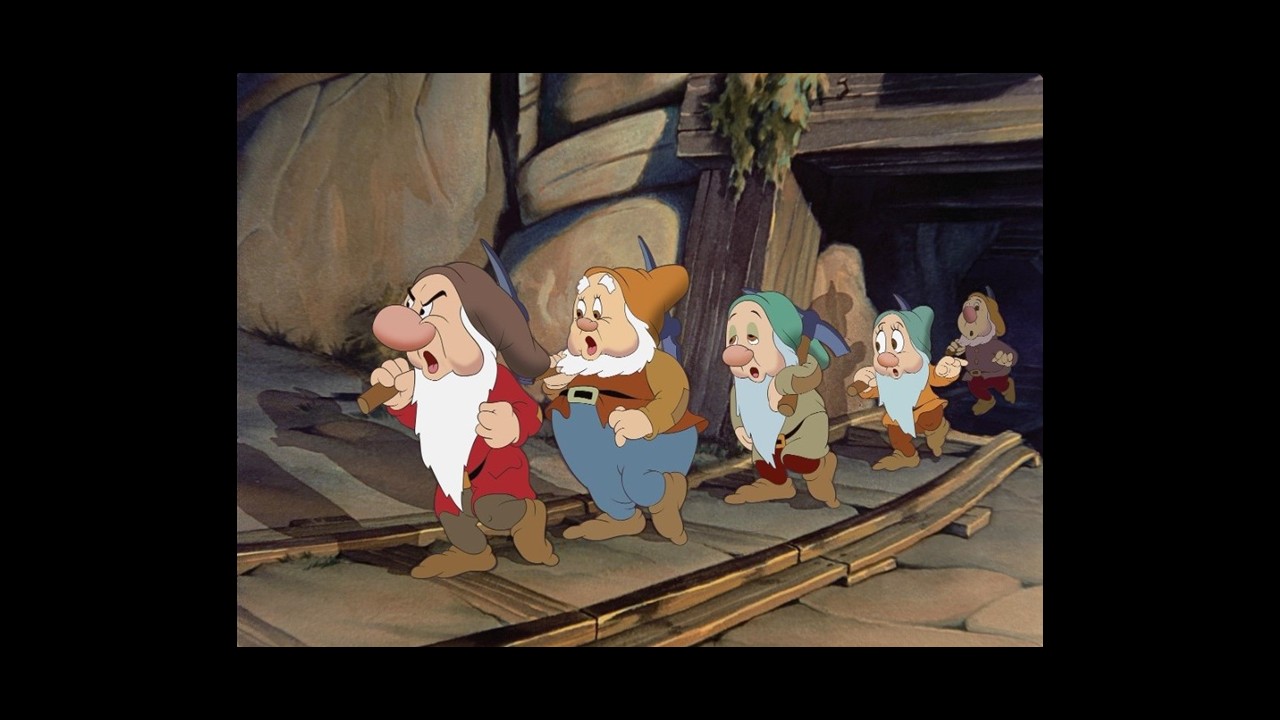

Here we have our little dwarfs, our little gnomes, getting their treasure.
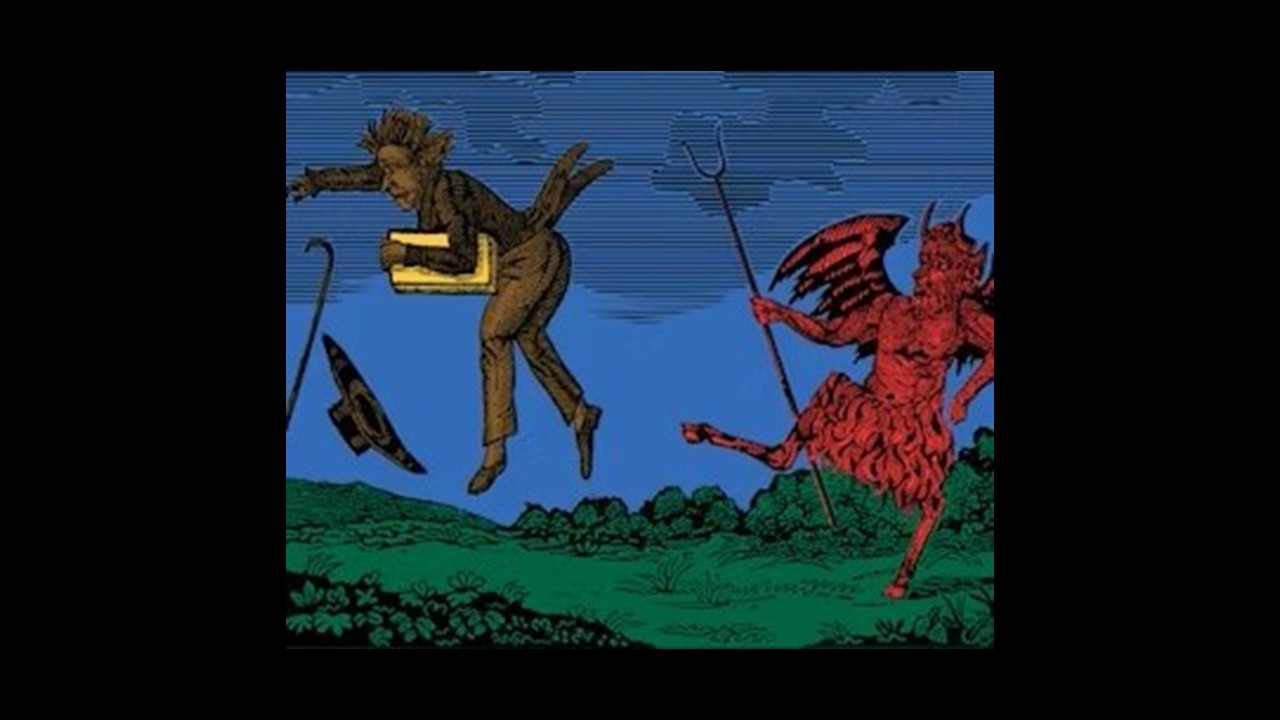
The devil is a famous treasure guardian in all these stories,
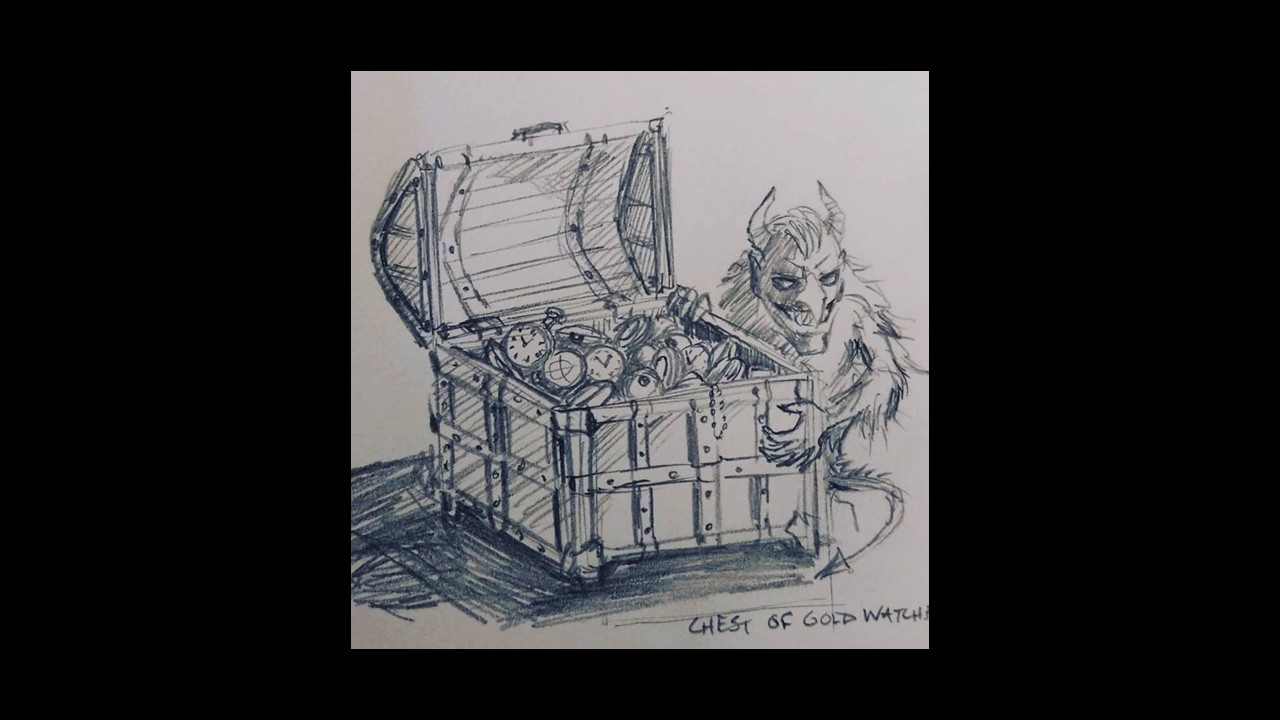
and his minions.

Ghosts or spirits of the person who had buried a treasure.
There are all these different kinds of treasure guardians.
Moroni as a Treasure Guardian
Every single one of them is pasted onto the Joseph Smith story.
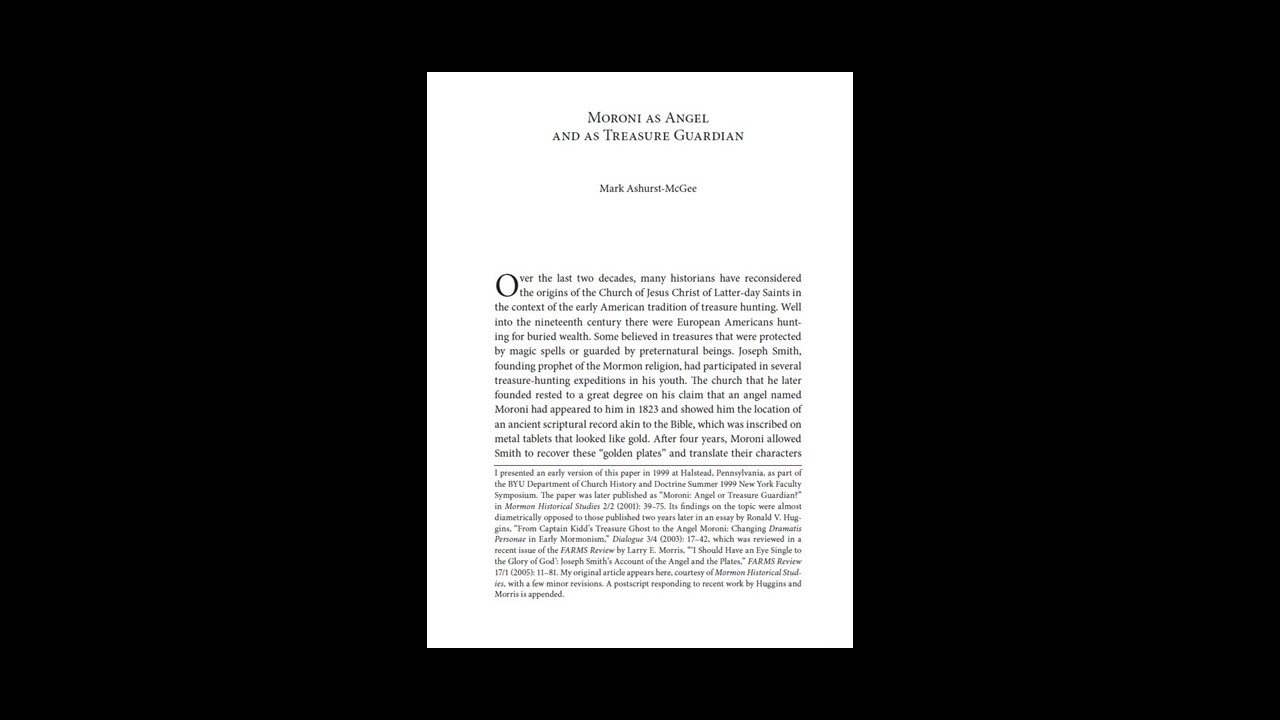
I tried to address this in an article, “Moroni as Angel and as Treasure Guardian.” I’m just going to call this part of my show notes if you want to read more about that.


Traditional Ways to Find Treasure
There are all kinds of things people do to try to get treasure. They use magic circles or spells or, you know, there are all different kinds of things people try to do.
Now, these are not standard. There is not a standard practice and ritual that everybody’s doing. And a lot of critics will try to say, “This is how people look for treasure, so this is what Joseph Smith did.”
That’s not the case.
The practice of looking for treasure is very fluid. There are all different kinds of ways of doing it, and not everyone is using any kind of magic.
What the Evidence Actually Establishes Regarding Joseph Smith
What do we actually need to deal with or face up to in terms of Joseph Smith’s practice?
There are people saying all kinds of things that the Smiths are doing.
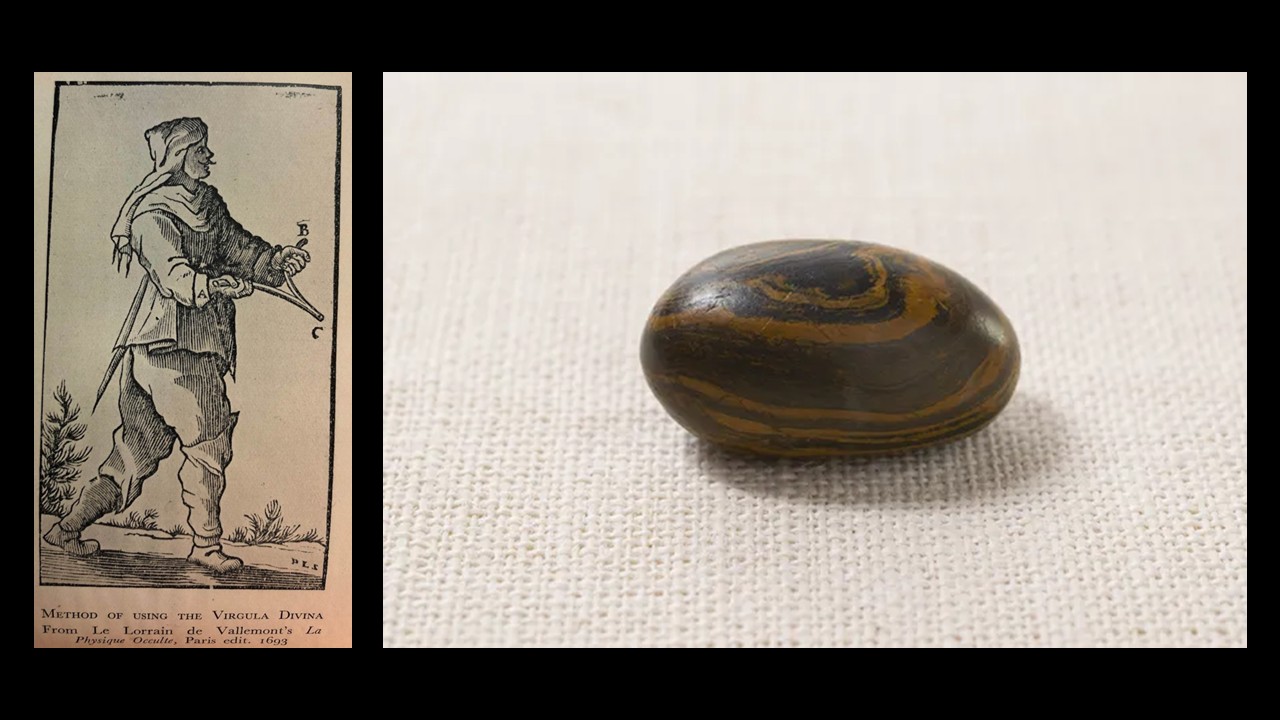
In terms of what’s really reliable that needs to be dealt with, basically his use of divining rods and seer stones to try to find treasure. And that’s really all that we know for sure.
So if you’re reading something that’s talking about the Smiths making a magic circle and cutting the throat of a sheep or whatever, if the author is not talking about that tentatively, then you know you’re not reading careful history.
Treasure Seeking and the Coming Forth of the Plates
Now this becomes part of the context for the coming forth of the gold plates.
This is from Joseph Smith’s 1832 history. He says in here he didn’t get the plates in 1823 because he sought the plates to obtain riches.
Joseph Smith writes that in 1832.
Now we’re getting towards the end, and I want to make a point here. Now we’re looking at what Oliver Cowdery wrote about this, and we’ll skip to the key quotation here.
When Joseph Smith couldn’t get the plates in 1823, this is what Cowdery said:
“He had heard of the power of enchantment, and a thousand like stories, which held the hidden treasures of the earth, and supposed that physical exertion and personal strength was only necessary to enable him to yet obtain the object of his wish.”
So he tries again, but he can’t get them.
This part about “he had heard of the power of enchantment, and a thousand like stories”—that’s all the treasure lore around treasure hunting.
So when Moroni says, “Hey, go get the gold plates,” and he tries to get them and he can’t, and he’s like, “Why can’t I get these?” Well, to try to understand what’s going on, he’s drawing on his culture, which is all this lore around treasure hunting.
From Treasure Lore to the Restoration
Here’s the point.
In 1832, when Joseph Smith is looking back on this, and in 1834, when Oliver Cowdery is looking back on this, they invoke this treasure lore, and that Joseph Smith was trying to understand what’s going on in terms of his culture, which included that treasure lore.
At the same time, from that distance they’re able to see, “Okay, that’s one of the ways in which he’s trying to understand what’s going on, but that’s actually not what’s going on—or it’s only a very small part of what’s going on.”
What’s really going on is the Restoration of the gospel.
In fact, moreover, Cowdery is saying, okay, you know, we can look back on this and say, “Why was he looking at it this way?”
And yet:
“While young, untraditionated and untaught in the systems of the world, he was in a situation to be led into the great work of God, and be qualified to perform it in due time.”
So, in other words, Smith and Cowdery at this time looking back—they’re saying, “Okay, he was young, he was foolish, but he wasn’t trained in classical creedal Christianity.”
His treasure-seeking environment is actually probably better to help him have the Restoration than having been trained in the Yale Divinity School.
I think that’s kind of the big picture, and I thank you for your time.