The Historical Jonah
John Gee | October 2025 FAIR Virtual Conference
The following transcript is from John Gee’s presentation at the October 2025 FAIR Virtual Conference. The transcript has been checked against the author’s original manuscript for the accuracy of historical names, dates, and specialized terminology while preserving the wording of the oral presentation.
The Historical Context of Jonah
Thank you for joining this virtual conference. I’m very grateful to the technical people who have made this possible, and I’m grateful to you for watching.
The main point of the book of Jonah is that Jonah preached to Nineveh and “they turned from their evil way.” Under these circumstances, Jonah has to be viewed as one of the most, if not the most, spectacular success stories of the Old Testament. If this is not the principal way that most people view Jonah, it might be because of how Jesus cited Jonah:
For as Jonah was three days and three nights in the whale’s belly, so shall the Son of Man be three days and three nights in the heart of the earth. The men of Nineveh shall rise in judgment with this generation and shall condemn it, because they repented at the preaching of Jonah. And behold, a greater than Jonah is here.
The focus in modern times has generally been on the fish in Hebrew, or whale in Greek, swallowing Jonah. Both ancient Judah and ancient Israel were landlocked countries, and it is not clear that they would have made a distinction between a fish and a whale.
Was Jonah a Historical Prophet?
Jonah was a northern Israelite prophet who lived in the time of Jeroboam II. If Jonah was historical, then “Jonah was the earliest, in point of time, of all the prophets whose labors and predictions have been recorded in separate books.”
“Since the first appearance of the story of Jonah, its truth has been called into question.” The book of Jonah has been called “a fable, legend, and fictional tale.” Others think of Jonah as a parable against the United States of America or against “the modern church” which “is in retreat.”
For most authors, the default assumption is that Jonah is ancient fiction. Most authors place it in the Hellenistic period. Unfortunately, the situation is more complicated than that. And we will argue here that a decent case can be made for Jonah being historical.
Assyria in the Time of Jonah
The book of Kings assigns Jonah to the reign of Jeroboam II:
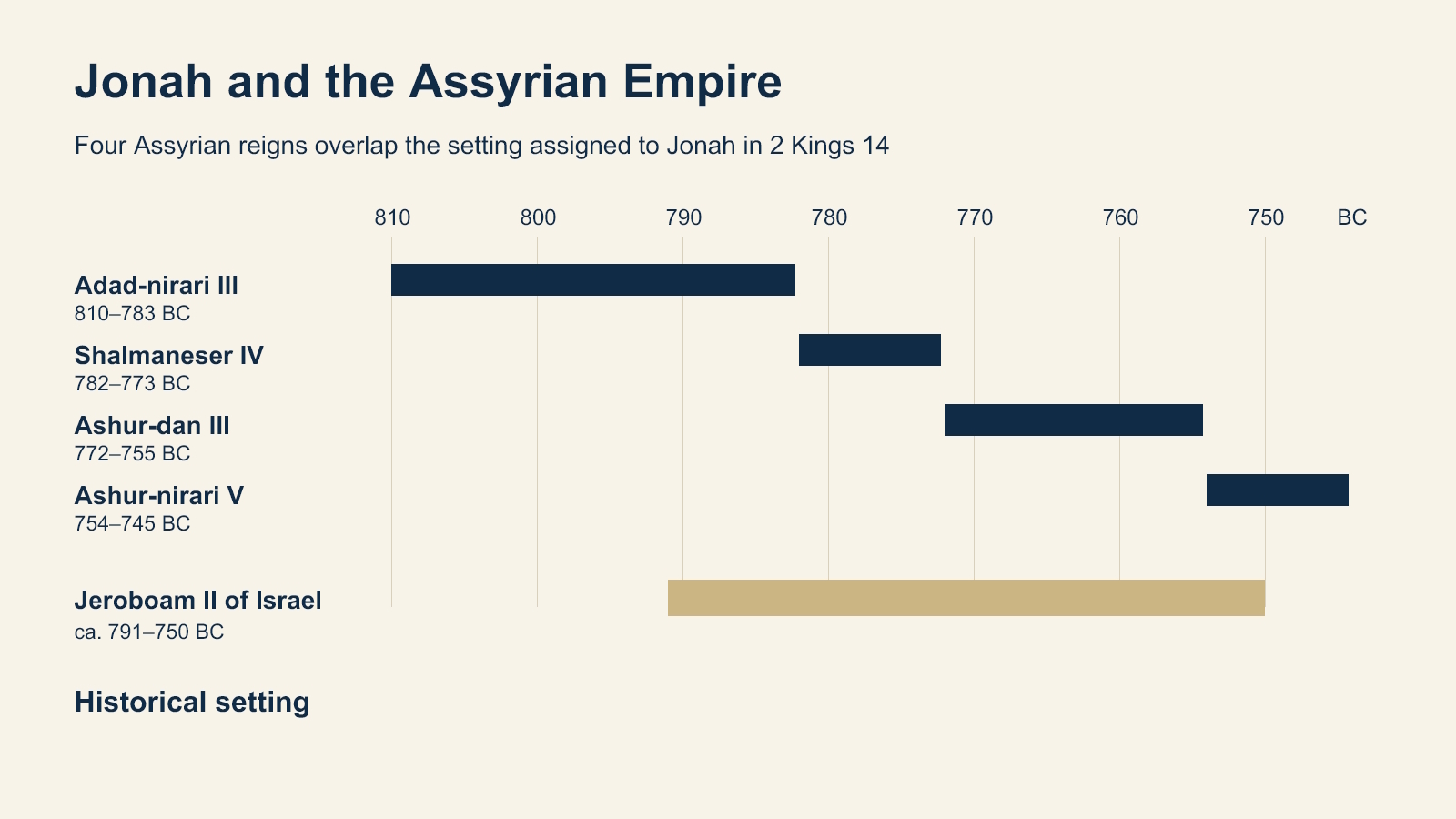
Jeroboam, son of Joash, reigned in Samaria forty-one years, and he did evil in the sight of Jehovah. He did not turn away from the sins of Jeroboam, son of Nebat, which he sinned with Israel. He restored the borders of Israel from the entrance to Hamath to the sea of the plain, according to the word of the Lord God of Israel which he spake by the hand of Jonah, the son of Amittai, the prophet from Gath-Hepher.
Four Assyrian kings’ reigns overlap with the long reign of Jeroboam II: Adad-nirari III, Shalmaneser IV, Assur-dan III, and Assur-narari V.
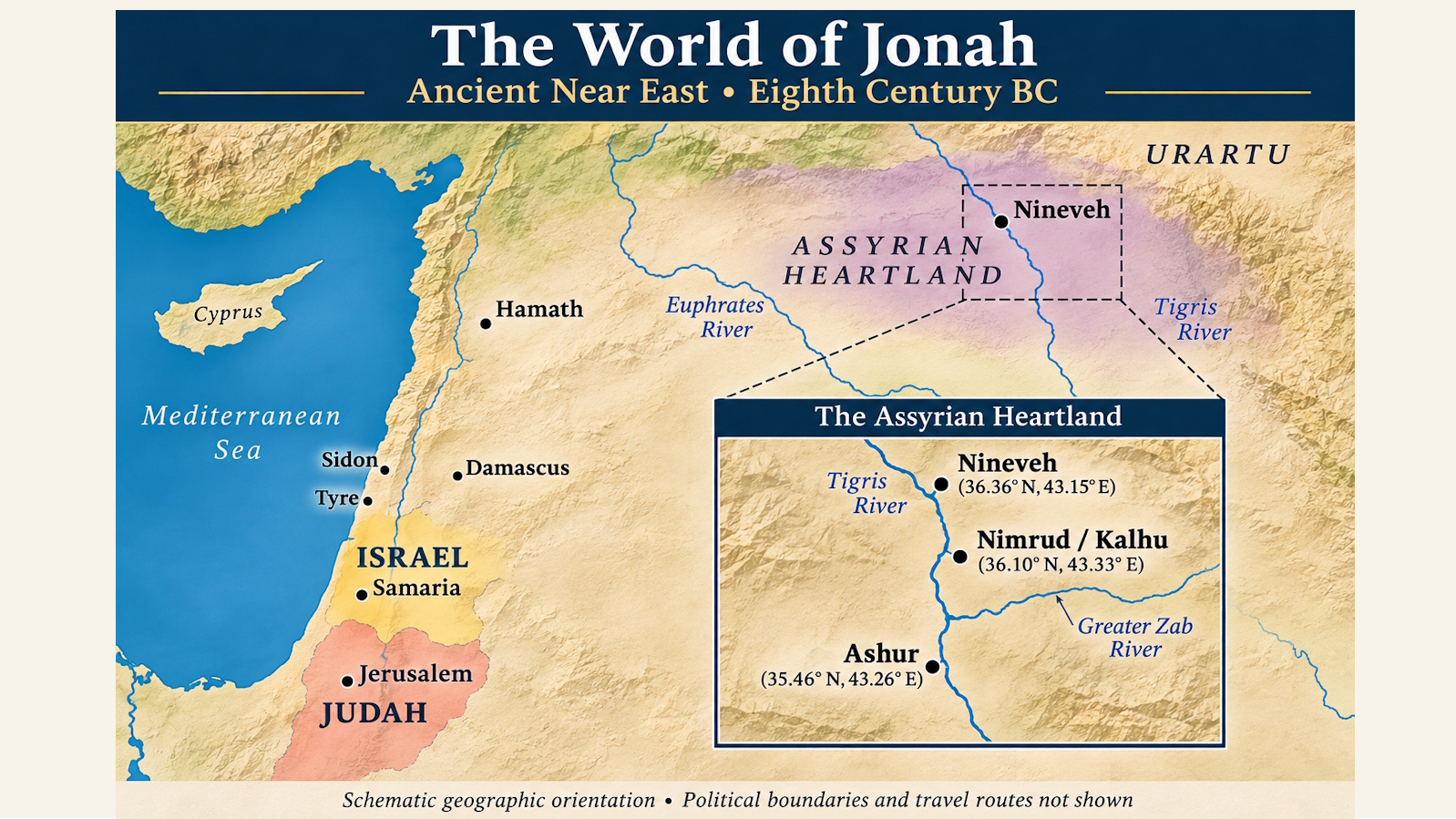
Assyria had started as a city-state with a couple of tributaries to the north. Assyria lies under the 300 mm isohyet. That is, it receives, on average, less than 300 mm of rain a year. And so, like Israel and Judah, the rainfall is not sufficient for consistent crops. Its tributary cities, however, were in the zone where there was enough rain. So they could load the crops on barges and send them down the Tigris and then drag the unloaded barges back up the river.
The Expansion of the Assyrian Empire
Assyria first rose to prominence in the early second millennium through trade. Textiles and metals were sent between depots of Assyria and Kanesh and then to associated settlements. Assyria annexed various territories to increase the amount of food available. Later, they attempted to control the trade routes by seizing various points along the routes and levying tolls.
The Assyrians had a reputation for cruelty. Ashurnasirpal II brags about burning the prisoners of war of his battles. On the surface, it appears as though Adad-nirari III continued the expansion of the Assyrian Empire by planting boundary stones on the Orontes River near Antakya at the border of the ancient kingdom of Hamath and between the borders of Kummuh and Gurgum.
Adad-nirari even put Jeroboam’s predecessor, Jehoash II, under tribute. Shalmaneser IV went as far as Damascus to exact tribute. But when we look more closely, we see more nuance is required.
Adad-nirari III and the Shift in Assyrian Imperial Policy
Adad-nirari III said that his grandfather was “the king of the four quarters, who slew all his enemies and flattened them like a flood.” These sorts of exploits, however, are not the ones that he claims for himself. And thus, “in his titles and epithets, we find recognition of a gap between the royal duty to expand the empire and Adad-nirari’s achievements as a military leader.”
Adad-nirari’s reign can be divided into three periods. The first period “focused on reestablishing Assyrian control of the west.” It lasted from 810 to 803 BC. “A total of four out of the first seven years were spent campaigning in the west . . . to crush a rebellion that arose during his father’s reign.”
The second period lasted from about 804 to 796 BC. At that time, Adad-nirari installed governors in regions liable to revolt. The third period talks about submission of foreign states without military action.
Evidence from the Tell al-Rimah Stele
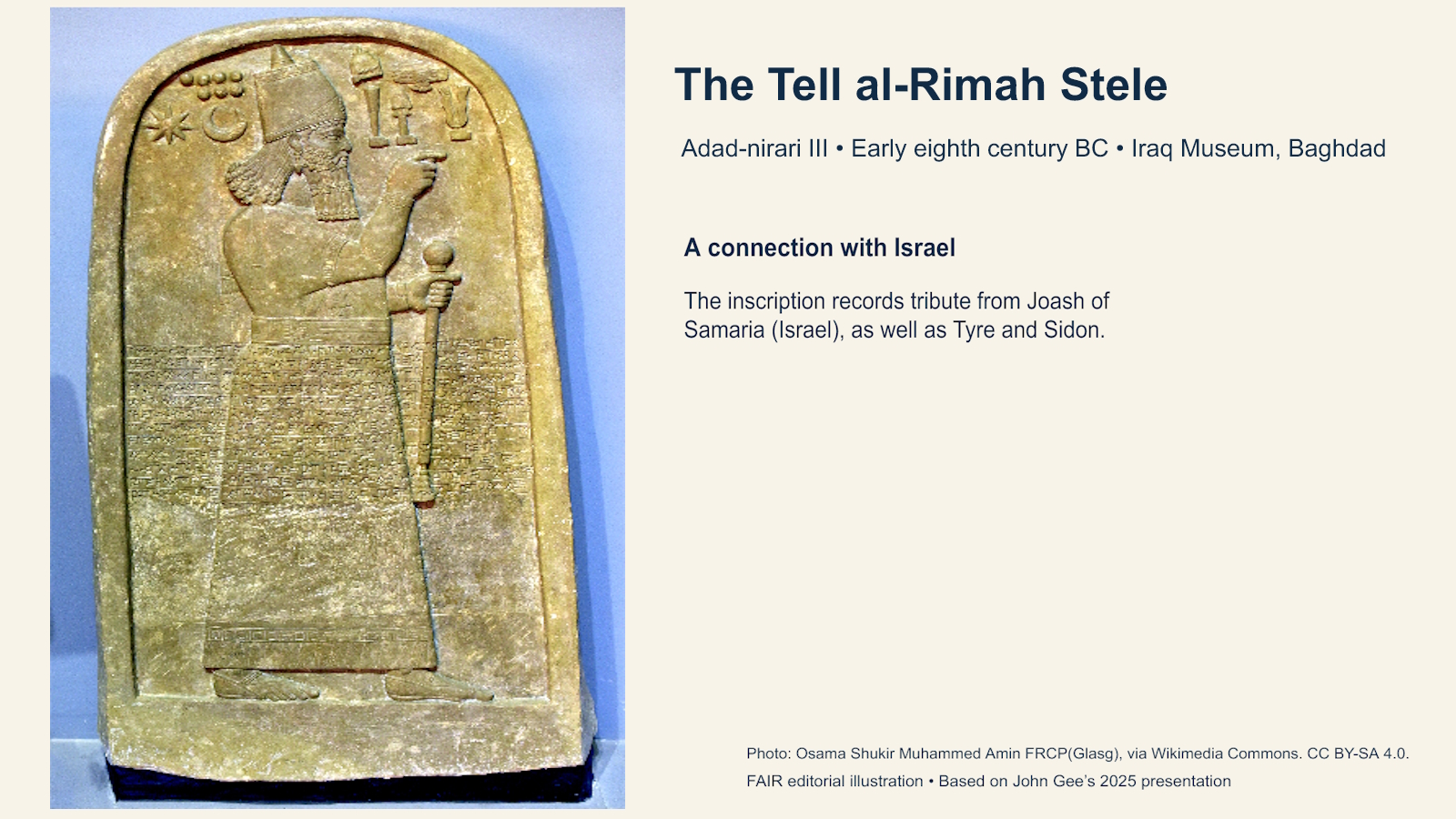
Adad-nirari says in his Tell al-Rimah stele:
I levied chariots, troops, and soldiers and commanded that they go to the land of Hatti. In one year I placed the whole land of Amurru and Hatti in my hands. I placed tax and tribute upon them until the last day. . . . He received the tribute of Joash of the Samaritan land and of the land of Tyre and the land of Sidon.
At the end of the campaign, he says that there were “in total 331 small cities which Nergal-eriš started to rebuild at the command of his lord.”
“In an inscription of Adad-nirari III found at Tell al-Rimah, reference is made to 331 settlements,” which were built in the region under the control of the Assyrian governor Nergal-eriš. And it has been suggested that the captives that Adad-nirari deported from his campaigns were responsible for the rebuilding. But this is an inference that is not present in the text.
It has also been suggested that Adad-nirari settled captives in the capital as well. But on closer inspection, evidence for this is missing. Granted, “most of the instances of mass deportation are from the reign of Tiglath-pileser III up to that of Ashurbanipal.”
The Shift in Assyrian Imperial Policy
The Tell al-Rimah stele dates to the second period of Adad-nirari’s reign. This action dates before the reign of Jeroboam II and thus before the time of Jonah. The eponym chronicle indicates that there were no more campaigns principally against the west after 796 BC.
On the other hand, we do have a series of decrees of Adad-nirari III giving land, people, and tax-exempt status to a group of individuals and institutions. Only three of these decrees have their dates preserved: 792 BC, 788 BC, and 786 BC. All of these date to the third period of Adad-nirari’s reign.
From the third period of Adad-nirari’s reign, we have a boundary stele that he had erected near Antakya, establishing peace between Zakur of Hamath and Ataršumki, the son of Adramu, and establishing the Orontes River as a boundary between the two countries.
From Conquest to Peace
In the last part of his reign, Adad-nirari claimed to have:
Established in my hands from the bank of the Euphrates, the land of Hatti, the entire land of Amurru, the land of Tyre, the land of Sidon, the land of Omri, the land of Edom, the land of Palestine, to the great sea of the west. I imposed tax and tribute upon all of them.
Imposed tribute, he may have, but that is different than conquering them.
By the end of his reign, Adad-nirari III “made the captive peoples return to their home and granted them permanent inheritances and food.” This is an abrupt about-face on a fundamental aspect of the Assyrian Empire. Because of this, “in the first half of the 8th century, the two Israelite states experienced a period of calm.”
Thus, “a central problem is how to understand the imperial hiatus and its effect on the overall perception of Assyrian imperialism.” The book of Jonah explains this. The book of Jonah says that the Assyrians repented, and from the surviving record it appears that they did.
Historical Evidence of Assyrian Repentance
Assur-dan III is known only for building activities. Assur-narari V stopped collecting taxes from foreign tributaries, and instead of war, we have “the Assyrian king arbitrating between local dynasts—with no visible inclination to annex their territory.”
For two generations, Israel had peace from the Assyrians. And by the end of this period, “Urartu had complete control of all the territory north of the Assyrian heartland, stretching from the Iranian plateau to the east and to north Syria and the Mediterranean in the west. Assyria was on the verge of extinction when Tiglath-pileser III came to the throne” with a policy of “Make Assyria Great Again.” 1
Dating the Book of Jonah
The book of Jonah is told in the third person. It does not necessarily need to be a contemporary account. The date of Jonah and the date of the book of Jonah do not need to be the same. This, of course, raises the issue of when was the book of Jonah written.
Scholars are divided on the date of Jonah. Some say that “determining the date for the composition of Jonah is such an elusive and probably impossible task.” Others state that “all competent critics agree that it is post-exilic.” “Dating the book is problematic because there is virtually no direct information and everything has to be derived by internal evidence of various degrees of trustworthiness.”
The twelve prophets are mentioned in Sirach, which includes Jonah, and therefore the text existed in the second century BC when Sirach was written. Jonah is also attested in the Dead Sea Scrolls. The second century BC thus forms the terminus ante quem, or the date before which it has to be written, and the eighth century BC forms the terminus post quem, after which it has to be written. And this gives a six- to seven-century span when Jonah might have been written.
Nineveh as the Assyrian Capital: An Anachronism?
In the book of Jonah, the capital of Assyria is Nineveh, and this is seen as an anachronism.
The book’s references to Nineveh are anachronistic and geographically implausible, suggesting the use of a symbolic “evil place” such as is found in other late prophets, and also, interestingly, in the Hellenistic world after 600 BCE.
The statement that Nineveh “was” a great city suggests that it was no longer in existence at the time of composition, i.e., after 612 BC.
The capital of Assyria changed throughout history. If one consults Wikipedia, one might have the impression that from the time of Ashurnasirpal II until Sargon II founded Dur-Sharrukin, that Nimrud was the capital. The book of Jonah would thus have an anachronistic capital for the Assyrian Empire. But this view is complicated when we look at the location the texts were found.
Evidence from Assyrian Royal Inscriptions
The capital of Tiglath-pileser III was at Nimrud. Of the royal inscriptions of Tiglath-pileser III, 109 come from Nimrud, 20 from Ashur, one from Arslan Tash, one from Mila Mergi, and one from Western Iran, and one from an unknown location. Of the royal inscriptions of Shalmaneser V, all nine come from Nimrud.
Sargon II moved the capital to Dur-Sharrukin, which is Khorsabad. Of his royal inscriptions, 284 come from Dur-Sharrukin and 113 come from Ashur, and the rest from various locations. We therefore expect that most of the royal inscriptions will come from the capital.
Was Nineveh the Capital in Jonah’s Time?
Let us then consider the Assyrian rulers of the time of Jonah and the aftermath. Of the royal inscriptions of Adad-nirari III, 29 come from Nineveh, 23 come from Ashur, 19 come from Nimrud, one comes from Antakya, one comes from Dur-Katlimmu, and one comes from Kızkapanlı, one comes from Sabaʾa, one comes from Tell al-Rimah, and one is of unknown provenance.
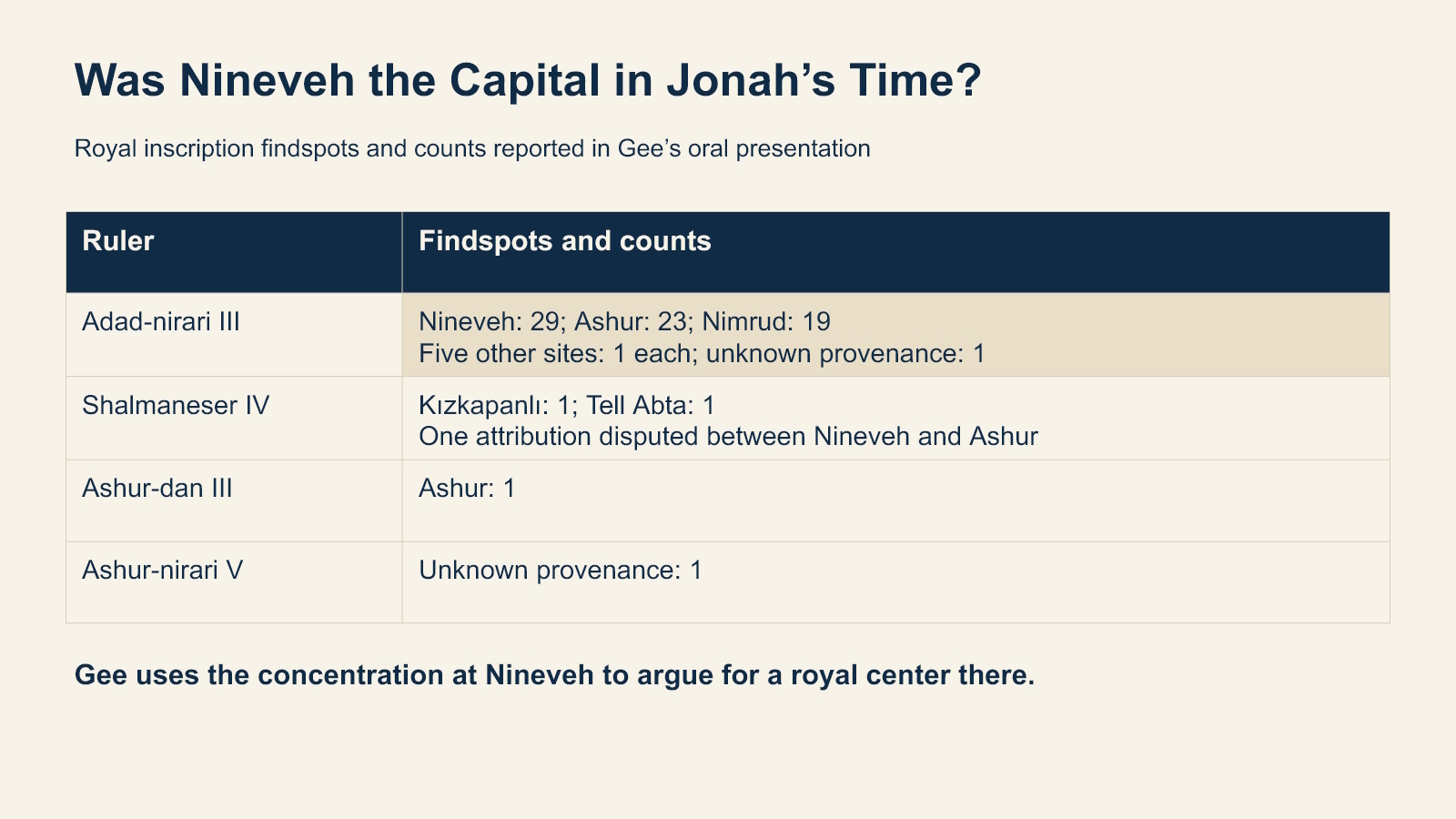
If most of the royal inscriptions come from the capital, then Adad-nirari’s capital was in Nineveh. Nineveh was also known for its hanging gardens.
And of the royal inscriptions of Shalmaneser, one was found at Kızkapanlı, one was found at Tell Abta, and one is purportedly from Nineveh but has been argued to be from Ashur. And the only royal inscription of Assur-dan III is from Ashur. The only inscription from Assur-narari V is of unknown provenance.
So what looks like a strike against Jonah, the capital being at Nineveh, turns out to be an argument in its favor.
Linguistic Evidence for Dating the Book of Jonah
All the book of Jonah leaves us with to date it is the language used in the text. Now, there are two problems with the text: one chronological and one geographical. The chronological problem is in some ways the most straightforward. Hebrew language changed over time, and linguistic features are generally divided between early and late features.
The problem generally is that the dates of the biblical books are almost all disputed, and one text may be designated early by one scholar but late by another, and this complicates determining which features of language are early and which are late.
Some books, however, claim to be late, and no one argues that they were written earlier than they claim to be. Think of the examples of Esther or Ezra, Nehemiah. No one claims that those came from the pre-exilic period. These provide examples of indisputably late features of language. Earlier forms appear, by contrast, with known late features.
The Geographic Problem: Northern and Southern Hebrew Dialects
The geographic problem stems from where Jonah came from. Jonah is a prophet from the northern kingdom of Israel. The Hebrew Bible is a record from those in the southern kingdom of Judah. Only exceptionally are northern prophets considered: Elijah, Elisha, Amos, and Jonah.
These northern stories were brought south after the ten tribes were scattered and the refugees fled south and settled in the land of Jerusalem. The Hebrew Bible is mostly written in the Judean dialect of Hebrew, and we know relatively little about the Hebrew dialect or dialects from Israel.
Like the accounts of Elijah and Elisha, Jonah is a third-person narrative. One is left with three general possible scenarios for a northern account being included in the Hebrew Bible.
- The first possibility is that Jonah was written in the north in the northern dialect and then brought with the northern refugees into the south.
- The second is that the story was brought by the northern refugees and written by someone in the southern dialect.
- The third is that the story was invented and has no basis in reality, but was written by someone in the southern dialect at a later time.
Examining Supposedly Late Vocabulary in Jonah
One critic helpfully gives a list of supposedly late vocabulary in Jonah. Now, granted, this was from the nineteenth century before many epigraphic sources were known, but modern critics do not feel the need to bother about citing much evidence. Some more recent arguments for post-exilic language uses are less than convincing.
So, of this list of vocabulary elements, each can be examined in turn.
Sailors and Ships
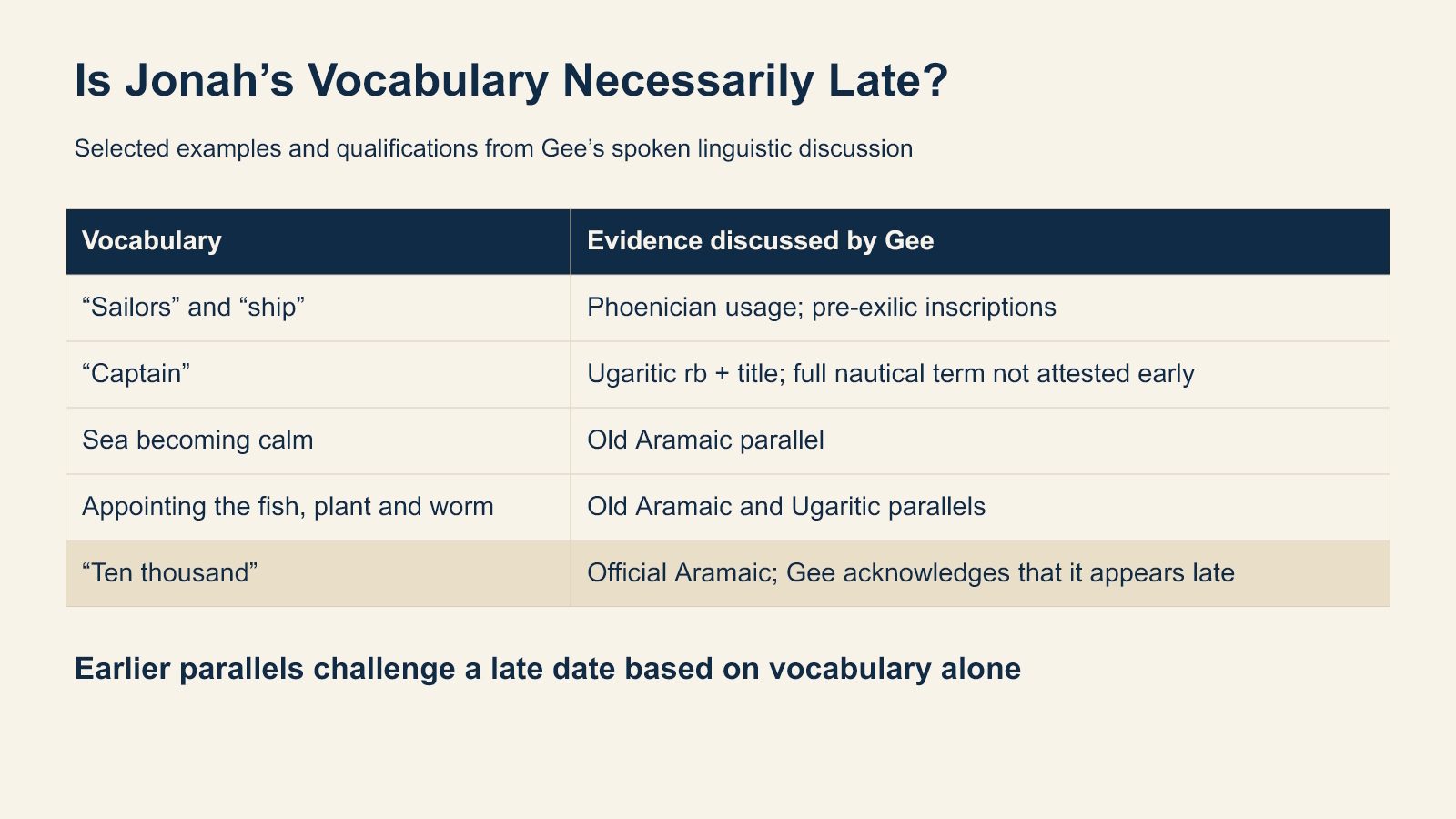
The term for sailors used is hammallāḥîm. This term is only used in the Hebrew Bible in Ezekiel, which happens to be the only other time when sailors are mentioned in the Hebrew Bible. It also happens to be the Phoenician term for sailor. The Targum uses a different term, sapnayāʾ, for the sailors.
The term for the ship used is hassəpînāh. This is a hapax legomenon in the Hebrew Bible, which alone does not tell us whether it is early or late because it is otherwise unattested. It is attested in other pre-exilic inscriptions. The Targums use a different term, ʾîlpāʾ, for boat.
The term for the captain of the ship is rab haḥḥobēl, “chief of the sailors,” both of which terms are supposedly late. But the construction of rb followed by a title is abundantly attested in Ugaritic and in other pre-exilic languages. The term ḥbl is a Punic term for sailor, which comes from Phoenician, even though it is not attested in Phoenician. It derives from a term that means “mooring rope” that is attested at least as early as Ugaritic.
Given the rather scanty coverage of nautical terminology in most pre-exilic languages, we can only say that this is not attested early but cannot be ruled out. The Targum uses a different term, rab səpanyāʾ, for captain.
Maritime Terminology and Old Aramaic
The term used for the sea being calm is yištoq. This is attested in Old Aramaic, and it has been noted, “some of the words relating to the sea voyage may be technical maritime terms, possibly Phoenician in origin, which could have been available at any period.” The Targum uses a different verb for the sea being calm.
The verb for consider or regard is yitʿaššēt. This particular form is a hapax legomenon in the Hebrew Bible, although the root appears in Jeremiah. It is attested in Old Aramaic. Since the term appears only once and is attested in pre-exilic times, there is no particular reason to consider it late. And the Targum uses a different term here.
Relative Pronouns and Northern Hebrew Grammar
The book of Jonah has fourteen relative pronouns. Twelve are ʾašer, three are še. Normally, the use of še is a sign of a post-exilic book. The pronoun še was borrowed from Akkadian ša during the exile.
Three terms show the use of the relative še. These are bəšelləmî, bəšellî, and šebin-laylāh. It is difficult to imagine that any of these terms was a result of linguistic updating, which would count against Jonah being early.
But on the other hand, Gary Rendsburg claims that they are a normal form of the relative pronoun in the Hebrew grammar of the northern kingdom and thus pre-exilic. And the Targum uses different expressions here.
Additional Vocabulary Evidence in the Book of Jonah
yəman
The term used for appointing or preparing the fish, the gourd, and the worm is yəman. This is also attested in Old Aramaic and Ugaritic, and the Targum uses a different term, zamîn, here.
yaʿabēr
The term used for the king of Nineveh laying aside his garments is yaʿabēr, and this term is so common it’s hard to credit this as an argument, but the Targum uses a different verb here.
ṭaʿam
The term for the royal decree is ṭaʿam, and this is, of course, a cognate with the Akkadian term for decree and is common in the Persian period, but it’s also argued that it occurs in Ugarit, and the Targum uses a different word, migzêrat, for a decree.
ʿāmaltā
The term in Jonah for labor is ʿāmaltā, and this term also appears in Old Aramaic, and this is the only word in the list for which the Targum uses the same word.
ribû
The term for ten thousand in Jonah is ribû, and this appears in Official Aramaic and thus appears late, and the Targum uses a related term, ribwān.
Linguistic Evidence Against a Hellenistic Date
Now, none of the vocabulary items that are supposed to be indicative of late vocabulary in Jonah appears in the Late Biblical Hebrew lexicon, and only one of them appears in the Targum of Jonah. This indicates that the supposed Aramaisms in Jonah were considered archaic by Aramaic speakers, particularly the late period, such as Jonah and the Targums, and therefore not used. And this makes a Hellenistic date for the book of Jonah unlikely.
The expression “God of heaven,” we are told, “is very late.” And this, of course, is an assertion that does not particularly hold up well since the expression appears in Genesis. It is more popular in later times, but its earlier use cannot be ruled out.
We are also told that “the compound Yahveh-Elohim is a certain sign of the post-exilic origin of the book,” except it also shows up in pre-exilic Lachish ostraca that have been found archaeologically.
In the nineteenth century, a compelling argument for the date of Jonah was that “some wandering exiled Jew may have seen the impressive ruins of Nineveh and was inspired to teach his fellow countrymen a lesson in Yahweh’s ever-present power.” But the arguments for dating based on language are less than conclusive.
Conclusion: The Historical Case for Jonah
So, if we look at the historical record, we cannot explain why the Assyrians suddenly stopped being imperialistic in conquering other countries and started making peace between them. And this lasted for two generations at precisely the time that Jonah is said to have gone there and that they repented.
If we look at some of the supposed anachronisms from the book of Jonah, like the capital being at Nineveh, this can be shown to be the capital in Jonah’s time.
And if we look at the language that is supposedly late, we find that most of it does not hold up as late. And in fact, most late versions, such as the Targums, use different vocabulary, and most of the vocabulary can be shown to occur in pre-exilic times.
Indirect Evidence for Jonah’s Prophetic Mission
Like all prophets in the Old Testament, direct evidence for their existence and effectiveness outside of the Old Testament is lacking. Absence of evidence, however, is not evidence of absence. What Jonah, like the other northern prophets Elijah and Elisha, has is indirect evidence of effectiveness.
According to the Old Testament, Jonah went to the Assyrian capital, Nineveh, and preached repentance. And for the next couple of generations there is genuine evidence that the Assyrians changed their ways.
Now, that hardly qualifies as absolute proof. But as a counterargument against a logical fallacy, it may be worth paying attention to. And thus, the book of Jonah may not be fictional after all. Thank you for your attention.