• Skip to primary navigation
  • Skip to main content
  • Skip to primary sidebar
  • Skip to footer

FAIR

My Account Search
  • Start Here
  • Find Answers
  • Scripture Study
  • Blog
  • Events
    • FAIR Conference
    • Virtual Conferences
    • Special Events
  • All Presentations
  • FAIR Books
  • About
    • Media & Apps
  • Get Involved

Book of Mormon historicity

Egyptian Influence in Ancient Israel

Summary

Summary

John Gee explores archaeological and iconographic evidence of Egyptian cultural influence in ancient Israel, particularly during the time of Lehi, as described in the Book of Mormon. While he clarifies that the evidence presented does not prove the Book of Mormon, it provides historical context for the Egyptian influence mentioned within its text, reinforcing the plausibility of its cultural and linguistic backdrop.

TL;DR

TL;DR (Too Long; Didn’t Read)

John Gee argues that archaeological evidence demonstrates significant Egyptian cultural influence in ancient Israel, including during the eighth and seventh centuries BC. Drawing on Egyptian and Egyptianizing artifacts found at sites throughout Syria-Palestine, he places the Book of Mormon’s references to Egyptian language and culture within the broader historical setting of Lehi’s Jerusalem.

Presentation

The Book of Mormon mentions Egypt in its background. It’s used in part of its writing and forms a background in language. In the past, many people have criticized this notion that ancient Israel was ever mixed up with the Egyptians, so I am going to talk about some of the evidence. I am going to start with the quotation from the massive 4000 page doctoral dissertation by Greg Mumford which he completed at the University of Toronto in 1998.

His dissertation, which for obvious logistical reasons has not been published, is entitled “International Relations between Egypt, Sinai, and Syria-Palestine during the late Bronze-age into Early Persian Period Dynasties 18 to 26 about 1550 to 525 BC,” and I’ll leave out the sub-title.

He looked at about 34 different sites throughout Syria, Palestine and Sinai. He looked at all the Egyptian and Egyptianizing artifacts, dividing his time period into about 19 to 20 different intervals, roughly about every 50 years, and looked through archaeological reports and did extensive analysis. This is from his conclusions. If you ever get a chance to look at the dissertation, it is on page 3986.

He says “Examination of the overall Egyptian/Egyptianizing artifact proportions from cultic mortuary occupation and combined the context at Syria- Palestine’s sites yields clear peak in Egyptian activity during late-Bronze 1B 1450 to 1400 BC, late-Bronze 2B to Iron 1A, 1200 to 1150 BC, early-Iron 2B 925 to 850 BC, and late-Iron 2B-2C, 750 to 600 BC.” So that’s precisely a peak during the time of Lehi.

We actually have a certain chart that shows you, from selected sites, where there are peaks in the percentage of Egyptian artifacts. Unfortunately these are only percentages and don’t tell you the numbers, so 3% may represent 8,000 artifacts in the site.

Iconographic Evidence

I would like to show you some iconographic evidence. I just brought some slides to show you, which show some of the Egyptian influence in Israel in the 7th and 8th centuries BC. So this is roughly from the time of Isaiah to Lehi. All of these artifacts are Israelite artifacts that come from that time, so we will consider them one by one.

These are Israelite seals, and we’ll start off with the ones showing scarabs. The first one here shows a very nice Egyptian scarab beetle with the wings out pushing the solar disc across the sky, with a nice Hebrew inscription saying “belonging to the ruler.”

It was bought in the antiquities market in Jerusalem, and is supposed to be from the area of Hebron, and is currently in Tel Aviv. This is just the impression of it, which lets Hebrew be read in the correct direction. These seals were designed to stamp on letters and let you know who owned them, or wrote them.

And the next one is currently in France, location is not known. It’s a human-headed Egyptian scarab with wings. This actually represents one of the 4 winds, with a nice Hebrew inscription and saying “this belongs to Wilcah.”

Next one is a royal seal, and according to the inscription belonged to Manassah the son of the king, and later became king himself. Again the Egyptian scarab beetle with the solar disc.

Our next one belongs to a man named Aukeymelek, and he was the son of the man named Samack. You notice on the slide that his father’s name is worked around the scarab on the top, his own name is on the bottom. Again, clear Egyptian influence, nice little ankh on your left.

This one is not a scarab but an actual seal impression. The back of this would be put on some papyrus. For whatever reason the papyrus is gone, and this is on a lump of clay. From what we can read of it, a man by the name of something like Domlah. This was also found in the antiquities market around Hebron.

Next one is a fellow by the name of Kamenjahu, son of Emet, which is the Hebrew word for truth. And this one is flanked by two birds. It’s a little unusual in that way. It is late 8th century in date. And the next one I have here belongs to a man by the name of Sayid Yahu. This one is a very nice because we have a lion drawing beside it. As you can see this is a fairly common motif during this time period. Same with the next one here. This is a man by the name of Shaffat, son of Yennah Yakub. And we have two bullae that have the same stamp on the impression. We are quite fortunate in that regard, in some cases we have as many as three.

The next one actually comes from the royal seal of King Hezekiah with a beautiful scarab beetle and solar disc. And the last one we have is found on a jar handle. Somebody stamped it in while still making this clay pot, and this belongs to Shemanjahu, son of a King. Unfortunately we don’t know which king.

Now moving from the stamped seals depicting scarabs, we also have a whole whole series of them that show winged uraei, or winged cobras, which are native to Egypt, with wings, shown in classic Egyptian style. The first one is the one of three bullae, which was found at Lachish. This one apparently got around because the next one here is the impression made by the same seal, but it was found in Jerusalem. The third one here is from Tele Judaida. We only have a drawing of this one. It was found in the Tele Judaida expeditions back in 1900, its present location is unknown.

Next one here belongs to a man by the name of Yakamoh Yajuh son of Mosseh Yajuh. You will see a nice Egyptian uraeus. The next one belongs to a man by the name of Saadha, and I noticed a little ankh sign over here. Somebody punched a hole and drew a little “T” shape under it making the ankh sign. And this one also has nice winged solar discs at the bottom.

The next one belongs to Elishama who is the son of a king. This fellow is known from the Book of Jeremiah. So here we are in Lehi’s day, with a good Egyptian uraeus sporting the crown of upper and lower Egypt. This is sporting a royal Egyptian crown as well.

The next one was found in the antiquities market in Beirut; it is now in Oxford. They took this scarab, most of these seals are actually shaped like Egyptians scarabs following Egyptian prototypes. Someone carved out the bottom, so we get the nice letters here “belonging to the son of” and someone carved out the rest of it and it is probably in some rubbish heap somewhere.

The next one here belonged to a fellow by the name of Eljahu, son of Geljahu. This also should remind you of the Exodus account of those fiery flying serpents. This one belongs to a man by the name of Jeremiah. It’s not the one from the Bible, this is the son of Asah. These things are also quite small. This one for example, which is typical, is 19 millimeters in height. So just about 2 centimeters long. And the writing on there is very small, but they do tell us something about the carvings in Lehi’s day.

The next one here belongs to a man by the name of Shaufat, and has this winged uraeus sitting on a lotus flower. We have another one with the ankh sign put on its side, and was found in Jerusalem and belongs to a fellow by the name of [Abuyao?].

We have another one here–this one is two sided. So this one is the inscription from the one side, and the other is the inscription from the other side. It belongs to the man by the name of Sadok, and he is the son of Lechad. Then it was re-used by a man by the name of Zacharyu. It says that he is the Priest of Dor. So here we have a man with a clear Yaju name, so it seems at least his parents worshipped Jehovah, and he seems to have followed suit. But he is a Priest at Dor. There is no biblical record or archaeological record of a sanctuary to the Lord ever being there, but there was apparently one there at this time. Because Dor was conquered by the Assyrians in 733 BC, we can gauge this one pretty clearly to be from the 8th century.

This is Shecenyaju son of Elasa, and another winged scarab belonging to Yeddayaju. Now in some cases we don’t get the nice winged scarabs, instead we get the side view as in this one. You get the scarab with a solar disc on his head, and an ankh sign with an extra bar on it. This one belongs to Cheppetyaju, son of Osayaju. Most of what we get out of these are the names.

This one here is another unusual one because the uraeus is looped over the solar disc, the solar disc is winged. There is another solar disc on the serpent’s head, there is an ankh sign with a fish. There are a number of these scarabs with fish.

This motif with the winged scarab became very common much later in Egyptian history, but it is a testament of their presence at this time. This one here shows no wings whatsoever on the snake, although this one does. What would really be interesting is to have the papyrus which these seals attached. If we had two or three of these instead of just the bullae, it would probably rewrite our history of Israel.

The next type we have has Egyptian sphinx’s on it. So the first one here, there are only a couple of these, belongs to a man by the name of Sholomet. If you notice the carving style, the lines are much thicker and deeper than they are on most of these other scarabs and this has led some people to wonder if this one is actually authentic. While that one may not be authentic, this one belonging to Hannah, is.

Now here again we have the Egyptian crown on the sphinx. What is unclear on this particular seal is Hannah is usually a woman’s name, although most of these seal impressions belong to men. And Egypt not only has human sphinx’s, but also what are called cryo sphinx’s, sometimes called griffins. They have a falcon’s head rather than a human head on them. First one here belongs to a man and by the name of Giki, strangely enough it sounds similar to the name of a Bishop I’ve been working with recently.

This next one was found at Ashkelan. A lot of these were found during illicit digs, when there were only about 2 centimeters left. One could easily skip over them. They are also easily secreted off a dig. This one is a very nice one with a nice double Egyptian crown with the white crown of upper Egypt and the red crown of lower Egypt. We also have an almost identical one here belonging to Yohokim, and another one here belonging to Hosea. We are not sure if it is the same Hosea of the Bible.

This one is really unusual because it has a cricket at the bottom, and is attested on other seals. This one belonged to Asaf, and has the ankh sign, while this one here belonged to someone possibly named Pechab. Oddly enough there is a Was-scepter staff sticking up out of the griffin’s head. At least, that is what I take it as. It might be a representation of the double crown but it looks much more like a jackal-headed Was-scepter.

This one provides an example of the certain bakeries of pre-Israelite script, something that we may not have appreciated when The Book of Mormon talks about difficulty of writing in Hebrew. Those two letters look like they might have a tick or might not. If they don’t have a tick they’re read as “p’s” if they do that the tick they are read as “n’s”.

This one has the name of Allah, and this one’s name is almost Ezekial, it’s just missing the “l” on the end. This one, his name is Jonathan. It’s a little bit late to be the prince with that name. This one belongs to the son of Hosea. I don’t know if that is the prophet, it’s probably just a common name.

Then we come to seals that have human figures emerging out of a lotus. In an Egyptian motif, there is a wonderful example of this from the tomb of Tutankhamun, where Tutankhamun’s head is seen coming out of a lotus blossom. This is equated with the Egyptian God Nepertune, as well as the god Horus. So this is a nice one here belonging to Abigow, servant of Uzziah. There is a king by that name.

We have others that are just Egyptians solar discs, you’ve already seen a couple of these. This one is one of those inspired by two sides except this one does not have two different names, it is not re-used. It is the same name on both, he just flips it over. This is a nice Egyptian figure standing and his name is Shebanjayu and the bottom is identified as Shebanjayu, servant of Uzziah.

This one has a wonderful elaborate Egyptian crown with the solar disc and uraeus hanging off of it, a wonderful late period motif. I don’t have it in color, but it is a beautiful, glowing orange.

This one here is a combination of motifs. You see two uraei hanging off an ankh sign, with a winged solar disc at the top, a scarab pushing the sun on the one side and a fish on the other, with a very odd mask in the middle. And the inscription on the back side says it belongs to Uzza.

Now in some of these cases they decided to go for a very elaborate type of seal. These are based on earlier second intermediate period scarabs that were used by Egyptian officials and often contained cartouches of kings. This one, which belongs to Shmaryahu, at least the lower cartouche is a badly done imitation of the cartouche of Tuthmose III. I am not quite sure how to read the cartouche on the top. Shmaryahu actually stuck his name in the cartouche, which is a little unusual because Egyptian cartouches are reserved for the names of kings. Everyone else isn’t allowed to cartouche.

There is this other one belonging to Palty. He doesn’t bother to put his name in a cartouche, but again, a rather garbled version of the name of Thutmose III at the bottom. This is actually much later than Thutmose III. The style, with all the fancy work, is more like the second intermediate period scarabs.

We had one miscellaneous one. You can tell it is Egyptian by the ankh sign, but it had to be reconstructed from two different seals of the same person. You can see in this one you get the legs, and this one you get the ankh sign. You get a little bit of the inscription on the second one over, and you are able to come up with a composite line drawing. It belongs to Thotunyahu’s son, Huni.

And finally, I thought I’d just go over some of these seals that are connected with royalty because these have a secure date, and from them we can get a feel for the time period when this was used. So the first one of these belongs to a servant of Uzziah, and Uzziah reigns from 783-742 BC.

The next one belongs to the servant of Ahaz, who is Uzziah’s grandson. This one belongs to Ahaz’s son, Hezzekiah. And this one to Hezzekiah’s son, Manassah. Note the similarity in the motifs. This one here belongs to a son of the king during Jeremiah’s time period. I am not sure exactly which king it is. And finally this one just tacked on the end of a jar handle, tells us he is the son of a king, but does not tell us which one.

Conclusion

So if you look at the time periods this is covering, we have Uzziah 783-742 BC, Ahaz 735-715 BC, Hezzekiah 715-687 BC, Manassah 687-643 BC, and then the time period of Jeremiah around 600 BC. This period of using the royal seals with Egyptian iconography happens to match the time period where there is a peak in Egyptianizing materials found in Israelite settings. This helps form some of the backdrop for Lehi’s time in Jerusalem. It gives us some background which Lehi came out of, that we read about in the beginning of The Book of Mormon, about having Egyptian influence there, which is repeated again in the end of The Book of Mormon.

All of this doesn’t necessarily prove anything about The Book of Mormon. It is not one of those things that give sufficient proof, but provides a backdrop for Lehi’s day, and a background from which The Book of Mormon comes.

TOPICS

Book of Mormon

Egyptian in The Book of Mormon

Brant A. Gardner

Brant A. Gardner

Book of Mormon Scholar • Mesoamericanist • FAIR Conference Speaker

Brant A. Gardner, Book of Mormon scholar and FAIR Conference speaker

Read Brant Gardner's statement of faith ↓

Brant A. Gardner received a master’s degree in anthropology from the State University of New York at Albany, specializing in Mesoamerican ethnohistory. His work has focused particularly on reading the Book of Mormon in its historical, cultural, and literary contexts, with special attention to ancient Mesoamerica.

Gardner is the author of Second Witness: Analytical and Contextual Commentary on the Book of Mormon, Traditions of the Fathers: The Book of Mormon as History, The Gift and Power: Translating the Book of Mormon, Engraven Upon Plates, Printed Upon Paper: Textual and Narrative Structures of the Book of Mormon, and The Plates of Mormon: A Book of Mormon Study Edition Based on Textual and Narrative Structures in the English Translation, published by Kofford Books.

Gardner has also been a longtime contributor to Latter-day Saint scholarship and apologetics and has presented multiple times at the FAIR Conference. His research brings together anthropology, Mesoamerican ethnohistory, textual analysis, and close reading of the Book of Mormon to explore questions of translation, historicity, culture, and the structure of the text.

Bio last reviewed:

Contributions at FAIR

Testimony

Brant A. Gardner’s statement of faith

Books have typically defined both my intellectual and religious life. In my very early teens a relative gave me a book surveying world archaeology, and from that time some tie to antiquity formed in my soul and brain and eventually dictated my selection of graduate studies. That fondness for archaeology and ancient history began to intermingle with my understanding and testimony of the Book of Mormon when I found Thomas S. Ferguson’s One Fold, One Shepherd among my father’s books. From the time I first picked it up, my interests in the gospel and in archaeology had fused. My father never got the book back.

I took that excitement about the Book of Mormon and archaeology with me on my mission in Spain. When I returned, the excitement still burned brightly enough that I decided that I should take my new fluency in Spanish to the chronicles that surely supported everything in the Book of Mormon. I wanted to be able to say that I knew that they were true because I had read the sources and they said just that. I did: They didn’t. I didn’t lose any faith in the Book of Mormon, but I certainly lost faith in LDS writers who opined about New World history and the Book of Mormon (including One Fold, One Shepherd). By the early 1970s, I resigned myself to the role of gadfly, poking at the obvious problems with the armchair archaeologists and their misuse of information relative to the Book of Mormon. Then I met John Sorenson.

Dr. Sorenson allowed me to vent about the problems that were obvious in the way LDS writers had attempted to use archaeology and history in support of the Book of Mormon. His response was to give me a manuscript (about a decade before it was published as An Ancient American Setting for the Book of Mormon). At that time, my mental picture of Nephites and Lamanites vacillated between movie depictions of ancient Jerusalem and the Romans-from-an-alternate-universe depictions of Arnold Friberg. Sorenson painted a picture that comfortably placed the Book of Mormon in Mesoamerica. I didn’t, and don’t, agree with all of Sorenson’s analyses, but he gave me a context in which for the first time I could see how the Book of Mormon could plausibly fit into a real place and time.

Nevertheless, the Book of Mormon took a distant back seat to the exciting world of Mesoamerican studies. However, while doing some fieldwork in Guatemala, all of the note cards I had amassed towards a dissertation were stolen. In the days of typewriters rather than computers, there were no backups. Lost was lost. Right at the point where all that remained was the final examination and the dissertation, that disheartening loss and our economic realities led my wife and me to decide that I should stop my program for a year and earn some money to get us on our feet. It has been a very, very, long year.

While concentrating on trying to find a way to support and raise a family, interests in Mesoamerica lingered in my reading. Eventually, it was the Internet that provided the impetus to reintegrate my academic interests and love for the Book of Mormon. While participating on a fascinating email list, the owner/moderator of the list asked if I would be willing to write a weekly column. I remembered James Faulconer‘s book entitled Scripture Study: Tools and Suggestions (FARMS, 1999). Faulconer suggested that one might go through the scriptures slowly and to ask lots of questions of them. Having read several scholarly commentaries on books of the Bible, I keenly felt the lack of a similarly scholarly and comprehensive commentary for the Book of Mormon. I agreed to do the article as an ongoing commentary on the Book of Mormon that would go slowly so as to be able to ask lots of questions of the text.

It has been a fascinating project and in some ways a blind leap of faith. Considering my background in Mesoamerican religious ethnohistory and Sorenson’s foundational work, I determined to read the text against a Mesoamerican historical and cultural background. When I started, I didn’t know if it would work, but I began as though it would. I soon found that whenever I attempted to look ahead I was going to be wrong. I had to plug along a verse at a time.

It was not so much a process of fitting the Book of Mormon into a Mesoamerican setting as it was the text opening my eyes to the world in which it was written. The authors had to tell me their story; I couldn’t impose one on them. Why did the people in the Book of Mormon have the specific problems they had? Why did Nephite apostasy always take a very similar form? Why was victory defined so differently from my understanding of European history? Why did some faith-promoting stories in the text make so little sense if you looked at the story carefully?

The authors seemed to patiently explain how their particular culture at their particular time provided the background that seemed to naturally answer such questions. Of course, I mean that metaphorically. The text, seen through the plodding and gradual travel through time and space, was not only a different kind of fit than I had imagined, it was a better one.

The Book of Mormon is very different from what I read as a teenager or even as a young father. The text is the same, but now I read about some of my best friends. They were real people with real lives, real problems, and, perhaps best of all, real solutions. Even after the commentary was published, the Book of Mormon keeps reminding me that there is even more to its story. I had thought I would have finished, but it seems that there is still more to understand. The Book of Mormon has become richer, more nuanced, more understandable—yet no more true.

The Book that Mormon created was written by a very human man. It was translated by a very human man. Nevertheless, both Mormon and Joseph were touched by the divine, and it is the divine that shines in and through the text. It makes so much more sense to my mind as I understand it against history. The divine in it continues to make sense to my heart.

It always did. It always will.

February 2011

Book of Mormon Evidence in Mesoamerica

Start Here

Question

Is there historical and cultural evidence for the Book of Mormon in Mesoamerica?

Short Answer

Brant Gardner argues that no single archaeological or cultural parallel proves the Book of Mormon. Instead, he identifies multiple geographic, chronological, cultural, political, and textual convergences that he believes collectively support reading the Book of Mormon as an ancient text situated in Mesoamerica.

Key Takeaways
  • Gardner distinguishes isolated parallels from multiple independent lines of converging evidence.

  • Proposed Mesoamerican geography must match not only locations but also chronology, populations, cultural patterns, and relationships between places.

  • Gardner identifies potential convergences involving warfare, political organization, kinship, social change, literacy, and material culture.

  • Ancient cultural context can sometimes help explain Book of Mormon narratives that seem strange from a modern perspective.

  • Gardner does not equate the Jaredites directly with the Olmec or the Nephites and Lamanites directly with the Maya.

Summary

Summary

Brant Gardner proposes convergence as a more rigorous way to evaluate evidence for Book of Mormon historicity than simply identifying parallels. Using his image of a Dalmatian hidden among apparently random spots—“seeing the dog”—he argues that no individual point of correspondence is sufficient, but multiple independent pieces of evidence can combine to reveal a coherent historical pattern.

Gardner surveys proposed convergences involving Book of Mormon geography, Mesoamerican chronology, population movements, political organization, kinship, warfare, material culture, and literary conventions. He also examines passages that can seem puzzling to modern readers—including Limhi’s expedition and the Anti-Nephi-Lehies—and argues that a Mesoamerican cultural context may help explain them. Gardner distinguishes this historical argument from spiritual confirmation, maintaining that prayer and revelation remain the means of knowing the Book of Mormon is true.

TL;DR

TL;DR (Too Long; Didn’t Read)

Brant Gardner argues that the strongest historical case for the Book of Mormon does not depend on one archaeological discovery or isolated parallel. Instead, geographic, chronological, cultural, political, and textual evidence can converge like individual dots forming a recognizable picture—what Gardner calls “seeing the dog.”

 From Quetzalcoatl to Mesoamerican Studies

When I was on my mission and even before that time, I was very fascinated with archaeology, particularly with Mesoamerica. I had read some of the LDS scholars who had correlated things in the Book of Mormon to things in history and particularly in Mesoamerica, and I believed it—so on my mission I’m telling everybody—and I had one advantage when I got back from my mission that I had not had before: I went to Spain, and when I was in Spain, oddly enough, I learned Spanish!

It just so happens that a very large number of the documents that come out of Mesoamerica are written by Spanish-speaking people, and knowing that I actually had the language to be able to read some of the documents in their original, I decided that it was my duty to read some of them.

So that when someone says to me, for instance, this particular question that I was really interested in, “When you tell me that the Book of Mormon talks about Jesus Christ coming to the Americas, and you say that that’s related to the Aztec Great White God,” I can say to them, “Yes, I know that’s true because I’ve read it.” I thought this was a good idea.

What the Documentary Evidence Showed

And so, I started reading the information, and I read every LDS author on the subject. I read every document I could find on the subject.

I eventually became addicted to the subject and probably spent way too long on it, although it did foster my love for the anthropology and ethnohistory of that area of the world, and it kind of took me in a completely different direction. But the end result of that particular study was that I found out that what we as LDS had written on that topic was simply wrong—we just got it wrong. 1

From the documentary evidence, there was no way that I could say that the legendary information from Quetzalcoatl had anything at all to do with the appearance of Jesus Christ in the Book of Mormon.

I published an article on that, and thereafter, became probably one of the darlings of the anti-Mormon community. In fact, I suspect that I am probably one of the most often quoted pro-Mormons that is favorably cited in anti-Mormon literature because I wrote this article.

It just so happens that if you look at the comments about the various things that I have written and talked about, it turns out that at that particular point in my life, I was probably very open minded, quite intellectual, very astute and very logical, because I looked at the evidence and found out it didn’t support something that was supposed to support the Book of Mormon.

Following the Evidence in Both Directions

Now, since that time, I’ve looked at the Book of Mormon and I’ve compared it to Mesoamerica, and I’ve found all kinds of reasons why I believe that the Book of Mormon took place in that area of the world. I have gone from darling to dunce.

All of a sudden, everything that I used to know that made me so good when I talked about Quetzalcoatl, all of the sudden seems to have flown out the window, and I really know absolutely nothing at all, what I’m talk about, and certainly my methodology must have changed dramatically—this is all a surprise to me because it hasn’t.

In part of the time that I spent learning about Mesoamerican topics, I have probably spent as much time complaining about the quality of the correlations that we as LDS have made to a particular area of the world as I’ve ever done doing anything else, but nobody is interested in hearing that.

My Role as a Curmudgeon

I had at one point in time decided that I was destined to be the curmudgeon in the LDS community and my sole function would be to try to keep other people on the right track by telling them when they had gone off.

I was reasonably certain from looking at all of the materials that had been published through probably the 1970s that the typical way that the LDS would approach Mesoamerica is to go through and say, “If this is a pretty ruin, it was Nephite. If it’s an ugly ruin it was Lamanite.” (Laughter)

You will find wonderful pictures, gorgeous photographs of Palenque, which was way too late and had absolutely nothing to do with the Book of Mormon. When you get to the places where the Book of Mormon probably took place, you will probably find out that they are really ugly. It turns out they’re really probably backwards—but the fact is that they are there.

Understanding Rather Than Simply Proving the Book of Mormon

Now what we’d like to do is spend some time talking about the New World, the kind of information that is out there, and why the information that is there is starting to tell us more about the Book of Mormon.

Now I do have to kind of give you one other little piece of background, this is a very strange kind of thing for me because I have been forced into this position: My interest in the Book of Mormon is to explain it—I love the Book of Mormon and I want to learn more about it, I want to learn what it is telling me, I want to learn what the people think, I want to learn how they act, I want to learn why they did the things that they did. I really want to comprehend them.

I already believe, I really don’t need to prove it to myself—been there done that, had the inspiration that tells me, even when I didn’t have some of the rest of the information that I’ve got, that this is a true book. But that isn’t what people want to hear.

Mormons want to hear proof of the Book of Mormon. So anytime I’ve ever said anything about it, the basic question has been, “How can you prove the Book of Mormon, how can you show me that it is true?” We’re going to try to talk a little about that.

Moving Beyond Simple Parallels

Now there is a paper being passed around; most of what I’d like to do today is talk about bits and pieces that are on there, but I want to tell you why you’ve got the whole list.

You have the whole list because it’s absolutely impossible for me in a 40-minute presentation to talk about everything that is on there, but everything that’s on there makes a difference, and here is the reason that it makes a difference:

What we are looking at when we’re trying to find a way to explain the Book of Mormon, is we are trying to find a methodological process that is going to help us to understand when we have actually found something that makes sense, as opposed to the time when we are simply making wishful guesses, and we have made a lot of wishful guesses in the past. We need to know the difference between the two of them.

A Parallel Doesn’t Equal a Connection

One of the problems we’ve had in the way we present information is it will create something that’s called a parallel. We’ll say, “Okay, there is a piece of information in the Old World, there is a piece of information in the New World, those two things are parallel, therefore there must be some connection.” That isn’t enough.

One of the wonderful parallels that I remembered was that in the Old World they had adobe bricks, and in the New World, they had adobe bricks. Well okay, that’s true.

Sun-dried mud is probably something that can come about by independent invention. I really don’t see a lot of reason why someone has to import the idea of making something out of sun-dried mud. It’s going to happen, people are going to understand that, people are going to find it. The fact that those two things are parallel is virtually meaningless.

When a Parallel Looks Better Than It Really Is

The other problem with parallels is that when you create a parallel, very frequently you will make the thing that you are talking about appear to be more parallel than it really is simply by the way that you state it.

Going through some of the material on Quetzalcoatl and knowing the legends behind it, I would look at people putting the parallels down, and I’d look at them and say, “Well yes, if you just read that, that is really comparable, but if you actually talk about what the information is that lies behind the way they said it, it doesn’t say that. And the parallel really is not there.”

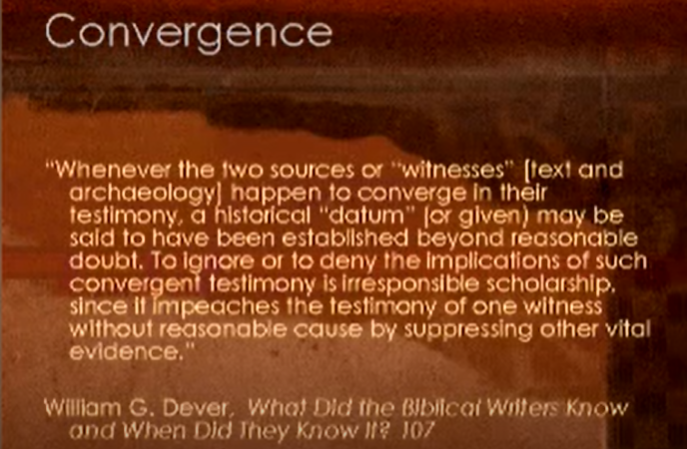
So parallels are really not going to help us, but there is something that does, and the problem is we need a vocabulary to do it and what I’m to do is borrow a vocabulary term that William Dever, a biblical archaeologist in Old World Israel, that he came up with to try to solve the same kind of riddle, to be able to say that there is something that helps us create a point of evidence that is better than a parallel even though it seems to be similar.

Convergence

He calls it a convergence so rather than a parallel, we are going to talk about a convergence. 2

His comment, “Whenever the two sources or ‘witnesses’ [text and archaeology] happen to converge in their testimony, a historical ‘datum’ (or given) may be said to have been established beyond reasonable doubt. To ignore or to deny the implications of such convergent testimony is irresponsible scholarship, since it impeaches the testimony of one witness without reasonable cause by suppressing other vital evidence.” (William G. Dever, What Did the Biblical Writers Know and When Did They Know it? 107)

What he is talking about in that case is the text of the Bible and the dirt archaeology to which it is being compared. The difference is, when he is creating a convergence rather than a parallel, he is taking a large quantity of material and he is saying, “Here are things that come together in a similar description.”

And we have to have location, we have to have time, we have to have the content of the information and in essence what he is saying is the more pieces of information that interrelate with each other and all depend upon the same location, same place, same time, same people, same concept; the more of those you get, the more you are converging the two types of testimonies of information, and the more chance then you have that one of these datums is now going to be something you can establish.

Seeing the Dog: How Convergence Works

So that is what I want to talk about: a convergence. To give you an idea of how a convergence works, here is my favorite example.

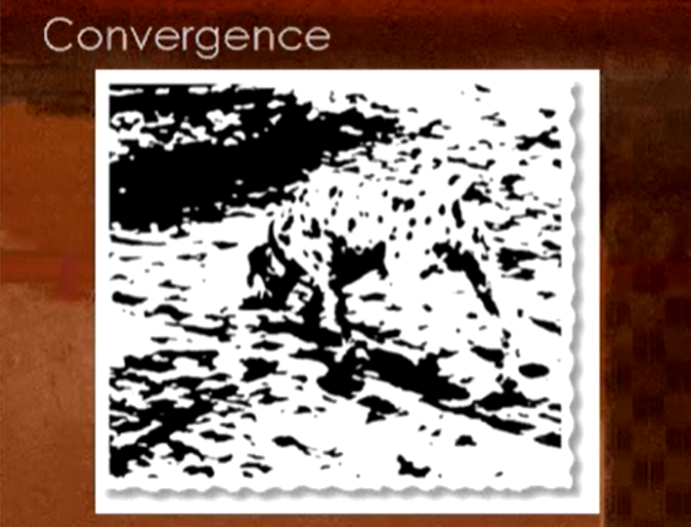
First impression, you look at this, and what you really should see is just a bunch of dots. Okay. Your first impression should be a bunch of dots. Now, after that you should see something. What are you seeing? You’re seeing a dog. I can actually see a few hands out here, so how many people don’t see a dog? That happens every once in a while because there are so many dots on there that you don’t see it.

That’s an important piece of information to remember because even though there is a whole bunch of us that see a dog there, it isn’t as absolutely clear as it might be if it were cleanly defined lines. Nevertheless, the location, the placement of the spots, all of the information, there is a dog standing over there. So for those of you who aren’t seeing it—that’s the head of the dog. You’re looking at a Dalmatian that’s drinking something from the ground. Foreleg, left hind leg, right hind leg, body—there’s even kind of a tail hooked around here.

When the Mind Creates Patterns

We, as human beings, have minds that are capable of creating cohesive patterns out of incoherent information. How many of you have stared at a tree, a cloud, a carpet and seen a face in it? Is the face there? Absolutely not. The reason that we see it is because we have a mind that creates things and it tends to create faces because we are so chemically wired to see the face. It is so important for us that we tend to create faces.

The difference is, if you blink two or three times, sometimes you look back and you can’t find it. Once you’ve seen the dog, you cannot “unsee the dog.” It actually is there. It may be difficult; we may not have all the data that we need to be able to clearly define it. But once you see the dog, that dog is there and you cannot “unsee the dog.”

That is the kind of evidence that we’re going to be talking about. We will not have a complete picture. We will not have a jigsaw puzzle where every single piece of the puzzle is there and there will not be any gaps, but what we will have is a sufficient picture that we can “see the dog.”

And I will tell you that having been through the Book of Mormon in detail over the last several years that it is now impossible for me to “unsee the dog.” This is a text that took place with real people in a real time and there is no way I can see it any other way, because I have “seen the dog” and I understand that it’s there.

Why One Piece of Evidence Is Not Enough

Now here is the next problem we have with seeing the dog, we will start talking about the evidence for the dog and someone will say,

“That spot. There is no reason why that spot is unique to this dog. I’ve seen things that have had a spot like that that weren’t a dog.”

Well, yes.

Which is why when you look at all this kind of evidence, you can’t take one piece and say, well this one thing is going to prove it. It isn’t a single thing. In any good historical argument, you are not going to find the one single thing where you say, okay here is the smoking gun; this is the one thing that does it.

We only have one way of coming up with a single action that we could take that will prove the Book of Mormon and that is prayer and revelation. You pray and get revelation. That is the only single thing that will demonstrate it.

If you are looking at an historical argument, you need to have an argument that has a lot of pieces together, not worrying about the single thing. Now, we do have to make sure that that really is a dot and not something that we’re not looking at. It really does have to be real information. So that’s where we are: trying to move on from that.

Surveying the New World Evidence for Book of Mormon Historicity

So here is the kind of thing that we would like to take a look at, I’m going to run through a lot of this stuff pretty quick. Some of the stuff I’m not even going to mention hardly at all and then I’ll try to end up with some of the things that I kind of find most fascinating about “seeing the dog” in the Book of Mormon.

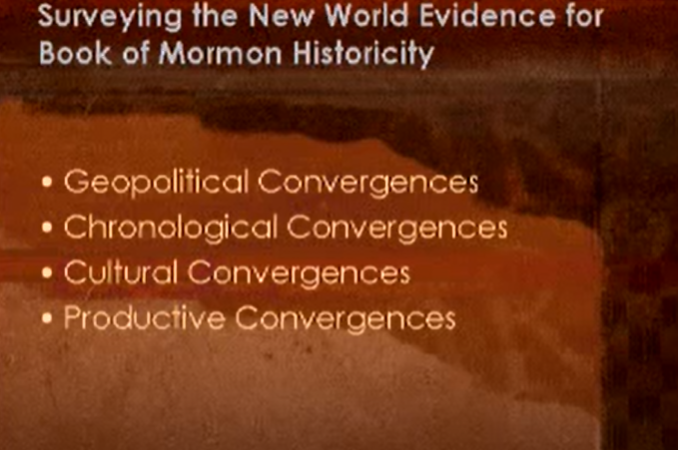
Geopolitical Convergences

Geopolitical Convergences: This is where we are talking about the fact that we have to have it on the map somewhere and then even more complicated than putting it on the map is we need to know something about the peoples that were there so converging that type of information.

Chronological Convergences

Chronological Convergences: One of the best arguments that I’ve heard for understanding that the Book of Mormon could not have taken place in the Great Lakes area is because people did not live there at the right time. Anytime you see a theory that is positing people that don’t live somewhere, that are supposed to be there and they are not there—it’s not a real strong theory.

Anytime one of the theories of Book of Mormon geography posits that you must have an area of the world under water at a time when people were living there, probably not a very good thing, even if they were under water some other time in geological history. Chronology makes the difference; you have to match the right time periods. You can have absolutely the right thing happening, and if it’s a thousand years too late, it doesn’t count, it isn’t a convergence, and it isn’t even close.

Cultural and Productive Convergences

Cultural Convergences: Once we get those first two done, then we need to look at the culture of the area and whether or not that converges and the descriptions match the kinds of things we find in the Book of Mormon.

Productive Convergences: Which is where understanding the context of the Book of Mormon, or the place where it would have taken place, actually teaches us something about the Book of Mormon that we would not understand otherwise. In other words, it becomes a way to elucidate the text, particularly in places where the text might be a little bit confusing or a little strange.

Geopolitical Convergences

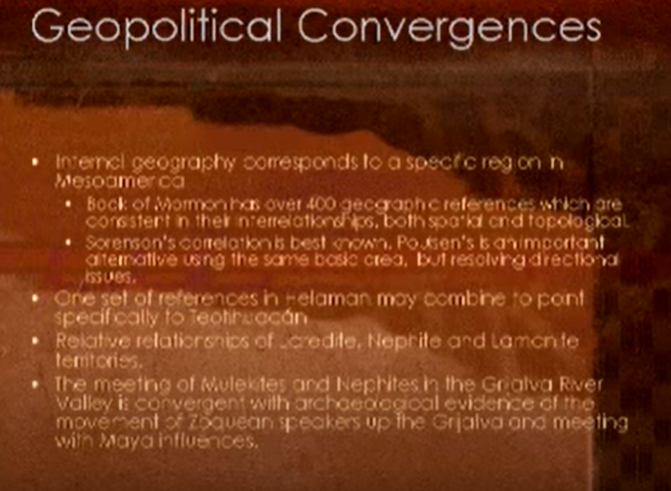
  • Internal geography corresponds to a specific region in Mesoamerica
  • Book of Mormon has over 400 geographic references that are consistent in their interrelationships, both spatial and topological.
  • Sorenson’s correlation is best known. Poulsen’s is an important alternative using the same basic area, but resolving directional issues.
  • One set of references in Helaman may combine to point specifically to Teotihuacán. 3
  • Relative relationships of Jaredite, Nephite and Lamanite territories.
  • The meeting of Mulekites and Nephites in the Grijalva River Valley is convergent with archaeological evidence of the movement of Zoquean speakers up to the Grijalva and meeting with Maya influences.

There are two correlations I’d like to put up here.

  • I am not a geographer.
  • I cannot tell for what reason, I simply don’t comprehend this stuff.
  • I understand people and
  • I understand archaeology and ethnohistory

But I just don’t seem to do geography very well, so I will rely on other people for geography.

But here is the problem that you have in geography—what you must do is you must create a convergence between the descriptions in the text and a place in the world. There are two of them I’m going to show you. Both of these are converging in the same general area of the world, they simply interpret the data slightly differently and I don’t know how to distinguish between the two as of yet. But, for the purposes I have, they agree in the places where I need them to agree, so I’m not too worried about it—the rest of it will work out.

Matching the Text to a Real Geography

But here is the problem you have, you have to take the text and the descriptions of geography in the text and you have to find a way to match it up in the real world. This is an incredibly difficult proposition.

John Sorenson has discovered at least 400 different kinds of textual correlations in the Book of Mormon, which, if you were going to have a convergence between the text of the Book of Mormon and a geography in the real world, you’ve got 400 things that have to match. This is not an easy process. If you are matching 400 locations in relative distance from each other, in topography where you go up and down and it’s consistent in the right way, you know this is simply difficult to do.

There is a recent article that attempted to say that Book of Mormon geography is so vague that you could probably put it anywhere including the Malaysian Peninsula. It was an interesting idea. Some of the things actually worked out.

One of the problems, however, is that based on that particular geography, all of the Lamanites had to be in the very, very bottom tip. And the problem is:

  • you have all this area that’s Nephite and based on the Nephite geography
  • but all of the Lamanites (that the text tells us are more numerous than the Nephites) are in this little tiny area

And it just doesn’t work, you just don’t have that kind of population distribution.

On top of that, the next thing I’ll talk about is the other reason why the Malaysian geography (model) won’t work, but to start off, we’ve got to get a geography.

Mesoamerican Models of Book of Mormon Geography

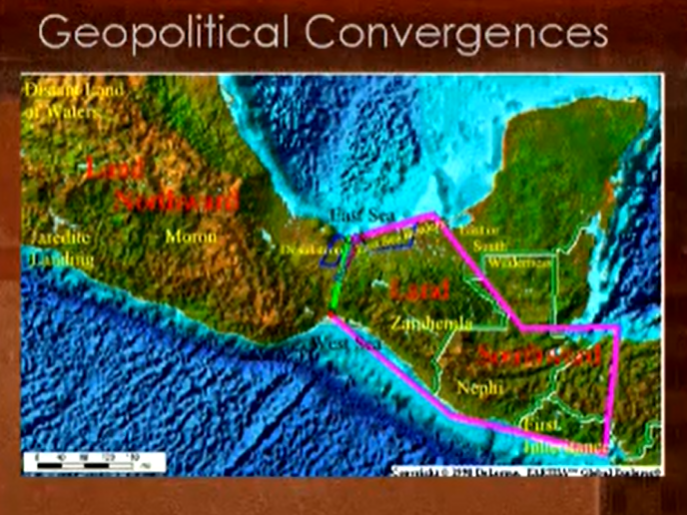
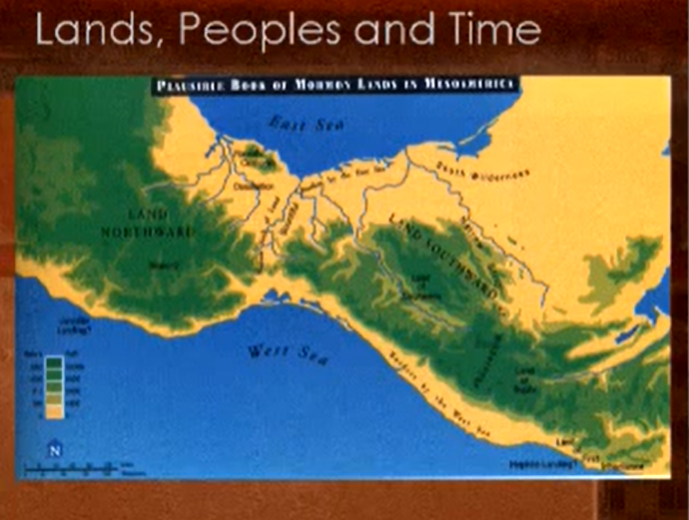
You are looking at the Yucatan Peninsula, Isthmus of Tehuantepec. And basically, this is the correlation of how John Sorenson would lay out the Book of Mormon in this land. Larry Paulsen, who is a member of FAIR, has another idea of how to do it, slightly different. What he does is kind of fascinating because in one way we have to make sure that we understand it.

What you’ll see at the top is this North-South axis. And that really looks familiar to us because as modern Americans we conceptualize directions and cardinal directions as a plus sign. What we miss is that Mesoamerica did not. Mesoamerica did not use the concept of a plus sign whenever they described the world and the four quarters of the world. They used an “X”.

So for them this is North, not that single line that we think of, but that pie, that whole piece of direction is North. It changes concepts dramatically when we have a quadrant that is Northwest, and they kind of tilt it and say ‘that whole thing is North’. So the concept of what “North” is was probably very different in the Mesoamerican world.

Adding People and Chronology to the Map

Now, here is why that doesn’t bother me that there are two different ones, and secondly, why when you take the next layer of information and you put it on the map that things like the Malaysian hypothesis fall to pieces.

In addition to being able to take the text and have some sort of a convergence with a geography we now have to put people on and in addition to putting people on the map, the Book of Mormon very clearly tells us that there is a chronological relationship among these people; and we need to find that same chronological correlation.

For instance, the Book of Mormon tells us that in the North, we are supposed to find the oldest culture and we’re supposed to find people who would have been there, let’s say, 2,000 BC. We are supposed to be able to find maybe a newer culture down along here and there better be people there around 600 BC.

We are also told in the Book of Mormon that people move out of this lower area and start moving towards the North, end up in the city of Zarahemla, where they meet up with some people who have come down from the North, the Mulekites, and they all meet in this area of Zarahemla along the river Sidon. That’s a lot of information. That is very difficult to guess.

Matching Book of Mormon Peoples to Mesoamerican Chronology

What would happen if we look at this map of Mesoamerica and the oldest people were down here and the youngest people were up there? It would be disqualified. But it isn’t. That’s where the old people are. That’s the Olmec culture up in that area; had been in that area for an awful long time.

This is the Maya region. Interestingly enough one of the things that happens is if you look at the linguistics of the area, the Olmec are—the best evidence anyway—is that they’re speaking a language that has been reconstructed and labelled Mixe-Zoque. 4

The Mixe-Zoquean speakers, which is kind of a combination of two languages, later Mixe, and later Zoque. What happened was the Zoquean group moved up that river. And this area has a connection to the people up there, and they were Zoquean speakers that moved out and historical data tell us that there is this movement of people from the North to the South along that river.

It also indicates that there is information about some of these speakers that move up this area, and meet up there, and some of the cultural data from here is starting to come into here somewhere around 200 BC. Now that just so happens to be a time period when the Book of Mormon is saying that something is happening.

Jaredites, Olmec Culture, Nephites, and Maya Culture

The Book of Mormon says that we have to have Jaredites in the North that happen to have a time depth and geographical correlation that match up very nicely with the Jaredites. Now please understand that I will not, and do not ever say that the Olmec and the Jaredites were exactly the same. I think that the most logical thing that you can say is that the Jaredites participated in Olmec culture.

Similarly, when we talk about the Maya, I do not think that either Nephites or Lamanites were Maya, but that they participated in that culture and may or may not have learned to speak that language. But there were Olmec who were not Jaredites, there were Maya who were not referenced in the Book of Mormon.

But what’s fascinating is that the history of this area tells us that there is a people who is coming from this area and merging here; ending up with a cultural influence from people this way going in that direction and that just so happens to be what the Book of Mormon tells us is supposed to happen at the same time.

Population Movement around 200 BC

There is another piece of information about this area down in here which is the area of the Land of Nephi, one of the cities that Dr. Sorenson suggests might have been the city of Nephi, Kaminaljuyu, in Guatemala. 5 I have just recently read that there is documented evidence of Cholun speakers moving into that area in about 200 BC.

Think of what that means for Book of Mormon history. Right in 200 BC we don’t know exactly what is happening, but according to the text, all of the pressures on the Nephite people are increasing right around this particular period of time, and increasing so severely that Mosiah has to take all the people who will go with him and flee and leave.

What is changing things so dramatically that all of a sudden at this point somewhere around 200 BC, they have to leave this area? Well, history tells us that there is a new People that is moving in. Perhaps that is creating some pressure.

Chronological Convergences

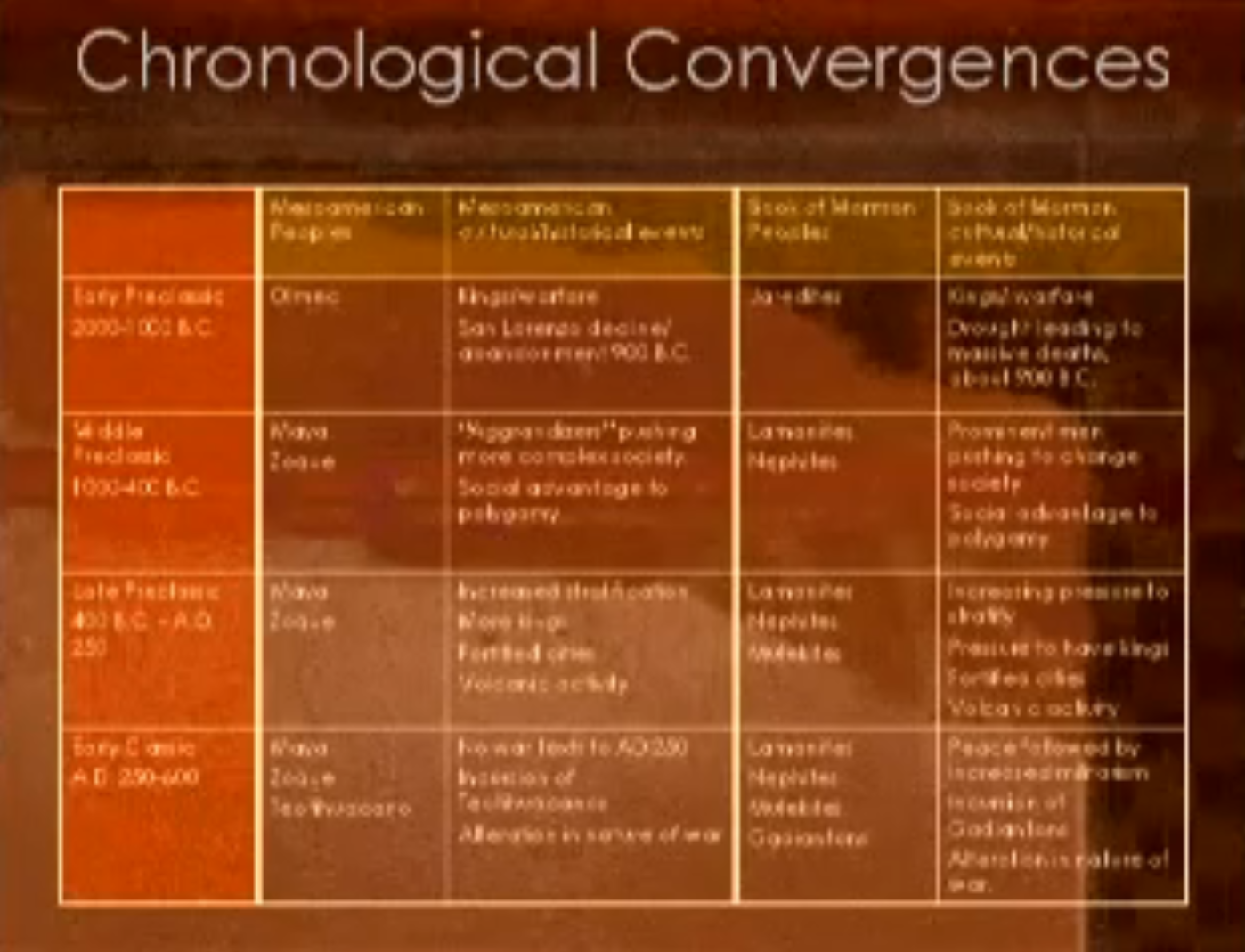
Again, if we have the wrong people in the wrong place it doesn’t really help us. One of the ways in which you get a convergence with the Book of Mormon and things that are happening in Mesoamerica is not just in this gross location of where the people are, but the kinds of things that are happening at the same time. For instance, having kings and warfare. It’s nice to say that they are there, but that is a piece of the puzzle rather than one that’s particularly interesting.

One of the things I did when I was looking at the Jaredite chronology, is I tried to rebuild the chronology in the Book of Mormon based on king lists and run backwards from times rather than make up an assumption of when I thought it might start, and based on this Jaredite king list chronology, I started laying out when these things might possibly have taken place.

One of the things that happened after that was put together is I find that in the city of San Lorenzo, they’ve got a decline and the city is being abandoned right at a time when the Book of Mormon is talking about a severe drought in the land.

San Lorenzo and the Jaredite Drought

Now, are those two exactly the same? Don’t know. But it is kind of fascinating that you’re going to have in the historical record, a decline of a population that in many cases and other instances have been tied to droughts happening at the time when the Book of Mormon is indicating that there is a severe drought in the area.

Then we get into this next time period where we have changes occurring down in the Maya world and what’s happening is you are moving from smaller populations to larger populations, you are moving from villages to cities, and the political structures are beginning to change.

So the social pressure in Mesoamerica is one that is developing this push towards what will become the classic Maya model of kingship. Those pressures are happening quite early and there are several mechanisms that have been used to try to describe how people moved from the small village into the situation where they are getting more social stratification.

Aggrandizers, Trade, and Social Inequality

One of the two people who wrote the article that I think makes the most sense on this was John Clark and he talked about a process of aggrandizers where one of the things that they would do is you’d get some ambitious people who would start trading and then they would get more trade goods, and this was going to increase their status in the community, and because they are increasing their status in the community it’s going to get some differential in what they have and what somebody else has, the kind of trade goods you have. You will get some sort of social inequality there.

One of the things that absolutely struck me is that this is first of all an economic argument in that you’ve got people who are looking to better themselves through trade and look at wealth, money, etc. And the second thing is the mechanism that they used was that they would have plural wives.

The reason? They’d have more people to work. You get more wives, so you get a bigger family, you have a cottage industry and now you’ve got more workers, you’ve got a built-in workforce, you create more items, you get more trade.

Costly Apparel and Multiple Wives

It has always been fascinating to me that this is the exactly the time period where Jacob is complaining about something that is happening in his community, and he complains about two things that you would not suspect are connected which are costly apparel and multiple wives. He is telling people why this is terrible.

Why is it those two things? How do those go together? Why are they related? Because that’s what is happening at that time period.

Next kinds of things happen, you get these increasing pressures to have kings; you get fortified cities; the Book of Mormon talks about the time of Christ. The best information about what’s happening when Christ comes is that there is this massive volcanic activity.

There are lots of indications that at least around this time period, within 100 years before and after, there are a lot of very active volcanoes. We are not at the point where we can say this is the volcano that erupted and is being described in the Book of Mormon. But what you can say is that around that time period, it is pretty obvious that there was some heavy volcanic activity. So again you are getting a convergence in time and place and in description.

Warfare and Chronological Convergence

This one is brand new—Mark where are you? Stand up and say hello to everybody. This is Mark Wright he’s a Mesoamericanist getting his Ph.D at UC Irvine. It’s been a heck of a lot of fun talking to him because we actually talk shop and I can say things and he knows what I’m talking about.

This is one that he pointed out to me, this is from David Stewart in a recent discussion at the Texas Maya meetings where he was just happening to mention that there are no Maya text dealing with warfare prior to 200-250 AD, and then after that we get it all the time. Why? There is a really kind of odd convergence and frankly one that I wasn’t expecting to see.

Next kind of thing that we’re getting, militarily, we know that down in the area where the Book of Mormon would have taken place, around the time that the closing events are occurring in the Book of Mormon, the people of Teotihuacán are coming down, they are bringing with them a new style of warfare, they change the rules.

There are all kinds of indications that things are dramatically different when all these Teotihuacános come down, and then you read the Book of Mormon text and right at the same time that historical documents are talking about the Teotihuacános coming down and changing the nature of warfare, we have Mormon who is first of all complaining about the Gadiantons, and secondly complaining that the nature of warfare has changed and complaining it just isn’t the way it used to be.

So the Book of Mormon is one more time, chronologically reflecting the same kinds of pressures that we know to have been occurring at that time period.

How Many Correlations Can Happen by Accident?

To this point in time, we are still at one of those things where you look at it and you say, how can this kind of a correlation happen by accident? How do you hit that many things and that carefully?

Somewhere along the line we should have the chronology getting mixed up if we were in the wrong place. If we were in the Great Lakes region this would have blown up a long time ago. If we were in Malaysia it would have blown up a long time ago at the time when we’re looking for just the older populations—there are not populations and peoples in the right places at the right time in Malaysia. There is a good reason why that doesn’t work. Way past geography the rest of the geopolitical situation does not work.

But the Book of Mormon just keeps getting better, and including things that I found out yesterday, make it look better than I’d seen.

The Israelite Background of the Book of Mormon

Another one that is fascinating and I’ll just mention it, because it’s not my research but I find it absolutely amazing. People have really complained about the Book of Mormon because it is the wrong kind of document. You are talking about Christianity way too early. There are just all kinds of things that are supposed to be wrong against an Israelite background.

The problem is, they are wrong against an Israelite background only (inaudible) pre-exilic Israel. The more that Israelite religion is being reconstructed prior to the time that Lehi took off, the more the Book of Mormon’s theology and the things that it’s concerned with fit right in. It’s not nearly as problematic as they thought.

What’s wrong are the expectations that were brought to the text—not the text itself.

Cultural Convergences

  • Anthropological
  • 1 and 2 Nephi parallel established patterns of ethnogenesis 6
  • “Getting the right things wrong” – when the text makes a “mistake,” it make the “correct” mistake
  • Insider/outsider vocabulary
  • Pejorative stereotyping
  • White/dark as metaphor rather than skin color
  • Mormon’s presentism
  • Mormon’s description of wealth in Alma 1
  • Lamanites learning literacy from the Nephites
  • Literate society
  • Monument stones – stelae and Coriantumr’s story-stone 7
  • Annals format
  • Book of Mormon literary parallelism including chiasmus, Mesoamerican emphasis on parallelism and evidence of chiasmus in the Popol Vuh.
  • Dynasty emphasis – Book of Mormon book-name changes
  • Indications of vigesimal system 8
  • 400-year prophecies
  • Suggestive structures in counts and estimates.

“Getting the Right Things Wrong”

There are things that people will say about the Book of Mormon, they will say, “You know they got this wrong, this is wrong, you shouldn’t do it this way”. The problem is, you really don’t want and should not find a historical text that is perfect according to our modern perceptions what a history ought to be.

The Book of Mormon should not look like a modern history; if it does, it’s a forgery. It should look like an ancient text, that’s where it came from.

In ancient texts there are lots of things that people get wrong and the Book of Mormon happens to get a whole bunch of things wrong. For instance, it uses insider/outsider terminology. It tends to say, as most people do when they are first creating their societies, there is “us” and “them.” There is this big wall around us, and anybody who is not us is them and we don’t like them. It’s wrong for modern history but it’s exactly right for ancient history.

When the Book of Mormon Gets Things “Wrong”

Mormon makes a mistake when he is talking about some of the historical conditions of Teotihuacán 250 years earlier. Well, is that wrong? For an ancient historian no, actually it’s exactly right. He should not have known what happened in a city that is that far away 250 years earlier.

What he should have done is what he did. He assumed that what he knew about the city at that time had always existed. That’s the way people thought at that point in time. So oddly enough, in a lot of cases some of the things that the Book of Mormon gets wrong—from an anthropological standpoint—it is getting exactly right.

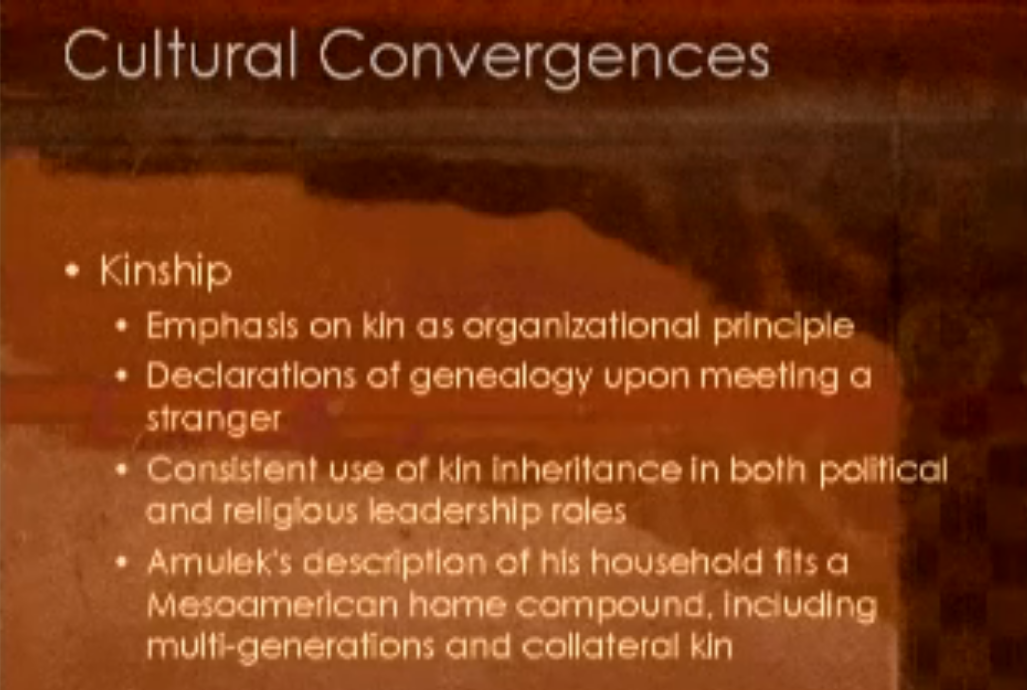
Kinship

  • Kinship
  • Emphasis on kin as organizational principle
  • Declarations of genealogy upon meeting a stranger
  • Consistent use of kin inheritance in both political and religious leadership roles
  • Amulek’s description of his household fits a Mesoamerican home compound, including multi-generations and collateral kin

This is actually very important—the kinship structure inside the Book of Mormon and the way kin function in the Book of Mormon matches a kin-based society. By the time of Joseph Smith we had lost a lot of that and certainly by our time we’ve lost even more of it. But the Book of Mormon tends to operate like a kin society would have, which again is something that it ought to do. Contrary to what our expectation would be from somebody who is writing in the 1830s.

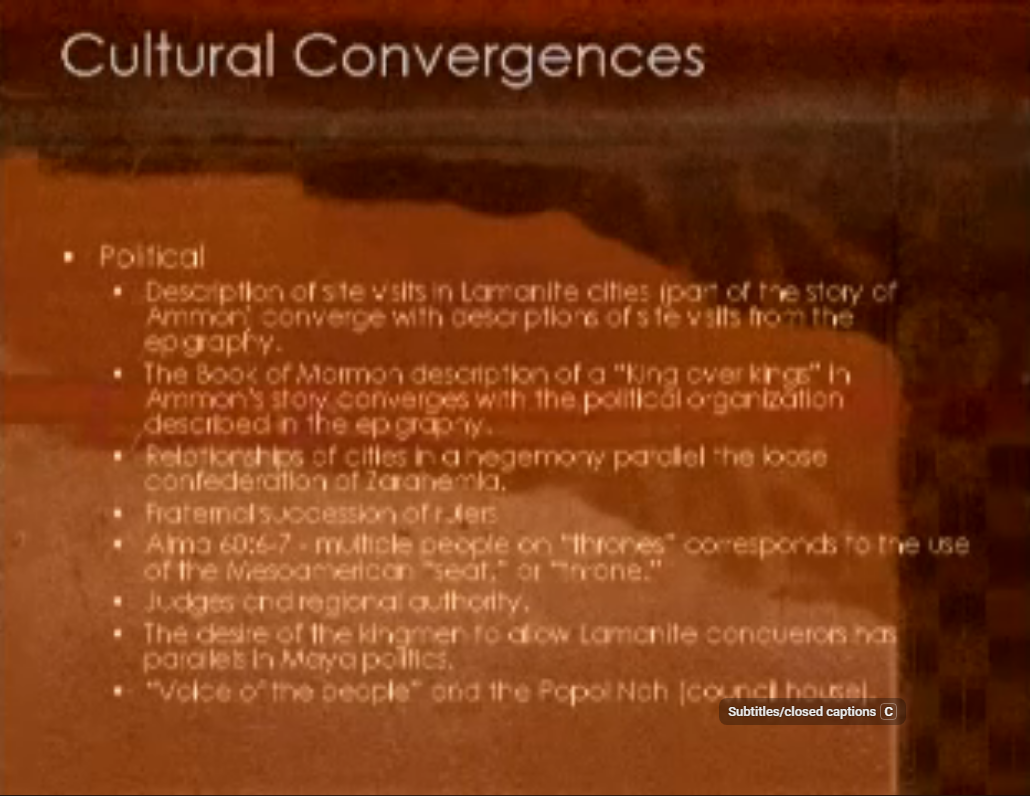
Political Convergences

  • Political
  • Description of site visits in Lamanite cities (part of the story of Ammon) converge with descriptions of site visits from the epigraphy. 9
  • The Book of Mormon description of a “King over kings” in Ammon’s story converges with the political organization described in the epigraphy.
  • Relationships of cities in a hegemony parallel the loose confederation of Zarahamla. 10
  • Fraternal succession of rulers
  • Alam 60:6–7 – multiple people on “thrones” corresponds to the use of the Mesoamerican “seat,” or “throne.”
  • Judges and regional authority.
  • The desire of the Kingmen to allow Lamanite conquerors has parallels in Maya politics.
  • “Voice of the people” and the Popol Nah (council house). 11

Is the Book of Mormon Describing Democracy?

In general, one of the things that people will say about the Book of Mormon is that it’s got to be modern because it talks about voting. The voice of the people has to be a vote. Anybody who has said that has not examined the text on the voice of the people.

Anybody who thinks

  • that the Book of Mormon is a democracy and
  • that the Book of Mormon promotes democracy

has not studied it. It does not. It is a very complicated system. I am sure that somewhere in the world there is another system that’s just like that. But the only one I happen to know of is in the Maya world where down at the bottom here in the Popol Nah, or the community house, where the elders gather together to hear the cases and discuss them.

The “voice of the people” being literally that. And if you read one of the sections in the Book of Mormon where it is talking about it, you can actually see in your mind’s eye these people just talking. And somewhere in talking it out, changing their minds and coming to whatever the consensus opinion is. It has nothing to do with votes.

The political system in the Book of Mormon simply doesn’t look modern at all. What it does look like is the things that I’ve seen in Mesoamerica.

Warfare

  • Warfare
  • The seasons of warfare match with the types of seasonality in Mesoamerica
  • Relationship of timing of war and famines
  • Militia style – no standing army
  • Defensive armament is correctly described
  • helmets
  • slings
  • breastplates
  • shields
  • “thick clothing” as armor
  • wounds on the legs – ie. no greaves 12
  • Descriptions of the deployment and types of weapons
  • Tactics
  • Rarity and surprise of right movements
  • Scouting a walled city, using ladders if not other way
  • Hiding in foxholes
  • Battle between champions
  • Defeat of the king is the defeat of the army
  • Battle by appointment
  • War on a tribute model rather than a conquest model
  • Fortifications described that fit with developing Mesoamerican fortifications – appearing at approximately the same time period.
  • Lineage succession of the general

What is fascinating about this is that not only does he mention certain weapons, but the Book of Mormon is very accurate in the way those weapons are used in an attack. I am not a military man, but there is a certain way that you would do things and I’ve consulted with a couple of military men—the Book of Mormon actually makes military sense.

People who do war for a living can look at the text and say, they’re doing the right kinds of things with the right weapons the right way.

None of these are the way war was fought when Joseph Smith was thinking of things and the tactics are entirely different.

Aztec Warfare and Book of Mormon Tactics

One of the ones that I found very fascinating, Ross Hassig has book out called “Aztec Warfare” and the longer I read that, and the more I read the Book of Mormon, the more I start seeing the same tactics being used in several occasions.

There are textual witnesses of the Aztecs doing some of the very same things that we have seen in the Book of Mormon. So obviously they are effective tactics. We don’t know who came up with them, but it is kind of curious that that area of the world knew about them and used them including hiding in foxholes, popping up and attacking your enemy as they come by.

Productive Convergences

  • Productive Convergences
  • Geography as explanation
  • Limhi’s expedition gets lost because they follow the wrong river.
  • Tactics depending upon topographic relationships.
  • Culture as explanation
  • Jacob’s use of Isaiah
  • Ammon and Lamoni
  • Why Lamoni thought Ammon was “more than a man”
  • Clan struggles as background for Ammon at Waters of Sebus
  • Anti-Nephi-Lehies
  • Mesoamerican caches and the Book of Mormon burying of weapons 13
  • Captive sacrifice and the seating of kings
  • Seating of kings and the raid on Ammonihah

If the text of the Book of Mormon is an authentic text it should be written by someone who assumed that we knew as much about his world as he did; that’s the way the ancient people tend to write. That’s the way the Biblical writers wrote.

They simply assumed that they did not have to explain a lot of things to us because they assumed that we were part of the culture and that we would understand things. So, the only things that you get told are the things that you need to know because you’re supposed to know everything else.

That works really well until:

  • the world has changed and
  • we don’t know everything else and
  • all of a sudden things become kind of confusing and
  • they look strange and
  • you get these odd questions about the Book of Mormon text where it tells a story
  • where in our hearts of faith we know that it’s a darn good story but
  • as soon as we step back from the view of faith and we look at it kind of cold and calculated it becomes a stupid story

I’ve got two of them for you. One of them is thanks to Larry Poulsen.

How Do You Lose a City?

How do you lose a city?

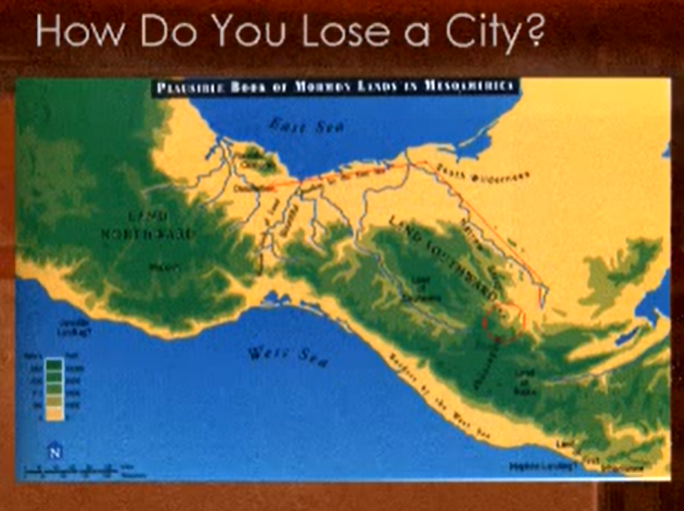
Zarahemla might not have been the biggest city around and frankly was not, should not have been. When they get to Zarahemla they’re actually very homesick for where they came from probably because they’ve now gone to the backwater 14 after coming out of a real nice place which is probably why the people of Limhi want to go back and inherit that land—so they do—and they go down and after a long period of time with King Noah and everybody else they get dominated by the Lamanites, things really aren’t very good and so they’re hoping for Zarahemla to come help them out and somehow rescue them.

So they send a party to go back to Zarahemla—and they can’t find it! This is only a generation later. I’m not even that bad with directions. How do you lose a city when the instructions are ‘go to these mountains, find the river and follow the river until you hit the city’?

Follow…Which River?

There are two rivers. This is the Grijalva and the Usumacinta. It doesn’t quite show you there but one of the things that Larry Poulsen noted when he was doing some research on this is that the headwaters of those two rivers are only a mile apart in the same mountains.

They followed the wrong river. They did exactly what their parents told them to do—go to the river, follow it. Wrong river. How did they lose Zarahemla? It wasn’t on that river.

However, when you get up here, what’s up there? Jaredites. It’s exactly what they were supposed to find.

How do you do that if you don’t know this geography? How do you make that mistake so right? That is a convergence. If it were the only convergence it would be a curiosity but it isn’t.

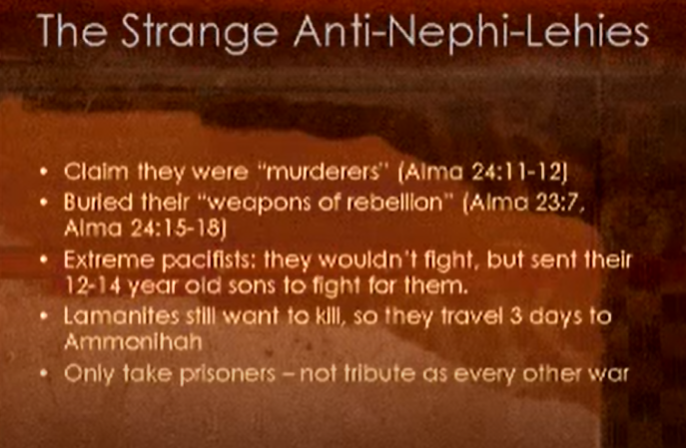
The Strange Anti-Nephi-Lehies

Two years ago I was here and I talked about the strange case of Ammon at the Waters of Sebus and talked about that being a weird story. I’ve told that a couple of times and people really get nervous when I talk about weird stories in the Book of Mormon and they think I’m basically disrespectful or don’t like it.

That, first of all is not true, I love the Book of Mormon. Secondly, this is really a weird story! This one’s probably the strangest story in the Book of Mormon because it makes absolutely no sense whatsoever so forget about the fact that this is a faith-promoting story, take your faith hat off and listen to the stupid story!

First of all the people of Anti-Nephi decide that they are going to lay down their weapons and not fight because they claim they were all murderers. Now think about that—when did the women and children murder anybody?

Even if the men were off murdering in war, and by the way you never define murder in war—soldiers never murder. We would have to redefine it differently so that we could go ahead and do it. But when did the women and children do it? And they’re saying they’re all “murderers” and this is a terrible thing. (Alma 24:11–12)

Burying the “Weapons of Rebellion”

Next one. They bury their “weapons of rebellion.” (Alma 23:7, Alma 24:15–18)

That sounds interesting—they’re going to bury their weapons. Now, how many of you out there if you had a million dollars and you buried it in your background and you thought you needed some of it might go dig it up? You know if I buried the darn thing I know where it is.

That doesn’t really prevent me from doing much with it. Why is burying this thing—first of all why do it in the first place and secondly, why do I think that’s going to do anything? If I want my sword I’ll go dig the darn thing up.

Extreme Pacifism and the Anti-Nephi-Lehies

Now, they are extreme pacifists, they are so pacifistic that they are not going to take up a weapon in their own defense and they are going to allow someone to kill them rather than to fight back. That’s pacifism. That’s really remarkable and these same people sent their 12 to 14-year-old sons off to war and said, see you later I’m not going. I’m not going to fight. But you, good luck. That’s weird. That’s a dumb story. It just doesn’t happen.

We’ve got the next two: the Lamanites when they finish killing all these people they decide that they still want to kill someone. They’ve got this bloodlust so they take a two or three-day hike off to a city and go attack them. You know somewhere along the second day of marching I would probably say, I don’t feel like killing anybody anymore. Can I go home? Can I have a hot meal? Why do you go that far away to go kill somebody? You had people right there.

Next, this is the only story in the Book of Mormon where we talk about a Lamanite attack where the Lamanites don’t try to dominate the city and set up a tribute relationship so that they can get an economic benefit from having conquered that city. These guys go in, they just kill people and leave but it’s the only time we ever get a mention in the Book of Mormon that they take prisoners. Why toss that odd little piece in?

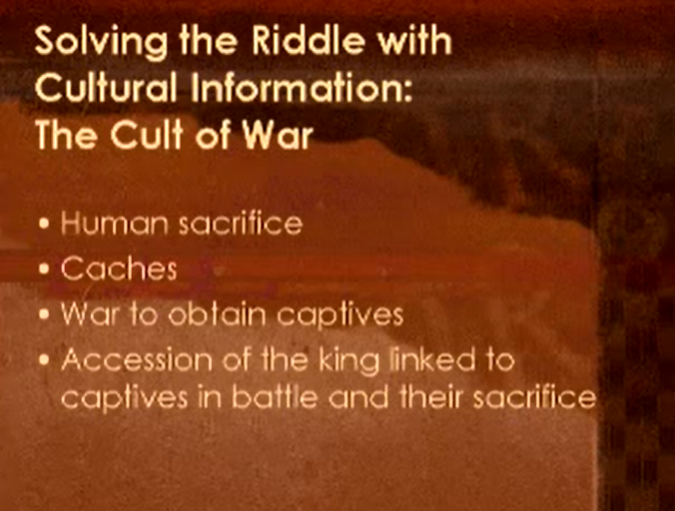
Solving the Riddle with Cultural Information: The Cult of War

Human sacrifice

This is where Mesoamerica comes to our help to tell us why this particular story sounds so dumb to us but works in the context of this part of the world. The religion of most Mesoamericans can be summed into the cult of war—where war is a sacred thing and war is part and parcel of your religion.

Part of this is not only killing people in warfare but bringing people back and then sacrificing them. Now think about the people who have claimed that they are murderers. When do they murder? Well, they probably didn’t. But if:

  1. they have been converted to the gospel and
  2. they have learned that human sacrifice is probably not something that they ought to do

Those people who have participated in, condoned and experienced the religion that did condone human sacrifice might have a different view of how their participation would be viewed.

Caches

Secondly, if their participation in the human sacrifices were distinctly related to war, and all of the feelings about that ancient religion were stirred up when they went to war, that will tell you:

  • why they didn’t want to go to war;
  • why they did not want to pick up any weapons;
  • why that was, for them, the hardest thing that they were going to do.

There were so many connections that were made between those actions and what they were trying to do.

In Mesoamerica it is a known procedure that people at the beginnings of new things and at the endings of certain things would cache objects—which means they would bury them. They would dig a pit and they would drop them in.

The Book of Mormon does not tell us this particular detail (probably, again, because it doesn’t need to), but most of the things that were cached were ritually broken. It is highly likely, given the context and the culture of that area, that we are talking about a cache. The reason they couldn’t go dig it up again is because they ritually broke, as an offering to God, all of their weapons as they offered their weapons to God in the earth. Which was a standard practice in that area.

War to obtain captives

Next, we have a war and part of the idea of war is to obtain captives so that’s, again, part of what we’re doing, we’re going off to Ammonihah to get prisoners.

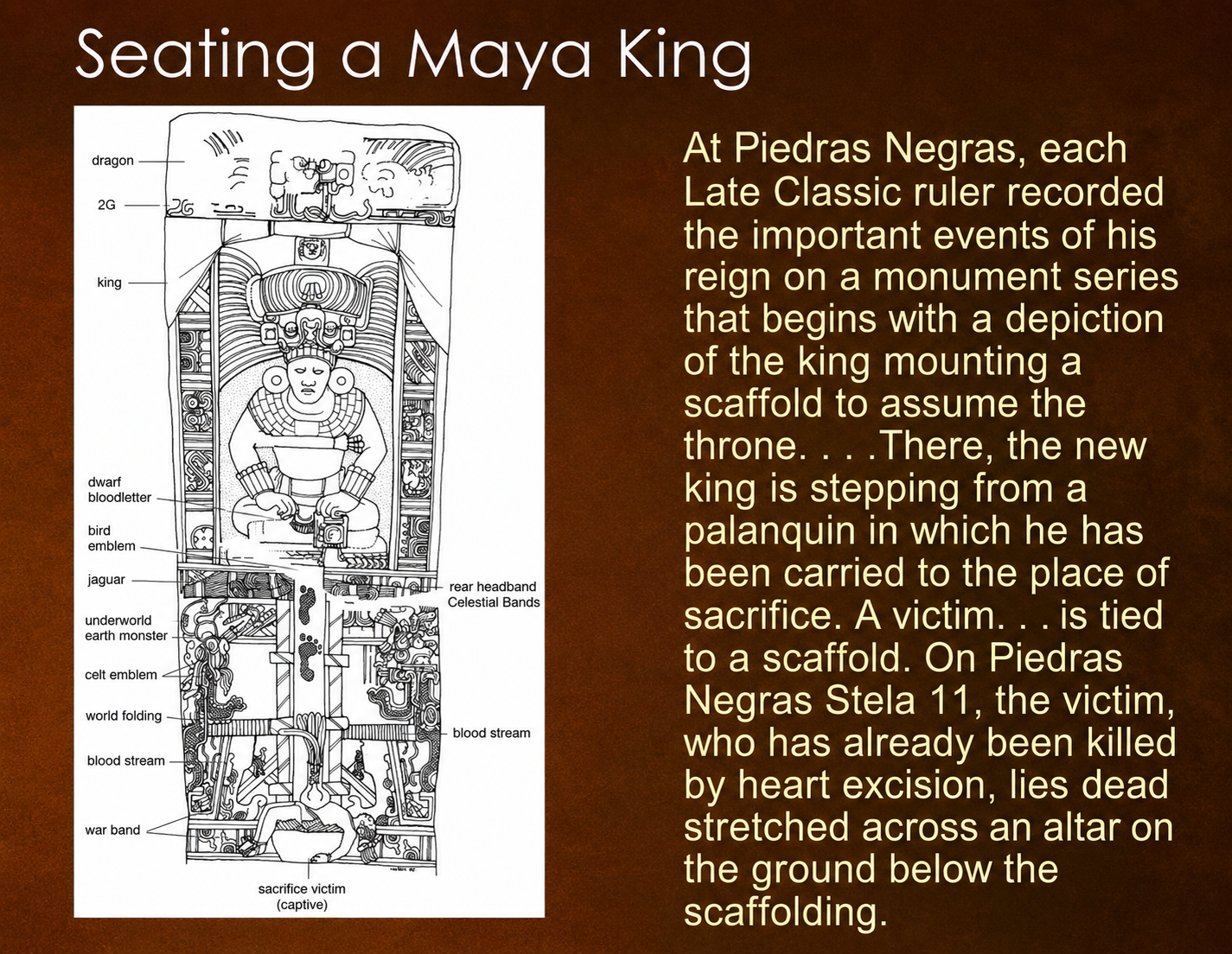
Accession of the king linked to captives in battle and their sacrifice 15

Then the very last thing that we have to know is how do you seat a new king? Well I’ll pop the slide up. I won’t read it. (Just so you get at least one Mayan picture while we’re here!) The people who are coming into the city of Anti-Nephi-Lehi to take it over were doing so with the express purpose of:

  1. capturing the city,
  2. removing the previous king, Anti-Nephi-Lehi,
  3. and setting up their own king.

They succeeded. They did not have any opposition therefore they must have been able to take over the city and set up their new rule.

When you have a new king how do you install that new king? And in the Mayan world, you seat them on their throne. But one of the things that you must do in order to properly seat a Maya king is you must sacrifice a prisoner captured in battle.

The Anti-Nephi-Lehies didn’t fight back, didn’t count. So you had to do what other texts have told us that other kings did, you go off to some unsuspecting city that’s probably going to be easy pickings 16 but who will fight back, fight them, get your captives, come back, install your king.

When the “Stupid” Story Makes Sense

In the context of Mesoamerica, this “stupid” story all of a sudden makes perfect sense. Of course it happened that way. But the only way we know why it happened the way the text tells us that it happened is by:

  • knowing where the Book of Mormon took place;
  • having a convergence not only of the geography into a place, but of the time, of the location, of the people, of all of these events and cultures where the text of the Book of Mormon converges with the information that we get out of Mesoamerica.

And not only tells us that the Book of Mormon took place there, but knowing that tells us more about the Book of Mormon than we might possibly have known otherwise.

We Can’t Unsee the Dog

Having been through the Book of Mormon for a long time, this is the “dog”. We are still in the process of

  • putting pieces together,
  • drawing in the outlines,
  • making sure that we have the details right.

Someday, perhaps, we’ll get to draw in the hair! But the “dog” is there.

Having been through the text, having looked as carefully as I possibly can—and, believe it or not, with the exact same rigor that I used in the paper where I came up with the idea that I didn’t like the Quetzalcoatl correlation, using those same tools, those same rigors—the “dog” is there, and I cannot for the life of me “unsee the dog.”

This is a different book than I read 20-30 years ago. But boy is it fascinating, and is it interesting! I get more and more interested in it the more I learn and the more I see. And it’s a much better book than I’d ever thought it was going to be. Though, it is still the one thing that I thought it was – which is *true*. And I bear you that testimony in Jesus’ name, Amen.

Questions and Answers

Have there been any cities, ruins, etc. believed to be the Book of Mormon peoples rather than Mesoamerican peoples?

Q: Have there been any cities, ruins, etc. believed to be the Book of Mormon peoples rather than Mesoamerican peoples?

GARDNER: Let me give you the real quick answer to that, my answer is no because I can’t tell you the difference between Book of Mormon peoples and Mesoamerican peoples. We’re in the wrong state to ask this question but if I were in New Mexico I would actually ask you how many of you had a neighbor who wasn’t a Mormon?

Up here that’s a little bit more difficult to do, but I suppose that you’ve all been to a state where there isn’t one. What does a Mormon car look like? I realize it looks like a minivan! (Laughter) But you know, there are actually other people who drive them. What does a Mormon house look like that’s different?

The material culture that we have is the material culture that everybody else has. 17 In my neighborhood you go up and down the street and there is no way from looking at the outside of the house, from looking at the cars, if you went inside from looking at my pots and pans and plates—there’s no way you could tell what my religion was.

Material culture does not tend to do that. So, as John Clark has said, we’ve probably found Nephite ruins and Nephite artifacts. We just can’t tell the difference because they look like everybody else’s.

Does the Book of Mormon ever suggest or imply mingling with indigenous peoples? Or why would the Book of Mormon peoples choose to include that?

Q: Does the Book of Mormon ever suggest or imply mingling with indigenous peoples, or why would the Book of Mormon peoples choose to include that?

GARDNER: I do believe that it certainly implies that. There’s only one text I know of where the implication is as explicit as we’re going to get it. Which is when Nephi and his brothers are leaving after the split.

And Nephi is taking all the people to go up to the Land of Nephi. He goes through and he names names, and he says

  • this person went with me, and
  • this person went me and
  • this person went with me and t
  • his person . . .

And he doesn’t name Laman or Lemuel. We’re pretty sure we know why they didn’t go with Nephi—since they were trying to kill him. We’re reasonably certain that Laman and Lemuel’s wives and children would remain with them. But other than that, Nephi seems to have named everybody we’ve ever known about that we’re not pretty sure has died by the time you get to this separation of people. And yet at the end of this time, when he’s named just about everybody there is to name he says, “and all others who would go with me.” Well, who the heck were these others?

The Others Nephi Talks About

The next thing that happens, if you’re looking at the text, as you go through and you say, well if there were others there does the text give us that hint? And I won’t go into the reasons but there’s several reasons to believe that the text simply doesn’t work without others there.

There’s also a speech that Jacob gives at Nephi’s behest specifically talking about a passage in Isaiah that makes absolutely no sense whatsoever unless there are others with the group at the time. So then the next question is, why don’t they mention that?

A complicated issue and if you remember what Matthew Brown was talking about in texts, what you have as a text may or may not represent all of the rest of the information that you might have had. You’ve got a text and you have to do deal with.

But we have a text to and we don’t have either the text that Nephi wrote about the more mundane things nor do we have what Mormon abridged to that text; all we have is the secondary text Nephi explicitly tells us that he’s writing it for entirely different reasons and if you look at 1st Nephi it is an incredibly well crafted document. 2nd Nephi falls apart frankly, we are like disappointed in my boy Nephi because 1 Nephi is great and 2 Nephi kind of fades but he planned it.

Ethnogenesis and the “Others”

Now, one of the things that I’ve just learned recently is that there some patterns of ethnogenesis when you’re trying to explain how you get a new people and there are several things that happen there but one of them is that you create these dichotomies between the insider and the outsider.

Why doesn’t he mention the others? They’re not relevant to his story of ethnogenesis. What’s relevant is that there’s a split and he’s trying to define who the Nephites. These others are now part of the Nephites, he doesn’t need to define them as separate—it is his intent to define them as part of the group and is opposed to everybody else.

Since the whole face of the land was altered at Christ’s death why should today’s geography correspond to pre-Christ geography?

Q: Since the whole face of the land was altered at Christ’s death why should today’s geography correspond to pre-Christ geography?

GARDNER: How many of you remember Mount St. Helens? I have a little bottle of ash that somebody collected for me. Mount St. Helens really looks different. The whole face of Mount St. Helens is really quite different but I know where Mount St. Helens is. It hasn’t moved.

Although the face of the land changed, that is a literary reference to the degree of change in the land. It’s not a change that says,

“by golly I could not find my way home because all the roads were backwards.”

That simply doesn’t happen.

If you are going to look at the Book of Mormon and say that it happened as a real text, you have to assume that there’s a real world behind it. And the real world simply doesn’t change so dramatically that we would not be able to recognize it. Certain things are going to change, but not that many.

Answers in this Presentation

What does Brant Gardner mean by “convergence” in Book of Mormon studies?
He means multiple independent pieces of historical evidence that fit together rather than a single similarity or parallel being treated as proof.

Does Brant Gardner claim the Nephites were Maya?
No. Gardner explicitly says he does not believe the Nephites or Lamanites were simply “Maya,” but proposes that Book of Mormon peoples participated in broader Mesoamerican cultures.

Does Gardner identify the Jaredites as the Olmec?
No. He specifically cautions against equating them, suggesting instead that the Jaredites may have participated in Olmec culture.

Why does Gardner compare Book of Mormon evidence to “seeing the dog”?
He uses an image of a Dalmatian formed by scattered spots to illustrate cumulative evidence: individual dots may mean little, but together they can form a recognizable pattern.

How does Mesoamerican culture help explain the Anti-Nephi-Lehies?
Gardner proposes that Mesoamerican practices involving ritual caches, warfare, captives, sacrifice, and royal accession provide a cultural context for details in the Anti-Nephi-Lehi narrative that can otherwise seem puzzling.

Search topics

Book of Mormon evidence in Mesoamerica; Book of Mormon historicity; Book of Mormon archaeology; Book of Mormon geography; Mesoamerican geography; archaeological evidence for the Book of Mormon; Brant Gardner convergence; Book of Mormon cultural convergence; Book of Mormon chronological convergence; Book of Mormon warfare; Nephites and Maya; Jaredites and Olmec; Mulekites; Zarahemla; Anti-Nephi-Lehies; Waters of Sebus; Mesoamerican political systems; Mesoamerican kinship; ancient American cultures

Book of Mormon anachronisms; archaeological criticism of the Book of Mormon; Book of Mormon geography criticism; Book of Mormon historicity criticism; CES Letter Book of Mormon archaeology; CES Letter Book of Mormon evidence; Book of Mormon evidence criticism; Joseph Smith and Book of Mormon authorship; Book of Mormon ancient origins

The Case for Historicity: Discerning the Book of Mormon’s Production Culture


As an article of faith, Latter-day Saints affirm that “We…believe the Book of Mormon to be the word of God.” (8th Article of Faith). The book itself declares that it is “it is an abridgment of the record of the people of Nephi, and also of the Lamanites.” (Title Page of the Book of Mormon). While it is possible for the word of God to not be a history, most Latter-day Saints understand that it is not possible for this book to be the word of God if it is not the history it claims to be. As Kent P. Jackson declared: “[The] historicity [of the Book of Mormon] is fundamental to what it is and what it intends to accomplish.”1 The acceptance or rejection of the Book of Mormon as scripture often hinges on the acceptance or rejection of the Book of Mormon as history.

Lou Midgley described the basic lines of the historical debate: “There is nothing in the Book of Mormon…that suggests that it should be read as anything other than historical fact. On the other hand, critics of the Book of Mormon have always insisted that it is a product of the nineteenth century–that it reflects the thinking and the world of Joseph Smith (or one of his contemporaries) immediately prior to its publication.”2 In keeping with the dichotomous appraisal of the prophet Joseph Smith by believer and critic, both believers and critics tend to approach the question of when the text was written as an either/or proposition. For the critics this is essential, for any indication of authentic antiquity would appear to validate its historicity and therefore Joseph Smith’s claim that it represents a translation of an ancient document. For the believer, however, the faithful declaration of antiquity has led to such a focus on the ancient world that the rather obvious aspects of modern production receive little attention.

Believers seldom recognize that it really is undeniable that the conditions of the American Northeast left their imprint on the text. For instance, it was published in English, not French. Had Joseph Smith lived not too much farther northeast, “adieu” would never have been controversial.3 A slightly different set of political pressures in England in the 1600s would have kept the Geneva Bible as the standard for the English language, and the Book of Mormon would never have so clearly imitated the style of the King James Bible.4

The problem for the historian is that the Book of Mormon declares a dual creation. The plate text is declared to be ancient. The translation, however, in inextricably associated with Joseph Smith. This dual production complicates the issue, but not beyond similar efforts to understand the historicity of the Bible. The Bible, in English, is also a translation. It also faces a difference between a known history and a textually asserted history. It proposes similar issues about whether the textually asserted history might reflect actual events or only literature or myth. Historian Baruch Halpern provides an interesting analogy that he created to describe approaches to the Bible. It is appropriate to our discussion of the historicity of the Book of Mormon:

The image of the map clarifies [the various approaches to the Bible as history]. The map, say of Europe, includes cities and highways of the tenth century, of the eleventh century and so on, continuing into our own time. In effect the confessionalist maintains that all those cities were on the map from the start, that God created Europe, and the map, in the tenth century. Critical study divulges that this is not so, that some of the cities and highways appeared later, and it is the job of the historian to determine when each town, highway, and so on, was added. Negative fundamentalists, however, date the whole map by its latest elements. Because the map reflects a view from the twentieth century, they argue, it cannot be used to get at earlier times.5

Just as does the Bible, the Book of Mormon has its confessionalists who accept the text uncritically. It is also susceptible to what Halpern calls “negative fundamentalists” precisely because it has a history that is demonstrably related to the nineteenth century American Northeast. The historian’s task for the Book of Mormon is one of analyzing the various roads in its map and discerning the time period in which they were created.

Our task would be infinitely easier if we had (and could read) the original plates of Mormon. Lacking those plates makes our task more difficult, but not impossible. There are ways that we can use the modern text to examine its possible relationship to a different and ancient culture. In archaeology, contextual clues can help date the various roads of the European map to determine when they were laid down. Textual archaeology similarly requires contextual clues to determine the time and culture that created the text. We are looking for what may be termed the production culture of each “road” in the text; that is, the conditions and assumptions prevalent when the text was produced.

It is virtually impossible for a text to be without some trace of its production culture. Orson Scott Card described the problem this way: “[Joseph Smith’s] work should proclaim itself to be a phony on every page today. This is because every storyteller, no matter how careful he is, will inadvertently confess his own character and the society he lives in. He can make every conscious effort, he can be the best educated scholar you could possibly find, but if he tries to write something that is not of his own culture he will give himself away with every unconscious choice he makes. Yet he’ll never know he’s doing it because it won’t occur to him that it could be any other way.”6

A similar explanation from a social-historian’s perspective comes from Bruce J. Malina, professor of theology at Creighton University, and Richard L. Rohrbaugh, professor of religious studies at Lewis and Clark College: “Readers and writers always participate in a social system that provides the clues for filing in between the lines. Meanings are embedded in a social system that is shared and understood by all participants in any communication process.”7 When both the reader and the writer share the same social system, meaning may be communicated with reasonable clarity because the shared social system provides common ground for understanding. When the writer leaves spaces between the lines, the shared social system fills them in. The problem with historical texts is that what was written anciently was written not only in a different time, but for a different time. The production culture is different from the reading culture.

Malina and Rohrbaugh explain the resulting problem: “Although meanings not rooted in a shared social system can sometimes be communicated, such communication inevitably requires extended explanation because a writer cannot depend on the reader to conjure up the proper sets of related images or concepts needed to complete the text.”8

In Orson Scott Card’s world there is a great deal of extended explanation. This is not simply the nature of the literary effort. It is the nature of an attempt to explain the unusual–that which is not shared with the contemporary reader. Science fiction as a genre frequently demands both the creation of the unusual and extended descriptions that make the unusual understandable. One of the differences between the Book of Mormon and imaginative literature is precisely in this missing level of detail. It claims to be a representative of the unusual, but it rarely explains why or how it is unusual. The historical question is whether this lack of explanation is because there are no unusual features, or because the text was written in a time and place when they were not unusual and therefore did not need explanation.

The Reader vs. the Writer

As we begin to dig into the Book of Mormon’s historical layers there is an important distinction that should be made in the type of data we analyze. Malina and Rohrbaugh reminded us that there are two participants in the text; both writer and reader. There is great danger that a reader’s culture will influence the perception of the writer’s culture. They explain: “We have…suggested that each time a text is read by a new reader, the fields of reference tend to shift and multiply because of the reader’s cultural location. Among some literary theorists this latter phenomenon is called ‘recontextualization.’ This term refers to the multiple ways different readers may ‘complete’ a text as a result of reading it over against their different social contexts.”9

They describe this process using the Lukan story of the inn at Bethlehem:

Consciously or unconsciously we have often used mental images or scenarios drawn from modern American experience to fill in the unwritten pictures that complete the text. Thus, when Luke tells us that the family of Jesus could find no room in the inn at Bethlehem, it is not difficult for most Americans to construct the scene. We do it from our modern experience of overbooked hotels or motels in crowded locations. That such a “scenario” is completely inappropriate, however, never dawns on many American readers. They simply do not know that ancient Bethlehem had no hotels, that advance reservations were an unknown phenomenon and, more important, that room in any village lodging was based on kinship or social rank rather than offered on a first-come-first-served basis.10

The result is that: “Meanings realized in reading texts inevitably derive from a social system. Reading is always a social act. If both reader and writer share the same social system and the same experience, adequate communication is highly probable. But if either reader or writer comes from a different social system, then, as a rule, nonunderstanding–or at best misunderstanding–will be the result.”11

The problem of misunderstanding based on the reader’s culture is immediately applicable to understanding the Book of Mormon. The text does not explicitly declare its geographic location and so the reader must supply some external understanding in order to locate the action in time and place. With no other available context, the original response to the Book of Mormon was built from the reader’s environment. Books such as Ethan Smith’s View of the Hebrews and Josiah Priest’s American Antiquities12 were influential in their own right, but probably represented a codification and expansion of popular opinion that formed part of the information environment of the early Saints. Not surprisingly, those Saints read the Book of Mormon against that background.13

It has proven overwhelmingly tempting, for some, to assume that this reader’s context necessarily informs the text’s production culture. Doing so, however, creates the possibility that the analysis demonstrates the recontextualization rather than the original text. We must be careful to examine the writer’s production culture, not the reader’s. Fortunately, scholarship both in and outside of the Church has developed to the point where we no longer need supply a nebulous nineteenth-century understanding to our reading of the Book of Mormon. Examination of the textual clues to geography has led to a new context in which it may be placed. The current best Latter-day Saint scholarship suggests that the Book of Mormon took place in a limited area of the region known as Mesoamerica.14

The explosion of secular scholarship concerning Mesoamerican cultures in the last fifty years has created a newly available historical picture. The Book of Mormon may now be compared to two different and reasonably well-known potential production cultures: the American Northeast of the nineteenth century and Mesoamerica from the times claimed by the Book of Mormon.

The Nineteenth Century Production Culture and the Translation Layer

Apart from the obvious nineteenth-century elements of language and imitative style, other features strongly suggest that the nineteenth century Northeast was their production culture. Mark Thomas discusses the similarity of certain phrases in the Book of Mormon to the evangelical vocabulary recorded in documents contemporary to Joseph Smith: “In addition to biblical phrases, evangelicals had their own conventional phrases or formulas for describing conversion: ‘redeeming love,’ ‘to taste redeeming love,’ ‘to hear the shouts of redeeming love,’ and ‘to sing the song of redeeming love,’ a phrase that also appears in the Book of Mormon (Alma 5:26).”15

Both the specificity of the phrase and the theological context in which it appears locate this phrase in Joseph Smith’s cultural background. Although not proof, it is strong evidence suggesting that the phrase “to sing the song of redeeming love,” as found in Alma 5:26, comes from a nineteenth-century production culture.

If our English text were claimed to be an original ancient document, the presence of this phrase (and others like it), which may be localized in both time and space to Joseph Smith’s era, would be strong evidence that the production culture of the entire work was modern, not ancient. Similarly, phrases that obviously copy or echo the King James Version New Testament would be strong indications of anachronism–if the English text were considered to be the original text.

Such anachronisms of vocabulary, however, may be indictments of the translation and not necessarily the underlying text. For instance, the King James Bible speaks of candles. In the ancient Mediterranean, candles would be an anachronism as oil lamps provided most light. Although technically incorrect, the anachronistic term “candle” may be confidently ascribed to the translator, not the original text. The textual road itself was laid down much earlier. It is the translation “road” that was laid down at a later time and reflects concepts appropriate to the time of translation rather than the time of the original.

Of course the Book of Mormon presents a problem because we do not have the original text in the original language. We do not have the ability to consult the original language to confidently separate vocabulary issues into text or translation. Nevertheless, because it claims to be a translation, we must treat the English text as the translation layer, not the original. When we find phrases or vocabulary that reflect a nineteenth-century production culture, we cannot tell immediately whether they are artifacts of the underlying text or of the translation.

William Clements, a professor in the Department of English, Philosophy, and Languages at Arkansas State University, points out this very problem in a nineteenth-century translation of a Native American document. Rufus Sage translated a BrulÈ narrative into English in 1846. Similar to the Book of Mormon, the original is no longer available. Similar to the Book of Mormon, aspects of the translation indicate the time period in which that translation was made:

Several elements of this text probably derive more from Sage than from the oral narrator. For instance, the scenic description (the “silvery spring overhung by drags and shaded by cottonwoods”) must reflect the romantic literary esthetic of Sage’s time. The careful pacing of the narrative with each phase of its progress fully explained and related to earlier phrases suggests the hand of the textmaker, as does the attention to detail in the dialogue, especially the story-within-the-story. Throughout the text, the language strikes twentieth-century ears as too formal for a story of this sort–a personal anecdote devoid of apparent ritual associations. And one must wonder to what extent the English words Sage has employed in his text represent what the narrator actually said. For example, Sage uses the English terms “conflict,” then “fray,” and then “fight.” Are these translations of the same Lakota word? If Sage’s three words in fact reflect real variations in the narrator’s diction, do they catch the different shadings of the original Lakota vocabulary? The mixture of somewhat formal, “literary” English usages (for instance, “a face suffused in blood”) with stereotypical “Indianisms” (“Three moons sped”) also raises questions about the tonal level of the text. Yet Sage did not see himself as being unfaithful to his originals.

Regarding another text he made from a BrulÈ story, he wrote, “In penning the above I was guided solely by the leading incidents as related in my hearing.” In truth, though, he was also guided by his sense of the literary–of what was necessary to make a good tale in a written European language.16

Sage’s attempt at a faithful translation of a Native American document shows evidence of its production culture, just as we would expect. There are phrases and themes that almost certainly derive from the translator’s culture rather than the culture of the original narrator. Quite apart from the text being translated, the English version places the translation’s production culture in the 1800s.

This is precisely the problem with have with the Book of Mormon. We have evidence of the modern production culture precisely at the level of the vocabulary of the English text. When we see parallels of phrases that are similar to other documents we may suspect that the translation layer is contaminated with the culture that produced those phrases. What we cannot say for certain, however, is whether or not such contaminations that make the Book of Mormon read as “a good tale in a written European language” have any relationship to the underlying text.

Assessing the Production Culture of Structural Elements

In order to more accurately assess the production culture of the Book of Mormon, we must move beyond items that are based on vocabulary. One place where the subconscious production culture should be most evident is in the event structures: those places where we see a concept being employed in the text rather than being explained in the text.

A feature that is often argued to point toward a modern production culture for the Book of Mormon is the text’s description of political sentiment. Richard L. Bushman describes one such claim: “The late Thomas O’Dea, a sympathetic but critical scholar, thought that ‘American sentiments permeate the work.’ ‘In it are found the democratic, the republican, the anti-monarchial, and the egalitarian doctrines that pervaded the climate of opinion in which it was conceived and that enter into the expressions and the concerns of its Nephite kings, prophets, and priests as naturally as they later come from the mouths of Mormon leaders preaching to the people in Utah.'”17

Evidence for O’Dea’s position would come from seeing the text’s insistence on the “voice of the people” as evidence of a democratic urge and Mosiah’s condemnation of monarchies as reflective of republican sentiment. Those features certainly reflect a modern vocabulary. The question is whether they behave in modern ways when we see those principles operating in the text.

Bushman elsewhere described his attempt to discover the democratic and republican features of the Book of Mormon:

When I was asked to give some talks in Utah during the bicentennial of the American Revolution, I decided to examine the political principles embodied in the Book of Mormon and make some application to our Revolution and Constitution. I thought this would be simple enough because of the switch from monarchy to a republic during the reign of Mosiah. I was sure that somewhere in Mosiah’s statements I would find ideas relevant to the modern world. With that in mind, I accepted the invitation to talk, but not until a few months before I was to appear did I get down to work. To my dismay I could not find what I was looking for. Everything seemed just off the point, confused and baffling. I could not find the directions for a sound republic that I had expected.18

Along with O’Dea, Bushman apparently believed that the democratic vocabulary of the translation layer would be reproduced in the event structures of the text. He continues, describing the result of his confrontation with the evidence of actions rather than vocabulary:

I long ago learned that it is better to flow with the evidence than to compel compliance with one’s preformed ideas. So I asked, instead, what does the Book of Mormon say about politics? To my surprise, I discovered it was quite an unrepublican book. Not only was Nephi a king, and monarchy presented as the ideal government in an ideal world, but the supposedly republican government instituted under Mosiah did not function that way at all. There was no elected legislature, and the chief judges usually inherited their office rather than being chosen for it.19

At this point in our analysis we have a connection to nineteenth-century politics that can be seen on the translation layer, but which cannot be confirmed on the event-structure layer. The lack of textual confirmation of vocabulary cautions us against positing a nineteenth-century production culture but it does not necessarily exclude it. Perhaps the differences were related to Joseph’s imagination, although it seems unlikely that he would use obvious terms for the inobvious structures–and leave them unexplained.

Until relatively recently, this was the end of the question. Doubt could be cast on the nineteenth-century production culture, but lacking a non-nineteenth-century culture against which comparisons could be made, there was no clear way to develop a more compelling argument. In the terms Malina and Rohrbaugh used, we had only the modern recontextualization, and not necessarily the original context.

The recognition of Mesoamerica as a plausible location for the Book of Mormon, however, gives us the opportunity to compare the text’s political structures against a different culture. The ability to read Maya texts yields a reasonable picture of Maya politics. While it has long been understood that kings reigned over the Maya cities, it is now apparent that those kings did not rule autocratically. They ruled with the assistance of a council formed from leaders of important lineages.20 Political power was held by balancing the tensions among these lineages. This is most dramatically attested in the reign of Yax Pasaj near the final years of Cop·n where he acts on monumental sculpture in company with important nobles, rather than majestically alone as most kings are represented on the monuments.21 These lineages or councils operated in buildings designated as popol nah or ‘mat houses.” The mat was the symbol of ruling power, and these buildings are therefore locations associated with the political system. They might be attached to the state, but also were present in some smaller communities. The various popol nah functioned for the debate of policy as well as centers for instruction in ritual dance.22

The great houses, or lineages, formed a governmental layer that functioned just below the monarchy and which was integral to the political process. Even under the monarchy there were political structures similar to the Nephite judges. In fact, John Pohl notes that in one of the later Mixtec codices: “The four priests…specifically conform to descriptions in the RelaciÛn de Tilantongo and elsewhere of a body of judges who administered the realm for the king.”23

In the course of history, some Mesoamerican communities appear to have followed the same political path as did the Nephites. They disposed of the position of the king. When they did so, these previous structures remained in place but were elevated to perform the centralized ruling function. There is some evidence that this took place at Teotihuac·n.24 It is much more certain that a council of lineage heads ruled in ChichÈn Itz·.25 While all of these examples post-date the Book of Mormon, there is no reason to believe that the essential political structures were significantly different in earlier times.

The Book of Mormon describes the “voice of the people” as a function of monarchy as well as of the later reign of the judges. When Mosiah declares eligible sons to become king, he seeks the voice of the people concerning which son might become king. (Mosiah 29:1-2) When Limhi becomes king, he does so according to the voice of the people. (Mosiah 7:9) The Book of Mormon represents this political feature as a continuation from the days of the monarchy, but applied to the new conditions. That continuity is evidenced in the Mesoamerican examples where the monarch has been eliminated. Descriptions of the ways the voice of the people functioned are rare, but fit better with discussions in the popol nah than as a democratic vote. (See Alma 2:3-7)

When the Book of Mormon describes a reign of judges that retains features of the monarchy, it is completely at home in a Mesoamerican setting. The shift from a king to judges is not only understandable in Mesoamerican politics, Mesoamerican political structures show us how the Nephite system plausibly moved from monarchy to judgeship. The change declared by Mosiah was not a wholesale alteration of political systems, but rather a modification of a system that elevated existing structures to new functions.

What do Book of Mormon political structures tell us about the production culture of the Book of Mormon? They tell us that the strongest evidence for a nineteenth-century production environment is limited to the translation layer; it is vocabulary based. When we attempt to see that vocabulary enacted in the text, it behaves differently from modern expectations, but in ways consonant with the plausible historical production culture. As Orson Scott Card suggested, it is in the unconscious and inobvious aspects that the text ought to show its true production culture. That is precisely the level at which the antiquity of the text’s political descriptions are most strongly attested.

The Test of Productivity

Of course an examination of political structures is only one element. The ultimate case for the historicity of the Book of Mormon will depend upon multiple similar examples. However, we have not yet finished with the ways in which the political data in the Book of Mormon may be related to a particular production environment.

Malina and Rohrbaugh pointed out that modern readers frequently recontextualize an ancient document because their social referents differ from those of the text. When the correct context is restored for the modern reader, the text takes on new vistas of meaning. For example, the book of Judges contains the story of the murder of the Moabite king Eglon by Ehud. The story begins: “But when the children of Israel cried unto the Lord, the Lord raised them up a deliverer, Ehud the son of Gera, a Benjamite, a man lefthanded.” (Judges 3:15) The text tosses in a description of Ehud as “a man lefthanded” without any explanation or reason for telling us why this might have been important to the story. As Baruch Halpern explains:

Ehud is not “lefthanded” rather, “his right hand was ‘itter.” This adjective comes from a root meaning “to bind,” and suggests that the use of the hand was somehow impeded (v. 15; cf. Ps. 69:16)… In all three texts [using “his right hand was ‘itter”] the lefthanders are Benjamites. In no other text does handedness figure. The logical inference is that Benjamin was known for producing southpaws. They could have done so as, until recently, the Maori did, by binding the right arms of young children–hence ‘bound as to his right hand”–and inculcating dexterity with the left. On this supposition Ehud was not, as the translations have it, “a man lefthanded.” He was one of a breed of men schooled in the use of the left hand for war.26

In this example, cultural data is packed into a term that is left unexplained. Read from a modern perspective, being lefthanded is a bit of non-essential data. In the cultural context that produced the description, however, it was a very important clue to Ehud’s deadly nature.

Such information is not simply nice to know. It is essential to the correct understanding of the motivations and events of the text. Given a text without context, as the Book of Mormon has been, events float unrelated and unexplained on an unknown ocean. If, however, we find the correct production culture, we should be able to supply the missing context and retrieve sense from near nonsense. If we find the correct environment, it should improve our comprehension of the text.

As a final test of the production environment for Book of Mormon politics, I will examine one of the popular stories from the Book of Mormon. The account of Ammon at the waters of Sebus is both well-known and entirely misunderstood. If we strip the story of its faith-inspiring aspects it becomes nearly nonsensical. Allow me to retell the story in a way that highlights its anomalous aspects.

  • Ammon, a traditional enemy, volunteers to be a servant for a Lamanite king. Instead of killing or jailing this enemy, the king immediately offers one of his daughters in marriage.
  • The Lamanite king has an ongoing problem with his flocks at the waters of Sebus. Several times a band of men has scattered the flocks. (See Alma 17:28.) In spite of the repeated scatterings, it never occurs to the king to send armed guards to protect them. He could have done so, because in the aftermath of these events, he suggests that armies could protect Ammon (Alma 18:21). Strangely enough, however, they couldn’t protect the flocks.
  • Mormon indicates that it is thieves who are after the flocks, but they pick a particularly difficult target. The text specifically mentions that the flocks “scattered…insomuch that they fled many ways” (Alma 17:27).
  • Ammon suggests that the he and servants round up the flocks. It does not appear that this has ever occurred to anyone before. That they were successful (Alma 17:32) confirms that the so-called thieves did not get anything for their effort. We must assume that other servants could have gathered the flocks. However, they preferred to lose their lives rather than track down the errant animals.
  • Apparently only after the flocks are scattered do the servants give Ammon the bad news: “Now the king will slay us, as he has our brethren because their flocks were scattered by the wickedness of these men.” (Alma 17:28). First the king offers him a daughter, then he sends Ammon into a situation where it is virtually certain he will be executed.
  • Ammon seems to be the only one to whom it occurred to fight back. Just as the king never supplied armed guards, there is no record of any other servant resisting. None of Ammmon’s companion servants joined in the fight.
  • In the spiritual aftermath, the king and queen are lying as though dead. When the servant Abish gathers people to see the miracle, several of those who come are relatives of those who scattered the flocks, including the brother of a man who was slain. (Alma 19:21-22) The text doesn’t tell us why the king lives among thieves.

Of course the spiritual message is the same in spite of all of these oddities. However, in a historical document we expect that the actions of the participants in the events would make some kind of sense. This is where the lack of cultural context for this tale becomes dramatically obvious. Everything that we ought to know to fill in these blanks of nonsense is missing. The motivations and reasons are not clearly explained as they would be in a science fiction story that attempted to create an unusual situation. This story is either the result of a very poor writer, or of unexplained cultural context.

Mesoamerican political tensions supply the missing content. Maya kings balanced their own power base against competing lineages. The translated texts tell of some instances that appear to indicate a change in the power balance, with a new lineage assuming the throne and creating a new dynasty. Historian David Drew describes the problem for the Maya kings:

Increasingly recognized today…is the likelihood of a constant, dynamic tension between the ruler, along with the family group, the royal lineage that surrounded him, and other powerful and long-established lineages within a city state. The centralizing success of royal dynasties almost certainly obscures the extent to which kings depended upon and negotiated with other political factions. For each dynasty of the Classic period had in earlier centuries been merely one among many such patrilineages or kin-groups. It is impossible to know with any precision how ruling lines established themselves at the end of the Preclassic period–as war-leaders, perhaps, or as mediators in local disputes. However they came by their authority, they could only have maintained it through consent and co-operation, despite the impression of absolute power that their monuments create. From the eighth century, at Cop·n in particular, there is some evidence of the negotiation that must have gone on behind the scenes. There is little reason to believe that this kind of jostling was not seen in earlier centuries too.27

All aspects of the story of Ammon at the waters of Sebus make perfect sense against the backdrop of a Mesoamerican king struggling with competition from a powerful rival lineage. Note that when the king is discussing the incident with Ammon he asks: “tell me by what power ye slew and smote off the arms of my brethren that scattered my flocks” (Alma 18:20, emphasis added). While it is possible that the phrase “my brethren” is extremely generic, it would be very unusual to presume robbers as “brothers” of a king, and equally as unusual to include anyone outside of the city as one’s “brothers.” These thieves really are “brethren,” and that is the whole reason for the trouble. Now let me retell the story against the backdrop of political tensions with Lamoni’s “brethren.”

Ammon comes before the king and asks to be a servant. Ammon is a Nephite and therefore not only an outsider but an enemy. The king offers to make him family by marrying one of his daughters. If Ammon had accepted, he would also have accepted rule by the new family and therefore be under the king’s control. By refusing, Ammon continues to be an outsider and therefore potentially uncontrollable. The king decides to place Ammon in a position where this condition of being outside the city’s political intrigues might be advantageous: He sends him to water the flocks at Sebus.

The dumb thieves who don’t get much from their raids are actually getting everything they want. Key to understanding the story is that whatever ruse was employed to allow the fiction that they were robbers, the reality was that they were well-known to the servants and to the king. They were members of the rival lineage who were attempting to alter the balance of power. By scattering the king’s flocks they were embarrassing the king and therefore diminishing his appearance of total control. Because the rival lineage was sufficiently powerful, the king could not move against them directly without creating civil war. Therefore, the king could not send armed guards. If he killed the members of the competing lineage it would break whatever illusion of cooperation there was and instigate civil disorder. The guards cannot defend themselves for the same reason that the king could not send troops.

The king could not, however, allow the situation to completely embarrass him. Therefore the fiction of thievery is either created or allowed to remain. Because something had to be done to restore the king’s honor in the situation, the guards are punished for their “failure.” The king places the failure on the guards and executes them to demonstrate that he is still controlling the situation.

Along comes Ammon, who is an outsider to the political intrigue. Ammon is not a member of either lineage and as an outsider would be unaware of the identities of these “brethren” thieves or the delicate political situation; he is a wildcard in a high-stakes game. The king deliberately puts him into a situation where it is possible–even probable–that he will use his sword, where all other servants have held theirs. It is quite possible that the king expected Ammon to do some damage, but ultimately fail to protect the flocks. From the king’s perspective, any damage that Ammon did would improve the king’s standing in the political impasse by gaining more revenge without the political cost–because it was done by an outsider.

When Abish finds many relatives of the robbers as well as the brother of the slain “thief” close by, we have our confirmation that this is a delicate political dance. Only if the family is part of the royal court would so many relatives of outlaws be that close to the home compound of a king. That a family of a thief is that close to the king tells us that the thieves were also that close. The thieves at the waters of Sebus were not from another city. They were not miscreants ostracized from this city. They were of a family that was sufficiently prestigious that it spent time in close proximity to the king. It had to be a competing royal lineage.

This reinterpretation of the events against a Mesoamerican cultural background creates sense from the near nonsense of the contextless account. Our analysis of Book of Mormon politics tells us that not only do the structural elements trace more firmly to a Mesoamerican context, but that the Mesoamerican context provides needed information that fills in the gaps between the assumed understanding of the writer and the reader.

Conclusions

Because the Book of Mormon specifically claims to be a translation, we are obliged to examine it as a translated text. The examination of political data from the Book of Mormon highlights both the necessity and the functionality of making such an analytical separation in the way we understand our evidentiary task.

There are political terms that have an obvious similarity to the nineteenth-century production culture. However, since those similarities only exist on the level of vocabulary and cannot be seen in the way political concepts are worked out in the text, we may confidently ascribe the nineteenth-century similarities to the translation layer. It is really very easy to demonstrate that the translation layer was the result of a nineteenth-century production culture. Of course, that has never really been in question at all.

When we dive below the surface of the vocabulary of the translation and attempt to deal with the event structures of the text, the situation is dramatically different. Where the translation layer fits comfortably into the nineteenth century, the event structures are discordant with it. In the case of political structures, we find that they do not match with the expectations of vocabulary. They do, however, fit into the context of time and place that best fits the geographic features described in the text. This last type of evidence is particularly important because it comes directly from the unconscious and unwritten portions of the text.

The Book of Mormon makes complete sense as a historical document, but does so only when we place it in the correct historical context. Without the correct production culture, the text is anomalous and sometimes foreign to human experience–as in the contextless reading of Ammon at the waters of Sebus. Placed in the correct production culture where the unstated assumptions writer become explicit for the reader, the text authentically describes human motivations appropriate to that historical time and place.

Bibliography

Allen, Joseph L. Exploring the Lands of the Book of Mormon. Orem, UT: SA Publishers, 1989.

Bushman, Richard L. “The Book of Mormon and the American Revolution.” BYU Studies 17, no. 1 (Autumn 1978): 3-20.

——. “My Belief.” BYU Studies 25, no. 2 (Spring 1985): 23-30.

Card, Orson Scott. The Book of Mormon, Artifact or Artifice? Adapted from a Speech Given at the BYU Symposium on Life, the Universe, and Everything, February 1993. June 2004 (http://www.nauvoo.com/library/card-bookofmormon.html).

Clements, William M. “”Tokens of Literary Faculty”: Native American Literature and Euroamerican Translation in the Early Nineteenth Century.” In On the Translation of Native American Literatures, edited by Brian Swann, 33-50. Washington and London: Smithsonian Institution Press, 04/06/23, 1992.

Cowgill, George L. “State and Society at Teotihucan, Mexico.” 1997. In The Ancient Civilizations of Mesoamerica: A Reader, edited by Michael E. Smith and Marilyn A. Masson, 300-23. Malden, Massachusetts: Blackwell Publishers, 04/06/23, 2000.

Drew, David. The Lost Chronicles of the Maya Kings. Berkeley: University of California Press, 1999.

Halpern, Baruch. The First Historians: The Hebrew Bible and History. San Francisco: Harper & Row Publishers, 1988.

Hauck, F. Richard. Deciphering the Geography of the Book of Mormon: Settlements and Routes in Ancient America. Salt Lake City: Deseret Book Company, 1989.

How is It That the Book of Mormon Prophet Jacob Ends His Account with the French Word ‘Adieu?’ June 2004 (http://farms.byu.edu/questionday.php?id=1).

Jackson, Kent P. “Joseph Smith and the Historicity of the Book of Mormon.” In Historicity and the Latter-Day Saint Scriptures, edited by Paul Y. Hoskisson, 123-140. Salt Lake City: Religious Studies Center, Brigham Young University, 2001.

Malina, Bruce J., and Richard L. Rohrbaugh. Social-Science Commentary on the Synoptic Gospels. Minneapolis, Minnesota: Fortress Press, 04/06/24, 1992.

Martin, Simon, and Nikolai Grube. Chronicle of the Maya Kings and Queens. London: Thames and Hudson, 2000.

McGrath, Alister. In the Beginning: The Story of the King James Bible and How It Changed a Nation, a Language, and a Culture. New York: Anchor Books, 2001.

Midgley, Louis. “No Middle Ground: The Debate Over the Authenticity of the Book of Mormon.” In Historicity and the Latter-Day Saint Scriptures, edited by Paul Y. Hoskisson, 149-70. Salt Lake City: Religious Studies Center, Brigham Young University, 2001.

Olive, Phyllis Carol. The Lost Tribes of the Book of Mormon. Springville, Utah: Bonneville Books, 2001.

Pohl, John M. D. “The Four Priests: Political Stability.” 1994. In The Ancient Civilizations of Mesoamerica: A Reader, edited by Michael E. Smith and Marilyn A. Masson, 342-59. Malden, Massachusetts: Blackwell Publishers, 2000.

Priest, Josiah. American Antiquities and Discoveries in the West. 1834. 4th ed. Colfax: Ancient American Archaeology Foundation, N.D.

Schele, Linda, and Peter Mathews. The Code of Kings: The Language of Seven Sacred Maya Temples and Tombs. New York: Scribner, 04/06/24, 1998.

Smtih, Ethan. View of the Hebrews or the Tribes of Israel in America. 1825. 2d ed. Colfax, Wisconsin: Ancient American Archaeology Foundation, 2002.

Sorenson, John L. An Ancient American Setting for the Book of Mormon. Provo/Salt Lake City: Foundation for Ancient Research and Mormon Studies/Deseret Book Company, 1985.

Thomas, Mark D. Digging in Cumorah: Reclaiming Book of Mormon Narratives. Salt Lake City: Signature Books, 1999.

Notes

1 Kent P. Jackson, “Joseph Smith and the Historicity of the Book of Mormon,” in Historicity and the Latter-Day Saint Scriptures, ed. Paul Y. Hoskisson (Salt Lake City: Religious Studies Center, Brigham Young University, 2001), 124.

2 Louis Midgley, “No Middle Ground: The Debate Over the Authenticity of the Book of Mormon,” in Historicity and the Latter-Day Saint Scriptures, ed. Paul Y. Hoskisson (Salt Lake City: Religious Studies Center, Brigham Young University, 2001), 149-150.

3 How is It That the Book of Mormon Prophet Jacob Ends His Account with the French Word ‘Adieu?’. June 2004 (http://farms.byu.edu/questionday.php?id=1).

4 Alister McGrath, In the Beginning: The Story of the King James Bible and How It Changed a Nation, a Language, and a Culture (New York: Anchor Books, 2001). See especially chapters 5-7.

5 Baruch Halpern, The First Historians: The Hebrew Bible and History (San Francisco: Harper & Row Publishers, 1988), 4.

6 Orson Scott Card, The Book of Mormon, Artifact or Artifice? Adapted from a Speech Given at the BYU Symposium on Life, the Universe, and Everything, February 1993, June 2004 (http://www.nauvoo.com/library/card-bookofmormon.html).

7 Bruce J. Malina and Richard L. Rohrbaugh, Social-Science Commentary on the Synoptic Gospels (Minneapolis, Minnesota: Fortress Press, 04/06/24 1992), 10.

8 Ibid.

9 Ibid., 13.

10 Ibid., 11.

11 Ibid., 14.

12 Ethan Smtih, View of the Hebrews or the Tribes of Israel in America, 1825, 2d ed. (Colfax, Wisconsin: Ancient American Archaeology Foundation, 2002) Josiah Priest, American Antiquities and Discoveries in the West, 1834, 4th ed. (Colfax, Wisconsin: Ancient American Archaeology Foundation, N.D.);

13 An interesting text is Phyllis Carol Olive, The Lost Tribes of the Book of Mormon (Springville, Utah: Bonneville Books, 2001). Olive presents her evidence for a North American geography of the Book of Mormon by using the type of evidence that the early Saints would have used. While not convincing with modern data available, it is nevertheless an interesting example of the type of evidence that would have led the early Saints to their interpretation of the text.

14 See John L. Sorenson, An Ancient American Setting for the Book of Mormon (Provo/Salt Lake City: Foundation for Ancient Research and Mormon Studies/Deseret Book, 1985) Joseph L. Allen, Exploring the Lands of the Book of Mormon (Orem, Utah: SA Publishers, 1989); F. Richard Hauck, Deciphering the Geography of the Book of Mormon: Settlements and Routes in Ancient America (Salt Lake City: Deseret Book Company, 1989).

15 Mark D. Thomas, Digging in Cumorah: Reclaiming Book of Mormon Narratives (Salt Lake City: Signature Books, 1999), 134.

16 William M. Clements, “‘Tokens of Literary Faculty’: Native American Literature and Euroamerican Translation in the Early Nineteenth Century,” On the Translation of Native American Literatures, ed. Brian Swann (Washington and London: Smithsonian Institution Press, 04/06/23 1992), 41-42.

17 Richard L. Bushman, “The Book of Mormon and the American Revolution,” BYU Studies 17, no. 1 (Autumn 1978): 2-3.

18 Richard L. Bushman, “My Belief,” BYU Studies 25, no. 2 (Spring 1985): 27.

19 Ibid.

20 David Drew, The Lost Chronicles of the Maya Kings (Berkeley: University of California Press, 1999), 243.

21 Simon Martin and Nikolai Grube, Chronicle of the Maya Kings and Queens (London: Thames and Hudson, 2000).

22 Drew, The Lost Chronicles of the Maya Kings, 243. Linda Schele and Peter Mathews, The Code of Kings: The Language of Seven Sacred Maya Temples and Tombs (New York: Scribner, 04/06/24 1998), 44.

23 John M. D. Pohl, “The Four Priests: Political Stability,” 1994, in The Ancient Civilizations of Mesoamerica: A Reader, ed. Michael E. Smith and Marilyn A. Masson (Malden, MA: Blackwell Publishers, 2000), 355-356.

24 “Supreme Teo political authority may not always have been strongly concentrated in a single person or lineage. R. Millon suggested that Teo might have been an oligarchic republic. The case now seems stronger, though not yet overwhelming.” George L. Cowgill, “State and Society at Teotihucan, Mexico,” 1997, in The Ancient Civilizations of Mesoamerica: A Reader, edited by Michael E. Smith and Marilyn A. Masson (Malden, Massachusetts: Blackwell Publishers, 04/06/23 2000), 315.

25 The inscriptions amongst the buildings to the south of the city center help to explain how the political system at ChichÈn Itz· worked. They do not talk of dynastic rulers and their great deeds, as in previous centuries. Instead they mention a number of individuals, with names such as ‘Kakupakal’ or ‘Kokom’, in connection with the dedication of buildings and other ceremonies, often concerned with the maintenance of sacred fires and the drilling of ‘new fire’ on important occasions in the calendar. The glyph for sibling, y-itah is used to describe the relationship between these people, suggesting rule by “brothers.” Some may indeed have been related in this way and Diego de Landa also talks of the tradition of “brothers” ruling at ChichÈn Itz·. But the phrase may best be interpreted to mean “companions” or individuals each of roughly equivalent status. They are accorded the title ahaw, but significantly none is termed k’ul ahaw or supreme, “divine lord.” What this would seem to represent is rule by council, by the heads of different lineages. At the time of the Spanish Conquest some small city states still used the term multepal, best rendered as “group rule,” to describe what was probably a very similar system Drew, The Lost Chronicles of the Maya Kings, 372.

26 Halpern, The First Historians, 40-41.

27 Drew, The Lost Chronicles of the Maya Kings, 324.

Primary Sidebar

Faithful Study Resources for Come, Follow Me

Subscribe to Blog

Enter your email address:

Subscribe to Podcast

Podcast icon
Subscribe to podcast in iTunes
Subscribe to podcast elsewhere
Listen with FAIR app
Android app on Google Play Download on the App Store

Pages

  • Blog Guidelines

FAIR Latest

  • Come, Follow Me with FAIR – Isaiah 58–66 – Jennifer Roach Lees
  • Come, Follow Me with FAIR – Isaiah 58–66 – Part 1 – Autumn Dickson
  • Jesus Lives to Lift
  • Come, Follow Me with FAIR – Isaiah 50–57 – Part 2 – Autumn Dickson
  • Come, Follow Me with FAIR – Isaiah 50–57 – Jennifer Roach Lees

Blog Categories

Recent Comments

  • Willie Louise Truitt on The Joy of a Covenant Relationship with God
  • Katrina on In memory of Chandler “Chuck” Hendry
  • Nancy Farmer on Come, Follow Me with FAIR – Psalms 49–51; 61–66; 69–72; 77–78; 85–86 – Part 1 – Autumn Dickson
  • Nicko De Leon on In memory of Chandler “Chuck” Hendry
  • Becky Matson on In memory of Chandler “Chuck” Hendry

Archives

Follow Us

  • Facebook
  • Twitter
  • iTunes
  • YouTube
Android app on Google Play Download on the App Store

Footer

FairMormon Logo

FAIR is a non-profit organization dedicated to providing well-documented answers to criticisms of the doctrine, practice, and history of The Church of Jesus Christ of Latter-day Saints.

Donate to FAIR

We are a volunteer organization. We invite you to give back.

Donate Now

Site Footer

The use of the temple in past and current logos and the name "Mormon" are licensed for use by The Church of Jesus Christ of Latter-day Saints.