• Skip to primary navigation
  • Skip to main content
  • Skip to primary sidebar
  • Skip to footer

FAIR

My Account Search
  • Start Here
  • Find Answers
  • Scripture Study
  • Blog
  • Events
    • FAIR Conference
    • Virtual Conferences
    • Special Events
  • All Presentations
  • FAIR Books
  • About
    • Media & Apps
  • Get Involved

Covenant

Kerry Muhlestein

Egyptologist · Ancient Scripture Scholar · Author

Kerry Muhlestein, Egyptologist and professor of ancient scripture at Brigham Young University

Kerry Muhlestein is a professor of ancient scripture and ancient Near Eastern studies at Brigham Young University and director of the BYU Egypt Excavation Project. An Egyptologist and scholar of the ancient Near East, his research and writing explore ancient Egypt, the Hebrew Bible and Old Testament, covenant theology, and the Book of Abraham.

Muhlestein earned a BS in psychology with a Hebrew minor and an MA in ancient Near Eastern studies from Brigham Young University, followed by a PhD in Egyptology from UCLA. His first full-time academic appointment was a joint position in religion and history at BYU–Hawaii. He later joined the faculty at BYU and has directed its Egypt excavation project since 2011.

His scholarly work includes extensive research on Egyptological subjects and the Book of Abraham. He has also written for Latter-day Saint audiences on the Old Testament, Isaiah, ancient covenants, the gathering of Israel, and Joseph Smith’s First Vision. His books include Let’s Talk about the Book of Abraham, Learning to Love Isaiah, God Will Prevail, and The Essential Old Testament Companion.

Muhlestein has served in professional Egyptological organizations and was a visiting fellow at the University of Oxford during the 2016–17 academic year. He has taught in Jerusalem on multiple occasions and brings together archaeological, historical, linguistic, and Restoration perspectives in his study of scripture.

Bio last reviewed:

Contributions at FAIR

Statement of Faith

While the development of my testimony is too multifaceted and encompassing to relate in its entirety here, I am very pleased to be able to talk about my testimony in relation to my academic work. In the end, they are really both the result of my desire to search for truth. Because I want so much to be able to continue learning and to acquire as much truth as I can, I seek it via every avenue I can. I cannot imagine that the Lord does not expect us to employ every means available to us as we seek for enlightenment. Would he expect us to do anything less than bring everything we have to the table, every bit of emotional, social, intellectual, and spiritual capacity we possess?

Because of this conviction, I have sought to find God with all of my mind, with all of my soul, and with all of my heart. I have found him in all of these ways. Having done so, I also know the variations of reliability between these differing sources of knowledge. Epistemologically, spiritual revelation is a more reliable source than intellectual investigation. Simply put, experience has shown me that we are ever learning in our intellectual pursuits, learning today that what we taught yesterday was incorrect, but that this is never the case with that which I have learned through revelation.

I have had too many experiences confirming the truth of the existence of God, the atoning power of His Son, and the restoration of His gospel through Joseph Smith to be able to retell them all in any setting. Some of these epistemological experiences have been large and powerful. They have come in the way of direct answers to prayers via powerful communication. They have come in unsought-for moments when I have been engaged in work associated with the Gospel. They have at times come unexpectedly when I have been about the tasks of daily life, but have let my thoughts be drawn out to pondering all manner of ideas. They have come in moments of first waking and in hours of exhaustion. These communications have sometimes been so tangible that I have wondered if there were physical and tangible beings or objects nearby.

Yet more often I have experienced quiet confirming nudges of spiritual communication. These are not typically overwhelming or awe-inspiring, yet they are real and recognizable as reminders that those things I have already learned continue to be unchangeable and steadfast truths. It takes familiarity with the language of the spirit to come to recognize these frequent bolsterings of the soul, but in my view they are more important and wonderfully welcome than the ostensibly larger events of life

I know there are those who have not had these experiences, and so they either do not understand them, they doubt them, or they stubbornly refuse to acknowledge that they are possible. In this they are wrong, for I have experienced them and know them to be real. While I have no intent of condescension, I honestly feel sorry for those who have either not experienced or recognized spiritual communications. They have never developed a vital, important, and exhilarating sensory ability. Like someone who insists that ultra-violet does not exist on the color spectrum because he himself has not experienced it, they limit their acknowledgment of reality because of their limited sensory ability. My pity for those who have not taken advantage of the opportunity to develop other avenues of learning does not cause me to value this venue of knowledge less. While it may take away opportunities for open discussion, it does not detract from a more sure form of knowledge.

With hope I warmly welcome all to seek out this form of learning. Study the words of ancient and modern prophets to learn how to experience spiritual communication. It is real, and is readily available to all who sincerely seek it.

Anyone with any experience in academia is aware that we are continually developing both better tools and skills for learning, and a better store of knowledge. This is exactly what we should be about. Yet inherent in such a system is the fact that things we hold to be true today may no longer be accepted as truth tomorrow. Even in studies such as physics we often have to unlearn certain principles as further evidence demonstrates that our former belief/knowledge was incorrect. This is certainly true of my own discipline, Egyptology. I have taught many things in the past that I can no longer teach today because we have learned now that they are not correct. I have often uncovered data myself which contradicts things which I had championed in the past. This is the nature of my profession, and any honest and good academician will operate with this understanding in view.

Yet this is certainly not the case with knowledge revealed from God. Truths learned from Him, via inspiration and revelation, never change. Thus it would be quite foolish of me to discard truth I have learned from God in favor of truths I have learned from even the most vigorous inquiries of my discipline. Having learned countless times in numerous, undeniable, unmistakable, and powerful ways that Joseph Smith is a prophet, I would be ill advised to discard this truth because of information that seemed to contradict it in my discipline. Thus I value knowledge learned from God more highly than knowledge acquired by my flawed intellect.

Even so, I relish the opportunity to apply all of my limited mental facilities to try to find out both the things of God and of this world. I am enthralled with the pursuit of truth that I undertake in my Egyptological endeavors. Moreover, I have found that when I do my best intellectual discovering, my findings align with my spiritual discoveries. To me this confirms that I am on the right track academically.

I would like to be clear that I have not set about trying to verify my spiritual knowledge with academic knowledge. I have not felt the need to defend the prophetic abilities of Joseph Smith—that defense is best left to the spirit. Yet I have always felt an almost siren-like call to apply my research skills towards better understanding the things of the scriptures and of Joseph Smith’s revelatory abilities. I have also developed a passion for helping others with honest questions find those answers. This has not been done in an apologetic way, but rather rises out of a real thirst for knowledge and a sincere desire to help other honest seekers of truth. This line of investigation has been enticing and addicting to me. I have continually found that when I apply my best efforts to learning more, those efforts confirm the truth of what I had already learned via revelation.

Let me provide a few examples. Early in my graduate career I encountered the writings of Latter-day Saints who argued that the story about the near-sacrifice of Abraham in the Book of Abraham was supported by evidence that the Egyptians engaged in this kind of sacrifice. I was somewhat repulsed by this argument for two reasons. First, as I read the Book of Abraham, it was clear that the near-sacrifice of Abraham consisted of an amalgamation of ritual trappings stemming from Canaan, Mesopotamia, and Egypt. I did not see why some would insist that the human sacrifice element had to have come from Egypt (and am still not convinced that the text dictates such a reading). Second, as an Egyptologist I had been taught that the Egyptians did not do this sort of thing. I took it upon myself to ask a few respected colleagues, who assured me this was the case. Thus I taught in classes and other settings that the Egyptians did not engage in human sacrifice, and I made light of attempts to show otherwise.

One day a colleague of mine suggested I might be mistaken in this, and suggested I look into a particular incident archaeologically attested at the Nubian fortress of Mirgissa. As I looked into this I not only saw that I might be wrong, but I found myself intrigued by how such an incident fit into a larger concept of Egyptian culture. I decided to do my dissertation on the larger concept, hoping to come to a clearer understanding of the apparent human sacrifice at Mirgissa and how it fit into Egyptian religion and culture in general. This was partially inspired by a desire to set right anything incorrect I had taught, and partially by an innate curiosity that had seen a gap in knowledge that was fascinating to me. Thus I studied the role of religious violence in Egypt, with special attention to sanctioned killing. As I studied this larger phenomenon I came to recognize many examples of ritual human sacrifice in Egypt, and to understand the kinds of circumstances that would lead to it. As the picture more fully developed, I was surprised to one day realize that the settings I was describing matched perfectly with those set out by the Book of Abraham.

Without having set out to justify that Abrahamic story, I found that I understood him and his time better, and simultaneously I unexpectedly found my intellectual learnings aligning with my spiritual knowledge. I have since taught extensively, in the United States and internationally, about ritual slaying in ancient Egypt. I have been asked by other Egyptologists to speak and write about this topic for other Egyptologists. My findings have been widely accepted. It also provided the smallest nudge of confirmation that my spiritual sensitivities were correct. This spiritual knowledge needed no such nudge, but often such bolstering confirmations come when unsolicited.

This was neither the first nor the last time that my academic undertakings paralleled my revelatory experiences. I will share just one more. I once had a well spoken and well intentioned friend of another faith correspond with me about some questions he had regarding the Book of Abraham. He asked me if there were any known examples of Egyptian priests possessing texts which spoke of biblical figures. I realized that I did not know much about this, and was not sure if anyone did. I knew that the owner of the papyrus from which the Book of Abraham was most likely translated was a priest from Thebes around 200 BC. But I did not know much about what priests from this or other periods knew concerning Jewish beliefs. I was aware that this was a time of real internationalization in Egypt, and that among Hellenistic and Egyptian elites there was a vigorous search for intercultural knowledge. The Septuagint, the Greek translation of the Hebrew Bible that came from Egypt, arose at least partially from this cultural phenomenon. I was also aware of other phenomena which suggested that Egyptians had a knowledge of things biblical. But I was sure there was more to be learned about this. Both Latter-day Saints and people interested in Judaism, Early Christianity, and Egypt in general would be interested in this topic. Furthermore, I had recently become involved in a project that was investigating the rise of Christianity in Egypt, and I felt that a greater understanding of what Egyptians knew of the Bible would be important background knowledge for understanding the advent of Christianity in that country. And so I set about finding some answers. It seemed to me that I would better understand a great number of things important to Egyptology and Latter-day Saints much better if I knew more about the spread of biblical knowledge in Egypt.

I found that my good friend and colleague John Gee had already done work on this (as he typically has with anything Egyptological that is in any way connected with the Book of Abraham). I started with what John had done, and attempted to go a step or two further. It was a fun and invigorating project, requiring me to stretch my academic abilities and to acquire a great deal more knowledge on some key subjects than I already had. This was exciting. Careful research yielded more and more, until I decided that the project was really something that I would have to break down into a few separate studies and papers. Work on some of these continues forward even as I write this.

It became very clear that Egyptian priests had an extensive knowledge of stories about biblical characters, both those that were in the Bible and stories that went beyond the canon. While I don’t think we can generalize this statement to all priests in Egypt, it is inescapable that at least a number of priests in Thebes had such knowledge, and hence presumably had texts which conveyed this knowledge. What was surprising to me was the way the evidence forced me to a conclusion about the timing of this. As I attempted to determine when the latest date could be for these Theban priests to have gained access to such texts, the evidence led me to positing that it was certainly by 150 BC, and almost surely by 200 BC. This was astonishing. Since it appears, from examining the Joseph Smith Papyri, that the Book of Abraham was owned by a Theban priest about 200 BC, it was almost too serendipitous to find evidence that Theban priests in 200 BC had texts about biblical characters, both canonical and non-canonical, and especially about Abraham. I have never based my testimony on such evidences, and would never think that something like this demonstrates the truth of this scriptural record. Yet it is always exciting to find one avenue of pursuing truth that matches another. I still remember when I was first able to put a finger on the date 200 BC and the city of Thebes that I sat in my office and experienced a wash of both emotions and spiritual inflows. It was another small reminder of things I had already learned more powerfully and more surely earlier. Yet I am grateful for these reminders.

These are only a few of the examples I could share. Most of the learning experiences I have had are too personal to share in such an open forum.

I am grateful for all of the learning experiences I have had, for all of the various avenues of learning which I have experienced. I am awash in real revelations regarding the existence of God, His overwhelming love for us, the supernal gift of His Son, the incomparable power of the atonement, and the gracious gift of the restoration of the Gospel through Joseph Smith. I look forward to more and more opportunities to learn about these truths, and to understand them in ever expanding ways. I trust that I am only at the beginning, and that there is more growth and learning in store via more avenues than I have guessed. While I have some questions that have not yet been answered, all of my past experiences assure me that there is an abundance of answers that will come in an endless variety of ways. My past knowledge gives me great hope for the future. Not just hope, but an assurance of those things which have already come and which are yet to come.
March 2010

Defending Josiah

Start Here

Question
Did King Josiah invent Israelite religion, or was he restoring ancient covenant worship?

Short Answer
Some modern scholars argue that King Josiah created or radically reshaped Israelite religion during the seventh century BC, using newly written scriptures to support religious and political reforms. In this presentation, Allen Hansen examines these claims and argues that the historical, biblical, and Jewish evidence better supports the traditional view that Josiah was restoring covenant worship that had been neglected during periods of apostasy.
Rather than presenting Josiah as a religious innovator, the Bible consistently portrays him as one of Judah’s most faithful kings. Hansen explores the historical context, the discovery of the Book of the Law, archaeological evidence, and scholarly theories to explain why Josiah’s reforms are better understood as a return to earlier covenant traditions than the invention of a new religion.
Key Takeaways
  • King Josiah is praised throughout scripture as a righteous king who renewed Judah’s covenant with God.
  • Some modern scholars claim Josiah’s reforms fundamentally changed Israelite religion, but those conclusions depend on debated historical reconstructions.
  • The discovery of the Book of the Law prompted Josiah to eliminate idolatry and restore temple-centered worship.
  • Biblical, historical, and Jewish sources consistently portray Josiah as restoring ancient covenant faithfulness rather than inventing a new religious system.
  • Understanding the scholarly debate helps readers thoughtfully engage with questions about biblical history while maintaining confidence in the scriptural record.

Summary

Summary

King Josiah’s reforms have become a focal point in debates over the origins of biblical religion. Many contemporary scholars argue that Josiah’s court created or substantially reshaped Israel’s scriptures in order to centralize worship in Jerusalem and establish a new theological program known as the Deuteronomistic movement. Hansen carefully explains these scholarly theories before evaluating the evidence on which they rest.

The presentation argues that this modern reconstruction fails to account for the broader historical context, the biblical narrative, and the remarkable consistency of Jewish memory regarding Josiah. Hansen examines the discovery of the “Book of the Law,” the political circumstances of seventh-century Judah, changes in religious symbols over time, and post-biblical literature to show that Josiah’s reforms are better understood as a restoration of ancient covenant worship than as the invention of a new religion.

TL;DR

TL;DR (Too Long; Didn’t Read)

King Josiah has become a central figure in debates about the origins of biblical religion. While some scholars argue that he invented or reshaped Israelite worship, Allen Hansen demonstrates that the biblical record, Jewish tradition, and historical evidence more naturally support the traditional understanding of Josiah as a faithful king who restored covenant worship after generations of apostasy. The presentation offers a balanced examination of modern scholarship while defending the reliability of the biblical account.

Download Allen's Paper

You can download Allen’s entire paper here.

Introduction

Introduction

Allen Hansen is an independent researcher. He was born and raised in northern Israel. He served a mission in Russia and married Katarina from Ukraine. They’re parents to a daughter. His research interests include the Bible, ancient, medieval, and early modern Jewish literature, Book of Mormon translation, and the meeting points between the Church, Judaism, and the history of Israel. Allen’s paper is titled “Defending Josiah.” So we’ll turn the time over to him.

So my paper today is on defending Josiah.

Perception of King Josiah

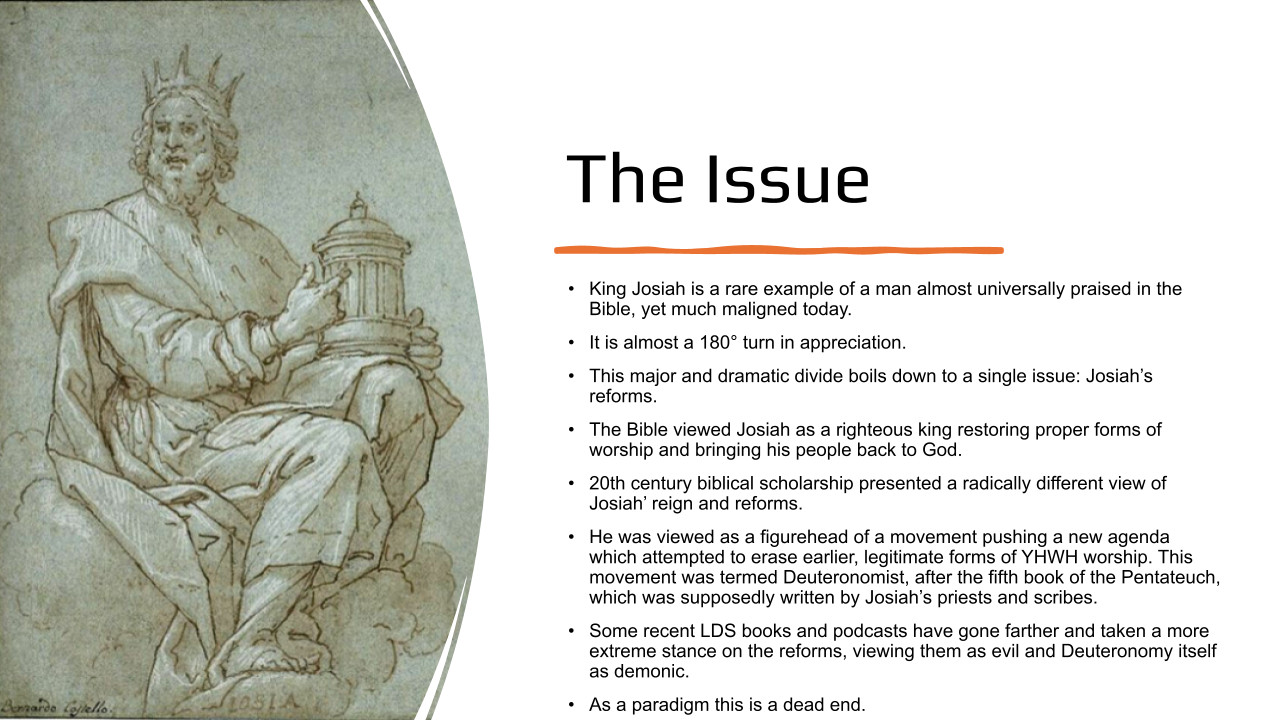
King Josiah is a rare example of a man almost universally praised in the Bible, yet much maligned today. It is almost 180° turn in appreciation. This major and dramatic divide boils down to a single issue and that is Josiah’s reforms. How one perceives the reforms tends to decide one’s view of Josiah. The Bible views Josiah as a righteous king restoring proper forms of worship and bringing his people back to God.

Deuteronomistic View

Modern scholarship, on the other hand, presents a radically different view of Josiah’s reigns and reforms. He became viewed as a figurehead of a movement pushing a new agenda which attempted to erase earlier legitimate forms of Yahweh worship.

This movement was termed “Deuteronomist” after the fifth book of the Pentateuch, which was supposedly written by Josiah’s priests and scribes.1

Studies of Margaret Barker, contributed to an LDS view that sees the reforms as a form of apostasy. Some recent LDS books and podcasts have gone even farther and taken a very extreme stance on the reforms, viewing them as evil and Deuteronomy itself as demonic. As a paradigm, this is a dead end. This puts us in a place we do not want to be. And the Bible is our scripture–among others–but it is one of our scriptures. Deuteronomy is important to the Book of Mormon, Doctrine of Covenants, New Testament. We don’t want to dismiss it over an issue we don’t quite understand.

Josiah’s Reforms as Positive and Necessary

I’m going to argue that overall, even if there were excesses, Josiah’s reforms were a good thing and a much needed thing. And if we learn that, we can learn to better understand all of our scriptures.

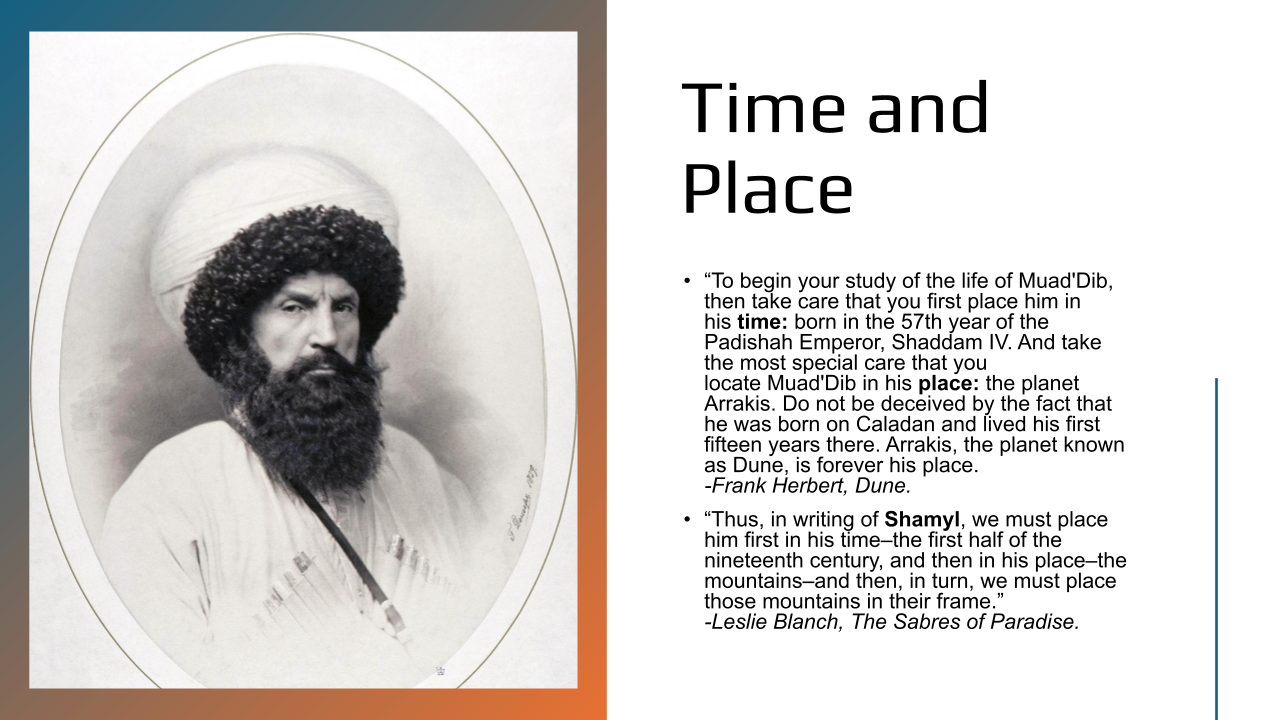
Time and Place

There’s a wonderful Frank Herbert quote in Dune.

“To begin your study of the life of Muad’Dib, then take care that you first place him in his time. Take the most special care that you locate Muad’Dib in his place.” 2
This is a wonderful explanation for historical context because historical context is time and place. Herbert adapted this from an insight in Lesley Blanch’s almost forgotten book, The Sabers of Paradise, and it’s a study of the 19th century conflict between the Caucuses and the Russian conquest.
She wrote that

“We must place him [Shamyl] first in his time and then in his place. . . and in turn we must place those mountains in their frame.”

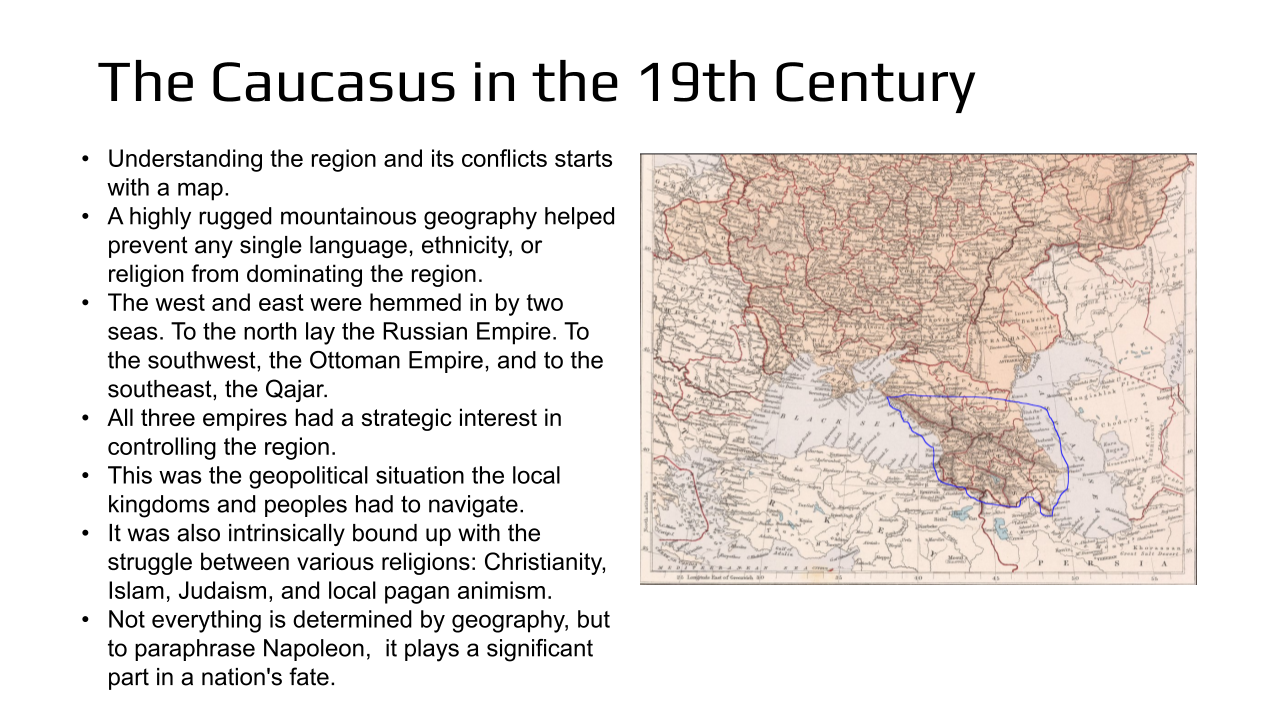
Napoleon said that a nation’s geography determines its foreign policy or its fate. And this is very true.

If we look at a map, it becomes obvious that you’ve got Russia to the north. You had the Ottoman Empire, Persian Kavad Empire to the south, and seas on either side. And when all of these empires wanted to expand, they ran up against this place. So you cannot understand a thing about it without understanding the geography and the time.

The pair of time and place, that is historical context, or at least good shorthand for it. So whether it’s politics, culture, war, economics, intellectual or religious beliefs, they all fit into that concept of time and place. This is true for doing history in general, but when the Bible is so distant to us, context is crucial.

Josiah’s Time and Place

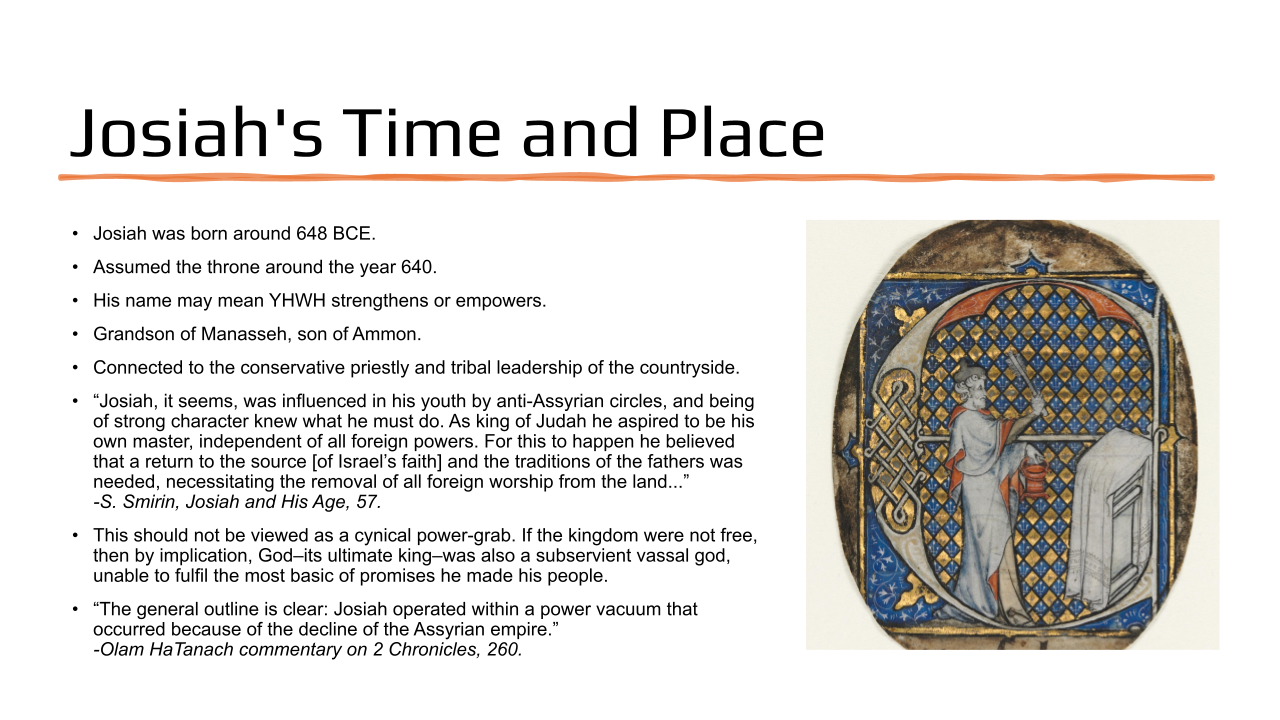
So let’s look at Josiah’s time and place. He was likely born around 648 BC and he assumed the throne about 8 years later after his father was assassinated. This is really important because this coincides with the downfall of the Assyrian Empire.

Now Josiah is also connected to conservative priestly and tribal leadership of the countryside. He marries into them and he likely absorbed that world view. And the Israeli scholar Shalom Smirin wrote that Josiah, it seems, was influenced in his youth by anti-Syrian circles. And as king, he aspired to be his own master, independent of all foreign powers. So for that to happen, as Smirin notes, Israel had to return to its source and show faith in God. Okay, this is not a cynical power grab.

If the kingdom were not free, then by implication, God, its ultimate King, was also a subservient vassal-God. Unable to fulfill the most basic of promises he made to his people. Okay? And he operates within this vacuum of the Assyrian Empire losing power. And we’ll get to that in a moment.

Judah’s Location and Significance

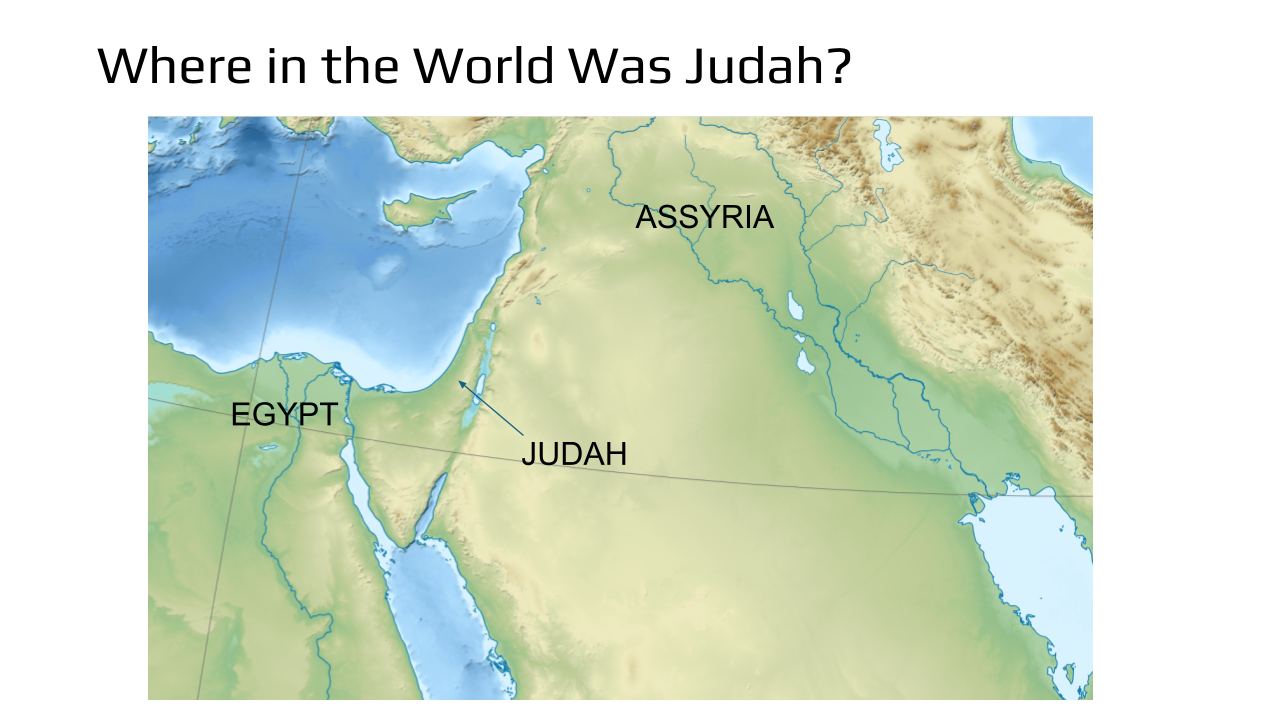
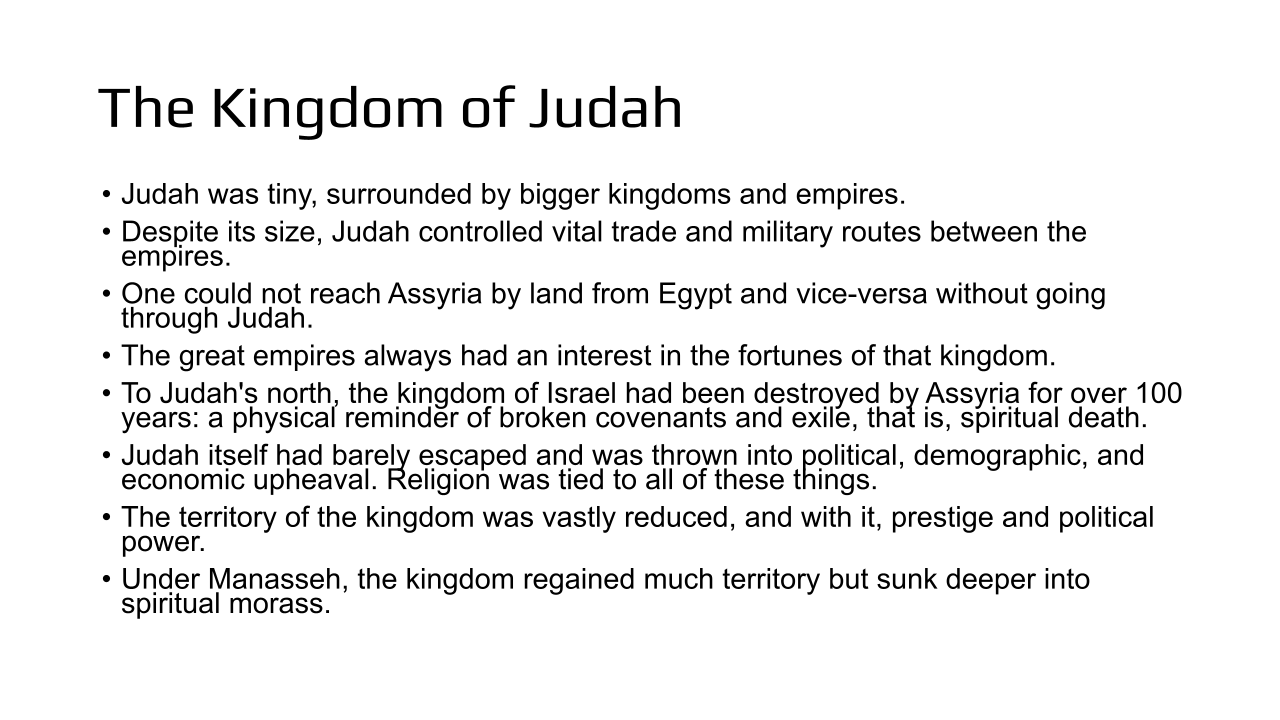
But I want us to look at this map. Okay, forgive it. It’s a little crude with the drawing and everything, but it gives a general picture. So, to the south and the west, you have Egypt. To the north, you have Assyria. And Judah is this tiny little country nestled in between them. But to get through for trade or war, you have to pass through the kingdom of Judah, the tiny kingdom of Judah. So, the great empires, they always had an interest in the fortunes of Judah.

In Josiah’s day, the kingdom of Israel had been destroyed by Assyria. It was over a hundred years ago, and it served as a physical reminder of broken covenants and exile, which ancient Israel conceptualized as spiritual death. Judah itself had barely escaped and was thrown into political, demographic, and economic upheaval. And religion ties into all of that.

So after Syria came in, the territory of the kingdom was vastly reduced. It lost prestige and power under Manasseh who was very close to Assyria. The kingdom regained much territory but it sunk deeper into spiritual morass.

The Assyrian Empire

And with that, let’s look at the Assyrian Empire because without understanding it, we’re going to struggle with understanding what happened with the reforms.

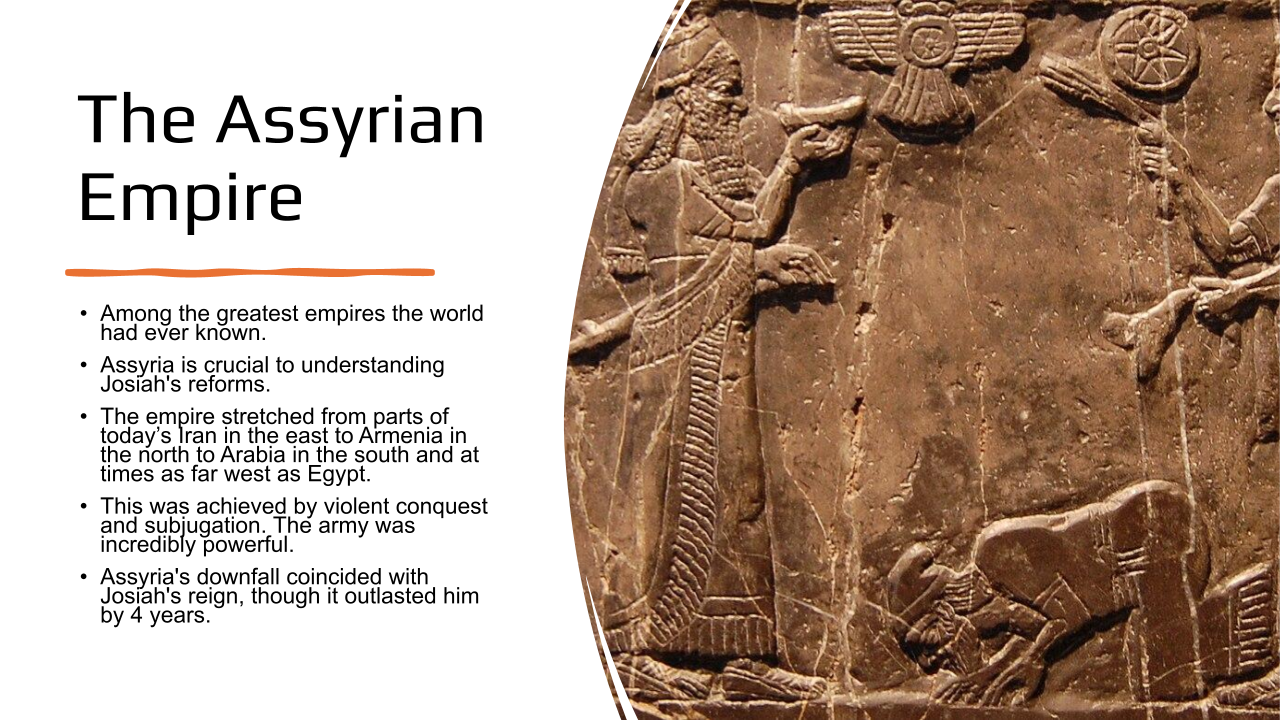
So this was among the greatest empires the world had ever known. It stretches as far east as Iran, as far north as Armenia and Arabia in the south, and it went even as far as Egypt in the west. Naturally, these kingdoms weren’t lining up to join Assyria. The army, the military was incredibly powerful, and it violently conquered and subjected the kingdoms of the region.

Now, Syria’s downfall, it was pretty dramatic and it happened throughout Josiah’s reign. Not only was the army powerful, so was the ideology.

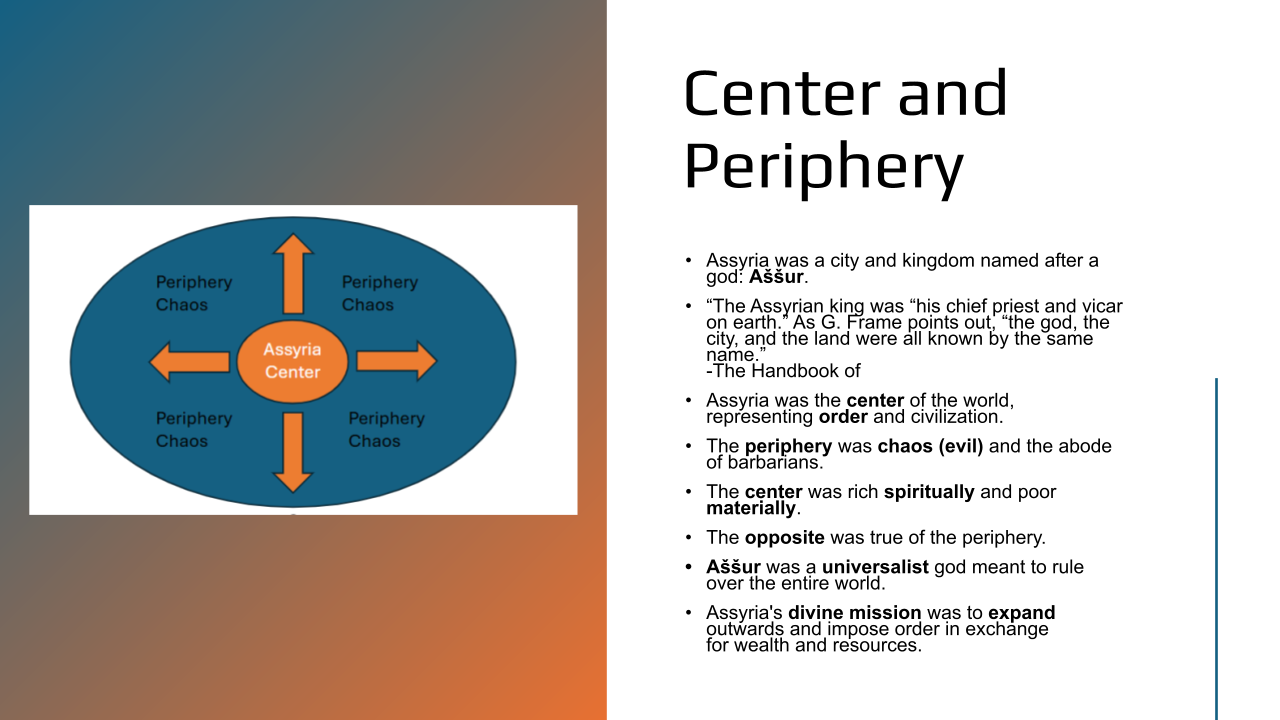
Assyria was a city first, then a kingdom, and it was named after a god, Ashur. The Assyrian king was his chief priest and vicar on earth. The god, the city, the land, they’re all known by the same name. They’re identified with each other.

Ashur was a universalist god who was meant to rule over the entire world by conquest. So you see, Assyria is the center. It’s where the order is, civilization, the gods, and it’s surrounded on the four corners by the periphery, which is where chaos, evil, the demonic, the barbaric, the center. It was rich spiritually, but impoverished materially.

The exact opposite was true of the periphery. So Assyria’s divine mission was to expand outward and impose order in exchange for wealth and resources. So a very extractive venture.

Acknowledging Ashur

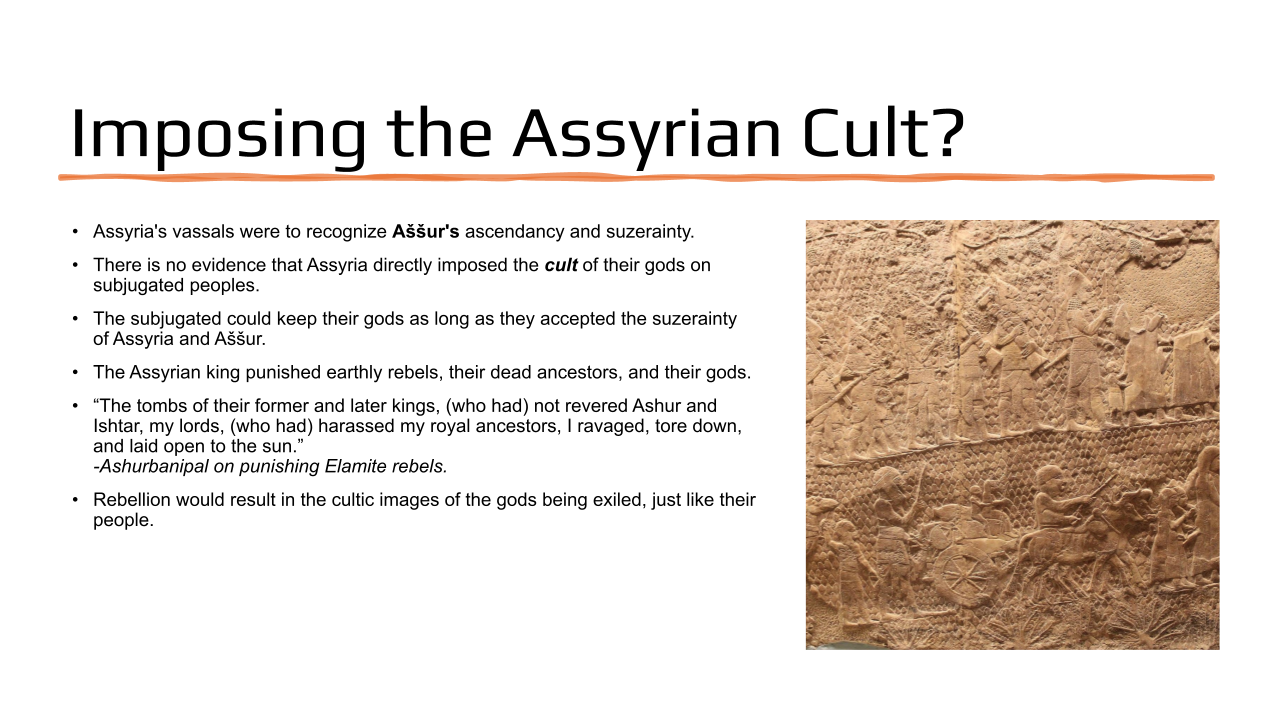
Now Syria’s vassals, they not only recognize the king, they’re also to recognize Ashur’s ascendancy and suzerainty, as in he’s the head god of all the gods. We don’t have evidence that Assyria directly imposed the cult of their gods on subjugated people, and they didn’t have to. The subjugated could keep their gods as long as they accepted the suzerainty of Assyria and Ashur. 3

Political rebellion was always a religious affair in the ancient near east. The Assyrian king would punish earthly rebels, their dead ancestors, and their gods. Rebellion was a highstakes game. If you lost, it would result in the cultic images of the gods being exiled just like their people.

Assyrian Influence

So if Assyria let its vassals keep their gods, then what was the big problem? That problem was soft power, cultural cache and influence. When you are the dominant power, many begin to see things your way and do what you do.

Can you imagine living in the world today and not experiencing some sort of presence or influence from the United States? That was Assyria in the ancient near east. The influence on Israel and Judah’s elite was clearly deleterious, as they voluntarily adopted Assyrian ways. And these were always idolatrous.They resurrected older, forbidden practices and transformed the meaning of others.

Chariots of the Sun

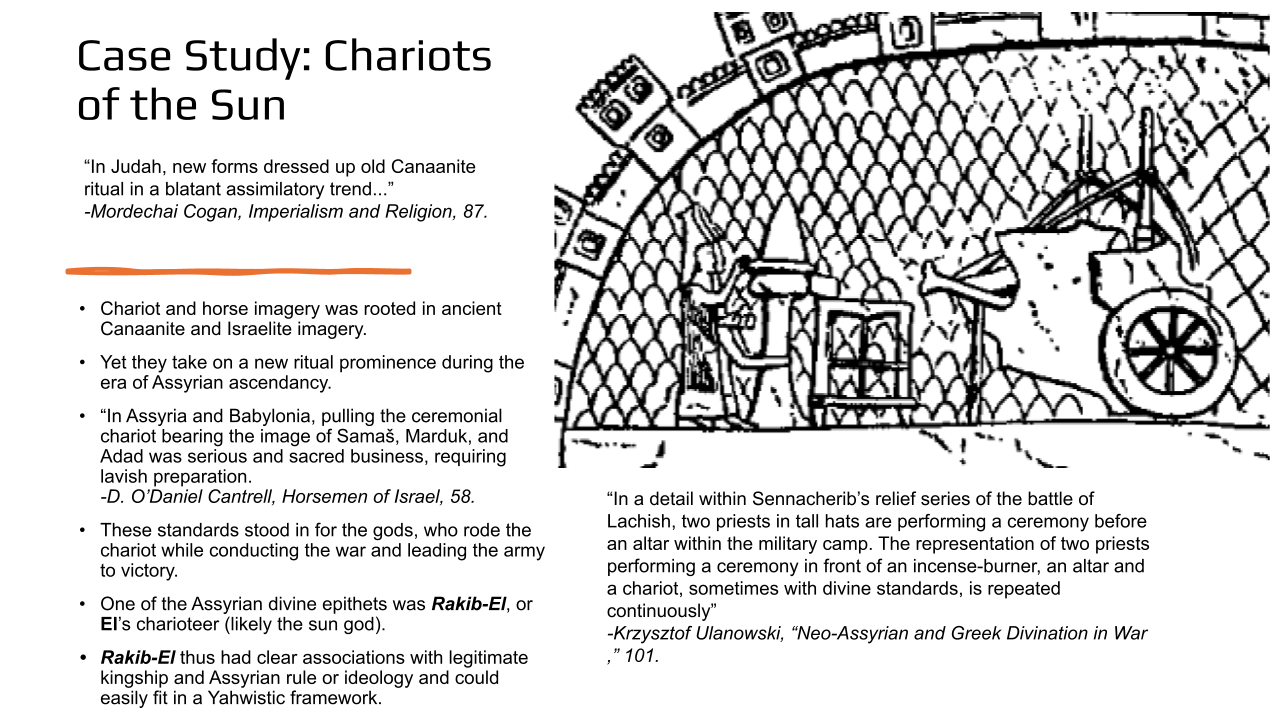
We have a little case study. If you look at this picture, this is from the Assyrian palace reliefs depicting the war against the kingdom of Judah in Lachish, as we read in Isaiah. So in Judah, new forms dressed up old Canaanite ritual in a blatant assimilatory trend, as Mordechai Cogan said.

Chariot and horse imagery was rooted in ancient Canaanite and Israel imagery. And in the Bible, we find plenty of references to God and to horses and things like that and chariots. Yet, we find that these take on a new ritual prominence during an era of Assyrian ascendancy.

The standards that we see in this chariot in the picture, they stood in for the gods who rode the chariot while conducting the war and leading the army to victory. One of the Assyrian divine epithets was Rakib-El, or El’s charioteer, and this likely meant the sun god’s chariot. So Rakib-El had clear associations with legitimate kingship in Assyrian rule or ideology and it could easily fit in a Yahwistic framework. And that was the problem.

Egypt

Now before we move on to the reforms we need to understand a little bit about Egypt. It was the other big empire of the ancient Near East.

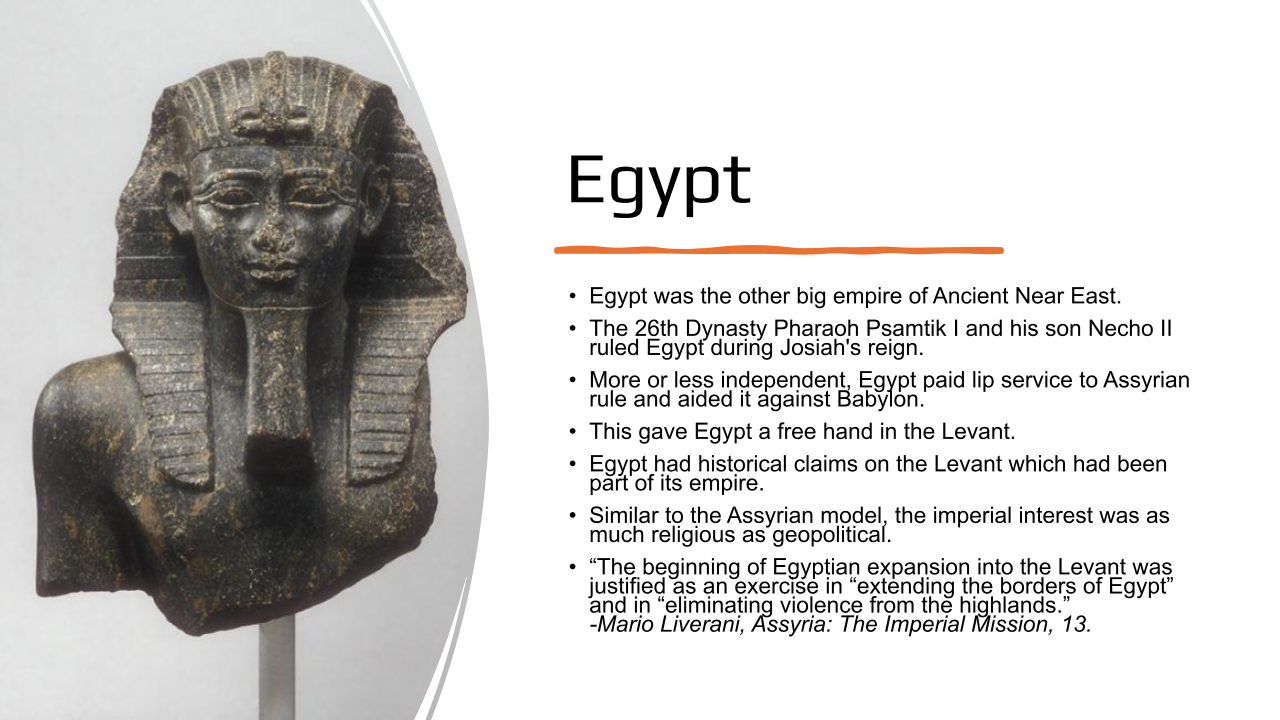
During Josiah’s day it was the 26th dynasty, so Psamtik I and his son Necho II. They’d basically thrown off Assyria’s yoke. They were more or less independent. They paid lip service to Assyria and they came to its aid against Babylon, the new kingdom on the rise.

Egypt had historical claims on the Levant which had been part of its empire. The imperial interest was as much religious as geopolitical. They extended the borders of Egypt and civilization and eliminated violence from the highlands. They aided Syria against Babylon because they could get concessions from Assyria and regain much of their empire.

Egyptian Ascendancy

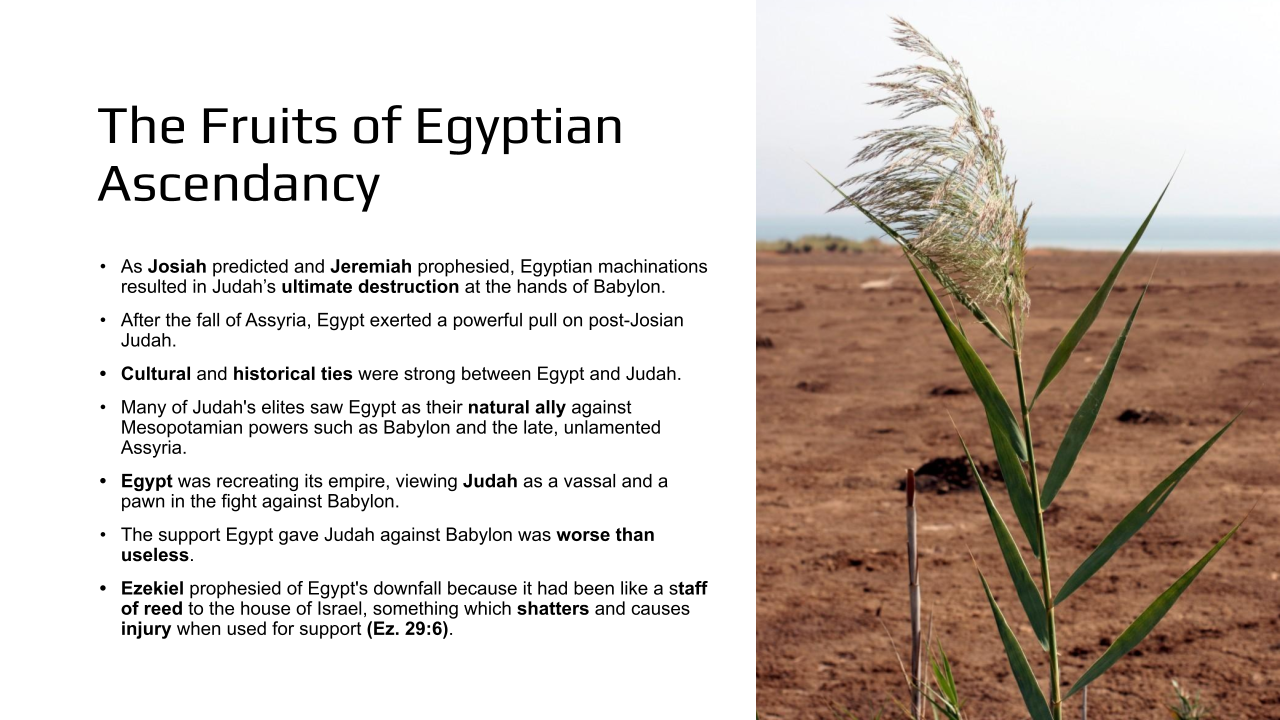
Now, as Josiah predicted and Jeremiah prophesied, Egyptian machinations resulted in Judah’s ultimate destruction at the hand of Babylon. Egypt exerted a powerful pull in post-Josiahan Judah.

They had really old cultural and historical ties. They were strong and many of Judah’s elite saw Egypt as their natural ally against anyone in Mesopotamia; be it Babylon, be it Assyria. Egypt viewed Judah as a vassal and a pawn in their fight against Babylon. The support Egypt gave Judah against Babylon was worse than useless.

So Ezekiel prophesies of Egypt’s downfall because it had been like a staff of reed to the house of Israel. And if you lean on a reed, it’s going to shatter, splinter, cause you terrible injuries. And that’s what happened with Egypt.

King and Kingship

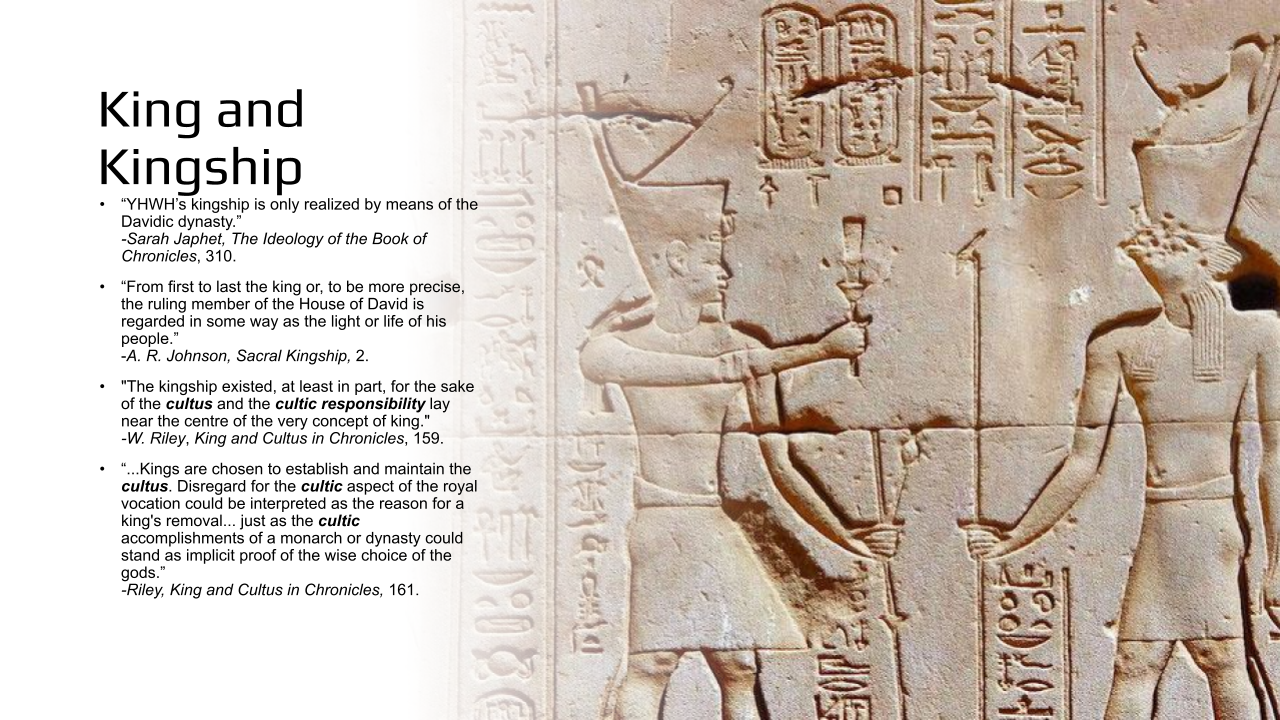
You know, the king is something we got to talk about because while we think we might know it, it’s too familiar a concept. We’ve got to think about it a little bit more to make sense.

Israelite Kings

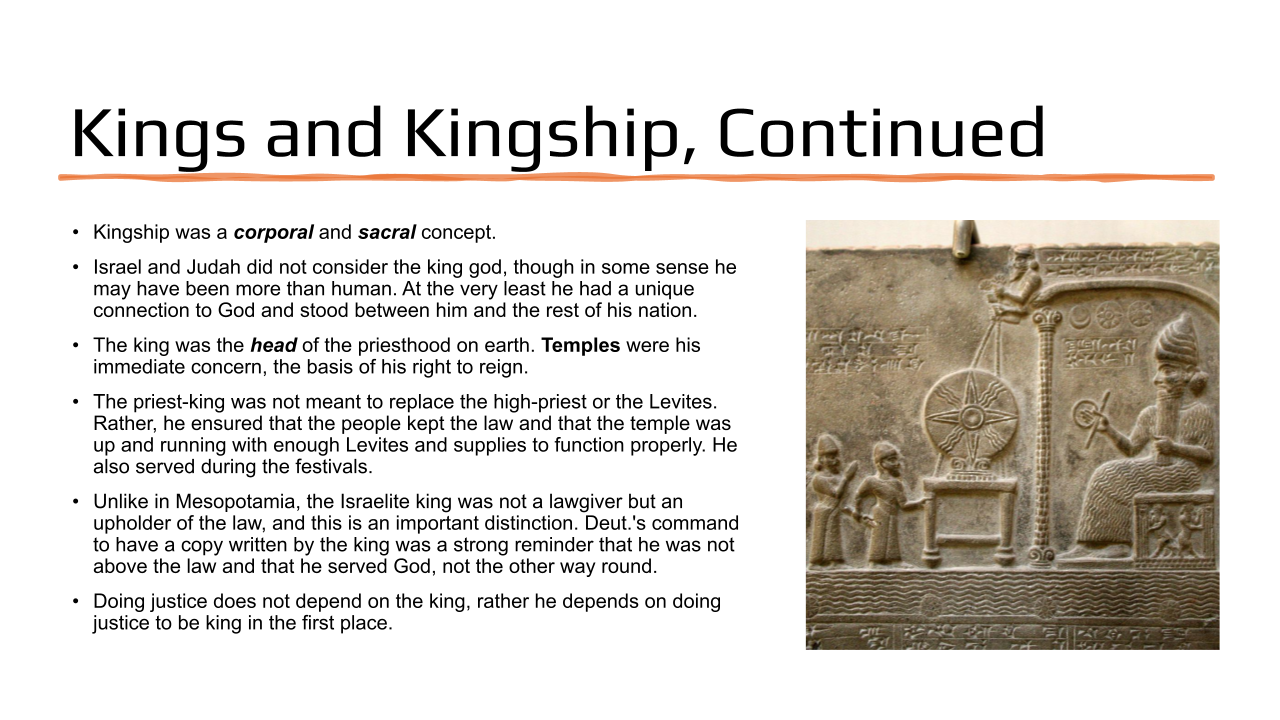
Kingship was a corporal and sacral concept. Israel and Judah did not consider the king God. Although in some sense he may have been more than human. At the very least, there’s this unique connection to God and he stands between God and the rest of his nation. He goes back and forth between them.

The king was also the head of the priesthood on earth. Temples were his immediate concern, the basis of his right to reign. He does not replace the high priest or the Levites, but he ensures that people keep the law and that the temple is up and running, has enough Levites to function there, and it has enough supplies for them to do what they need. Festivals were when the king was needed the most.

Mesopotamian Kings

Now, in Mesopotamia, the king gives the law, like Hammurabi; the king decides what’s wrong and what’s right to an extent. Deuteronomy and Israelite kingship do not really have that concept. Deuteronomy makes the king write a copy of the law to remind him that he was not above the law. That he served God, not the other way around. So, doing justice does not depend on the king, rather he depends on doing justice to be king in the first place.

Medieval Kings

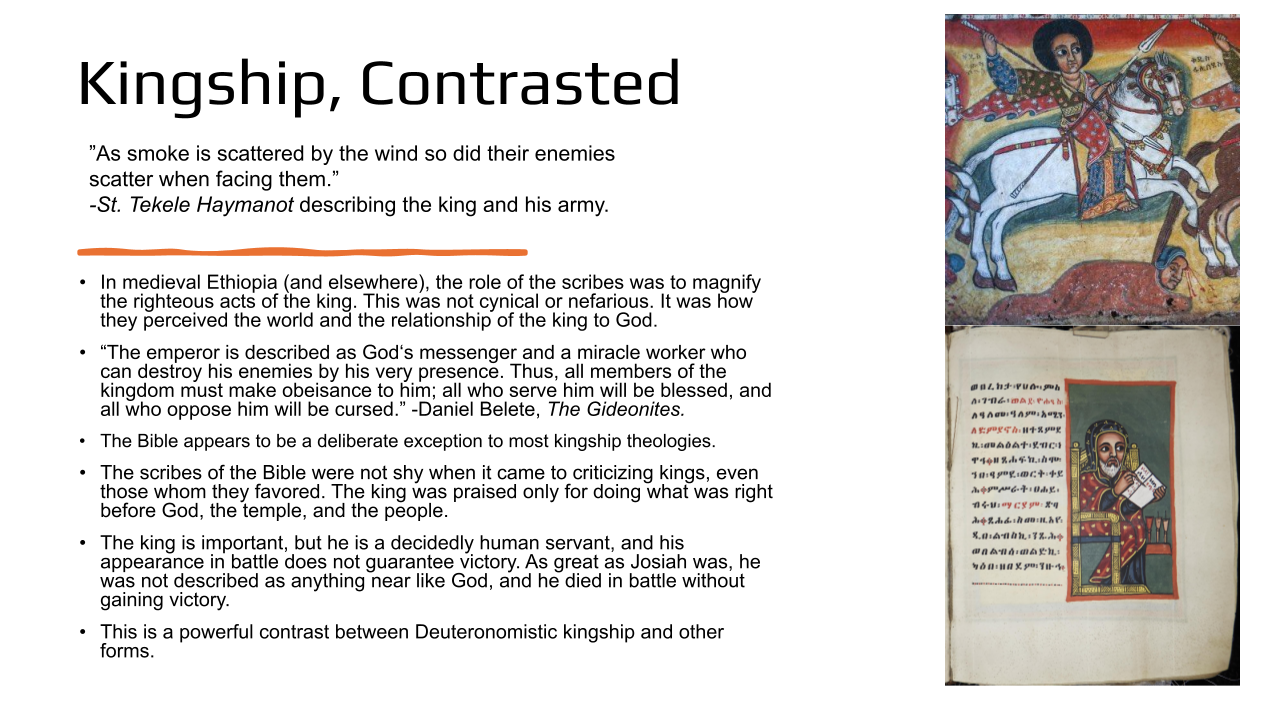
Now a little bit of comparative material is always helpful. In medieval Ethiopia and elsewhere, the role of the scribes was to magnify the righteous acts of the king. This was not cynical. It was not nefarious. It was how they perceived the world and the relationship of the king to God. So he’s God’s messenger. He does miracles. His enemies flee at his very presence.

And as Daniel Belete wrote,

“Thus all members of the kingdom must make obeisance to him. All who serve him will be blessed and all who oppose him will be cursed.”

The Bible, on the other hand, is a deliberate exception to most kingship theologies. Scribes of the Bible were never shy when it came to criticizing kings, even those whom they favored. The king was praised only for doing what was right before God, the temple, and the people. As important as the king is, he is a decidedly human servant. His appearance in battle does not guarantee victory. Josiah was slain in battle and lost.

Josiah was not described as anything near like God. This is a powerful contrast between Deuteronomistic kingship and other forms.

The Reforms of Josiah

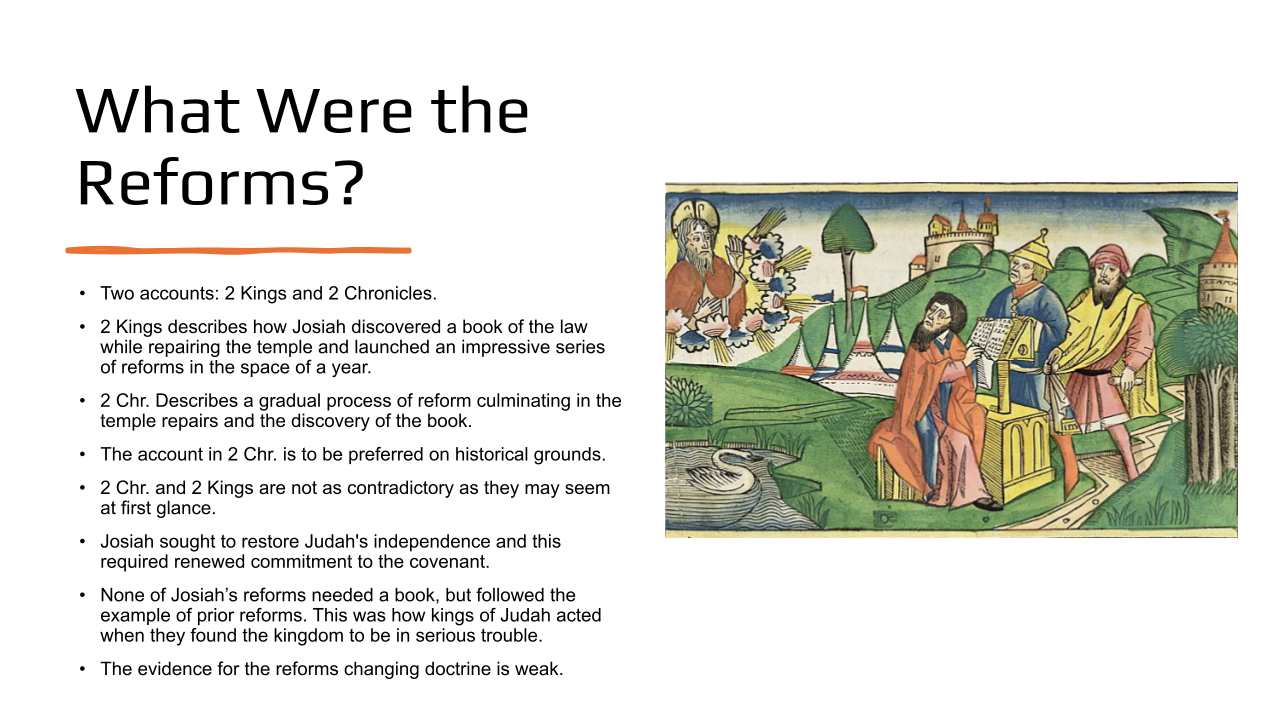
And with the idea of kingship in mind, let’s look at the reforms. We have two accounts in the Bible. There’s 2 Kings and 2 Chronicles. Second Kings describes how Josiah discovered a book of the law while repairing the temple. He launched an impressive series of reforms in the unlikely space of a year.

2 Chronicles, on the other hand, describes a gradual process of reform culminating in the temple repairs and the discovery of the book. The 2 Chronicles account is to be preferred on historical grounds. It doesn’t contradict Kings like you may think on the surface. My paper is going to have a description of why that is. But for now, let’s look at what happened.

Josiah sought to restore Judah’s independence, and this required renewed commitment to the covenant. None of Josiah’s reforms needed a book. They followed the example of prior reforms. This was how kings of Judah acted when they found the kingdom to be in serious trouble. And the evidence for the reform’s changing doctrine is weak.

Why Reforms Were Needed

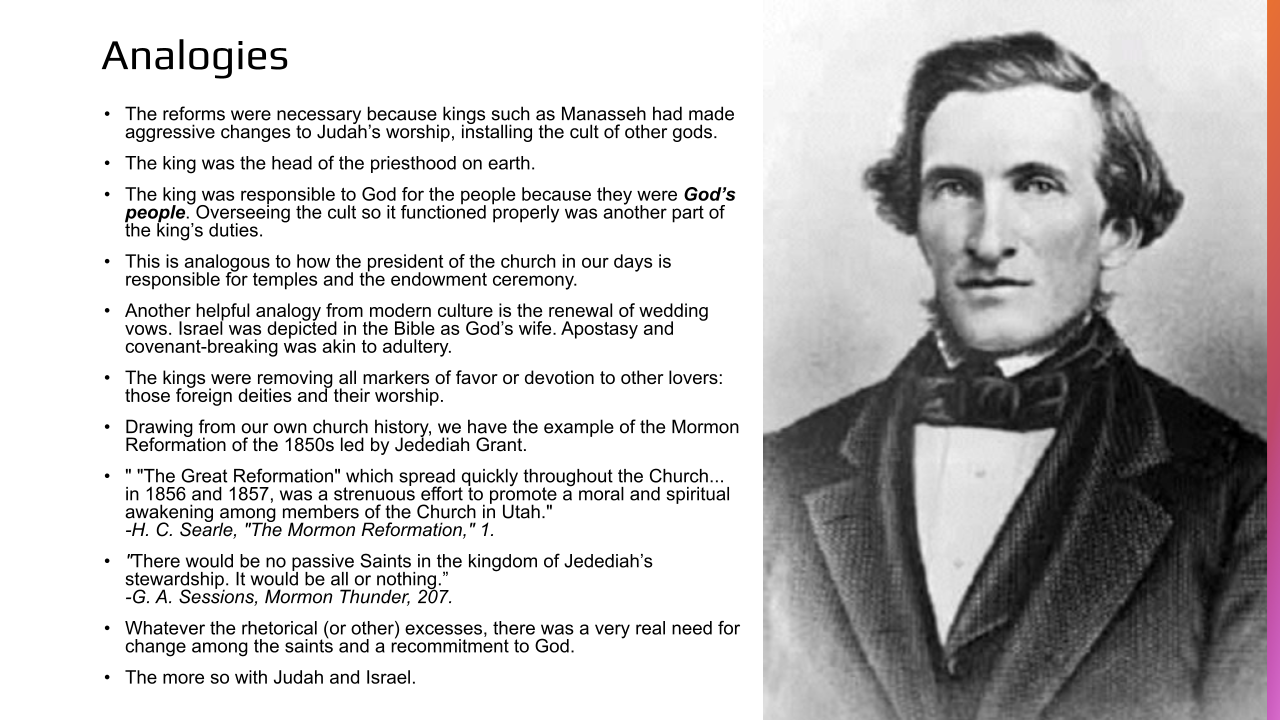
Now the reason he needed a reform in the first place, kings such as Manasseh and others had made aggressive changes to Judah’s worship, installing the cult of other gods, and that had a corrupting influence.

The king, as we saw, was the head of the priesthood on earth. He was responsible to God for the people because they were God’s people. And overseeing the call so it functioned properly was another part of the king’s duties. Just as today the President of the Church is responsible for the temple and the endowment ceremony and making any required changes; that’s what the kings were supposed to do.

We can also think of this as the renewal of wedding vows. Israel was described in the Bible as God’s wife. Apostasy and covenant breaking was akin to adultery. So what the kings did was to remove all markers of favor or devotion to other lovers, those foreign deities and their worship. That’s why they had to go.

‘Mormon’ Reformation

Drawing from our own Church history, we have the example of the Mormon Reformation of the 1850s led by Jedidiah Grant. And this was a strenuous effort to promote a moral and spiritual awakening among members of the Church in Utah.

As Gene Sessions wrote, I love this turn of phrase,

“There would be no passive saints in the kingdom of Jedidiah’s stewardship. It would be all or nothing.”

Whatever the rhetorical or other excesses of this reformation, there was a very real need for change among the saints and a recommitment to God. The more so with Judah and Israel who had sunk into idolatry.

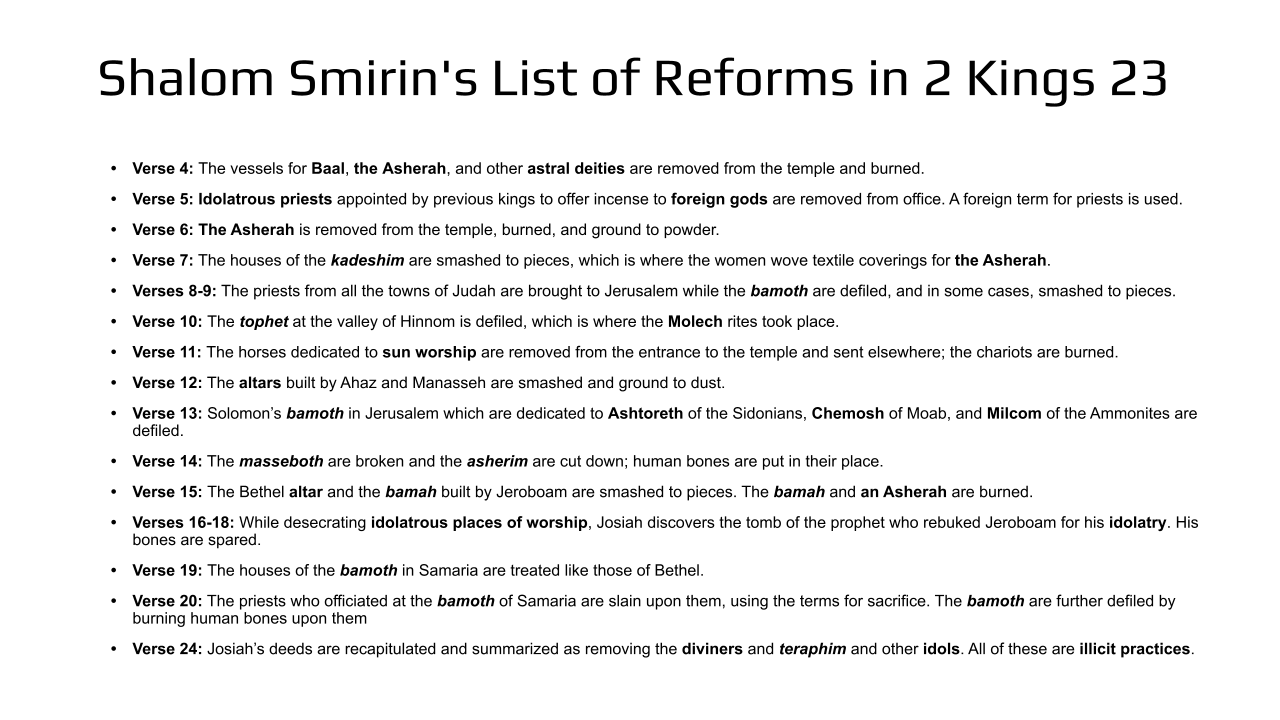
Shalom Smirin compiled an excellent list of what the reforms were about. As we can see, all of them dealt with idolatry. There is one exception and we will get to that. But otherwise, this is all about what Israel or Judah was doing in its worship.

Josiah’s Passover

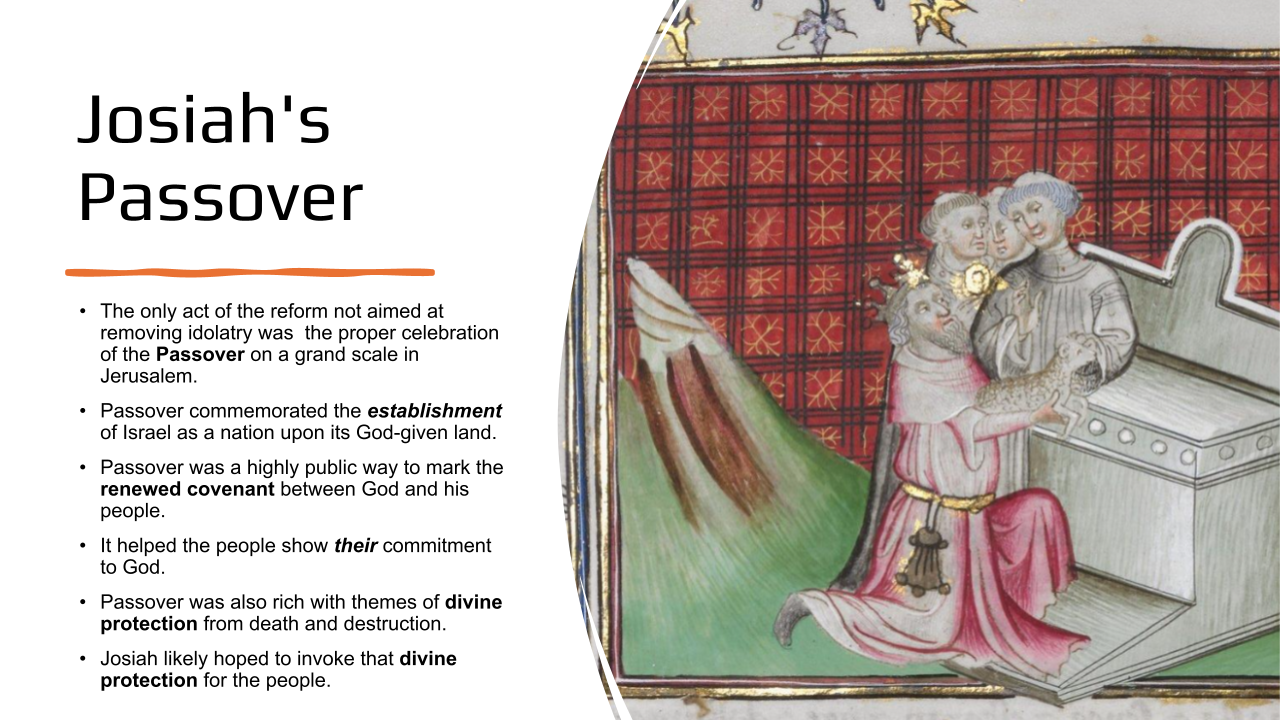
The only act of the reform not aimed at removing idolatry was proper celebration of the Passover on a grand scale in Jerusalem. The Passover, as you may recall, commemorates the establishment of Israel as a nation upon its God-given land. God takes Israel out of Egypt and brings it to the Promised Land.

Passover was a highly public way to mark the renewed covenant between God and his people. It helped the people show their commitment to God, and it was rich with themes of divine protection from death and destruction. That’s in the name, the destroying angel passing over the children of Israel. Josiah likely hoped to invoke that divine protection for the people. Failed, but he tried.

Claims of Changing Doctrine

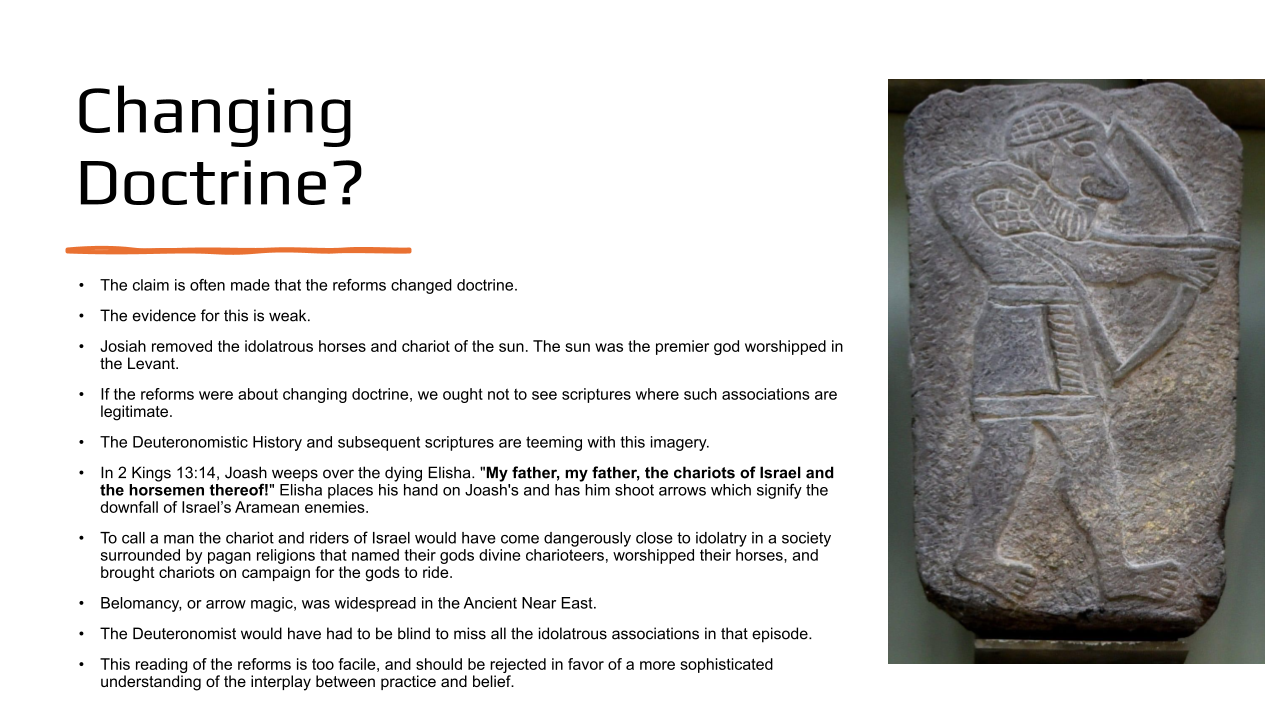
Now, the claim is often made that the reforms changed doctrine. The evidence is weak at best. If you recall, he removed the horses and the chariots of the Sun. The Sun was the premier god worshiped in the Levant. And if the reforms were about changing doctrine, we ought not to see any scriptures where such associations are legitimate, especially not Deuteronomistic history. But Deuteronomistic history and subsequent scriptures are teeming with this imagery.

In 2 Kings chapter 13, the king Joash weeps over the dying Elisha and he says, “My father, my father, the chariots of Israel and the horsemen thereof.” He then instructs the king to take a bow. Elisha places his hand on Joash’s hands and has him shoot arrows which signify the downfall of Israel’s Aramean enemies.

So to call a man the chariot and riders of Israel would have come dangerously close to idolatry in a society surrounded by pagan religions that named their gods divine charioteers, worshiped their horses, and brought chariots on campaign for the gods to ride. And arrow magic was widespread in the ancient Near East and Assyrian kings offered up offerings of arrows to the god while on campaign.

The Deuteronomist would have had to be blind to miss all the idolatrous associations in that episode. And whatever we think of him, we know he wasn’t an idiot. He would have recognized problematic associations.

So because of that, this reading of the reforms is too facile and should be rejected in favor of a more sophisticated understanding of the interplay between practice and belief.

Symbols Change

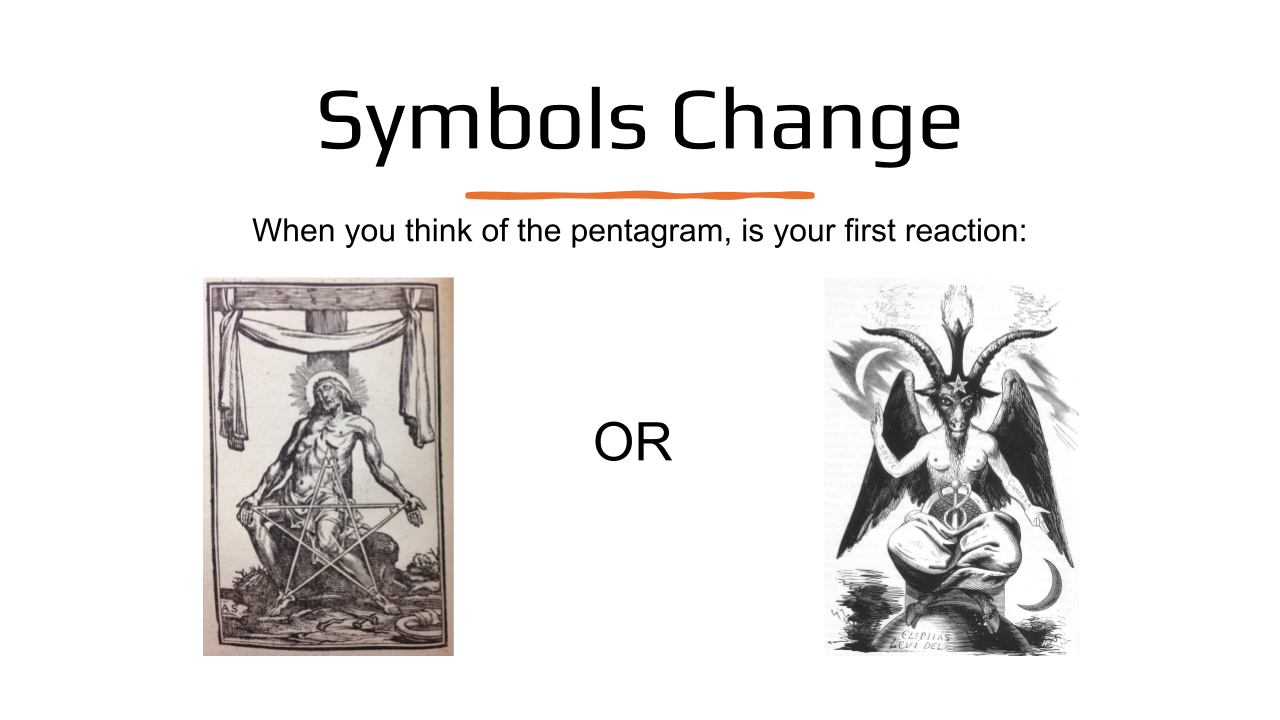
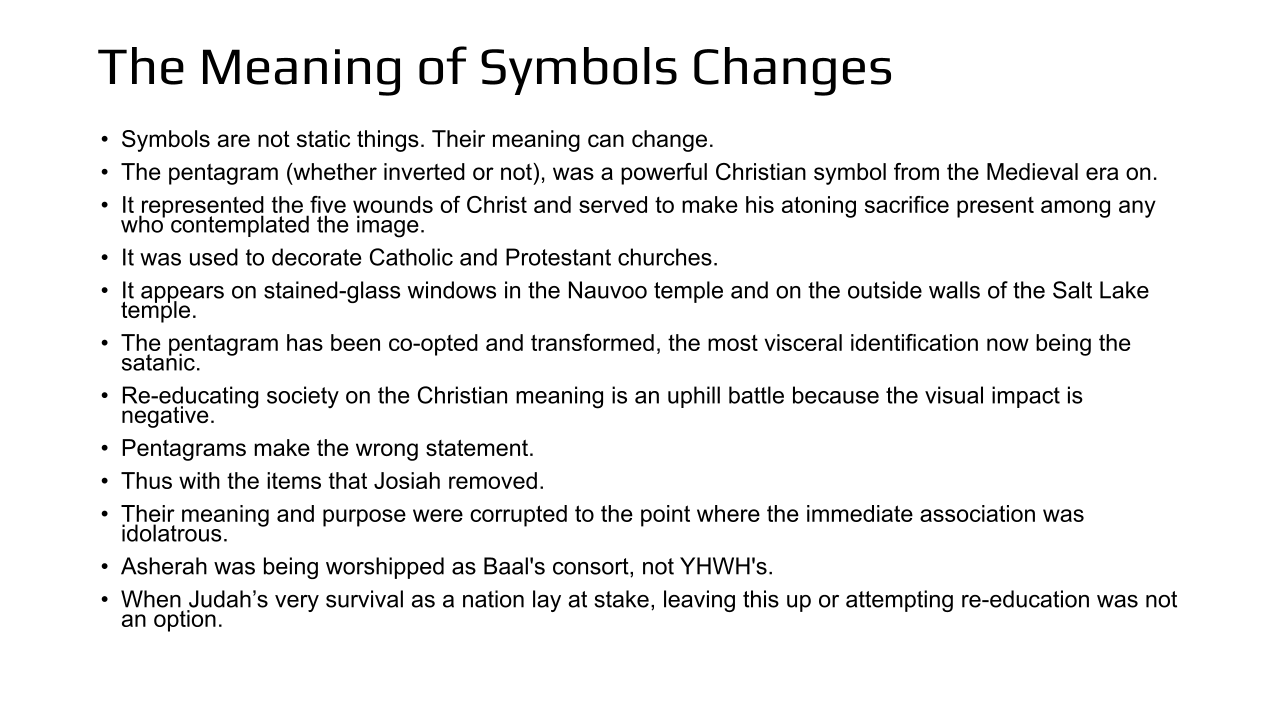
Now, symbols change. When you think of the pentagram, is your first reaction, the image of Jesus, or is it the other one? Symbols, they’re not static. Their meaning can change and it does change.

The Pentagram

The pentagram used to be a powerful Christian symbol from the medieval era onwards. Among others, it represented the five wounds of Christ and they served to make his atoning sacrifice present among any who contemplated that image. If you read Sir Gawain and the Green Knight, it’s a major part of that plot.

It was used to decorate Catholic churches and Protestant ones. And we have it on stained glass windows in the Nauvoo Temple and on the outside walls of the Salt Lake Temple. But the pentagram has been co-opted and transformed. The most visceral identification now being the satanic.

Now, if you want to re-educate society on the Christian meaning, that’s a long uphill battle because the immediate visual impact is negative. These pentagrams make the wrong statement.

Josiah Removed Corrupted Symbols

And thus it is with items that Josiah removed. Their meaning and their purpose were corrupted to the point where the immediate association was idolatrous. Asherah was being worshiped as Baal’s consort, not Yahweh’s. So when Judah’s very survival as a nation lay at stake because of their idolatry, leaving this up or attempting re-education was not an option.

Josiah and Violence

The Myth

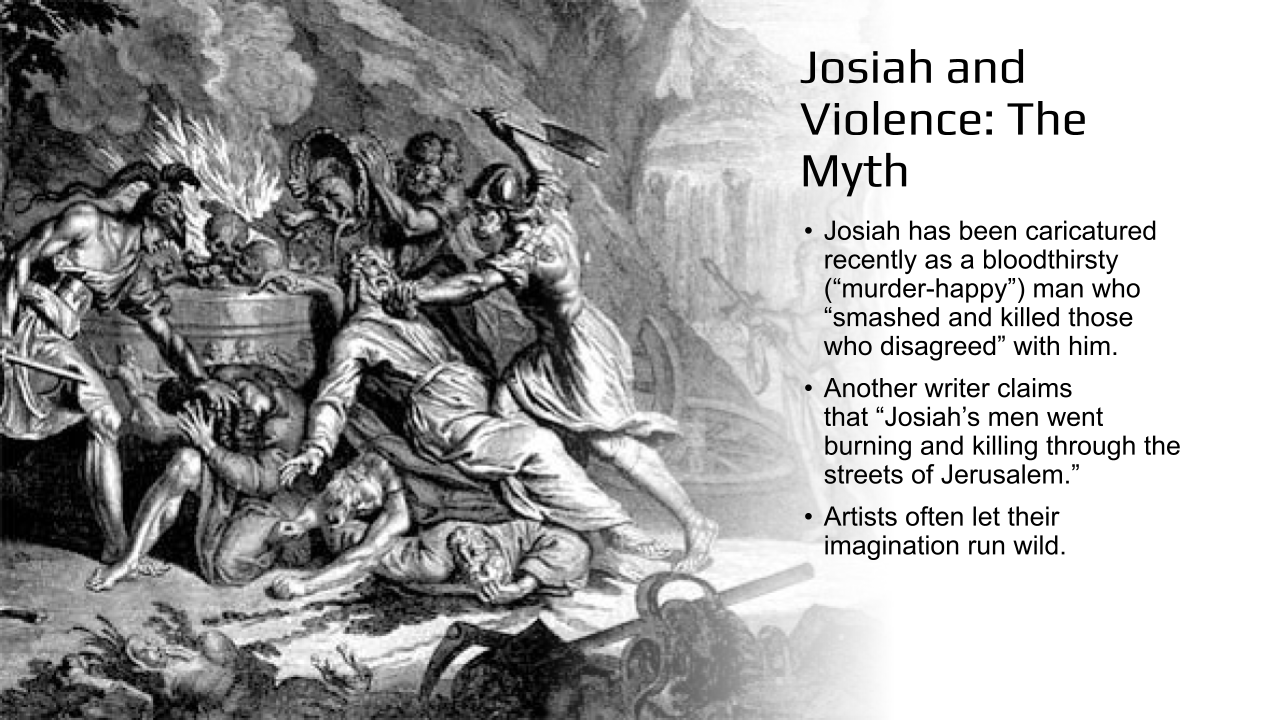
People have been disturbed by some of the violence in this narrative, but it also gets caricatured quite a lot. Recently, someone wrote that he was a “murder-happy” man who smashed and killed those who disagreed with him. And another writer claimed that “Josiah’s men went burning and killing through the streets of Jerusalem.” And this 17th century illustration is quite lurid, as you can see. Artists let their imaginations run wild.

The Reality

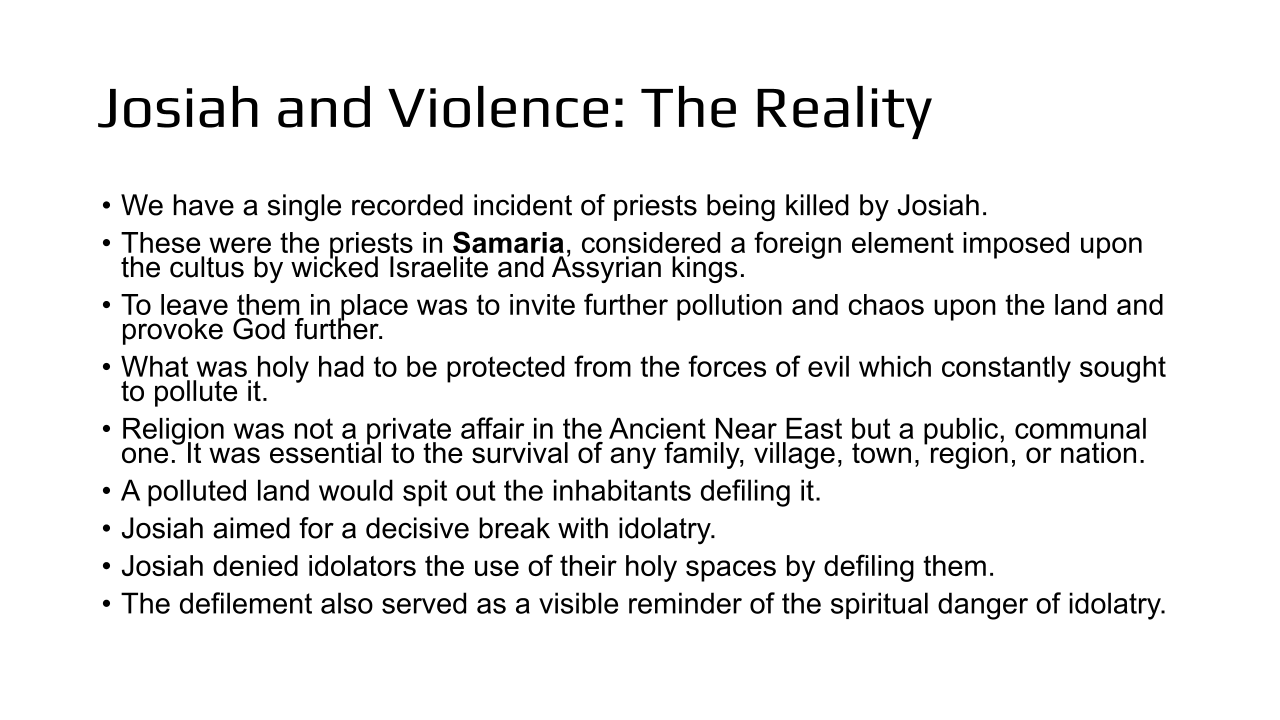
The reality though was different. We have a single recorded incident of priests being killed by Josiah. Otherwise, even those involved in idolatrous rites in the kingdom of Judah, he treated them gently and kindly. The ones killed were the priests in Samaria, considered a foreign element imposed upon the cultists by wicked Israelite and Assyrian kings. To leave them in place was to invite further pollution and chaos upon the land and provoke God further.

What was holy had to be protected from the forces of evil which constantly sought to pollute it. And religion was not a private affair. What you did mattered for your community. The religion was essential to the survival of any family, any village, town, region, or nation. Polluted land spits out the inhabitants defiling it. And if Josiah aimed for a decisive break with idolatry, he had to deny the idolaters the use of their holy spaces by defiling them with the bones. And this defilement also served as a visible reminder of the spiritual danger of idolatry. Think warning labels with skull and crossbones.

The Discovered Book

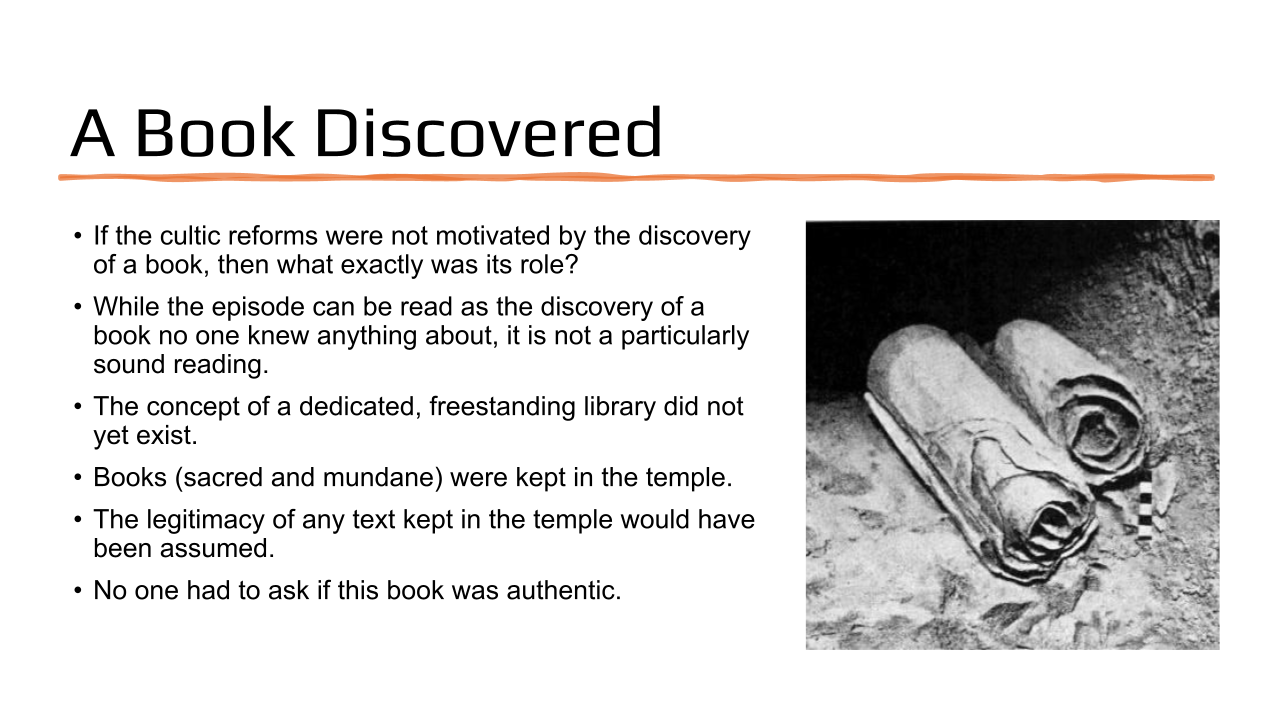
Okay. Now if the book was not what influenced the reforms or caused them, what exactly was its role? Books were kept in the temple. There weren’t dedicated freestanding libraries and the legitimacy of any texts kept there would have been assumed. No one at court had to ask if this book was authentic. And that’s not the question they posed to Huldah the prophetess.

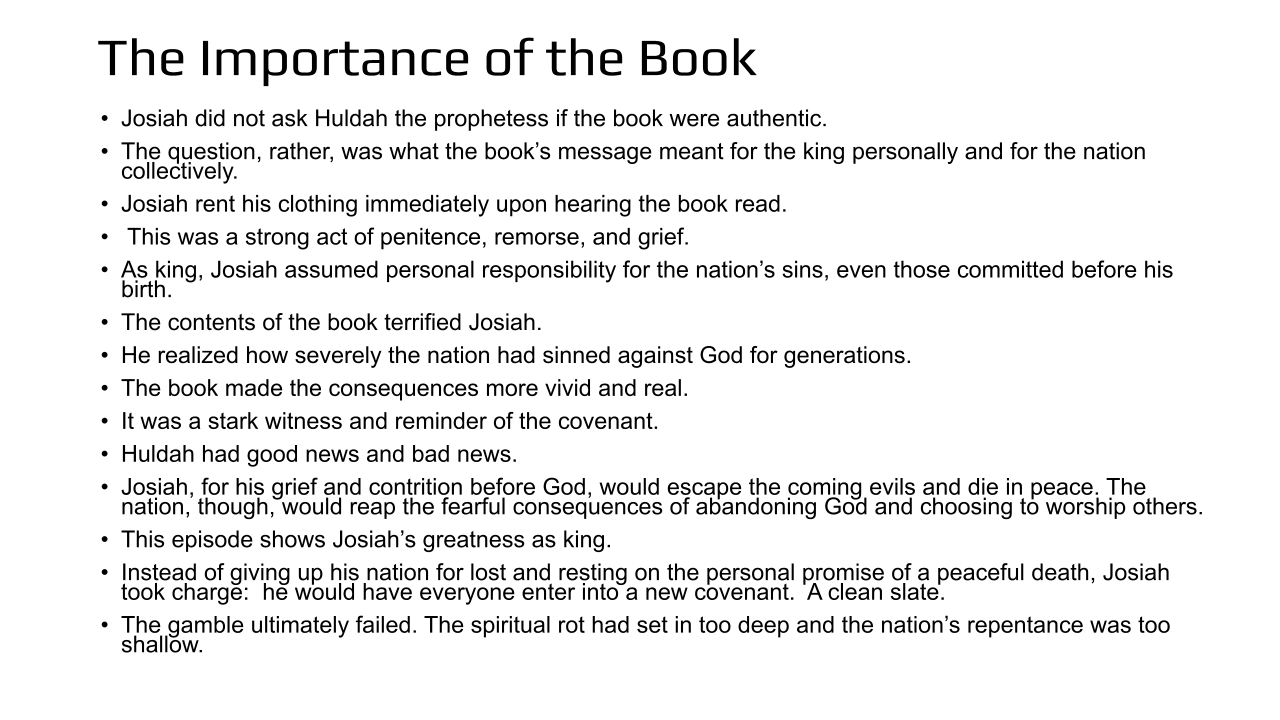
The question rather was what the book’s message meant for the king personally and for the nation collectively.

Recall Josiah rent his clothing immediately upon hearing the book read. This is an act of penitence, remorse, and grief. And as king, Josiah assumed personal responsibility for the nation, even sins committed before his birth. And what he read terrified him.

He realized how severely the nation had sinned against God for generations. Huldah had good news and bad news. Josiah, for his grief and contrition before God, would escape the coming evils. He’d die in peace. The nation though would reap the fearful consequences of abandoning God and choosing to worship others.

And we see how great Josiah was as a king. He didn’t give up his nation for lost, but he took charge. He decided to have everyone enter into a new covenant, a clean slate. But the gambit ultimately failed. Spiritual rot had sent in too deep and the nation’s repentance was too shallow.

Deuteronomy and the Deuteronomist

My paper is going to cover more on Deuteronomy. But for now, let’s talk about who the Deuteronomist is.

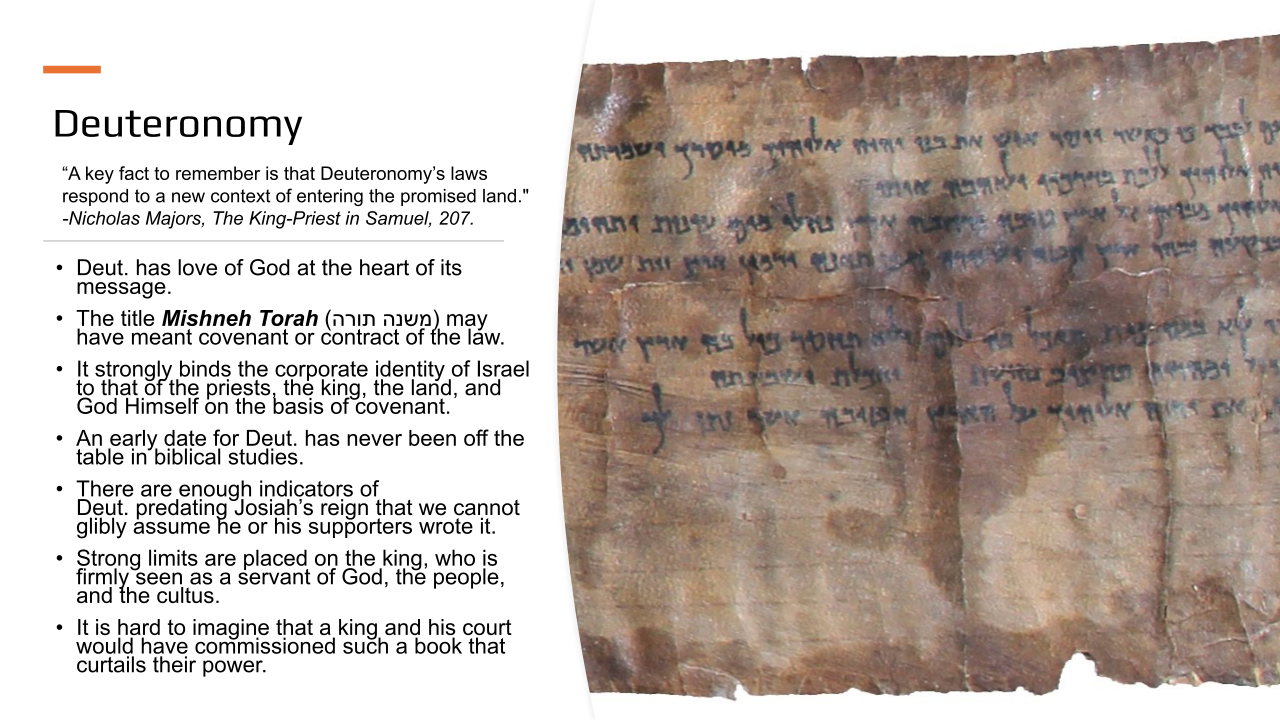
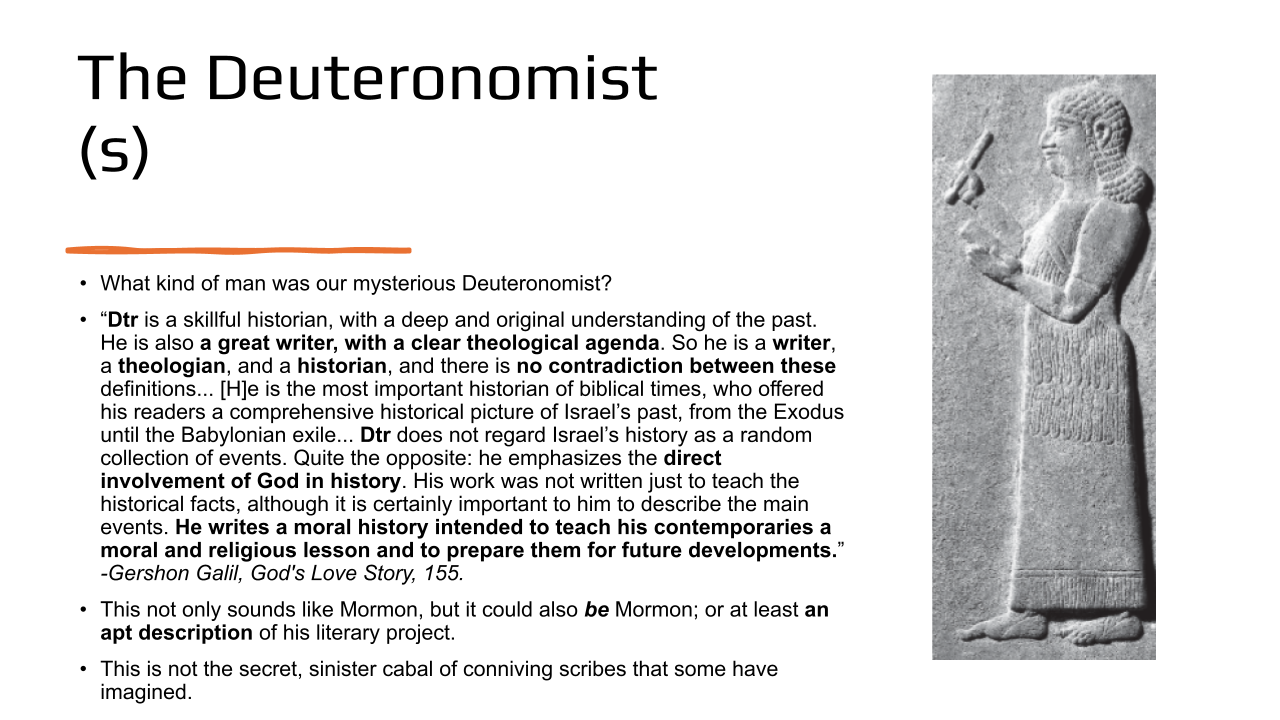
What kind of man was he? Gershon Galil said he would have been a great writer with a clear theological agenda, a writer, theologian, historian. And there’s no contradiction between these. He emphasizes God’s direct involvement in history. His book was not written to teach historical facts, though it’s certainly important to him. He writes a moral history, tended to teach his contemporaries a moral and religious lesson and prepare them for future developments. So this not only sounds like Mormon, but it could be Mormon or at least an app description of his literary project. We’re not dealing with this secret sinister cabal of conniving scribes. That goes beyond what any evidence says.

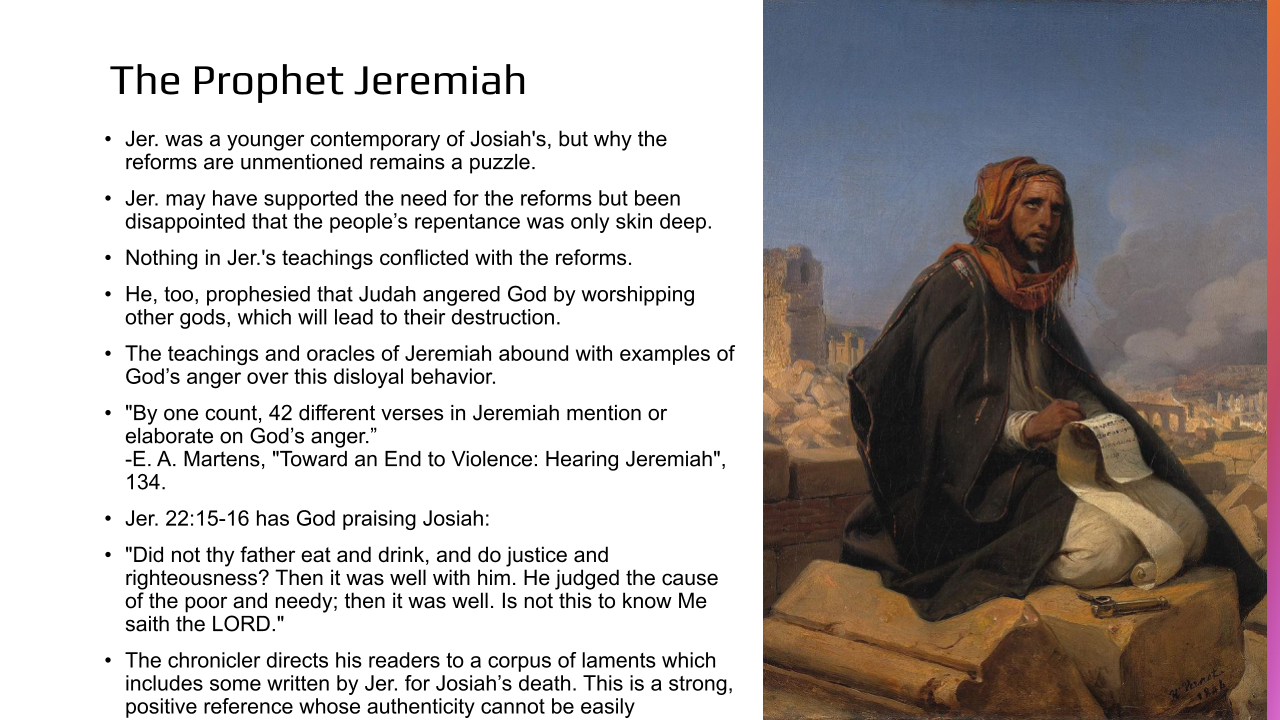
The Prophet Jeremiah

An important piece of the puzzle is Jeremiah. He was a younger contemporary of Josiah’s, but we don’t know why he doesn’t mention the reforms. Maybe he was disappointed that people’s repentance was only skin deep. That’s suggested by Talmudic traditions. But there’s a better way. We can look at what he taught and see if any of it conflicts with the reforms.

Nothing did. Jeremiah prophesied that Judah angered God. They worshiped other gods and that will lead to their destruction. He was full of anger towards the conduct of the people and we have him present an oracle from God praising Josiah. It was well with him, and his behavior is to know God according to the prophecy of Jeremiah.

Now the chronicler also directs his readers to a corpus of laments which includes some that Jeremiah wrote for Josiah’s death. This is a strong positive reference and we cannot easily dismiss the authenticity of it.

Death of Josiah

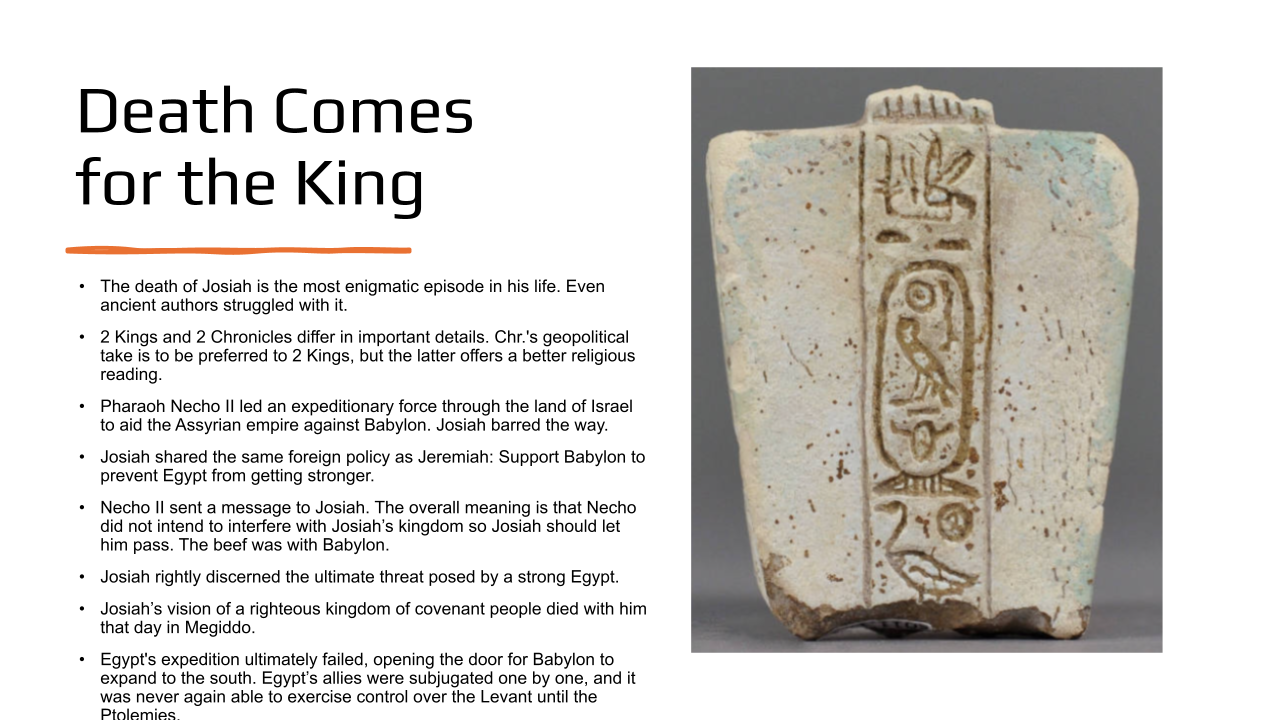
Now the death of Josiah is the most enigmatic episode in his life. Even ancient authors struggled with it, and we have two accounts. Kings and Chronicles differ in important details. Chronicles’ geopolitical take is to be preferred to second Kings, but the latter offers a better religious reading, and we’ll look at both.

So, what happens is that Pharaoh leads an expeditionary force through the land of Israel to aid the Assyrian Empire against Babylon. Assyria is on its last legs. Josiah bars the way, and he shared the same foreign policy as Jeremiah: support Babylon to prevent Egypt from getting stronger.

But Necho sent a message to Josiah. The overall meaning is that Pharaoh did not intend to interfere with Josiah’s kingdom, so Josiah should let him pass. The beef was with Babylon. Josiah rightly discerned the ultimate threat posed by a strong Egypt. It was not going to leave his kingdom alone. Sadly, his vision of a righteous kingdom of covenant people died with him that day in Megiddo.

Egypt failed. It opened the door for Babylon to expand to the south. Egypt’s allies, including Judah, were subjugated one by one, and it was never again able to exercise control over the Levant until the Ptolemies.

Josiah and the Shema

Now, in Second Kings, Josiah turned back to God. He repented. He showed him loyalty with all of his Lev, of his Nefesh, and all of his Me’od. And we’ll get to that. But this is the exact same trio of words used in the Shema, which Jesus calls the first great commandment. Combination of terms indicates the complete and total nature of this love-loyalty to God. Lev is the heart. Nefesh is the soul or life. And Me’od is much plenty and might.

Ancient treaties required a vassal to assist the Lord with all his heart. So it provides him with men and chariots and even a willingness to assist with all his soul. That is, the vassal was required to die for his lord if necessary. Josiah is shown to be God’s selfless and loyal vassal who did not hesitate to lay down his life for him in battle.

Josiah in Apocryphal and Post-Biblical Texts

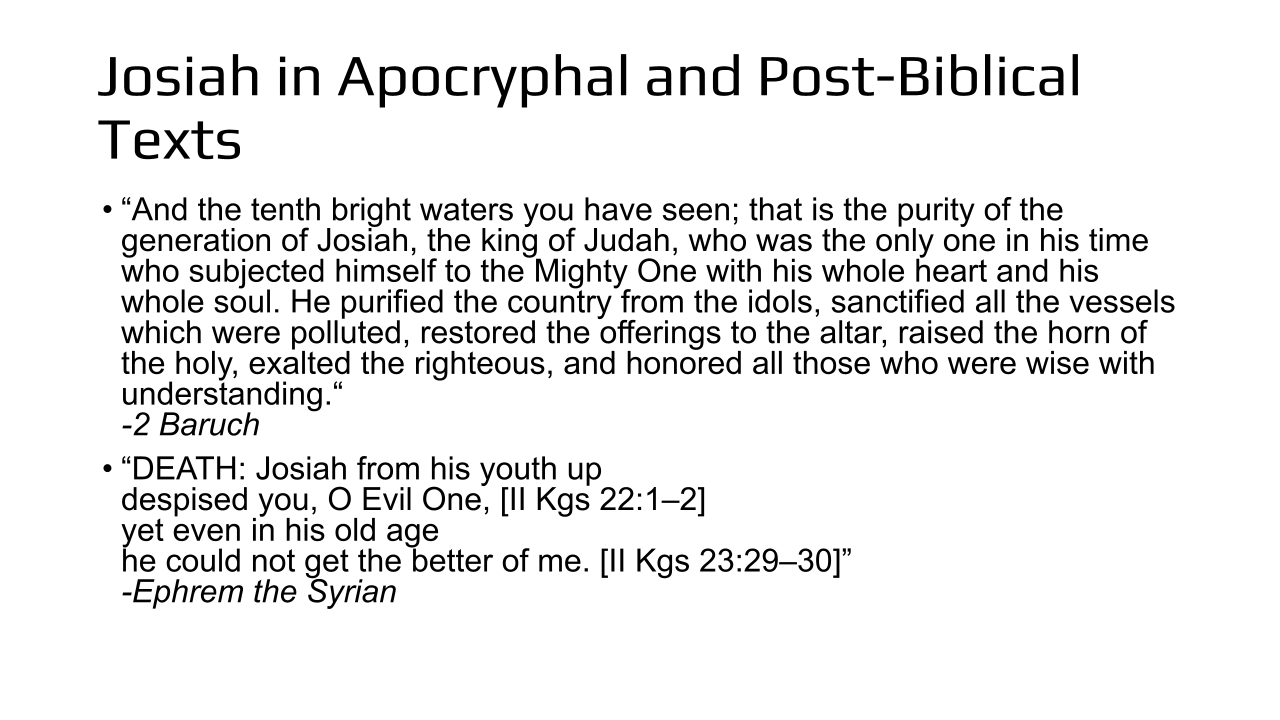
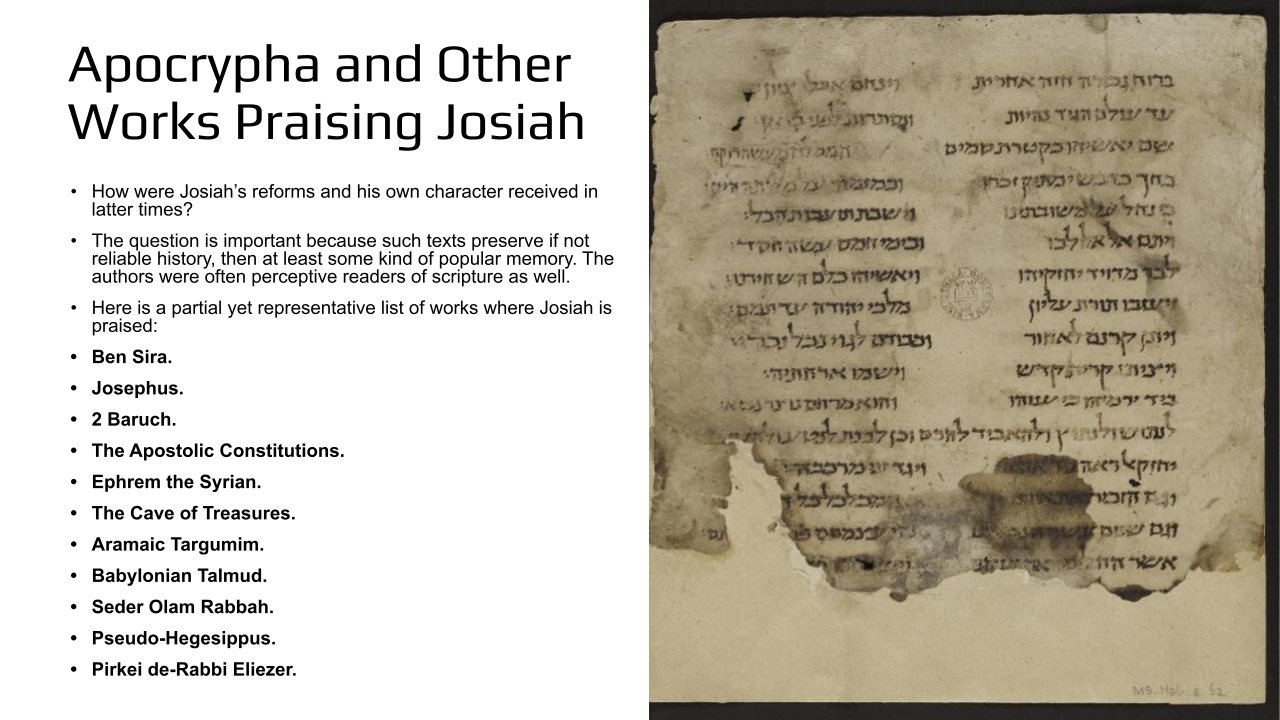
And I think it is only fair to look at what apocryphal and post-biblical texts have to say because they tell us a lot about popular memory, what people were thinking, how they interpreted the scriptures.

And so this is a list, quite a lot of works, that all praise Josiah. Ben Sira especially goes well beyond any praise in the Bible. We find Josiah’s reputation is good in the Bible and outside it, until in modern times it takes a hit.

Witness of the Restoration

Now direct references to Josiah and the restoration are few and far between. All of them view Josiah positively. Not a single prophet, apostle, or other general authority of the restoration is on record condemning, disparaging, or rejecting the reforms. We’re not bound by tradition or precedent, but these do bear some weight in the Church and they should be considered as part of our overall picture.

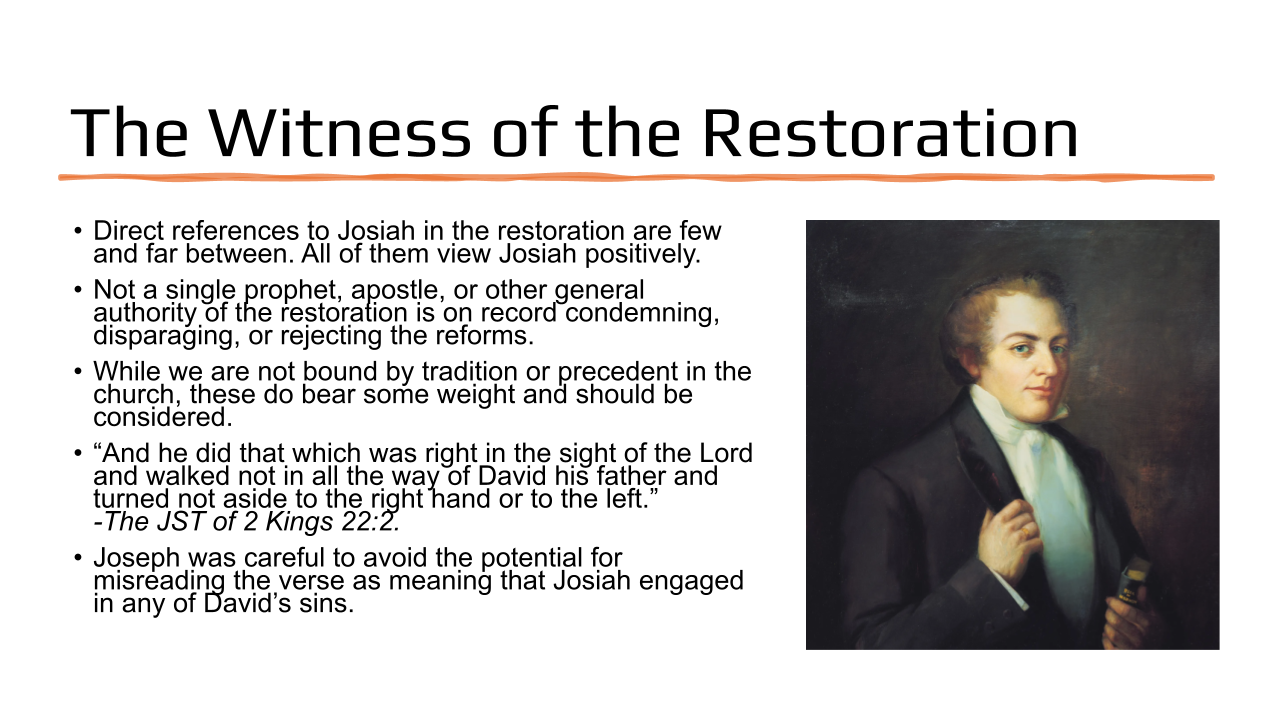
And we see that Joseph makes very few changes. But one of them is this. He takes 2 Kings 22:2 and he re-words it so you avoid the potential for misreading the verse as meaning that Josiah engaged in any of David’s sins. And that’s why he says, “Walk not in all the way of David his father.” That means he did not do the wicked things there. He did what was right in the sight of the Lord.

More Witnessess

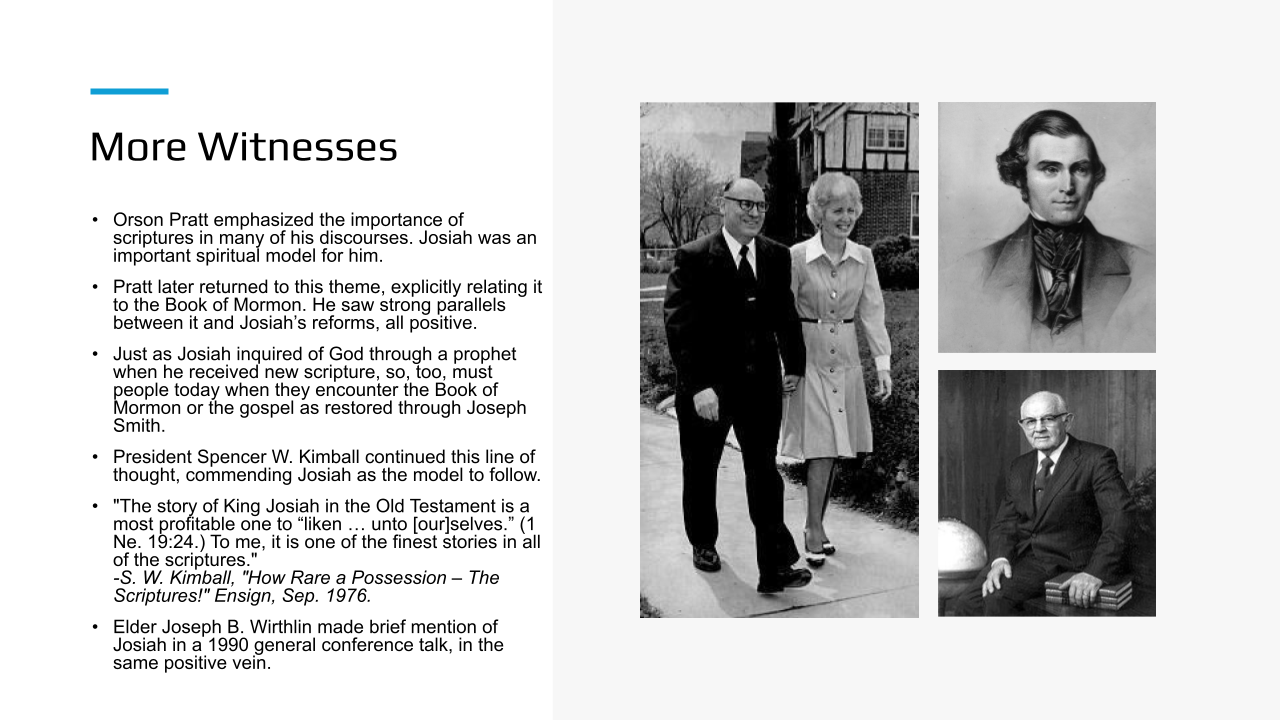
Now in the mouth of two to three witnesses, right? We’ll give you four. Orson Pratt actually spoke quite a bit on Josiah, relatively. Scripture was important to him. Josiah was a spiritual model. And Pratt relates to the Book of Mormon. He saw strong parallels between it and Josiah’s reforms, and all of them were positive. Just as Josiah inquires of God through a prophet when he receives new scripture, so too must people today when they encounter the Book of Mormon or the Gospel as restored through Joseph Smith.

And President Spencer W. Kimbell continued this line of thought and he commended Josiah as the model to follow in the First Presidency Message.

The story of King Josiah in the Old Testament is a most profitable one to liken unto ourselves. To me, it is one of the finest stories in all of the scriptures.

And in 1990, Elder Wirthlin made brief mention of Josiah in general conference in the same positive vein. So we don’t have a lot of references, but they are all positive.

Conclusion

So when all is said and done, Josiah was no villain. He was a king. He sought to do God’s will and save his people, followed God, did right by him. And he succeeded on a personal level, but he failed to save his nation. Josiah took his royal and priesthood duties seriously. This is the best reading of all the evidence we have. If we look at it together, that’s what we get.

Josiah as a Positive Example

My hope is that I’ve raised enough points in favor of Josiah and his reforms that we reclaim him as a positive example. That’s what we should do as scholars and students of the gospel is seek to understand. Most arguments against him are not as solid as they may have seemed. Some are entirely baseless. And I close in the hope that some of the insights in this paper will lead to a better understanding of the Book of Mormon and other restoration scripture. Thank you.

Search topics

King Josiah; Josiah’s reforms; Defending Josiah; Josiah and Deuteronomy; Deuteronomistic History; Deuteronomist theory; Book of the Law; discovery of the Book of the Law; 2 Kings 22–23; 2 Chronicles 34–35; Josiah’s Passover; covenant renewal in ancient Israel; ancient Israelite religion; worship in ancient Judah; temple worship in Jerusalem; centralization of worship; idolatry in Judah; high places in ancient Israel; Asherah worship; Baal worship; chariots of the sun; Assyrian influence on Judah; Assyrian religion and ideology; Ashur and Assyrian kingship; Egyptian influence on Judah; Necho II and Josiah; fall of the Assyrian Empire; ancient Near Eastern kingship; biblical kingship; Jeremiah and Josiah; Huldah the prophetess; biblical reform movements; historical context of Josiah; Jewish views of Josiah; Margaret Barker and Josiah; Deuteronomy in the Book of Mormon; Deuteronomy in Latter-day Saint scripture; covenant faithfulness; apostasy and restoration in the Old Testament; symbolism and religious change; pentagram as a Christian symbol; Old Testament higher criticism; biblical historical criticism

CES Letter; Bible criticism; Old Testament criticism; Mormon Bible beliefs; Latter-day Saint views of the Bible; LDS scripture reliability; Mormon apologetics; Latter-day Saint apologetics; Mormonism and biblical scholarship; LDS response to higher criticism; Mormon views of Deuteronomy; Mormon views of King Josiah; Mormon temple worship and ancient Israel; Mormon covenant theology; Mormon Church scripture claims; Mormon Church criticism; Mormon faith crisis and the Bible; anti-Mormon claims about scripture; biblical corruption claims; reliability of the Old Testament; development of biblical texts; authorship of Deuteronomy; religion invented by Josiah; did Josiah create Judaism; did priests write Deuteronomy; was Josiah an apostate; was Josiah a righteous king; faithful responses to biblical criticism

Frequently Asked Questions

Did King Josiah invent a new religion?

No. While some modern scholars argue that Josiah’s reforms fundamentally reshaped Israelite religion, this presentation contends that the biblical and historical evidence better supports the traditional understanding that Josiah sought to restore covenant worship already established in Israel’s history.


What is the Deuteronomistic History?

The Deuteronomistic History is a scholarly theory proposing that Deuteronomy through 2 Kings were edited into a unified historical narrative during or after King Josiah’s reign. Many scholars view this as a literary explanation for similarities across these books, though the extent and dating of this editorial work remain debated. Hansen examines this theory and its assumptions throughout the presentation.


Why is the discovery of the Book of the Law significant?

According to 2 Kings 22, the Book of the Law was discovered during renovations to the Jerusalem Temple. Josiah responded by renewing the covenant, removing idolatry, and restoring proper worship. Critics sometimes argue the book was newly written, while defenders maintain it was an authentic ancient text that had been neglected during previous reigns.


Why do many scholars criticize King Josiah?

Some historians believe Josiah’s reforms centralized political and religious authority in Jerusalem and that biblical writers portrayed him more favorably than history warrants. Hansen argues these conclusions often depend upon speculative historical reconstructions rather than direct evidence.


Why does Josiah matter to Latter-day Saints?

Questions surrounding Josiah influence how readers understand the reliability of the Old Testament, the development of scripture, and the preservation of covenant worship. Understanding these debates can strengthen confidence in scripture while encouraging thoughtful engagement with biblical scholarship.


Criticism & Faithful Response

CriticismFaithful Response
Josiah invented Israelite monotheism.The biblical record presents Josiah as restoring earlier covenant worship rather than creating something new.
The Book of Deuteronomy was written during Josiah’s reign to justify political reforms.While this theory is influential, it remains a scholarly hypothesis rather than an established historical fact. Hansen examines alternative explanations consistent with both scripture and historical evidence.
The biblical writers idealized Josiah for theological reasons.Ancient authors certainly wrote with theological purposes, but theological intent does not automatically negate historical reliability.
Josiah centralized worship for political control.The biblical narrative presents centralized worship as obedience to longstanding covenant law rather than political innovation.

Key Definitions

King Josiah

King of Judah (ca. 640–609 BC) remembered in the Bible for renewing the covenant, restoring Temple worship, and removing idolatry.


Deuteronomistic History

A scholarly model proposing that the books of Deuteronomy through Kings were compiled or substantially edited into a unified theological history during the late monarchic or exilic periods.


Book of the Law

The sacred text discovered during Temple repairs in 2 Kings 22 that prompted Josiah’s sweeping religious reforms.


Covenant Renewal

A formal recommitment of Israel to worship Jehovah and obey His commandments, often following periods of apostasy.


High Places

Local worship sites frequently condemned by biblical prophets because they often became associated with idolatry or unauthorized worship.

Primary Sidebar

Faithful Study Resources for Come, Follow Me

Subscribe to Blog

Enter your email address:

Subscribe to Podcast

Podcast icon
Subscribe to podcast in iTunes
Subscribe to podcast elsewhere
Listen with FAIR app
Android app on Google Play Download on the App Store

Pages

  • Blog Guidelines

FAIR Latest

  • Come, Follow Me with FAIR – Isaiah 58–66 – Jennifer Roach Lees
  • Come, Follow Me with FAIR – Isaiah 58–66 – Part 1 – Autumn Dickson
  • Jesus Lives to Lift
  • Come, Follow Me with FAIR – Isaiah 50–57 – Part 2 – Autumn Dickson
  • Come, Follow Me with FAIR – Isaiah 50–57 – Jennifer Roach Lees

Blog Categories

Recent Comments

  • Willie Louise Truitt on The Joy of a Covenant Relationship with God
  • Katrina on In memory of Chandler “Chuck” Hendry
  • Nancy Farmer on Come, Follow Me with FAIR – Psalms 49–51; 61–66; 69–72; 77–78; 85–86 – Part 1 – Autumn Dickson
  • Nicko De Leon on In memory of Chandler “Chuck” Hendry
  • Becky Matson on In memory of Chandler “Chuck” Hendry

Archives

Follow Us

  • Facebook
  • Twitter
  • iTunes
  • YouTube
Android app on Google Play Download on the App Store

Footer

FairMormon Logo

FAIR is a non-profit organization dedicated to providing well-documented answers to criticisms of the doctrine, practice, and history of The Church of Jesus Christ of Latter-day Saints.

Donate to FAIR

We are a volunteer organization. We invite you to give back.

Donate Now

Site Footer

The use of the temple in past and current logos and the name "Mormon" are licensed for use by The Church of Jesus Christ of Latter-day Saints.