The Tabernacle and Temple in Ancient Israel
The book of Exodus informs us that during the days of the prophet Moses, the Lord commanded the Israelites to build a portable temple called the Tabernacle. The Lord provided Moses with the design for this building. He also indicated what kind of clothing would be worn by those persons who officiated there and what type of ritual activities would take place within its precincts. This structure was notable for its connection with the initiation ceremonies of the Israelite priests.
When the Covenant People finally settled in their homeland, the Lord commanded that a larger, permanent temple be built after the same pattern as the Tabernacle. This building was constructed by king Solomon after extensive preparations had been made by king David. In this temple, the priests of Israel continued to be initiated into their office, but this was also a house wherein kings experienced ordinances that were connected with their enthronement.
The temple institution continued to have a central place among the descendants of the patriarch Jacob up through the earthly sojourn of the Messiah and for several decades thereafter—until the temple of Jerusalem was destroyed in 70 A.D.
Addressing Common Christian Objections
Christians who reject the idea that a temple has any relevance to the modern disciples of the Savior usually argue the following two points:
- The Atonement of Jesus Christ made Israelite temple worship obsolete, and
- Temple ceremonies were never part of the gospel of Jesus Christ.
In this paper, I would like to weigh these two claims in the balance against the historical and biblical records and see if they hold up under scrutiny.
In the process of doing so, I will present what I believe to be a new—and hopefully insightful—approach to this issue. Critics have charged that the Israelite temple institution became obsolete for the contemporary followers of Jesus Christ, but the texts of the New Testament do not seem to support this contention.
The Savior Himself did not reject the temple. Shortly before His death on Calvary, He cleansed the temple in Jerusalem—indicating that He viewed it not only as His Father’s house but also as a
place that needed to retain its state of sanctity (see Matt 21:12–13).
Jesus and His Disciples in the Temple
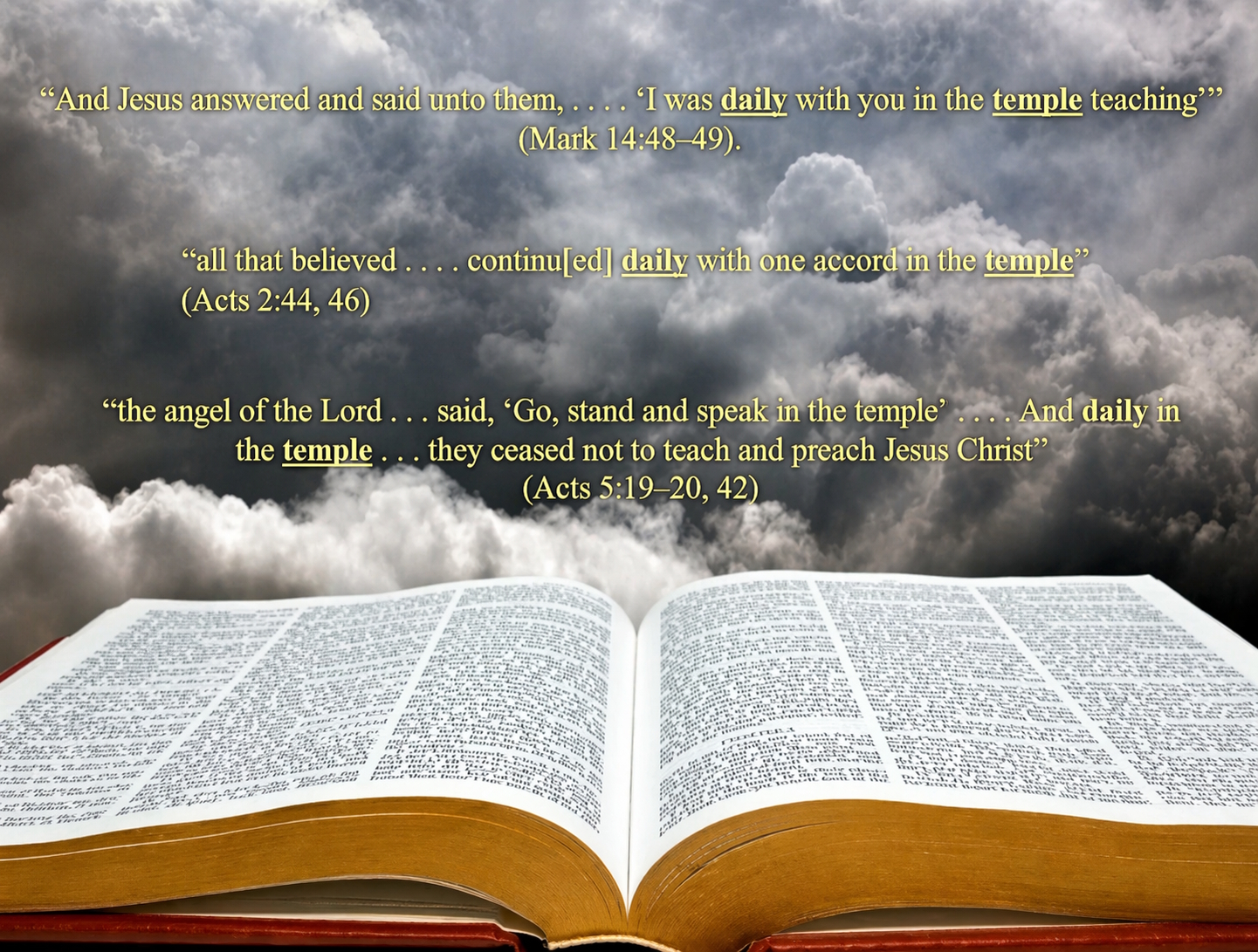
In the book of Mark, chapter 14, verse 49, the Redeemer stated that He taught in the temple on a daily basis. And His disciples followed suit. According to the book of Acts, “all that believed” (which suggests the entire community of Christians in the Jerusalem area—amounting to several thousand people) “continu[ed] daily with one accord in the temple” (2:41, 44, 46).
In addition, the book of Acts indicates that Christ’s apostles were commanded by an angel to teach in the temple, and they obeyed this directive daily (see 5:19–21, 42). It should be pointed out that the apostles of Jesus Christ did not leave the temple behind; they were forcibly removed from its premises.
Peter and John were there during the hour of prayer (see Acts 3:1) and were kicked out by “the priests, and the captain of the temple, and the Sadducees” (Acts 4:1–3). The apostle Paul was shown the door by a group of Jews from Asia (see Acts 21:27–30).
Early Christians and Temple Worship
It should be noted that before Paul was taken away, he had submitted himself to rituals of purification (v. 26), thus demonstrating that even a leader of the Christian faith had no aversion to participating in some of the Israelite temple ordinances. It should also be noted that in Acts 22:17–18, Paul is described as offering prayer in the temple, and while doing so, he had a vision of the resurrected Lord and was given instructions by Him about building up His kingdom. 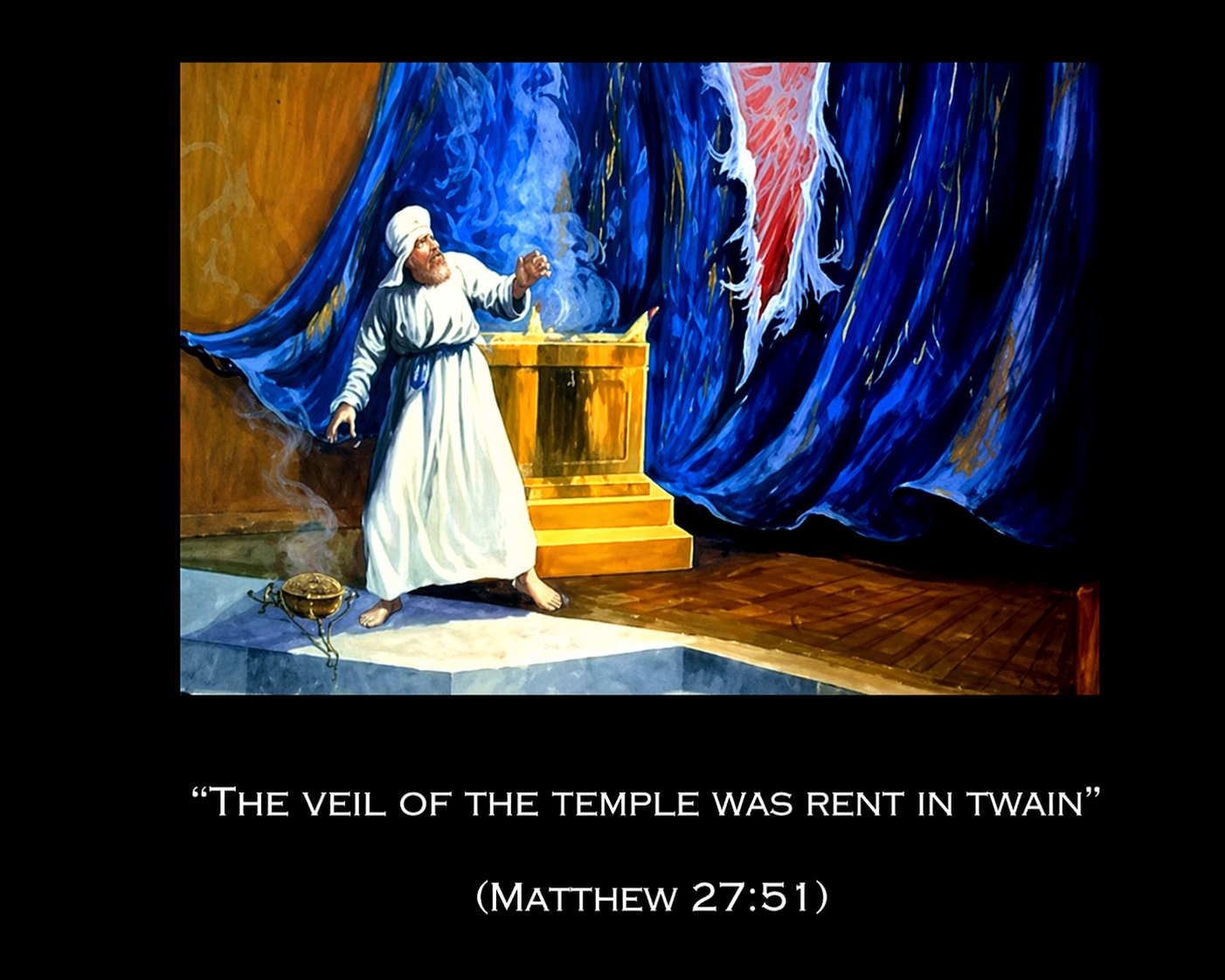
In all of this, it can be seen that the first-century disciples of Jesus Christ attended the temple often, experienced purification rites there, prayed there, taught there, and received revelation from the resurrected Lord there. Notice that all of these things happened AFTER the tearing of the temple veil, which occurred during the crucifixion.
It is obvious that the destruction of that particular curtain did not signal to the first-century Christians that the temple had become obsolete and should therefore be abandoned.
Priesthood Before the Law of Moses
Another argument made by critics is that since Moses built the Tabernacle, and the rituals of priestly initiation were practiced inside the Tabernacle, they must have been classified as part of the Law of Moses. Therefore, when the Atonement abolished the Law of Moses, the initiation rites of the priests became obsolete—or so the argument goes.
But as anyone who reads the Old Testament should know, the office of priest, as recognized by God, predated the Law of Moses—and so did the office of king. Melchizedek was both a king and a priest (see Gen. 14:18), and, as indicated in the Psalm 110 coronation text, the king of Israel was (by divine decree) a priest after the order—not of Aaron and the Law of Moses—but of Melchizedek (see v. 4).
Because the offices of king and priest existed prior to the Law of Moses, there was no reason for their abolishment after the Atonement had eliminated the old law.
The Temple in the Book of Revelation
There is another New Testament text showing that there was a definite link between the first-century Christians and the temple institution: this is the book of Revelation. In this scriptural record, the apostle John described the heavenly temple of God in considerable detail, but this fact might not be obvious unless one looks at the big literary picture. 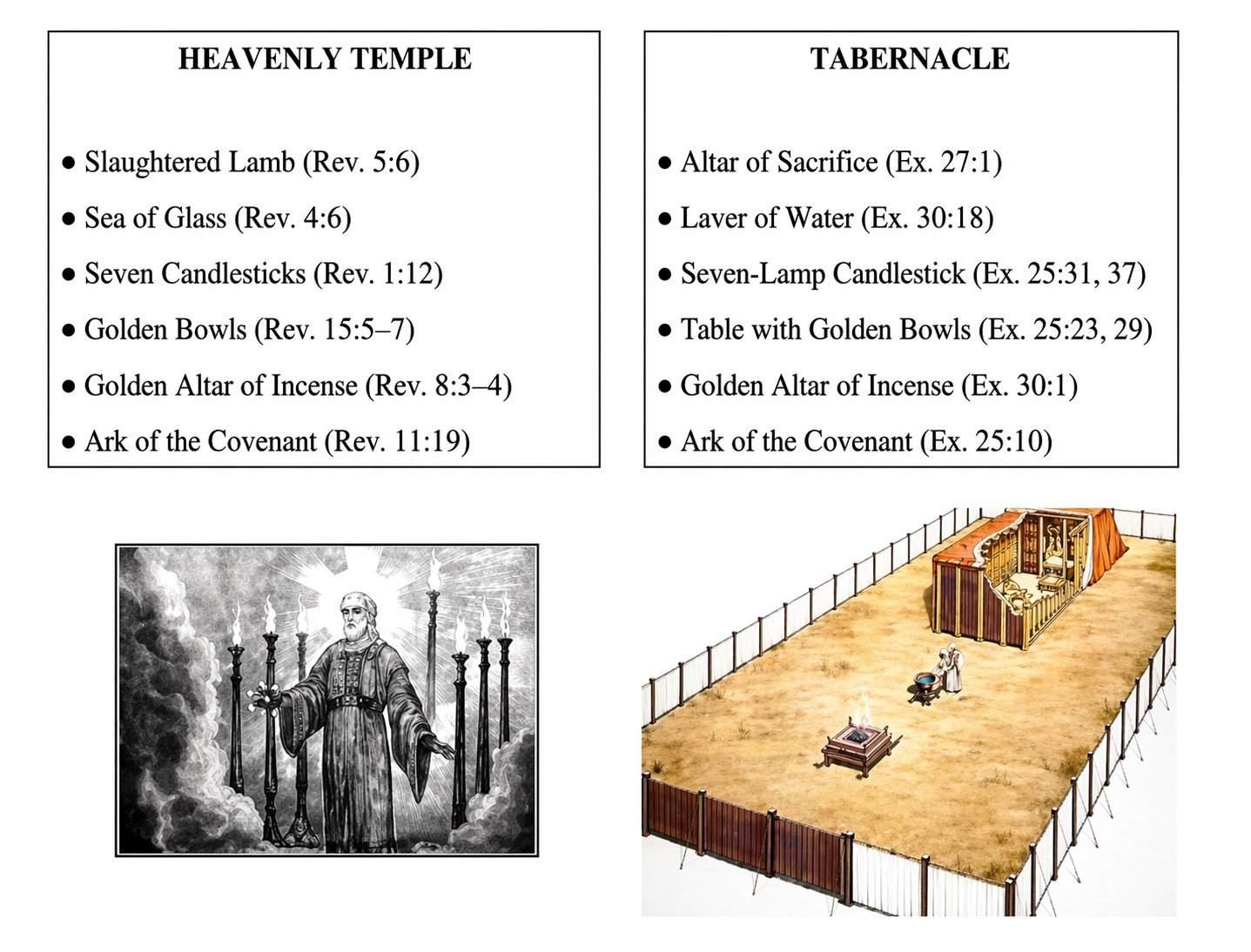
The Heavenly Temple and Its Earthly Pattern
Consider the parallels—shown on this slide—between objects described in the book of Revelation and the description of the Tabernacle in the book of Exodus. When Moses was commanded to build the Tabernacle on the earth, he was reminded to construct it according to the pattern that he had been shown by the Lord (see Ex. 25:40).
It is evident from this directive, and also the parallels on this slide, that the heavenly temple of God served as the prototype for His earthly sanctuary. The first-century Christians were not very likely to consider temple ideology to be obsolete since—as the apostle John saw during his vision—God’s throne was still located inside of His heavenly temple after the Atonement had taken place (see Rev. 7:15). 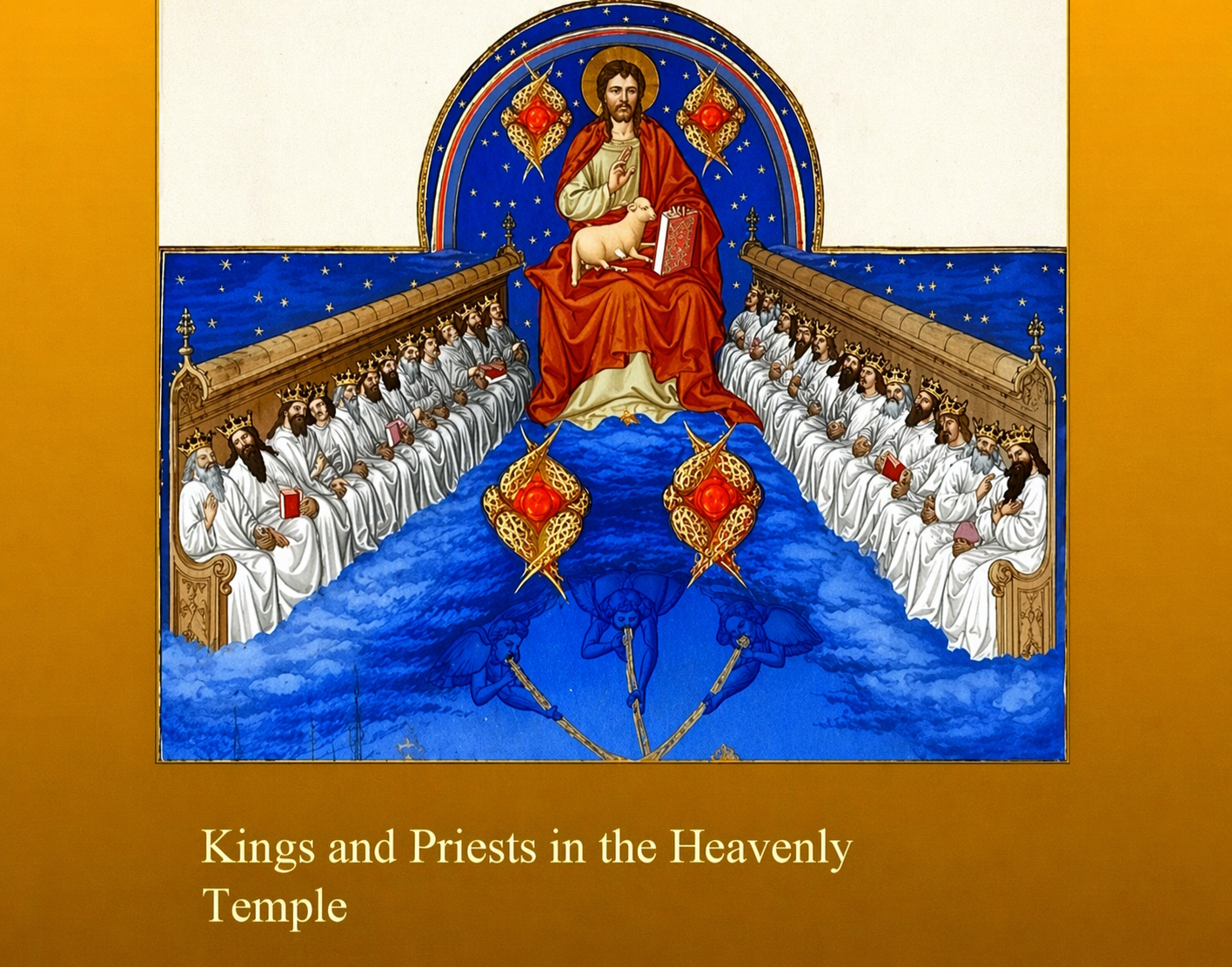
But beyond that, the text of Revelation chapter 6, verses 9 through 11, needs to be taken into consideration. There it is indicated that some people who once dwelt upon the earth had ascended to the heavenly temple and were invested there with white clothing: the message being that Christians—even after the Atonement of Jesus Christ had been accomplished—could experience the rite of investiture in the temple of God.
The New Jerusalem as a Holy Sanctuary
Critics are quick to point out that in Revelation chapter 21, verse 22, John said that he did not see a temple inside of the city of the heavenly New Jerusalem (see Rev. 21:22), and they conclude from this statement that the temple had become outdated in the eternal scheme of things.
But what the critics have failed to recognize is the fact that while John declared that “there will be no temple in the New Jerusalem (21:22), the city itself is, as it were, a vast sanctuary”—this, according to George Beasley-Murray in his commentary on the book of Revelation. 1
And beyond this, it needs to be recognized that this city is fashioned after the cubic pattern of the Holy of Holies of the earthly temple (see Rev. 21:16; cf. 1 Kgs. 6:20). Anyone who enters into this city will thus be entering into the most holy place of God’s temple.
Kings and Priests in Early Christianity
While all the above information tends to support the idea that the first-century Christians held a positive outlook on temple ideology, the question naturally arises about whether or not those early Saints had a connection to the Israelite temple’s initiation system (which is not necessarily the same thing as the temple’s sacrificial system—though there was some overlap).
Again, the book of Revelation provides relevant information. In chapter 1 of that apocalypse, the apostle John directs his comments to numerous individuals who constitute “the seven churches which are in Asia” and mentions that Jesus Christ has “made us kings and priests unto God” (Rev. 1:5–6).
Then in chapter 5 of the same book, the twenty-four elders who surround God’s throne in the heavenly temple (as pictured on this slide) declare that the Lamb—meaning Jesus Christ—had “made” them “kings and priests” unto God (v. 10).
Sacred Vestments and Temple Symbolism
This same group of twenty-four elders (who likely represent the twenty-four courses of ancient Israel’s temple priests—see 1 Chron. 24:1–19) are said elsewhere in John’s book to be “clothed in white raiment” and having “crowns of gold” upon their heads (Rev. 4:4).
A glance through the books of the Old Testament confirms that the temple priests of ancient Israel and the Israelite kings wore white linen vestments and were adorned with golden crowns (see Ex. 39:30; Lev. 16:4; Ps. 21:3; 1 Chron. 15:27).
But the question still remains about the nature of Christian kingship and priesthood during this time period and how status in these offices was bestowed. Were they simply symbolic, spiritualized, and allegorical titles, or did the New Testament Saints physically experience initiation rites like the kings and priests did during the times of Moses and Solomon? 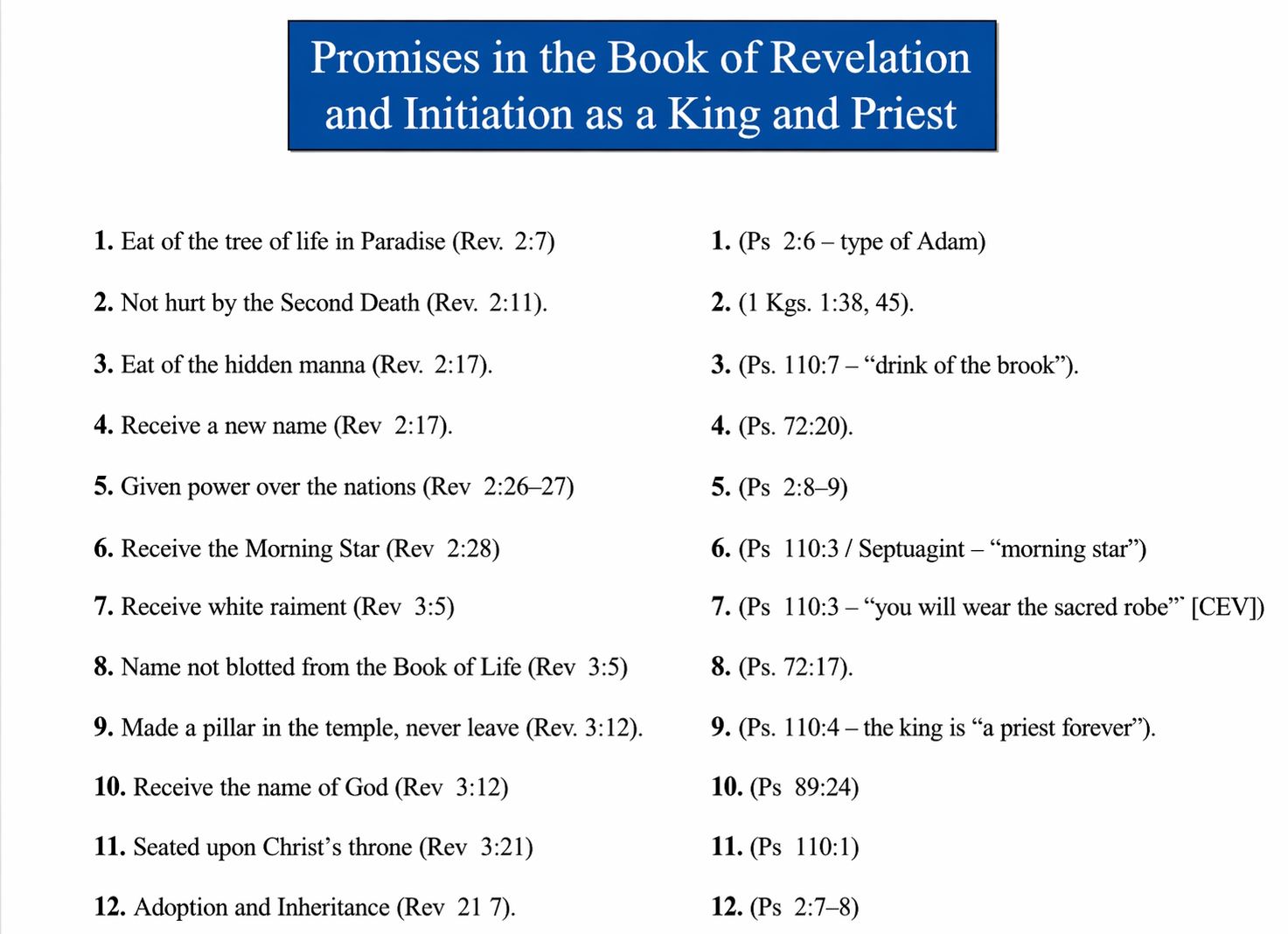
The Pattern of Twelve Promises
I would now like to draw your attention to a distinct pattern in the book of Revelation which suggests that the offices of ‘king and priest’ were not simply bestowed upon the first-century Christians by verbal decree. This pattern is found among twelve statements made by Deity regarding those mortals who overcome the world.
Let us briefly examine each of these twelve statements in the order of their appearance in John’s apocalypse and make comparisons between them and the initiation rites of ancient Israel’s kings and priests. Notice also, as we go through these slides, the number of connections between the promises enunciated by the Lord and the physical objects found inside of the Israelite temple complex. 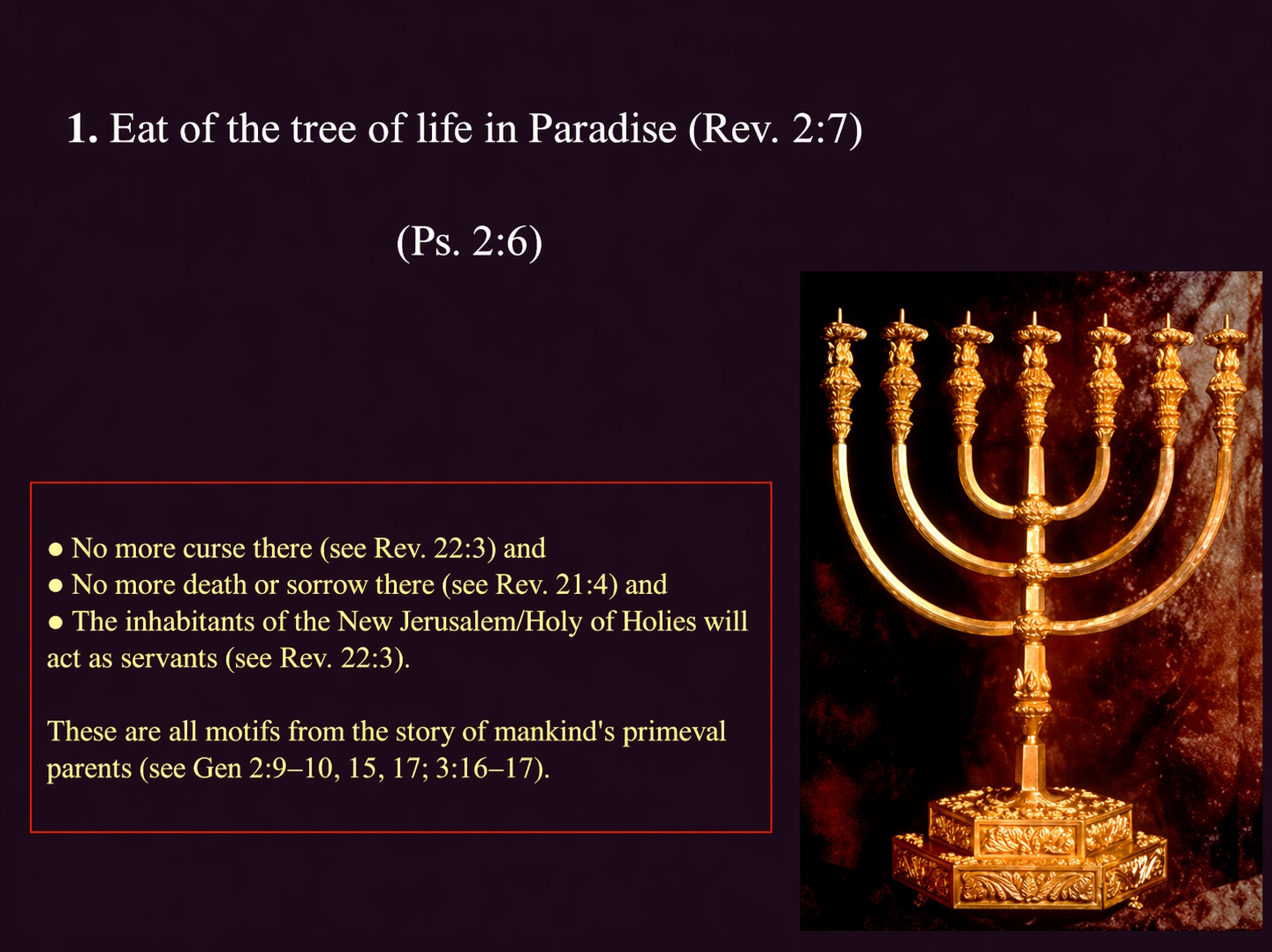
Promise #1: The Tree of Life
#1. Eat of the tree of life in Paradise (Rev. 2:7)
New Testament scholar David Aune of Notre Dame University explains in his book of Revelation commentary that this is a promise that the godly and the righteous will *“inherit the garden of Eden.”*2
Notice in the book of Revelation that the tree of life and the water of life are located inside of the New Jerusalem/Holy of Holies cube (see Rev. 22:1–2). In addition, it is said in John’s record that there will be
No more curse there (see Rev. 22:3) and
No more death or sorrow there (see Rev. 21:4) and
The inhabitants of the New Jerusalem/Holy of Holies will act as servants (see Rev. 22:3).
Eden, Kingship, and the Temple
These are all motifs from the story of mankind’s primeval parents as recorded in the book of Genesis (see Gen. 2:9–10, 15, 17; 3:16–17). The message in all of this is that those people who are allowed access to the Holy of Holies city will become like Adam and Eve and experience the things that they did before the Fall.
There is also a connection between these ideas and the enthronement rites of the Israelite king. In the book of Genesis, it is stated that God created Adam and “put” him into the Garden of Eden (Gen. 2:7–8).
In Psalm 2—which is recognized by many biblical scholars as a coronation text—the Lord states that He has “set” the Israelite king upon the “holy hill of Zion” or the temple mount (Ps. 2:6). A book entitled Adam in Myth and History draws attention to this parallel and makes the connection between kingship and the Adam figure.3
This connection becomes more significant when it is remembered that the Israelite temple was decorated with symbols of the Garden of Eden.4
Promise #2: Protection from the Second Death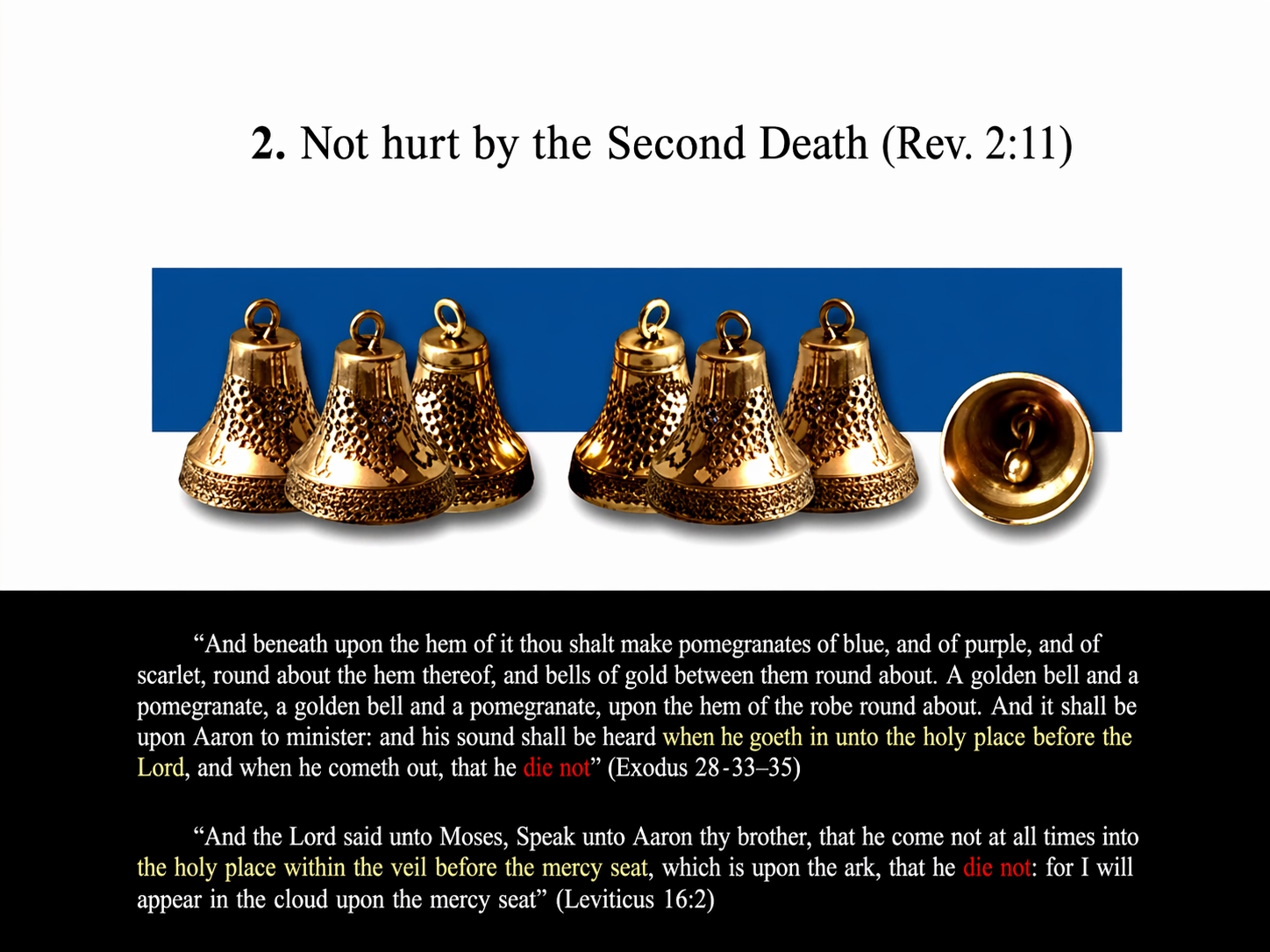
#2. Not hurt by the Second Death (Rev. 2:11)
The Rabbinic expression “second death” describes the type of death that will be suffered by the wicked in Sheol.5 Revelation chapter 20, verse 6, clarifies that kings and priests of God will not be affected by the second death.
Professor Gregory Beale of Wheaton College has written in the New International Greek Testament Commentary that it is the priestly and kingly status of persons that gives them power over the second death because such people will be able to *“serve in the presence of God.”*6
The idea of serving in God’s presence is significant to this discussion because Revelation chapter 22 reveals that God will be physically present inside of the New Jerusalem/Holy of Holies (see vv. 3–4), but it also says that those people who qualify for the second death cannot enter through the gates of the New Jerusalem/Holy of Holies (see vv. 14–15) or, in other words, they will not be able to pass by the angels who stand guard at the gates of that structure—as can be seen in Revelation chapter 21, verse 12.
Temple Gates, Guardians, and Sacred Entry
This circumstance was mirrored by the cherubim which were embroidered upon the temple veil that was stationed at the entrance to the Holy of Holies of the earthly temple (see Ex. 26:31–33) and also by the priestly porters who stood at the temple entrances (see 1 Chron. 9:17–27).
Some Old Testament scholars are of the opinion that in order for someone to get past the temple porters they had to participate in an entrance liturgy where questions and answers were exchanged and a password was given.7
This brings us to the picture of the bells on this slide. These devices were attached to the bottom of the robe that was given to the high priest of the temple when he received his initiation rites. It appears that the bells on the high priest’s robe served as a way whereby he could gain entrance into certain temple areas.
Ritual Preparation and Access to God’s Presence
You will notice in the scriptures listed below these bells that they were necessary for the high priest to have on his person so that he would not suffer death when he went “within the veil.” In Richard Watson’s Biblical and Theological Dictionary, he tells us that *“the palace of kings was not to be entered without due notice, [and this was done] by striking some sonorous [or sound-producing object] . . . [T]he High Priest did, by the sound of his bells at the bottom of his robe, ask leave to enter [the sanctuary of God].”*8
On this next slide, you can see that both the kings and the priests of Israel went through a washing rite as part of their induction into office. At the bottom of this slide is a passage from the book of Exodus wherein the Lord states that His temple priests were required to ritually wash certain parts of their bodies with water before serving inside of His holy house. Failure to do so could result in the offender suffering death. 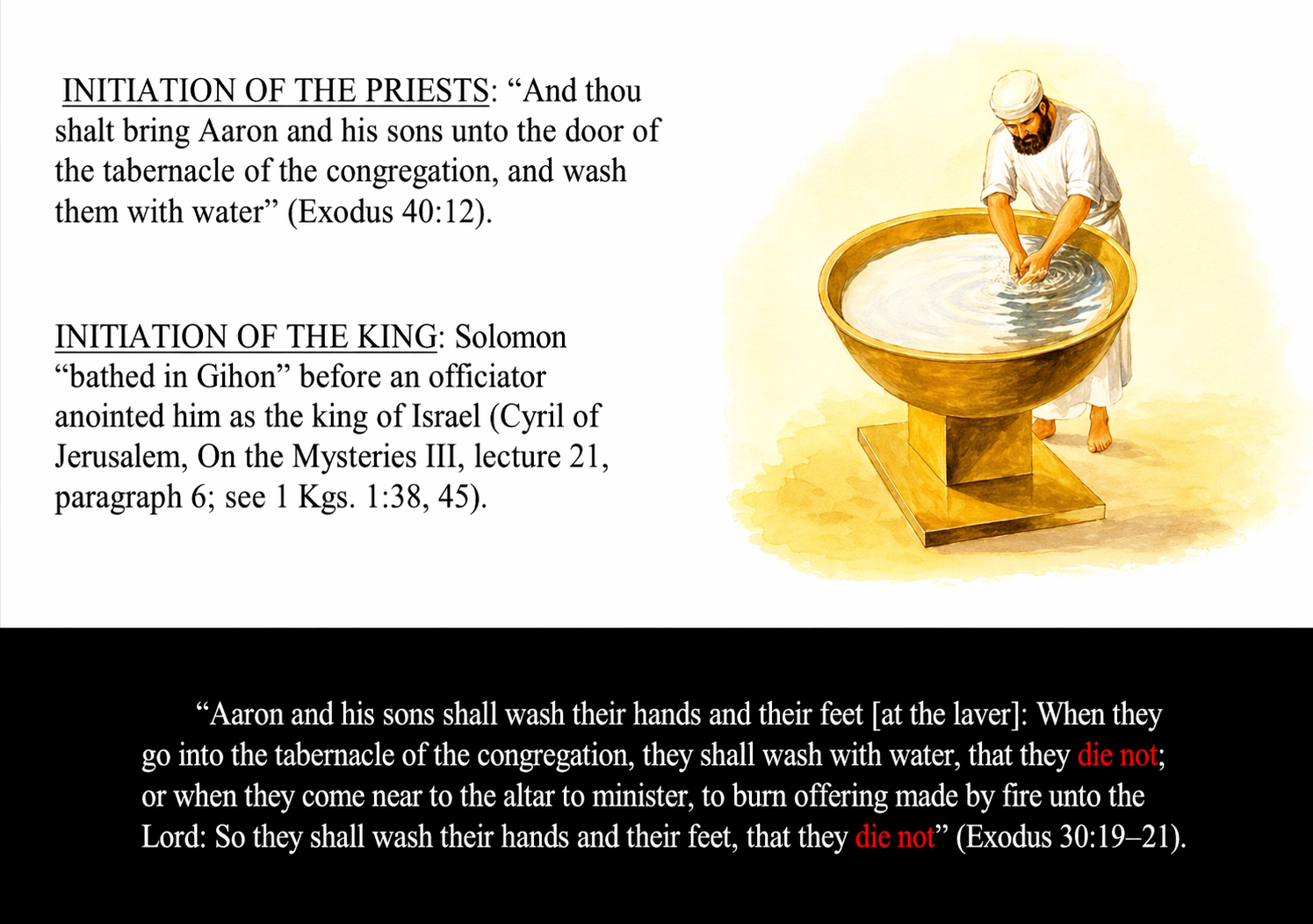
Promise #3: The Hidden Manna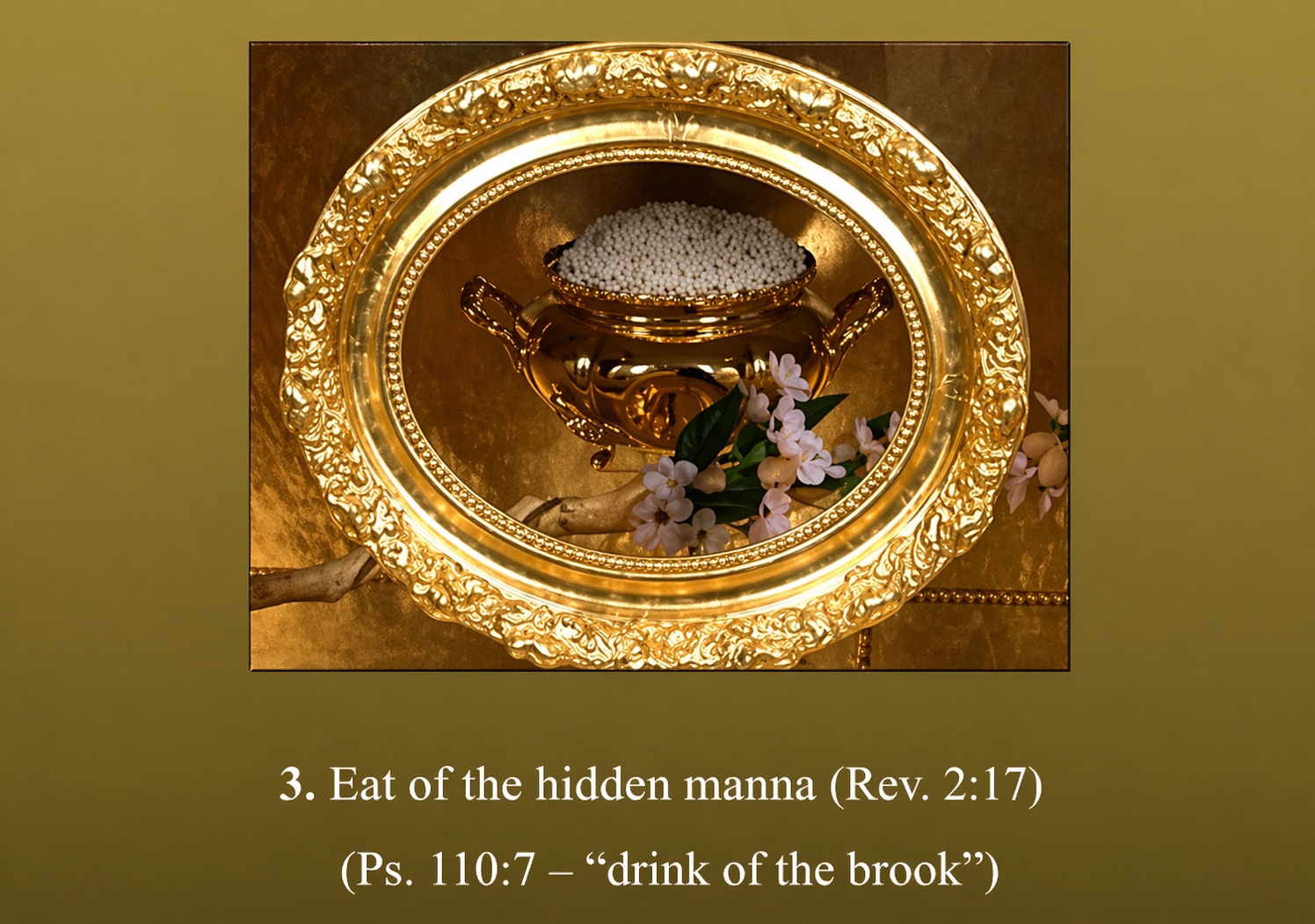
#3. Eat of the hidden manna (Rev. 2:17)
It is known from the texts of both the Old and New Testaments that a portion of the manna that fed the Israelites during Moses’ day was concealed inside of the Ark of the Covenant, which was itself placed inside of the Holy of Holies (see Ex. 16:15, 33–34; Heb. 9:4). Because of the inaccessibility of this manna—except to the high priest of the temple—it could be thought of as being ‘hidden’ away.
There was a Jewish tradition that during the Messianic era the manna (or “bread” as Moses called it—see Ex. 16:15) would once again descend and nourish God’s covenant people.9 During Jesus Christ’s Messianic ministry, He positively identified Himself as the “bread of life” (Jn. 6:51).
Manna, Kingship, and Divine Nourishment
George Widengren, in his study called The King and the Tree of Life in Ancient Near Eastern Religion, hypothesized from his knowledge of Mesopotamian cultic patterns that the pot of manna in the Israelite temple was part of the regalia handed over to the king of Israel during his coronation ceremony.10
While there is no reference to ‘manna’ in the coronation Psalms, there is a comparable reference to nourishment in Psalm 110:7 where it is said of the king that he will “drink of the brook.” This is likely the Gihon brook, which was considered mythologically to be the source of life.11
This act of drinking could thus be seen as partaking of the water of life—which is something those in the New Jerusalem/Holy of Holies will reportedly do (see Rev. 21:6; 22:1; cf. Ezek. 47:1).
Promise #4: Receiving a New Name
#4. Receive a new name (Rev. 2:17)
The new name is a subject that is directly connected with royal accession. “When [the Israelite king] is crowned and receives the scepter,” says the Anchor Bible Dictionary, *“he receives a new name.”*12
An article published in the Journal of Biblical Literature says, “The indications are that . . . the bestowal of a regnal name [or throne name], was a regular feature of the pattern of kingship in Judah from [the time of] David down to [the time of] Zedekiah.” This source also states that “the occasion of the bestowal of the royal name was doubtless the time of the anointing and enthronement; the utterance of the new name would naturally accompany the divine adoption” (—a subject that will be mentioned later on in this presentation).13 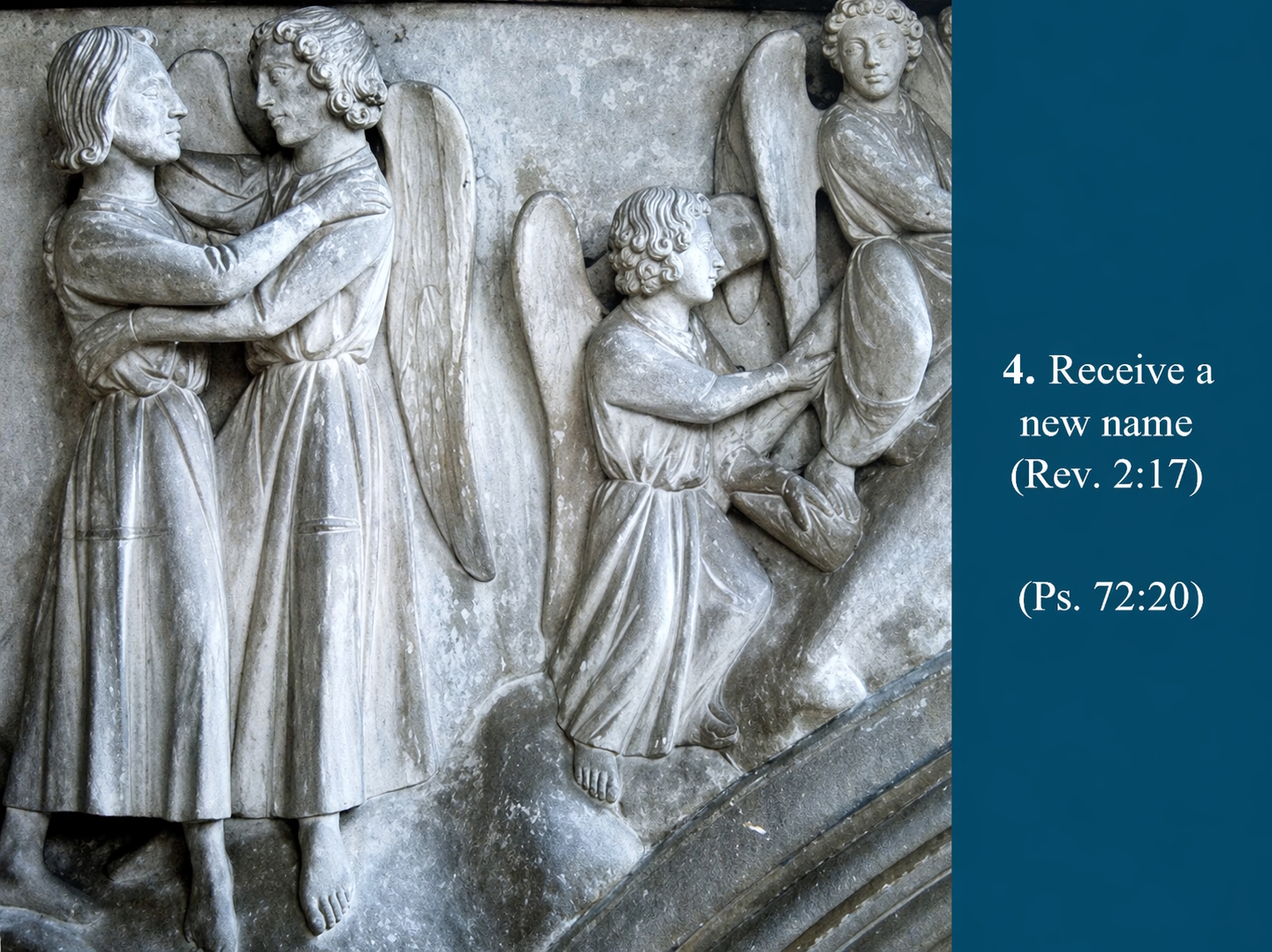
Jacob, Divine Encounter, and Identity
On this slide, you see an illustration of the story in Genesis where the patriarch Jacob ‘wrestles’ with a so-called ‘angel.’ Yet, in this sculpture, the two seem to be embracing rather than wrestling. Indeed, one medieval rabbi’s commentary on the Torah insists that Jacob’s experience with the heavenly being should be translated in Genesis as, *“and he embraced him.”*14
It was in this embrace that Jacob received a new name (see Gen. 32:24, 27–28).
Sacred Embrace and Divine Relationship
In Louis Ginzberg’s collection of The Legends of the Jews, it is reported that the two cherubim on top of the Ark of the Covenant were both male in gender, and they would miraculously embrace each other “whenever Israel [was] devoted to their Lord.” An embrace was thus associated with the Holy of Holies of the Israelite temple.15
As Dr. Raphael Patai has noted in one of his published volumes, the cherubim were at one time refashioned as a male and female couple and were shown in an intimate embrace. But the meaning of the imagery associated with them remained the same as before; they were a *“symbolic expression of the relationship between God and Israel.”*16
As an aside, it might be mentioned that early Christian initiation embraces were reported by Hippolytus, Cyril, Ambrose, Chrysostom, and Narsai. This represents a time span of about 150 A.D. to 450 A.D. and covers a geographic area from North Africa to Jerusalem to Syria to Italy to Constantinople. 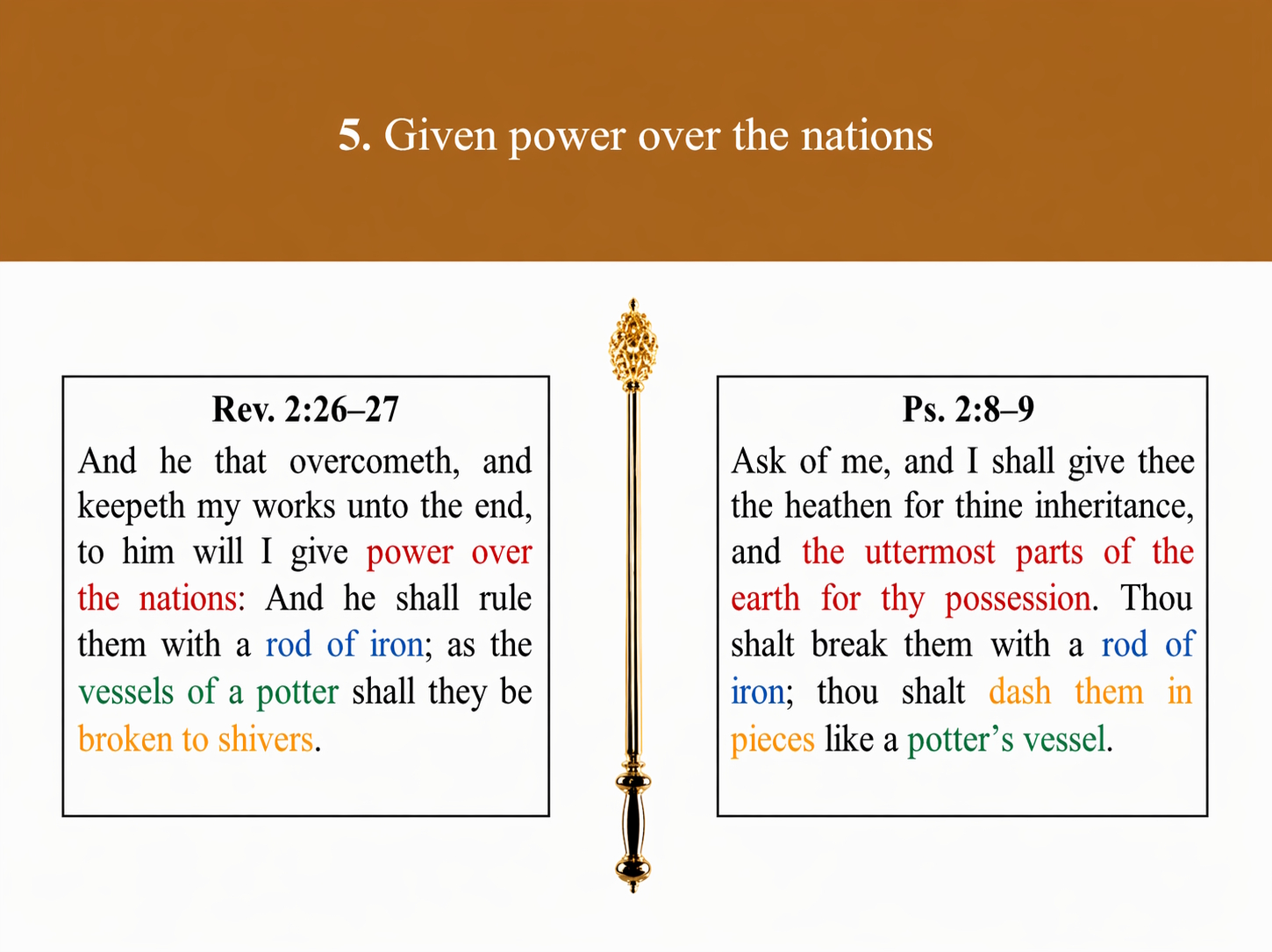
Promise #5: Power Over the Nations
#5. Power Over the nations (Rev. 2:26–27)
This is a passage that has direct connections to the royal coronation texts of the Old Testament. These verses in the book of Revelation are, in fact, *“a free rendering of Psalm 2:8–9.”*17
This becomes clear when the two blocks of words are placed side by side and key phrases are highlighted—as on this slide. Here, recognized kingship coronation motifs are being applied directly to the first-century followers of Jesus Christ. 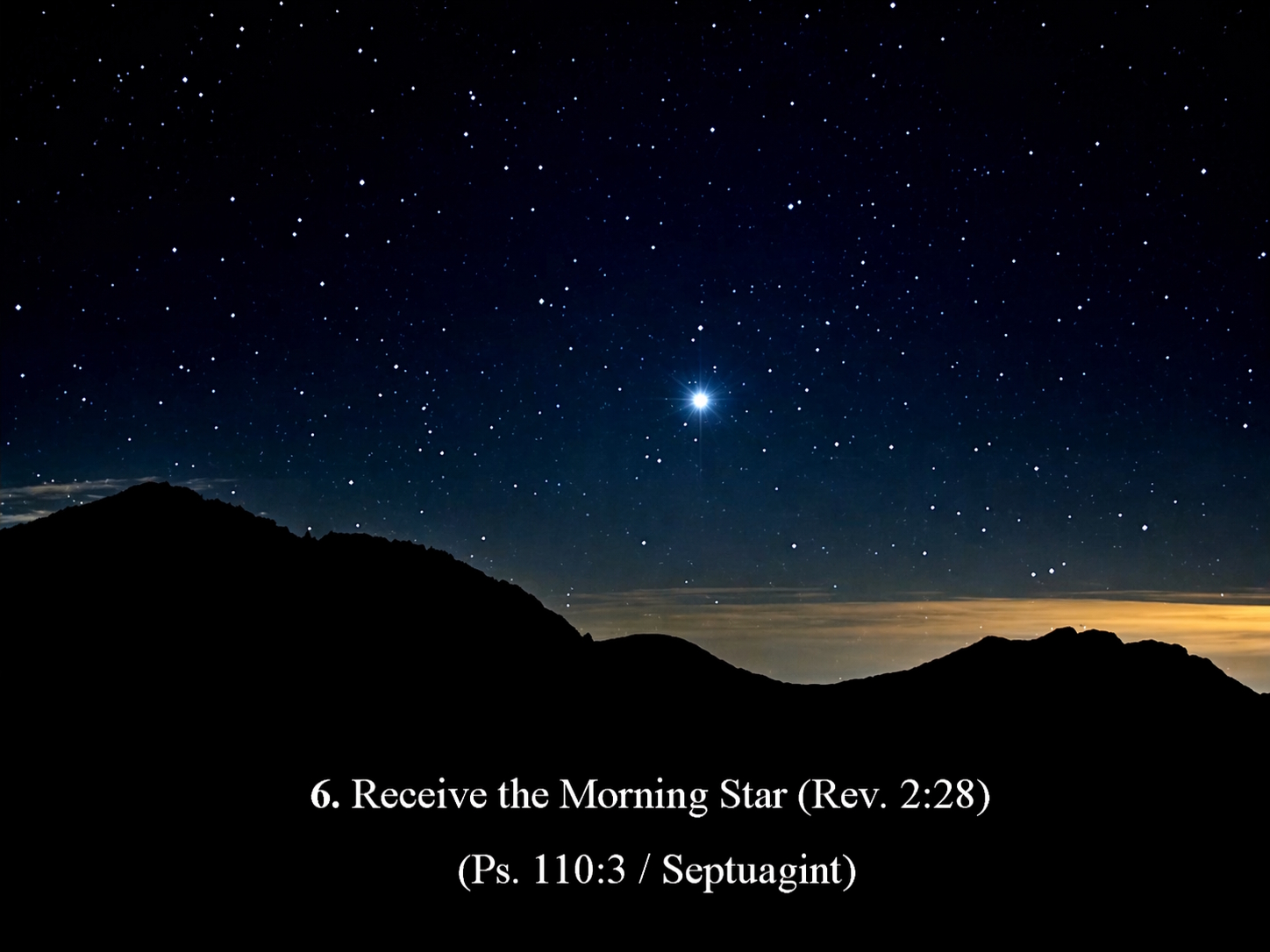
Promise #6: The Morning Star
#6. Reception of the Morning Star (Rev. 2:28)
The morning star is actually not a star at all but rather the planet Venus. During Babylonian times, “Venus was the symbol of sovereignty. In Roman times it was more specifically the symbol of victory and sovereignty, for which reason . . . Caesar’s legions carried her sign on their standards.”
It therefore appears—in connection with what was discussed in the previous slide—that *“the morning star was the sign of conquest and rule over the nations.”*18 It should also be remembered that *“the star was a familiar symbol in Jewish writings for the expected Davidic king.”*19
The magi of the New Testament stated that they had seen the star of the king of the Jews in the east (see Mt. 2:2). All of this is likely tied together with Revelation 22:16, where Jesus Christ calls Himself the “morning star.”
Kingship, Birth, and the Morning Motif
The second scriptural reference on this slide shows that in the Septuagint version of Psalm 110:3—which is a royal coronation text—the “morning star” is mentioned. In the King James translation of Psalm 110:3, however, only the concept of “morning” is discernable.
In a coronation context, the morning would be the time of the king’s new birth as a member of God’s family—which will be discussed in a later section of this presentation. 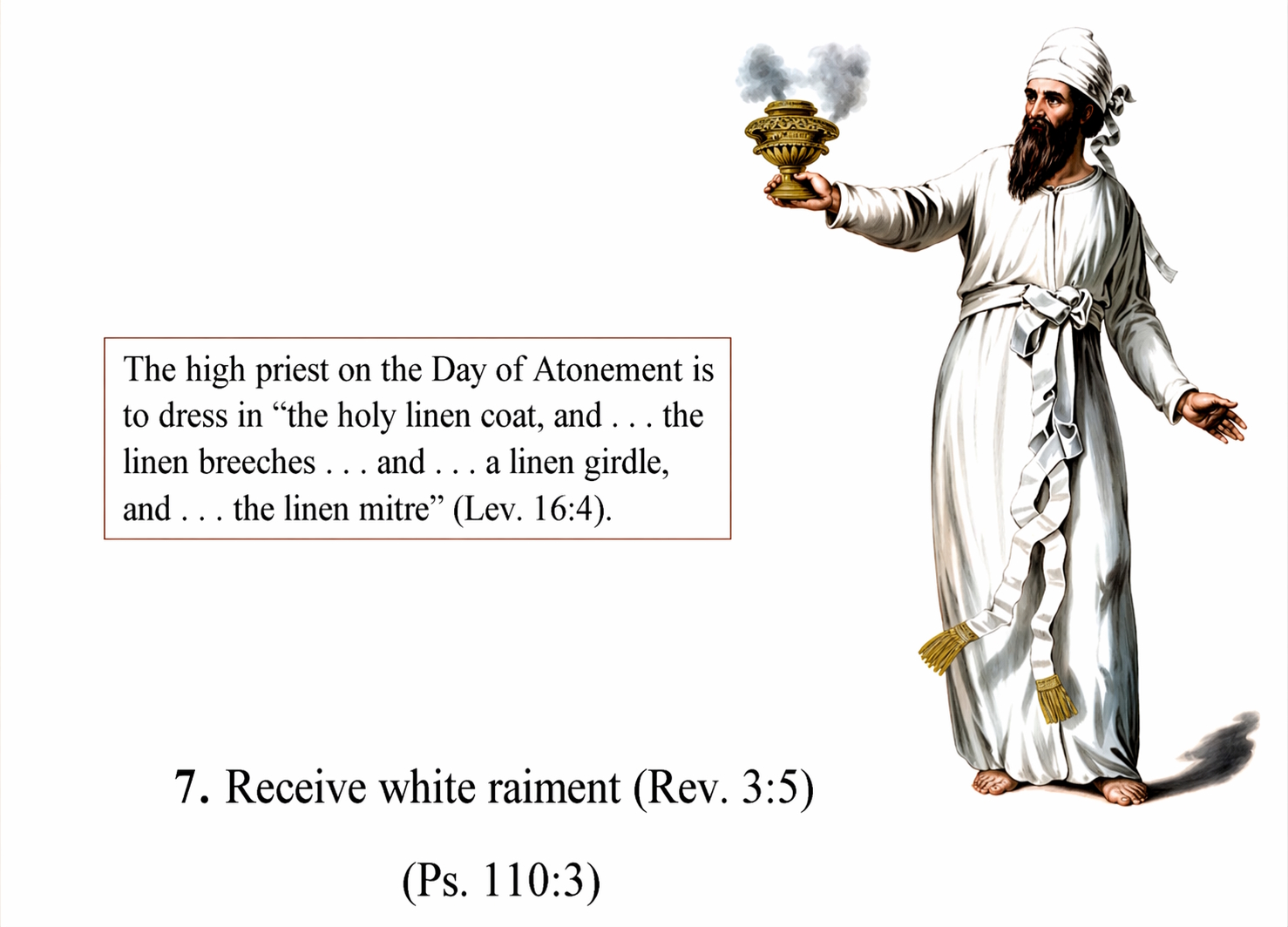
Promise #7: Clothed in White Raiment
#7. Clothed in white raiment (Rev. 3:5)
According to Robert Thomas’ commentary on the New Testament apocalypse,
“the source of [this] image is . . . Zechariah 3:1–10 where the filthy garments of Joshua the high priest [of the temple] are replaced with clean ones.” He says that “overcomers are [thus] linked to the priesthood and priestly functions through this promise” in the book of Revelation. 20
It is well-known that the temple priests of ancient Israel were invested with white clothing when they were initiated into office (see Ex. 28:4), but it appears from 1 Chronicles 15:27 that the king of Israel also received clothing of this nature.
Sacred Vestments and Coronation
And it seems from a modern scholarly rendition of Psalm 110 that the king’s acquisition of this apparel took place on the day of his enthronement. William Brown of the Union Theological Seminary in Richmond, Virginia, translates verse 3 of this recognized coronation text as saying, “In holy splendor,” and he notes that the feminine cognate of the word ‘splendor’ can refer to cultic vestments. 21
Indeed, one modern Bible translates these words as “in holy garments” (ESV), and another says “you will wear the sacred robes” (CEV). 
Promise #8: The Book of Life
#8. Name not blotted from the Book of Life (Rev. 3:5)
One commentator on this passage says that the Book of Life is frequently referred to in ancient Israelite and Jewish literature “as a kind of heavenly citizen registry.”
In addition, he teaches that “in Judaism and early Christianity, the primary setting of the Book of Life motif was the judgment scene in which God is seated upon His throne surrounded by heavenly courtiers . . . . The origin of this metaphor,” he says, *“is certainly that of the ancient near eastern royal court, where records were made available to the king for dispensing justice.”* 22
Kingship, Priesthood, and Eternal Record
In Robert Thomas’ exegetical commentary on Revelation, he proposes that this promise “advances the thought of the priestly purity of the overcomer.” According to him, having one’s name recorded in the book is connected with admission into the New Jerusalem. 23
So, once again, we have a promise that can be connected with kingship and priesthood and the most holy room of the temple. Another tie-in of this promise with Israelite kingship can be discerned in Psalm 72—which is recognized by some scholars as a coronation text.
In verse 17, it is stated that the king’s name will endure forever—which is another way of saying that it will never be blotted out. 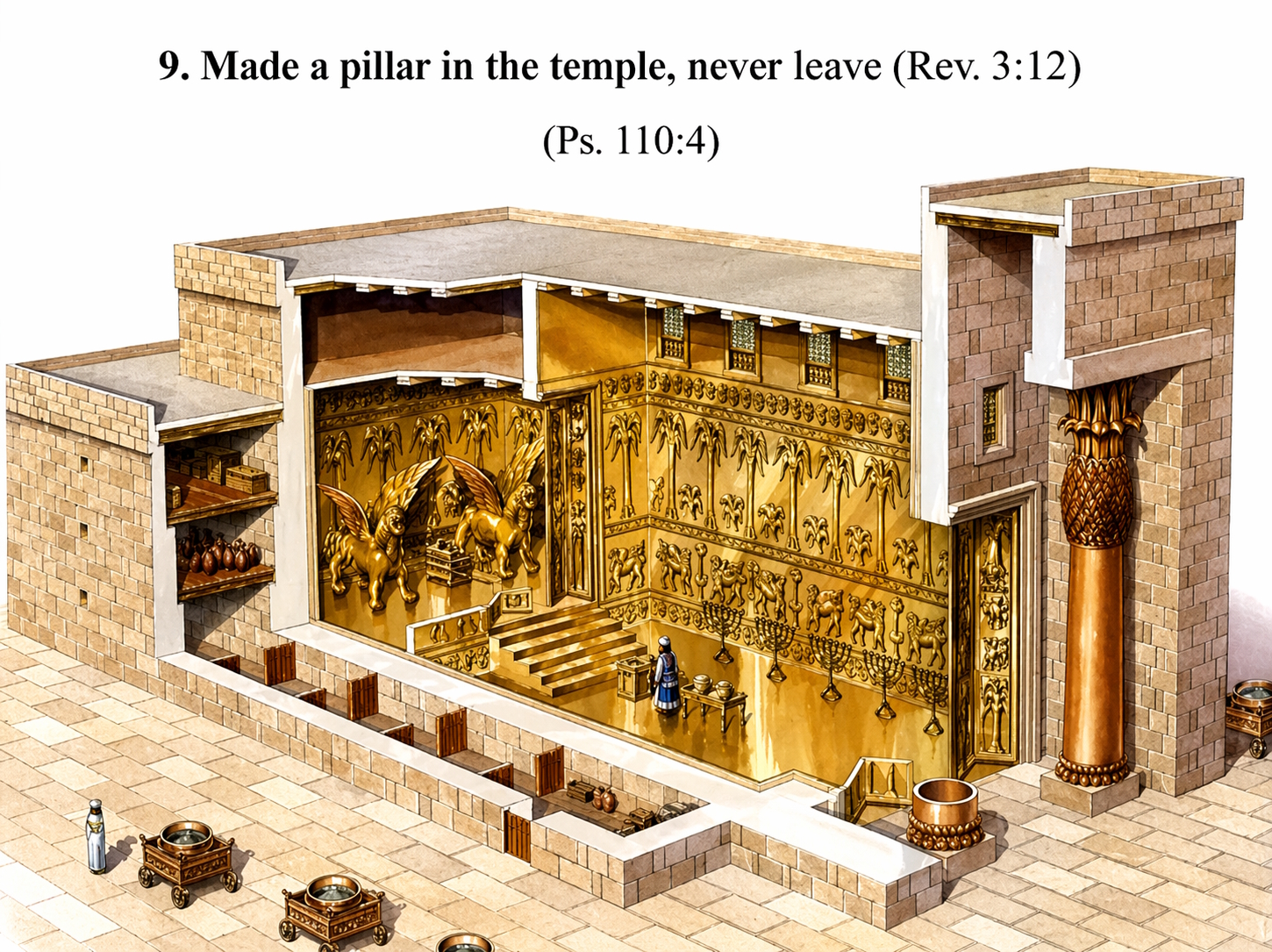
Promise #9: A Pillar in the Temple
#9. Made a pillar in the temple (Rev. 3:12)
This is a reference to “the heavenly temple,” says one scholar, and to the individual becoming *“a permanent part of the temple of God, and hence a continual participant in the divine worship that takes place there.”* 24
Robert Charles—an Archdeacon of Westminster and a Fellow of the British Academy—thought it possible that this figurative language served *“to set forth the dignity of the faithful as priests of God in the next world.”* 25
In this light, it is interesting to note that in the Psalm 110 coronation document, it is stated that the king is “a priest forever.”
Promise #10: The Name of God and the New Jerusalem
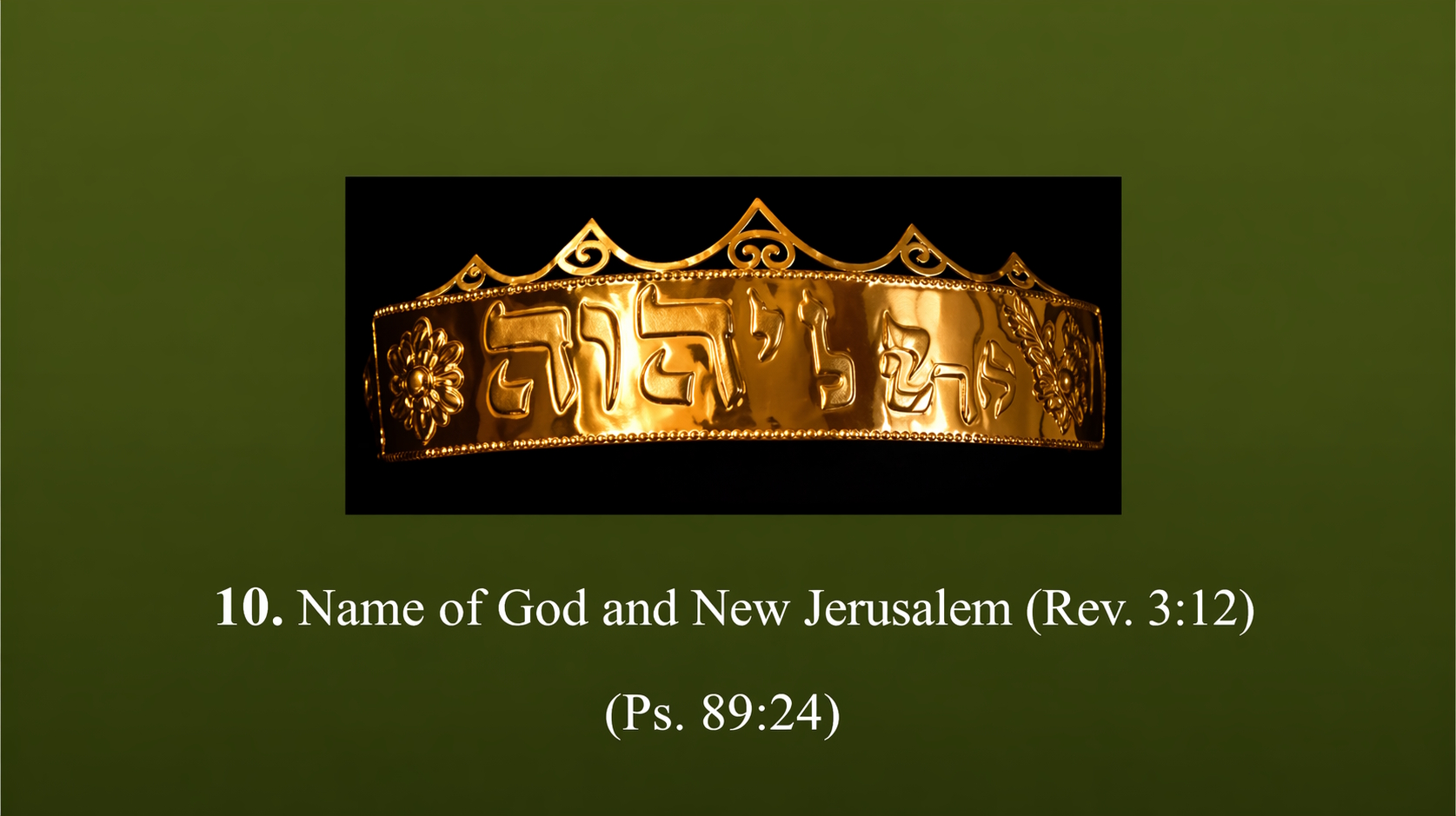
#10. Name of God and New Jerusalem (Rev. 3:12)
This promise can be directly connected to the temple priests since Revelation chapter 22, verse 4, indicates that the name of God is written on the forehead of the individual, and Exodus 39:30 specifies that the name of God was written on the crown (or forehead) of the High Priest of the temple.
In this way all of those who overcome the world become high priests and would thus all have access to the Holy of Holies of the temple—a concept which is confirmed in Hebrews 9:3 and 10:19.
“The name of God and the name of His city should not be overlooked,” says Richard Wilkinson in the Journal of Biblical Literature.
*“The relationship between the oriental king and his city was of the greatest significance, as the city symbolized the institution of kingship not only by virtue of its position as the seat of the monarch but also because the very act of accession was invariably legitimized by the site of the enthronement.”* 26
Kingship, City, and Exaltation
If we turn to the Psalm 89 coronation text, we can see a possible parallel to this concept in verse 24. There the king of Israel is promised that he will be exalted in the Lord’s name. 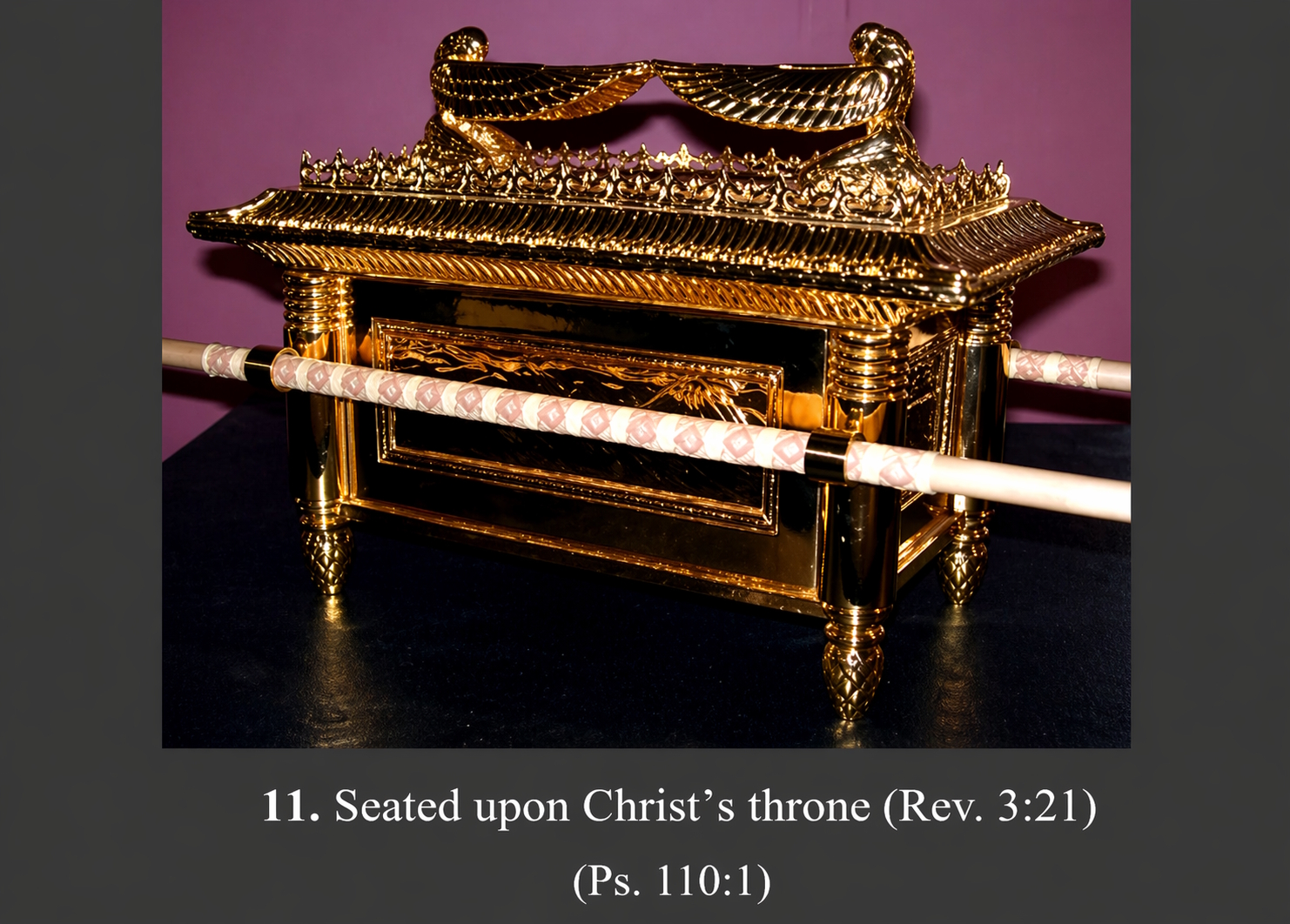
Promise #11: Seated Upon Christ’s Throne
#11. Seated upon Christ’s throne (Rev. 3:21)
The Savior’s throne—as mentioned in this promise—is “the throne of David” or the throne of the Israelite king. 27 This promise pertains, therefore, to kingship within the house of Israel and also suggests the idea of deification for the Saint who is privileged to take this exalted chair.
“The promise that the victorious Christian will sit with Christ on His throne,” says one commentator, “is based on ancient Near East and Israelite kingship and enthronement imagery.” The phrase “just as I also conquered and sat with my Father on His throne,” says David Aune of Notre Dame University, *“is an allusion to Ps. 110:1.”* 28
And, of course, verse 1 of Psalm 110 mentions the footstool of the Israelite king’s throne. The Psalm 89 coronation text speaks of God establishing the king’s throne at the time of coronation (see Ps. 89:3–4, 29, 36), but a more direct parallel to the promise of Revelation 3:21 can be seen in the two books of Chronicles where it is stated that Solomon sat upon the throne of the Lord as king—meaning that he was a vice-regent and representative of the heavenly Sovereign (see 1 Chr. 28:5; 29:23; 2 Chron. 9:8). 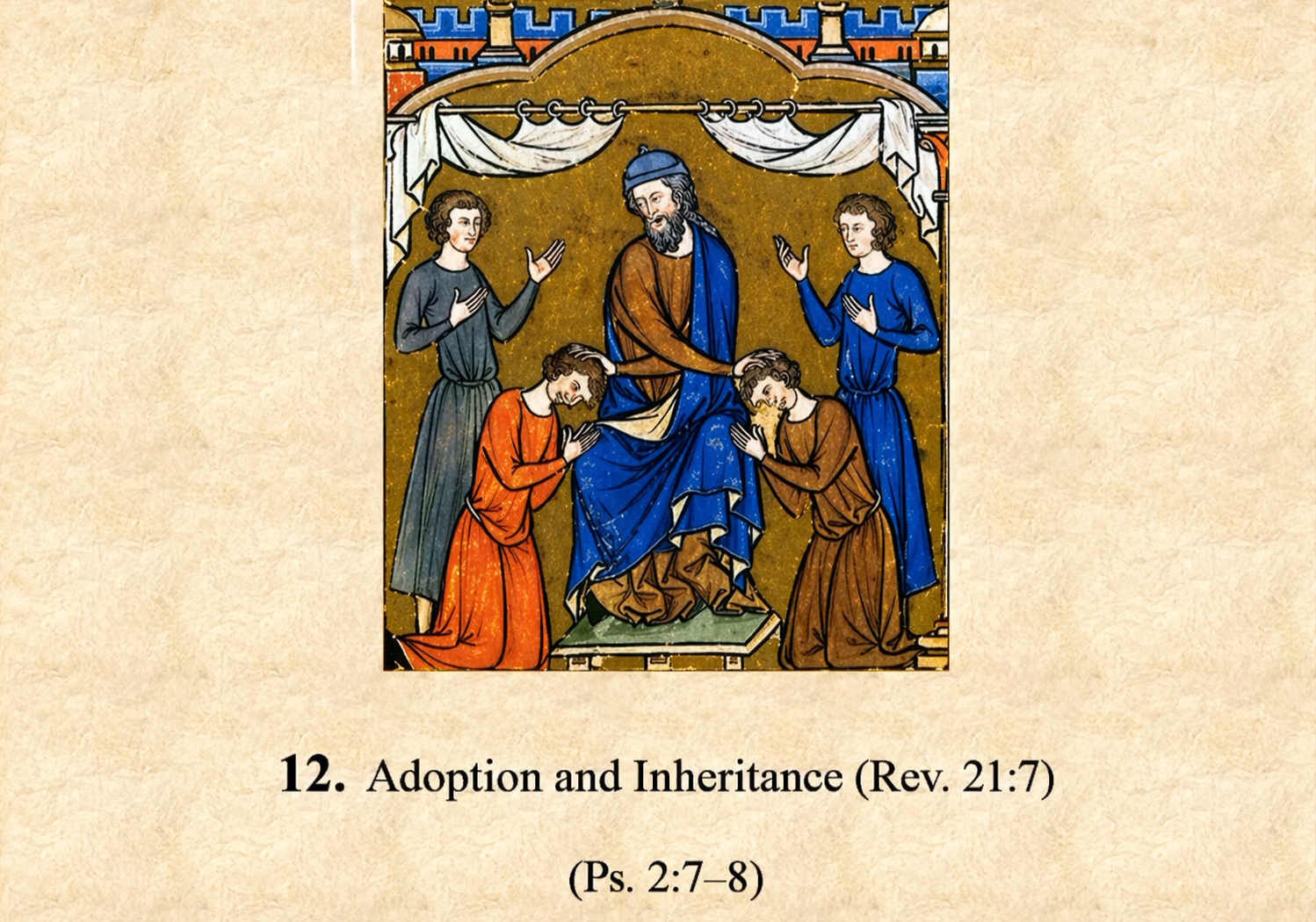
Promise #12: Adoption and Inheritance
#12. Adoption and Inheritance (Rev. 21:7)
Robert Charles made note of the fact that this particular promise has a connection with kingship since it is made in the Old Testament to king David and also to king Solomon (see 2 Sam. 7:14; Ps. 89:26–27). 29
The connection of the Revelation 21:7 text with Israelite kingship becomes clear when it is compared alongside Psalm 2:7–8. The divine adoption formula is present in both passages, and this, in turn, is tied to the concept of all-encompassing inheritance.
Roland de Vaux affirms in his volume on Ancient Israel that the king was adopted by Deity on the *“day of [his] consecration.”* 30
The Theological Dictionary of the Old Testament states that *“the sonship of the king is considered to be a divine guarantee of his power and authority. It is divine power that gives the king his power.”* 31
Firstborn Blessings and Royal Sonship
The illustration on this slide is the patriarch Jacob adopting Ephraim and Manasseh and assigning Ephraim as the inheritor of the blessings of the firstborn (see Genesis 48). The Psalm 89:29 coronation text indicates that the king of Israel became the Lord’s “firstborn.” 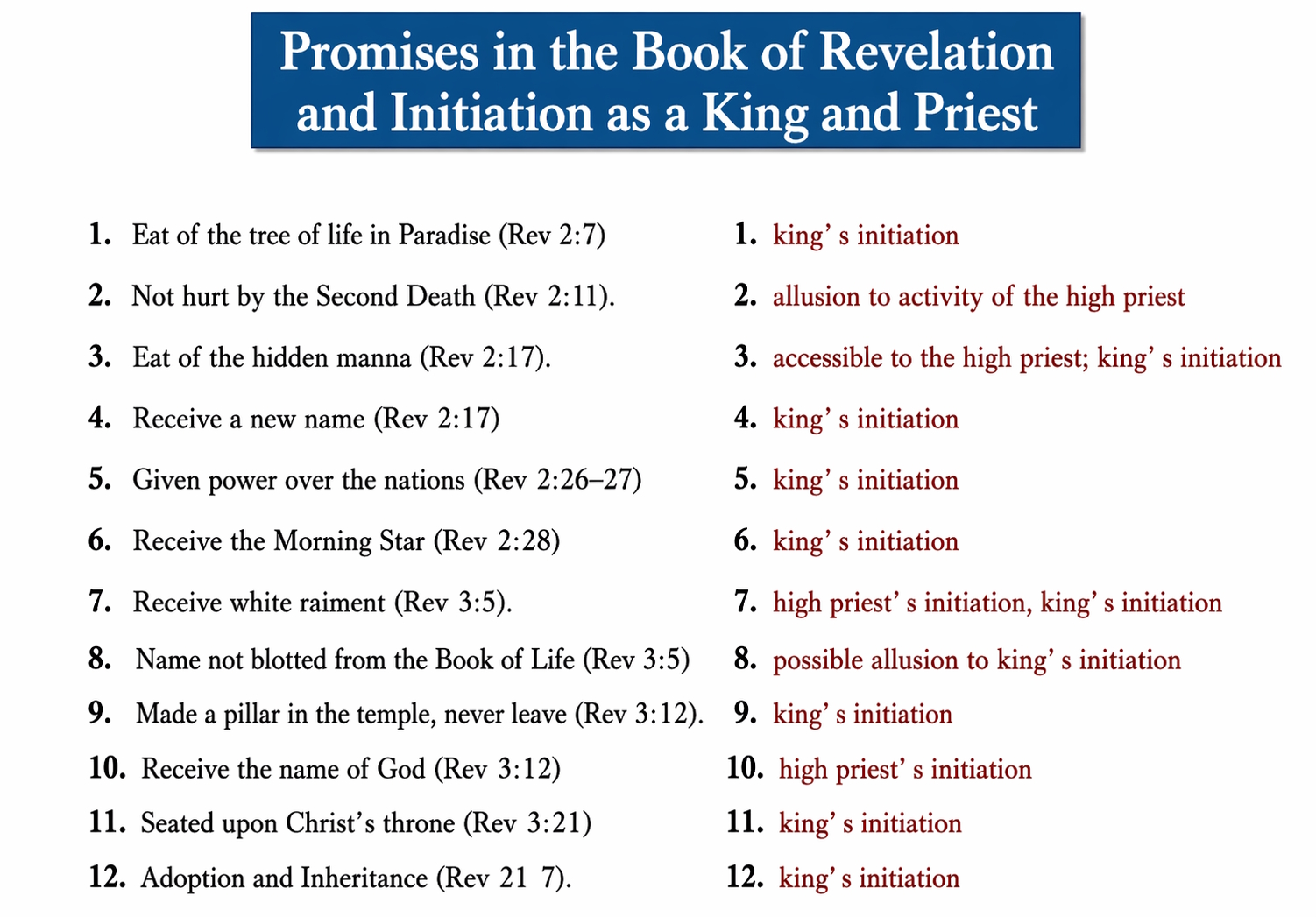
Summary of the Evidence So Far
To summarize thus far: The texts of the New Testament suggest that the orthodox Christians who lived in the area of Jerusalem at the time of Jesus Christ did not abandon the Israelite temple after the Atonement had been wrought. They were forced to leave it instead.
The book of Revelation indicates that these Christians held to a belief in the existence of, and relevance of, the heavenly temple of God, and they also believed in the ideologies of kingship and priesthood as connected with that temple. In addition, they claimed that as mortals they had—like their heavenly counterparts—been MADE kings and priests unto God.
Jesus Christ gave a series of promises to His faithful disciples in the book of Revelation which all have connections to Israelite temple concepts, and most of them have connections to the actual initiation rituals of the Israelite kings and priests.
The Question of Early Christian Liturgy
The question that needs to be asked at this point is this: Did the early Christians view this connection with ancient temple initiation rites as merely allegorical, or is there any evidence that the connection took actual liturgical form?
The most logical thing to do to resolve this question is to take a look at early Christian liturgical practices and see if there is a connection with the initiation ceremonies of the Israelite kings and priests.
Before we take a journey down that road, I would like to point out that the long-standing view of many scholars has been that early Christian liturgy was a development of activities that took place inside of the Jewish synagogue. That view has not gone unchallenged, however. 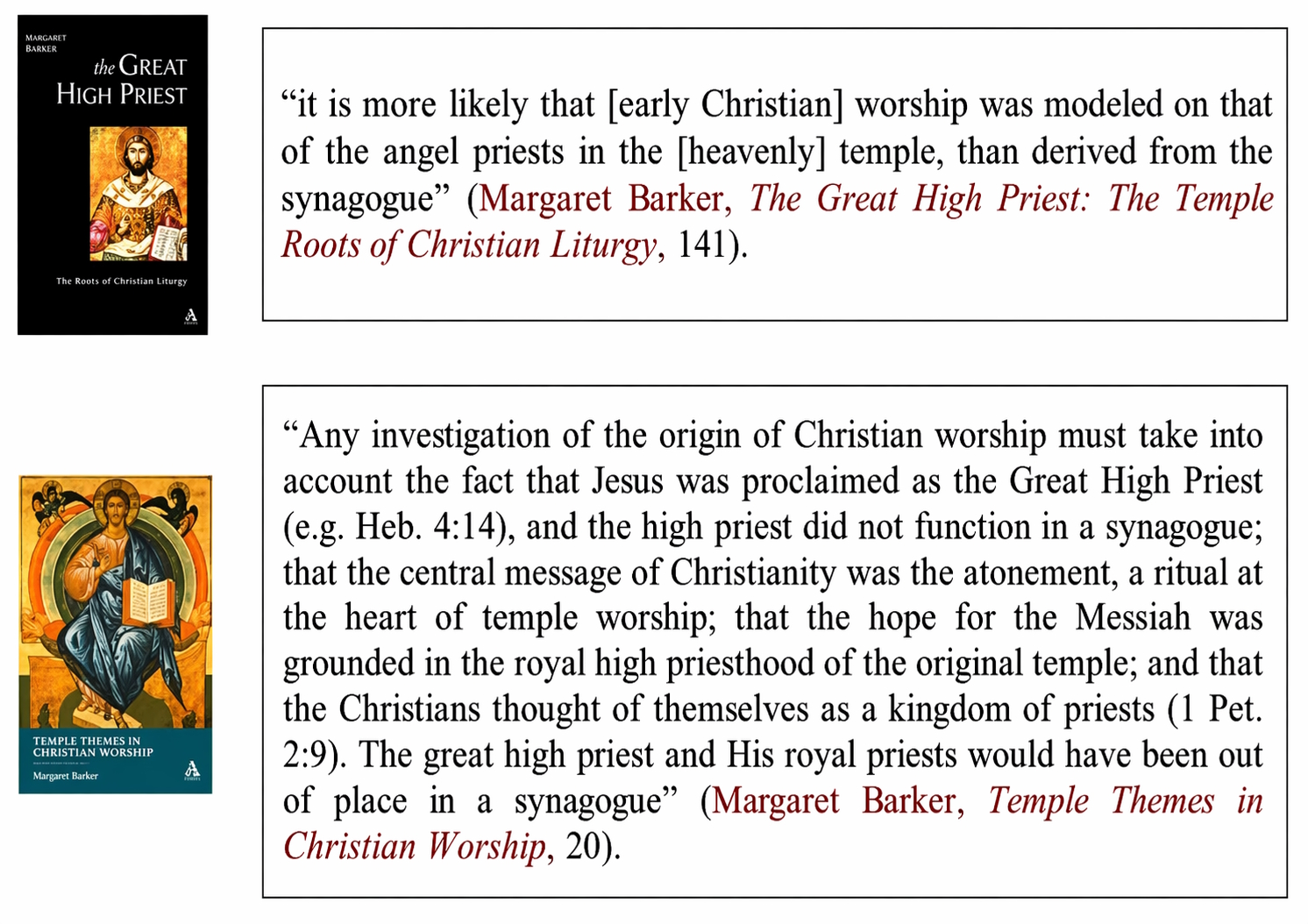
Temple Roots of Christian Worship
In Margaret Barker’s book called The Great High Priest: The Temple Roots of Christian Liturgy, she puts forward her belief that *“it is more likely that [early Christian] worship was modeled on that of the angel priests in the [heavenly] temple, than derived from the synagogue.”* 32
Likewise, in her book called Temple Themes in Christian Worship, she says,
*Any investigation of the origin of Christian worship must take into account the fact that Jesus was proclaimed as the Great High Priest (e.g. Heb. 4:14), and the high priest did not function in a synagogue; [It must also be considered] that the central message of Christianity was the atonement, a ritual at the heart of temple worship; that the hope for the Messiah was grounded in the royal high priesthood of the original temple; and that the Christians thought of themselves as a kingdom of priests (1 Pet. 2:9). The great high priest and His royal priests would have been out of place in a synagogue.* 33
Early Christian Initiation and Temple Language
With that view enunciated, we can now turn to a large collection of early Christian initiation texts that was updated in 2003 by Dr. Maxwell Johnson of Notre Dame University. This collection is called Documents of the Baptismal Liturgy.
Throughout these texts are references to temple terms such as laver, altar, sacrifice, incense, priest, Levite, and high priest. There are even statements in these documents that initiates are going to enter into the temple of God to receive certain ordinances and also enter into the Holy of Holies. (The Liturgy of Jerusalem—from about 350 A.D.—uses both of these terms—temple and Holy of Holies—to describe the building where the liturgy takes place.)
It should also be pointed out that like the promise from the book of Revelation, some of the early Christians were told that they would enter Paradise by passing the cherubim who guard its entrance. They were also, in some instances, directly compared with Adam in Paradise.
Themes of Kingship, Priesthood, and Adoption
Their names were said to be written in the Book of Life, and they participated in a form of adoption. Significantly, the themes of priesthood and kingship were taught to the initiates on a regular basis in these initiation documents.
One text reads: *“As if old priests and kings were anointed in Israel, so do you likewise.”* 34
Let us take a closer look at the anointing ceremony of the Christian initiates and the temple connections that it had.
The Anointing Ceremony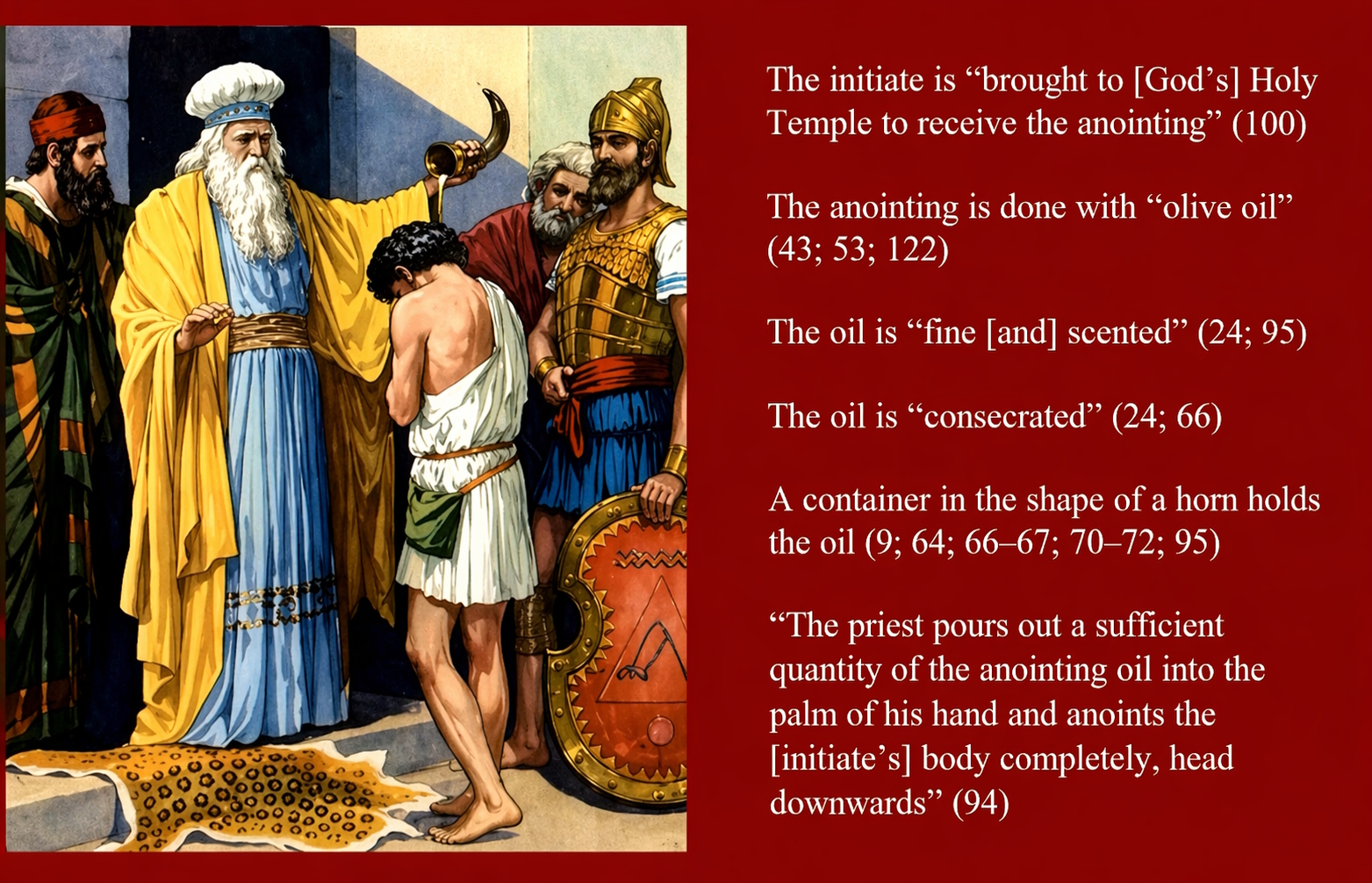
On this slide, you see a depiction of a kingly anointing in ancient Israel, and on the right are characteristics of the early Christian anointing ceremony. The numbers after each notation on this slide are pages from the book edited by Maxwell Johnson.
Notice, as we read through them, that all of these concepts are matched by biblical texts that have to do with the anointing of Israelite kings and priests.
- The initiate is “brought to [God’s] Holy Temple to receive the anointing” (100)
- The anointing is done with “olive oil” (43; 53; 122)
- The oil is “fine [and] scented” (24; 95)
- The oil is “consecrated” (24; 66)
- A container in the shape of a horn holds the oil (9; 64; 66–67; 70–72; 95)
“The priest pours out a sufficient quantity of the anointing oil into the palm of his hand and anoints the [initiate’s] body completely, head downwards” (94)
Detailed Anointing Rite (Armenian Text)
Here is an ancient Armenian text that describes the Christian anointing ceremony as it was practiced in that part of the world in the ninth century. 35
This is a direct quote.
“[the priest] anoints [the initiate] with holy oil:
First [on] the forehead, saying: A fragrant oil poured out in the name of Christ, the seal of heavenly gifts.
Next the eyes, saying: This seal which is in the name of Christ, may it enlighten thine eyes, that thou mayest not ever sleep in death.
The ears: May the anointing of holiness be for thee unto hearing of the divine commandments.
The nostrils: May this seal of Christ be to thee for a sweet smell from life to life.
The mouth, saying: May this seal be to thee a watch set before thy mouth and a door to keep thy lips.
The palms of the hands, saying: May this seal of Christ be for thee a means of doing good, of virtuous actions and living.
The heart: May this seal of divine holiness establish in thee a holy heart, and renew an upright spirit within thy interior.
The backbone: May this seal which is in the name of Christ be for thee a shield and buckler, whereby thou mayest be able to quench all the fiery darts of the evil one.
And the feet: May this divine seal guide thy steps aright unto life immortal.”
Investiture and Sacred Clothing
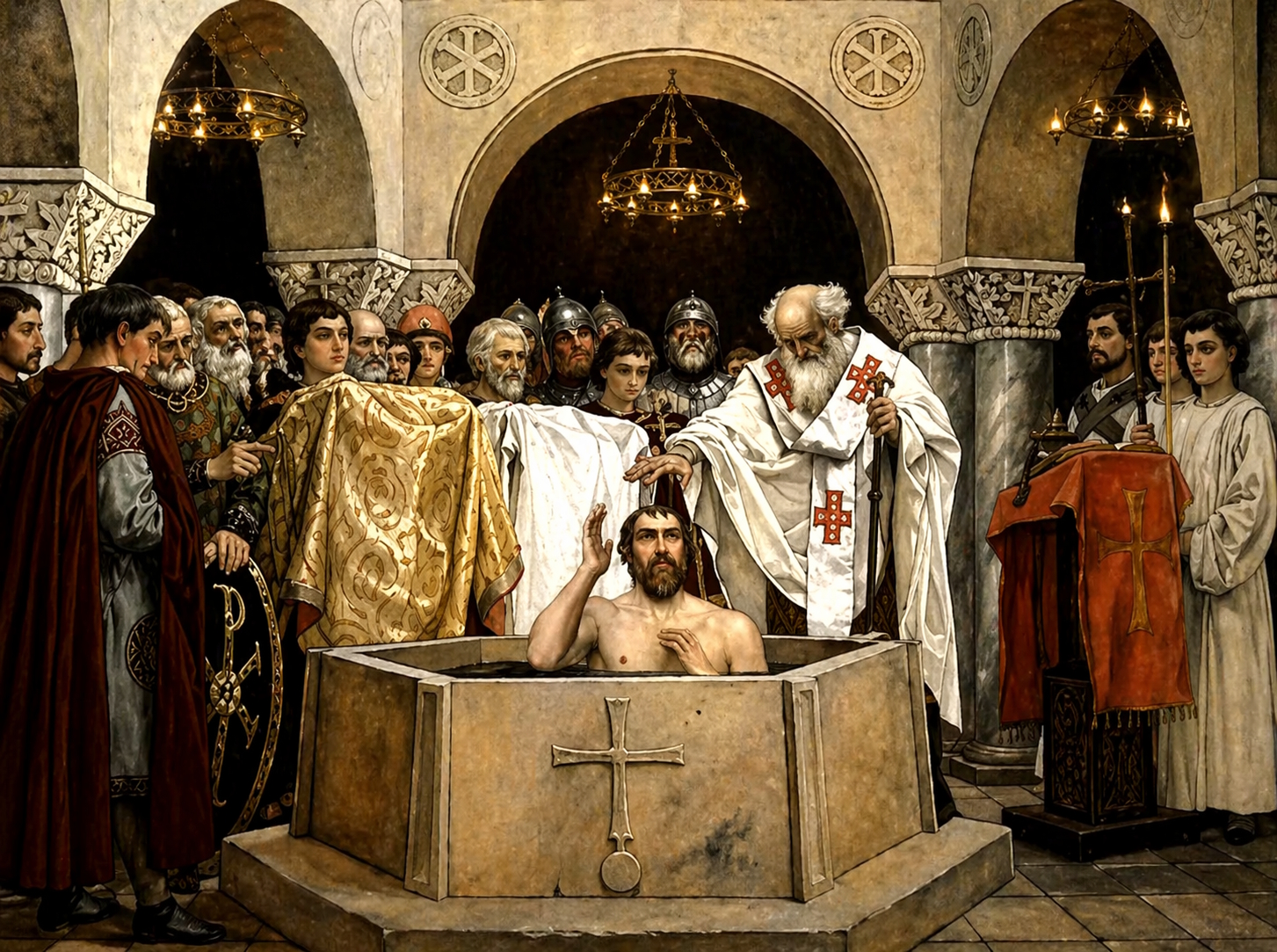
Another obvious parallel between the initiation rites of the Israelites and the Christians was that of investiture. On this slide, you can see that in the background someone is holding the white garment that the initiate is about to receive.
The color, of course, is a match to the white vestments worn by Israel’s kings and priests. In one early Christian text in Maxwell Johnson’s book, this piece of baptismal clothing is specifically called “the glorious robe which Adam lost.”
In another document, the initiates not only receive “white vestments” but also a royal head covering which is called a “crown” and is bound on them by a priest. These initiates are said to be wearing “the garment of glory”—which sounds very much like the “garments . . . for glory” to be worn by the Israelite temple priests (Ex. 28:2, 40).
Aprons and Ritual Dress
But the parallels between the clothing of these two groups do not end here. The ephod worn by both Israelite kings and priests has been identified in a book published by E. J. Brill as a ceremonial loincloth girded about the waist.
The ephod worn by the high priest of the temple was “a sort of apron hung on the front of the priest’s body and fastened around the waist by means of an attached belt; it was made of fine linen cloth (ö?s) which was embroidered” with colored threads. 36
The Aprons
The evidence for aprons among the ecclesiastical dress of the early Christians is both literary and archeological. The Greek clerics made note of the ritual aprons of the monks of Egypt which were only worn by them on liturgical occasions.37 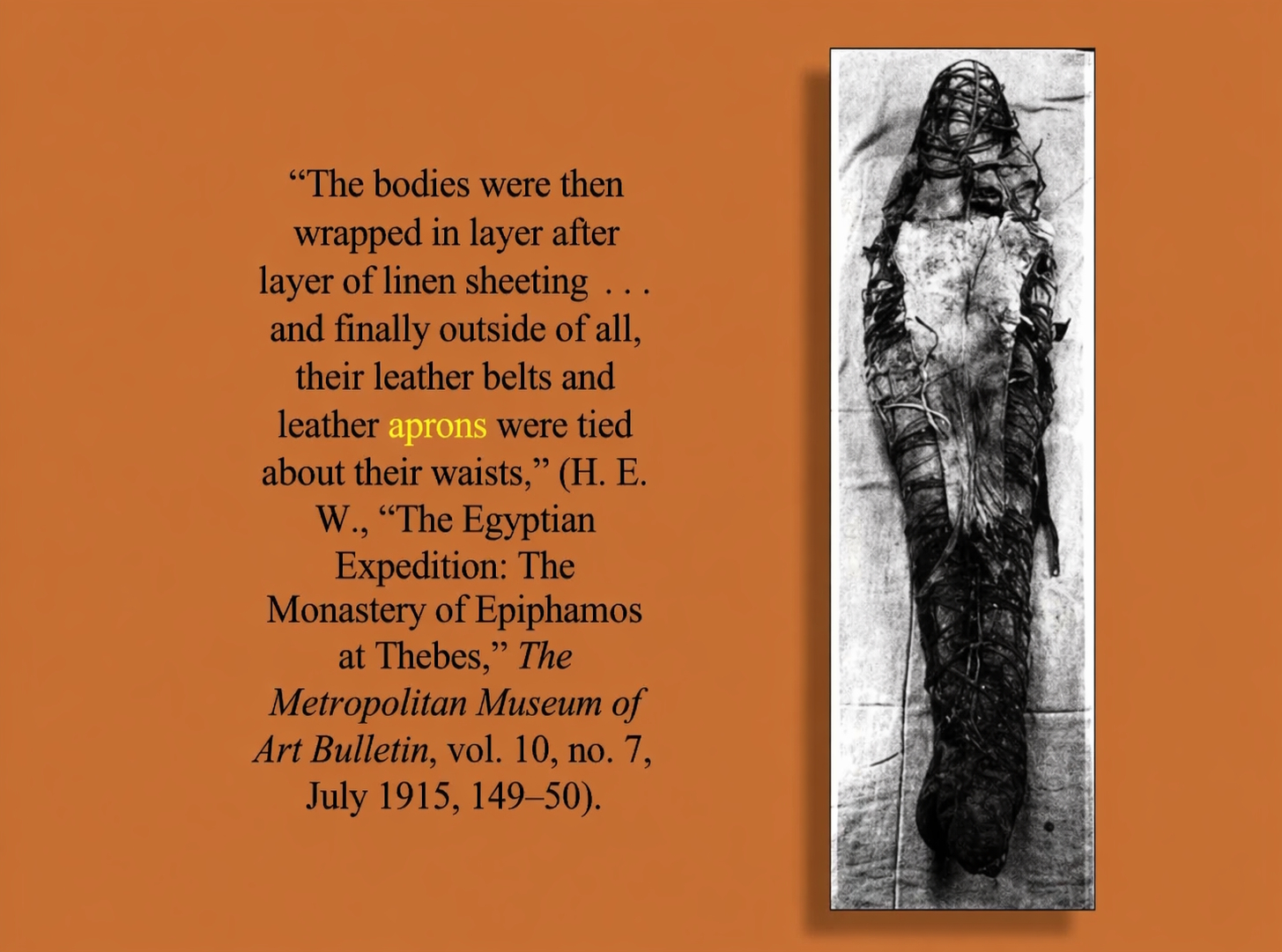
All of the buried monks at the monastery of St. Mark in Thebes had *“a leathern apron . . . deposited upon the last layer of clothing.”* 38
Likewise, when the 7th century monks of the Epiphanios monastery were buried, “their leather belts and leather aprons were tied about their waists” on the outside of a layer of linen cloth.
I have spoken with a person who is involved in the excavation of a vast pre-Coptic Christian cemetery in Egypt, and I have been informed by this individual that many of the Christians buried there are wearing aprons. This is the same cemetery that has been written about in an article published in BYU Studies. 39
Which leads us to the next slide. 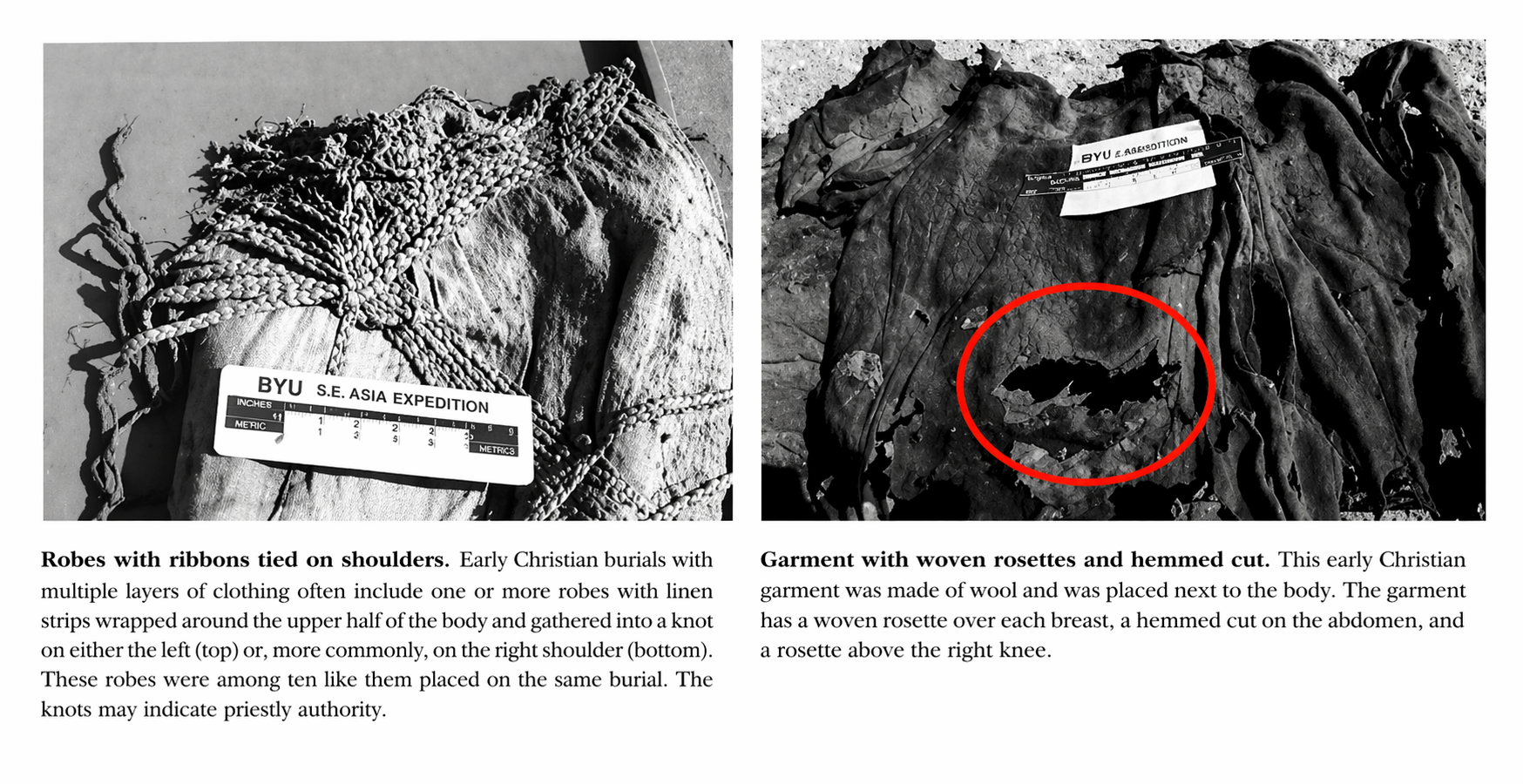
Early Christian Garments and Symbolic Markings
Here are pictures of two other items of clothing worn by some of the early Christians in the cemetery just mentioned. On the left is a robe that has linen strips gathered together in a knot on one of the shoulders, which may indicate that it is a priestly piece of clothing.
Some of the robes worn by these Christians have the knot located on the left shoulder, while others have it on the right shoulder. The photograph on the right shows a garment worn next to the body of the Christian who was buried in it.
What is curious about this piece of clothing is that it was decorated with rosettes over each breast and over the right knee but not over the left knee. Then, there is the hemmed cut located over the abdomen. This feature is significant because a straight-line design is sometimes depicted in artistic representations of early Christian white garments. 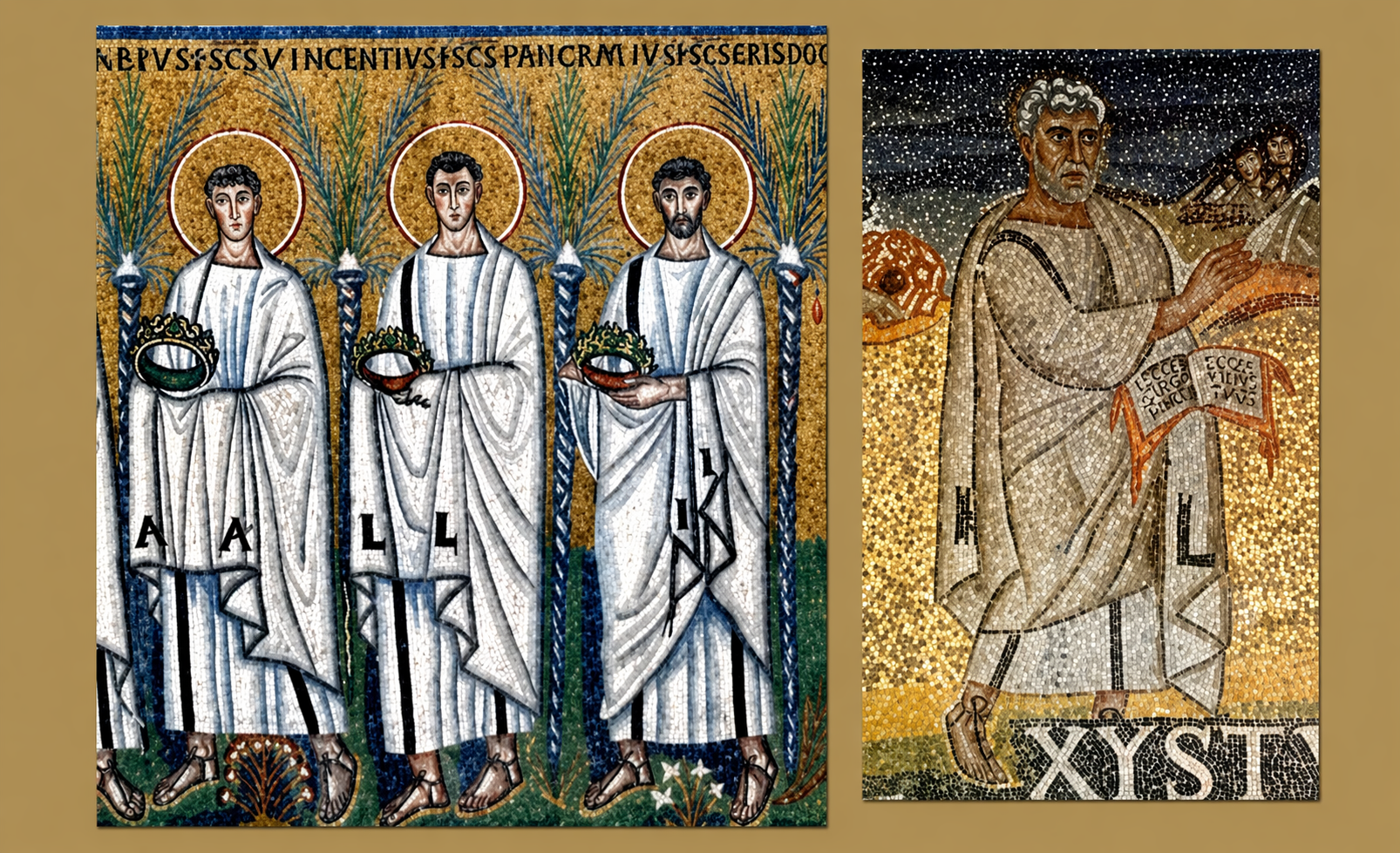
Gammadia and Sacred Symbols
Here are some examples. These marks are referred to overall as gammadia. The name comes from the Greek letter gamma, which is shaped like a right angle. You can see right-angle marks in both of these examples on the screen.
The gamma or right-angle mark is by far the most common of the gammadia to be found in early representations of the white Christian garment. The meaning of these marks is not clearly understood by scholars, but Edmondo Lupieri—an Italian professor of the history of Christianity—has recently postulated in a commentary on the book of Revelation that they may be connected with the kingship of Jesus Christ. 40 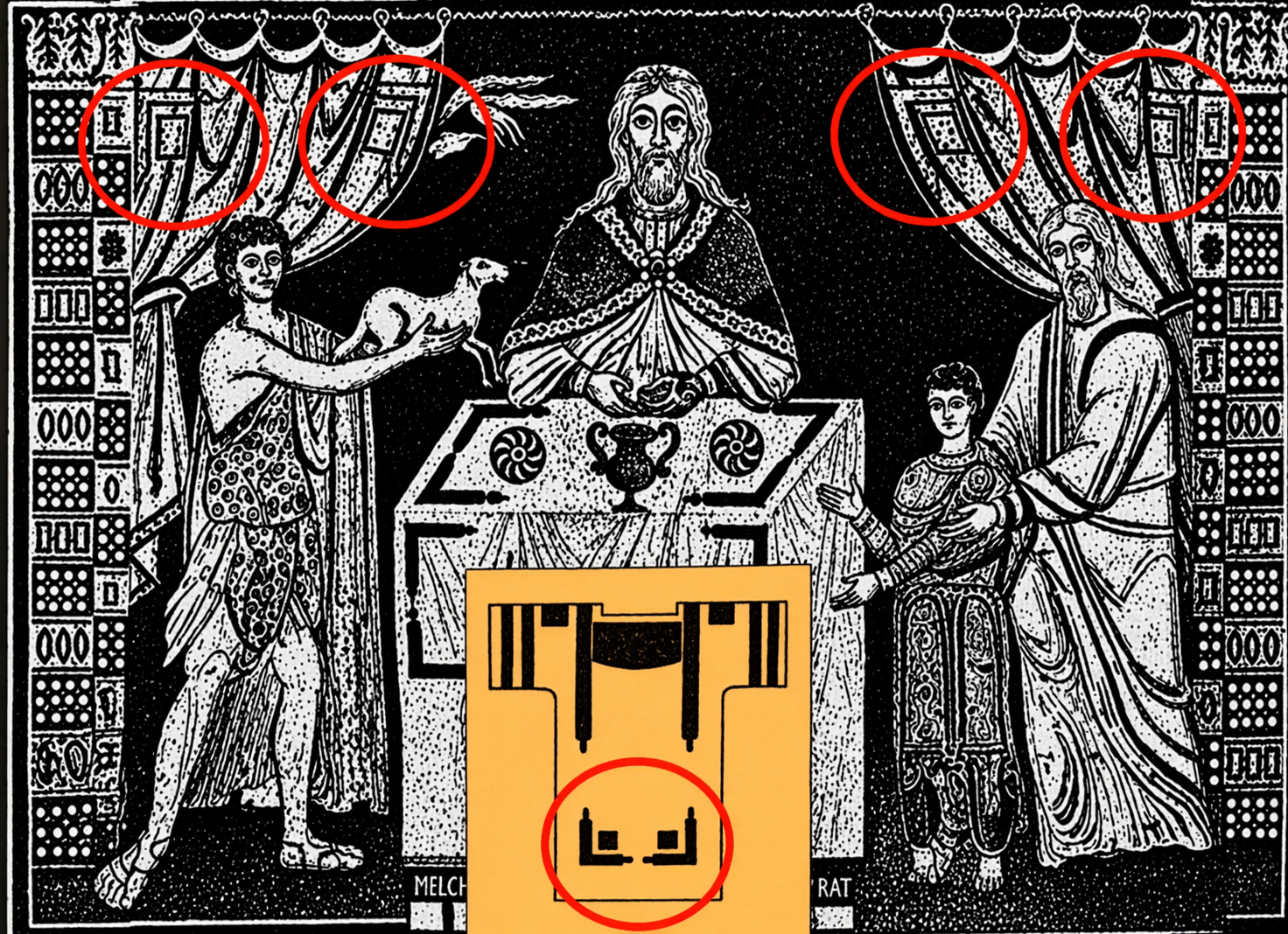
If you examine early Christian depictions of the Savior enthroned, you will notice that sometimes He has the gamma mark on His robe, and so do the angels who stand next to His throne.
Veils, Temples, and Cosmic Imagery
It should be noted that right-angle gamma marks have been discovered on the tunics of some Coptic Christians—as shown here at the bottom of this slide. You can see that the same exact design on the tunic (a gamma mark with an interior square) is depicted on the veil above it.
The veil in this mosaic represents the barrier of eastern Christian churches which separated the main audience chamber from what they called the Holy of Holies. These markings on the veil are interesting because it is known that there were cosmological markings on the exterior veil of the Jerusalem Temple during the time of Jesus Christ. 41
We will talk about another cosmological symbol associated with the Savior in just a few minutes. 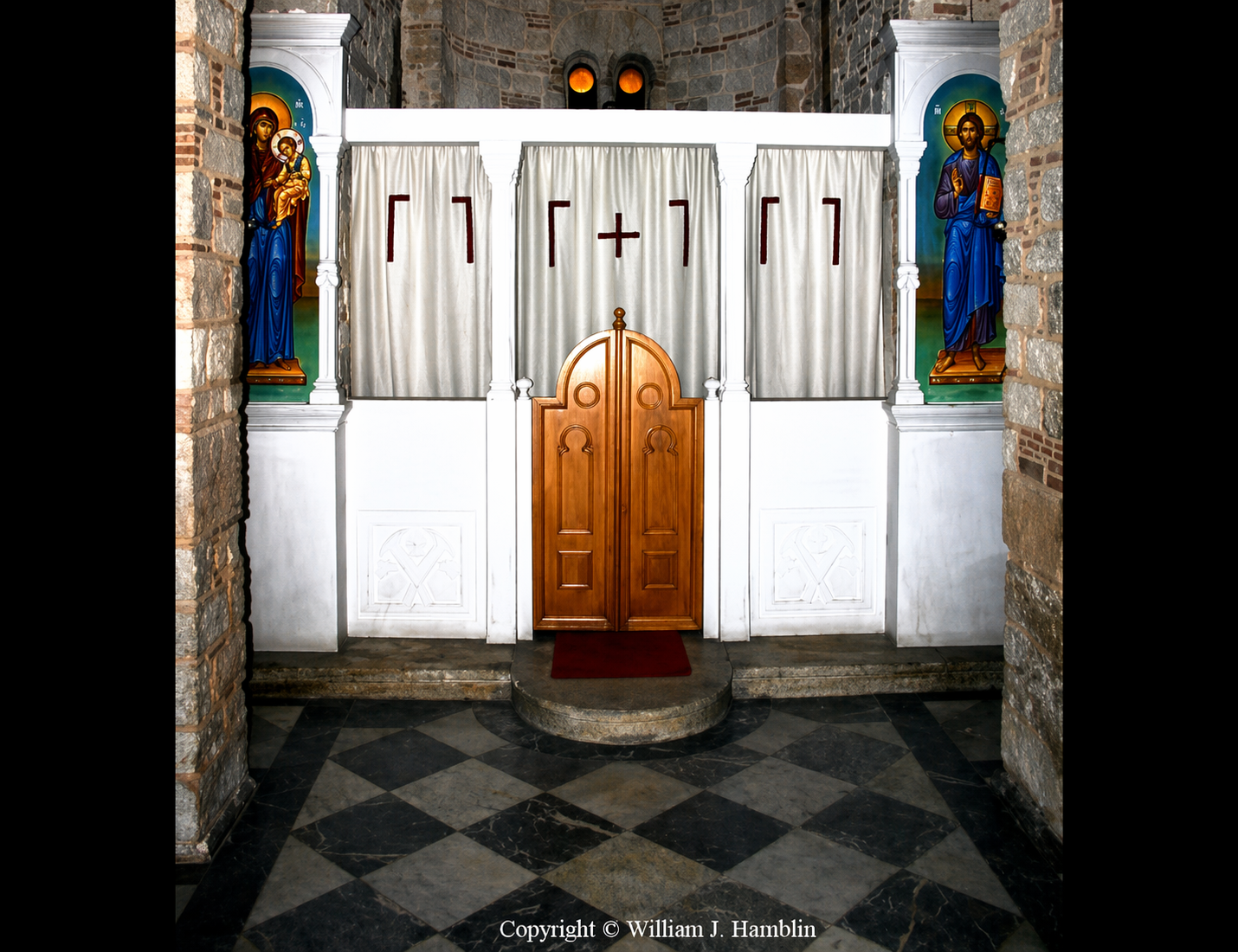
Byzantine Veils and Temple Motifs
On this slide, you see a modern-day replica of a Byzantine Holy of Holies veil with gamma marks on it. Besides what you can see here, there are also doors, veils, and gamma marks on either side of this entryway.
The Byzantine church building where this barrier is located is in Greece, and it is interesting to note that on its outer wall are symbols associated with the temple of king Solomon.
Even though scholars do not currently understand the meaning behind the gamma marks, the same shape was depicted in a medieval Moralized Bible where the context is clear. 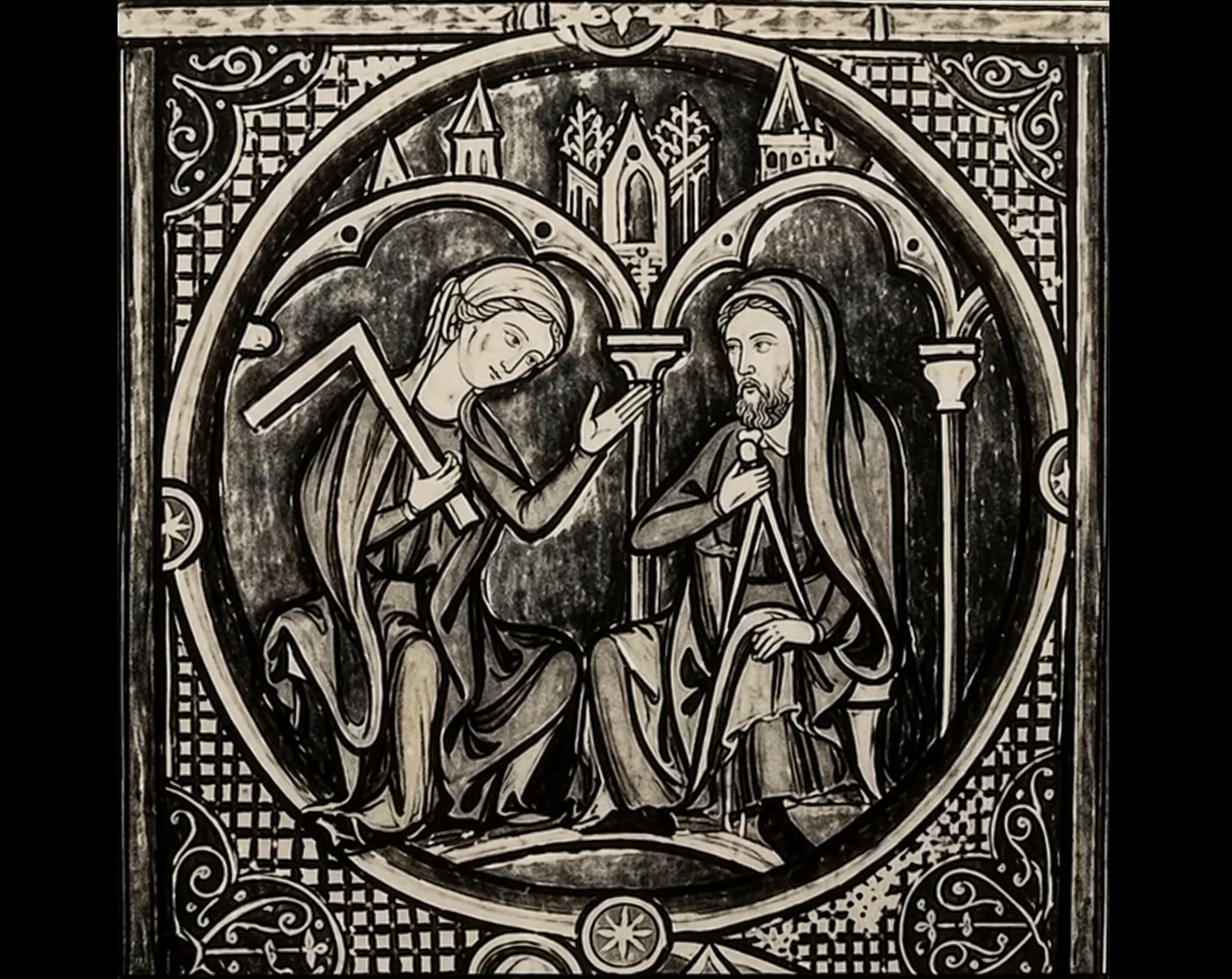
Symbols of Righteousness
Here on this slide, you can see Zacharias the temple priest and his wife Elizabeth. She is holding a carpenter’s square to her chest (and it is pointing off to her right), while he holds an architect’s compass to his chest.
A similar picture in another Moralized Bible shows the same couple both holding carpenter’s squares, and the accompanying text explains that the right-angled tool is a symbol of their righteousness. 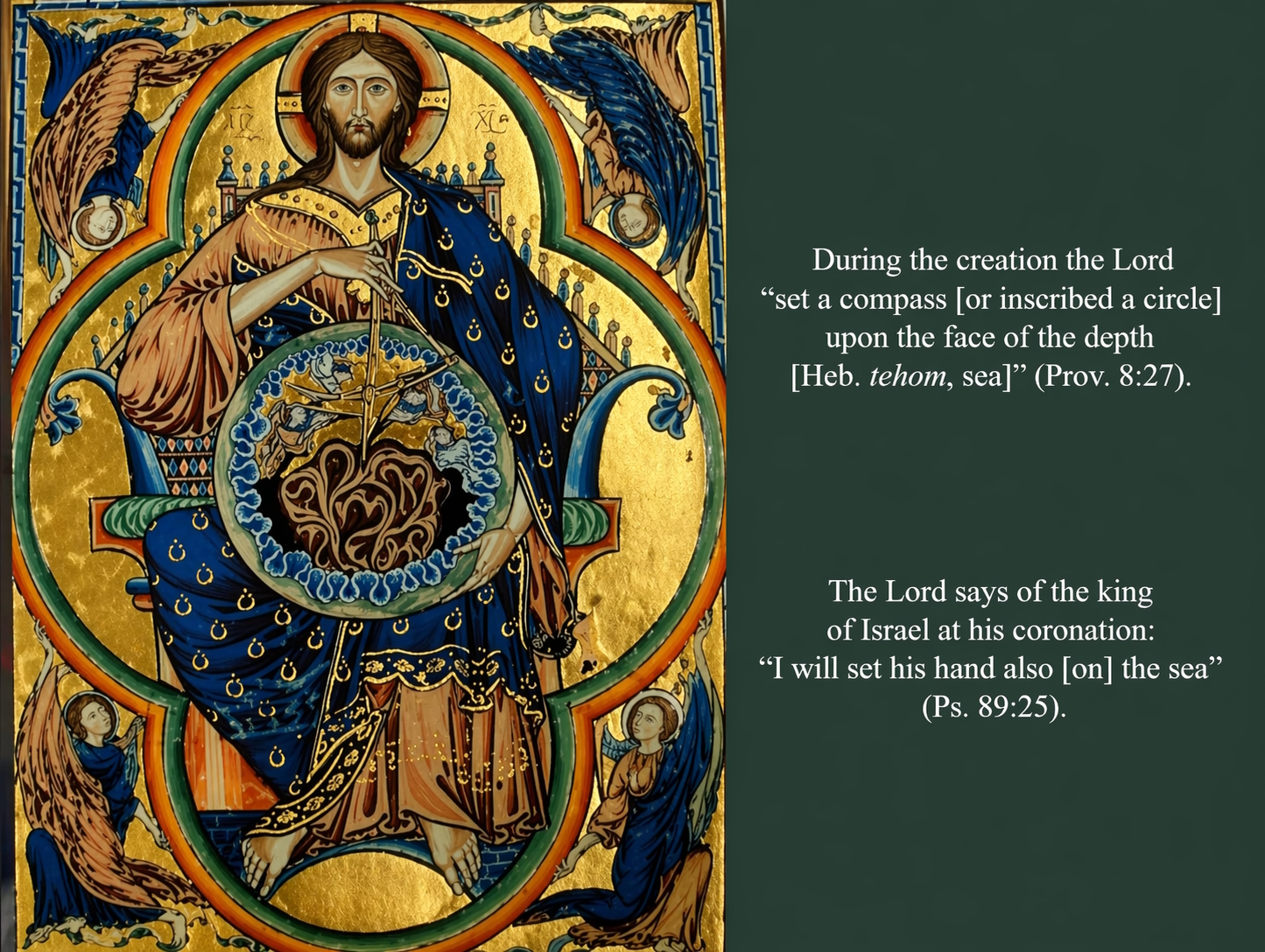
The Compass, Creation, and Kingship
The architect’s compass is significant because it was displayed in many early Christian depictions of the Lord as the Creator. And, interestingly, this image seems to have a connection with the kingship initiation rites of ancient Israel.
Here on this slide, we see the Lord enthroned as King, and He holds a large compass over the elements of creation. Notice the waves of the sea on the outside edge of the world which He is holding.
In Israelite cosmology, God was viewed not only as a King, but it was considered that His royal status was connected with His defeat of the Chaos Monster at the time of creation.
The Chaos Monster was an “insolent” serpent who dwelt in the sea and, as Herman Gunkell put it in his study on Creation and Chaos, he was God’s antagonistic enemy whose “dominion on earth [was] a reign of terror” which *“perpetrated upon the earth eternal devastation.”* 42
Creation, Chaos, and Royal Authority
On this slide, you see a reference to Proverbs chapter 8, where it is indicated that God conquered the Chaos Monster by inscribing a circle around the sea and thereby setting a boundary for the waves—which were a visible symbol of chaos.
By turning to the Psalm 89 coronation text, we find creation motifs and also hear the Lord say of the king of Israel: “I will set his hand also [on] the sea.”
According to Professor Nicolas Wyatt of the University of Edinburgh, Psalm chapter 89, verse 25, seems to speak of the Israelite king sharing with the heavenly King in the primeval victory over chaos. “We may even conjecture,” he said, *“that in an appropriate ritual, the king [of Israel] was handed the weapons of . . . [God] at this juncture in the liturgy.”* 43
Ritual Victory Over the Serpent
But since the implication of Proverbs 8:27 is that the Lord overcame chaos by inscribing a circular boundary upon the sea, it is just as logical to conclude that during the Israelite king’s enthronement he was handed not a weapon, but rather the implied instrument used by the Lord to conquer chaos—an architect’s compass.
If we scan through Maxwell Johnson’s book on the Documents of the Baptismal Liturgy, we find that when some of the early Christians received their initiation rites, they were not only taught the story of creation but they had a confrontation with a serpent named Satan.
The initiates were told during this ritual to consider the adversary to be in their immediate presence and to tell him to “depart.” Thus, a victory was gained against the initiate’s enemy.
Covenant, Renunciation, and the Handclasp
Another way that the early Christians ritualistically separated themselves from Satan was to renounce him by way of covenant. One initiation text is particularly interesting because in it the initiates made their renunciation and covenant by clasping the left hand of the officiating priest.
Then another covenant was made—this time to commit oneself to Jesus Christ—by a clasping of the right hand with the officiator. The right-handed clasp is a motif found in early Christian artworks in a context that has already been mentioned in this presentation. 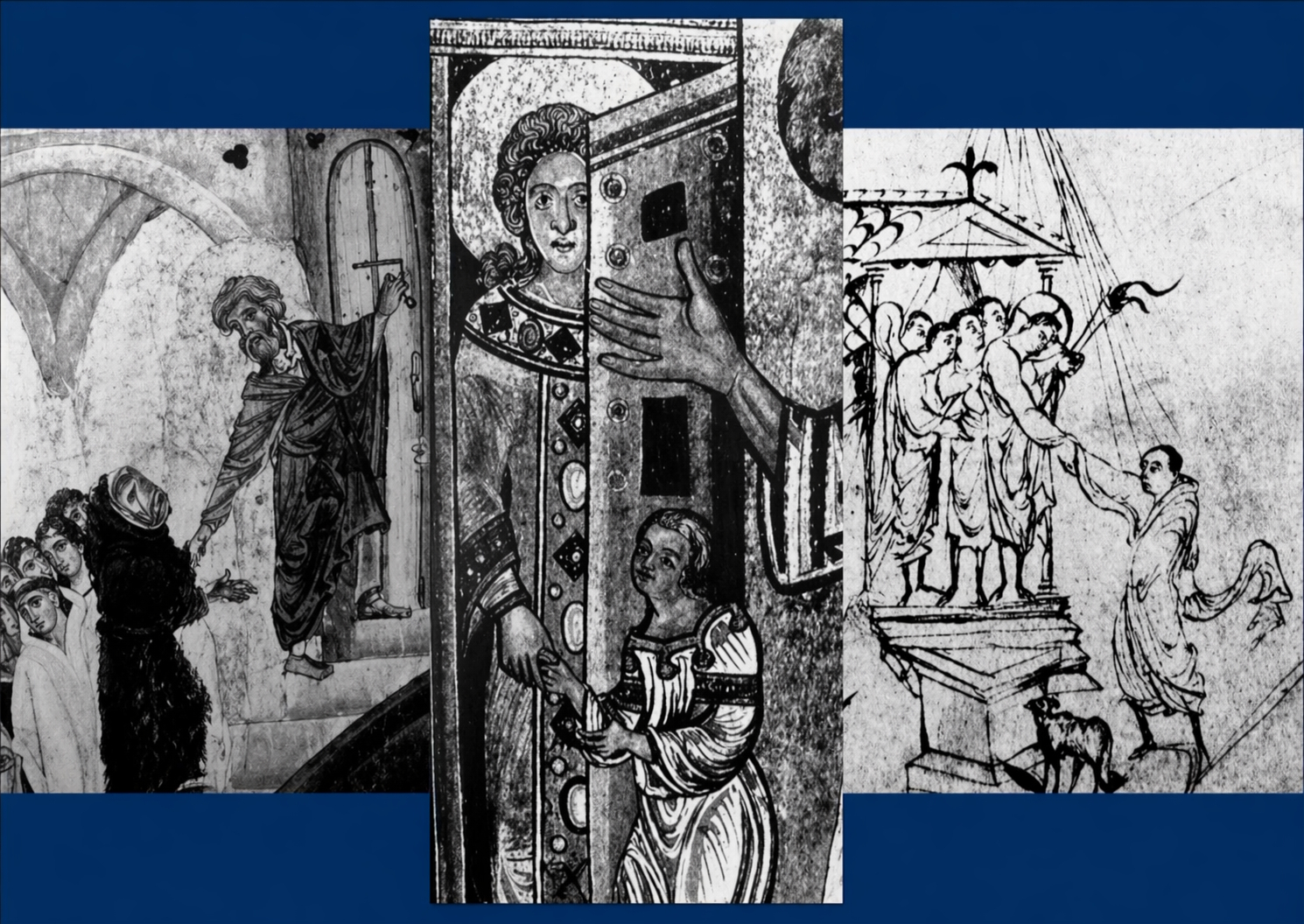
Here on this slide you can see, on the left, that a monk is being admitted through the gate of Paradise by the apostle Peter. In the middle is a resurrected Christian in a white robe being admitted through the gate of the New Jerusalem. And on the right, we see the Israelite king standing at the veiled door of the Jerusalem Temple and being admitted by the Lord into an assembly of people (see Psalm 27).
Ascension and the Royal Handclasp
Notice in the first and third pictures that a stairway is present, which marks both scenes as ascensions. It is curious that in the King James translation of the Psalm 89 coronation text, it is said that the Lord’s right hand will be established with the king (vv. 13, 21).
Psalms scholar John Eaton renders this passage with these words (with the Lord speaking): *“My hand shall hold him fast.”* 44 This suggests a handclasp between the Heavenly King and His earthly vice-regent.
Indeed, two scholars who have written commentaries on the Psalms (Hans Kraus and Arnold Anderson) state outright that a right-handed clasp between God and the king belonged to the Israelite enthronement ritual. 45
Modern Eastern Christian Temple Symbolism
In this last section of my presentation, I would like to bring you into the modern age and read some material from the eastern orthodox Christians. Now that you have seen the patterns set forth in this talk, you can decide whether or not temple architectural and liturgical motifs have been continued among the modern disciples of Jesus Christ.
I will now read you a summary of information that is found in a book called The Church of the East: An Illustrated History of Assyrian Christianity.
Sacred Architecture: Space and Time
The architecture of Eastern church buildings is symbolic in nature, reflecting the axis of space and also the axis of time. The axis of space forges a connection between earth and paradise. Meanwhile the axis of time begins with the creation and moves through the events of the Savior’s life, crucifixion, and resurrection.
Participants in the Syrian liturgy are considered to be personal participants in the events of sacred time. Nestorian church buildings are oriented so that the rising sun in the east strikes the holiest part of the building, thus corresponding to the location of the glory of God as seen in the prophet Ezekiel’s vision of the Israelite temple (see Ezek. 43:1–4). 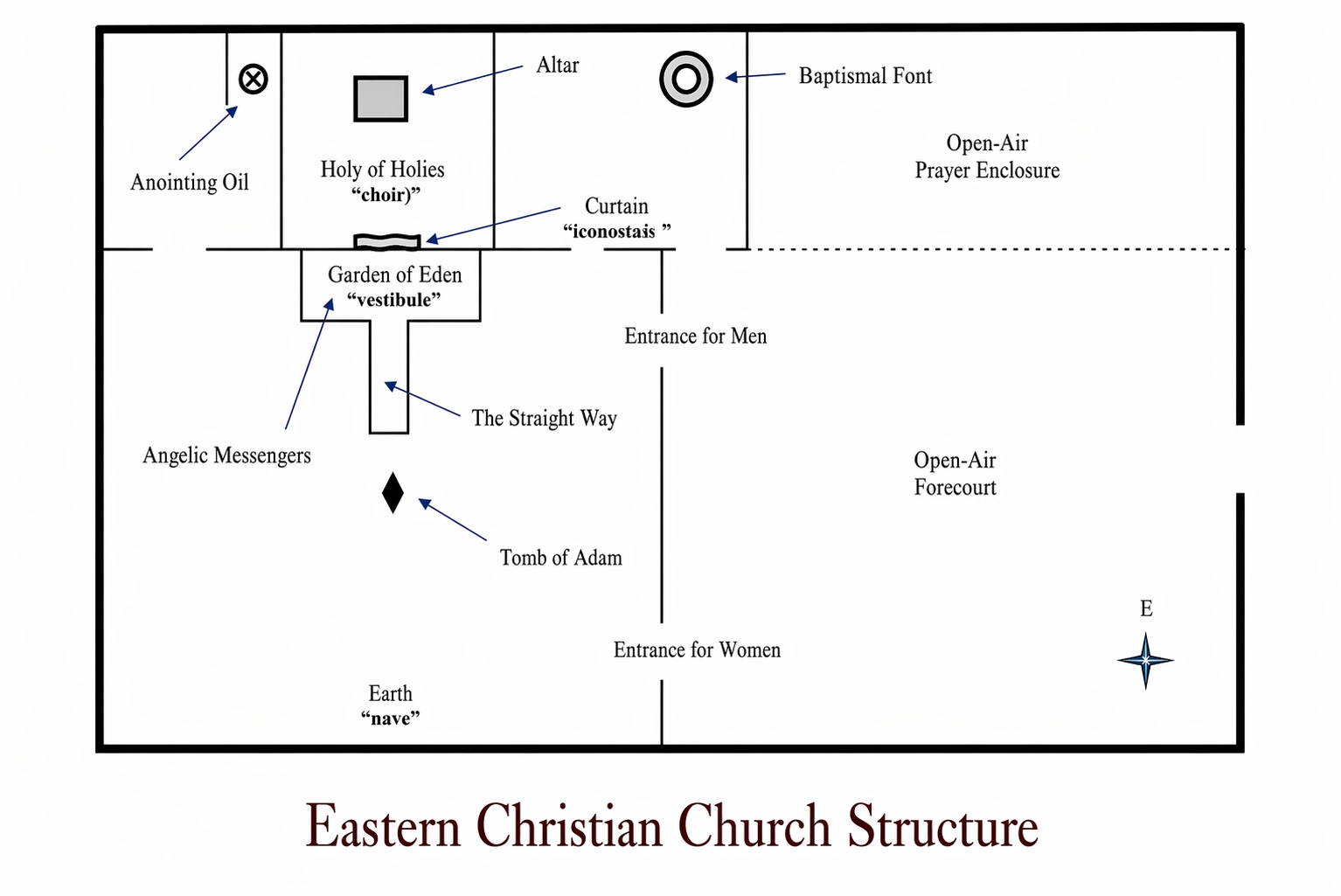
Temple Layout and Sacred Progression
Beyond the entrance to the church, there is an open-air “forecourt” where the shoes of worshippers are removed and also a smaller open-air enclosure where prayers are offered. The interior of the church proper includes a main congregation hall called the “nave.”
This area of the church represents the earth, and the eastern-most portion of it, or “vestibule,” represents the Garden of Eden. Paradise is considered to be a bridge between heaven and earth, and when scriptures are being read from this location during the liturgy, the readers are considered to be angelic messengers who bring God’s teachings from heaven to earth.
The Path to the Holy of Holies
There used to be a slightly elevated pathway built into the floor of Eastern churches which led up to the Garden of Eden called “the straight way” which signified “the narrow path” leading to the heavenly realm.
In earlier times, there were separate entrances into the nave for men and women. Each group would gather in their respective places—males on the right and females on the left. (Syrian Orthodox worshippers are placed in opposite stations, with women on the right and men on the left.)
The Holy of Holies in Christian Worship
The most important part of the church is located in the east and is called the “choir” or Holy of Holies. This place represents heaven and is where the “liturgy of the mysteries” occurs.
An altar is placed inside of this area of the church. And above it is a baldachin which is symbolic of the Ark of the Covenant. “The holy of holies is raised on three levels” and thereby designates it as a space which is holier than the others in the building.
Veils, Separation, and Divine Presence
Between the Holy of Holies and the nave in some Eastern churches is a barrier called the “iconostasis.” This screen (which is constructed of wood or stone) is equipped with a doorway. A “curtain” is stretched across it in order to conceal the content and activities of the most holy place.
In Syrian Orthodox churches, only a curtain is utilized to mark this division. When the curtain is closed, it is representative of the breaking of the connection between heaven and earth caused by the actions of Adam and Eve. (In earlier times Adam’s presence in the building was signified by his symbolic tomb in the nave.)
Opening the Way to Heaven
The curtain is drawn aside during the liturgy to signify the opening of heaven and the presence of Jesus Christ. Only certain ranks of clergy are allowed to pass by the curtain divider and into the Holy of Holies.
The priest leads the prayers of the congregation from the altar inside the most holy place. Incense is employed during the liturgy to symbolically represent rising prayers. 46
Notice in all of this that there are three ascending levels of existence represented in this building’s architecture.
Transition to Final Section
Finally, let me read you a short summary of the initiation rites of Greek Orthodox monks from a book published by Yale University Press. See if you detect any connection between what is said here and the information that has already been presented.
Greek Orthodox Initiation Rites
Stage 1: New Identity and Investiture
The initiate is brought into the church building and given “a new name”. He is invested with a tunic and a headdress.</p>
Stage 2: Covenant, Washing, and Entrance
The service is symbolic of three things:
- A second baptism or washing
- The return of the prodigal son
- Marriage
The initiate goes to the Royal Doors and altar (i.e., the iconostasis/veil). There the abbot—who represents the father from the prodigal son parable—meets him.
<p>There is an exchange of questions and answers between them. It begins with the abbot inquiring why the initiate has come there. The initiate responds by announcing his intent. The questions and answers that follow incorporate the taking of “formal vows” of obedience, chastity, and living a monastic lifestyle.
The abbot reminds the initiate that “invisible angels are present recording [his] vow.” The initiate is then invested with ecclesiastical clothing, a girdle, and a headdress. At the end of the ceremony, the initiate and the initiator embrace one another. 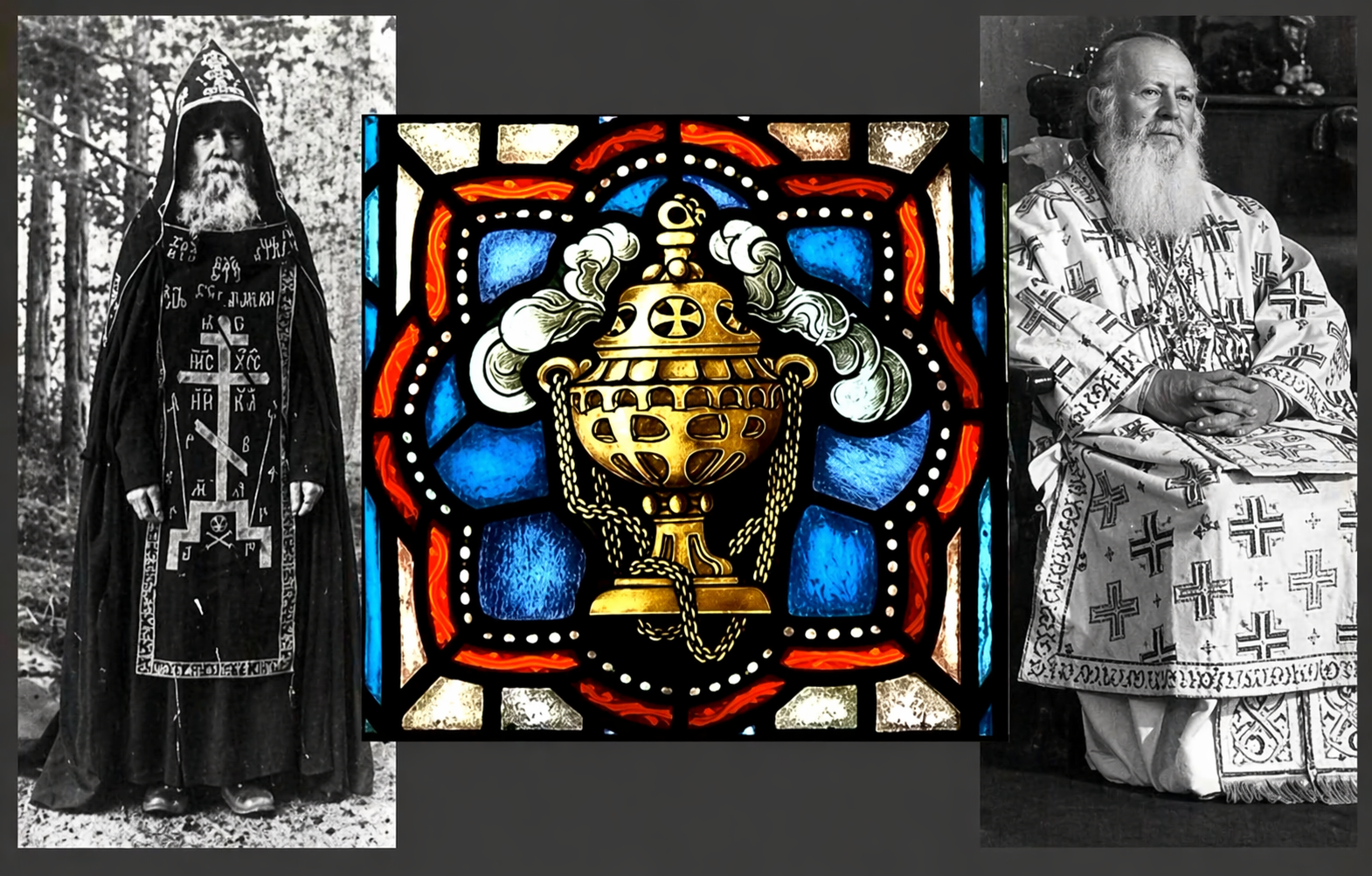
Stage 3: Full Investiture and Lifelong Commitment
The initiate is invested with the Great Schema, or full religious dress, which includes “an elaborately embroidered apron.” This apron includes a symbol of Adam and also the acronym for Paradise.
The clothing given to the initiate in this stage of his progression is never to be taken off. Day or night, “even in death.”</em> Monks at this stage of initiation vow to *“renounce the world and the things of the world.”* 47</p></p></em>
Conclusion: Do Temples Still Matter After Christ?
This talk began by stating the claims of some individuals that:
- The Atonement of Jesus Christ made Israelite temple worship obsolete
- Temple ceremonies were never part of the gospel of the Redeemer
The evidence presented calls these claims into question. Even after the Atonement took place, those who personally knew the Savior still held onto a distinct temple ideology.
More than that, they were promised by the Lord Himself—after the Atonement—that the faithful could receive the same temple-related blessings that were experienced by the kings and priests of Israel.
Liturgical practices of the Israelite temple found expression in some of the rites of the early Christians. And some of those practices are echoed among the orthodox followers of the Master even today.
Thank you for your attention.
