• Skip to primary navigation
  • Skip to main content
  • Skip to primary sidebar
  • Skip to footer

FAIR

My Account Search
  • Start Here
  • Find Answers
  • Scripture Study
  • Blog
  • Events
    • FAIR Conference
    • Virtual Conferences
    • Special Events
  • All Presentations
  • FAIR Books
  • About
    • Media & Apps
  • Get Involved

seer

The Gift and Power: Translating the Book of Mormon

Brant Gardner

I confess that I have been more afraid of doing this than I have any other presentation I have done and that’s because we’re talking about topics where you tend not to talk about we get someone embarrassed about the church we can talk about seer stones today. We don’t like to talk about seer stones. We like to talk about the Urim and Thummim and there is a good reason of why we talk about the Urim and Thummim but we try not to call the Urim and Thummim a seer stone it can sound so much more elegant if we call it the Urim and Thummim. So that’s kind of the problem and the basis that we are looking at.

What I want to talk about is the process of translating the Book of Mormon. Brother Brown started that process for us this morning and I was kind of encouraged by some of the questions because some of the questions that were asked of him are some of the ones that I really like to try and answer and that of course makes me nervous because what we really want to see if we can do is talk about how seer stones work and how you would translate with one and believe it or not we’re going to come up with the theory of how that’s going to work.

First what I am not talking about. Kind of have to being with that because as Scott had mentioned we had for a little while a book for sale out there and it’s becoming again at some point in time so this is a topic that I have written book about and there is no way that in this amount of time we’re going to be able to talk about everything that we try to cover in the book, so there is certain things that you can’t cover, one of the things that I didn’t put on the slide that is however very important. One of the things that I couldn’t cover the book and I am not going to cover now is a very important preliminary question to this entire issue of how was the Book of Mormon translated and that is that the question of how the Book of Mormon was translated is completely moot unless it was translated.

So the very first issue that we really ought to know about is can we say that the Book of Mormon was translated and neither here nor there in the book, well I actually address that. I start off in the book and I said no we’re just going to take that as given, so you have to take that as given right now. Now I will also tell you that it’s a given based on information that I have already researched and I have my reasons for having the security of knowing that the Book of Mormon is a translated ancient document. So I have seen the evidence it just not what we are going to talk about now. Now that we have a book that’s a translation what do we do with it? Well the kinds of things we are not going to do with it is I am not going to talk about the stories of translation. There is a lot of interesting things there, how is it that the seer stones became a Urim and Thummim, those are things that I am looking at in the book but again we are in a short period of time, we got to get to the fun stuff.

The next one I don’t want to spend too much time on but I do have to mention a little bit is what kind of translation was it. So we have the question of is it a translation that we are going to table for the moment but then the question becomes what kind of translation. For those of you read anything that people have talked about the nature of the translation of the Book of Mormon, there is all kinds of theories of what the relationship of our English text might have been to the text on the gold plates. One of the concepts is that it’s a literal word for word, very, very close translation.

For those of you familiar with work the Royal Skousen’s done, this is probably closest to what he would call an ironclad type, well actually it’s kind of back from that. He has this concept of an “ironclad translation” this is just absolutely dictated and absolutely controlled and he said that the evidence shows that’s not there. I would call that an inerrant translation and totally agree with him that the evidence is that we don’t have an inerrant, perfect, God-breathed translation, something else happened. What I found is as I was looking through the definitions of what kind of translation it might be I found that the scheme of that Skousen that come up with wasn’t particularly useful because what he defined as a “tight translation” that I would probably say is literal. His actual definition talked about the dictation not the translation and we really want to get to the translation. I want to talk about the relationship between the text in English to the text on the plates, not the text that Joseph spoke.

So what I am looking at is three different ways of translating that are all legitimately used modes of translation, each of which moves slightly farther away from its sourced text. So the literal one is the one that comes the closet to the source text. The functional translation is one that says I am following the text but the vocabulary will be slightly different and modify, the syntax might be modified so that somebody else would understand it. But in general that’s going to follow very closely without being a word for word literal translation.

And the last one a conceptual translation is one where you say, for instance, an idiom. I have to translate this idiom. What does it mean to be in hot water? If I translate that literally I am going to get it wrong. So I have to translate it in some way that conveys the information even though I am getting farther away from the words. And in some areas of a conceptual translation that might even drift a little bit farther away.

When I first started looking at the evidence to try and tell me what kind of translation we had in the Book of Mormon. My operating assumption based on everything that I had seen before was that I was pretty convinced from what I had seen that it was a functional translation. I started looking back through the data again and I started finding some things that told me it just wasn’t that simple. And you’ve heard brother Ricks talk about the names and the fact the names are authentic ancient names.  You know I have to agree with him. He is right. Not because I did the research, they did it and they showed it to me and I said “you guys are right”, those are authentic ancient names. That is not a functional translation. That one is pretty literal. And it’s literal and the connections are such that it’s non random so it’s not one where I could say you know it just so happened you came up with a word that was similar.

Linguists will tell you that there are about a 5% similarity between any two languages that are totally unrelated, where you could find a word in one language and a word in another language that really look the same and might even have the same meaning and the languages aren’t related at all. It just pure happen stance. There is only so many syllables we can pronounce and every once in a while somebody is going to put them together if you get enough languages together.

So one of the options might have been to say that some of these names were pure happenstance there is too many of them, the correlations are too tight. So for names there really is evidence, there is a literal translation. However it’s still the majority of the translation that the evidence that I have seen tells me that it’s more functional rather than literal. What that means is it’s going to follow the plate text but the vocabulary will be different. And one of the things we have to do as we start looking at how the book was translated is to come up with some sort of a theory that will say here is how was translated and here is why names are translated literally. Other things are functional and I’ve got at least two incidences where I think there is some conceptual translation of the Book of Mormon and I think we can talk about what triggered those and how those occurred as well.

All right. Let’s go into the more interesting stuff. What we really do want to talk about are those two questions. How do seer stones work and how do you translate with one? I have been in several conversations with people and I am sure you’ve asked yourself the same kind of thing. Do seer stones work? Really hard question to answer because unfortunately it’s the wrong question. Okay. Do seer stones work? If I really have to answer that question I have to say no, seer stones don’t work.

A seer stone is a rock. We have seer stones. The church still has them, I’ve seen them. At one point in time I remember going on the temple square and going through the museum there and I saw one and I looked at it and I saw a rock. I didn’t see the translation, I didn’t see anything else I saw a rock. I can pretty much guarantee you that the vast majority of us as we would look at that rock would see, a rock. That does not mean that something isn’t working because they were looking at the rock and that’s what we have to look at. What we will be looking at is the idea that this whole concept of the seer stone working “It’s the seer that’s working,” and it’s stone that becomes the trigger that allows the seer to do what the seer does. So that’s kind of step one and we will talk about how that happens.

Step two is once you know how a seer stone works, that isn’t necessarily telling us how you translate with one and so that’s the next question is how do you translate with the seer stone. All right. How do you see in a stone? I won’t read this one, you can read it. This is from a modern seer, a modern scryer. This is from a guy who actually wrote a book on how to see, how to scrye. That’s the word the people use for people who look in crystal balls or seer stones or any number of things. And as you can see there is a number of places where this particular quotation corresponds a lot to what we get for the descriptions of how Joseph Smith used the seer stone. He put them at the crown of his hat and stuck his head down in there.

Now for those people who think that he might have been reading something like a manuscript that he was hiding in the crown of his hat, how much light did he need? If you are putting your head down in the hat the purpose of that is to cut out light. I am going to have a real hard time seeing anything and the older I get the harder it’s getting for me to see if there isn’t enough light. So I am not getting light into my eyes, I am not seeing something and here is the secret of seer stones. Seer stones are used in ways that make it so you should not be able to see a thing. They create a contradiction in that the person explains what they are seeing at a time when they should not be able to see. And that happens with all of the instruments that they use for Scrying. So what you do with the seer stone? You stick in the hat. That wasn’t only way Joseph used it.

Another way that Joseph used it that we have a record he held it up to a candle. Think about what happens when you hold a seer stone up to a candle. You have this black dot in the middle and the corona of the light on the outside and you’re disrupting your vision. The Romans used to have a sword and they take the sword, the polished blade of the sword and they glint the sun of it and stare at the glint of the sun. Okay that blinds you. So you are not going to see correctly.

The ancient Americans used polished obsidian. They would have concave mirrors and would use polished obsidian. First of all you would see something in it but if it’s concave again something is disrupted there and so all though they were used as mirrors there is something else going on with the reflection that they are seeing. In the Salem witch trial they all began because there were girls who were trying to find out who they were going to marry and one of the ways is to do that was to see them by dropping an egg white into a glass of water. You stare through it and now that’s going to mess up your vision, so everything about seer stones says you are messing up your vision. Okay. Everything about seer stones also tells you that the seer saw. So now we’ve got a problem how do you see when you can’t see.

If we’re going to understand how seer stones work we have to understand a little bit about how the brain operates because these things are happening in a very human brain. Every prophet that I am aware of has been human no matter how divinely touched, no matter how extra and extraordinarily human they might have been. They had a brain and that brain functions in certain ways and in certain cases probably in ways that are slightly different but very similar to our own. One of the important things about vision is that we have to understand that vision does not occur in the eyes, vision occurs in the brain. Although light comes into the eyes we only see what is transmitted to the brain, and is only a very small part of the data that actually comes in through the eyes. Not only that but the brain is creating vision.

For those of you who know something about the optic nerve, at the very back of the eye you have an optic nerve and that optic bundle comes in and attaches to the back of the retina and it creates a blind spot where we cannot see anything. How many of you know exactly where your blind spot is and see it all the time? Nobody. That’s because the brain fills it in, the brain knows how to generate vision so that we see in a place in the brain where technically we can’t see. So the brain is capable of generating the image. We do not see because light takes a picture and somebody inside our brain looks at the picture. The brain creates the vision, sometimes we see less than what’s there.

There is a wonderful story about a group of psychologists that got together and they went in and took this test and they are all competing with each other to see who is going to do the best and so real simple one. They said what we want you to do is I want this group of people to account these three players in black as they pass the basketball around and I want you guys to watch the guys in white as they pass this basketball around and I want you to count how many times they pass the basketball.

So they go through this whole process and they finish it up and everybody is comparing and somebody is one off and they said at the end of this okay now “how many of you saw the gorilla?” And they said “what you mean.” Nobody saw a gorilla. So they played back the tape and in the middle of it the guy walks out in the gorilla suit stands there for one second, beats on his chest and walks off and nobody saw him. Because our brain interprets the information coming in and it saw that irrelevance that “you don’t need that I won’t show it to you.” How does that happen when you are seeing in the brain?

There are certain people that have a brain structure that sees a little bit differently than many of us do. They can see in pictures, I am not one of them. They have what they call an eidetic memory, some people have called a photographic memory and that’s not correct, that’s not what it means. But it does mean that people are able to have and hold in their mind a very detailed picture of something so that when they recall it they can bring up the picture and describe it. And they talk about these people saying when they describe this mental picture that they are seeing that their eyes will move like they are scanning the picture but it’s not there. One of the descriptions of one the man who had this capability, who had this fantastic memory and I am not suggesting the memory part but I am talking about the visual part.

Years able he was able to tell people, out of this grid of numbers, he could give the list down, across, diagonally. Somebody had written it down and tested them a couple of years later. Except for a number or two that were poorly written he got them all right and they said well how did you do that and he said simple I just call up the blackboard, I can see it and I read it off.  Now most of us can’t do that, but there are some people whose visual memory is sufficient that they can see a picture and they can read it. What I am suggesting is that when Joseph Smith uses a seer stone his vision is occluded but he sees in his brain a picture that allows him to describe it in detail that is much more vivid than the rest of us could. Anytime in the pre scientific world when they don’t know how he does this would say that the seer stones made it happen.

Close your eyes and I think you’ve had a pet cat or a pet dog, take a look at the back of your eyeballs and kind of figure out where the spots are, what kind of shape the ears were. Can you do that? The answer is, sure we all can. We can call up an image that we can look at and it’s not particularly vivid in many cases but if somebody says “what shape beagles ears?” You call up the picture of a beagle and start looking at it and then describe it. Okay. So we take this memory of things that we have seen and we store it and we can reverse the process and create a picture when there is nothing coming into our eyes, so the brain can generate an image.

How many of you dreamed last night? Yeah we all do but remembered it or not, right. In your dreams how many of you actually saw action happening. Now some people are good they can dream in color. I have no idea whether I dream in color or not because I am partially color blind, I don’t even seen in color but what happens is you see things happening, I see stories occurring. My eyes are pretty closed about that time but I am seeing something because vision occurs in the brain. So once we know that you can you reverse that process and instead of light coming into the eyes to generate vision we can have something in the brain that will generate vision that we can see when we cannot see, that’s how seer stones work. They all work on the principle that everybody knows who sees that process that you can’t see through your eyes. So what you are describing and seeing has to come through some other means and depending on what culture you are in and when you are there they’ll have different explanation for how that happens. It was the gods, the spirits, it’s something extra and that mechanism is what starts the process for understanding how Joseph is going to use the seer stone.

Now we have had people who have been scrying and using these methods for thousands of years in every culture around the world. This idea that you would see in a stone or see in a blade or see in a blot of ink or a polished thumbnail, all of those things are recorded and they happen in multiple cultures and people know they see these things. It’s not going to be that widespread if it doesn’t happen. This is human nature we’re talking about.

Now we can also know that it’s not normal because people see these and they know that they can’t do it but somebody else does. So that process is there. Regardless of that, none of them have translated the Book of Mormon, just one. If you take away Mosiah translating the plates we have only Joseph Smith whoever translated with that method. Go to Mosiah we got two. So if nobody else has translated how do you translate?

Now we have to talk about language. Where does language come from? One of the questions that was asked earlier of Brother Brown is can you think without language? Amazingly we have a hard time understanding that we can think without language. The problem is we all do, we all think prior to language. One of the things that Steven Pinker that I am quoting up here mention he said “everyone of us have had the experience of saying oh that wasn’t what I meant to say, we’ve said something but whatever came out of mouth wasn’t what we intended.” Which means that there has to be a meant to say before it meant and it just come out of our mouth and I would suggest that in many cases there is meaning that occurs prior to the time that we can express it.

Think of the number of times that people have had spiritual experiences and they know they’ve had them and the burning has been there and it’s been filling their soul and they try to explain it and words fail. That doesn’t mean they didn’t experience it, that doesn’t mean it wasn’t real. It means that there is comprehension and understanding that surpasses language and they haven’t been able to translate it. So we have something that occurs before language is generated and in his terms Pinker calls it “mentalese” say this is how we think, we think in this pre language subset.

Now one of the other things that’s fascinating is that as you see how the brain works that a lot of what we think occurs below the level of consciousness. So that what will happen is somebody will say, “what was the word for that?” And you go “if you hadn’t asked, I would have known. I know the answer to that, come back at about an hour or two and it will come.” And then what happens as you forget about it and a hour or two later all of a sudden you remember. Everybody has done this. That’s because the brain keeps working on this thing in the background and doesn’t tell us about it. It just keeps going, figures it out, puts everything together and goes up to the top and it says Eureka I’ve got it! Because there are all kinds of things that occur prior to the level that we are conscious of them and one of things he is talking about here is this idea of priming and they found out that there are people that will actually recognize sentences that they have not read because they contain words or concepts that they have read.

So we have a brain that is designed to interact with language and produces language but language is not its native storage mechanism, it generates language. Put those things together, how is Joseph Smith ever going to translate? How many of you have been reasonably fluent in more than one language? We should get a whole bunch of foreign missionaries here and a whole bunch of other people that have done it. Now how many of you who are not reasonably fluent with another language have struggled with the dictionary to translate. Okay. For those of you who are reasonably fluent and have trouble struggle with the dictionary you know the difference between those two.

If I am struggling with the dictionary I really don’t know that language and I am dealing with it on a word by word basis, if I know the language I am not even thinking about. I remember one time when I was on a mission they asked me to translate for this one sister we had she was French and our zone conference were in English. And so I was supposed to translate the English into Spanish so that she could hear it in Spanish so that if she needed it she might translate in French which she knew Spanish well enough so she didn’t have to go through that process. But you know when you are translating something live you don’t have a time to think and so that word is this word and I should do it this way and you are concentrating on getting the information across. That’s called translation, but it isn’t translation where you say this word is that word.

Something occurs in your brain that is located in the concept of meaning and you take that meaning and express it in language. How did Joseph Smith translate? First of all did he translate? That’s the question I say we had to pause it because there is no way to demonstrate that other than to take The Book of Mormon and go through it and say is that an authentic ancient record? The answer, I believe, is yes. So therefore he translated. How did he do it? Where do all this information come from.

The only explanation I can give you is the God gave it to him in pure understanding, and that pure understanding goes into his brain in the way that we store pure understanding. It goes into the brain in “mentalese.” How is it then expressed in language? It is expressed in language in the same way that we express “mentalese” is. Into our language through the vocabulary, the sentence structures, the idioms to which we have access, based on our education. So how is it that the Book of Mormon contains revival language? It’s part and parcel of Joseph’s brain, part of his language. As soon as that’s the meaning he is looking for those words come out.

How many of you have ever used a cliché? How many of know that you shouldn’t and do it anyway? Because I come out of your mouth whether you care about it or not? Even if you don’t want to use them they pop out because we have these phrases burned in our brain. They are part of our language and we hit the meaning and we pop them out we don’t even know what the heck we said. Because that language, that meaning triggers that string and we are going to pop out that whole strings. So how does Joseph get that language? It is part and parcel of his brain. Of course he is going to do it that way. But the understanding comes from that which God gave him.

We need to start pulling whole bunch of things together here. Andrew Lang was kind of an interesting anthropologist at the end of the 1800, 1900s. He got interested in this whole idea of scrying and people seeing and stones and crystal balls and all of that. So he bought a crystal ball and in a very unscientific experiment he took his crystal ball and he handed a bunch of his friends and asked them what they saw. A whole bunch of them looked at the crystal ball and didn’t see a darn thing. One of the things he said is you know if you look into a crystal ball he said if you try three or four times and you never see pictures you never going to sorry it just isn’t going to work for you.

He said however several of his friends without any prompting, without being told what was supposed to happen would look into this thing and they would see pictures, so it was working. The one that was really fascinating was the young girl. He gave it to this young girl, the young girl looked at it and what she saw was a paper with writing on it that was so real to her that she turned the ball over to see the paper on the other side. Okay. Now how did she see the paper? Brain created it. What is that have to do with Joseph Smith? Well in the discussion that Brother Brown was doing this morning we were talking about Joseph’s translation the papyrus of John. Several of the descriptions that we have of how Joseph translated talk about him seeing words on Parchment. Where did they come from? Same places the girl saw the paper. How does he see something on paper? The brain generates it. Where do the words come from? Well the “mentalese” translates them, he gets language, the language is translated into something that he reads and he sees the words that he dictates to the scribe.

So people say well did Joseph Smith read the translation? All the evidence says yes. Absolutely he saw it. The question then is if he saw it did he translate? Absolutely the same way I translate from two different languages if I know them well, I understand it and I say it. He understood it and he gave it to us and we have it in his language therefore in his translation. So yes he saw a translation, yes he translated.

Here is the last thing that I was trying to do. What we’ve just been talking about and how does the seer stone work and how do you translate with seer stone. I actually toyed with the idea of reading two chapters and I figured that will put you all to asleep after dinner. So we didn’t do that, but that’s the information and there is a final chapter that says now that we have a theory for how Joseph Smith translated is that a productive theory? Can we use that theory to begin to explain the facets of the Book of Mormon that we see? Can we answer questions and let me do two of them for you?

Let’s start with the hypothesis that the majority of the translation is a functional translation. One that, although it is an authentic translation of an ancient document may not have the precise words that were on the document. I am guessing that there is a very large majority of people here who have not read Allen Christenson translation to the Popol Vuh. I don’t know why you haven’t. The Popol Vuh for those who might not know is a Quiché document. Quiché is sufficiently different language that they use language in ways that don’t translate very neatly into English and so what Allen Christenson did was something absolutely wonderful for people like me that really want to get into this he gave us two translations. He gave us a functional translation, he gave us a literal translation. You read the literal translation you go what and then you read his other translation in nice smooth English and if you go between the two you can tell that he is telling the same story and getting the same information but the sentences are dramatically different.

The Quiché sentences are much smaller, tighter and demonstrate a completely different understanding of literature and how would you turn a phrase, what the meaning might be and they are both translations. The majority of the Book of Mormon reads like a functional translation. It’s nice and it’s smooth. Let’s say that it was some language like Quiché, doesn’t read like that at all, it reads like English. It reads like the King James Bible. Why does it read like King James Bible? The native language to Joseph of course that’s what he is going to produce, it was scripture. Any time he produced scripture and it sounded like King James Bible because that’s a scripture was supposed to sound like.

Again information comes into the brain, comes out. Why functional? Because the “mentalese” that we use to store information is designed to handle the gist and not the words. It comes into a brain that is created in such a way that what we understand is meaning, not specific vocabulary. So of course he’s got meaning and of course in the translation of that meaning it’s going to come out and whatever words Joseph Smith has to be able to communicate that meaning. I suspect that a scholar of a different language might translate it different way. Brigham Young said that if someone other than Joseph  were to translate the Book of Mormon he has no doubt that it would be materially different than the translations we have. Of course it was in Joseph’s words, it was what he knew.

Now that tells us why the majority of it was that way and I will confess that when I first started working on the project I was pretty convinced that Joseph only translated one way and I had to come up with an answer to how he translated. Then I started looking at the data and the data proved me wrong, data are funny things like that. And we have the names well if everything is functional how do you get a name? A name is a very different kind of animal and is stored in different structures in the brain. Names are not nouns, they are proper nouns and we remember them that way. In fact they are just finding out that there is now a cluster of things that all fire together and if we think of a particular person we think of this whole set of things. But still the name is a specific thing so when that fires it is qualitatively different in the brain storage mechanism than these meanings because it is a name not a description. And so why is it that we get this literal translation of names that we can go from that name back to the subject? It’s the way names are stored. It’s not surprising at all that’s how we’re going to get that information.

So far I have been able to go through questions about the translation and apply that theory in concept in ways that begin to answer facets of the text. That doesn’t say that it’s proof. When we were talking about someone in the message boards one of the brilliant anti Mormons said “you mean you’ve got these great theory that you can’t prove.” Yeah, you just can’t prove historical theory, it just doesn’t work. You can find out if it’s productive and if it does something, if it answers the questions, but there is no way to prove this. The only person who really could have told us how he did it was Joseph Smith and I suspect that he did not understand fully how he did it either. But he did know one very, very important thing. He knew that he did not do it alone. So that when he was asked how he did it, the only competent answer he could give was that it was through the gift and power of God and that is what we really need to know. Thank you.

Joseph the Seer—or Why Did He Translate With a Rock in His Hat?

Brant A. Gardner

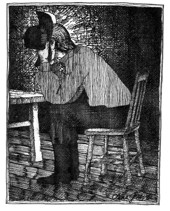
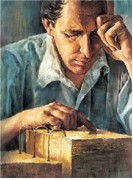
Two pictures:

[To the left] The manner of translation was as wonderful as the discovery. By putting his finger on one of the characters and imploring divine aid, then looking through the Urim and Thummim, he would see the import written in plain English on a screen placed before him. After delivering this to his emanuensi,[sic] he would again proceed in the same manner and obtain the meaning of the next character, and so on till he came to the part of the plates which were sealed up.1

Truman Coe, Presbyterian Minister living among the Saints in Kirtland, 1836

[To the right] I cheerfully certify that I was familiar with the manner of Joseph Smith’s translating the book of Mormon. He translated the most of it at my Father’s house. And I often sat by and saw and heard them translate and write for hours together. Joseph never had a curtain drawn between him and his scribe while he was translating. He would place the director in his hat, and then place his [face in his] hat, so as to exclude the light, and then [read] to his scribe the words as they appeared before him.2

Elizabeth Ann Whitmer Cowdery, Oliver Cowdery’s wife, 1870

These two descriptions of Joseph Smith translating the golden plates paint radically different pictures of the same event. It easy to accept the finger-on-the-plates translation, but the rock-in-the-hat feels completely foreign. Nevertheless, it is a much better attested description of the process than the first.

Why do we have both of these pictures if the second better fits the majority of descriptions? To answer that question, there are two stories that must be told: first–why would anyone think of translating with a rock in a hat?–and second–why we are so surprised at that?

Why Do You Look At Rocks in Your Hat?

When the English left their villages and emigrated to the New World, they brought their customs and beliefs with them. Along with the hopeful, the adventurers, and the farmers,-—cunning men and wise women disembarked in the New World.3 To be a cunning man or a wise woman was to play a well defined and important role in pre-industrial villages. Keith Thomas, retired Professor of Modern History at Oxford University, wrote what has become the principle history of folk magic in England from the sixteenth to the nineteenth centuries. He tells how, in the villages, contemporary medicine drove people to the cunning men and wise women who understood herbs. The lack of local police forces made the community depend on cunning folk to find lost or stolen goods.4 These village specialists performed such important functions that Thomas notes that the community was “likely to believe that the cunning folk were taught by God, or that they were helped by angels, or even that they possessed some divinity of their own. The common people, wrote Thomas Cooper, assumed that the power of these wizards came by ‘some extraordinary gift of God’.”5

The cunning men and women exhibited their extraordinary talents in many ways, but there is one that provides the backdrop against which young Joseph Smith is more clearly defined. He belonged to a class of cunning men whose specialty was scrying, or seeing the hidden. It was a specialty with a very long and almost universal history.6 Anthropologist Andrew Lang, writing in 1905, describes the tools of their trade:

Not only is the plain crystal, or its congener the black stone, used, together with its first cousin the mirror, and the primitive substitute of water, but almost any bright object seems to have been employed at one time or another. Thus we find the sword among the Romans; and in mediaeval Europe polished iron . . . lamp-black is sometimes smeared on the hand, or. . . a pool of ink poured into it; visions are seen in smoke and flame, in black boxes, in jugs, and on white paper. . . .7

All of these methods sound strange to our modern ears, but they were not only accepted but revered for most of human history. By the time we find scryers or seers in England between the seventeenth and nineteenth centuries, their tools were often stones and their functions had evolved into two general forms; seeing a hidden future, and seeing the hidden location of things that were lost (or the thief who made them get “lost”). The conservative nature of such practices dictated that when the traditions of the cunning men and wise women are found in the Palmyra area of the 1820s they still performed their traditional functions of telling fortunes and seeing things that were lost, hidden, or stolen.8

Young Joseph Smith was a member of a specialized sub-community with ties to these very old and very respected practices, though by the early 1800s they were respected only by a marginalized segment of society. He exhibited a talent parallel to others in similar communities. Even in Palmyra he was not unique. In D. Michael Quinn’s words: “Until the Book of Mormon thrust young Smith into prominence, Palmyra’s most notable seer was Sally Chase, who used a greenish-colored stone. William Stafford also had a seer stone, and Joshua Stafford had a ‘peepstone which looked like white marble and had a hole through the center.'”9 Richard Bushman adds Chauncy Hart, and an unnamed man in Susquehanna County, both of whom had stones with which they found lost objects.10

There are some reminiscences that tell us how the village seers operated before modern history either forgot or dismissed them.. Lorenzo and Benjamin Saunders gave interviews in 1884 remembering their dealings with the Palmyra seer, Sally Chase. Lorenzo reported:

I tell you when a man willme that anyone can get a stone, & see knowledge of futurity, I say that he is a liar & the truth is not in him. Steve Mungou lost his pocket book in the road with some $50 in money in it. He went right to Sally Chase to get her to look & see where it was; She went & looked. He was drawing wood out of the woods. She said that pocket book lays right at the side off a log in the woods where you loaded that wood. It lays right at the side of the log well we went & hunted & raked the ground over where she said but could not find it. It past along & finally one night got a paper from Canadagua [Canandaigua, New York], & in it was that a pocket book was found & taken to an old Ontario Bank[.] Took it there & the owner could come & describe his book. And he went & found his pocket book at the bank. I lost [a] drag tooth out of my drag, dragging on my brothers premises there; I says: Sally, tell me where is that drag tooth? She told me “it lays in a log heap.” She says I think it lays a little past you will find it.

I went & hunted & hunted but could not find it there. I afterwards found it away over in one corner of the field.11

Benjamin provided a similar story: “My oldest Brother had some Cattle stray away. She claimed she could see them but they were found right in the opposite direction from where she said they were.”12 These accounts portray the way Sally Chase functioned in the community. When things were lost, you went to the seer who consulted her seer stone and described how to find the lost item. The Saunders brothers could have been describing events from an English village of over a hundred years earlier. In the brief descriptions that have survived, we know that Lorenzo consulted her at least twice himself, once to find the drag tooth and once to find lost cattle. He also tells us of another client, Steve Mungou. Both brothers, however, found it necessary to append that, of course, Sally was mistaken in the location she gave, a qualification that apparently didn’t stop them from consulting her again.

Joseph Smith, long before golden plates complicated his position as a local seer, appears to have functioned just as Sally Chase did. Quinn reports that: “E. W. Vanderhoof [writing in 1905] remembered that his Dutch grandfather once paid Smith seventy-five cents to look into his ‘whitish, glossy, and opaque’ stone to locate a stolen mare. The grandfather soon ‘recovered his beast, which Joe said was somewhere on the lake shore and [was] about to be run over to Canada.’ Vanderhoof groused that ‘anybody could have told him that, as it was invariably the way a horse thief would take to dispose of a stolen animal in those days.'”13 While Vanderhoof reported a positive result of the consultation, it is interesting that his statement includes a qualifier that has the same intent as those added by the Saunders’ brothers. By the end of the century, one wouldn’t want to actually credit a village seer when describing their activities. Nevertheless, it isn’t the effectiveness that is important—it is the nature of the consultation. Sally Chase’s clients consulted her to find things which were lost, and Joseph Smith had at least one client who did the same.

The social expectations of the village seer also explain two contradictory statements about what Joseph Smith did as a village seer. The first statement comes from Henry Harris in 1833: “Joseph Smith, Jr. the pretended Prophet, used to pretend to tell fortunes; he had a stone which he used to put in his hat, by means of which he professed to tell people’s fortunes.”14 Compare that statement to a story Lorenzo Saunders told to Edmund L. Kelley during his 1884 interview:

We went to Smiths one day, it was a rainy day; We went into the old mans shop, he was a cooper, and the old man had a shirt on it was the raggedest & dirtyest shirt, and all full of holes. & we got Jo. Smith to look & tell us what color our Girls hair was. well you see by & by some of them says go to Jo. says he Jo. come look into futurity & tell us how it is there? Jo. says I can not do that, I can not look into futurity I can not look into anything that is holy. The old man stood there and says: “I guess he can not look into my shirt then.15

Both Henry Harris and Lorenzo Saunders expected that Joseph Smith told fortunes. Of course they would have that expectation, because everyone knew that was one of the typical functions of the seer. However, where Harris may simply be repeating the assumption, Saunders describes what happened when he asked Joseph to act on that assumption. At least in this case, Joseph refused. The fact that the joke in the account depends upon young Joseph’s comment about not looking at that which is Holy and his father’s holey shirt suggests that this was a remembered incident and that Joseph Smith, Jr. actually had refused. I suspect that the refusal tells us about the spheres in which Joseph believed that particular talent operated. That refusal suggests Joseph made a distinction between that which was holy (which I believe he classified as religion) and his other functions (which I believe he classified as a talent).

What the modern world tends to know about the village seers is the result of only one of the ways in which their talents were put to use. Since they could see that which was hidden, local seers became involved in the mania of digging for lost treasure. As with the other functions of the cunning men and wise women, the idea of digging for treasure traced its roots to England, including much of the accompanying lore. In England, the semi-scientific root of treasure seeking was the habit of the wealthy burying their goods for safe-keeping in the absence of a deposit banking system.16 In the New World, the plausible explanation was based on the riches reputedly buried by Spaniards or pirates. It is probable that everyone could cite cases of people who had struck it rich through their digging, though none of them had, nor anyone they personally knew.17

In English tradition, seers were invited to assist the diggers in locating the buried goods. As Thomas explains: “There was not necessarily anything magical about the search for treasure as such, but in practice the assistance of a conjurer or wizard was very frequently invoked. This was partly because it was thought that special divining tools might help, such as the ‘Mosaical Rods’ for which many contemporary formulae survive.”18

It is therefore no surprise that we see the Palmyra seers engaged in the local mania for treasure digging. As with the English practice, however, it is important to note that money-digging didn’t require the seer. They were simply seen as useful. Note the relationship of the diggers to their guides in this series of descriptions Ronald W. Walker compiled:

The adepts often played a major role in money digging. The two men who in 1827 sought neatly boxed Spanish dollars below the old pier at New London, Connecticut, were directed by an elderly wise woman. Seeking pirate treasure in Maine, three men imported from Connecticut, a “far-famed and wonderfully skillful rodsman” to assist them. In turn, treasure-hungry farmers of Rose, New York, sought the help of a “medium,” while the 1825 expedition to the Susquehanna hills began with a “peeper” named Odle, whose power of “seeing underground” piqued William Hale’s interest. Moreover, the longtime diggers around Bristol, Vermont, made use of expert advice. They consulted a series of “prophets,” including two women, an “old Frenchman” east of the mountains, and finally a conjuror who promised that by removing a few rocks and “shunning the solid ledge” the long-sought cave might be entered.19

This places an important context around the best-known case of Joseph Smith, Junior’s participation in treasure-digging. Josiah Stowell, Sr., believed that he had found a lost Spanish silver mine and had his hired hands dig for it in 1825. When they were unable to find it, he hired Joseph Smith, Jr. to help them find what they had dug for and missed.20 This incident was the reason that in 1826, Stowell’s wife’s nephew took Joseph to court as a “disorderly person,” a term that was then defined in such a way that we might consider it a case of fraud.21 Presumably, Peter Bridgeman believed that Joseph had defrauded his uncle because he used a seer stone. This would not be the last time that Joseph’s activities with a seer stone were described as fraud. In terms coined only later, Joseph would be accused of being a “confidence man.”22 One of Joseph Smith’s biographers, Dan Vogel, picks up and continues this theme. As Vogel describes the reason why one might see Joseph as a con man, he also provides the information that allows us to see the important ways in which that label is a distortion of the actual historical situation:

A typical confidence scheme in Smith’s time involved a transient who entered an area that was known for its tales of lost treasures and the charlatan’s magical powers could be put to good advantage. Using a “peep” stone or mineral rod, he would lead the credulous to a remote spot where he had previously deposited a few coins and was able to impress them by “finding” the coins. In the ensuing excitement, he would ask to be paid for his services or, more boldly, suggest that a company be established and that shares be sold. Thereupon, he would disappear with the money. On the other hand, he might string the people along by leading them to subsequent spots, then offer magical explanations for the failure to locate or secure the treasure. For instance, he might tell them that the treasure was protected by an evil spirit or that they had not precisely followed the magical formula he had given them. Eventually he would suggest that the undertaking be abandoned, whereupon he would slip out of town with the money.23

The implication is that since Joseph used a peep stone, he must be seen in the same category as those who ran a scam with one. Clearly the 1826 court appearance tells us that some contemporaries considered him in that category. However, although the evidence is complex, it appears that Joseph was acquitted of the charge at that time.24 Should he also be redeemed from the continuing charges?

Undoubtedly there were those who preyed upon the folk beliefs of the too-trusting rural communities. However, the fact that the communities would be willing to follow the confidence scheme simply tells us that there was an existing belief system in which seer stones were considered effective and acceptable. The confidence men played off inherited traditions. Nevertheless, the fact that there are dishonest pretenders in any profession does not suggest that the entire profession is designed for dishonesty. Scams were run concerning seer stones not because seer stones were novel, but precisely because they were a traditional and respected method of finding that which was hidden.

There are two critical differences between the con men and the village seers. First, the charlatans were transients and the village seers were residential. The second is that the con man elicited money for his talents, and the village seers were consulted. We have at least three descriptions of how Joseph related to his clients, including Josiah Stowell, and in each case the client came to him with their problem.25 The con men created the scam for money and left so they would not have to deal with the consequences. The true village seers were part of the community, and remained so through success and failure. Their clients came to them because of a cumulative reputation. Against the records of a few scam artists we have the long tradition of village seers stretching back to England and covering hundreds of years of respectable service in their communities.

It is this traditional context of a finder of lost things, a see-er of the unseen, that explains how rocks in the hat figure in to the story of Joseph Smith and the translation of the Book of Mormon. The plates were accompanied by the Nephite Interpreters, which were two stones set in a silver bow.26 These stones appear to have functioned in a way Joseph understood from his experience with a seer stone. Although he began translation with the Nephite Interpreters, the record indicates that he changed to using his own seer stone. Why put the stone in a hat to translate? That part of the picture is easy. That was how such a stone was used. For Joseph’s community, that aspect was not unusual at all.27

Why translate with a stone? The conceptual link in Joseph’s mind would have been that he had been able to see that which was hidden, and the meaning of the script on the plates was certainly hidden to understanding. Nevertheless, this wasn’t a simple transition from seer to translator, even for Joseph. Joseph’s talent was for the mundane, but his gift was for the Holy. Joseph understood the difference between the two when Benjamin Saunders wanted him to see into futurity. Joseph understood that when he was asked to translate, he was being asked to do something very different from what village seers did. He was being asked to do something very different from what learned men did (2 Ne. 27:15-18).

Joseph learned from his community how to operate as a village seer, but he didn’t begin to understand how to be God’s seer until Moroni appeared to him. He did not fully make that transition until the sacred interpreters helped him move from finding lost objects to finding a lost people and lost gospel. Then, having learned to see that which was Holy, Joseph never returned to the mundane functions of the village seer. Eventually, he learned that he could use a seer stone just as well as the Interpreters. Only when he learned to see that which was Holy could he translate–and then it didn’t matter the lens through which he saw.

It is at this point that some might wonder if I believe that all seers saw things in their seer stones. I believe that seers believed that that they saw things in their seer stones. Do I believe that the seer stone prepared Joseph to translate?28 Only in that it allowed him to believe that he had a God-given talent that could be used for the purpose. Nothing in the world view of the seers prepared him for translating. He didn’t originally believe that his secular stones could translate, only the sacred interpreters. Even later when he learned that he could also translate through his own seer stone, he consistently said that the translation was done through the gift and power of God, not through any kind of rock. He knew that no other village seer could do it; he knew that he could not do it, save God alone intervened. Translating the plates was beyond the realm of the village seer and firmly and exclusively in the realm of God’s Seer.

Why Are We Surprised that Joseph Used a Rock in His Hat to Translate?

If we can find a context in which Joseph translating with a seer stone makes sense, why do we have to look so hard to find it? Why isn’t it as natural for us as it was for Joseph? That story also requires that we delve into history; in this case, the history of the interconnections between what we understand to be religion and what we understand to be magic.

Judeo-Christian religion shared the cultural cradle of the ancient Middle East. Dr. Shawna Dolansky, Assistant Professor of Religious Studies at Northeastern University, notes: “Evidence from ancient Egypt and Mesopotamia suggests that the dichotomy between magic and religion that is the starting point for many discussions of magic by contemporary scholars was not necessarily evident in biblical times. The fact is, in these civilizations that were contemporary with biblical Israel, magic and religion were only beginning to be differentiated. Evidence especially from Mesopotamia shows that this dichotomy is not an inherent one, but one that gradually develops over a period of time and is intimately tied to increasing social complexity.”29

Many of the Old Testament stories that we accept as religion have much in common with magical practices. They are difficult to separate because their differentiation depended not upon the things that were done, but the way those things were perceived. Sarah Iles Johnston, professor of Greek and Latin at Ohio State University explains:

The modern scholarly quest to establish a division between magic and religion does have some roots in antiquity, insofar as both ancient and modern discussions hinge on terminology: what one chooses to call any particular activity (and, it follows, who is doing the choosing) determines whether the activity is understood as acceptable or discredited, pious or blasphemous, religion or magic. In antiquity, magic (a term that I use as a shorthand way of referring to a variety of ancient Mediterranean words) almost always referred to someone else’s religious practices; it was a term that distanced those practices from the norm–that is, from one’s own practices, which constituted religion.30

Stated simply, “what I do is religion, what you do is magic.”31

Although it is difficult to see without close examination, the Old Testament exhibits this internal/external dichotomy between religion and magic. On the one hand, it is clearly antagonistic to people who perform certain acts. For example, we find in Exodus 22:18 the verse that underlay so many later tragedies: “Thou shalt not suffer a witch to live.” Deuteronomy 18:10-12 provides a list of magical practices that should be avoided: “There shall not be found among you any one that maketh his son or his daughter to pass through the fire, or that useth divination, or an observer of times, or an enchanter, or a witch, or a charmer, or a consulter with familiar spirits, or a wizard, or a necromancer. For all that do these things are an abomination unto the Lord.”

In spite of these obvious prohibitions, Dolansky notes that when you examine the nature of the practices, it isn’t the magic but the magician that is the problem. She concludes that “magic in the Hebrew Bible refers to the mediation of divine power; and in the hands of priests and prophets it is perfectly legal.”32 It is not the act, but the actor that creates the separation between religion and magic.33 David Frankfurter, Professor of Religious Studies and History at the University of New Hampshire, notes that: “people in their own cultural systems use such descriptive labels for political, sectarian, or simply taxonomic reasons, even with little reality behind the labels. Practically any practice, that is, might be labeled ‘magical’ or ‘sorcery’ under certain conditions.”34

Because these terms and concepts were socially constructed, they played an important role when social relationships changed. The division between religion and magic that affected Joseph Smith’s world (and which is perpetuated in ours), followed the tremendous social disruption of the Protestant Reformation and the Age of Enlightenment. As the Western world emerged from the Middle Ages, the Catholic Church had become the sole repository of answers to questions about how the world worked. As the Church had grown and conquered new territories, it often incorporated local religious practices into its own doctrines and understandings. In particular, local concepts of sacred space and sacred ritual often retained their sacrality while nominally moving from pagan to Christian spheres.35 The Protestant Reformation changed the definition of what was to be considered religion and what was deemed magic, and with that change, triggered massive social realignments—first in England and later in the Americas.

Where the Catholic tradition had accepted all types of sacred place and practice, the Reformation severely limited both. In redefining religion, it labeled as magic many of the aspects of Catholic sacred space and ritual.36 Richard Bushman has noted that “The Enlightenment drained Christianity of its belief in the miraculous, except for Bible miracles. Everything else was attributed to ignorant credulity.”37 Nevertheless, Jon Butler of the Department of History at Yale University points out:

By traditional accounts, magic and occultism died out in the eighteenth century: the rise of enlightenment philosophy, skepticism, and experimental science, the spread of evangelical Christianity, the continuing opposition from English Protestant denominations, the rise in literacy associated with Christian catechizing, and the cultural, economic, and political maturation of the colonies simply destroyed the occult practice and belief of the previous century in both Europe and America. Yet significant evidence suggests that the folklorization of magic occurred as much in America as in England. As in England, colonial magic and occultism did not so much disappear everywhere as they disappeared among certain social classes and became confined to poorer, more marginal segments of early American society.38

It is precisely this folklorization that created the social dichotomy in practices that were accepted by, in Butler’s terms, the more marginal segments of early American society. This separation with parallel persistence is what anthropologist Robert Redfield of the University of Chicago called a Little and Great Tradition. He explained:

Let us begin with a recognition, long present in discussions of civilizations, of the difference between a great tradition and a little tradition. . . In a civilization there is a great tradition of the reflective few, and there is a little tradition of the largely unreflective many. The great tradition is cultivated in schools or temples; the little tradition works itself out and keeps itself going in the lives of the unlettered in their village communities. The tradition of the philosopher, theologian, and literary man is a tradition consciously cultivated and handed down; that of the little people is for the most part taken for granted and not submitted to much scrutiny or considered refinement and improvement.39

Although some aspects of Redfield’s separation of the traditions have been criticized,40 the basic idea of the two separate but interrelated aspects of religion in a culture has great explanatory power. Irving Hexham, professor of Religion at the University of Calgary, describes the complex modern religious history of Korea in terms of the intertwining of a Little and Great Tradition:

When a Great Tradition is in decline its Little Tradition can continue with a vigorous religious life until another Great Tradition seeks to impose its beliefs as the religion of the people. This situation of religious change is well illustrated by the course of religious history in Korea, where the shamanism of the Silla kings was officially replaced by Buddhism. But with the decline of Buddhism and the imposition of Confucian rituals by the Yi Dynasty shamanism once more emerged as the enduring Little Tradition. Later in the nineteenth century when Confucianism declined, Christianity entered Korea and shamanism once more reasserted its traditional role.41

It is this ability to persist parallel to and intertwined with the Great Tradition that tells us how the social complex of the cunning men and wise women not only crossed the ocean from England, but formed a vibrant part of a defined segment of American society. The duality of traditions also explains the mutual antagonism between them. As competing explanations of reality, the two are uneasy bedfellows at best and feuding relatives at worst. D. Michael Quinn noted this division in approaches to the Little and Great Traditions: “Early Americans who did not share the magic world view condemned such beliefs and practices as irrational and anti-religious, but intelligent and religious Americans who perceived reality from a magic view regarded such beliefs and practices as both rational and religious.”42

Almost by definition, we perceive history through the eyes of the Great Tradition; the tradition with the greater social and economic standing and the tradition with greater ability to create a written legacy through the Enlightenment’s association with education. The Great Tradition writes the history that colors our perception of the Little Tradition. In the case of what we call magic, the anti-magical stance of the Great Tradition makes the folk magic Little Tradition an embarrassment. Andrew Lang, a British anthropologist of the last generation, provides a fascinating example of what happens when the Great Tradition expectation meets the Little Tradition reality: “‘I am glad to say my people are not superstitious,’ said a worthy Welsh clergyman to a friend of mine, a good folklorist, now, alas, no more, and went on to explain that there were no ghosts in the parish. His joy was damped, it is true, half-an-hour later, when his guest inquired of the school children which of them could tell him where a bwggan was to be seen, and found there was not a child in the school but could put him on the track of one.”43

The disdain of the Great Tradition for the Little Tradition is evident in an account of a trial for fraud, held in Kent, England, in 1850: “The defendant, who had the appearance of an agricultural labourer, resided at Rolvenden, where he enjoyed the reputation of being ‘a cunning man’, able to cure diseases, to explain dreams, to foretell events, to tell fortunes, and to recover lost property. He was resorted to as a wizard by the people of miles around, principally by the ignorant, but also by parties who might have been expected to know better.”44 The facts of the case are that many in the community consulted this cunning man. Of course, they had to have been ignorant folk. Nevertheless, there were some who didn’t appear so ignorant, although even they–should have known better.

Alan Taylor, a fellow at the Institute of Early American History and Culture, Williamsburg, Virginia, and an assistant professor at the College of William and Mary, explains the chasm between the Great and Little Tradition by focusing on Martin Harris:

[Martin Harris] was an honest, hard-working, astute man honored by his townsmen with substantial posts as fence-viewer and overseer of highways but never with the most prestigious offices: selectman, moderator, or assemblyman. In the previous generation in rural towns like Palmyra substantial farmers like Harris would have reaped the highest status and most prestigious offices. But Harris lived in the midst of explosive cultural change as the capitalist market and its social relationships rode improved internal transportation into the most remote corners of the American countryside. The agents of that change were the newly arrived lawyers, printers, merchants, and respectable ministers who clustered in villages and formed a new elite committed to “improving” their towns and their humbler neighbors. The village elites belonged to a new self-conscious “middle class,” simultaneously committed to commercial expansion and moral reform. Because of their superior contacts with and knowledge of the wider world, the new village elites reaped higher standing and prestigious posts from their awed neighbors.

Utterly self-confident in their superior rationality and access to urban ideas, the village elites disdained rural folk notions as ignorant, if not vicious, superstitions that obstructed commercial and moral “improvement.” Through ridicule and denunciation, the village middle class aggressively practiced a sort of cultural imperialism that challenged the folk beliefs held by farmers like Martin Harris. Harris’s material prosperity was comparable to the village elite’s but, because of his hard physical labor and limited education, culturally he shared more with hardscrabble families like the Smiths. A village lawyer needed only scan Harris’s gray homespun attire and large stiff hat to conclude that a farmer had come to town.45

We should not expect that because the Little Tradition is associated with the less educated that they were therefore simple or naÔve. Martin Harris might have been a participant and believer in the Little Tradition, but that doesn’t mean that he threw caution to the wind. The new elite might have seen Martin Harris as an ignorant and credulous farmer, but he would have seen himself as a cautious believer. His credulity allowed for true seers, but his caution told him that there were charlatans abroad. He pointedly told Joseph: “I said, Joseph, you know my doctrine, that cursed is every one that putteth his trust in man, and maketh flesh his arm; and we know that the devil is to have great power in the latter days to deceive if possible the very elect; and I don’t know that you are one of the elect. Now you must not blame me for not taking your word.”46

To resolve his question of whether or not he should support the Book of Mormon, Martin tested Joseph. When a pin Martin was using to pick his teeth fell into straw around his feet, he first attempted to find it. Not succeeding, he asked Joseph to use his seer stone to find the pin. Joseph did, bolstering Martin’s confidence that Joseph had the talent he professed.47 I find it particularly apt that the nature of the test was to find something lost. That is, of course, what a seer did.

Nevertheless, believing in Joseph as a true prophet and true seer had Martin straddling two traditions. The village seer belonged to the Little Tradition and a true prophet belonged the Great Tradition. Those in the Little Tradition understood that their quotidian practices were not religion (though they certainly didn’t consider them un-Christian). They even understood that their village practices were not respected by the Great Tradition. This is the reason that so many of those who participated in the Little Tradition attempted to separate themselves from it when they were later part of the Great Tradition, or when an interviewer from the Great Tradition asked about the old days. Richard Bushman demonstrates how this pressure affected the reminiscences of some of Joseph Smith’s neighbors:

The forces of eighteenth-century rationalism were never quite powerful enough to suppress the belief in supernatural powers aiding and opposing human enterprise. The educated representatives of enlightened thought, newspaper editors and ministers particularly, scoffed at the superstitions of common people without completely purging them. The scorn of the polite world put the Palmyra and Manchester money diggers in a dilemma. They dared not openly describe their resort to magic for fear of ridicule from the fashionably educated, and yet they could not overcome their fascination with the lore that seeped through to them from the past. Their embarrassment shows in the affidavits Hurlbut collected. William Stafford, who admitted participation in two “nocturnal excursions,” claimed he thought the idea visionary all along, but “being prompted by curiosity, I at length accepted of their invitations.” Peter Ingersoll made much more elaborate excuses. One time he went along became it was lunchtime, his oxen were eating, and he was at leisure. Secretly, though he claimed to be laughing up his sleeve: “This was rare sport for me.”48

Not only does understanding the Great and Little Traditions explain the antagonism we see in the Great Tradition histories, but the dual traditions also help explain one of the features or a Little Tradition religion when it is transformed into a Great Tradition religion. That shift in social acceptance and expectation triggers a responsive shift in the way the new religion sees itself and its history.

Morton Smith, a professor of History at Columbia University, examined this tendency in early Christianity, which began as a Little Tradition religion, but became a Great Tradition religion. Smith notes that the earliest forms of Christianity had a strong affinity with magical practices—practices that remain in descriptions of the healing miracles and turning water to wine. By the time of the gospels, however, that history was being written to remove references to magic. He concludes:

What evidence did the Christian tradition, as presented in the gospels, have in common with the picture of Jesus the magician? Since the authors of the gospels wished to defend Jesus against the charge of magic, we should expect them to minimize those elements of the tradition that ancient opinion. . . would take to be evidence for it, and to maximize those that could be used against it.

This expectation is, in the main, confirmed. The evangelists could not eliminate Jesus’ miracles because those were essential to their case, but John cut down the number of them, and Matthew and Luke got rid of the traces of physical means that Mark had incautiously preserved.49

The New Testament presented its message to, and participated in, a Great Tradition that Morton Smith notes was: “hostile to magic.”50 So also did the modern Saints tell their story within and to a Great Tradition that was hostile to magic.

As the early saints transitioned from a collection of believers into a formal religion, they began to see themselves within the Great Tradition. As with early Christianity, the stories they told of themselves naturally were recast to distance themselves from their Little Tradition heritage and provide an acceptable Great Tradition history. One of the obvious places to see this process in action is with the tools of the translation. We all know that Joseph used the Urim and Thummim to translate the Book of Mormon—except he didn’t. The Book of Mormon mentions interpreters, but not the Urim and Thummim. It was the Book of Mormon interpreters which were given to Joseph with the plates. When Moroni took back the interpreters after the loss of the 116 manuscript pages, Joseph completed the translation with one of his seer stones. Until after the translation of the Book of Mormon, the Urim and Thummim belonged to the Bible and the Bible only.51 The Urim and Thummim became part of the story when it was presented within and to the Great Tradition. Eventually, even Joseph Smith used Urim and Thummim indiscriminately as labels generically representing either the Book of Mormon interpreters or the seer stone used during translation.52

The Urim and Thummim were traditionally divinatory rocks, but most importantly, they were biblically acceptable divinatory rocks.53 From the Great Tradition perspective, their presence in the Bible made them religion, not magic. I suspect that the two interpreters made a natural comparison to the two stones, one Urim and one Thummim, from the Bible. Calling the biblical divinatory tools “rocks” instead of Urim and Thummim seems to demean them. The reverse process, calling the interpreters and seer stones Urim and Thummim, places them in a more appropriate religious category where they belong because of the sacred use to which they were put in translating the Book of Mormon.

This recasting of history was a story the Saints told themselves as much as what they presented to the world. I doubt that there was any conscious attempt to reconcile their history with Great Tradition expectations, let alone any attempt at deception. It was simply the natural response to their self-definition as a religion rather than a folk belief. It was a story told in a way that they subliminally knew was appropriate for a Great Tradition religion. The new history did not deny the past or alter the facts, but recolored them with a new vocabulary.54

Why, then, are we so surprised to learn that Joseph translated with a rock in his hat? That is a Little Tradition description and we are now firmly in the Great Tradition. We share the Great Tradition antipathy to those elements of the Little Tradition. Time has made the gap even greater than it was in Joseph’s day. Why do we have the two pictures with which we began? The more accurate, but more uncomfortable picture is a Little Tradition image. The other is a Great Tradition image. We have both because we can tell the story from two different perspectives.

Regardless of the perspective from which we tell the story, the essential fact of the translation is unchanged. How was the Book of Mormon translated? As Joseph continually insisted, the only real answer, from any perspective, is that it was translated by the gift and power of God.

Notes

1 Truman Coe to Mr. Editor, Hudson Ohio Observer, August 11, 1836 cited in Dan Vogel, Early Mormon Documents, 5 vols. (Salt Lake City: Signature Books, 1998), 1:47.

2 Elizabeth Ann Whitmer Cowdery, “Elizabeth Ann Whitmer Cowdery Affidavit, 15 February 1870,” in Early Mormon Documents, ed. Dan Vogel, 5 vols. (Salt Lake City, UT: Signature Books, 1870), 5:260.

3 Catherine L. Albanese, A Republic of Mind and Spirit: A Cultural History of American Metaphysical Religion (New Haven, CT: Yale University Press, 2007), 68. Also Jon Butler, Awash in a Sea of Faith: Christianizing the American People (Cambridge, Mass.: Harvard University Press, 1992), 67.

4 Keith Thomas, Religion and the Decline of Magic (New York: Charles Scribner’s Sons, 1971), 649-50.

5 Ibid., 266.

6 Deanna J. Conway, Crystal Enchantments: A Complete Guide to Stones and Their Magical Properties (Berkeley. Calif.: The Crossing Press, 1999), 291-3.

7 Andrew Lang, Crystal Gazing: Its History and Practice, with a Discussion of the Evidence for Telepathic Scrying (New York: Dodge Publishing Company, 1905), 32.

8 For the practices, see Thomas, Religion and the Decline of Magic, 656. Herbert Passin and John W. Bennett, “Changing Agricultural Magic in Southern Illinois: A Systematic Analysis of Folk-Urban Transition,” (reprint of a 1943 article) in The Study of Folklore, edited by Alan Dunces (Englewood Cliffs, New Jersey, 1965), 316-17, discuss agricultural magic in an Illinois town as collected in 1939, when the practices were beginning to fade. They note that they were practices that followed the Old English pattern.

9 D. Michael Quinn, Early Mormonism and the Magic World View (Salt Lake City: Signature Books, 1987), 38.

10 Richard L. Bushman, Joseph Smith and the Beginnings of Mormonism (Urbana and Chicago: University of Illinois Press, 1984), 70.

11 Lorenzo Saunders, “Lorenzo Saunders Interview, 12 November 1884,” in Early Mormon Documents, ed. Dan Vogel, 5 vols. (Salt Lake City, UT: Signature Books, 1884), 2:154-55.

12 Benjamin Saunders, “Benjamin Saunders Interview, Circa September 1884,” in Early Mormon Documents, ed. Dan Vogel, 5 vols. (Salt Lake City, UT: Signature Books, 1884), 2:139.

13 Quinn, Early Mormonism and the Magic World View, 39.

14 Henry Harris, “Henry Harris Statement, Circa 1833,” in Early Mormon Documents, ed. Dan Vogel, 5 vols. (Salt Lake City, UT: Signature Books, 1833), 2:75.

15 Lorenzo Saunders, interviewed by E. L Kelley, 12 November 1884, “Miscellany,” E. L. Kelley Papers, RLDS Church Library-Archives, Independence, Missouri, p. 11, in Early Mormon Documents, ed. Dan Vogel, 5 vols. (Salt Lake City, UT: Signature Books, 1833), 2:155.

16 Keith Thomas, Religion and the Decline of Magic, 234.

17 Ronald W. Walker, “The Persisting Idea of American Treasure Digging,” BYU Studies, 24, no. 4 (Fall 1984):433, notes: “The reality of actual treasure finds hardly explains the power and tenacity of the reassure myth “Finds’ were never commensurate with actual digging and were more a matter of accidental discovery than conscious magical enterprise. Even the discovery of mines, allegedly the most successful of the diggers’ pursuits, evoked skepticism and lacked documented results.”

18 Thomas, Religion and the Decline of Magic, 236.

19 Walker, “The Persisting Idea of American Treasure Hunting,” 439-40.

20 Richard L. Bushman, Joseph Smith: Rough Stone Rolling (New York: Alfred A. Knopf, 2005), 48.

21 Bruce A. Van Orden, “Joseph Smith’s Developmental Years, 1823-29 (JS ñ H 50-67),” In Studies in Scripture, Vol. 2: The Pearl of Great Price, edited by Robert L. Millet and Kent P. Jackson, (Salt Lake City: Randall Book, 1985),373.

22 Dale R. Broadhurst, “Joseph Smith: Nineteenth Century Con Man?” accessed July 2009 from http://sidneyrigdon.com/criddle/Smith-ConMan.htm, provides a long and nicely documented piece that clearly argues that Joseph Smith was precisely a con man, and was described as one. That he would have been seen as a con man by the writers from the Great Tradition is certainly understandable (see later in this paper). However, seem from inside his own social and economic class, the term is unwarranted and inaccurate. It is a historically accurate misrepresentation, but a misrepresentation nonetheless.

23 Vogel, Joseph Smith: The Making of a Prophet, xiv.

24 Previous records of what happened at the hearing have been supplemented by the discovery of court documents that have allowed a more complete legal analysis of the conclusions. The discussion of what happened at this hearing is beyond the scope of this papers. Sources to be consulted are: Marvin S. Hill, “Joseph Smith and the 1826 Trial: New Evidence and New Difficulties,” BYU Studies 12, no. 2 (1972):223-33, Gordon A. Madsen, “Joseph Smith’s 1826 Trial: The Legal Setting,” BYU Studies 30, no. 2 (1990):91-108, “Just the Facts: The 1826 Trial (Hearing) of Joseph Smith,” Accessed July 2009 from http://www.lightplanet.com/response/1826Trial/facts.html.

25 Vanderhoof’s grandfather came to Joseph to ask about the lost mare. Josiah Stowell came to Joseph to hire him to help find the silver mine. Martin Harris asks Joseph to find the pin he dropped in the straw (discussed below).

26 J. W. Peterson, “William Smith Interview with J W. Peterson and W. S.Pender, 1890,” in Early Mormon Documents, ed. Dan Vogel, 5 Vols., vol. 1 (Salt Lake City, UT: Signature Books, 09/03/23 1890), 508. A. W. Benton, “Mormonites,” Evangelical Magazine and Gospel Advocate 2:15 (April 9, 1840), 201, as quoted in Stephen D. Ricks, Joseph Smith’s Means and Methods of Translating the Book of Mormon (Provo, UT: Foundation for Ancient Research and Mormon Studies, 1986), 3.

27 “Palmyra Reflector, 1 February 1831,” in Early Mormon Documents, ed. Dan Vogel, 5 vols., (Salt Lake City, UT: Signature Books), 2:243, “‘Peep stones’ or pebbles, taken promiscuously from the brook or field, were placed in a hat or other situation excluded from light, when some wizzard or witch (for these performances were not confined to either sex) applied their eyes, and nearly starting [staring?] their [eye] balls from their sockets, declared they saw all the wonders of nature, including of course, ample stores of silver and gold.” Bracketed text retained from Vogel.

28 Mark Ashurst-McGee appears to see a developmental path from Joseph’s use of folk magic into his abilities as a prophet. Clearly there is a connection, but I seem to see a greater separation than he does. Mark Ashurst-McGee, A Pathway To Prophethood: Joseph Smith Junior As Rodsman, Village Seer, And Judeo-Christian Prophet, Master’s Thesis (Logan, Utah: Utah State University, 2000), iii, “For the most part, I present Joseph Smith’s divinatory development as he himself experienced it. Dowsing with a rod, seeing things in stones, and receiving heavenly revelations were as real to Smith as harvesting wheat. In order to understand his progression from rodsman to seer to prophet, one must first understand his worldview. The mental universe of early American water witches and village seers forms one of the historical and cultural contexts in which Joseph Smith developed his divinatory abilities.” Reacting specifically to this statement, my objection would be that Joseph Smith did not “develop his divinatory abilities,” but rather that they were bestowed upon him a s a gift from God, leveraging a talent he already had into the confidence to do what otherwise he would never have believed he could have done.
Alan Taylor also indicates a developmental path: Taylor, “Rediscovering the Context of Joseph Smith’s Treasure Seeking,” 21, “Indeed, I would argue that Joseph Smith, Jr.’s transition from treasure-seeker to Mormon prophet was natural, easy, and incremental and that it resulted from the dynamic interaction of two simultaneous struggles: first, of seekers grappling with supernatural beings after midnight in the hillsides, and, second, of seekers grappling with hostile rationalists in the village streets during the day.” Although these factors certainly contributed to the development of Joseph Smith the person, I do not see them as foundational for Joseph the Prophet. I see Moroni’s visit as creating a fundamental shift in his worldview, requiring that he relearn his place and reassign his talent to the Lord. It may not have been world-wrenching, but it still was dramatically different from the context of his daily life prior to that event.

29 Shawna Dolansky, Now You See It, Now You Don’t: Biblical Perspectives on the Relationship Between Magic and Religion (Winona Lake, Indiana: Eisenbrauns, 2008), 21.

30 Sarah Iles Johnston, “Magic,” in Religions of the Ancient World: A Guide, ed. Sarah Iles Johnston (Cambridge, Mass.: Harvard University Press, 2004), 140. Dolansky, Now You See It, Now You Don’t, 15, “In the case of the ancient world, it is difficult to find firm divisions between magical and religious activities until the time of classical Greece, and then those categories refer to social rather than substantive distinctions.”

31 Dolansky, Now You See It, Now You Don’t, 4: “The problem of differentiating between actions that are magical and those that are religious is important in the fields of anthropology and religious studies. Both magic and religion claim access to realms outside of ordinary reality and attempt to manipulate supernatural forces for desired outcomes in the natural world. Scholars have approached the categories of magic and religion from a variety of perspectives, distinguishing them on the basis of their techniques, social effects, and the status of their chief proponents. Some have suggested that there is no real difference, that the categories merely denote social conventions (“what I do is religion, what you do is magic”) and that the terms themselves should be dissolved altogether.

“The problem of defining magic has been a major portion of most LDS responses to the accusation that Joseph Smith participates in magic or the occult. In all cases, the problem is not with the facts, but with the connotations of the labels. See the following discussions of the use of the term “magic,” and to what it might apply: John Gee, “Abracadabra, Isaac and Jacob,” A review of “The Use of Egyptian Magical Papyri to Authenticate the Book of Abraham: A Critical Review” by Edward H. Ashment, FARMS Review, 7, no. 1, (1995): 47-67, John Gee, “Early Mormonism and the Magic World View, revised and enlarged edition,” A review of “Early Mormonism and the Magic World View, revised and enlarged edition” by D. Michael Quinn, FARMS Review, 12, no. 2, (2000):2-6, William J. Hamblin, “That Old Black Magic,” A review of “Early Mormonism and the Magic World View, revised and enlarged edition” by D. Michael Quinn, FARMS Review, : 12,no. 2 (2000 ): 3-9, Rhett S. James, “Writing History Must Not Be an Act of ‘Magic,'” A review of “Early Mormonism and the Magic World View, revised and enlarged edition” by D. Michael Quinn, FARMS Review, 12, no. 2 (2000):2-4.

32Dolansky, Now You See It, Now You Don’t, 99.

33 Ibid., 99-100.

34 David Frankfurter, “Dynamics of Ritual Expertise in Antiquity and Beyond: Towards a New Taxonomy of “Magicians”,” in Magic and Ritual in the Ancient World, ed. Paul Mirecki and Marvin Meyer (Leiden, The Netherlands: Brill, 2001), 159.

35 Karen Louise Jolly, “Magic, Miracle, and Popular Practice in the Early Medieval West: Anglo-Saxon England,” in Religion, Science, and Magic: In Concert and in Conflict, ed. Jacob Neusner, Ernest S. Fredrichs and Paul Virgil McCracken Flesher (New York and Oxford: Oxford University Press, 1989), 176, “Although there was conflict in early medieval society between the extremes of magic and religion–a product of the Christianizing process in which the converted and the church hierarchy redefined the acceptable and unacceptable–there were also gray areas of assimilation in which practices stemming from a similar outlook were transformed into something acceptable. The Christian Church, though openly countering magic with miracle, was not blind to this assimilation process as another means of conversion.

“The extremes of magic and religion or science, although well defined in most cultures, would necessarily have such gray areas between them, a product of the influences of change over time, as the acceptable and the unacceptable were redefined.”

36 Keith Thomas, Religion and the Decline of Magic, chapter 3, “The Impact of the Reformation,” provides extensive examples of the way in which this process moved through the Protestant rejection of Roman Catholicism. He concludes (75-76): “Protestantism thus presented itself as a deliberate attempt to take the magical elements out of religion, to eliminate the idea that the rituals of the church had about them a mechanical efficacy, and to abandon the effort to endow physical objects with supernatural qualities by special formulae of consecration and exorcism.”

37 Richard L. Bushman, Joseph Smith and the Beginnings of Mormonism, 7.

38 Butler, Awash in a Sea of Faith, 83

39 Robert Redfield, The Little Community and Peasant Society and Culture (Chicago: University of Chicago Press, 1960, rpt 1989.), 41-42.

40 Edith Badone, “Introduction,” in Religious Orthodoxy and Popular Faith in European Society, ed. Edith Badone (Princeton: Princeton University Press, 1990), 6: “Redfield’s work is in the tradition of the “two-tiered” models of religion that Brown seeks to escape. Like the term popular religion itself, the great tradition-little tradition distinction has helped to perpetuate the misconception that popular religion is always rural, primitive, unreflective, and traditional, as opposed to the urban, civilized, intellectual, and modern religion of the elite.” Stanley Brandes, “Conclusion: Reflections on the Study of Religious Orthodoxy and Popular Faith in Europe,” in Religious Orthodoxy and Popular Faith in European Society, ed. Edith Badone (Princeton, NJ: Princeton University Press, 1990), 187: “Despite these theoretical advances, Redfield and his followers–like the evolutionists before them–implicitly denigrated the religion of the masses. Not only did they view popular religion as less reflective and creative–in other words, more reactive–than that of the elite but they also believed that popular religion lagged behind elite religion temporally; elite beliefs and practices of one century might be discovered among the peasantry of the next.”

41 Irving Hexham, “Modernity or Reaction in South Africa: The Case of Afrikaner Religion,” in Modernity and Religion: Papers Presented at the Consultation on Modernity and Religion Held at the University of British Columbia, Dec. 15-18, 1981, ed. William Nicholls (Waterloo, Ontario: Wilfrid Laurier University Press, 1988), 81.

42 Quinn, Early Mormonism and the Magic World View, 225.

43 Lang, Crystal Gazing, 1.

44 David Vincent, Literacy and Popular Culture: England 1750-1914, Cambridge Studies in Oral and Literate Culture, ed. Peter Burke and Ruth Finnegan, vol. 19 (Cambridge, England: Cambridge University Press, 1993), 172.

45 Alan Taylor, “Rediscovering the Context of Joseph Smith’s Treasure Seeking,” Dialogue: A Journal of Mormon Thought, 19, no. 4 (Winter 1986):21. Internal references silently removed.

46 Martin Harris interview with Joel Tiffany, Tiffany’s Monthly, V , 169.

47 Ibid., 164.

48 Bushman, Joseph Smith and the Beginnings of Mormonism, 71-72.

49 Morton Smith, Jesus the Magician (New York: Barnes & Noble, 1978), 92.

50 Ibid., 146. As might be expected, Morton Smith’s presentation of Jesus as a magician is even more controversial than calling Joseph Smith a magician. John Gee, “‘An Obstacle to Deeper Understanding’.” Review of D. Michael Quinn, Early Mormonism and the Magic World View, revised and enlarged edition, in FARMS Review of Books, 12 no. 2 (2000):188 notes that Morton Smith’s idea that there were itinerant Greek magicians has been discredited. Gee does note (p. 186), “If Jesus can be seen in such a context [as a magician], why not Joseph Smith?”

51 J. V. Coombs, Religious Delusions: Studies of the False Faiths of To-Day (Cincinnati: The Standard Publishing Company, 1904), 61-62, “Dr. Wyl says that the name Urim and Thummim was first used by W. W. Phelps about the time of the publication of the Book of Commandments. This is ten years after Moroni’s visit. In the interim the work of translating is done by seer stones and stone spectacles! What a blessed thing it is that the more dignified instrument came soon enough to get into the second edition of the revelations, at the same time belated Moroni makes his advent!”

52 Richard Van Wagoner and Steve Walker, “Joseph Smith: ‘The Gift of Seeing'”, Dialogue: A Journal of Mormon Thought vol. 15, no. 2 (Summer 1982):62, “These stones could not have been the Nephite interpreters, yet Joseph specifically calls them ‘Urim and Thummim.’ The most obvious explanation for such wording is that he used the term generically to include any device with the potential for ‘communicating light perfectly, and intelligence perfectly, through a principle that God has ordained for that purpose,’ as John Taylor would later put it.” See also Mark Ashurst-McGee, “Moroni as Angel and as Treasure Guardian,” FARMS Review 18, no. 1 (2006):42.

53 This is an intentional distillation of the tradition, which would never have accepted the crude designation of “rocks” for the tradition stones the Urim and Thummim represented. There is a long tradition that they were associated with the gems on the ephod. See Cornelis Van Dam, The Urim and Thummim: A Means of Revelation in Ancient Israel (Winona Lake, Indiana: Eisenbruans, 1997), 16-23, 27-31.

54 The saints themselves would not have perceived a great division in their participation in the two cultural spheres. For them, the transition was likely imperceptible, even though they began to see themselves from the perspective of the religion they had joined. Bill Hamblin notes that they never did label themselves with any of the terms that the Great Tradition would have used to describe their Little Tradition practices. William J. Hamblin, “That Old Black Magic,” Review of D. Michael Quinn, Early Mormonism and the Magic World View, revised and enlarged edition, in FARMS Review of Books 12 no. 2 (2000): 233, makes this point in reference to Quinn’s association of the terms with Joseph Smith and his peers: “Joseph Smith never called himself a magician, sorcerer, occultist, mystic, alchemist, kabbalist, necromancer, or wizard. He did not ’embrace’ this ‘self-definition.’ Nor did any of his followers.”

Primary Sidebar

Faithful Study Resources for Come, Follow Me

Subscribe to Blog

Enter your email address:

Subscribe to Podcast

Podcast icon
Subscribe to podcast in iTunes
Subscribe to podcast elsewhere
Listen with FAIR app
Android app on Google Play Download on the App Store

Pages

  • Blog Guidelines

FAIR Latest

  • Come, Follow Me with FAIR – Isaiah 58–66 – Jennifer Roach Lees
  • Come, Follow Me with FAIR – Isaiah 58–66 – Part 1 – Autumn Dickson
  • Jesus Lives to Lift
  • Come, Follow Me with FAIR – Isaiah 50–57 – Part 2 – Autumn Dickson
  • Come, Follow Me with FAIR – Isaiah 50–57 – Jennifer Roach Lees

Blog Categories

Recent Comments

  • Willie Louise Truitt on The Joy of a Covenant Relationship with God
  • Katrina on In memory of Chandler “Chuck” Hendry
  • Nancy Farmer on Come, Follow Me with FAIR – Psalms 49–51; 61–66; 69–72; 77–78; 85–86 – Part 1 – Autumn Dickson
  • Nicko De Leon on In memory of Chandler “Chuck” Hendry
  • Becky Matson on In memory of Chandler “Chuck” Hendry

Archives

Follow Us

  • Facebook
  • Twitter
  • iTunes
  • YouTube
Android app on Google Play Download on the App Store

Footer

FairMormon Logo

FAIR is a non-profit organization dedicated to providing well-documented answers to criticisms of the doctrine, practice, and history of The Church of Jesus Christ of Latter-day Saints.

Donate to FAIR

We are a volunteer organization. We invite you to give back.

Donate Now

Site Footer

The use of the temple in past and current logos and the name "Mormon" are licensed for use by The Church of Jesus Christ of Latter-day Saints.