
The two great commandments are to love God and love our neighbor. But because God’s children have a wide diversity of opinions and personalities, the second commandment can be difficult to keep. Contention has always plagued the human family, and it seems to only grow louder with the rise of social media.
Respectful communication may feel like a dying art, but it is still possible, and it has never been more needed. With the help of our Savior and His teachings, we can learn how to navigate these tough conversations and maintain our commitment to both truth and love.
So, how can we love someone we disagree with? Here are some suggestions:
- Be humble and teachable.
- See them as a child of God.
- Actively love.

Be Humble and Teachable
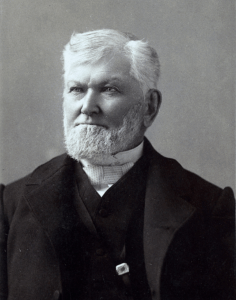
First, we can remember to practice humility. Wilford Woodruff reminded:
“We all have our weaknesses; God has permitted them that we might be taught humility in ourselves and charity toward others. We none of us are perfect whilst we dwell in the flesh.”[1]
A disagreement is an opportunity to practice the virtues of humility and charity. When we sincerely listen to someone’s perspective and try to recognize and correct our own mistakes, it can do a lot to heal a strained relationship, even if we still disagree.
On many topics of opinion and public policy, there may be more than one right answer, and answers may change as new evidence comes to li
ght. We can try to be open minded toward other people’s ideas and conscious of where we may be biased or misinformed. As the Savior taught in His Sermon on the Mount, we shouldn’t rush to remove the mote from our brother’s eye while we may have a beam in our own (>Matthew 7:3–5).
There is such a thing as absolute truth from the mouth of God, where answers don’t change. If a friend is disagreeing with revealed eternal doctrine or teachings from the prophets, humility does not mean retreating from our testimony. The message is not the problem, but our approach may be.
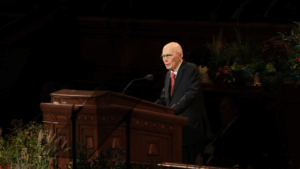
The Lord has instructed us to teach by persuasion, gentleness, meekness, and kindness (Doctrine and Covenants 121:41–42). Rather than speaking the truth with aggression or condescension, we are to speak the truth in love (Ephesians 4:15). Being rude isn’t justified by being right, and jumping to correct someone may not be productive. Elder Gary E Stevenson explained, “When it comes to missionary work, God doesn’t need you to be His sheriff”.[2] President Dallin H Oaks further stated that being a peacemaker “does not mean to compromise our principles and priorities but to cease harshly attacking others for theirs”.[3]
Speaking to the Saints in Ogden in 1880, Wilford Woodruff said,
“Our aim is high and glorious and our mission is sublime above all others. . . . Let us, therefore, be one; be ready to forgive, let us never think we have so much dignity that we need no instruction or chastisement. Let us be humble and ponder what we are here for.”[4]
One of the things we are here for is to stand as examples of Christlike love. What message is our behavior during an argument sending? Are we inadvertently teaching our friends that Church members are judgmental, self-righteous, and unkind? Or are we showing them that disciples of Christ are humble, compassionate, and welcoming?
See Them as a Child of God
When we feel we are under attack, our brains often fail to keep a clear perspective. Our drive toward self-defense can lead us to overestimate our own wisdom and virtues, while hyperfocusing on the faults and errors of our perceived attackers. If we aren’t careful, we may see the person in front of us as a problem rather than a human being.
In an 1889 letter to Church leadership in New Zealand, Wilford Woodruff wrote:
“All men are the sons of God and should be treated as brethren in all the relationships of life.”[5]
Elder Ulisses Soares reaffirmed this message in 2023:
“We are all begotten spirit sons and daughters of heavenly parents who truly love us… We all have divine nature, heritage, and potential… We are all equal before God.”
</blockquote>A person who argues with us is much more than an adversary; they are our spiritual brother or sister, and they have a loving Father in Heaven and a future full of divine po
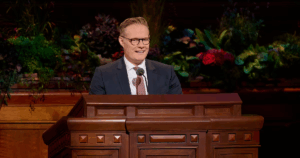
ssibilities. Instead of reducing them to one opinion, we should open our eyes to see more of who they really are. If this is someone we see regularly, we could write out a list of their positive attributes to keep as a reminder. We can set aside their “bad parts” for a moment—what are the good parts? We could think of what we first remember admiring about them, their skills and talents, the good memories we’ve shared, what we both enjoy, the positive impact they have, and the wonderful person they may yet become.Seeing people as children of God can also help us see ourselves in them. Just like us, all of God’s children experience hurt, frustration, and sadness. Just like us, their emotions and negative life events can influence the way they see things. In their bad moments, we should treat them the way we wish people would have treated us in our bad moments. We should pray for the strength to give them grace, just as we have been given grace, and to feel God’s love for them. Elder Karl D. Hirst said,
“Whichever parts of us seem different, His love is where we find togetherness. . . . When we love one another in this way, as completely and fully as we can, heaven gets involved too.”[6]
In the early years of the Church, members were often persecuted in ways we are blessed to not experience. The Saints were imprisoned, attacked, and discriminated against on many sides, and yet they resisted the urge to demonize their persecutors. In an epistle to the Saints in 1886, Wilford Woodruff wrote:
“Do not harbor envy, vengeance, or hatred against this nation or against those who have aided or abetted in your suffering, but rather go before the Lord and pray that He will soften [their] hearts.”[7]
He remembered everyone’s status as children of God with the option to repent, and he firmly held out hope that they would. With help from heaven, we can carry on this legacy, following our Savior’s example of loving even our enemies (see Matthew 5:44). Christ never gives up on them, and neither should we.
Actively Love
Love is both a feeling and an action. Having this perspective can expand our understanding of the command to love our neighbors and enemies. If we aren’t experiencing feelings of love, we can still obey by doing actions of love. If we don’t love someone, we should love them anyway!

Charity, the pure love of Christ, is another description of love in action. President Russell M. Nelson taught,
“Charity is the antidote to contention. Charity is the spiritual gift that helps us to cast off the natural man, who is selfish, defensive, prideful, and jealous. Charity is the principal characteristic of a true follower of Jesus Christ… In situations that are highly charged and filled with contention, I invite you to remember Jesus Christ.”[8]
Looking to Jesus Christ as our example, we can put off the natural man and choose charity instead.
There are many ways to apply this advice in tough moments.
- If we want to scream or throw out an insult at someone we disagree with, we can make an effort to take a deep breath and speak calmly instead.
- If we’ve started mentally labeling them as a bad person, we can make an effort to rewrite those thoughts.
- If we feel the urge to talk badly about them behind their back, we can make an effort to say positive things about them instead.</li>
Anything we can do to help them is loving them, even if our emotions aren’t on board—and our actions will influence our emotions over time.
Elder David L. Bucker taught, “In a world calling for division, distance, and disengagement, there is always much more that unites us than divides us.”[9] Sometimes a conflict feels so big that we forget all the space around it. If we set aside our fight for a moment, could we still be good study partners in geometry with someone we disagree with? Could we have great conversations about other topics? How about getting a group together and playing pickleball, hiking, seeing a movie, or going to a football game? Could we drop small compliments, help with little inconveniences, or share good news and lucky breaks? Every time we interact with them, we have an opportunity to take steps in a more positive direction.

Press Forward in Faith
In an epistle to the Saints in 1893, Wilford Woodruff wrote:
“We feel now that a time for reconciliation has come; that before entering into the Temple to present ourselves before the Lord in solemn assembly, we shall divest ourselves of every harsh and unkind feeling against each other; that not only our bickerings shall cease, but that the cause of them shall be removed, and every sentiment that prompted and has maintained them shall be dispelled.”[10]
His optimism may seem bold, but remember what the God we worship is able to do! Remember what incredible promises He makes with us in the temple! We have much more important and joyful things to do than hold grudges.
Navigating disagreements is not an easy task, but our prophet Russell M Nelson confirms that “the Lord loves effort”.[11] As we keep making efforts to love those we disagree with and improve the way we communicate, the Lord will be with us and work miracles in His time.

Cammie Garner studied biodiversity and conservation at Brigham Young University. Next, she completed a master’s degree in biology education from Grand Canyon University. After working as a tutor and STEM camp counselor, she became a full-time service missionary for The Church. As a missionary she serves in the temple, FamilySearch center, humanitarian center, and local art lab. Cammie also produces content for missionary social media projects. Cammie enjoys writing, painting, music, and sharing the good news of Jesus Christ.
The Wilford Woodruff Papers Foundation’s mission is to digitally preserve and publish Wilford Woodruff’s eyewitness account of the Restoration of the gospel of Jesus Christ. We make his records universally accessible in order to inspire all people, especially the rising generation, to study and to increase their faith in Jesus Christ. For more information, please explore wilfordwoodruffpapers.org.
- Discourse by Wilford Woodruff, circa 1888, p. 4, The Wilford Woodruff Papers, wilfordwoodruffpapers.org/discourse/1888. ↑
- Gary E. Stevenson, “Love, Share, Invite,” April 2022 general conference, ChurchofJesusChrist.org. ↑
- Dallin H. Oaks, “Following Christ,” April 2024 general conference, ChurchofJesusChrist.org. ↑
- Discourse by Wilford Woodruff, December 19, 1880, p. 1, The Wilford Woodruff Papers, wilfordwoodruffpapers.org/discourse/1880-12-19. ↑
- Letter to William Paxman, May 23, 1889, p. 1, The Wilford Woodruff Papers, wilfordwoodruffpapers.org/letter/1889-05-23. ↑
- Karl D. Hirst, “God’s Favourite,” October 2024 general conference, ChurchofJesusChrist.org. ↑
- Epistle to the Saints Scattered Abroad, November 1886, p. 21, The Wilford Woodruff Papers, wilfordwoodruffpapers.org/epistle/1886-11. ↑
- Russell M. Nelson, “Peacemakers Needed,” April 2023 general conference, ChurchofJesusChrist.org. ↑
- David L. Buckner, “Ye Are My Friends,” October 2024 general conference, ChurchofJesusChrist.org. ↑
- Epistle to the Saints, 1893, p. 2, The Wilford Woodruff Papers, wilfordwoodruffpapers.org/epistle/1893. ↑
- Russell M. Nelson quoted by Joy D. Jones in “An Especially Noble Calling,” April 2020 general conference, ChurchofJesusChrist.org. ↑
