Kerry Muhlestein provides insights and strategies for better understanding the Book of Isaiah. He discusses the historical and cultural context of Isaiah’s writings, the prophetic themes within the text, and how modern readers can apply these teachings to their lives. The talk emphasizes the importance of studying Isaiah to gain deeper spiritual insights and to better appreciate its significance within Latter-day Saint doctrine.
This talk was given at the 2022 FAIR Conference on August 3, 2022.

Kerry Muhlestein, a professor and expert in ancient scripture, has taught about Isaiah for nearly three decades and authored a verse-by-verse commentary on the book.
Transcript
Kerry Muhlestein
Introduction
It’s wonderful to be with all of you, although those lights are so bright I can’t see you very well. But I’m just glad to be here, and I love FAIR and all that they do. So, I guess I’ll give my plug to donate money as well. I’m especially excited this year to talk about Isaiah. We’re just about there in the Come Follow Me readings; we’re about a month away from when we start to study Isaiah. That’s why I thought this would be a great topic for right now.
I have to tell you, last year around November, I had this great concern. I felt like with the Come Follow Me program, we were into the scriptures more than we ever had been as a Church. It was just my sense, as I visited people and went around places, that we were really getting into the scriptures. But I was afraid the Old Testament year would be kind of like the Isaiah chapters in the Book of Mormon – people would be so excited when they get to the Old Testament, and then, ‘Whoa, okay, we don’t like this.’
Old Testament
So, I’ve been so pleased to see that I think we’re into the Old Testament more than we ever have been before, and the members of the Church are really learning and studying. There are lots of great resources out there that have helped with this, and we’ve got some spiritual momentum, I think. It’s wonderful.
So, I’m hoping that Isaiah doesn’t prove to be like the Isaiah chapters in the Book of Mormon. I’m hoping that we get into Isaiah this year and that we can make it something that we love. Sometimes, as members of the church, we know that the Savior told the Nephites, ‘Great are the words of Isaiah,’ and we should study the words of Isaiah, and we know they’re important. Yet, we get to them, and we struggle, then we start to feel guilty about not loving them and not understanding. So, we’re here to help with that.
I know that many people have been putting a lot of effort into helping us be ready to understand Isaiah this year, and I hope to be one of those individuals. So, we’re going to take a step towards that right here, and I’ll introduce you to some resources as we go along.
Obstacles in Understanding Isaiah
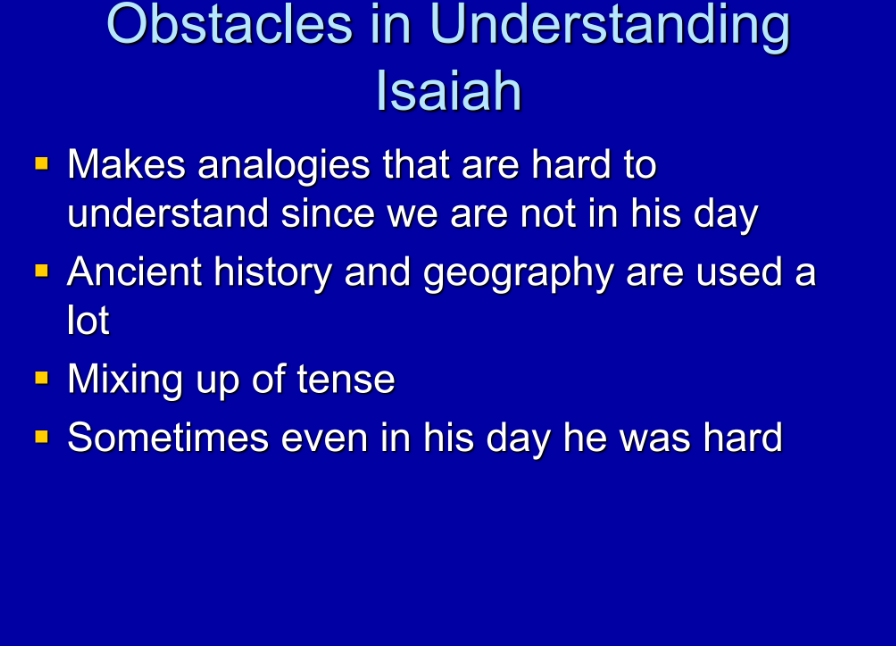
There are some obstacles in understanding Isaiah that I hope we can kind of look at and then figure out how to get past them. There are a number of obstacles; some of them are that he makes analogies that are really hard for us to understand because he’s drawing on cultural elements of his day. Since we’re not familiar with them, that can be difficult for us.
He uses ancient history and ancient geography a lot, so we’ll talk about that as we go along. He really does rely on what, well for him, it’s not ancient; he draws on what’s happening in his day. He’s a prophet to the people of his day and speaks about things that mean something to them, but we aren’t very familiar with them. It’s ancient history for us, and we’re not familiar with the geography he draws on either.
Language in Isaiah
He mixes his tenses, and by this, I mean he uses what, in Hebrew, we call prophetic perfect. This means he uses the past tense for things that haven’t happened yet. He jumps around in time. So Isaiah will frequently be talking about things in his day that are terrible, then, in order to comfort himself and his people, he jumps forward a couple of thousand years later to say, “See, it’s going to work out at some point,” and then he’s back in his day. Frequently, he means both days at the same time, and that gets a little bit tricky. We’ll talk about that as we go along as well.
He was using a high register of the language; he was one of the most learned people of his time. I would say, if he’s not the most gifted writer in the history of the world, he’s in the top 10. He is an incredibly gifted writer, so even people in his day had a hard time understanding him.
You’re probably familiar with the story in the New Testament when Philip comes across a eunuch who’s studying Isaiah, and he says, ‘Do you understand?’ The eunuch responds, ‘How can I, except someone should guide me’, right? So that’s what we want to do – provide some guides and some tools that will help you as you study Isaiah.
Slow Down–Isaiah Ahead
So, this would be my very first tool for studying Isaiah, to ‘slow down’ because Isaiah is ahead. And I don’t mean that in a negative way, I mean this in the most positive of ways. We’ve been reading the narrative writings of the Old Testament, used to going along at a pretty good clip. Isaiah is dense; he intentionally packed a lot of meaning into a few words. He carefully crafted his words, and we can’t read it like we’ve been reading the narrative chapters.
We’re going to have to be willing to pay a little bit of a price. There are some great rewards waiting for those who will pay the price, but you’re going to have to slow down, stop, and work on understanding him in a way that isn’t what we’re used to right now where we’re revved up. You know, we’ve just read like 300 years of history in one week in ‘Come Follow Me’. We’re revved up and we’re going quickly, and now we’re going to have to slow down.
Do What You Can
I would say, in particular, at least in my opinion, if you’re trying to keep up with the ‘Come Follow Me’ reading – and maybe the Church curriculum writers will be mad at me for saying this – but if you’re trying to keep up with the ‘Come Follow Me’ writings, I think we have like 15 Isaiah chapters assigned in a week, it’s better to do five really well than 15 poorly. So, I would just say, do what you can.
If you have more time to pour into scripture study during the Isaiah month and a half or six weeks that we do Isaiah, (that should tell us how important this is), if you have more time to pour into it, pour into it. If you don’t have more time, then do what you can with the time you have. Do those chapters that you can, carefully and well, is what I would suggest. I think we’ll get more out of it that way.
Symbols
One of the reasons you need to do that is because Isaiah uses symbols, and we could have a long discussion on why Isaiah uses symbols or why the Lord uses symbols. Orson F. Whitney once said that God teaches using symbols; it’s His favorite method of teaching. There are a lot of reasons for that. One of them is that the symbols stick with us for longer, and another is that we can grasp more layers of meaning out of a symbol than we can out of a simple statement. It will speak to us differently at different times, so Isaiah uses symbols a lot.
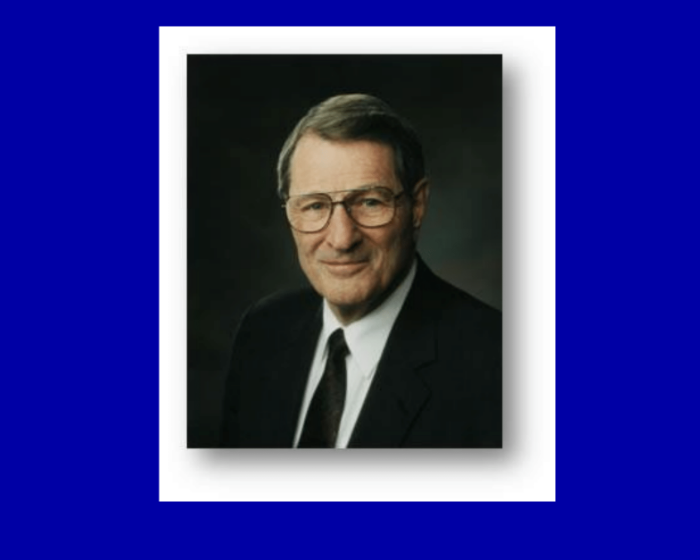
Maybe we can understand this if we compare it to Elder Maxwell. He is the closest thing to Isaiah we’ve had in the last few years. This audience is probably familiar with Elder Maxwell. We’re now at the point where in my classes in college, my students haven’t heard of Elder Maxwell, which makes me cry.
One of the things that makes symbols difficult, and this is going back to what I talked about at the beginning, is that if someone is drawing on a cultural element that everyone in their day is familiar with but someone hundreds of years later isn’t familiar with, then we’re gonna have to stop and try to figure out what those symbols mean.
Example
Let me give you an example. You may remember when Elder Maxwell said this, and I think it’s small enough that I can read it.
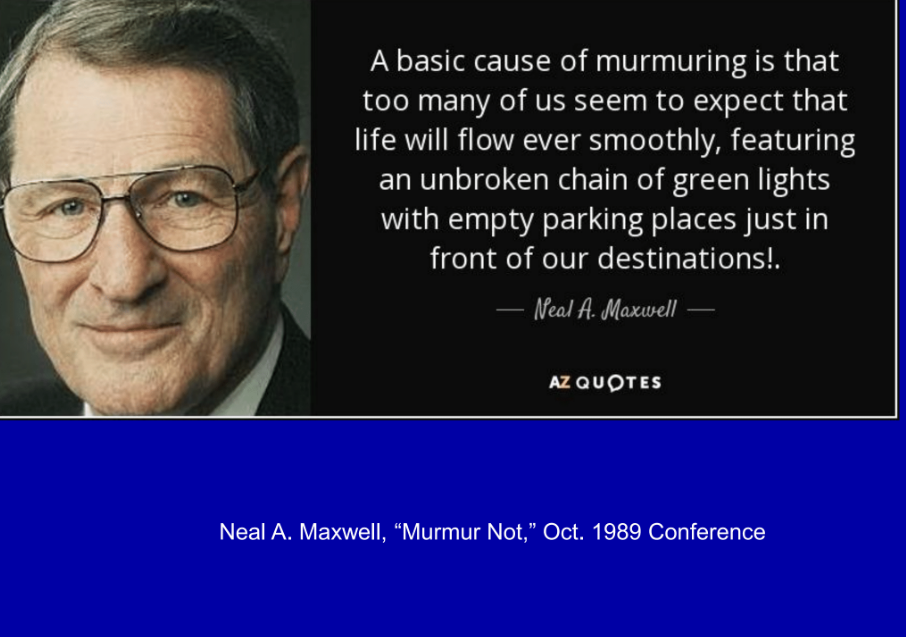
A basic cause of murmuring is that too many of us seem to expect that life will flow ever smoothly, featuring an unbroken chain of green lights with empty parking places just in front of our destinations.”
Now we all get what he means by this. We’re familiar with green and red lights and parking spaces, and we had to find one out here this morning and so on, right? My guess would be in a few hundred years that people will say, ‘Huh, what are you talking about? Green lights? Why did they need green lights?’ and so on. It just won’t make sense to them, but it makes so much sense to us right now. We don’t even have to stop and think about it; we just get it automatically.
Shift Perspective
So if we’re going to understand Isaiah, we’re going to have to put ourselves in the shoes of his original readers, and you’re going to hear me talk about that in a number of ways today. So we’re going to have to stop and unpack the symbols that he uses. Let’s be clear: Isaiah uses symbols and imagery. He uses his words to paint a picture, and he wants us to feel something with that picture. Quite often, that’s what he’s trying to do—to create a feeling. And sometimes, we get caught up in whether something is literal or not.
Rather than focusing on how it’s literal, stop and ask yourself, ‘What is he trying to do? What is he trying to get me to feel?’ So, in a minute, we’ll look at an example when he talks about cities that could hear each other howling from long distances. Instead of getting caught up in saying, ‘How could that have happened?’ we should ask, ‘What’s he trying to get me to feel with that? What does he want me to understand? What’s the picture he’s trying to paint when he uses symbols?’ Let’s stop and unpack them.
Unpacking Symbols
I would say there are at least three steps that we should take to unpacking symbols, and the problem is that most often we skip or hurry through the first step. This is the slowing down business I’m talking about. The first step is to spend some time literally understanding the symbol.
So, Isaiah will talk about threshing and winnowing. Even a hundred years ago, almost everyone would have been familiar with that, but we are no longer a very agrarian society, and most people aren’t familiar with threshing and winnowing today. So, stop and ask yourself, even if you’re familiar with it today, we do it a little bit differently than they did. Get online and do research or whatever you want to do, but find out what threshing is and how it works. Learn the details of it. What is winnowing, and how does it work?
Once we know those literal elements (and if you don’t learn those well, you’re going to miss out on lots of meanings from the symbol), then we stop and say, ‘Okay, what are the possible layers of symbolism behind this? Why is he using it in this context? What does it add to his discussion to have used this symbol? Why did he choose the symbol here?’
The Third Step
The third step would be, ‘Okay, so how does that work in my life? How does the Lord beat me like you beat kernels when you’re threshing? How does the Lord sift me like he sifts when we’re winnowing?’ Try and make that personal application, but that last step can only happen well if you’ve done the first two steps well. So, I would suggest just slowing down and taking the time to do that.
Isaiah 15 Example
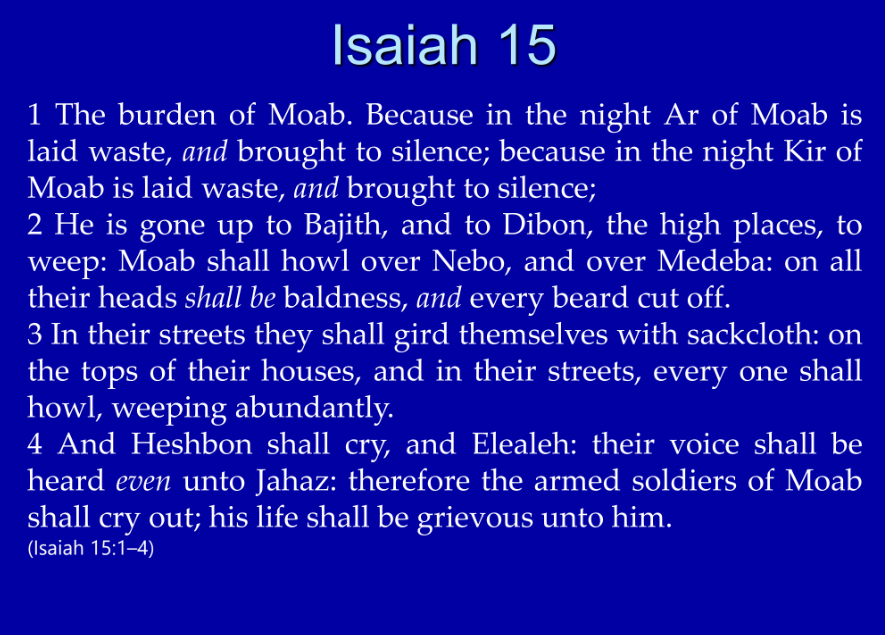
Let me give you an example that I was just talking about and also refer you to some resources that might be helpful. We won’t read this whole thing; this is from Isaiah chapter 15. You’ll get to this in the second week of the Come Follow Me reading, and it’s the burden of Moab.
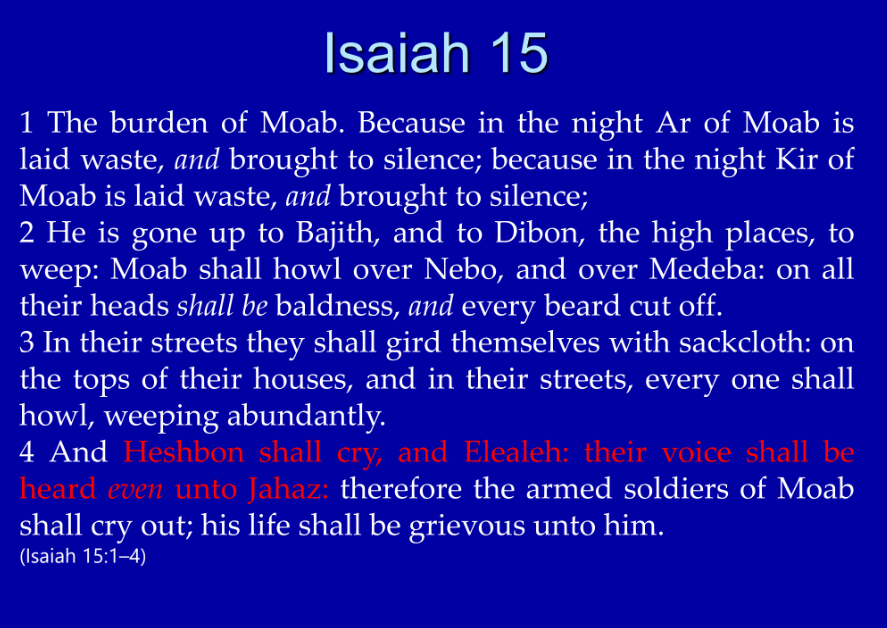
So, it’s a prophecy against Moab, and he’s talking about all of the terrible things and terrible destruction that happens in Moab. We’re just going to focus on these lines here: ‘Heshbon shall cry, and Luhith; their voice shall be heard even unto Jahaz.’ Now, you’re typically going to breeze past that and say, ‘A bunch of names I don’t even know what they mean or how to pronounce them, move on,’ but they’re place names. So, stop and let’s see if we can figure out what’s going on with these things.
Resources
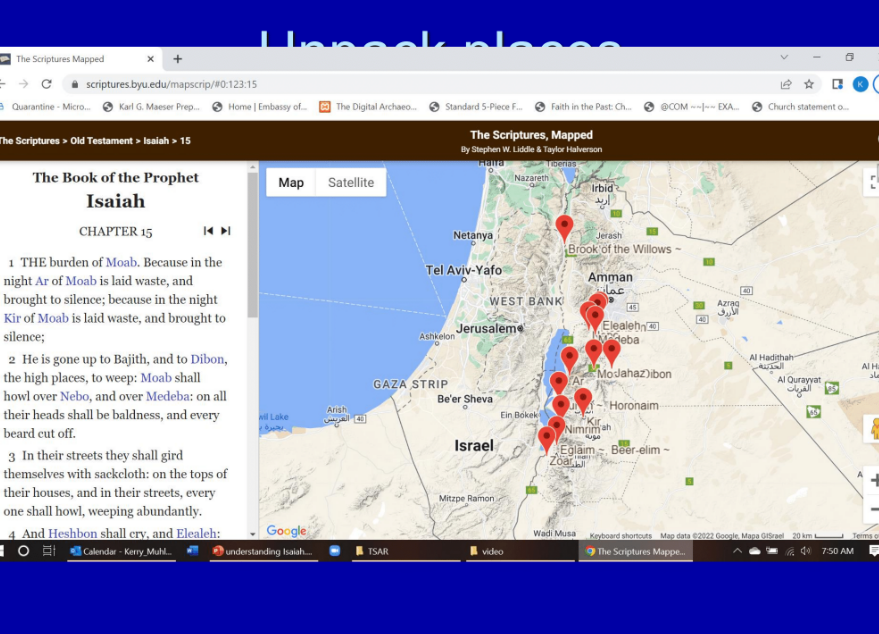
One thing you can do is go to a place – I should have had it written up somewhere – but I’ll just tell you the web address: scriptures.byu.edu. All right, that’s scriptures.byu.edu, and just going there is wonderful, but this particular tool – go to scriptures.byu.edu/mapscrip (note–just s c r i p … no “t”). Then you’ll have all the scriptures in front of you, and here, I’ve chosen Isaiah, then I chose chapter 15, and you can see it automatically populated all of the sites that are mentioned in that chapter. So, you get an idea – one of the pictures he’s painting is everywhere in Moab there was destruction.
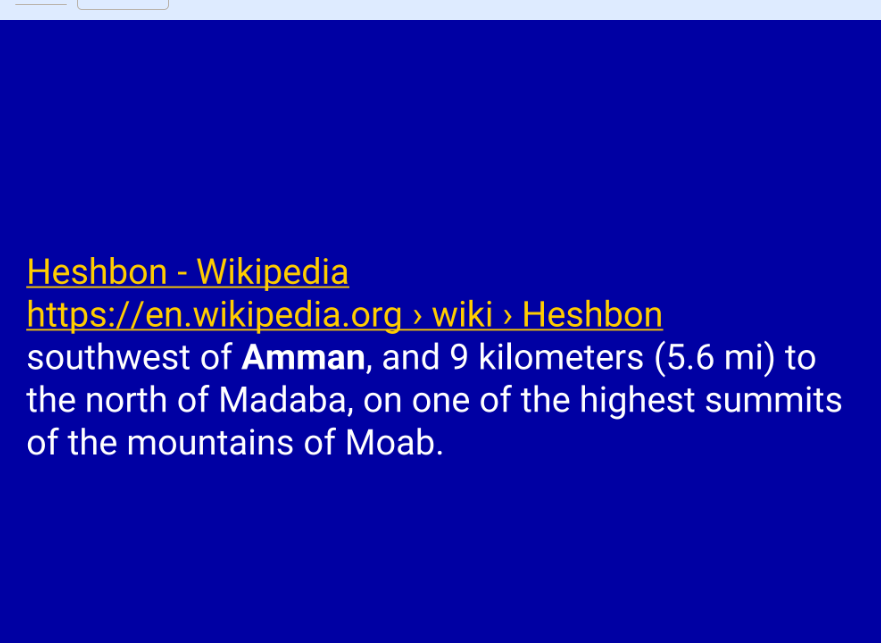
Then you could go to those specific places, so you can go to Heshbon, and I just look it up on Wikipedia, and it tells me it’s about five miles north of Madaba. All right, Madaba is a modern city, so I can figure out where that is on the map, and then – well, I went to Jahaz.
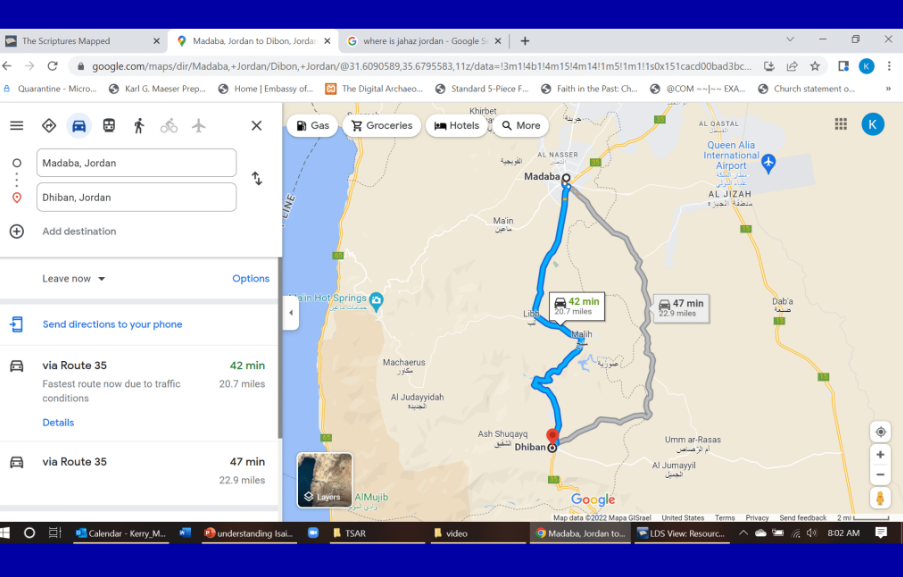
And had to figure out where it was – and it’s a little bit south of a particular place, so then I just went to Google Maps and I get about 24 or 25 miles between them. But I know one is about five miles north, and one’s about five miles south, and so on. So, they’re roughly 30 miles apart.
Modern Context
I can even put it into–I did this when I spoke earlier this last week to the Layton mission – so I figured out what’s 30 miles south of Layton, and I think it was Draper. I can’t see this, it’s too small, but Murray – Murray, okay, the city where I was born. So in Layton, something bad happened, and the howls of pain echo so loudly that they can be heard in Murray. Now, I can start to feel the image he’s trying to convey, the despair they are experiencing. However, this will take some time to fully comprehend. That’s why I suggest slowing down. Take advantage of the available resources, look into it, and find out what he is trying to teach us.
Imagery
Now, I ask myself, what kind of imagery is he using? Here are some other examples where he talks about the plowman who plows differently for fitches and cummin than for breadcorn. In verse 27, he explains that fitches are not threshed with a threshing instrument, nor is a cart wheel turned about upon the cummin. Fitches are beaten with a staff, and cummin with a rod. On the other hand, breadcorn is bruised, and so on. He discusses both planting and threshing differently.
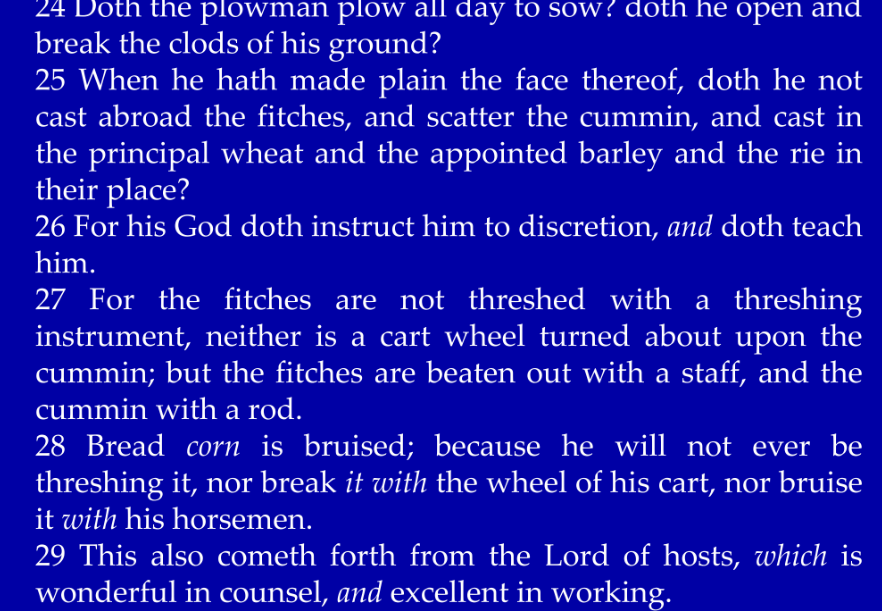
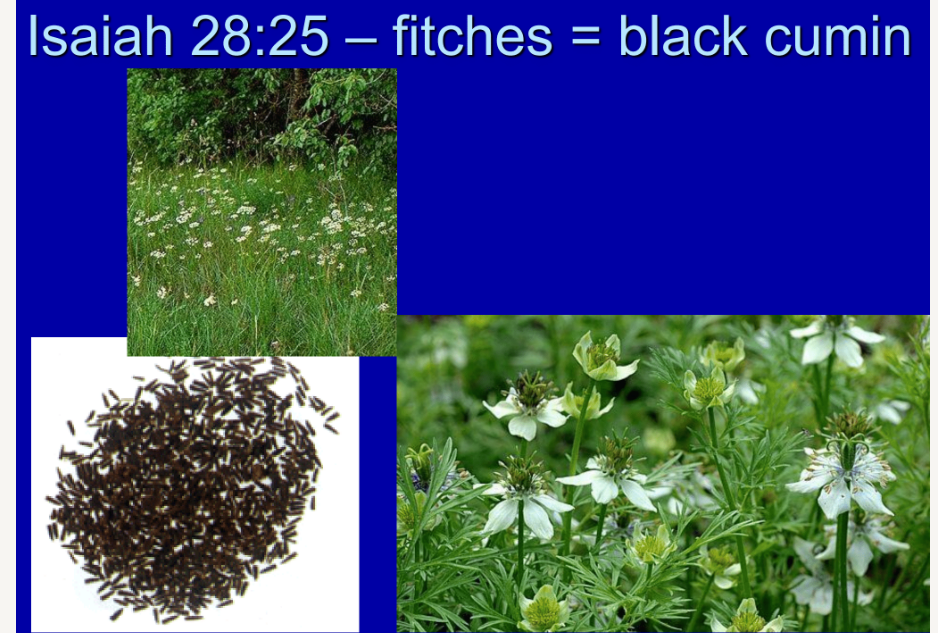
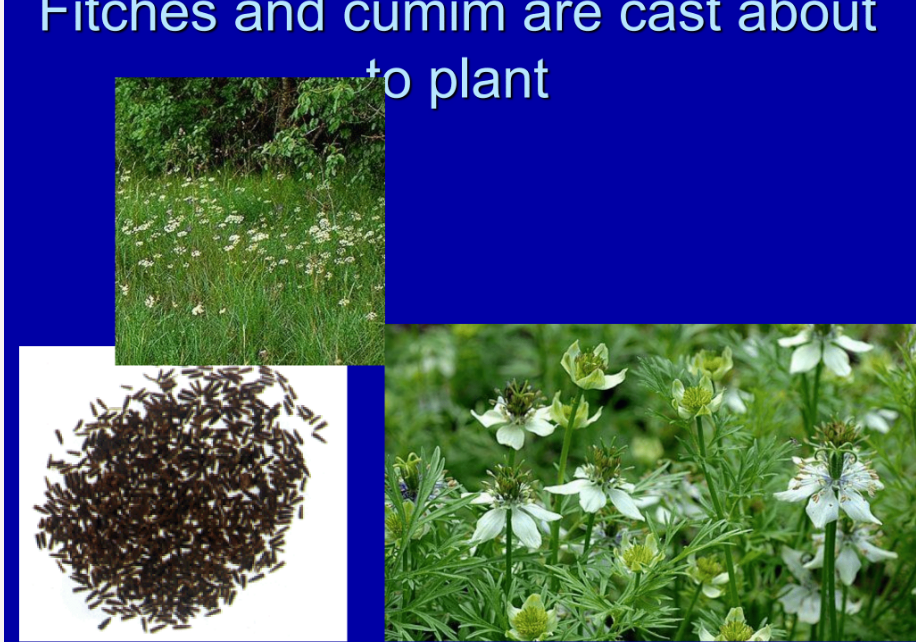
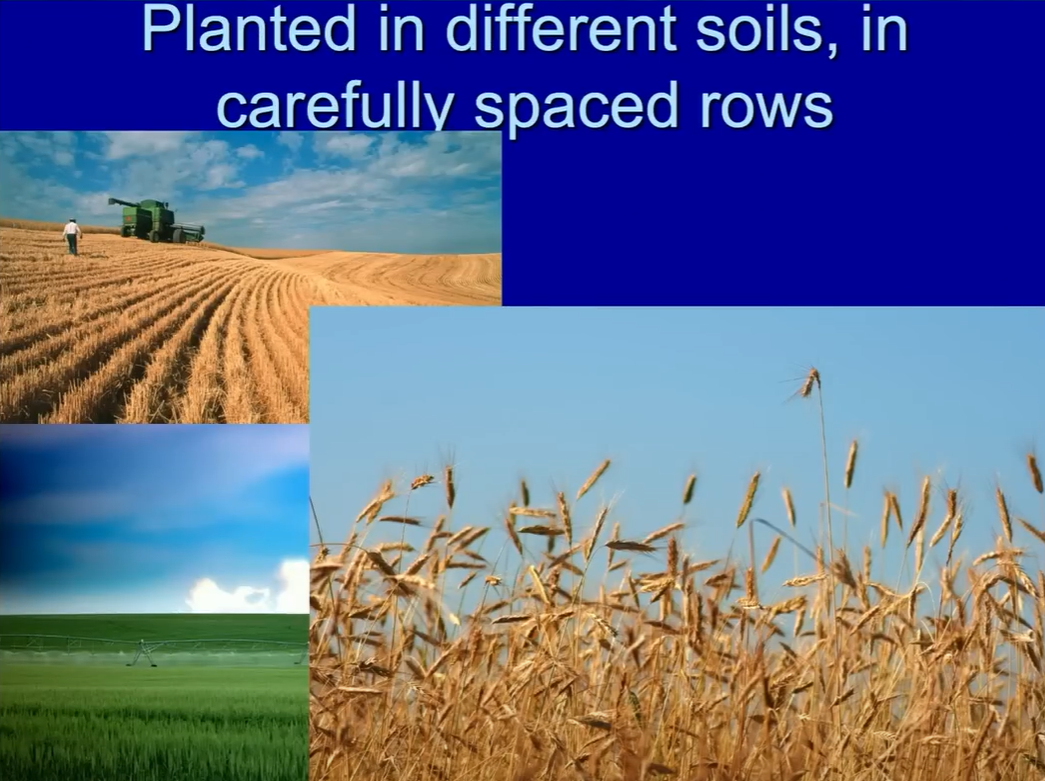
By going online, you can learn that fitches are black cumin, and they are planted by casting them, unlike wheat, barley, and rye, which are carefully spaced in rows.
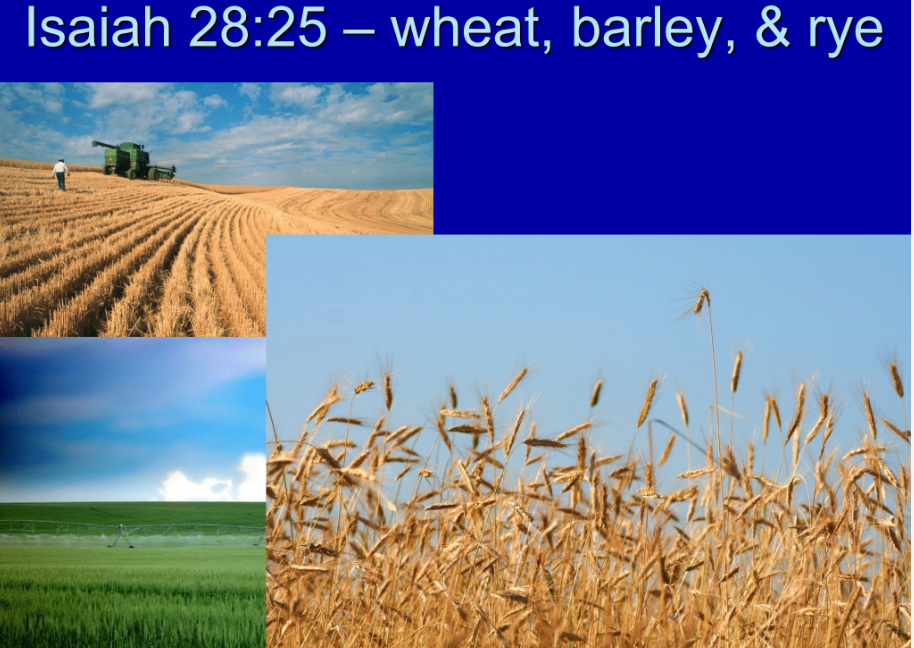
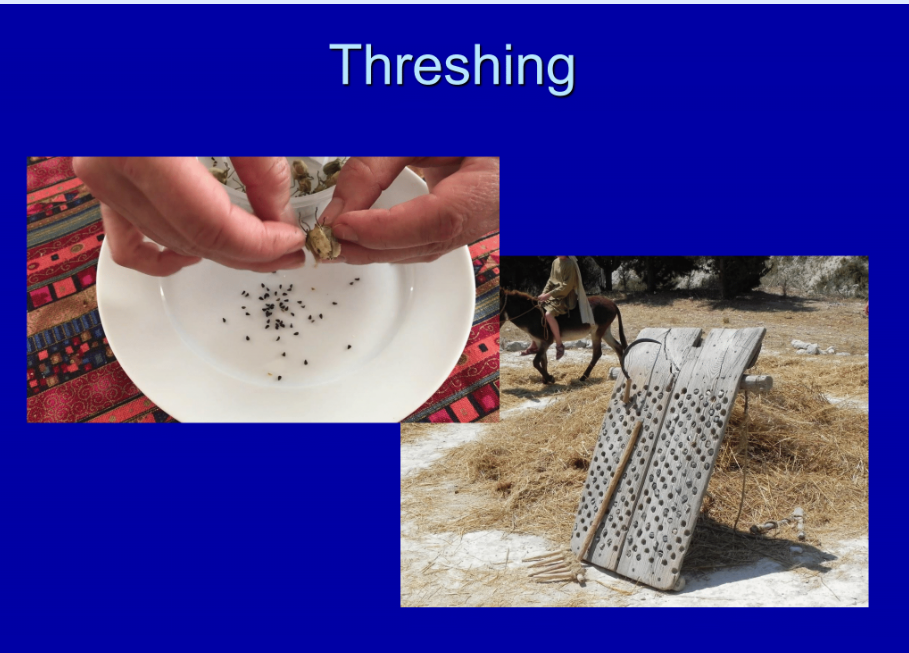
The threshing methods also vary; fitches are delicately threshed by hand, while wheat, barley, and rye are put on a stone and you put a big board containing stones and beat it up and so on.
Line Upon Line
And this discussion is at the end of the chapter that talks about learning line upon line, precept upon precept. When you recognize that different plants require different approaches in planting and harvesting, you can understand that the Lord teaches individuals differently based on their needs. He’ll teach them in the way they need so they can grow and flourish. It doesn’t look the same for everybody and this is something you might miss if you simply read through the text without delving into the details of plowing, cummin, fitches, and so on. It may seem confusing at first, but looking into it will provide clarity.
Spend the time to slow down and look into it; there are all sorts of resources online you can find.
And here’s the shameless plug for my own commentary. But there are lots of commentaries that can help you with these things, where you don’t have to look up how far apart things are, or how the different planting works, and so on. Someone’s done that heavy lifting for you. I would suggest doing some of it yourself; there’s some learning that happens in the process. But you can speed up the process by going to some commentaries.
Additional Resources
There are oodles of podcasts these days that I think will be helpful for you. I would recommend following mine; I have one called ‘The Scriptures Are Real.’ I also created a website. It’s a really ugly website because I designed it, but that’s because when I had people design websites, later on I couldn’t update them. But it’s called outofthedust.org. It’s got a page that’s an Old Testament study page, just to help with the Old Testament in general. There’s an Isaiah one that I’m in the midst of creating, where I’ll have videos and all sorts of other things. And you can get a free gift to summarize what I’m talking about today, so you don’t have to write it down; there’s a summary of it there of that website as well.
So that’s outofthedust.org, but there are lots of other podcasts, lots of other websites. I think there are lots of members of the Church right now who are putting resources out there to help us to get as much as we can out of the scriptures. BYUtv has Come Follow Up; I mean, there are all sorts of great resources. So turn to these resources, as well as doing your own research, and that will help you when you’re slowing down; you may not have to slow down as much.
Historical Context
Another important key is knowing the historical context. Now, we’re not going to give you that whole historical context here today because that would take a lot of time. But in some ways, you know it; we’ve just finished going through the historical context in Come Follow Me. Now you’re going to have to go back and review because we’re getting to it a month and a half, two months after we did it. But very briefly, Isaiah is prophesying during the time when they are warning Israel and Judah that they are going to be destroyed if they don’t repent.
He warns for years about that. They don’t repent. At least the Northern Kingdom doesn’t repent, and the Northern Kingdom is scattered during Isaiah’s ministry. The kingdoms around them are destroyed and scattered during his ministry. Judah, about 20 years later, still during his ministry, will largely be destroyed, but Jerusalem is miraculously spared. Knowing that historical context will help you understand so many prophecies because Isaiah prophesied to his people in his day.
So, I will tell you this is one of the reasons why I wrote my commentary. One, because I didn’t find an LDS commentary that treated every verse of Isaiah, and I felt like we needed one. So I did that. But second because all of my dear friends and colleagues who have written wonderful commentaries tended to focus on the last days, which is great. However, Isaiah had an original context that is crucial to understanding the last day’s fulfillment better. I’m going to show you an example of that in just a moment. I want to make sure we talk about that original context, so we’ll briefly discuss Isaiah chapters 7 through 9.
Syro-Ephraimite War Example
Let’s move through this quickly, as it’s just an example. We’re only going to touch on a couple of verses in Isaiah chapters 7 through 9. The original context for this is what’s called the Syro-Ephraimite War, involving Syria and Ephraim, the northern kingdom of Israel.
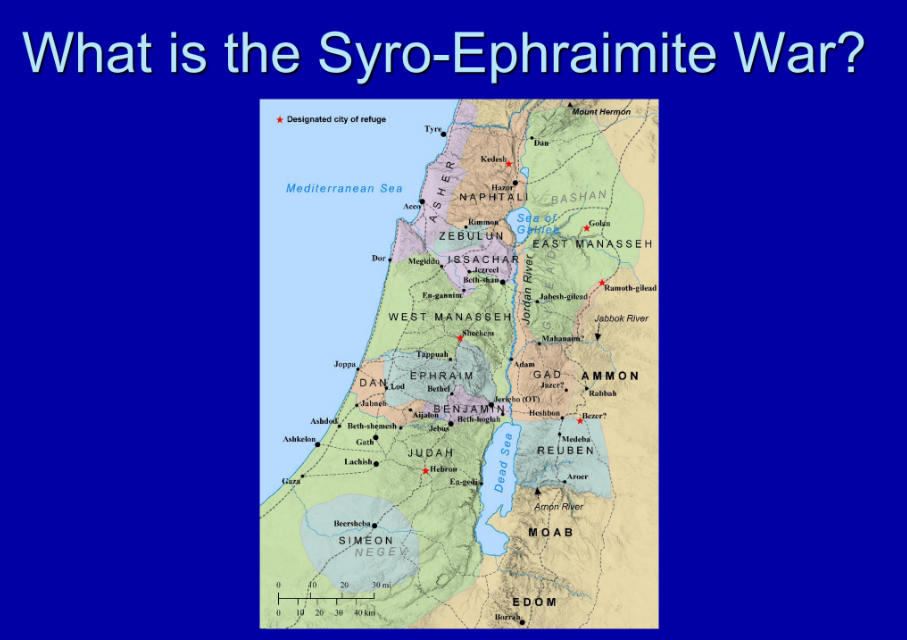
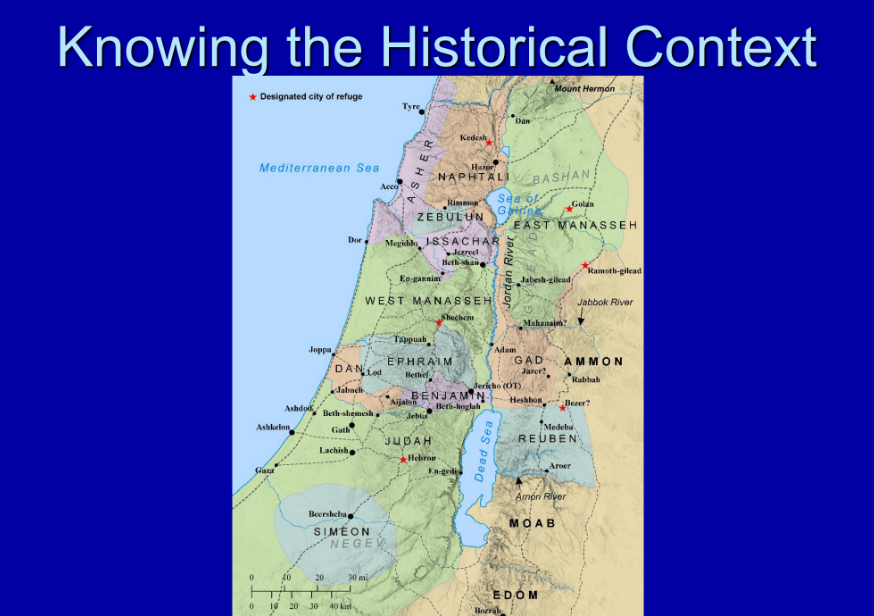
Here’s what’s going on: Syria, a mighty empire, has been conquering people to the east. Now, they’re starting to move west. As they come down the fertile crescent, they’ll hit Syria, then Israel, and finally, Judah. On the other side of the River Jordan, they’ll be hitting Ammon, Moab, and Edom.
Syria doesn’t want to be conquered by the Assyrians, but they don’t think they can withstand them on their own. The kingdom of Israel also doesn’t want to be conquered, but they can’t withstand the Assyrians independently. So, they make an alliance, but they believe the two of them together won’t be able to withstand. They want Judah to join the alliance.
Example Continued
Ahaz, the king of Judah, is faced with a difficult decision. He thinks, “hey even the three of us together can’t beat Assyria.” He has a couple of different choices. He can join the alliance and be defeated by Assyria or choose not to. In the latter case, the Syrians and the kingdom of Israel have decided they will go to war against Judah to force them to join the alliance, and will even try to assassinate their king to place someone on the throne who would want to join their alliance.
And King Ahaz doesn’t like either of those options, so his other option, as far as the world is concerned, as he thinks this thing through, he decides, ‘Well, then I’ll ask Assyria for help,’ and that’s what he has decided to do. Of course, if he asks Assyria for help, that lets them into the room, and they will take over Judah as well, but in a more gentle way. They’ll take them over and control them, and that’s the price he’s willing to pay.
That’s actually what happens. So that’s the setting when Isaiah is told by God to go and give him a third option, an option that doesn’t make sense to the world but makes sense to God because God can do things that none of the rest of us can do.
Dual or Multiple Fulfillment Prophecies
As we look at this, we’re going to see an example of what we’d call dual or multiple fulfillment prophecies. Most of Isaiah’s prophecies are intended to be understood and fulfilled in more than one time period; they aren’t supposed to happen just once. There are very, very few that have one fulfillment; most of them have multiple fulfillments. The more we understand the original context, the more we can understand these multiple fulfillments.
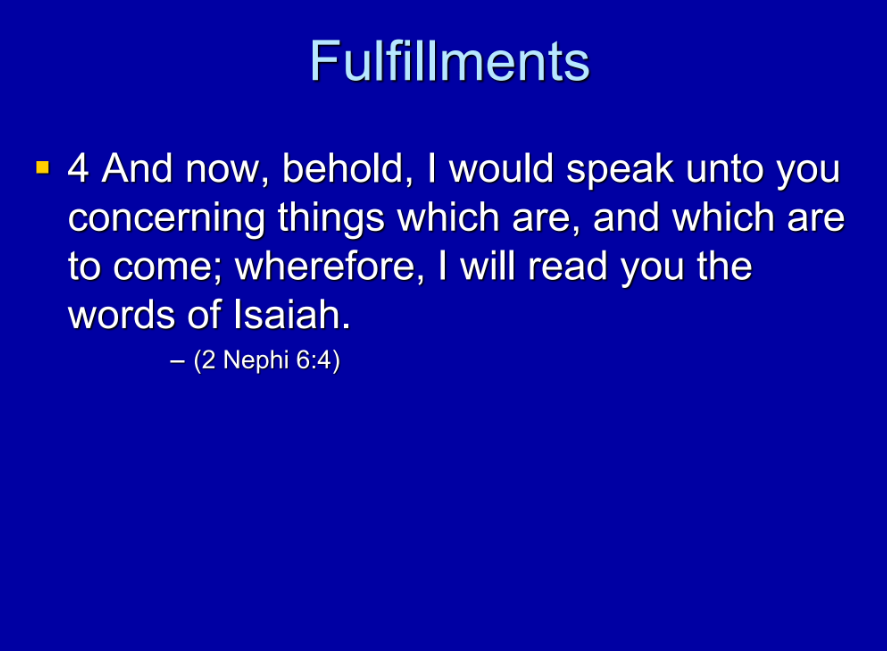
Nephi gives us this idea in 2 Nephi chapter 6, where he says, ‘Behold, I would speak unto you concerning things which are and which are to come; wherefore, I will read you the words of Isaiah.’ Meaning, when we read Isaiah, we can talk about things that are in our day and also in another day at the same time because Isaiah, and this is part of why Isaiah is difficult, he has to be just a little bit vague in order for his prophecies to be fulfilled in multiple time periods.
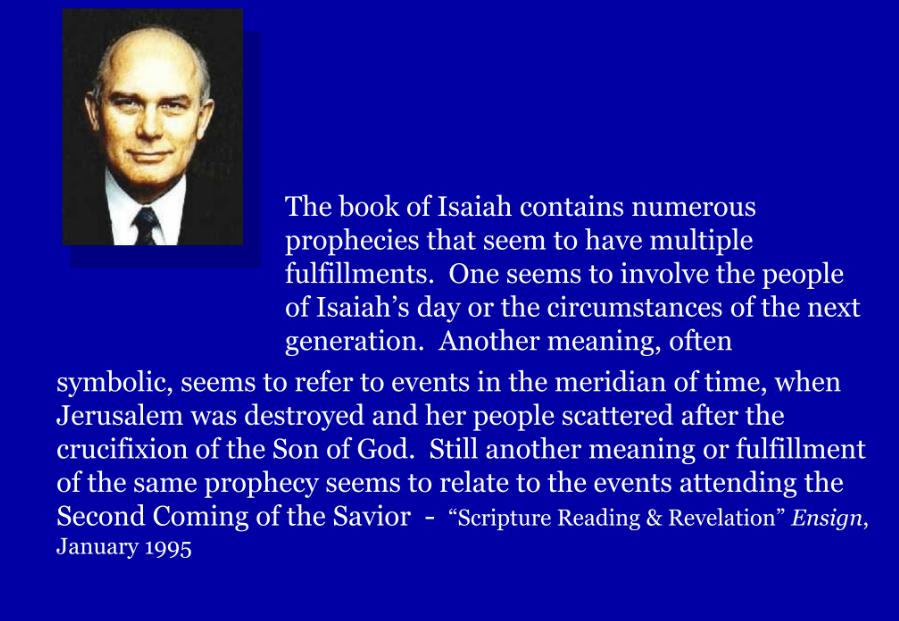
All right, this is from President Oaks. He says,
The book of Isaiah contains numerous prophecies that seem to have multiple fulfillments. One seems to involve the people of Isaiah’s day or the circumstances of the next generation, and that’s the one we most often skip but is the most helpful. Another meaning, often symbolic, seems to refer to events in the meridian of time when Jerusalem was destroyed, and her people scattered after the crucifixion of the Son of God. Still, another meaning or fulfillment of the same prophecy seems to relate to the events attending the second coming of the Savior.”
So, there’s this idea of it being fulfilled in more than one time period.
An Exercise
Just to make sure we get this down, let’s read Elder Holland.
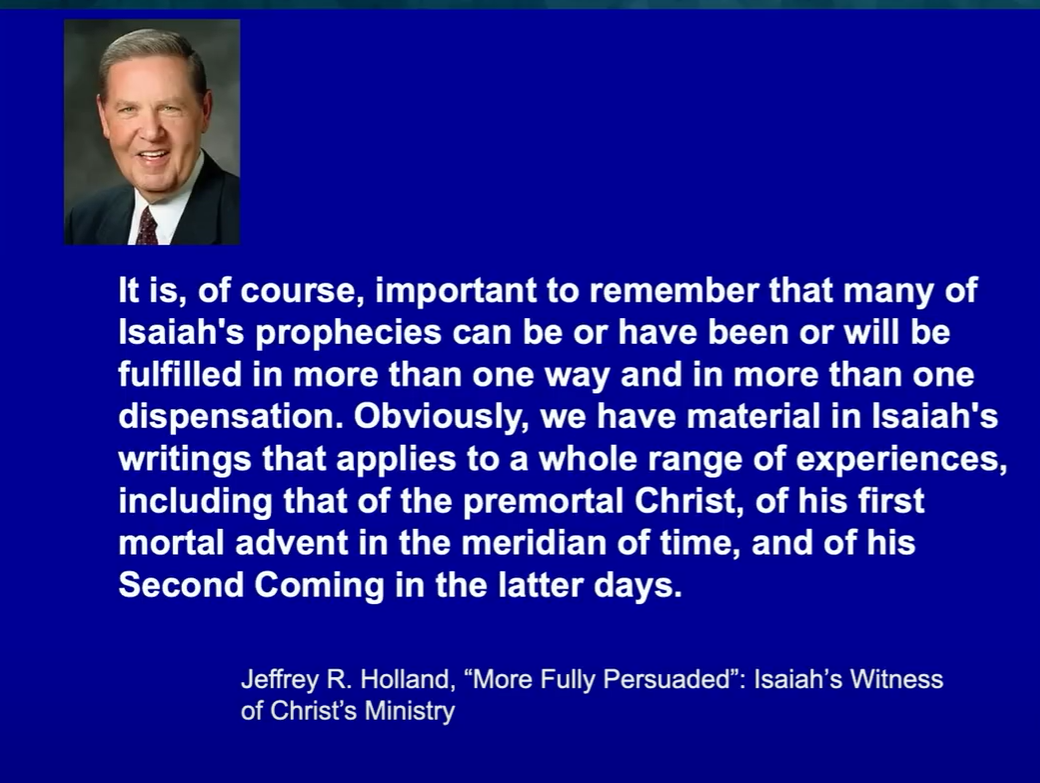
It is, of course, important to remember that many of Isaiah’s prophecies can be, or have been, or will be, fulfilled in more than one way and in more than one dispensation. Obviously, we have material in Isaiah’s writings that applies to a whole range of experiences, including that of the pre-mortal Christ, of his first mortal advent in the meridian of time and of his second coming in the latter days.”
So hopefully, we’ve got this down now.
Isaiah’s prophecies are fulfilled in many time periods, so let’s go through an exercise of that, and I will admit I’ve stolen this from my colleagues; it’s been used by so many of my colleagues in my department at BYU that I’m not sure exactly who the original person is that came up with this. I think it’s Mark Ellison. My apologies to whoever it is if it wasn’t Mark Ellison, but anyway, this is a great way of understanding how understanding one context will help us understand another context better.
In order to do this, I’m going to have to introduce some of you to a little bit higher culture than you’re used to. Many of you just haven’t quite gotten to a high enough culture to have encountered this song, so we’re going to read from a country song. We’re gonna raise your culture just a little bit.
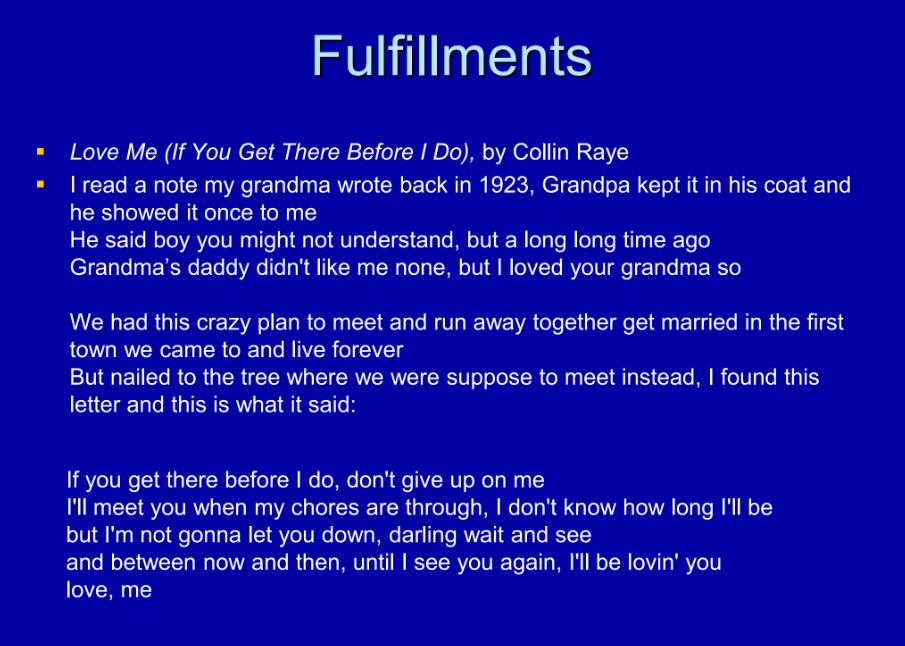
All right, so yeah, I don’t know why you’re laughing, but anyway, okay. As we look at this, we’re going to read from a song called “Love Me,” usually called “If You Get There Before I Do” by Colin Ray. All right, and I’ll just read this to you:
Love Me
I read a note my grandma wrote back in 1923. Grandpa kept it in his coat
And he showed it once to me.
He said, ‘Boy you might not understand,
But a long long time ago grandma’s daddy didn’t like me none,
But I loved your grandma,
So we had this crazy plan to meet and run away together,
Get married in the first town we came to, and live forever.
But nailed to the tree where we were supposed to meet,
Instead I found this letter.
And this is what it said:
‘If you get there before I do, don’t give up on me.
I’ll meet you when my chores are through,
I don’t know how long I’ll be,
But I’m not going to let you down,
Darling, wait and see,
And between now and then,
Until I see you again,
I’ll be loving you.’
So that’s the chorus. All right, now keep that chorus in mind as we get to the next verse.
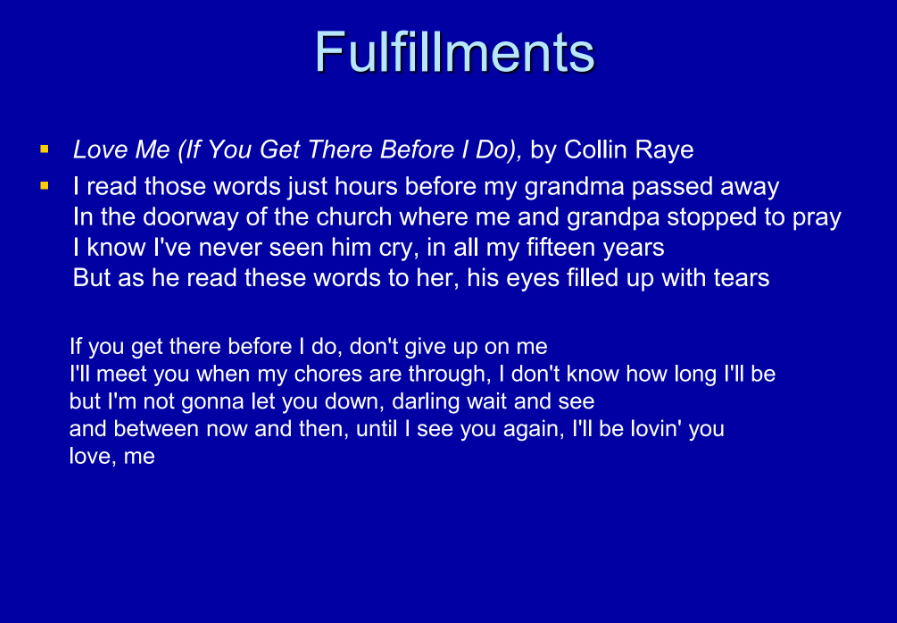
I read those words just hours before my grandma passed away,
In the doorway of the church where me and grandpa stopped to pray,
I know I’ve never seen him cry in all my 15 years,
But as he read these words to her, his eyes filled up with tears,
‘If you get there before I do, don’t give up on me.
I’ll meet you when my chores are through,
I don’t know how long I’ll be,
But I’m not going to let you down,
Darling, wait and see,
And between now and then,
Until I see you again,
I’ll be loving you.’
Context
Now if you just had that second verse with the chorus, that would mean something, but because you read the first verse, and you understood the original context of those words, it changes and amplifies the meaning of the second time, right? It really does change it and you get more out of it. That’s what happens for us when we understand the original context of Isaiah.
Emmanuel Prophecy
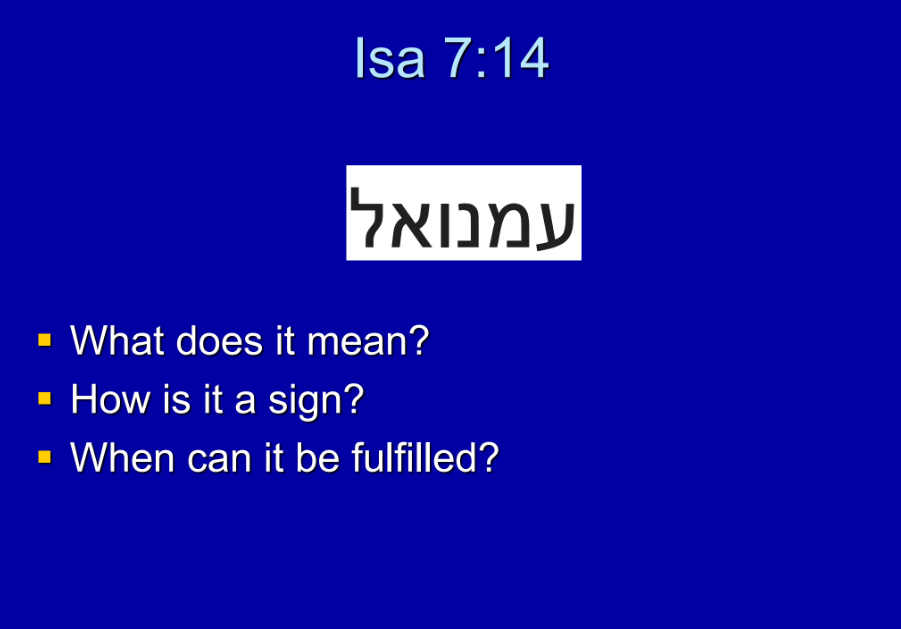
So now back to Isaiah chapter 7 and what we call the Emmanuel prophecy. Emmanuel, which literally means, ‘God is with us,’ and so this is the Emmanuel prophecy. We may have to ask ourselves how this is a sign. We’re going to read a little bit here. What happens is, as I said, God sends Isaiah to king Ahaz to tell him ‘you’ve got a third option.’
So we get in verse five, “Because Syria, Ephraim, and the son of Remaliah have taken evil counsel against thee.” So he’s just mentioning the the countries and the the rulers of those countries, “saying let us go up against Judah, and vex it, and let us make a breach therein for us, and set a king in the midst of it, even the son of Tabeal.”
So this is where he’s saying, ‘we’re going to conquer you and put a new king on the throne that will help us,’ and that’s what Aahaz is worried about.
Verse 7: “Thus saith the Lord God, It shall not stand, neither shall it come to pass. For the head of Syria is Damascus, and the head of Damascus is Rezin; and within threescore and five years shall Ephraim be broken, that it be not a people.”
All right so he’s just told them, basically, that Syria and and the Kingdom of Israel, within 65 years, it actually ends up being much less than that, but within 65 years will be destroyed. They won’t be there, they don’t need to worry about it. Now he wants to make sure that Ahaz knows about Syria. So this is the third option, right? His options were, ally with Syria and Israel, or ally with Assyria, and that’s all the world had to offer to him.
Third Option
God gives a third option: do nothing. Don’t do anything; let me take care of it for you. Now, to the world, that doesn’t make sense, right? This is one of the great themes of Isaiah, by the way: Trust in God; don’t follow the world’s ideas or thinking. God’s ways work better, alright? And we see not only is that taught in precept but in practice. Because Ahaz will ignore it, and it doesn’t work out well for him. Hezekiah will listen, and it does work out well for him. So, the third option is to do nothing, and he wants to make sure that Ahaz takes that seriously.
Ahaz
So, we get in verse 10, “Moreover, the Lord spoke again unto Ahaz, saying, Ask thee a sign of the Lord thy God; ask it either in the depth or in the height above.” But Ahaz said, “I will not ask, neither will tempt the Lord.” Ahaz has apparently decided, ‘I’m going to Assyria; I don’t care what Isaiah says.’ He wasn’t expected to meet Isaiah; God had Isaiah do a stealth meeting, right, to just pop out and meet him there. And he’s determined he’s going to do it his own way. So, he says, ‘No, no, I’m not going to tempt God,’ because he doesn’t want a sign. He’s going to get one anyway, but it’s an odd sign.
And Isaiah said, “Hear ye now, O house of David’, meaning the king of Judah, Ahaz, ‘is it a small thing for you to weary men? But will ye weary my God also? Therefore, the Lord Himself will give you a sign: Behold, a virgin shall conceive and bear a son and shall call his name Emmanuel, meaning God is with us. Butter and honey shall he eat that he may know to refuse the evil and choose the good. But before the child shall know to refuse the evil and choose the good, the land that thou abhorrest shall be forsaken of both her kings.'”
A Sign
So let’s look at this sign first of all.
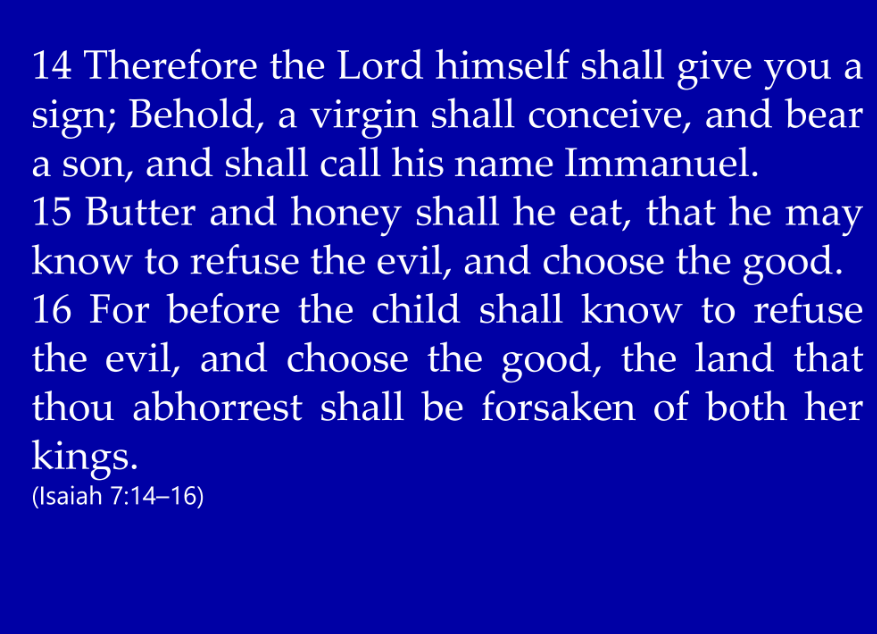
A virgin, and the word is alma, all right? There are two words for virgin; one means virgin and it doesn’t mean anything else. That’s not the word that Isaiah uses. He uses a word that’s a little more vague, almah, which can mean virgin, but what it really means is “young woman” most of whom are virgins, but it just means young woman right, not necessarily a virgin. And so this is important, because it can be interpreted in more than one way, and that’s Isaiah’s intent.
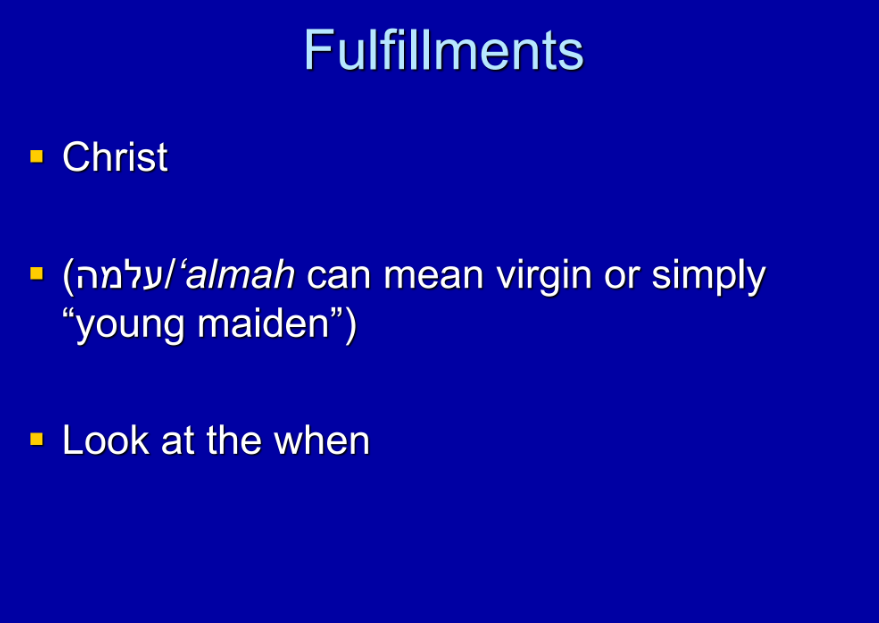
So a virgin will conceive and will name a child who in some way shows us that
God is with us. But look at when this could be fulfilled.
We know that the primary fulfillment of this is Christ. Christ is conceived of a virgin, and literally is God with mankind. But as I said almah means a young maiden, so let’s look at the when.
When
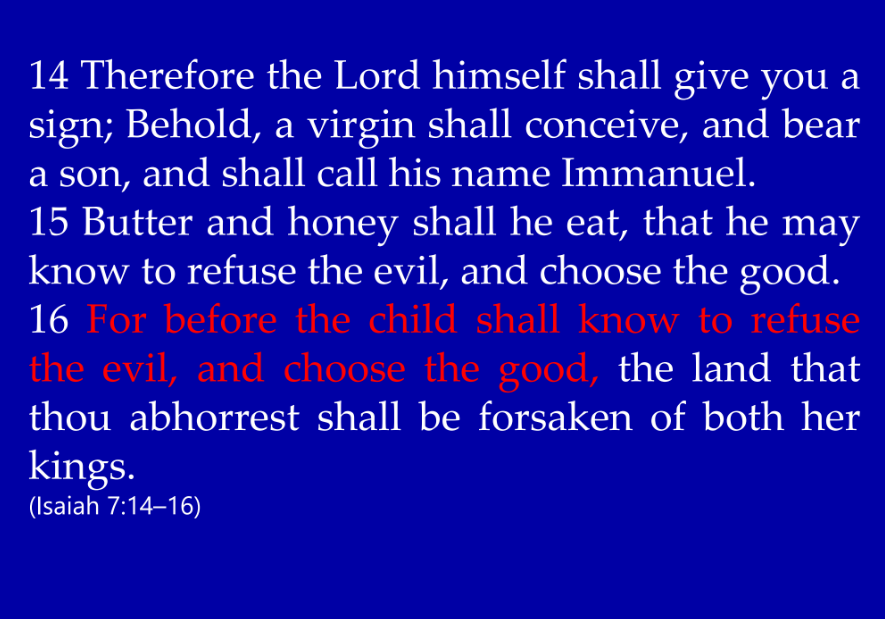
And remember in verse 16 it said “before the child would know to refuse the evil and choose the good.” Well we would say that’s within eight years; before the child is eight years old those two kingdoms are going to be gone. This is about 740 BC, that’s 740 years before Christ, so Christ can’t be that fulfillment of it. There has to be another fulfillment.
So there we have it that before he can choose to refuse the evil and choose the good so within eight years.
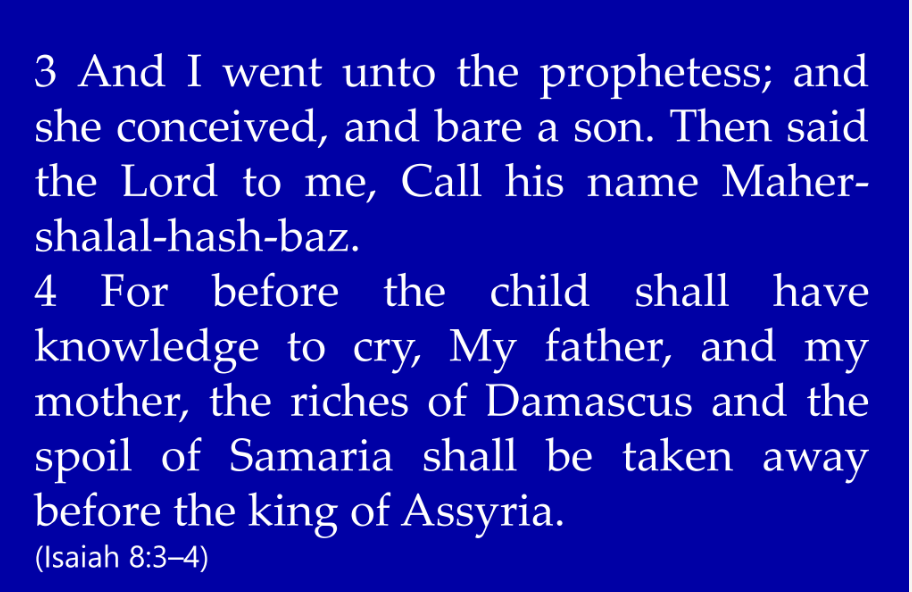
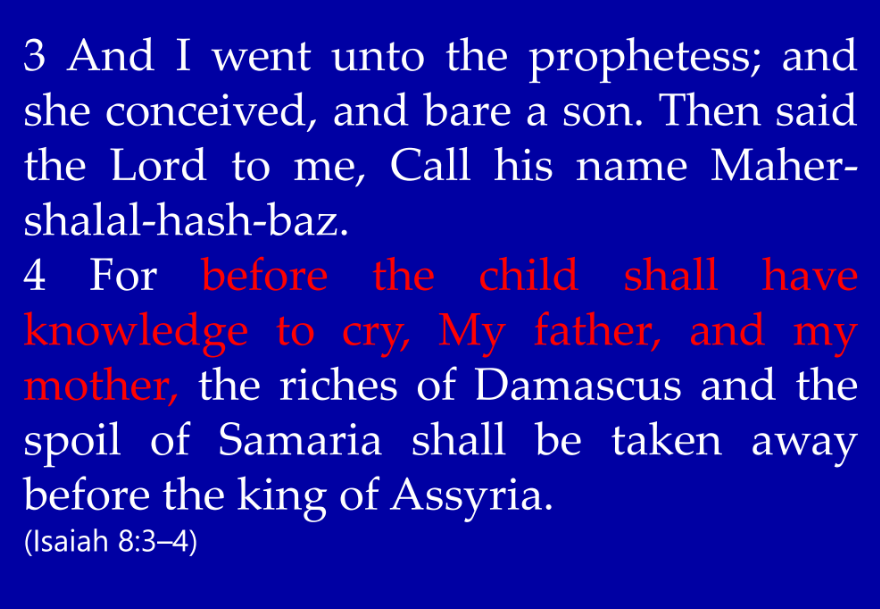
Now let’s look at chapter eight. “And I went unto the prophetess; and she conceived, and bare a son. Then said the Lord to me, call his name Maher-shalal-has-baz,” which is a really cool name, “for before the child shall have knowledge to cry, My father, and My mother, the riches of Damascus and the spoil of Samaria shall be taken away before the king of Assyria.”

So in this case, and I don’t know how long it is between when he visits Ahaz and he goes in to his wife who is a young woman; she’s an almah, she’s a young woman and she has a child. And so, we’ve got, at least roughly a year in between, before he can say ‘my mother’ and ‘my father’, so before he really knows how to talk, about two years, maybe three years after his meeting with Ahaz, those two kingdoms will be destroyed. Alright, so there’s another timeline and another fulfillment, right? Because we’ve got this kind of time window that he gives us.
Mahershalalhasbhbaz
So, it would seem that Maher-shalal-hash-baz is a fulfillment. He is conceived of a young maiden, and it will be clear by the time he is roughly two years old, and those two kingdoms are destroyed, that God is with them.
There’s another fulfillment that most people in Isaiah’s day, within a few years, and Jews since then, would assign to this; and that’s the king.
Before we get to that, we have something from Elder Holland to read.
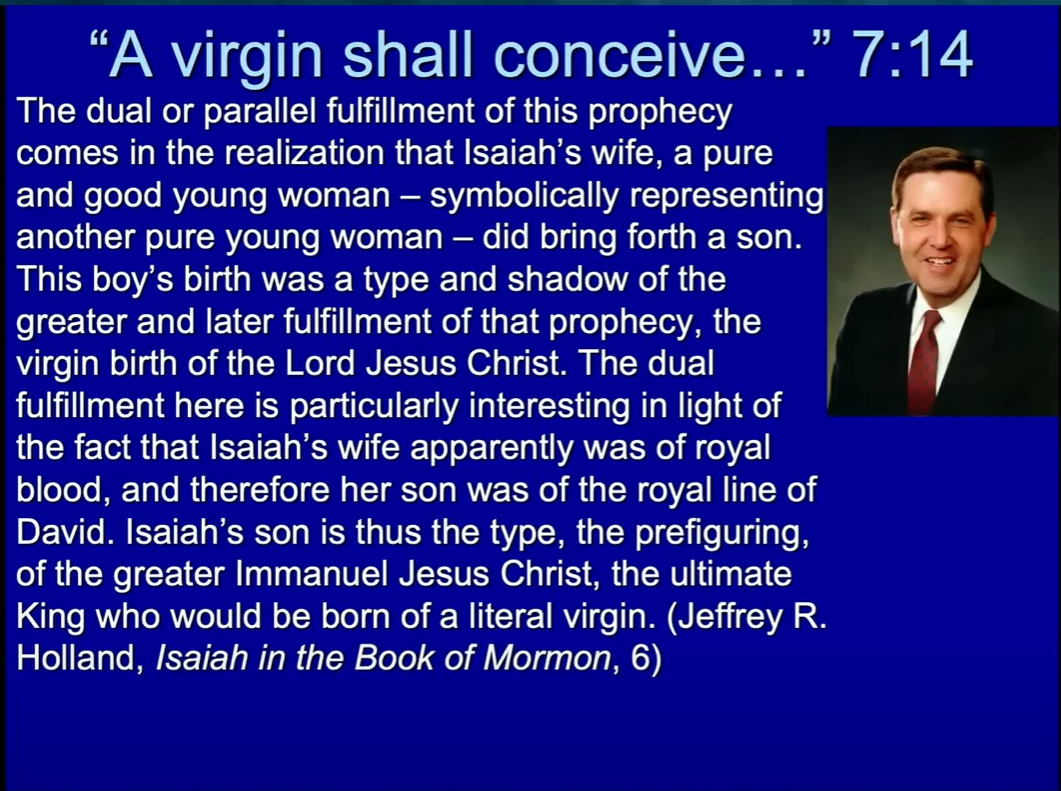
The dual or parallel fulfillment of this prophecy comes in the realization that Isaiah’s wife, a pure and good young woman symbolically representing another pure young woman, did bring forth a son. This boy’s birth was a type and shadow of the greater and later fulfillment of that prophecy: the virgin birth of the Lord Jesus Christ. The dual fulfillment here is particularly interesting in light of the fact that Isaiah’s wife apparently was of royal blood, and therefore, her son was of the royal line of David”. That’s a tradition; we don’t know that for sure, but that’s a tradition. “Isaiah’s son is thus the type, the prefiguring of the greater Emmanuel, Jesus Christ, the ultimate king who would be born of a literal virgin.”
Hezekiah
Alright, so Maher-shalal-hash-baz is one fulfillment, but I would say another fulfillment is Hezekiah.
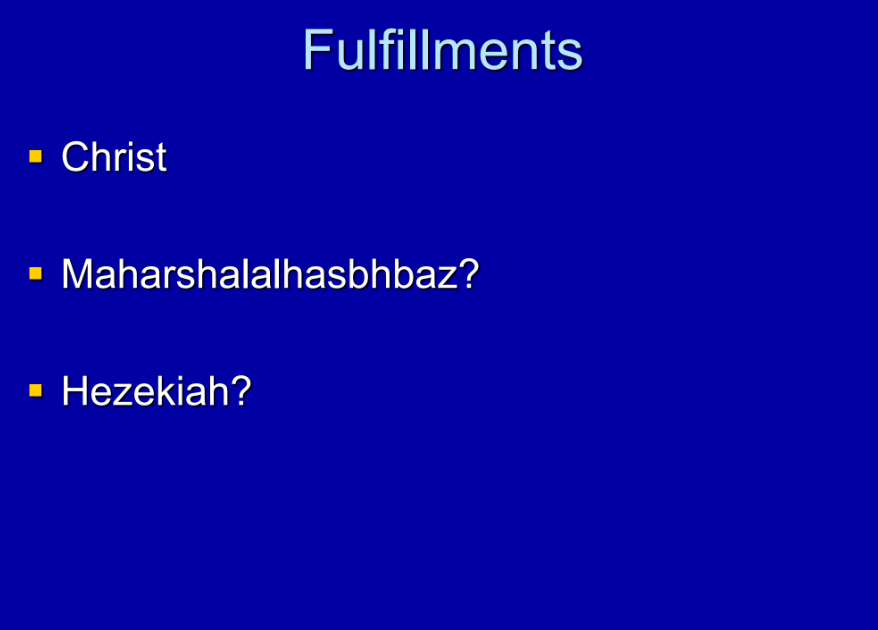
Hezekiah, who seemingly was already born when this happened, was a few years old. So, about the time he turns eight, those kingdoms are destroyed and are taken away. And then, within a few years later, when Hezekiah is king, he starts to follow his father’s footsteps. To begin with, he’s going to look to Egypt for help and do his own things he can do for help, as he’s going to rebel against Assyria. Then Isaiah comes and says, ‘No, don’t trust in any of those things, trust in God. Get your people to repent and trust in God.’
So, Hezekiah does get his people to repent. They purge idolatry, they renew the covenant, they keep the festivals and Passovers, they do everything they can to repent. And while much of Judah is destroyed, Jerusalem is miraculously spared as God wipes out the Assyrian army, making this a very clear sign that God is with them. There was no doubt God was with them when they were miraculously spared. So, I would argue that Hezekiah is a fulfillment of that.
And when I think of Hezekiah as that fulfillment, and what Hezekiah did in getting people to get that idolatry out of their lives, bringing them to God, helping them make and keep covenants so that they could be saved, it helps me understand that first fulfillment, Christ, all the better. I understand what Christ does as Emmanuel better by understanding what Hezekiah does as Emmanuel.
Abrahamic Covenant
Well, we have just a few minutes left, so I’m going to touch on one more thing, and we’ll touch on this briefly, but I think it is really key for understanding Isaiah. Besides these ideas, you can see with this one how knowing the historical context and looking for multiple fulfillments helps us understand Isaiah. Another great key is to understand the Abrahamic covenant and then to look for it in Isaiah’s prophecies.
Isaiah uses the Abrahamic covenant more than just about any other prophetic writer that I’ve encountered. I’ve been studying and writing on the Abrahamic covenant for years now, and as I came to really understand the Abrahamic covenant, it revolutionized Isaiah for me. So, we have to understand the basic promises of the Abrahamic covenant like protection, prosperity, posterity, promised land, having a righteous king to rule over you and to help you come unto God, some of those basic promises; and what you’ll find is, and this is true not just of Isaiah but of all sorts of prophetic writers, but especially Isaiah, Isaiah doesn’t say, ‘Okay, I’m talking about the Abrahamic covenant.’ He draws on those things, and we should figure out he’s talking about the Abrahamic covenant.
Conclusion
So, if he says, ‘You are going to have so many children, such a huge posterity, that you’ll need to make your tent bigger because it won’t be big enough to hold all your children. So, when you make your tent bigger, you’re going to need to enlarge it. Then you’ll need to lengthen its cords and strengthen its stakes,’ what he’s really saying is, ‘now you’re really receiving the blessings of the Abrahamic covenant.’
It’s really coming to pass in your life. When he says, ‘Woe unto you who build houses close to one another,’ because they’re going to be desolate. He’s not talking about construction practices or the evils of having a townhome or something like that. He’s saying ‘you had a lot of posterity, so you had to build your houses close to one another, but now you’ve broken the covenant, so there’s no one left. You have no posterity. That’s because you’ve broken the covenant.’
So, I would encourage you, as you read Isaiah, to look for his use of whether you have those blessings or the opposite of those blessings and recognize that Isaiah is talking about keeping or breaking the covenant. You will find that Isaiah testifies of Christ and the covenant more than he does anything else. He is constantly testifying of Christ and the covenant. Understanding that Isaiah does that through symbols, through multiple fulfillments, through images, will open Isaiah to us in a wonderful and powerful way that will bring great meaning to our lives. It’s my prayer that that happens for all of us, and my testimony is that he does teach of Christ and the covenant. In the name of Jesus Christ, amen.
Scott Gordon:
Thank you very much. I know Isaiah is one of those things that people love to hate because it’s like, ‘Oh, that’s hard. That’s hard stuff.’ Okay, the first question: Could Brother Muhlestein restate the podcasts he recommends?
Kerry Muhlestein:
Oh, well, I recommend a lot of them. Follow Him is a fantastic one. Mine is a little bit different, but it’s, The Scriptures Are Real. We won’t try to go through everything comprehensively, but we’ll choose a couple of things that we think really make it real. Those are two great ones. I like Come Follow Up on BYU TV, and so I’ve chosen those three because they represent three very different things. Follow Him tries to go through everything systematically. Mine kind of hits on highlights, and Come Follow Up hits on personal applications. So, you can get three different ways of doing it with those. There are a ton of other good ones. One Minute Scripture Study is fantastic for just a quick thing. I can’t remember the one that Taylor Halverson and Tyler Griffin do, but with Book of Mormon Central, what’s that? Come Follow Me Insights, that’s a great one. But there are a whole bunch of great ones.
Scott Gordon:
Thank you. And would Carrie please summarize the main points on how to unpack a symbol?
Kerry Muhlestein:
Sure, I’ll do that. And again, I’ll say that if you go to outofthedust.org, I’ve got a little brochure you can get there on Isaiah that will have these things written down for you. But the main points are: look at the literal symbol and make sure you understand literally what’s going on there. Then think of all the different ways that that symbol can be applied in Isaiah’s day and in other time periods. And then figure out how that can be applied in your life at that moment. When you read it again next month, you’ll have different answers for that. It will speak to you in a different way. That’s the beauty of symbols. Okay, thank you.
Scott Gordon:
And to what extent can Isaiah be read to understand the signs of the times?
Kerry Muhlestein:
That’s a great question. Signs of the times are just a tricky thing in general. Isaiah certainly is prophesying about the last days, often by talking about his own day. And again, I’ll stress, understand his day and what he’s saying to his people, and then you can understand a little bit better what’s happening in the last days. But he’s vague enough, and that’s the same thing with anyone who does “Signs of the Times,” John the Revelator, or Daniel—they’re pretty vague, so it’s hard to get details.
So maybe I’ll just give one example of that: Isaiah 29. We hear all the time about how “they will speak to us as out of the dust.” Alright, and we say, “Book of Mormon”, that’s true, that’s good. But let’s think about how Isaiah’s audience would have taken that. This is a prophecy given when Isaiah is saying this whole countryside is going to be destroyed by the Assyrians. They’re going to kill most people in most towns, and they did. They destroyed every large town, defense city, or outpost, except for Jerusalem. Those people were laid into the dust, and the fact that they were dead and buried (some of them not buried, just decomposing) spoke to the people around them. It told them that they should take God seriously. The deaths that happened in the northern kingdom as Israel was scattered, spoke to them and said, “God warned us this would happen,” and those dead bones in the dust are telling us we should have listened to God. So, that is how they would have thought, and I think they’re absolutely correct in taking it that way. That’s how they would have interpreted the idea of them speaking to them out of the dust.
Now we get to the Book of Mormon, and the Book of Mormon is both a book that’s buried in the dust, but also buried by people who are laid in the dust, who were also destroyed because they didn’t listen to God. And that should speak to us out of the dust—both their record and just their lives should speak to us out of the dust, warning us that we should listen to God. I key in on this because “outofthedust.org” is my website. I use this “out of the dust” theme a lot, the Facebook group, all sorts of other stuff. So, that is a sign of the time—the coming forth of the Book of Mormon and recognizing what happened when people didn’t keep the covenant. Us keeping the covenant as a result, ‘I was actually listening, whereas they didn’t,’ is one of the signs of the times. Also, that many people would fall away, even the very elect starting to be deceived, is a sign of the time. So, Isaiah is a guide for that, but in a very vague, very general way.
Scott Gordon:
Thank you; I think it was very helpful. The next one says, “Any thoughts on the King James Version influence on the Book of Abraham, Isaiah, and the works on Isaiah variants in the text such as the work of David P. Wright and Tibetans?”
Kerry Muhlestein:
Yeah, I won’t go too in-depth on that, but it does remind me of another resource I was going to share with you. But, I think there’s no doubt that King James English has an impact on all this. Joseph Smith, when he translates, thinks of scripture in terms of King James English and tries to reproduce that. Royal Skousen has some ideas about influence from people from King James, and even earlier, Dave with him on that. I don’t know where to go with that, but it’s an interesting thought, and Royal Skousen knows his English very well. But there’s no doubt it has an impact on it. I would say, rather than focusing too much on that, because I think we can’t really tell exactly all the ways it has an impact, let’s focus on how it impacts us in our reading of Isaiah. That’s one of the things that makes Isaiah difficult. I love the King James Version; I think it’s a poetic way of presenting things as powerful. But it’s not only using an ancient language in translation, but for us, it’s a second ancient language. King James is old enough; it’s not how we speak today, and sometimes that’s a little bit tricky for us, so, I would say, read the King James Version; it’s so powerful, but I would also recommend using a few other translations as you read Isaiah that may make it helpful.
Sometimes, so here’s the resource I would suggest. It’s called “netbible.org,” all one word, “netbible.org.” They’re a Christian group that has done a translation of the Bible, and you can go to that website, go to Isaiah, and you can pull up, and they’ll have like five different translations side by side. Or you can have King James or NRSV or whatever on one side, and Hebrew on the other side. If you don’t know the Hebrew, you click on the word in English, it’ll be highlighted in Hebrew. You click on that; it brings up the definition. You can click on it again, word study, giving you lots of information about that word. So, it’s both looking at various translations and trying to get into the Hebrew a little bit. It’s a really handy, user-friendly website, netbible.org. I don’t get any money from them, just to be clear. So thank you very much.
Scott Gordon:
So there’s two parts here: How do you approach the multiple Isaiahs in scholarship, and then secondly, what is your general take on the Abraham Gileadi’s work on Isaiah?
Kerry Muhlestein:
Alright, these are big questions that require longer answers than what we can give here, but let me address the multiple Isaiahs question quickly. Many people will be aware of this; many won’t. But most scholars think that Isaiah 1 through 39, somewhere in there (there’s not complete agreement as to where to divide these), but generally 1 through 39 is written by the original Isaiah. Then we have another Isaiah or another person who starts after that, who wrote and wanted people to accept his writing. So he said, “These were written by Isaiah,” and eventually they were accepted as being written by Isaiah. Most scholars would hold to that, and many would also say that there’s a third Isaiah, so we call them Second and Third Isaiah or Deutero and Trito Isaiah.
Starting, there’s some more disagreement about that, but the later chapters, we’ll just not get too specific here. Anyway, there are some reasons for that, and we should understand that historically the reason this started—it’s not the reason why everyone keeps going with it, but the reason that this started is because in that Second Isaiah, there are some really specific prophecies about Babylon, about the destruction of Babylon, about Cyrus and the return of the Jews. And if you don’t believe in prophecy, you say, “Hey, wait a minute, I don’t know about that.” And I’ll say as an Egyptologist, I have some things I read that are supposed to be prophecies, and I say, “I don’t know that those Egyptians really could have known that ahead of time.” So I think this was written later. That’s what most scholars did with that part of Isaiah: he couldn’t have known that ahead of time, so I think it’s written later.
Once you come to that idea, then you start looking for other evidences. So there are some linguistic evidences that they’ve come up with, saying, “Well, we see later Hebrew in here; we see some Aramaisms and so on.” There are thematic changes, and so on. So people said, “Okay, that’s all written by a Second Isaiah.” In theory, as Latter-day Saints, we don’t have a problem with that. We believe that there are all sorts of changes and things that happen; it doesn’t mean it’s not inspired. Second Isaiah, if he’s a real person, absolutely could be inspired, and we’ve canonized it, learned from it. One of the problems we have as Latter-day Saints is that typically, they date that to after the Babylonian exile because it’s naming Cyrus and so on, so after the Jews have come back.
“It has these specific names in it; well, Nephi quotes Second Isaiah, and Nephi’s version of the Brass Plates is from about 600 BC, so, that dating doesn’t work very well for us. There are ways around that, as members of the Church and all sorts of people have different ways of doing it, and that’s fine with me. Nephi doesn’t quote Third Isaiah, so we don’t really have a problem with that. Personally, I just don’t find it very convincing, partially because the linguistic arguments don’t hold water very well. John Gee has been doing a lot of work on this, and I’ll let him speak to his own work. But, there are more earlier Hebrew uses than later Hebrew, and it’s done in a way that not even Joseph Smith, who tried to write in King James English, is good enough to imitate the language that well. What we probably have are recopyings with glosses from later Hebrew. They’re Aramaisms. There’s a long, complicated linguistic debate we don’t have to get into, but I just don’t find it particularly convincing. I don’t care that much, but I don’t find it particularly convincing.
The thematic shift would be natural because this is also where Isaiah has been warning people to repent, or they’re going to be destroyed. That’s the point where, well, now everyone has been destroyed, and Jerusalem’s miraculously spared. There should be a thematic shift; he doesn’t need to keep talking about the same things. There’s no point to it anymore. I also find some poetic structures, a chiasm that spans between what we would call Second and Third Isaiah. So while we don’t have any problem with Third Isaiah among Latter-day Saints in general, it just doesn’t work for me structurally. It doesn’t work.
Scott Gordon:
But I have one more question I want to ask. I just want to give you a chance to respond to this. How would Dr. Muhlestein recommend helping youth feel God’s love while reading Isaiah or the scriptures in general?
Kerry Muhlestein:
Ah, fantastic question. So I will say that I have a podcast episode on the second week of Come Follow Me where I interviewed Josh Sears on my podcast ‘The Scriptures Are Real,’ where we address that at more length than we can do it here. But I would say Isaiah talks about God’s mercy and love more than almost anyone. He has to keep holding out this idea that there will be destruction, but he always follows with the idea of mercy and love. So maybe I’ll just paraphrase Isaiah 54:10 because we don’t have time for me to look it up. But in Isaiah 54:10, God says that it is more likely that the hills will leave than God’s hesitance or His covenantal love and mercy will depart. And that’s what he’s really saying again and again and again, that yes, you’ll mess up, you’ll break the covenant, I will have to humble you, but I will never stop loving you. I will never stop giving you another chance. Some of the ways he says this: I leave a remnant, I will act out in mercy, and Isaiah always is closing with these ideas of joy. We’re going to sing joy and hymns of praise to God because no matter how hard things have been, He will always be there for us. He will always accept us back; He’ll always give us another chance and make things wonderful so that we praise Him in joy.
It’s the main message of Isaiah. Christ makes it possible, keeping the covenant makes it possible, but that’s His message. God will come through for us, and we will have joy.
Scott Gordon:
Thank you so much.
Kerry Muhlestein:
Thank you, my pleasure.
coming soon…
Why is Isaiah so difficult to understand?
His use of symbolism, historical references, and prophetic language requires effort to interpret, but provides profound insights when studied carefully.
How do we know Isaiah’s prophecies are relevant today?
Many of Isaiah’s teachings apply to multiple time periods, including the latter days, and emphasize eternal gospel principles.
Strengthening faith through deeper scripture study.
Understanding prophecy as a tool for spiritual growth.
Applying ancient teachings to modern life.
Share this article
