In his presentation, Jed Woodworth, historian and managing editor of the Saints series, discusses the approach taken in Saints, Volume 3 to balance themes of faith and doubt within the historical narrative of the Church of Jesus Christ of Latter-day Saints. Woodworth explains how Saints aims to present an honest, well-researched history that includes complexities and challenges without diminishing faith, emphasizing a faithful perspective that invites readers to choose faith amid opposing views.
This talk was given at the 2022 FAIR Conference on August 4, 2022.

Jed Woodworth, historian and managing editor of the Saints series, combines academic expertise with a faith-centered approach to explore the balance of faith and doubt in Church history.
Transcript
Jed Woodworth
Introduction
What a pleasure it is for me to be with you today. I count many of you as friends, and those I don’t know, I hope to make your acquaintance during the day. As Scott mentioned, the Church is in the middle of writing a multi-volume history called Saints. Today, I’d like to discuss faith and doubt in Saints and how that functions.
Reception of Saints and the Notion of Honesty
You know, whenever I tell people I’m a historian and what I work on, I get a comment which is, “Oh, I love Saints,” and then there’s always some kind of adjective like “Saints is faith-promoting” or “Saints is fun” or “Saints is idiotic.” I don’t get that, but that’s actually a Goodreads comment — “idiotic.” The positive to negative comments actually run in the direction of about nine to one, so if you are running for election or you’re a baseball player and you hit 900, that’s a pretty good average.
The reception has just been beyond our wildest dreams. We didn’t realize that Saints, when we set out to write these books, would resonate with the audience the way they have, but one word stands out to me that I’ve gotten on a couple of occasions, and that word is honest. I’ve had people tell me Saints is an honest book, and I ask them what they mean by that, and they say, “Well, you’re not afraid to tackle controversy and you tell both sides, but of course, you’re telling the story from the perspective of the particular Latter-day Saint.”
The point is that we’re not going to bury controversy, but that our character, who’s usually a fundamentally faithful person, is going to be represented, and that faithful view will be represented. So, I’d like to talk again about how Saints balances doubt and faith in the lives of various characters.
Overview of Saints as a Multi-Volume History
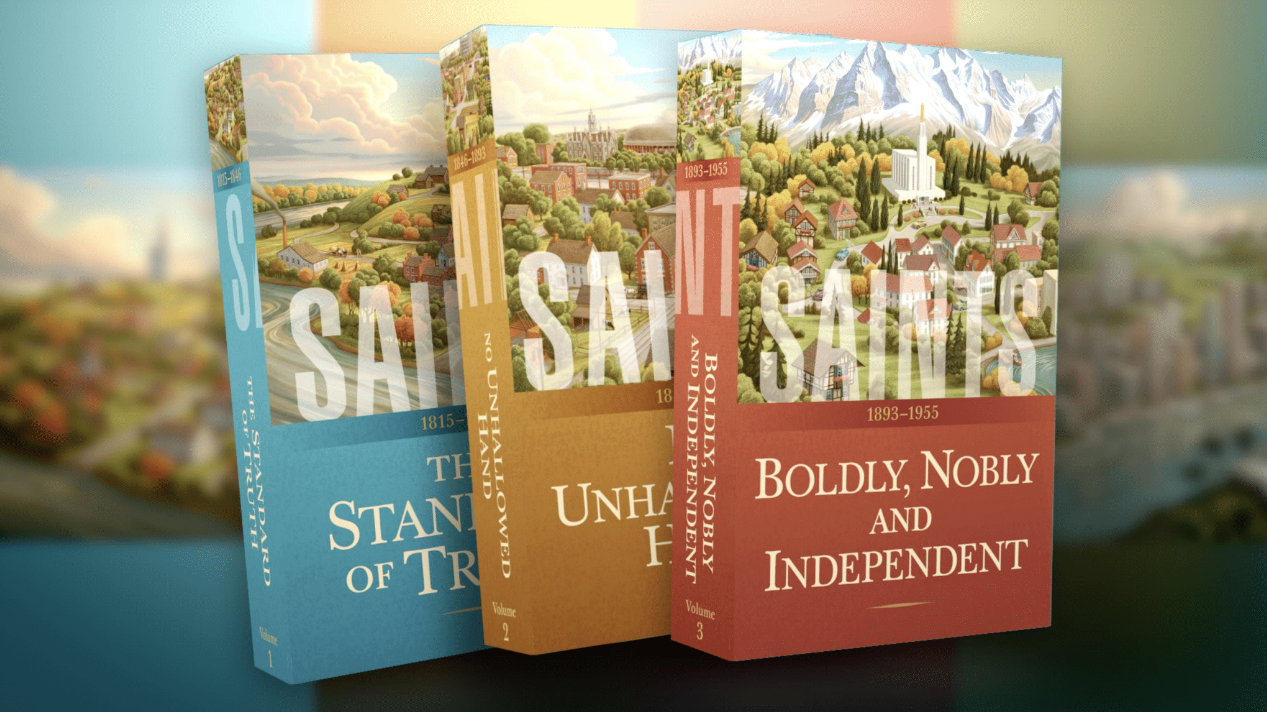
For those who don’t know, just briefly, I mentioned that Saints is a four-volume history that the Church is now writing. We haven’t had a multi-volume history since B.H. Roberts in 1930, so it’s been quite a while. It’s a character-driven history, a narrative history, so not a comprehensive history as B.H. Roberts set out to write.
So these stories that we pick, we have various criteria for figuring out what makes a good story in Saints. Volume 1 was published in 2018. Volume 2 came out right before the pandemic, which, you know, we weren’t thrilled, we didn’t get the press that we would have hoped to have; however, we gave something for people to read during the pandemic, and then Volume 3 came out just a few months ago in 2022, and Volume 4 is in progress. If I have bags under my eyes, it’s because I’ve been up late working on Volume 4; it’s about halfway written.
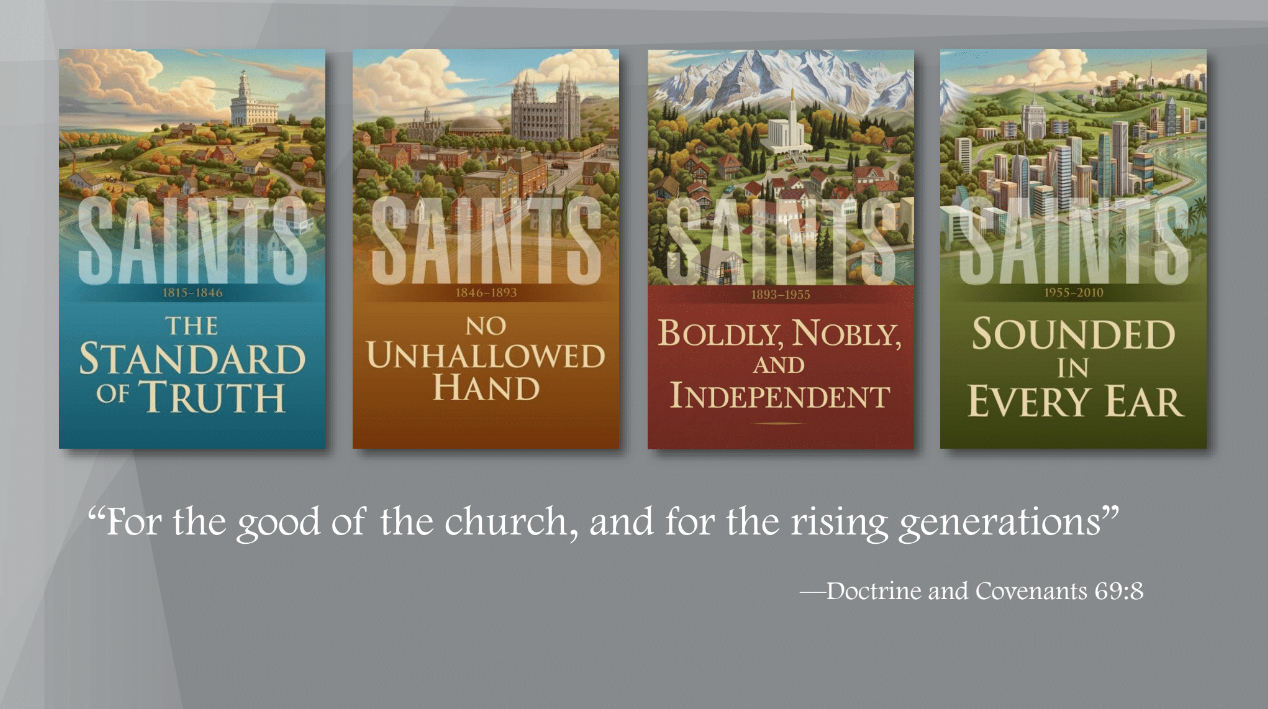
So here’s the cover art for the Saints series. You’ll recognize the title of each volume comes from Joseph Smith’s Wentworth letter: “The Standard of Truth has been Erected,” and so on. The cover art was done by a local artist, Greg Newbold, and we’re quite pleased with that cover art.
Implicit Assumption in Saints Regarding Faith
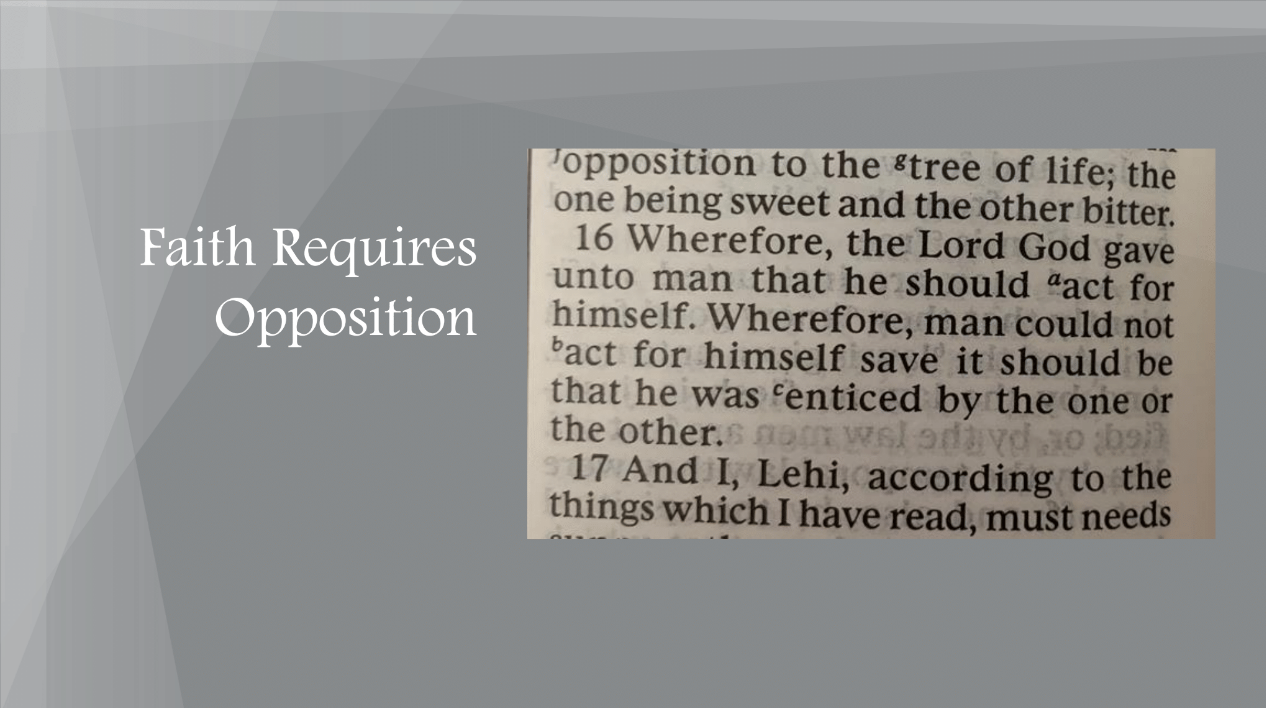
Now, implicitly in Saints, there is an assumption, not an explicit formulation, but it’s an implicit assumption that faith is something that must be freely chosen, and to choose faith, there must be opposition.
Here’s a passage from Lehi’s great last sermon in Second Nephi 2 where he tells his sons wherefore the Lord God gave unto man that he should act for himself, wherefore man could not act for himself save it should be that he was enticed by the one or the other, and that word enticed is the most important word here. Well, I guess you could say act for himself would be important, but the word entice suggests that there has to be an alternative to the faithful position that is reasonable, appealing, in a word, enticing. And we see that in this area. I think we see it throughout Church history. Namely, you can always take a faithful event and take the data points or the documents behind it and array a faithless account of that same event. So you’re going to have competition with faith.
I think for a long time in the history of the Church, we assume that faith is what you have when you align all the evidence and it steamrolls the competition, and that’s faith at the end of that. And the competition really doesn’t add up to anything. Well, that, I don’t think that’s what Lehi is saying here. I think he’s saying the enticing part has to be there, and then the person, in this case, personalities or characters in Saints freely choose the faithful course in the competition of competing evidence.
Exploring Competing Views
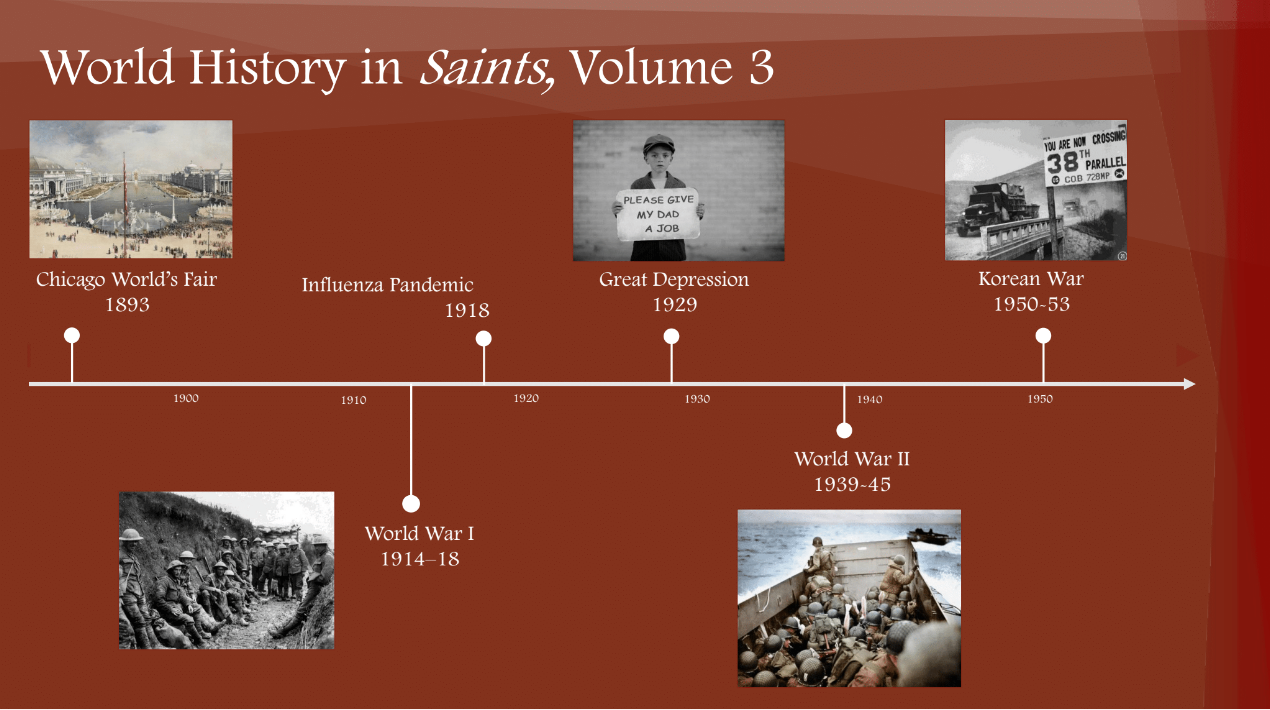
So let’s talk then about some of the competing views that might damage faith in this era. We know it’s a period of great duress. There are two world wars, there’s the Korean War, there’s a worldwide pandemic, the Great Depression, Chicago World’s Fair that’s there. I’ve put that up to illustrate how affluence or even hedonism, other kinds of isms in this era that involve wealth and luxury, that those are also competitions or a competitor to faith. This is the era where agnosticism and atheism really take root among not the literati but the everyday population, and so that provides competition.
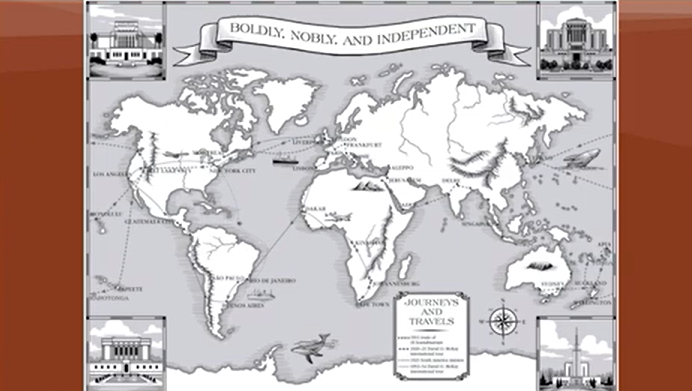
Now, this map which is at the beginning of Volume Three reminds us that the restored gospel was taken to certain areas in this era, but there are large swaths that are untapped in this era: large parts of Africa, the Middle East, the Soviet Union, and it reminds us that there’s order in the Kingdom but there’s always going to be barriers to the truth going forward and sometimes we have to wait out those barriers. Sometimes we can attack them and take them down, but sometimes we have to wait them out, and in the case of Communism in Eastern Europe, for example, we had to wait quite a long time for that to unravel.
Establishing Authority in Saints
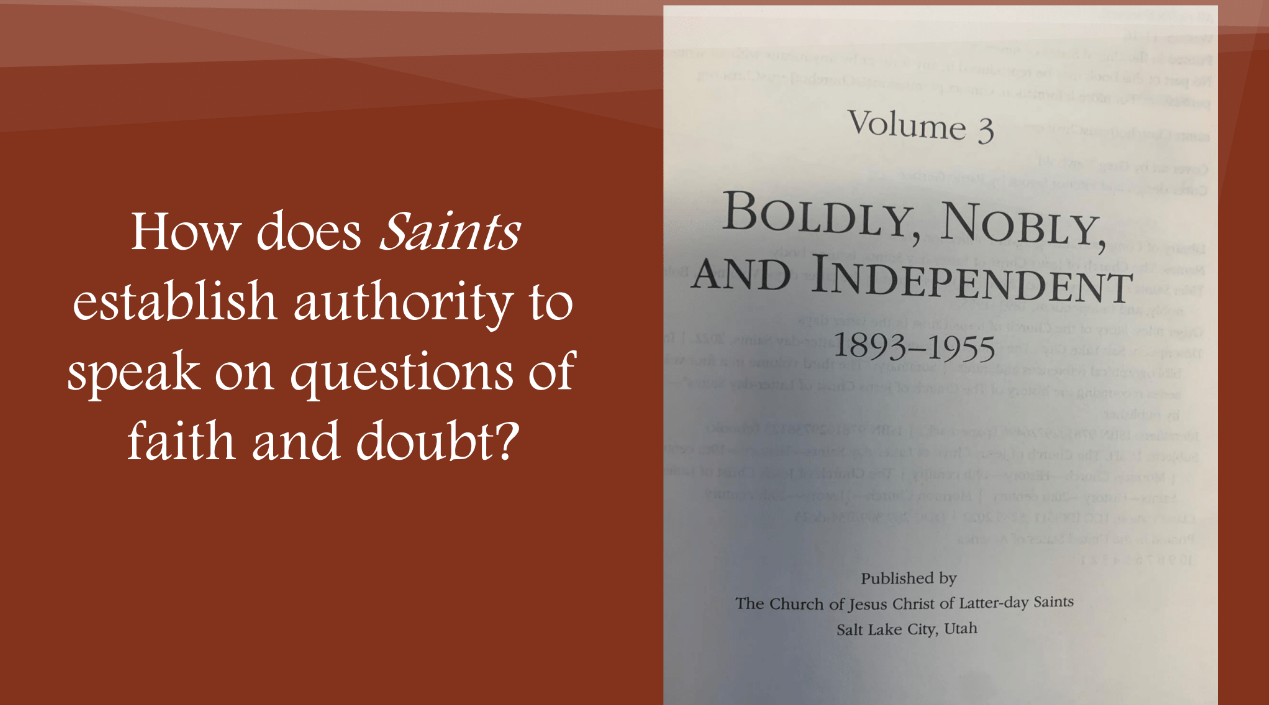
So I’d like to talk just for a moment about how Saints establishes authority to speak on these questions. Here’s the cover, the title page of Volume Three, and you’ll notice the imprimatur at the bottom is published by the Church and that immediately conveys that this is a Church publication and so this you can trust the Church on this count to speak truthfully.
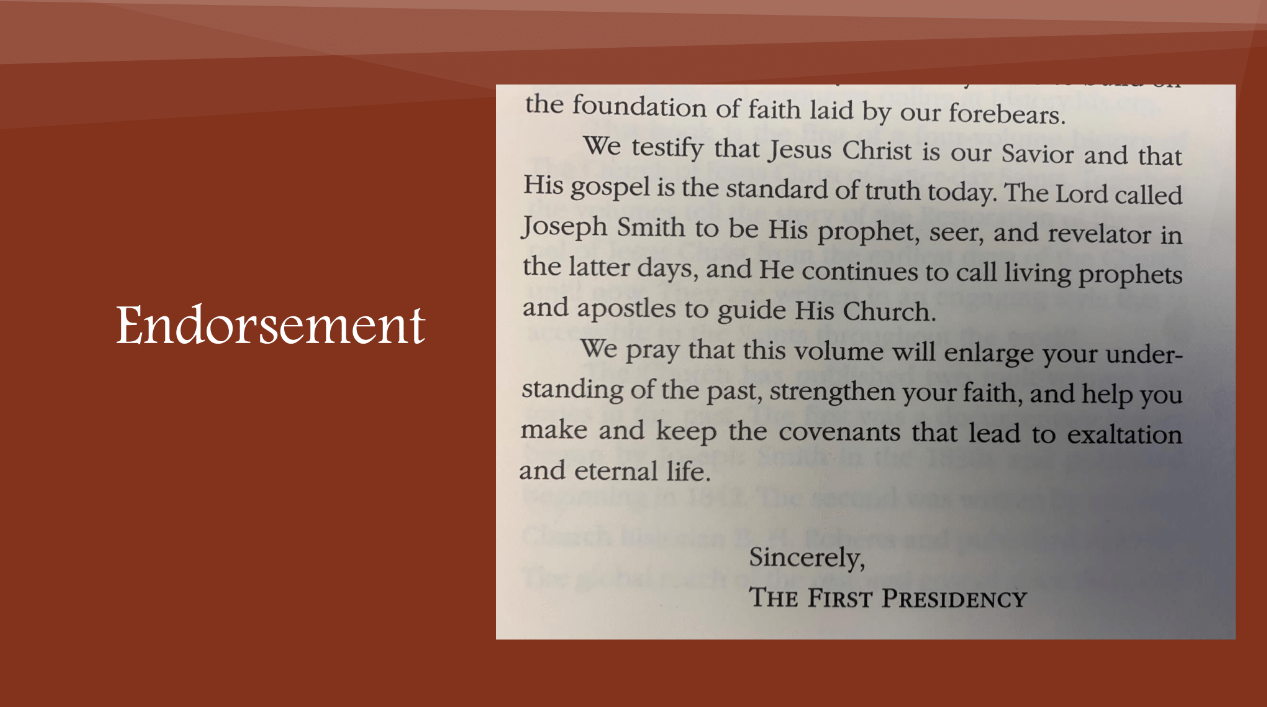
There’s also an endorsement in Volume 1 by the First Presidency where they recommend Saints to readers.
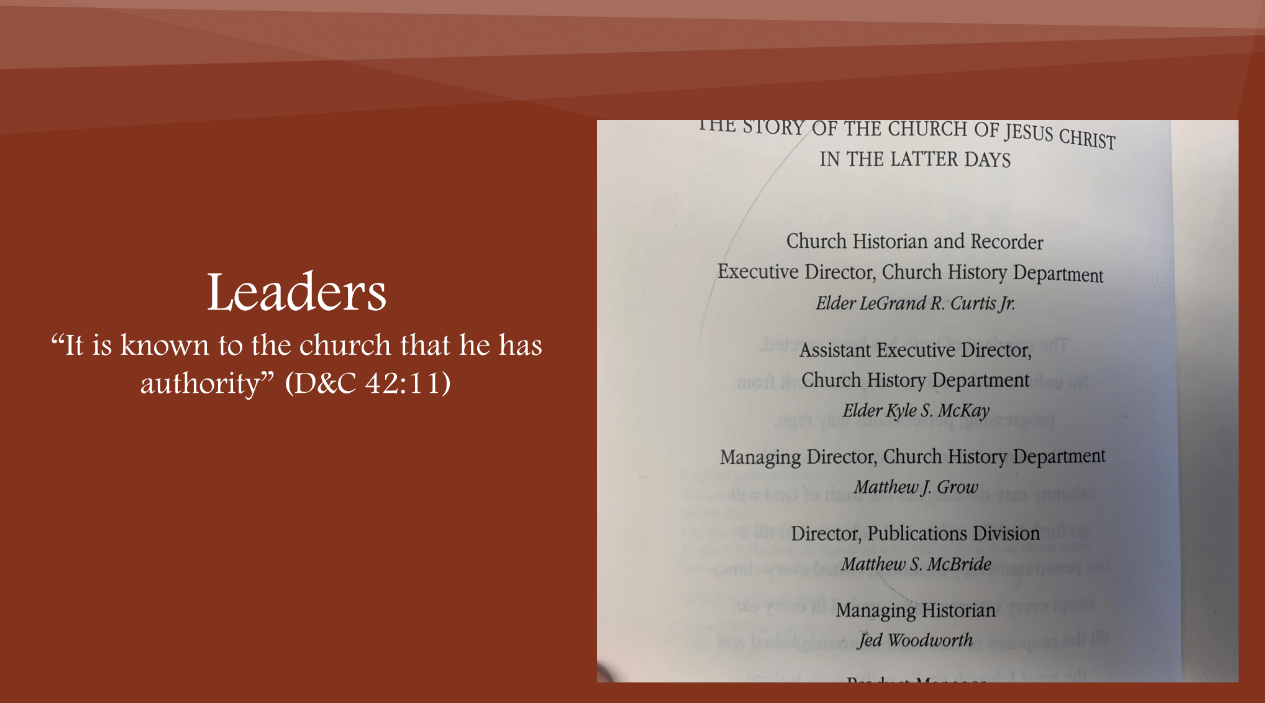
Then we have a list of people who contribute here: the Church historian’s name, the assistant Church historian Matthew Grow, who is the managing director, Matthew McBride, who you’ll hear from next hour, and myself.
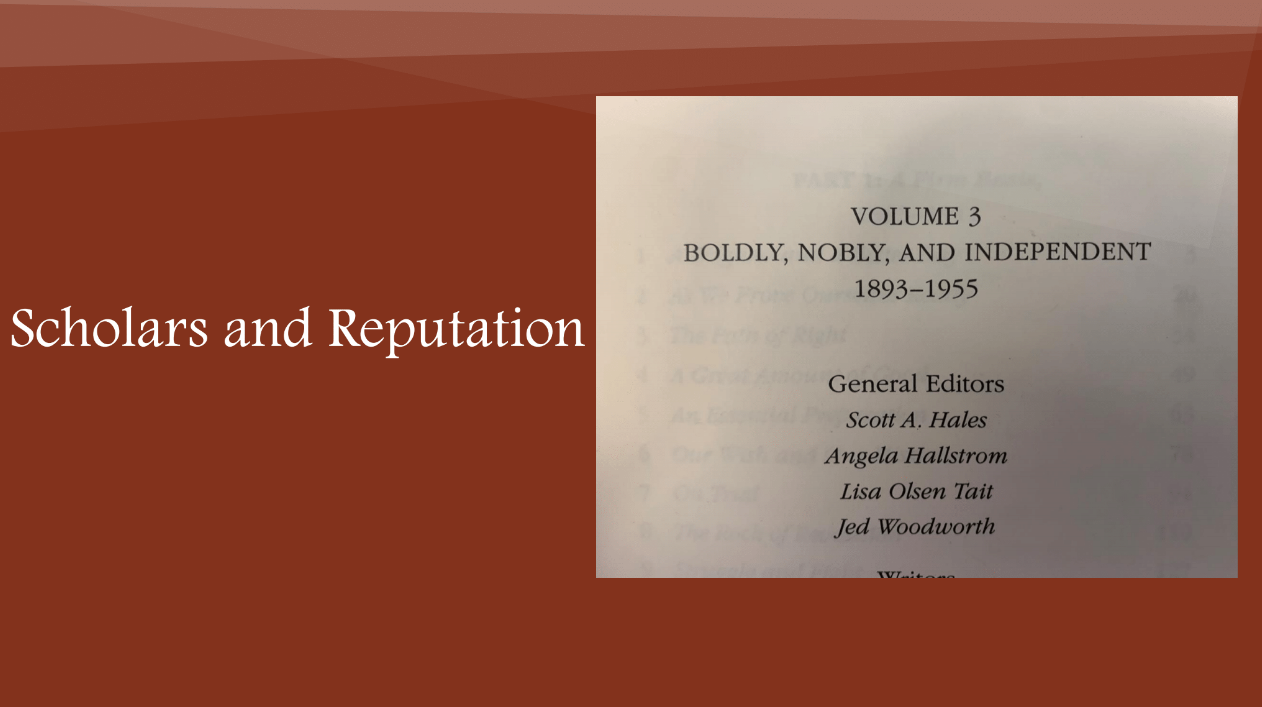
And then we have four general editors: Scott Hales, Angela Halstrom, Lisa Olsen Tait, Jed Woodworth, all of whom have PhDs in history or English.
Scholarly Confidence in Saints Contributors
Now, I put up this slide to just point out to you that the scholars who are listed here, they have reputations, they’re scholars in their own right outside of Saints. And so, this should inspire confidence that the people who contribute to Saints, who write Saints, who research Saints are not just making things up. They can’t write whatever they want, or that is to say, they don’t write on a whim. They have to adhere to the scholarly standards of their professions. And so, having the names listed of who contributes to Saints should inspire confidence that we’re speaking truthfully on questions of faith and doubt.
Exploration of Key Themes in Saints Volume 3
Now, I’d like to explore some of the key themes in Saints Volume 3.
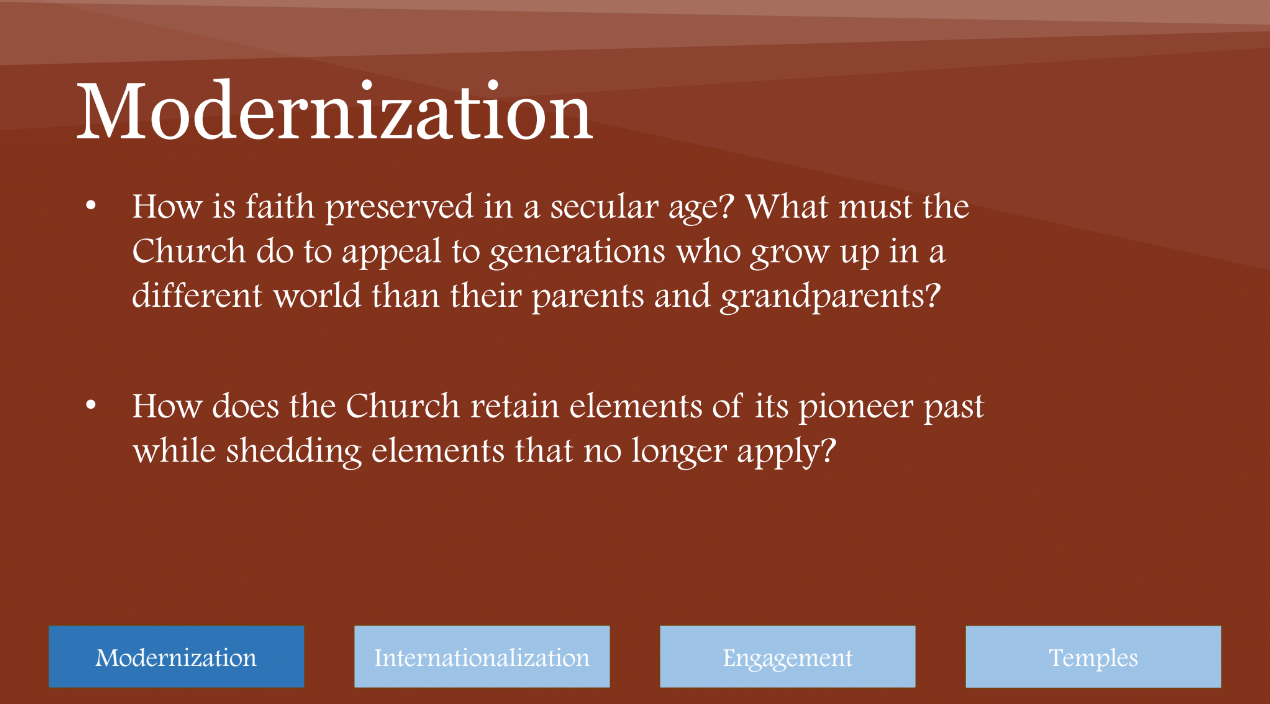
There are four large themes that are covered in the book. First, modernization; internationalization; engagement; and temples. I’ll explain each one in turn.
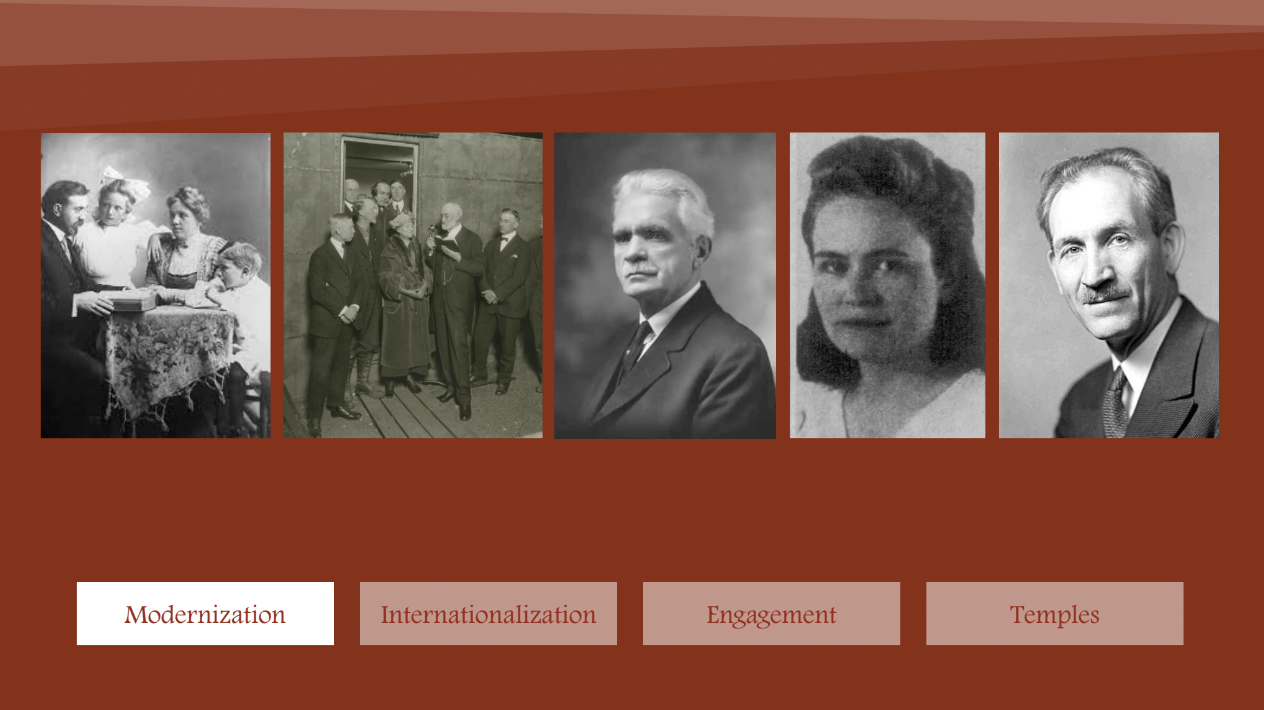
Modernization
By modernization, I mean how is faith preserved in a secular age, which this age is, the first half of the 20th century, what does the Church have to do to appeal to generations who grow up in a different world than their parents and grandparents? And of course, every generation, this is a new issue, repeated over and over throughout the generations. How does the Church retain elements of its pioneer past or the previous generation while shedding elements that no longer apply?
Now, here are some examples. I’m not going to go through each one, but the couple on the left, John and Leah Widtsoe, and two of their children. We use them in Saints Volume 3 to illustrate some important principles about faith and doubt, and one involves learning.
John and Leah
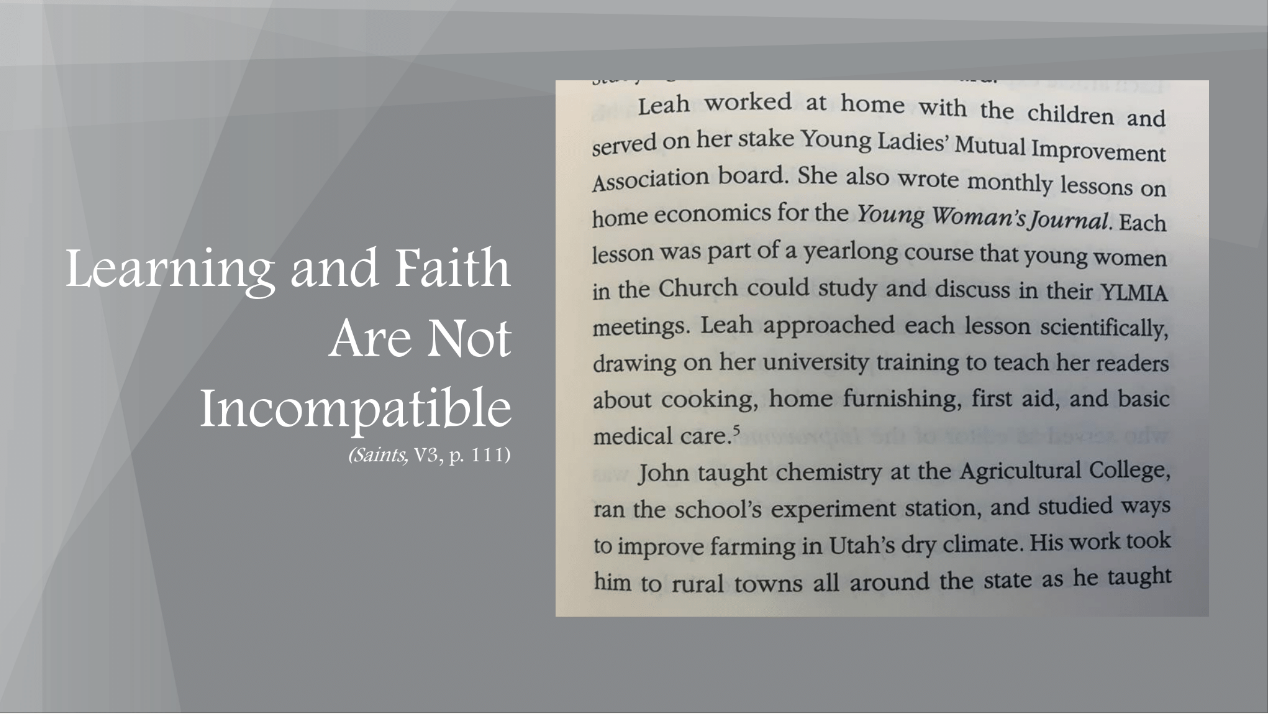
So, John and Leah are representative of a generation of saints that went out to college. They left Utah. Leah went to New York to study domestic science. John went to Harvard and then later to the preeminent chemistry graduate program, probably in the world, in Germany. And we have a passage that shows how their learning comes into play, how it’s utilized in building the kingdom. I like to read that together.
Leah worked at home with the children and served on her stake young lady’s Mutual Improvement Association board. She also wrote monthly lessons on home economics for the young women’s Journal. Each lesson was part of a year-long course that young women in the Church could study and discuss in their YLMIA meetings. Leah approached each lesson scientifically, drawing on her university training to teach her readers about cooking, home furnishings, first aid, and basic medical care. John taught chemistry at the agricultural college, ran the school’s experiment station, and studied ways to improve farming in Utah’s dry climate. His work took him to rural towns all around the state.”
The meta message here is that higher education does not have to tear down faith. It can be utilized to build up faith, to build up the kingdom in this case. And we see how these characters in this era don’t have to run away to graduate school and then lose their faith. John and Leah are illustrative of this movement. And even today, studies have been replicated multiple times, that Latter-day Saints are unusual in that the more education you get, the more your faith is strengthened, whereas for many others coming out of the Christian tradition, the opposite is true, namely, the higher degrees you get, the more your faith is damaged.
Tragedy
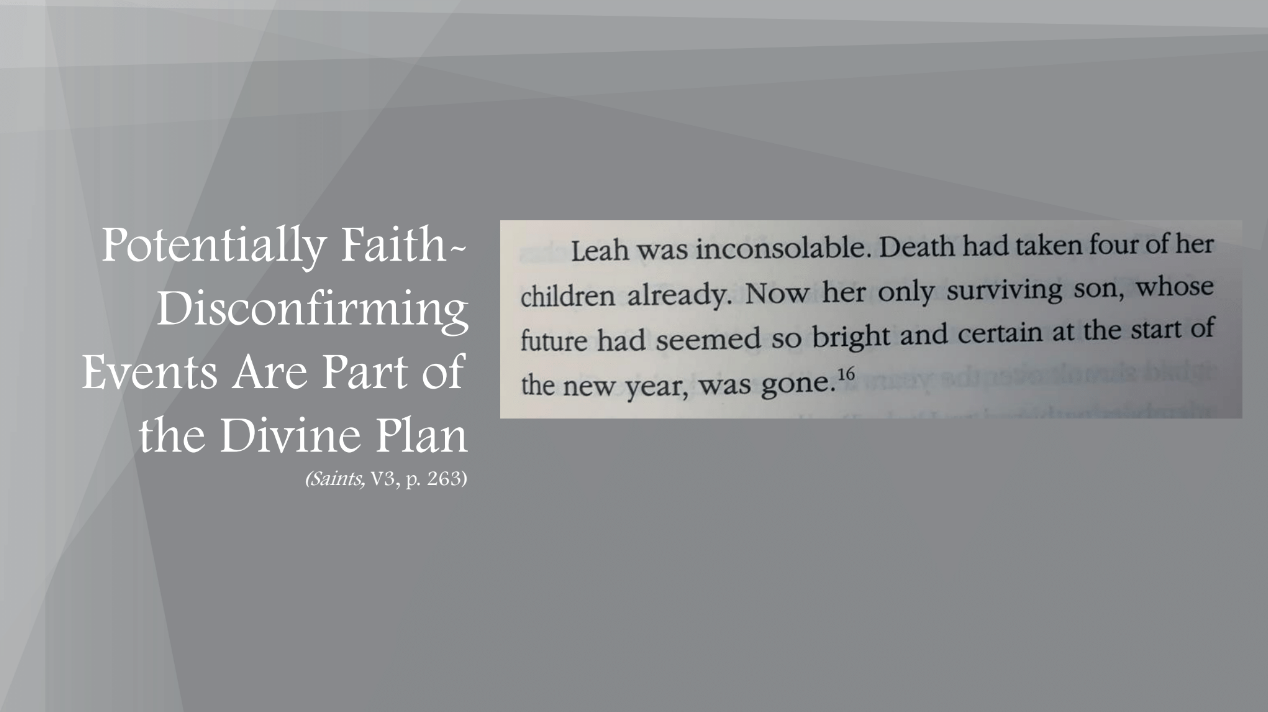
So, we know that no person, no family is immune from tragedy, and we see tragedy being played out in John and Leah’s life. They were unusually stricken with death in their own family, and in 1927, their only surviving son, they had great hopes for this young man, all accounts were that he was an amazing young man, he was a seminary teacher, engaged to be married, a returned missionary named Marcel. Marcel passed away in 1927 of a sudden illness. In the text, we write about it in this way: Leah was inconsolable; death had taken four of her children already. Now, her only surviving son, whose future had seemed so bright and certain at the start of a new year, was gone.
So we learn from this that tragedy, pain of all kinds, is part of the plan, and so we see the Widtsoes working through this, recognizing that no amount of righteousness, nothing they could have done, would have saved them from going through this tragedy.
Comfort Through Faith
But it doesn’t end there, you know. Sometimes when you go to a Protestant funeral, everyone is dressed in black, and it’s just the most morose of occasions. But we know for Latter-Day Saints, our hope is elsewhere, and we do have a hope for a better world, a hope that God will comfort us not just in the next life, we’re not just waiting for comfort later on, but here and now he comforts us.
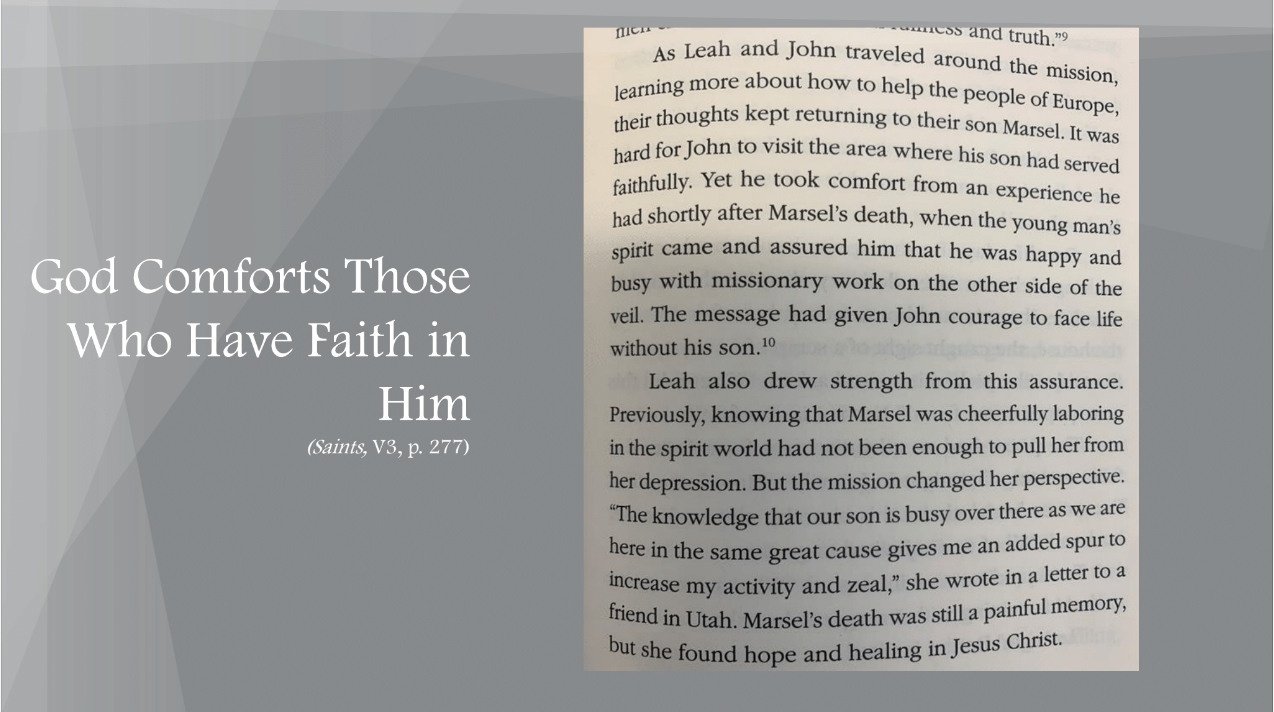
And so we show this through the Widtsoes. In this passage, John and Leah get called to lead the European Mission within six months of Marcel’s death, and John felt that Heber J. Grant, who issued the call, was doing this to help them get past their grieving. We have this great passage that talks about how, over the course of years, they served in this calling for six years, they came to understand Marcel’s death differently.
Excerpt
As Leah and John traveled around the mission, learning more about how to help the people of Europe, their thoughts kept returning to their son, Marcel. It was hard for John to visit the area where his son had served faithfully [he had served in Great Britain], yet, he took comfort from an experience he had shortly after Marcel’s death when the young man’s spirit came and assured him that he was happy and busy with missionary work on the other side of the veil. The message had given John courage to face life without his son.
“Leah also drew strength from this assurance. Previously, knowing that Marcel was cheerfully laboring in the spirit world had not been enough to pull her from her depression.” Notice even that word, depression; we’re willing to use it in Saints, not to hedge, not to pull back and act like this wasn’t a part of Leah’s life, “But the mission changed her perspective.”
“’The knowledge that our son is busy over there as we are here in the same great cause gives me an added spur to increase my activity and zeal,’ she wrote in a letter to a friend in Utah. Marcel’s death was still a painful memory, but she found hope and healing in Jesus Christ.”
Ambiguity
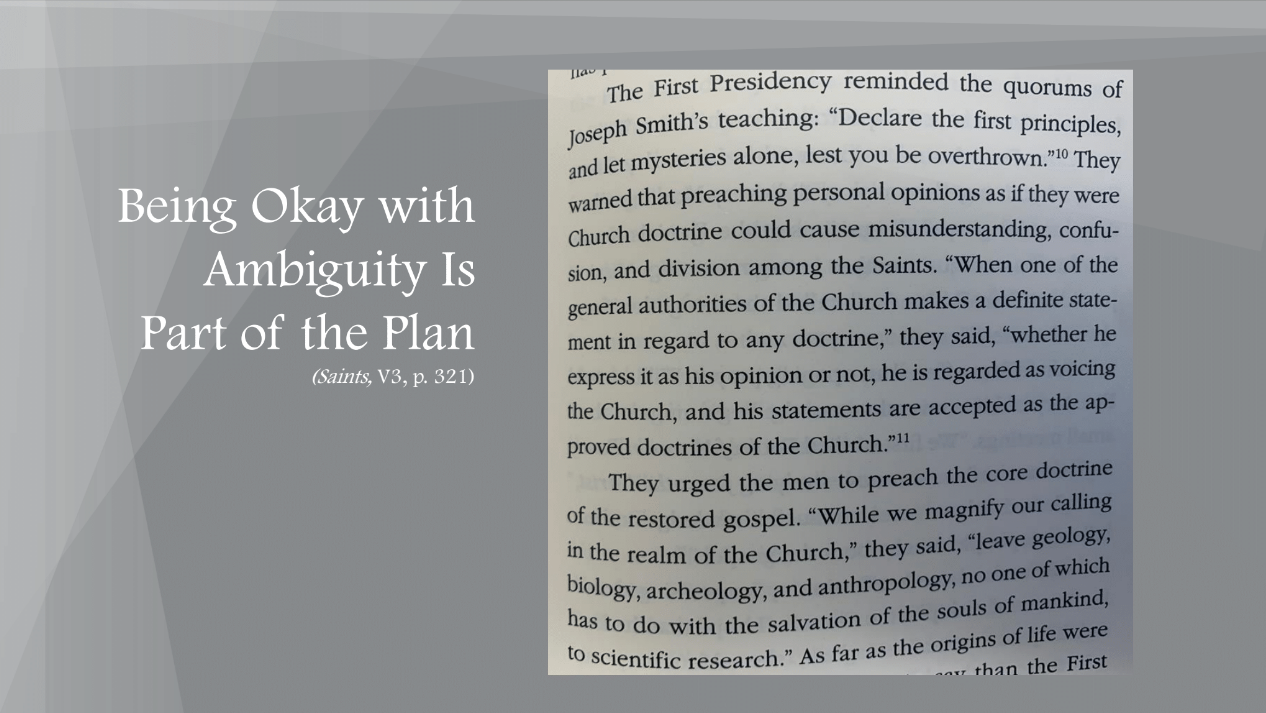
A second story I think I’m going to tell rather quickly involves an evolution controversy with two high authorities, B.H. Roberts, who was a member of the First Council of Seventy, and Joseph Fielding Smith, who was an apostle. They looked at the question of organic evolution differently, and ultimately, the First Presidency told them, “Hey, knock it off, guys. You don’t need to talk publicly about your own views on this issue. Let’s dwell on the largest principles here and dwell on what we know, not what we don’t understand or even what we think we know.” And so they issued a statement privately to the authorities saying,
Declare the first principles and let mysteries alone lest you be overthrown.”
They go on to say the personal opinions were not really what the authorities should be teaching as they go out, and they urged both Elder Roberts and Elder Smith to preach the core doctrine of the restored gospel.
While we magnify our calling in the realm of the Church, leave geology, biology, archeology, and anthropology – not one of which has to do with the souls of mankind.”
I think they were really saying, leave it to FAIR to talk about anthropology and geology and biology. And of course, there’s a place for that, right? Just not at stake conference.
Internationalization and the End of the Gathering
Okay, internationalization. The Gathering comes to an end in this era, and there are really two prongs to this. One is the leading authorities asking the Saints to remain in their own lands, and then those who are gathered in the Intermountain area are given the freedom, and in some cases even encouraged to leave for opportunities that they wouldn’t have here. So, for example, graduate school, we mentioned, and work opportunities. And all of us today are inheritors of this change and inversion of the Gathering, where we now are going back out into the world.
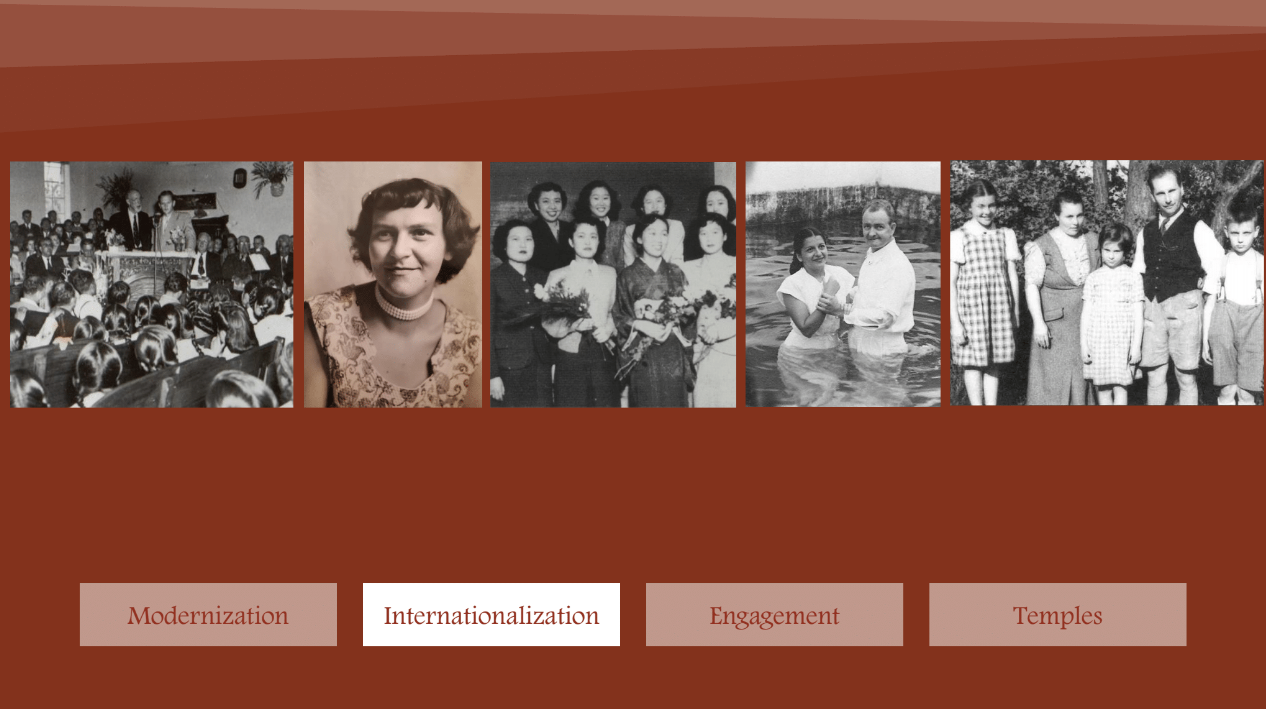
We have a story in the last quarter involving the Saints in Mexico. So, there was quite a large movement in the 1930s that were arguing in Mexico that they should have a native Mexican Mission president. And the First Presidency said, “Wait a second, you don’t understand the way the Church operates. We will call and assign whomever we deem the right person.” And so it resulted in a schism in Mexico City, about one-third of the members left the Church for a time.
And how was this problem resolved? Well, George Albert Smith in 1946, he went to the Mexican Saints in Mexico City and held a conference where he invited them to come back. And Saints tells this story, I think, in a quite a beautiful way. What he says when he arises there has been no rebellion here, only a misunderstanding. And then he proceeds to invite them to come back, and many of them do come back at this time, even at that very moment in the conference they decided to come back into the Church.
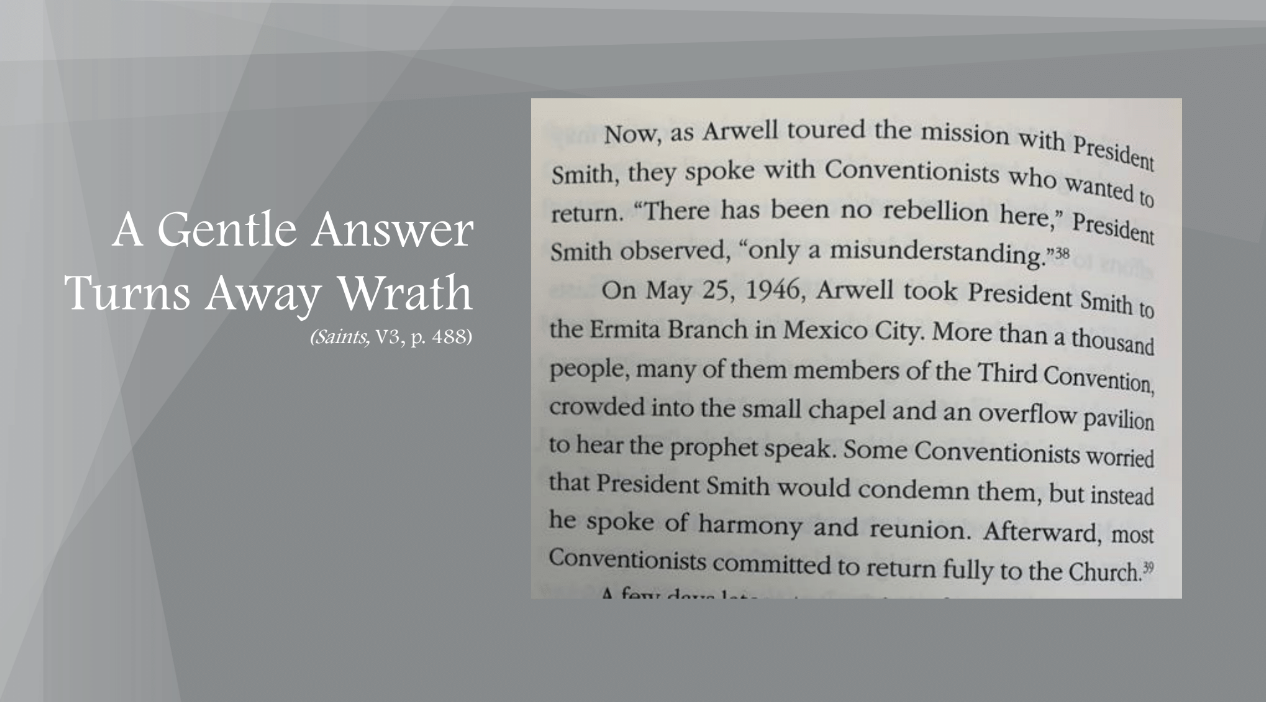
A Gentle Answer
So, we learn from this, I think one of the lessons in our own age where there’s so much contention on social media and so much bickering between political parties, is that “a gentle answer turns away wrath,” to quote the proverb. So, I think this is a great message for our own era.
Okay, another story we have is a story involving a French character, Jeanne Charier. And Jeanne Charrier was, she was quite an intellectual person. She was converted while she was at University, but she was quite a doubting person at the University. And then when she found the Church, she was able to develop faith she didn’t really know she had.
The Problem
But she had a problem, which is there were no eligible young men in France at the time. Well, okay, I say no, but just a very few whom she might marry, and she was in her 20s, wanted to marry but wasn’t in a position to do it. And she made a commitment when she joined the Church that she would not marry out of the Church, nor would she just marry a Church member just because he was a guy, you know? She wanted to be in love with the man. So she decided to remain in Europe rather than gather to Utah. And she found her fulfillment by serving in the Church.
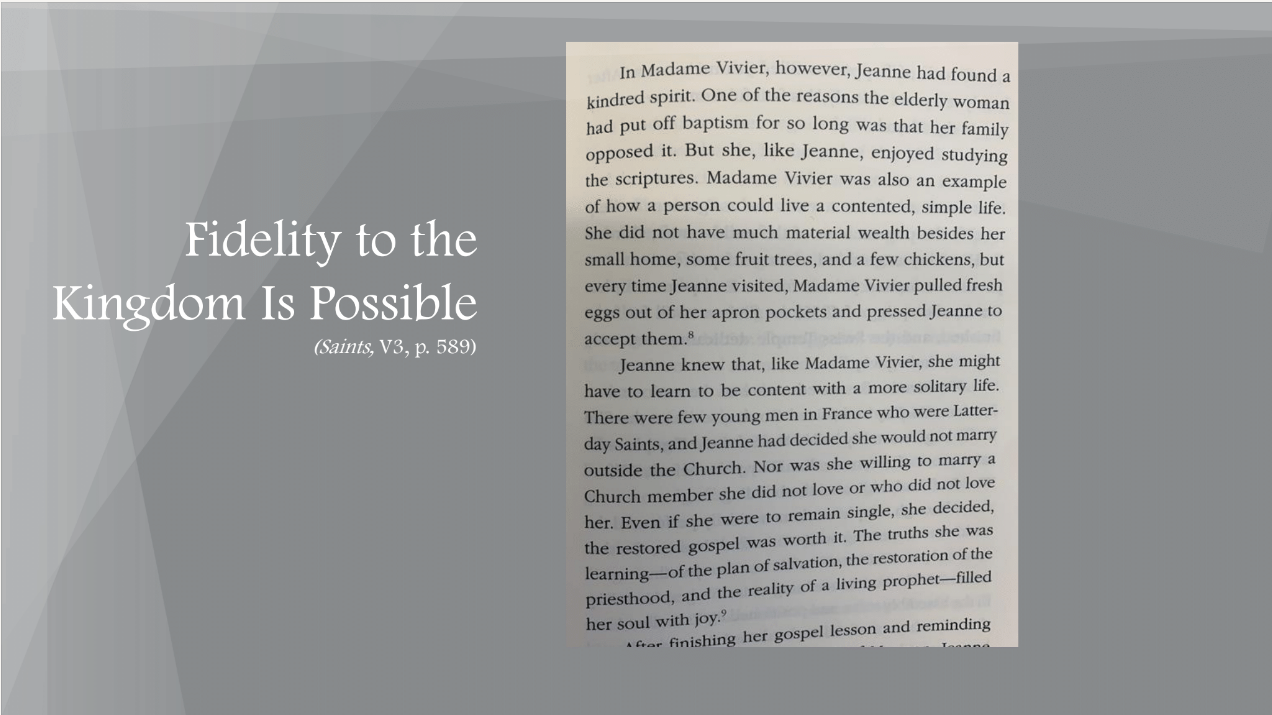
And in this one case, in a passage in the last quarter of Saints, we tell about her visit to Madame Vivier, who was a widow, who was infirm. And we show how Jeanne was able to put the kingdom and the demands of the kingdom before her own personal desires. This is a story for our age as well, how to maintain faith when there are strands that would pull our young people away from devotion to the kingdom.
Engagement
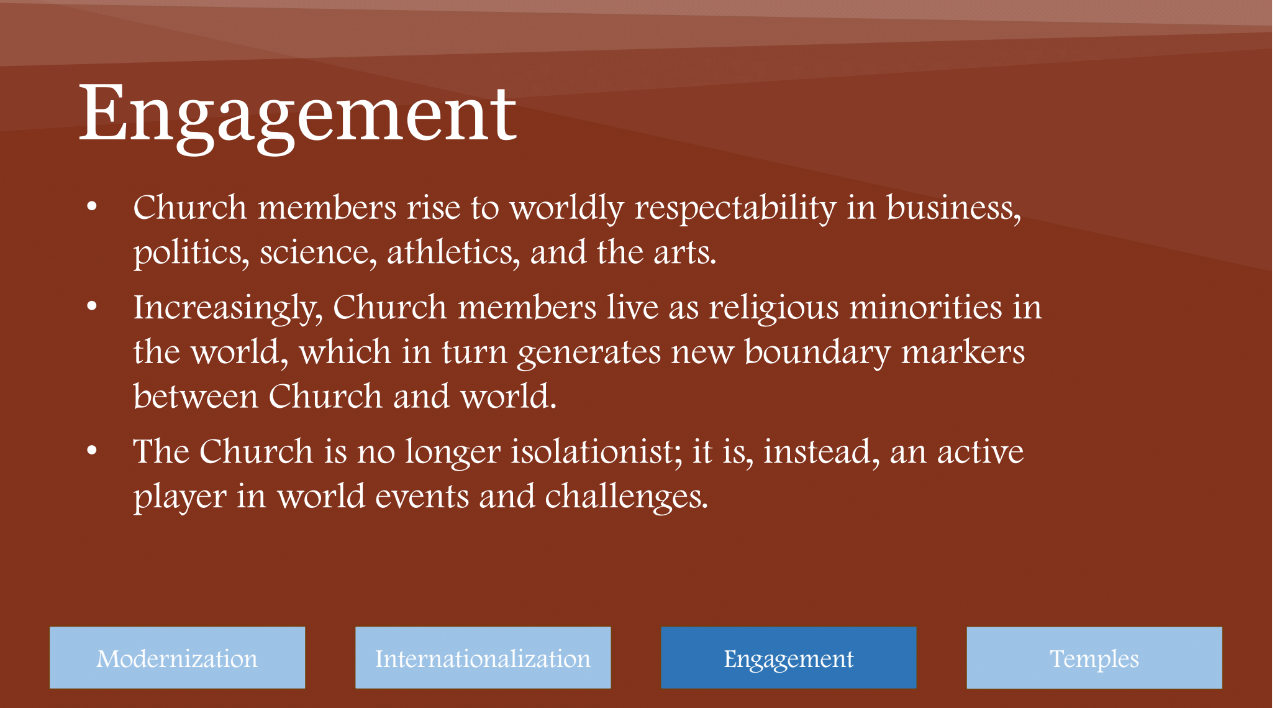
Okay, the third theme of Saints 3 is engagement. Church members rise to worldly respectability in business, politics, science, athletics, and the arts. So early on, we tell the story of Alma Richards, who wins an Olympic gold medal in the high jump in Sweden. We’ve never had an Olympian before in the Church, let alone a gold medalist.
We show Reed Smoot rising to the highest levels of the U.S Senate. For a long time, he’s actually head of the Senate budget committee, which holds the purse strings to the U.S economy. It’s just astounding to think that by 1920, after we’d had this history in the 19th century of being ooted out, persecuted, and driven, how by 1920 a Latter-Day Saint is so trusted that the whole U.S budgetary system is essentially in his hand.
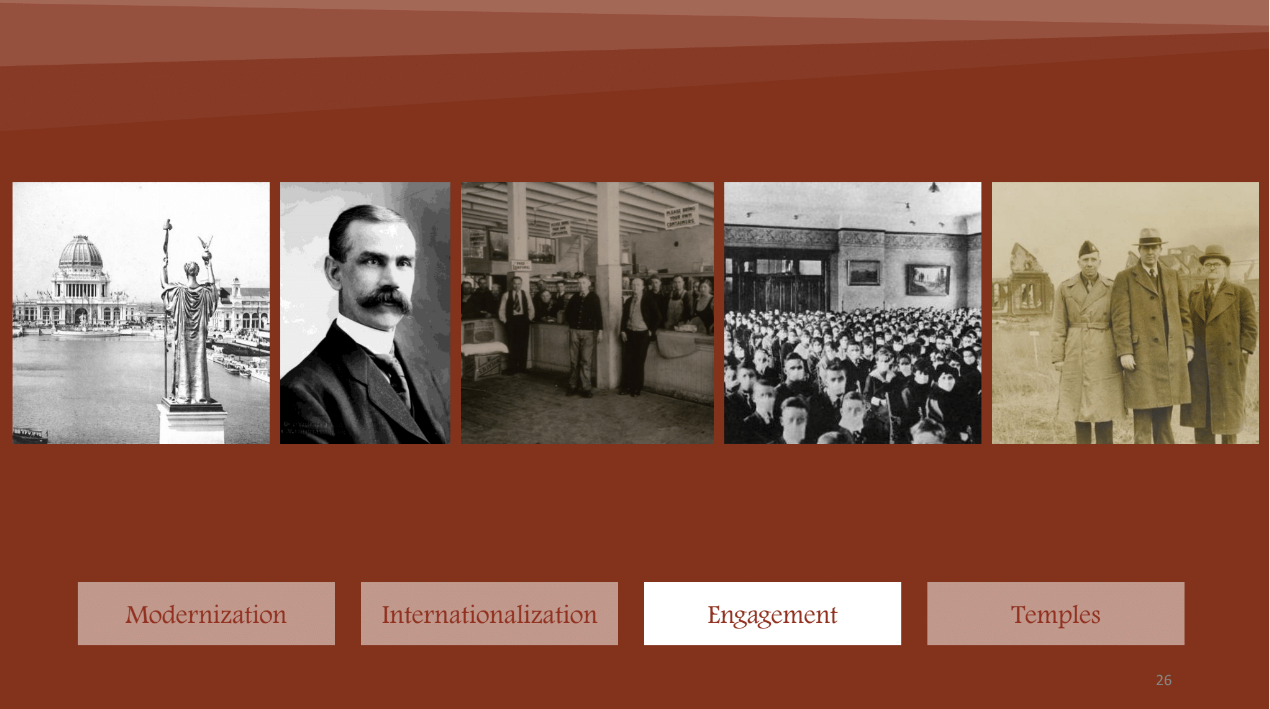
This is a revolutionary change in our Church that has really lasted to the present day. The Church is no longer an isolationist Church; instead, it is an active player in world events. [slide] You see Reed Smoot there second from left.
Church Welfare Program
Now, one of the most admirable parts of, at least, worldly acclaim for our Church in this era is the Church welfare program. I reviewed a lot of documentation about how this was received in the press. No one is criticizing what the Church is doing; they think it’s a wonderful thing to put people back to work and to gather the Saints together. They were so interested, the press, that they sent a team out to Salt Lake City in 1937 to do a newsreel that was put at the beginning of movies shown in the theater.
Time Magazine had this series called the March of Time, and they would have 10-minute newsreels where you would watch, instead of previews like we watched today, you would watch news, and one of them was on the Church’s welfare program. This again reflects this reproachment or engagement with the world that the Church is having. You’ll notice in this clip so I’m going to play part of it for you. You’ll notice the Church is framed as the wealthiest Church in the world, which is fascinating that again that it is considered thus after years of extreme poverty.
Video
(From the Video) “The March of Time. In the western vastness of the United States is a region strangely like the Holy Land, the state of Utah. Utah’s Dead Sea is the Great Salt Lake, like the mountains of Judea are her Purple Hills. For three quarters of a million people throughout the U.S, Utah is a holy land. Or here in Salt Lake City beside a river called Jordan rise the spires of a New Jerusalem, the Church of Jesus Christ of the Latter-Day Saints, the Mormon Church. Governing the Mormon Church with the aid of 12 Apostles and the Council of wise men is the venerable Mormon pontiff, eighty-year-old Heber Jedediah Grant. [Heber J Grant speaks:] ‘Individual aggressiveness, prayer, industry, and independence have built our Church.’
“The best-known Mormon institution is the 300 voice Tabernacle Choir. A fundamental doctrine of the Mormon faith is that every member shall be self-supporting and by paying one-tenth of all he earns as a tithe to the Church, prove his own devoutness and make the Church itself independent. With its funds shrewdly invested in gilt-edged securities and its ablest advisors guiding Zion Enterprises in wide fields of business and finance, the Mormon Church today is financially strong, its members the wealthiest Churchgoers in the world. “
Needed Presidents
Okay. Wealthiest Churchgoers in the world. Now I love that line about shrewdly invested in gilt-edged securities. While we don’t state this directly, but, I would hope that a reader would be able to see it’s no coincidence that the Lord allowed a banker and an insurance agent in Heber J. Grant to head the Church during the Great Depression. It’s absolutely true that that knowledge came to bear to save the Church during this time of duress. We see this, I think, in every era where a Church president is raised up to lead during that time. Now we have a medical doctor who presides during a worldwide pandemic.
Diversification and Inclusivity
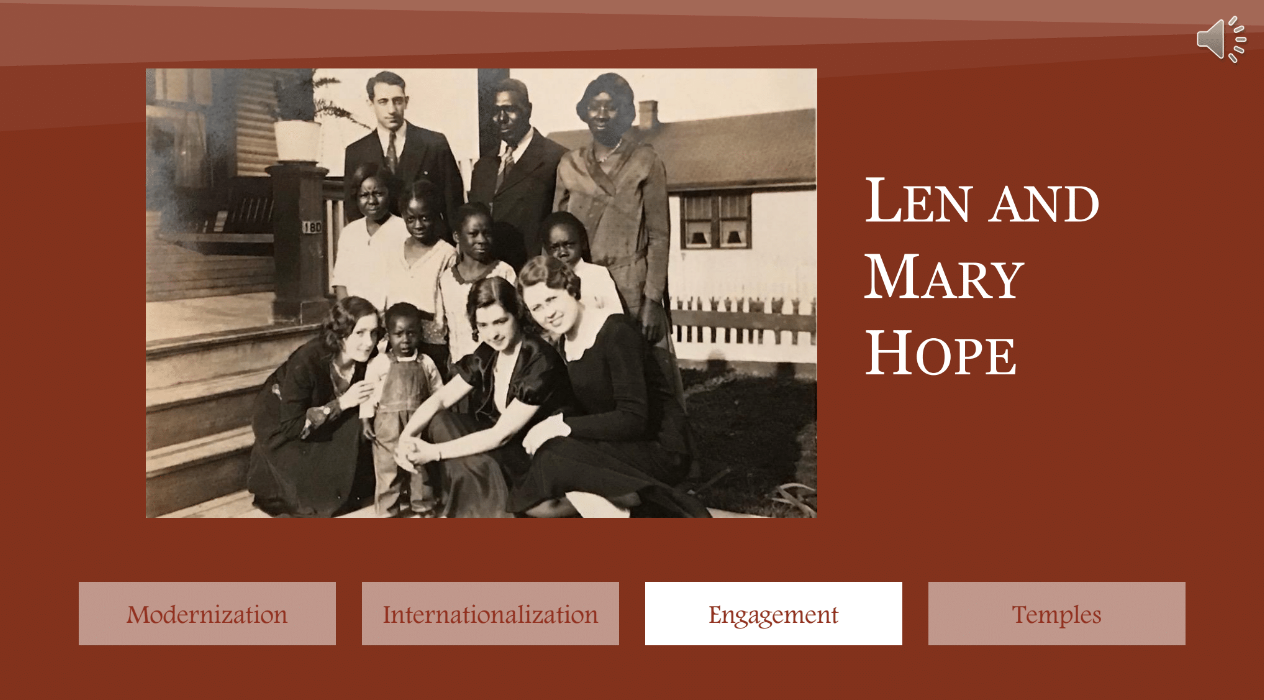
Now I’d like to turn to another element of engagement where the Church is not isolationist any longer. The Church begins converting black members in larger numbers in this era, and not just black members, but people of various ethnicities and races. The Church is going into South America, for example, in this time.
But we tell the conversion story of a black family in Alabama, Lynn and Mary Hope, and then we follow them to Cincinnati. The reason why I put their story here is we don’t try to shrink or shy away from the racism that this family endured, not only outside the Church but in it. We show in Cincinnati a schism within the branch.
Members Welcoming the Hopes
Cincinnati Branch, if you know where it is, Kentucky abuts Cincinnati on the Ohio River, and so there were members from the south in Kentucky who came across the river, who attended the branch, and there were members from the north. As near as we can tell, many of the northerners loved the Hopes, wanted them in the congregation, had no issue with them joining the congregation, but there were some members from the south that felt otherwise. We show how these northern members were willing to go to the Hope’s home and worship with them, bring the sacrament to them, and that represented a workaround to a problem that was going on in the branch but also in the larger world.
We actually have this amazing recording that Marion D. Hanks, who was a missionary in Cincinnati in the early 1940s, made where he recorded Len Hope bearing testimony. This recording dates to about 1947, and I’m going to play a section of it for you. I hope you can grasp a sense of Len Hope’s testimony. Despite things not being perfect in the Church and in the larger world racially, he still clung to his faith despite those obstacles.
Testimony of Len Hope:
And the Holy Ghost might come, the small pure voice calling you to feel the life of the servant harmless as a dove, bold as a lion and humble as the Lamb. The greatest thing of all in the world they’ll give you an assurance in your heart to know which of all the sects was right and from that day after this, I haven’t had a minute doubt in my heart that the Church of Jesus Christ of Latter-day Saints, was the only true Church on the Earth. And I love to live the gospel, pay an honest tithing, live the word of wisdom, and will be saved back into the presence of Our Lord from which we went forth.”
About the Hopes
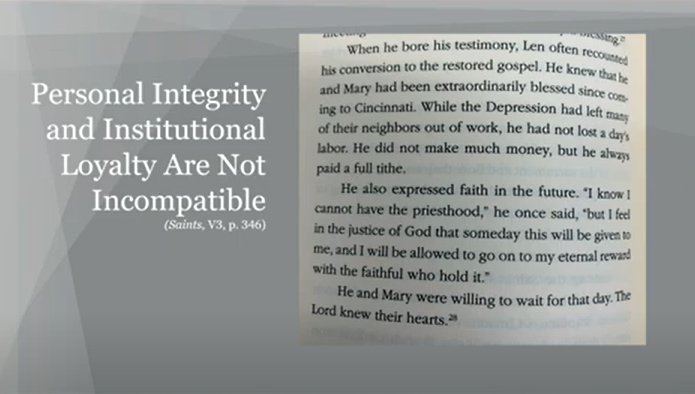
Okay, let me read a passage about the Hopes from Saints volume 3.
When he [Len] bore his testimony, he often recounted his conversion to the restored gospel. He knew that he and Mary had been extraordinarily blessed since coming to Cincinnati. While the Depression had left many of their neighbors out of work, he had not lost a day’s labor. He did not make much money [He worked in a paper factory], but he always paid a full tithe.” We have numerous accounts from missionaries where they say Len was fastidious about paying his tithe. “He also expressed faith. ‘I know that I cannot have the priesthood,’ he once said, ‘but I feel in the justice of God that someday this will be given to me, and I will be allowed to go on to my eternal reward with the faithful who hold it.’ He and Mary were willing to wait for that day. The Lord knew their hearts.”
Once again, personal integrity and institutional loyalty are not incompatible. Sometimes, we hear people say that they need to resign from their Church membership because the Church hasn’t satisfied them on some count. Well that argument is not a very good argument. We all can find something that we wish were improved in the Church, and if we took that argument literally, none of us would be in the Church. The Church is a place where we bear one another’s burdens and where things evolve over time. So I love the story of Len and Mary as a story that shows you can have things that you want as a person and you have institutional loyalty, and even if those things that you want as a person are not entirely met, you can still be loyal to the institution.
Saints Resources
With that, I think I would like to take questions at this point. I have a few more slides that we could get into. Let me just conclude by showing this slide.
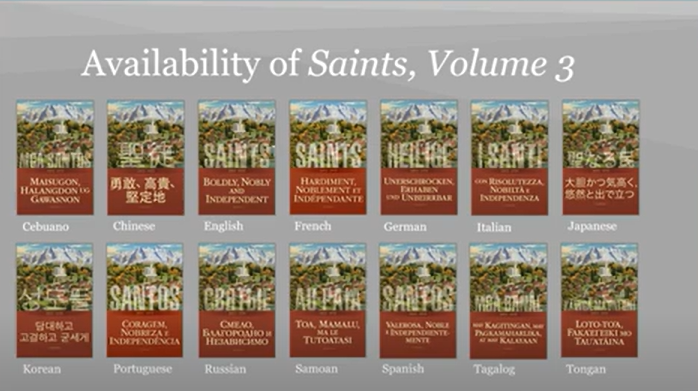
Saints is translated in full into 14 languages, covering about 96 percent of all members in the world that can read Saints in their own language. The other 4%, they get parts, mainly because there aren’t enough members to justify a full translation, but many of those 4% know English as a second language. It really has a worldwide coverage.
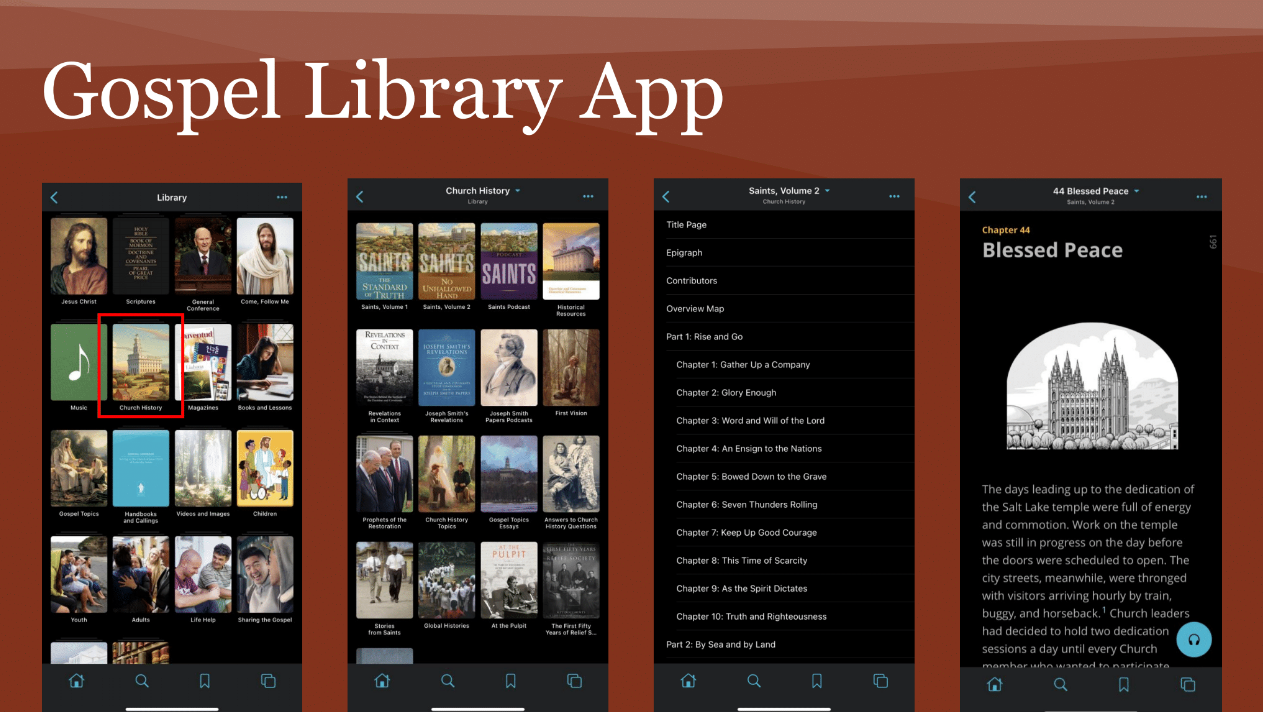
It can also be found on the Gospel Library app on your phones. Saints one, two, and three, as well as a Saints podcast which I find very few people, or relatively speaking don’t know that we have a podcast. We’ve got about 90 episodes up. So, each chapter of the book has about 45 minutes where a talking head is being interviewed, and then there are Church history topics and videos.
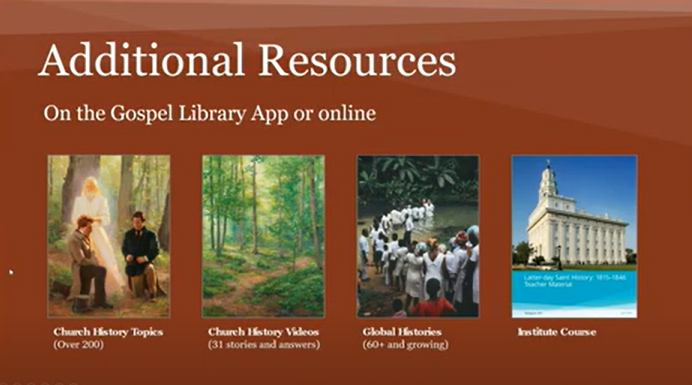
The Church history topics are a deep dive into topics that Saints, because of its narrative pacing, is not able to pause and reflect on. And so, we’ve written short essays on these topics. We have over 100 essays. This content is only online. And then, you see the additional resources there that you could get into.
Conclusion
So, I hope you enjoy Saints and I’m happy to answer your questions now. But just in sum, I want you to know that these books are being written with the utmost care. They’re being written by people who are devoted to the world of scholarship and the life of the mind, but also to the Kingdom and to the faith that we all share.
And I hope that you can sense that from my words and my testimony and I speak for our team. I think our team is just amazing, is second to none. And we have, as I say, this combination of faith and learning, faith and scholarship is there on every page. And I hope you can see that and benefit by it. Thank you.
Scott Gordon:
Great, thank you so much. And I think I can say on behalf of everyone here how much we appreciate the history department and what you have done in putting forward with Saints and all these volumes because I know that’s a massive undertaking. I don’t know if you can respond to that or not, it’s up to you.
Jed Woodworth:
Massive undertaking, well, yeah. And one of the things that is not well known about Saints is that we have a very small team. You know, it’s a large project but we only have five full-time people that work on Saints. But as you can see from the contributors page, we have a lot of people who read it. We’ve got nine review cycles where we have various stages of people who will read it. We have young people who read it, we’ve got experts who have either published, or archivists, who know a lot about the subjects that are covered in chapters. So, we have that stage where experts read it.
We have another stage where generalists read it, generalists from around the world. We have Apostolic reviewers, the Church historian reviews it, and then ultimately the first presidency reads it. They read every word and we have benefited from their comments. We’ve learned that President Nelson is a footnote reader. I mean, he doesn’t just read the running text, he reads the notes and he’ll correct us if we have something wrong.
Scott Gordon:
I knew I liked him for some reason. That must be it.
Jed Woodworth:
In one case we had a man in volume three named Vernon Sharp. We called him Vernon Sharp. And President Nelson wrote to us and said, “Well, you know, his name is J Vernon Sharp.” I’m not sure if the J got into the book but hopefully. So that has been a faith builder for me to see how the presidency has been able to find areas that were weak. You know, when you send a book up, you don’t want them to find anything and you are happy with the way it is, and yet they’ve always been able to advise us in ways that have been beneficial.
Scott Gordon:
So here’s a question: Saints reads very differently than BH Roberts’ history of the Church. How was the decision made to use this style in telling the Church story?
Jed Woodworth:
Yeah, so the BH Roberts history, called a comprehensive history of the Church, is a Victorian style written by a Victorian. I mean, BH Roberts was born in the 1850s, and so a 30-word-sentence in his era was well understood. Today, in the texting generation, our sentences have to be shorter. If they’re not shorter, they’re not going to be understood by young people. So you take a Roberts sentence and you cut it in half. So that’s one thing. The style has to be simpler for younger people.
But also, the reality is BH Roberts was read by college-educated people mainly, and Saints has to be read by people all around the world. So I’m constantly thinking, how could this sentence be misunderstood by someone in Uganda or Indonesia or Congo or wherever it is? And if I can’t explain an idea simply, then I have to go back and look at how to do that.
But there’s always going to be some specialized vocabulary. I mean, sometimes, like for example, we avoid the word “College” because “College” in other parts of the world means something else. It means “High School” essentially. So we always use “university,” thinking of a worldwide audience. But you know, Saints 4 has some issues that people are just going to have to learn about, like ERA, the Equal Rights Amendment. That is not an understanding that everyone around the world is going to have. But it’s important enough that we discuss it.
Scott Gordon:
Speaking of Saints 4, that brings up another question: When will volume four be available?
Jed Woodworth:
Well, I said up here it’s about halfway written. We’re hoping for 2024, but you know, there’s no guarantee.
Scott Gordon:
So one question came in: I found that The Hope Family story is very touching, and I know that Margaret Young has addressed that in the past at some of our conferences. But do we know what happened to the Hope children? Do we know if they stayed active?
Jed Woodworth:
Yeah, so one of them is still alive. He lives in Philadelphia, his name is William. He’s about 87, 86 or 87. And we wrote him, hoping that he would answer. We didn’t get a reply. And so I and the literary editor had a bet. Okay, if he replies, then I buy you a shake. If he doesn’t reply, you buy me a shake. And I won the bet. I said I don’t think he’s going to reply anyway.
What happened to them? It’s in some ways, it’s the story of America. In other ways, it’s an unusual story. So they come out in 1947, at the invitation of Marion D. Hanks; they come to Utah for a visit on the occasion of the 100th anniversary of the Pioneers entering the valley, and Len falls in love with the place. We don’t have Mary’s sentiments on her reaction. And Len said, “I’d really like to move out here.” And so they move out in 1952, and they live in Salt Lake City. And then within six months of their move, Len gets sick and he passes away. We think he had some kind of lung ailment from the paper, the particles that he inhaled. But so he passes away, and that leaves Mary here alone.
They have, I think, five children, but the children are in various stages. Some have already gone off and married, and the long and short of it is, the children don’t stay in the Church, but Mary does. She moves back to Philadelphia, where she has a son. I mentioned William, but they had another son who lived there. And so the children migrate to the Nation of Islam. So they’re Christian, initially, and then they migrate into Islam. But, you know, it’s a tragic story in some ways, the generation that doesn’t stay in the Church, where the parents have some belief and then the kids leave. And we’ve seen that story again and again.
Scott Gordon:
What do you consider to be the most interesting or surprising anecdote you learned while compiling this volume?
Jed Woodworth:
One of my favorite stories is how the Nan Hunter character came to be. So, some of you recognize there’s the story of a woman in San Diego who is a housewife in 1952 and a member of her bishopric comes to her and says, “We’re starting this new program in California, early morning Seminary, and we want you to teach it.”
How that story came to be, for me, is quite hilarious. So we had a reviewer who said there’s not enough California in the book. And my initial response is, “Oh, that’s special pleading.” I mean, are we going to say there’s not enough Maine or North Carolina? But on reflection, I started thinking, “Yeah, I can see the point.” California has an outsized influence. I mean, there are more members in California in sheer numbers than Utah. And so I went back and I just did a thought experiment. What happens in California in this era? I mean, besides the temple, right? LA Temple’s dedicated just outside of this era, but it’s being built in the volume three era. And it occurred to me, early morning Seminary begins in California.
Ten stake presidents in the LA area get together and they say, “Look, our young people don’t have the benefits of Seminary down here. We need to change that.” And they enlist the CES personnel in Salt Lake, and they send someone down. And he doesn’t know when to hold Seminary because they don’t have buildings, they don’t have release time, the people are scattered. So he finally concludes, the only time we can do it is early morning.
So I went to a collection of interviews done by a CES person where he went back and interviewed early Seminary teachers in California. And I was reading through this, and this woman stood out. I mean, most of them were men, but I think there were two women in the collection, and Nan Hunter’s story was so interesting to me. We wrote it up in an afternoon and revised it and got it into the book.
It’s just, it was a beautiful thing how initially this claim, not enough California, that I in my heart, I was kind of revolting to that claim. And then I just let it settle and ponder about it. And then I became converted to the idea of more California. And you know, maybe there’s a lesson in that, that we can have an initial, a negative reaction to certain things, but if we trust in the process, and in this case, I trusted in the wisdom of the authority who said this, even though initially I wasn’t converted to it. But over time, it worked on my feelings. And so we ended up getting that story in, out of that claim.
Scott Gordon:
That’s great. Being from California, I appreciate that. That’s good. I was just looking at the book again with my wife and we noted in chapter two, there’s this interesting story that kind of resonated with me about a gentleman who was making all kinds of wild claims against the Church, and it turned out he’d been a member. His name was William Jarman?
Jed Woodworth:
Yes, it was William Jarman.
Scott Gordon:
And he’d been a member, but then he had some practices that were not savory. And then he got arrested for larceny. And then he made a career out of going on the speaker circuits against members of the Church. I thought that just sounds so familiar to me.
Jed Woodworth:
Yes, yeah, we’ve seen that professional anti-Mormon.
Scott Gordon:
Yeah, the last question is: Will volume three be available on Audible eventually?
Jed Woodworth:
Well, that actually catches me by surprise. I thought volume three was already on Audible. I don’t know if everybody could help us with that. Well, I mean, the answer is yes, the other volumes are on Audible, and maybe it’s, I mean, volume three has only been out two months, so maybe that’s the issue. [Someone says it’s on Audible.] Man, what an easy question.
Scott Gordon:
It is on Audible. Excellent. So thank you. We really appreciate your time and your efforts in putting this together.
Jed Woodworth:
Thanks, Scott.
coming soon…
Does Saints sugarcoat Church history?
It presents both challenges and faith-building experiences, allowing readers to grapple with historical complexity while maintaining a faithful lens.
Why is doubt acknowledged in Saints?
Faith grows stronger when it is freely chosen amid competing viewpoints, reflecting Lehi’s teachings in 2 Nephi 2.
Faith as a choice amid opposition.
The evolving role of the Church in a modern world.
Honesty and transparency in presenting history without undermining belief.
Share this article
