Summary
Gary Lawrence explores the impact of discussing the concept of agency in a relaxed and open manner. He emphasizes how these conversations can naturally spark interest in the gospel by helping others understand the importance of making choices and the role of agency in spiritual growth. He encourages creating a positive environment for such discussions to foster deeper interest in faith.
This talk was given at the 2022 FAIR Conference on August 4, 2022.
Gary Lawrence, a public opinion researcher and author, specializes in understanding attitudes and effective communication strategies, applying his expertise to helping others share gospel principles naturally and meaningfully.
Transcript
Gary Lawrence
Introduction
Thank you very much, and it’s a pleasure to be with you this afternoon, and I hope that what we talk about may be of interest and help you as you share the gospel with other people.” How comfortable conversations about the gift of agency lead to interest in the gospel or,” “Have an attitude of gratitude for latitude and vicissitudes, dude.”
To have an attitude of gratitude for latitude is, in essence, to accept the broad range of free agency. Vicissitudes happen with the ups and downs of life, most of them on the negative side.

Ups and Downs
When I served a mission in Germany, it wasn’t too many years after World War II, and a lot of people at the door would say, “I’m not interested. If God existed he wouldn’t have let this happen.” And many missionaries of that age will tell you they heard that door after door after door, the people rejecting religion of any sort because of all of the things that they had experienced of a negative nature.
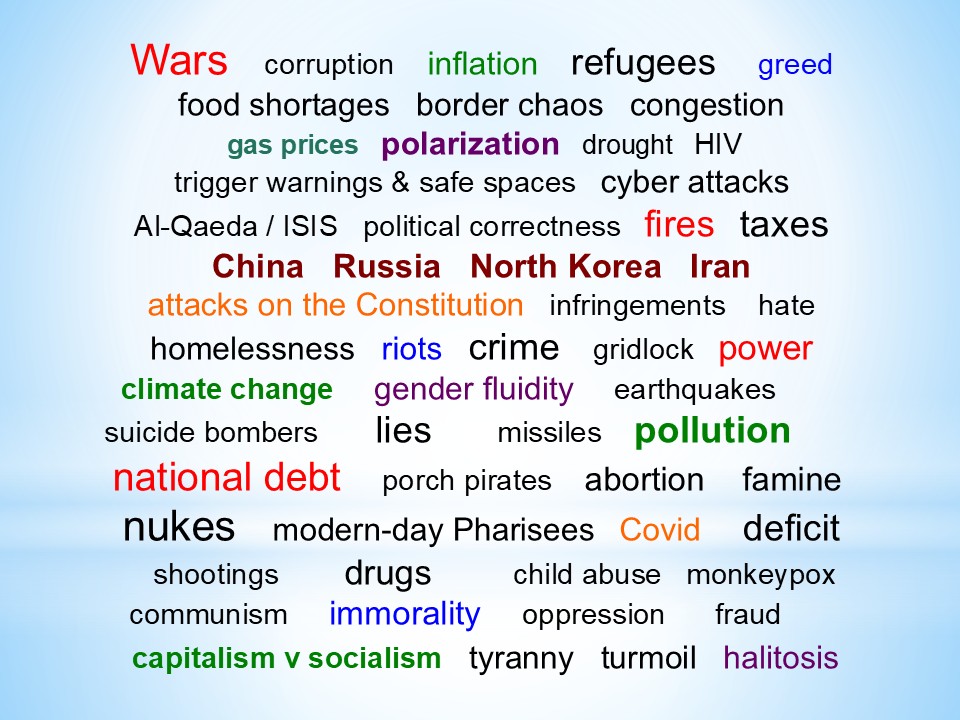
By the same token, if not so intensely, we face a lot of these problems of life, the ups and downs of vicissitudes, from wars to famines to plagues to earthquakes and everything in between. And people today are saying, “If God loved us, if He was really there, He wouldn’t let these things happen.” And of course, we say it’s just the opposite, all of these things are for our benefit and experience and shall be for our good.
A Parallel
And there’s a parallel, it reminds me of the little girl who’s getting a vaccination and she looks at her mommy, “Why are you letting these people hurt me?” Of course, the little girl doesn’t understand very much about immunology and the mom couldn’t explain it all in as great a detail, but through life, she comes to recognize that what happened with this lousy experience was really for her good. And so when we look back at all of the problems facing us, we know the answers, we know what will help people, and it is the Gospel of Jesus Christ.
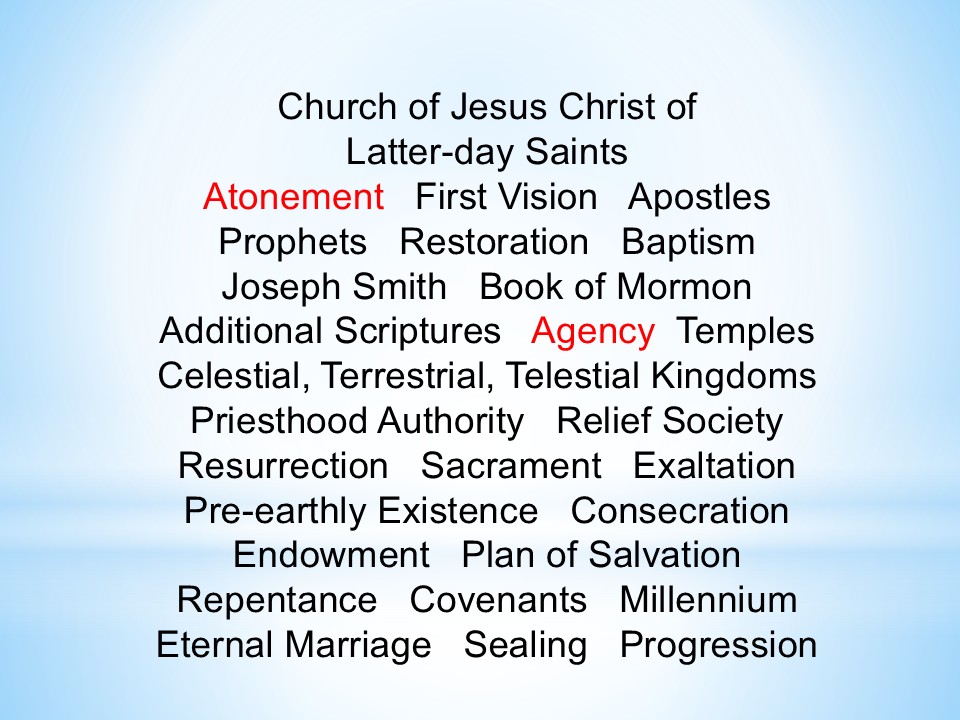
So you have all of the problems lined up with the answers. What do you emphasize? How do you begin? How do you start to explain things? Yes, we could start with the First Vision, yes, we could explain the Book of Mormon, yes, we could explain about resurrection and on and on and on.
Setting the Framework
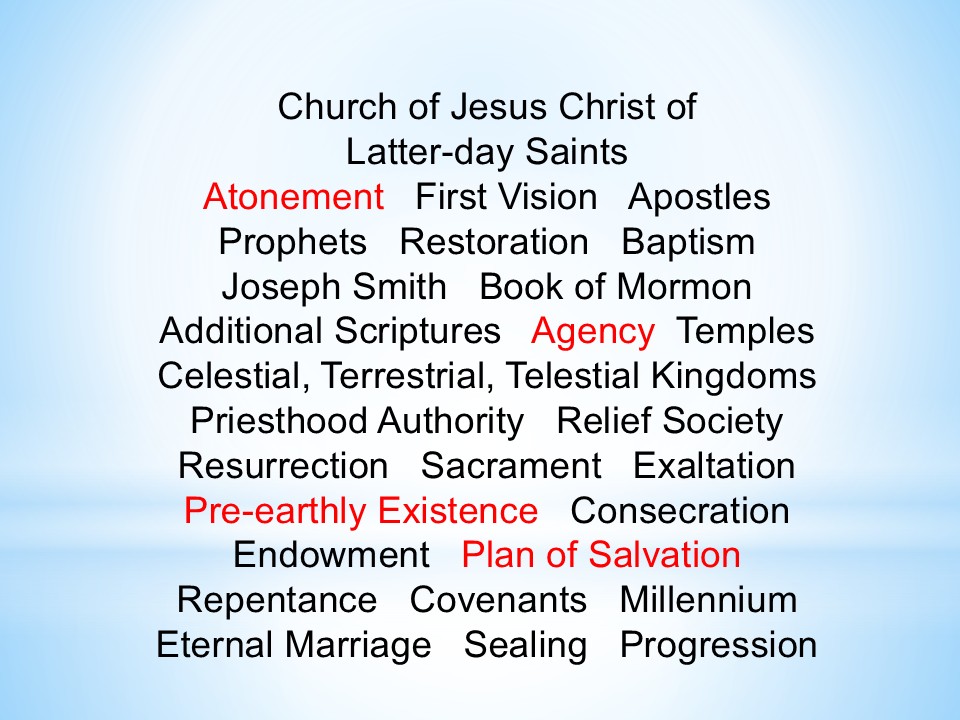
And what I’m here today to suggest is a way of setting a framework, and every College debate coach in this nation tells his students, he who sets the frame usually wins. We set the frame for life by emphasizing, to begin, with two things: atonement and agency.
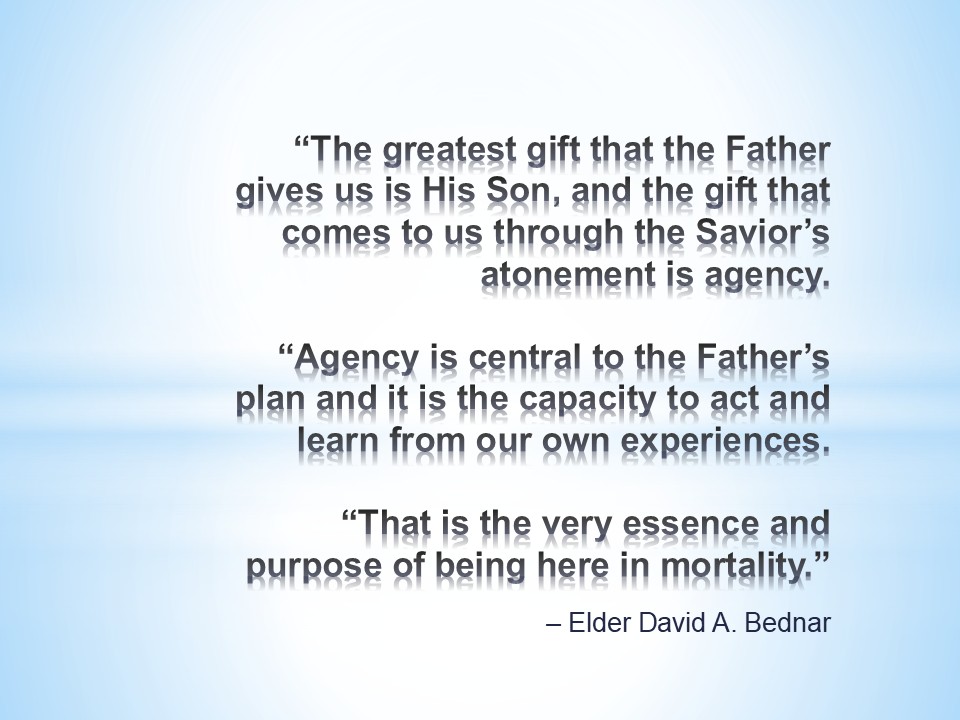
And I love Elder Bednar’s talk;
The greatest gift that comes from God is His Son, and the gift that comes to us through the Savior’s atonement is agency. Agency is central to the Father’s plan and it is the capacity to act and learn from our own experiences. That is the very essence and purpose of being here in mortality.”
In essence, agency and atonement go together. You cannot have one without the other. You could have the atonement, but if you don’t have agency, there’s nothing to be atoned for because you couldn’t be held responsible. But we have agency so we learn, we take responsibility for our actions and decisions, and we progress.
It’s the magnificent gift of agency.
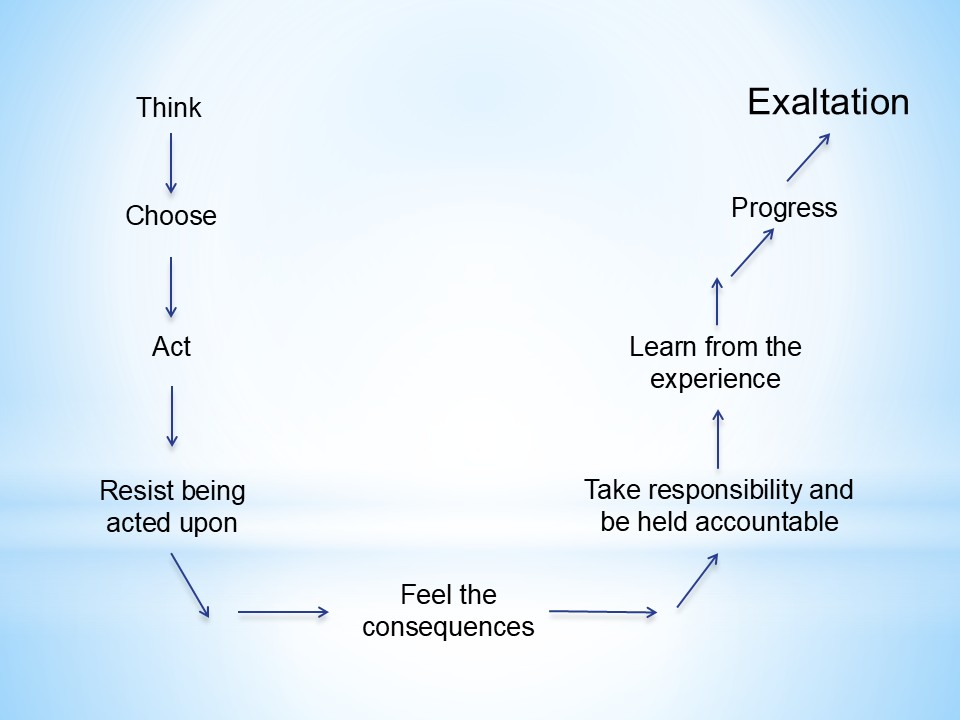
What Agency Entails
Now let’s just quickly go through the pattern of what it entails. This is all, of course, old news to all of us, we’re very, very familiar with it.
But it first begins with thinking, and then choosing, and then acting. And there’s a great phrase that somebody said, “Nobody eats until somebody takes a risk.”
A farmer plants his field and he’s taking a risk with the weather, with the lightning, with fire, whatever it may be.
Progress
And in the process, we resist being acted upon, we feel the consequences, we take responsibility and are held accountable, we learn from the experience, we ponder, we review, we think, and we go, “Aha!” (Which is why a lot of people are going to end up with dimple chins and slope foreheads.)
And we progress. Now what if things don’t turn out right? What’s the pattern then?
Well, rinse and repeat – or repent and repeat.
And when we do, and no matter how many times we circle around, repenting sincerely and improving each time we make a decision, we eventually hit the goal of exaltation.
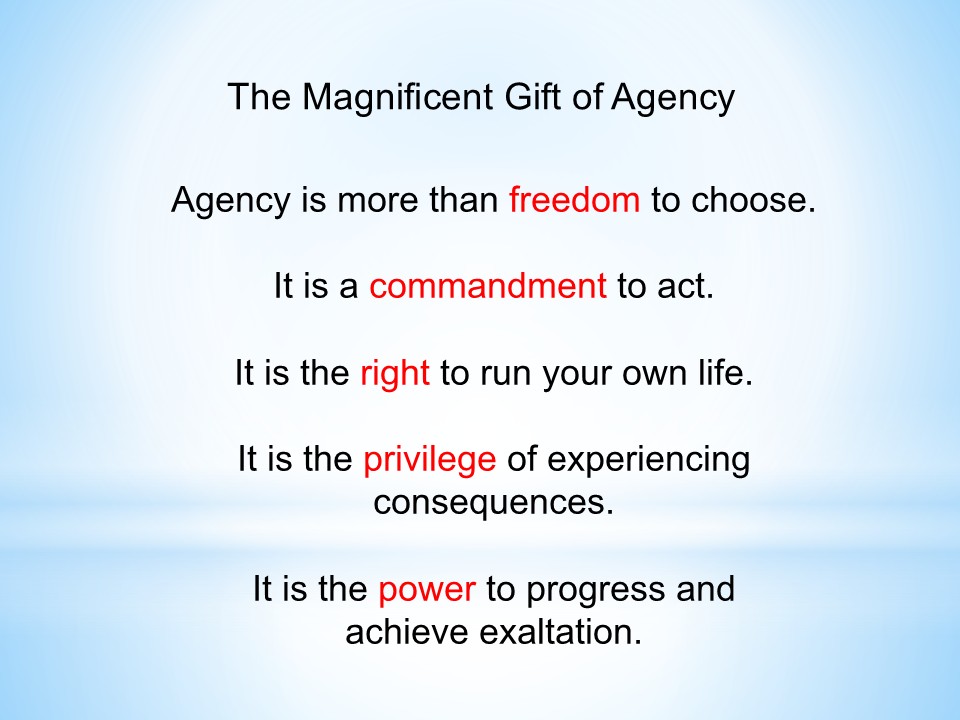
The Components of Agency
So, the magnificent gift of agency has several components. It’s more than freedom to act. It’s a commandment to act, it’s the right to run our own lives, a privilege of experiencing consequences, and it’s the power to progress and achieve exaltation. Note the key words: freedom, commandment, right, privilege, and power.
Agency and atonement work together. We are given power as we came here on this earth, power to choose, to act, to learn, repent, and progress.
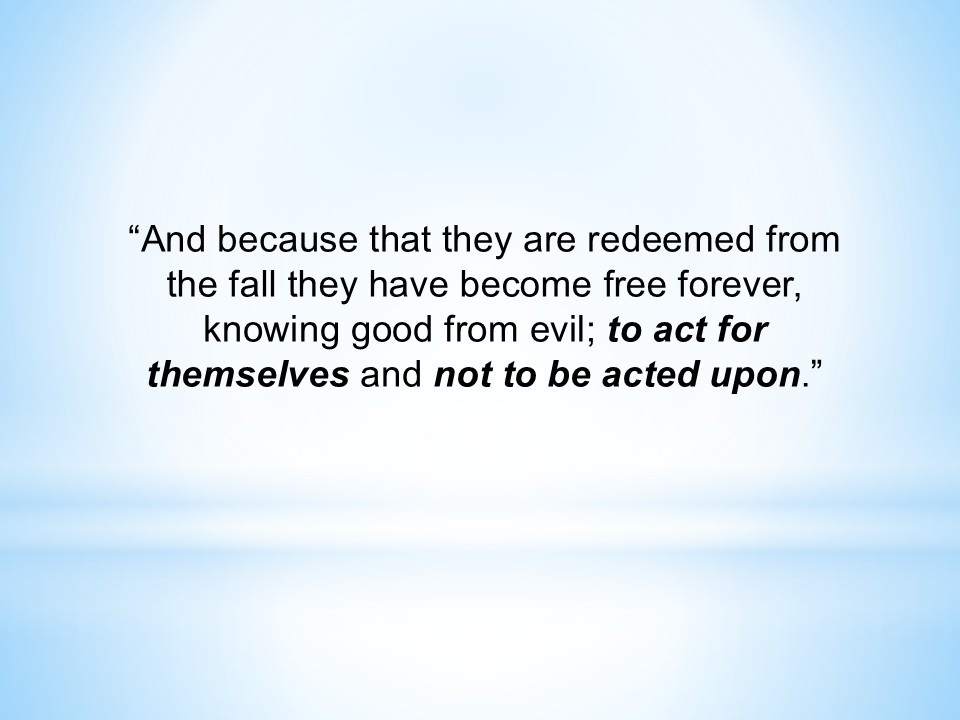
And as it says in the second chapter of 2nd Nephi, one of my favorite chapters, we “become free forever, knowing good from evil; to act for [ourselves] and not be acted upon…”
Now, Elder Uchtdorf expressed it very nicely:
What I am asking is that you always look for opportunities to bring up your faith in natural and normal ways with people – both in person as well as online.”
What he’s asking us to do is to “look for opportunities to bring up [our] faith in natural and normal ways with people – both in person and online.” In natural and normal ways.
Pre-earthly Existence and the Plan of Salvation
So when I take a look again at the atonement and agency, I’ll add two more items to it:
Our pre-earthly existence and plan of salvation. As I was growing up, it was known as the pre-existence, sometimes known as the premortal existence, but mortal has a connotation of death, and so I think for most people not of our faith, if you mention it in terms of a pre-earthly existence, they get it.
And our job again is to frame and to plant. We frame by expanding the vision. The little girl receiving that inoculation shot didn’t see the big picture. A lot of people facing today’s problems don’t see the big picture. So we frame by expanding the vision, and we plant a new thought that the Holy Ghost can work on.
Act Two
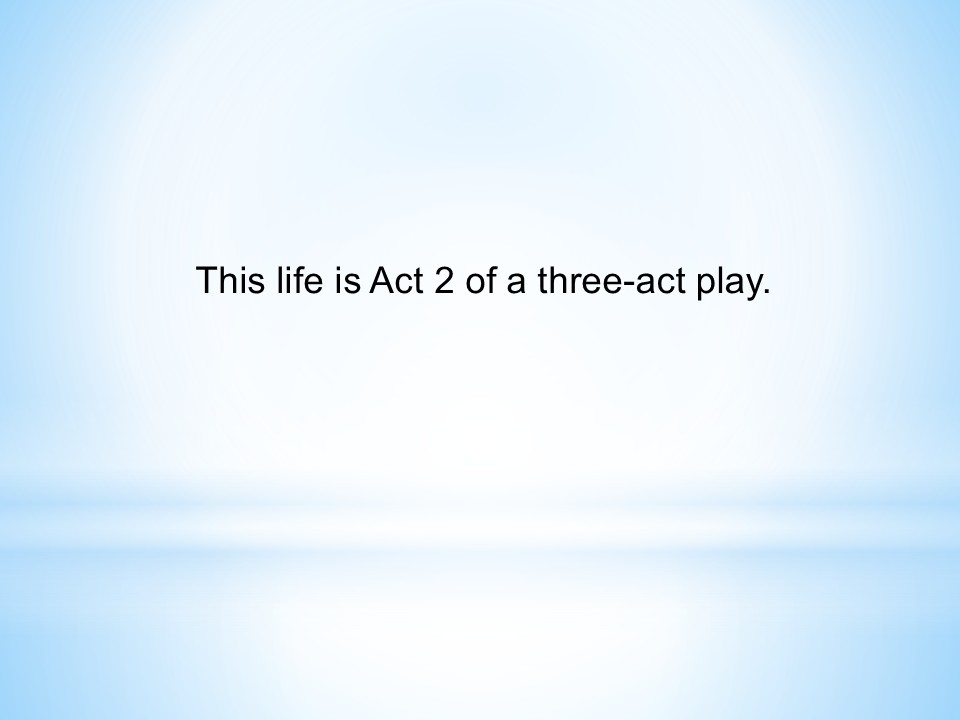
The one that I find very useful is this one: this life is act two of a three-act play. Most people don’t think of it that way. They think life begins, life ends, there may be something afterwards, they don’t even think of something that might have happened before.
I did a national survey, about 12 years ago, where we asked, and found out what percentage of Americans believed we lived with God in heaven before we came here. You want to take a guess?
28 percent. We are two of those 28 points, which means for every one of us, there are 13 other Americans not of our faith who also believed that they lived with Heavenly Father before they came here. They believe in the pre-earthly existence. Why is that so? Where were they taught that? “Upstairs,” they brought it with them.
HOME
And sometimes the conversation will flow a little bit more in that direction, and we can explain to people that if you attend a religious service, a funeral service, in any denomination, you’re likely to hear “God called him home”, right? Well, ask yourself, how can a place be called home if we never lived there? So we have this framework, and now we’re ready to explain the gospel, right? Wrong. There’s an awful lot that’s not being done in our missionary efforts that I think we can contribute to helping if we understand a few more things.
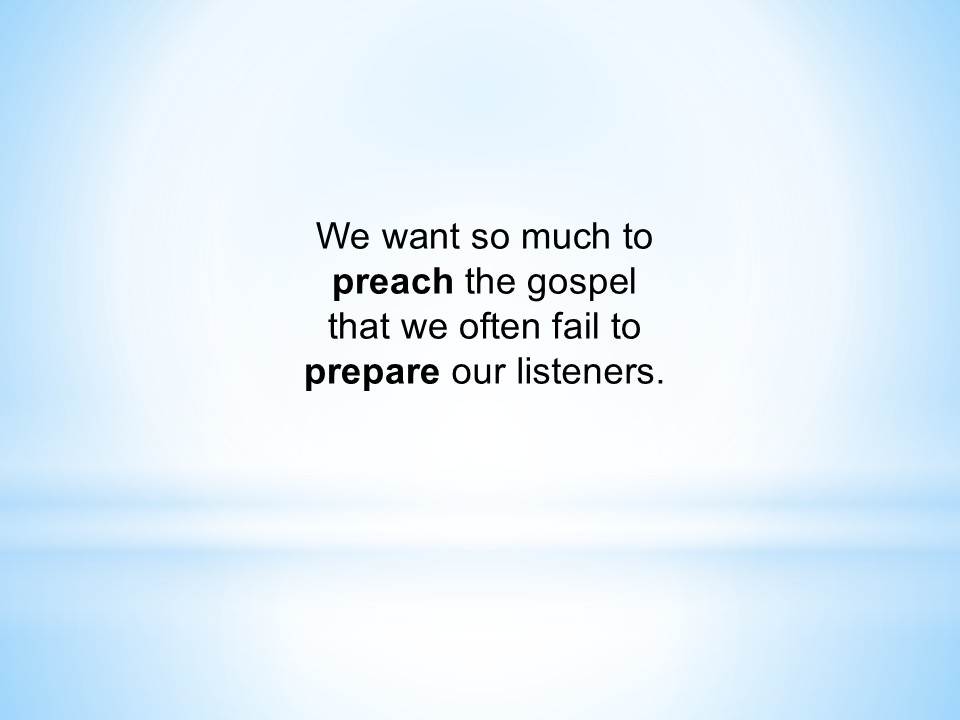
I know here in my home in California, we have a lousy retention rate. In California, for new baptisms five years later, only one person out of ten is still a member, is still active. So there’s much to do, especially when we want to preach the gospel, we fail to prepare our listeners.
Love, Share, Invite
How well do we know them? How well do we really understand who we’re talking to? And I love Elder Bednar’s statement: we love, we share, and we invite. Thank goodness we’re not using the word challenge anymore.
But to love and then share, some people will think, “Well, I have a Christian love for everybody, so now I’m going to just launch into preaching and sharing.” No, how well do you love that person you’re talking to? How well do you understand him or her? So when I drop a little note into people’s minds that we lived with God in heaven before we came here, I follow it up with this: this life is act two of a three-act play.
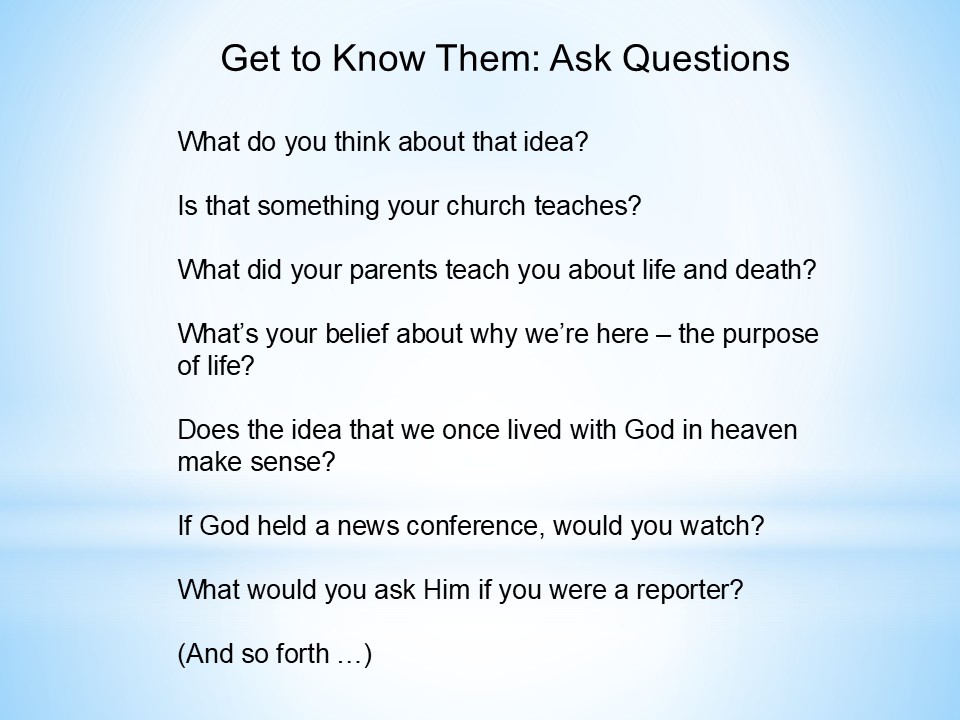
I ask them what they think about the idea, is it something that their church teaches? There’s only one church in this world that teaches, as a regular part of its doctrine, the pre-earthly existence. What did your parents teach you about life and death? What do you think is the purpose of life?
Mental Ocean
Does the idea that we once lived with God in heaven make sense? And then make it sort of modern-day by saying if God held a news conference, would you watch? And if He did hold a news conference, do you think you’d learn something new? And if you had the opportunity to be a reporter at that news conference, what would you ask Him?
And we find that people think deeply about it. You’ll find that people do a lot of worrying about the future. In public opinion research, we have what we call a mental ocean. At the top of this mental ocean would be people’s opinions, they change daily, whichever way the wind’s blowing.
Beneath those are a strong set of attitudes. But the deepest current in the mental ocean would be the values, the people’s hopes, their needs, their beliefs, and their fears. You tell me somebody’s fears and I have a pretty good idea what their values are and their hopes and their needs and their beliefs. Let’s understand what they worry about about the future, and then we can see an opportunity of how the Gospel of Jesus Christ, the restored Church of Jesus Christ, will help.
Respond in Conversation
So as you encourage others to, talk about themselves, their opinions, or experiences, or philosophy, and so forth, polite people will, in turn, ask you questions about you and your beliefs.
Don’t use a little crack in the door to barge through, but respond in normal conversations back and forth. Find out what they believe. See an idea of when you can drop something into their mind, and it comes down to planting a thought, which is the second part.
Plant a Thought
There was a young man in high school, at Anaheim High School, not a member of the Church, who was walking down the hall, and as he passed a group of girls who he recognized were, to use the old vernacular, Mormon girls, he overheard one of them say, “I can’t imagine getting married anywhere but in the temple.” He continues to walk by; he just happened to overhear that phrase, and he said, “I could not get that thought out of my head day after day after day. What is so special about a temple? What about Dana Point at Sunset or somebody’s backyard or a nice Cathedral or a nice setting? So, I decided to investigate.”
I think you know where this story is going. He investigated the Church, he joined, served a mission in the Philippines, and was until just recently a member of our stake presidency. That girl who said, “I can’t imagine getting married anywhere but in the temple,” to this day, probably does not know what she put in motion. It’s a power, plant a thought.
The Magnificent Gift of Agency
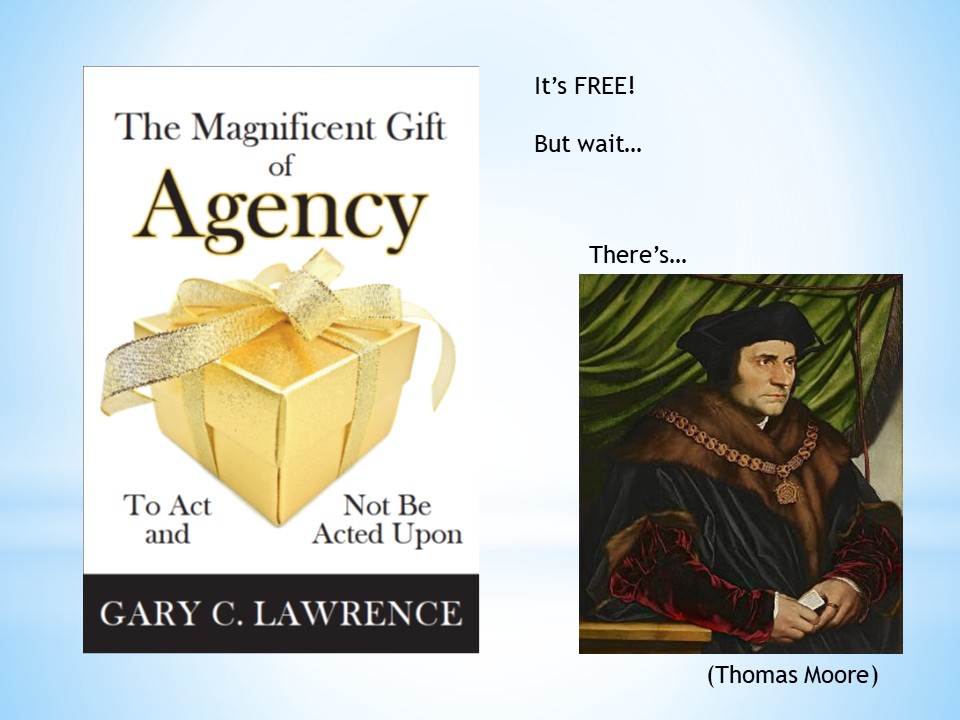
And to assist you in having normal, comfortable conversations that may lead to an interest in what we believe, at the end of my presentation today, I would like to give each one of you a free copy of my book, “The Magnificent Gift of Agency.”
When we get through with the Q&A or beginning of the Q&A, that will be passed along. I hope you’ll find it useful. And I’ve always wanted to say something like this: it’s free!
And then what do they say next on TV? “But wait….” And then what comes next? (“There’s more!) That’s to get you to wake up after lunch.
So, it boils down to agency.
Honoring Agency vs. Violating Agency
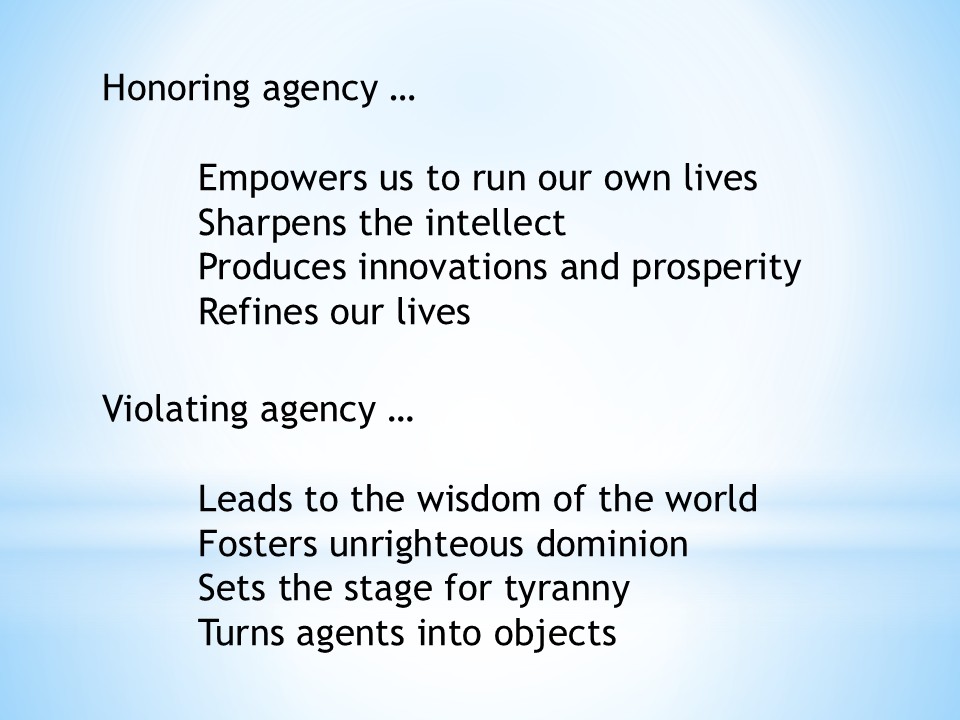
Honoring agency empowers us to run our own lives, sharpens the intellect, produces innovations and prosperity, and refines our lives. Violating agency, on the other hand, leads to the wisdom of the world, fosters unrighteous dominion, sets the stage for tyranny, and turns agents into objects.
Let’s say you face a decision. There’s a proposal, an idea, maybe it’s in your business, maybe it’s in public life, maybe you’re a representative of the state legislature, in the Congress, and there’s a proposal or policy, piece of legislation brought before you. How do you decide? And may I suggest that we put into the bleachers on the side any labels: Republican, Democrat, liberal, conservative, etc., and just follow a few guiding questions.
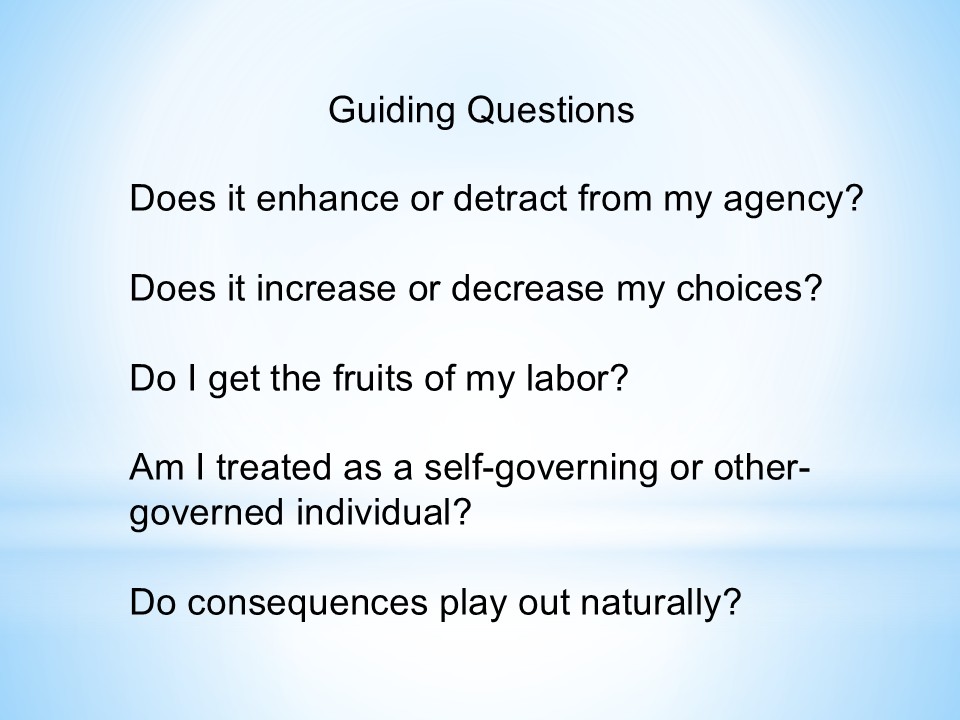
- Does it enhance or detract from my agency?
- Does it increase or decrease my choices?
- Do I get the fruits of my labor?
- Am I treated as a self-governing or other governed individual?
- And do consequences play out naturally?
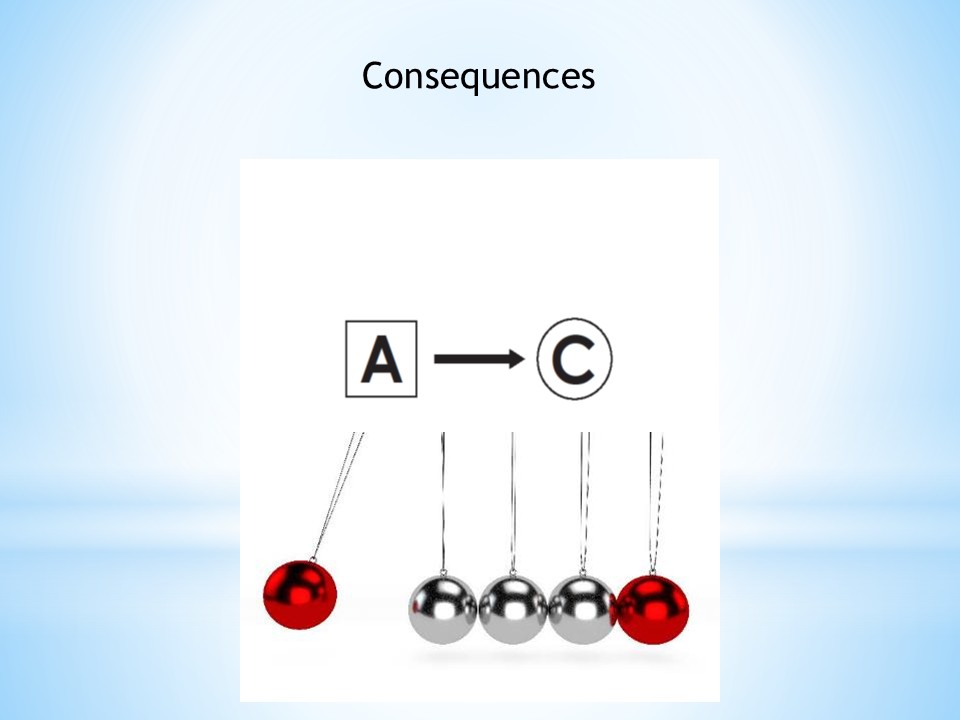
Consequences
Let’s pause here and look at consequences in a little more detail.
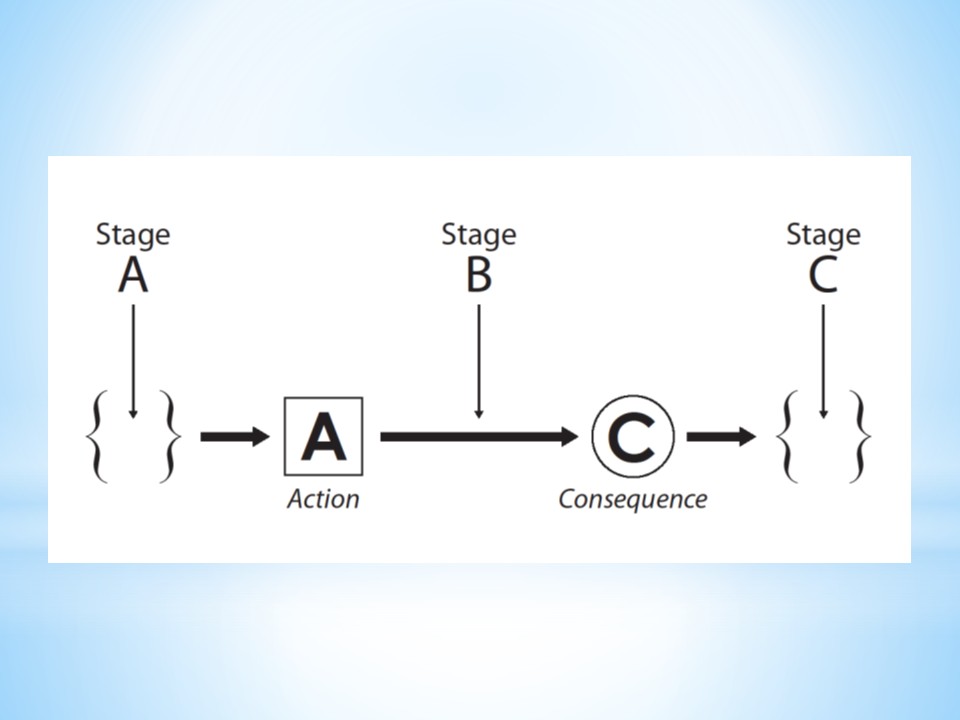
There will always be consequences to every single action that any of us take. The normal pattern is, have an action; you get a consequence.
But take a look at what happens in the learning from that consequence, divided into four segments.
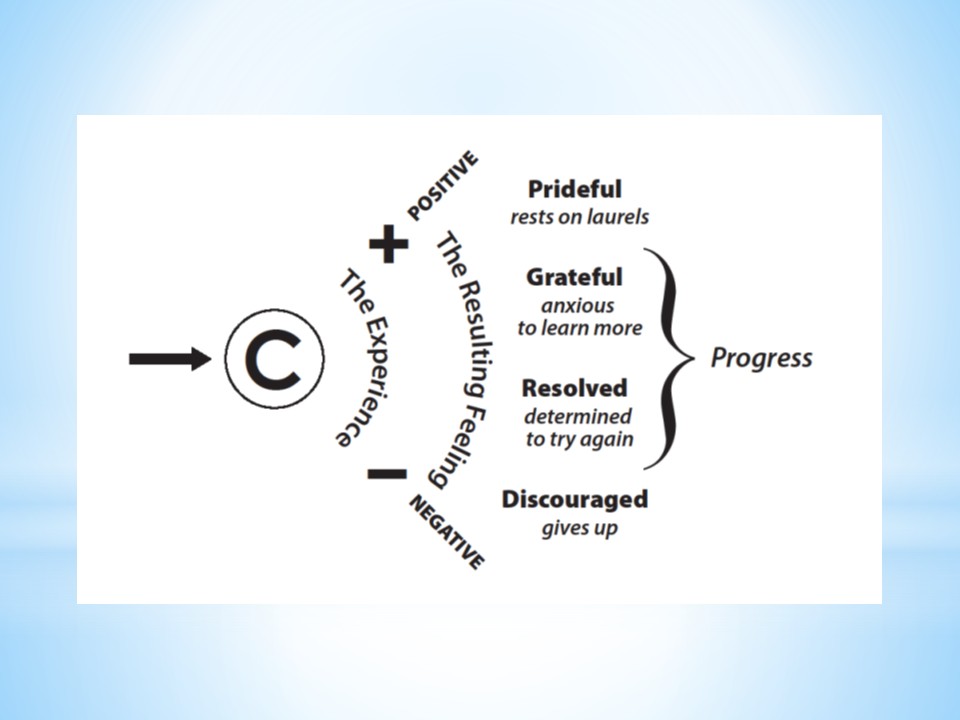
There are two positive outcomes and two negative outcomes. Positive could be prideful, “Hot, I kind of nailed that one, didn’t I?” and then you rest on your laurels. At the other end of the scale, you could be discouraged and give up.
In each case, you haven’t learned what you need to learn from the consequences. It’s the two things in the middle. If it’s a positive outcome of that consequence, you’re grateful and you’re anxious to learn more. If it’s a negative outcome, it’s still positive because you will become resolved and determined to try again.
Helicoptering
The problem with us, and I’m speaking from personal experience, is that sometimes we become helicopter helpers or helicopter parents. There’s several times that we can help influence others.
We can talk to them. Let’s say your children, grandchildren, you can talk to them before they act, or you can talk to them after they act and have felt a consequence and help them learn from it. But the problem is too many of us intervene between the A and the C, the action and the consequence.
Now, I’m not talking about a baby who falls from a second-floor balcony. I’m not going to let it bounce on the sidewalk to teach it a lesson. I’m not talking about major injury and death. I’m talking about the consequences that are negative and yet still give that person a chance to go on.
The Positives of Agency
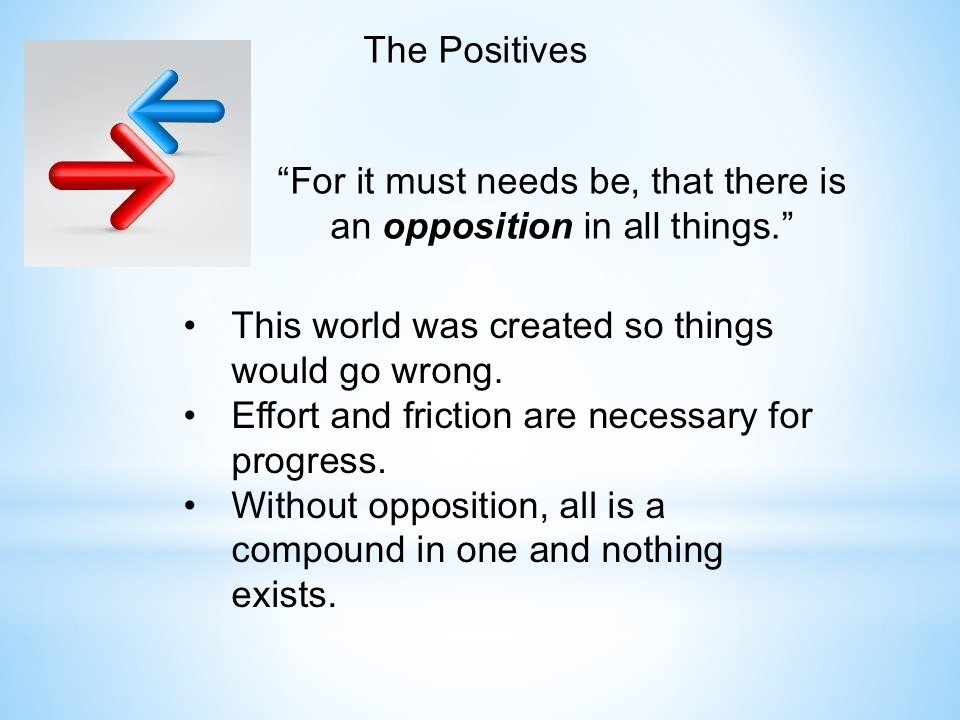
Let’s take a look at some of the positives. All of these will be treated in my book. So, you can read it in more detail, but positives that begin with opposition.
There must needs be opposition in all things, to which I wish the writer had said, “Thank goodness.” Why?
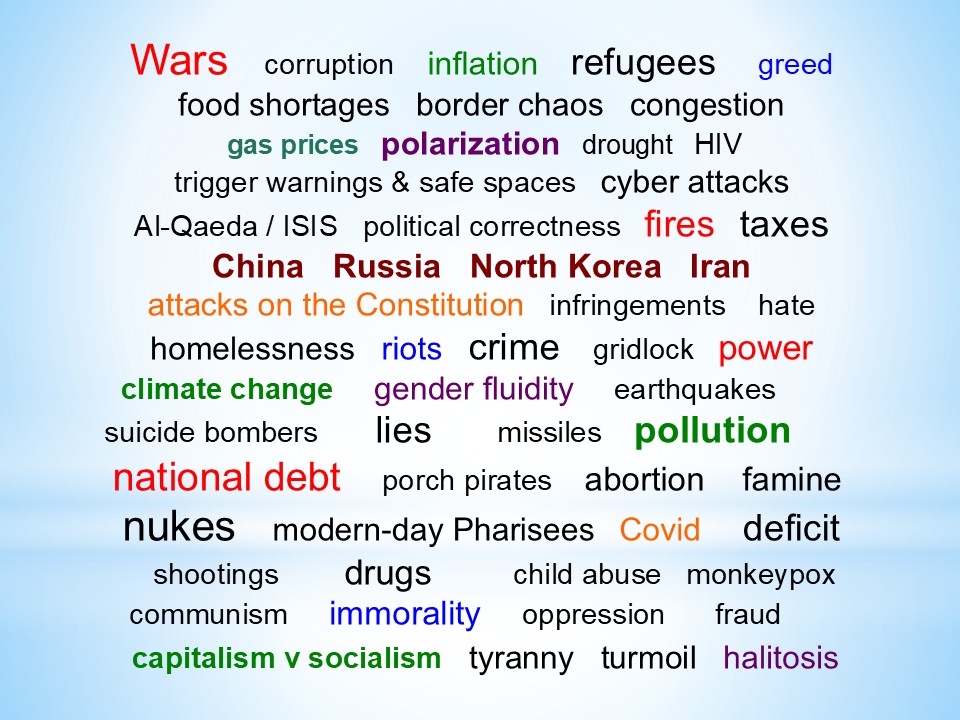
And there’s another statement that I use, “The world was created so things would go wrong.” It’s a natural part of life. Yes, we have wars. Yes, we have famines. Yes, we have inflation.
But effort and friction and opposition are necessary for progress because without opposition, all is compound in one, and nothing exists. Without opposition, everything is black ice, and the car doesn’t move forward, no matter how the tires spin.
I’m a half-century Californian, but I grew up seven miles from here in Springville, and I know about our black ice like you know about black ice. Those tires can spin and spin and spin but won’t move until you put either sand underneath it or tire chains.
D&C 122
So, let’s return back to this. Here are all the problems.
Here’s the parallel. How can we look at it in the right perspective? May I suggest D&C 122?
The Prophet Joseph was in Liberty Jail (talk about an oxymoron, ‘Liberty Jail’). And as part of three sections of the Doctrine Covenants given to him, and the one that says, “If you are called to go through these things,” and the 11 items are listed, everything from perils and false accusations and being in the hands of murderers and the very jaws of Hell gape open wide after thee, this big if-then sentence, then concludes, as you well know, “Know that all these things shall give thee experience and shall be for thy good.”
So that medicine in that inoculation to that little girl is going to help her just like the gospel is going to help people once we get it to them so they understand how it works. Let’s take a look at the mind.
The Human Mind
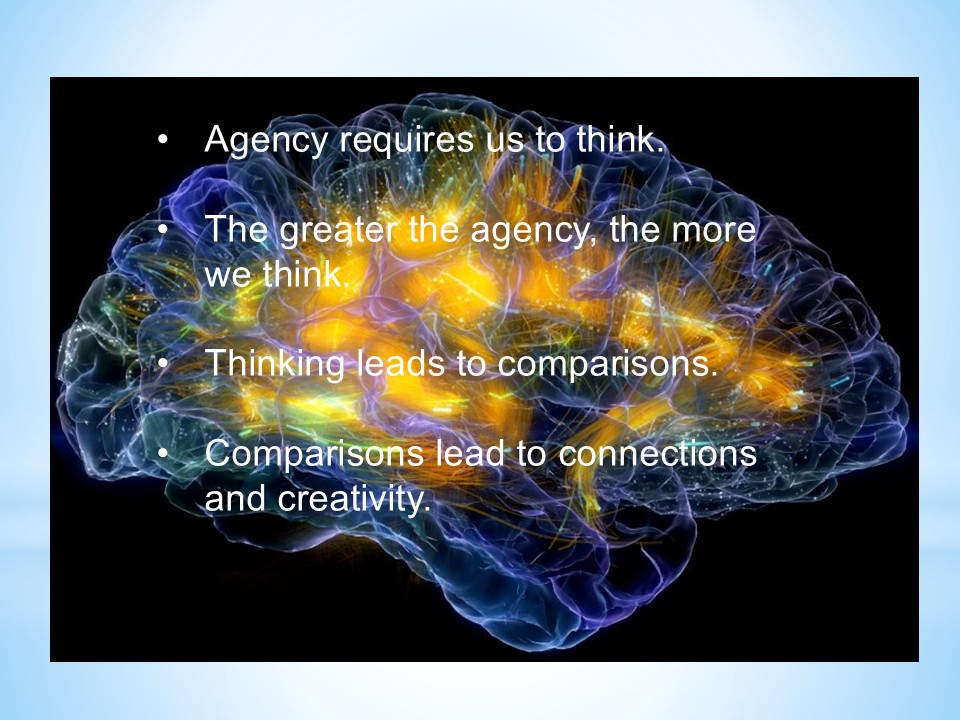
In your mind, there are 100 billion little houses that are called neurons and trillions of miles of dendrites that are the connecting wires, each 1/100th the diameter of a human hair, to connect the neurons with each other into clusters that we call thoughts. Now, when a new stimulus comes into your mind, the mind will take a look at it and say, “Hmm, I wonder where that belongs. Hey, you guys over there, does this thought belong over? Okay, what about you guys?” And the more time we can allow the mind to check out connections, the more creative we will be.
There was a young teenager who was plowing a potato field in Idaho a century ago, and as he completed his line-by-line furrow-by-furrow plowing the potato field for preparation for planting, he looked at it and began to wonder, and he started to connect those lines that were plowed with other kinds of lines, like maybe a picture might have a whole bunch of lines connecting through it. And guess what?
It led to the image connector and the cathode ray tube. Philo Farnsworth, one of the pioneers of television, and it all started with the potato field.
Agency requires us to think. The greater the agency, the more we think. Thinking leads to comparisons. Comparisons lead to connections and creativity. And as the saying goes, “The light goes on.” Steve Jobs put it this way, “Creativity is just connecting things.”
Action
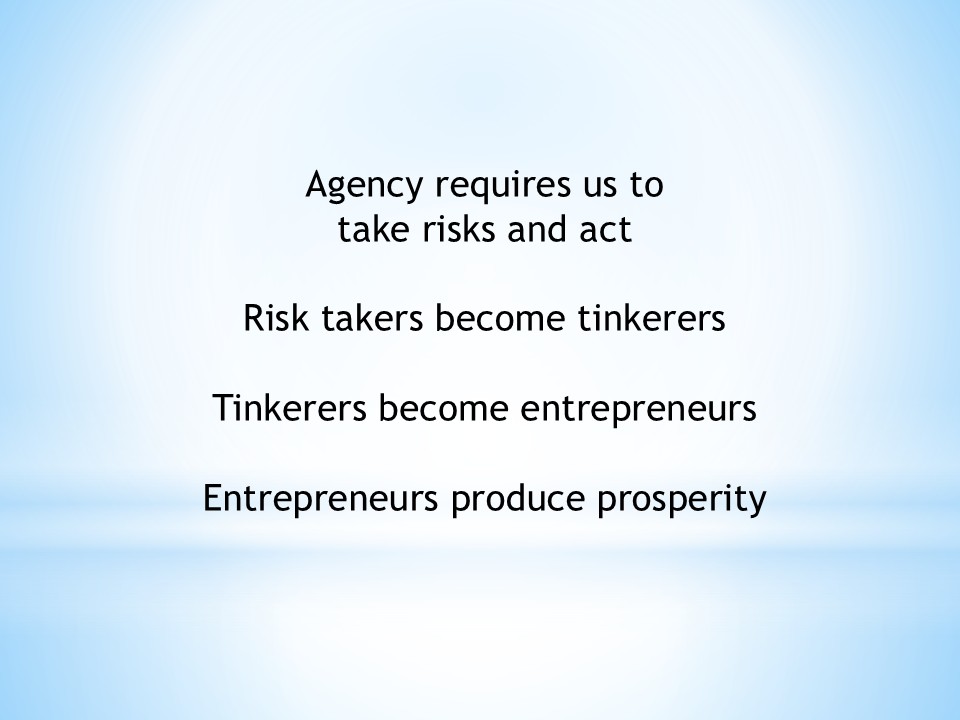
Agency requires us to act. Risk-takers become tinkerers.
I have a buddy in high school who loved chemicals and the fact that teachers would always hold their breath every time he went into the chem lab, wondering what explosion was going to happen next. Well, Woody went on to get a PhD in chemistry, and he has blessed society with his knowledge because tinkerers become entrepreneurs, and entrepreneurs produce… prosperity.
Let’s go back to the mind again. In the process of connecting things together that may lead to innovations and inventions and improvements of life in general, there’s also another improvement in our lives that comes from thinking and making connections: humor. Let me share a few of them.
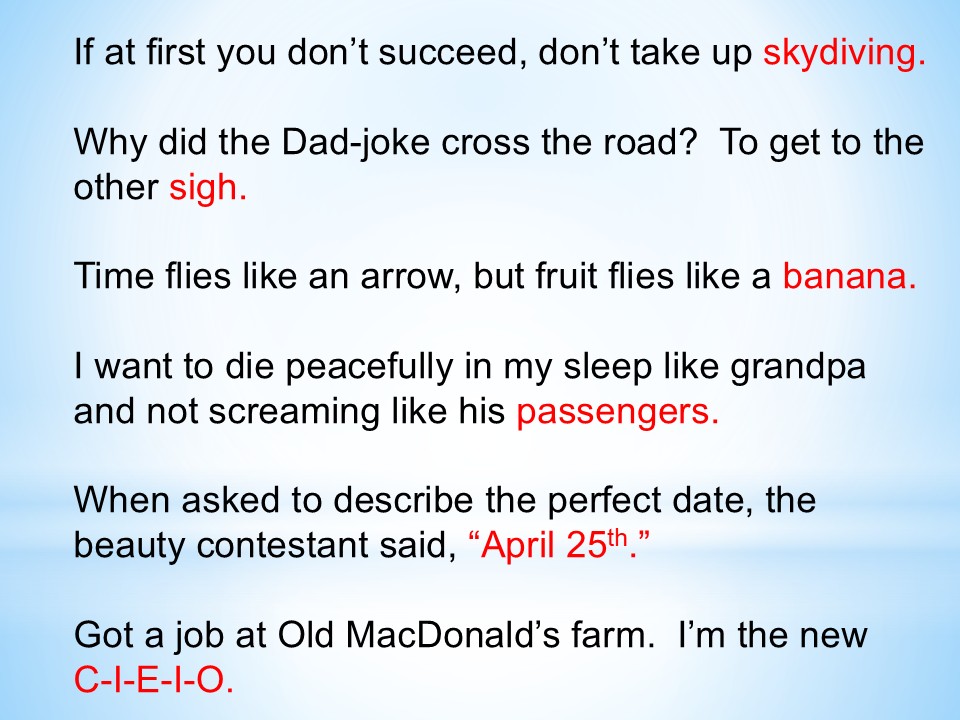
Can you read that last one? “Got a job at Old MacDonald’s farm. I’m the new C-I-E-I-O.”
What did all these things have in common? It’s a surprise ending, the unexpected connection. Look what happens with the last word in each of those. Up to that particular point, you don’t know where it’s going, and all of a sudden, it’s the surprise that leaves a disbound of humor.
Dissonance Tolerance
And in the process, several kinds of things happen. First of all, you have to have some dissonance tolerance. You have to let the mind work. Don’t be too quick to cram this new little idea into a neighboring thought. Let the mind work.
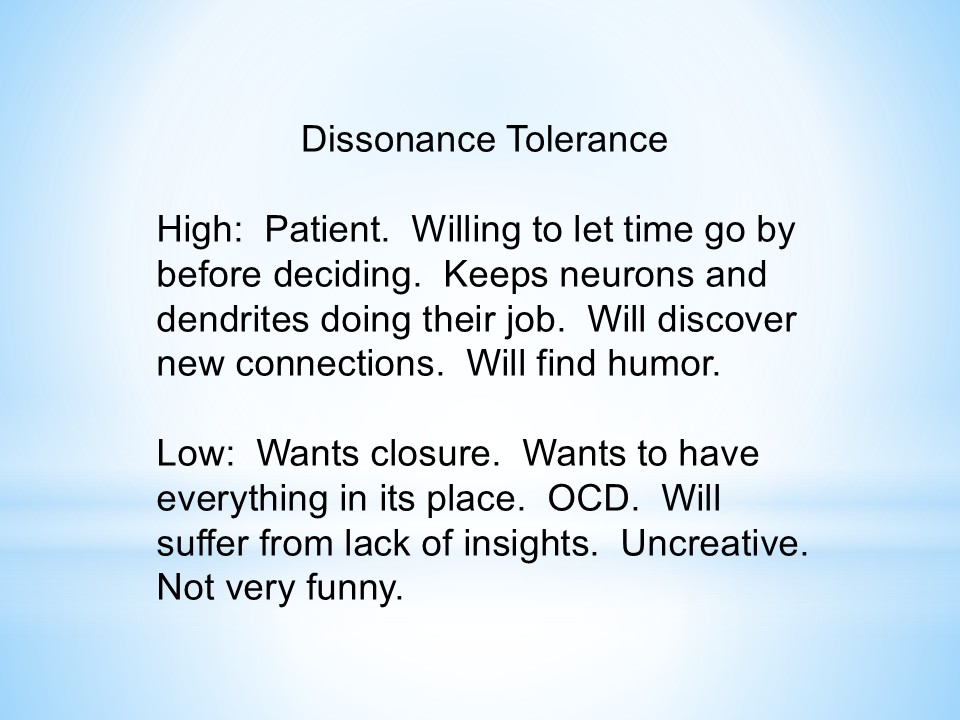
Be patient. Be willing to let time go by before deciding. Let some neurons and dendrites do their job and discover new connections. You’ll find humor. But if you have low dissonance tolerance, you want to have everything in its place real quickly. You want closure. You have OCD, which is really CDO in alphabetical order. If you suffer from that, you suffer from lack of insights, you’re uncreative, and you’re not very funny. So my point is, let the mind work and plow and see connections, and somehow the Holy Ghost then plays his role to put a new little insight into your head that may lead to wonderful, wonderful things.
The Savior himself had a great sense of humor. I think that when all the record is told, we will find that He used humor in a very positive way. I’m not talking about the loud guffaw. I’m talking about that nice, gentle chuckle, that nice humor where you see things.
A Scriptural Example
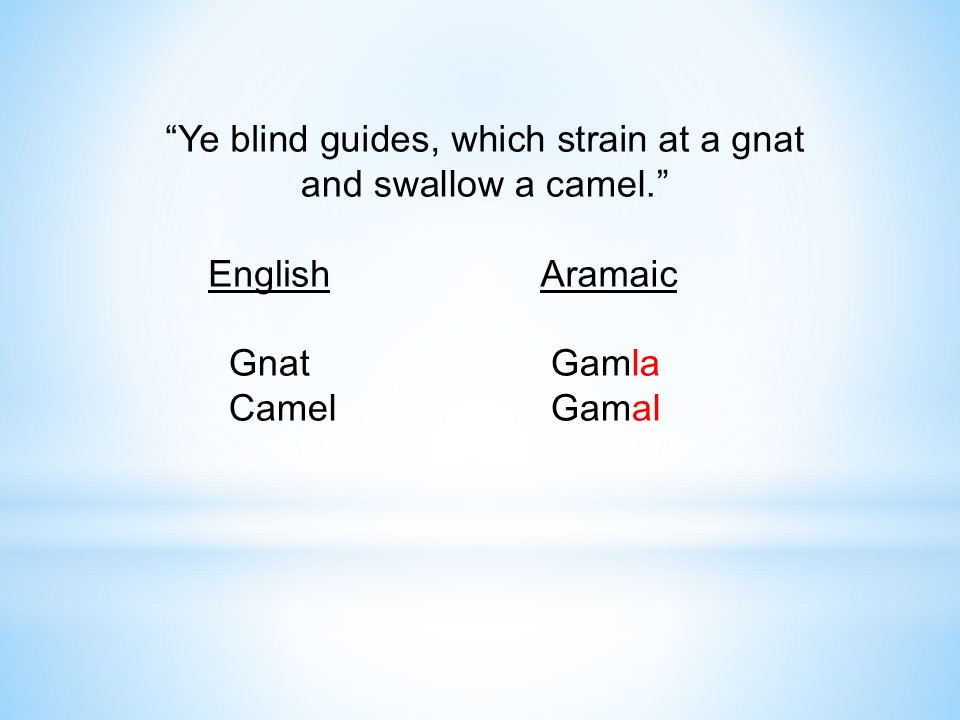
Now, for example, He chewed out the Pharisees one time, several times. But one time, he said, “Ye blind guide, you strain at a gnat, you swallow a camel.” Well, in English, you have a gnat and a camel. You have something small, something big. Yeah, it gets a point across. But does anybody laugh at it when you say gnat and a camel? Not really.
But in Aramaic, the Savior’s mother tongue, a gnat is a “gamla” and the camel is a “gamal.” In other words, He took the last two letters and flipped them. That’s known as a first-class pun, a play on words. And not only was he chewing out the Pharisees for their picky, petty rules and regulations, but he caused the people to laugh at the Pharisees. And if there’s one thing an authoritarian cannot stand is to be laughed at. So I suggest we do a little more laughing.
The Negatives or Misuse of Agency
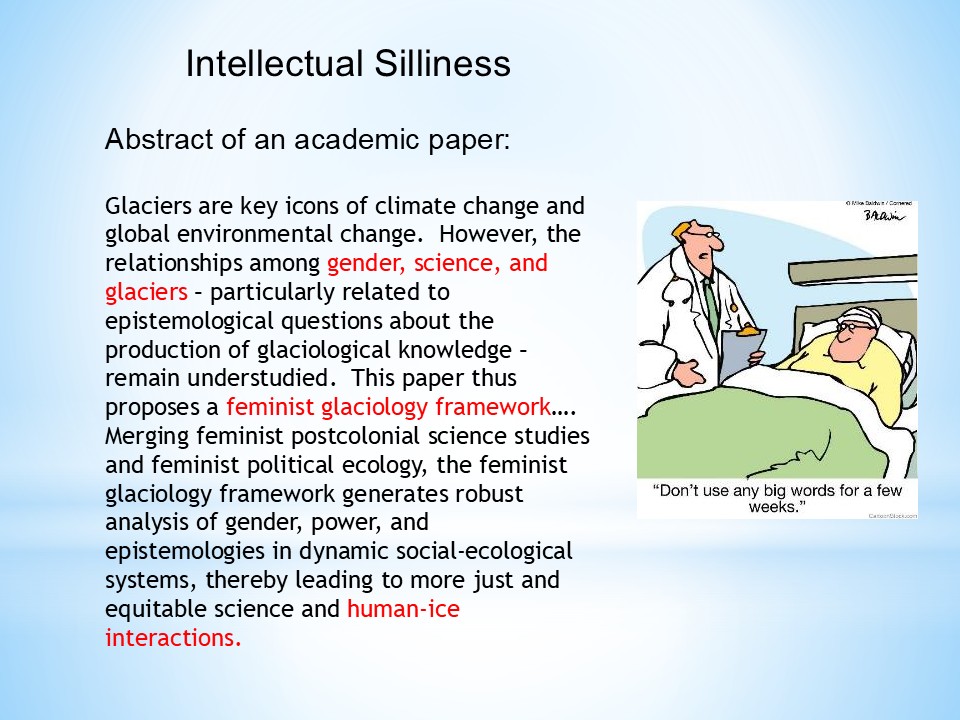
Now, let’s take a look at the negative sides of agency when people misuse it. And the first thing that comes to my mind, again, is that intellectual silliness.
This is an actual abstract of an academic paper, and I won’t tell you which university. No, it’s not in Utah. It’s in another state. But we’re talking about gender and glaciers, a feminist glaciology framework, the human eyes’ interactions. They start to worship the three-pound God between their ears. And as a result, they use big words again, you know?
And I think about humanized relations and interactions. I think, well, was the Titanic sunk by a male iceberg or by a female iceberg? Gets to be pretty silly sometimes.
Distortion
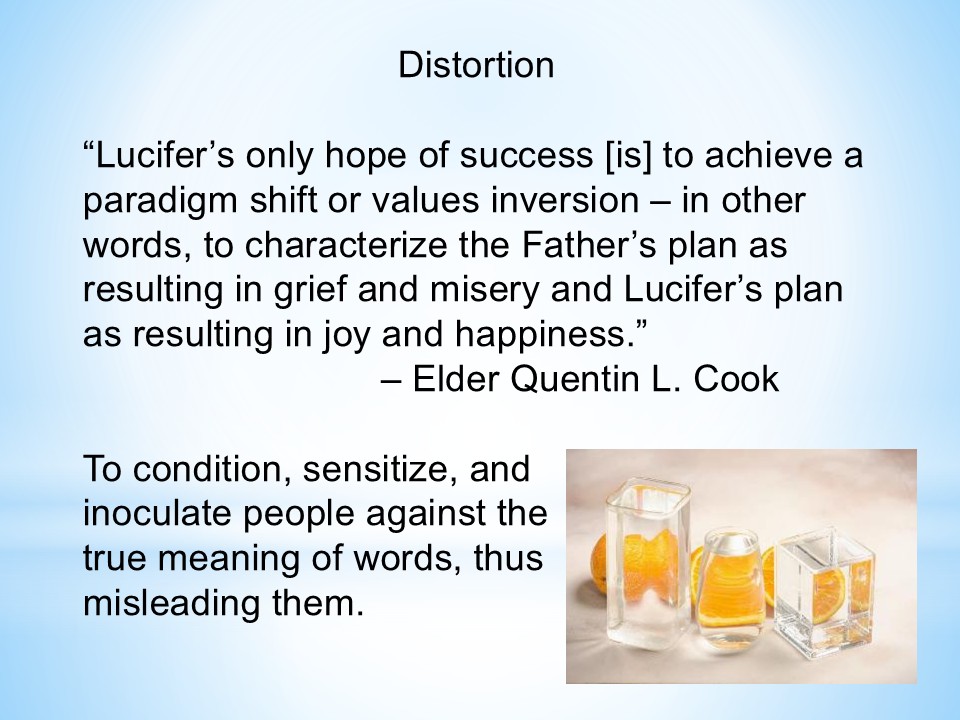
Then you get distortions. As Elder Cook mentioned, “Lucifer’s only hope of success is to achieve a paradigm shift or values inversion–in other words, to characterize the Father’s plan as resulting in grief and misery and Lucifer’s plan as resulting in joy and happiness.” And as we know, he’s always saying, “Don’t worry, you may be beaten with a few stripes, but in the last, we’ll all end up in the Kingdom of Heaven.”
Well, distortion is when people condition, sensitize and inoculate people against the true meaning of words. And are we seeing a deterioration of the language today in our culture? You better believe it. We are, and I say, “Hello, Isaiah 5.”
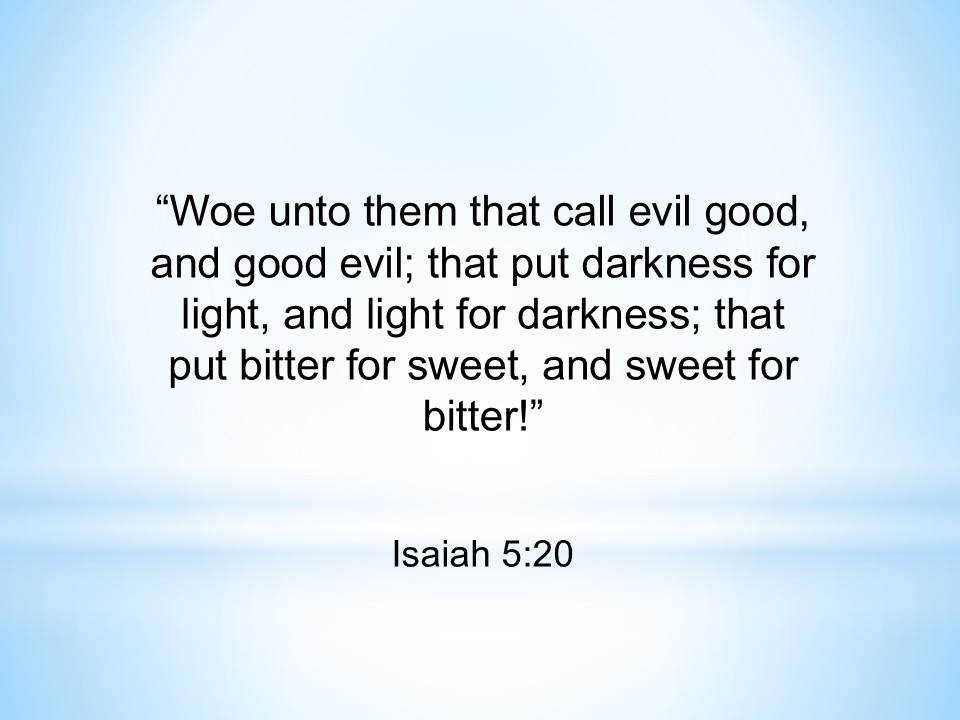
“Woe unto them that call evil good, and good evil; that put darkness for light, and light for darkness; that put bitter for sweet, and sweet for bitter.”
And the recent example: the World Health Organization announced it will update its gender and mainstreaming manual in light of new scientific evidence and conceptual progress, emphasis on intersectionality equity, and this idea that gender is a continuum.
How many do they have now? 57, something like that? And biological sex is not limited to male or female. What a slap in the face to the Father who created male and female.
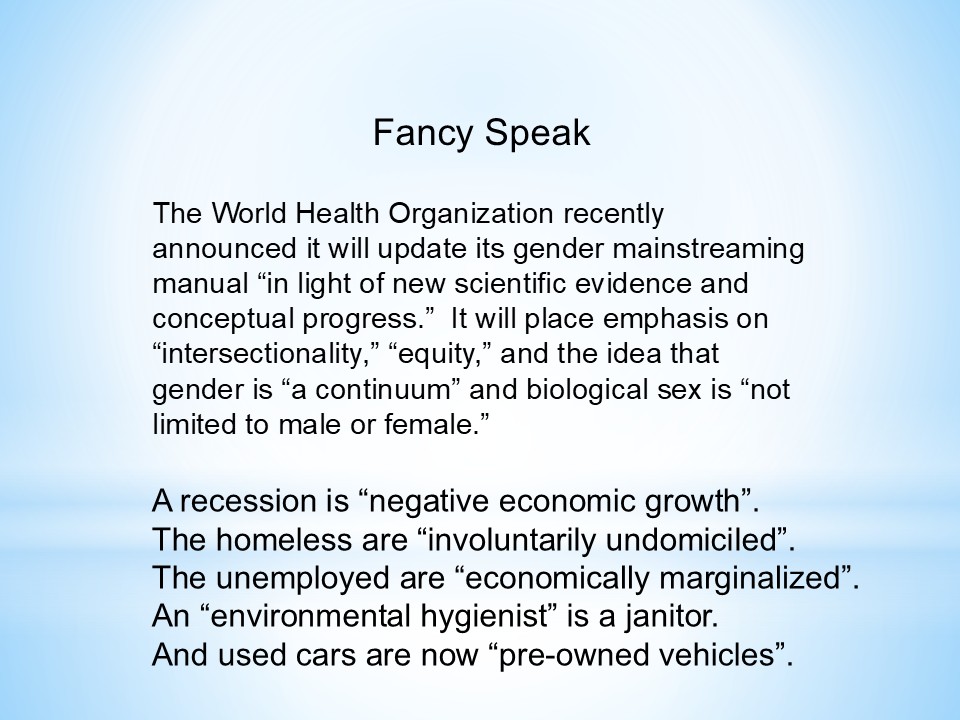
Fancy Speak
We also see fancy speak, recession is negative economic growth. Homeless are involuntarily undomiciled. Talk about fun words again, right? The unemployed, the environmental hygienists, and used cars are now pre-owned vehicles. So, there’s the fancy speak again.
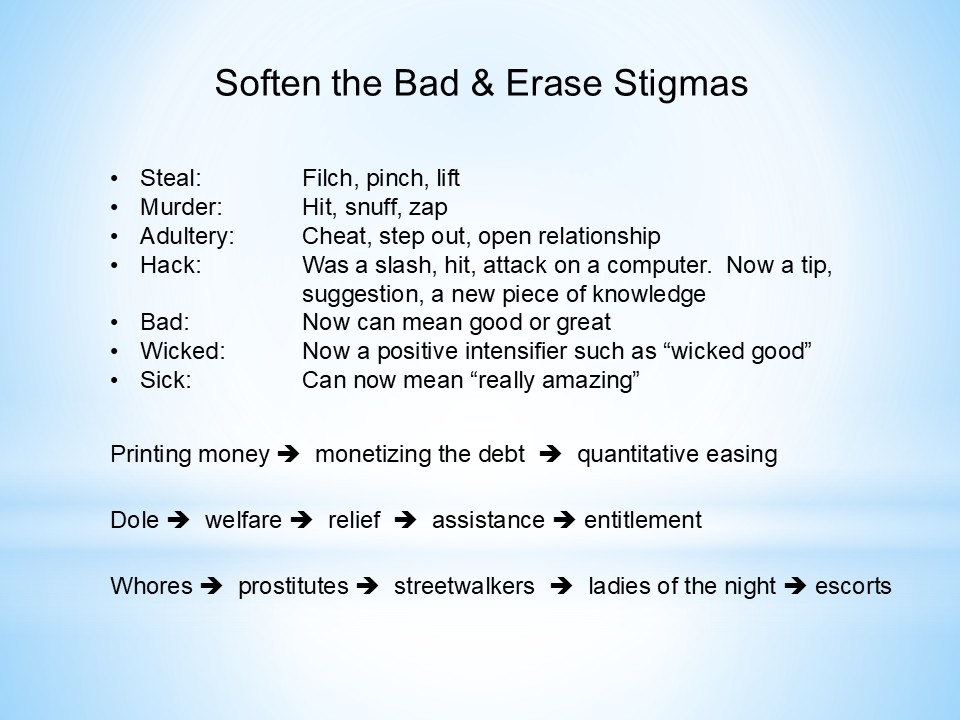
We’re seeing a softening of the bad. You change this; you soften bad terms, and they’ve therefore become more acceptable if certain things are violated. To steal is now just to “filch, pinch, or lift.” To murder is to hit, snuff, and zap. Adultery is to cheat, step out; open relationship. That one’s coming into vogue. To hack, a hack used to be a slash or an attack on a computer. Now it’s a new piece of knowledge. I’ve got several hacks for you. I’ve got a few neighbors too. Bad now means good or great. Wicked can be a positive intensifier such as “wicked good,” and “sick” can now mean real and really amazing.
And then stigmas. Again, a stigma is a consequence, and it comes as a result of some kind of an action. But what is happening in society today? Printing money is now quantitative easing. Dole then became welfare relief, then assistance, and now it’s an entitlement. Whores, we don’t use that word anymore. Prostitutes became streetwalkers, became ladies of the night, and now are escorts, a nice fancy term.
What’s the point? When blurring the meaning of words robs concepts of clarity, people begin to doubt their undergirding institutions, in other words their own values of gender, marriage, country, and religion.
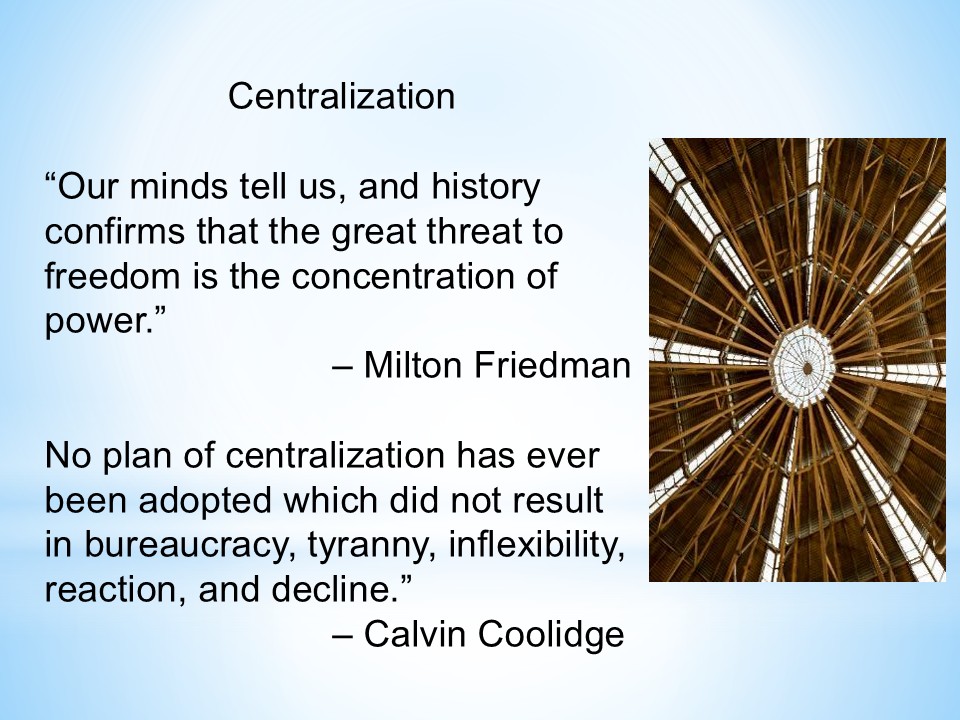
Centralization
Then there’s centralization. History confirms that the great threat to freedom is the concentration of power. “No plan of centralization has ever been adopted which did not result in bureaucracy, tyranny, inflexibility, reaction, and decline.” So said President Calvin Coolidge a hundred years ago.
The Constitution was established by God; not just inspired, established. D&C 101: “the people are sovereign”, that verifies agency. Then there’s a division of power and the separation of power and the enumerations of power because He knew, and we were finding out. that the concentration of power leads to tyranny.
We are sovereign, the government is a servant, and that’s a sacrosanct principle.
We have learned by sad experience that it is the nature and disposition of almost all men, as soon as they get a little authority, as they suppose, they will immediately begin to exercise unrighteous dominion.” (D&C 121:39)
Are we seeing that? We see it in many different settings.
Agency
Today there are 185,000 pages of federal regulations; each state adds its own regulations to that pile. Again, check with agency: Does this regulation, this proposal, this policy increase my agency or diminish it? Does it increase my choices or diminish my choices?
“If I saw my way to it as a practical politician,
I should be willing to go farther and
superintend every man’s use of his chance.”“Men are as clay in the hands of
the consummate leader.”“Resistance is left to the minority, and such
as will not be convinced are crushed.”– Woodrow Wilson
We had one president who said it’s government’s role to superintend every man’s use of his chance. In other words, his chance, meaning his agency, and it’s up to government experts to superintend the way we use our agency. We are clay and must be convinced and crushed.
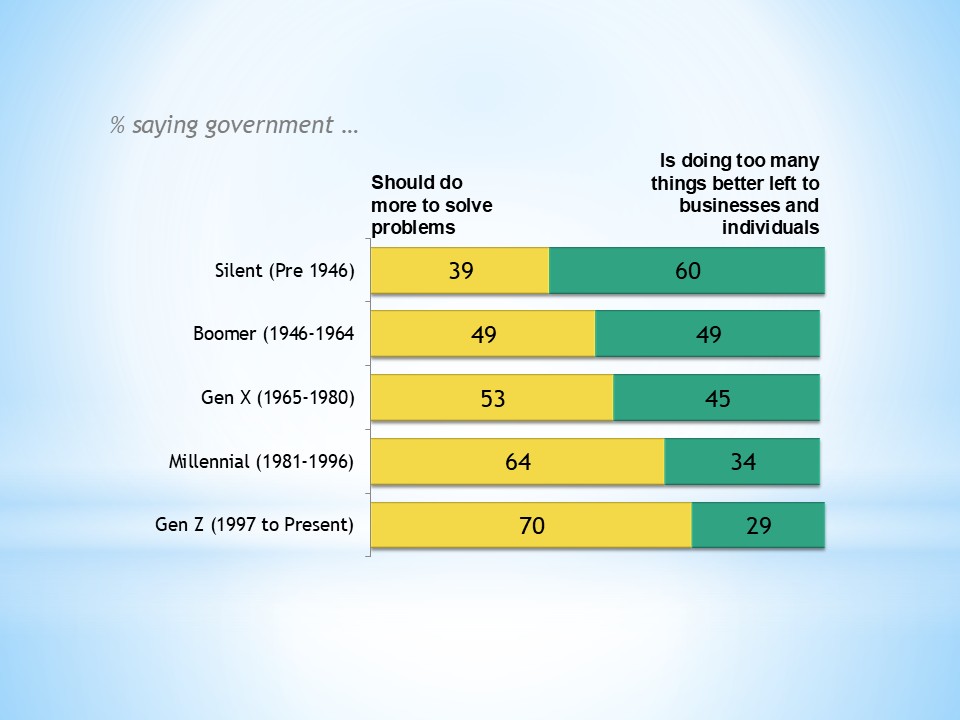
Today’s Beliefs
Take a look at what’s happening today in terms of different age groups: Should government do more to solve problems, or is government doing too many things better left to businesses and individuals?
If you were born before 1946, 60 percent say government is doing too many things better left to businesses or individuals. And that completely reverses if you get down to people who were born after 1997, where 70 percent say governments should do more to solve problems rather than letting businesses and individuals exercise their agency. All of which, intellectualism, distortion, centralization, concentration of power, lead to statism and socialism.
So now you get into a good, interesting discussion. I will guarantee you that if you start bringing up things of a current nature you can get into this situation quite quickly.
And so I suggest that people talk about equality; talk about equal what? An equal opportunity, and we can verify this, every one of us will have had or will have the opportunity to follow the Savior, keep his commandments, return to dwell in the Father’s and Son’s presence forever.
But equal outcome is a totally different story. It’s the equal distribution of wealth, central planning, wage and price controls. Satan agitates for equalities of outcomes precisely because it destroys motivation, it destroys justice, and destroys agency. And I state it very firmly to my neighbors: socialism is the anti-agency. Take a look at Satan’s whoppers along these lines:
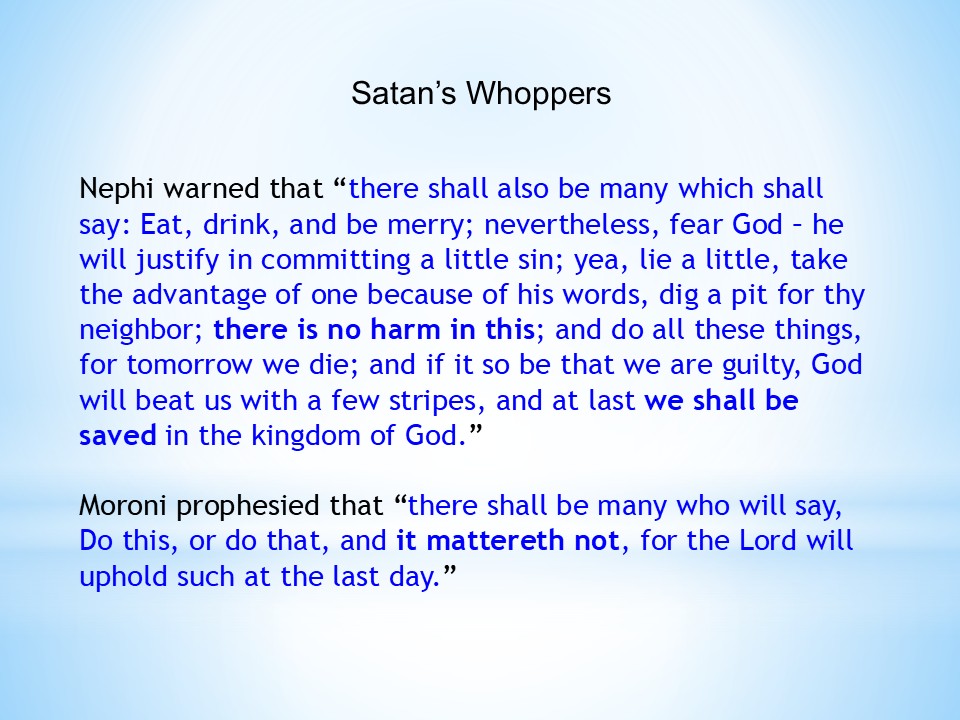
Satan’s Lies
Eat, drink, and be merry. I can commit a little sin, no harm in this. I’ll be beaten with a few stripes, and at last be shall be saved in the kingdom of God. That was Nephi’s warning. Four times in the Book of Mormon these Whoppers come up.
Moroni prophesied: “There shall be many who will say, Do this or do that, and it mattereth not, for the Lord will uphold such at the last day.”
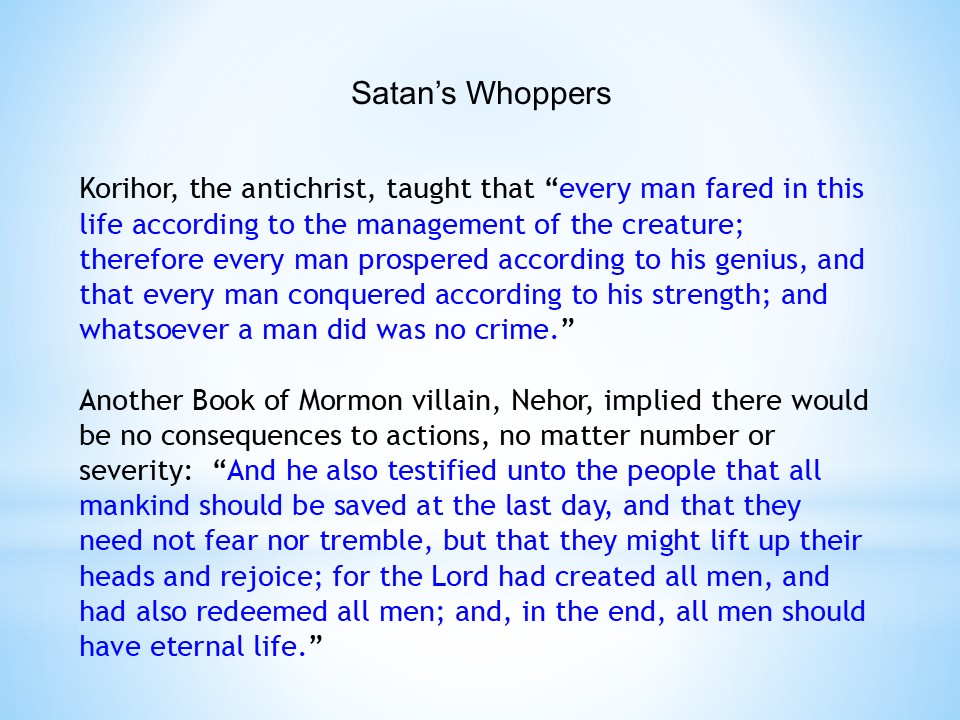
Korihor, the Antichrist: “Every man fared in this life according to the management of the creature… Whatsoever a man did is no crime.” And the last one, Nehor: No consequences, no matter the number or severity: “And in the end, all men should have eternal life.” We’re all going to be saved, so you don’t need to fear, don’t tremble, no sweat. The Lord created all men and will redeem all men no matter what we do or don’t do. That’s the philosophy that’s out there, which leads to tyranny.
There are 200 million video cameras in China, for example, and they’re increasing more and more. They know who walks across a crosswalk improperly; they know every conversation.
A Personal Anecdote
It was interesting; I was able to be part of a delegation that went to Russia at the fall of the Soviet Union and to teach people about democracy and how it works. And these were people who wanted democracy, wanted freedom. And so we’re telling them how to campaign in a free campaign kind of a setting.
And so we divided them into separate groups and had them work on it for 45 minutes among themselves. How would you build a coalition of people to vote for your candidate? Who do you want? You want the old, the young, the people on the west side of town. Where do you want to build this coalition?
We let them work for 45 minutes, and then they came back to report, and I asked the first team leader, I said, “Okay, who do you want on your team?” And he said, “We want the waiters.”
And I thought, through the translator, that, well, I didn’t quite understand that and let him talk a little bit more. And then the second team leader, “Who do you want on your coalition?” He says, “We want the waiters.”
And I said, “Time out. I’m a dumb American,” and boy, do they believe that because I didn’t know how things worked in the Soviet Union. I said, “How many of you had the waiters as the number one group you want on your coalition?” Every hand went up. I said, “Tell me why.” “Because the waiters listen in on all the conversations, and they know the dirt about everybody, and we want them on our side.” Fascinating.
What Are We Going to Be?
Well, it all leads, brothers and sisters to agents or objects. What are we going to be?
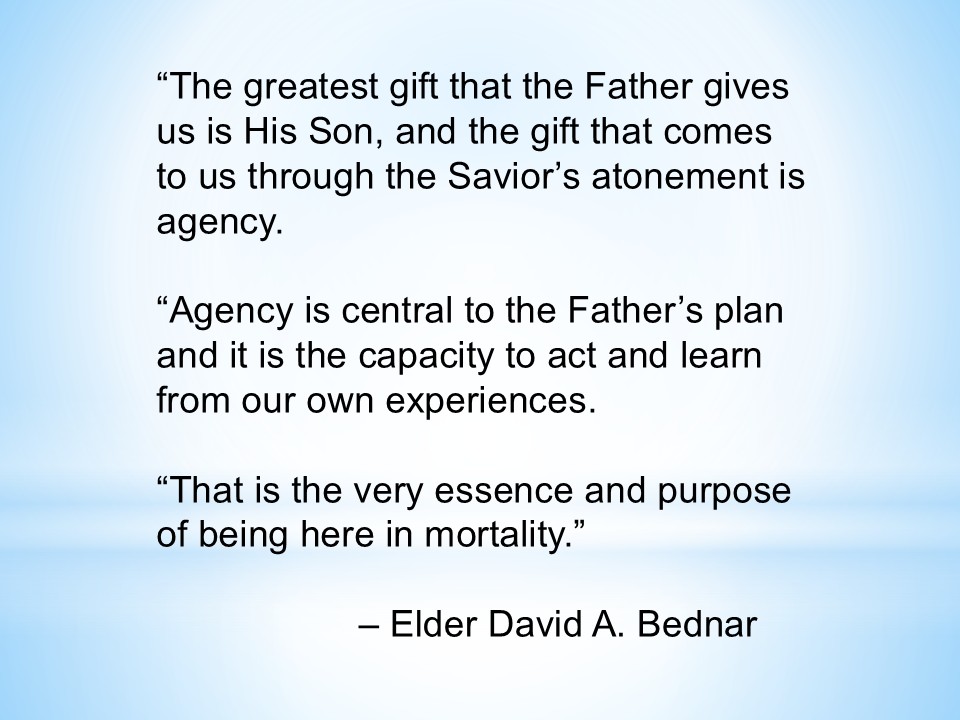
I’ll close on a positive note. Elder Bednar again: The greatest gift that the Father gives us is His Son, and the gift that comes to us through the Savior’s atonement is agency. Agency is central to the Father’s plan and it is the capacity to act and learn from our own experiences. That is the very essence and purpose of being here in mortality.”
How to Have Normal Comfortable Conversations on Agency
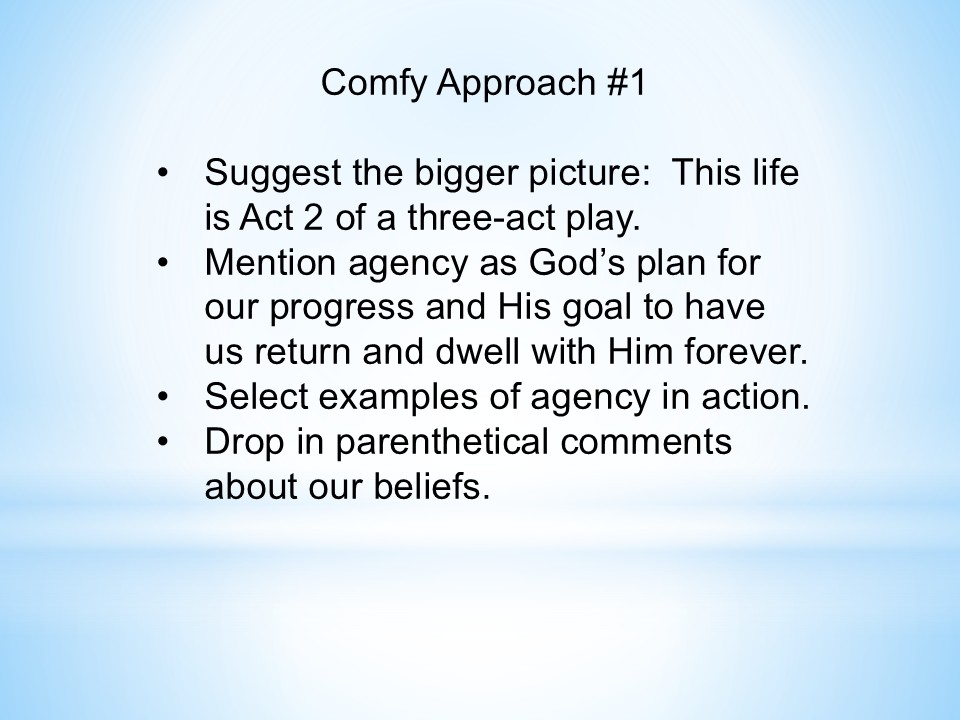
How do we communicate these truths in normal and comfortable conversations?
One comfy approach suggests the bigger picture I started out with: this life is act two of a three-act play. Then mention agency as God’s plan for us to progress and return and dwell with Him forever. Select examples of agency in action and drop in parenthetical comments about our beliefs.
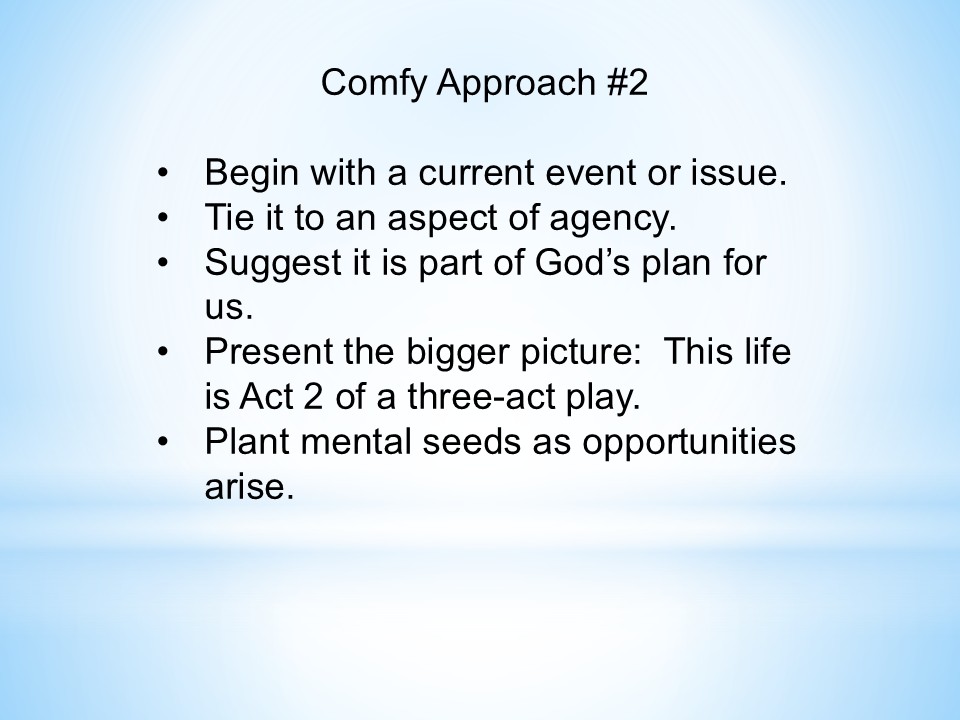
Comfy approach number two: just the reverse. Begin with a current event or issue and you can choose in this; we’re rife with them right now. Tie it to an aspect of agency, but then give them that hope, because they fear for the future, that it is part of God’s plan for us. And mention the little kids who get vaccinated and wonder why their mommies and daddies allowed them to have pain.
And then present the bigger picture: this life is act two of the three-act play, and you plant mental seeds just like that girl in the hallway of Anaheim High School that the Holy Ghost can work on as opportunities arise.
Conclusion
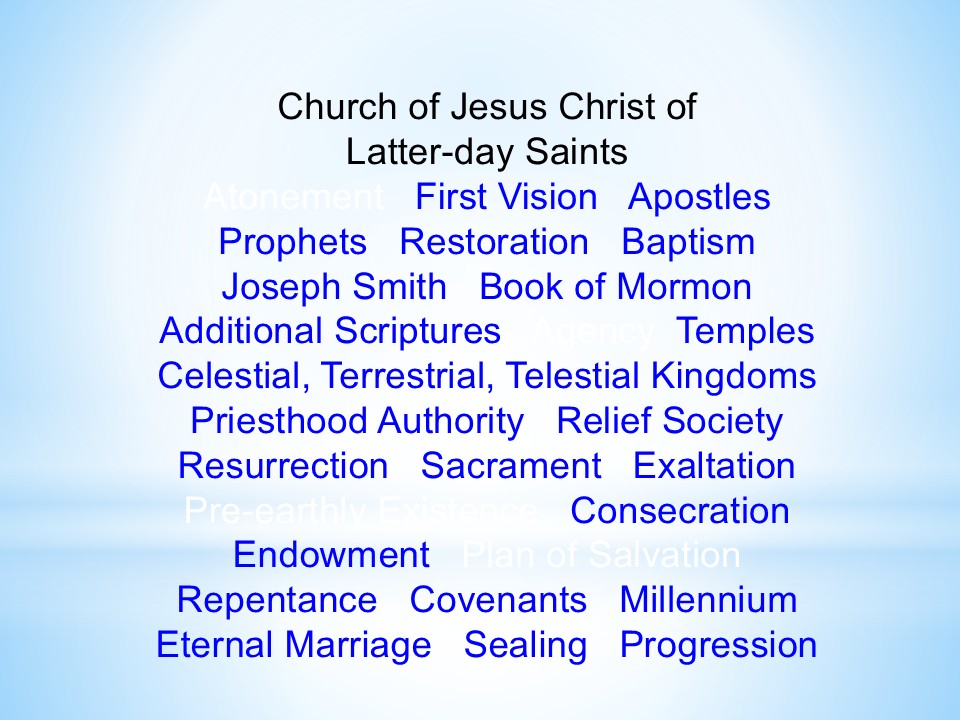
The gospel has many things that we can talk about. I’ve emphasized four of them today.
You’ve got another whole bunch that we can use.
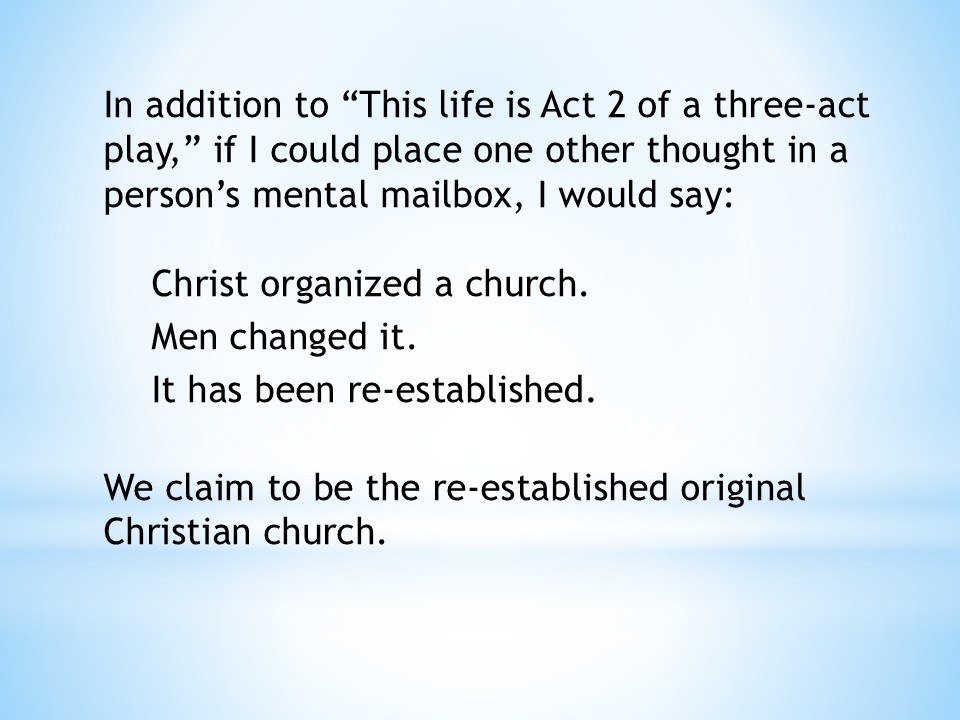
In addition, if I could add one more thing to this life is an act two statement, if I could place one other thought in a person’s mental mailbox, I would say:
“Christ organized a Church; men changed it, yet it has been reestablished. We claim to be the reestablished original Christian Church.”
Thank you very much.
Audience Q&A
Scott Gordon:
Thank you so much for sharing your thoughts with us today. I have a few questions here. The one thing is, I love the idea of love, share, and invite, but it never feels normal and natural when I share and especially when I invite. How can I become more normal, natural, automatic for me?
Gary Lawrence:
A good question, and that’s the way it is. We will all feel a little bit of tension, and we want to share something. So, you can share without setting the stage, but that will be resisted. But find out what that individual is concerned about, what fear does that individual have, and then you can say, “Well, it’s my belief that,” or “I have been brought up to think this.” In other words, you’re not making it a “therefore you should do,” but simply this has been my experience, share your experience with them.
Scott Gordon:
Okay, and then, it says, do you have tips for slowing your mind to develop a higher dissonance tolerance?
Gary Lawrence:
How do you develop a higher dissonance tolerance? Patience is a virtue, not being quick to react. Sometimes we see a problem, something hits us, and we want to immediately fix it. If we just wait a little bit, sometimes a different answer will come to us. And so it really comes down to checking ourselves as soon as possible. How much time should I allow to go by to build up this distance tolerance? In other words, don’t let outside pressures force you to make a decision prior to your wanting to make that decision or you feel comfortable making that decision.
So, somebody does something, you want to react; let it sit for a while, say, “Well, I’ll get back to you tomorrow morning,” or something, and it’s in the process of waiting that we can then hear the still small voice. The Holy Ghost doesn’t talk to you when there’s cheering going on in the stadiums. I don’t care who you’re cheering for. It’s in the quiet times. I had a bishop who said the best time to get insights is at two o’clock in the morning. If you happen to wake up, just sit someplace quiet and just think and let certain thoughts wash over you. That also builds dissonance tolerance.
Scott Gordon:
Okay, how do you respond to those who think we have too much agency?
Gary Lawrence:
Too much agency? That’s a good question. In any society, there must be a certain level of law and order. So yes, I have the agency to run a red light, but really, I don’t want to exercise that agency in that situation. So I’m not talking about that. I’m talking about those kinds of rules that are more of a “thou shalt do” rather than “thou shalt not do,” and then at that point, I don’t think there is such a thing as too much agency. Those who would turn you into an object want to control every aspect of your life, and some federal rules are just hilarious. You know, that you’re not allowed to skydive while you’re drunk. That’s an actual rule on the federal registry. You are not allowed to shoot pigeons with a machine gun, and you are not allowed to have homogenized milk from a quarantined giraffe. Now, when we get down to that kind of detail, then the people who are in favor of that, they’re the ones who are exercising improper agency over us.
Scott Gordon:
So, here’s my last question for you: how do you respond to the frequent diatribe, “A living God wouldn’t allow this suffering to take place”?
Gary Lawrence:
That’s a very good question because that’s what we began with: would a loving God do this and the same thing, because a loving parent will allow his child to be vaccinated. He is allowing us to be vaccinated even though it’s painful. Again, from the Doctrine and Covenants, all of these things shall give thee experience and shall be for your good. That’s what you keep coming back to. In the end, when we understand the full picture, we will know that everything the Lord allowed us to go through has been for our good and our progress, and the ultimate goal is exaltation to live again with God.
Scott Gordon:
Thank you. Appreciate it.
Gary Lawrence:
Thank you very much.
Talk Details
- Date Presented: August 4, 2023
- Duration: 48:03 minutes
- Event/Conference: 2022 FAIR Annual Conference
- Topics Covered:
Common Concerns Addressed
Why does a loving God allow suffering?
Agency is essential for growth—without opposition and struggle, true progress and learning wouldn’t be possible.
How can we make gospel discussions feel more natural?
Engage in sincere, everyday conversations and ask thoughtful questions to plant gospel principles in a non-intrusive way.
Apologetic Focus
The importance of agency in God’s plan.
How to address common objections to faith.
Strengthening testimony through small but meaningful interactions.
Explore Further
- Historical summary of the Mountain Meadows Massacre
- Perpetrators of the Mountain Meadows Massacre
- Brigham Young and the Mountain Meadows Massacre
- Others involved in the Mountain Meadows Massacre
- Blood of the Prophets [1]: Brigham Young and the Massacre at Mountain Meadows
- Blood of the Prophets [2]: Brigham Young and the Massacre at Mountain Meadows
- Blood of the Prophets [3]: Brigham Young and the Massacre at Mountain Meadows
Share this article
