Summary
Jen Yorgason Thatcher shares insights on strengthening faith through personal revelation, daily connection with the Savior, and understanding God’s love. She counsels to stay anchored by focusing on eternal truths, setting aside doubts until answers come, and maintaining faith in Jesus Christ and His plan.
Introduction
Scott Gordon: Our next speaker is Jen Yorgason Thatcher. She’s an adjunct faculty member in the BYU Religion Department and the School of Family Life, where she teaches The Eternal Family. She received her master’s in the BYU School of Family Life, with a research emphasis on families and religion. She is a wife and a mother, and with that, we’ll turn the time over to Jen Yorgason Thatcher.
Presentation
Jen Yorgason Thatcher: All right, I’m excited to be here! It’s tricky, though; it’s the afternoon, and I know you’re going to get tired. We are going to move quickly—I hope you’re okay with that.
As I said, I am a stay-at-home mom, but I have been blessed to be able to teach just a little bit each week and to really focus on teachings about the family, something I’m passionate about. Teaching on the topics that I’m going to be speaking on today, I should say, came to me—to apply to teach this at Education Week. And when I put down those titles and felt good about them, I just thought, ‘Well, I have a lot to learn.’ And I still have a lot to learn.
I welcome your questions, but I’m planning on doing a longer presentation with no question and answers. We’ll see at the end if there’s time, but most likely there won’t be. However, I would still love your questions, because I’m still learning too. I’m hoping that what I present to you today will be helpful for those who find themselves on the covenant path, those who are striving to be steadfast and immovable.
The Need for Resilient Faith
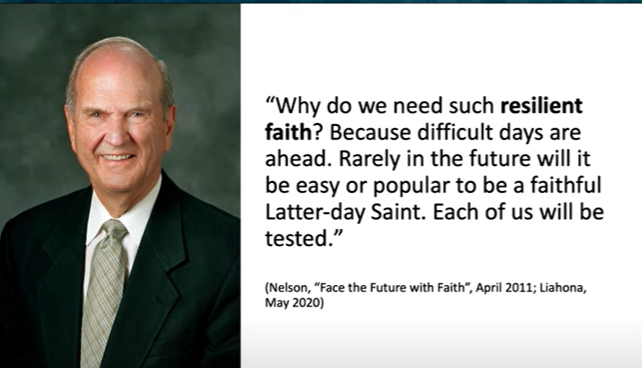
We have been warned that we need resilient faith, that there are difficult days ahead, and that rarely in the future will it be easy or popular to be a faithful Latter-day Saint. Each of us will be tested. We all need to know how to have resilient faith.

I’m also hoping and praying that this presentation will help those who find themselves at this time halfway in and halfway out—maybe not feeling the joy of the gospel that they used to feel, maybe not feeling the Spirit like they know they used to feel. Maybe for those who aren’t happy with everything they are hearing or seeing with politics, policies, practices, teachings, or culture.
The Plan of Redemption as a Pattern for our Lives
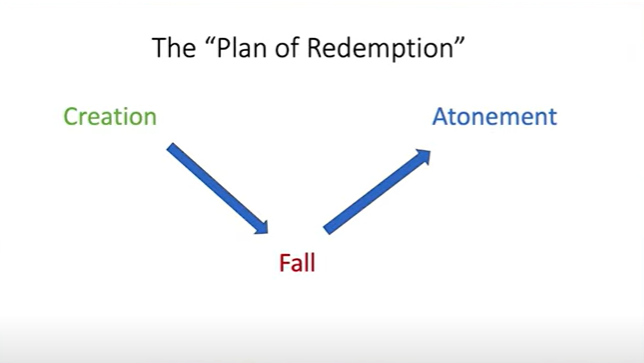
The good news is that the three pillars of the Fall are also a pattern in our lives. God knew that we would experience continual falls throughout our lives—mistakes, stages, times, and events where we may feel tested. If we find ourselves in what some call a “faith crisis,” we find ourselves in a spiritual fall, the Savior is there. The answer is Jesus Christ, and He will pull us out of that; He can help us to rise out of all our falls.
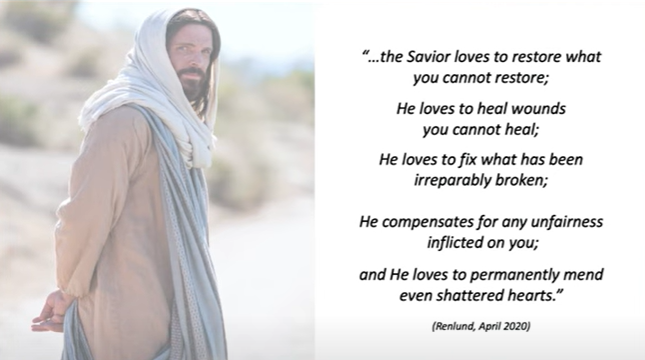
He loves to restore what you cannot restore, He loves to heal wounds you cannot heal, He loves to fix what has been irreparably broken. He compensates for any unfairness inflicted on you, and He loves to permanently mend even shattered hearts. Thank you, Elder Renlund, for that beautiful, eloquently put quote. He loves to bless us and to pull us out of our falls.

Our family went to Puerto Rico a couple of years ago. We were excited for the beautiful beaches, for El Yunque, the national rainforest where it rains 365 days a year. It happened to be a downpour that day—it didn’t stop raining the entire time we were there. But we were especially excited for the snorkeling.

We went to a little island called Culebra, off Puerto Rico, and were told that a specific beach there had a lot of sea turtles. In fact, we were told that very morning they had seen 20 or 30 sea turtles.
We arrived at this rocky beach and were told that it drops off quickly, so it gets deep really fast. Unfortunately, we only had three life jackets and three sets of flippers, and there were three daughters who wanted to go out. I decided to join them, so I went out with my snorkeling mask. We were only a few feet from shore—maybe as far as the back row in this room—but it was deep. My daughters were busy looking around, getting used to breathing in the cold water, and adjusting to the chilly water on a rather cold, bumpy day with lots of waves.
As they were getting comfortable, I was having a completely different experience. I was trying to breathe and look underwater, but if you’ve ever been snorkeling, you know there’s a moment of, “Can I breathe? Am I doing this right?” Along with the bumpy, cold waters, and without any flippers or a life jacket, I quickly found myself running out of energy and unable to stay afloat. So, I did what I knew I needed to do—I lay on my back, floated, and enjoyed the beautiful sky for about a minute. I could still hear the girls nearby and decided to try again to breathe, stay calm, and not get anxious.
But within just a minute, I knew I was going down; I would be underwater very soon. Finally, I called out to the girls for help. It wasn’t a calm request; it was more of a desperate “Help!” They looked over, surprised, saying, “Mom?” They couldn’t believe I was asking for help—they thought, “Doesn’t Mom know how to swim?” But they swam over to me, grabbed my arms, and helped me to the shore. I was exhausted, and there was no way I could swim back on my own.
Once I got to shore, I found Paul, who was just nearby looking at seashells with our two youngest children. I told him, “I just about drowned out there by the girls! I couldn’t swim—it was the weirdest, craziest thing.” He replied, “Okay, I’ll go out,” and, being strong, I figured he’d be fine. So, I stayed on the shore, looking for seashells and playing with the younger two. Five or maybe ten minutes later, Paul came back and said, “I almost drowned out there. I literally almost drowned!”
As strange as it sounds, this made me feel a little better, knowing it wasn’t just me who struggled. But it also terrified me—he almost drowned right there while I was on the shore! We realized that you cannot, or at least we couldn’t, swim in those waters and breathe at the same time.
There’s a lesson in that experience. Since then, I have learned that many drownings happen when family members are close by, sometimes even watching and thinking everything is fine.
Many are Spiritually Drowning
And I think there are many in our Church, in our families, and in our wards right around us who are spiritually drowning without us even realizing it—not knowing they need to call out for help to someone with a life jacket.
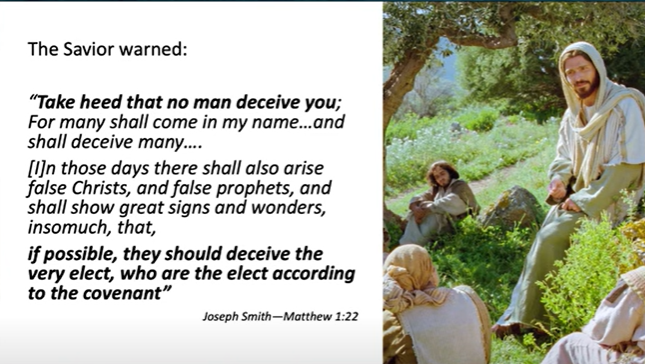
The Savior warned that this would happen in our days. He said, “Take heed that no man deceive you, for many shall come in my name and shall deceive many. In those days, there shall arise false Christs and false prophets and shall show great signs and wonders, insomuch that, if possible, they should deceive the very elect.”
Joseph Smith helped us see, through his translation, that the Savior was speaking about the “very elect according to the covenant”—those are covenant members of the Church whom Satan would deceive, if possible.
Safety Amid the Storms Ahead
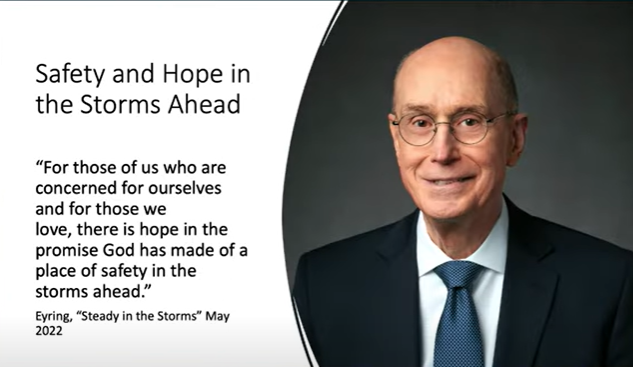
I’m grateful for all the words of comfort about such warnings. President Eyring said, “For those of us who are concerned for ourselves and for those we love, there is hope in the promise God has made of a place of safety in the storms ahead.”
Now, if you look back to that scripture, two things really stand out to me: “take heed” and “if possible.” If it’s possible, Satan will deceive the very elect. So, how do we make it not possible for us and our loved ones to be deceived? Because we know that everyone will be tested.
Take heed. What does “heed” mean? It’s not just listening; it’s not just knowing. It’s acting on it, right?
Acting on the Words of the Prophets
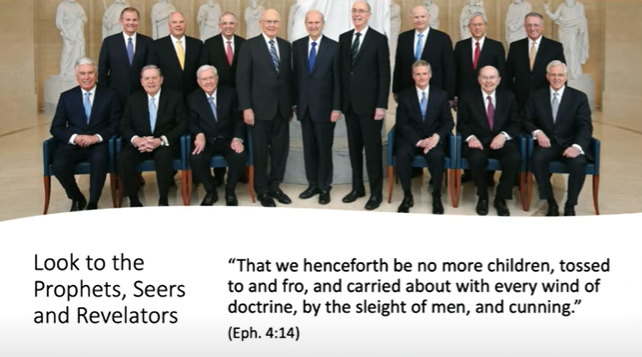
Are we acting on the words of the prophets? Are we truly taking heed? The Lord didn’t want us to be “tossed to and fro” and “carried about with every wind of doctrine” in our day. He wants us to have a place of safety, and that place of safety is with the prophets. We stay with them; we take heed; we follow what they are saying.
Jesus Christ himself said, “Thou shalt give heed unto all his words and commandments which he shall give unto you, as he receiveth them, walking in all holiness before me. For his word ye shall receive as if from mine own mouth, in all patience and faith.”
There will be times when we don’t completely understand what the prophets say, and we will have to be patient as the Lord helps us understand. We will have to wield the shield of faith and say, “I don’t know everything, but I have faith. This is my prophet. I trust this comes from the Lord, and I’m going to give it time until I understand completely.”
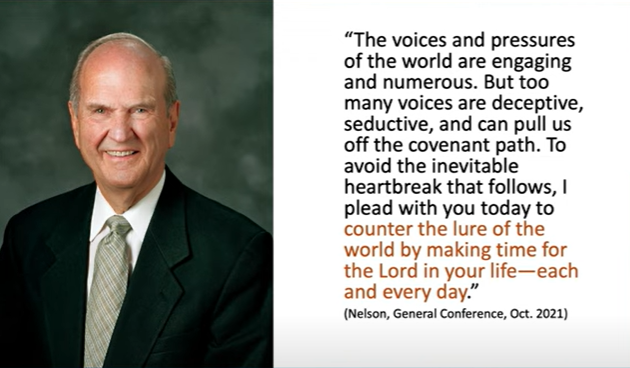
President Nelson has repeatedly emphasized this principle. He said, “The voices and pressures of the world are engaging and numerous, but too many voices are deceptive, seductive, and can pull us off the covenant path. To avoid the inevitable heartbreak that follows, I plead with you today to counter the lure of the world by making time for the Lord in your life each and every day.” Other times, he has said, “Give Him a fair share of your time.” Or “Give Him a generous portion of your time.”
Daily Connection With Heaven

Are you doing that? Are you giving Him time every day? Are you spending time with Him every single day? It’s like that— I wish I had the picture here, I should have— but in El Yunque, the rainforest, every single day of the year, it rains. Are we turning to our Heavenly Father? Are we seeking to have time with Him, with our Savior, Jesus Christ, every single day? If not, we are not safe. That’s what our prophet has been telling us. We need that daily connection with heaven.
It’s the small and simple things, isn’t it? And I’m guessing that you’ve seen this too, but I’ve noticed that those who have left the covenant path often stopped doing the little things, haven’t they? It’s just the little things. We’ve probably experienced that in our own lives—stopping those little things puts us on a completely different path, and we end up somewhere totally different.
The good news is, if you’re not on the path and want to come back, the answer is still the little things—just those simple, little things that will bring you into the light and help you feel close to the Savior.
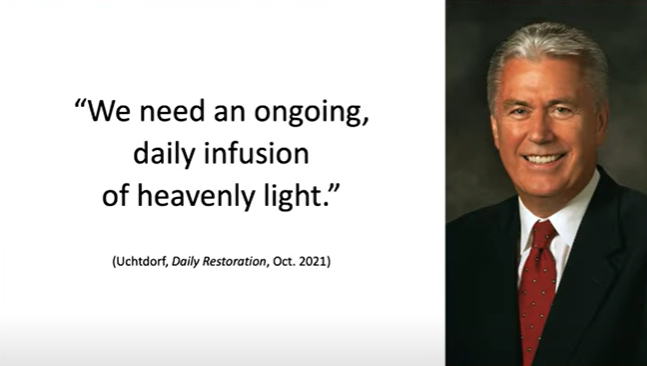
Elder Uchtdorf said “We need an ongoing, daily infusion of heavenly light.”

Have you ever plugged in your phone, thinking it was charging, only to come back later and find it’s still dead? Anybody? Everybody? Okay, all right, well, there’s an analogy here.
So often, the things that we do in our Church—reading our scriptures, saying our prayers, going to church—all of those things, sometimes we can do them without really doing them with a point in mind.
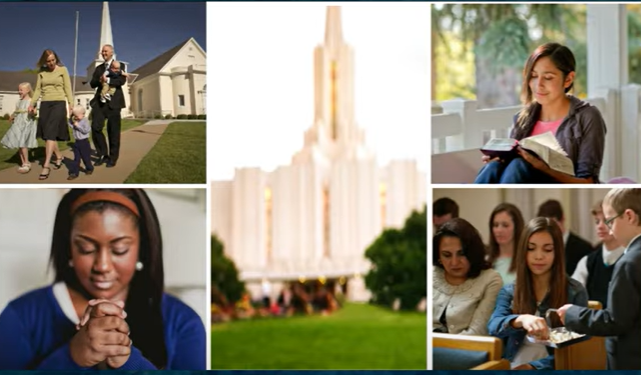
The point, when we do those, is to connect to our Savior Jesus Christ, to be close. And yet we can go through the motions and do them without necessarily coming closer to Him.
So, ask yourself, with each of these actions, each of these things that you’re doing, are you truly connecting to the source of power? If not, change the way you do it. It’s just small, simple little changes. Put more heart into it; put more yearning.
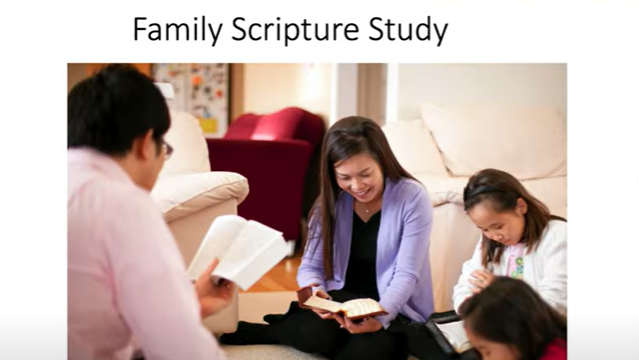
Our family scripture study—we’ve been counseled to daily spend time in the scriptures as a family, like that daily rain coming down into the rainforest. But the Lord doesn’t expect perfection. I love that the Lord loves effort. If we just gather, open up the scriptures, read something, and then talk about it—my research emphasis was specifically on conversations between parents and their adolescents and children and how important those conversations in religious families were in molding their faith.
We have found in our own home—and maybe you have found this too—that often that Come, Follow Me study that starts in one place completely goes to a different place because somebody asks a question and they want to talk about something different. And that’s okay, because it’s promoting family conversations, gospel conversations that help to teach and answer those questions that our children and grandchildren have.
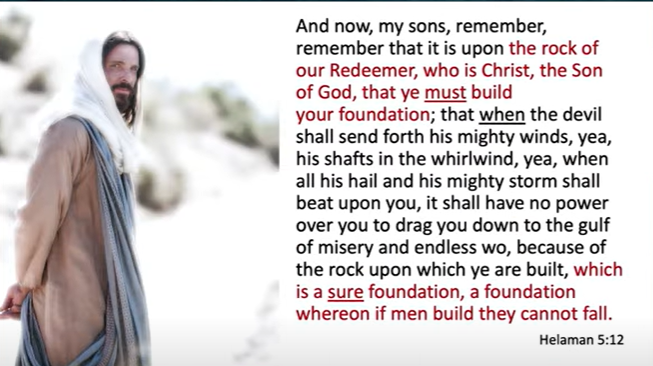
The most important thing we can do to be spiritually prepared, if you boil it down to the bare necessities, is to build our foundation on the Lord Jesus Christ. So, ask yourselves: Is your foundation on Jesus Christ? Is it truly? When you gather as a family, when you do anything, are you bringing it all the way back to the Savior? If not, change the way you do it. Small changes can make a huge difference.
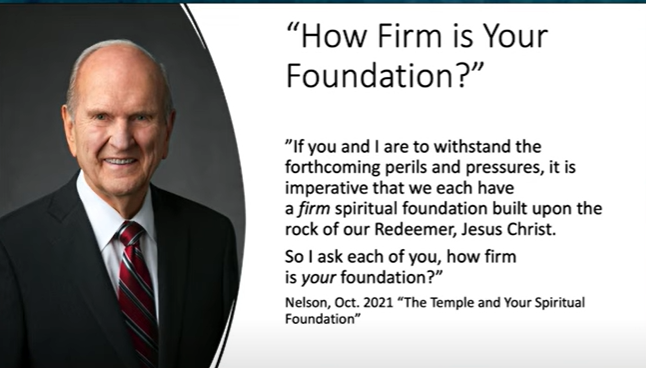
President Nelson said, “If you and I are to withstand the forthcoming perils and pressures, it is imperative that we each have a firm spiritual foundation built on the rock of our Redeemer, Jesus Christ.” So, I ask each of you, how firm is your foundation?
Unshaken Faith
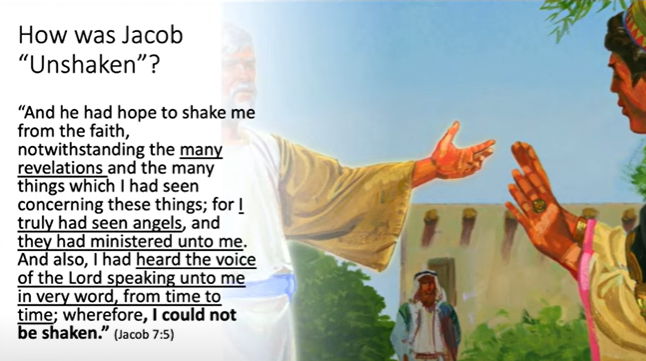
Look at the story of Jacob and Sherem. Sherem, as you know, was going around to members of the church and convincing them—he was very cunning and very convincing—and he was leading them to no longer believe, to leave the church. And it was working. Then he decided to go to Jacob, of course, go to the leader, you can take out a bunch.
He goes to Jacob. Now, notice the pattern. Notice why Jacob could not be shaken. Sherem had “hoped to shake me from the faith, notwithstanding the many revelations and the many things which I had seen concerning these things; for I truly had seen angels, and they had ministered unto me. And also, I had heard the voice of the Lord speaking unto me in very word from time to time; wherefore, I could not be shaken.”
Isn’t that exactly what President Nelson has been telling us to do? To hear Him. To seek, to learn how to receive personal revelation and to have it often. Like Jacob, we need to be able to say, “You cannot shake me. I’ve had too many experiences. And not just twenty years ago, or back on a mission,” or whatever. But now—today, yesterday, the day before. We need daily experiences where we know the voice of the Lord is speaking to us.
So, let’s look at the simple things—let’s look at prayer and scripture study and just talk for a couple of minutes about those.
Daily Revelatory Prayer
President Nelson has said, “In coming days, it will not be possible to survive spiritually without the guiding, directing, comforting, and constant influence of the Holy Ghost.” That’s what we need.

So, look at your prayers. Are your prayers leading to revelation? Are you hearing the voice of the Lord, or are you just sending your prayers up like a voicemail and then hanging up, hoping He gets it and will call you back?
I have a voicemail here, left by my husband’s co-worker’s son a long time ago. Let’s see if I can play it… Oh, sorry, let’s try again. Okay, go back… There, you’ve got it.
[Voicemail recording plays]
“Dad, you know what, please, please, please, on your way home… I really, really, really love you to pick up the two motorcycles, the littlest one for Dalen and the next size for me, if they’re still there, because I really want a little motorcycle so I can keep up with you. You and I… I just want one. Please, Dad, please. Call me back. I love you, Daddy. Bye-bye.”
Priceless, right? You can see why I keep using that one over and over again. But aren’t our prayers sometimes like that? We go to Him with our list; we know exactly what we want. We beg, and we plead, and we tell Him we love Him. We just want Him to do it, and then we’re done. The prayer is over. We get up, go on with our day, or go to sleep, hoping He gets that message.
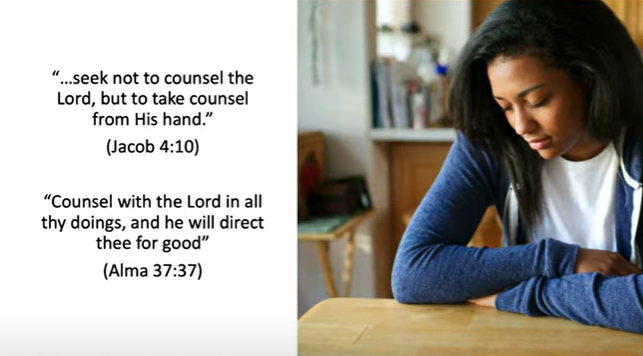
That’s not how prayer is meant to be. Look at what it says in Jacob: “Seek not to counsel the Lord, but to take counsel from His hand.” How often are we counseling Him, telling Him what He needs to do for us?
“Counsel with the Lord in all thy doings, and He will direct thee for good.”
Look at your own prayers. Notice: are they the voicemail, or are they a conversation? Ask Him your questions. Ask Him for help. It’s okay to express what we want, and that we really want it, but we also need to stand back and say, “What do you want? What do you want to tell me? How should I look at this differently? What do you want me to learn from this?”
Because I’m not getting what I wanted. “What do you really want me to know and to learn?” Ask Him those questions, and then listen. Pay attention to the thoughts that come into your mind and heart. He will speak to you; He will give you answers to your prayers.
He has said to “pray always.” How do we do that? I think this is the answer: “Look unto me in every thought; doubt not, fear not.”
Have you ever had a time in your life when you were so desperate for answers that every single one of your thoughts became a prayer? I have.
We found ourselves here at Utah Valley Hospital, having a stillborn. It wasn’t the plan. We had gone in that very day to find out if we were having a boy or a girl, and the ultrasound showed there was no heartbeat. She had just passed away, probably a few days before. It had been a few days since I had felt her move.
As I entered that hospital room, we had no answers. We didn’t know why. We didn’t know if we could have more children. We didn’t know if she was ours for eternity. We didn’t know if they were going to take her away, if we should bury her, if we should name her, if we should put her on the family tree. What’s the doctrine? There were two different things we were looking up, and we just didn’t know.
We entered that hospital room, pleading, “Heavenly Father, please…” And I remembered a scripture from the day before. What a tender mercy—it had been the main scripture in a lesson I was teaching, and it came to mind. I thought, “Okay, Heavenly Father, every single one of my thoughts is going to be a prayer.”
I asked, “How could we have joy? How did the early Saints have joy?” This happened to be the week of July 24th, so Come, Come, Ye Saints was on my mind. As soon as I asked the question—how could they have had joy when their family members were dying, starving crossing the plains, and here I was, delivering a stillborn baby—all I had to do was ask.
And because it was a prayer, and because I asked Him, He decided in His mercy to pour out joy in that hospital room. He showed me how they had joy: He gave it to them. He poured out joy, love, peace, comfort, and hope. He gave us all of those feelings instantly after I asked.
It was a sacred room. And as we held that little baby, I thought I would cry, and it would have been okay to cry. But we just looked at her in awe—what an amazing creation. And we knew, we knew we could have hope. We didn’t have all the answers; we still don’t have all the answers. But we knew God loved us. We knew He had a perfect plan for us and for that sweet little baby, and that’s all we needed at that time.”
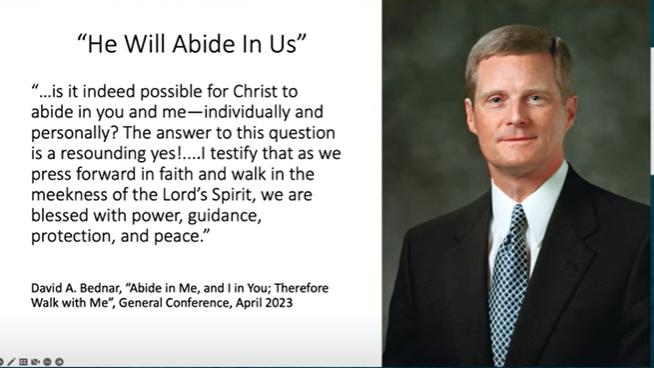
Elder Bednar has taught—I loved his talk, I loved what he shared. He said, “Is it indeed possible for Christ to abide in you and me individually and personally? The answer to this question is a resounding yes. I testify that as we press forward in faith and walk in the meekness of the Lord’s Spirit, we are blessed with power, guidance, protection, and peace.” He can abide in us, and we in Him. We can be close to Him all day long through the constant companionship of the Holy Ghost.
Daily Revelatory Scripture Study

Look at your scripture study. Is it a revelatory experience, or are you going through the motions? I know there are a lot of smart people in this room who love to understand doctrine, and I love that too—it’s good. But are you also looking for a connection with heaven as you read your scriptures? Are you opening your heart to having personal experiences with the Lord?
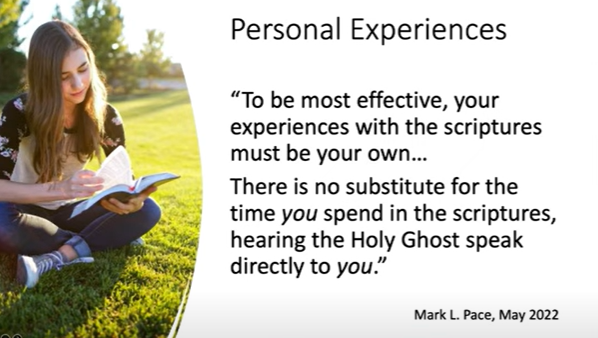
Elder Pace said, “To be most effective, your experiences with the scriptures must be your own. There is no substitute for the time you spend in the scriptures hearing the Holy Ghost speak directly to you.”
Are you remembering that when you open up your scriptures, you’re looking for a message directly for you that day? What does God want to tell you? What message does He have?
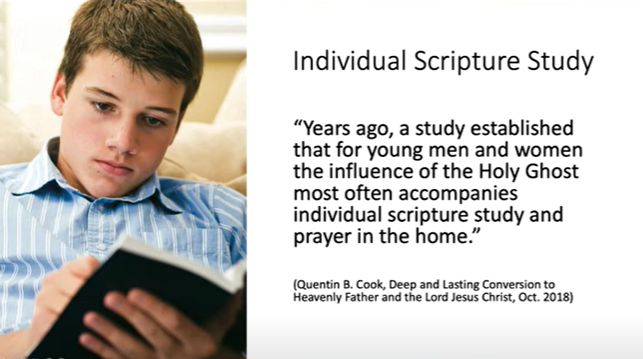
Years ago, a study established that for young men and women, the influence of the Holy Ghost most often accompanied individual scripture study and prayer in the home. It wasn’t the family scripture study. So when your teenager says, “I don’t want to do family scripture study,” say, “Good, you can just go do your personal scripture study.” It’s fine.
And don’t stop inviting them. “Hey, do you still say your prayers at night?” “Yeah, Mom.” “Okay, good, good—keep praying. Are you still reading your scriptures every night?” “Yes, Mom.” Or, “No, it’s not going so well.” “Well, keep doing it—I promise Heavenly Father has messages for you every single day.”
That’s the iron rod—that’s the safety in the midst of darkness. Hold on to it, and continue to invite our families to hold on to that. And then personally, look at yourself and say, “Well, am I doing it? Maybe that’s the problem.” Start with you. Start with you first, and do better at this. Seek for personal revelation in the scriptures.
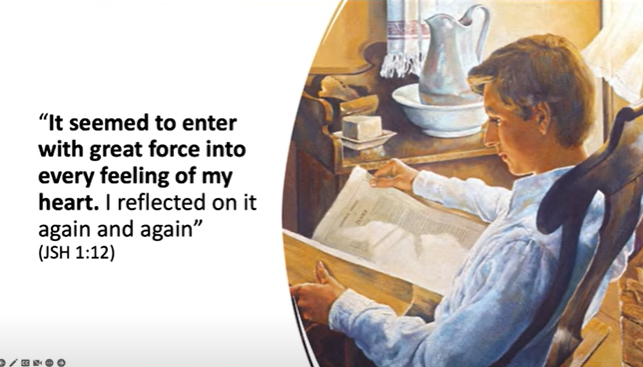
Like Joseph Smith, he had a question, he went to the scriptures, and he found his answer. And “It seemed to enter with great force into every feeling of my heart. I reflected on it again and again.”
We can have daily experiences like that. You might think, “Oh, that’s Joseph Smith, and he had an important mission,” but guess what—so do you. Each one of us has an important mission. God has important messages for every single one of us about what we’re dealing with that very day.
 So take your questions, your problems, your worries, your burdens—take them to the Lord in prayer, open up your scriptures, and look for answers. That’s how Richard G. Scott taught that it works: if you want to talk to God, you pray; if you want Him to talk to you, you open your scriptures. Well, do it—put Him to the test.
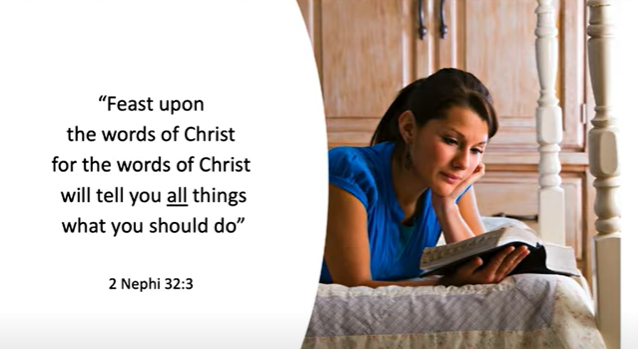
The scripture says, “Feast upon the words of Christ; for behold, the words of Christ will tell you all things what ye should do.”
He’s the one who said it, so put it to the test. Try it. Open up your scriptures and ask your questions—whatever it is that you need to know that day.
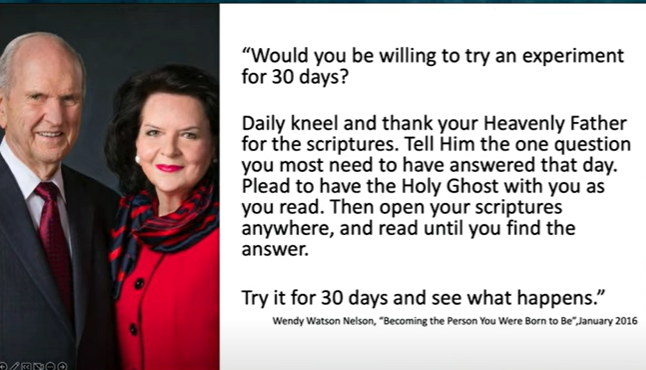
In fact, I’m going to let Sister Nelson, Wendy Watson Nelson, tell you. She was speaking to the youth battalion, I think—well, I think this was the talk where they called them the youth battalion. Okay, she’s speaking to the youth, and she said, “Would you be willing to try an experiment for 30 days?” And I’m extending this experiment invitation to you. She said, “Daily kneel and thank your Heavenly Father for the scriptures. Tell Him the one question you most need to have answered that day. Plead to have the Holy Ghost with you as you read. Then open your scriptures anywhere and read until you find the answer.”
How many of you have done this? I’m guessing a lot of you have. Have you done it recently? We need to have daily connection with heaven. Heavenly Father wants to talk to us. Jesus Christ wants to be close to us. They will give you answers to your questions. I promise. I’ve experienced this—try it for 30 days, keep trying, and you will see that you will receive answers to your prayers in your scriptures.
When Loved Ones Stray

Now, let’s shift gears a little bit and talk about when loved ones choose another path. I know our view of their path looks very dismal—kind of like this picture. They don’t necessarily have that same view. They feel like they’re doing great; their path feels bright, green, awesome, exciting—they feel free, sometimes. But we view it as this dismal path. Okay, so we’re talking about it from our view, but I hope that this will help. I know it’s not always like that picture right there.
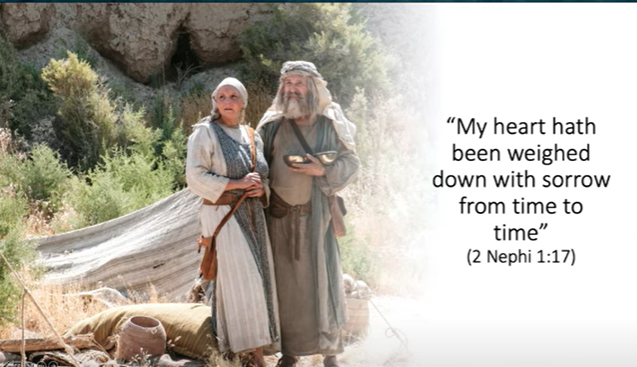
But often we do feel like Father Lehi and his wife, Sariah—we feel that our heart is weighed down with sorrow because we know the blessings that they’re missing out on. We know what they’re walking away from; we know what they used to feel and say and do. And so that can bring sorrow. And God understands that sorrow—a third part of His children also chose to walk away. He knows.
There are many others in the history of time who have known this sorrow. We’re meant to feel that sorrow; we’re meant to feel opposition in all things, right? We’re meant to feel the joy and the sorrow in life, so it’s okay if we’re feeling that sorrow.
One mother of a son who had gone another way said, “I still feel joy in my life. God gives me moments of joy, but I have so much sorrow.” So she prayed, “Heavenly Father, I’ve got this joy, I’ve got this sorrow.” Do you know what He said to her? “You’ve got two hands—you can hold them both.”
Hope in Christ
If you are experiencing the sorrow of loved ones close to you choosing another path, turn to the Lord. Ask your questions. Let Him teach you specifically what you need to know and what you can do. I have a couple of thoughts, but I know that your answers—your best answers—will come from Him.

One thing I know—even though we may think of them as lost, they are not lost. He knows exactly where they are. He knows them perfectly. He loves them perfectly. He knows exactly how to bring them back. So trust in that.
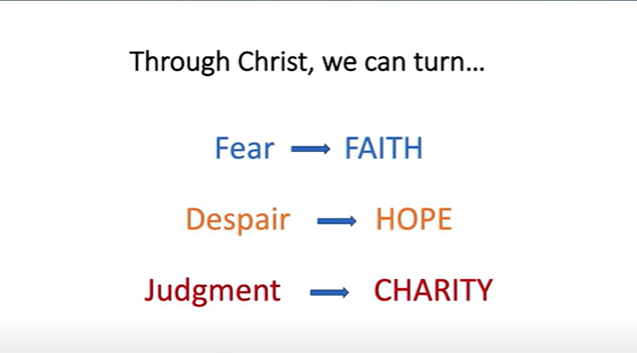
Through Jesus Christ, we can turn our fear into faith. It’s not faith in that person coming back—it’s faith in Jesus Christ. So take those fears and those worries, turn to Jesus Christ, and put your faith in Him. Trust that He is their Savior, that He can do His job.
Then ask, “What’s my job?” Your job is to love them. Change judgment to charity. Love them completely, unconditionally. Love them right where they are, and don’t stop loving them. Reassure them that you love them, no matter what.
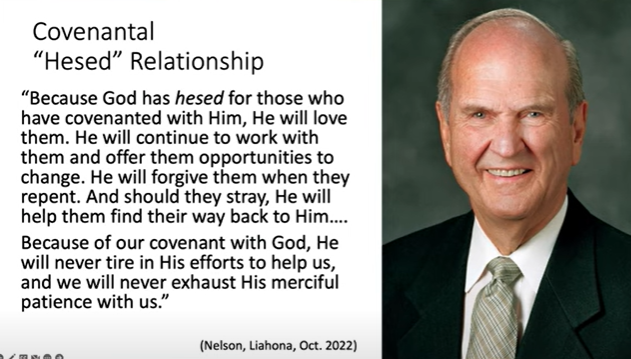
If you’re feeling despair, find hope in Christ. We can have hope in Him. There are many quotes I could share with you, but I just want to share this from the most recent October General Conference. President Nelson has been teaching us so much about our covenants and power in our covenants. Recently, he taught about the word hesed—a Hebrew word that describes the covenant relationship. He said, “Because God has hesed for those who have covenanted with Him, He will love them. He will continue to work with them and offer them opportunities to change. He will forgive them when they repent. And should they stray, He will help them find their way back to Him. Because of our covenant with God, He will never tire in His efforts to help us, and we will never exhaust His merciful patience with us.”
Let us be like that. Let us continue to love and care for those with differing beliefs, and trust in God—that’s exactly who He is. He knows how to seek after them.
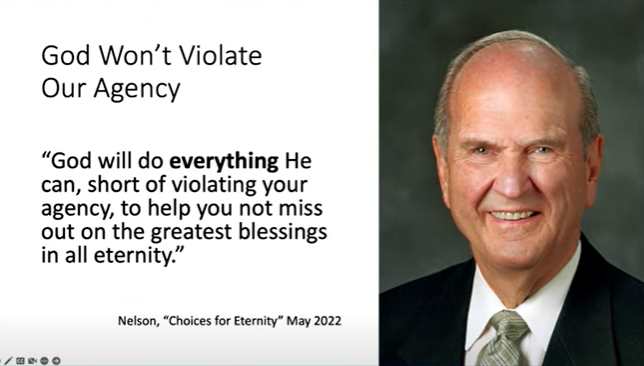
In fact, President Nelson said, “God will do everything He can—short of violating our agency—to help you not miss out on the greatest blessings in all eternity.” We must honor their agency as well. It’s what we fought for; it’s what we’re still fighting for. We want our agency, and we need to honor that.
Stay by the Tree
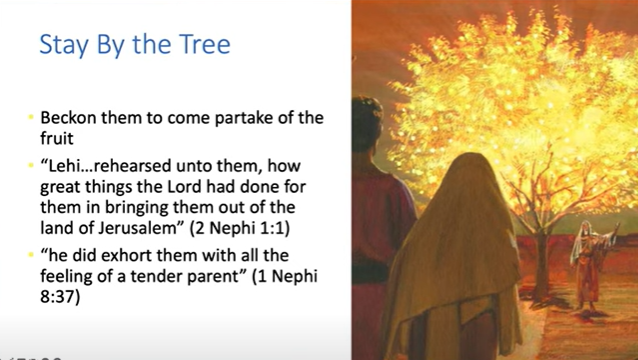
Another thing we can remember is to, like Father Lehi, stay by the tree. We don’t have to change because they’ve changed. Of course, we can be accommodating, loving, and sensitive, but in our families, in our homes, in personal worship, we can stay by the tree and beckon them to come and partake of the fruit. “Lehi rehearsed unto them how great things the Lord had done for them.” We can likewise do that; we can exhort them “with all the feeling of a tender parent.” Stay by the tree.
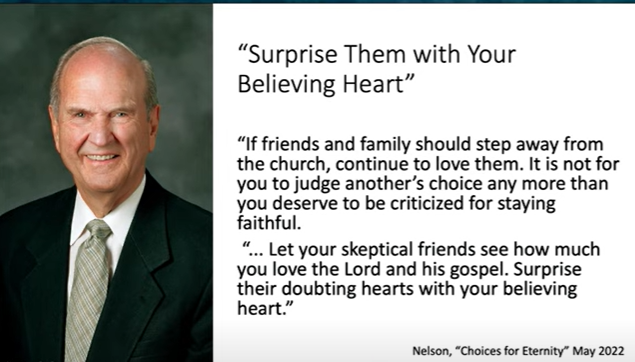
President Nelson said it beautifully: “If friends and family should step away from the Church, continue to love them. It is not for you to judge another’s choice any more than you deserve to be criticized for staying faithful. Let your skeptical friends see how much you love the Lord and His gospel. Surprise their doubting hearts with your believing heart.” Isn’t that good? Oh, don’t you just love President Nelson?

I was talking to a mother who has teenage and adult children struggling in their faith. They still live with her. She said, “What I’ve come to learn is that I can’t preach to them. I cannot preach to them. But what I can do is share my experiences.” So when she reads the Come, Follow Me lesson, she just looks for what she loves. She finds a personal experience or something she loves, and she shares that with her children—not to tell them what they need to love, but to share what she loves. Stories are a very safe place; it’s not preaching.
My mother wrote her autobiography, which was quite lengthy—several volumes. She said, “No one’s ever going to read this,” so she decided to make her “small plates.” Her small plates are only a few pages long, less than 20, I think. And she gave us her small plates, which are her most impactful spiritual experiences. She’s sharing those with her family so that we can know what God has done for her.

Often, a faith crisis in one person can affect others. I don’t know if you’re like me, but I’ve found myself affected by someone else leaving the Church.

I found myself looking at things through the lens they had. I found myself sitting in church, feeling absolutely nothing, listening to everything and looking at everything with glasses of skepticism, doubt, and pessimism. I felt nothing. I was even in Primary, sitting in the back row, and I could tell everyone was having a wonderful, spiritual day in Primary, and I felt nothing—nothing.
Choose Faith
It was soon after that I realized I didn’t have to wear his glasses. In fact, this was a choice. I could choose to take them off. I could take off those glasses and put on my glasses of faith. I had a believing heart—that was something I was blessed with as a child—and I had a lifetime of experiences where I knew God had been close to me and had shown me this was all true.
When I put those glasses back on—the glasses of faith—I promise you, immediately, immediately, the Spirit started to confirm that things were true. I felt little feelings of the Spirit: “It’s true, it’s true.” I felt it over and over again. The next week in Primary, I felt it over and over again.
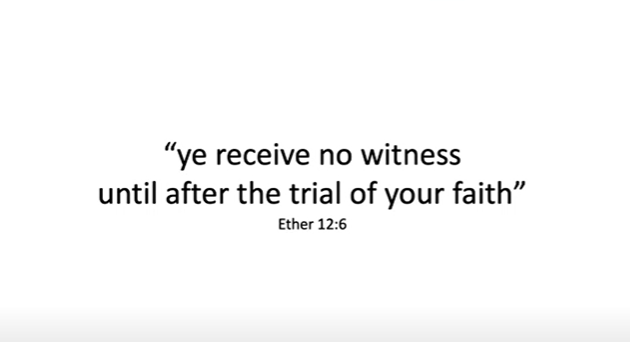
I learned something that day. I learned what the scripture says: “ye receive no witness until after the trial of your faith.” The Spirit does not confirm doubts. When we have doubts, we feel nothing. But when we have faith, the Spirit then can work and tell us it’s true.
Elder Kacher said, “Unbelief blocks our ability to see miracles, whereas a mindset of faith in the Savior unlocks the powers of heaven.” That’s true. So choose to wear the glasses of faith—it is a choice. You get to decide.
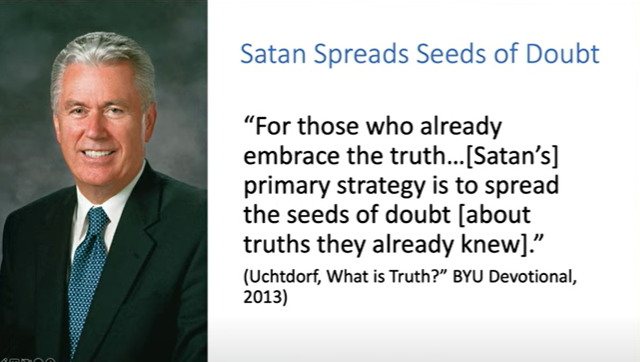
Elder Uchtdorf warned us, “For those who already embrace the truth, Satan’s primary strategy is to spread seeds of doubt about truths they already knew.” So watch for that; that’s something he does.
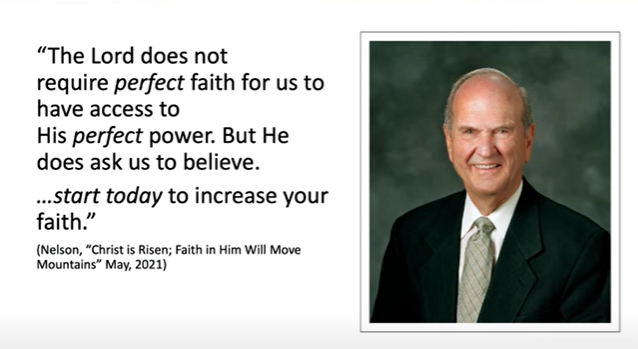
President Nelson taught, “The Lord does not require perfect faith for us to have access to His perfect power, but He does ask us to believe. . . Start today to increase your faith.”
This is what He’s asking us to do—keep increasing your faith. It’s either decreasing or increasing, so continue to work on that.
The Adversary is Real–Know His Tactics
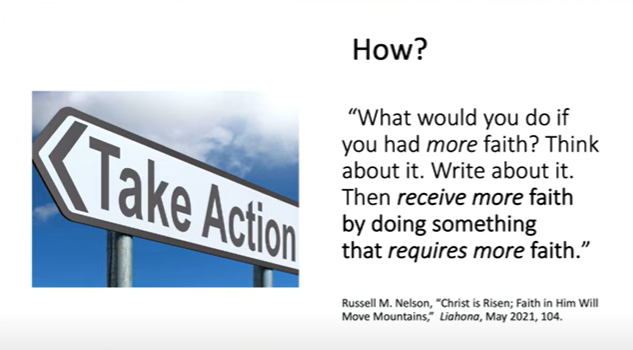
He said, “What would you do if you had more faith? Think about it; write about it; then receive more faith by doing something that requires more faith.” Faith is a principle of action. When you take action, your faith can grow.
We need to remember that the adversary is real.
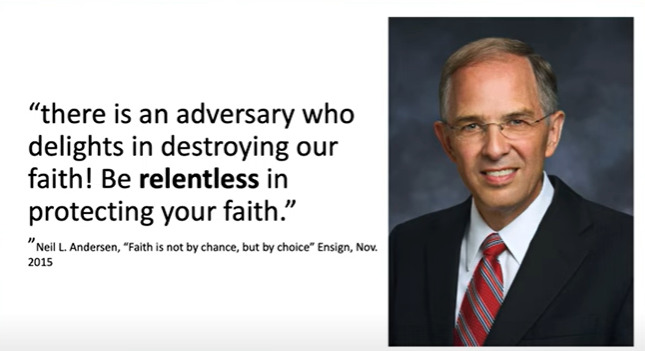
“There is an adversary who delights in destroying our faith. Be relentless in protecting your faith.” Elder Andersen warned. Sometimes we forget that he’s there.
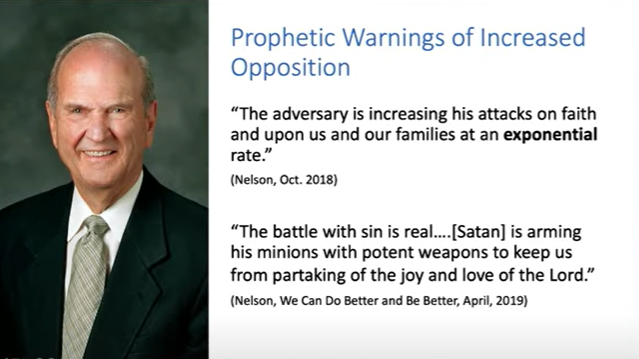
Our prophet, five years ago, warned us that “The adversary is increasing his attacks on our faith and on our families at an exponential rate.” Exponents get large really quickly, so that can be a really scary quote. Then,the one below it:
“The battle with sin is real. . . Satan is arming his minions with potent weapons to keep us from partaking of the joy and love of the Lord.”
We must know and remember that Satan is there, and we must understand his tactics—how he works—so that we can recognize when he’s trying to deceive us.
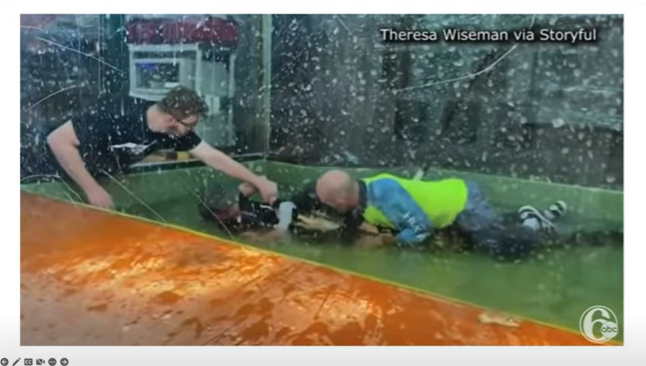
There’s a video I recommend; we’re not going to watch it here, but you’re going to want to go home and search for it. Has anyone here watched this video? It’s from Scales and Tails in West Valley City over a year ago. During a Saturday birthday party, there were some kids and adults gathered around, and there was a lady feeding an alligator. The alligator suddenly grabbed her hand and had a firm hold. Knowing what alligators do, she didn’t stand there hoping it would let go—she jumped into the water, and right away, the alligator started to do the “death roll.” She rolled with it, got her legs up, and managed to stay calm.
Everyone was panicking, but the man in the yellow shirt (who didn’t work there—he was just a birthday guest) jumped in to help. He got on the alligator, using his weight to stop it from rolling. She knew the alligator would try to grab more of her arm, so she stayed calm and waited for the right moment. When the alligator tried to get a better hold, she pulled her arm out, and the man outside pulled her to safety. The man in yellow, still on the alligator, was told how to get out, and within just a minute, he stepped right out. It was a miracle.
The lesson here is that because she knew the alligator’s nature and what it would do, she knew exactly how to get out, with the help of that man who jumped in.

So, what are Satan’s ways? We have been warned repeatedly about information online, and we must warn our families. Just like with pornography, we need to warn them that the adversary has put lies and deceptive information about our Church online that can hijack faith.
I believe Satan is hijacking testimonies—testimonies that have grown over a lifetime. People become lazy about the little things we’ve talked about, and in a short time, they’re gone.
Read this warning—this is from General Conference almost a decade ago: “Whatever the question is, if we need more information, we search it online. In seconds, we have a lot of material. However, Satan wants us to be miserable, and he distorts the real purpose of things. He uses his great tool to promote doubt and fear and to destroy faith and hope. With so much available on the internet, we must carefully consider where to apply our efforts. Satan can keep us busy, distracted, and infected by sifting through information, much of which can be pure garbage.”
Counterfeits

We need to teach our families how to recognize Satan’s counterfeits. Let me share a little story about my AirPods. My kids went running with one AirPod each, and one got lost. They told me the case fell by a neighbor’s bush, but we looked there, and it was gone. We went to the park where they ran, searching everywhere. Ironically, the park had little mushrooms that looked like AirPods, so every time I saw one, I thought, “There it is!” But each time, it was just another mushroom. Two hours later, we found the AirPod—right where we’d already looked by the bush, lying in the middle of the sidewalk.
The lesson here is to hold everything you find up to the light of truth. When you read something online that doesn’t feel right, that doesn’t align with doctrine, hold it up against the teachings of the prophets. Talk to someone you trust. I’ve learned that if I read something unsettling, it’s crucial to talk about it. I’ve been tempted to just go to bed and mull it over, but I’ve learned that’s when I need to talk to my husband, who didn’t read it and can help me see the truth. Together, we can discuss what was true, what wasn’t. And why it was so deceiving–because there were part truths. And hold it up against the doctrine, what the prophets are teaching.
“There is no Devil”
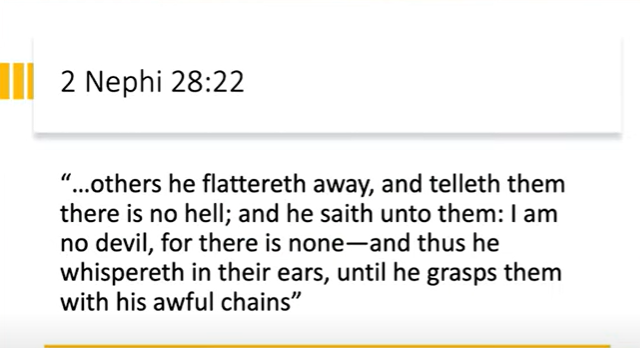
Another one of Satan’s tactics is to make us think he isn’t there, he wants us to completely take him out of the picture. And when people do that, they start pointing blame, where? They start pointing blame on the Church.
Anger
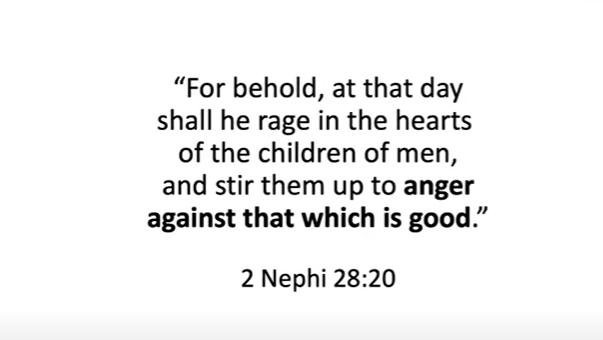
He stirs us to anger against that which is good.
I just met a wonderful woman last week who had left the Church for several years. She was at BYU-Idaho Education Week, and she had such a light in her eyes. I would have never guessed that she’d been away. She shared something that made me realize something important. She said, ‘Back when I went to church, I was comparing myself; I was sitting there feeling less than. I started to think, this Church makes me feel awful; this Church makes me feel less than. So, I’m not going to be part of this church.’
Her husband and kids kept going, her son went on a mission, and she eventually came back. She realized it wasn’t the Church making her feel that way; it was the adversary, who didn’t want her to see that he was the source of her feelings.
People often blame the Church or those in it because, yes, the Church is full of imperfect people who make mistakes, but the Church is not the people, the imperfect people.
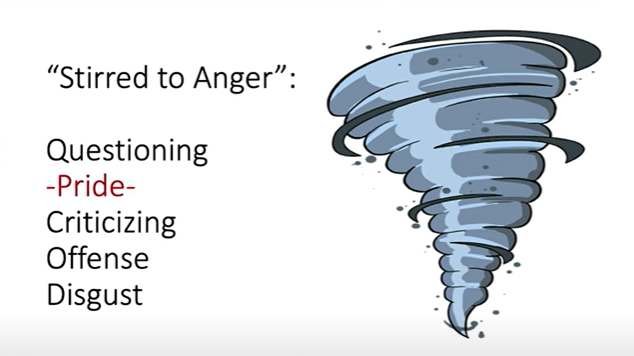
Satan also stirs us to anger; he wants us to contend with each other. He wants us to fight with each other, but he also wants to stir us to anger. When we start to have questions, he tempts us to feel pride and for those questions to become critical, like Laman and Lemuel murmuring. And then to take offense and even disgust.
This actually happened to me—I’m guessing it’s happened to many of you, too. It happened to me in a church house, in a room with people I love. I had no problem with any of them and no issues with the topic we were discussing, a topic I love and feel good about.
But I found myself starting to think, “Oh, why are they doing that?” and “Wait, don’t they want women? After all, we understand about women and the priesthood. ” And this was about a topic I love and feel at peace with, a topic I have come to understand and embrace. Within just a few minutes, I wasn’t exactly angry, but I felt unsettled. My heart had been stirred. I’ll come back to this story in a moment, but first, I want to share a couple of quotes about this pride of the learned.
Pride
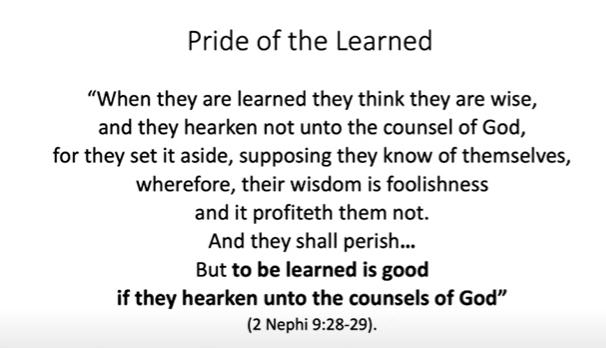
“When they are learned, they think they are wise, and they hearken not unto the counsel of God, for they set it aside, supposing they know of themselves; wherefore, their wisdom is foolishness, and it profiteth them nothing, and they shall perish. But to be learned is good if they hearken unto the counsels of God.”
In those moments of questions, and then our hearts are being stirred and pride starts to enter, we have to ask ourselves, “Is this really where I want to be? Do I want to be in Satan’s territory? Am I going to let him continue to stir my heart?” Because we know where that’s going.
Talk With Believers About Difficult Topics

Or instead, are we going to call out to somebody who has a life jacket and address the topic? I ended up talking to a friend out in the parking lot, saying, “Why am I feeling this way? Why am I bothered? Why do they do this?” And she replied, “I don’t know.” So I said, “Okay, well, I’m going to go ask my priesthood leader.”
I stepped right back into that meeting. They were just out in the hall, and I felt a little silly, but I asked them, “Why do we do this? Help me understand.” The response was, “Oh, just because they tell us to.” Not the most satisfying answer! So I went home and asked my husband, “Why do they do this?” And he gave me a really good answer.
I know now you’re wondering what the circumstance was. Okay, I’ll just tell you, since I’ve shared just about everything else! It was stake conference, and they were having an early Sunday morning priesthood meeting. On one part of the agenda, it said “auxiliary meetings,” but in another part, it said “priesthood,” so I thought, “Oh, is there a meeting for us to attend too?” I didn’t want to go to an early morning meeting, but somehow, Satan still stirred me to feel unsettled—wondering why they would have a priesthood meeting without us, especially when half the stake is led by women. I mean, don’t they want to tell us what they’re going to tell the men so that we can help the children?
And he had just stirred me! I know, I wish it wasn’t my story, but that’s what happened. So, I asked Paul, and he shared his thoughts on it. But it wasn’t until I went to the Lord, until I knelt down in prayer and asked Him, “Why? Help me understand. Why do they do this?” that I received the most beautiful answer.
Now that you know the circumstances, I’ll share the answer. Here’s what He told me, just for me; it might not be the answer you would need, but it was exactly what I needed. I said, “Heavenly Father, what do I not understand about women and the priesthood that I’m feeling unsettled about this Sunday morning meeting where they aren’t inviting me?”
He gently gave me the thought, “Your duty as a mother was to have children, to bear those children and rear them. These men who hold the priesthood of God, they have a duty they need to fulfill, and they need to feel that sense of duty. So, they’re going to go to a Sunday morning meeting and discuss that duty. You do not have to carry that duty.” It was the perfect answer for me, exactly what I needed to hear. Somehow, I had missed that. I didn’t fully understand that I don’t have to bear that duty that our wonderful priesthood brethren do, and I felt so grateful for that answer.
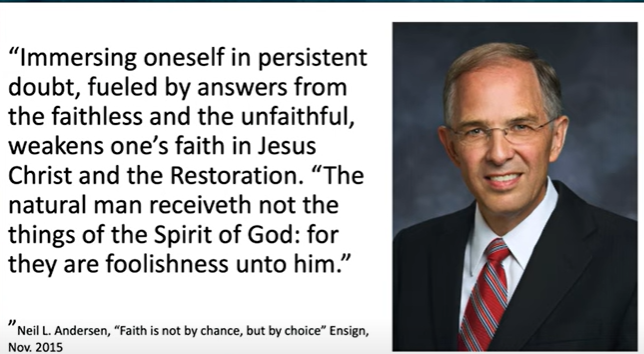
“Immersing oneself in persistent doubt, fueled by answers from the faithless and the unfaithful, weakens one’s faith in Jesus Christ and the Restoration.”
“The natural man receiveth not the things of the Spirit of God, for they are foolishness unto him.”

It is important that we discuss difficult topics in our homes with our children, and that we talk about these with the faithful, so we can understand how the adversary attacks on these topics.
Be Comfortable With Nuance & Uncertainty

We need to be willing to be comfortable with nuance, complexity, imperfection, uncertainty, and unanswered questions. We need to be okay with that.
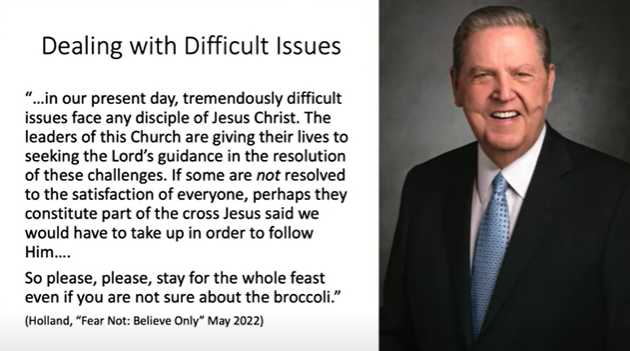
Elder Holland reminds us that, “. . . in our present day, “tremendously difficult issues face any disciple of Jesus Christ. The leaders of this Church are giving their lives to seeking the Lord’s guidance in the resolution of these challenges. If some are not resolved to the satisfaction of everyone, perhaps they constitute part of the cross Jesus said we would have to take up in order to follow Him. . . So please, please stay for the whole feast, even if you’re not sure about the broccoli.” Remember that one?
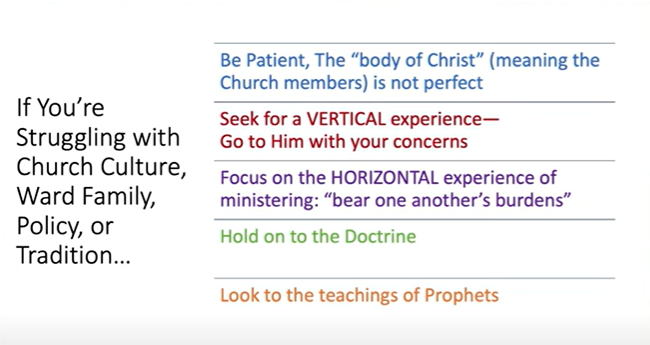
Be Patient
If you’re struggling with Church culture, ward family dynamics, policy, or tradition, here are a couple of suggestions. Be patient. The body of Christ is not perfect, just like our own bodies aren’t perfect. I’m sure you can think of things about your body that you’d like to just cut off and be done with, right? Well, the body of Christ is also imperfect.
Seek to have a vertical experience when you go to church—seek to hear God speak to you. When you’re there with that horizontal experience in your ward family, where you may have issues with certain things or people, focus on ministering. Look for someone who needs you. Don’t focus on imperfections or things you dislike about how others serve in their callings. Hold to the doctrine, and look to the teachings of the prophets, as we’ve talked about already.
Turn Doubts into Sincere Questions

We must turn our doubts into sincere questions.
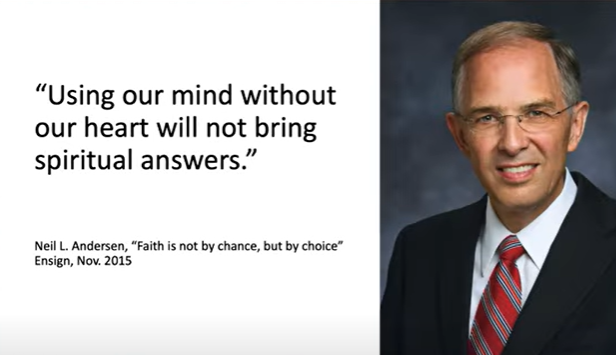
Elder Anderson taught that “Using our mind without our heart will not bring spiritual answers.”
Take Questions to the Lord

Take those questions to the Lord.
And as President Nelson said, “Let God prevail.” Be willing to be humble.
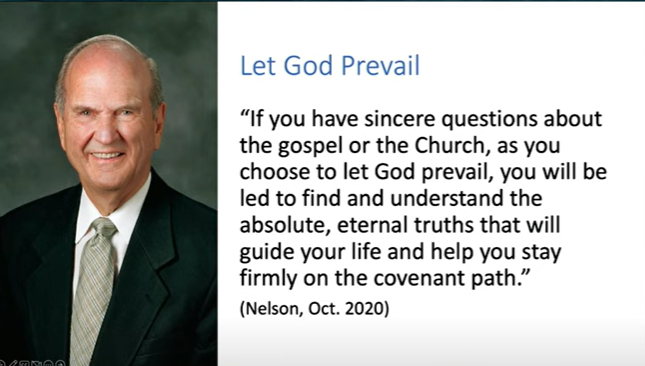
He taught, “If you have sincere questions about the gospel or the Church, as you choose to let God prevail, you will be led to find and understand the absolute, eternal truths that will guide your life and help you stay firmly on the covenant path.” I am so grateful for a prophet who reassures us.
Be Willing to be Humble
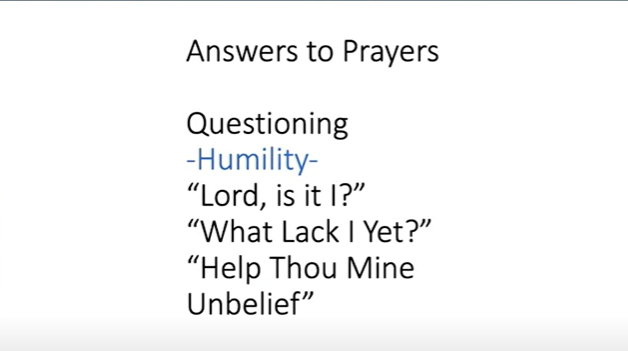
This is the pattern I have seen for myself: I need to back up. Go back to my initial questions, insert humility instead of pride, and, in humility, ask, “Lord, is it I? What am I doing? What lack I yet? What don’t I understand? Help Thou my unbelief.” That’s when He will give us answers, when we humbly ask, willing to let God prevail and willing to let Him teach us.
Choose to Believe
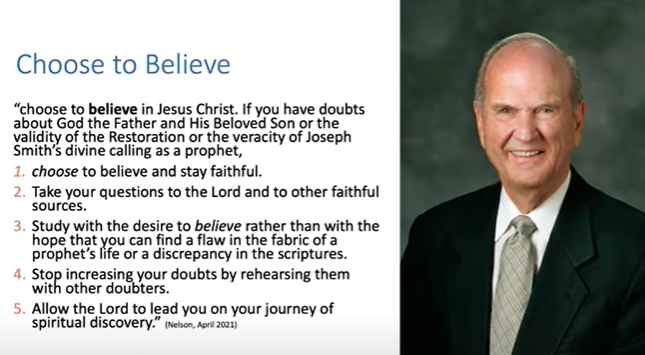
President Nelson said—numbers added here for emphasis—“Choose to believe in Jesus Christ. If you have doubts about God the Father and His Beloved Son, or the validity of the Restoration, or the veracity of Joseph Smith’s divine calling as a prophet, [and I would insert or anything else about the gospel], 1. choose to believe and stay faithful. 2. Take your questions to the Lord and to other faithful sources. 3. Study with the desire to believe rather than with the hope that you can find a flaw in the fabric of a prophet’s life or a discrepancy in the scriptures, 4. Stop increasing your doubts by rehearsing them with other doubters, and 5. Allow the Lord to lead you on your journey of personal discovery.”
Unanswered Questions are Okay
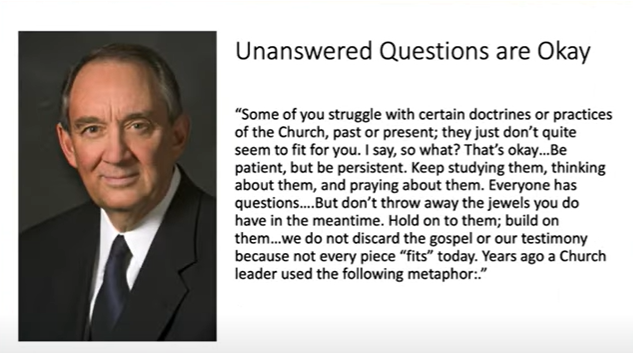
Elder Hinckley also encouraged us, saying, “Some of you struggle with certain doctrines or practices of the Church, past or present. They just don’t quite seem to fit for you. I say, so what? That’s okay. Be patient, but be persistent. Keep studying them, thinking about them, praying about them. Everyone has questions, but don’t throw away the jewels you do have in the meantime. Hold on to them, build on them. We do not discard the gospel or our testimony because not every piece fits today. Years ago, a Church leader used the following metaphor:
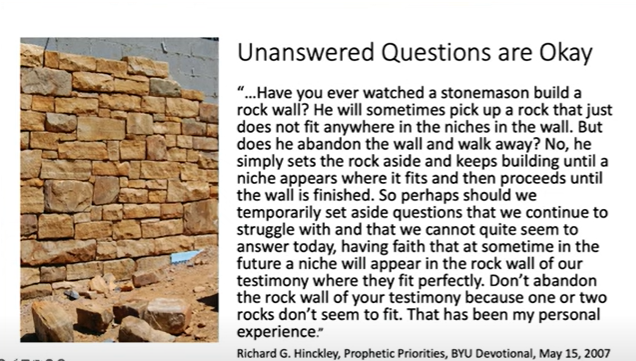
“Have you ever watched a stonemason build a rock wall? Sometimes, he will pick up a rock that just does not fit anywhere in the niches of the wall. But does he abandon the wall and walk away? No. He simply sets the rock aside and keeps building until a niche appears where it fits, and then he proceeds until the wall is finished.
“So perhaps we should temporarily set aside questions we continue to struggle with, those we cannot quite seem to answer today, having faith that sometime in the future, a niche will appear in the rock wall of our testimony where they fit perfectly. Don’t abandon the rock wall of your testimony because one or two rocks don’t seem to fit. That has been my personal experience.”
I had been married to Paul for about ten years. When he was in his mid-30s he came home from church one day and said, “I just got an answer today for a question I had on my mission. I’ve had it ever since then, and I got it today.” I won’t go into the details of it, but he realized why he didn’t get the answer when he was a young 20-year-old. He didn’t have the life experience—it’s like that rock wall, he didn’t have the experience needed to truly understand. And then, as a dad, a father, and a bishop, he finally understood, and God gave him the answer when he was ready to receive it.
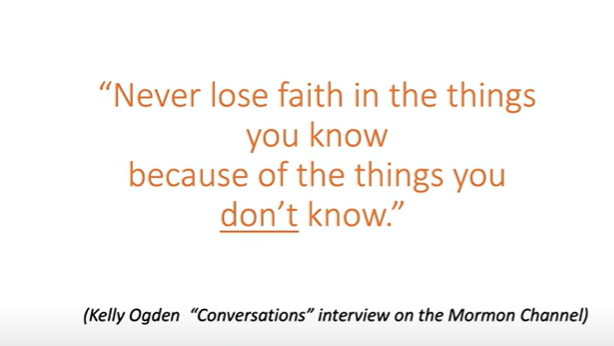
This is Kelly Ogden. He said: “Never lose faith in the things you know because of the things you don’t know.” We must remember that Satan would tell us to “walk away, walk away—it’s not worth it.”
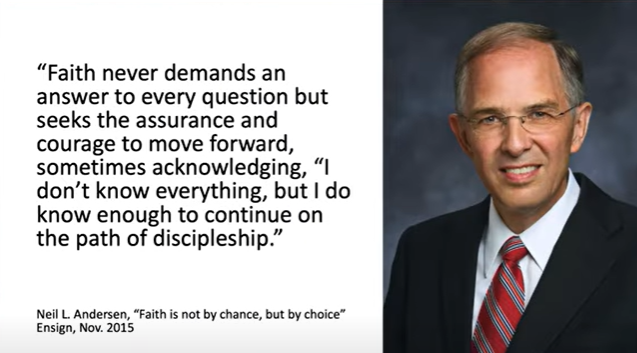
Elder Andersen said, “Faith never demands an answer to every question but seeks the assurance and the courage to move forward, sometimes acknowledging, ‘I don’t know everything, but I do know enough to continue on the path of discipleship.’”
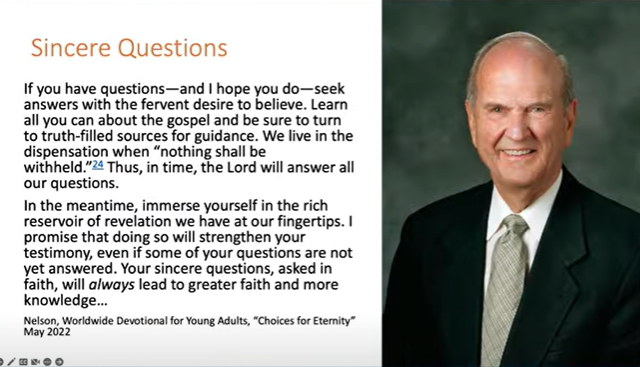
This is President Nelson. He said, “If you have questions—and I hope you do—seek answers with a fervent desire to believe. Learn all you can about the gospel and be sure to turn to truth-filled sources for guidance. We live in the dispensation when nothing shall be withheld; thus, in time, the Lord will answer all our questions. In the meantime, immerse yourself in the rich reservoir of revelation we have at our fingertips. I promise that doing so will strengthen your testimony. Even if some of your questions are not yet answered, your sincere questions asked in faith will always lead you to greater faith and more knowledge.”
And I say that in the name of Jesus Christ, amen. Thank you.
TOPICS
Faith
Doubt
Questions
Satan’s Tactics
