Summary
Summary
Elder Ahmad S. Corbitt affirms the divine authority of prophets and apostles in The Church of Jesus Christ of Latter-day Saints. He presents them as essential witnesses of Jesus Christ in a world that increasingly distrusts prophetic leadership. In this talk, he explains how Satan undermines trust in Church leaders by emphasizing their human weakness, historical mistakes, and social controversies—especially those related to race.
Drawing on scripture and modern prophetic counsel, Elder Corbitt teaches five principles: faith in Christ, avoiding judgment, respecting divine authority, recognizing the ongoing restoration, and practicing forgiveness. These principles help members maintain spiritual confidence and perspective. His address offers both doctrinal clarity and pastoral comfort, inviting a covenantal, forward-facing approach to Church history and criticism.
Church Service
Elder Ahmad S. Corbitt was sustained as a General Authority Seventy of The Church of Jesus Christ of Latter-day Saints on April 1, 2023. He has served in many Church callings, including:
- Full-time missionary in the Puerto Rico San Juan Mission
- Primary teacher and youth leader
- Elders quorum president and high councilor
- Counselor in two stake presidencies
- Stake president
- President of the Dominican Republic Santo Domingo East Mission
- First Counselor in the Young Men General Presidency
Professional Life
Elder Corbitt earned a BA in sociology from Richard Stockton University of New Jersey in 1989. He received his JD from Rutgers University School of Law in 1993. His professional career includes work as a:
- Trial attorney
- Vice president and general counsel for a New York public relations firm
- Executive director of corporate communications and government relations
- Associate general counsel for a Delaware company
He also directed the Church’s New York Office of Public and International Affairs and recently served as an Area Mission Specialist, training new mission leaders.
Personal Life
Ahmad Saleem Corbitt was born in Philadelphia, Pennsylvania, on August 16, 1962. He married Jayne Lillian Joslin in 1985, and they are the parents of six children.
This talk was given at the 2024 FAIR Annual Conference at the American Heritage School, Salt Lake City, Utah on August 8, 2024.

Elder Ahmad S. Corbitt was sustained as a General Authority Seventy in April 2023. A former mission president, public affairs director, and trial attorney, he holds a law degree from Rutgers. Currently, he serves the Church with extensive experience in leadership, communication, and global outreach.
Transcript
Elder Ahmad S. Corbitt
A Grateful Welcome
Good morning to everyone. What a wonderful privilege it is for me to be here with you. I’m accompanied by my wife, Jayne. Jayne, would you stand? There she is! Thank you.
Jayne’s had to put up with me for almost 40 years, because we’ve been married 39 and knew each other about a year before that.
I’m so grateful for Scott Gordon and DeLayna Beck and all of the professionals and servants of the Lord in FAIR and all the help they’ve given me. I congratulate you all on your important work.

The Great Blessing of Prophets on Earth
Imagine my joy when I learned that the actual Church Jesus Christ organized was restored to the world and that apostles and prophets once again walked the earth.
I was seventeen years old, graduating high school in West Philadelphia. When the missionaries taught my family about Joseph Smith’s First Vision, young Joseph’s desire to be in communication with God and to know His will resonated deeply with my own desires. Of course he was a prophet. Somehow, undoubtedly by the grace of God, I have never been tempted to doubt that he was.
I have read Joseph’s teachings and studied his history extensively, and he is my number one hero of all time 1. When the missionaries taught us about living apostles and prophets, I spoke up and asked, “There are apostles today? Where are they?”
They showed us a picture of President Spencer W. Kimball, his counselors and the Quorum of the Twelve in 1980. Strangely, they seemed to answer a question I did not know I had. This strengthened my sprouting testimony that prophets and apostles were still needed in modern times.
Over time, both parents and all ten children were baptized into The Church of Jesus Christ of Latter-day Saints. My sense of the importance of prophets steadily grew.
Later, as a full-time missionary, I often taught, as many of you did, “Surely the Lord God will do nothing, but he revealeth his secret unto his servants the prophets” 2 and that the Lord’s church was to be “built on the foundation of the apostles and prophets, Jesus Christ himself being the chief corner stone”. 3
Satan seeks to diminish confidence in the prophets and apostles.
Opposition to Prophets Is Part of the Pattern
Over the years of coming to know living prophets and apostles, my testimony of the sacred calling, office and keys of prophets generally has become infinitely stronger. I also see something of the intense opposition they face.
From hard-hearted Pharaoh to thick darkness in the Sacred Grove, to social media hostility toward General Conference talks, Satan has sought to diminish confidence in them. After all, throughout human history they have been the principal witnesses of Jesus Christ to the world. Satan hopes to impeach their character to discredit their all-important testimony of the Savior whom he hates and whose favored position it seems he eternally resents.
In our time, our adversary seeks to forestall what President Russell M. Nelson identified as “the most important thing taking place on earth today” – the gathering of Israel, for which the apostles hold the keys – and the Second Coming of Jesus Christ which that gathering must precede.4
Thus, prophets and apostles are always under fire. For, as one of them who was himself persecuted famously said, “there must needs be an opposition in all things”. 5 Jesus, Himself, warned His apostles, “If ye were of the world, the world would love his own: but because ye are not of the world, but I have chosen you out of the world, therefore the world hateth you”. 6
When the House of Israel Fights Against the Apostles
It is not news to us that our adversary and the world oppose prophets and apostles. What is odd and ironic is that this evil has infiltrated the Lord’s Church, despite the sustaining love Church members in general feel for our leaders.
Whether in antiquity or the latter day, Satan has always found ways to turn some of God’s own covenant children against His principal witnesses. Nephi states that after the Savior’s crucifixion, “I saw the multitudes of the earth, that they were gathered together to fight against the apostles of the Lamb…”.
Again, no surprise here.7
Nephi then apparently sees humanity generally and, to some extent, metaphorically over the expanse of world history. He said, “the multitude of the earth was gathered together; and I beheld that they were in a large and spacious building….” He was told this building represented the pride and wisdom of the world generally and had no foundation.
Fighting the Apostles: A Tragic Irony Within the Covenant
Nephi is then warned regarding a specific type of people inside this building who would also fight against the apostles. Their identity is shocking.
“And the angel of the Lord spake unto me again, saying: Behold … the house of Israel hath gathered together to fight against the twelve apostles of the Lamb”.8
You might be tempted to narrowly interpret the house of Israel or the Twelve Apostles of the Lamb as solely those at the time Jesus “was lifted up upon the cross and slain,” or in other ways. But the angel seems to describe them in the broader context of the pandemic of pride and worldly wisdom associated with this great and spacious building and its ultimate fall.
He warned Nephi and all of us, “Thus shall be the destruction of all nations, kindreds (or families), tongues, and people, that shall fight against the twelve apostles of the Lamb[.]”9
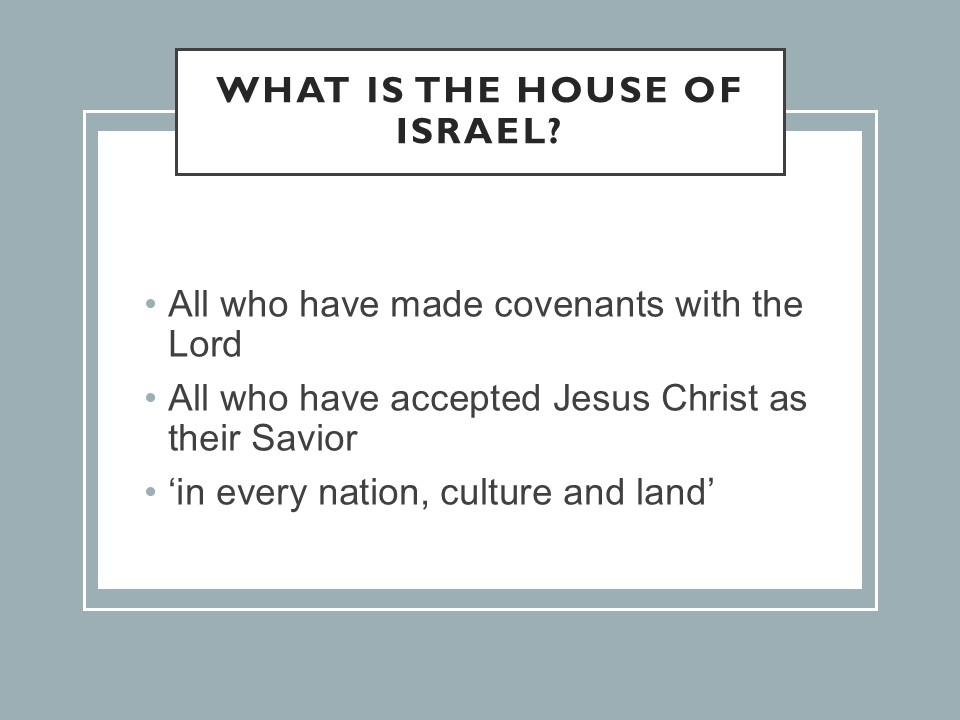
What Is the House of Israel?
What is the house of Israel in our day? President Nelson taught,
The house of Israel includes all who have made covenants with the Lord and who have accepted Jesus Christ as their Savior. Those who are of the house of Israel can be found in every nation, culture, and land.”10)
He said this includes,
faithful Gentiles who have been grafted into the covenant family of Abraham”. 11
How Satan Leads Covenant Members to Fight the Prophets
How does our adversary deceive God’s own latter-day covenant people to “fight against”—or oppose, criticize, or hinder in any way—those He has called, empowered and given keys to gather them to spiritual safety, power and eternal life?
I will discuss three of these deceptive ways, followed by a specific example, then several principles that can help us avoid fighting against the apostles of the Lamb.
Pride Can Undermine Our Ability to Forgive Past Prophets
Satan attempts to play on the pride of the Saints.
First, fundamentally, our adversary lures Church members into this harmful practice through the universal sin of pride, already mentioned.
To beware of pride is one of the most prominent warnings of our day, and of the Book of Mormon, which was written for our day and to facilitate our gathering. Pride leads to murmuring against prophets and apostles as they endeavor to “build up the church, and regulate the affairs of the same in all nations”.12
This includes their declarations and proclamations.
On the milder side, how often have you heard Church members say or post something like, “This or that ought to be done differently than how the Church or the Brethren are doing it” or even “I’m going to do it my way despite what they say”?
The Lord counsels us to uphold these leaders by “the prayer of faith” (D&C 107:22). He warns that “they who will not hear the voice of the Lord, … neither give heed to the words of the prophets and apostles, shall be cut off from among the people; For they have strayed from mine ordinances and have broken mine everlasting covenant”.13
How the Adversary Distracts the Faithful
Avoiding the Trap: Forgive Past Prophets Instead of Focusing on Their Flaws
Our adversary focuses us on their human weakness.
Second, the adversary deceives today’s house of Israel to oppose latter-day apostles and prophets by tempting us to focus on their human weakness. We know we are born into a fallen world where the human family is subject to all manner of flaws and imperfections.
“I give unto men weakness that they may be humble,” the Lord said.14 However, President Henry B. Eyring specifically asked the house of Israel to consider, “Have I thought or spoken of human weakness in the people I have pledged to sustain?”
I confess I am somewhat uncomfortable discussing the subject even now, though it is necessary to the premise of this talk. Still, I think I’ll turn it over to him and others.
He observed, “These are imperfect human beings, as are you.”15 In a recent social media post, President Jeffrey R. Holland said, encouragingly, “Except for Jesus, there have been no flawless performances on this earthly journey we are pursuing.”16
Sister Sheri Dew taught BYU–Hawaii students and faculty that, “the question of fallibility” is, itself, flawed, as it “leads us down a side road that misses the point of who prophets really are.” As author of the biographies of two presidents of the Church, she said, “I’ve never heard a prophet claim perfection. Have you? Can you think of any scriptural prophet who didn’t demonstrate some weakness?”17
The Prophet Joseph Smith said, “I never said I was perfect, but there is no error in the revelations.”18
The saving question is: what principles should guide our response if we should see human weakness among our leaders? I will share several momentarily.
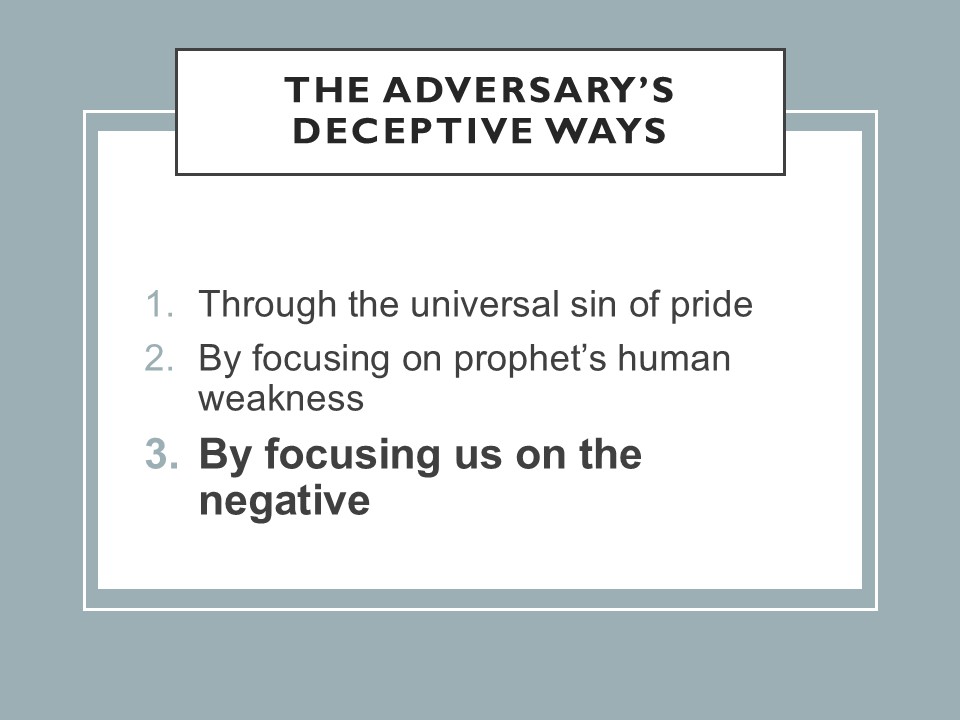
Focusing on the Negative in All Things
Our adversary focuses us on the negative in all things.
Third, closely related to focusing us on the human weakness and flaws of the Lord’s servants, our common enemy exploits the “opposition in all things” principle masterfully.19
If Lehi was correct, every single good has bad associated with it. This includes you and me, the house of Israel, prophets and apostles, the plan of salvation, the Savior, and God, Himself. If our adversary can stir God’s children to focus inappropriately on the opposition of these wonderful things, he wins.
He appears to have used this same strategy in the war in heaven. Of Lucifer’s fall from heaven, the Lord revealed, “the accuser of our brethren is cast down which did accuse them before our God day and night”.20
I find no indication of what the accusations were or even whether they were true or false.21 But the clear implication is that this critical focus on our brethren was deeply wrong.
A Premortal Pattern
Sadly, some have fallen into this same premortal pattern here in mortality and in our time. Perhaps the more relentless such criticism becomes – remember it was “day and night” in the premortal world – the harder it is to resist or stop.22
It seems clear it led, at least in part, to the fall of a mighty son of the morning and a third part of Heavenly Father’s spirit children, all in His loving presence.
Fomenting a Negative Focus
Let us beware of the devious spirit that foments negative focus on the negative in all things, especially our brethren.23
A Painful Example: Can We Forgive Past Prophets?
A specific application
Let me now share that specific example I promised. It is especially concerning to me. Sadly, it has damaged the faith of a subset of the house of Israel.
The issue of race as opposition to the preaching of the restored gospel of Jesus Christ is well-known. I think I am as aware as anyone of words and actions by some Church leaders in the 1800s and even the last century that are among what President Dallin H. Oaks sensitively referred to as “disappointments of the past”.24
Indeed, there has been a resurgence of publications related to this subject.
Question:
Are we justified in accusing our brethren of the past of racism “day and night,” even if the accusations are true, or are we in danger of perhaps repeating a perilous premortal practice?
This same scheming spirit can stir up other demographics in the house of Israel, including women, those attracted to their same gender, their loved ones, and others to anger against the prophets and apostles, past and even present.
Principle One: Faith in the Lord Jesus Christ
The first principle I will share to help us refrain from fighting against the apostles of the Lamb is the first principle of the gospel: faith in that Lamb and His atonement.
Whereas the accuser of our brethren, lacking faith in the Christ, was apparently stuck looking backward, President Holland taught, “faith always points toward the future.”25
As our faith in Christ and trust in God increase, we will, as the Book of Mormon repeatedly teaches, “look forward with an eye of faith and view” their promises fulfilled.
President Oaks invited, “Let us all look forward in the unity of our faith and trust in the Lord’s promises.”26 Nor will the Saints’ direction be downward, as if looking down on others from feelings of superiority.27
Our forward focus will be toward the fulfillment of President Nelson’s promise of “perfect peace and harmony”28 and President Eyring’s prophecy that “the Lord Jehovah will return to find his people unITEd, of one heart, unified with Him and with our Heavenly Father.”29
All these quotes and many more from living apostles show how clever Satan is at stirring up contention and disunity among us.
He even successfully entices some of our brothers and sisters to “fight against,” in my view, the most equality- and harmony-focused living prophets and apostles in the history of the earth.
This is the time for all the house of Israel to “look forward with one eye,” as our leaders do, and become a unified, happy, powerful, covenant people with zero racial, gender, ethnic or other disharmony.
Does Remembering the Past Undermine Forgiveness?
But don’t the Book of Mormon and Church history30 invite us to look back? Alma even urges his children to remember the captivity and persecution of their fathers and mothers.31
This record teaches these important lessons not to keep us looking backward but, as its introduction states, “to show unto the … house of Israel what great things the Lord hath done for their fathers.”
By highlighting the hand of the Lord in the liberation of their forebears, the Book of Mormon’s prophetic writers help us see that it was the Lord who freed our forebears – whether from bondage as blacks or persecution as pioneers or something else.
They thereby inspire sure faith that the Lord will similarly bless all of us going forward – if we exercise the forward-facing faith in Christ that book uniquely teaches.
Look Forward to Christ—Not Backward in Bitterness
This is also the answer for those who sincerely hope for healing through focusing on the Church’s past. Dear brothers and sisters, searching for others’ errors in the past is the opposite of thinking Celestial!32
If we repeatedly go back and touch the old cast iron stove that burned us in the past, we will never be healed.
Like Peter walking on the sea, it is when we single our eyes forward on Jesus that we can miraculously navigate the deep, dark, sometimes treacherous waters and boisterous winds of mortality.
By contrast, when we focus in other directions, we take our eyes off the Savior and healing and begin to sink.
If we, too, cry out, “Lord, save me!,” He will respond, “come unto me,” and that will always be forward.33
Principle Two: Condemn Me Not, Judge Not
Why We Must Forgive Past Prophets and Avoid Condemnation
“But Brother Corbitt, does the Lord want us to ignore racism in our church history? What should our response be to, say, nineteenth century attitudes and actions of prejudice in the Church that were directly contrary to what our leaders teach today?”34
Thankfully, a wise Heavenly Father has provided principles that address these questions in higher, holier and more effective ways than mere secular historical analysis can.
Seeing our day, Moroni said, “Behold, … Jesus Christ hath shown you unto me, and I know … that ye do walk in the pride of your hearts…”35 He then taught two key principles that can shield us all from deception where past prophets and apostles are concerned.
He stated the first in this easily missed but important plea to latter-day humanity: “Condemn me not because of mine imperfection, neither my father, because of his imperfection, neither them who have written before him.”
Apparently, as a historian and a prophet, Moroni comprehended the human tendency to let the flaws of earlier generations eclipse the more important contributions of those generations.
Of the Book of Mormon, itself, he similarly warned, “…whoso receiveth this record, and shall not condemn it because of the imperfections which are in it, the same shall know of greater things than these.”36
Moroni and the tendency to focus on weakness
Moroni worried that, “the Gentiles will mock at these things, because of our weakness in writing.”37
“Some of these sophisticated, faultfinding, latter-day people who ‘walk in the pride of (their) hearts’ will focus on our weakness and the imperfections of this record – and I would add those of past prophets and apostles – and miss the bigger picture and greater things.”
No wonder he warned, “he that condemneth, let him be aware lest he shall be in danger…”38
Obviously, many of earlier generations lacked the light and revelation regarding racial equality and understanding that prophets and apostles have long since taught and reinforced.39
But it is neither noble nor Christlike to condemn our brothers and sisters of the past because, as the morning was breaking and the shadows fleeing, they labored under less light than we do.
And how unfortunate it would be for any of us of any background to allow obscured views of the past to darken our vision of the shining opportunities of our day or our gratitude for those who facilitated them for us.40
The Ultimate Example of Looking a Gift Horse in the Mouth
In Jesus’s parable of the husbandmen, the Lord of the vineyard sent his imperfect servants to gather the fruit of his vineyard. However, those of the house of Israel who should have known better mistreated them.41
Like their modern counterparts, rather than be grateful for the Lord’s servants, they found reasons to oppose them. It is the ultimate in looking a gift horse in the mouth.
Jesus, I have learned from missionaries or parents or others that thou hast most painfully sacrificed Thine all for me. Thou gavest Thy life to overcome physical death (a free gift to me and to all), spiritual death and the demands of justice on the condition that I follow Thee. As a fallen mortal, utterly helpless to do any of this myself, I would have been forever cut off from God and my family.
Thou hast sent special witnesses of Thy name to proclaim these truths throughout the world and establish ordinances and covenants for me. But I would rather find fault with these witnesses and judge them because of their flaws, and maybe even post them on Facebook.”
Give Thanks Instead of Condemning: A Better Way to Forgive Past Prophets
Moroni states his second key principle immediately after the first, which I’ll repeat: “Condemn me not because of mine imperfection, neither my father, because of his imperfection, neither them who have written before him; but rather give thanks unto God that he hath made manifest unto you our imperfections, that ye may learn to be more wise than we have been.”42
In other words, we focus on and learn from past prophets’ and apostles’ teachings and witness of Christ and His gospel. Beyond that, as we see imperfections, we simply learn to be more wise in these areas as we move forward in faith.
But, again, we do not condemn or judge them.
I suggest that if this response seems strange, it may reflect some distance from Jesus’s teachings. He famously warned, “Judge not, that ye be not judged. For with what judgment ye judge, ye shall be judged: and with what measure ye mete, it shall be measured to you again”.
Judging includes not forgiving and assuming past prophets’ actions were wrong based on personal or modern standards.43

Embracing Charity, Not Historical Scrutiny
Thus, the issue is not whether someone in the past had a “flawless performance.” Let’s just take the latter-day and ancient prophets and apostles at their word and concede (to those who pick through history looking to publish such things) that, like us, “all have sinned, and come short of the glory of God,” in Paul’s words.44
No, the far greater issue is whether we will embrace the greater things in faith. The greater things include charity without which we are nothing anyway. And that forward-facing faith is unto repentance.
Again, we should be careful to avoid assuming past prophets’ actions were wrong, unwise or the fruit of human weakness simply because they look wrong from our modern perspective.
Prophets in the scriptures have, in fact, been commanded to do things that are clearly contrary to today’s norms, customs and even laws.45
As we seek and focus on the greater things in forward-looking faith unto repentance, we will less likely misinterpret as wrong the actions of past prophets.
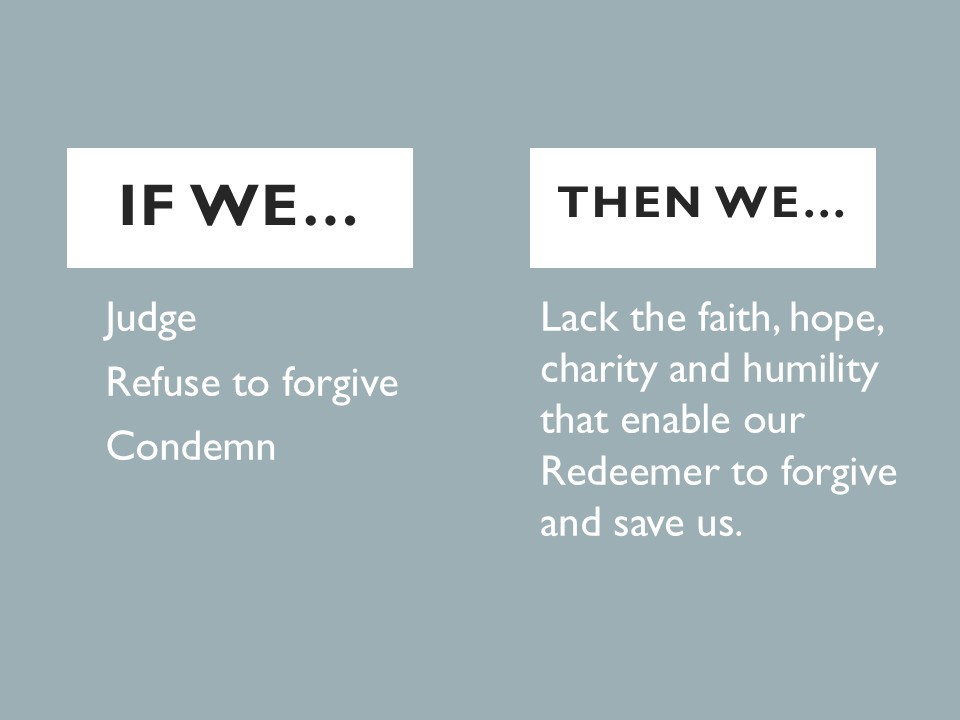
What Happens If We Refuse to Forgive Past Prophets?
Besides, if we really believe Jesus, as we judge others we will be judged, and as we refuse to forgive others, we will receive no forgiveness, regardless of how pure we are in that particular sin that really bothers us when others commit it.
This brings Jesus’s beams and motes warning into clearer focus.
As we search for or murmur about imperfections of the prophets and apostles – past or present – as we condemn and refuse to forgive them, we sadly lack the faith, hope, charity and humility that enable our Redeemer to forgive and save us.
This negative focus also leads to criticizing and having little confidence in the living prophets and apostles.
Thus, Moroni’s voice from the dust represents the voices of all the past prophets and apostles of Jesus Christ: “Condemn us not for our imperfection. Rather, give thanks unto God that ye may learn to be more wise than we have been.”
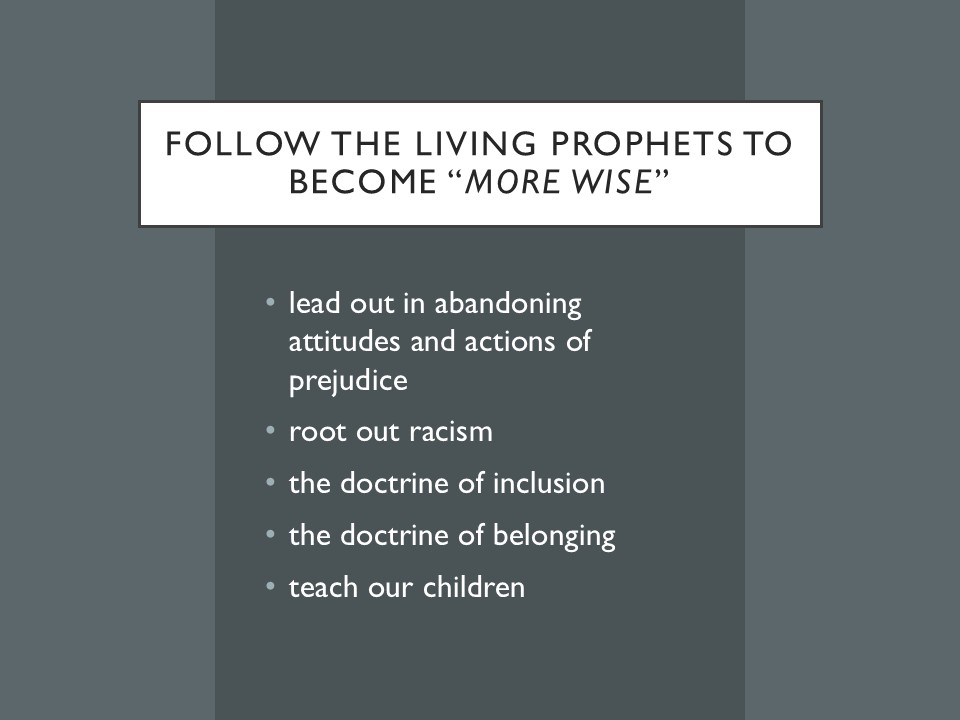
Follow the Living Prophets to Become “More Wise”
Some of the best examples of learning to be “more wise” than those who may have harbored “attitudes of racism”46 in the past are the prophets and apostles of the present.
Their teachings to “lead out in abandoning attitudes and actions of prejudice,”47 “root out racism,”48 and of “the doctrine of inclusion”49 and “the doctrine of belonging”50 model how we should similarly seek to be “more wise.”
We are also “more wise” when, following their teachings, we teach our children and others to avoid and discourage racial slurs and denigration.
Brothers and sisters, it is astonishing to repeatedly learn of credible stories of such things in some of our schools and communities right here in the center of the restored Church of Jesus Christ.
Even if the youth making such comments are not Latter-day Saints or not active, which is hard to imagine in communities with overwhelming populations of our people, one would think our influence as followers of Jesus Christ would smother such misconduct or, at a minimum, make it very uncomfortable to engage in or repeat.
If our children have not been convinced at home that the notion of racial superiority is wrong, we will need to be better at the Book of Mormon teaching to be more wise and at following the teachings and examples of the living prophets and apostles.
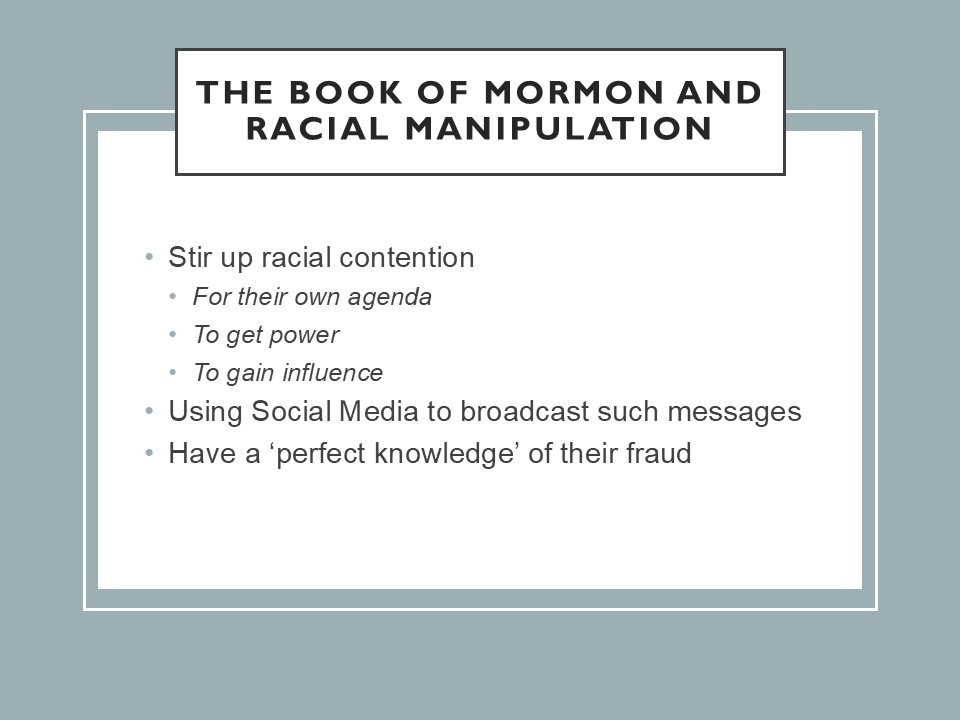
The Book of Mormon and Racial Manipulation
How the Adversary Exploits Race to Undermine Prophets
Sticking with the issue of race or color a moment longer, a few years ago, I shared what I consider an urgent, timely and related Book of Mormon warning with a Black American convert friend.
We discussed several Nephites by birth who were dissidents or “dissenters” from their church community, as well as Lamanite leaders who, like the dissidents, hated the Nephites.
In the interest of time, I’ll name just three Nephite dissidents.
“Now (Zarahemna’s) designs were to stir up the Lamanites to anger against the Nephites; … (that he might preserve their hatred towards the Nephites) (and) … usurp great power over them, and…over the Nephites…”.51
Later, “it came to pass that, as soon as Amalickiah had obtained the kingdom he began to inspire the hearts of the Lamanites against the people of Nephi; yea, he did appoint men to speak unto the Lamanites from their towers, against the Nephites. And thus he did … stir[] them up to anger…”.52
Modern Towers and the Spread of Contention
“Hmmm!,” she said as she read. I asked, “What do you see?” She said she saw a warning that in our time people would manipulatively stir up racial anger and contention for their own agendas, power and influence.
We saw the “towers” as the use of media and technology to broadcast such messages.
A Modern Example: Weaponizing Race Against the Church
A recent article in the Salt Lake Tribune illustrated this very point of race manipulation. It cited the case of a modern-day, dissident, former Latter-day Saint who made a fake Church website to deceive Black members into thinking Church leaders had apologized for the priesthood ban.
He convinced a Black member to publish it on social media – he appointed him to speak from his tower.
Despite this dissident’s abusing Black people in this way and seemingly manipulating them as a weapon against his former Church on the very morning of the First Presidency’s historic meeting with national officers of the NAACP, the article states his justification was to “start a conversation.”53
You see, he did it for Black people.
This reminded me of Amalakiah’s dissident brother, Ammoron.
In his heated exchange with Captain Moroni, Ammoron said, “…now, I am a bold Lamanite (or non-believer)[.]” “[B]ehold, this war hath been waged to avenge their wrongs, and to maintain and to obtain their rights to the government[.]”.54
Yet, like his modern counterpart, Ammoron, the scripture states, “had a perfect knowledge of his fraud”.55
This modern-day case of race or color stirring is one of many that parallel this repeated pattern and warning in the Book of Mormon, which, again, was written for our day.56
Principle Three: Satan Tempts Us to Exceed Our Authority
Pride Leads Us to Reject and Not Forgive Past Prophets
Another deceptive element about this apology hoax was that this conversation was not for this person to start.
The principle is: avoid exceeding our authority or assuming roles we don’t have. However well-intentioned, both flow from pride and lead to failure to defer to prophetic authority.
Not surprisingly, he who instigates this error knows all about exceeding authority.
“Behold, here am I, send me… and (contrary to thy plan and will) I will redeem all mankind, that one soul shall not be lost, and surely I will do it; wherefore give me thine honor”.
Of him the prophet Isaiah said, “…thou hast said in thine heart, I will ascend into heaven, I will exalt my throne above the stars of God: I will sit also upon the mount of the congregation,… I will be like the most High”.57
“I will exceed my authority.”
“I will presume to say what the Lord’s church should or should not do; I will say whether and when this church should apologize or change its positions or doctrine, and ‘surely I will do it,’ not those called by the Most High to do it.”
This mindset deceives our brothers and sisters into thinking too highly of their own opinions, which naturally occurs when we think too lowly of the teachings of prophets and apostles.
Principle Four: The Ongoing Restoration
Trusting the Prophetic Process and Forgiving Past Prophets
“Well, Brother Corbitt, if some past prophets and apostles were influenced by their cultures to say or do some things their living counterparts see as disappointing or incorrect, how do we know the same is not happening today, to be discovered in the future?”
Simple; yet powerful.
The Ongoing Restoration
In what our leaders call the ongoing restoration, from 1820 until now, the Lord has continually tutored His prophets, seers and revelators in the revelatory process by which He leads His Church.
President Nelson taught:
When we convene as a Council of the First Presidency and Quorum of the Twelve, our meeting rooms become rooms of revelation. The Spirit is palpably present. As we wrestle with complex matters, a thrilling process unfolds as each Apostle freely expresses his thoughts and point of view. Though we may differ in our initial perspectives, the love we feel for each other is constant. Our unity helps us to discern the Lord’s will for His Church.”
He continued:
In our meetings, the majority never rules! We listen prayerfully to one another and talk with each other until we are united. Then when we have reached complete accord, the unifying influence of the Holy Ghost is spine-tingling! We experience what the Prophet Joseph Smith knew when he taught, ‘By union of feeling we obtain power with God.’”58
Elder D. Todd Christofferson observed:
The objective is not simply consensus among council members but revelation from God. It is a process involving both reason and faith for obtaining the mind and will of the Lord.”59
What a wonderfully fine-tuned process for safely governing the Lord’s Church according to His will!
Political Neutrality
In addition, our Church’s well-known political neutrality and its increasingly sharp focus on Jesus Christ and His doctrine are more deeply and clearly established than ever in my humble observation.
Are you as confident as I am that we will not see President Nelson debating a member of the Twelve about a social issue before the Utah Legislature for that body’s deciding vote?!
Principle Five: Forgiveness of Our Leaders
Will We Forgive Past Prophets As Christ Has Forgiven Them?
With that not-so-subtle reference to the historic Brigham Young–Orson Pratt debate over slavery in the Utah Territory in mind,60 I come to a key truth about the limitations of secular history in matters of faith.
Although good historians can investigate many questions about past Church leaders, the questions I am about to pose are well beyond their purview.61
Repentance of Past Prophets
To what extent have past prophets and apostles seen, repented of and been forgiven of any flaws, imperfections, mistakes and misperceptions?62
What if Past Prophets Fell Short?
Remembering the Lord’s ways are higher than our ways and His thoughts than our thoughts, and that we avoid judging past prophets,63 giving heed to their words “in all patience and faith,”64 what of those cases where such leaders have, in fact, fallen short or the Lord has needed to chastise or correct?
Who among us does not presume that the Lord’s chosen prophets of old, regardless of the time period and cultures into which He sent them, would not be enlightened on being “taken home to that God who gave them life”?65
Revelation and Learning Continue
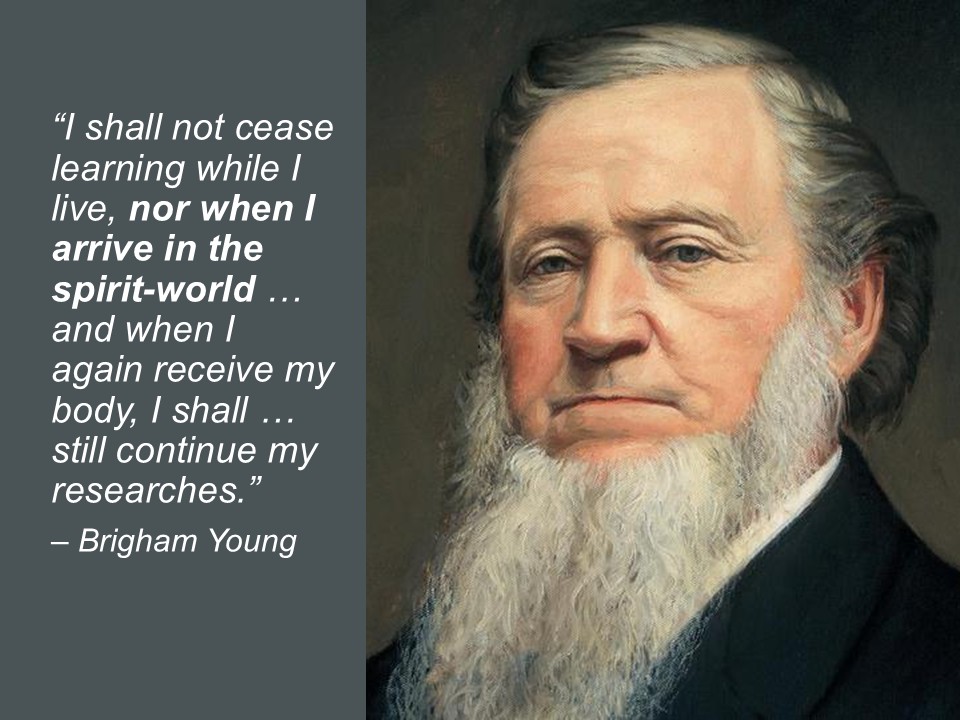
President Brigham Young declared:
I shall not cease learning while I live, nor when I arrive in the spirit-world … and when I again receive my body, I shall … still continue my researches.”66
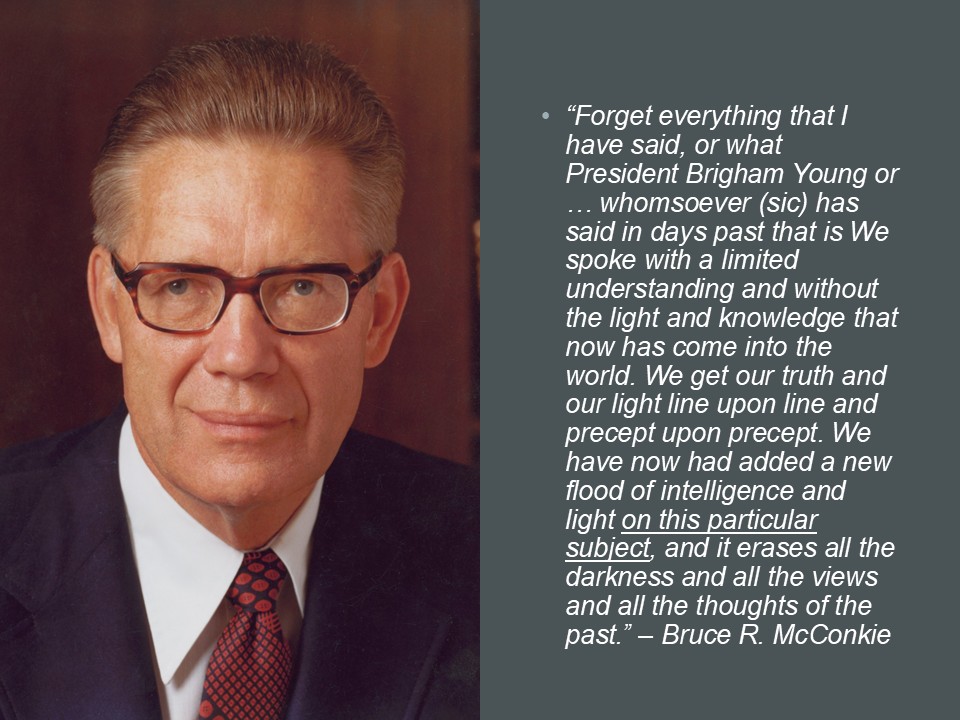
Regarding the revelation removing the priesthood ban, Elder Bruce R. McConkie said:
Forget everything that I have said, or what President Brigham Young or … whomsoever (sic) has said in days past that is contrary to the present revelation.”
He said,
We spoke with a limited understanding and without the light and knowledge that now has come into the world. We get our truth and our light line upon line and precept upon precept. We have now had added a new flood of intelligence and light on this particular subject, and it erases all the darkness and all the views and all the thoughts of the past.”67
If a moment of revelation on earth can constitute a “flood of intelligence and light” that erases darkness to this extent, how transformative must the effect be of coming into the incandescent presence of the very Light of Life, Himself?!
The Savior’s Capacity to Forgive
And as prophets and apostles of any and all ages of human history have repented, as God invites all His children to do, who here does not know in his or her heart that our merciful, loving Savior would not eagerly forgive every word from weakness or deed from darkness, as He apparently already has for Abraham, Isaac and Jacob, and as we hope and pray He does for each of us?
And if he did forgive and enlighten and sanctify His holy prophets and apostles on the other side of the veil “on this particular subject” or any other, as we are certain He would have, who are we to think to countermand the infinite Atonement of the Son of God?
Who are we to say, in effect, “I’m sorry Jesus, thou hast said, ‘Behold, I have suffered these things for all that they might not suffer if they would repent,’ but I say you got it wrong where this prophet or that apostle is concerned!”
Let Us Forgive Past Prophets and Follow Their Faith
The Greater Sin
Speaking of condemnation, small wonder the resurrected Lord declared:
“He that forgiveth not his brother his trespasses standeth condemned before the Lord; for there remaineth in him (or her) the greater sin”.68
What greater sin can we imagine than to deny, if only in our own minds and hearts, the efficacy and effectively the existence of:
“The most transcendent event that ever has or ever will occur from Creation’s dawn through all the ages of a never-ending eternity,” in Elder Bruce R. McConkie’s words.69
A recent discourse by Church Historian, Elder Kyle S. McKay, at BYU–Idaho reminded me of another powerful example, with which I conclude.
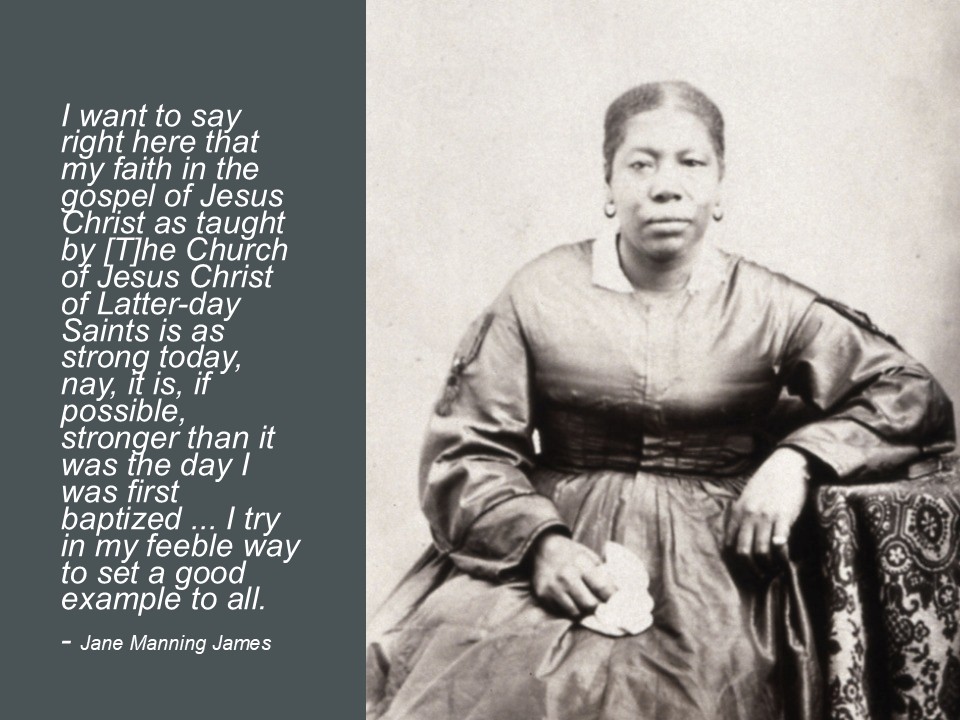
The Example of Jane Manning James and Others
He said:
Near the end of her life, Jane Manning James, (a black pioneer – President M. Russell Ballard spoke of her in a General Conference) identified by name Brigham Young, John Taylor, Wilford Woodruff, Lorenzo Snow, and Joseph F. Smith, not as men who upheld the Church’s race restrictions for priesthood and temple blessings (by which she was denied these blessings personally); rather, she identified them as ‘good, great, and holy men’ whom others should listen to and obey.”
I wish this faith and the rest of Elder McKay’s statement were more emphasized. He continued:
She died with this simple but sure testimony: ‘I want to say right here that my faith in the gospel of Jesus Christ as taught by [T]he Church of Jesus Christ of Latter-day Saints is as strong today, nay, it is, if possible, stronger than it was the day I was first baptized … I try in my feeble way to set a good example to all.’”70
In my study of her “good example” and history, I have seen disappointment but never an accuser of our brethren.
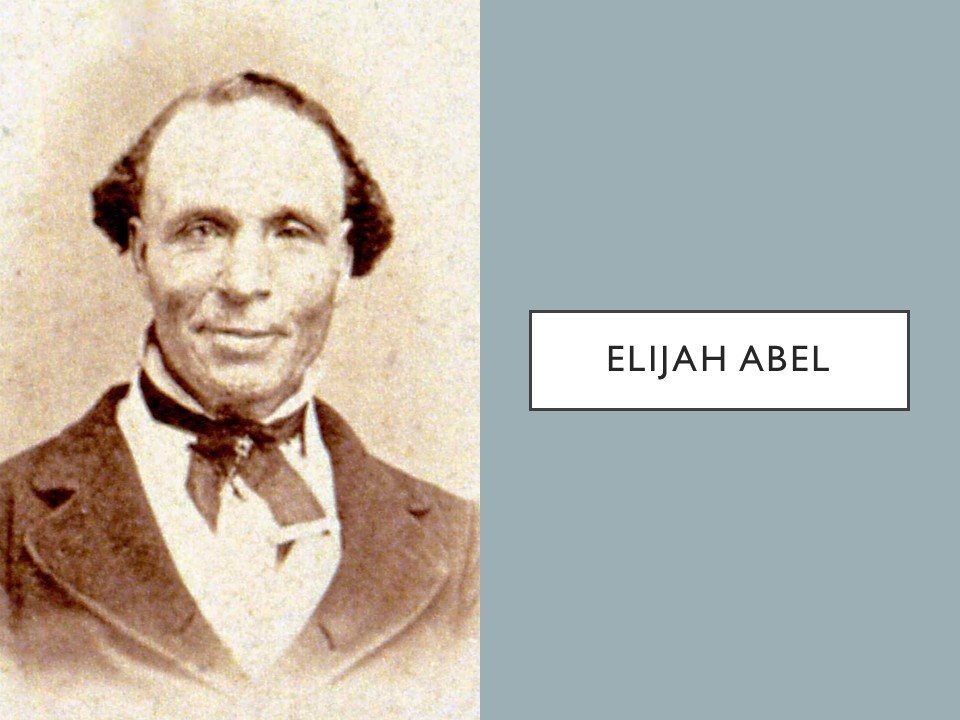
The same is true of her Black contemporaries, including Elijah Abel whose grave I had the privilege of dedicating a few years ago.
Their examples of faith, hope, charity and humility are among those I try to follow and I hope they are proud of my attempts.
Final Witness and Closing
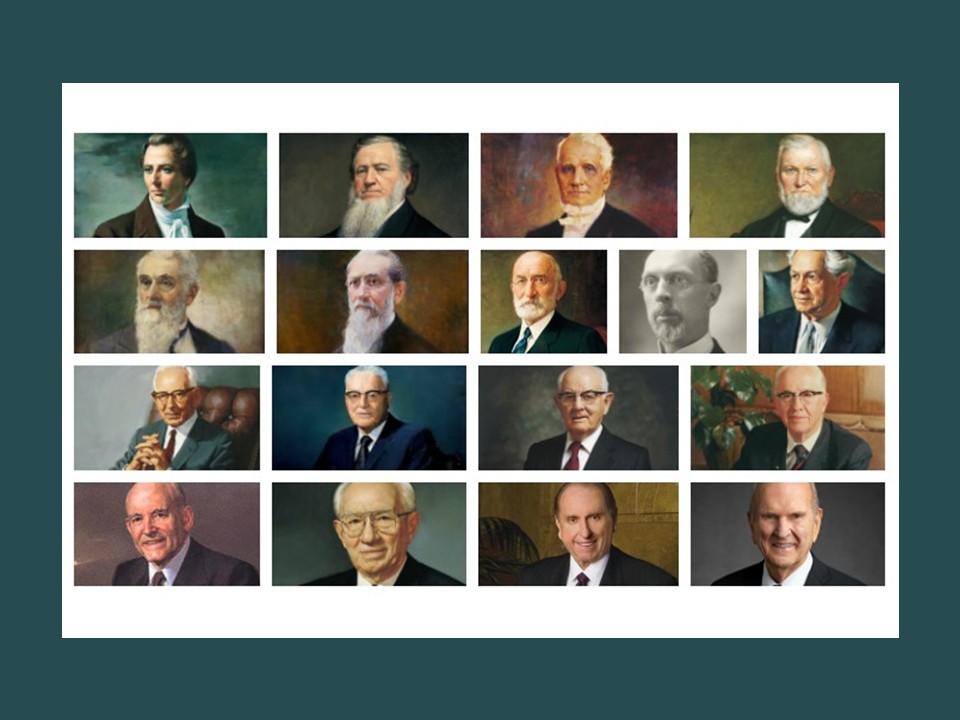
In that spirit, I bear my witness Joseph Smith, Brigham Young, John Taylor, Wilford Woodruff, Lorenzo Snow, Joseph F. Smith, Heber J. Grant, George Albert Smith, David O. McKay, Joseph Fielding Smith, Harold B. Lee, Spencer W. Kimball, Ezra Taft Benson, Howard W. Hunter, Gordon B. Hinckley and Thomas S. Monson were prophets of God and of the Lord Jesus Christ in an unbroken line of prophetic succession to and including President Russell M. Nelson.
I bear witness that those called to the holy apostleship under the direction of these prophets were and are special witnesses of the name of Christ in all the world.
I am fully confident the Lord has forgiven any mistakes, flaws and imperfections on their part regarding issues of race and anything else.
But of infinitely greater importance to my salvation, I beg Him to forgive my sins and mistakes, as I move forward unto Him — which is my forward focus.
In the name of Jesus Christ, amen.
Endnotes & Summary
Scholarly Abstract:
This address by Elder Ahmad S. Corbitt affirms the divine authority of prophets and apostles in The Church of Jesus Christ of Latter-day Saints. He emphasizes their role as essential witnesses of Jesus Christ in a world increasingly hostile to prophetic leadership. Elder Corbitt explores how Satan undermines trust in Church leaders by exploiting their human weakness, past imperfections, and controversies—especially those related to race.
Drawing on scripture and modern prophetic teachings, he outlines five guiding principles: faith in Christ, avoiding judgment, honoring divine authority, recognizing the ongoing restoration, and practicing forgiveness. These principles help members maintain confidence in inspired leadership. The talk offers both a doctrinal reaffirmation and a pastoral response to historical criticisms, reframing difficult topics through the lens of faith, maturity, and eternal perspective.
Footnotes:
Some may wonder why Jesus Christ isn’t my number one hero of all time. The answer is simple: Jesus is not my hero; He is my Redeemer and Savior.
Russell M. Nelson, June 3, 2018.
Also, I am convinced that by focusing us on the imperfections of prophets and others of the past, including our own ancestors, in many cases, our adversary seeks to thwart the spirit of Elijah. Church leaders have defined this as the Holy Ghost acting in relation to the family. Judging those of the past has the opposite effect of turning the hearts of the children to the fathers and mothers. (See Malachi 4:6 and Doctrine and Covenants 2.)
By this, Satan would reverse the momentum of this Spirit and prevent the fulfillment of associated prophecies, including as they relate to past prophets and apostles.
Jeffrey R. Holland
July 9, 2024
I know many who struggle with perfectionism. Around the Church I hear many who struggle with this issue:
“I am just not good enough.” “I fall so far short.” “I will never measure up.” I hear this from teenagers. I hear it from missionaries. I hear it from new converts. I hear it from lifelong members.
As children of God, we should not demean or vilify ourselves, as if beating up on ourselves is somehow going to make us the person God wants us to become.
With a willingness to repent and a desire for increased righteousness always in our hearts, I would hope we could pursue personal improvement in a way that doesn’t include excessive guilt trips or demolishing our self-esteem.
I believe that Jesus intended the commandment “be ye therefore perfect, even as your Father … in heaven is perfect” (Matthew 5:48) to be a tribute to who and what God the Eternal Father is and what we can achieve with Him in eternity, not a harsh verbal reminder of our shortcomings.
Except for Jesus, there have been no flawless performances on this earthly journey we are pursuing, so while in mortality let’s strive for steady improvement without obsessing about being perfect.
“You are not perfect. You did or said this or that wrong in my opinion or in fact. I know better. Therefore, I now lack confidence in you, prophets and apostles. Rather than sustain you and seek your counsel or direction, I now tell you what you should be doing. I hold you accountable.”
Doing so can tempt us to perpetually face backwards and become distracted by the negatives of the past. As critics of past prophets and apostles pick through disappointing history, recycling their imperfections, each negative found can become irresistible as it validates contrarian natures and narratives.
If we are not careful, each can reinforce the temptation to elevate indignation about offensive things from the past over the higher, holier teachings of Jesus – the “greater things.” In time, and through careful deception, we can find it hard to avoid speaking evil of the Lord’s anointed and letting go of accusing our brethren. The idea of following the prophets and apostles and trusting God becomes increasingly ridiculous and unimaginable to those caught in this trap.
This will make some in the modern house of Israel, including valiant spirits, feel they are pursuing a noble cause, all the while their faith in Christ is deceptively diminished because their confidence in His prophets and apostles has been subtly undermined.
For example, enlightened nations and individuals have increasingly rejected racism, sexism and prejudice, generally, as they very well should and as the First Presidency and the Twelve have repeatedly called on us to do in the clearest terms. As these advances continue, past prejudice can seem correspondingly more outrageous.
This presents a crossroads for all the faithful. Will we become increasingly more focused on and resentful of the past as the present improves? Or will we allow the Lord to leverage the progress He has inspired, to establish the modern house of Israel as a global model for “perfect peace and harmony,” in President Nelson’s words? (See endnote 28, below.
Dallin H. Oaks
“Institutionally, the Church reacted swiftly to the revelation on the priesthood…. The Lord had spoken through His prophet, and His Church obeyed.
In contrast, changes in the hearts and practices of individual members did not come suddenly and universally. Some accepted the effects of the revelation immediately and gracefully. Some accepted gradually.
But some, in their personal lives, continued the attitudes of racism that have been painful to so many throughout the world, including the past 40 years. Others have wanted to look back, concentrating attention on re-examining the past, including seeking reasons for the now-outdated restrictions.
However, most in the Church, including its senior leadership, have concentrated on the opportunities of the future rather than the disappointments of the past.”
President Oaks’ invitation:
“Our determination in this program is to celebrate the 40th anniversary of the revelation on the priesthood by looking forward. As we do, we express special appreciation for our marvelous members of African descent, especially our African-American members who have persisted in faith and faithfulness through a difficult transition period of fading prejudice.
Now we unite together in concentrating our attention on the glorious post-1978 effects of that revelation in blessing the children of God all over the world.”
The Importance of History
I am sure all thinking individuals recognize its enormous importance. None of us would ever want to repeat bad history, which can occur if people don’t know their history, including its negatives. The Lord, Himself, commanded, “…verily I say unto you, that it is my will that you should hasten to … obtain a knowledge of history, and of countries, and of kingdoms, of laws of God and man[.]”
Importantly, the Lord concluded with the fundamental purpose of history from His view, “and all this for the salvation of Zion.” The salvation of Zion is the doctrine of Christ not the condemnation of His imperfect witnesses. Thus, while the Lord commanded that we should be “instructed more perfectly in … things which have been,” He never intended the study of history to sow doubt regarding His work or condemnation of His anointed. Indeed, we are to “seek learning even by study and also by faith” because “all have not faith.”
A Duty of a Priesthood Office
An explicit duty of a priesthood office, which is not suspended by our hobbies or professions, is to see that there is no “murmuring, backbiting or evil speaking” in the Church, including of the Lord’s anointed, present or past.
Past Racism in the Church
“As we look to the future, one of the most important effects of the revelation on the priesthood is its divine call to abandon attitudes of prejudice against any group of God’s children. Racism is probably the most familiar source of prejudice today, and we are all called to repent of that. But throughout history, many groups of God’s children are or have been persecuted or disadvantaged by prejudices, such as those based on ethnicity or culture or nationality or education or economic circumstances.
As servants of God who have the knowledge and responsibilities of His great plan of salvation, we should hasten to prepare our attitudes and our actions — institutionally and personally — to abandon all personal prejudices.
As President Russell M. Nelson said following our recent meeting with the national officers of the NAACP: “Together we invite all people, organizations, and government[s] to work with greater civility, eliminating prejudice of all kinds.”
Mormon 8:12; see, also, v.17 and the Introduction to the Book of Mormon where Mormon states, “And now, if there are faults they are the mistakes of men; wherefore, condemn not the things of God, that ye may be found spotless at the judgment-seat of Christ.”
Kyle S. McKay, BYU-Idaho, April 25, 2023;
“So, what do we do with error? You can’t hide or hide from the humanness of humans. But it is equally unproductive to seek out error and wallow in it by making it an emphasis of study. You will never come to know and understand the truths of God by studying the errors of man.
Nor has God appointed you, me, or anyone to be an ongoing arbiter of error in His leaders, scrutinizing every word or act of apostles and prophets to make sure they fit within our current understanding of correctness. That is not His plan; it is not His order.”
The Morality of Refusing to Forgive
Some modern judges of past prophets may think they have nothing to be concerned about because they do not violate the standard by which they judge them. “I’m just fine condemning them and being measured against them because I don’t commit the particular wrong they committed.”
But the greater moral wrong is the fact of judging and refusing to forgive them not the issue about which we judge. Jesus did not say, “By the way, this firm doctrine does not apply if you’re judging about something you don’t do or about which you feel passionately.” I wonder if the accusing of our brethren in the premortal world had similar justifications.
Also, I note that neither Moroni nor Jesus puts a timeframe on their injunctions to not condemn. That Moroni directed his teaching to us in our day makes clear there is none.
Moreover, judging and condemning in this sense require divine permission, often extended in the form of priesthood keys. (Even in secular law, condemning requires authorization.) Therefore, those who judge past prophets must ask themselves who gave them the right to judge or condemn them. The Apostle James said, “There is one lawgiver, who is able to save and to destroy: who art thou that judgest another?” (James 4:12).
The Lord, Himself, commanded, “…verily I say unto you, that it is my will that you should hasten to … obtain a knowledge of history, and of countries, and of kingdoms, of laws of God and man[.]” Importantly, the Lord concluded with a powerful reason for this directive, “and all this for the salvation of Zion.” (Doctrine and Covenants 93:53).
What is the Salvation of Zion?
The salvation of Zion is the doctrine and gospel of Christ which leads to eternal life with God and our families, not the condemnation of its imperfect witnesses, which leads to self-condemnation.
Thus, while the Lord commanded that we should be “instructed more perfectly in … things which have been,” He never intended the study of history to sow doubt regarding His work or condemnation of the prophetic servants he sends into His vineyard to gather us. Indeed, we are to “seek learning even by study and also by faith” because “all have not faith.”
Moreover, an explicit duty of a priesthood office, which is not suspended by our hobbies or professions, is to see that there is no “murmuring, backbiting or evil speaking” in the Church, including of the Lord’s anointed, present or past.
In this place, servants of the Lord who may have been enveloped in, say, the narrow views on race of their earlier eras can see, learn and feel at a higher and holier level.”
The Prophet Joseph Smith famously observed, “Could you gaze into heaven five minutes, you would know more than you would by reading all that ever was written on the subject.” (Josephsmithpapers.org, History, 1838-1856, volume E-1 [July 1843-30 April 1844].
Perhaps it was his vision of the three degrees of glory and of the Father and the Son that aided in forming these advanced views.
All Talks by This Speaker
Talk Details
- Date Presented: August 8, 2024
- Duration: 45:16 minutes
- Event/Conference: 2024 FAIR Annual Conference
- Topics Covered:
faith crisis, prophetic fallibility, Mormon Church, Mormon racism, priesthood ban, LDS race and priesthood, racism in Mormon history, forgive past prophets, Joseph Smith, Brigham Young, Church leaders mistakes, black Mormons, Jane Manning James, Elijah Abel, Mormon Stories, CES Letter, exmormon doubt, LDS apologetics, doctrinal development, modern revelation, apostles and prophets, criticism of Church leaders, church history controversies, racial equality in LDS Church, LDS prophets and race, condemnation of prophets, trust in prophets, LDS historical issues, Mormons should apologize for racism, Ahmad Corbitt FAIR talk, Church transparency, LDS repentance, church unity, gospel forgiveness, judgment in Mormonism, mormon temple racism, spiritual healing, inclusion in the Mormon Church
Common Concerns Addressed
Sustaining prophets despite their mistakes
Concern:
Many struggle with the idea of sustaining past Church leaders who made mistakes, wondering whether doing so ignores or excuses their flaws.
Response:
Elder Corbitt acknowledges that prophets are human and imperfect, but affirms that their divine calling and revelatory role remain intact. He invites members to feel gratitude for what these leaders accomplished under limited light, and warns against presentism that judges past servants through a modern lens.
Past prophetic teachings conflict with current values
Concern:
Some members feel troubled when past teachings by Church leaders do not align with today’s social or moral standards.
Response:
This talk emphasizes the principle of progressive revelation—truth is revealed line upon line, as the Lord sees fit. Rather than judge past teachings as invalid, Elder Corbitt encourages listeners to trust that God is leading His Church forward and that increased understanding comes through continued revelation.
Worry that current leaders might also be wrong
Concern:
If prophets in the past made mistakes, how can we be sure that current apostles aren’t also leading the Church astray?
Response:
Elder Corbitt describes the revelatory process used today by the First Presidency and Quorum of the Twelve, which involves united spiritual discernment and the witness of the Holy Ghost. He testifies that this process is divinely guided and gives confidence that current Church direction reflects the Lord’s will—not human agenda.
Calling out past wrongs feels like moral courage
Concern:
Some feel that it’s their duty to expose and denounce errors in Church history or leadership as a form of righteousness or activism.
Response:
Elder Corbitt draws a distinction between sincere questions and the accusatory spirit of the adversary. He cautions that constant fault-finding—even when fact-based—mirrors the adversary’s role as “the accuser of our brethren” and leads away from Christlike humility and reconciliation.
Needing an apology before healing
Concern:
For some, moving forward in faith feels impossible without a formal apology or institutional reckoning for past harms.
Response:
Elder Corbitt acknowledges the pain but teaches that true healing comes not through institutional confession but through personal faith in Jesus Christ. He pleads with listeners to look forward in faith, as Christ invites, rather than waiting indefinitely for retrospective validation.
Prophetic counsel conflicts with personal views
Concern:
Members sometimes feel conflicted when prophetic counsel differs from their personal opinions on social or moral issues.
Response:
This talk invites humility and patience, urging listeners to give the Lord’s servants the benefit of the doubt and seek deeper understanding through personal revelation. Elder Corbitt reminds us that the gospel requires submission to God’s will, even when it challenges our assumptions.
Desire to fix or rewrite Church history
Concern:
Some feel a need to correct or reshape Church narratives about the past, especially around race, policy, or leadership.
Response:
Elder Corbitt warns against exceeding our authority or acting as self-appointed reformers. He emphasizes that the Lord governs His Church through ordained servants and teaches that faith and deference are essential parts of covenant discipleship.
Forgiving leaders feels like ignoring harm
Concern:
Forgiving past Church leaders for real harm—especially related to race—can feel like minimizing the damage done.
Response:
Elder Corbitt distinguishes forgiveness from denial. He teaches that Christlike forgiveness enables healing and spiritual power, and that the Lord’s Atonement is sufficient not only for our own sins but also for the failings of others—even prophets.
Pain caused by racism in Church history
Concern:
The racial restrictions once imposed by the Church still cause pain and confusion for many members today.
Response:
Rather than dismiss the pain, Elder Corbitt honors faithful Black pioneers like Jane Manning James and Elijah Abel, who faced injustice with remarkable faith. Their examples show that loyalty to Christ and His prophets is possible even amid deep personal disappointment.
Does prophetic forgiveness weaken authority?
Concern:
If prophets needed to repent, does that make their authority or revelation less valid?
Response:
This talk affirms that all—prophets included—are made whole through Christ’s Atonement. Elder Corbitt testifies that repentance magnifies prophetic power, not diminishes it, and that trusting in the Lord’s mercy toward His servants is essential to experiencing that mercy ourselves.
Apologetic Focus
Elder Ahmad S. Corbitt’s FAIR Conference address provides substantial apologetic value by affirming the divine authority of prophets and apostles while addressing the historical, racial, and cultural questions that often challenge modern faith. With a pastoral and scriptural approach, he invites listeners to consider prophetic fallibility in context, to resist the spirit of accusation, and to place their faith in Christ rather than in institutional perfection. By teaching the revelatory processes that guide the Church today, Elder Corbitt offers clarity, hope, and a compelling defense of trust in living prophets. He speaks directly to doubts raised by critics and reformers—while keeping the focus on discipleship, healing, and spiritual maturity in the face of historical complexity.
1. Prophetic Fallibility and Divine Calling
Concern:
How can prophets be divinely called if they make mistakes or reflect the biases of their time?
How This Talk Answers It:
Elder Corbitt affirms that prophets are chosen by God despite their human flaws, and that fallibility is not incompatible with divine authority. Drawing on teachings from Joseph Smith, Moroni, and modern apostles, he frames imperfection as a vehicle for humility and testimony, not disqualification from spiritual leadership.
2. Historical Context of Race and the Church
Concern:
Did the Church’s past racial policies reflect God’s will or human prejudice?
How This Talk Answers It:
Rather than defend or dismiss the past, Elder Corbitt offers doctrinal framing: leaders then operated under limited light, while greater understanding has since come through revelation. He shares his confidence that past prophets, like all of us, are accountable to and forgiven by God—and urges charity rather than retroactive condemnation.
3. The Role of Ongoing Revelation
Concern:
How can members trust that current Church policies reflect divine will and not cultural influence?
How This Talk Answers It:
Elder Corbitt testifies of the revelatory unity among the First Presidency and Quorum of the Twelve. He describes their decision-making process as rooted in discussion, humility, and spiritual confirmation, showing that the Church moves forward through inspired consensus—not public pressure or political debate.
4. Forgiveness, Judgment, and Healing
Concern:
Is it possible to forgive past leaders without minimizing real harm?
How This Talk Answers It:
Forgiveness, Elder Corbitt explains, is not denial but divine alignment. He teaches that judgment of past prophets invites condemnation of ourselves, while forgiveness allows Christ’s Atonement to work on our behalf. Healing, both personal and collective, begins with faith in Christ, not in human perfection.
5. Manipulation of Racial Issues for Influence or Activism
Concern:
How can members discern between sincere efforts for justice and divisive activism?
How This Talk Answers It:
Using powerful parallels from the Book of Mormon, Elder Corbitt warns against those who stir up anger and distrust—especially over race—while disguising it as righteous advocacy. He exposes how dissent cloaked in moral language can derail faith, and he reaffirms the Church’s true trajectory of inclusion and prophetic leadership.
Share this article
