Introducing Meagan Kohler
Our next speaker is Meagan Kohler. Meagan is a Latter-day Saint convert who studied philosophy, French, and Latin at BYU. She writes about faith and culture at the Deseret News and lives in Utah with her husband and four sons. And with that, I’ll turn the time over to Meagan.
Why I’m addressing women’s equality
As Scott mentioned, my topic today is I’m talking about the question of women’s equality in the church because it’s on a lot of people’s minds. It’s on a lot of women’s minds.
It’s something that I’ve written about several times in the past. So, if you’ve read my work, some of this will not be new, but some of it will.
But in order to make sense of what I’m going to say on this topic, I think it helps to explain a little bit of my background.
Background

This is me when I was 15 years old. This is just a few months before I met the missionaries. As you can see, I have kind of a wild look because I was indeed living a wild life.
And the truth is I really hate talking about this period of my life. I hate talking about the things that happened to me. I would love to just intellectualize this topic, but I really feel that the human and emotional dimension of it matters, and so that’s why I’m going to talk about these things.
I’ve written about some of these experiences. I have memories of when I was a little bit younger than I am here. My father was watching porn, as he often did, and he was watching it in my bedroom. I complained about it because I was trying to go to sleep, and he choked me. He beat me. My stepmother—I remember her pulling him off of me and dragging him out of my bedroom—and then he beat her so badly she couldn’t go to work for like a week.
My uncle had to come and get me, and I stayed with him for like a week, and I had to go back to living with my father.
Some early memories
I can remember my mother. When I lived with her, she was a single mom. We were very poor, and we lived in a lot of low-income housing. I can remember being five years old and having men whistle at me. I didn’t fully comprehend what that meant, but I knew how it made me feel. That memory is with me from when I was five years old.
I have another memory of when I was six. While I was riding my roller skates around, a man pulled up in his car and beckoned for me to come over. I did, thinking he was going to give me a balloon or something—I don’t know why I had that in my mind, but I did—and in fact he was just not wearing any pants. He got a thrill out of exposing himself to me.
My mother remarried. She had a second husband for a few years, and this man was very physically abusive. I can remember him hitting her. I can remember her being bloodied and bruised.
These are not really happy experiences. They’re not things that I have talked about very often previous to this point in my life, previous to needing to discuss this topic, because these are not the things, first of all, that I want to focus on, and secondly, they are certainly not the things that I want other people to see when they look at me.
But I need to tell you about this so that you can understand the difference that the church has made in my life, because that’s really what I’m going to be talking about today.
Before and after

This is a picture of me on my honeymoon. I have been a member of the church for about ten years at this point. I had gone to college, which is in itself a miracle given the trajectory that I was on. I’d done really well. I’d gotten into a really good law school. I had a scholarship. I was living a very stable and secure life at this point.
That difference—between this before and after—has given me pause. When I’ve encountered claims that the church is sexist, that it oppresses women, or that it promotes the interests of men above women, because my life contradicts that notion in a really big way.
And so that’s what I want to talk about. I want to talk to you about some of the reasons why I think that is—why the church has made such a huge impact in my life, not just as a person, but as a woman.
Speaking for women like I was
I feel like I’m doing this on behalf of a lot of women who are or were like I was. But these are women that you’re not going to hear from, because it’s really rare for them to escape the kinds of circumstances that I was raised in.
And because they don’t escape those circumstances, they don’t attain the social capital to be able to tell you what is going on in their lives or why. They probably don’t understand why, because I certainly didn’t.

There’s a picture of me now with my family that is so precious and dear to me.
Why the topic matters
I really also want to help those who are struggling with this topic. It is important, and we should care about gender equality. It absolutely matters.
But before I jump into that, I want to make a couple of disclaimers here about a couple of things that I’m not going to be talking about.
I’m not going to speculate on the reasons why the church is organized the way that it is, because I don’t know the answer to that question. All I can explain is what I see in the organization of the church and how it’s affected me—how it’s blessed me.
The other thing I’m not going to talk about today is women’s access to priesthood power. That is a real thing. It’s important. It may be even more important than what I’m going to be talking about. But that’s not the dimension of this issue that I’m going to be addressing today. So don’t interpret from my lack of discussion of that that I don’t think it’s important or that it isn’t important.
As I said, gender equality matters. It is not my intention at all to criticize anyone who is struggling with this issue. My heart goes out to them. I think women’s interests are very often sidelined by our larger culture, and historically that has been the case.
Women’s equality in Latter-day Saint theology
I think one of the wonderful things about the Church of Jesus Christ of Latter-day Saints is that gender equality is embedded in our theology.
This goes right back to the beginning. It goes back to Eve. Here’s this wonderful quote from President Oaks. He says,
“Some Christians condemn Eve for her act, concluding that she and her daughters are somehow flawed by it. Not the Latter-day Saints! Informed by revelation, we celebrate Eve’s act and honor her wisdom and courage in the Fall.” 1
This is important! And I do believe that this understanding of Eve is reflected in our doctrines and practices today.
Valerie Hudson on “who hearkened first to whom?”
Valerie Hudson gave an amazing talk about the role of men and women in the church about ten years ago here at FAIR, and that’s been a very influential address for me. So read that if you get a chance.2
I just want to share this little quote from her. She says,
“In the great plan of happiness, who hearkened first to whom?” And here she’s drawing on the particular Latter-day Saint understanding of this episode in the garden. She says, “Adam hearkened first to Eve. Adam received the gift of the first tree from the hand of a woman.” And she asked, “Do men still hearken today?” 2
What concerns look like now
It’s fair to say gender equality is a divine principle, and it does and it should concern us. But what do those concerns look like as they’re being expressed now?
I’ve gathered a few quotes that I have found from women online who are concerned. I did not choose these quotes in order to attack the people who hold this view. I did it because I think that it’s representative, and I want to acknowledge and wrestle with those concerns as they actually exist.
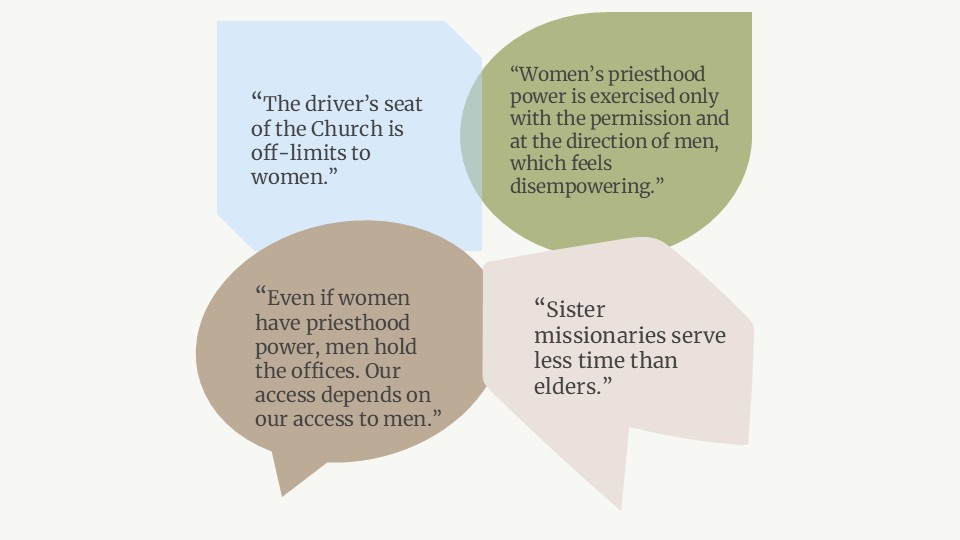
Here’s one: The driver’s seat of the church is off limits to women. Women’s priesthood power is exercised only with the permission and at the direction of men, which feels disempowering. Even if women have priesthood power, men hold the offices. Our access depends on our access to men.
A summarized expression of concerns
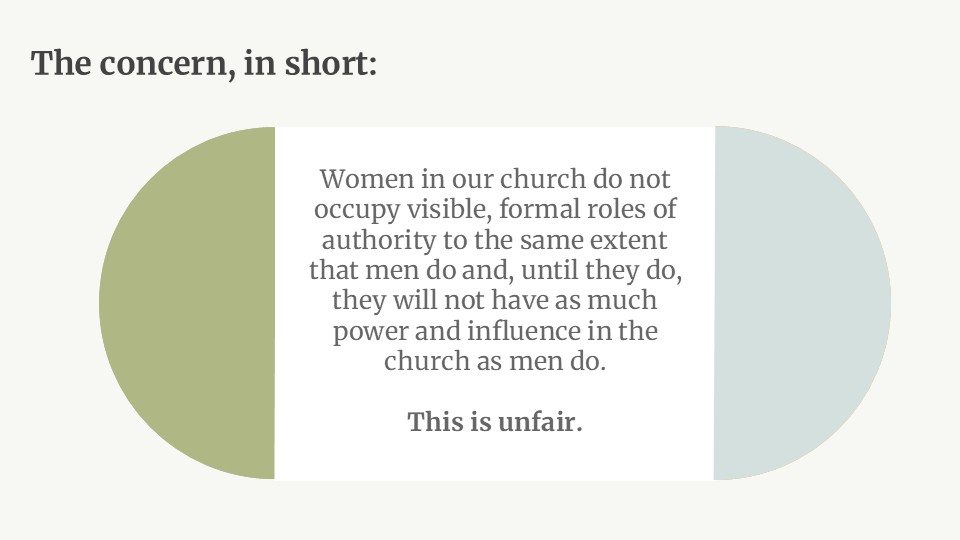
In going through the different iterations of this concern, here’s what I settled on as my summarized expression of concerns or criticisms about gender equality in the church: it’s that women in our church do not occupy visible, formal roles of authority to the same extent that men do. And until they do, they will not have as much power and influence in the church as men, and that this is unfair.
Assumptions behind these concerns
I think that there are some assumptions at work in this concern that are worth highlighting, because they are going to affect how we understand gender equality.
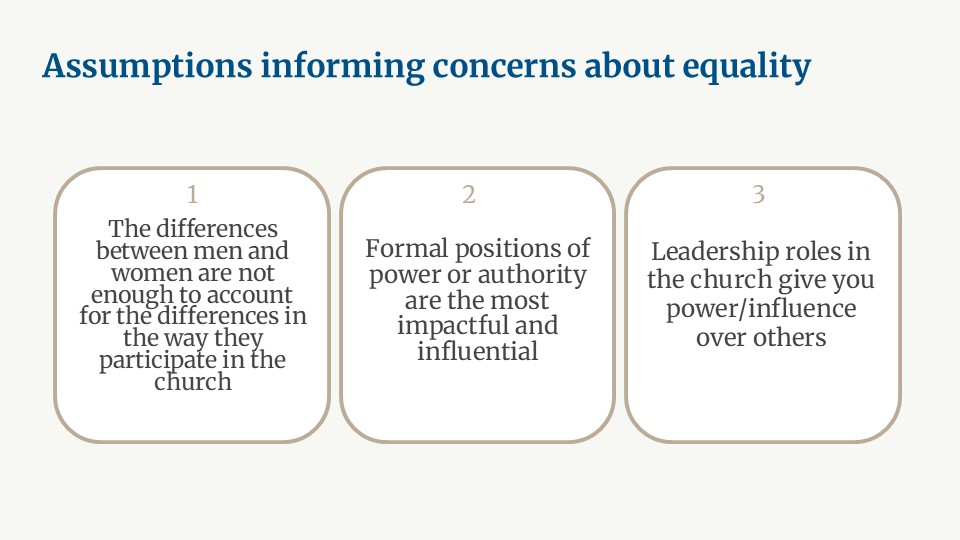
Forget number two for now. Number two is important, but I decided to focus on one and three because I think that they are at the heart of concerns about gender equality.
These assumptions informing concerns and criticisms about women’s position in the church include that the differences between men and women are not enough to account for the differences in the way they participate in the church, and that leadership roles in the church give you power and influence over other people.
“Institutional egalitarianism” defined
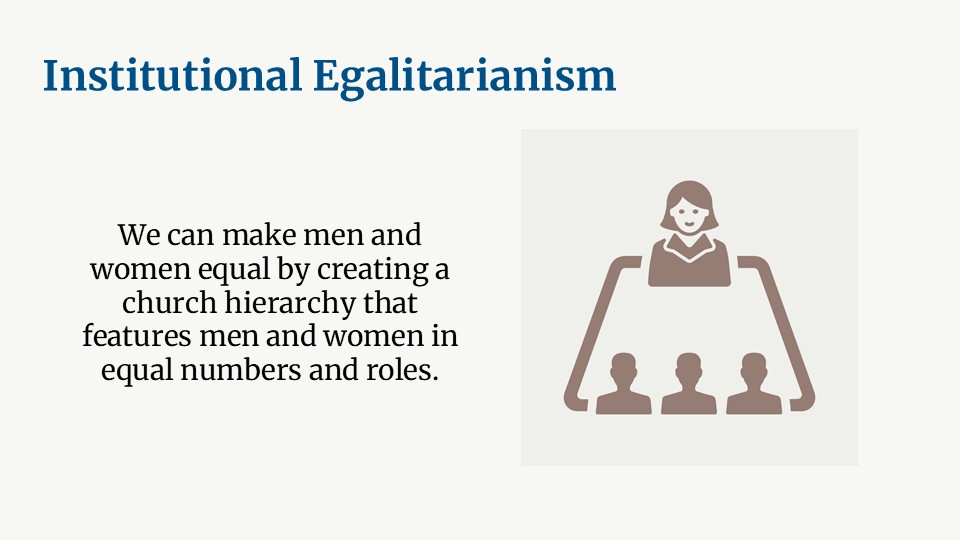
This leads to something that I have called institutional egalitarianism. This is the vision for equality that I see most often expressed, which is that men and women can be made equal by having them represented equally in the hierarchical structure of the church. So seeing women in the same roles as men and at the same rates as men would address the gender imbalance.
Where that frame can be too narrow
I don’t think that this is a bad way of looking at things. I think that there are a lot of places in life where we need more of this, because men and women, for all of their differences, can bring different strengths and perspectives to similar roles and responsibilities. So this is not necessarily a bad thing.
The problem is, I think that this understanding of equality is too narrow to address gender equality as it exists more generally—the kind of general gender equality that affected me, that resulted in the circumstances under which I was raised. I don’t think that this addresses that. So that’s my main concern.
Two reasons I think it falls short
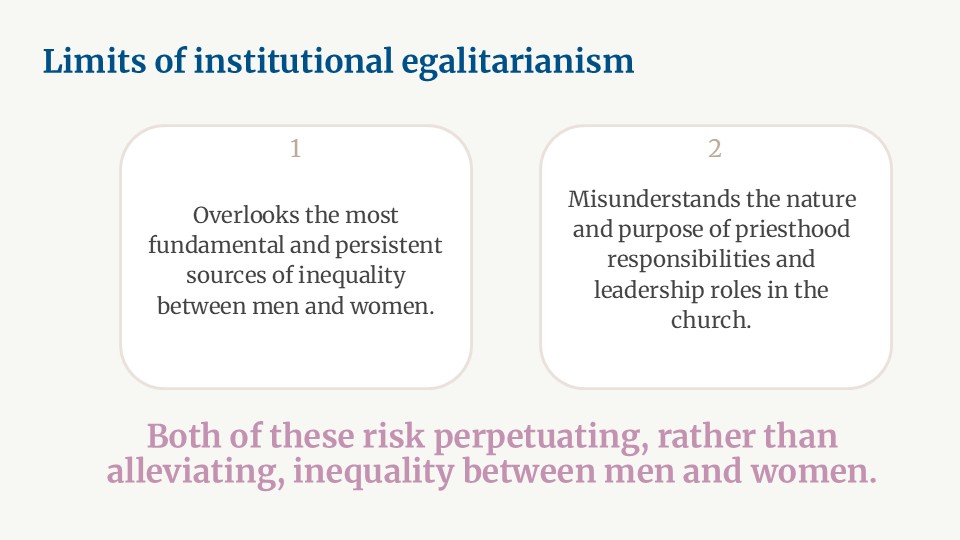
I think there are two reasons for this. I think this egalitarian aspiration for the church overlooks the most fundamental and persistent sources of inequality between men and women—the kinds of things that affected me growing up. But I also think that it misunderstands the nature and purpose of men’s roles and responsibilities in the church, which again affected me when I joined the church and had a lot to do with where I am now.
So it’s not inconsequential. Both of these misunderstandings risk perpetuating rather than alleviating inequality.
Asking different questions
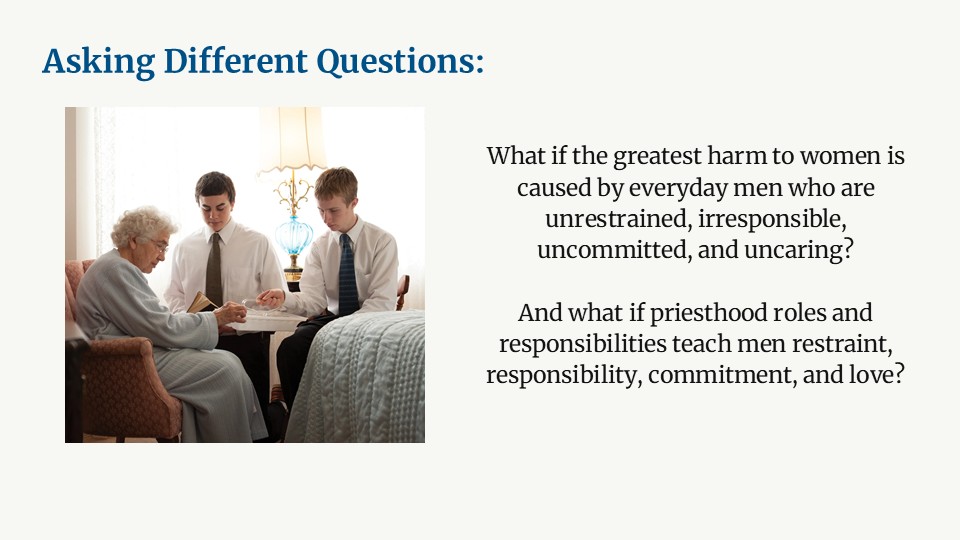
It’s not just an intellectual exercise. I think we need to ask some different questions. That’s what my experience from before the church and then joining has prompted me to do.
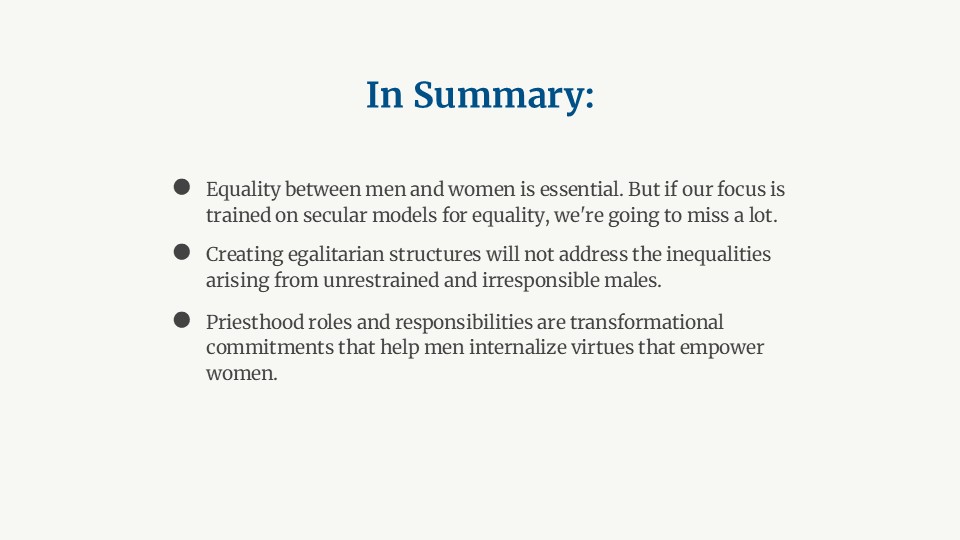
It has prompted me to ask questions like: What if the greatest harm to women does not occur within formal leadership roles in institutions? What if it occurs by everyday men who are ungoverned by the formative aspects of institutions—by men who are unrestrained, who are irresponsible, who are uncommitted and uncaring?
And what if priesthood roles and responsibilities teach men those principles that they need—that restraint, that responsibility, and that responsiveness to women?
Early harms and unequal support networks
I want to just point to how early in my life some of these difficult experiences began and how this kind of shook out for women who didn’t escape it the way that I did. I had friends who were in similar situations to mine. Many, many of them ended up having children out of wedlock and being abandoned by the fathers of those children.
Because of that they are stuck without resources. It’s not just the men who abandon them, right? A lot of these women are themselves products of situations in which men abandon their responsibilities. So their only support structure is other women who are similarly trying to pick up the pieces of a life that has been broken by unrestrained and irresponsible men.
Formal power vs. lived outcomes
So we have that on the one hand, and I don’t think we hear about that very often in discussions of inequality. We live in this time that is more egalitarian than ever in the sense of women occupying more of those formal positions of power—like heads of state or CEOs. And I think it’s wonderful. I really do. The problem is I don’t think that it has significantly changed the status quo for a huge number of women.
And that made me wonder why. Why are these women’s lives still being shaped by the worst impulses of the worst kinds of men? And how do we help them?
Evidence Louise Perry cites
Backing me up on this is Louise Perry. She wrote a really great book called The Case Against the Sexual Revolution.
She is pointing to this in some research that she discusses. There was a 2005 study across 48 countries examining gender and sexuality—so the connection between how sexuality differs between men and women. After controlling for things like class, income, culture, there were a lot of differences that persisted. She talks about this. This is Perry paraphrasing that research:
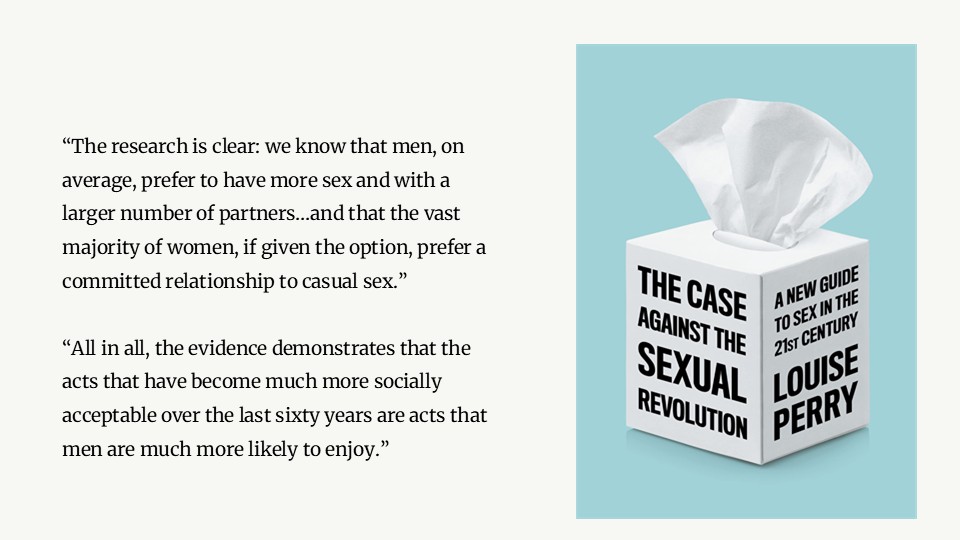
“The research is clear. We know that men on average prefer to have more sex and with a larger number of partners and that the vast majority of women, if given the option, prefer a committed relationship to casual sex.” 3
Women prefer committed family life. A lot of men want this too for various reasons, but in general women tend to prefer it more.
Our current sexual culture and women’s equality
Yet we live in a society in which marriage rates are plummeting. Birth rates are plummeting. Porn, fetishes, and sexual paraphilias are on the rise.
And what Louise Perry says about this:
“The evidence demonstrates that the acts that have become much more socially acceptable over the last 60 years are acts that men are much more likely to enjoy.”
What this is telling us is that, first of all, men and women are different. And if we ignore that, it’s going to affect women disproportionately, because men’s interests are what are being represented in our larger sexual culture, not women’s.
Broad life impacts of men “falling through”
This goes beyond just what happens in the bedroom. This has significant impacts on people’s lives. There are real costs to men falling through institutional cracks, and those costs are disproportionately borne by women and children.
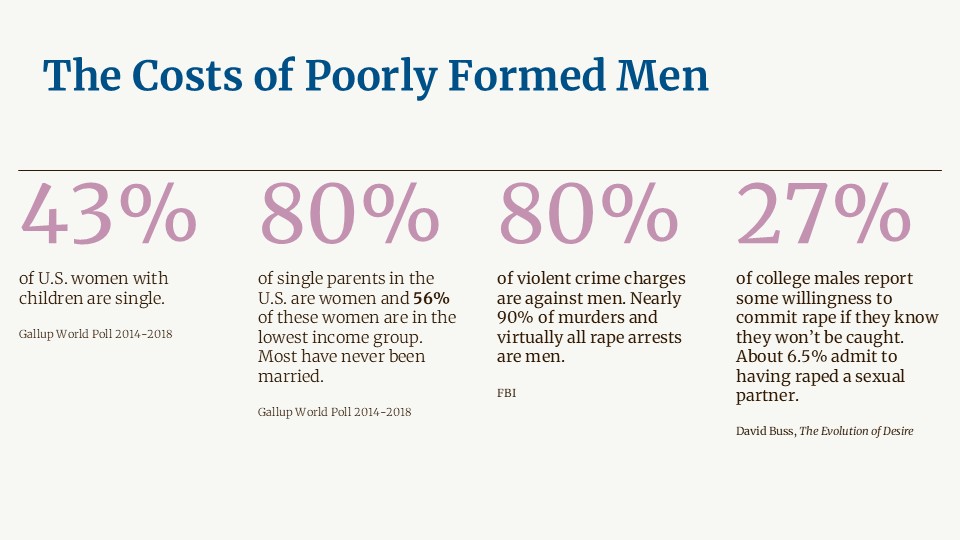
So 14% of women in the United States have advanced degrees, which is great, but 43% of all women who are mothers are single mothers.
Twenty-five percent of children born in the United States are born to a single parent, and overwhelmingly those single parents are women.
This single parenthood exposes both women and children to increased rates of violence, substance abuse, incarceration, and mental and physical illness.
Crime statistics
Nearly 80% of violent crimes—crimes that are charged anyway—are committed by men, and nearly 90% of murders and virtually all rape and sexual assault is committed by men.
Research on sexual aggression
David Buss is an evolutionary psychologist whose work I followed. He focuses on, again, gender differences in sexuality, and he has found that nearly 30% of college males in the United States report some willingness to commit rape if they know that they won’t be caught.
And by the most conservative estimates, 6.5%—and some people think this goes higher, 10–12%—admit to actually having raped a sexual partner.
Clarifying intent
My point here, just to be clear, is not that men are bad. I do not think that men are inherently worse than women.
But I do think that men are physically stronger and psychologically and emotionally more assertive. And because of that, I think it’s easier for them to shift the costs of their behavior, when they are bad, onto women.
Men are:
- Less intrinsically motivated by commitment.
- Less vulnerable in the absence of socially imposed restraints.
- Do not bear the physiological burdens of childbearing.
- Mature more slowly than women.
- Far more likely to commit violent and sexual crime.
What I draw from this is that, for psychological and biological reasons, pro-social behavior—such as committed fatherhood and good husbands, things that are really important for a functioning society—these things are not as easy to create or enforce in men as they are in women. It’s just more difficult to create good fathers than it is mothers.
And because of this, there are a lot of women who just cannot afford to worry about who is occupying what roles in our society and in our institutions, because they are still grappling, like I was, with the economic and emotional turmoil that is left in the wake of destructive male behavior.
A broader vision of women’s equality
This is why I think we need a broader vision of equality. It has to go beyond who’s in which roles—not that that isn’t an important question. It is. But we have to think about equality in ways that account for how men’s moral and emotional development impacts women, because if we ignore it, it doesn’t go away.
How the Church develops men
And this is where I think our church really excels, and that it just doesn’t get a lot of airtime. Our church takes the development of men seriously.
There are a few ways that I see this happening. This is not an exhaustive list, and this is certainly not all that the priesthood is about, okay? That would be way too simplistic. But this is what’s pertinent to our discussion.
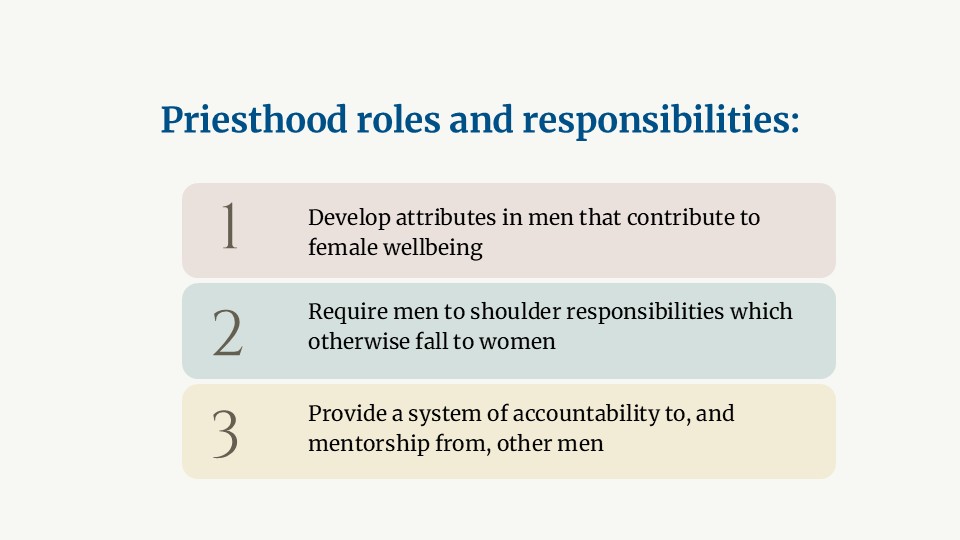
Priesthood roles and responsibilities in our church develop attributes in men that contribute to women’s well-being—like that restraint I was talking about, that responsiveness to others. This is huge.
When men are serving in leadership capacities, when they are taking upon themselves the responsibilities of being ordained priesthood holders, they are being asked to put themselves in the place of those whom they serve and to look at their problems, their trials, their emotions, their sufferings through the eyes of the Savior. This is incredibly formative.
These responsibilities also formally require men to take upon them responsibilities for the well-being of the people around them. And this is something that women do disproportionately when men are not required to do it. This is why we have so many single mothers. It’s because when a community needs to be formed, women generally take over those responsibilities.
And so I love that the priesthood—leadership roles, priesthood responsibilities in the church—formally require men to take upon themselves some of those duties.
Another really great and unique thing about how the priesthood works in our church is that it makes other men responsible for developing this in men. It provides a built-in structure where men are accountable to other men, but also that they have this mentorship from other men.
Reframing priesthood authority (Doctrine of Covenants 121)
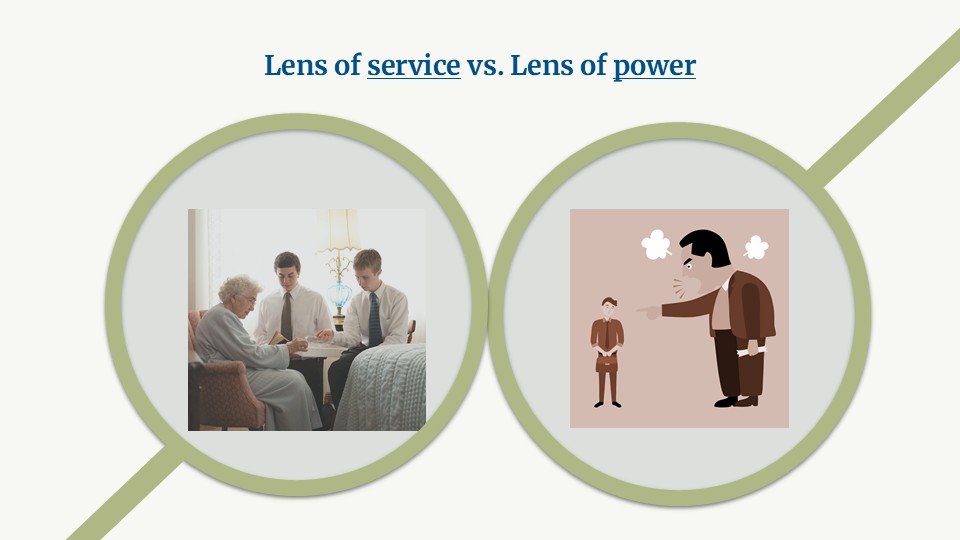
Looking at the priesthood in this way requires a perceptual shift. It’s a shift away from seeing the priesthood—and even priesthood authority—as something that gives you power over other people, and instead to see it in formative terms, to see it in terms of responsibilities.
Leadership does involve decision-making. It does involve counseling other members, and in some cases, when there’s discipline, you are using that position of authority to wield a certain amount of influence. That does happen, but it would be inappropriate, I think, to characterize men’s roles in the church as being primarily about those things. I think they are primarily about service and formation.
Scriptural Basis for this Lens
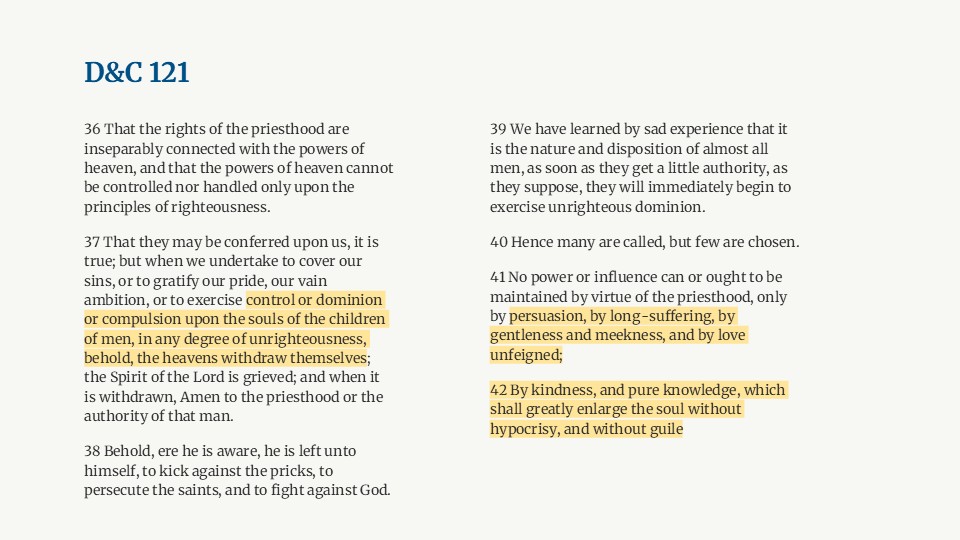
One of the ways that we know this is that it’s in the scriptures. We all know about Doctrine of Covenants 121, but I want to point to some specifics here. So verses 41 and 42 are listing off all of these important virtues tied to the priesthood—long-suffering, gentleness, meekness, sincere love, kindness—and in verse 37, it talks about some of the things that invalidate priesthood authority. 4
And that’s really important because what these verses are telling us is that there’s almost an inversion of the power structure here. What it’s telling us is that power is not about making other people do the things that you want. In fact, we’re explicitly told that if you try to do that, your authority will be revoked. Instead, power is about creating genuine connection with other people, understanding their problems, and seeking to support them.
A servant-leadership “inverted pyramid”
For anyone who is concerned about patriarchal systems—systems in which men are dominating women—this should be really exciting news, because we have a training program for dealing with that in our church.
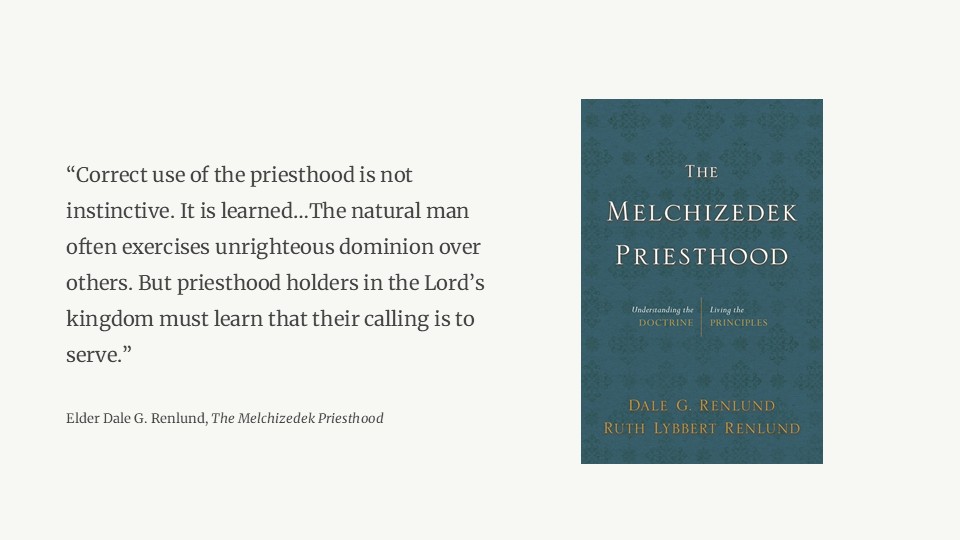
Elder Renland makes this point in an elegant way in his book. I’m not going to read this quote, but this is his book that he recently published about the Melchizedek priesthood. 5
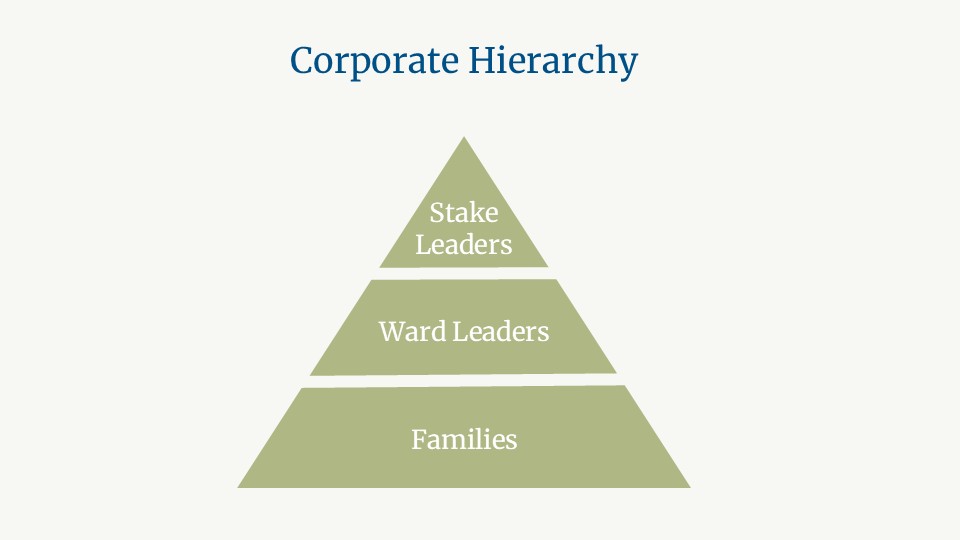
He says, okay, so this is how most people think about how power and authority work, based on how we think of corporate hierarchies. The families are on the bottom, and the higher you go in the church, the more on top you are in this power pyramid.
But he says—and he quotes from the scriptures where Jesus Christ is talking about being the foundation—“So a more accurate way to think about it is that priesthood leaders are at the bottom in the sense that what they are doing, they’re not trying to control people for their own interests. They are there to support. They are there to provide.”
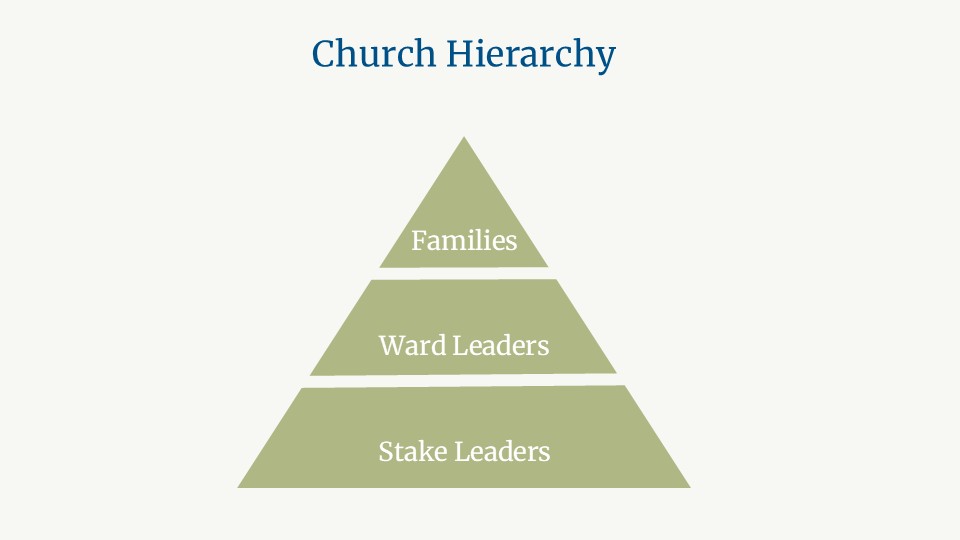
And so here we have—and he actually uses this pyramid illustration—I think this gives us a visual representation of a better way of thinking about the structure of our church in terms of responsibility and formation.
How sacrifice formed my early trust
Placing men in these roles, as I’ve mentioned, requires sacrifice from them. And that sacrifice had such a profound influence on me from my earliest associations with the church. Here’s what I wrote when I wrote my article about this:
“One of the first things that drew my interest to the church was that not a single missionary made any attempt to engage with me sexually on a sexual level. And attending church was my first experience where trustworthy males were the norm.”
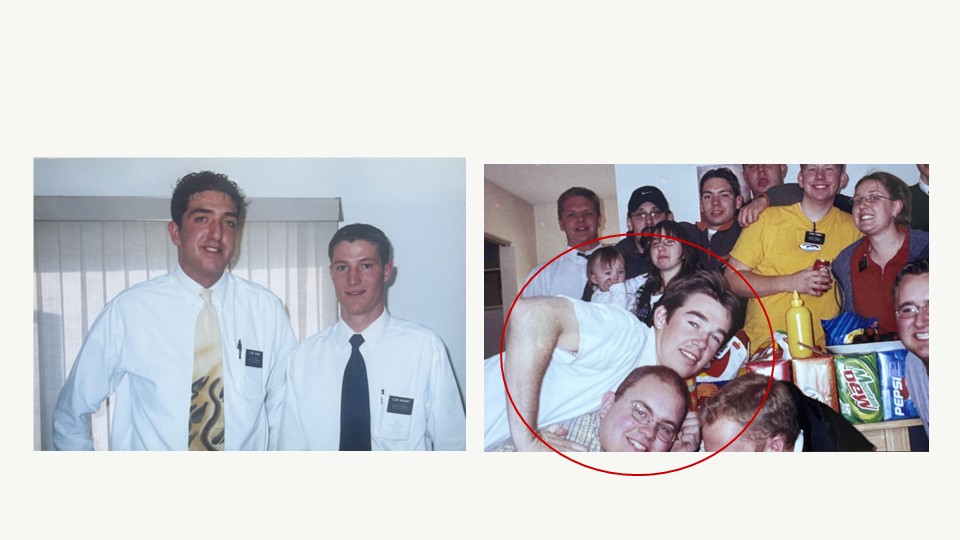
Here are the elders that taught me. They were young guys. This is a time in our culture in which many men are at their most destructive. And yet they were sacrificing their time and energy to God primarily. This showed up as getting up at 6:30 in the morning to read their scriptures and then pray, and they’re not going out and having fun for two years. That sounds really lame, but look at what an incredible impact this had on my life.
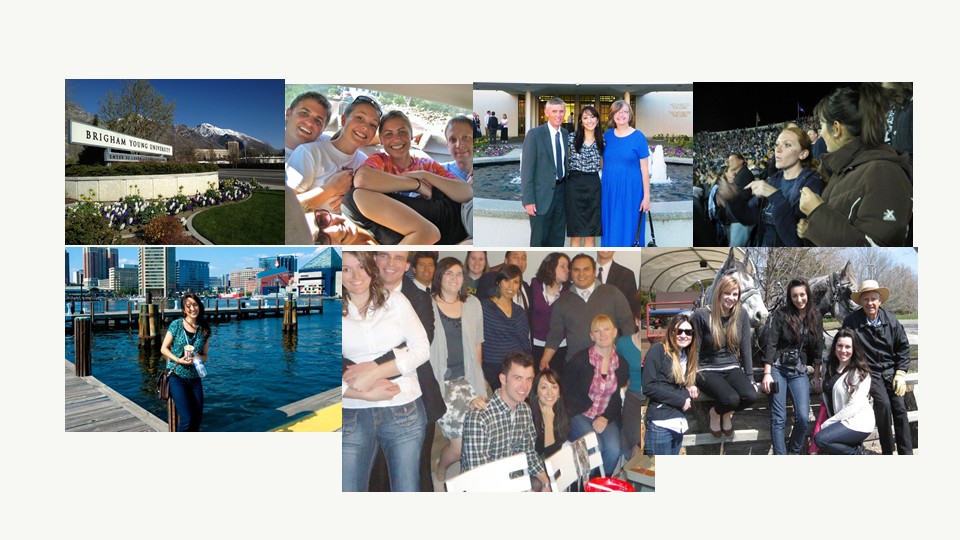
Their sacrifice—and this is what I want us to understand about priesthood roles and responsibilities—their sacrifice altered the course of my life. Everything in my life is so much better, and this characterized my young adulthood as well: men making very unexpected sacrifices to build up a young woman who was really torn down.
Being seen through the Savior’s eyes
I don’t know why, but I know that it needed to be men that did this. It couldn’t just be a community of nice people. The way that my early experiences made me feel is difficult to put into words. But I remember priesthood leaders—men who were formally designated to represent the Savior—sitting across from me, and me feeling through the Spirit that the way they saw me was a reflection of the way that the Savior saw me.
It had been impossible for me to see myself in those terms prior to that. I needed someone representing the Savior to see those things in me first, and then I could believe them. I could believe in that hope.
Choosing divine assumptions
I’m really running out of time fast. I guess we won’t have time for questions. You can ask me questions anytime.
Let me just say that there are a lot of assumptions that we inherit from the world around us, and we all have them. And if you don’t believe me, go read Jeffrey Thayne’s FAIR addresses on this topic. 6
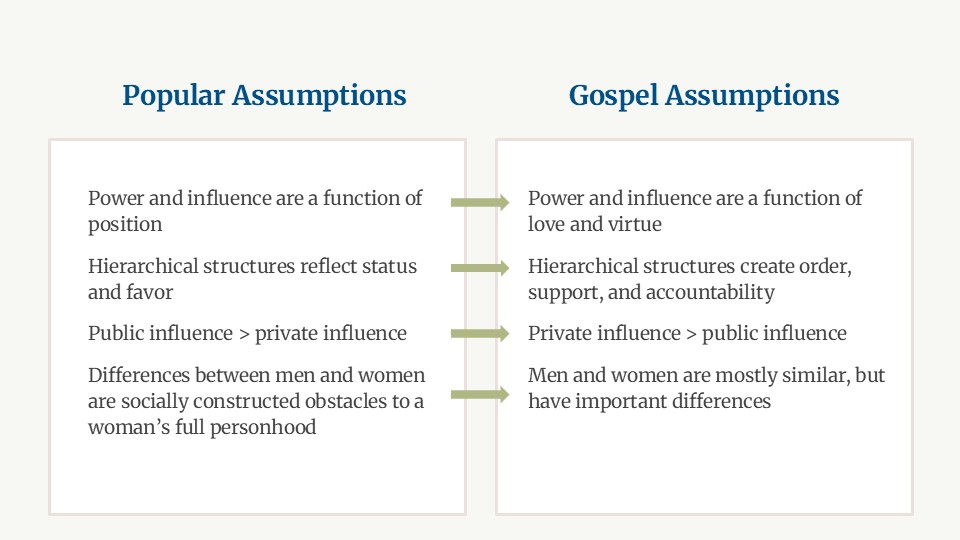
What I want you to know about this is that if we import these assumptions and we never question them, then the things that the church does are not going to make a lot of sense to us, until we are able to consciously choose some divine assumptions—or at least assumptions that are more harmonious with church teachings.
So, for instance, the idea that power and influence are a function of our positions. The challenge to that would be that power and influence are a function of love and virtue. This is what we are explicitly taught in our scriptures and by church leaders.
Testimony and concluding appeal
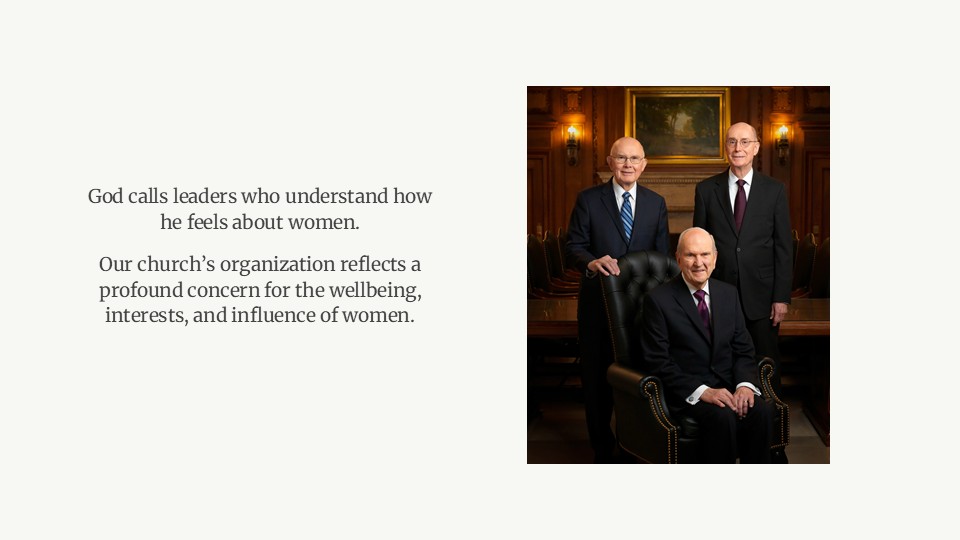
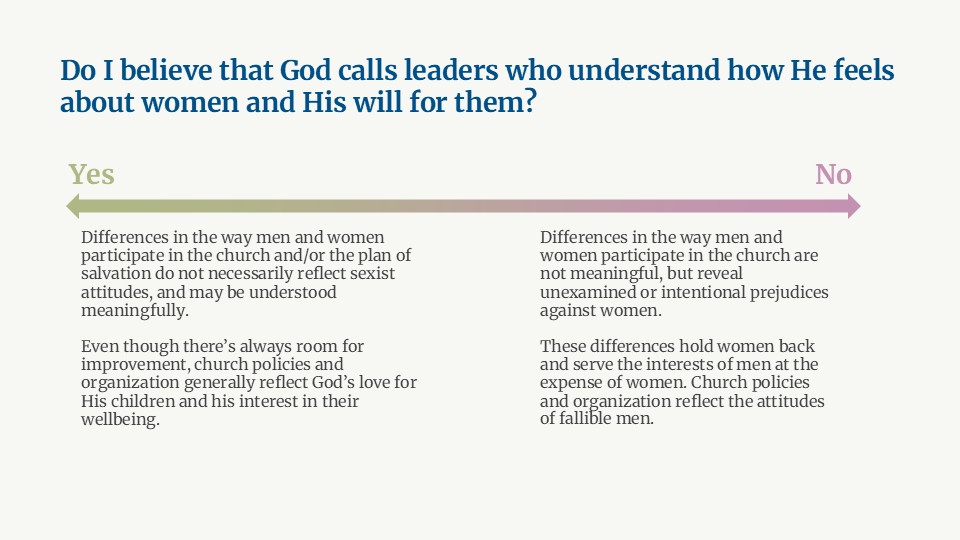
I just want to finish up by saying that I have had profound spiritual witnesses that the men—the senior leadership of this church—are prophets whom God has called. And that has had a really profound influence on the way that I have approached this question, because ultimately I do believe that the way that this church is organized reflects a God who calls leaders that understand how He feels about women.
I am not suggesting that everything in this church is perfect. And I do think that there are things that will continue to evolve and change that will incorporate women’s voices and perspectives at all levels of the church. And that’s a wonderful thing. But please don’t make the mistake of thinking that the way things are now does not have a purpose. And I share that in the name of Jesus Christ. Amen.
Q&A
The Justice of God
Question: Because of your experience, what do you have to say for those who say God isn’t real because bad things happen to good people?
Answer: Oh. Well, I think Don addressed that so much better than I possibly could. But I love what he said about that worry that he had that maybe he only was able to believe because bad things had not really happened to him. And now he knows for sure that that’s not true.
I believe that that’s one of the purposes of these difficult experiences that we have—so that our conviction is not simply one of convenience. It’s one in which that hope is refined by our difficulties. And I think you can kind of see how the experiences of my early life—which I certainly wouldn’t wish on anyone and which at the time I wished were not happening and would go away—how they have given me empathy and insights that I would not have otherwise had that can be helpful to other people.
Meagan’s experience with the missionaries
Question: Considering your background and upbringing regarding men, how did you first come to meet with the elders? And was that a struggle for you at first?
Answer: It wasn’t. In fact, I was looking for a church to join. And at one point I actually prayed about it, thinking, like, is there a church in the area that I should go to? Not like a one true church. But then I met the missionaries. And I don’t know that I was really convinced by a lot of the answers that they gave me during the discussions.
I think it was more informative to me, but their example and the light that they had and the sincerity and the warmth—that had a profound impact on me. And then later on I had those transformational spiritual experiences, but that was a really big part of it in the beginning.
Question: How did you find the missionaries, or how did they find you?
Answer: A street contact. I was walking down the street. Walking down the street.
Comment: Wow. So it gives a lot of missionaries hope.
Answer: Yes.
Women feeling heard
Question: Many women in the church feel that their voices and ideas don’t matter. What might help women feel more listened to and respected without diminishing the positive structures of the church for male formation?
Answer: I know that this—again, like I said—I’m not saying that there isn’t room to improve. Here’s what I’m going to say on this. I think it is really important that you have a personal witness of Christ and the leaders that He calls, not so that we excuse the wrong that our leaders do, but so that we can bear with their faults, knowing as we do that the Savior has a plan. And if I do what He is asking, it’s going to be okay. My voice will be heard.
I do feel that our leaders do their best. They are going to have shortcomings, but I know that the Savior cares about what women feel and that He is striving to have that be represented in the way that the church functions.
Advice for those abused
Question: Do you have any advice for those who have experienced abuse by men within the church?
Answer: This is something I’ve thought about quite a bit. In some ways I think that when that happens, it is so much worse because we know for sure that those men know better and have been trained better. Whereas a lot of the scumbags in my life were just guys that slip through the cracks. These are men who actually have been taught better.
I will tell you that my own healing is still a process. It is not something that I anticipate will be fully finished in this life. But going away from the church is the last thing that is going to help you. Being in this church and experiencing the Savior through the programs and policies and doctrines of the church has been extremely healing for me.
Scott’s response
Comment: I know. I teach at a secular school, and my classes are probably 80 to sometimes 90% women, and the assumption I usually make is they all have children and they’re not with a partner. So in so many cases I think, wow, the church can help you so much, and you just want to reach out and hug some of them because of their abuse cases and things that they hear.
So I think as much as we can fault some of the men in the church for some of the bad behavior and bad things they’ve done—and it exists. It’s real. It’s real. Absolutely. It’s real, and men need to repent and do better. On the other hand, I don’t see a better place outside the church. In fact, it’s better within the church than outside.
Answer: Yeah, that’s, I think, kind of my conclusion: if we take the hypocritical men who do wrong and we use that as a reason to upend this structure that has been so beneficial for so many men, what are the costs of that? We have to ask ourselves that question.
So, thank you so much for your time with us. We really appreciate it.
