“Reflections on Saints: Ministering with the New Four-Volume History of the Church” by Scott Hales
Scott Hales
Reflections on Saints: Ministering with the New Four-Volume History of the Church
August 2020
Summary
Scott Hales speaks about his work as a general editor and lead writer for the Saints project. Saints is a four-volume narrative history of The Church of Jesus Christ of Latter-day Saints. He shares insights on the creation and impact of the first two volumes, emphasizing their purpose to provide an updated, accessible, and faith-affirming history for Church members. Hales discusses the challenges and successes of the project. He covers the use of a multi-layered “birthday cake” format to engage a broad audience. Hales shares how the Saints books are helping members better understand and minister using Church history. He highlights the positive reception of the volumes, particularly their transparent approach to controversial topics. Hales mentions ongoing work on Volume 3, which covers the period from 1893 to 1955, navigating the Church’s evolution into a global presence.
Introduction
Scott Gordon: Our next speaker is Scott Hales. He’s been a historian and writer for the Church History Department since 2015. He currently works as a writer and story editor for Saints: The Story of The Church of Jesus Christ of Latter-day Saints, the new four-volume narrative history of the Church. And just as a personal note, I want to thank him for spearheading that project. I think it’s a wonderful project. I had a missionary ask me what he should do to prepare better for things. “Read Saints. That’s what you should be doing.” So with that, I’ll turn the time over to Scott Hales.
Presentation
Scott Hales: Once again, I am honored to take part in the FairMormon Conference. This is my third year speaking here. If you are unfamiliar with me and my work, I am a historian and writer for the Church History Department. During the last five years, I have worked as a general editor and lead writer for Saints. We published the first volume, The Standard of Truth, in the fall of 2018. The second volume, No Unhallowed Hand, was then published earlier this year. It was published about a month before COVID-19 drove us all back indoors.
Reflections on Saints
When I first spoke at FairMormon two years ago, Volume 1 had not yet come out. Some people in the audience had never heard of it. Much has changed since then. People used to ask me what I did for the Church History Department, and I think they had some sort of idea that I was a programmer for FamilySearch or something. And now they ask me when the next Saints book is coming out. So, you can imagine that ward dinner parties have greatly improved for me. We’re now halfway through publishing the volumes. It seems like an appropriate time to reflect on Saints and the important work it does in the Church.
As you can imagine, I’ve thought quite a bit about these books over the last five years. They have consumed my thoughts, occasionally robbed me of sleep. They have certainly receded my hairline. I’ve been presented with some of the most challenging and rewarding experiences of my professional career. I have invested a great deal in these books, and I look forward to the day when Church members will have all four volumes in their hands and on their bookshelves.
Today, I plan to reflect on three aspects of Saints:

Its purpose and execution. Its reception among readers. And its practical use and usefulness in the Church, specifically in how Church members can use it to minister formally and informally to one another. Most of the information I’ll be sharing is anecdotal and personal. We’re still yet to see what long-term effects Saints will have on the Church and its membership. Many people, including me and certainly many people in the audience, are beginning to see the positive influence Saints is having on Church members and their testimonies of the restoration.
Update on Saints Volume 3
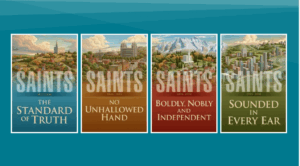
But before I begin, I want to give a quick update on Saints Volume 3: Boldly, Nobly, and Independent.

Volume 3 covers the 62-year period between the dedication of the Salt Lake Temple in 1893 and the dedication of the Swiss Temple in 1955. This is a dynamic time for the saints. They moved from being a geographically isolated and largely misunderstood religious community to a relatively well-known and generally respected Church with a burgeoning global presence. This change does not happen easily, as you can imagine. Nothing ever does in the Saints books. So much of the action in Volume 3 revolves around the Church’s growing pains. In many ways, you can think of Volume 3 as a coming-of-age story.
We expect to have this book out in a little more than a year. When COVID-19 struck in March, we worried that it would throw a wrench into our schedule. We’ve been working mostly from home this year. Thanks to modern technology, which allows us to coordinate our efforts and access historical documents remotely, we’ve been able to make steady progress on the books.

I don’t know what B. H. Roberts’ writing habits were when he wrote the Comprehensive History of the Church a century ago. I imagine Saints Volume 3 will be the first history of the Church written and researched primarily in pajamas. True story.
In all seriousness though, Volume 3 is progressing nicely and promises to be another great installment in the same series. It covers an era that is not well known among Church members. Readers will be sure to find it fascinating.
As you probably know, one of the primary purposes of Saints was to provide Church members with a more updated history than B. H. Roberts’ Comprehensive History, which was first published in 1930. Despite its title, Robert’s history was not a comprehensive record of the Church’s past. It was ambitious, it was thorough, and it was certainly a blessing to Latter-day Saints who wanted to know more about their history. But it did not account for everything that had ever happened in the Church since its inception. Because it was never updated, it eventually became outdated both in content and methodology.
Saints, likewise, is not a comprehensive history, nor does it pretend to be. When I came onto the project in 2015, we consistently referred to it as the “new history.” The idea being that Saints would not only be an updated history of the Church, hence “new,” but also that it would take a noticeably different approach to how we told our story than any previous history published by the Church. There was a sense that the world was changing, especially in the way people consumed and processed information, and that we as a Church needed a history that reflected and responded to those changes.

Moreover, the sense was that we needed a history that reflected the changing demographics of the global Church and that responded to a widespread desire, especially among millennial saints, to have the Church’s diverse membership represented in the history.
There was also the matter of audience. The new history was supposed to be a history of the people for the people of the Church, not simply its most educated members. We owe a great debt to scholars whose academic writing has illuminated and reshaped what we know and understand about Latter-day Saint history. But such work has not always reached the average Latter-day Saint reader. Primarily because the average Latter-day Saint is not that interested in reading academic writing.
The “Birthday Cake” Model
This, by the way, is true of average readers everywhere. There’s a reason why The Da Vinci Code and not some academic tome on the works of Leonardo was on the New York Times bestseller list for 103 weeks. If you want a large number of people to read something, you have to write it and package it in a way that appeals to them. For this reason, Saints ultimately took on a multi-layered multimedia design;
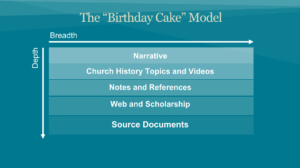
what I like to call its “birthday cake” format. The top layer of the cake, the icing, is a narrative history of the Church written in simple, accessible language to appeal to the widest audience possible. Here I’m referring to the books themselves, the narrative history.
As we all know, there are certain people who only eat the icing on the cake. That’s okay, especially if that cake comes from Costco where it’s really good. But there are also people who want to eat a more substantial slice. The same is true for Church members reading Saints. Some readers are content with the narrative alone, others want to know more, and the multi-layered multimedia format of Saints seeks to accommodate them.
Through Church history topics, articles, videos, and other features, we explore aspects of our history in more depth. Also, for those who like to eat as much of the cake as possible,
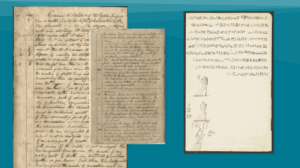
we’ve digitized most of our historical sources so that readers can see where we and other historians get our information.
Narrative Storytelling
Of course, we recognize that this format is not perfect. Everyone loves a good story, so it makes sense to use narrative to teach people about Church history. Narrative storytelling has long been a tool historians have used to make their research more interesting and appealing to the lay reader. Yet, narrative history has its limitations, especially in the way it often privileges coherence over controversy and scholarly debate. The past is messy; it unfolds haphazardly, heedless of the traditional rules of storytelling. To make sense of this mess, narrative historians organize what they know about the past into a coherent and long-established story structure. They identify key players or characters and follow them on an engaging journey through various problems. At the climax of the story, the characters resolve their problems and finally achieve their goals.

This approach to history excites readers and keeps them turning pages. However, it often does so by sidelining important analysis and questions still open to scholarly debate for fear of slowing down the story and losing reader interest. Reza Aslan, a scholar trained in both creative writing and the New Testament, acknowledged taking such an approach in his controversial narrative history, Zealot: The Life and Times of Jesus of Nazareth.

Quoting Zealot
“For every well-attested, heavily researched, and eminently authoritative argument made about the historical Jesus,” he wrote, “there is an equally well-attested, equally researched, and equally authoritative argument opposing it.”
“Rather than burden the reader with the centuries-long debate about the life and mission of Jesus of Nazareth, I have constructed my narrative upon what I believe to be the most accurate and reasonable argument based on my two decades of scholarly research into the New Testament and early Christian history.”
To satisfy his critics and further develop his argument, Aslan addressed scholarly debates in his footnotes where he acknowledged and responded to opposing views. We do something similar in Saints. Rather than use our endnotes to engage in debates, we direct readers to articles in the Church History Topics section of the Gospel Library.

Educating Our Readers
While the solution has its drawbacks–readers, for instance, have to know about the articles and make an extra effort to access and read them–it does allow us to acknowledge scholarly debates and educate our readers without interrupting our narrative momentum. I should say that this process is much easier on the online version where you can just click a link rather than with the books where you have to look up the footnotes and then pursue the articles themselves. So, there are ways around this if you’re using the digital copy.
But I do want to say that I have found these Church History Topics articles to be incredibly useful in helping people find answers to questions they have about Church history.
Another drawback to the Saints format has to do with accessibility. As I noted earlier, we’ve tried to make Saints as accessible as possible to readers. Aside from its writing style and design, which cater to a general audience, the book is available in print, digital, and audio, either for free or at an affordable price. The book and Church History Topics are also available in 14 different languages. Combined, the history is available to virtually every member of the Church.

Non-English Translations
Unfortunately, though, non-English speakers run into a language barrier the farther down they go in our multi-layered format since most of our primary and secondary sources are in English and have not yet been translated into other languages. The audiobook likewise is currently available in only three languages–English, Spanish, and Portuguese. This limits the access of readers who prefer the audio format.
Still, the fact remains that Saints has much to offer in all 14 languages. This is a remarkable improvement over the Church’s previous multi-volume histories, which were only available in English. Church members around the world have more access to Church history now than ever before.
Let’s reflect now about the reception of Saints and what it teaches us about how people can benefit from the books. As we worked on Volume 1, we wanted it to be an accurate, up-to-date, and accessible history that also affirmed and strengthened the faith of our readers. But it was impossible to know how well we achieved our goals without feedback from our audience. Before Volume 1 came out, someone asked the Saints team if we actually thought people were going to read the new history. Though publicly confident about this success, I secretly harbored some doubts.
History Readers and Not
There are two kinds of people in this world: those who read history and those who don’t. And sometimes it seems like those who do not read history vastly outnumber those who do.

I knew that writers like David McCullough and Ron Chernow had written hugely popular history books. But we wanted Saints to appeal not only to Church members who were naturally inclined to read books like The Pioneers and Alexander Hamilton, but also to those who had never picked up a history book in their lives. So, I was curious to see if Church members would give the new history a chance.

Saints Reviews
We knew we had produced something different. We knew it had the potential to do a lot of good in the Church. And we knew it was the kind of book many Church members had been praying for. But none of that would matter if nobody read it. Fortunately, we had good reason to feel confident. We sent portions of Volume 1 to outside readers for testing. Most of these readers were young millennials, and their response was overwhelmingly positive. We also received an encouraging response after publishing the first eight chapters of the book in the Ensign and Liahona magazines. But the doubts and uncertainties never subsided until the book hit the shelves and the reviews came in.
And we could not have asked for better reviews. Most readers seem to understand what we were trying to do with Saints Volume 1, noting that its transparency, thorough research, and readability made it an ideal book for helping Church members faithfully navigate challenging aspects of Church history.

“This volume shows the power of history in using an intimate knowledge of primary sources and judicious use of secondary sources,” wrote one Latter-day Saint blogger. “It addresses often repeated criticisms, but the authors talk about it in a matter-of-fact language and in the middle of excellent contextualization, which will make the sensationalist presentism of critics seem even weaker.”
“It is fantastic,” wrote another blogger. ”The style of prose reads like a novel, but it is very much rooted in some of our best understandings of the events and people who lived in the early period of the Church. The combination of the two results in a very readable, but accurate history.”
A FairMormon blogger also gave the book a positive, enthusiastic review. Though he took minor issue with the book’s literary style, which happens to be the very thing that I oversee in the book. That’s okay. This is what he wrote:

“I really like what has been done,” he wrote. “I only have a couple minor criticisms of the book. The style is actually a little too simple for my tastes, but this is unavoidable because the authors want these books to be read and understood by every member of the Church, no matter their educational level, including primary kids. And I did eventually get used to it.” So there’s at least that that made me feel better about it. I love you guys.
Other Criticisms
This book received other criticisms from otherwise positive reviewers.
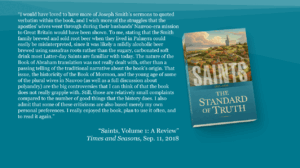
“I would have loved to have more on Joseph Smith’s sermons quoted verbatim within the book, and I wish more of the struggle that the apostles’ wives went through during their husbands’ Nauvoo era missions to Great Britain would have been shown,” wrote a blogger for Times and Seasons, the Latter-day Saint blog. He also objected to the book’s apparent lack of attention to issues surrounding the Book of Abraham translation, Book of Mormon historicity, polyandry, and the young age of some of the plural wives in Nauvoo, which were all topics the Church had covered in detail in its recent Gospel Topic essays. Still, he wrote, “Those are relatively small complaints compared to the number of good things the history does. I really enjoyed the book and plan to use it often and to read it again.”
Some of the most insightful feedback we’ve received about Saints and its positive effect on Latter-day Saint readers has come through the social media platform Goodreads. For those of you who don’t know, Goodreads allows readers to rate books according to a five-star system, with five stars being the best.

Statistics
As of August 5th, 2020, Saints Volume 1 has been rated by 5,439 readers.
Sixty-five percent of them have given the book five stars. Twenty-seven percent have given it four stars. Five percent have given it three stars. One percent have given it two or one stars.
Volume 2 has received similar ratings. Out of the 1,402 readers, sixty-two percent have given it five stars. Thirty-one percent have given it four stars. Five percent have given it three stars. Fewer than one percent have given it two or one stars.
Goodreads users can also leave reviews of the books they read. Saints Volume 1 currently has 1,107 reviews, and Volume 2 has 318. Several common themes run throughout them. Matthew, a reader of Volume 1 who gave the book four stars, was typical of other readers when he wrote,
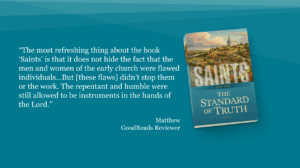
“The most refreshing thing about the book Saints is that it does not hide the fact that the men and women of the early Church were flawed individuals. But these flaws,” Matthew continued, “did not stop them or the work. The repentant and humble were still allowed to be instruments in the hand of the Lord.”
Five-Star Rating
Giving the book a five-star rating, a reader named Kara expressed another common sentiment about Volume 1.
“I’ve thought about how I might have handled the early saints’ hardships, and I know that most of them would have been beyond my capacities. But I’ve also learned that the things I face today would likely be beyond theirs. Though challenges look different; they are made to try us and help us grow in our own unique, individual way, and there is really no way to compare them.”
“I have also come to know that my faith is real and solid, and I am willing to go and do whatever the Lord would ask me to do.” Keep in mind that this is a public setting. She’s sharing this on social media, which I just think is fantastic. “Reading Saints has been such a blessing and made me so very grateful for all that has come before me to build the wonderful Church I am proud to be a member of today.”
Many reviewers comment on the treatment of difficult issues in Saints. Often they express their appreciation for the understanding they gain from reading about them. We see this in a four-star review of Volume 2 from a reader named Andy.
“Similar to the first volume, this account does its best to shed light on the circumstances surrounding controversial Church history topics,” he wrote. “There is a lot in here about polygamy, a lot. I gained more appreciation for how difficult it was for early Church members to adopt the practice but also how hard it was for some to give it up after embracing it for so long.”
Sarah’s Review
Reader Sarah expressed a similar view in a five-star review.
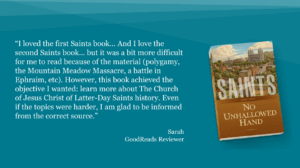
“I loved the first ‘Saints’ book, and I love the second ‘Saints’ book. . but it was a bit more difficult for me to read because of the material—polygamy, the Mountain Meadows Massacre, a battle in Ephraim, etc. However, this book achieved the objective I wanted: to learn more about the Church of Jesus Christ of Latter-day Saints’ history. Even if the topics were harder, I am glad to be informed from the correct source.”
Goodreads Reviews
There are other common themes in Goodreads reviews of Saints. Readers appreciate the book’s attention to underrepresented groups within the Church, such as women and people of color. Many readers express appreciation for the simple style and fast pace of the books. Occasionally, readers note how the volumes help them piece together their fragmentary knowledge of Church history. They give them a more complete understanding of how the restoration unfolded. Overall, the reviews suggest that Saints can be an effective resource for building faith. Saints helps Church members find answers and understanding to their questions about Church history.
Of course, not every online review is positive. As I noted earlier, one and two-star ratings of Saints are not very common on Goodreads. This seems to be the case for other websites as well with similar rating systems and similar audiences. Even less common are reviews from readers who give the book a low rating. For instance, of the 51 readers who gave Volume 1 a one-star rating, not a single one wrote a review to explain why he or she rated the book so low. This makes it difficult for us to understand their negative reaction to the book. Of the six readers who have so far given Volume 2 a one-star review, two have left reviews. One of those simply states “more lies,” so you can take that for what it’s worth. I don’t know.
Why Others Don’t Connect With the Book
Readers who give the Volume 2 stars are far more likely to write reviews. This gives us a better window into why some people do not connect with the book. The criticisms in two-star reviews usually boil down to two separate objections: number one, the book is not uplifting. Number two, the book whitewashes Church history.
Occasionally, some readers of Volume 2 also rate the book low because they do not like it as much as Volume 1. As one recent two-star review put it, and I love this,
“I feel really bad for leaving such a few stars for a Church book, but this was not even near as good as the first Saints book. I had a hard time getting through this one, even while listening to the audiobook. There are so many sad and disappointing stories in this book, I found it hard to be uplifting. I think it’s still important to read or listen to it, it’s good to know the history, but this one didn’t lift me like the first one.”
Common Criticism
Again, such reviews are rare on Goodreads. Yet even readers who rate the books highly occasionally mention aspects they did not like about them. One common criticism the book receives from otherwise favorable reviewers concerns its simple writing style. One reviewer docked volume one half a star because of the prose. That was another painful one for me.
“The pacing was done well, but the language was simple. . . I still wish it had been the beautiful prose I love”, so I’ve got something to work on. Another common criticism concerns the large number of characters and settings, particularly in volume 2.
“I’ve never much enjoyed reading nonfiction history books, but these books do a pretty good job of telling it in a story format that makes it a little easier to digest,” wrote one reviewer of volume 2. I still struggled a little to keep track of who was who as the narrative bounced around between accounts, but that probably speaks more to my attention issues than the quality of writing.“
Another Review
In a similar vein, another reviewer wrote,
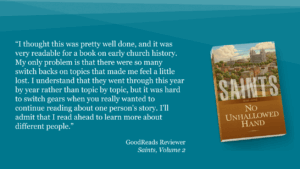
“I thought this was pretty well done and it was very readable for a book on early Church history. My only problem is that there were so many switchbacks on topics that made me feel a little lost. I understand that they went through this year by year rather than topic by topic, but it was hard to switch gears when you really wanted to continue reading about one person’s story. I’ll admit that I read ahead to learn more about different people.”
I’m sympathetic to these last two criticisms. The books do juggle hundreds of names and places, which can be difficult to keep track of, especially for readers who are unfamiliar with Church history. But in order for Saints to be a representative history, it needs to introduce readers to many important names and places. As a team, we try to be strategic jugglers as we craft the narrative. I think we’ve largely succeeded in producing something coherent despite the number of flaming bowling pins we have in the air.

Still, we’re telling a big story, and big stories are demanding by nature. But take comfort in this: it could be worse. Each volume of Saints could be as long and dense as War and Peace, which is notorious for its large cast of characters. If you don’t believe me, just ask Charlie Brown.

Prose
As far as the prose in Saints is concerned, I recognize that it is simple. Especially to people who are used to more complex writing. The style was a conscious choice, however. It was specifically designed to ease the translation process and make the narrative appeal more to a general readership. Indeed, one of the most challenging aspects of writing Saints is maintaining a clear, simple style. Especially when the subject matter is so complex. Yet in the end, I find the resulting simplicity very rewarding.

All Latter-day Saints should have a general knowledge of Church history. The simplicity of Saints‘ style helps them acquire it. I also believe that Saints can act as a young person’s gateway to greater knowledge and deeper understanding of Church history.

I am always happy when I hear about young people being inspired by Saints. We need young people who will grow up to be the next generation of faithful Church historians. I believe that right now, Saints is planting seeds in these future scholars.
Overall, the response to Saints has been excellent based on online reviews and feedback we’ve received from other outlets. The books have the power to engage readers, provide a foundational understanding of Church history, and strengthen the faith of Latter-day Saints.
Using Saints to Minister
I’d like to reflect on how Church members can use Saints to minister to one another. These days, ministering is a loaded term in the Church because it has been granted official status in the Latter-day Saint lexicon. In fact, I almost didn’t use it today because I worried that my Elders Quorum president would catch wind of my talk and call me out on my poor ministering efforts. But regardless of how diligent we are as ministering brothers or sisters, the fact remains that all of us in the Church are called to minister officially and unofficially to one another. Indeed, Latter-day Saints have always ministered, even before it became a program. It’s what we do whenever we go about doing good.
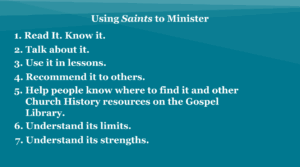
I’d like to mention seven things that you can do to make the most of Saints in your efforts to strengthen your faith and minister to others. This can be both in an official setting and an unofficial setting, wherever we go about trying to do good. How can we do that with Saints? This is not by any means an exhaustive list. I think it’s a good place to start for anyone who wants to use Saints as a ministering resource.
Read It and Know It
First, read it and know it. This is perhaps the most important thing you can do. You can’t use the book as a resource to help others unless you know what’s in it. I recommend first reading both books front to back rather than skipping around or reading topically. Like the Book of Mormon, it has an underlying structure and design, and its stories build on one another and draw meaning from each other. I also recommend becoming familiar with the Church history topics on the Gospel Library. Once you study the book and know its stories and characters well, you will be better prepared to know how it can help someone who needs ministering. Especially as you get to know the person and his or her needs.
Sadly, Church history is sometimes co-opted by individuals who wish to divide the body of Christ. Saints addresses points of historical controversy to prepare and fortify Church members against attacks on their faith. Since Church members often struggle to understand and discuss plural marriage, the Mountain Meadows Massacre, and other controversies, Saints provides readers with a reliable introduction to them. This in turn gives readers more confidence to address them when they minister to people with historical doubts.
Indeed, simply being aware of how Saints and the Church history topics handle controversies can prepare you to know how to respond when questions and doubts about Church history arise in your families and wards. Each volume is a testament that Church history is not something we should fear, but something we can and should turn to to strengthen our faith in the love of God and the goodness of Christ. Please read them.
Talk About Saints
Second, talk about Saints in your family’s wards and branches. Most Church members I encountered today know that Saints exists. But not everyone has read it and benefited from what it has to offer. One way to change this, I think, is to talk about it. Generate a buzz around the book in your home ward or branch. Remind people that it has been published. Let them know what you think about it. Keep the conversation going after they start the book or once they finish it. Just make sure you don’t spoil anything because nobody likes spoilers, right? And there are plenty of things to spoil in the book.
So far, I have not encountered anyone who did not have something to say or ask after reading Saints. They aren’t the kind of books one simply reads and then casually puts back on the shelf. Both volumes grapple with big issues and raise important questions about how God interacts with His children. Find ways to talk about these issues and questions with others who have the books. In doing so, you will spiritually fortify yourself and others.
You can also talk about it with people who are not members of the Church. I recently spoke with someone who is the only member of the Church in his family. Over the years, his mother has met several times with the missionaries. Lately, he and the missionaries have begun reading Saints with her. “I have been a member for 14 years,” he told me, “but my mother has never asked as many questions about the Church and its teachings as she has since we started reading Saints together.”
Use it in Lessons
Third, use it in lessons. If you have not already read Saints, keep in mind that next year we’ll be studying the Doctrine and Covenants through the Come Follow Me program. Saints is one of the many excellent supplemental resources available to enhance your study of that work of scripture. If you are a teacher in the Church, you will have ample opportunities next year to use Saints to develop and enrich your lessons. The books are designed to give Church members a foundational knowledge of Church history. A shared knowledge base from which we can all draw and understand as we discuss the Doctrine and Covenants and the Latter-day Saints’ experience.
Using Saints in your lessons will encourage your class to read it and learn from it. Both parents and children can use Saints and Come Follow Me lessons in their home. Ministering brothers and sisters can prepare lessons from Saints for their ministering families. The book should not take the place of the Doctrine and Covenants, but it can serve as a useful companion to it. Keep in mind that Saints does more than just respond to controversy. It gives us a greater sense of our shared heritage of faith.
Recommend it to Others
Fourth, recommend it to others. Recommending Saints is one of the easiest ways to use the book to minister to others. People who like to read are always asking for recommendations. Why not recommend Saints? I’ve heard of ward book clubs that read and discuss Saints. If you belong to a book club, consider using it as the next book. About a year ago, I had the opportunity to speak to a book club that had just finished reading Volume 1. Everyone there seemed to have been inspired and taught by the book. They all agreed that reading it was a better experience than reading Moby Dick. Moby Dick happens to be one of my favorite novels, but I like Saints even more.
Help People Know Where to Find It
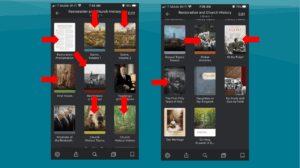
Fifth, help people know where to find Saints and other Church history resources on the Gospel Library. This is another easy thing you can do to encourage family members, ward members, and ministering families to begin their study of Church history. I find that most Church members are unaware of the many riches hiding in the Restoration and Church History section of the Gospel Library. If you take a moment to open it up, you’ll instantly see several important resources. These include the Restoration Proclamation, which President Nelson read at the most recent general conference. There’s also Saints Volume 1 and Volume 2; First Vision resources, including the new film, Ask of God; Joseph Smith’s four accounts of the First Vision; and the excellent new First Vision podcast. If you haven’t had a chance to listen to the First Vision podcast, I highly recommend it. It’s an excellent, excellent program.
Revelations in Context
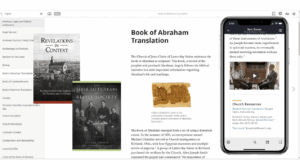
There’s also Revelations in Context, a collection of historical essays about the revelations in the Doctrine and Covenants. We’ve got the Church History Topics and videos. These are supplemental essays and videos related to Saints about topics and issues in the books. If you have not browsed the Church History Topics or the videos, I strongly recommend doing so. They are as much a part of the Saints project as the books themselves. Again, I have found them to be an incredible resource for Church members struggling with questions about Church history.
Global Histories, which Melissa just spoke about, is another little-known treasure. These short histories seek to share the inspiring story of how the message of the Restoration has been embraced and shared around the globe. And finally, there’s At the Pulpit and The First 50 Years of Relief Society, two valuable resources for learning the words and deeds of Latter-day Saint women from the beginning of the organization of the Church until the present. These are all available and more resources, as you can see there in the Gospel Library app. If you’re unfamiliar with them, please seek them out.
Understand Its Limits
Number six: Understand its limits. As useful as Saints is in ministering, it is not a sure-fire cure for spiritual ailments. As I’ve spoken to Church members about Saints, I’ve met people whose loved ones have left the Church partly because of issues or concerns related to Church history. I also know that there are people who continue to remain active in the Church despite harboring similar doubts and concerns. I believe that Saints is a resource that can help people come to terms with these issues.
Shortly after Volume 1 was published, we learned about a woman who had investigated the Church for a long time but never joined it because of reservations she had about Joseph Smith. After reading Saints, though, she gained a testimony of the prophet and subsequently accepted baptism. We like hearing this woman’s story because it illustrates how Saints can help bring people to Christ. But such results are not guaranteed. Saints may or may not help you or a loved one weather a faith crisis. It may or may not answer your questions about Church history. It is, after all, only a resource.
Divine Truths and Stories of Imperfect People
As we note in the preface of Volume 1, “Saints is not scripture, but like the scriptures, each volume contains divine truth and stories of imperfect people trying to become saints through the Atonement of Jesus Christ. Their stories, like the stories of all saints, past and present, remind readers how merciful the Lord has been to His people as they have joined together around the globe to further God’s work.”
If Saints has a role in bringing you or someone you love back to Christ, it will not be a result of our thorough research or powerful storytelling. It will be because the Spirit of the Lord works through the books to confirm truth and witness to you of God’s mercy and love.
Understand Its Strengths
Finally, seventh: Understand its strengths. Saints has its limits, but it also has its strengths. These books are reliable accounts of Church history grounded in sound research and careful analysis. They are easy to access and simple to digest. Most importantly, they approach challenging subjects from the perspective of faith. They offer readers an alternative to false, misleading, or misconstrued information about the Church and its history, which is so prevalent on the internet today. Saints is not scripture, but it can be a powerful instrument in our efforts to minister to God’s children. Let the Spirit help you know how best to use it in the Lord’s work. Over and over again, the books provide inspiring examples of Latter-day Saints who find strength and spiritual power in the restored gospel of Jesus Christ. What’s more, they have the ability to help people put their own mortal trials in perspective.
Personal Story
Let me share a story that a member of the Saints team recently shared with me. These are her words, not mine. She said, “My good friend grew up in the former USSR and joined the Church in 1992 when she was about 20 years old. Soon thereafter, she moved to the United States to get married, leaving her family behind in Ukraine. She was shocked and thrilled when her mother decided to join the Church a few years later. But although her mother was baptized, she was not very active in her Ukrainian branch.”
“About 15 years ago, her mother moved to Canada to live with her son, who is not a member of the Church. Now in her 70s, she became even less active because of the language and culture differences in her ward in Canada, but she continued to love the Book of Mormon and always read the Liahona in Russian.”
“When the first few chapters of Saints Volume 1 came out in the Liahona, she absolutely loved them. A self-described history nerd, she couldn’t wait for the entire book to be published in Russian. So she took all the excerpts from the various Liahona magazines and taped them together into her own book that she could read and reread. She told her daughter that it made her own suffering during all the turmoil in the Soviet Union and Ukraine more understandable when she read about the trials of the early Saints. She was very glad to finally get the printed book in Russian.”
Other Stories
There are other stories out there about how Saints has strengthened testimonies and brought people closer to Christ. I’m sure many of you have stories you could share. I am deeply grateful for the chance I have to be part of the Saints project. Our team is committed to writing an accurate, faith-affirming history of the Church. It’s pleasing how well Church members have received the first two volumes/ We look forward to the publications of volumes three and four. We wish we could write faster so that you could read them sooner. We know we are not alone on this project; we see the hand of the Lord in it often.
If you have not yet read Saints, please do so. If you have read it, please use it to bless the lives of others. It is our story; we need to know it. It must be part of who we are as Latter-day Saints. Thank you.
Q&A
Scott Gordon:
Welcome to our socially distanced question and answer area. I know Saints has been really helpful for me, and I had a missionary ask what he should read to prepare better and such. I recommended Saints because I think it provides a good basis and understanding, and what missionaries should know. And I know that’s a different perspective. Obviously reading the scriptures and prayer and all those things are important. But I think having a good understanding of history will equally give you strong foundations for your faith. So, here’s our questions we’re getting.
I personally found Volume 2 of Saints more narratively gripping and emotionally charged than Volume 1. Several of the chapters reduced me to tears. Was there any change in writers or direction, or is this period of history just that good? Can I expect Volume 3 to get even better?
Scott Hales:
Saints Volume 2 is a lot more difficult, or at least a lot more emotionally taxing than the first one. I think a lot of that has to do with just the era itself. It was a very difficult time for the Saints. It’s not one that we’ve talked about a whole lot over the years. Often when we talk about the persecution of the Saints or the challenges of the Saints, we talk about Missouri or we talk about some of the things that happened in Kirtland or Nauvoo.
But we don’t really talk much about what happens after the Saints get to Utah. And for many years, we haven’t talked about the government’s efforts to stamp out polygamy and what challenges and hardships that posed the Saints. I think a lot of readers today just came to the book really unfamiliar with this really painful part of our past. They experienced it in a different way, perhaps because they were not quite as prepared for it as the challenges they found in Volume 1. But as far as the writing team is concerned, it was pretty much the same team that we had for Volume 1. I think it’s just the content itself that was so emotionally charged and so dramatic.
Scott Gordon:
Okay, next question. I love the birthday cake model that’s been used for Saints. It’s an excellent way to be engaging while also being transparent. Is there any precedent for this multi-layered model in the broader field of historical writing? How did you guys come up with this model?”
Scott Hales:
That’s a really good question. You know, I think there are models out there. I think people have been experimenting with ways not only to write history, but just to write in general. Or to communicate in general with digital media, with the internet, with hyperlinks, and that sort of thing. And so, I think there are some precedents out there. This was a model that was engineered around the time that I came onto the project. Really just a little bit before I came on. I didn’t have a huge hand in it. But the idea was that we wanted to write a history, and we tried, or the department had tried, various ways to go about writing it and considered different formats.
We knew that we wanted something that would reach the Saints. Something that people would want to read. We knew that we wanted narrative to be a part of that. But what do you do with all of these issues that still need to be grappled with? You know, how do you go into depth about something like plural marriage without slowing down the narrative? How do you address all of these random issues that people may be interested in but we really don’t have time to cover them in a book that’s already really, really big?
And so, the team kind of hit upon this idea of creating supplemental essays that go more into depth on these issues. Let’s make our sources available so that people can look at them. They can mine them themselves and learn on their own. Kind of get into the documents themselves and come to their own conclusions about Church history and just learn what’s out there. There’s so much more out there than what you find in the book itself.
Scott Gordon:
As a writer, would you please elaborate on the principle of charity as it relates to uncomfortable, less than ideal, and even controversial events and characters in Church history?
Scott Hales:
I have spoken about the role of charity in writing Saints before. I’ve talked about how a lot of times we encounter attitudes from the past, things like racist attitudes of earlier Church members or sexism, which Melissa recently spoke about. There’s certain biases that earlier generations were just clueless to. They were blind to. There were blind spots in their worldview. As we’ve kind of tried to deal with these attitudes, we’ve tried to approach them with charity. We remind ourselves that in many ways, these figures were trapped within the limits of their own time period. Their own mores, their own historically situated worldviews. We wanted to approach them with care, charity rather than condemnation.
Oftentimes we’ve tried to do that as well with some of the antagonists that we’ve encountered. You know, people like in Volume 1. We have figures like Thomas B. Marsh or Oliver Cowdery. These heroes who kind of fell and turned out to be antagonists toward the Church at points. And you know, they likewise were struggling with these kind of historical problems. They didn’t really know the future; they couldn’t make decisions based on what would happen next because they didn’t know. So, we wanted to make sure that we were charitable to them. And make sure that we acknowledge and praise when they come back.
Volume II
So one of the things I love about Volume 2 is that we see people like Oliver Cowdery coming back into the fold. We mentioned Thomas B. Marsh, and people like Martin Harris and their efforts to return to the fold of the Church. So, I don’t know if that’s what the question’s asking, but I think that’s one of the things that informs us as we’re writing Saints. We want to make sure that we are being charitable toward the people we write about, despite their flaws.
Scott Gordon:
I appreciate your answer; it helped clarify the question for me as well. That’s it is that charity that they were looking for.
So, in Volume Three, how do you plan to balance covering a lot of history while still maintaining a sense of narrative and intimacy as the Church history becomes more and more global?
Scott Hales:
Yeah, and that is like a daily struggle for us. That is one of the, I mean, we just had a conversation about it this week. I mean, we talk about this all the time. What can we do to minimize confusion? To minimize the kind of whiplash that some of the reviewers were talking about? And in some ways, I think it’s inevitable. I mean, whenever you are dealing with a big story, and you see this really in any history with a large scope or any film even with a large scope or a long-form narrative, you have to do some juggling. Sometimes things get lost. So we’ve tried to minimize the number of settings and characters without losing any of the representativeness that we want the book to have.
One thing that we try to do is select characters who can get us a lot of different places at one time or who can take us to as many places as possible. Then the reader will still be grounded in the point of view of one historical figure while still addressing different points or aspects of the Church.
Volume Three
I mean one of the people that we’ll see in Volume Three is John A. Widtsoe, who appears at the end of Volume 2. One of the nice things about John A. Widtsoe is he helps deal with the crisis of modernity very early in Volume Three. Young Latter-day Saints are beginning to face things like evolution and other kinds of scientific advancements. They’re trying to reconcile that with their faith and having a very hard time doing it. And so, Widtsoe helps us do that early on. He and his eventual wife, Leah Dunford, are both coming of age at this really weird time in Church history. Suddenly plural marriage is gone. Other aspects of the Church that were central to the 19th-century experience of being a Latter-day Saint are now gone. So what does it mean to be a Latter-day Saint in the 20th century?
And so both John Widtsoe and Leah Dunford are grappling with this at the beginning of the volume. So they help us do that. Then later on, they’re both called to Europe. So we can kind of use them as a way to get the narrative to Europe. Then once we get them there to Europe, we can then introduce other European characters to help us tell what it was like to be in the Church in the 1920’s in Europe. So we try to look for these characters that can get us to a lot of different places and introduce us to other characters, so that the whiplash is not as great. We’ll see if it works; we’ll see. It’s a big experiment right now.
Scott Gordon:
I’m going to combine a couple of questions here. It has to do with Saints becoming more integrated in Church curriculum in the future. Can you provide an example of how I might find stories in it related to a gospel doctrine lesson in a particular section of the D&C? So one says, Do you anticipate Saints becoming more integrated in Church curricula in the future? Another question is, I struggle to know how to use Saints in lessons I might give in Church. Can you provide an example of how I might find stories in it related to a gospel doctrine lesson?
Scott Hales:
Okay, so the first question there is, do I anticipate seeing it in the curriculum? Yes, I think we’ll see that more and more. In fact, I know that already it’s being used in institute classes. We’ve talked to institute teachers and institute students who have really enjoyed using it in the classroom. But I do know that it’s the format itself. It’s not really designed to be a manual, and I think that’s one of the challenges some teachers have.
How do I use this if it’s a narrative? If everything’s so interconnected? When everything moves from one place to another and it doesn’t really follow a clear line sometimes? Or at least you have to do a lot of skipping around to kind of get the clear line? How in the world do I use that? I think it’s up to every individual teacher to figure out how to do it. I would try to find good stories that stand alone and use those to illustrate points in your lesson.
So for example,
I think about a scene in Volume 1 where, I believe it’s Oliver Cowdery and David Whitmer, are in Missouri. The saints have just been mobbed, and William McClellan, I think, comes and he says basically, “We’ve just been mobbed. I nearly lost my life. You’ve got to tell me, is this true? I need to know that I’m not sacrificing my life for something that isn’t true.” And there, Oliver Cowdery and David Whitmer bear testimony to William McClellan that indeed they saw the plates. They bear witness of having seen the gold plates. It’s a really powerful moment. That’s a stand alone story that could be used in a lesson about the Book of Mormon or Three Witnesses.
I think there might be a temptation, to like assign this chapter or that chapter. I think it might be more effective if rather than assigning chapters, you assign certain passages. Kind of identify a passage that illustrates a principle you want to teach or that has a great story that exemplifies a point. Then use that rather than trying to just assign chapters or whatnot.
Scott Gordon:
Okay, and the last question is, do you know when your next publication date target is?
Scott Hales:
I have no idea. We have a general sense. Like I said, with COVID-19, our schedule has been put back a little bit. But not a whole lot. So we are really, really hoping to get it out within a year. It just depends on how things go. But we are making really steady progress, and I’m loving how the volume is turning out. There are so many great stories that we’ll be telling. A lot of new stories that have never been told before. We’re accessing some letters and documents that probably have not been read since they were written. So we’re really excited to get the book out as soon as possible.
Scott Gordon:
Thank you. We really appreciate the work you’re doing in Saints and we appreciate you coming and speaking to us today.
Scott Hales:
Thank you,
