Responding to The Lost Book of Abraham
Michael Rhodes: What we are going to be talking about is a response to the recent video, “The Lost Book of Abraham: Investigating a Remarkable Mormon Claim,” and my evaluation of the basic flaws in the scholarship in that.
This was a video that was produced in 2002 by the Institute for Religious Research in Grand Rapids, Michigan.
This is the same group who, back in 1985, published the book on the Joseph Smith Papyri, “By His Own Hand Upon Papyrus: A New Look at the Joseph Smith Papyri,” Charles M. Larson’s book.
Focus of Book of Abraham Critics
It’s interesting that critics of the Book of Abraham very rarely, if ever, deal with the text itself.
They deal with the perceived method by which it was produced, and try to prove it false on that basis, rather than looking at the text itself. That’s certainly what happens here.
In only one tiny instance at all do they even talk about the text itself in this video.
The test of Joseph Smith’s prophetic calling ought to be the fruit itself—“Wherefore by their fruits ye shall know them,” it says in Matthew (Matt. 7:15–16, 20)—and not the methodology he used in producing that text, which we indeed don’t know anyway.
So that’s just an observation to begin with here.
Book of Breathings Papyri Is the One Joseph Smith Translated From
The basic argument put forward by this DVD, and by that previous book, and ever since the papyri fragments became available, is that the Book of Breathings papyrus that forms part of these papyri is the papyrus that Joseph Smith used in translating the Book of Abraham.
- Scholars have now translated this book. It is a Book of Breathings. It isn’t the Book of Abraham.
- Moreover, it can be reliably dated to around the second century B.C.—nearly 2,000 years after Abraham.
Ergo, Joseph Smith was a false prophet.
Book of Breathings Papyrus Contains Facsimile 1
Let’s look at the flaws in that reasoning. I’m taking each of these arguments step by step.
The Book of Breathings papyrus that the Church now owns is the actual document that Joseph Smith had.
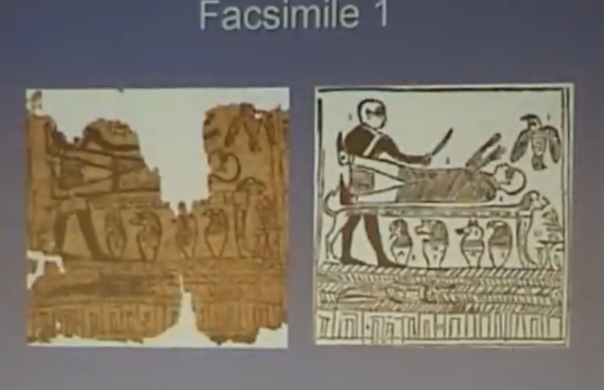
The reason they say that is because, first and foremost, facsimile number one is part of it.
It certainly is part of the collection of papyri that Joseph Smith had.
Here we have that particular portion from which facsimile number one was taken, and it’s beyond any shadow of doubt that’s exactly what it is.
Obviously, portions are missing, and were filled in by the engraver, but it’s obvious that this is the actual facsimile, and it does form the beginning of the Book of Breathings.
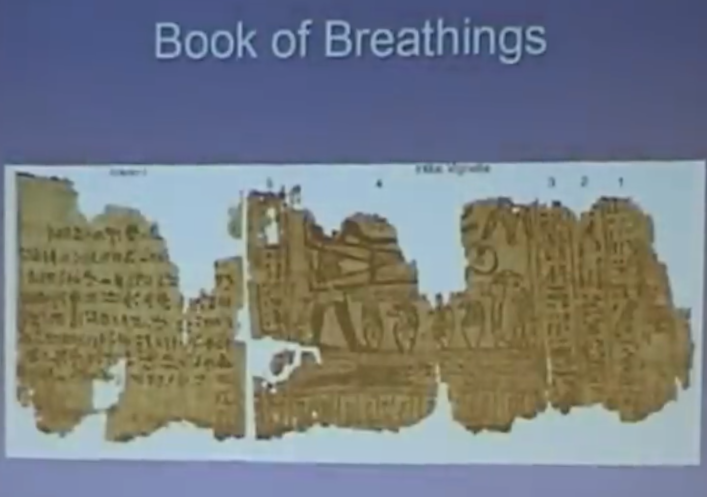
You can match up the papyri fragments quite nicely, and there is no doubt that this forms the beginning of the Book of Breathings.
The name of the author of the Book of Breathings is in the hieroglyphic text to the right of the facsimile, and that name is also found in hieratic text of the Book of Breathings.
Joseph Translated from the Kirtland Egyptian Papers
The video claims that some of the Kirtland Egyptian Papers are the actual documents that Joseph Smith used in the translation process.
This is on the basis of the fact that you have passages from the Book of Abraham and hieroglyphic characters that are demonstrably from the Book of Breathings there.
The problem with that is, as Hugh Nibley and others have definitely shown:
- The English text was written in first, in a different ink.
- The characters were copied afterwards.
- In many cases, the characters actually overlap the original English text.
So what we have here is not the process of translation, but clearly someone trying to match up Joseph Smith’s translation with some characters on the papyri.
It seems to be the unsuccessful attempt of some of the brethren to figure out how Joseph Smith did what he did, so that it’s not the translation process at all.
No Mention of Abraham in the Papyrus Fragments
We translated the text. My most recent book is a translation and commentary of that text.
It doesn’t mention Abraham; there is no Book of Abraham in there.
How do we reconcile that with the fact that Facsimile 1 is right there at the beginning of it?
In fact, Facsimile 3, although we don’t have the original of that, would have come at the end of the text of the Book of Breathings.
Indeed, the fragments we do have contain no mention of Abraham, but they are only fragments, and that’s a key point here.
We only have a tiny bit of all of the papyri that Joseph Smith had. (We can come up with percentages if we want.)
The key point is, we only have fragments of the actual Book of Breathings.
There are probably 40 to 50 percent of the total text of the Book of Breathings found on the papyri.
Whether there were other texts on the papyri we don’t know, because we don’t have all of the papyrus.
There is no reason why a copy of the Book of Abraham couldn’t have been on there.
To say that there couldn’t have been is simply an argument from silence, and not good scholarship.
Two Texts on One Papyrus
In the video, Robert Ritner, who is a professor of Egyptology at Chicago, maintains that it is totally unprecedented to find two different texts on an Egyptian papyrus like that.
There are, in fact, numerous examples of just that.
Probably the one that has the greatest similarity is the Papyrus Vandier, which has a Book of the Dead, an Egyptian religious text like the Book of Breathings on one side, and a tale on the other about a man who was sacrificed—remarkable parallels with the Book of Abraham.
So there are, in fact, examples of ancient Egyptian papyri with multiple texts on them.
We simply don’t know what’s on the rest of the papyrus.
Papyrus Dated to the Second Century B.C.
How about the fact that it can be reliably dated to the second century B.C., rather than 2,000 B.C., the assumed date of Abraham?
“Written by His Own Hand”
They made a big deal about the fact that, in the introduction there, it says, “written by his own hand” upon papyrus.
That’s simply indicating the authorship of the original book, you know, like I can take a copy of Harry Potter and say, “This is written by J. K. Rowling.”
That doesn’t mean she wrote that one I am holding in my hand.
It is simply a copy of an original text.
All this says is that it was originally authored by Abraham, and what we have is a copy, and not the original one penned by him previously.
“Translation”
“Translation” is another important term for me to define here.
Joseph Smith used that term in a somewhat broader sense than we do today.
The thing that comes closest to what we think of as a translation is the translation of the Book of Mormon, where he had an ancient text in front of him, and translated into a modern language: English.
He did it a little bit differently, with the Urim and Thummim rather than with a knowledge of the grammar, a textbook, a dictionary, and so on, but that comes closest to our concept of the process of translation.
Translation of the Bible
The translation of the Bible proceeded totally differently.
He simply had a text of the King James Version of the Bible in front of him, and through direct revelation obtained divine commentary, corrections, and additions to that text in English without ever seeing the original documents.
D&C Section 7 as Translation
In D&C Section 7 is another example of a translation.
Here is a translation of an ancient parchment done by John, that Joseph Smith clearly did not have direct access to, but via revelation obtained a translation into modern English.
What Kind of Translation Was the Book of Abraham?
So what kind of translation was the Book of Abraham?
Which of those three does it fit into?
Well, two possibilities occur to me.
(The middle possibility is not possible, because he didn’t have an English translation of the Book of Abraham, which he then corrected.)
So the first and the third are the two possibilities:
- a translation of an ancient text just like the Book of Mormon, or
- a translation by direct revelation like the parchment of John.
Let’s look at each of those.
Translation from an Ancient Text
This seems to be supported, the idea of translation from an ancient text, by references in the diary of Joseph Smith translating ancient Egyptian records, and statements of some of his associates.
It is undeniably possible that a copy of the ancient Book of Abraham could have been somewhere on that papyrus.
To me, that is the most likely explanation, but I don’t eliminate the possibility of the second one, although it doesn’t feel as good to me—the idea that the Egyptian papyri simply stimulated Joseph Smith to thinking about Joseph in Egypt, and Abraham, and thus received by direct revelation.
If you adopt that stance, then you have to assume that the statements in Abraham 1:12 and 14 referring to the illustrations, are parenthetical remarks by Joseph Smith, inserted into the actual text of Abraham.
Either way, it works, but I prefer the first, and that is, for the moment, what I believe at this point.
The Facsimiles Problem
That brings us to what I call the “facsimiles problem.”
Facsimiles one and three, that are now associated with the Book of Abraham, are the beginning and ending of the text of the Book of Breathings on this particular papyrus.
Facsimile number two was totally elsewhere, and had no relationship even with the Book of Breathings, but was a separate document.
Why are they associated with this ancient pagan text?
Was somehow there a relationship with Abraham?
Ancient Origins of the Facsimiles
The answer, to me, is simply that these illustrations ultimately derive through a 2,000-year period from illustrations done by Abraham in that intervening period, and adapted for other uses.
What Joseph Smith simply did was to give the original interpretation of the illustrations as they had been done by Abraham, although they are in a very distorted form as they appear now.
The key to that is, is there evidence, then, that anciently, these illustrations were associated with Abraham?
That’s the real pivotal question, and the answer is, “Yes.”
This is really, to me, the bulk of the evidence that supports Joseph Smith’s association of these scenes with the Book of Abraham.
Facsimile #1
Let’s start with facsimile number one.
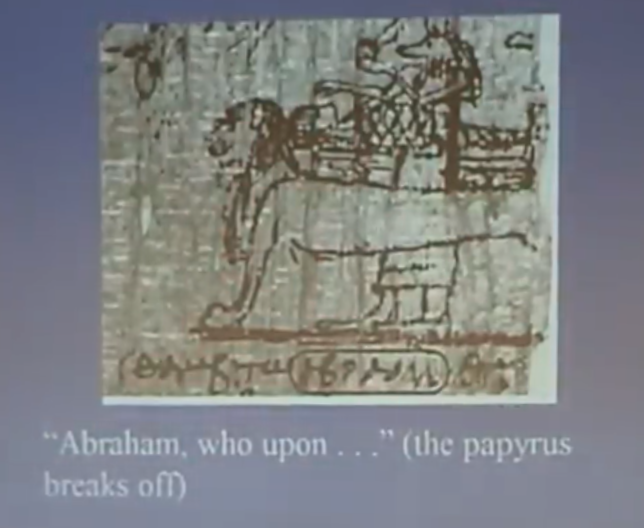
An ancient Egyptian papyrus dating roughly to the 1st or 2nd century A.D. (within a few hundred years of the Joseph Smith papyri) has a lion couch scene similar to that which we find in the Book of Abraham.
Let’s look at that.
Underneath there, in the circled portion, is the name Abraham, and it says, “Abraham, who upon,” and then the papyrus, as you can see, breaks off.
The key point here is that an ancient Egyptian papyrus that Joseph Smith didn’t know about, associates this scene with Abraham.
Comparing the Lion Couch Scenes
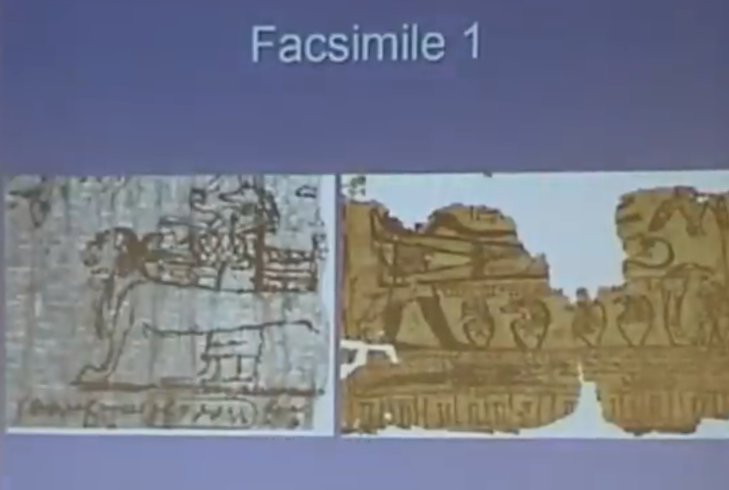 Let’s put these side by side.
Note that there are some similarities, and there are some differences.
First of all, the person is not actually lying on the lion couch. Right?
They are on another bier, reclining, with the standing figure; but the general similarity is obvious, and again, the association with the name Abraham is pivotal.
Facsimile #2
Let’s turn to facsimile two.
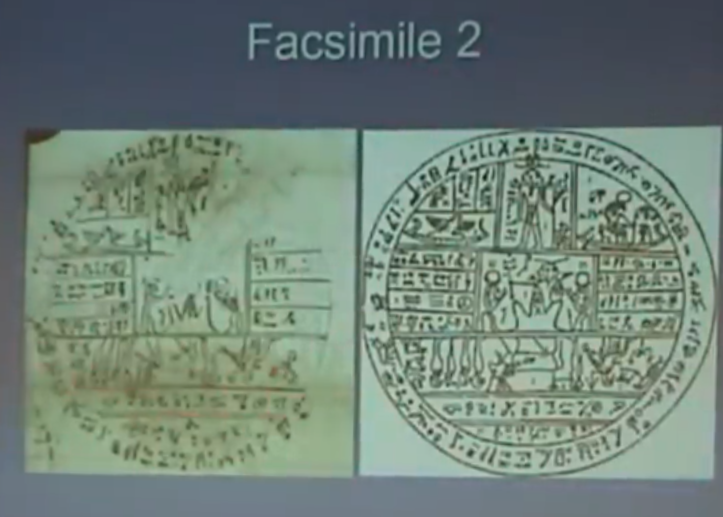
On the left is a copy from the Church historian’s office of facsimile number two, illustrating that apparently, at least when that drawing was made, there was a considerable amount of damage.
In fact, the areas that are shown damaged have text that has been taken from other papyri and placed into the drawing, which don’t belong there, are upside down, or have other problems.
That helps to understand some of the seeming incongruities with the facsimile drawing as we now have it.
Abraham and the Wedjat Eye
In an ancient Egyptian papyrus of roughly the 1st or 2nd century A.D., again, there is a phrase, “Abraham, the pupil of the eye of the Wedjat.”
The Wedjat was the special eye of Osiris.
Osiris was killed by his brother, chopped into pieces, and thrown all over the earth.
His wife’s sister, Isis, gathered them all together, and couldn’t find the other eye, and so that other eye was miraculously restored, and then he was resurrected.
So the eye, the Wedjat eye, the perfect whole eye, was symbolic of resurrection and eternal life.
And there it says that Abraham was that Wedjat eye.
The Hypocephalus and the Book of the Dead
In the 162nd chapter of the Book of the Dead, it contains the instructions for the making of what facsimile number two is, a hypocephalus.
It talks about the Wedjat eye, and then says that it represents another eye.
It’s a pupil, is what it is.
That’s one of the representations.
And so here we have Abraham called the Wedjat eye, and the text that talks about making hypocephali associated with Abraham.
Pseudepigraphical Texts
Pseudepigraphical texts are ancient texts that are of religious content, but never made into the Bible for various reasons, some of them fairly obvious.
When you look at the Gospel of Thomas, for example, at the end, Peter comes up to Christ and asks, “Are women going to be in the Celestial Kingdom?”
Pointing at Mary Jesus replies, “Don’t worry, Peter; their sex is going to be changed, we’ll all be men, and everything will work out.”
It’s fairly obvious why that one didn’t make it into the canon.
The Apocalypse of Abraham
Pseudepigraphical texts, though, clearly have some ancient roots that go back to traditions associated with the people that they claim to be talking about.
In the ancient pseudepigraphical text, the Apocalypse of Abraham, Abraham sees a vision, and in his vision he describes what is in the heavens, on the earth, in the sea, in the abyss, and in the lower depths.
In facsimile number two, these words are found: “O mighty God, Lord of heaven and earth, of the netherworld and of his great waters.”
Very similar terminology!
So we are finding even wording in these ancient texts associated with Abraham that are similar to wording found on this particular hypocephalus.
Creation Imagery and the Hypocephalus
Also in the Apocalypse of Abraham, Abraham sees “the fullness of the universe and its circles in all.”
He sees “a picture of creation” with two sides.
That is the hypocephalus.
To the Egyptians, besides being the eye, it was the world, that which the sun encompassed.
As you look at it, there is an upper and a lower portion.
The lower portion is inverted to the upper.
This is a description in this book about, purporting to come from Abraham, of the hypocephalus, where he’s seeing the creation portrayed, if you will, in this manner.
The Four Figures in Facsimile #2
Abraham sees what are clearly the four figures labeled number six in facsimile number two.
He describes these four beasts, one with the head of a man, one with the head of a hawk, one with head of a jackal, and so on, that are the same as those that are portrayed there in facsimile two.
He sees, and again, where it’s quoted, this is a direct translation from the original, “the host of stars and the orders they were commanded to carry out, and the elements of the earth obeying them.”
That resonates with the language we find in Abraham 4, verses 1, 12, 18, 21, and 25, where it talks about the elements of the earth “obeying.”
So we’re finding even that same language being used in this ancient text that purports to come from Abraham, and the Book of Abraham, and again, the association with the hypocephalus, and facsimile two.
Abraham and the Priesthood Promise
Abraham, in this document, is also promised the priesthood, and that his priesthood would continue in his posterity, an element of the Abrahamic covenant that is totally missing in the Bible.
But it’s the central truth of the Book of Abraham.
And that promise is associated with the temple (interesting again).
 Facsimile #3
Let’s turn to facsimile three.
Again, facsimile three we don’t have the original of.
It clearly belongs with the Book of Breathings.
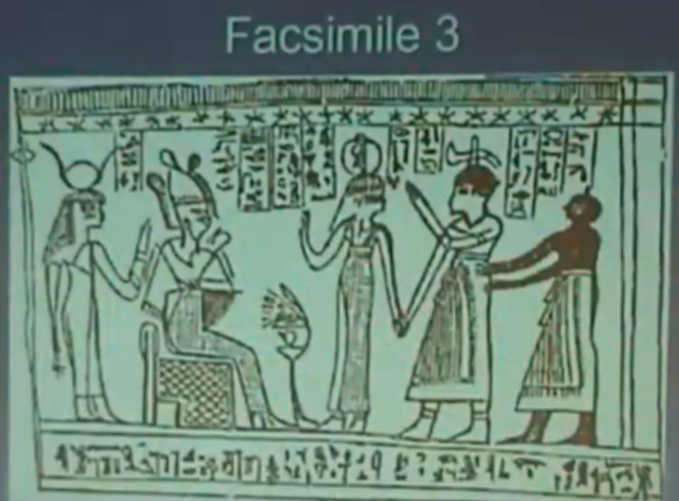
The name of the owner of that papyrus, Hor, is found there.
As it now stands, it is a portrayal of the man, Hor, who is right there [points to the slide] with the god Anubis, who leads the dead, standing behind him.
And the goddess of Truth, identified by the feather on her head, leading him into the presence of the god Osiris, whose wife, Isis, is standing behind him.
He has passed the judgment, and is worthy to enter into the presence of god, and in fact, become one of the gods.
That’s the essence of what that scene portrays from the Book of Breathings standpoint.
The Testament of Abraham and Judgment Imagery
The Testament of Abraham, another ancient pseudepigraphical text, describes Abraham seeing a vision of the Last Judgment.
In his vision of last judgment, he sees an angel with scales weighing the souls of men.
Scholars all agree that this is clearly a reference to the 125th chapter of the Book of the Dead.
The guy must have had this before his eyes as he was describing it.
This is an admixture, if you will, of Christian doctrine with ancient Egyptian concepts of the judgment of the dead.
The Judgment Scene and Facsimile #3
One of the Joseph Smith papyri fragments is, in fact, this 125th chapter.
I’ll show you that in a moment.
Facsimile three portrays, simply, the next step in that process.
After the weighing of the soul, or the heart in the case of Egyptians, you are brought into the presence of Osiris.
The Papyrus of Neferirnub
Let’s look at some illustrations.
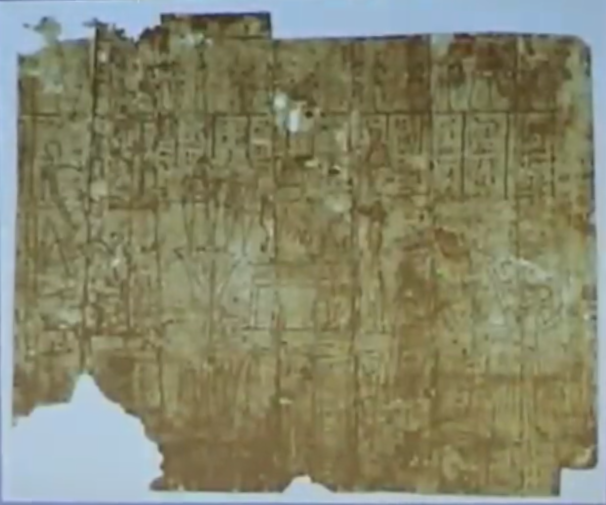
You’re probably not going to see it all.
This is horrible.
This is an indication of the state of preservation of these papyri.
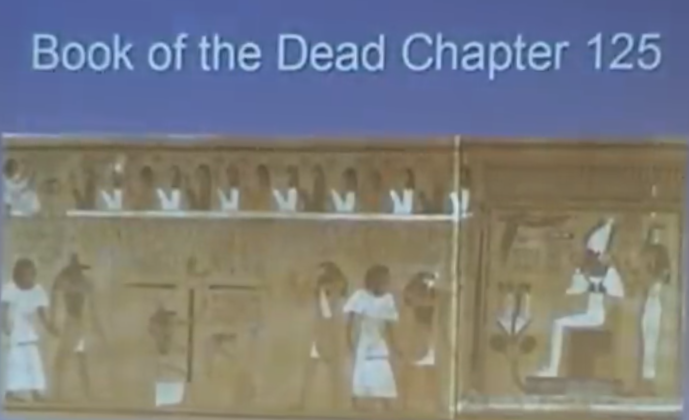
The god Osiris is seated there, the scales are down below, and the young lady is being brought into the presence of Osiris by the goddess, Truth.
Her name is Neferirnub.
This is one tiny fragment of a Book of the Dead that is among the Joseph Smith papyri.
A Better-Preserved Judgment Scene
Here is that actual scene from a better-preserved Egyptian papyrus.
Here we have the man Hunefer, being brought by the god Anubis before the scales.
His heart is being weighed against a feather, which has beautiful symbology in Egyptian because your heart is the center of your thoughts and your desires, and the feather is the Egyptian hieroglyph for truth and justice.
And so we have the balance with truth and justice.
The god Thoth is recording the results of that, and if you pass, then you are introduced into the presence of Osiris.
That’s the scene on the right that forms basically the similar scene that is facsimile number three.
Judgment and Outer Darkness
The animal standing underneath the scales there, with the head of a crocodile, the front body of a leopard, and the rear body of a hippopotamus, is a monster that, if your heart doesn’t balance, gobbles your heart up.
And then you are cast into outer darkness, where there is mud and snakes and sewage, which I think is a good personification of outer darkness.
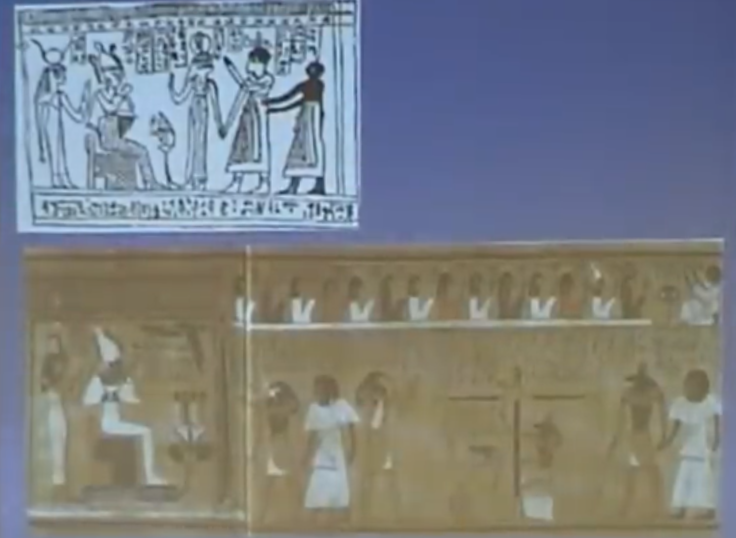
Reversing the Hunefer Papyrus
What I’ve done here is reverse-mirrored the Hunefer papyrus so that it matches the same direction as the Joseph Smith one.
You can see that it’s simply portraying that final scene of that total judgment scene, and hence just such a scene in the Testament of the Abraham is being described.
Joseph Couldn’t Have Known These Things
Several ancient Near Eastern documents associate the scenes that we understand as being facsimile one, two, and three with Abraham. They are roughly contemporary with the Book of Abraham papyri.
Secondly, none of these documents were available at the time of Joseph Smith. He couldn’t have somehow sneaked into the library in Kirtland and seen these, and come up with this. They weren’t available anywhere in the world.
He couldn’t have known about them.
Not Lucky Guessing
You can’t dismiss this as just lucky guessing.
When I give exams, I give a lot of multiple choice, and if the students don’t know, they don’t do well on the exam. You flip a coin, with one out of four, you are not going to do well on the exam.
Joseph Smith hit the nail on the head three times with these representations being associated with Abraham anciently. How can that be just lucky guessing? I mean if so, he is the best guesser in the world, and we ought to listen to him anyway!
Are the Doctrines Worth Betting Our Lives On?
At the end of this video, Richard Mouw (head of the Fuller Theological Seminary in California) says:
“Are the doctrines taught in the Book of Abraham credible? Are they the sort of things we should bet our lives on?”
With the implicit answer, “Heck no!” because of all of this mountain of evidence they’ve shown us that it’s not true.
Well, yes they are!
They are certainly worth betting our lives on!
The Doctrines of the Book of Abraham
The Book of Abraham contains some of the most beautiful and poignant doctrines of the Restoration:
- the preexistence,
- our eternal nature as human beings,
- the council in heaven,
- a much better portrayal of the creation.
There is beautiful and wonderful doctrine there.
We might respond, “Do we want to bet our eternal lives on the opinions of scholars?”
I think that would be an apt question, and I would wonder what their response would be.
Closing Statement from Hugh Nibley
Let me close with this statement from Hugh Nibley. Which sums up nicely what I’ve been trying to put across here.
The words of the prophets cannot be held to the tentative and defective tests that men have devised for them. Science, philosophy, and common sense all have a right to their day in court. But the last word does not lie with them.
Every time men in their wisdom have come forth with the last word, other words have promptly followed. The last word is a testimony of the Gospel that comes only by direct revelation. Our Father in heaven speaks it, and if it were in perfect agreement with the science of today, it would surely be out of line with the science of tomorrow. [You might say scholarship, too.]
Let us not, therefore, seek to hold God to the learned opinions of the moment when he speaks the language of eternity.
Thank you.
