Insights from the Joseph Smith Papers into John C. Bennett’s Dismissal from the Church
Matthew C. Godfrey
Insights from the Joseph Smith Papers into John C Bennet’s Dismissal from the Church
August 2019
Summary
Godfrey provides insights into the John C. Bennett incident and its significance in understanding Joseph Smith’s leadership. He focuses on Bennett’s rise to prominence in Nauvoo in 1840, his eventual fall from grace in 1842, and the internal conflict his actions caused within the Church. He highlights Joseph’s approach to opposition, particularly his attempts to give Bennett a chance to reform, and examines the broader fallout from Bennett’s actions.
Introduction
Scott: Matthew Godfrey is a general editor and the managing historian of the Joseph Smith Papers. He holds a PhD in American and Public History from Washington State University. And he has contributed to several Joseph Smith Paper volumes. You can read more online about his biography. And with that, I would like to introduce Matthew Godfrey.
Presentation
Matthew: Well, thank you very much. It’s a pleasure for me to be here with you all today. I’m grateful for the opportunity to talk with you about some of the research that we’ve been doing in the Joseph Smith Papers.
It’s a little daunting to follow the Welches and to go from the lofty planes of Christ’s parables down into the sordid world of John C. Bennett. But that’s what we’re going to do now. I do think it is valuable to study a little bit about the John C. Bennett incident in the Church and Joseph Smith’s reaction to it. I think it’s a good window into Joseph Smith as a leader. Shows what he did when facing opposition and conflict from within the Church. I hope that what I say today will be useful to you.
I think for most scholars of Latter-day Saint history, John C. Bennett is a familiar character. 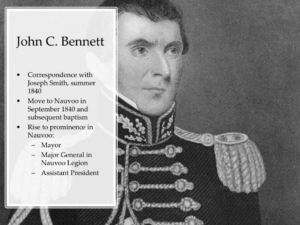
Of course, his rise to prominence in Nauvoo, Illinois, in 1840 and 1841, and his equally dramatic fall from grace in 1842 has been well chronicled by historians.
Much of the discussion of Bennett has traditionally revolved around what his true intentions were in joining the Church. How a prophet, Joseph Smith, could embrace so thoroughly such a charlatan as Bennett was. Why Joseph Smith did not act earlier in exposing Bennett.
What I’m going to talk about today doesn’t address those first two areas. But it does explore the third topic a bit. I’ll share insights that we’ve gained from the Joseph Smith Papers into events that led to Bennett’s dismissal from the Church. I’ll also examine how and why Bennett’s removal became so contentious.
The Tumultuous Summer of 1842
The last couple of years, I’ve been working on Documents Volume 10 of the Joseph Smith Papers. It will be released next spring. It covers May 1842 through August of 1842, so a quite tumultuous summer for Joseph Smith. And as part of examining this, I worked with a number of documents pertaining to John C. Bennett’s dismissal from the Church in May and June of 1842. My examination of these documents led to questions and insights into this affair that I’d like to share with you today.
So, John C. Bennett first appeared on the Nauvoo scene in the summer of 1840. He began a brief correspondence with Joseph Smith in July of 1840. Although he had apparently met Joseph in the early 1830s. Joseph Smith did not remember the encounter. And when he first answered one of John C. Bennett’s letters to him, Joseph said that he had not had the pleasure of his acquaintance. Bennett had also apparently written to both Joseph Smith and Sidney Rigdon in 1838 when the Latter-day Saints were encountering their difficulties in Missouri. None of those letters have been located.
Bennett’s Arrival in Nauvoo
Regardless, Bennett informed Joseph Smith in a July 25, 1840, letter that he intended to move to Nauvoo and that he wanted to unite with the Church. He believed that would bring him great happiness. Now, Bennett initially proposed meeting Joseph Smith in Springfield, Illinois, in December of 1840. Within a couple of weeks of this July 25th letter, he had decided to come to Nauvoo immediately and “devote my time and energies to the advancement of the cause of truth and virtue.” Because of Bennett’s expressions of sympathy and kindness, Joseph Smith believed him to be a friend to suffering humanity and truth.
By September of 1840 Bennett had arrived in Nauvoo. He had been baptized, become affiliated with the Church, and thereafter he became thoroughly integrated into the community. John C. Bennett drafted and lobbied for the act that incorporated the City of Nauvoo. He was appointed the Major General of the Nauvoo Legion. Bennett became an assistant president of the Church, filling in for Sidney Rigdon because of Sidney Rigdon’s illness. And he was elected the mayor of Nauvoo.
However, at some point in 1841, Joseph Smith began hearing unsavory rumors about Bennett.
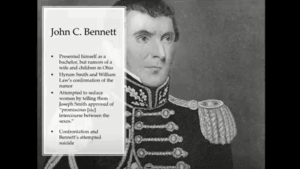
The mayor had portrayed himself as a bachelor to the Nauvoo community. Joseph Smith received a letter that Bennett had a wife and children living in McConnellsville, Ohio. Knowing that it is no uncommon thing for good men to be evil spoken against, Joseph Smith recalled. He kept the letter quiet, but he held it in reserve.
Confirming Rumors
In July of 1841, Hyrum Smith and William Law confirmed the rumors that Joseph Smith had heard. They were back East for another mission with the Church. They said, writing from Pittsburgh, Pennsylvania, that they had spoken with a respectable gentleman from the neighborhood where Bennett’s wife and children resided. He told them that Bennett had a wife and children living and that she had left him because of his ill treatment towards her.
So this news was bad enough coming in the summer of 1841. It was made worse because Bennett had been courting a woman in Nauvoo and giving her the impression that he intended to marry her. Bennett was also apparently approaching other women and telling them that there was no harm in “promiscuous intercourse between the sexes.” Something he said Joseph Smith and the Church approved of.
Upon receiving the letter from Hyrum Smith and William Law, Joseph Smith confronted Bennett about it. According to Joseph, Bennett did not deny any of it. Shortly thereafter, Bennett evidently attempted suicide by taking poison, but the attempt failed and he soon recovered. Bennett then continued his attempts to seduce women. Joseph Smith would not take any official disciplinary action against him until the spring of 1842.
Why Did Joseph Wait So Long To Expose Bennett?
There are several possible explanations for this. One may have been that Joseph, knowing from personal experience that it was no uncommon thing for good men to be evil spoken against, was making sure that he had all the facts about Bennett in hand. And I think this is a key point to why Joseph waited so long. Joseph, of course, by this point had had many instances in his life when he had been unjustly accused of things. Understanding this, I think he wanted to proceed with caution. Ensure that he knew all that was going on and that everything was verified that was said about Bennett before acting.
So in addition to having Hyrum Smith and William Law investigate whether or not Bennett had a wife and children living in Ohio, Joseph requested information from other sources. At least two individuals, one from Urbana, Illinois, and one in Monticello, Illinois, were asked in 1842 what they knew about Bennett. One responded that he was “an infamous rascal.” The other noted that Bennett had used a land scheme to swindle individuals in Michigan out of money and had misrepresented himself as a surgeon in the U.S. Army.
Investigation
Joseph Smith also sent George Miller, who was a bishop in Nauvoo, to investigate Bennett’s personal life in Ohio. Miller wrote to Smith from McConnelsville, Ohio, that Bennett’s wife, Mary Ann Barker Bennett, was living with her father and two children there, and that she and Bennett had at least one other child who had died. “Bennett had participated in several adulterous relationships,” Miller reported, “and also used his wife bad otherwise.” Mary Ann Barker Bennett had endured Bennett’s conduct for several years. She had finally left him under satisfactory evidence of his adulterous connections. Bennett had asked his wife for a divorce, but as yet she had not agreed to it, Miller explained. He concluded that Bennett was an imposter and unworthy of the confidence of all good men.
Now, there’s been some confusion as to when Miller conducted his investigation. The letter that he wrote to Joseph Smith was published in the Times and Seasons under a March 2nd, 1841, date. It appears that this date was a mistake, however. Miller did not make the journey until March of 1842. For one thing, the letter is included in the Times and Seasons with other letters with an 1842 date. For another, we know that Miller attended a lyceum gathering in Nauvoo toward the end of February 1841. It’s highly unlikely that he had time to attend this meeting late in February in Nauvoo and then travel to Ohio, make his investigation, and report on it to Joseph Smith on March 2nd. So the timeframe just doesn’t work for that.
Reconnaissance of 1842
However, we also know that in early 1842, Miller was sent on a mission to Kentucky. Thus, it’s highly likely that he was able to visit McConnelsville, Ohio, at this time. Miller did not return to Nauvoo until April of 1842. Because McConnelsville was located in southeastern Ohio, fairly close to the border with Kentucky, it would have been easy for Miller to travel the short distance there to make his investigation. So it appears that Miller did not complete his reconnaissance until March of 1842, just a few weeks before Joseph Smith took decisive action against Bennett.
Giving Bennett a Chance
Another explanation for Joseph’s delay was he was trying to give Bennett a chance to reform. Only after Joseph had done all in his power to persuade Bennett to amend his conduct and only after determining that Bennett was not willing or able to reform did Smith and other Church leaders withdraw fellowship from him.
An editorial in the Times and Seasons reaffirmed this. Bennett, it said, “had been dealt with from time to time, had sometimes acknowledged his iniquity, asked and prayed for forgiveness, begged that he might not be exposed. Because of this,” the editorial continued, “he was borne with from time to time until forbearance was no longer a virtue.”
Now, this did not mean that Joseph Smith accepted what Bennett was doing. Just that he did not discipline him officially or publicize his conduct because, as discussed above, Joseph did confront Bennett privately in 1841. Lorenzo Watson, Emma Smith’s nephew, remembered hearing Joseph Smith quote, “Give J.C. Bennett a tremendous flagellation for practicing iniquity under the base pretense of authority from the heads of the Church.” Lausanne placed this confrontation at Joseph Smith’s home in the summer of 1841. It’s unclear whether this was separate from the altercation discussed above that led to Bennett’s suicide attempt. But it is clear that Joseph Smith clearly had private conversations with Bennett about his conduct. Joseph, though, was unwilling to go public with the charges against Bennett because Bennett admitted his wrongdoing and promised to reform.
General Condemnation
Now, the need to act became more pressing when Joseph Smith realized that John C. Bennett was not going to stop using Joseph’s name in his attempted seductions of women in Nauvoo. When Joseph heard in 1842 that Bennett was continuing to tell women that Joseph approved of promiscuous intercourse between the sexes, Joseph decided to take action. He publicly proclaimed against such conduct. This occurred on Sunday, April 10, 1842. Joseph stood before a Latter-day Saint congregation and quote, “Pronounced a curse upon all adulterers and fornicators and unvirtuous persons and those who had made use of his name to carry on their iniquitous designs.”
Yet this was still a general condemnation. Bennett was not mentioned by name, at least as far as we know. This was the catalyst for Joseph to formally discipline Bennett and others who were pursuing the same course in Nauvoo.
In May, the Nauvoo High Council investigated charges of attempted seduction of women in Nauvoo, disciplining some members of the Church for their involvement. Bennett was not one of those members, however, that was disciplined by the Nauvoo High Council. He probably wasn’t dealt with because of his high standing in the Church at the time. Instead the Church’s highest leaders would deal with him.
Notice of Withdrawal of Fellowship
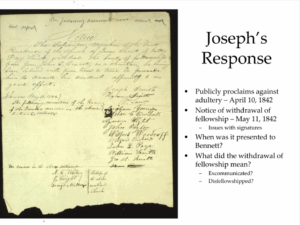
The initial step that Joseph Smith took against Bennett was to have Willard Richards prepare a notice of withdrawal of fellowship on May 11, 1842. And that is this document right here. This notice stated that the First Presidency of the Church withdrew the hand of fellowship from General John C. Bennett as a Christian, he having been labored with from time to time to persuade him to amend his conduct but apparently to no good effect.
Now after Willard Richards prepared this, Willard signed the document for Joseph Smith, and then Hyrum Smith and William Law of the First Presidency signed the document. Sidney Rigdon did not sign. Perhaps because he had a strained relationship with Joseph Smith at this time.
Now, you’ll notice that beneath William Law’s name, you have a listing of names of 10 members of the Quorum of the Twelve Apostles. Then to the side there are the three bishops of the Church in Nauvoo. Richards signed for four of the apostles; he provided the signature for John E. Page, William Smith, George A. Smith, and Orson Pratt. Now, Bennett later claimed that Church leaders “forged the names of Lyman White, who was then in Tennessee; William Smith, who was in Pennsylvania; and John E. Page, who was in Pittsburgh.” However, when you look at the document, you can see that Lyman White’s signature is in Lyman’s own hand. Lyman was in Nauvoo at this time; he was not in Tennessee, as Bennett claimed. Joseph Smith visited him on May 6th. White was also present at a May 14th meeting of the Nauvoo City Council.
Signatures and Allegations
Now, the others that Willard Richards signed for probably at least gave their consent to the inclusion of their names. William Smith may have been in Nauvoo at this time. He was elected to the Nauvoo City Council and appointed to a committee on May 19th. We know that Page was not in Nauvoo at this time. He had departed for Pittsburgh by the time the notice was prepared. But he had been in Nauvoo in April. He likely gave his consent to the action taken against Bennett at that time.
At the end of the column with the names of the Twelve Apostles, there’s a name that has been scratched out. Orson Pratt’s name. Richards wrote Orson Pratt’s name on the notice, but he then crossed it out. Now, according to Bennett, Orson Pratt refused to sign the notice because, “he knew nothing against me.” There is no other indication why Orson Pratt’s name is crossed out. Part of the issue may have been his uncertainty about allegations surrounding his wife, Sarah. It’s not clear if Orson knew about these at the time. He may not have known about this. But Bennett would later accuse Joseph Smith of proposing marriage to Sarah while Orson was preaching in England. Joseph Smith denied these charges, instead insisting that Bennett and Sarah Pratt had had an affair while Orson was away.
Pratt and Hyde
These allegations and countercharges really came out in July of 1842. Orson may have had an inkling of these allegations already. This may have been a reason why he didn’t want his name included on this. The fact that his name was added and then crossed out suggests that Richards believed that Orson wanted his name included, but after Orson objected to it, Richards removed his name by scratching it out.
Of the members of the quorum of the twelve apostles at the time, only Parley P. Pratt and Orson Hyde are not listed. Pratt was presiding over missionary efforts in England at the time. Hyde had not yet returned to Nauvoo from his mission to Jerusalem. The fact that those two names don’t appear on this strengthens the argument that Richards sought permission from the apostles to include their names. That he didn’t just write names on there like Bennett accused him of doing. Because of the length of time it took to communicate overseas, Richards would not have been able to obtain approval from Parley P. Pratt and Orson Hyde before creating the document. But he was presumably in contact with all of the other apostles at some point close to the time that the notice was prepared.
Presenting the Notice
When this notice was presented to Bennett, and what Bennett believed it meant, is difficult to ascertain. According to Bennett, he voluntarily withdrew from the Church on May 17, 1842. Remember, this notice is dated May 11, 1842. Bennett said that he withdrew from the Church, not because he had committed any improprieties, but because he had joined the Church for the sole purpose of exposing Joseph Smith as a fraud. After he had withdrawn, Bennett continued, Joseph Smith and other leaders prepared their “Mormon bowl of excommunication,” this notice of withdrawal of fellowship, and dated it retroactively to May 11th to make it seem as though they, and not Bennett, had severed ties.
Bennett’s claim that the notice was not prepared until after May 17th is contradicted by an affidavit that William Law swore. Law declared that he signed the notice several days before Bennett withdrew his membership. In addition, it’s clear that Bennett knew that he was in disharmony with other Church leaders by May 17th. William Law intimated to Bennett that Church leaders had withdrawn fellowship some four or five days after May 11th. Hyrum Smith confronted Bennett about Bennett’s alleged immoral conduct on May 17th. Bennett also told the Nauvoo City Council on May 19th that he hoped “to be restored to full confidence and fellowship and my former standing in the Church,” suggesting that he knew about the May 11th withdrawal of fellowship by that time.
Publication
However, Church leaders apparently did not show the actual document, the notice withdrawing fellowship to Bennett, until May 25th. According to a May 26 entry in Joseph Smith’s journal, Dr. Bennett was notified the day previous that the First Presidency, Twelve, and bishops had withdrawn fellowship from him. Bennett was told that Church leaders would publish the notice. After he humbled himself and requested it, they told him that they would withhold publication at that time.
What Did the Withdrawal of Fellowship Mean?
What this withdrawal of fellowship actually meant to Bennett and Joseph is also the subject of different interpretations. The Church today has very precise terms for different types of discipline. Excommunication is a formal removal of an individual from the Church. If someone is disfellowshipped, he or she remains a member, but with a temporary suspension of membership privileges. In 1842, terms were used a little more loosely. The phrase “cut off” was used more frequently than excommunication in describing a person removed from the Church. Saying that leaders have withdrawn fellowship from an individual could mean that the person was excommunicated. But in a few cases, it seems to have also meant that the person was not excommunicated but remained a member of the Church.
In 1840, for example, Church leaders withdrew fellowship from Almon Babbitt, but Babbitt apparently remained a member of the Church. He was not cut off from the Church. Bennett himself called this fellowship withdrawal notice the “bowl of excommunication.” He also claimed that he was not cut off from the Church until June 18th. Because Joseph Smith also instructed James Sloan to allow Bennett to withdraw his name from the Church record if he desires to do so on May 17th, it may be that Joseph did not regard this fellowship withdrawal as an excommunication. So although it’s not readily apparent what the withdrawal of fellowship meant, it is clear that by June, all parties no longer regarded Bennett as a member of the Church.
Bennett’s Removal
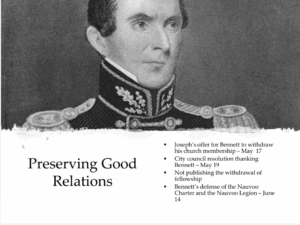
Now, interestingly, Bennett’s removal at first was not as contentious as it would become. As mentioned above, Joseph Smith told James Sloan to allow Bennett to remove his name from Church records if Bennett so desired. Joseph told James Sloan that if Bennett took such action, it would be met with “the best of feelings towards Bennett.” Joseph may have seen this as a way for Bennett to exit the Church gracefully, despite the sordid charges of adultery and seduction that had been levied against him. Also, on May 17th, Bennett swore an affidavit stating that Joseph Smith had never taught him that illegal, illicit intercourse with females was, under any circumstances, justifiable. Bennett will later declare that he made this affidavit only because Joseph threatened him with violence if he didn’t do so. There’s no additional evidence that supports Bennett’s claim.
Instead, on May 19th, the Nauvoo City Council met to elect a new mayor because Bennett resigned the post on May 17th. After Joseph Smith was elected mayor, he oversaw the passage of a resolution by the city council thanking Bennett “for his great zeal in having good and wholesome laws adopted for the government of this city and for the faithful discharge of his duty while mayor of the same.”
Maintaining A Good Relationship
Just a few days later, when Bennett appeared before the Nauvoo Masonic Lodge on May 26 to answer charges of immoral conduct, Joseph Smith pleaded on his behalf. Bennett was forgiven. These actions, coupled with the fact that Joseph agreed to withhold publication of Bennett’s withdrawal of fellowship, indicates that in May, Joseph was doing all in his power to maintain a good relationship with Bennett. Bennett appears to have taken a similar approach, at least until the end of June.
On June 14th, for example, Bennett wrote a letter to Simeon Francis, the editor of the Sangamo Journal, to defend the Nauvoo Charter and the Nauvoo Legion against criticisms Francis had made in the journal. Bennett’s letter showed none of the animosity he exhibited towards Joseph Smith later in June. Instead, he was defending Joseph and defending Nauvoo City Charter and the Legion from charges against it.
Denouncing Bennett
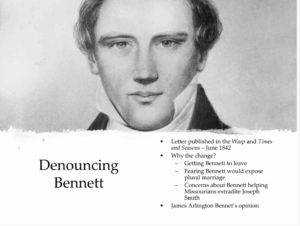
Now, something changed in the next few days, and exactly what it was is hard to pinpoint. What we do know is that in the June 15, 1842, issue of the Times and Seasons, the notice of withdrawal of fellowship from Bennett was published. So, you remember when they presented this to Bennett, they agreed not to publish it because he pleaded with them not to do this. But in the June 15th issue, it is published. On June 18th, Joseph Smith spoke before thousands of citizens in Nauvoo and exposed the iniquity and wickedness of General John Cook Bennett. Three days after this, on June 21st, Bennett left Nauvoo for Springfield, Illinois.
A week later, The Wasp, which was a Nauvoo city newspaper, published a lengthy letter from Joseph Smith outlining what Bennett had done and what actions Joseph had taken against him. The letter was addressed to Church members and to all the honorable part of the community. It stated that Joseph believed it necessary to make people aware of Bennett’s actions so that they could “regard him as he ought to be regarded, namely as an imposter and base adulterer.” Smith also wrote a letter to Illinois Governor Thomas Carlin, stating that Bennett was “one of the basest liars he knew.”
Changing Course
So, why did Joseph Smith decide to change course and expose Bennett? This is one of those instances where you wish that you had more information from the historical record, because the record is not clear about this. Bennett’s biographer, Andrew L. Smith, speculates that Joseph Smith hoped that Bennett would leave Nauvoo quietly. Then when Bennett remained in the city, Joseph decided to publicly censure him to get him to leave.
So, that’s one possibility. Another is that perhaps Joseph feared that Bennett would expose his practice of plural marriage at the time and that Joseph wanted to get his side of the story out first. Historians have debated how much John C. Bennett knew about plural marriage. It’s clear he at least had some knowledge of it. Though much of the sensational detail that he provided about it in his book, The History of the Saints, did not conform to reality.
Another possibility is that Bennett may have again reverted to his former behavior and continued to declare that Joseph Smith condoned illicit relationships between men and women. Perhaps by mid-June, he was spreading the rumor that Joseph Smith was complicit in an attempted assassination of former Missouri Governor Lilburn W. Boggs that occurred in early May. Bennett later makes this charge in one of his letters. He could have been talking about this before writing the letter. Bennett may have even volunteered to help officials extradite Joseph Smith to Missouri to be tried on that charge.
Threatened Destruction
Joseph himself stated in his June 23 letter about Bennett that he had been credibly informed that Bennett “has colleagued with some of our former wicked persecutors, the Missourians, and has threatened destruction upon us.” Joseph also informed Governor Carlin on June 24th that there was strong evidence that Bennett and the brothers David and Edward Kilbourne were ready “at a moment’s warning to assemble and come to Nauvoo to kidnap Joseph Smith and mob Church members out of the place.”
Coming Forward
One reason why Joseph may have decided to come forward in June and publicly denounce Bennett may have been because some of these things had occurred. But if Bennett had started to accuse Joseph Smith of trying to assassinate Governor Boggs, of saying that he was going to come and mob the saints out of Nauvoo, why did he have that change? Because clearly in his June 14th letter, he was not thinking in those terms. He was trying instead to be more conciliatory.
It may be that Bennett had decided he had nothing else to gain by maintaining good relations with the Church. If he was going to be removed from the Church and had also already lost his civic position as Mayor of Nauvoo and would soon be cashiered out of the Nauvoo Legion as well, he may have just decided, ‘I have nothing else to gain here, and so I’m going to go out with a flaming fireball.’ So, that may be one reason. He may have decided that he instead had much to gain by lecturing against Joseph Smith and publishing against him. Maybe there was money to be made in these activities.
He may have also realized that Joseph Smith was going to expose him publicly and so decided to go on the offensive prior to Joseph doing that. Whatever the reasons, Joseph believed by the end of June that Bennett’s conduct needed to be exposed and that it was necessary to denounce his character.
James Arlington Bennett
On June 30th, Joseph Smith wrote a letter to James Arlington Bennett, a prominent citizen of Long Island, New York, who had struck up a friendship with the Saints through John C. Bennett. So, here we start to get different Bennetts involved. So hopefully, this won’t get too confusing. Joseph Smith informed James Arlington Bennett of the necessity of publishing the character and conduct of John C. Bennett to the world. “It was truly unpleasant to do so”, Joseph Smith continued, “but his conduct while amongst us at Nauvoo and up to the present time has been such as to make it a matter of duty which I consider we owe to the public generally.”
In addition to these letters, correspondents and affidavits were published in the Wasp and the Times and Seasons as evidence of John C. Bennett’s adulterous and deceiving ways. Joseph Smith believed it necessary to take these steps. However, James Arlington Bennett was not sure it was the best route to take. He wrote back to Joseph Smith and said that he wished most ardently that Joseph would have allowed Bennett to depart in peace without any public exposure.
Bennett’s Attempts to Discredit Joseph Smith
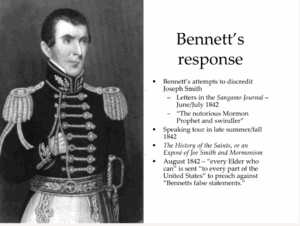
Now, James Arlington may have been correct in this opinion. Not long after John C. Bennett left Nauvoo, he began writing a series of letters published in the Springfield newspaper, the Sangamo Journal, that attacked Joseph Smith and the Church. The first letter that he wrote, dated June 27th and published in the July 8th issue of the Journal, called Joseph Smith “the notorious Mormon prophet and swindler.” It accused Joseph of sending the Danites after Bennett to kill him. It charged that Joseph Smith had proposed marriage to Nancy Rigdon, Sydney’s daughter, as part of his practice of plural marriage. Bennett also demanded that Joseph Smith be brought back to Missouri to stand trial on charges levied against him in the 1838 conflict with other Missourians. Bennett pledged to either deliver Joseph Smith to the Missourians or die in the attempt.
Now, subsequent letters outlined charges that Smith was complicit in the May assassination attempt on Boggs. They also claimed he proposed marriage to Sarah Pratt while Orson was preaching in England. In response to these letters, the Wasp and the Times and Seasons published affidavits disproving Bennett’s allegations and continuing to accuse him of immoral behavior.
Attempts to Discredit
In the late summer, Bennett began a speaking tour throughout the United States to discredit Joseph Smith to an even wider audience. He then compiled the letters he had written to the Sangamo Journal, coupled them with additional material, and published these as a book entitled The History of the Saints or an Expose of Joe Smith and Mormonism. This was published with the press in Boston.
His lectures and book had an immediate impact. Apostle John E. Page wrote from Pittsburgh that “The disclosures of Bennett have done much to injure the cause of the kingdom here.” Robert D. Foster, who is in New York, wrote a letter to Joseph Smith saying that Bennett’s libels had generated many votaries, who were birds of the same feather, without principle.
So to counteract Bennett’s efforts, Church leaders asked in August of 1842 for “every elder who can to go forth to every part of the United States” and preach against “Bennett’s false statements.” By the end of the summer of 1842, the relationship between Joseph Smith and Bennett had disintegrated into a series of charges and counter-charges.
Conclusion
Was it inevitable that the relationship turn so toxic? Did Joseph Smith’s choice to go public with his criticisms of Bennett lead to Bennett’s slanderous publications? Certainly, Joseph Smith treated Bennett with respect from April to June of 1842. He gave Bennett numerous opportunities to reform. Joseph allowed Bennett to withdraw his name from the Church. He spearheaded a resolution of appreciation for Bennett’s service on the City Council. He defended Bennett before the Nauvoo Masonic Lodge. Such actions seem to preserve Bennett’s goodwill towards Joseph and the Church, at least if Bennett’s June 14th letter to Simeon Francis is any indication.
So if Joseph had continued with this conciliatory attitude, would Bennett have written his expose and gone on the lecture circuit? That question is difficult to answer because as we’ve explained, it’s ultimately not clear from the historical record why Joseph decided to change course in June and expose Bennett publicly.
Bennett’s Influence
Whoever was to blame, the relationship deteriorated quickly in July with the publication of Bennett’s letters in the Sangamo Journal. Bennett’s animosity had a lasting effect. His lurid descriptions of polygamy colored the way that the general public viewed the practice of plural marriage in Nauvoo. His efforts to get Joseph Smith extradited to Missouri led to attempts to arrest Joseph Smith in the summer of 1842. Joseph eventually had to go into hiding in August of 1842.
Retracing the weeks before his departure from Nauvoo helps illuminate the timeline of Joseph Smith’s actions against him. They show possible reasons why Joseph waited so long to expose him. They also highlight that, with different actions from both parties, the difficulties that developed may have been avoided. Or at least mitigated to some extent. From a relatively brief period of association with the Saints, essentially from September of 1840 to June of 1842, Bennett had a large influence on their history. Some of it good, but most of it bad. Thank You.
Q&A
Scott Gordon:
All right, here’s an interesting question. “Is Bennett the only ultimate source of the quotation ‘happiness is the object and design of our existence’ passage that we attribute to Joseph Smith? And what are the other sources, if any?”
Matthew Godfrey:
That quotation from Joseph comes from a letter that Bennett produced. He said it was a letter that Joseph Smith had written to Nancy Rigdon to get her to accept Joseph’s plural marriage proposal to her. In the course of that letter, he talks about the importance of obedience. Then has the quotation “Happiness is the object and design of our existence.” So Bennett says that this is a letter that he got a copy of that Joseph Smith had written to Nancy Rigdon. Now, some scholars, including Garrett Dirk Mott, who has published an article about this, believe that it is possible that Bennett forged the letter. Bennet had been accused in previous times of forging other documents. And so, it wouldn’t have been a stretch for him to have forged this letter as well. And I think Garrett has some good arguments for that.
In the Joseph Smith Papers, Documents Volume 9 covers the time period that this letter was supposed to be written. It was supposed to be written in April of 1842. That volume will be out next month, by the way, in September. We include that letter as an appendix to the volume. When we include something in the Joseph Smith Papers as an appendix, it means we’re not certain whether Joseph Smith really produced the document or not. So I think there are some questions about what we call the “Happiness Letter.” Whether it really is something that Joseph Smith produced, whether Bennett made it up. We just don’t really know. What Bennett gave to be published in the newspaper really is the only copy of the letter that we have. So that’s an interesting thing with that.
Scott Gordon:
This is a good question too. “What seems to be lost in the effort to maintain Bennett in good standing is the women who were seduced. Is there any more information on them?”
Matthew Godfrey:
That is a great question. There were several women that Bennett approached. Not just Bennett. There was a group of a few other men in Nauvoo who were doing similar things that Bennett was doing. In May of 1842 the Nauvoo High Council had trials for these men for what they were doing in Nauvoo. And in the course of those trials, several of the women testified about what had happened to them. And so when you look at the testimony that they give, we have a little bit more information about them.
One woman, I believe her first name was Sarah, last name Fuller, was a widow who Bennett had approached and had seduced at various times. And so she lays out her story in her testimony before the Nauvoo High Council. So there is a little more information that we have about these women. And that is a great point that Joseph, at the time, may have been trying to preserve good relationships with Bennett. He may have been trying to gather information. But in delaying the time that he took to discipline Bennett, it did come, at the cost of these women that Bennett was approaching. And that others were approaching as well. So yes, they very much, these women, are an important part of this story. We don’t have a lot of information about them, but we do have some information about them.
Scott Gordon:
All right, this is another interesting one. I’m not sure I have a great answer for this, but it is an issue that comes up. “Why do you think the Lord spoke well of John C. Bennett in Doctrine and Covenants 124:16-17, since Bennett was apparently already abusive, neglectful, and even unfaithful to his wife and family back in Ohio?”
Matthew Godfrey:
That’s a great question. I think in part it kind of touches on revelation and when revelation comes to someone. What part someone’s existing knowledge of the situation might have on a subject. I believe that Brian Hales has written about this in a few places and has some good arguments to make. I think if you read what is said about Bennett, it says essentially that if Bennett will be faithful and continue faithful, he’ll receive great blessings. That can be said for all of us. That if we continue faithful and do the things that we’re supposed to do, that we will receive great blessings.
So yes, Bennett, at the time the revelation was given, January of 1841, had at least already, it appears, lied to Joseph Smith about being married because he told Joseph Smith that he wasn’t married. I think maybe the Lord looks a little bit deeper and just says if he reforms, if he repents, if he gets himself straight and continues faithful in that way, then He will reward him just as He would with any of us. But it’s an interesting situation when you read that. I don’t know if that’s a great answer. I would encourage you to read more of what Brian has written about this for an answer to that.
Scott Gordon:
“Please clarify in relation to George Miller’s investigation, did a Times and Seasons newspaper dated to 1841 contain letters from 1842?”
Matthew Godfrey:
So the Times and Seasons issue was an 1842 issue. It’s an issue that’s published in June of 1842. It includes Miller’s letter in it, but Miller’s letter in the Times and Seasons is dated March of 1841. So what I’m arguing is that the year is wrong in that publication. That Miller actually wrote the letter in March of 1842. So the Times and Seasons publication was from 1842, not from 1841.
Scott Gordon:
So this one, kind of covering Bennett’s charge that Joseph Smith sent the Danites after him. “Is there good evidence that the Danites actually existed and took actions in defense of the Church and revenge actions or are the Danites mostly folklore?”
Matthew Godfrey:
It is clear that there was a Missouri organization formed in 1838 known as the Danites. Its purpose was to defend the First Presidency against outside charges and from dissent within the Church. If you look at the Joseph Smith Papers website, there’s a document on there that’s the Constitution of the Danites. We have a historical introduction to that that kind of outlines the history of the Danites. If you go to Volume 6 of the Documents series, and some of our introductions, we also talk about the Danites. Alex Baugh just barely published a piece as well about the Danites in Missouri that you can go to for more information on them.
The one thing that we do know about the Danites is that they existed only in Missouri. We don’t know how much knowledge Joseph Smith had about the activities that they were doing. He had some knowledge of the Danites. He knew that they existed. It does not appear that Joseph directed their activities. Sampson Avard, who was the head of the Danites, seemed to have done several things on his own accord. And then once the difficulties in Missouri ended, the Danites seemed to go out of existence. But they remain in, kind of this folklore sense. There’s always, kind of this notion that there are these avenging angels that Church leaders will sick on people.
In Nauvoo, no Danites existed. And so John C. Bennett’s charge that Joseph Smith was sending the Danites to kill him has no validity there. The charge will reappear in Utah, that Brigham Young had a group of Danites that he would send out to kill apostates and whatever else. But there’s no really good evidence that the Danites existed outside of Missouri in that 1838 period.
Scott Gordon:
All right, this question, also about plural marriage, says, “During this judgment of Bennett, didn’t Joseph Smith marry Orson Hyde’s wife while Joseph sent Orson to Jerusalem? Couldn’t this be part of why Joseph Smith delayed judging John C. Bennett?”
Matthew Godfrey:
So we don’t have a clear date on when Joseph marries Miranda Hyde as a plural wife. It may have been in 1842 during this period. It also may have been in 1843 at a later period after Orson had returned from his mission. So there is some conflict about the dates as to when Joseph actually married Miranda Hyde. Without knowing for certain when that marriage date occurred, it’s hard to say whether this had any influence on Joseph Smith delaying judgment against John C. Bennett. This gets into the notion of John C. Bennett going around telling women that Joseph approves of illicit intercourse between the sexes. At the same time, Joseph Smith is practicing plural marriage.
It’s clear, though, that Joseph Smith saw his practice of plural marriage as something entirely different from what John C. Bennett was doing. For one, John C. Bennett wasn’t sanctioned to go out and have these relationships with women. He was not authorized to do so. For another, whenever Joseph Smith entered into a plural relationship, it seems that he approached family members first. He approached the women themselves. He gave them time to think about whether or not they wanted to enter into the relationship. And this is very different from John C. Bennett going and saying, “Hey, you know, we can sleep with whoever we want to.” And so Joseph himself saw John C. Bennett’s actions as very different from his practice of plural marriage.
Thank you.
