The Eight Witnesses – Larry Morris
Larry Morris
The Eight Witnesses
August 2019
Summary
Morris discusses the testimony of the Eight Witnesses to the Book of Mormon, emphasizing the empirical nature of their experience compared to the more spiritual experience and testimony of the Three Witnesses. He highlights criticisms of the Eight Witnesses’ testimony for lacking historical details but defends its value as a firsthand, near-contemporaneous account supported by multiple witnesses.
Introduction
Scott Gordon: Our next speaker is Larry Morris. Larry Morris is an independent writer and historian. He is the author of a documentary history of the Book of Mormon. He was previously an editor with both the Neal A. Maxwell Institute for Religious Scholarship and the Joseph Smith Papers. Morris’s co-editor on a number of books, and I’m sure you’ll enjoy his presentation. So here is Larry Morris.
Presentation by Larry Morris

Thank you very much. I’m honored to be here and really glad to speak about one of my favorite subjects: the eight witnesses.
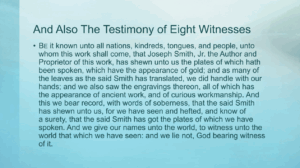
Let’s start by reviewing their testimony. This was the version that was published in the 1830 Book of Mormon:
“Be it known unto all nations, kindreds, tongues, and people, unto whom this work shall come, that Joseph Smith, Jr. the Author and Proprietor of this work, has shewn unto us the plates of which hath been spoken, which have the appearance of gold; and as many of the [plates] as the said Smith has translated, we did handle with our hands; and we also saw the engravings thereon, all of which has the appearance of ancient work, and of curious workmanship. And this we bear record, with words of soberness, that the said Smith has shewn unto us, for we have seen and hefted, and know of a surety, that the said Smith has got the plates of which we have spoken.
And we give our names unto the world, to witness unto the world that which we have seen; and we lie not, God bearing witness of it.”
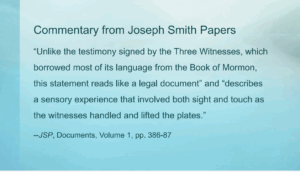
The Joseph Smith Papers has a good summary of the eight witnesses’ testimony. “Unlike the testimony signed by the Three Witnesses, which borrowed most of its language from the Book of Mormon, this statement reads like a legal document and describes a sensory experience that involved both sight and touch as the witnesses handled and lifted the plates.”
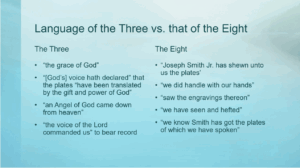
Differences Between the Three and the Eight Witnesses
The differences between the Three Witness Testimony and the Eight Witness Testimony are striking. The three is a very religious document. It mentions “the grace of God” at least twice. They tell of hearing God’s voice declaring the authenticity of the translation. They saw an angel who came down with the plates. The witnesses heard the voice of the Lord commanding them to bear record. Joseph Smith is not mentioned a single time in the testimony of the three.
The eight is strictly empirical. They mention Joseph Smith four different times as the one who showed them the plates that they saw and hefted. The testimony of the three is a testimony of the Book of Mormon and of the Savior. The testimony of the eight testifies of one thing: Joseph Smith has the plates.

Historical Background
One criticism that we see, this is a typical example from Dan Vogel. “As a historical document, the Testimony of the Eight… is disappointing. It fails to give historical details such as time, place, and date. Neither does it describe the historical event or events, but simply states that the eight signatories, collectively, have seen and handled the plates.”
I think that point is well taken, and it’s unfortunate that we don’t have some of the background. When David Whitmer gave a fair amount of historical background when he told of the experience that he and Oliver had with Joseph. He told what happened right before and where they went when they had this experience. And he mentions how they were sitting on a log when the angel appeared. So it is unfortunate that we don’t have the kind of historical background for the testimony of the eight.
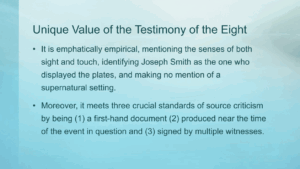
Unique and Valuable
Nevertheless, I believe the Eight Witness Testimony is just a unique and valuable document. It is emphatically empirical, mentioning the senses of both sight and touch, identifying Joseph Smith as the one who displayed the plates, and making no mention of a supernatural setting. It thus qualifies as a historical account and is therefore fully able to be investigated through historical methodology. And moreover, it meets three crucial standards of source criticism. One, a first-hand document. Two, produced near the time of the event in question. Three, signed by multiple witnesses. That is really good.
One of the amazing things about the coming forth of the Book of Mormon is that Joseph Smith first reported Moroni’s visit in 1823. Then he received the plates in September of 1827. But for that time period, we do not have a single contemporaneous document mentioning the Book of Mormon. We have quite a few people who later gave reminiscences, such as Joseph and Lucy and the Harmony neighbors.
Many people gave reminiscences, but no document that was created during that time period. So we rely on reminiscences to reconstruct what happened with the coming forth of the Book of Mormon. But the testimony of the eight was created close to the time that they had their experience. You’ve got eight witnesses, which is a really good number, strong, first person. I think it is the most valuable document related to the coming forth of the Book of Mormon.

The Truth of the Book of Mormon
We have different accounts of the eight testifying as a group. It took place in Manchester, New York. As you may remember, the experience of the three witnesses happened in Fayette near the Whitmer farm. Lucy Mack Smith wrote that the party kind of moved over to Manchester. That was where the eight had their experience. And she said, “After these [eight] witnesses returned to the house, we held a meeting, in which all the witnesses bore testimony to the facts, as stated above.” She has just included the testimonies of the three and the eight in her history.
Luke Johnson attended a conference in October of 1831. He said, “At this Conference the eleven witnesses to the Book of Mormon, with uplifted hands,” isn’t that interesting, “bore their solemn testimony to the truth of that book.” So in that case, the eight were not necessarily speaking of their experience of handling and seeing the plates. They were bearing testimony to the truth of the Book of Mormon.
John Corrill joined the Church in 1831. He got to know all the witnesses quite well. In his history, which was commissioned by Joseph Smith and was published after he was excommunicated, he had lost his faith in Joseph. He wrote, “Eleven persons besides Smith bore positive testimony of [the Book of Mormon]… I was unable to impeach their testimony, and thought that it was as consistent to give credit to them as to credit the New Testament.”
Words From Each of the Eight Witnesses
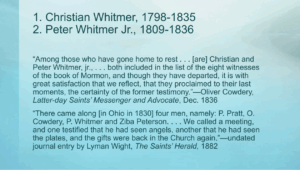
Let’s take a look at the different witnesses in the order of their deaths. We do not have first-hand accounts of Christian and Peter Whitmer Jr. other than the testimony of the eight itself. They were both living in Missouri when they died in 1835 and 1836, respectively. After their deaths, Oliver Cowdery wrote the following: “Among those who have gone home to rest… [are] Christian and Peter Whitmer Jr.,… both included in the list of… eight witnesses of the Book of Mormon, and though they have departed, it is with great satisfaction that we reflect, that they proclaimed to their last moments, the certainty of the former testimony.”
Then Lyman White was in Ohio in 1830 when Parley P. Pratt, Oliver Cowdery, Peter Whitmer Jr., and Ziba Peterson arrived on their mission. And of meeting those four missionaries, Lyman White wrote in 1882: “There came along four men, namely, P. Pratt, O. Cowdery, P. Whitmer, and Ziba Peterson… We called a meeting, and one testified that he had seen angels,” probably Oliver, “another that he had seen the plates,” probably Peter, “and the gifts were back in the Church again.”
Of that mission, they went on to Independence, Missouri. Peter Jr. offered this brief description of their mission. “1830, the word of the Lord came unto me by the prophet Joseph Smith in the tenth month, saying, ‘Peter, thou shalt go with thy brother Oliver to the Lamanites.’ We started on the same month to the west to the tribe of Buffalo, and there we declared the Book of Mormon from thence to the state of Ohio. There we declared the fullness of the gospel and had much success.”
Joseph Sr.
We don’t have a firsthand account from Joseph Smith Sr. as one of the eight witnesses. We do have some interesting accounts from others.
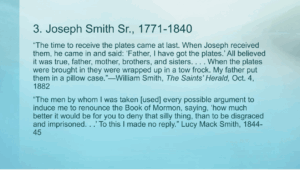
William witnessed Joseph bring the plates back to the Smith home in Manchester in September of 1827. He wrote, “The time to receive the plates came at last. When Joseph received them, he came in and said, ‘Father, I have got the plates.’ All believed it was true, father, mother, brothers, and sisters…” Several members of the Smith family, if not all of them, handled the plates at this time. William continues, “When the plates were brought in they were wrapped up in a tow frock. My father put them in a pillow case.” So this would mean an instance of Joseph Sr. handling the plates, separate from his experience as one of the eight.
Then Joseph Sr. had a very interesting experience when he was imprisoned for a debt. Early in the autumn of 1830, a Quaker called at the Smith home and demanded payment from Joseph Sr. for a note of fourteen dollars. He had bought it from Joseph Sr.’s creditor. Joseph Sr. offered him all that he had–six dollars–with the promise for the remainder. Lucy was willing to give him her gold beads. But the man said that unless Joseph paid the whole debt at once, he would go to jail. The Quaker even offered to forgive the debt if the Smiths would burn up their copies of the Book of Mormon. This Joseph Sr. refused, and he was taken into custody by a constable. He was held in Canandaigua, about seven miles south-southwest of Manchester.
Third Hand Account
Joseph Sr.’s recital, featured here, was related to Lucy by way of Samuel. So Lucy’s account is third hand, but this is what Joseph Sr. reportedly said:
“Immediately after I left your mother, the men by whom I was taken commenced using every possible argument to induce me to renounce the Book of Mormon, saying ‘how much better it would be for you to deny that silly thing than to be disgraced and imprisoned when you might not only escape this but also have the note back as well as the money which you have paid on it.’ To this, I made no reply.
They still went on in the same manner until we arrived at the jail. When they hurried me into this dismal dungeon. I shuddered when I first heard those heavy doors creaking up on their hinges. But then I thought to myself, I was not the first man who had been imprisoned for the truth’s sake, and when I should meet Paul in the paradise of God, I could tell him that I too had been in bonds for the gospel which he had preached. And this has been my only consolation.”
Hyrum Smith’s Account
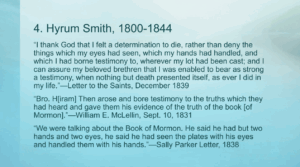
Hyrum Smith left a powerful first-hand account. This was in a letter to the saints written in December of 1839, after he and Joseph had endured so much persecution in Missouri. “I thank God that I felt a determination to die, rather than deny the things which my eyes had seen, which my hands had handled, and which I had borne testimony to, wherever my lot had been cast: and I can assure my beloved brethren that I was enabled to bear as strong a testimony, when nothing but death presented itself, as I ever did in my life.”
William McLellin turns out to be a great compiler of testimonies from both the eight and the three witnesses. He was preaching with Hyrum in September of 1831. He wrote, “[Brother] H[iram] Then arose and bore testimony to the truths which they had heard and gave them his evidence of the truth of the book [of Mormon].” In 1838, Sally Parker heard Hyrum speak as he was on his way moving from Kirtland to Missouri. “We were talking about the Book of Mormon. He said he had but two hands and two eyes, he said he had seen the plates with his eyes and handled them with his hands.”
More From Hyrum
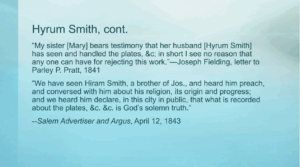
More from Hyrum. Joseph Fielding, his brother-in-law, wrote, “My sister [Mary] bears testimony that her husband has seen and handled the plates, &c; in short I see no reason that anyone can have for rejecting this work.”
Then a newspaper article from 1843 in Massachusetts. “We have seen Hyrum Smith, the brother of [Joseph], and heard him preach, and conversed with him about his religion, its origin and progress; and we heard him declare, in this city, in public, that which is recorded about the plates, &c. &c. is God’s solemn truth.”

Samuel Smith
Samuel Smith died about a month after Joseph and Hyrum. Unfortunately, we don’t have a first-person account written by Samuel. But you may remember that after the Book of Mormon was published, Samuel took copies and went out doing missionary work. Of course, he met the Young family. Phineas Young, Brigham’s brother, who would later be a brother-in-law to Oliver Cowdery, remembered that experience. “‘Ah,’ said I, ‘you [referring to Samuel] are one of the witnesses.’ ‘Yes,’ said he, ‘I know the book to be a revelation from God, translated by the gift and power of the Holy Ghost, and that my brother Joseph Smith is a Prophet, Seer, and Revelator.’”
Then William McLellin again, 1831, in his journal: “I spoke about the evidences of the Book of Mormon [and] Brother Samuel arose and bore testimony of what had been said, and of the Book of Mormon.”
Daniel Tyler in 1883 wrote of an experience he had in 1832. “Elder Smith delineated the circumstances of the coming forth of the Book of Mormon, of which he was a witness. He knew his brother Joseph had the plates, for the prophet had shown them to him, and he had handled them and seen the engravings thereon.”
Hiram Page’s Letter
Hiram Page married Catherine Whitmer in 1825, and he’s a great witness. And in a letter to William McLellin, this is what he wrote:
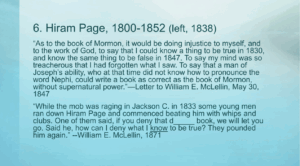
“In the next place, you want to know my faith relative to the Book of Mormon and the winding up of wickedness. As to the Book of Mormon, it would be doing injustice to myself, and to the work of God, [of the last days] to say that I could know a thing to be true in 1830, and know the same thing to be false in 1847. To say my mind was so treacherous that I had forgotten what I saw.
To say that a man of Joseph’s ability, who at that time did not know how to pronounce the word Nephi, could write a book of six hundred pages as correct as the Book of Mormon without supernatural power. And to say that those holy angels who came and showed themselves to me as I was walking through the field, to confirm me in the work of the Lord of the last days, three of whom came to me afterwards and sang in hymn in their own pure language. Yea, it would be treating the God of heaven with contempt to deny these testimonies, with too many others to mention.”
William McLellin again. “[When] the mob was raging in Jackson C. in 1833 some young men ran down Hiram Page and commenced beating him with whips and clubs. One of them said, if you deny that… book, we will let you go. Said he, how can I deny what I know to be true? They pounded him again.”
Additional References to Page
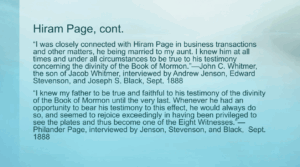
A couple of later references to Hiram Page: John C. Whitmer, the son of Jacob Whitmer, wrote, “I was closely connected with Hiram Page in business transactions and other matters, he being married to my aunt. I knew him at all times and under all circumstances to be true to his testimony concerning the divinity of the Book of Mormon.”
And Hiram Page’s son, Philander Page. “I knew my father to be true and faithful to his testimony of the divinity of the Book of Mormon until the very last. Whenever he had an opportunity to bear his testimony to this effect, he would always do so, and seemed to rejoice exceedingly in having been privileged to see the plates and thus become one of the eight witnesses.”
As I mentioned, two of the Whitmers died in good standing in Missouri. In 1838, John Whitmer and David Whitmer were both excommunicated. Hiram Page and Jacob Whitmer both left the Church. But you can tell throughout the remaining 30 or 40 years, the Whitmers continue to bear very strong testimony of the Book of Mormon.
Testimonies
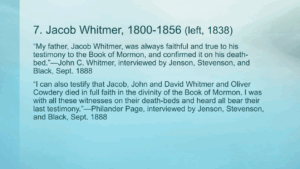
Jacob Whitmer is a good example of that, left the Church in 1838, died in 1856. And his son, John C. Whitmer, said, “My father, Jacob Whitmer, was always faithful and true to his testimony of the Book of Mormon, and confirmed it on his deathbed.”
Philander Page again. “I can also testify that Jacob, John and David Whitmer and Oliver Cowdery [they were all uncles of his] died in full faith in the divinity of the Book of Mormon. I was with all these witnesses on their death-beds and heard all bear their last testimony.”
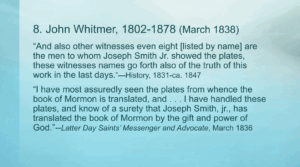
John Whitmer lived longer than any of the other eight witnesses, and of the three, David lived the longest. As I mentioned, John was excommunicated in March of 1838, and he left some really good first-person accounts. In a history that he wrote, which was commissioned by Joseph Smith, he said, “And also other witnesses even eight are the men to whom Joseph Smith Jr. showed the plates, these witnesses names go forth also of the truth of this work in the last days.”
In March of 1836, in an editorial in the Messenger and Advocate, he wrote, “I have most assuredly seen the plates from whence the Book of Mormon is translated, and… I have handled these plates, and know of a surety that Joseph Smith, jr., has translated the Book of Mormon by the gift and power of God.”
Empirical Experience
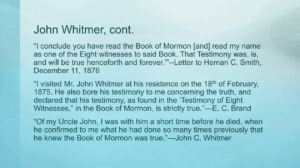
At the end of his life, John Whitmer was still bearing testimony. In a letter to Heman C. Smith, he said, “I conclude you have read the Book of Mormon [and] read my name as one of the eight witnesses to said Book. That Testimony was, is, and will be true henceforth and forever.”
E.C. Brand; “I visited Mr. John Whitmer at his residence on the 18th of February, 1875. [Two years before John’s death.] He also bore his testimony to me concerning the truth, and declared that his testimony, as found in the ‘Testimony of Eight Witnesses,’ in the Book of Mormon, is strictly true.”
John C. Whitmer; “Of my Uncle John, I was with him a short time before he died, when he confirmed to me what he had done so many times previously that he knew the Book of Mormon was true.”
Given all of these testimonies, it’s a little difficult to see how people can argue that the experience of the eight was not empirical.
Claims of Spiritual vs Empirical Experience
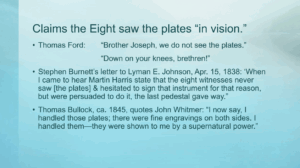
Let’s discuss some of those claims that they saw the plates in vision. Frequently when someone claims that the eights saw the plates in vision, the next step is to conclude that they must have seen the plates simply in their imagination.
Thomas Ford, if you remember, was the governor of Illinois who failed to protect Joseph and Hyrum before they were murdered in Carthage Jail. And in the 1840s, he wrote a history of Illinois. He wanted to give a history of the Saints, and this history was published after he died. He says, “The most probable account of the witness statements is that they were part of a conspiracy.”
Then, maybe just to cover his bases, he says,
“I have been informed by men who were once in the confidence of the prophet, [he doesn’t say who they were,] that the prophet privately gave a different account of the matter. The prophet had always given out that the plates could not be seen by the carnal eye but must be spiritually discerned, that the power to see them depended upon faith and was the gift of God to be obtained by fasting, prayer, mortification of the flesh, and exercises of the spirit. Therefore, when Joseph saw, quote, ‘the evidences of a strong and lively faith in any of his followers’, he set them to continual prayer and other spiritual exercises to acquire this lively faith by means of which the hidden things of God could be spiritually discerned.”
“Then, when he could delay them no longer, he assembled them in a room and produced a box which he said contained the precious treasure. The lid was opened, the witnesses peeped into it, but making no discovery, for the box was empty. They said, ‘Brother Joseph, we do not see the plates.’ Joseph responded, ‘O ye of little faith, how long will God bear with this wicked and perverse generation? Down on your knees, brethren, every one of you, and pray God for the forgiveness of your sins and for a holy and living faith which cometh down from heaven.’”
Historical Value
Lumping the three and eight witnesses together, Ford claimed that they “dropped to their knees and began to pray in the fervency of their spirit, supplicating God for more than two hours with fanatical earnestness, at the end of which time, looking again into the box, they were now persuaded that they saw the plates.”
It’s a rumor that Ford has heard and passed on. As a third-hand anonymous account, it has very little historiographical value. But, to me it’s kind of amazing that historians as well trained as Fawn Brodie and Dale Morgan cite Ford’s account as if it has some value. I think later historians have reached the obvious conclusion that it shouldn’t be taken seriously.
The next document that leads some people to believe the eight saw the plates in vision is a letter that Stephen Burnett wrote to Lyman Johnson on April 15, 1838. Of course, in January of 1838, Joseph and Sidney Rigdon had fled Kirtland in fear of their lives. 1837 had been the year of the great financial disaster. Many faithful people became disillusioned with Joseph Smith and lost their faith. Warren Parish, for example, had been quite close to Joseph Smith, and by mid-1837, had become a bitter foe. Stephen Burnett had been quite faithful. But he began losing his faith as he talked with Luke S. Johnson, John Boynton, both original apostles, Martin Harris, and others who had been excommunicated late in 1837 after the collapse of the Kirtland Safety Society Anti-Banking Company.
Sympathize With Losing Faith
Burnett wrote, “When I came to hear Martin Harris state in a public congregation that he never saw the plates with his natural eyes, only in vision or imagination, neither Oliver nor David, and also that the eight witnesses never saw them, [meaning the plates,] and hesitated to sign that instrument for that reason, but were persuaded to do it, the last pedestal gave way. In my view, our foundations was sapped and the entire superstructure fell a heap of ruins.” You can really sympathize with him losing his faith.
But the interesting thing is he’s getting his information from Martin Harris. The irony is that Harris had become the de facto spokesman for the other witnesses. By the time Burnett wrote this letter in April of 1838, the Whitmer family was all in Missouri. Some of the Smiths were still in Kirtland. They weren’t communicating with these dissenters. There’d been a very tense atmosphere. Joseph Senior had become involved in a physical altercation in the Kirtland Temple with some of these dissenters. So someone like Stephen Burnett, if he was trying to find out the truth of the eight witnesses’ experience, Martin Harris was probably the best source that he had. But of the eleven witnesses, Harris is the only one known to have been alone with Joseph when he saw the plates, making him the one least qualified to speak for the others.
Fragile Pronouncement
According to Burnett, Martin Harris did not claim to have received his information from the eight witnesses themselves. It’s entirely possible, especially given Martin’s temperament and his bent toward what some of his colleagues called religious enthusiasm, that he made presumptions about the experience of the eight without ever consulting them. And we don’t even know if Harris was on the scene at the Smith farm in Manchester when the eight witnesses returned from seeing the plates.
Given Martin Harris’s standing as a Book of Mormon witness, Burnett Parish and others naturally put a good deal of stock in his comments. We can especially sympathize with Burnett, who is still clinging to his conviction that the plates were real, when Harris’s supposed declaration that the eight saw the plates only in vision brought his once strong faith crashing down into a heap of ruins. But Burnett quite understandably failed to realize that Martin’s apparently ironclad pronouncement was fragile. That the 1829 empirical statement of the eight was still the best evidence for what they claimed to have experienced. I believe that the eight or any other witnesses should always be allowed to speak for themselves.
Controversial Document
We also have a controversial document created by Thomas Bullock in 1845. Early in 1839, Church member Theodore Turley was appointed to a committee helping the Saints evacuate from Missouri. On April 4th of that year, Turley and Heber C. Kimball visited Joseph Smith and others in Liberty Jail. The next day, Kimball and Turley were in Far West at the committee’s office when John Whitmer and seven other men entered the room. We don’t know exactly why John Whitmer was with these others. An account in the History of the Church is based on Bullock’s notes. This is how it reads in the History of the Church:
“Also, eight men, Captain Bogart who was the county judge, Dr. Lafferty, John Whitmer, and five others came into the committee’s room, and presented to Theodore Turley the paper containing the revelation of July 8, 1838, to Joseph Smith, directing the twelve to take their leave of the Saints in Far West on the building site of the Lord’s house on the 26th of April, which is coming right up.” This event is on April 5th.
John Whitmer
The twelve were tasked to go to the isles of the sea. These hostile Missourians asked Turley to read that revelation. Turley said, “‘Gentlemen, I am well acquainted with it.’ They said, ‘Then you as a rational man will give up Joseph Smith’s being a prophet and an inspired man? He and the twelve are now scattered all over creation. Let them come here if they dare; if they do, they will be murdered. As that revelation cannot be fulfilled, you will now give up your faith.’ Turley jumped up and said, ‘In the name of God, that revelation will be fulfilled.’ They laughed him to scorn. John Whitmer hung down his head.” This is information that Bullock, while he was working on the History of the Church, got from Turley.
And Turley then said, “I now call upon you, John Whitmer. You have published to the world that an angel did present those plates to Joseph Smith.” Of course, that wasn’t technically what John Whitmer published to the world. He published to the world that Joseph Smith had plates. But it’s often the case that the testimonies of the eight, their physical and spiritual testimonies, are conflated. Whitmer replied, “I now say I handled those plates; there were fine engravings on both sides. I handled them,” and he described how they were hung. “And they were shown to me by a supernatural power.” He acknowledged it all.
This is an uncorroborated account. It’s also third hand since it’s Bullock reporting what Turley said about what John Whitmer said. So, we’re not certain that that’s what Whitmer said. Nevertheless, if he did, the question of what he meant is open to debate.
Reaffirming Conviction
But writing of this purported statement of John Whitmer, that “I handled those plates, there were fine engravings on both sides, they were shown to me by a supernatural power,” the late Grant Palmer and others have concluded that, “This added detail of how Whitmer saw, indicates that the eight probably did not observe or feel the actual artifact.”
The presumption here is that the eight must have seen the plates in a miraculous setting. I believe it’s possible and even probable that when he said the plates had been shown to him by a supernatural power, he was reaffirming his conviction that God had directed the creation and preservation of the plates as well as the translation of the Book of Mormon.
Beyond the Evidence
It’s interesting that Turley challenged Whitmer by referring to his testimony in the midst of these hostile anti-Mormons. One of whom, Samuel Bogart, later fled Missouri after committing a murder. In the presence of those kinds of witnesses, Whitmer not only affirmed that he had handled and seen the plates, he confirmed his belief that the Lord played a crucial role in the coming forth of the Book of Mormon. We can’t know for certain what Whitmer meant because he had no chance to ever comment on this. But that uncertainty itself shows that concluding, “The eight probably did not observe or feel the actual artifact,” goes beyond the evidence. Bullock’s third-hand notes lacked the historiographical authority to overrule both the testimonies of the witnesses themselves and the second-hand accounts of those who talked directly to them.
I discussed this in greater detail in an article in the summer issue of Dialogue, and that’s available at dialoguejournal.com.
Conclusion
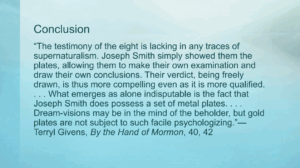
I believe Terryl Givens sums things up pretty well. “The testimony of the eight is lacking in any traces of supernaturalism. Joseph Smith simply showed them the plates, allowing them to make their own examination and draw their own conclusions. Their verdict, being freely drawn, is thus more compelling, even as it is more qualified… What emerges as alone indisputable is the fact that Joseph Smith does possess a set of metal plates… Dream-visions may be in the mind of the beholder, but gold plates are not subject to such facile psychologizing.”
Thank you very much.
Q&A
Why couldn’t Emma see the plates?
According to Emma, she didn’t ask to see the plates. She doesn’t give any evidence that she and Joseph discussed the matter. She said she was content not to see them. But she did feel the plates. And she mentions that as she was cleaning house and the plates were covered with a small cloth, she handled the plates and heard the leaves rustle. So she is an empirical witness of the plates but didn’t request, and apparently the topic didn’t come up.
Why is Grant Palmer so convinced that the eight witnesses did not really see the plates in his book, An Insider’s View of Mormonism?
I did mention Grant Palmer. When I compared the treatment of several critics’ treatments of the plates, I thought Grant Palmer’s treatment was more detailed than most. But I believe he was convinced by this supposed statement of John Whitmer that he saw the plates through a supernatural power and what Burnett said about Martin Harris’s claim that the eight never saw the plates physically. I think Palmer, not that I can speak for him, but I think he found those things convincing.
Was Philander Page a member of the Church, and have any descendants of the Whitmers remained in the Church?
Where’s our Whitmer? I would be looking for Richard Anderson right now. I believe there have been descendants of the Whitmers who have joined the Church, but I’m not positive of that. And Philander Page, I’d have to double-check on that. I don’t know his birth date and if he joined the Church in Kirtland before the Whitmers left the Church.
Is there an original Eight Witness holograph with original signatures or only the page printed in the Book of Mormon?
David Whitmer said that all of the witnesses signed their names to their statements. But the earliest document we have is the printer’s manuscript, and that’s in Oliver Cowdery’s hand. We do not have the original manuscript for the witness statements. We don’t know if they signed that, but like I said, David Whitmer said they did.
A blogger has argued for two sets of plates. One set of plates seen by the Eight Witnesses and the other by the Three Witnesses.
I looked pretty carefully at all the empirical accounts of the plates. I believe that there was one set of plates and one set only. Now, I don’t know why someone would argue that there were two sets of plates.
In some publication, you have mentioned the possibility that fake plates could be created.
Yes, I have. And in fact, you probably know of the Kinderhook plates. They were small bell-shaped plates that seemed to have engraving. They were taken as authentic for 100 years and eventually were discovered to be a forgery of some men who got together. One of them was a blacksmith working in his shop. They created fake plates specifically to try and deceive Joseph Smith.
To me, the empirical evidence is undeniable that Joseph Smith had plates. So if the critics believed that those plates were fake, I believe it’s up to them to offer an explanation. To me, it’s not conceivable that Joseph Smith could have produced fake plates on his own. I think the Kinderhook plates offer a good example of what it did take just to create a few small plates. So to create several plates with rings would have been a more difficult task. But if there were fake plates, I think it would have to have been a conspiracy, not Joseph working by himself.
What is a good reference for your Eight Witness material?
Richard Anderson’s book about the Eight Witnesses is good. Dan Vogel does not put all the statements in one book, but Early Mormon Documents is a very valuable source. In my recent book, I collected everything that I talked about in my paper.
How many statements do we have for Martin Harris regarding his experience with the angel and the plates? Is there a consistent pattern… interpretations of these statements?
Well, it’s a curious case about Martin Harris. Several believers who talked to Martin reported that he said, “I saw the plates with my physical eyes.” Several non-believers reported that Martin said, “I saw them with my spiritual eyes.” So that’s a difficult thing to try and understand. Maybe he was speaking to each audience in terms he thought they would understand, but it is fairly consistent. We have several examples of both.
Thanks very much.
