The Book of Mormon Witnesses: Sincerity and Reality
Dan Peterson
August 2021
Summary
Daniel C. Peterson defends the credibility of the Book of Mormon witnesses by comparing their unwavering testimonies—often given under persecution—to those of the early Christian apostles. He critiques naturalistic explanations arguing they fail to account for the witnesses’ consistency, sincerity, and transformative experiences.
Introduction
We’ll move on to our final speaker for our conference, Daniel C. Peterson. He has been a professor of Islamic studies and Arabic at Brigham Young University. Young is founder of the University’s Middle Eastern Text Initiative. He’s been a long-time friend of FAIR. He’s currently with the Interpreter Foundation, and he’s also now a major film producer. So, with that short introduction, we’re going to start first with a video clip. After that, we’ll listen to Daniel Peterson.
Presentation
“If Joseph just said he saw God, people would say, “We understand, all sorts of people have seen God.” When he says he has plates, then he becomes a charlatan.”
“A detractor can simply say, ‘Well, they’re all lying. Every one of them is lying.’
“You will see the plates; the Lord has declared it.”
“Even antagonists of Joseph Smith seem to believe that he has something.”
“And I have not denied my testimony, which is attached to the Book of Mormon, nor will I.”
“This guy is anything but a cynic.”
“Because it is true.”
“He’s a wholehearted believer, and that’s why he leaves.”
“I find that the witnesses are credible.”
“Of course, we were in the spirit when we had the view, but we were in the body also.”
“They were challenged time and time again to recant their testimonies, but they never did. That’s powerful stuff.”
“Never doubt it. You do so at your own peril.”
[Applause]
Witnesses Film
Dan Peterson: Some of you may know that I recently worked on a film project about the witnesses to the Book of Mormon. You just saw a preliminary trailer for the second part of that. A lot of people think that the theatrical film that is still playing in theaters, that that’s all there is, but it isn’t. In fact, the main part of it, as I always conceived it, is still to come. And that’s a two-part docudrama, which will include interviews with scholars—LDS and non-LDS. It will broaden its coverage beyond the three witnesses to the eight witnesses, and to the informal or unofficial witnesses.

COVID-19 considerably delayed this project. That was a preliminary bit of filming that we did.
Now, I need to announce something before I forget it. As I say, the second installment—the docudrama— is going to be called Undaunted: Witnesses of The Book of Mormon. It’ll likely go public in early October or thereabouts. But I want to say something that’s kind of important. It is news that just came to me in the forenoon today. The theatrical film—is beginning to run down. It’s showing in fewer and fewer theaters. Even Avatar and Titanic and Gone with the Wind eventually leave the theaters. So it’s naturally begun fading. It’s still out there. It’s in some theaters around here and some in Arizona and elsewhere—Idaho—at least last time I checked.
The Docudrama
But one really, really important thing is there are a lot of people who weren’t able to see the film because it wasn’t showing anywhere near them. We’ve just successfully arranged for the film to be shown in four theaters in the Provo-Orem area during Education Week. So if people are coming in from outlying areas on Education Week, I hope they’ll have a chance. And if you haven’t seen it, or if you know people who haven’t seen it but who wanted to but might be coming to Education Week, I hope you’ll mention that to them.
And we’re kind of pleased that we managed to work this out because a lot of big films are coming out. There are actually more films than screens right now. So for us to be able to get those screens for Witnesses during Education Week in the area around BYU is really a big deal for us.
So anyway, you just saw a one-minute ad for that docudrama.

You should supplement my remarks today with the companion presentation I gave at the 2020 FAIR Conference. Even together, they cover only a fragment of what I could say on this subject.
Apostolic Witnesses to the Resurrection
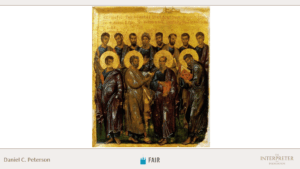
Okay, according to ancient traditions, the early apostolic witnesses to the resurrection of Jesus paid a heavy price for their testimonies. Let’s run through these. You may know all of this, but:
Peter was crucified in A.D. 66, at his request upside down, under the emperor Nero.
As it happens, the apostle Paul–though not one of the original Twelve–was also beheaded that same year, under Nero’s rule, in Rome. It was a bad year to be a General Authority.
Tradition holds that Andrew preached within the boundaries of today’s Ukraine and around the Black Sea. He also preached in Asia Minor (modern-day Turkey) and in Greece, where he was crucified.
Thomas served as a missionary east of Syria. Traditionally even into India, where four soldiers with spears killed him.
Philip taught in North Africa, in Carthage—within modern-day Tunisia—and also in Asia Minor, where authorities eventually put him to death.
According to tradition, Bartholomew spoke with Thomas in India, and also preached in Armenia, Ethiopia, and southern Arabia. Sources disagree on how or where he was martyred, but leading accounts say he was flayed alive and then beheaded–either in Armenia or India.
James, the son of Alphaeus, reportedly preached in Syria, where, according to Josephus, people stoned him and then clubbed him to death. Some traditions have him being crucified, though, in lower Egypt. That is, in the northern part of the country near modern Cairo or in the Nile Delta.
Apostolic Witnesses, cont.,
Supposedly, Simon the Zealot ministered in Persia and was killed when he refused to sacrifice to the sun god.
Reports say Matthias, who replaced Judas Iscariot after Judas had betrayed Jesus and committed suicide, was burned to death in Syria.
Matthew, traditionally credited as the author of the Gospel that bears his name, may have escaped martyrdom. Some sources say so. Others claim that people stabbed him to death in Ethiopia.
John was the leader in the Christian community in Ephesus—the major city in Asia Minor, again in modern-day western coastal Turkey. Roman authorities exiled him to the island of Patmos during Domitian’s persecution in the mid-90’s A.D. An early Latin tradition reports that Roman officials cast him into boiling oil at Rome but he escaped uninjured. No historical account reports his martyrdom.
Tradition says that people dragged Mark the Evangelist by a rope through the streets of Alexandria, Egypt, in A. D. 68 until he was dead.
Comparison of Ancient Apostolic Witnesses to Latter-day Witnesses

At the 2001 annual meeting of the Evangelical Philosophical Society in Denver, Colorado, I participated in a debate between five Latter-day Saint academics. That’s including me, and five prominent evangelical Protestant philosophers and theologians. Richard Mouw, a committed Calvinist but a kind and fair-minded man who served as president of Fuller Theological Seminary in Pasadena, California, moderated the three-hour discussion.
It was, shall we say, a spirited and entertaining evening—at least for me. I thought the Latter-day Saint side did reasonably well and made a positive impression. For my purposes here, though, I want to mention just one small portion of that debate. It involves William Lane Craig.
That name may be familiar to a few of you. He certainly ranks among the most prominent evangelical Protestant philosophers in the English-speaking world. Indeed, among the most prominent philosophers of religion in the world generally. He’s a person for whom I have considerable respect. He’s a formidable and very experienced debater.
Mormonism
At one point, Craig purported to contrast the evidence for Christianity with the evidence for what he termed Mormonism. I’m paraphrasing, but I think I’m reasonably close to his actual words:
Christianity, he said, has eleven credible witnesses to its fundamental claim—the resurrection of Jesus. Mormonism has absolutely nothing that’s even remotely comparable.
I remember glancing at Richard Mouw, the moderator. He looked back at me and rolled his eyes. It was really as if Dr. Craig had fastened the debater’s equivalent of a “kick me” sign on his posterior.
Fortunately, I was assigned to respond to him, so I didn’t miss the opportunity. Because the Restoration does have credible witnesses. Whether coincidentally or by divine design, if one has in mind the official witnesses to the Book of Mormon. Even precisely eleven of them.

A few years thereafter, my wife and I drove around a bit in western Missouri. It’s an arguably weird interest of mine—this is, not western Missouri—but I was trying to track down the graves of the witnesses to the Book of Mormon in that part of the state near Independence. Most of them are located there.
The Holy Land
Driving through the countryside, we noticed church after church, festooned with signs and even banners inviting people to enroll for a tour of the Holy Land. Now, nobody’s a stronger advocate of touring the Holy Land than I am. Most of my Middle Eastern residency has been in Egypt, but I’ve lived in Israel or Palestine for about a year altogether. I’ve visited it more times than I can count. I’ve even led somewhere between, I don’t know, 15–20 such tours myself.
But I really wanted to be able to tell the residents of that part of Missouri that, while they were thinking about traveling to Israel in order to visit sacred sites connected with scriptural history, the landscape right around them was dotted with the graves of witnesses directly comparable to those described in the New Testament. Yet I’m betting they were entirely unaware of the fact.

It’s true that the witnesses to the Book of Mormon didn’t suffer violent death at the rate that the ancient apostles did. For all of its imperfections, life in the United States—even on the Missouri frontier—was more secure than under Nero. Even so, they suffered considerable hardship and persecution. Indeed, at least one of them, Hyrum Smith, was a martyr in the fullest sense of the word.
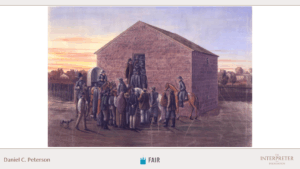
Words of Hyrum the Martyr
Perhaps responding to suggestions that the experience of the eight witnesses was merely spiritual and visionary, Hyrum insisted during an 1838 speech that it was entirely real.
“He said that he had but two hands and two eyes,” Sally Parker remembered in a letter written in August of that year. He said he had seen the plates with his eyes and handled them with his hands.
And Hyrum himself wrote in December 1839 of his sufferings in Missouri. Authorities arrested Hyrum, Joseph, and others in the fall of 1838. Authorities then imprisoned them in the ironically named Liberty Jail from the beginning of December to the beginning of April. At that point, weary of the cold misery and despair—and despairing in Missouri justice—the prisoners managed to escape.

A Stronger Testimony
This is what Hyrum said:
“Having given my testimony to the world of the truth of the Book of Mormon, the renewal of the everlasting covenant, and the establishment of the kingdom of heaven in these last days, and having been brought into great afflictions and distresses for the same, I thought that it might be strengthening to my beloved brethren to give them a short account of my sufferings for the truth’s sake, and the state of my mind and feelings while under circumstances of the most trying and afflicting nature.
“I had been abused and thrust into a dungeon and confined for months on account of my faith and the testimony of Jesus Christ.
“However, I thank God that I felt the determination to die rather than deny the things which my eyes had seen, which my hands had handled, and which I had borne testimony to wherever my lot had been cast.
“And I can assure my beloved brethren that I was enabled to bear a stronger testimony, when nothing but death presented itself, as ever I did in my life.”
Fellowship With Us
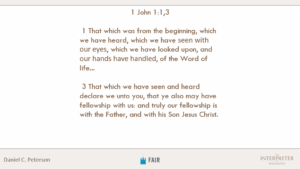
Now, Hyrum’s language plainly echoes the opening words of 1 John 1:
“That which was from the beginning, which we have heard, which we have seen with our eyes, which we have looked upon, and our hands have handled, of the Word of life; that which we have seen and heard declare we unto you, that ye also may have fellowship with us. And truly our fellowship is with the Father, and with his Son, Jesus Christ.”
Now, Hyrum’s words were not empty. He meant them.
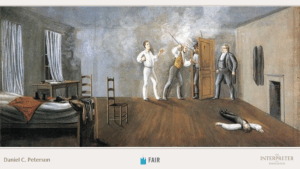
On the 27th of June 1844, at the hands of an armed mob with painted faces, Hyrum Smith sealed his testimony with his blood.
Significantly, the Greek word martus means “witness.”
On the morning Hyrum left for Carthage Jail, with a very acute sense of the likely fatal outcome, he remained loyal to his little brother. Which is, in and of itself, worthy of note. He was loyal to his little brother.
John Taylor’s Testimony
According to the testimony of John Taylor, who was severely wounded in the same violent attack that took the lives of Joseph and Hyrum, Hyrum read the following verse in the Book of Mormon. Finishing, he turned down the leaf upon it.
“And it came to pass that I prayed unto the Lord that he would give unto the Gentiles grace, that they might have charity.
“And it came to pass that the Lord said unto me: If they have not charity, it mattereth not unto thee; thou hast been faithful; wherefore, thy garments are clean.
“And because thou hast seen thy weakness, thou shalt be made strong, even unto the sitting down in the place which I have prepared in the mansions of my Father.
“And now I bid farewell unto the Gentiles, yea, and also unto my brethren whom I love, until we shall meet again before the judgment-seat of Christ, where all men shall know that my garments are not spotted with your blood.”

The Night Prior to the Martyrdom
According to the accounts of those who were in the prison with Joseph and Hyrum just prior to the martyrdom, during the evening the patriarch Hyrum Smith read and commented upon extracts from the Book of Mormon on the imprisonments and deliverance of the servants of God for the gospel’s sake.
Joseph bore a powerful testimony to the guards of the divine authenticity of the Book of Mormon, the restoration of the gospel, the administration of angels, and that the kingdom of God was again established upon the earth—for the sake of which he was then incarcerated in that prison, and not because he had violated any law of God or man.
On the morning of their murder, both Joseph and Hyrum bore a faithful testimony to the latter-day work and the coming forth of the Book of Mormon. Before sunset that evening, the armed mob had done its work. “The testators are now dead,” wrote John Taylor, announcing their martyrdom, “and their testament is in force.”
I might add here that Elder Holland has spoken powerfully and eloquently on this very fact. It’s highly unlikely that men, knowing very confidently they were going to their deaths, would die with a lie on their lips like this, going before God.
Additional Testimonies From Witnesses
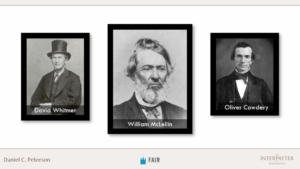
An account given in a recently published manuscript, originally written by William McLellin sometime between January 1871 and January 1872. McLellin was chosen as one of the Twelve Apostles in 1835, but he was excommunicated from the Church in 1838. However, he never abandoned his faith in the Book of Mormon. That faith rested, to a significant degree, upon his early searching interviews with the witnesses.
He was a highly intelligent man, and it seems a rather irascible one. He was very careful and intent upon getting at the truth. He left a number of statements on his investigations.
William McLellin Statement
Here’s one of them:
“In 1833, when mobbing reigned triumphant in Jackson County, Missouri, I and O. Cowdery fled from our homes for fear of personal violence on Saturday, the 20th day of July. The mob dispersed, agreeing to meet again on the next Tuesday. They offered eighty dollars reward for anyone who would deliver Cowdery or McLellin in Independence on Tuesday.
“On Monday, I slipped down into the Whitmer settlement, and there in the lonely woods I met with David Whitmer and Oliver Cowdery. I said to them, ‘Brethren, I have never seen an open vision in my life, but you men say you have, and therefore you positively know. Now you know that our lives are in danger every hour if the mob can only catch us.Tell me, in the fear of God, is that Book of Mormon true?'”
“Cowdery looked at me with solemnity depicted in his face and said: ‘Brother William, God sent his holy angel to declare the truth of the translation of it to us, and therefore we know. And though the mob kill us, yet we must die declaring its truth.’”
“And David said: ‘Oliver has told you the solemn truth, for we could not be deceived. I most truly declare to you its truth.’”
“Said I: ‘Boys, I believe you. I can see no object for you to tell me falsehood now when our lives are endangered.’
“‘Eight men testify also to handling that sacred pile of plates’, he continued, ‘from which Joseph Smith read off the translation of that heavenly book.’”

Hiram Page
One circumstance I’ll relate of one of these eight witnesses:
While the mob was raging in Jackson County, Missouri, in 1833, some young men ran down Hiram Page in the woods—one of the eight witnesses—and commenced beating and pounding him with whips and clubs. He begged, but there was no mercy. They said he was a “damned Mormon” and they meant to beat him to death. But finally one of them said to him:”If you’ll deny that damned book, we’ll let you go.”
Said he: “How can I deny what I know to be true?” Then they pounded him again.
When they thought he was about to breathe his last, they said to him: “Now, what do you think of your God when he don’t save you?”
“Well,” said he: “I believe in God.”
One of the most intelligent among them said: “I believe the damned fool will stick to it though we kill him. Let’s let him go.”
But his life was nearly run out. He remained confined to his bed for a length of time. .
So much for a man who knows for himself. Knowledge is beyond faith or doubt; it is positive certainty.
McLellin Continues
This is McLellin continuing:
“I, in company with a friend, I visited one of the eight witnesses in 1869—the only one who was now alive.”
(I think it was probably John Whitmer.)
“And he bore a very lucid and rational testimony and gave us many interesting particulars. He was a young man when he had these testimonies; he was then 68 years old, and still he is firm in his faith.
“Now, I would ask you: what will I do with such a cloud of faithful witnesses bearing such a rational and yet solemn testimony? These men, while in the prime of life, saw the vision of the angel and bore their testimony to all people.
“And eight men saw the plates and handled them; hence, these men all knew the things they declared to be positively true—and that too while they were young. And now, when old, they declare the same things.”
Now, I have to say: John Whitmer was bitter against the Latter-day Saints and against Joseph Smith. But these testimonies stayed with him—and convinced him.
Near the beginning end of the Interpreter Foundation’s Witnesses film is a dramatic scene that occurred in 1833. A mob in Independence, Missouri, tried to force David Whitmer and others to repudiate their faith and denounce the Book of Mormon. John P. Greene, a New York convert to the Church very soon after Whitmer himself, told the story as follows:
John P. Greene
“When the mob again assembled, they went to the houses of several of the leading Mormons, and, taking Isaac Morley, David Whitmer, and others, they told them to bid their families farewell, for they would never see them again.
“Then, driving them at the point of the bayonet to the public square, they stripped and tarred and feathered them amidst menaces and insults.”
We had decided in our film to forego the tarring and feathering. Turns out, it’s kind of difficult to do, and not very pleasant for the actors. Even if you don’t use real hot tar and real feathers. And there are budget limitations. Tar is cheap, but we couldn’t afford it.
“So, the commanding officer then called twelve of his men, and, ordering them to their guns, had them present them at the prisoners’ breasts and be ready to fire when he gave the word.
“He addressed the prisoners, threatening them with instant death unless they denied the Book of Mormon and confessed it to be a fraud. At the same time, adding:”If they did so, they might enjoy the privileges of citizens.”
“David Whitmer hereupon lifted up his hands and bore witness that the Book of Mormon was the word of God. The mob then let him go.
David Whitmer
And David Whitmer himself told M.C. Smith that when the mob commanded him to renounce his testimony, he instead reaffirmed it in the face of death. His most substantial known account recalls that:
“The testimony I gave to that mob made them fear and tremble, and I escaped from them.”
“One gentleman—a doctor—told him afterward that the bold and fearless testimony borne on that occasion, and the fear that seemed to take hold of the mob, had made him a believer in the Book of Mormon.”
Samuel Smith
Okay, Samuel Smith.
Samuel Smith might also be considered a kind of martyr.
A mob killed his brothers Joseph and Hyrum on June 27, 1844, while being held at Carthage Jail in Illinois.
Just prior to their death, a mob attacked Samuel while traveling toward Carthage to help out. He is said to have developed some kind of pain in his side while trying to escape them. Some have argued this may have contributed to his death a month later.
After evading the mob, Samuel arrived at the jail and retrieved his brothers’ bodies. He may have been the first Latter-day Saint on the scene after the martyrdom.
Officially, Samuel died of “bilious fever”—an imprecise term that’s no longer in medical use.
Lucy Mack Smith had now lost three of her sons within a month.
She maintained afterward that Samuel became ill and died because of his fatigue and shock at the death of his brothers.
David Whitmer
David Whitmer had been out of the Church for 50 years when he died in Richmond, Missouri, on January 25th, 1888. It had been fully 60 years since his experience with the angel and the plates. But he wanted his testimony about the Book of Mormon to be heard even beyond his death.
Note the two books—presumably the Bible and the Book of Mormon—carved atop his grave marker. And the words carved into its side:
“The record of the Jews and the record of the Nephites are one.
Truth is eternal.”
Belief in Things That are Incorrect
At this point, a skeptic might well point out that people often believe things that are plainly incorrect. Not uncommonly they die or are willing to die for falsehoods. History is replete with martyrs for communist revolution, extremist Islam, and the like. So a willingness to die for it doesn’t prove a proposition or a belief system true.
But there’s a distinct difference, in my view, between lifelong devotion to a conclusion that one has mistakenly drawn—or to a worldview that one has embraced in error—and a readiness to endure persecution and even to die for a claimed experience.
The early disciples of Jesus hadn’t just reasoned their way into Christianity. They had, they firmly believed, seen the risen Christ—and that experience utterly transformed them. If they knew it to be false, if they were deceivers, would they have embraced martyrdom for it?
Mainstream modern Christian scholars and apologists make that argument regarding the resurrection of Jesus—and they’re right to do so. But the same argument can be made for the witnesses to the Book of Mormon.
Perhaps Sincere but Hallucinating?
Maybe, though, they were sincere but sincerely hallucinating?
To respond to that idea, I’m going to be drawing on the work of the evangelical Protestant philosopher Gary Habermas and the physician Joseph Bergeron regarding the resurrection of Christ. Their arguments seem entirely appropriate, in my judgment, to the Book of Mormon witnesses as well.
In an effort to maintain a naturalistic worldview, scholars have proposed three psychiatric explanations for the disciples’ claim of having seen and interacted with the resurrected Jesus: hallucinations, conversion, disorder, and bereavement experiences.
Now, neither conversion disorders nor bereavement experiences have any clear relevance to the Book of Mormon and to the witnesses, so we’ll concentrate here on hallucinations.
We use Bergeron and Habermas’s definition of hallucinations as:
“Perceived experiences of one or more physical senses without external stimulus or without physical referent.”
Which is to say, very importantly, that hallucinations are personal and subjective.
Gerd Lüdemann
The atheist German New Testament scholar Gerd Lüdemann will serve as an example of the hallucination thesis applied to the Easter story. Lüdemann suggests that Peter experienced a visual hallucination of Jesus due to his severe guilt and grief, and that Peter’s subjective vision was followed by similar hallucinations among the other disciples, which spread by a kind of contagious religious ecstasy. An incomparable chain reaction, he calls it.
“Incomparable” is right. Even resulting in group hallucinations. Tales of Christ’s resurrection appearances represent, “a shared hallucinatory fantasy.” He says the early Christian disciples were susceptible to such psychological phenomena owing to their lack of cultural and intellectual sophistication.
At this point, a critic of the restored Church might spring to sudden attention.
After all, nobody has ever accused the Book of Mormon witnesses of being cultural and intellectual sophisticates. Might they not have been, “susceptible to contagious religious ecstasy,” just like Lüdemann’s early Christian disciples?
However, Lüdemann’s incomparable chain reaction—vague but dismissive—is mere hand-waving. It explains nothing. It’s no better than Fawn Brodie’s brushing aside of Mary Whitmer’s unexpected experiences of the plates and the messenger out in the Whitmer barn.
“Joseph must have marveled at his ability to induce visions in others.”
Well, he should marvel at such a thing. Who can do that?
Hallucination is a Symptom
Non-medical writers primarily propose the hallucination hypothesis–a way of dismissing claims of Christ’s resurrection–in debates or theological books by New Testament scholars rather than being subjected to a more appropriate specialized medical readership.
As a result, the analysis of potential medical causes for these hallucinatory symptoms is generally flawed—and often absent. Psychiatric hypotheses for the disciples’ post-crucifixion experiences of Jesus are not to be found in peer-reviewed medical literature. This is noteworthy, since these hypotheses propose hallucinatory symptoms which imply an underlying medical pathology.
A hallucination is a symptom, Bergeron and Habermas say—not a diagnosis. We must consider what caused the purported hallucination.
Causes of Hallucinations
There are basically three kinds of etiology—or causes—for hallucinations:
- Psychophysiologic — arising from alteration of brain structure and function.
- Psychobiochemical — due to neurotransmitter disturbances.
- Psychodynamic — arising from intrusion of the unconscious into the conscious mind.
Let me take these in turn:
Psychophysiological hallucinations can be caused by such things as structural injuries to the brain, including tumors, midbrain strokes, lesions, and seizures.
Now, what are the odds that all of the early witnesses to the resurrection of Christ were victims of structural brain injuries? What’s the probability that the three witnesses to the Book of Mormon, the eight witnesses, and the various unofficial or informal witnesses were all suffering from tumors, strokes, or lesions? Is there any evidence that any of them suffered seizures? No, there isn’t.
Psychobiochemical—biochemical derangement or delirium—can result from such things as toxicity, drug effects and drug withdrawal, infections, and of course specifically hallucinogenic drugs.
In his 1970 book The Sacred Mushroom and the Cross, the late Dead Sea Scrolls scholar John Allegro proposed the theory that no historical Jesus ever existed. That early Christianity was focused instead on the psychedelic mushroom Amanita muscaria. That the New Testament is a coded account of the early disciples’ adventures in an ancient sex and mushroom cult.
Scholars widely rejected Allegro’s proposal. His graduate mentor at Oxford denounced it. Another academic predicted—accurately, as it turned out—that he would never again be taken seriously as a scholar. He was forced to resign his academic position. His publisher eventually apologized formally for the book.
Philip Jenkins pronounced The Sacred Mushroom and the Cross, “possibly the single most ludicrous book on Jesus scholarship by a qualified academic.”
In 2019, an article appeared in the Journal of Psychedelic Studies arguing that Joseph Smith employed naturally occurring herbal chemicals to induce hallucinatory visions in his followers.
The Argument
There’s little, if anything, in the argument to take seriously. It might perhaps supply some context for Captain Kirk’s explanation to a puzzled 1986 earthling in Star Trek IV: The Voyage Home that Mr. Spock was harmless. Says Captain Kirk:
“Back in the sixties, he was part of the Free Speech movement at Berkeley. I think he did a little too much LDS in court.”
I wondered, learning of the thesis, whether we narrowly missed having a church named Sergeant Pepper’s Lonely Hearts Club Band. A friend suggests the theory be called Lucy Mack Smith in the Sky with Diamonds.
Now, Brian Hales recently reviewed the Journal of Psychedelic Studies article in Interpreter: A Journal of Latter-day Saint Faith and Scholarship. His review, which is available at no charge online, is entitled Visions, Mushrooms, Fungi, Cacti, and Toads. Anyway, it has not had much reception among scholars.
Psychodynamic—mental illness or psychosis, such as schizophrenia—can be associated with visual or auditory hallucinations.
Again one has to ask: How likely was it that all of the witnesses to Christ’s resurrection were suffering from a severe psychosis? Or all of the many witnesses to the Book of Mormon, counting the unofficial ones? Probably what, at least 16 or 17?
Indeed, where’s the evidence that any of them did?
However, suggestions that the Book of Mormon witnesses hallucinated their experiences with the plates and the angel and the other artifacts are rarely, if ever, couched in such specific medical terms. More commonly, it’s simply vaguely insinuated that, as residents of the early 19th century, they lacked the close contact with the real world that we sophisticated moderns enjoy.
Seems implausible, though, to assume that the witnesses—early 19th-century farmers who spent their lives rising at sunrise, pulling up stumps, clearing rocks, plowing fields, sowing seeds, carefully nurturing crops, herding livestock, milking cows, digging wells, building cabins, raising barns, harvesting food, bartering in an often cashless economy for what they could not produce themselves, wearing clothes made from plant fibers and skins, anxiously watching the seasons, and walking or riding animals out under the weather until they retired to their beds shortly after sunset in a world lit only by fire—thad no disconnection from everyday reality.
“Being Out of Touch”
It’s especially unbelievable when the claim is made by people whose lives—like mine—consist, to a large extent, of staring at digital screens in artificially air-conditioned and artificially lit homes and offices, clothed in synthetic fibers, commuting between the two in enclosed and air-conditioned mechanical vehicles while we listen to the radio, chat on our cell phones, and fiddle with our iPads, whose inner workings are largely mysterious to us, who buy our pre-packaged food with little or no regard for the time of the season, by means of plastic cards and electronic financial transfers from artificially illuminated and air-conditioned supermarkets, enmeshed in international distribution networks of which we know virtually nothing, the rhythms of whose daily lives are largely unaffected by the rising and setting of the sun.
Somehow, the current generation seems ill-positioned, to me anyway, to accuse the witnesses’ generation of being out of touch with nature and reality.
But there’s an even more fundamental reason to reject the notion that all of the Book of Mormon witnesses were hallucinating.
Hallucinations are Private Experiences
It’s noteworthy, write Bergeron and Habermas, that hallucinations are private experiences. Hallucination hypotheses therefore are unable to explain the disciples’ simultaneous group encounters with the resurrected Jesus.
While some may consider the disciples’ post-crucifixion group encounters with the resurrected Jesus as collective simultaneous hallucinations, mainstream clinical thinkers reject such an explanation.
What are the odds that separate individuals in a group could experience simultaneous and identical psychological phenomena mixed with hallucinations?
Peer-reviewed literature does not contain the concept of collective hallucination.
Dr. Gary Sibcy, a clinical psychologist based in Virginia, writes:
“I have surveyed the professional literature—peer-reviewed journal articles and books written by psychologists, psychiatrists, and other relevant healthcare professionals—during the past two decades, and have yet to find a single documented case of a group hallucination.”
Gary Habermas’s comment about Christ’s appearance to the eleven apostles is precisely relevant here—and worth repeating:
“Hallucinations are private events observed by one person alone.
Two people cannot see the same hallucination, let alone eleven.”
Gary Collins
In support of his position, he cites personal correspondence from the clinical psychologist Gary Collins, who writes:
“Hallucinations are individual occurrences. By their very nature, only one person can see a given hallucination at a time. They certainly are not something which can be seen by a group of people. Neither is it possible that one person could somehow induce a hallucination in somebody else.”
(Fawn Brodie notwithstanding.)
Since a hallucination exists only in this subjective personal sense, it is obvious that others cannot witness it.
“Hallucination is a solitary phenomenon,” agrees the Catholic writer Karl Keating.
In medical literature, there are no records of even two people having the same hallucination at the same time.
Now, if you want to test this fact experimentally, here’s a way to do it:
You ever wake up in the middle of the night from a dream about a blissful vacation in the South Pacific? Wake your spouse—or call a friend—and invite that other person to join you in your dream. Let us know how that works for you.
Shakespeare
Already Shakespeare, that unequaled observer of human nature, recognized the fact that subjective visions or dreams aren’t shared. A passage from his 1595 play A Midsummer Night’s Dream is apropos here. Theseus, the Duke of Athens, and his bride-to-be, Hippolyta, Queen of the Amazons, have just heard the tale told by the lovers Hermia, Lysander, Helena, and Demetrius. A tale of strange transformations and fairies in the woods. Hippolyta is impressed and puzzled by the story.
She says:
“’Tis strange, my Theseus, that these lovers speak of.”
Theseus, who’s a skeptic, says:
“More strange than true. I never may believe these antique fables nor these fairy toys.”
But Hippolyta responds wisely:
“But all the story of the night told over,
And all their minds transfigured so together,
More witnesses than fancies’ images,
And grows to something of great constancy.”
A Midsummer Night’s Dream is obviously fiction of the most fantastic kind.
Still, within the framework of the play, we know that the lovers’ story is completely true. That Oberon, Titania, Puck, and the others were, in fact, active realities.
Hippolyta’s point is an entirely sound one. The consistency of the tale told by various witnesses indicates that it rests upon more than mere imagination.
Bergeron and Habermas
The point deserves the most forceful possible emphasis.
Quoting Bergeron and Habermas again:
“Hallucinations are personal experiences, and the notion that separate individuals within a group could simultaneously experience identical hallucinations is inconsistent with current psychiatric understanding. Simultaneous, identical, collective hallucinations are not found in peer-reviewed medical literature. There’s no mention of such phenomena in the Diagnostic and Statistical Manual of Mental Disorders.
“As such, the concept of collective hallucination is not part of current psychiatric understanding or accepted pathogeny.”
Collective hallucination, as an explanation for the disciples’ post-crucifixion group experiences of Jesus, is indefensible. For the same reason, attempts to explain the experiences of the witnesses of the Book of Mormon as group hallucination are indefensible.
Now, Bergeron and Habermas do acknowledge three outlier views holding that group hallucinations, while extremely rare, can occur. Particularly when there is a heightened sense of group expectation. This could conceivably apply to such famous Marian apparitions as Fatima, Lourdes, and Guadalupe, for which pilgrims have often traveled for many hours or even days in a state of high religious enthusiasm.
I’m not saying that it necessarily does. It could even be argued—not very plausibly, I think—to be relevant to the Three and the Eight, who went out, though not very far, expecting an encounter with the plates of the Book of Mormon.
However, in group hallucinations—if such even occur—
“Not everyone in the group experiences a hallucination. Those that do see something have different hallucinations from one to another. And the apparitions do not carry on conversations.”
Mary Whitmer
But all the apostles after the first Easter saw and heard the same things. The accounts of the Three Witnesses and the Eight Witnesses are consistent among themselves. And neither the women at the tomb, nor the two disciples on the road to Emmaus, were expecting what they experienced. Nor the informal witnesses to the Book of Mormon. For example, Lucy Harris, Lucy Mack Smith, Catherine Smith, William Smith, Josiah Stowell, and Mary Musselman Whitmer, whom I discussed in my FAIR Mormon remarks last year. There was no heightened sense of group anticipation. There was no anticipation at all—and often no group.
Furthermore, Gary Habermas observes:
“The collective hallucination thesis is unfalsifiable. It could be applied to purely natural group sightings, simply calling them group hallucinations too. Concerning this thesis, crucial epistemic criteria seem to be missing. It can be used to explain away almost any unusual occurrence. How do we determine normal occurrences from group hallucinations?”
To me, the only criterion for many critics seems to be just this: If the witness claim doesn’t fit our preconceived worldview, it must have been a hallucination.
What are the Odds?
In the case of both the early Christian disciples and the Book of Mormon witnesses, those who want to dismiss them need visual hallucinations—which are rare. They need auditory hallucinations—which are also rare.
They need tactile hallucinations—which are perhaps even rarer.
And they need them all together, in a kind of hallucinatory trifecta.
What are the odds of this? Surely, they’re very, very low.
Furthermore, as Habermas points out, the wide variety of times and places that Jesus appeared, along with the differing mindsets of the witnesses, is another formidable obstacle.
The accounts of men and women—hard-headed and soft-hearted alike—all believing they saw Jesus, both indoors and outdoors, provide an insurmountable barrier for hallucinations.
The odds that each person would be in precisely the proper and same frame of mind to experience a hallucination—even individually—decrease exponentially.
Many Witnesses
The same reason applies to the Book of Mormon witnesses. The Three Witnesses had their experience separately from the Eight. Moreover, the Three Witnesses had their experience in two separate groups. One made up of Joseph Smith, Oliver Cowdery, and David Whitmer. The second composed of Joseph Smith and Martin Harris.
Even the Eight, according to one account, may have seen the plates in two distinct groups of four each.
Lucy Harris, Lucy Mack Smith, Catherine Smith, Mary Whitmer, Josiah Stowell, and William Smith all had their experiences quite separately. They were under different circumstances, and brought different attitudes to the encounter.
Do Hallucinations Transform Lives?
Here’s yet another consideration, pointed out by Habermas:
“Generally, hallucinations do not transform lives. Studies indicate that even those who do hallucinate often disavow the experiences when others present have not seen the same thing.”
Critics acknowledge that Jesus’s disciples were transformed—even to the point of being willing to die for their faith. No early text reports that any of them ever recanted. It is highly unlikely that this quality of conviction came about through false sensory perceptions—without anyone rejecting it later.
We can say the same of the witnesses to the Book of Mormon.
Illness Characterized by Hallucinations
In my judgment, the hallucination thesis fails completely for both the resurrection of Christ and the reality of the golden plates.
Bergeron and Habermas provide a good summary conclusion:
“The proposed hallucination hypotheses are naive in the light of medical and psychiatric pathonomic considerations. Those suffering illnesses characterized by hallucinations are sick. They require medical and psychosocial support, a structured environment, pharmacological support, and behavioral treatment.
“Persons suffering from psychosis in Jesus’s time, not having the benefit of modern medical treatment, might well have been considered lunatics or demon possessed. They would be unlikely candidates to organize as a group and implement the rapid and historic widespread expansion of the Christian religion during the first century.”
Clinically Implausible and Historically Unconvincing
In the end, hallucination is clinically implausible and historically unconvincing as an explanation for the claims of either the Lord’s ancient witnesses or His modern ones.
Nor would such mentally ill individuals go on to the career in journalism, politics, and the law that Oliver Cowdery enjoyed for his ten years out of the Church.
Nor were they likely to be able to manage the successful businesses that David Whitmer ran for many years in Richmond, Missouri—despite his connection with an extremely unpopular religious movement. Let alone to be elected mayor of the city, as he was.
In the end, to borrow language from Bergeron and Habermas again:
“Hallucination is clinically implausible and historically unconvincing as an explanation for the claims of either the Lord’s ancient witnesses or His modern ones.”
So, What are We Left With?
The Eight Witnesses
I focus on the official witnesses to the Book of Mormon at the close, quoting from a classic discussion by Elder B. H. Roberts.
“The testimony of the Eight Witnesses,” he wrote nearly a century ago, “differs from that of the Three Witnesses in that the view of the plates by the latter was attended by a remarkable display of the glory and power of God and the ministration of an angel. But no such remarkable display of God’s splendor and power was attendant upon the exhibition of the plates to the Eight Witnesses.
“On the contrary, it was just a plain matter-of-fact exhibition of the plates by the Prophet himself to his friends. They saw the plates, they handled them, they turned the leaves of the old Nephite record, and saw and marveled at its curious workmanship.
“No brilliant light illuminated the forest or dazzled their vision. No angel was there to awe them by the splendor of his presence. No soul-piercing voice of God from the midst of a glory to make them tremble by its power.
“All these supernatural circumstances present at the view of the plates by the Three Witnesses were absent at the time when the Eight Witnesses saw them.
“In this latter event all was natural, matter-of-fact, plain—nothing to inspire awe or fear or dread, nothing uncanny or overwhelming, but just a plain, straightforward proceeding that leaves men in possession of all their faculties and self-consciousness; all of which renders such a thing as deception or imposition entirely out of the question.
Elder B.H. Roberts, cont.,
“They could pass the plates from hand to hand, guess at their weight—doubtless considerable, that idea being conveyed in their testimony: ‘We have seen and hefted.’ ‘We know of a surety,’ said they, ‘that said Smith has got the plates.’
“They could look upon the engravings and observe calmly how different they were from everything modern in the way of record-making known to them, and hence the conclusion that the workmanship was not only curious but ancient.”
“But the testimony of the Three and the Eight Witnesses respectively stands or falls together. If the pure fabrication theory is adopted to explain away the testimony of the Eight Witnesses, there’s no reason why it should not be adopted to explain away the testimony of the Three. But every circumstance connected with the testimony of all these witnesses cries out against the theory of pure fabrication.
“It is in recognition of the evident honesty of the Three Witnesses that the theory of mental hallucination is invented to account for their testimony, as it is also the evident honesty of the Eight Witnesses that leads to the admission by many anti-Mormon writers that Joseph Smith must have had some kind of plates which he exhibited to the Eight Witnesses, though he may not have obtained them through supernatural means.
The Testimony of the Three and the Eight
“The hallucination theory breaks down under the force of the matter-of-fact testimony of the Eight Witnesses, from which all possible elements of hallucination are absent.
“The manifestation of divine power through which the Three Witnesses received their testimony destroys the theory of deception alleged to have been practiced by the Prophet on the credulity of the Eight Witnesses by exhibiting plates that he had either manufactured himself or some ancient plates accidentally discovered.
“Such then is the force of this direct testimony of the Eleven Witnesses to the truth of the Book of Mormon—the testimony of the Three and the Eight—when considered together.”
My Conclusion:
The witnesses were sincere. They were not hallucinating. There were plates. There was an angel. The voice of God confirmed the translation.
The implications of these simple facts are breathtaking. They confirm that God lives, that Jesus is the redeeming Christ, and that the Church and Gospel have been restored. That’s quite a bit. In the name of Jesus Christ, amen.
Q&A
Scott Gordon:
Okay, I just have a few questions here.
The first question — I kind of expected this one. Dan, is there any chance Witnesses will make it to a streaming service such as Netflix or Hulu?
Dan Peterson:
Well, I don’t know about Netflix or Hulu. But we will be eventually turning it into DVDs and streaming it in some fashion.
Scott Gordon:
Is there any way to watch Dan Peterson’s debate with William Craig?
Dan Peterson:
I don’t think anyone recorded it, which is really too bad. Even some of the evangelical theologians in the group came up and said afterward they thought we’d won. And I think that must have pained them terribly. So I wish it were preserved for posterity. But you know, the fact that it’s not allows me to make that claim — that we won.
Scott Gordon:
It’s nice to take the win. Next question. In the film, just before the mob relents and releases David, the ringleader falters because of the mention of Jesus Christ. He even repeats the name back. It’s a wonderful piece of writing for the film. How historically accurate were the actions and words of the ringleader? Was the mention of the Savior actually central in that incident?
Dan Peterson:
We don’t have the exact words of the ringleader, but we do know that something David said — something in his testimony — led the mob to disperse, where they were planning to kill them. And I mean, this was a time — there was a lot of violence. They weren’t averse to violence. But for some reason, the mob just disperses.
It’s always reminded me a little bit of that story of Jesus in Nazareth being taken out to the brow of the hill. Suddenly He just passes among them, and they kind of forget what they were there for.
So it had to be something like what is shown in the film — but we don’t know the exact dialogue.
Scott Gordon:
Do you foresee a time in the future when witnesses of the gospel will be similarly persecuted like the early Christians and early Restoration ones?
Dan Peterson:
Yeah, I do, actually. And I’m not happy to say that. I think with the shift in social values, I can see society turning against not only Latter-day Saints but conservative Christians, conservative Jews— for their stance on social issues and things of that kind.
It will be more and more difficult to get certain kinds of jobs, to be accepted to certain graduate schools. I’ve heard rumors of certain graduate schools who just say, “Well, you know, graduates of BYU. They come with these social issue attitudes, presumably fairly conservative, so we just won’t accept them anymore.”
And you can’t prove that because they don’t write it up and say to you, “You’ve been barred from graduate school because you come from a conservative religious tradition.” But I would be surprised, actually, if that’s not happening.
Scott Gordon:
Here’s the last question. Unofficial apologists often do most of the work in apologetics. While many of you are qualified to speak on the subject, how can we, who may not be formally trained in Near Eastern studies, stylometry, etc., engage in apologetics without being criticized on the basis of authority and credentials?
Dan Peterson:
Well, you know, in the long run, authority and credentials don’t matter at all if your argument’s good. If the facts are right, you’ve marshaled them with sound logic, then that’s all you need to do. And anyone can do that. And any person with credentials can fail at doing that—it happens all the time.
That’s a simplistic answer, I know. We must advance arguments based on their quality, not the credentials of the person advancing them. If it’s a silly argument, it doesn’t matter how many doctorates you have after your name—it’s a bad argument.
On the other hand, if you make a good argument. I could name a few people in academia who, for some reason or another, never got doctorates. There was one, Peter Brown, who taught at Princeton. I actually sat in on—it was odd, because it was a doctoral defense of one of his students—and I thought, “There’s something funny here.” Peter Brown doesn’t actually have a doctorate, but he’s conducting the investigation of one of his PhD candidates to grant him a doctorate.
Scholars widely recognized Peter Brown as the leading authority on the period of late antiquity. And I don’t know why, but he got an M.A. at Oxford and then quit and just turned to writing. But nobody would have dared to question his mastery of the subject.
Scott Gordon:
You have been the concluding speaker at FAIR conferences since 1999—every year. So we want to express our appreciation to you and all that you’ve done.
TOPICS
Book of Mormon Witnesses
Witnesses of Christ’s Resurrection
