ted “Decisions Determine Destiny, My Road to Christ” by Dan Galorath from our 2022 FAIR Conference
Dan Galorath
Decisions Determine Destiny, My Road to Christ
August 2022
Summary
Dan Galorath shares his deeply personal 17-year journey from agnosticism to conversion to The Church of Jesus Christ of Latter-day Saints, marked by spiritual experiences, life changes, and gradual acceptance of gospel principles. His testimony highlights how faith, persistence, and inspired scholarship can lead even the most unlikely individuals to Christ and lifelong discipleship.
Introduction
Scott Gordon: Our next speaker is Dan Galorath. He is the founder and CEO of Galorath Inc., a software and solutions company focusing on the future delivered. He has received lifetime achievement awards for his work in program management, measurement, planning, estimation, and project control.
Dan also serves on several business and charitable boards. As an adult convert to the Church, he views the internet and social media as a means to declare unto every soul the mission of Jesus Christ and the Plan of Redemption, which are clearly made known in the Book of Mormon. He lives in the Ponte Vedra, Florida area and currently serves in the presidency of the Florida Jacksonville Mission. He previously served in the presidency of the California Los Angeles Mission.
Dan is going to give a very personal report of his experience within the Church and coming to the Church. And with that, we’re going to turn to Zoom and Dan Galorath.
Presentation

Dan Galorath: Thank you, Scott. So why am I speaking at this conference? When Scott first approached me—and I think a couple of other people asked me as well—they said, “Would you give your conversion story at a conference?”

I said, “A scholarly conference?” My conversion story is just not the caliber of what Lynn Wilson just taught us, or Neal, or anyone. I said, “Why would you want me to do this?”
My Conversion Story: The Fruits of the Scholars
And as I pondered it, I realized that my conversion story is sort of the fruits of what scholars are doing. And so I agreed to do it. For myself—I’m not a scholar; I wish I was—I’m in awe of the scholars. I was at the Book of Mormon Central offices about a month ago or something, and they were talking about—I think it was called—chiasms. And I was like, “Wow!” I just wanted to go learn about them. I’m more of an applied user of the scriptures. I use them to help myself, to help my family, and to help others get on and stay on the covenant path.
So that’s why I’m here today, and I’m going to tell you my story.

First of all, my conversion took 17 years. I was first introduced to the gospel when I was 19 years old. Someone invited me to—well, I don’t know, it was a missionary open house and a few picnics sponsored by a local congregation. I went to the missionary open house, and I didn’t get it. They were using Church terminology. I remember they kept saying, “I bear my testimony,” and I’m like, “What are they talking about?”
I learned a lot about missionary work, by the way, from that. They were nice people. Again, they invited me to some picnics and things. Then after I—well, they sent somebody to teach me. I think four or five people came and said, “Hi, we’re here to teach you some lessons,” and I said, “Well, I don’t want any lessons.” I never heard from those people again.
So a few things I’ve learned about missionary work—they did some really good things. Obviously, I’m here now. A few things I learned maybe could’ve been done better. I’ve searched forever after—this was in the United Way in Chicago, in what I think was called Forest Park, Illinois—for the man who first introduced me. Wouldn’t he be surprised today? His first name was Harvey. I think his last name was Carmen, likely like the comedian, but I’ve never been able to find him. I’d love to give him a call just to tell Harvey what happened.
Upbringing

Anyway, I was a stubborn, hard-hearted unbeliever. I am not proud of who I was. I don’t know if I was an agnostic or an atheist—as a child, I didn’t really think that much about it. My grandmother was an Irish Catholic, and my mother was the daughter of an Orthodox Jewish family. I was mocked for being Jewish. I don’t know why—we didn’t seem to act Jewish in any way. My parents had no signs of religious beliefs. Sometimes they took off the High Holidays and watched TV. So my upbringing was really… nothing.
I was occasionally invited to the worship services of my grandfather, but nobody ever explained anything. I had no clue. The big story about me when I was young: they had wine on every plate for Passover seder or something, and I went around and drank it all. But really—just nothing. It’s really, really a shame.
I wish I could go back in time and talk to my grandfather and learn what he knew. And my big thing—my mother used to say when something bad happened, “God was punishing me.” So that was my religious upbringing: God’s punishing you when something goes wrong.
Young Adult: Fun but no Joy

Well, roll forward—from the 60s to the mid-80s—as I was a younger adult. I was lost. I had a lot of fun, way more fun than I have now, but I had no joy at all.
Again, it was friendship—and in a number of different ways. Missionaries tracked me out a couple of times. Each time, I refused their invitation. I just had no desire to learn anything about being a member of the Church or any other religion.
I Thought I Had Everything

In the mid-80s, people thought I had everything. My house was—I think it’s the fourth one on the right in this picture. I lived in the Venice Canals. I had a fancy car and a sailboat in Marina del Rey down the street. And people thought I had everything.
Well, I had an alcoholic girlfriend. She actually blessed me in many ways, because of her I can’t stand the thought or the smell of alcohol. I can still get nauseated today thinking about the smell of Jack Daniels. But I ended that relationship. Still, I was lost. No joy. Nothing.
Again, I had lots of fun, but I had no joy—and I didn’t know where to turn.

Of course, in the scriptures: Adam fell that men might be; and men are, that they might have joy. I was joyless. And I probably didn’t know it for a while.
My Search for Happiness

In 1987—again, after I got rid of the alcoholic girlfriend and was trying to figure out what to do with my life—I started watching a TV program. This was in Chicago. It was about “Christ Consciousness.” And the best I recall, you could worship Christ by visualizing whatever you wanted in the world, and if you visualized it enough, it would appear.
It didn’t work too well.
But anyway, I was interested in this—it was easy. So I went to a bookstore. I was living in Los Angeles. Los Angeles has bookstores for everything. There was a bookstore called the Bodhi Tree Bookstore—all the books on New Age Christianity you could ever want. So I went down to the Bodhi Tree Bookstore looking for books on Christ Consciousness. You basically imagine it, and you get it.
Well, there was a Book of Mormon on the shelf. Now why there was a Book of Mormon there, I have no idea. But I thought that was interesting. I said, “Well, I don’t have to buy that. People have been trying to give me one of those for decades.” So I left the Bodhi Tree Bookstore. I had a bunch of books on Christ Consciousness and visualizing what you wanted and getting it. And I came back and I phoned the missionaries so I could have a free copy of the book.
First Missionary Visits

I got my book. . . and a lot more.
They showed me how to pray. I had never prayed before in my life—unless you count visualizing what you wanted in Christ Consciousness as praying, I had never prayed before in my life.
They asked me if I would pray after the first discussion. I said I would, but I really didn’t intend to. In fact, I didn’t intend to have them back at all. But they did set a return appointment. At the time, I was kind of lonely. I had gotten rid of the girlfriend. I was trying to figure out my life. So I said, “Sure, you can come back.”
I felt strange, but I actually prayed—for the first times in my life. I prayed, and I talked to God, and I didn’t know if He was there. And things started happening.

You know, I love Alma 37:37—“Counsel with the Lord in all thy doings, and he will direct thee for good.”
It was an incredible time for me. As I was praying, I started getting answers—easier than I do now. When I first started praying, I would get answers. I’m not sure people even believed me because I got answers very quickly. And I thought life was going to be so easy, because all I had to do was pray, and God would tell me what to do, and things would be easy.
Answers to Prayers
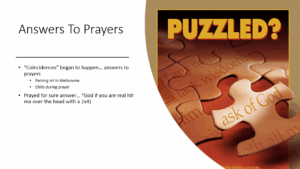
So all these different coincidences started happening—His answers to prayers.
One that I recall very well: I was at a meeting in Melbourne, Florida. I was with a bunch of people in my business. There was a guy I used to do some consulting work with before, and we had stopped doing it for whatever reason. He was being kind of obnoxious to me in front of everybody.
I had to go back and pick up an envelope that was sent to my hotel room. So I went back to pick up the envelope and as I went in my room, I got on my knees and said, “Heavenly Father, if you’re there, would you help me with this situation?”
I drove back to the meeting area in Melbourne, and there was this other fellow messing around in the trunk of his car. Nobody else was in the parking lot. I went over there and spoke to him and said, “Why are we treating each other this way?”
We became friends again. That was an interesting coincidence.
I had dozens of those—and I’m not going to talk about them all. But one thing I really remember vividly: I lived on the Venice Canals—you saw where it was, with water on one side and, a good block away, the ocean on the other side. It was always pretty breezy.
As I was praying, I started getting these chills. Now I know they were the Holy Ghost, but I didn’t know at the time. I started praying with a sweatshirt and sweatpants on—and I still got those chills. I said, “Well, this is really interesting. This is more than just a coincidence.”
But I went to Heavenly Father, and I really said, “God, if you’re there, you need to hit me over the head with a 2×4. I can’t do faith.”
And He did.
It’s something I can’t quite describe, but I can never deny. It’s almost like—you know if you’re shooting marbles, and you take your thumb and kind of flick it to shoot the marble?—well, that happened to my heart. Twice. Boom. Boom.
I stood up, in shock. I knew God was real. He told me in a way I could never deny. He hit me over the head with that 2×4. It was just amazing. But then my next thought was, “Oh, that’s great. I’m so glad I know You’re there… You don’t want me to be a Mormon, do You?”
I didn’t know enough to say “a member of the Church of Jesus Christ of Latter-day Saints” at the time.
Growing Line Upon Line

Well, line upon line, I learned that He did.
The book Drawing on the Powers of Heaven is a really meaningful book to me. It helped me to understand prayer, and answers to prayer, and to get through this time.
Of course, 2 Nephi says, “I will give unto the children of men line upon line, precept upon precept.” If I had been baptized immediately, I would’ve probably been asked to leave the Church the next month. I’m not proud of it—I was deeply, deeply in the world. And line upon line, I learned different things that I needed to change in my life to be able to live more like a member of the Church.

There was experience after experience, so I knew God was real. But the Church was talking about Joseph Smith—this young boy was a prophet? I wasn’t smart enough to know what a prophet was, but it was just hard for me to understand how this person could be a prophet.
And I gotta say, when I first read the Book of Mormon, I didn’t find it that easy. I know people say it’s much easier than the Bible, but I struggled with some of it.
I remember I read all of Alma one weekend. My summary was: they’re good, they’re bad, they’re good, they’re bad, they’re good, they’re bad, they’re good. You could’ve summarized that in a few pages. I realize now the stupidity of my view.
But how could a farm boy be a prophet? And he had this book that I was having a hard time understanding.
The Book of Mormon
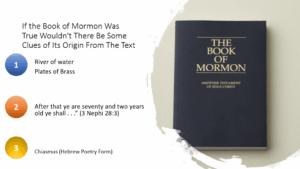
You all know this stuff better than I do. Things like “river of water,” “plates of brass,” “72 years”—these were all things that were hints. But the one that got me was chiasmus.
Jack Welch had discovered chiasmus some years before I was investigating the Church. I was going to church in the same ward as the married UCLA PhD students—one of those PhD students, I believe it was Morgan Tanner (who’s now helping at Book of Mormon Central), gave me a paper on chiasmus. And I read that paper, and I said, “My gosh… he could not have made this up.” And chiasmus has been a blessing to me a thousand times since.
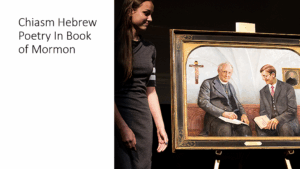
I had the opportunity to speak at the dinner for Jack at his 50th anniversary. I spoke at the dinner before, and it was an incredible event—because without chiasmus, without Jack, I don’t know what my life would be like today. But I can imagine. If I look on Facebook, I can see my high school friends. My best friend in high school—his big joy in life is that he can put a beer keg in his bar, in his house, and he can pump draft beer from the bar. But for the grace of God, that could have been me.
Anyway, I met Jack maybe ten years ago now. We were both working on the board of another foundation. And after a little bit of talking, I realized that he was the one who had discovered chiasmus—that he had helped me to join the Church. So we became fast friends.
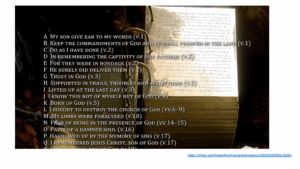
Again, I realize you all know this well. But I always like to show Alma 36. And I’ll tell you why in a minute. Let’s watch Alma 36 and how it’s a chiasm.
Let me tell you why that’s so special to me. In numerous cases, I’ve used the chiasms to demonstrate the truthfulness of the Book of Mormon. I could go on about a whole bunch of them, but one that strikes me more than any other.
I was in the mission presidency in Los Angeles, and we had a missionary who had gotten a copy of the CES Letter. He read it and decided the Church wasn’t true–he was going home. He was in a threesome, and he just sat in his apartment, strumming a guitar, waiting to go home.
Well, I went over, and I picked him up. He and I just drove around Los Angeles, talking for a few hours. Then we parked, and I told him a little bit of my conversion story.
And I showed him a chiasm. I think I showed him Alma 36. I said, “Elder, you and I are pretty smart, right?”
“Oh yeah, yeah, we’re smart.”
“Let’s us do a chiasm right now.”
Well, he decided it was too hard. He ended up staying and serving the rest of his mission.
I’ve used chiasms in many other cases. Many people that we teach in the missions don’t need to see things like chiasmus—but many do. I’ve used it with engineers and other people to, again, show what I know about the Book of Mormon. I always describe it as: this was my logical testimony before I got my spiritual one.
But if not for chiasmus, and not for that paper, and not for Morgan Tanner giving me that paper—I don’t know where I’d be today. But it can’t be pretty.
The Word of Wisdom

And I said I had things I had to change. I literally drank 20 cups of coffee a day—two big pots when I was at home. When I was on the road, big old things. If I didn’t get coffee in the morning, I would stop at 7-Eleven and get the big monster, huge coffee.
I used to say coffee was a vitamin, and I could prove it. If you look at the characteristics of vitamins, they give you more energy, they make you feel better. Coffee did exactly the same thing for me.
And when I was told I needed to give up coffee, I was like, “How can I do that?” I drank alcohol as well, but not much—and because of the aversion to alcohol from my former girlfriend, that wasn’t hard. But coffee was a vitamin.
I used to teach seminars at the National Security Agency. I’d leave Los Angeles on Sunday, get there late Sunday night, and then go teach Monday morning. Well, if you all know, it’s three hours later, so I had jet lag.
I would have two carafes of coffee delivered to my room by room service every day, chug-a-lugging them before I went in to teach in the morning. I was convinced that that’s the only way I could do it—that if I didn’t have coffee, I wouldn’t be able to teach.
Well, as I, line upon line, got to the coffee part, I said, “Okay, I’m gonna do this, and I’m not gonna have any coffee.” And here’s what I found: coffee was a diversion. It was something to do. You could sip it, and you could stir it, and you could do all kinds of things with it. It made no difference in my life.
When I quit coffee, I went through withdrawals. It was several days of headaches and kind of miserable. Coffee had never done anything positive for me. And that was huge. Again, as the Lord walked me through things line upon line, that was a big one for me.
Tithing
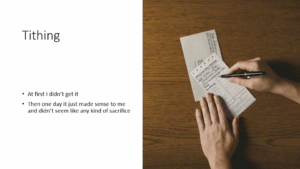
The next one: tithing. Ten percent of your income. You know, I was all about me. Why would I give you—or anybody else—ten percent of my income?
As I was doing something—I don’t remember what I was doing at the time—the Lord, who often speaks to me by sending thoughts sideways (where I’m doing something else and the thought will come into me), it came into me at the time that sales tax in Los Angeles was only six and a half percent. And the thought came: “The cost of tithing after taxes is six and a half percent—the same as sales tax. No big deal.”
Now, I’m kind of embarrassed to talk about that today—that that was the way I got it—but I said, “Okay. I will pay tithing. It’s not that big a deal.”
And the first time I paid tithing—I had some tough times around the time I was starting with the Church. I remember writing that first tithing check. I spelled tithing wrong. That’s how new I was—I wasn’t yet a member.
And I remember hoping something good would happen. And boy, I sure thought good things happened. It was a miracle. Yeah, I’m such a believer in tithing now. Not just for the physical blessings, but for obedience and for a hundred other reasons. But I saw tithing literally change my life.
Fun Without Sin: The Start of Joy
Again, I was in the world. I was deeply in the world. I used to live down the street, in Venice, from a bar called Rebecca’s. And my next-door neighbor used to say, “Let’s walk over and crawl home.” Again—I didn’t really crawl home. He might have sometimes. But I didn’t know you could have fun without sin.
I remember going to an event—probably my first one in the singles ward; I was single at the time. It was wholesome, and it was nice people. And when I got all done, I said, “Wow. I had a good time.” And a good time without doing anything. I didn’t need any alcohol, anything else. I was shocked that you could have a good time in that way.
Yet there were people trying to “save me from the Mormons.” People started warning me: “They’re going to do this and do that. They’re gonna make you wear a little tag…” Which—I actually just got done with a missionary meeting—I’m wearing a little tag right now. But you know, “They’re gonna do all these things.”
And it fascinated me, because I was cleaning up my life, and the people that were warning me—their lives were kind of a mess.
Anti-Mormon Literature
Anyway, I started reading all the anti-Mormon literature I could get. You could subscribe to something by mail, and they would mail it to you. And then a number of other things. It’s way better today than it was back then. The writing was usually terrible. The logic was kind of circular—suppose like it still is today. It was the time of the salamander letter. I got it. I never read the book on the salamander letter—I think I bought it—but it sounded too weird, you know?
And of course, you’d all heard: “Joseph Smith copied other books—the View of the Hebrews,” and all these things. Everybody warning me: “Stay away from these bad people.”
But all I saw were the fruits. By your fruits ye shall know them.
In fact, this reminds me: I was just at the last General Conference. And if you’ve gone to General Conference—you probably all have—you know when you’re going through there, there are people, detractors, trying to “save” you. One of them came up to me just this past April and said, “You can have your porn and be saved too.” And I just… I didn’t know what to say. I didn’t really want porn. But his thought was, “Just be saved. Believe and be saved. And you can do whatever you want.”
I am so grateful to not believe that way. Because if I did, and if I hadn’t gone through line upon line, what I’ve learned—I think I would have been thinking I was saved, and I wouldn’t have been doing anything I was proud of.
Moroni’s Promise

And the the Moroni promise. I was praying to know if I should join the Church. It took five months. And every time I prayed, I’d get an answer: “No, don’t join the Church.”
People told me, “That couldn’t be the Lord. The Lord would never tell you not to join the Church.” My bishop told me Satan was talking to me. But what was happening was—I was being taught line upon line, precept upon precept. I was being changed. And I needed that five months to become at least a minimally acceptable member of the Church.
Well, as time went on, I prayed every month after I knew the Church was real:
“Should I join this month?” And I’d get an answer—I’d get an answer like that in those days. I wish I could still get answers like that. The answer was, “No, don’t join this month.”
So people were saying, “Oh, you’re not listening to the right spirit. The Lord would never say that,” etc., etc.
My Baptism
Well, then in April that year, I got an answer: “Yes. You already know. Go ahead and join the Church.”
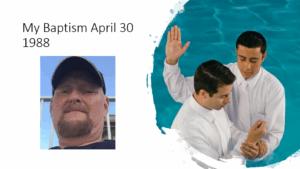
Well, being the hard-hearted guy that I was—and still am, I suppose, to some extent—I waited until the last day of the month. I was baptized on April 30th.
I still remember April 30th, 1988, like it was yesterday. The water was warm. The missionary that baptized me kind of slipped, and we both went under the water. It was the first day of the best of my life.
When I attend baptisms—and I often attend baptisms because of my calling in the Church—I’ll tell people now: “This is the first day of the best of your life.”
I wasn’t perfect—still am not perfect. I was way less perfect than I am now. But it was the covenant path. And I’m so grateful for it. That’s the missionary that baptized me—a couple of years ago.
Support from Ward Members
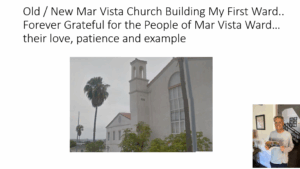
Now, I started going to the Mar Vista Ward there in Los Angeles, and I’m forever grateful. There was love, and patience, and example. In fact, the first time I was called to a mission presidency, I called my first bishop and I said, “Tell me—how did you do it? How did you keep me active?” There was adversity all over—I’ll talk about that in a minute. And he told me the way he did it. But the people of that ward were the most loving, welcoming people. And without them—again—I don’t know what would’ve happened.
The man on the right was Kerry Penrod. He was my first home teacher. He brought me in as part of his family. And I was pretty lonely. I’d lost a lot of my friends because I joined the Church. I remember my next-door neighbor had a boat called Shockwave. It was a transcontinental racing boat. So I used to go out with him sometimes. He came over when I was investigating the Church. He knocked on the door: “Hey, you want to go sailing?”
“Yeah, sure. Where are we going?”
“Just sailing.”
Anyway, we stopped over at a bar near the boat. And I said, “I thought we were going sailing.”
He said, “Yeah, we’re just gonna have a few drinks first.”
Then they kept ordering what they called “shooters”—these little shots of straight alcohol—and lined them up for me. Had five of them lined up. And I said, “Guys… I’m going home.” They never invited me again, obviously.
But that Mar Vista Ward—that bunch of people—were so kind and so inclusive. I still keep in touch with many of them today.
Continued Studying, Praying and Living the Gospel
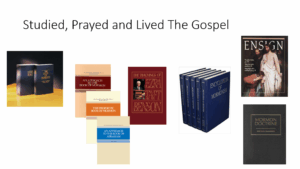
Well, I didn’t really have any family in the area or anything like that, so I started reading—trying to figure out how to be a member of the Church. Shortly after I was baptized, the Teachings of President Benson came out. I used those as my guideposts. I loved Mormon Doctrine, and I wish it were still in print. There are some things that maybe should be changed, but I thought it was great.
The scriptures—I loved them. These are just a few of the books I read. When the Encyclopedia of Mormonism came out, I bought one right away—it was like 400 bucks—but I thought it was great. And I’m so grateful I had that time. I was single. I was lonely in many ways. But I had the opportunity to read.
I don’t get to read as much today, but whenever I come to a group of scholars like you, I’m so grateful for what you do. It’s just incredible. Again, I think I say I’m an applied scripture person. But I do enjoy hearing the details and the depths of things.
By the way, I got to hear the first talk this morning on Isaiah. I thought it was great. And one of the things I learned was: it’s okay to do humor in a scholarly conference! And not only that—it’s okay to do country music!
Well, one of my favorite lines from a country song is: “If you want to make God laugh, tell Him your plans.” I didn’t think I’d get to say that today—but that is so true. Not sure what verse that is… but, “If you want to make God laugh, tell Him your plans.”
Post Baptism Trials of Faith

So I was baptized. I was studying. Things were going pretty well. And then—a trial of faith. A serious trial of faith.
I had been consulting for a company. I was a professional consultant. I’d been consulting for one company without getting paid—for over a year. I was working at the National Security Agency, and they’d asked me to help this company survive because they wanted to use some of what the company had. Well, after some time, the owner of that company promised that the stock in that company would transfer to me, and he would get a royalty. But I was supposed to end up with the stock.
I remember praying before the last session we went to—they were supposed to straighten all this out. I said, “Heavenly Father, please bless me that this all goes well.” And I physically felt the Spirit. I said, “Ah, things are going to go great.”
I went into this meeting—and it was a disaster. He said, “I don’t just want a percentage of what’s done by this company I want to give you stock of—I want a percentage of everything you do in life.”
Well, that was a “see you later.”
So I walked away from this thing. Again, he owed me substantial amounts of money. I thought it was going to be okay—and it was a mess.
Now, looking back on it, it was the best thing that ever happened to me. But at one point, we went to a settlement judge. The settlement judge’s job was supposed to be to get everybody to agree. He said, “Dan, why don’t you just pay the guy…” I forget what royalty amount—“and everybody’d be happy.”
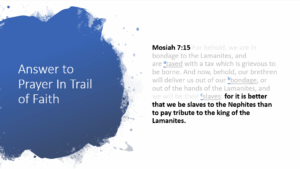
I went into a little room, and I prayed to know what to do. I opened up my scriptures—these were the days of hard copy scriptures—I just went bam, stuck my finger in, and hit Mosiah 7:15:
“For it is better to be slaves to the Nephites than to pay tribute to the king of the Lamanites.”
I went back out there and said, “Judge, I will not pay tribute. If I lose everything—if I go to jail—whatever. I will not pay tribute to him.”
Turned out that was the right thing to do. The whole thing went on for a long time, cost a lot of money, almost bankrupted me—but it all ended up okay.
Now, as I look at that trial—and I just told you the very top of it—one of the things I remember the most: my company was very small at the time, we were doing consulting, and we were building a product. Payroll was coming up, and I needed—it was very little at the time, I didn’t get paid—but I needed $14,000 to pay a couple of employees.
I got on my knees. “Heavenly Father, I need $14,000 by Friday.”
I’d maxed out my credit cards. The second mortgage on my house was done. I didn’t know where I was going to get it.
The next day—by Federal Express—a check came in from GTE, General Telephone and Telegraph who owed us $14,000. We were tiny. We didn’t know they owed us $14,000. It came Federal Express. Nobody sends a check by Federal Express. Ever. It costs more and the longer it takes somebody to cash it, the more money you make on the float. But this one came. I paid my employees. And it was just unbelievable.
Without that trial—without the trial of faith, this whole nightmare of a trial—I wonder if my testimony would be as strong. I hope it would. But I am not so sure. That trial of faith was a large blessing for me, looking back after all these years.
First Temple Recommend

Well, the year went on, and I got my first temple recommend. I was so excited. I remember—I had it in my left breast pocket driving from the bishop’s office to the stake center. And again, I was in the world. I had a potty mouth. I was a lot of things I’m not proud of. And after a year, I hadn’t gotten rid of a lot of that yet. A lot of sharp edges hadn’t yet been cut off. I suppose there are still some on there.
As I was driving over to the stake president’s office—someone cut me off in traffic—and I spewed out a stream of obscenities. And I went, “Oh no.” It was like somebody just hit your knee with a hammer. It just popped up. I didn’t think about it—it just spewed out. I thought, “Well, I should probably just go home.” But I was close enough to the stake center, I thought, “Well, I’ll just go in and face the music.”
I went into my first temple recommend interview. The last question used to say something like, “Is there anything in your life that’s not in harmony?” And I told him what had happened.
This good stake president took my temple recommend. I thought he was going to tear it up into pieces. He smiled and said, “Brother Galorath,, we’re not perfect. We’re just trying to be.” And I had my first temple recommend.
Service Brings Blessings–Enduring to the End
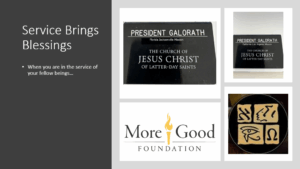
So some people ask, “Why do you do so much? Why are you working with More Good and Book of Mormon Central? Why are you excited to be in the mission presidency—twice?
I would do anything for the gospel. The gospel means everything to me. I would do anything to help others have the joy of the gospel of Jesus Christ. I’m just one person, but I’m trying to do all that I can.
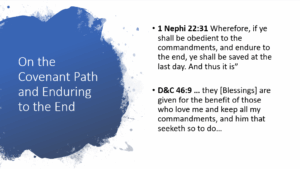
Brothers and sisters, I know this is the Lord’s Church. I don’t just think it, don’t just hope it. I know it. And I know it from experience. I know it from seeing it in other people’s lives. And I know it because He told me—in a way I could never misunderstand or deny. Yeah, the whole gospel of Jesus Christ—I am so excited to help other people find the gospel and stay on the covenant path.
In the name of Jesus Christ, amen.
Q&A
Scott Gordon:
Thank you, Dan, for your time and your testimony. We really appreciate it. We have a few questions from the audience.
What advice would you have for people who are struggling with the policies of the Church that attract highly publicized criticism from others? In other words, you have young people now that are struggling—as you did—with certain items. What advice would you give to them?
Dan Galorath:
Well, my first advice, that would be good for some, maybe not for others, is: if you know the gospel of Jesus Christ is true (and that assumes you do), then the policies must be true as well.
For those that are struggling and wouldn’t use that logic—try living them. Try living the policies and see what happens to your life.
I spend time on TikTok to see what’s happening, and “Under the Banner of Heaven” and those kinds of things, half-truths mixed with error—we know where that comes from.
Some of the things I do—for example, sometimes I’ll send some of the More Good Foundation or Faith and Beliefs videos to people. I know the recorded version of my testimony—the one I just gave you—is being used in Finland for people who are struggling.
Bearing testimony, helping people to look at their realities—especially like I walked through with that missionary, showing them that things really are true. And boy, it’s hard. I wish I had a full answer. I would definitely tell you the full answer. But I can tell you: there is joy in the gospel that doesn’t exist in any other way.
The half-truths used by our detractors are 90% lies, in addition to the half-truths. I realize that doesn’t come out to 100%, but—help people to see the beauty and the power of the gospel.
My testimony has helped a number of people over the years. I’m so grateful.
But you gotta want to believe.
My youngest boy got married during Covid, and he got married in our backyard because the temple was closed. We just had all five of my boys and all five of their wives in the temple for his sealing. And I look at that and they say, “How did that happen?”
Almost 90 percent my wife—but we lived what we believed, and that’s part of it as well. We always did the little things. We always had scriptures and prayers at night—eight o’clock every night—with scriptures and prayers. The kids were little, and, you know, their friends didn’t want to come over when they were older because they knew eight o’clock was scriptures and prayers.
And, you know, when I was home, I always had family. We did the little things. Is that going to solve the problems of the world today? It’s not. But little things can help as well.
Again, I really like the Faith and Beliefs. I love some of the things in Book of Mormon Central that show the truthfulness of the gospel as well, and other things. There’s so many of you that have wonderful, wonderful resources.
Scott Gordon:
So, what advice would you give for helping those who don’t yet see or feel a need for God in their lives?
Dan Galorath:
If you don’t yet have a need for God in your life—we were just working, just before this presentation—I was just working with the social media missionaries on videos that try to help somebody feel the Spirit in 30 seconds. They use music and video and words.
One I really liked talked about, you know, “Are you struggling with the things of the world? The anxiety?” It had sorrow. It had a picture of President Hinckley right after he lost his wife. And in sorrow, in those things, we help them to feel the Spirit. And once they feel the Spirit, we’ve got a little while where we can touch their hearts.
Yeah, I love the Everyday Missionaries book by Clayton Christensen. And I love Love, Share, and Invite. People misunderstand Love, Share, and Invite. It isn’t a phrase—“I’m going to love, share, and invite them.” It is three distinct activities.
The first one is loving everybody—and you’re probably already doing that. The second one, Share, is sharing things about the gospel of Jesus Christ: “Oh, I went to church Sunday and we did blah blah blah,” or “I’m going to the temple on Saturday,” or whatever. Being not afraid to talk about it. And Invite is inviting when the time is appropriate. You know, Elder Uchtdorf taught: “Come and see. Come and help. Come and stay.”
There are Come and See activities all the time in the Church. If you’re speaking in a sacrament meeting, it’s a Come and See activity. Invite people to come. If there’s a ward picnic, invite people to come. If you do it—as Clayton Christensen says—if you do it with the Spirit, nobody will be offended. And if we hide it under a bushel, people are never going to know it.
Scott Gordon:
So, you read anti-Mormon literature right after you were baptized? How did you deal with it?
Dan Galorath:
Before I was baptized, actually, yeah. How did I deal with the anti-Mormon literature as I was studying the gospel? Well, it was pretty obvious then that, you know, it was partly true and partly false.
Now, today—it’s obvious as well to me, because I know more. If I looked at some of the better anti-Mormon literature now, and if I didn’t really want to know, I probably would be discouraged and walk away.
You gotta wanna.
Scott Gordon:
So I have another question for you. Do you show a picture of your younger self to your missionaries now, so they can see what a good prospect looks like?
Dan Galorath:
Yeah… [laughs] Well, I was kind of a geek. I’m not sure I was that great a prospect. You know what we do? We talk about how much better—and I just did it the other day. I bore my testimony in a training meeting, you know, about how my life was before and how my life is after. So that they know, when they go out and try to help people—even though they’re rejected nine times out of ten—they’re doing something good.
When I was in the Los Angeles Mission presidency, Elder Oaks came out and he told us—he promised us—that if we shared the gospel with somebody, even if they didn’t listen, that it would be something—a little chink in the armor—for the next time.
That happened to me. It took over time.
Now, if we open our mouths—if we talk, obviously not in a demeaning way, but talk about the realities of the gospel in a loving way—people may or may not listen. But they won’t be offended.
Scott Gordon:
So just so you know, we had one of the audience members here approach me and say that they too felt really strongly about the Mar Vista Ward. And I have my own testimony, if you want to call it that, of the Mar Vista Ward—since my wife grew up in the Mar Vista Ward. So thank you for sharing that.
And thank you for speaking with us today.
Dan Galorath:
All right. Thank you.
