Summary
Paul Hoybjerg emphasizes the Christian responsibility to build sincere, respectful relationships with individuals of different faiths, backgrounds, and orientations, motivated by a belief that all people are children of God. He outlines five principles for effective bridge-building and and encourages members to “show up,” serve, and foster relationships based on mutual respect and human dignity.
This talk was given at the 2022 FAIR Annual Conference on August 5, 2022.

Paul Hoybjerg is the founding partner of Hoybjerg Law, specializing in advocacy for victims of accidents and abuse. A passionate community builder, he co-founded the Courts and Clergy Lawyers Auxiliary, serves on the board of the Sacramento County Bar Association, and actively fosters relationships across religious, minority, and LGBTQ communities.
Transcript

Introducing Paul Hoybjerg
Scott Gordon: Our speaker is Paul Hoybjerg. He’s the founding partner of Hoybjerg Law. His firm specializes in advocating for individuals who’ve been injured in accidents, as well as victims of abuse. Hoybjerg Law has offices in California, Utah, and Idaho and Mr. Hoybjerg has been published in Massachusetts, Utah, California, and in nationally syndicated magazines. He has been interviewed and presented on multiple podcasts and has appeared on Fox and NBC.
He co-founded the Courts and Clergy Lawyers Auxiliary in Sacramento, which combines the efforts of lawyers from the Jewish, Catholic, Muslim, and Church of Jesus Christ of Latter-day Saints faiths. Mr. Hoybjerg sits on the board of directors for the Sacramento County Bar Association. He has used his connections to build bridges with domestic violence centers, minority and religious organizations, and the LGBT community. Mr. Hoybjerg is passionate about helping restore and respect the human dignity of each individual.
With that, we’ll turn the time over to Paul Hoybjerg.
Presentation
Paul Hoybjerg: Perfect. Well, first of all, thank you for the opportunity to get to speak here today. I apologize I couldn’t be in person; I was actually just out in Utah last week for some meetings and had to be in California this week for a few depositions and a few hearings, so I appreciate the accommodation.
I also want to thank you for the opportunity–I love the mission of FAIR: “Faithful Answers, Informed Responses.” What a wonderful message—that we can ask and increase our faith through questions.
My hope today is that I can provide some answers and suggestions as to how you can build relationships with those of different faiths, backgrounds, and orientations. As members of the Church, it’s critical for us to build relationships with those different than us.
In addition to being members of our local wards, we are members of our local faith communities, local government, local school districts, and local neighborhoods. There are wonderful parts of the gospel which we can share with everyone, and they will only see them if we provide them an opportunity that is inviting and respectful.
Reaching Out to Others
Now, while it can be overwhelming to reach out to those different than us, I can personally tell you of the joy that comes as we love each of God’s children for who He knows them to be. Doing so has helped me develop a deeper relationship with my Savior, Jesus Christ, and understand His nature and His character better.
Now, I’d like to offer five ways that you can build bridges with non–Church-affiliated individuals, groups, and organizations:
- Respect and embrace the reason why we build bridges.
- Embrace your role in this process.
- Respect and embrace the organizations that you are seeking to build a relationship with.
- Utilize and seek opportunities to make meaningful connections when they come.
- Celebrate the differences.
Respecting and Embracing the Reason Why We Build Bridges
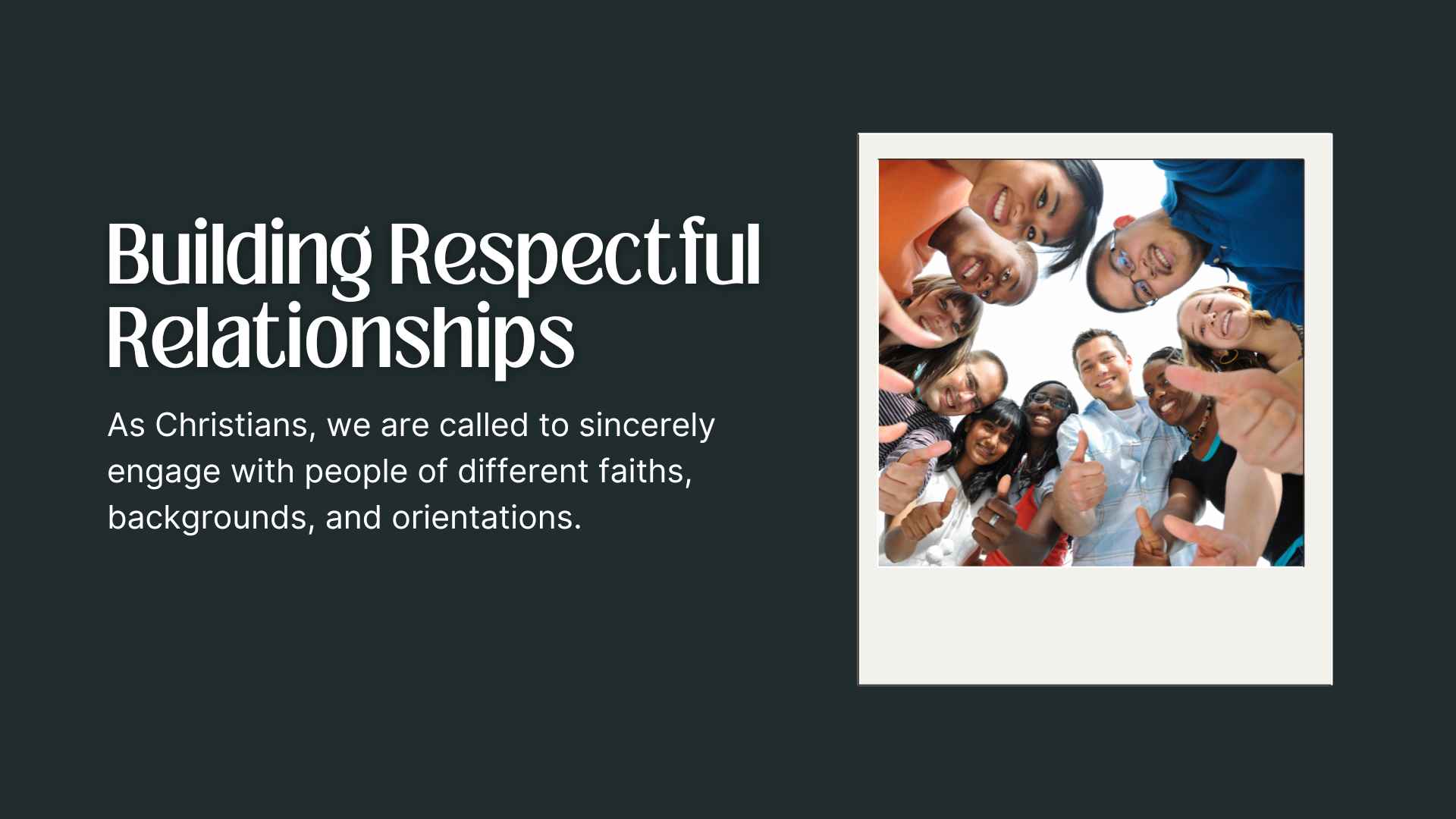
Simply put, the reason why we do so—why we make connections with those different than us—is because we are all children of God. He loves us and asks us to love each of His children.
Christ spent much of His ministry with those different than the traditional follower. He looked at the soul rather than the status.
The two great commandments given in Matthew 22 are to love God and love thy neighbor. Now, I’m no scriptorian, and I have not read the Hebrew translation, but I haven’t read anything that said the requirement of that second part is that they have an active temple recommend. The scripture and the invitation apply to all.
Now, when I reach out to other groups, our motives have to be pure—or else it’ll show. We must approach them with a singular and unequivocal goal: to show them that we believe that they are a literal child of God and that we are there to love them. It has to permeate everything we do and be in every conversation.
Motivation
If we try to build bridges with any other motive—whether it be to try and convert them or for personal gain—it will show. They will see through it. Once they can tell we genuinely care, miracles will follow.
With every relationship that I try to build, my general rule of thumb is that when I approach an individual or organization, I want to research all that I can about them so that I am familiar with their purpose. Then I look at how I can help them accomplish their goals while staying true and faithful to my values.
I don’t ask for something at any point in time in our relationship. I don’t approach these organizations and say, “I want to become friends with you because here’s what you can do for me.”
What I’ve noticed is that as I provide a service, a gesture, or a friendship that is good and kind, the other person will naturally ask, “Paul, what can I do for you?”
Or, as time develops, and we’ve developed a strong enough relationship in which, like a friend, I can share with them what I’m working on and ask them for insight. If they offer help—wonderful. If not, then their thoughts, ideas, and even just camaraderie are enough.
Personal Example
Now, I’ve been fortunate to have friendships with other individuals, groups, and organizations. I can remember early on in my legal career, being invited by an attorney at our office. She told me that she wanted me and my wife to come to a mixer—which, for those of you that aren’t lawyers, is where a bunch of lawyers get together for a social function, typically done at a bar.
She said, “I need you to be there because I can’t talk to people, and you’ll talk to anyone.”
I asked her what the mixer was, and she said, “Well, it’s at this bar, and it’s the African-American Asian Lawyers Association.” And I had to laugh, because I am from a small town in Idaho called American Falls. My grandparents immigrated from Denmark, and my wife is this blonde-haired Bostonian. So, it wasn’t quite the mold that we typically fit.The extent of my diversity is that I speak Spanish fluently.
So, my wife and I went to this mixer, and we laughed the entire way. In fact, we actually sat in the parking lot and thought, “What on earth are we doing?”
Sincerity
Now, while I didn’t know exactly why I was going, I had a clear understanding as to what I was going to do and how I was going to approach people. I wanted to make sure that as I spoke with them, I spoke to them with kindness, respect, and a desire to learn about who these people were. I wanted them to be genuinely listened to and appreciated for their good qualities.
From that single mixer, I met individuals who have become dear friends. It has been those relationships that led me to being asked to be vice president of La Raza Lawyers, which represents all Latino lawyers in Northern California.
The friendships continued, and from there, I developed bonds with the governor’s secretary over appointing judges, a member of President Biden’s cabinet, and even a member of O.J. Simpson’s “Dream Team.” Because of that singular mixer we went to we were able to get an invitation for our J. Reuben Clark Law Society—which is the LDS Lawyers Association—to sit on the board of directors for the Sacramento County Bar Association.
Where It’s Led
Those invitations have continued and I’ve become friends with the LGBTQ Bar president and her wife. We were also able to develop a council where the lawyers from the Catholic, Jewish, Muslim, and LDS faiths could come together and promote and protect each other.
Sometimes, as we start to build bridges, we get invited to certain things—and we have to laugh about it. But as we approach it and understand that the reason why we’re building bridges is to exemplify who we know Christ to be, miracles can follow.
I have noticed that when I approach every meeting with sincerity, love, and charity—which is the pure love of Christ—that miracles follow. Loving God and loving His children is the first, middle, and last step to any bridge-building.
Respecting and Embracing Your Role in the Process of Building Relationships
We have to ask ourselves: what is our role?
My mind goes back to a few years ago, when there was a roundtable put on by politicians, judges, and faith leaders here in Sacramento. We were discussing the Supreme Court case that many of you are aware of, which involved a cake maker and a gay couple. At this meeting, we were to discuss the merits of the case and our individual viewpoints.
Some of the most ardent opponents of religion in California were present at this meeting. I was president of the J. Reuben Clark Law Society and was asked to represent the LDS faith. I spent weeks preparing and agonizing about what I would say.
The day before the event, as I was preparing, I got a call from the Church’s legal counsel. He said, “Brother Hoybjerg, we know you’re speaking tomorrow, and we want to remind you of one thing.”
Now, at this point, I had been losing sleep and studying furiously at night about each topic, attendee, the Supreme Court case, and precedent. I was thinking he was going to say something like, “You’ll be inspired about what to say,” or “The Spirit will be with you.”
But his comment was—and it reminds me of your disclaimer at the beginning of this conference— “Brother Hoybjerg, we want to remind you of one thing:
You are not authorized in any way, shape, or form to bind the Church in any political or legal way. You have no authority on behalf of the Church in any regard. But we’re praying for you, and good luck.”
What Can Evolve and Transpire
As I got off the call, I kind of started to laugh. I thought, “Well, that wasn’t the comment I was expecting the day before.” But it brought a lot of peace to me, and it put into perfect perspective what my role at the meeting was to be.
As 1 Timothy 4:12 says, I was to be “an example of the believers.”
I went into the meeting and had clarity as to what I wanted to say. I was not speaking as an official representative of the Church, nor did I have to use certain disclaimers or rote language. I was Paul—a member of the Church that loved the gospel he followed and knew the value it had. I knew it was worth respecting, preserving, and protecting.
As the conversation went on throughout this panel, there began to be a general consensus that we needed to mold and evolve our beliefs to be inclusive of all other ideas and doctrines.
I raised my hand and shared that there will be certain viewpoints and doctrines from which we will never evolve. But what can evolve and transpire is a building of trust, dialogue, and friendships from which we can make meaningful compromises.
After that meeting—even in meeting with some of the most ardent opponents—they told me that although they didn’t agree with what I said, they respected it and they understood why I said it.
Be an Example
Your role in building bridges is not to change the Church’s position. It is not to apologize for its doctrine. You didn’t make up the doctrine, nor do you need to apologize for it. Your role is to be an example of the believers.
When I get asked tough questions—similar to the ones that FAIR addresses—people say, “Come on Paul, what about X, Y, or Z?” Something in Church history or something with regards to the doctrine–there are some things I don’t have answers for. And I’ve been asked how I can follow something that doesn’t provide all the answers. It’s not my role to know all the answers. It’s my role to love God and to do my best to follow His teachings.
Now, as I’m sure you can imagine, when you get with folks that are not of the Church, you can’t necessarily quote Doctrine and Covenants or a previous conference talk, because it won’t quite connect with them the way that it connects with us. So I’ve found that I use various other resources, including poetry, literature, and also movies.
My Go-To Story
I responded to them with this story:
When I was a kid, my dad tried to inspire me to play hard in sports and give it everything I had. He had me watch the movie Rudy. And for those of you that haven’t watched this movie a hundred times like I have—it’s about a boy who wanted to make the Notre Dame football team, but he was too small and too unathletic.
There’s a line in that movie that applies here. Rudy is talking to a priest as he’s trying to get into Notre Dame, and he asks, “Have I done everything I can do?”—or in other words, “What’s the answer?”
The priest’s response was: “In my 35 years of religious study, I’ve come to two incontrovertible facts: Number one, there is a God. And two, I’m not Him.”
When I get asked about why certain things happened in Church history or why we have a particular doctrine, I share this story and let them know: “I don’t know the answer. But I believe there is a God, and I know He knows the answer. And I trust Him.”
Understanding our role with God helps us understand our role in relationship-building.
By the way, as I’ve shared this story, I have yet to receive an unkind response to this analogy. If anything, it helps put into perspective why I believe what I believe and how I follow.
As you approach organizations, don’t go to convert or change them or try to steer the Church in a different way. Go as a disciple of Christ—and as yourself.
Being Yourself and a Disciple
For me personally, I’m a personal injury lawyer. I help people who get hurt in accidents, listen to them and share details of their lives. I find that as I have a greater love for each of God’s children, it makes me a better advocate. And as I seek truth and I’m unwavering in my allegiance to integrity and civility, it makes me a more honest and effective lawyer. As I strive to learn about others, it helps me interact with them in a way that is inviting and genuine.
Now, as mentioned before, I have offices in California, Utah, and Idaho—with very different demographic populations and very different interests. I’ve found that as I approach various groups, and as I’m not ashamed of my faith, they are much more receptive and respectful. I don’t make a big ruckus when they want to meet in bars or the event is a wine-tasting event. I have some friends that like going with me because whenever alcohol is served, they get my portion. They know who I am because there is no off switch. There is no equivocating.
While they will not always agree or even like what you believe, respect can come when there is a genuine recognition that one’s internal faith leads to a greater respect of human dignity for all.
As I understand my main and primary roles in my life—which is, first, a Christian; second, a husband; third, a father; fourth, a lawyer; and fifth, a neighbor—I’ve found that being good at one makes me better at the other. Embracing my roles helps me build relationships and bridges with those different than myself, as the foundation of each is truth and human dignity.
Embracing the Organizations You’re Seeking to Build a Relationship With
Map out what you want to accomplish and who you can help to get there. Sometimes relationships are formed without planning—like my La Raza connections—but otherwise, have a plan.
It will be exhausting, and you may burn yourself out if you’re trying to help every group you come across. Learn who you want to work with and learn what they need. Look for ways that they can be friends with you without it being too expensive to them.
An example of this is with politicians. If you are looking to get an in with a politician, don’t just have it be an LDS connection. Approach them to attend an event that has multiple faiths, involves youth participation, and provides a greater good. It makes it less risky for them and is beneficial to their own ambitions to be there.
Look for any tie that you have. I’m the Assistant Communication and Public Affairs Director for Northern California, which covers the eleven stakes north of Sacramento. You’d be amazed at how many connections you have through communications and public affairs. The world gets smaller as, inevitably, somebody knows somebody. And then you have a launching point.
By asking them about an organization, you may also realize that there are already connections. Sometimes this helps to not duplicate work that’s already been done.
Study It Out
My dear friend here told me that she approached a food shelter as part of her public affairs work. She said, “Yes, I’m from The Church of Jesus Christ, and we’d like to help you get resources.”
The response was: “Oh, that’s so nice of you, but we don’t need additional help. We get half of our needs from the Mormons and the other half from the LDS Church—but thank you.”
In this way, you need to do your own research. Where it says in Doctrine and Covenants 9:8 to study it out in your heart and your mind. We’ve already talked about the heart part, which is the reason why we build bridges. This, and understanding the organization, is the mind and the logical part. Look at the organization and see what they need and see how you can help them. Respect who they are, what they are doing, and why they are doing it.
Respecting and Embracing the Opportunity to Make a Meaningful Connection
Once you’ve got your heart in the right place and your sights set on the organization you want to work with, look for the opportunity when you can do something that will benefit them and build trust. Those opportunities don’t often come along, so you have to be looking—and move when they come.
Last year, the LGBTQ bar president sent out an email about an event in which the governor’s secretary was talking about how to apply to become a judge. I called the bar president and told them to bring this up at the board meeting and invite the members to attend.
At the board meeting, he said, “We’d like to turn the time over to Paul because he has a cool event to share.”
I responded, “Actually, it’s not even my event, but I know the LGBTQ organization is hosting an event on how to become a judge, and I think we should attend and support each other’s events.”
This was a small act. It was not politically divisive, nor was I taking a political stance—or even really doing anything other than an email and a two-sentence blurb.
The LGBTQ president was shocked and thanked me over the board meeting, which was really cool—to have twenty board members, including members from every minority organization and the governor’s council, see the LGBTQ president thank an LDS member for their kindness.
The following day, she called me and asked me to be on a panel for ways to respect the LGBTQ community at large. I sat on the panel and shared that my faith believes that we are all children of God. My faith is the reason why I treat each member of the community with respect, in accordance with my beliefs and values.
Opportunity
With the Latino community, we’ve gone to different organizations and helped them to promote, fundraise, and build bridges. You will notice opportunities as they come along that you will not think you previously had.
As we get to this point, I would ask you to pray and wait for the opportunity. If it does have a political tie, this is the one thing that I would say: make sure you’re going through the front door—not some side window.
I remember when we wanted to join the Sacramento County Bar Association. Because of my La Raza connections and even just other friendships, we had a strong invitation from all the other board members, but we didn’t get approval from the Church for some time. And we waited.
We waited for years, making sure that we had all the documentation, because we didn’t just want to do something and then later on apologize, or later on ask for permission or for forgiveness. We wanted to make sure that we did it the right way. Because when you build bridges—and you build them on solid foundations that can be repeated—and when you build them on foundations that are clear, concise, and have a strong foundation—then they last.
We were able to get Church approval and, with the help of a few other BYU members, change a few of the J. Reuben Clark bylaws, so that now, not only could we join the bar and sit on that board, but any other chapter throughout the country can do so as well.
Celebrating the Differences
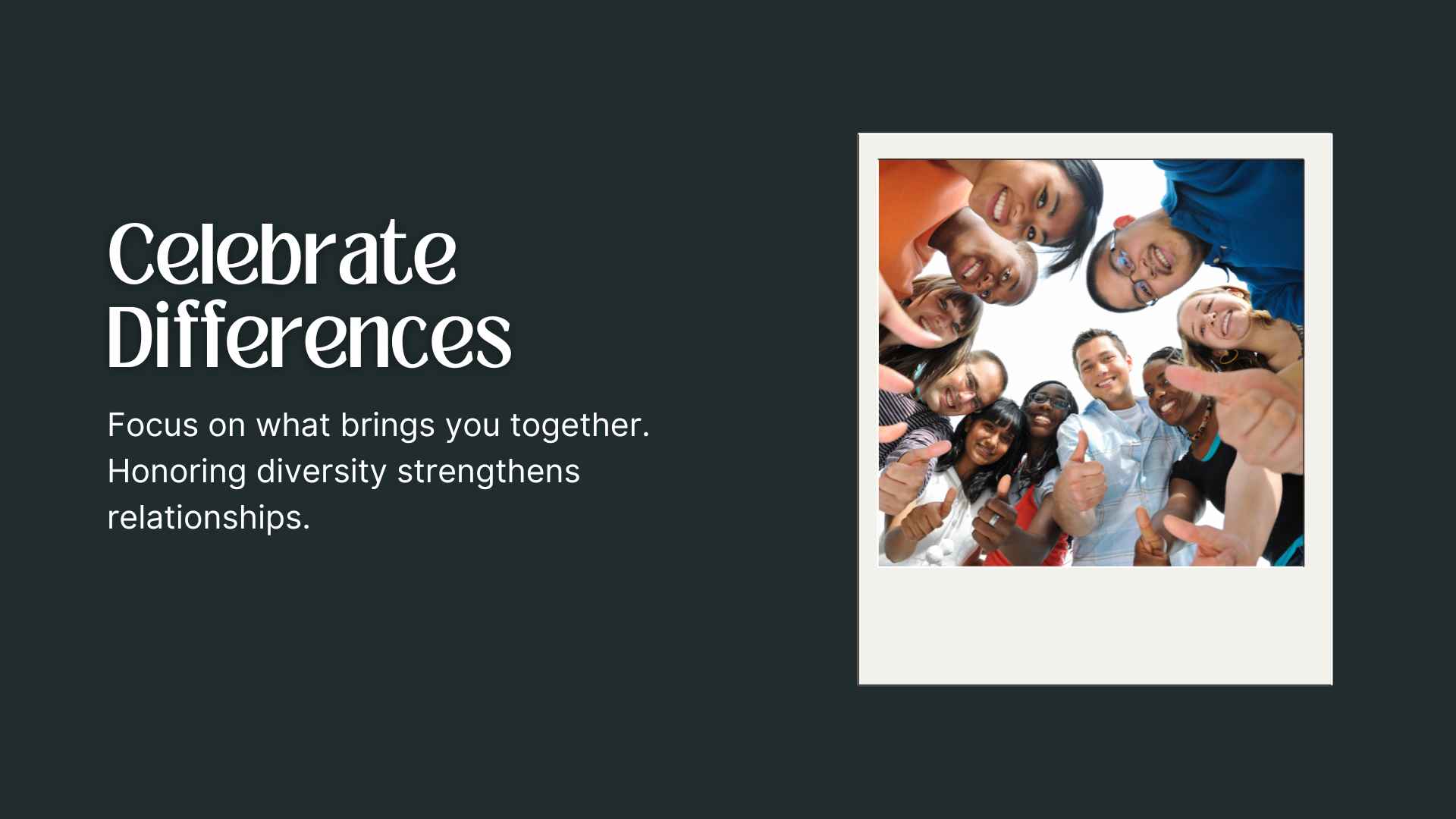
When we talk about this last point—celebrating the differences—I like using the term “respecting human dignity” because it lends itself to encompass all of God’s children and the importance of treating each individual with respect. As we do this, there is a great celebration of respect, tolerance, and peace. Peace is not the absence of differences; it’s the presence of respect.
Now, in your efforts, I promise you miracles. God will give us gentle guidance that will bless every aspect of our lives. There can be a celebration as we become united with those of different backgrounds, beliefs, and orientations—to advocate that all persons are treated with civility. No one should be bullied, beaten, or shamed. We respect and value all of God’s children, as each human has value. We celebrate that we are different.
A few months ago, I got to speak at the BYU Religious Freedom Annual Review. At night, there was a panel moderated by Elder Quentin L. Cook. One interaction was so funny.
The Jewish rabbi said, “It is my belief that when the Messiah comes—”
And the Christian panelist, who was next to him and a dear friend of his, interrupted him and said, “When he comes again. You always forget the ‘again’ part.”
The rabbi laughed and said, “Yeah, for me, when he comes. For you, when he comes again.”
And everyone laughed.
Bringing and Embracing Joy
This joke, and even just this jest, was such a classic and wonderful example to me that even though we have differences, when we have developed a friendship, and when we have developed a respect and even just a mutual adoration, we can enjoy things and there can be joy.
I remember going to a La Raza meeting at the Mexican Consulate. There were over 150 people, and they had passed out to these 150 people shots of tequila. I was sitting there just laughing as I had my little thing of Sprite. They passed out the shots, and they were singing this Mexican song, and I laughed as I said, “You’re a long ways from Idaho, Paul.”
But as I got to be with my friends and enjoy their differences, they knew that I wasn’t drinking tequila, and they knew that I wasn’t there for that. But they knew that I was there to respect and enjoy them.
In the process of bridge-building, I want to remind you: it’s okay to laugh and have fun. You’ll have experiences that you never thought you would have. Embrace them. And keep a prayer in your heart for strength—and for those around you.
With some of our dear Catholic friends, when our son was born, one begged me to be our son’s godfather. I mentioned to him, “Well, that’s not really what we do.”
He said, “Well, I’d be honored if I could. Is there any way that I could be his proverbial godfather?” And I said, “Of course.” Even today, he still jokes around and checks in with me every once in a while to check up on my son.
We can build relationships with other groups that are wonderful.
Acknowledging the Challenges
Now, while there is joy in the process, I will mention it’s not always easy. It’s uncomfortable and stretches us beyond our comfort zone.
I remember when we were kids, we would get out of the tub, and we would tell my mom, “Mom, I’m cold!” And she would say, “That’s okay. That’s how you should feel. If you didn’t feel that way, I’d be worried.” She would then wrap us up in a warm blanket, and the discomfort would quickly disappear.
If we’re truly reaching out to those different than us, it’s okay to feel an awkwardness or a level of discomfort. That’s how we should feel—or we’re not stretching enough.
I cannot tell you how many times I’ve gone to meetings where I’m the only one that looks like me, believes like me, or has the same interests. I’ve felt alone and uncomfortable. But my sweet mother’s words come back to me—and with a prayer, I am wrapped up in the warmth of God’s love, and I gain strength and purpose.
Closing Remarks
I want to thank all of you for being here, and for your efforts, and even just your desires to participate and learn in a place like FAIR. You’re in my prayers, my dear friends, and I pray for your courage and for your success. Thank you again.
Audience Q&A
Scott Gordon:
What do you think is the best way to handle hostile confrontations? You know, sometimes you come in with the best of intentions, and you’re met with hostility.
Paul Hoybjerg:
That’s going to happen. And I think you have to prepare for that hostility. Often, what I’ve found is that you go to the base of what you can build upon. It’s just like the LGBTQ bar president told me: “Well, you know, Paul, really our community gets bullied a lot, and you guys just don’t understand.”
And I told her about an experience that I had in which we had a kid in the Bay Area who, because he was a member of our faith, really got targeted and really got bullied to the point that he became suicidal because of how hostile people were to his faith and to his beliefs.
I mentioned that to her, and I said, “Do you think that’s okay—for there to be bullying against people just because of their faith?” And she said, “Well, no.” And I said, “Don’t you think it’s important for all of us to have that respect?” She said, “Well, yeah. Of course I do.” So I think that when you meet that level of hostility, go to the basics of human dignity—almost where they can’t really refute it. Look for ways that you can draw a meaningful connection.
Because I’ve gone into really hostile environments, and the best way that I’ve handled it is to get to a base that we can agree on—some sort of principle that we can agree on, or some sort of joint project that we can work on together. Whether it be a domestic violence center, a food shelter, something like that—something that we can use to try and make that connection.
And if that doesn’t work, what I will then share is: “Let me tell you the reason why I’m doing this. I’m doing this because I want to preserve and protect doctrines that make me want to treat you better. That’s why I’m here. I’m not here to convert you. I’m not here to change you. Nor do I expect you to change because of me. But I do expect you to have respect for me—and that’s what I want to extend to you.”
Scott Gordon:
Elder Holland has said that as we show love, we should avoid being an advocate of LGBT actions. Is there something you specifically wouldn’t do that crosses the line from showing love to advocating? Or do you have any guidelines to give us on that?
Paul Hoybjerg:
Definitely. Definitely. I think it’s one of those things that—for us—we don’t equivocate on doctrine. The doctrine of what is instructed in the temples with regard to sexual relations is very clear. So I think that what we can do is extend our arms in love and mention that we believe we’re all children of God. But I think when it comes to equivocating or saying how the Church should change its position, or where the Church has been wrong—that crosses a line. And I don’t go there.
Oftentimes when people ask, “Well, do you believe that LGBT folks should be allowed to be married in the temple?”—that’s when I get back to what my role is. That’s not really my place. For me personally, I believe that God loves each and every one of His children, and I’m cognizant and aware of what every person is dealing with and how they choose to live their lives. But that’s not really my role.
So when they ask, “Do you want to take this position or that position?”—my position has been: We’re children of God, and we love them.But from a Church doctrinal standpoint, I don’t like deviating. And I think that President Oaks has been very, very clear: that the Church will change its position on certain parts of the deal with the LGBTQ community when God changes His position. And until that happens, they are not authorized to change their position. And that’s how I feel too.
Scott Gordon:
Have you encountered personalities that are disrespectful regardless of your actions? How do you respond to that—where they just don’t back down?
Paul Hoybjerg:
Oh, definitely. At that one meeting I mentioned, where I was the LDS voice, one of the other people there said to me afterward: “Hey, I really respected what you said. But just so you know—we pressured you to change your position on a few other issues, and we’ll just continue to pressure you until you change.”
And at that point, I just kind of smiled at her and said: “You know what? We love you, and we appreciate you. But just so you know, these doctrines that I believe in—they don’t come from man. They come from God. And we’ll do our best to follow Him.” And I shook her hand and wished her the best. To be honest with you, what I had done beforehand—before that meeting—and it was my sweet wife’s idea: our daughter was being blessed, and I had actually invited every member of that panel to our baby blessing and to our home afterward. None of them showed up.
But afterward, I said, “Hey, if ever you’re in the Roseville–Rocklin area, we’d love to have you over to our home.” And she was kind of taken aback by that, and said, “Okay.” And I said, “Let us know.” We would have loved to have had her in our home—because for all the things she may hear about the LDS faith, if she saw my sweet children and my sweet wife, I think she’d be able to see that there’s some value there.
Scott Gordon:
If we have an interest in building bridges—whether it be with other faith denominations, nonprofit work, the LGBTQ community, or any of those areas—and we don’t know where to start. Just for our average member, where we don’t have a position of communications director. We don’t have a position that’s outlined in the Church. Where should we start?
Paul Hoybjerg:
Show up. Show up to an event. Show up to a joint event. Just show up.
One thing that I’ve read about Brigham Young and his early interactions with the Church is that he showed up early and stayed late. Show up to these other organizations and just offer to set up or offer to take down. Even as an individual member, notice what different organizations are doing. Whether it’s the Boys and Girls Club, the YMCA, even a local food shelter—show up. Help them set up.
Sometimes members say—especially in tough economic times—“Well, I don’t have thousands of dollars to donate to these organizations.” Well, if you have a Saturday morning, call them and say: “Hey, I’m just a member here. I’m just a person here. I’d love to be able to help out.” Even if it’s just sweeping or some sort of maintenance work for them, that can be the most effective way to make an in.
Rarely do I go into these organizations and mention my official title with the Church—because I’m not trying to act as the official representative of the Church. And also, they’re kind of on guard, if that makes sense. It seems like I want something.
The Latino organization that I approached—I remember talking to them, and they said: “So do we have to pay tithing? We know that you guys do tithing. Do we have to pay tithing if you guys help us out?” I thought, “No! We’re literally offering to give you guys some extra food from the Bishop’s Storehouse. No—this has no ties to it.”
So I think even for the individual member, that can be the most effective thing—because you’re not going with any motive other than just: I love God. I love my neighbor. And this is a way to start.
Scott Gordon:
Well, I do know, going along with your comments, one thing that every Latter-day Saint is really good at is setting up and taking down chairs. So we have lots of practice. And vacuuming floors.
So, we really appreciate your time and the information you shared with us. Thank you very much.
Paul Hoybjerg:
Thank you very much. I really appreciate all of you. And feel free—if ever you have any questions—let me know. I’m always happy to be a resource for you.
Endnotes & Summary
In Respecting Human Dignity – Tools to Build Bridges and Celebrate Differences, Paul Hoybjerg emphasizes the Christian imperative to foster sincere and respectful relationships with people of all backgrounds, faiths, and orientations. Drawing on personal experiences as a lawyer and community advocate, Hoybjerg shares five principles for effective bridge-building: respecting the reasons we connect, embracing our role, understanding organizations, seeking meaningful opportunities, and celebrating differences. He inspires listeners to reflect Christ’s love in every interaction and demonstrates how these efforts can transform communities and deepen personal faith.
📖 Books Mentioned or Thematically Relevant:
(This talk doesn’t directly reference specific books, but for FAIR’s bookstore you might recommend:)
- 📖 Bridges: Ministering to Those Who Question
A guide for engaging with those who have doubts or different perspectives, rooted in compassion and understanding. - 📖 The Spirit of Truth: A Response to Criticisms of the LDS Faith
Addresses tough questions about Latter-day Saint beliefs while emphasizing respectful dialogue and faith-building answers.
All Talks by This Speaker
coming soon…
Talk Details
- Date Presented: August 5, 2022
- Duration: 35:04 minutes
- Event/Conference: 2022 FAIR Annual Conference
- Topics Covered: Paul Hoybjerg FAIR talk, LDS bridge building, Mormon LGBTQ dialogue, faith and respect differences, CES Letter LGBTQ Mormon response, Mormon Stories religious liberty, building community across faiths LDS, Mormon apologetics human dignity
Common Concerns Addressed
Are we compromising doctrine by engaging with diverse communities?
No. Engagement and friendship are based on love and service, not doctrinal compromise.
What if others are hostile to our faith?
Focus on shared human dignity and stay rooted in the principles of charity and authenticity.
Apologetic Focus
True discipleship involves outreach, not withdrawal.
Respect for differences does not require doctrinal surrender.
Building bridges fosters opportunities for meaningful dialogue and testimony.
Explore Further
coming soon…
Share this article
