Taking the Best Arguments for Atheism Seriously
Tarik Lacour
Taking the Best Arguments for Atheism Seriously
August 2022
Summary
Tarik Lacour examines two of the strongest philosophical arguments for atheism—the problem of evil and divine hiddenness—and discusses why they deserve serious attention from Latter-day Saints. He suggests that while atheistic arguments are formidable and made by highly intelligent thinkers, there are thoughtful, reasonable ways for believers to respond without dismissing the force of these challenges.
Introduction
Scott Gordon: Tarik Lacour is a PhD student in philosophy and an MS student in psychology at Texas A&M, as well as a member of the Lifespan Cognitive and Motor Neuroimaging Laboratory, which is under the direction of Jessica Bernard. His primary research interests are in the philosophy of biology, cognitive science, and bioethics. When he is not brooding about the implications of naturalism and evolutionary biology, he’s spending time with his daughter, Chloe, and his wife, Eliza, who is also expecting another daughter in November. With that, we’ll turn the time over to Tarik.
Presentation
Tarik Lacour: Just a few points of order before I get started here. So, my wife, who’s not with me today because she’s watching our daughter — and as Scott mentioned, we’re also expecting another one — she’s an anesthesiologist. She puts people to sleep for a living. I’m a philosopher of biology and a High Councilor, so I’ll put you to sleep for free.
But, another serious point: my friends Jennifer Roach and Robert Boylan — Robert’s not with us — so Jen said she would pay me ten dollars if I cried during this talk. And Robert said he’d match that if I cried while giving testimony about the B-theory of time. I can assure you neither will happen. Or if it does, it’s not for the money.
So this talk is on philosophy. It’s a little denser, so if you’re getting confused at all, make sure you pay attention to the slides and you should be able to get along just fine.
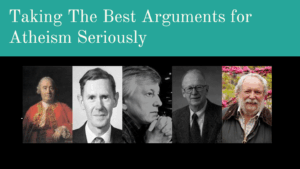
Prominent Philosophers
Let me talk first a little bit about the luminaries that are on these photographs. So you have David Hume, who’s my favorite philosopher, John Mackie, JL Schellenberg — who are two very prominent atheist philosophers of religion — William Rowe, another prominent atheist philosopher, and on the very end in the beard is Michael Ruse, who is one of the founding fathers of philosophy of biology and has an influence on some of my answers to these problems.
So, here we go.
Before I begin this talk, I want to dedicate it to some friends of mine: Liz Goodnick, a professor of philosophy at the Metropolitan State University of Denver; Benjamin Watkins of the Real Atheology podcast; Emerson Green of Walden Pod; and Jeffrey J. Louder, founder of the Internet Infidels.
As you can tell from the names of the respective podcasts and websites, all these people are atheists, naturalists, and secularists. Despite our differences, we’ve always been able to talk openly and frankly about our respective beliefs and differences, and happily, we’ve always come away from our discussions with mutual respect, intelligence, and integrity. Without hesitation, they have made me a better philosopher and a better Christian. I appreciate your friendship — I don’t deserve it.
The Best Arguments for Atheism
My topic for today is The Best Arguments for Atheism.
In June of this year, a Gallup poll found that 81 percent of Americans believed in the existence of God. While that is an overwhelming majority, it is down six percent since 2017. Belief in God is down due to more factors than I can identify and discuss in this brief period. Still, in recent decades, there has been a flurry of scholarship on the atheistic side of the philosophy of religion, giving arguments against the existence of God.
When I say “explosion of scholarship,” I do not mean the New Atheists such as Richard Dawkins, Christopher Hitchens, and Sam Harris. They give little argument for their positions and instead relish in ridicule and caricature. No, I am thinking of people like J.L. Mackie, J. Howard Sobel, Graham Oppy, Paul Draper, and J.L. Schellenberg, who are not polemical in the slightest but take the views of their interlocutors seriously and give arguments that will make even the devout believer pause — if they are sincere. It is with their work that I wish to engage.
Many arguments have been given for atheism. Still, I will focus on what other philosophers consider to be the two strongest arguments: the problem of evil and divine hiddenness. Whether you have read any philosophy of religion or not, you have likely heard some version of these arguments throughout your life.
The Problem of Evil
Let’s begin with the problem of evil.
The problem of evil is the problem of reconciling how an all-good, all-knowing, all-powerful God could allow the world to be imbued with pain and suffering. My philosophical hero, David Hume, put the problem succinctly in his work Dialogues Concerning Natural Religion:
“Epicurus’s old questions are yet unanswered. Is God willing to prevent evil but not able? Then he is impotent. Is he able but not willing? Then he is malevolent. Is he both able and willing? Whence then is evil?”
Typically today, there are two formulations of the problem of evil: the logical version and the evidential version. Allow me to outline each and respond to them.
The Logical Version
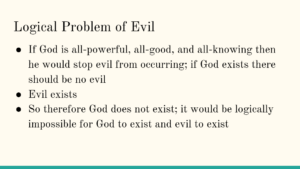
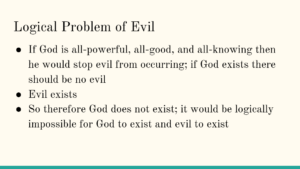
The logical version of the problem of evil states that there is a logical contradiction between evil and God’s existence. If one exists, then the other cannot exist. J.L. Mackie best articulates the logical version in his famous paper Evil and Omnipotence:
“In its simplest form the problem is this: God is omnipotent — that means all-powerful; God is wholly good; and yet evil exists. There seems to be some contradiction between these three propositions. So if any two of them were true, the third would be false.”
And traditionally, the one that is attacked first is the first premise — that because God is perfect and all-powerful, he can create a world in which there is no evil or suffering.
The most famous argument against the logical version of the problem of evil comes from Alvin Plantinga and is known as the Free Will Defense.
In short, Plantinga argues that if God gives us free will, then he cannot guarantee that the world will not contain evil, because God cannot make us freely do whatever he wants.
Plantinga’s Writings
In his book God, Freedom, and Evil, Plantinga writes:
“A world containing creatures who are significantly free and perform more good than evil actions is more valuable, all else equal, than a world having no free creatures at all. God can create free creatures, but he can’t cause or determine them to do only what is right. If he does so, they are not significantly free at all; they don’t do what is right freely. To create creatures capable of moral good, therefore, he must create creatures capable of moral evil. He can’t give these creatures the freedom to perform evil and at the same time prevent them from doing so. The fact that free creatures sometimes go wrong, however, counts neither against God’s omnipotence nor against his goodness, for he could not have forestalled the occurrence of moral evil only by removing the possibility of moral good.”
At this point, you may think I can close the talk. Plantinga has buried the logical version of the problem of evil, and we can move on.
Not so fast.
Moral Evil and Natural Evil
A majority of philosophers of religion today indeed think that the logical interpretation of the problem of evil is now dead. For example, Paul Draper, who is a prominent atheist philosopher of religion, writes in a footnote to his paper The Distribution of Pain and Pleasure as Evidence of Atheism the following statement:
“I agree with most philosophers of religion that theists face no severe logical problem of evil.”
If even the atheists have given up the logical version of the argument, isn’t that game over?
However, philosophers such as Mackie, Oppy, Sobel, and I are not persuaded of this.
One problem for this defense is that it addresses moral evil but not natural evil. Natural evil is the type of evil that comes from the world being the way it is. Think of earthquakes, diseases, hurricanes, etc. They are not a matter of our free choice. So even if Plantinga’s argument succeeded, it would still fail to explain why the world is such a chaotic place where great suffering comes about that is not our fault at all.
Libertarian Free Will
However, the main trouble for me comes from the fact that this argument is predicated upon libertarian free will.
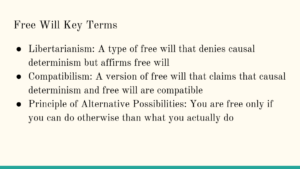
Libertarian free will is a view of free will that argues that causal determinism—the view that, given the past and the laws of nature, the future can only occur in one way—is false, but despite that, we have free will.
In addition, Plantinga affirms the principle of alternative possibilities: given the same state of affairs a person is in, they can choose between doing one thing or the other, but it is entirely up to them.
To illustrate this fact, let’s presume we could rewind the clock to the beginning of me giving this address—that’s probably what Scott would actually want to do: rewind the clock and just end it after Brother Foster’s presentation. If determinism is true, then it wouldn’t matter how many times you rerun the clock—the events would play out the same. If indeterminism is true, then it could vary each time.
Whether determinism is true or false is an open question in physics, with some versions of quantum mechanics, such as the Bohmian and Everett interpretations, affirming determinism, and others opting for indeterminism. However, fields such as neuroscience and psychology, which are more directly related to the question of human behavior, tend to affirm determinism.
Example
A good example of this would be the existence of illusions. You’ve probably seen this: while driving on the road, it seems wet even though you know it’s not. And even after you know that fact, you still keep seeing the illusion, kind of showing that it’s determined—it’s not really up to you.
While it’s true that Latter-day Saints have tended to reject causal determinism, it should be noted that ancient and modern scripture are silent on the issue. What scripture affirms is moral responsibility.
So, we want to view a free will that demonstrates moral commitment but is compatible with determinism being either true or false. One idea of this type of free will, known as compatibilism, is to say that if what I do is voluntary—that is, not forced by someone or something else—then I have done so freely.
Another Idea
Another is that we, as machines, have degrees of freedom—that is, we have multiple capabilities for responding to different states of affairs. As the philosopher and cognitive scientist Daniel Dennett wrote:
“Contrary to the familiar vision, determinism does not erode control. The Viking spacecraft is as deterministic a device as any clock, but this does not prevent it from being able to control itself. Fancier deterministic machines can not only hold themselves; they can evade the attempts of other self-controllers to manage them. If we are deterministic devices, we need not on that account fear that we cannot also be in control of ourselves and our destinies.”
Both views are compatible with causal determinism being true or false. As determinism may be true, and we are obligated to affirm moral responsibility, we should be compatibilists rather than libertarians.
(And just so we’re clear, libertarianism about free will has nothing to do with politics—just throwing that out there.)
Even If…
But even if libertarianism were true, Plantinga’s argument would still not be sound. Why not? Because libertarianism does not entail the principle of alternative possibilities—that is a separate contention, and certain philosophers, such as William Lane Craig—a virtual clone to Plantinga—reject it.
So even if we were to grant that we are libertarian free agents—we aren’t, but let’s keep kidding ourselves for a moment—this would still not make Plantinga’s argument sound, because God could have given us libertarian freedom without giving us the power to do significant evil.
For instance, God could have created us with the ability to do evil, but made it so that we are unaware of having the power, and thus always do good—without God making us do good.
And indeed, an omnipotent being could bring about this state of affairs—yet He hasn’t. This shows that the Free Will defense will not save us from the coal mine, upon closer examination.
Mackie concludes in his work The Miracle of Theism:
“In short, all forms of the Free Will defense fail, and since this defense alone has any shot of success, there is no plausible theodicy on offer.”
(Theodicy would be trying to explain why God allows evil to happen in the world.)
An Obligation to Answer
While I agree with Mackie that the Free Will defense will not succeed in defusing the Logical version of the problem of evil, he would be overplaying his hand a bit to say there was no answer. Fortunately, he continues:
“There may be some way of adjusting these which avoids internal contradiction without giving up anything essential to theism, but none has yet been presented, and there is a strong presumption that theism cannot be made coherent without a severe change in at least one of its central doctrines.”
As Latter-day Saints proclaim the restored gospel to every creature, we are always obligated to answer those who have questions—and this is even more pressing in the case of someone like Mackie.
So how do we respond to this argument?
The Nature of God According to Latter-day Saints
First, it is essential to note that the type of God Mackie argues against in his first premise is not the type of God that Latter-day Saints believe in. Mackie states in his opening chapter that the type of theism he is disputing is the type defended by people such as Richard Swinburne, who say that God is:
“A person without a body, that is, a spirit present everywhere, that is, omnipresent, the creator of the universe, perfectly free, able to do anything, that is, omnipotent, knowing all things, that is, omniscient, excellent, a source of moral obligation, eternal, a necessary being, holy and worthy of worship.”
By contrast, the God of the Latter-day Saints is described more in terms like this: the ruler of the universe, the greatest conceivable being, a person with a body, worthy of worship, morally perfect—that is, a person whose characteristics we would consider to be the best and we would most like to replicate—omnipotent (that is, all-powerful), omniscient (that is, knowing all things past, present, and future), and the only being of a species with whom we have to do—that is, while acknowledging that there are other beings of the same class, we only worship this particular being.
So one way of dissolving the problem Mackie poses is that while such a problem may exist for other Christians, since Latter-day Saints do not believe in the same type of God, the problem does not exist for them in the same way.
A Better Answer
However, this response—while technically true—would be more of an evasion than an answer. So let’s try to do it better.
Mackie assumes in premise one that God is all-powerful, and since He is omnipotent, He can create a world where there is no evil. The problem Latter-day Saints could raise is twofold.
First, this assumes creation ex nihilo, which Latter-day Saints explicitly reject. Like Mackie, Latter-day Saints are materialists and affirm that matter is eternal and uncreated, which is consonant with current physics.
Second, in Latter-day Saint theology, God may not even create people—they may be necessary beings. And if they are metaphysically necessary—that is, they don’t come into existence or pass out; they are just there—then God can’t make a world in which they don’t exist and suffer pain.
This view—that we are all needed in some sense—has been defended by Blake Ostler and is consonant with process philosophy, which is a type of philosophy that’s really big on creativity and becoming, which Ostler also supports in his work.
An Option
Given this, the first premise as Mackie formulates it is incorrect. Whatever it means to be all-powerful, if God cannot create nor coerce intelligence, that is no moral defect of God if they do wrong at some point, as they are not His creation.
While I don’t fully accept this view, as I agree with Hume that the notion of a necessary being is problematic, it is a live option for Latter-Day Saints and allows them to escape the thrusts of Mackie’s argument.
Skeptical Theism
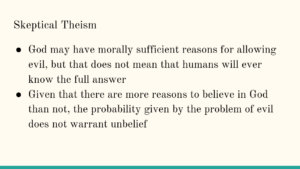
If you are a Latter-Day Saint but not a process philosopher, but are some type of a naturalist, then there’s another avenue open to you. That is the approach that is known as skeptical theism: the view that while God may have morally sufficient reasons for allowing evil and suffering in the world, it may be the case that humans will never know entirely what the reason is.
Ostler criticizes this view in his most recent book Exploring Mormon Thought: God’s Plan to Heal Evil, which I highly recommend you all read. But ironically, Ostler admits in his preface that the skeptical theist view does have some plausibility:
“The problem with attempting to answer these questions” (meaning the problem of evil) “is that the only honest answer we can give is that we do not know. Lacking any clear revelation on the matter, we are left to struggle, doubt, and suffer through this challenge. Perhaps even worse, when we attempt to provide an answer, we often justify and even defend the evils that occur in the world.”
This is what the skeptical theist affirms: God exists, evil exists, and while God may have morally sufficient reasons for allowing the evils to occur, it does not mean that we will ever know the complete answer. However, we are still justified in believing in God because there are other arguments or reasons in His favor that make His existence more plausible, even in light of the logical problem. So it shows that the existence of evil and that of a loving God are not logically incompatible.
Evidential Argument of Evil
Like I said previously, the Logical version of the problem of evil is not the one that is viewed as the primary challenge to theism these days. Instead, it is the evidential problem.
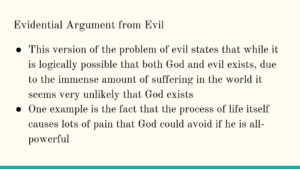
Unlike the Logical problem of evil, the evidential problem allows that it is logically compatible that God and evil coexist, but given the immense amount of pain and suffering in the world, it seems unlikely that God does exist.
Two examples are worth recalling.
Before I share this example, I should remind you that I actually live in Texas, so this one’s very close to home. On May 24th of this year, a gunman walked into a school in Uvalde, Texas, and killed 19 children and two teachers. As a father of a small daughter who has another infant on the way, as I hugged my daughter that night, I thought of all the parents who would never have this opportunity again, and understood why in such a moment a person could believe that such an act was unjustified—if a loving God exists.
Now, to be clear, the problem of evil, whether logical or evidential, has never bothered me. But in times such as this, it is not hard to see why it could affect others. Such an effect is not unreasonable.
Darwin
Let’s move away from the human element for a moment. As my friend Spencer Marsh (he’s in the audience somewhere) and Walker Wright will tell you, I am as hard-nosed a Darwinian as you will ever meet. As such, I am a science advocate of evolution by natural selection acting upon random genetic mutation. I consider it the hallmark theory of the scientific age and would award Darwin the award of “best idea ever,” as this theory brings so much together.
Darwin famously concludes in his book On the Origin of Species that there is “grandeur in this view of life,” so he’s very optimistic about it.
Be that as it may, Darwinism is a brutal way of life—and of bringing about life. Think of the spider wasp. This wasp stings a spider to paralyze it, then lays eggs in it. After the larva hatch, they eat the spider while the spider is still alive.
I am sure that many of us—including myself—are not big fans of spiders. Can I get an “amen”? Yes? Okay, off topic. Even just reading the part of Harry Potter and the Chamber of Secrets where the acromantula (these are the giant spiders) capture Harry Potter and Ron Weasley is enough to give me night sweats throughout the week—but I digress.
The point here is that if a loving God exists, why use such a laborious process as evolution by natural selection to bring about life? Indeed, a loving God would make sure nature was not “red in tooth and claw.”
Several prominent philosophers such as J. Howard Sobel and Paul Draper have defended the evidential argument from evil, but I will focus on the argument’s original formulator, William Rowe.
Rowe’s Opinion
In his paper The Problem of Evil and Some Varieties of Atheism, Rowe structures his opinion in this way:
Premise one:
“There are instances of intense suffering that an omnipotent, omniscient being could have prevented without thereby losing some greater good or permitting some evil equally bad or worse.”
This is an empirical premise supported by the examples I outlined. An omnipotent, loving being could make a world where wasps could reproduce without causing intense suffering to spiders and could also prevent a shooter from massacring small children and teachers.
There must have been some way that this could have been done. It would be difficult to deny this premise prima facie—but I’ll focus on it in a moment.
Premise two:
“An omniscient, wholly good being would prevent the occurrence of any intense suffering it could, unless it could not do so without thereby losing some greater good or permitting some evil equally bad or worse.”
Conclusion:
“Therefore, there does not exist an omnipotent, omniscient, wholly good being,” or in other words, God does not exist.
Premise One
Let’s begin with this first premise.
Again, Rowe aims at a different God than the one envisioned by Latter-Day Saints, but the evidential argument deserves a response. The first premise of Rowe’s argument assumes that God can create just about any world that He wants to, but that is far from clear in the Latter-day Saint view. As a material object, God will be subject to physical law, and it may be that the type of creatures He creates or forms cannot be done other than through these methods.
This means that evolution by natural selection may be the only means God has of creating sentient life like us, so the pains brought on by the struggle for existence are unavoidable.
This point has been raised by the atheist philosopher of biology, Michael Ruse, in an interview for the New York Times that he did with Gary Gutting in 2014. Gutting asked Ruse the following question:
“Do you think that evolution supports the atheistic argument from evil? It makes no sense to think that an all-good, all-powerful God would have used so wasteful and brutal a process as evolution to create living things.”
Ruse’s Interview
Ruse, who is as ardent a Darwinian as I am, said this:
“I have never really thought that the pains brought on by the evolutionary process, in particular the struggle for survival and reproduction, much affect the Christian conception of God. For all of Voltaire’s devastating wit in Candide” (that’s a book where Voltaire kind of makes fun of these types of things), “I’m a bit of a Leibnizian on these matters.
“If God is to do everything through unbroken law—and I can think of good theological reasons why this should be so—then pain and suffering are part of it all.
“Paradoxically and humorously, I’m with Dawkins here. He argues that the only way, naturally, you can get the design-like features of organisms—the hand and the eye and consciousness—is through evolution by natural selection brought on by the struggle. Other mechanisms don’t work. So God is off the hook.”
There’s another arrow that the Latter-day Saints have in their quiver against Rowe and other defenders of the evidential problem of evil. All defenders of the argument assume creation ex nihilo—and that we come to earth with no say in the matter. Now, this is brought forward very strongly by people like Jean-Paul Sartre, who say we’re just thrust into existence.
Karamazov
After reading the point that Ruse and I made, Ivan Karamazov—he’s one of the primary characters in The Brothers Karamazov—could still wail:
“Yes, perhaps God cannot create us without the suffering brought on by evolution, but why did he do it in the first place if he knew there would be so much suffering. Wouldn’t it have been better not to create anybody?”
First, spirits may be eternal and don’t come into being; they are just necessary. So, in truth, there is no creation, and God is not responsible for your being in existence. This is the view Ostler and others have defended, but, as I mentioned, I’m skeptical about that view, though it’s very plausible, but regardless, we can agree that we all existed before our earthly conception. We knew what lay ahead of us: it would be a life of suffering and pain, and God did not force us to come here. We came voluntarily.
So, God is not liable for our aches and sorrows. That lies solely on us, as we knew the risks of coming here and came anyway. For this reason, it seems meaningless for Latter-day Saints to complain about suffering. What else did you expect?
Divine Hiddenness
Now, let me speak of the problem of divine hiddenness, and I will be finished—and you’ll cheer for that, I’m sure.
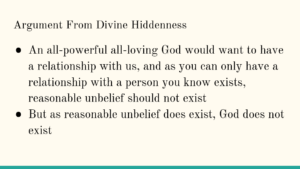
The issue of divine hiddenness is that if God is all-powerful and all-loving, then he would make his existence very obvious to us, so that we can enter into a relationship with him. It’s kind of hard to enter into a relationship with a person that you don’t know about, exactly.
J.L. Schellenberg—the most ardent defender of this argument—formulates it this way in his book The Hiddenness Argument: Philosophy’s New Challenge to Belief in God:
Premise one:
“If a perfectly loving God exists, then there exists a God who is always open to a personal relationship with any finite person.”
Premise two:
“If there exists a God who is always open to a personal relationship with any finite person, then no limited person is ever non-resistant in a state of non-belief about the proposition ‘God exists.'”
In other words, God would make his existence like the existence of the sun—you could see it, and no one would really argue about it.
Additional Premises
Premise three:
“If a perfectly loving God exists, then no finite person is ever non-resistant in a state of non-belief about the proposition ‘God exists.'”
Premise four:
“Some finite persons are or have been non-resistant in a state of non-belief about the proposition ‘God exists.'”
Premise five:
“No perfectly loving God exists.”
Premise six:
“If no perfectly loving God exists, then God does not exist.”
Conclusion:
“Therefore, God does not exist.”
Appeal
This argument from Schellenberg has appeal, whether you accept the premises or not, because we can all agree that God could have made his existence much more evident than he has done. He could have ascribed his name on every cell in our bodies, written his name in the sky, or made our brains wired to think about him every five minutes.
Yes, God could make himself more obvious. Both theists and non-theists agree that there is some evidence for God’s existence. If there were not, there would be little reason to write scores of books and articles on the subject and debate it in public forums. But few philosophers of religion would claim the other side is irrational for believing as they do, so long as they give some evidence for their belief.
So, if God is not apparent but perfectly loving, why is this so?
Skeptical theism again has a part to play here. We will never know the honest answer for God’s hiddenness, but that does not mean that God does not have a reason for remaining hidden.
Also, back to the point made against the evidential problem of evil: we knew that we would be tested before we came to this life. Before coming here, God’s existence was more than apparent, and we had a relationship with him. So that would satisfy part of what Schellenberg proposes.
God is not Hidden
We knew that that would no longer be the case when we left his presence for a time. So, Schellenberg’s second premise is false. We knew that there would be times of disbelief before coming here and agreed to it anyway. Our relationship, where it seems it should be obvious, is more like the relationship of Rachel and Ross from the show Friends: it is on a break.
Also, it bears noting that even if God’s existence were undeniable, that does not mean that you would want a relationship with that being or believe in such a being. Many people ignore the obvious. We can all be stubborn.
And finally, the hiddenness argument presupposes that there are other powerful arguments for God’s existence, such as the fine-tuning argument, variations of the cosmological argument, or arguments for miracles. If you want to go down the road of someone like Alvin Plantinga, you could say that belief in God is properly basic—meaning it is a belief that is rational to hold even apart from arguments for God’s existence.
All of these arguments give us a strong inductive case for God’s existence and show that God is not hidden.
Finally, if God seems hidden at a time, remember that your life is not over yet. Keep seeking, and God will make himself known to you.
Conclusion
I do not hope to have defeated all the arguments for atheism or to make it appear that I have. Adjustments and new ideas can be made, and many more are available to the non-believer. However, I do hope to have shown that a Latter-day Saint can take the argument seriously and have much to contribute to the current discussion.
I hope we all come away from this seeing that our atheist, agnostic, and skeptic friends have powerful defenders in their view. J.L. Mackie, J.L. Schellenberg, J. Howard Sobel, Graham Oppy, and Paul Draper are, to use a phrase from President Trump, “bad dudes.” They deserve to be taken seriously and given a response.
In fact, you could even run kind of an argument saying: if God existed, he wouldn’t make such smart people argue against his existence. So, yes, I take these gentlemen very, very seriously.
Thankfully, Latter-day Saints have reasonable answers, and more will be developed in time. As we look to share the gospel with our friends, let’s not forget that the question of God’s existence is the first question. God has to exist for the resurrection and all the other parts of the gospel.
We need argument and evidence to make this proposition more plausible than not to our unbelieving friends, so that the gospel is a live option in a world that’s becoming more progressively secular.
To quote President Ezra Taft Benson: “We can do it. I know we can.”
Thank you.
Q&A
Scott Gordon:
Thank you. So, one of the difficulties I always have when we invite people speaking about philosophy is: I look at these questions people have sent to me, and I don’t even understand what they say.
Tarik Lacour:
Hopefully I can help there.
Scott Gordon:
So, let me go with a really easy one first: What’s the worst argument for atheism that you’ve heard?
Tarik Lacour:
It’s given in The God Delusion by Richard Dawkins, where he says that because we’ve explained away design in biology— you can explain the design of organisms through natural selection— so you don’t need a Creator. You can hope for that in physics, so therefore God doesn’t exist. Even if you accepted the premises, that doesn’t follow. And the other reason it’s the worst argument is, Richard Dawkins is a brilliant biologist. I would expect much better. That’s worse than my intro philosophy students.
Scott Gordon:
One argument versus atheism is the problem of induction. How do the best atheists deal with this issue, and any thoughts on how an LDS can approach induction?
Tarik Lacour:
For those who don’t know, induction would be how do you know that the future will resemble the past? Because, for all you know, everything—the laws of nature—could change in five minutes, for example. So that’s the problem that comes from Hume and other philosophers.
I’m not sure that’s really an argument for theism or against it. It’s a problem for everyone. So I guess you would say you can use induction because you would say, well, God wouldn’t allow you to be deceived to go throughout your life with the world going one way and then it just changing for no reason. Whereas on atheism, I guess you don’t have that guarantee. But it’s a problem for all of us, I would say.
Scott Gordon:
Okay, so how do you recommend that we address epistemology within the Church classes?
Tarik Lacour:
Epistemology is theory of knowledge. Well, we often say things like, “I know the Church is true” or “I know this or that.” Well, you should probably start by: what do you mean by the word “know”? Does that mean you strongly believe? Are you just repeating that because lots of people have said it, so you think it’s just a slogan?
You should ask yourself the question of, “Why do I believe what I believe?” not just believe. In other words, we should not be the parody that we’re represented as in the Book of Mormon Musical—you know, “Just believe.” Although, I love that song by the way. Very good.
Scott Gordon:
When talking about the LDS version of God, you mentioned he was the greatest of all beings but didn’t agree with the Swinburne view of a necessary being. Why do you stay away from saying God is a necessary being for the LDS framework?
Tarik Lacour:
Well, it would seem a necessary being would be something that’s logically contradictory to deny that that is the case. So, in other words, if you said “two plus three equals seven,” well, that’s logically contradictory. But it doesn’t seem that saying “God exists” or “God doesn’t exist” is a logical contradiction. It’s just an empirical question.
So, I don’t think we need to affirm that God’s a necessary being. But the other reason would be, if you think that God is a material being composed of parts, then you would have to think perhaps—and this is kind of one view of the King Follett discourse—that there may have been a time where either God didn’t exist, or there was just matter for a while. That’s how I view that. So, I don’t think God is a necessary being, but I think he’s the greatest being.
Scott Gordon:
Okay. It seems that Job, in this week’s Come Follow Me, addresses the problem of evil. Do you have any insights into the philosophies shown in Job’s story?
Tarik Lacour:
Well, the first thing I would say is: if someone’s suffering, don’t be Job’s comforters. In the context of what I’m doing here, I’m doing this as an academic thing where we’re not suffering, right? But if someone’s best friend has died, it’s not really the time to tell them, “This is why it happened.” Because first of all, you don’t know. And second, what they need is comfort and love. So that’s kind of the big thing there.
The main point, I think, of the “Job’s comforters” takeaway is: if you don’t know, you don’t help anyone by acting like you do. Just say, “I don’t know,” and just be there.
Scott Gordon:
Okay, let me give you one more. While it seems that our doctrine of moral agency is most closely aligned with libertarian free will, we are regularly taught that God can change people’s hearts, with lots of scriptural examples. This seems to be a contradiction. I found some understanding in Molinism, with an omnipotent God who actualizes a world where we can freely choose, but is not fully satisfying. Do you have any thoughts on how to resolve God’s ability to change people’s actions with perfect moral agency?
Tarik Lacour:
I’ll explain the term there. Molinism comes from a philosopher named Luis Molina, and his view is that God creates the world after thinking of what free agents could do, and he creates the world where he gets the most people saved and gets the minimum lost.
That doesn’t work for Latter-day Saints because God doesn’t really create us in the full sense.
As far as God’s changing your heart, though—if God can kind of act upon you, it would seem that you’re okay with some kind of determinism in that case. But you can still affirm moral agency, since we still seem to have some control in the matter, even if God is pushing on us. Or, there are other ways of reconciling that, saying that those scriptures are metaphorical rather than metaphysical.
Scott Gordon:
Thank you. I really appreciate your time.
