Summary
Brian Ashton, President of BYU-Pathway Worldwide, details the program’s mission to provide equitable, accessible, Church education globally. He highlights its innovative model. Combining online learning, mentorship, and community gatherings, while also supporting employment through tiered job progression and remote work. Ultimately, Ashton emphasizes the program’s role in preparing disciples of Jesus Christ. And fulfilling the Lord’s covenant to establish and bless His people.
Introduction
Scott Gordon: For our first speaker we’re very honored to have President Brian Ashton. He is the president of BYU Pathway, which, as I understand, is now the largest Church school we have. So, with that very short introduction and nothing else, I’m going to introduce President Ashton.
Presentation
President Ashton: Brothers and sisters, I am grateful to be with you here today. I love that introduction. Oftentimes I get these long introductions. I told Scott I don’t need a long introduction, so I was very happy for that. If I could say anything about my introduction, it’s that I love the Lord. I love my family. And I repent really fast. So anyway, today I want to talk about BYU-Pathway and serving the hidden many.
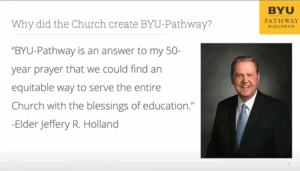
Elder Jeffrey R. Holland came to visit with the BYU-Pathway employees about two years ago. One of the things he said was that, “BYU-Pathway is an answer to my 50-year prayer that we could find an equitable way to serve the entire Church with the blessings of education.”
Lack of International Access to Education
Many of our brothers and sisters do not have access to education. Now, internationally, that’s oftentimes easy to understand. In Africa, there are only seats in universities for 9% of the university-aged youth, and so it’s very competitive. In most countries, if by the age of 12 you don’t show that you’re university-caliber, you’re not going to get in. If you go on a mission, you miss your window, and so many people just don’t have that access. That’s true throughout much of the world, but it’s also true here in the United States. There are many people who don’t have access to higher education. Certainly not Church education. This could be because of cost, fear, family situation, or where they live.
The Brethren and the Church have been anxious to provide education to everyone throughout the world. I want to talk a little bit about how BYU-Pathway does that.
Mission & Purposes of BYU-Pathway Worldwide
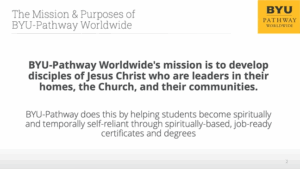
Our mission at BYU-Pathway “is to develop disciples of Jesus Christ who are leaders in their homes, the Church, and their communities.” We do that “by helping students become spiritually and temporally self-reliant through spiritually-based, job-ready certificates and degrees.” Sometimes I think there’s a little confusion about what BYU-Pathway does. But our goal is to get someone a degree and a job.
We are the access provider within the Church Education System. We’re not accredited as BYU-Pathway, although we do provide courses. But our degrees come from BYU-Idaho and Ensign College. So, let me explain how we work in CES and the Church Education System.
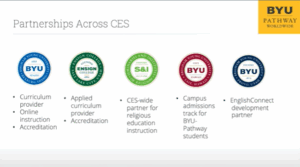
Our partnership with BYU-Idaho provides some of our certificates and degrees. They also hire our instructors, and they provide some accreditation. The same goes for Ensign College—they provide certificates and degrees and accreditation. Seminaries and Institutes provide all of our religion courses, and that’s one of the most important functions we provide.
We have a partnership with BYU-Hawaii where you can receive preferred access if you take our introductory program called PathwayConnect and then a first certificate. Particularly if you’re an international student. Finally, we work with BYU on EnglishConnect, which helps our non-English-speaking students learn English. All of our programs are in English.
International Growth
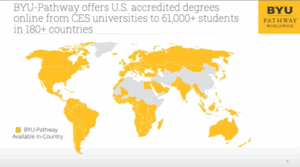
You can see where we’re located. As of last year, we had over 71,000 students in more than 180 countries. Pretty much wherever the Church is organized, you can access BYU-Pathway. Any place marked in yellow or gold is where we operate.
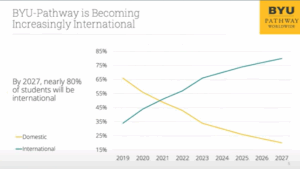
Many of you will remember the Pathway program that started in 2009 out of BYU-Idaho. The idea then was just to get people into BYU-Idaho. We’ve come a long way since then. When it was the Pathway program, the focus was mostly on domestic students. But we’ve grown. In 2021, we became a majority international program. This year, about 65% of our students are international, and by 2027, nearly 80% of our students will be international. We may beat that, given the way international growth is going.
Growth in Africa
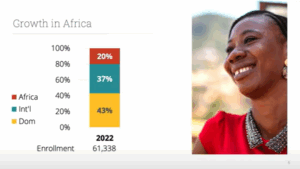
Much of that growth is coming from Africa. Last year, as I mentioned, we had over 61,000 students—20% of them, or about 12,000, were in Africa. This year, we’ll have nearly 70,000 students, and 19,000 will be in Africa. By 2027, we’ll nearly double in size, and 38% of our students will be in Africa. This is happening without domestic growth slowing; domestic students, in terms of total number, will stay relatively stable. Yet the demand internationally is absolutely huge.
Our brothers and sisters there want the blessings that we have had from Church schools. You think about what BYU, BYU-Idaho, Ensign College, or even BYU-Hawaii have done in most of our lives. It has literally changed who we are, who we married, the friends we have, and has helped keep us active in the gospel. Our brothers and sisters throughout the world want those same blessings.
How the Program Progresses
EnglishConnect
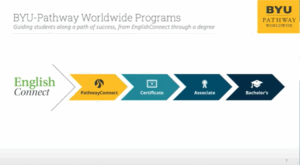
The way BYU-Pathway works, as I mentioned, is that all of our courses are in English, at least for now. If you’re not a native English speaker, or you don’t speak English well, we have an English exam that you take to pass. That’s the only real requirement to get in. You take EnglishConnect. Then we have an introductory, foundational program called PathwayConnect, which BYU-Pathway develops. Then, you move into certificates and degrees. We call it “certificate first” because we want you to get a job-ready certificate and get a job right away.
Most universities create all the value in your last year, just before you graduate. In BYU-Pathway, we want you to be able to get a job as soon as you can along the way. All of our students work, or nearly all of them. And they need to work. We want to see their income increase as they progress through the program.
You take a first certificate, a second certificate, and a little bit of general education to get an associate’s degree. A third certificate, plus the rest of your general education, gets you a bachelor’s degree. Let me tell you a little about these.
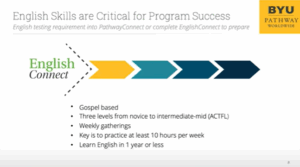
EnglishConnect Levels
EnglishConnect is gospel-based. It has three levels, from novice to intermediate. You can go from speaking no English to being at an intermediate level. As you progress to EnglishConnect 3, we use the ACTFL standards. (American Council on the Teaching of Foreign Languages). We try to get students up to their standard of speaking. There are weekly gatherings, so you study on your own, but you also come together, either online or in person. The key to learning is practice—practice for 10 hours a week.
If you practice 10 hours a week, that can include reading your scriptures in your native language and in English side by side. That’s how I learned Spanish on my mission. Or you can listen to General Conference talks, watch movies, or talk with people. If you do that for 10 hours a week, you can go from not speaking any English to, in one year, being able to enroll in BYU-Pathway. We see that consistently, and it’s amazing.
There’s a lot of demand for this. For example, in the Democratic Republic of the Congo, in Kinshasa, we have one stake where 3,100 people are enrolled in EnglishConnect and Institute. Of those, less than 125 are members of the Church. There’s great demand, and it’s a great missionary tool. We see a similar pattern in many places around the world.
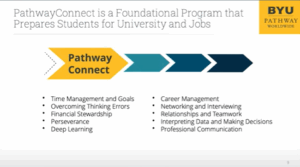
PathwayConnect
You then move on to PathwayConnect, which I explained as a foundational program. I like to think of it as our version of BYU’s foundational courses like “American Heritage.” If you don’t have a high school diploma, we’ll take you and teach you what you need to learn in PathwayConnect. You can see the other things that PathwayConnect does to prepare you for both university and a job. Things like time management, goal setting, overcoming thinking errors, persistence, and career management.
But the real key to PathwayConnect is that the Holy Ghost is the witness and teacher of all truth. What we teach at the university should be truth. If you want to do well and learn, using the Holy Ghost as a guide and a helper, you can learn much more efficiently. In fact, our domestic students who go through PathwayConnect on average get half of a grade higher than campus students in the same courses and taking the same evaluations and tests.
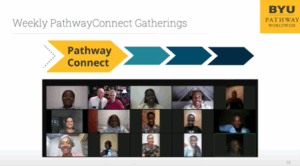
PathwayConnect also has a weekly gathering that can be done online or in person. You can see here a group from Africa, along with a missionary couple clearly not from Africa. They’re from the United States. Through technology, they can have this gathering with students in Africa in the evening. And around noon their time, they’re able to be online and help these students. In these gatherings, the students support one another, teach one another, and participate in leadership activities. It’s really the highlight for them. Whenever I ask students what their favorite part of BYU-Pathway is, they say, “The gathering.”
Certificates and Degrees
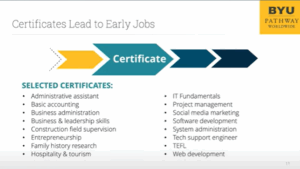
Once you finish PathwayConnect, you start on your certificate. I’ve put just a few of the certificates we offer on the screen. These are certificates that lead to early jobs. You can pick your certificates—three certificates create a bachelor’s degree, so you have options in most of our degrees. Again, two certificates plus some general education gets you an associate’s degree. And three certificates plus the rest of your general education gets you a bachelor’s degree.
Degrees
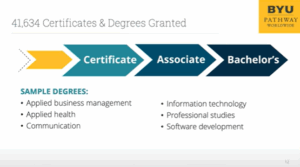
We have issued nearly 42,000 certificates and degrees. You can see we have a relatively limited set of degrees. Applied business management, applied health, communication, information technology, professional studies, and software development. The reason we have a limited number of degrees is that we operate in more than 180 countries. We have to be scalable. Things like teaching you to be a lawyer or an engineer require different curriculums for every single country. They often require practicums in-country, and that’s just not scalable. So, we won’t teach you to be a lawyer or an engineer. We may not even teach you to be an elementary school teacher. But, we will allow you to get a degree that gets you a good job and allows you to support a family and serve in the Church.
Spiritual Outcomes
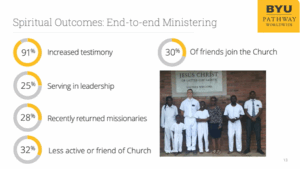
Now, as I mentioned at the beginning, what’s most important are the spiritual outcomes. We’re really trying to help people use education to come unto the Savior and eventually be exalted with their families. 91% of our students report that they have an increased testimony because of their experience at BYU-Pathway. 25% of our students serve in leadership positions within their ward or stake. They serve in bishoprics, Young Women presidencies, Relief Society presidencies, or stake presidencies. This is a worldwide number; internationally, the number is much higher. In fact, in Africa, over 35% of stake presidencies have at least one member enrolled in BYU-Pathway. Elder Ballard said that BYU-Pathway will be the backbone of growth in Africa because it develops leadership skills. 28% of our students are recently returned missionaries. Three years after they come home, 96% are still active in the gospel.
Last semester, of our new students, nearly a third were either less active or friends of the Church. We love this statistic—nearly a third of those non-members joined the Church. So, this is a terrific missionary tool.
Temporal Side
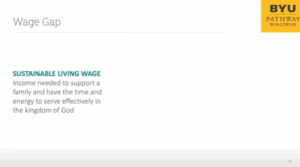
Now, on the temporal side. One of the things we want for our students is to achieve what we call a sustainable living wage. This means they can support a family, educate their children, and serve in the Church. We’d like them to be a bishop or a Relief Society president and still be able to work one job and get six to seven hours of sleep a night. Now, I don’t know that all of us do that, but that’s the goal. So, that’s how we define a sustainable living wage.
Unfortunately, many of our students, especially internationally, don’t have jobs when they come to BYU-Pathway. Of those who do, at least in most international countries, they make only a third of a sustainable living wage. Let me give you some examples.
Wage Gap
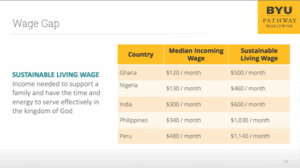
In Ghana, for example, those who have jobs come in making less than a dollar an hour. You figure that an average work month has about 172 hours in it. They need to make just under $3 an hour. That’s where we need to move them. Nigeria is similar. You can see in India that they’re making roughly $2 an hour. But they need to be making more like $4 an hour. If you look at Peru, they come in making less than $3 an hour. They need to make somewhere between $6 and $7 an hour to have a sustainable living wage. I’ll show you ways we can help them do that.
Job Progression
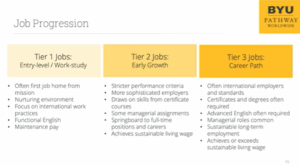
We also have a job progression that we want to see. For international students who aren’t employed, we want them to start with what we call a Tier 1 or work-study job. These are data entry jobs where your English doesn’t have to be great—it can be functional. You start to learn job skills, such as showing up on time and dressing appropriately. You may even be doing the work on your cell phone. Many of our students don’t have computers when they start BYU-Pathway. You’ll be paid some kind of maintenance pay. For most of our students, this means a work-study job where they get between 50 cents and a dollar an hour. Plus a little bit on top to help pay for internet. It gives them enough to afford more than one meal a day, save for a computer, stay in school, and pay their tuition.
Tiers 2 and 3
By the time you’ve completed PathwayConnect and your first certificate, we want to get you to what we call a Tier 2 job. This might be in a call center or something similar, with stricter performance criteria and some managerial opportunities. It does require additional problem-solving skills and better English. The goal here is that by the time you finish your first certificate, you’ll have a sustainable living wage so that you can support a family, serve in the Church, and do the other things you need to do.
Finally, by the time they graduate, we want students to have a Tier 3 job. Which is really a career path. This is a job they can stay in for 10 or 20 years while serving as a stake president or a stake Relief Society president. We like to think of this as a job that offers at least double the sustainable minimum wage. We’ve had good success helping students get these jobs.
Temporal Outcomes: 2-3 Better Jobs
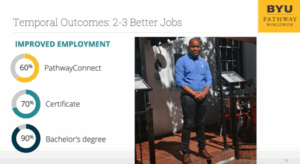
You can see that after completing PathwayConnect, 60% of our students, are getting improved employment. Because they speak good English and have problem-solving skills, as well as the ability to work across borders. That’s within six months. By the time they complete their first certificate, usually in just over a year, another 70% get improved jobs. That’s well over 100% that have improved employment by that point. And many have improved their employment twice. Then, by the time they graduate, another 90% improve their employment. So, we’re seeing really good results with this.
How Students Get Jobs
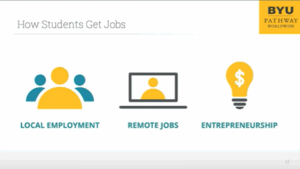
Let me tell you how they get jobs. The first is local employment, where they may work in a company in their city. The second is remote jobs. Because of the pandemic, work has changed. It’s been a huge blessing for these international students, who often live in countries where labor markets simply don’t function or are incredibly inefficient. I just returned from a trip to South America, and in Brazil, 60% of our students who want jobs get remote jobs. Often without our help.
I’m going to show you a video of a young man I met in Paraguay. He completed an assignment in which he had to put his resume on LinkedIn. Within two weeks, he had been hired by PricewaterhouseCoopers to work remotely. These are good jobs. Finally, entrepreneurship is another option. Let me share some examples of students who have gotten these types of jobs.
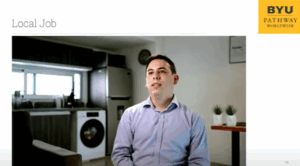
The first one is Andrés Romero from Buenos Aires, Argentina. Andrés completed BYU-Pathway while working full-time. In four years, he earned his bachelor’s degree. After completing his first certificate, he got hired locally by HP (Hewlett-Packard). As he was about to finish his associate degree, JP Morgan Chase came to Buenos Aires and opened a hub to handle internal controls for the entire world.
Andrés
They wanted people who were honest—Andrés is a returned missionary. They wanted people who spoke English well—Andrés was doing all his coursework in English. They wanted people who knew how to work across borders—Andrés’s coursework was with students from all over the world. So, when the executive from the United States interviewed him, he said, “You really go to BYU-Pathway and are taking classes from BYU-Idaho through BYU-Pathway?” Andrés said, “Yes, I really am.” The executive replied, “You made the right choice,” and they hired him.
Today, just a few years later, Andrés is a vice president at JP Morgan Chase. In fact, they are moving him to Houston. He was put in charge of hiring over 1,000 people for JP Morgan Chase in Buenos Aires. Of course, he started hiring BYU-Pathway students. His colleagues began asking, “How come the people you hire do so much better than the people we hire?” He told them, “They go to BYU-Pathway. Here’s what it’s about.” Now he fights with his colleagues to hire BYU-Pathway students. I was down there at the end of last year. It was fun meeting all the BYU-Pathway students. Many of whom were still students in PathwayConnect and had moved to Buenos Aires precisely so they could work for JP Morgan Chase. Here’s his story:
(Video plays)
Video
In my family, education was something very important since the beginning. My father was one of the first in his family to go to college, and it took him many years. So, it was something very important for me. I saw him waking up very early in the morning, going to his job, and continuing until he achieved that goal.
When I arrived on my mission, my trainer, my first companion, gave me a BYU sticker. I always felt it would be great to study there because you can have both things. Religion, education, a degree, and a career that you want to follow. It was not an easy path. But the first certificate I took was very important for me in helping me get the job I wanted. That’s how I got my first job, in a very big tech company. By the time I had my associate degree, I moved to this job, which is where I am working now, for one of the biggest financial institutions in the world.
They decided to open a hub, and one of the executives came to open it. I had an interview with him. What was very shocking to me was when I told him that I was studying through BYU-Idaho through Pathway, he said, “You made the right choice. You’re studying in the right place.” For me, it was very personal, and a confirmation that all the sacrifices and efforts were worth it.
Video, continued
He hired me, and since then, I’ve grown from position to position. This year, I had the opportunity to hire several students from BYU-Pathway Worldwide. They had some certificates completed, and the important thing is, they are ready. They have the skills we need. Something that is important, that we really value, is people who can work with others. People who can lead others. The focus that BYU-Pathway Worldwide has on those things really makes a difference. When you are interviewing someone, you can see the difference.
It’s a completely different way from what I’ve seen at other universities. Yes, you are studying, but you are also receiving spiritual strength and learning things from the scriptures, from the prophets. No matter what you study, you are learning how to treat others, how to lead others, how to help others. It helps you to become a better disciple year after year. That’s the difference of BYU-Pathway Worldwide. You can feel the Spirit in those moments. That’s another confirmation that this is the right way to do it.
Andrés said in that video that it was very personal when the executive said to him, “You’re in the right place.” The reason for that is he had been told he needed to study at an Argentinian university. Many people told him, “Don’t study through BYU-Pathway, you’ll never get a job.” Well, he’s got a better job than almost all of the people he knows in Argentina.
Remote Jobs
Remote jobs are another way. You can see some examples of the types of jobs our students are getting.
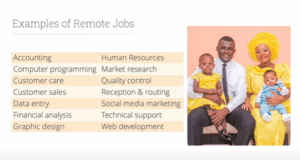
The picture here is, his name is difficult to say, but it’s Eek Pangong Etim. He’s a bishop in Nigeria. He was a draftsman making far less than a sustainable wage when he joined BYU Pathway. Today, he works for a solar company here in Utah, doing design for them, and he works from home. Inflation is incredibly high in Nigeria, where he lives. But he gets paid in dollars, so he doesn’t have to worry about it. It’s been a huge blessing to his family.
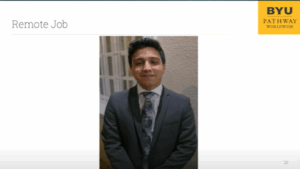
I wanted to show you one example, a video of a student. This is Samuel Lopez. He’s from Paraguay. I just met him the other day, and his story was so interesting. He’s the one who got hired by PricewaterhouseCoopers that I asked him to do a video. Now, I asked him to do it in Spanish. He actually speaks better English than Andrés. But I asked him to do it in Spanish because we wanted to use it in Latin America as part of our promotional material. So, you’ll hear it in Spanish, but it’s got subtitles. He joined BYU Pathway, and within his first class, he got a better job. Then, in his second class, he had an assignment to put his resume on LinkedIn. Within two weeks, he got this job with PricewaterhouseCoopers. Here’s his story.
[Video plays in Spanish]
Video
(Translation)
Hello I am Sauel Lopez, and I want to tell you a little bit of my experience with BYU-Pathway. When I returned from the mission, I started BYU-Pathway, and gradually progressed through courses. I remember the first time I had a job interview where I was able to apply all the things I learned with BYU-Pathway. I was hired immediately.
Later, thanks to an assignment I had in one of the classes at BYU Idaho through BYU-Pathway, I was hired by a company that saw my Linkedin profile. Which was part of an assignment I had to do at school. They also say that I studied at BYU Idaho, which is viewed as very trustworthy. The company is an international company. I never thought I would have this opportunity. It is something that doesn’t happen to young people like us. But thanks to that, today I am in the job of my dreams.
I remember when I was interviewed and they told me that I didn’t need to worry about anything because they found me at BYU Idaho. So they knew the kind of person I was. I know that BYU-Pathways can bless our lives.
Entrepreneurship
Hopefully, you could read those subtitles. My final example is Promise Sakey from Ghana. She’s an entrepreneur. Here’s her story:
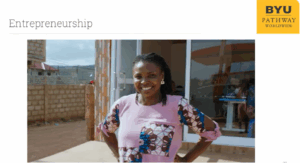
My name is Promise Sakey, and I am a BYU Pathway student. I am a fashion designer. I sew both for male and female. I have this dream of being self-employed. I want to have a business of my own, but how will I be able to do that? I need something to give me this understanding.
Not until I did BYU Pathway did I begin to have this idea on how I could market my products, market myself, and market what I do. When you’re doing something, you need something that drives you, is a passion. I love fabrics, I love design, and I love creating things. It makes me happy when I’m sewing, and I think, “Oh, this is going to be so nice on this client.” And you picture this style in your head and think, “What do you think about this?” I just love creativity.
Pathway Helps
BYU Pathway taught us how we could be interested in people. Now, I try to apply that to my business, trying to make sure my clients are my friends. I don’t just look at what I want to gain from them—I care about their well-being. There are times that I may not have heard from a client for three weeks or a month. I’ll send them a message saying, “Hi, hope you’re fine, I’ve not heard from you.” They’ll reply, “Don’t worry, I’ll get you some clothes to make for me.” You just care about them. You don’t just see them as customers—you see them as part of your family. When you’re able to relate with them, your business goes well because you form a very good relationship. And they bring more clients to you because they trust you and trust what you can deliver.
I’m happy I did BYU Pathway. It has really helped me, and it’s helping my business, too.
So, she didn’t have that business before she joined BYU Pathway, but you can see she’s done very well.
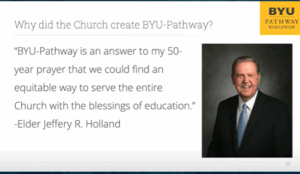
Let me return to this quote from Elder Holland about how BYU Pathway is an answer to his 50-year prayer. Most of our students struggle. They have not had the blessings of Church education.
Student Challenges & Overcoming
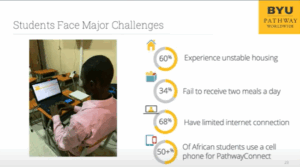
Here are some statistics. 60% of our students experience unstable housing conditions. Meaning they don’t really know where they’re going to live from month to month sometimes. 34% don’t get two meals a day—in Africa, that number goes up to 69%. Additionally, 68% have limited internet connections. In many countries, it costs more to get the internet than it does to pay tuition. Finally, over 50% of our African students do PathwayConnect on a cell phone. If you’ve ever tried to do Excel or write a term paper on a cell phone, it’s tough. But they persist and do quite well.
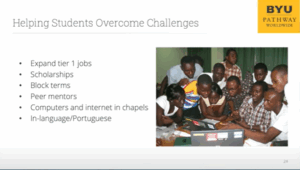
We’re doing a lot to help them. For example, we’re expanding our Tier 1 jobs. By the end of this year, we hope that every student who needs a Tier 1 work-study job will have one. They’ll sign up and have a job. We’re expanding our scholarships. We’re moving to block terms instead of semesters, meaning classes now take seven weeks instead of 14. We’ve found that in the shorter time period, retention is better, and completion rates are higher. Knowledge comprehension and retention are also better. This now allows students to complete a degree in under four years. If they take two courses per block. Which is pretty amazing.
Every student gets peer mentors, which means they have someone who has gone through the program. Almost all of our students are first-generation college students, and they have someone to guide them. We’re increasing accessibility to computers and the internet in the chapels. Finally, in 2025, we’re actually going to launch BYU Pathway in Portuguese.
Conclusion–What the Lord is Trying to Do
Now that’s who BYU Pathway is. As I conclude, I want to bring this back to what the Lord is trying to do. The prophet Jacob, Nephi’s brother, gives us an idea of what He’s trying to do.
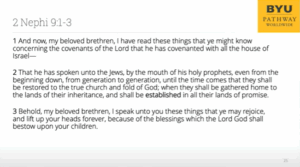
This is from 2 Nephi 9:1-3. Jacob says: “And now, my beloved brethren, I have read these things that ye might know concerning the covenants of the Lord that He has covenanted with all the house of Israel—that He has spoken by the Jews, by the mouth of His holy prophets, even from the beginning down from generation to generation until the time comes that they shall be restored to the true Church and fold of God.” So it’s going to come to pass in our day. “When they shall be gathered home to the lands of their inheritance.” To Ghana, to Paraguay, to Brazil, to Argentina, to the Philippines, right? To Nambia, “and shall be established in all their lands of promise.”
The question with this scripture is, what does it mean to be “established”? I’ve come to believe that in the broad gospel sense, being established means to have the gospel. The priesthood, local priesthood leaders. Access to the temple. Family. The ability to learn by study and by faith. The ability to support one’s family. A future for one’s children. Safety. And hope.
Findings from Travels
As I travel around the world, I hear two things. First, people say, “We want to go to the United States. We don’t want to stay in our country.” Because their country is not yet established. They don’t have some of these things. Second, I hear, “We feel forsaken and forgotten by the Lord.” I can’t tell you how many priesthood leaders have told me, “My people feel forgotten and forsaken.” BYU Pathway is one of the tools to help them become established.
Of course, the ultimate meaning of being established is to live in an exalted state with our Heavenly Father and Jesus Christ. But we can be established here, and the Lord has covenanted to do this with His people. He has provided BYU Pathway and Church education to help make that happen.
Let me share with you just a couple more scriptures on this. This is Isaiah 49, also quoted in 1 Nephi 21:8-16. Isaiah says:
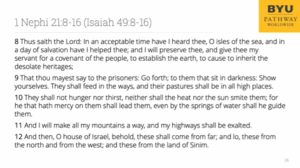
“Thus saith the Lord, in an acceptable time have I heard thee, O isles of the sea.” Now, of course, “isles of the sea” means really just that you’re far from Jerusalem. Jacob, Nephi’s brother, taught that the Nephites were upon the isles of the sea. But of course, they weren’t. They were in the Americas. “And in a day of salvation have I helped thee: and I will preserve thee, and give thee my servant for a covenant of the people, to establish the earth. . .” There’s that word again. If you start looking for the word “establish” throughout the Old Testament, you’ll find it over and over again. “. . .to cause to inherit the desolate heritages.”
Desolate Heritage
Now, that’s an interesting phrase. What’s a desolate heritage? When the pioneers came to Salt Lake, guess what? It was a desolate heritage. Many of these students live in places where corruption is rampant, or where they don’t have the ability to worship as they wish, or where they don’t have access to jobs. They feel like they’re in desolate heritages. When Israel was scattered, the Lord said, “I’ll make your heritages desolate.” So now, they’re coming back to these desolate heritages. They need to become established, much like Salt Lake has done.
“That thou mayest say to the prisoners, ‘Go forth’; to them that sit in darkness, ‘Show yourselves.’ They shall feed in the ways, and their pastures shall be in all high places. . .” A reference to food, and “high places” refers to temples. “That they shall not hunger nor thirst; neither shall the heat nor sun smite them. . .” If you don’t have housing, it’s tough to get out of the sun. “. . .for he that hath mercy on them shall lead them, even by the springs of water shall he guide them. . .” Of course these are springs of living water. “And I will make all my mountains a way. . .” Temples teach us the way to exaltation, which is why we need temples. President Nelson is doing all he can to get temples to everyone—”and my highways shall be exalted.”
Isaiah 35:8 teaches us that highways are the way of holiness. “Oh, house of Israel, behold, these. . .” Meaning those inheriting these desolate heritages, the students we’ve just heard from. “Shall come from far: and lo, these from the north and from the west; and these from the land of Sinim. . .” Probably from the south.
The Blessings of Church Education
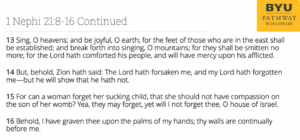
“Sing, O heavens; and be joyful, O earth; for the feet of those who are to be established. . .” There’s that word again. “. . .shall break forth into singing, O mountains; for they shall be smitten no more, for the Lord hath comforted His people, and will have mercy upon His afflicted.”
In this process of being established, here’s what will happen:
“But Zion said, ‘The Lord hath forsaken me, and my Lord hath forgotten me.'” That’s the same thing priesthood leaders are telling me. “But He will show that He hath not, for can a woman forget her sucking child, that she should not have compassion on the son of her womb? Yea, they may forget, yet will I not forget thee, O house of Israel. Behold, I have graven thee upon the palms of my hands; thy walls are continually before me.”
As these people live the gospel, go to the temple, and receive the blessings the Church has given them. Including the blessings of Church education. They become established. In doing so, they come to know that Jesus Christ is their Savior to a greater degree.
Just two last, very brief scriptures, and I’ll open up for questions.
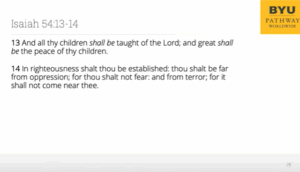
Isaiah goes on to say about those who are established, “And all thy children shall be taught of the Lord; and great shall be the peace of thy children.” How is He teaching them? Through Church education, through Sunday School, through priesthood and Relief Society. “In righteousness shalt thou be established.” As you keep the commandments, I’ll give you these blessings. “Thou shalt be far from oppression; for thou shalt not fear, and from terror; for it shall not come near thee.”
The Gathering
Finally, when does this happen? This is Isaiah 32, talking about the gathering:
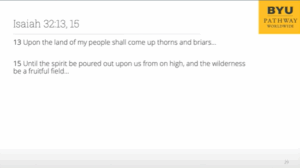
“Upon the land of my people shall come up thorns and briers”—when He scattered them, they became desolate places. How long? “Until the spirit be poured upon us from on high, and the wilderness be a fruitful field.”
Brothers and sisters, the reason our mission statement says nothing about teaching degrees or education, but says we are to build disciples of Jesus Christ who are leaders in their homes, the Church, and their communities, is because helping people receive the Holy Ghost is what matters. That’s what helps them go from where they are today to where the Lord wants them to be. We could do all of this, and if we didn’t bring the Holy Ghost into their lives, it would all be for naught.
I bear testimony that the Lord is moving among His people. One of the ways He is preparing for Zion and the second coming is through Church education and through BYU Pathway. I leave that testimony with you in the name of Jesus Christ, amen.
Thank you, and I’ll open up for questions.
Q&A
Scott Gordon:
I’m actually lucky enough to teach many of the students from BYU Pathway in my international business class. It’s really amazing. One of the things you didn’t bring up is that we have students in my class from Idaho, Utah, and California. We talk about culture in our international business class. Then they have to interact with people from Brazil, the Philippines, Nigeria, and South Africa. I think it really adds a lot to the education of our students at BYU Idaho as well.
Brian Ashton:
remote jobs. You remember, Andrés, at JP Morgan, they wanted people who were used to working across boundaries. Andrés had been working with students all over the world in his class projects. One of the things we’ve become known for at BYU Pathway is that we produce students from anywhere in the world. They can work for a company in Europe, North America, or Australia, remotely. They understand the work practices and how to work with people from different cultures.
Scott Gordon:
Just a story, not a question. Last year, as I organized my groups, just because of a fluke of time zones and such, I ended up with a group of five young men from all over Africa and one young lady from Alaska. They all called her “Mom,” which I thought was funny because she was only 23 years old.
Is there a relationship between BYU Pathway and the Perpetual Education Fund?
Brian Ashton:
So, that relationship is developing, and we hope to have an announcement soon—that’s all I can say.
Scott Gordon:
Okay, is BYU Pathway a more effective method than just building a BYU South America or BYU Africa?
Brian Ashton:
So, BYU Pathway is currently the size of BYU and BYU Idaho combined. In five years, Africa alone will be bigger than BYU—significantly bigger than BYU. We constitute, therefore, a huge chunk of the students in the Church education system. But BYU Pathway is only 2% of the budget. You can’t expand around the world and build campuses—they’re just too expensive. BYU Pathway is the Lord’s solution to that.
Scott Gordon:
How is BYU Pathway regarded in the academic world?
Brian Ashton:
It’s regarded the same way BYU Idaho and Ensign College are considered in the academic world. I will tell you, our team is meeting with the dean of Harvard Business School next week to talk about how to do online education successfully. Yeshiva University has come to our headquarters multiple times to discuss how we do this online successfully. We’re considered one of the innovators, and our students get jobs. There are some who say, “Hey, look. This is a religious school out of Utah serving students. And they have a bias that these international students aren’t as good as domestic students.” But I will tell you that’s simply not true. Our students are as smart as anyone, and they do really well. I’ll put Andrés Romeo up against any student from BYU or from Harvard, where I attended.
Scott Gordon:
What about students with disabilities? Is Pathway appropriate for someone whose disability would make a traditional college degree difficult?
Brian Ashton:
Absolutely, we’ll make the adjustments that we need to make. I had a missionary when I was a mission president who came to our mission. He couldn’t read or write, despite having graduated from high school. The reason he couldn’t read or write was he had a form of dyslexia where the words appeared differently every time he saw them. You can imagine how hard it is to learn how to read and write. He would try to write me emails. My wife and I would sit and try to decipher them. It was impossible.
One time, I made the mistake of calling on him in zone conference to read scriptures. He just couldn’t do it. At one point, I was prompted to promise him that he would get a college degree and gave him a blessing to that effect. He was terrified, and quite honestly, so was I. But over time, with the Lord’s help, he got better at reading and writing until he finished his mission. And I could largely understand his emails. Not entirely, but largely. He could study the scriptures to some degree.
I followed him for five years after his mission. Encouraged him to get into college, whether a community college or BYU Pathway. He finally enrolled in BYU Pathway, got all A’s in his first courses. He needed some adjustments, but we made accommodations. He’s now one semester away from finishing his degree. He’s had almost all A’s. He’s gotten a better job. Has multiple job offers. And is planning to go to graduate school. He kept his covenants, the Lord helped him, and now he reads and writes pretty well.
We see this constantly. We see kids with autism and other disabilities, like those who are blind, and they do extremely well.
Scott Gordon:
Here’s a comment from someone who has experienced it. For last year’s missionaries in the Democratic Republic of Congo, my wife and I taught English Connect and helped with BYU Pathway. We encountered two big obstacles: the lack of good, stable internet, and the difficulty students have learning English. Having English Connect Gatherings in our area was very difficult. Learning English has great value, but we would love to help create a French-language version of Pathway.
Brian Ashton:
Let us get Portuguese first. If that works, let’s talk!
Scott Gordon:
Are all Pathway missionary couples remote, or do some get called to work in other countries?
Brian Ashton:
We often call people in other countries. For example, in Mexico, almost all of our missionaries are from Mexico. There are a handful who choose to go on missions to another country and serve as BYU Pathway missionaries. If that’s something you want to do, we would love to talk to you.
Scott Gordon:
Excellent. Okay, the next question is along those lines. What are some of the best ways to get involved in work like this?
Brian Ashton:
Let me give you some ideas. One way is to be a BYU Pathway missionary. If you want to facilitate one Gathering, it’s three to five hours a week, and you can live from home. You can pick your area of the world and pick your time and day. If you want to do a couple, it might take you 10 hours a week—that’s one option.
Another option is to donate to scholarships. 80% of our students get scholarships. The number one reason our international students drop out is they can’t afford it. Despite the fact that a degree is priced to the cost of living in their country. For example, in Africa, the average student pays less than $500 for a bachelor’s degree. So, if you’re tired of your kids and don’t want to pay a lot for education, move them to Africa and have them enroll in BYU Pathway!
Another way you can help is we’re always looking for companies that need remote workers. If you have a company and you’re looking to outsource some of your work to people outside the United States, you can get really good employees, like Andrés Romeo in Argentina for $4 an hour or in Peru for $7 an hour. That’s an opportunity for people.
Those are just a few ways—there are others.
Scott Gordon:
It’s interesting you hit the next two questions. How do I donate to Pathway, and how do I hire your students?
Brian Ashton:
If you want to donate, get on our website. There’s a link at the bottom—actually, I think it’s at the top too—that says “Donate.” You can also contact the Church’s Philanthropies Department. If you want to send us a check, we’ll get it where it needs to go. Just make it out to BYU Pathway and indicate it’s a donation for scholarships. If you want to hire our students, call our office. The number is 801-240-0580, and they’ll put you in touch with the right person.
Scott Gordon:
Okay, and the final question is: is it pronounced “Pathway” or “Pathways”?
Brian Ashton:
I don’t correct people on this because nearly 95% of people say “Pathways,” but there is no “s.” Truthfully, it is BYU Pathway. We like to emphasize the “BYU” because the Church wants to use that brand across the whole world.
Scott Gordon:
Looks like we have a few more questions from the audience if we have time.
(Attention turns to the audience member. The sound is indiscernible for those watching online through streaming. The host assists.)
Scott Gordon:
If some of your best students come to America, do we have a plan to stop that?
Brian Ashton:
The truth is, they don’t come to America. What they do is work from home and work remotely. Now, Andrés at JP Morgan Chase is moving to Houston, but he spent his time in Argentina. The rest—almost everyone else—stays in their home country and serves in their home country.
Scott Gordon:
Thank you very much for your time. We really appreciate it.
Brian Ashton:
Scott, I’m grateful to be here.
