Summary
Rappleye addresses the criticisms regarding Martin Harris’s claim that he saw the Book of Mormon plates with “spiritual eyes,” which skeptics use to claim that the witnesses never physically saw the plates. He argues that Harris’s claim of spiritual sight was not meant to imply that the plates were not real or tangible, but that such experiences involved both divine preparation and natural interaction.
Introduction
Scott Gordon: Our next speaker is Neal Rappelye. He’s the research project manager for Scripture Central and is involved in ongoing research in various aspects of the Book of Mormon’s historical context, including ancient Israel, ancient Arabia, the broader ancient Near East, pre-Columbian Mesoamerica, and the 19th-century witnesses to the discovery and translation of the Book of Mormon plates. He’s also a brand-new father, and his child, who is somewhere around here, is very cute. With that, I’ll introduce Neil’s paper.
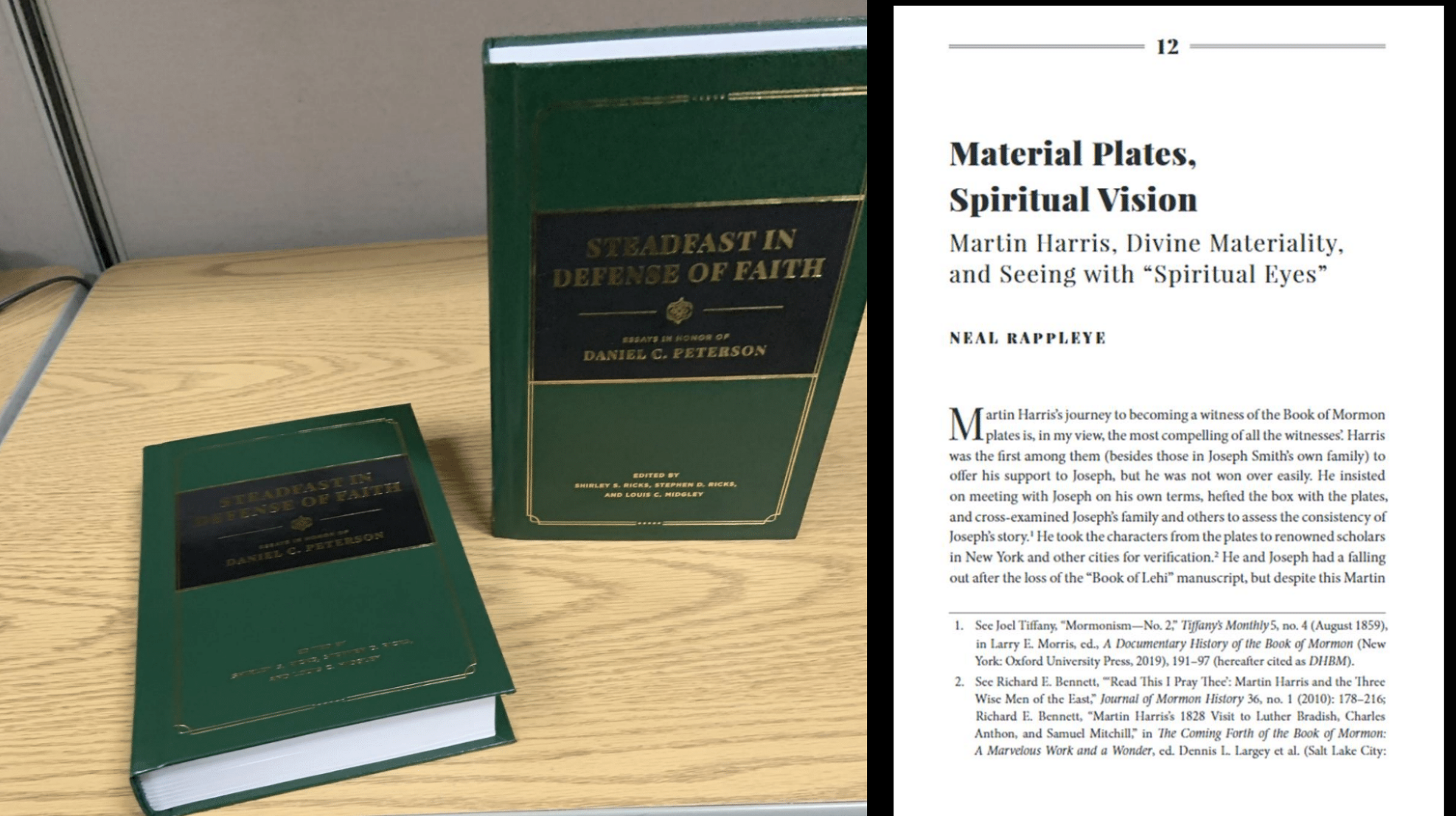
Neal: Thank you for that. As Scott mentioned, my paper here is a highly condensed version of one that contributes to the volume Steadfast in the Defense of Faith, presented in honor of Dan Peterson yesterday, and available here tomorrow for purchase. I recommend you not judge the volume based on my paper—there are several much better contributions. But Dan, as many of you probably know, has had a longstanding interest in the Book of Mormon witnesses. He even made a film and a documentary on the Book of Mormon witnesses, so I was honored to offer this contribution on Martin Harris as a tribute to his work.
Due to time constraints, I’m going to rearrange some of the material and my argument. I hope it still ends up making sense—I’m not sure if it will, but we’ll see how it goes.
Critics Claim
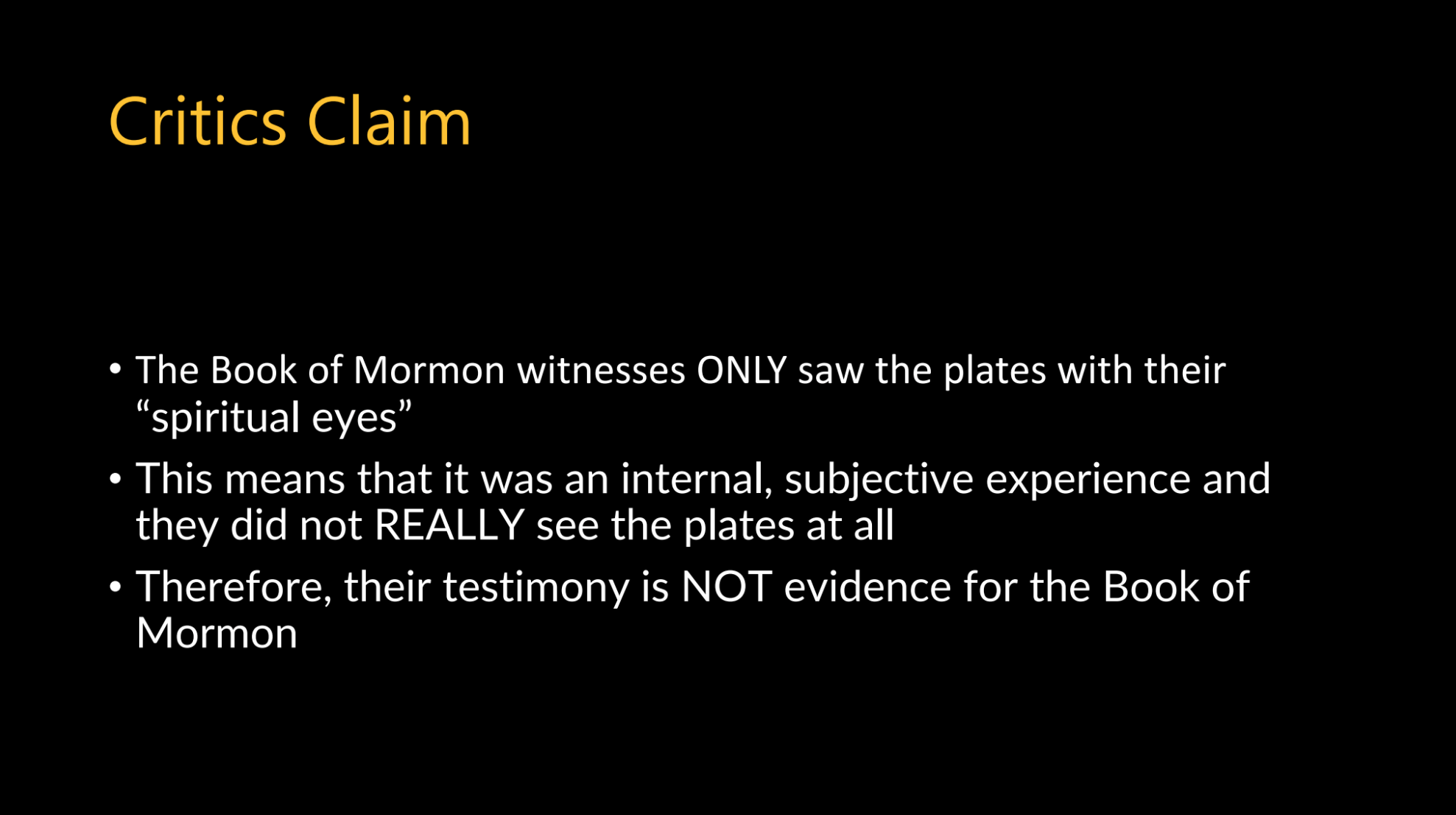
Many of you have probably heard the claim made by some critics or skeptics of the Book of Mormon that the Book of Mormon witnesses said they only saw the plates with their spiritual eyes. Critics argue that because of this, the experience was only internal or subjective, and that the witnesses were admitting this. Therefore, they did not really see the plates at all and therefore their testimony is not actually evidence for the Book of Mormon.
“Spiritual Sight”
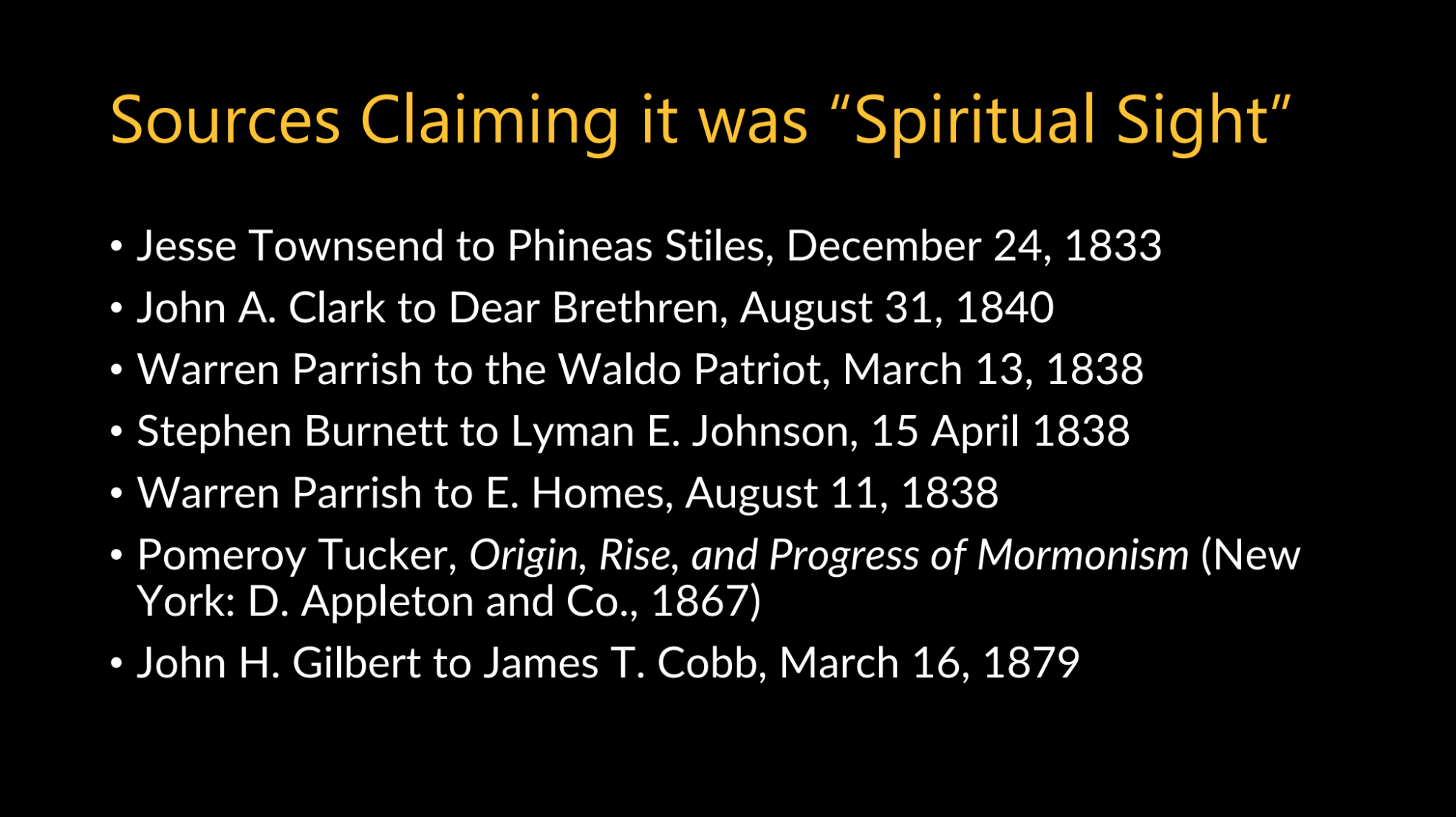
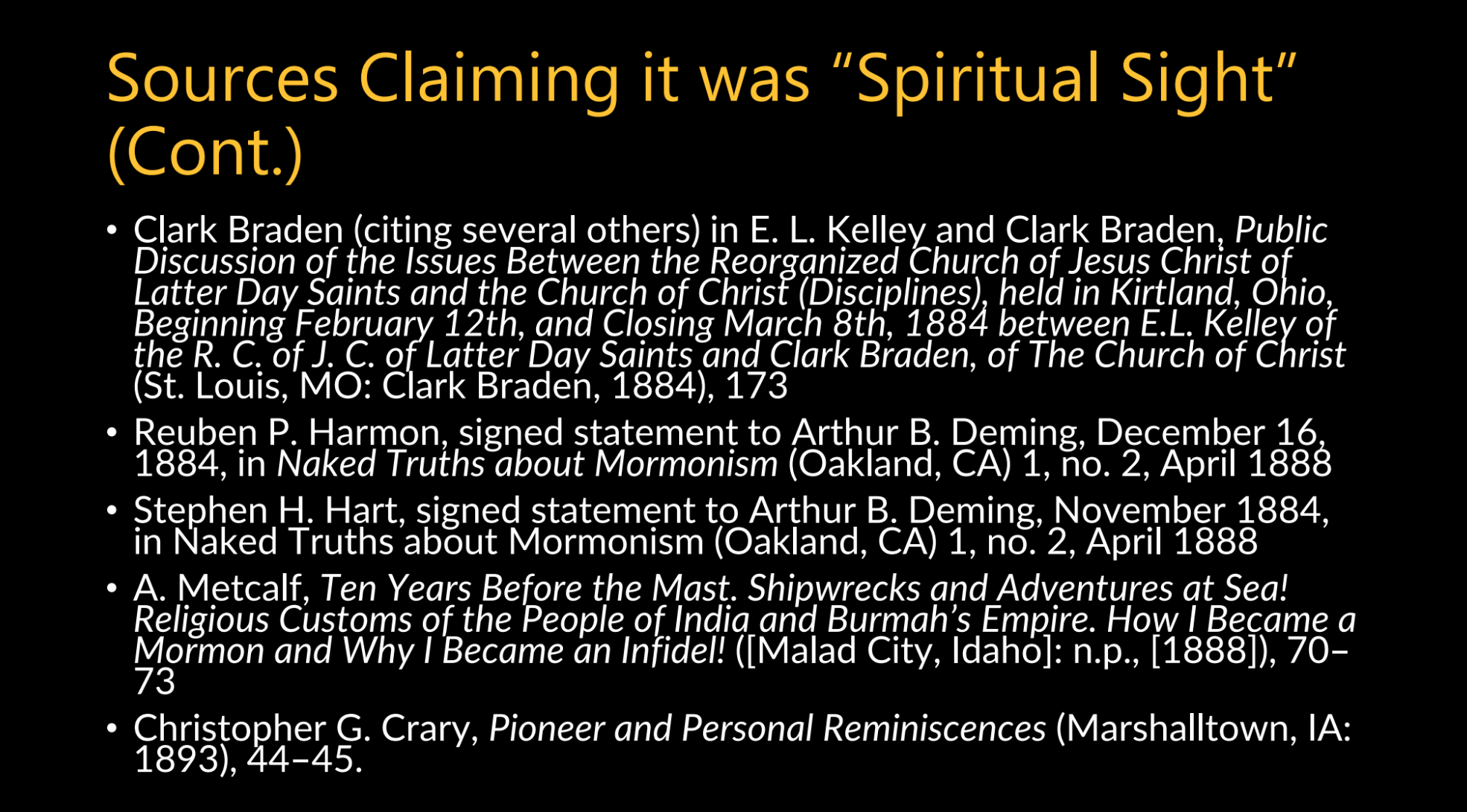
This argument is generally based on a handful of historical sources, most of which are tied back to Martin Harris claiming he saw the plates with spiritual eyes or the eye of faith. The slides above contain most of the sources that are used for the basis of this claim.
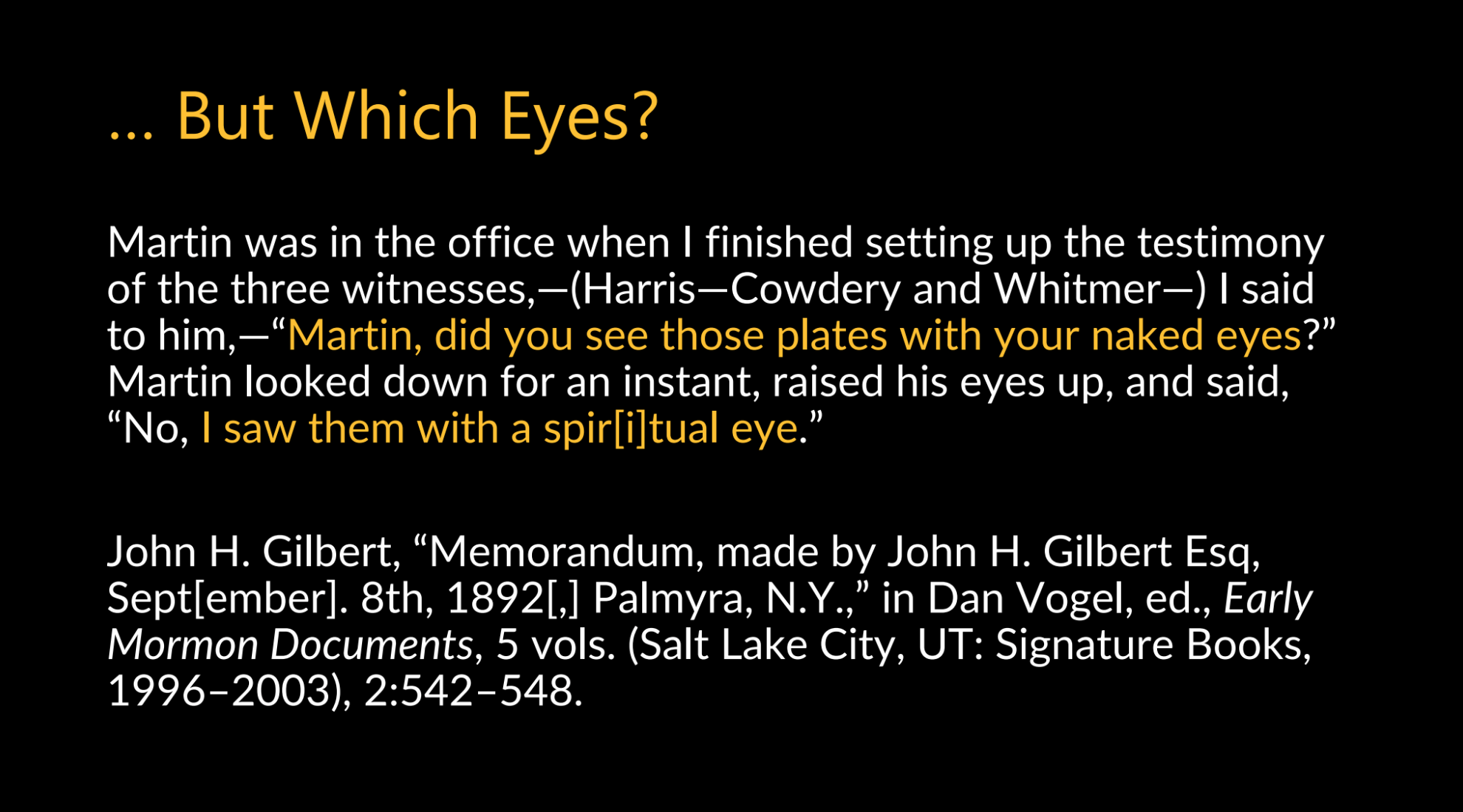
One example here, John Gilbert, who typeset the Book of Mormon, said that while he was setting the type for the three witnesses’ statement, Martin was in the printing office. Gilbert said he asked, “Martin, did you see those plates with your naked eyes?” Martin allegedly responded, “No, I saw them with a spiritual eye.” In another source, Martin is alleged to have said that not only he, but all the witnesses—including the eight witnesses—only saw the plates with a spiritual view. Critics then extend this claim to all the witnesses, suggesting that none of them actually saw the plates.
Source Problems
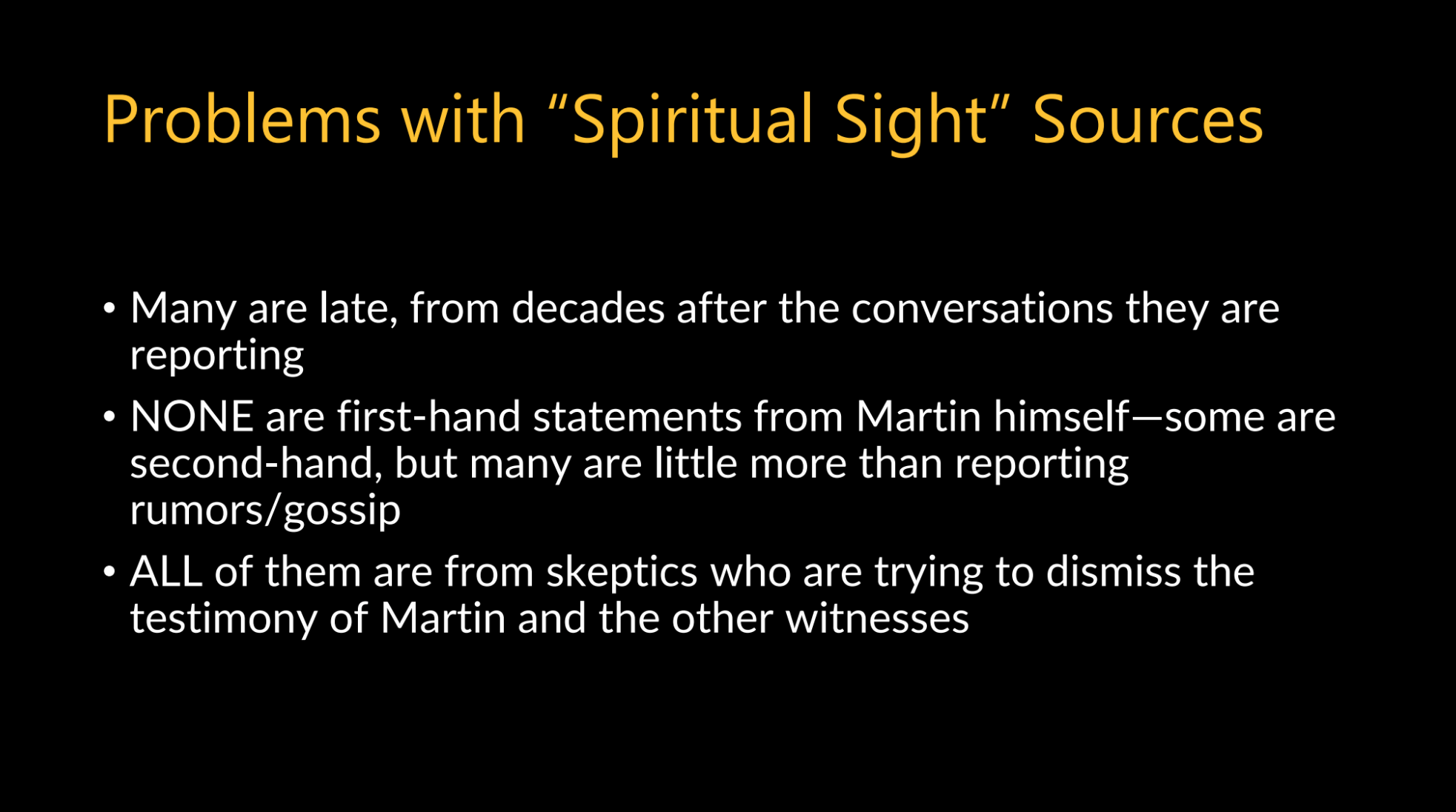
There are a number of problems with these sources, though. Many of them are very late; they often are being written decades after the conversations that they’re reporting. None of them are firsthand; none come directly from Martin Harris or any of the other witnesses. Many aren’t even secondhand, so many of them don’t even come from someone who actually spoke to Martin Harris directly. They’re reporting something they heard from someone else about what Martin said, or whatever. It’s basically rumors or gossip that they’re reporting. All of them come from skeptics who were trying to dismiss the testimony of the witnesses and Martin’s experience in some form or another.
Most of them probably would not have believed Martin or any of the other witnesses, even if they had insisted that they saw the plates with their natural eyes. As I go into some of the context here, I’m convinced that this actually would have made them even less likely to believe; it would have actually made things worse for Martin if he had claimed that to some of these people.
I do want to be clear, though. I’m not pointing all of this out to completely discredit these sources or simply handwave or dismiss them. That’s really not the point. In trying to understand what Martin said, we need to understand that his words are only being given to us and filtered through these skeptical, critical individuals and their memories. They’re shaping the context in which we get these expressions and phrases, rather than being able to hear what Martin himself had to say and how he contextualized and couched this language.
These people who relayed this information in their sources certainly took it to mean that Martin did not really see the plates and the angel. But my question—what I’m trying to understand—is what spiritual sight actually meant to Martin Harris.
What Did “Spiritual Sight” Mean to Martin Harris?
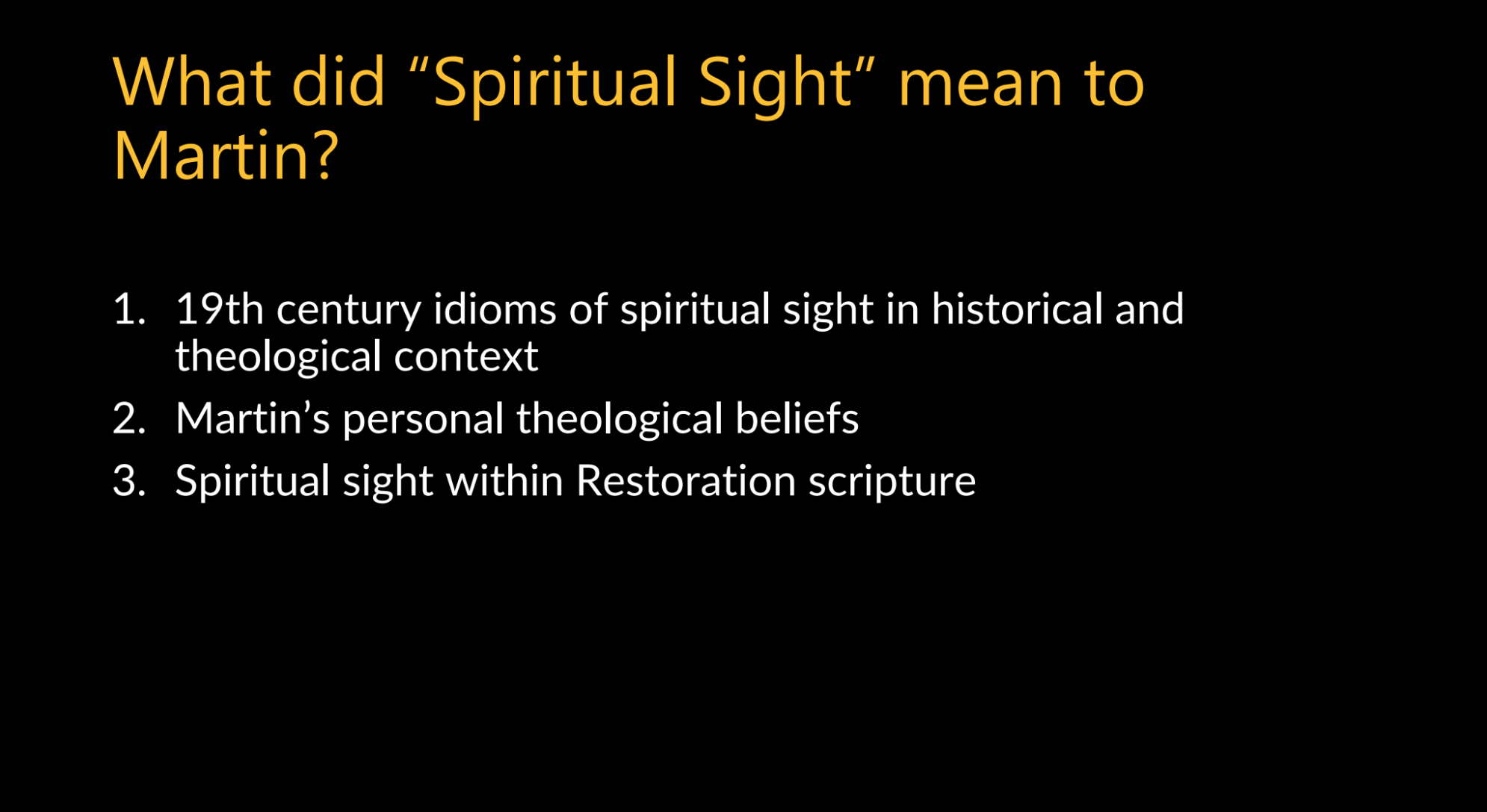
To better understand that, I want to take a step back and look at what spiritual sight and these idioms about spiritual sight actually meant within the historical and theological context of the 19th century. Then, I want to compare and contrast that with some of Martin’s own theological beliefs and also talk about the Restoration, and some of the ways our theology differs from that broader context. I’ll also discuss some Restoration scripture that I think provides a different view of spiritual sight than the dominant culture, one that is more grounded in materiality and physicality, even.

Let’s go ahead and start with the spiritual idioms from the 19th century.
Commonly Used Spiritual Terms
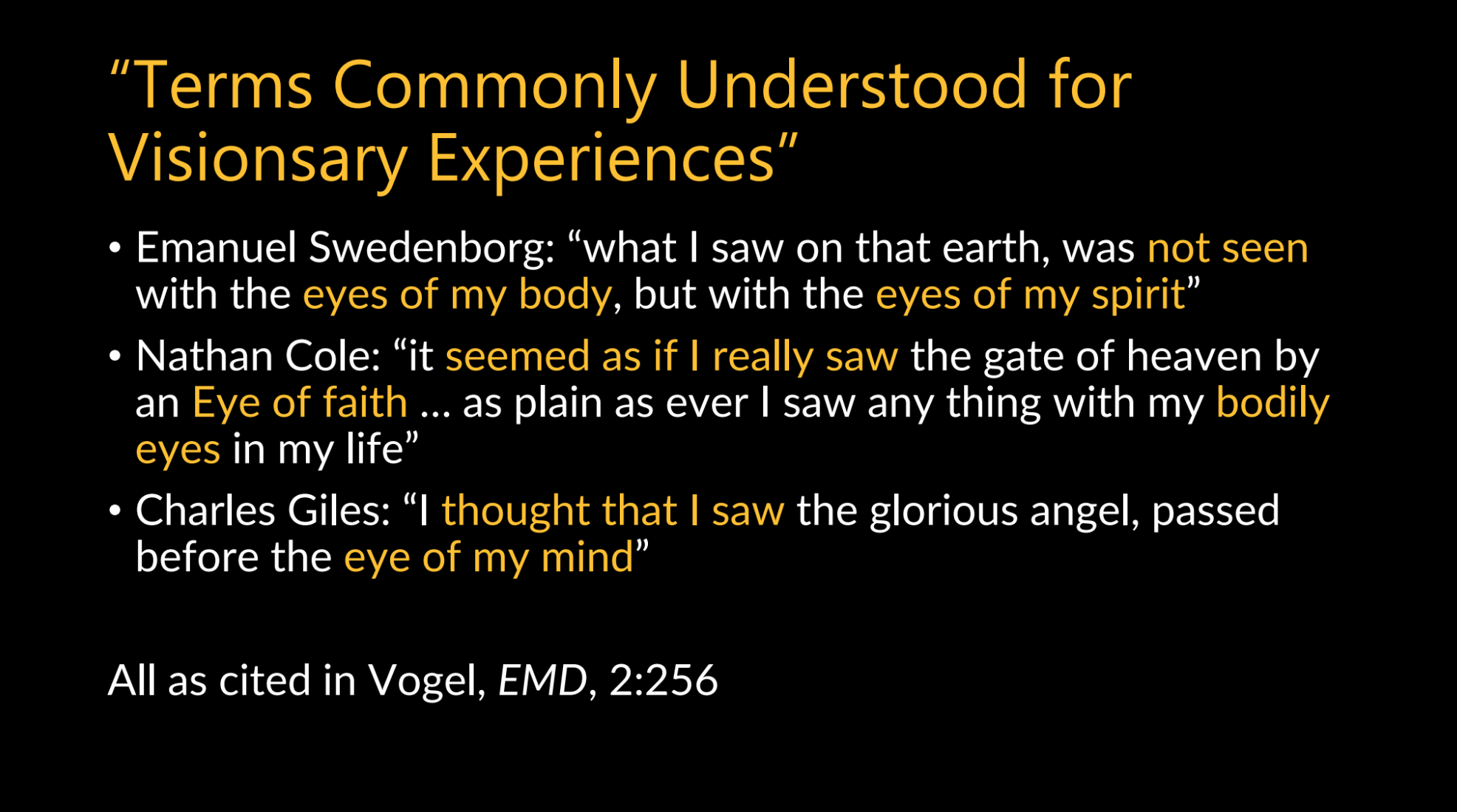
Critics have pointed out that these are terms commonly used and understood for visionary experiences in this time period, citing examples like Emanuel Swedenborg, Nathan Cole, and Charles Giles. But it is important to understand that there’s a theological context to these expressions that developed over centuries in the post-biblical period.
I’m just going to preface this with an apology to anyone who actually knows a lot about philosophy and theology and its history, because this is going to be a vast oversimplification due to time. I also admit that I’m not much of a theologian myself, so I’m primarily dependent upon Esther Hamori’s discussion of this topic in her book When Gods Were Men, which I thought was excellent. That being said, let’s charge ahead with vast oversimplification.
Post-Biblical Judeo-Christian Theological Worldview
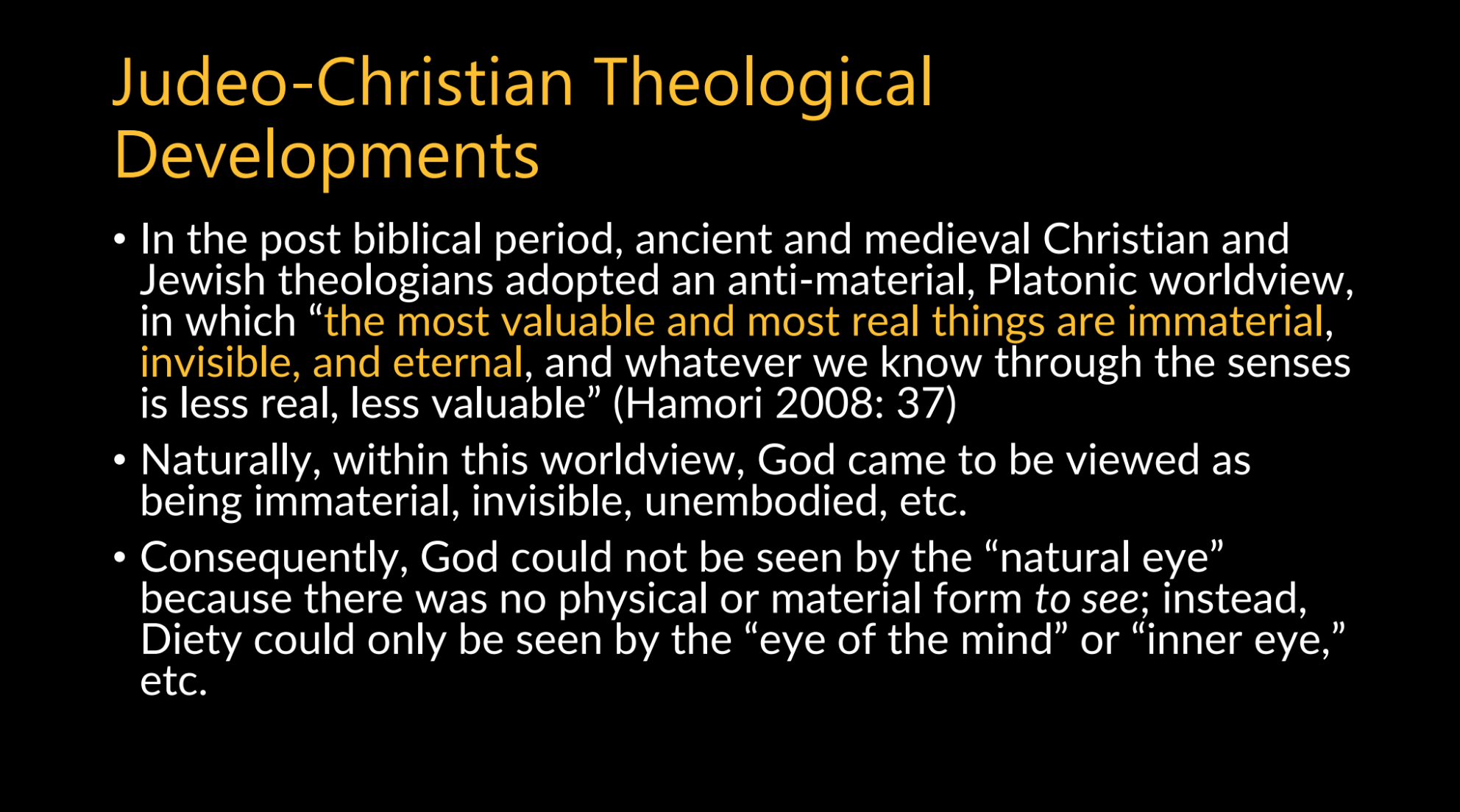
In the post-biblical period, Jewish and Christian theologians adopted a Platonic, non-materialist, and even anti-materialist worldview, in which “the most valuable and most real things are immaterial, invisible, and eternal. And what we know through the senses is less real and less valuable.” So, naturally, within this worldview, God could not be material and embodied because that would make Him inferior. So, they came up with notions about God being immaterial, unembodied, and so forth. Consequently, this meant that God could not actually be seen with the natural eye or with your natural senses because there was no physical form to see for God.
Instead, they started speaking of seeing God with the eye of the mind, the inner eyes, spiritual eyes, and so forth.
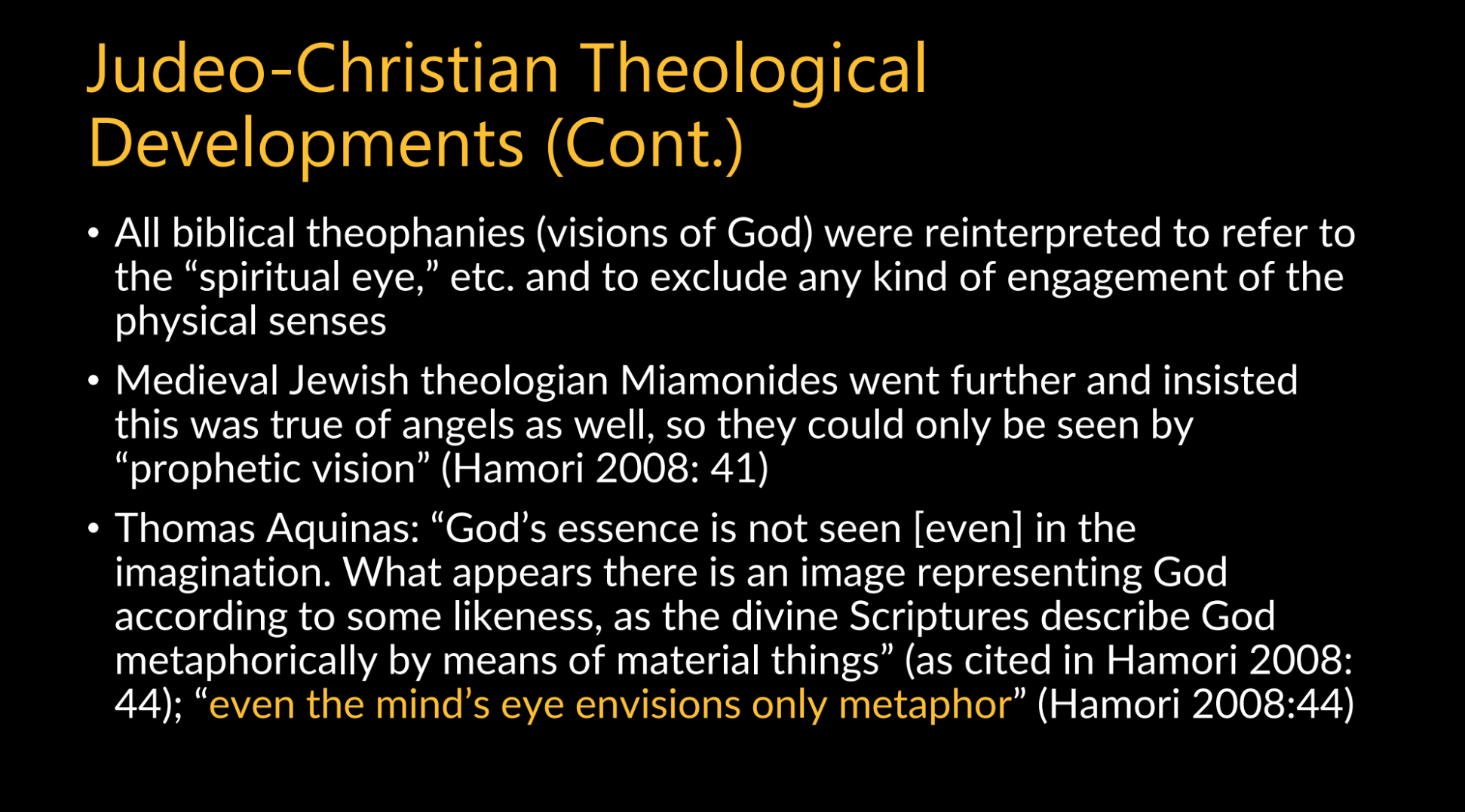
This posed a problem because the Bible talks about theophanies—people having these visions of God and speaking to God face-to-face. These theophanies had to be reinterpreted to refer to spiritual sight, and they were also reinterpreted to exclude any kind of interaction with the physical, natural senses.
These ideas were not limited to just seeing God; they were extended to angels. The logic of this, I thought, came to full fruition with Thomas Aquinas in the 13th century, who reasoned that if God and other divine beings are immaterial and have no physical form, then even what is perceived with the spiritual eyes, or the eye of the mind, or the inner eye, or whatever, could not actually be God. It’s still just a metaphor or a symbol for God. There was no possible way to truly see divine beings or things like that within this worldview.
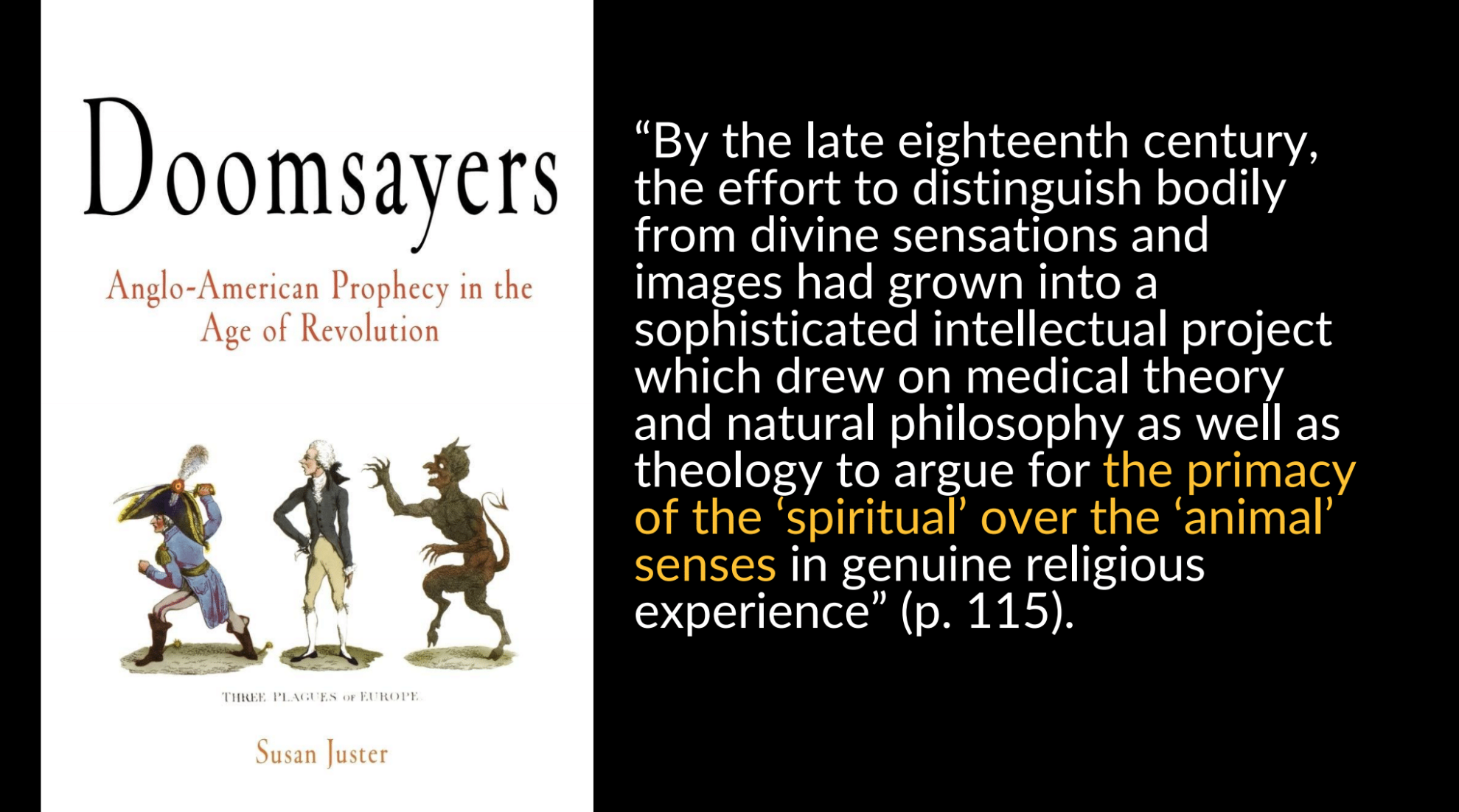
According to Susan Juster in her book Doomsayers, by the late 18th century, distinguishing bodily from divine sensations and images had grown into a sophisticated intellectual project. It drew on medical theory, natural philosophy, and theology. An important point is that, for a lot of people, they argued for the primacy of spiritual over the animal or the natural senses in genuine religious experience. Juster further explains that in general, visions should be seen, not felt or heard, in any physical way, and they were to be seen by the eye of faith alone. Genuine visions were to be seen with the spiritual, not the natural eye.
In other words, this is really a different kind of paradigm than the way we approach these sources and this kind of thing today. We tend to come from—and our critics today tend to come from—a much more naturalistic outlook, in which the spiritual senses are seen as less legitimate. But in that time and place, spiritual senses, for claims about divine authority and divine things, were viewed as superior to the material, natural senses. Many people viewed having visions by spiritual sight as superior to natural sight.
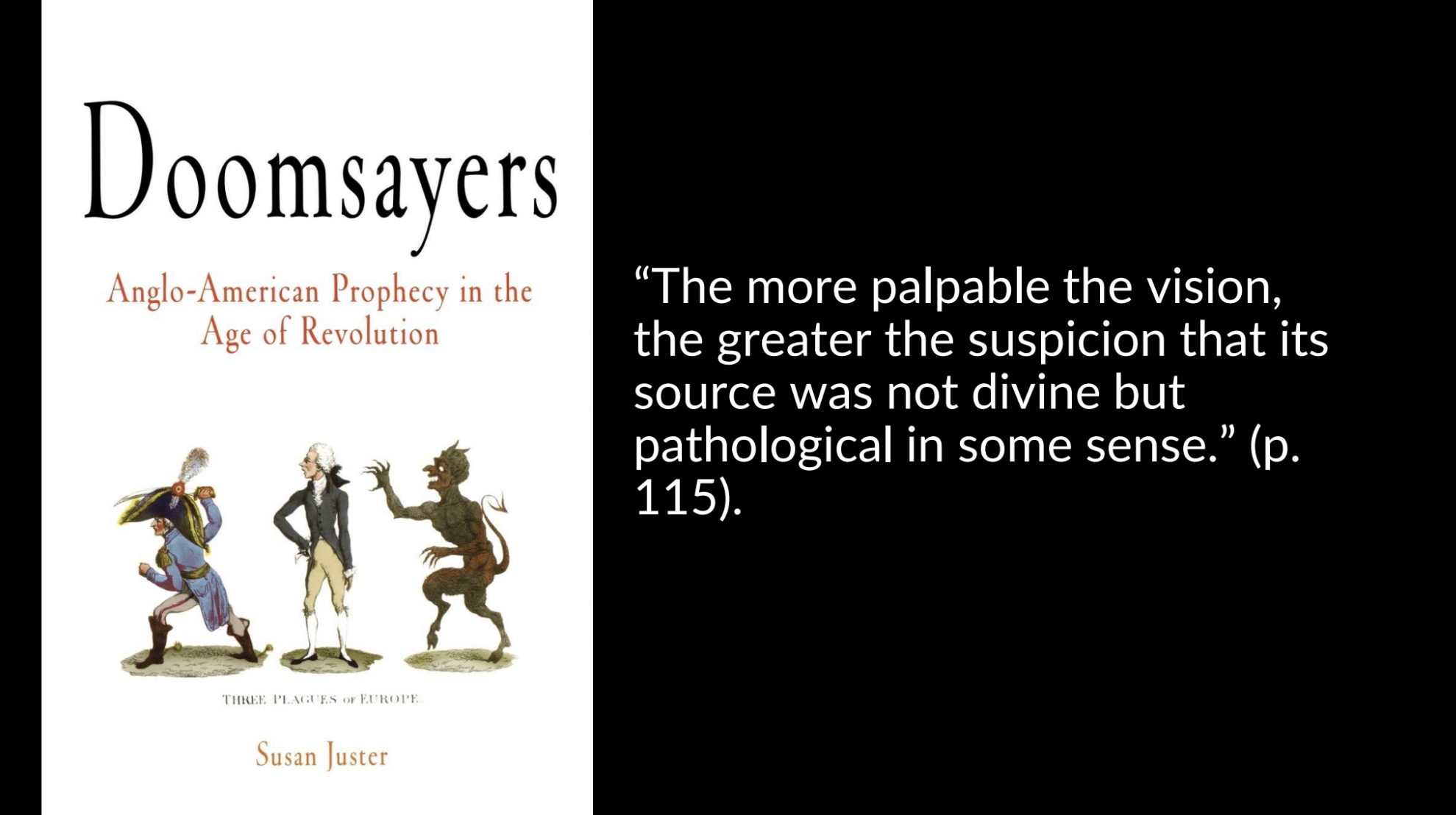
In fact, Juster notes that “The more palpable”—that is, the more tangible, physical, literal sorts of visions—”the greater the suspicion that its source was not divine, but rather pathological in some sense”. People who had more physical, literal visions were thought to be mentally deranged. They were considered delusional, crazy, insane. A term that was used a lot for them was “monomaniacs,” and, as I’ll show later, we actually see this term applied to Martin Harris specifically.
Spiritual Sight vs Natural Sight
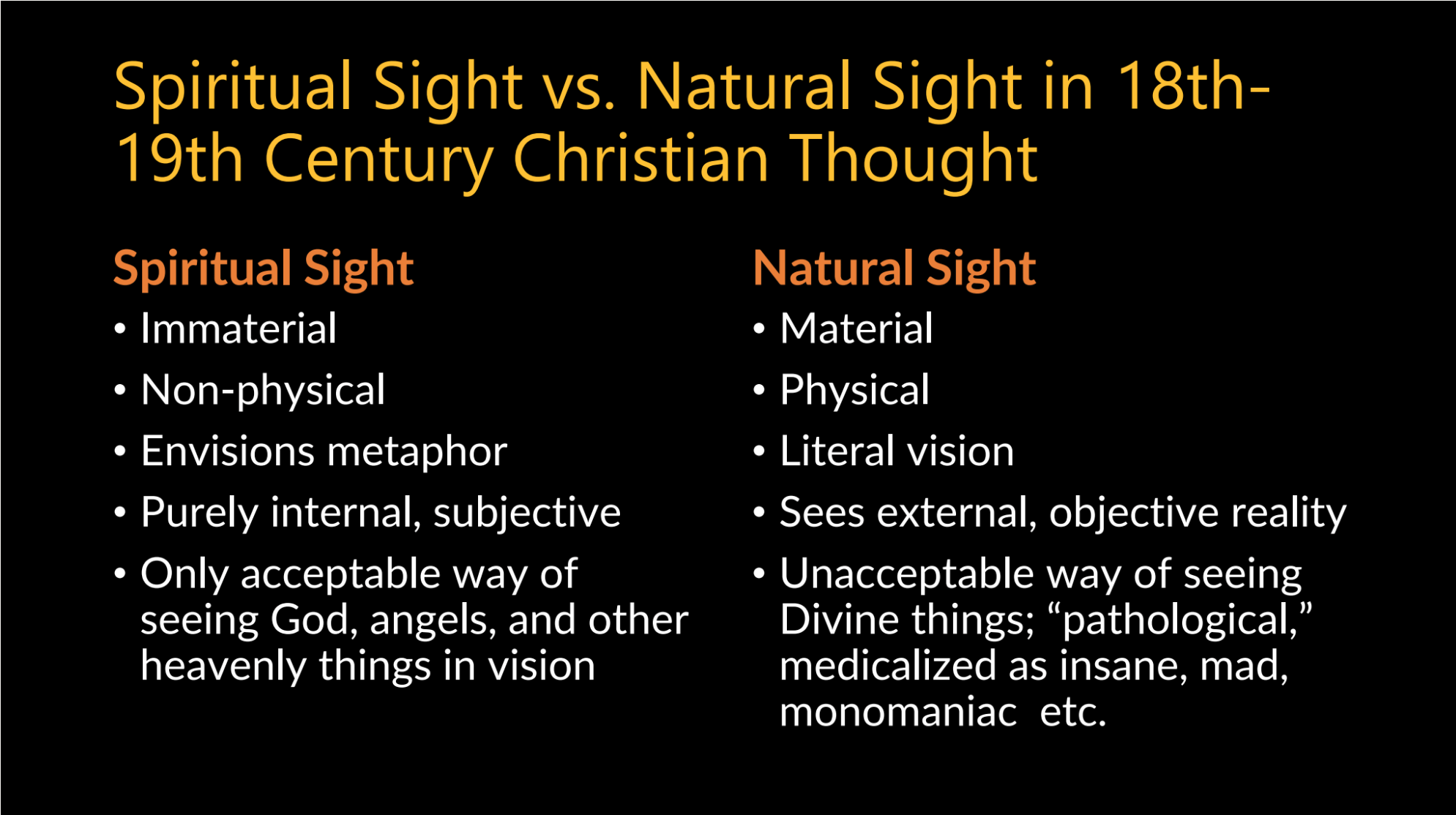
There’s this complete dichotomy between spiritual and natural sight; they are mutually exclusive forms of experiencing divine things or the world. One is seen as the legitimate way to have a vision; the other is seen as illegitimate. So, when Martin is being asked about this sort of thing—when they ask, “Did you see this with your natural eyes?”—he’s kind of being put in an impossible position. If he says, “Yes, I saw them with my natural eyes,” they’re going to write him off as completely insane and crazy. But if he says, “I saw them with my spiritual eye,” as he apparently did according to some sources, that gives them a way to say, “Okay, well, it must have just been an internal, subjective experience, and I don’t have to really believe that this material artifact, the plates, actually existed.”
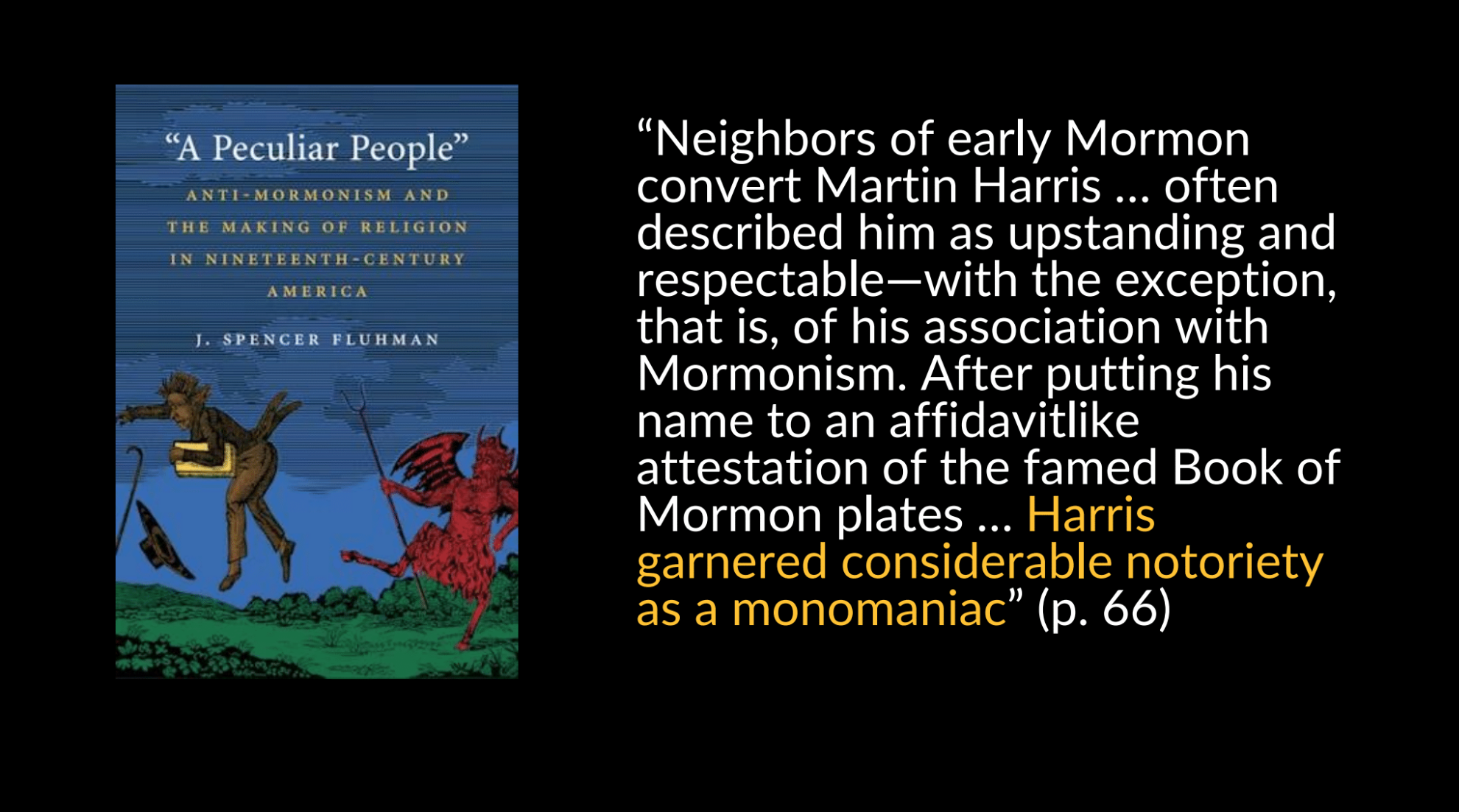
As it is, like I said, Martin does get written off as crazy. There are a number of primary sources, but I don’t have time to go into them. I’ll just use this quote from Spencer Fluhman in his book A Peculiar People, where he notes that Harris, after he signed the affidavit affirming the witnesses’ statement, garnered considerable notoriety as a monomaniac—that is, he was considered to be insane. At least in religious matters. There are sources that specifically say he was perfectly rational in every other aspect of his life, but he was considered kind of insane when it came to religious matters. I suggest this is a hint that Martin is not actually playing by the right rules and keeping a proper division between natural and spiritual sight according to what’s expected within his culture at that time.
Martin’s Statements
So, with that in mind, I want to turn to some of what we know from Martin Harris’s own statements about what he believes about seeing God and divine things in general.
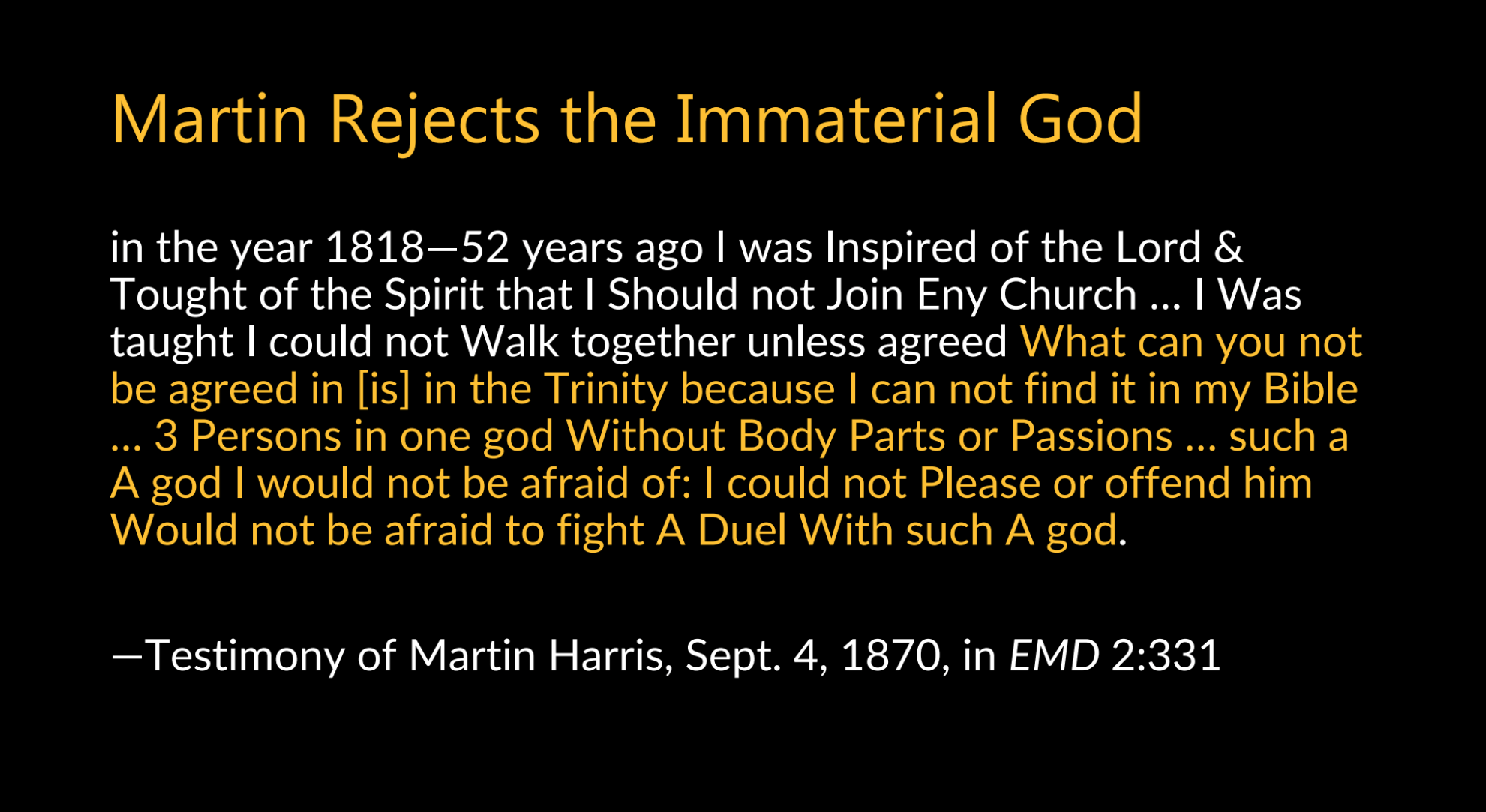
Years before The Book of Mormon came forth, according to his own recollection, he had already rejected the Trinitarian idea of a god without body parts and passions. He specifically said—this is kind of funny to me because it’s a very anthropomorphic, very humanlike notion of God, right?—he says, I “would not be afraid to fight a duel with such a God,” right? He just wouldn’t be afraid to fight him. And so, he doesn’t believe in that God because he wouldn’t be afraid to fight him. I think this is inspired somewhat by Genesis 32, where Jacob wrestles with God, but he kind of contemporises it by making it about a duel instead. But in any case, like I said, this is a very anthropomorphic, humanlike notion or way to see God that only makes sense if you embrace the idea that God is embodied.
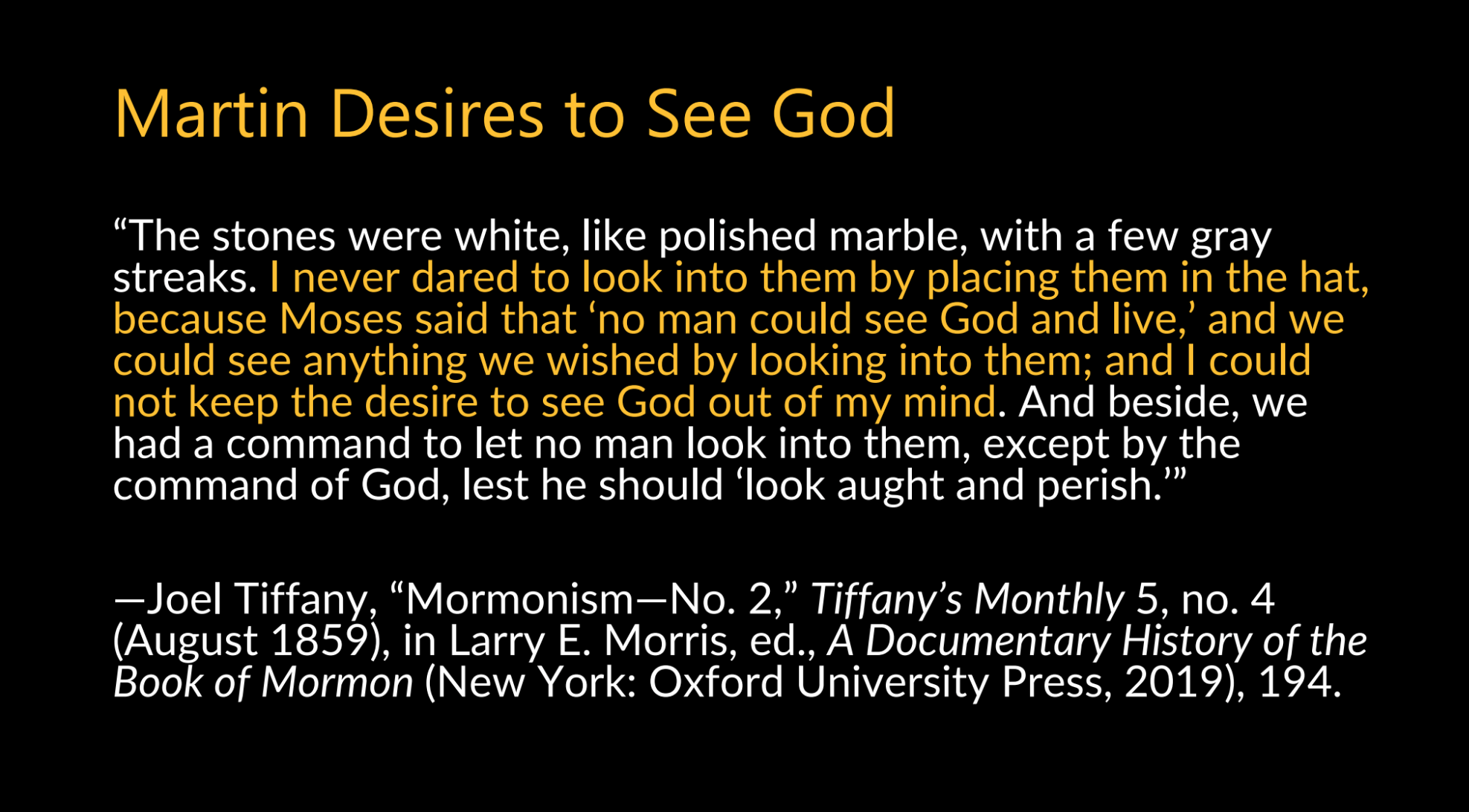
In another source, he talks about being afraid to look into the interpreters because he was told that you could see anything you want by looking into these interpreters, and his desire to see God was so strong that he was afraid to look into them because then he was afraid he would see God and die, because that’s what it said in the Old Testament, right? Exodus 33:20: “No man can see God and live.”
Old Testament Passages on Seeing the Lord
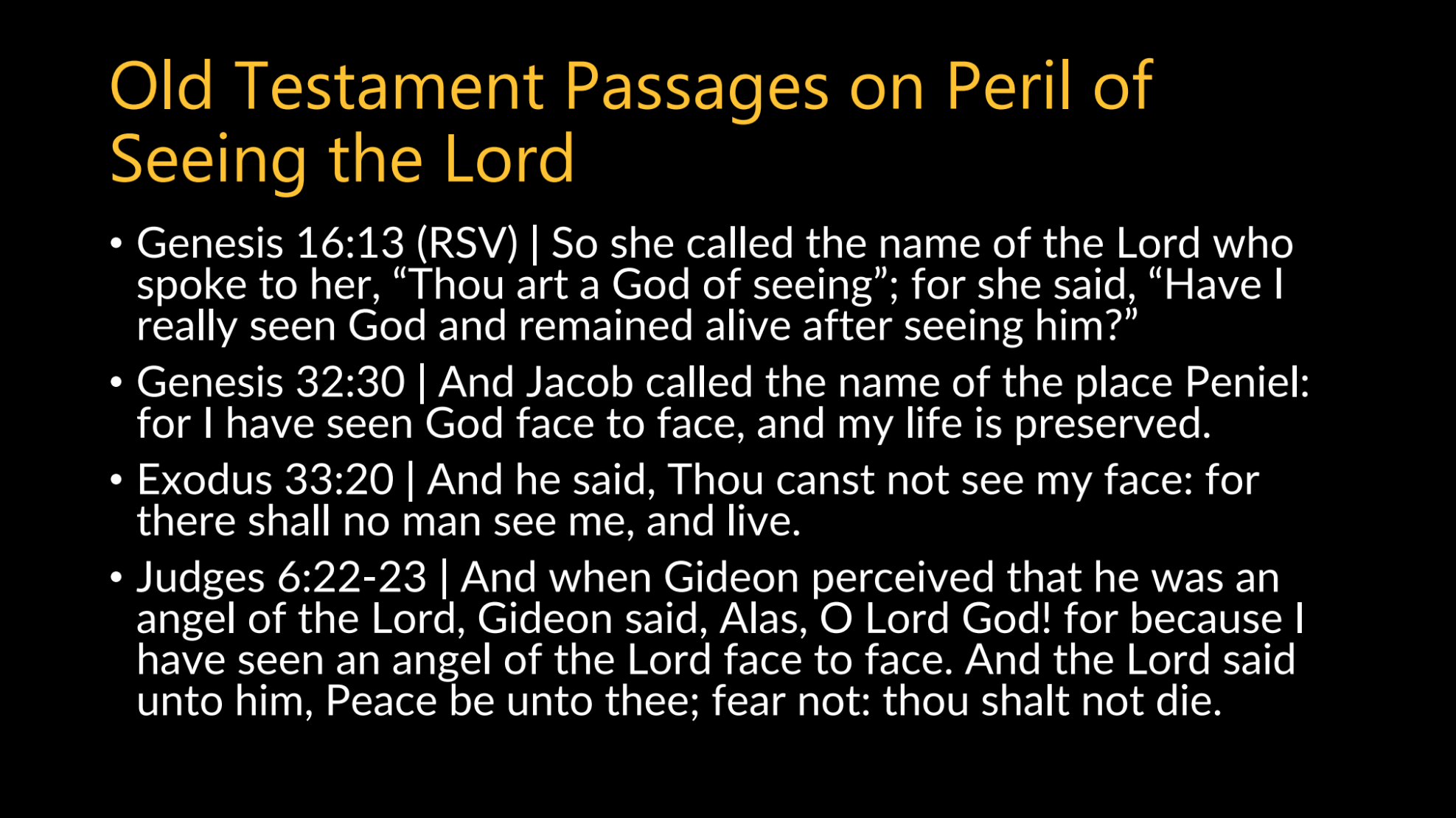
There are a number of other passages in the Old Testament where people fear they will die or marvel that they survived after having an encounter with the Lord or even the angel of the Lord in at least one instance. Surviving the divine presence requires some kind of purification or divine permission, as seen in Isaiah 6. This is coming from an Old Testament Hebrew background in which God is very much embodied, anthropomorphic, and humanlike. He has a form that can be seen, but it’s just dangerous to see it because of how glorious and powerful it is. (There are some of the scripture references if you want those.)
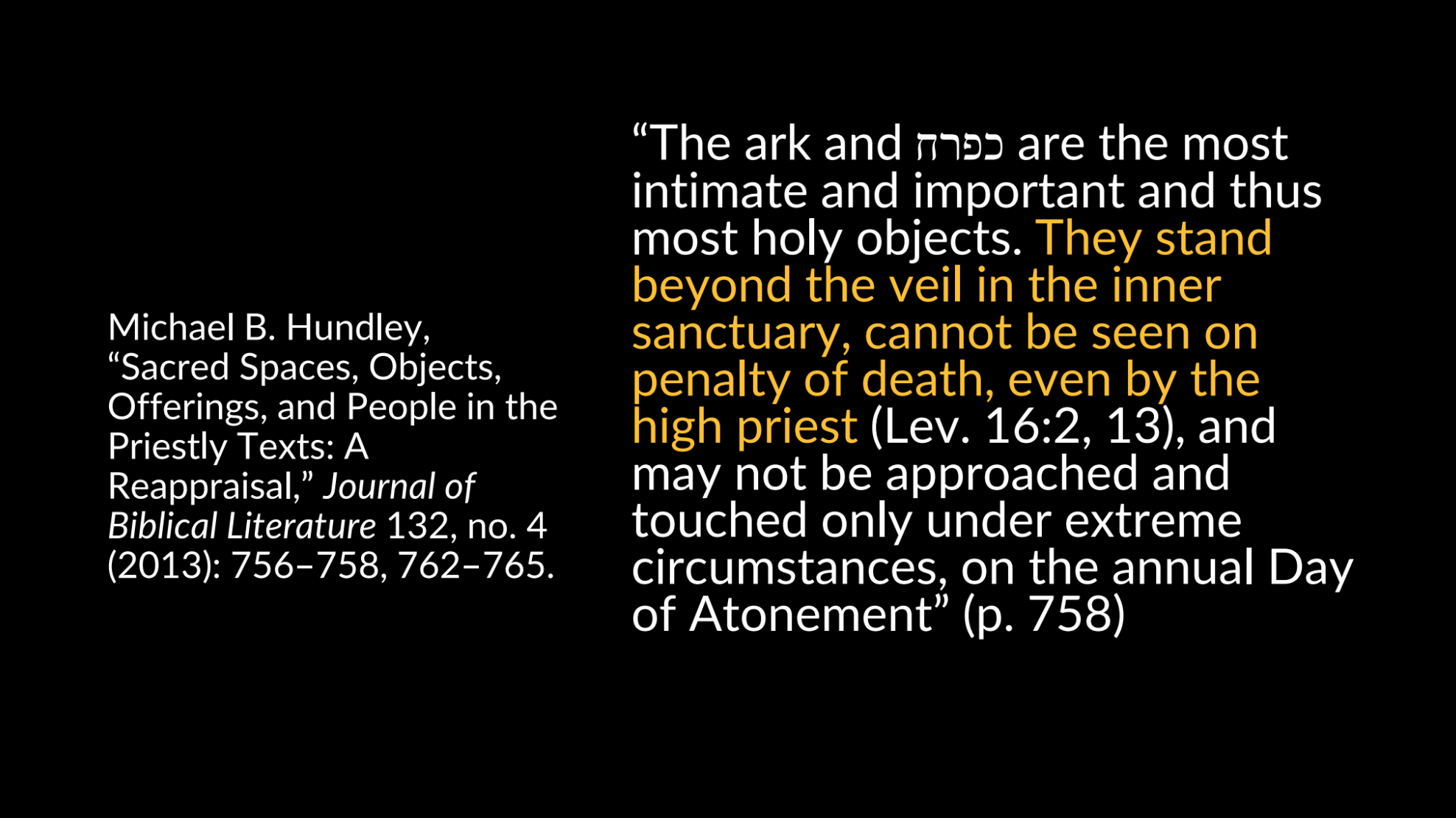
In the Old Testament, there are also sacred objects, most famously the Ark of the Covenant, and other items usually associated with the temple and tabernacle, which could only be seen and handled by authorized personnel, such as priests and Levites. As one scholar put it, “The Ark cannot be seen on penalty of death, even by the high priest.”
Martin held similar beliefs about sacred objects. He also appears to be informed by the Old Testament in what he believed about seeing and handling sacred objects.
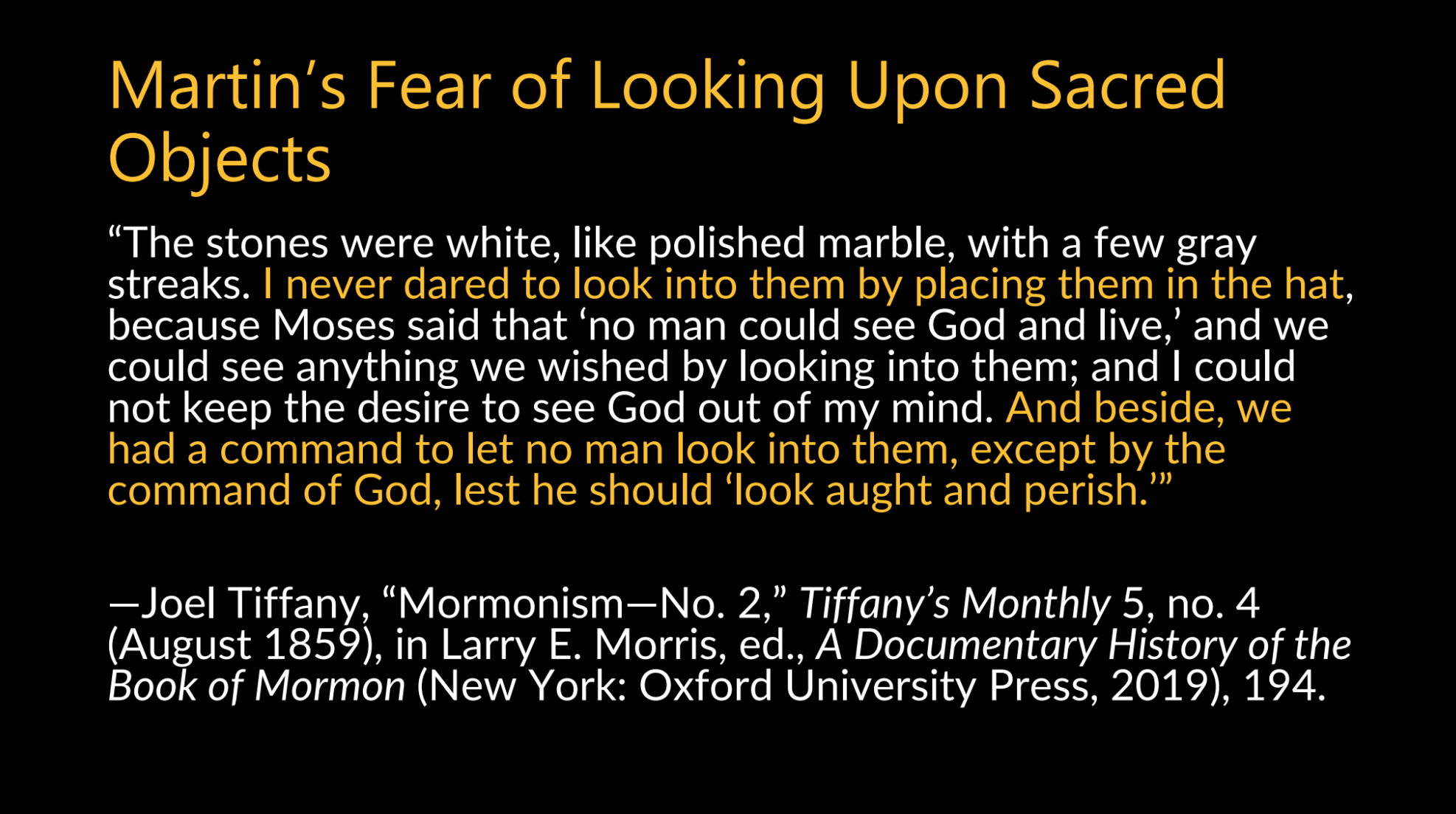
In addition to being afraid of seeing God in the interpreters, he says he’s afraid to look into the interpreters, period, because God commanded him not to. They received a command that no man look into them except as commanded by God, lest he “look aught and perish.” That’s actually quoting and alluding to Mosiah 8:13.
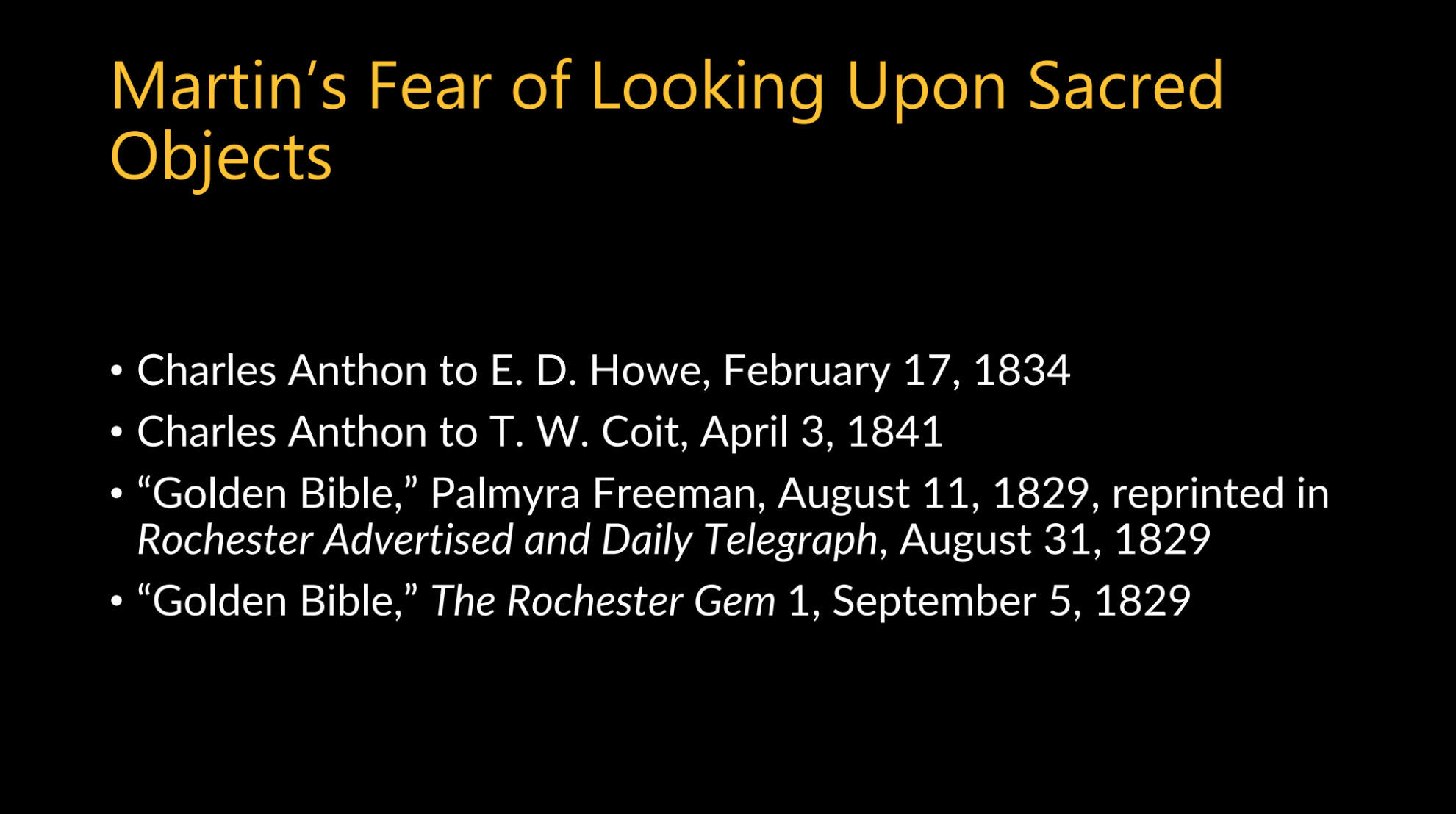
There are several other sources that report Martin being afraid or concerned, or unwilling to actually look at the plates without permission from God because he was afraid he’d incur some kind of curse or wrath from God.
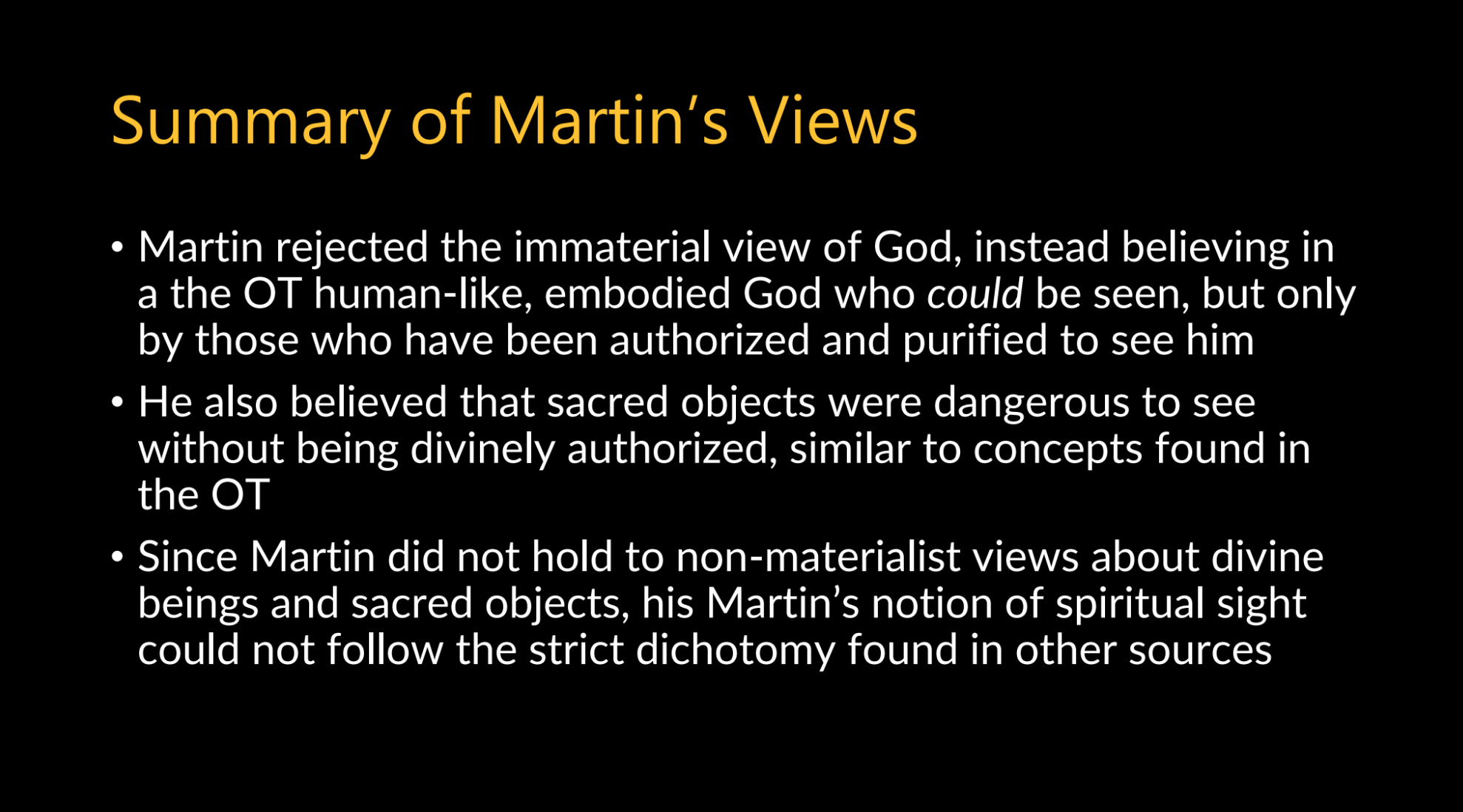
My takeaway from all of this is that Martin rejected the immaterial view of God and clearly believed in physical, tangible sacred objects, which could only be seen if authorized by God.
So, his notion of seeing with spiritual eyes and the eye of faith could not follow the strict dichotomy used by theologians operating within the non-materialist or anti-materialist paradigm.
Restoration Model
With that in mind, I want to talk very briefly about how the Restoration provides an alternative model for understanding spiritual sight that is more consistent with what we know Martin himself believed, even before converting to the Church.
Joseph Smith’s Theology
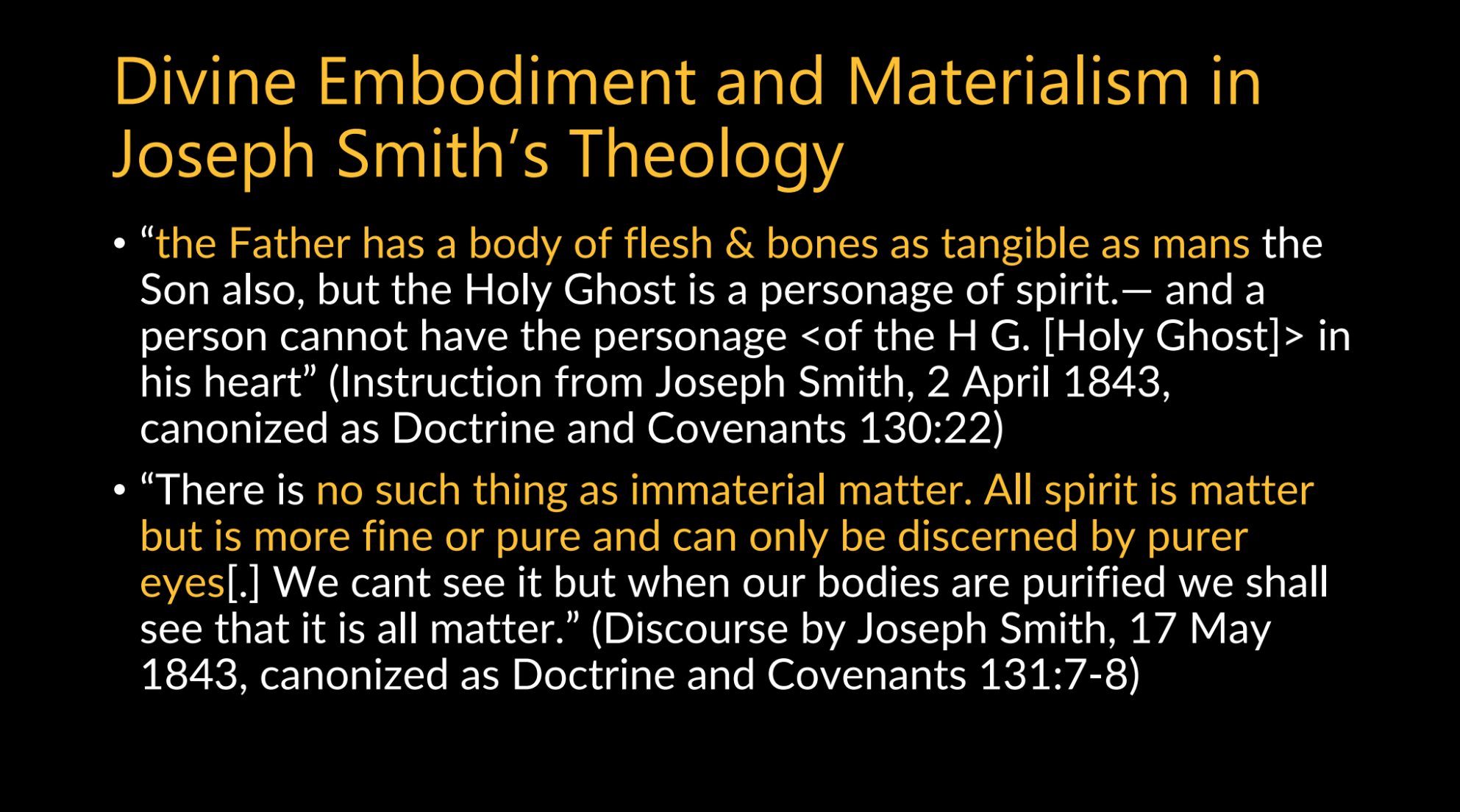
Joseph Smith, as we all know, in Nauvoo taught that God has a body as tangible as man’s, and that there is no immaterial matter. He said, Spirit is matter; it is more fine and pure, but you have to have pure eyes to see it. So, right there, we have a different notion of spiritual sight. But since these are the 1843 teachings of Joseph Smith, and Martin had left the Church by then, and some critics argue this is a late theological development from Joseph Smith, I want to turn to some early Restoration texts that I think reflect this.
The Brother of Jared
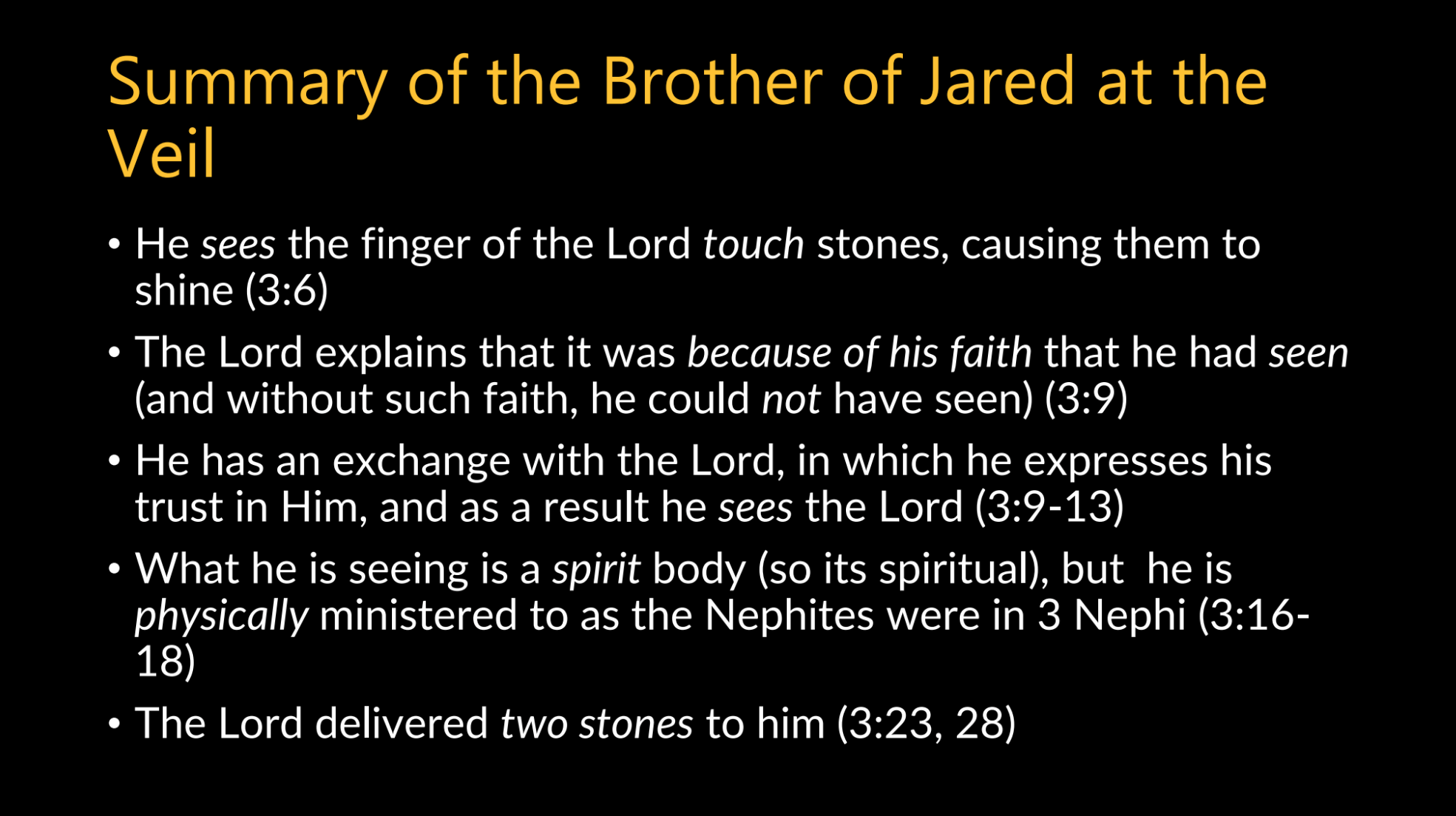
Due to time, we’ll only deal with the brother of Jared, and we’ll deal with it very, very quickly. I’m just going to summarize the key points here. The brother of Jared sees the finger of the Lord touch stones, right? There’s a tangible, physical element right out of the gate. The Lord tells him it’s because of his faith that he’s able to see. It’s because of his faith that he’s then able to see the Lord. The Lord reveals himself completely. He’s seeing a spirit body, but it says that the Lord ministers to him as he did to the Nephites in the flesh. In 3 Nephi, the Lord’s ministry to the Nephites is very physical—there’s physical contact in his ministering to the people. Then, at the end, the Lord delivers two additional stones to the ones he already touched, which we know as the interpreters. So, there’s an exchange of physical objects in this experience.
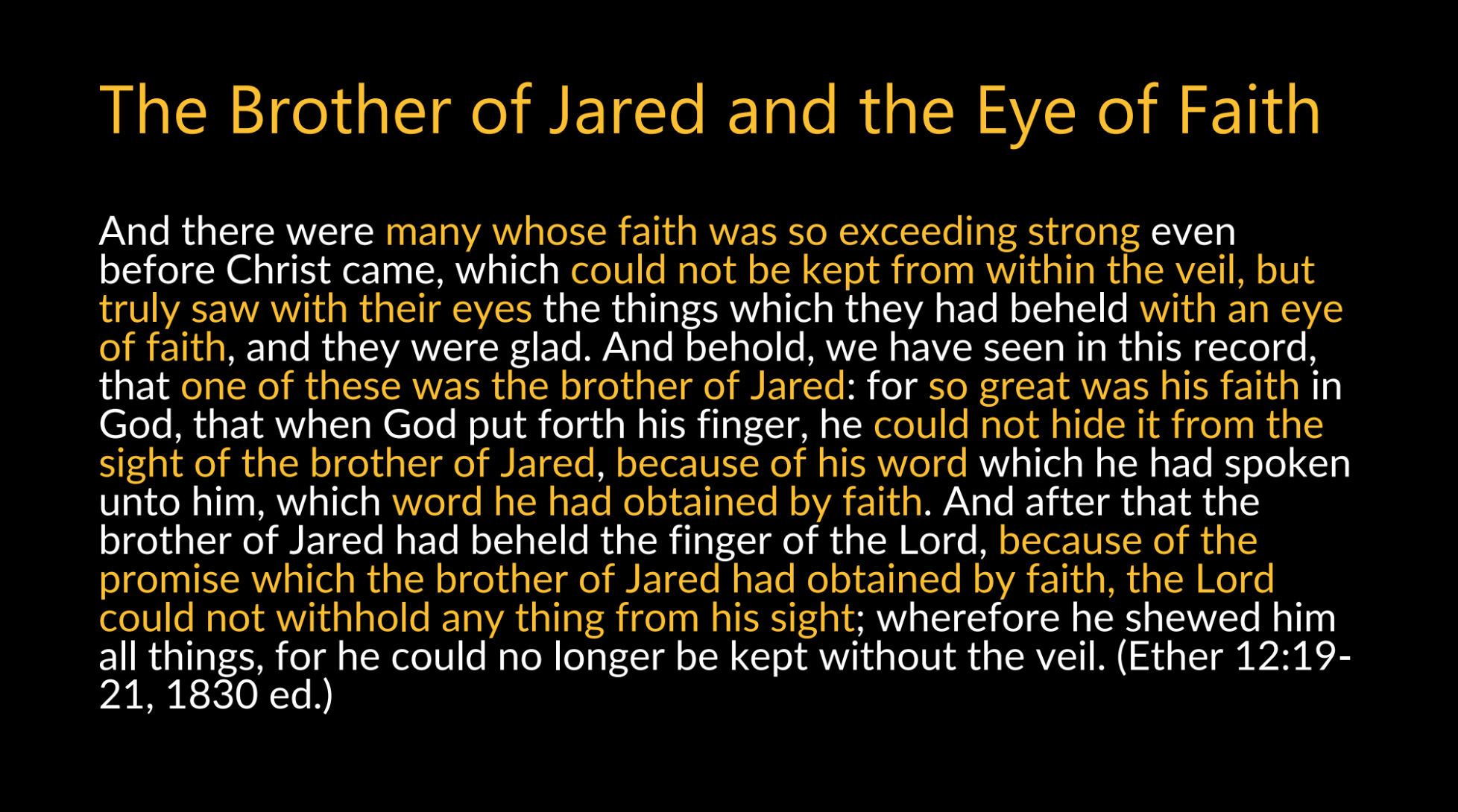
In Ether 12, Moroni specifically talks about many whose faith was so exceedingly strong that they could not be kept from within the veil but truly saw with their eyes the things they had beheld with an eye of faith. He uses the brother of Jared as the very first example of this. He says the Lord could not hide his finger from the brother of Jared because of his word, which he had obtained by faith, and because of the promise which he had obtained by faith, the Lord could not withhold anything from his sight.
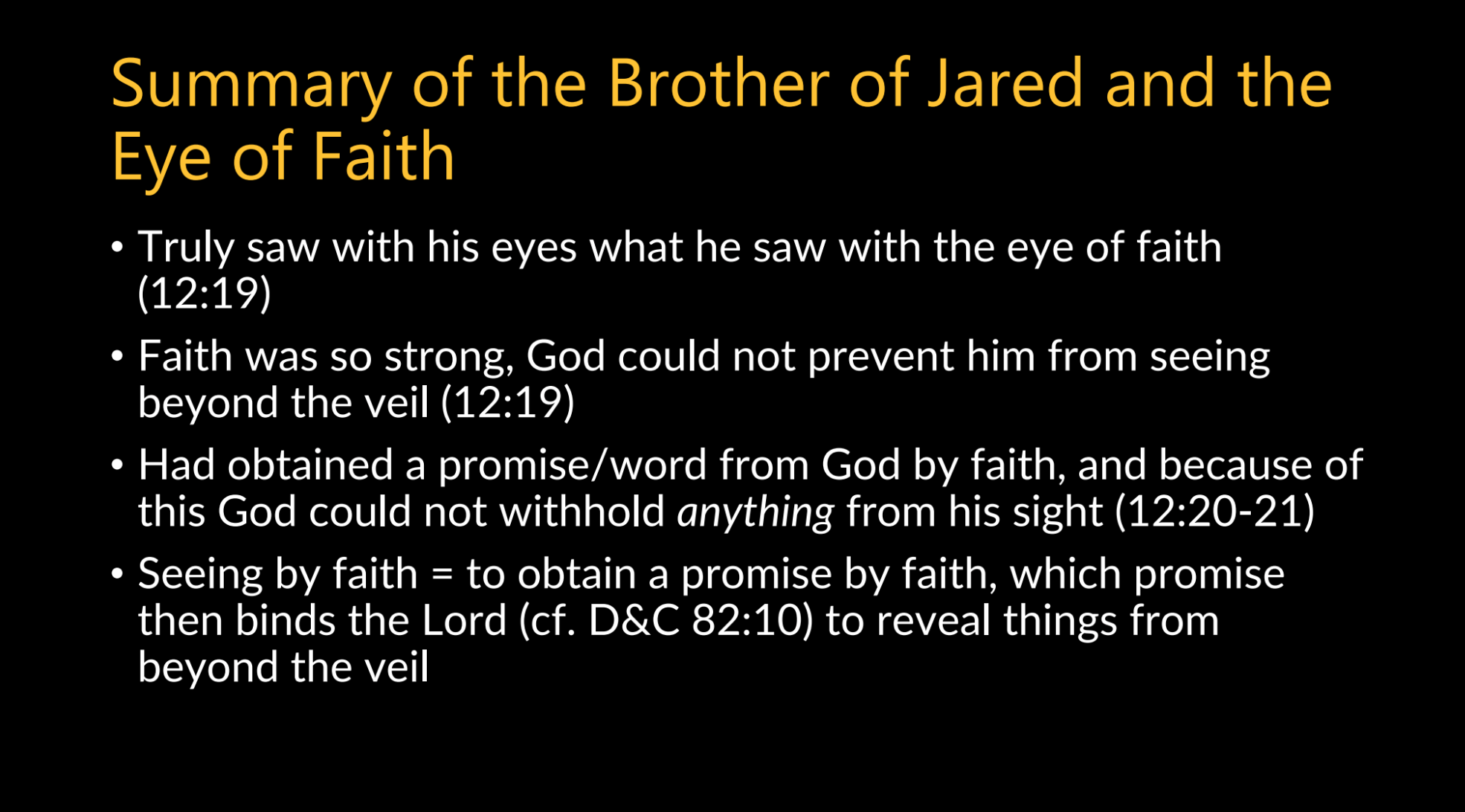
This account equates seeing by the eye of faith with truly seeing with your eyes. It is by faith—not because it’s some non-physical, immaterial way of seeing, or an internal, subjective way of seeing, but because the brother of Jared showed such great faith in God’s promises that the Lord was bound by his promises to reveal things from beyond the veil. (You can cross-reference D&C 82:10: “I, the Lord, am bound when you do what I say.”)
The Three Witnesses
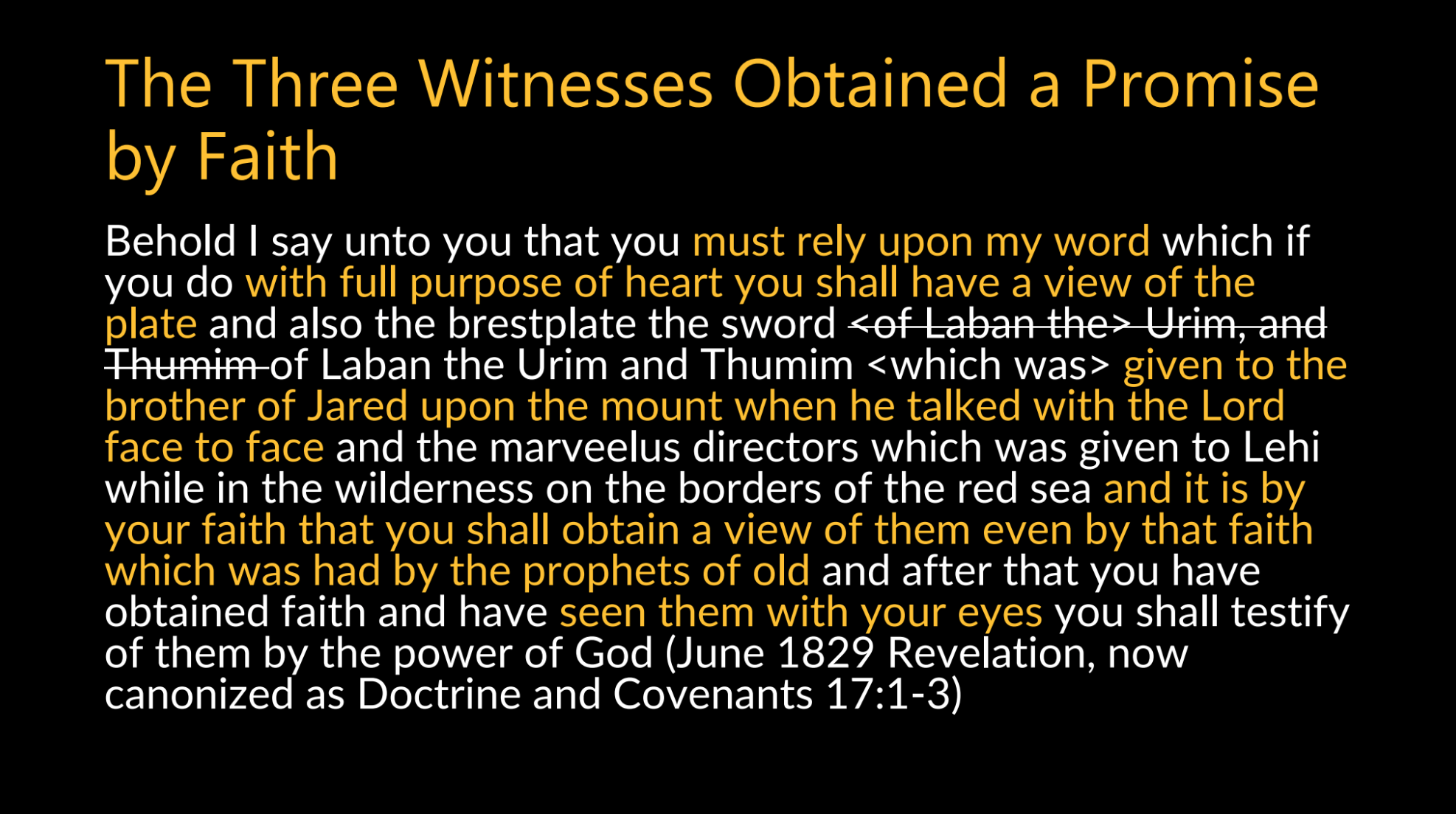
To wrap up, I want to compare that to the promise to the three witnesses in D&C 17.
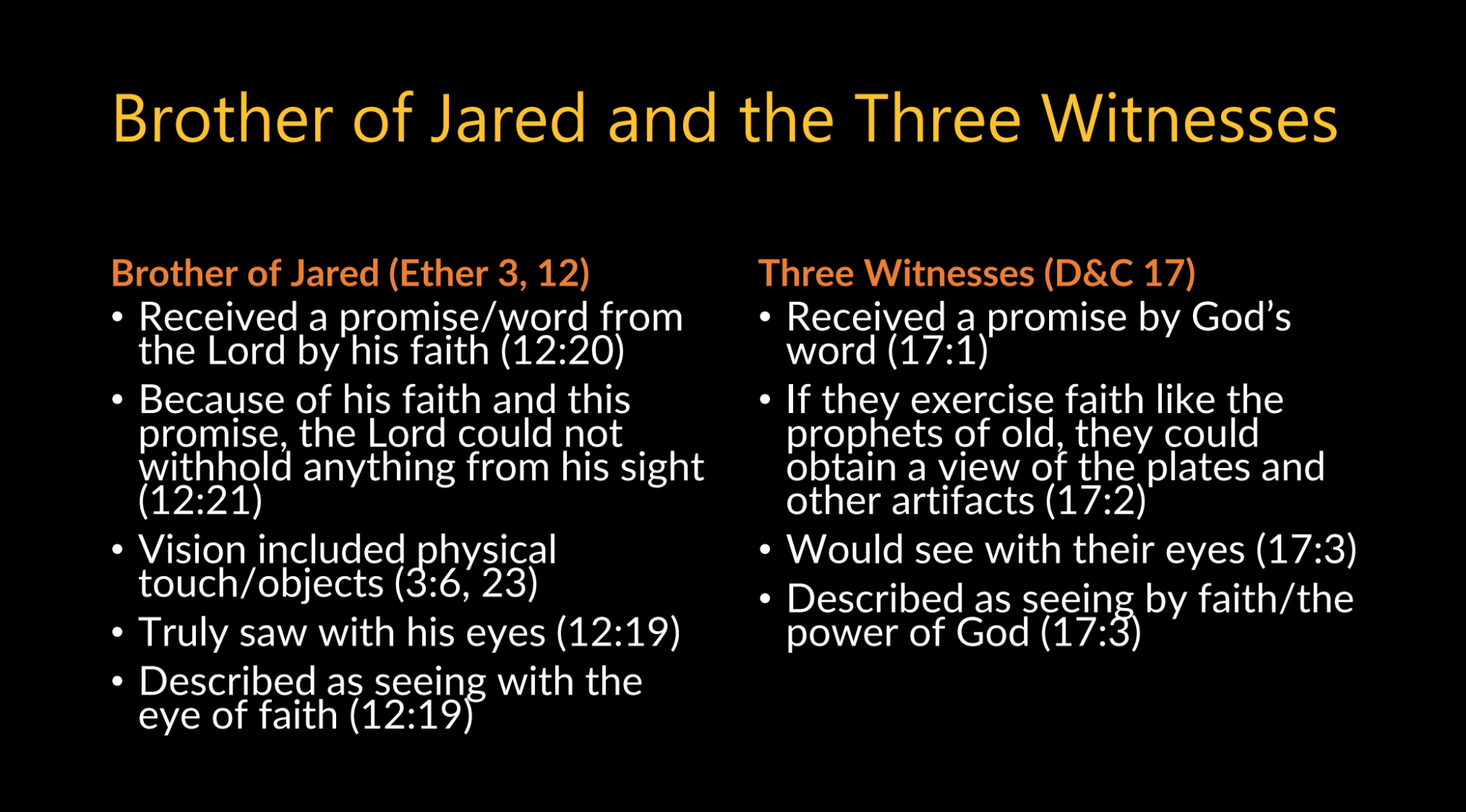
For the sake of time, we’ll just go straight to this comparison chart. The three witnesses are also given a promise by God’s word that they could see the plates, but only if they exercised faith like the prophets of old, like the brother of Jared, who is specifically mentioned in D&C 17. Once they obtained sufficient faith, they could see with their eyes, it says, and they were to testify of seeing by the power of God. This is the same notion of spiritual sight found in Ether, which explicitly included physical touch and tangible objects.
Joseph Smith and the Plates
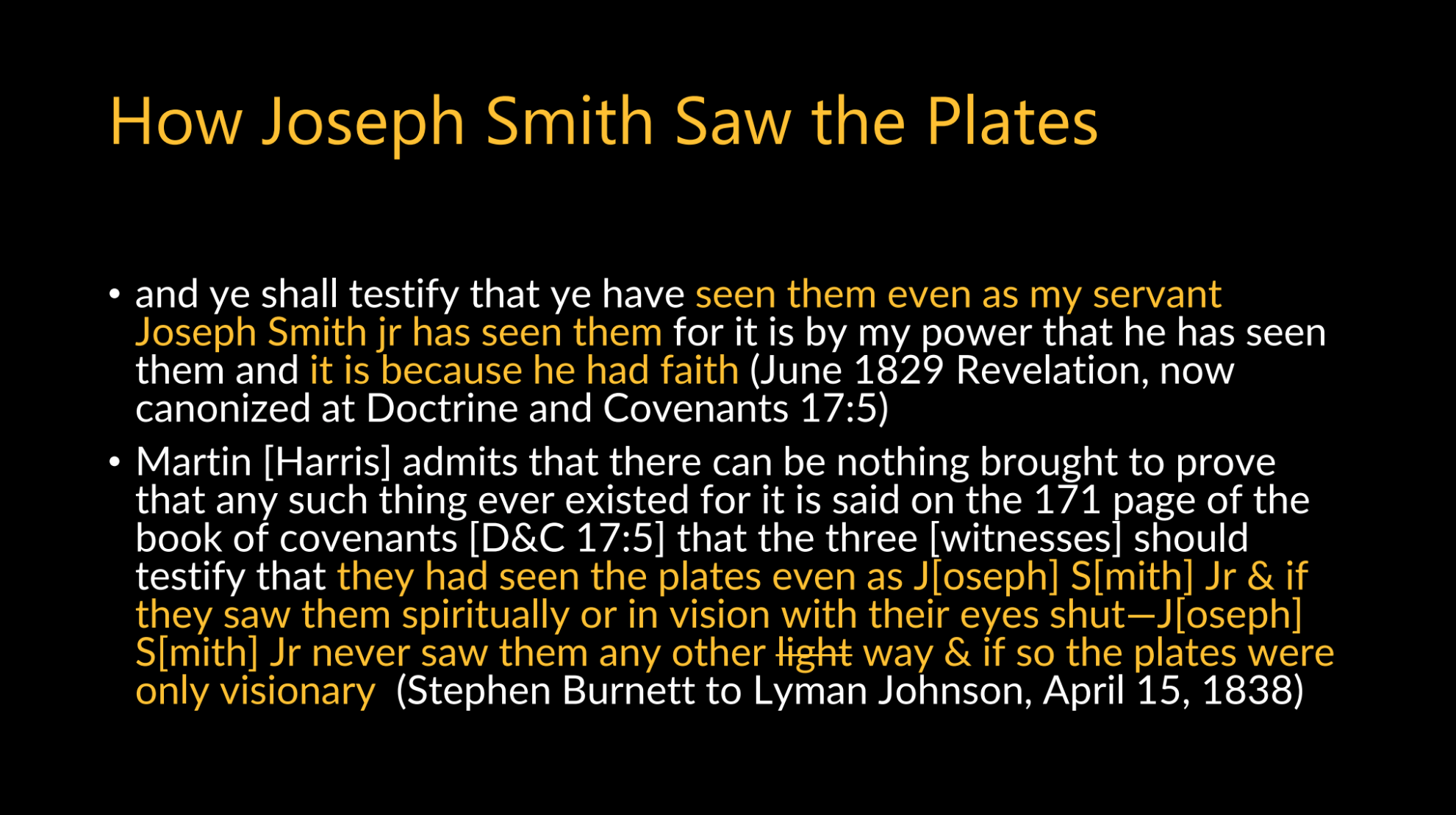
One of the things that D&C 17 does, though, is it connects this to the way Joseph Smith experienced the plates—the way he saw the plates. It says explicitly that they would see them, even as my servant Joseph Smith Jr. saw them, for it is by my power that he has seen them, and because he had faith.
Martin’s critics picked up on this in Kirtland, and they took it to mean that, since he supposedly had only seen the plates spiritually or in vision, then Joseph Smith had only seen them that way too, and so the plates were only visionary. The problem here is that Stephen Burnett, who’s our source on this, is making assumptions about Joseph Smith’s experience based on what Martin Harris said. I propose a better method is to actually look at Joseph Smith’s own experiences with the plates and use that to inform us on what it actually means to see by spiritual sight or by divine power.
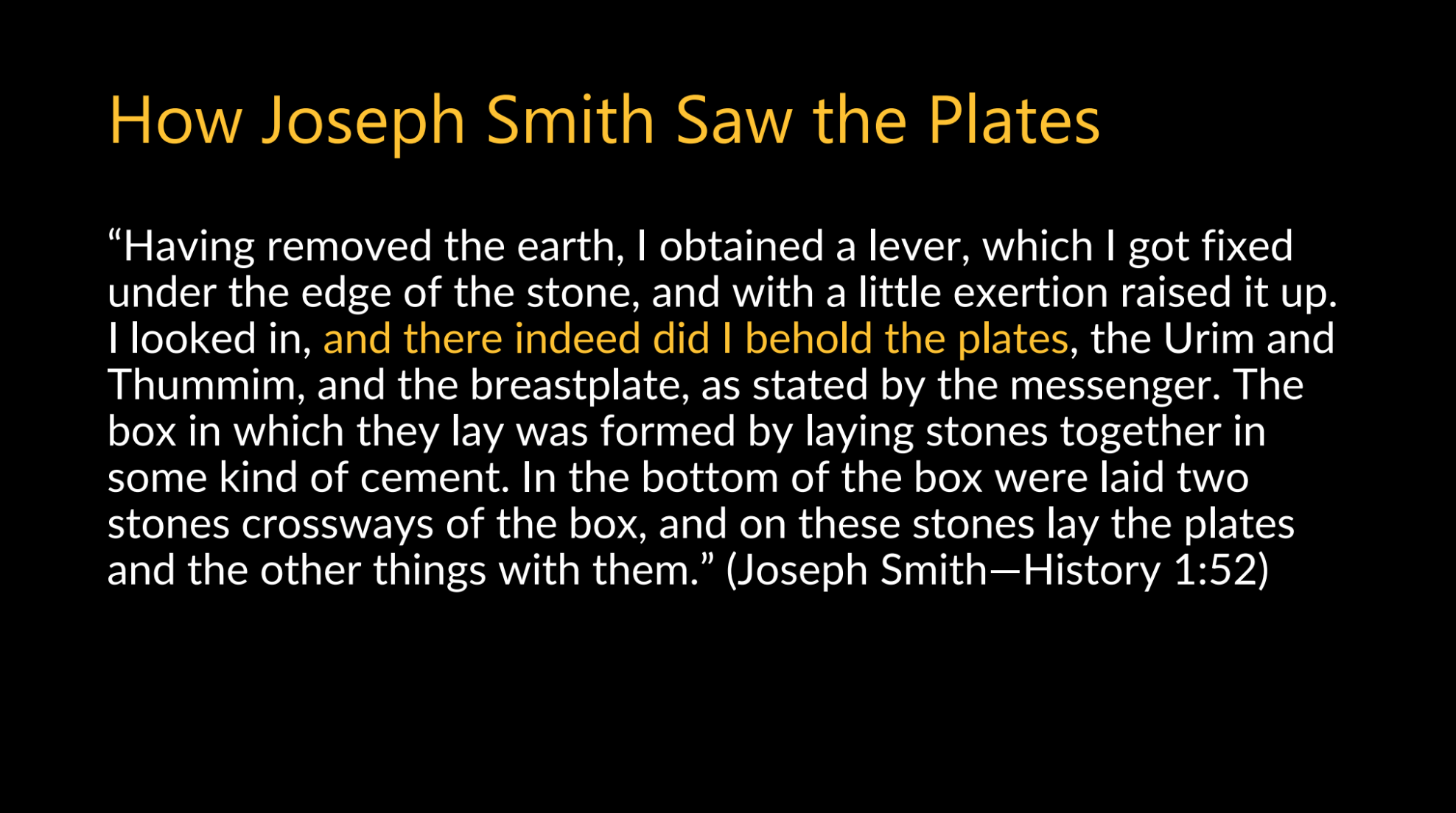
Just really quickly, Joseph Smith’s account of going to get the plates—there’s nothing visionary about it, right? He digs into the earth, removes a stone, and sees the plates.
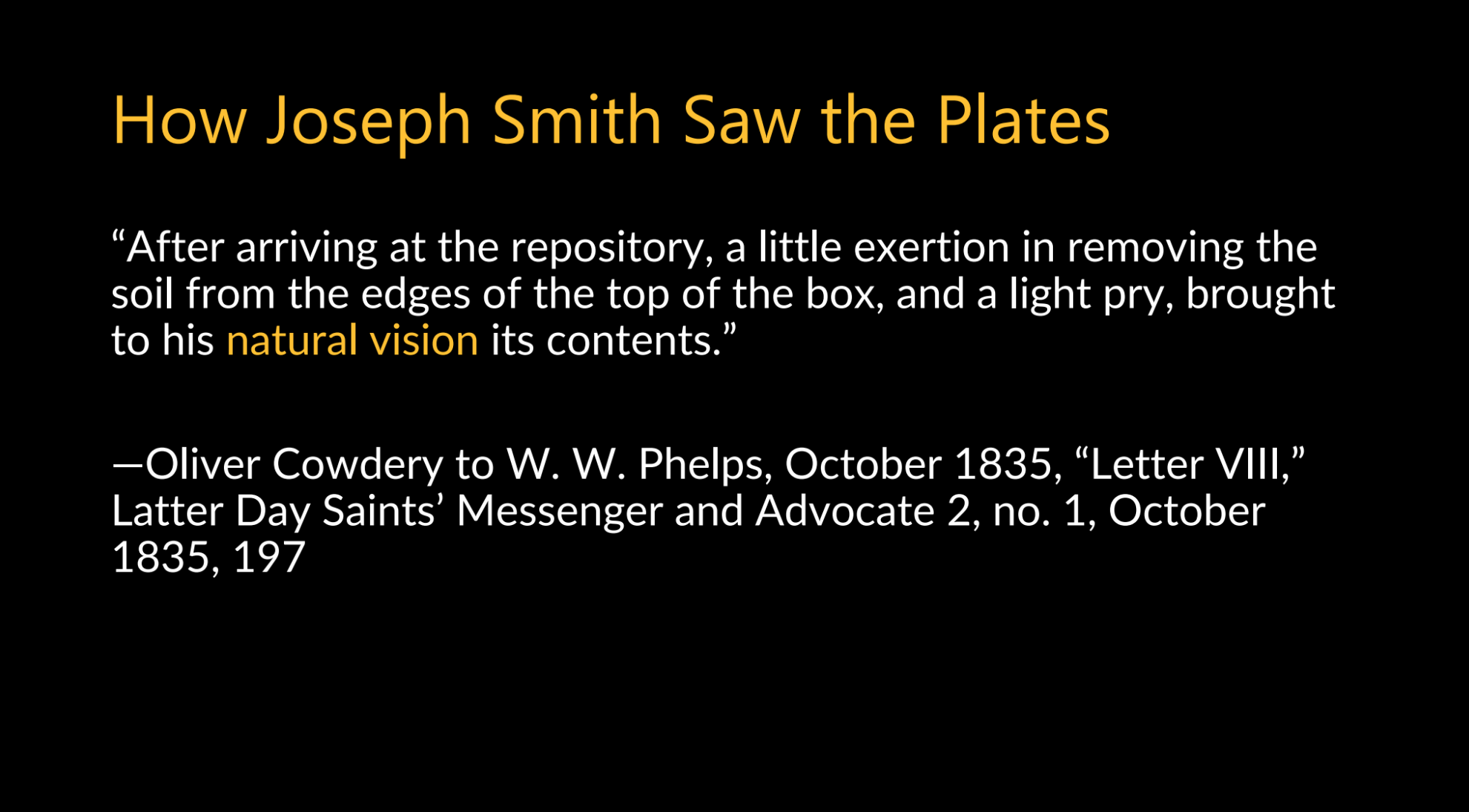
Oliver Cowdery, in relating this experience, specifically says it’s with his natural vision that he sees the plates.
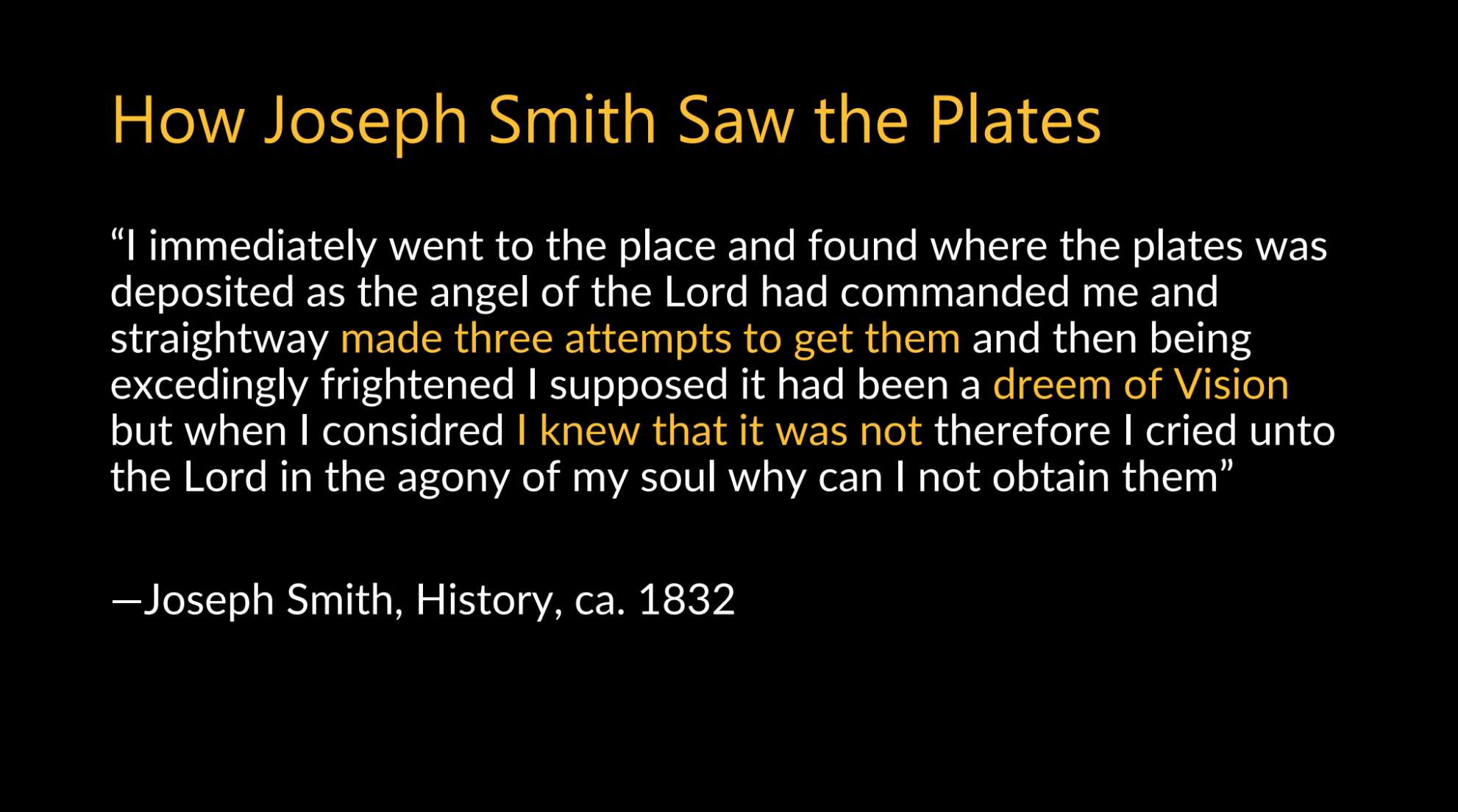
He talks about making three attempts to get the plates and explicitly says that he knew it was not a dream or vision.
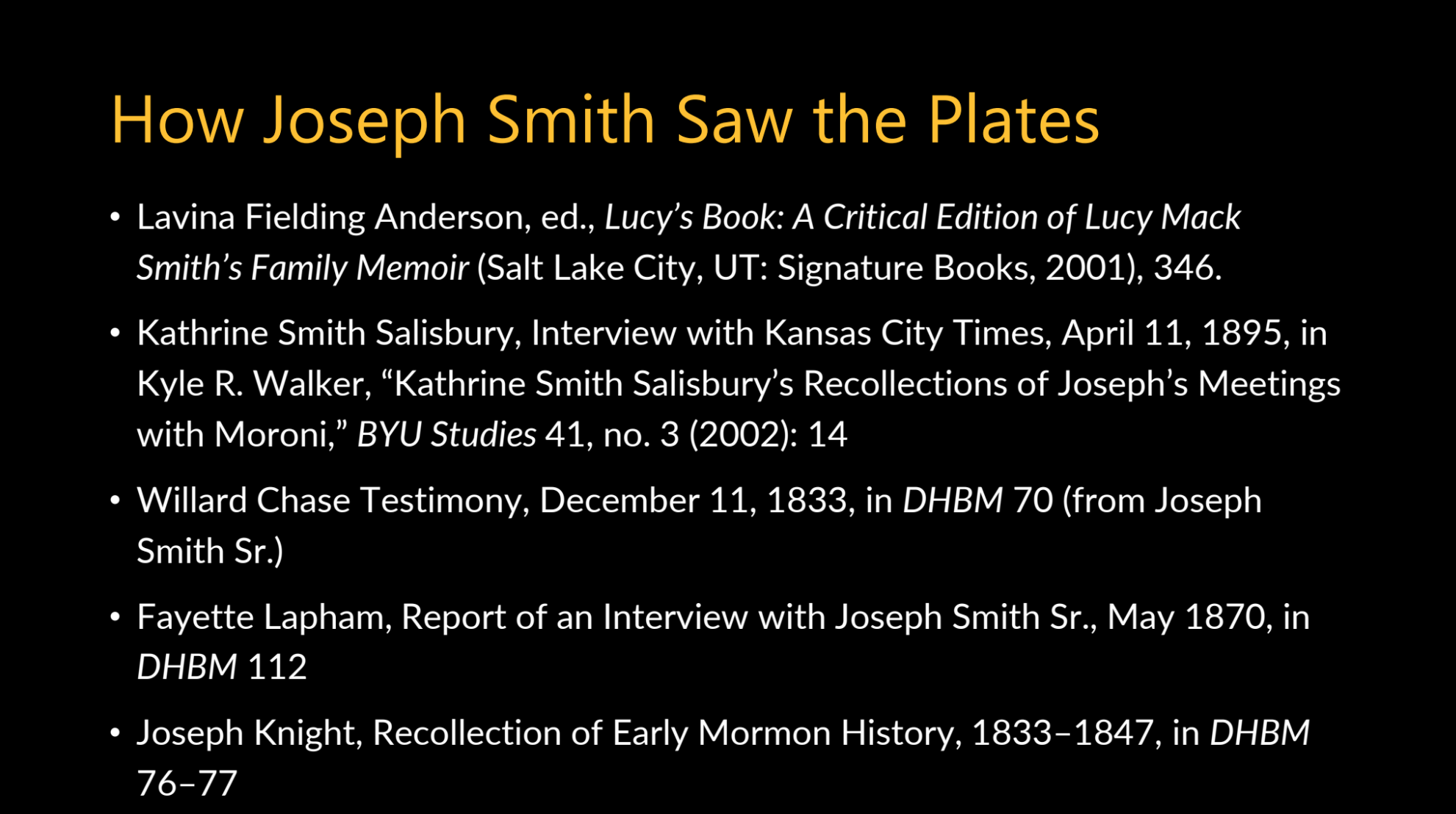
Several sources from his family elaborate on those three attempts to see the plates. They talk about how he physically lifted the plates out of the box, but then, when he set them down and turned to close the box, the plates would disappear and reappear back in the box. Now, I admit that obviously has a very supernatural, divine element to it, but he’s also physically lifting the uncovered plates and interacting with them. So again, this division between spiritual/supernatural and natural/physical just doesn’t exist within these sources, within the worldview, or within the experiences of Joseph Smith.
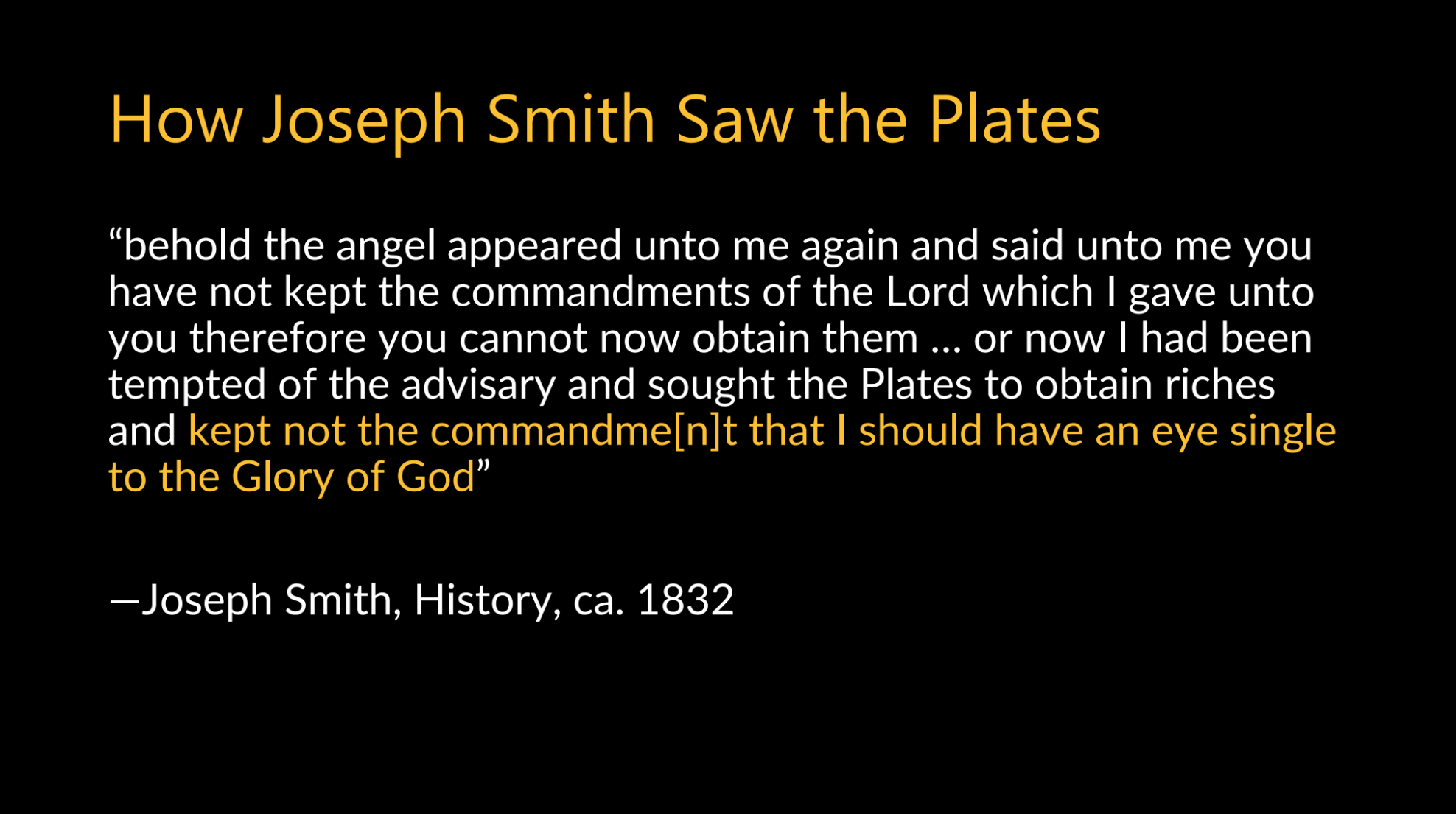
Joseph Smith then explains that the reason he couldn’t attain the plates was because he did not have his eye single to the Glory of God. Which was a way of saying that he actually lacked spiritual vision. So there’s this ironic subversion of expectations. It’s his lack of spiritual vision that makes him unable to physically obtain the record. Again, the conflation between natural and spiritual experience, they don’t hold to this dichotomy that they’re supposed to in polite company in the 19th century.
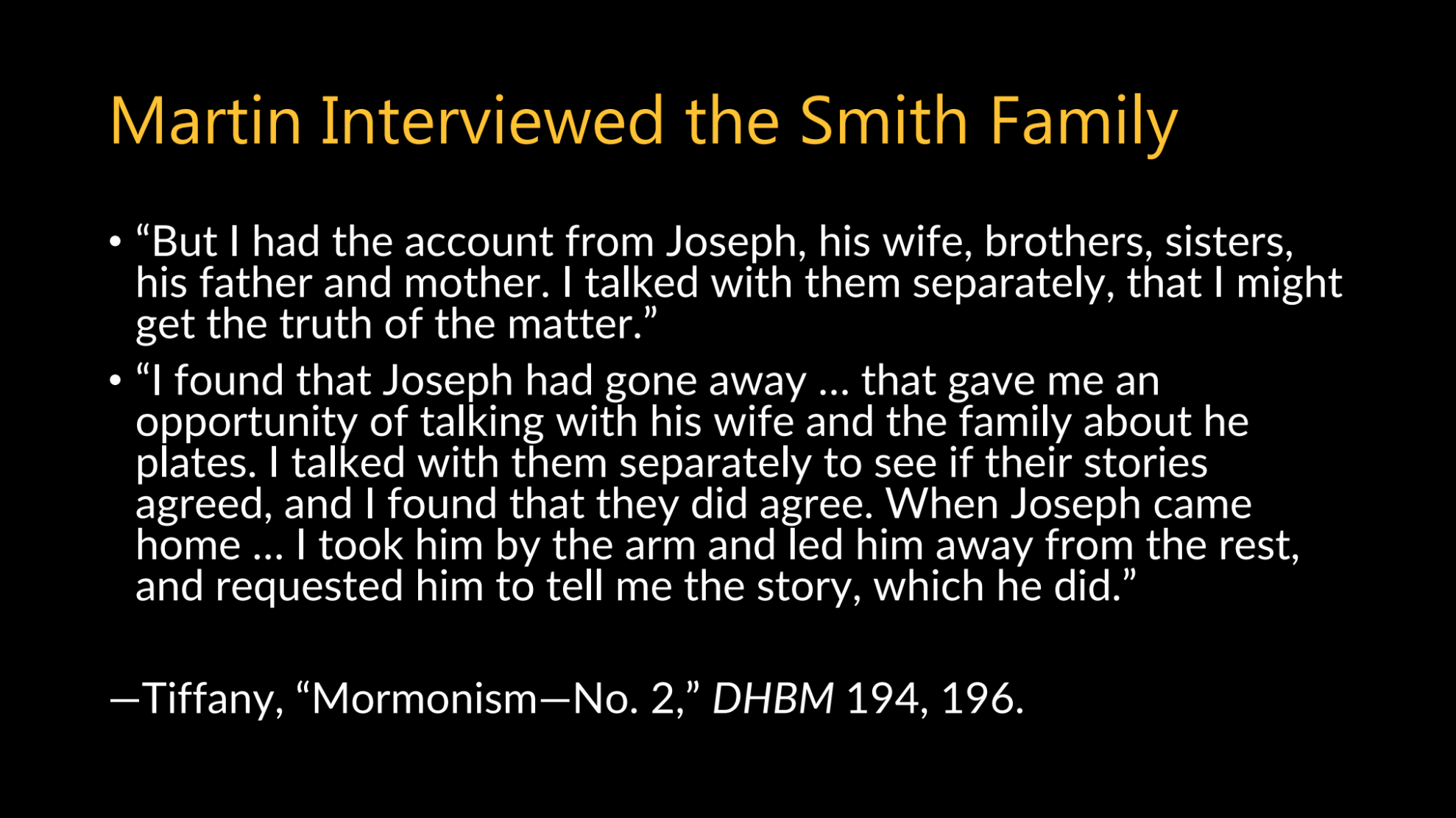
Martin Harris would have known these stories because Martin interviewed Joseph Smith and his whole family before getting involved with Joseph Smith and would have heard about these experiences from them. So, he would have known that Joseph Smith had physical, tangible interactions with the uncovered plates.
Additional Material
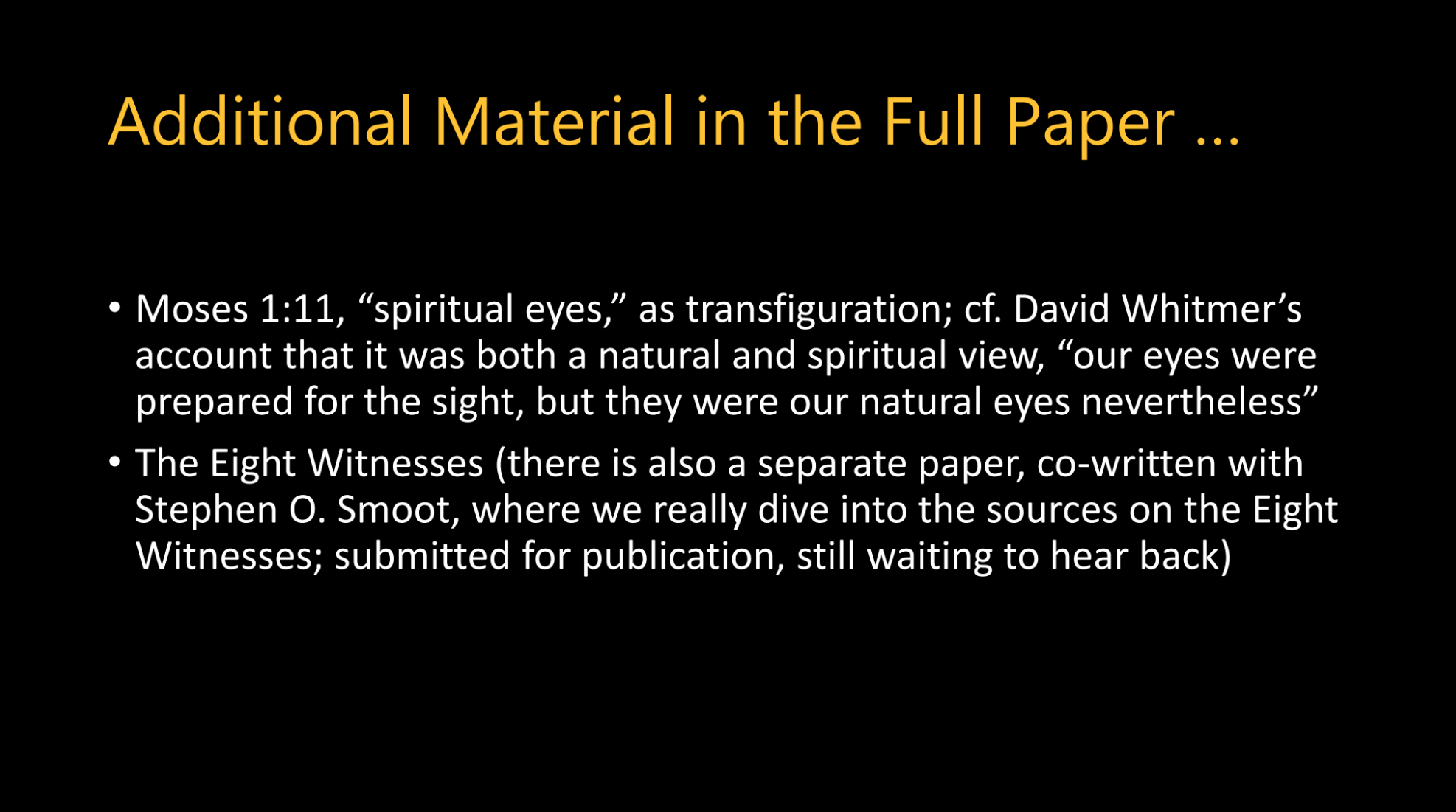
In the full paper, I lay out my argument a little more, and I include several other things like Moses 1:11 and David Whitmer talking about how their eyes were prepared for the sight, but they were their natural eyes nevertheless, and so forth. I also talk a little bit about the eight witnesses, but I have a paper that Stephen Smoot and I co-wrote that really goes into the eight witnesses on this and shows that they absolutely had physical interactions with the uncovered plates. Stephen Burnett is contradicted by almost every single source we have from the eight witnesses. So, that paper has been submitted for publication, and hopefully, it comes out soon—we’ll see.
Conclusions
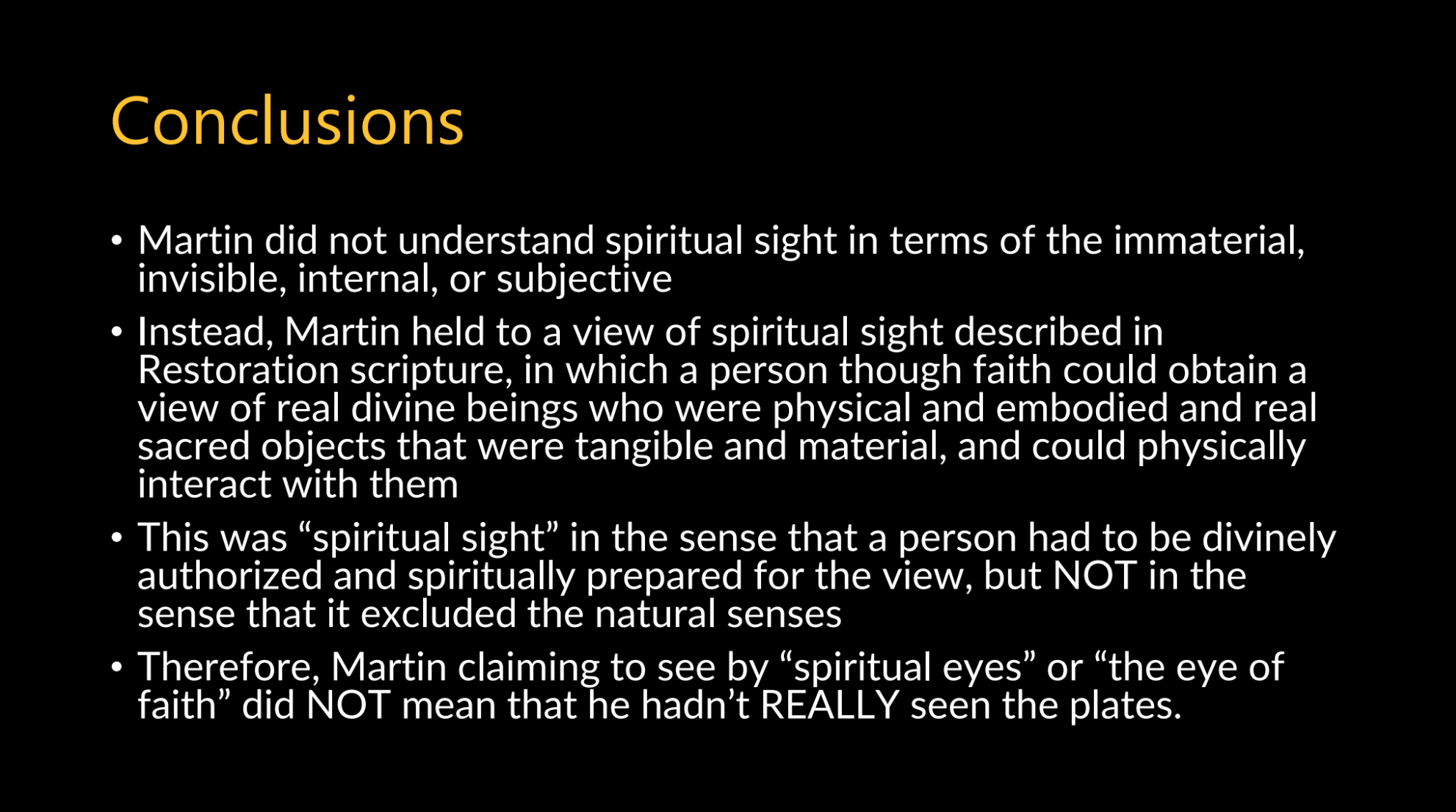
Just to kind of quickly wrap up, I think what all of this shows is that Martin did not understand spiritual sight in terms of the immaterial, the invisible, the internal, the subjective, or the imaginary, which is another word that others attributed to him, or the notion that people attribute to spiritual sight. He held to a view of spiritual sight described in Restoration scripture, in which a person, through faith, could obtain a view of real divine beings who were physical and tangible—as tangible as you and I—and real sacred objects that were tangible and material, and that you could physically interact with. This was spiritual sight in the sense that a person had to be divinely authorized and spiritually prepared for the view, but not in the sense that it excluded natural senses. Therefore, Martin, claiming to see by spiritual eyes or the eye of faith, did not mean, or at least he was not intending to communicate, that he had not really seen the plates in some sort of external, objective way.
Thank you.
TOPICS
Book of Mormon Witnesses
Martin Harris
