Summary
John Gee emphasizes the duty of Latter-day Saints to defend the Church and the gospel as part of their covenant obligations. He explores the historical and scriptural foundations for this responsibility. Gee critiques intellectuals within the Church who prioritize secular academic standards over their covenants. He highlights the need for consecration and sacrifice even if it requires sacrificing professional recognition or popularity.
The Duty to Defend
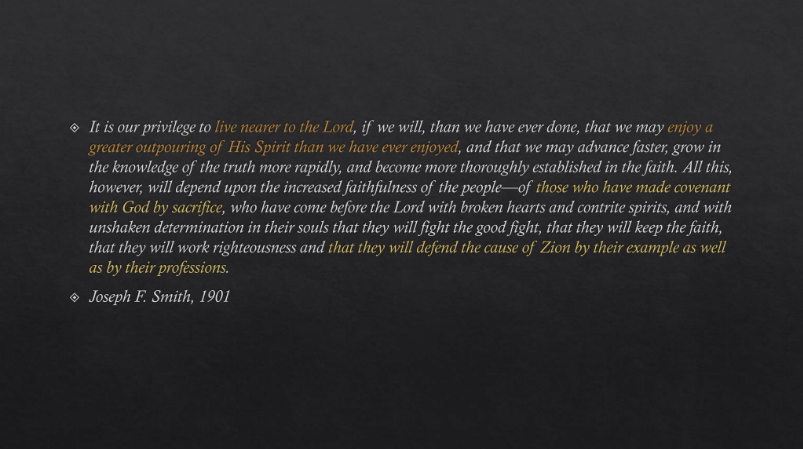
I would like to explore the idea expressed by President Joseph F. Smith in 1901 that “those who have made a covenant with God by sacrifice . . . will defend the cause of Zion.”[1] President Smith called doing so a “privilege.” He promised that those who defended the cause of Zion would “enjoy a greater outpouring of [the Lord’s] Spirit than we have ever enjoyed.” That they would “live nearer to the Lord.”[2] For Latter-day Saints, both of those blessings are desirable. They know that “when we obtain any blessing from God, it is by obedience to that law upon which it is predicated.”[3]
President Smith already knew something about what it meant to “defend the cause of Zion by their example as well as by their professions.” And about some of the costs associated with doing so. Returning home from his first mission to Hawaii late in 1857 or early in 1858, 19 year-old Joseph F. Smith demonstrated that he was willing to sacrifice even his own life if necessary. This was immediately after the Mountain Meadows Massacre when tensions were high. Johnston’s army was on the way to Utah.
The Example of Hyrum Smith
Returning to camp one day, his arms loaded with firewood, he encountered a band of ruffians. One of them declared it was his duty to exterminate every “Mormon” he should meet. He stuck a gun in Elder Smith’s face and asked, “Are you a ‘Mormon’?”
Elder Smith answered, “Yes, siree; dyed in the wool; true blue, through and through.” Elder Smith fully expected to receive the charge of the man’s pistols. But the answer so took the man aback that he shook Elder Smith’s hand and declared, “I am glad to see a man that stands up for his convictions.”[4]
Joseph F. Smith was following the example of his father, Hyrum Smith. one of the witnesses of the Book of Mormon who eventually did give his life for what he believed.
Using the Press
The early Latter-day Saints saw it as a duty to defend themselves through the press.[5] Early Saints wrote and published things that defended their beliefs. They had scriptural precedent for that, for they have been commanded:
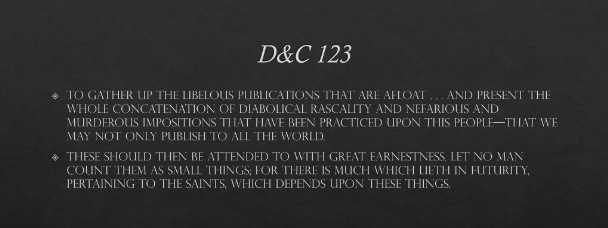
to gather up the libelous publications that are afloat . . . and present the whole concatenation of diabolical rascality and nefarious and murderous impositions that have been practiced upon this people—That we may not only publish to all the world.[6]
The Saints have often treated this command lightly. Yet we are assured that these should then be attended to with great earnestness. Let no man count them as small things. For there is much which lieth in futurity, pertaining to the saints, which depends upon these things.[7]
“Be Ready Always to Give an Answer”
Besides these modern injunctions, there is a clear ancient commandment.
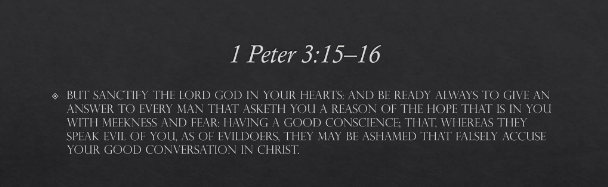
But sanctify the Lord God in your hearts: and be ready always to give an answer to every man that asketh you a reason of the hope that is in you with meekness and fear: Having a good conscience; that, whereas they speak evil of you, as of evildoers, they may be ashamed that falsely accuse your good conversation in Christ.” (1 Peter 3:15–16)
This scripture has been cited many times in connection with defending the Church. Brigham Young cited it 29 times in his discourses.[8] But for about sixty years it was not cited in General Conference. Its use was revived by Harold B. Lee in response to “the doubts and the vain philosophies in the minds of some of our young people.”[9]
President Dallin H. Oaks cited this scripture in connection with the covenants of the sacrament:
Take Upon Us the Name of Christ
We also take upon us the name of Jesus Christ whenever we publicly proclaim our belief in him. Each of us has many opportunities to proclaim our belief to friends and neighbors, fellow workers, and casual acquaintances.
As the Apostle Peter taught the Saints of his day, we should “sanctify the Lord God in [our] hearts: and be ready always to give an answer to every man that asketh [us] a reason of the hope that is in [us].” (1 Pet. 3:15.)[10]
According to President Oaks, defending the Kingdom of God is implicit in the covenants of the sacrament. It is also echoed in the baptismal covenant
to stand as witnesses of God at all times and in all things, and in all places that ye may be in, even until death, that ye may be redeemed of God, and be numbered with those of the first resurrection, that ye may have eternal life” (Mosiah 18:9).
A Covenant Obligation
Elder Boyd K. Packer addressed the issue of the covenants to defend the Kingdom of God.
In the Church we are not neutral. We are one-sided. There is a war going on, and we are engaged in it. It is the war between good and evil, and we are belligerents defending the good. We are therefore obliged to give preference to and protect all that is represented in the gospel of Jesus Christ. And we have made covenants to do it.[11]
Elder Packer saw a covenant obligation to protect the gospel and the Church.
Packer noted that there was, or should be, a distinction between Latter-day Saint scholars and other scholars. Commenting on an associate he had who resisted pressure from his graduate advisers to present a secular view of the Church, he noted that
[Scholars who are not members of the Church] do not know of the things of the Spirit. One can understand their position. It is another thing, however, when we consider members of the Church, particularly those who hold the priesthood and have made covenants in the temple. Many do not do as my associate did. Rather, they capitulate, cross over the line, and forsake the things of the Spirit. Thereafter they judge the Church, the doctrine, and the leadership by the standards of their academic profession.[12]
Academic Profession as a Lens
According to Elder Packer, disciples of Jesus Christ should not adopt the standards of their academic profession as a lens through which to examine or judge the Church. Elder Packer continued:
One who chooses to follow the tenets of his profession, regardless of how they may injure the Church or destroy the faith of those not ready for “advanced history,” is himself in spiritual jeopardy. If that one is a member of the Church, he has broken his covenants and will be accountable. After all of the tomorrows of mortality have been finished, he will not stand where he might have stood.[13]
Those who keep their covenants will judge the world by the Gospel of Jesus Christ. Not the other way around. Those who prefer the tenets of their profession to the detriment of faith have broken their covenants. He makes an even starker claim:
Those of you who are employed by the Church have a special responsibility to build faith, not destroy it. If you accommodate the enemy, who is the destroyer of faith, you become in that sense a traitor to the cause you have made covenants to protect.[14]
As Elder Packer lays the issue out, many individuals in the Church have made covenants to protect the Church. Those who are employed by the Church should build faith.
The BYU Experience
Among the expressions in the Brigham Young University Mission Statement, is the following statement:
In meeting these objectives, BYU’s faculty, staff, students, and administrators should also be anxious to make their service and scholarship available to The Church of Jesus Christ of Latter-day Saints in furthering its work worldwide.[15]
According to the Mission Statement it is incumbent upon all administration, faculty, staff, and students to use their scholarship in furthering the work of The Church of Jesus Christ of Latter-day Saints. It should be available to build and defend the Kingdom of God. This is the one requirement of the BYU Mission Statement that is explicitly shared by “BYU’s faculty, staff, students, and administrators.”
In 1998, the Foundation for Ancient Research and Mormon Studies (FARMS) was brought into Brigham Young University. It was brought in, according to President Gordon B. Hinckley, “to provide strong support and defense of the Church on a professional basis.”[16]
President Hinckley saw “a bright future for this effort now through the university.”[17] For President Hinckley, the defense of the Church on a professional basis was something that Brigham Young University should be doing. Arguably, this is part of BYU’s mission.
Building the Temple of Learning
In 2004, Elder Maxwell compared the need for BYU professors to defend the Kingdom to those who built the Nauvoo Temple.
In a way LDS scholars at BYU and elsewhere are a little bit like the builders of the temple in Nauvoo. They worked with a trowel in one hand and a musket in the other. Today scholars building the temple of learning must also pause on occasion to defend the kingdom. I personally think this is one of the reasons the Lord established and maintains this university. The dual role of builder and defender is unique and ongoing. I am grateful we have scholars today who can handle, as it were, both trowels and muskets.[18]
This passage has since been quoted by President Oaks in 2014, President Oaks in 2017,[19] and Elder Jeffrey R. Holland in 2021.[20] President Oaks expounded in a talk on “challenges to the mission of Brigham Young University” that:
In my leadership conference message of August 2014, I encouraged BYU faculty to offer public, unassigned support of Church policies that others were challenging on secular grounds. Note that word unassigned. The Church should not have to ask or assign. The duty is inherent in the position.[21]
Fundament Doctrine and Policies on the Family
Offering public, unassigned support or making their service and scholarship available to the Church is inherent in both the faculty position and the mission statement of Brigham Young University. Not providing it President Oaks saw as a challenge to BYU’s mission. To emphasize this point he added the following comment in both addresses:
I would like to hear a little more musket fire from this temple of learning. Especially on the subject of our fundamental doctrine and policies on the family. Since our members should be defenders of marriage as the union of a man and a woman, as Elder Nelson taught in his [2014] BYU commencement address, we should also expect our teachers to be outspoken on that subject.[22]
Apparently, President Oaks did not feel that the BYU administration, faculty, and staff were providing enough public support. Either assigned or unassigned. It does not seem that President Oaks thought that fulfilling the other objectives of the mission statement was sufficient.
The statement he referred to was then Elder Russell M. Nelson address to BYU graduates that:
Disciples of the Lord are defenders of marriage. We cannot yield. History is not our judge. A secular society is not our judge. God is our judge!”[23]
Instruction
In 2015, the First Presidency sent the following statement to every faculty and staff member at BYU:
The auditors of tomorrow, when they study the balance sheets of Brigham Young University, are not alone going to be satisfied by how well you fit into business, but they are going to ask one more pertinent question: . . . have we developed staunch defenders of the faith of the Church?”[24]
It is much easier to develop students who are staunch defenders of the faith if faculty are staunch defenders of the faith themselves.
It is also easier for faculty to staunchly defend the faith if administrators first set the example. The duty is inherent in the position. Whether anyone at Brigham Young University paid any attention to this is an open question.
It is apparent that the First Presidency did want some of these instructions put into practice. On June 12, 2019, they issued guidelines to those involved in religious education throughout the Church Education System that stated that one of the purposes of religious education
is to teach the restored gospel of Jesus Christ from the scriptures and modern prophets in a way that helps each student . . . strengthen their ability to find answers, resolve doubts, respond with faith, and give reason for the hope within them in whatever challenges they may face.”[25]
Developing Staunch Defenders of the Faith
The First Presidency here breaks down the task of developing staunch defenders of the faith into four tasks. Teaching students to find answers for themselves, resolve their own doubts, respond with faith to challenges, and give reasons for that faith to others. Becoming a staunch defender of the faith is an expectation of every student at every Church institution of higher education. It is a duty inherent in the position of every administrator, faculty, and staff member at those institutions to teach students by word and deed to do so.
In 2018, Elder Holland gave the first public address scolding a campus entity in over a third of a century. He hoped it “will apply across the entire campus and beyond,”[26] Elder Holland said,
We ask you as part of a larger game plan to always keep a scholarly hand fully in the face of those who oppose us.”[27]
He said that the Brethren want those at Brigham Young University “to contribute to that defense—with solid, reputable scholarship intended as much for everyday, garden-variety Latter-day Saints who want their faith bolstered, at least as much as it might be intended for disinterested academic colleagues across the country whose stated purpose will never be to ‘prove or disprove the truth claims of the Church.’”[28]
University Community’s Response
Elder Holland left no doubt who was asking the university to do what he asked since he noted that he did not speak just for himself.
I come tonight in my true identity as an Apostle of the Lord Jesus Christ. . . . I am here with not only the blessing but also the rather explicit expectation of the officers of the university’s board of trustees, whose executive committee I currently chair. In that sense, I speak for all of your governing advisers—not just for myself.”[29]
The Lord’s prophet who chairs your board, and his fellow apostle, who sit with him, sent me to you.”[30]
The university community’s response has on the whole been muted. One would think that with the same explicit request coming from the university’s board of trustees at least seven times in an eight-year period, that the university would have paid more attention.
The Intellectuals’ Approach
Unsurprisingly, the idea of defending the Church or even supporting the Church does not appeal to all intellectuals within the Church.
One opponent of this approach is Benjamin Park. Park praised the ‘New Mormon History’. He sees it as
a successful attempt to use the tools of the broader academy to help understand the Mormon tradition,”
and an earlier version of Mormon Studies.[31] Park thus sees the New Mormon History (much as Elder Packer did) as the attempt to “judge the Church, the doctrine, and the leadership by the standards of their academic profession.”[32]
Where Park naively sees this as a good thing, Packer foresaw potential problems. Where Park sees the effort as “successful,” Packer warned that
there is no such thing as an accurate, objective history of the Church without consideration of the spiritual powers that attend this work.”[33]
According to Packer, any attempt to use only the tools of the broader academy is neither accurate nor objective. It is not a success; it is a failure.
Park maintains that
America has long found cultural power and fascination in the Mormon tradition, and the Mormon Studies community has finally developed the intellectual resources and discursive tools required to quench that thirst.”[34]
But Park also notes that what is arguably the culmination of the New Mormon History, Richard Bushman’s Rough Stone Rolling, failed to gain widespread acceptance among those outside the faith while alienating some in the faith.[35]
“An Embodiment for Broader Cultural and Religious Tensions”
It quenched neither the thirst to explain Joseph Smith away nor the thirst to bolster faith. If the Mormon studies community really did have the intellectual resources and tools to quench either thirst, it has failed to demonstrate them.
For Park, the goal of “Mormon Studies” is to show that the Church of Jesus Christ of Latter-day Saints is merely “an embodiment for broader cultural and religious tensions” and not unique in any way.[36] For Packer, this would count as a failure.
Perhaps this difference in viewpoint is one reason why Park wants to distinguish what he would like to do and what Elder Packer asked individuals to do. Park invokes Jefferson’s metaphor of a wall between church and state to argue that “Mormon scholarship is much healthier when there is a clear separation between Mormon studies and Mormon apologetics.”[37]
A requisite of Mormon studies is that one needs to check one’s religion at the door. That may or may not work as scholarship. Packer and Park would disagree on that point, But it does not work as discipleship. As Elder Holland put it:
Lesson number one for the establishment of Zion in the 21st century: You never ‘check your religion at the door.’ Not ever. My young friends, that kind of discipleship cannot be—it isn’t discipleship at all.[38]
Corollaries
Park’s request has corollaries that need to be made explicit. The first is that the wall between Mormon studies and those who would defend the Church implies that there is an inseparable wall between Mormon studies and those who keep their covenants. Those who keep their covenants are excluded from Mormon studies and are not welcome there, at the insistence of those who do Mormon studies.
This, in turn, means as a second corollary that those who do Mormon studies do not keep their covenants. Packer would have agreed at least in part with Park. He stated that
one who chooses to follow the tenets of his profession, regardless of how they may injure the Church or destroy the faith . . . has broken his covenants.”[39]
Park and Packer agree about what the New Mormon History and Mormon studies are doing. They also agree that the approach of both is a rejection of covenants. Where they differ is whether this is either good or desirable.
The Goal of Mormon Studies
The goal of Mormon studies, according to Kathleen Flake, is “to make a living by thinking about” “all things LDS.”[40]
Spencer Fluhman saw the goal differently. For him, “guiding principle” of Mormon studies was “friendship.” That is, “intellectual good society and the friendship—forged across boundaries—that defines it.”[41] The boundaries to which he refers are “the boundaries within and around religion and those who study it.”[42]
In this, he agrees with Nibley. Nibley saw the goal of such endeavors as gaining the “respect and recognition” and “professional camaraderie” of the experts outside the Church.[43]
As Elder Oaks pointed out years ago:
The scriptures have a word for gospel service “for the sake of riches and honor”; it is “priestcraft.” (Alma 1:16.) Nephi said, “Priestcrafts are that men preach and set themselves up for a light unto the world, that they may get gain and praise of the world; but they seek not the welfare of Zion.” (2 Ne. 26:29.).[44]
Sacrifice
As the stories of Joseph F. Smith and Hyrum Smith illustrate, defending the Church of Jesus Christ of Latter-day Saints may come at a cost. There may be a sacrifice involved. In their cases, it involved a willingness to sacrifice even their lives if necessary, which in Hyrum’s case it was. In most cases, the sacrifice is not as drastic.
As Park and Fluhman have laid out, if one keeps one’s covenants one can certainly expect to sacrifice friendship, respect, recognition, professional camaraderie, or even being viewed as a scholar or as being involved in scholarship. Those involved in defending the Church and Kingdom of God are certainly familiar with those sacrifices.
Sacrifices of respect and recognition will not come easily to those whose hearts are set on the honors of men. Their goal is to be seen as honorable. But the “honorable men of the earth” receive a terrestrial reward. Not the celestial reward of those who are “valiant in the testimony of Jesus.”[45]

Elder Maxwell noted that
what so many honorable individuals do is certainly useful and even commendable. But their focus is not on the celestial. . . . I hope you will not settle for being among the ‘honorable’ men and women of the earth.”[46]
It can also be difficult to achieve a terrestrial goal by telestial means.
Institutional and Individual
Sacrifice sometimes applies institutionally as well as individually. President Spencer W. Kimball, in his second century address to BYU, noted that BYU can expect to be hated in the world.[47]
Starting in the late nineteenth century, many institutions of higher learning faced a choice about whether they would sacrifice their faith on the altar of their scholarship or their scholarship on the altar of their faith. Historically most institutions have made the former choice.[48]

Speaking of the mission of Brigham Young University, Elder Holland drew a line in the sand.
If at a future time that mission means foregoing some professional affiliations and certifications, then so be it. There may come a day when the price we are asked to pay for such association is simply too high and too inconsistent with who we are. No one wants it to come to that, least of all me, but if it does, we will pursue our own destiny.”[49]
At one point in time, there was a situation at BYU where donors sacrificed their means and scholars sacrificed their time, talents, and reputations to defend the Church. That situation ended when certain individuals were no longer willing to make those kinds of sacrifices.
One must still be willing to make those sacrifices if they wish to keep their covenants. Even if no one wants it to come to that. If our covenants are getting in the way of what we are trying to do, then we obviously are trying to do the wrong thing.
Consequences
There are other consequences that come from the neglect of covenants. Elder Packer issued a solemn warning on the subject:
I want to say in all seriousness that there is a limit to the patience of the Lord with respect to those who are under covenant to bless and protect His Church and kingdom upon the earth but do not do it.[50]
Consecration
The sacrifice required to keep the covenant of defending the Kingdom is a form of consecration. Elder Neal A. Maxwell discussed the purpose of consecration as pertaining both to scholarship and scholarship in the context of defending the faith:
We tend to think of consecration in terms of property and money. Indeed, such was clearly involved in the foregoing episode [of Ananias]. But there are various ways of “keeping back part.” And these ways are worthy of your and my pondering.
There are a lot of things we can hold back besides property. There are a lot of things we can refuse to put on the altar. This refusal may occur even after one has given a great deal, as was the case with Ananias. We may mistakenly think having done so much, that surely it is all right to hold back the remaining part of something. Obviously there can be no complete submissiveness when this occurs.”
Scholars might hold back in ways different from those of a businessman or a politician. There’s an almost infinite variety in the number of ways you and I can hold back a portion. . . .
A few may hold back a portion of themselves so as to please a particular gallery of peers. Some might hold back a spiritual insight through which many could profit. Simply because they wish to have their ownership established.
Some may even hold back by not allowing themselves to appear totally and fully committed to the Kingdom, lest they incur the disapproval of a particular group wherein their consecration might be disdained.
So it is in the Church that some give of themselves significantly, but not fully and unreservedly.[51]
Conclusion
Faculty, staff, students, and administrators who do not “make their service and scholarship available to The Church of Jesus Christ of Latter-day Saints in furthering its work worldwide”[52] are arguably holding something back. Perhaps, too, they are holding themselves back. Perhaps certain promised blessings would come if they were “dyed in the wool; true blue, through and through.”
President Kimball told the BYU community that he was “both hopeful and expectant that out of this university and the Church Educational System there will rise brilliant stars in drama, literature, music, sculpture, painting, science, and in all the scholarly graces.”[53]
We may have been expectant that those brilliant stars that might arise from BYU would receive the recognition and accolades of the secular world. There may be some of those.
But as Saints whom Jesus prophesied would be hated in the world, we cannot expect that any brilliant stars will necessarily receive the praise of the world. We may, instead, find that those brilliant stars appear as their work is consecrated to “make their service and scholarship available to The Church of Jesus Christ of Latter-day Saints in furthering its work worldwide.”[54]
It may be that the sacrifice we are called to give up is popularity.
Thank you very much.
