Introduction
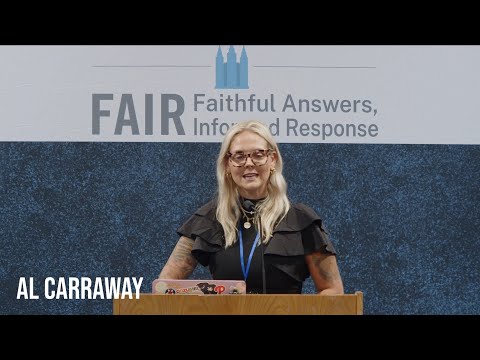
Al Carraway is a convert to the Church of Jesus Christ of Latter-day Saints and a multi-award-winning international speaker with over 14 years of experience, having spoken in more than 11 countries. She’s also a number-one best-selling, multi-award-winning author with over eight published titles, including Finding Yourself in the New Testament, Wildly Optimistic, My Dear Little One, More Than the Tattooed Mormon, and others.
So—with that short introduction—I’m going to turn the time over to Al Carraway.
It Is Good for Us to Be Here
Hello. How are you? I am elated to be here. Although my neuroma’s like, “Uh, why are we wearing heels? We hate this decision.” It’s fine. It’s great. I am thinking of that—oh, it does move—that is lovely. I almost don’t need a microphone, so I apologize in advance.
I’m thinking about Peter at the Transfiguration of Jesus, and he says, “You know, it is good for us to be here.” And that is exactly how I feel. It is good for us to, like, be here, you know?
“Ask Me About My Jesus”
And thinking of my topic—they gave me a different topic actually—and I said, “No, I want to change it. Is that fine? Are you okay?” And they’re like, “We are okay.”
But it makes me laugh a little bit because a few years ago, I cannot even begin to count how many forums and podcasts were against me saying that I left this Church because I talk too much about only Jesus. That surely I must have left this Church. Uh—wait, like what? Wait, wait, wait. Okay. Okay.
But it’s almost around the same time—completely unrelated to that—but around the same time I was making, like, I don’t know, shirts. I was making shirts, and I went online and I had this shirt designed out, and I had everyone on my Instagram vote for which design they liked the most.
What if Someone Does Ask Me About My Jesus?
And I had 40,000 people vote for this one design. They were like, “Yes, this is the one.” And I’m like, “Cool, cool, cool.” So I ordered a lot of the shirts. And granted, when I posted it on my stories for the vote, it didn’t say what the shirt ended up saying. It says, Ask me about my Jesus. It had this cute little cartoon that 40,000 people were like, “We need this.”
I ordered so much of it. Then no one bought it. I went online and I’m like, “You guys, what happened? Like, all these boxes in my basement—like, what is going on?”
They realized—the ones that responded—they were like, “We actually are too scared to wear that because, like, what if someone actually does ask me about Jesus? Like, I don’t know if I feel comfortable answering and responding. I don’t know if I know Him well enough in a personal, intimate way to even have those conversations.”
Joy in Jesus
And just barely—I just barely got off—I am a Church history tour guide. I’ve been doing it for five years, and I am obsessed with them. I just got off one of my tours a week ago, and we had 120 people come with me on this Church history trip.
On our Nauvoo day, we had our matching trip shirts, and it said Joy in Jesus across the top—which is referencing a general conference talk, like a recent one.
And the amount of people—different people throughout the whole day—they would come up to my participants and they would say, “Oh, so are you, like, with a Baptist church or something?”
We’re like, “Oh, this is from general conference. We are your church. Like, this is it. We are you.”
“My Jesus”
And I just feel like—you know what? Oh, and even just like a talk—not that I need to drill this point in anymore—yeah, you get it. But I just did a talk where I needed to submit my talk in advance, a month in advance, so they could approve it.
<p>And I said the words my Jesus in it, and they came back with disapproval saying, “We don’t think you can say that.” And I’m like, “Oh, I am going to—but that is so interesting that you feel that way.”<p>And you know what? I just feel like—oh my gosh—absolutely. We have done such a beautiful job pivoting and refocusing and shifting lately in so many different areas and so many different ways to focus more on Him who is ours. Like, yeah, for sure—I know you have seen it too—a bigger emphasis and a bigger and a stronger redirect to our Jesus.
But yet I still feel like there is this lingering disconnect. I see it nearly every day—everywhere—online and in person. This lingering disconnect.
Who Is This?
It’s kind of like the person on Palm Sunday—I love him. He’s one of my favorite people in the scriptures. And I have no idea who he is.
But when Jesus is coming down on Palm Sunday and everyone’s saying Hosanna, there is someone on record to say, “Well, who’s this?”
And the answer is just my favorite. He goes, “Oh, this is Jesus.”
A Lingering Disconnect
But I feel like for years my emphasis—absolutely yes—it has been on “Well, who is this Jesus who is ours?”
And you know what? I feel like yes, there is a disconnect because we know God because we can talk directly to Him. And yes, we know the Spirit because we feel it—we’re guided by it—but what do I do with Jesus in a personal and intimate way if I am not talking to Him and He is not guiding me? What do I do with any of it?
Now, I am going to answer that very directly in a little bit, but I am just so excited to redirect my time right now to just talking about your Jesus—which, ironically, no—not even my new book coming out in a few weeks—it’s called Your Jesus.
And I don’t know how they got it a month in advance, but it’s back there. And I did have to fight and fight with my publishers to even call it Your Jesus. So whatever—anyways—you can have it. It’s back there.
Healing the Leper
I am thinking about leprosy. I am thinking about it being the worst sickness. It’s a painfully long process—we know this. It’s their entire body just, uh, deteriorating, and they’re disfigured. And they’re labeled in scripture as being just living dead—like, ooh, you know? Their bodies—they smell. They’re decomposing. Their hands are without fingers, their feet without toes. And it’s a chronic, incurable disease. So, what is there to even look forward to? Can hope even be found with something so impossible?
They would be completely outcast—abandoned by family, friends, society. If anyone would even come across a leper, they would have to literally and verbally say that they were unclean. Touching a leper would cause them to be unclean—you know all of this. These poor souls are just cut off from everything and everyone that they’ve ever known and loved over something they couldn’t even control. No support system, no hope.
Early Israelites believed that this is punishment for sin—that they were paying for their actions. They deserved this. It’s what they get.
Fear, loneliness, shame—and like, where even is their headspace, I wonder? Is there even any sign of morale? I don’t know. Passing time, continuously beating them down.
Not “Can He,” but “Will He”
And somehow this man full of leprosy—he’s able to dig deep and find whatever that was left in him, to show up still.
- To venture away from banishment.
- To put himself in the public eye.
- To live through the embarrassment and the shame of those fleeing at his sight—verbally yelling at him—of his disgusting state to others.
But then Jesus—He falls at the feet of the Savior, hiding his face. And his request was humbly worded, with pain and hesitance: Lord, if thou wilt, if you are willing, thou can make me clean.
Not “Can He heal me?”—but “Will He?” “I will.” Outstretching His hands, laying them upon his head, moving with compassion—Be thou clean.
And immediately the leprosy departed from him. Sores are closed. Deformities removed. Missing limbs restored. Smell of rotting flesh disappeared—and skin made smooth. He touched the untouchable, and He cured the incurable. Our impossibilities are not a struggle nor an inconvenience to your Jesus. He will not meet His match with our suffering—bound by nothing—help, compassion to all.
And aside from this physical healing, I don’t doubt that it was Jesus’s compassion that really healed this broken man. How long had he been stripped of compassion, of someone’s time? How long had this man been deprived of touch—of love? I don’t doubt it’s how Jesus treated this man that really made him feel whole. He comes with healing in His wings and a compassion that knows no bounds—and we can be whole. Jesus—He asked him to tell no man, but he does. Like, how can he not? And great multitudes came because of that man.
The Woman at the Well
And you know—there is just not much more that could have been stacked against the unnamed woman at the well. A Samaritan—alone. Don’t even—I could go on a whole tangent about that. I won’t. Different time.
It makes her just hated and unclean and pushed far from time and attention. But also being a female in a society where women are both demeaned and disregarded—her list of offenses continues to increase against her as her actions add a history of sin and adultery. Trips were—yeah, absolutely—made to the well in groups when it was colder. Alone at the heat of the day makes it likely that she was outcast even by the women in her community.
Maybe this woman at the well, as she sat alone drawing water—maybe she was thinking the weight of her burdens. Maybe she was wishing things were different, or that she were different. Perhaps she was thinking how she wanted to be alone—or worse, maybe she felt like she deserved to be alone. But then Jesus—He comes to her, pulled in direction by inspiration and duty. He must needs go—are His words—as He travels the path that literally no one took.
Jesus Offers Living Water
His living water that He freely offers to all—if anyone thirsts, let him come drink, be filled, be sustained, be nourished by Him. Anyone. Even the unnamed, the unworthy, the mistreated. Jesus—all knowing—He still offers to her. He knew her, her secrets, the depths of her soul, and He sits with her still. He teaches her still. And He stays there for two days.
Jesus declared Himself to her—that He is the Messiah. I that speak unto thee am He. And there were multiple times where Jesus chose not to respond with who He is—and yet this Samaritan woman was worth telling this incredible truth to. A marginalized, sinful outcast—a despised race—was deserving of Him. Having an intimate one-on-one encounter with her Jesus. She was experiencing the living water welling up inside of her that moved her to this renewal and this revival.
No longer was she paralyzed by her past or fear or shame or judgment as she runs into the city, telling all of those who once looked down on her—saying to come see. And they did. Many of the Samaritans of that city believed on Him for the saying of that woman which testified. Her actions and testimony bring a city of people to their Jesus. And like the leper—many more believed.
The Woman Caught in Adultery
I know we already brought up the unnamed woman caught in adultery—which, the whole thing was staged entrapment. That’s another tangent—not today, another time. But oh no, don’t even get me started.
Okay, but let’s just talk about her for a minute. She is dragged in front of a crowd. I imagine how quiet that crowd got as they watched and listened to Jesus respond to her and the law—which is what they were trying to get Him caught up in.
I imagine how she might have felt—seeing, like, the Lord see her. Like, really see her. I imagine she’s scared to death. The life of this woman depended on Jesus—which, how true that rings for even us. And Jesus—He silenced His critics while graciously addressing a sinner in need of mercy and understanding and compassion.
Dignity, Care and Mercy
He delivers a healing balm to her—and anyone with a heart weighed down with guilt and shame and trauma and pain caused by others or by ourselves—just both.
Convicted by their own conscience, the silence was now filled with the noise of stones dropping and hitting the dirt—as slow shuffles, as one by one the accusers walked away. The only one qualified to throw a stone didn’t. Maybe that quiet moment that He took while drawing in the dirt—I wonder if that was creating a space for her to feel love without judgment.
And maybe—because this was, like, the worst moment of her life—Jesus, He’s with her still.
In contrast to how the Pharisees and the scribes handled her—Jesus, He treats her with dignity and care and mercy as He speaks and listens to her and calls her woman. The same respected term He uses for His own mom. Her fear immediately being swallowed up in the compassion.
Go, sin no more.
She Is Not Condemned
She is not condemned. Nor does He ask for an explanation. Nor does He begin a sermon on self-improvement—a crime worthy of even death—and yet He raised not His voice, nor hesitated with forgiveness.
And it’s not because He doesn’t care about wrongdoings, but because of this immense love that is so eager to forgive that He presents her—and you—with new chances and new life.
Okay. Well—why would that be so readily available though? Uh—well, because that’s why He purposely chose to die. You know what I mean? Like—He lived and died just for us to have the ability and the privilege for us to change, for things to change, and to give us something so much more.
We can be anything and still be worth it to Him. All is not lost.
How quickly He forgives—and how quickly He continues to give. So much more is to come.
Your Jesus Is an Anomaly
In nearly every way, your Jesus is an anomaly. He deviates from what is standard or expected. And He chooses to love the least lovable people. And He chooses to use and call the least likely characters.
She who had neither title nor position nor formal education nor a stainless past becomes a witness of the Messiah.
He does and will continue to call us to great things with deep and profound impact.
If He found that much importance to allow Himself to be killed, then absolutely He stands ready with arms open for every single one of us—regardless of what we have or have not done—offering Himself and offering these beautiful magnifications that lead and elevate us to become as He is.
The Woman with the Blood Disease
The woman with the blood disease—life and circumstances have brought her into the literal dirt, buried under the crowd with fatigue and failure. Whatever it is that is left in her—like, left in her—although, uh, probably not much, you know—it’s all just invested in every option that there was. She used every resource, every penny that she had into finding relief and progress and healing—and with all these different doctors—and it just doesn’t happen.
Visualizing her working through her fatigue and discomfort and pain to gather new funds to just try again—each time being hopeful that it will be different than the last—just to have her hope, her heart, shattered again and again. No progress is made. And it’s not just that her repetitive efforts didn’t change—it’s that her condition worsened.
Unclean
So, with the physical ailments aside—like leprosy—we know blood, you’re unclean. She is pushed out—no contact, no touching—or else, you know, it would transfer. And so that really, that leads to a solitary life for her—to be alone with all of it. Spiritually, physically, she’s alone. Her pain, her loneliness—it must have been unimaginable. I know that she absolutely felt loss of hope and loss of strength—and loss of faith. And I know that she probably thought often how maybe she’s the exception to things getting better here.
But then comes Jesus to her—traveling in the streets that are so packed. They’re so packed that you’re just shoulder-to-shoulder foot traffic. And Jesus stops in the middle of this moving masses, and He’s like, “Who touched Me?” Now—if I am there—I am laughing in your face like, “Uh, everyone. Everyone is touching You. Look around.” But her touch of His tassel is a cry of a believing heart.
Christ Gives of Himself
Jesus—immediately knowing in Himself that virtue had gone out of Him. Jesus felt virtue—which is power, as the Greeks say—leave Him. This is an actual, literal giving of His own. It is a literal giving of Himself to us. He stops for her—gives of Himself literally to her—and heals even lingering impossibilities. She is not the exception—and neither are you.
If we are ever hanging on by what seems to be a thread—let’s just make sure it’s a thread that’s part of His hem. You know what I mean?
Matthew the Publican
And Matthew—okay, aside from the Samaritans—the most hated people back in the New Testament are arguably the publicans, those who worked for the Roman government.
And they’re collecting taxes from Jews, and they cause so much grief to the Jews because they’re also, like, making profit from the excess taxes they collect. So that just increases their hatred a little more. And yeah—they also are outcasts in their community. They’re also shamed and judged and detested.
And since publicans were native Jews—absolutely—they are excommunicated in their religion as well. They are cut off from contact with their family. There is not a place for them—literally. But then comes Jesus—“A publican? Follow Me.” So Matthew—he left his place and he follows Him. And he did it. Matthew becomes among the first apostles because he does that.
Jesus—He pulls from this group of hated, outcast, and excommunicated—and pushed out—and He sees great worth and great purpose and great need of them too. He goes to the hated and the forgotten and the different and the sinners—and He spends time with them, and He befriends them, and He blesses them, and He calls them to really great things. Jesus does things differently—and He sees things differently. He always has. And luckily so—because then comes Jesus to me.
Doing things differently and seeing things differently—luckily so.
Then Comes Jesus to Me
Do you know how many people told me I can’t and shouldn’t be doing not even one percent of what I’ve been doing? Uh—everyone at first. And you know—this month will be 16 years since my baptism—which, uh, just makes me really old, ‘cause I was in my 20s. I was here a few months after my baptism. I was shoved down your throat shortly after I was baptized. Uh, yeah, we know.
But that was 15 years ago—16. We’re all old. It’s okay. But you know—I just keep showing up in the ways I feel called to, don’t I? I just keep showing up at the chapels and keep showing up at the conferences. And you know what—you may feel alone and burdened and what? Too different, too radical—told by others that we’re either too much of something or not enough of something. Yeah. Yeah. Every day I hear that. But Jesus will—and does—travel forbidden, uncharted paths to get to us—on purpose.
Even and especially when everyone else may fail us, He comes to us because He doesn’t lose sight of us. Jesus—He sees the real you, and He chooses to stay, to love, to cleanse, to advocate, to save. He knows the depths of our soul—and still His invitation to drink from His living water and experience His love is for anyone who thirsts.
The Unworthy and the Unnamed
The unworthy and the unnamed are deserving of Him who is unfailing. When you realize that you are invited to Jesus’s table, it no longer matters who doesn’t invite you to theirs. There is not one misfit, not one outcast, not one sinner who Jesus is not saying to them, Follow Me—and offering them so much more. Sometimes we think, okay, that is all well and good and fine and cute—but I tried that, and it’s just a pipe dream, right?
I have tried—and it is just not compatible with my life. And yeah, you’re right. It’s not compatible. This is not compatible. Like when Peter—when he was asked to leave everything behind three years previous—that’s not compatible. That wasn’t easy. But it should disrupt our lives. It should disrupt our plans. It should change us.
We should allow Him to disrupt and change and pivot. That is the best part.
Limiting a Limitless God
And I realize—I have subconsciously put a box around Him. Everything that I know about Him thus far—it actually was debilitating me from learning what else. I am limiting a limitless God. And I don’t mean to. I say, “This is how He comes to me. This is how I hear Him.” And then everything else—it is just going over my head. And just like the people on Palm Sunday—I have this whole book on the New Testament. You should also read that one, too—you know what I mean?
But I get to Palm Sunday, and everyone’s saying Hosanna, and He got the palms, and He’s treated like the King that He is. And you’re like, “Yes, finally.” Then it was not even a few days later where those same people lined those same streets and they watched Him—either in favor—walk to His death, or at least in indifference. I just wanted to get so mad—like, wait, what happened? Like, in those few days—are you kidding?
Then I realized—oh, I can’t be mad. That’s me. I do that. Even though, like, they were all saying Hosanna for different reasons—they all had their idea of how He can come to them, right, at that time. Yes, of course you have the believers—but then you have people who are like, Military leader, yes! Political change, yes! Hosanna!
And then when He didn’t come to them in those ways—they turn. And maybe I never turned away enough completely—but I pivot, for sure. I pivot away to my own ideas, my own plans, my own problem solving. Like, I do that.
Dropping the Nets
So—to Peter and his failed fishing—if we can just say, like he did, I will, and drop our nets at His command—magnifications happen. Both our ships-filled-and-sinking type of magnifications. So—to Peter—what on earth is more important than his entire career and trade and life support?
Uh—people. Souls. Your soul. And using it for many great things of greater importance and greater meaning. Fish are nothing. If He wanted fish, He showed us that He could get fish.
He wants you. He wants to give you so much more—all that’s right here within reach. All that is better, and all that is lasting, and all that is good. I have come that they might have life, and that they might have it more abundantly. It’s my favorite scripture. It’s John 10:10. Life more abundant.
This is the will of Him who sent me.
Peter Walking on Water
Actually—speaking of Peter—can we
just, like, talk about him? A little tangent—because I hate that I have been a member for almost 16 years and I have not sat in not one Sunday School lesson about Peter walking on the water where we don’t pick him apart.
Why do we do that?
We do it to other people—and we do it to ourselves.
And that is absolutely the language and the lens and the narrative of the adversary.
It is him that gets us to shift our focus off the good and off the progress and off of your Jesus onto everything that’s around us—telling us other things are worthy of our concern and time.
He gets us to feel bad about our efforts so that we stop making them.
It’s the adversary’s unhealthy and inaccurate perspective to get us to slow down, or to stop trying, or—I don’t know—to retreat, to give up, to say, Stay still. Sit still. Stay on the boat.
Like—ooh, hate that—to keep our distance from Jesus. Oh no thank you. That is a fast no for me.
The Courage to Step
I am upset that we have been taught by the adversary to quickly react to other people’s efforts on the water—on their way to Jesus.
Commenting on what others could have done differently—and if only they had more of this, and oh, if only they had more of that—and we focus, and we start believing that we have failed, and that our efforts are not good enough, and that we are not good enough.
Or that the waves are too big, and the thunder is too loud, and Jesus is too far, and what’s required and what’s asked of us is too impossible. But Peter—he is the only one that got out of that dang boat. He is the only one who stepped. He is the only one that did something seemingly impossible. And he’s the only one that got closer to his Jesus because of it all.
Who are we to critique when we are still on the boat? Or when we’re also out there stepping—surrounded by those same waves—waging the same storm? Who are we to get in the way of anyone and their Jesus? He who even the winds could obey—they could have stopped the storm at any time, but He didn’t until Peter makes it back into the boat. In fact, Peter never even would have been on the boat if it weren’t for Jesus Himself saying, “Hey, go on the boat.”
Uh—okay. Sure, sure, sure.
The Real Lesson
So—what if, I wonder, it’s not even about walking on water? What if it’s not even about that? What if it’s just going to Him during it all—regardless of it all? It’s the adversary that tells us, “Oh thou of little faith, wherefore didst thou doubt?”—that that is scolding.
But that is not the Jesus who is yours. That is not how He sees you. And that is not how He sees your effort. Wherefore didst thou doubt is not in response to him sinking. If we were to pull up that scripture—if I did tech and had something to show—I would show you in scripture that it was actually in immediate direct response to Peter’s pleadings to be saved.
Lord, save me.
Wherefore didst thou doubt—as if saying, Of course I will save you. Rescue you. How could you doubt that? I am right here. I am out here with you. Did you really think I was going to let the storm hurt you? Your efforts—your small steps forward—may only seem like slip-ups and failures, but you are, in fact, moving forward. And you are, in fact, right now even doing something seemingly impossible.
As Peter knew—safety does not come from reaching for the boat—but for Him. There is nothing He cannot fix, and no one He will not save.
Judas and the Last Supper
I think of Judas—who cuts down the worth of the Messiah for pocket change. Jesus—He knew beforehand, knowing in perfect detail down to the very second of His arrest. With that knowledge, on His last night—Jesus’s greatest desire—that’s the word He uses a lot—was to be there with them, to feast one last time with His friends, is what He calls them. Sometimes people would ask, “You know, if you knew that this was, like, your last day of life, what would you do?”
It occurred to me—Jesus, He knew.
And He washed feet.
Washing feet of guests was only an act for slaves to perform. And Peter—well, Peter, in protest, he withdraws, because how could he let the Messiah of anyone wash his feet—of someone so unworthy in comparison? “Depart from me, for I am a sinful man, O Lord.” Jesus answering, “If I wash thee not, thou hast no part with me.”
To which Peter responds with deep devotion to Him, “Lord, not my feet only, but also my hands.” More Jesus, you know—and Judas—his feet, too.
Even Judas
The very hands that will soon be driven through with nails are washing and serving even Judas. Jesus is passing to and feasting with and serving the one He knows is going to betray Him—speaking volumes toward His love. Even with our sins, and the times that we pivot and turn away, Jesus—He does not dismiss Judas until after the Passover meal and washing his feet.
So while supping and washing first, it’s as if Jesus is saying, “You are still mine, and I still love you.” Jesus—He is a better Savior than we are sinner. He does send Judas away to carry out the act of arrest and death—because Jesus’s greatest desire, that word He uses—even knowing our mistakes—is to give us so much more. And to Him—that was worth it. To Him—we are worth it.
And so Judas—he left to betray Him.
And he does so with clean feet.
Peace I Leave with You
At this Last Supper, Jesus—He then ends the meal with leaving them with peace. His crowning peak to His last teaching is leaving us with His peace. In all the darkness and the weight and the pain that He will suffer—and all the darkness and the pain and the weight that we will suffer—the Savior of our soul consoles us.
Let not your heart be troubled.
Spoken of twice in just a few short verses of each other. Peace I leave with you, my peace I give unto you. Not as the world giveth, give I unto you. Yeah. Yeah. As He leaves the intimate upper room, He is then in the Mount of Olives. Olives—oil—Gethsemane—oil press, right? And then He prays for you in His final moments before crushing agony and pain that causes Him to literally collapse directly on His face.
His Prayer in Gethsemane
He dedicates His time and His love to pray for them—to pray for you.
- Please, Father, protect them in this world from the evil, for they are not of this world, even as I am not of this world.
- Please sanctify them—consecrate, make them holy.
- Please, Father, I pray that they might have my joy in themselves.
The Only Begotten is pleading to God Himself for us—to be protected, for us to be holy, to have His joy in us—to be part of us. His prayer and greatest desire is for us to believe on Him—to give us the glory that was given to Him from God.
He wants us back—reunited, sanctified—with that same glory. That’s huge, that is what is for us. And that is why He consciously makes those next steps into the garden—for this, His greatest prayer and desire—to be able to come to pass.
The Weight of Pain
And you know—I have absolutely collapsed under fatigue and pain from trials. Absolutely. I have struggled so long that my body—it just hurts. It just physically aches. It’s sore because the burden that I’m asked—it’s too big, and it’s too heavy, and it’s too unwanted, and it’s been too long.
- I have known loss so painful—it has caused me to yell so loud that I lose my voice.
- I have felt hollow.
- I have felt empty because of what He’s bringing me to.
But I have never bled from it. Not even—not even one pore.
The Garden and the Cross
Jesus—bleeding great drops of blood—that was not figurative. That was literal. Bleeding from every pore means He gave all He had to give, and He held nothing back. Giving all so that we could receive all. No mortal man could even withstand a sliver of the weight that Jesus felt in that garden—feeling the weight and the consequences of every living soul that has ever been and will ever be.
As I have been so overwhelmed just within my sphere of things—within my own self—and knowing that that was just the start of it. Being dragged through five different locations, like some sort of sick road show of mistreat and maltreaty. His clothes are torn. Being yelled, “He’s guilty of death!” Blindfolding Him. Spitting on Him. Taunting Him. Mocking Him. Who struck You?
Peter denies Him. And Jesus—not only did He hear that denial—but in scripture, they actually locked eyes when he did that. I can’t handle a sliver of what Peter must have felt. His right-hand apostle. He goes out and he weeps bitterly.
I sink at the thought if I become too aware of all the many ways that I unintentionally deny Him—to others, but also to myself—because that brutality was for saving my soul too.
Peter, Judas, and Forgiveness
I loved Him deeply—but so did Peter. And in the very process of what Jesus was in the midst of—during Peter’s denial and Judas’s betrayal—is the very act that will unlock forgiveness and change from our Peter and Judas moments. But yet—with all of that—and perfect knowledge—It grieveth me that I should lose you.
Calvary
Upon the cross of Calvary—they crucified your Lord on a hill intersected at the most crowded roads at the time of many visiting nations for Passover.
And Jesus—He is the spectacle of mockery. A target for stones, abuse. Stripped of His clothes. And great mallets in Jewish hands forcibly drive Roman nails into sinless flesh. Centered in between two thieves at the place of skulls. The most drawn-out and most painful death at the time—is what they chose.
At nine o’clock in the morning, those spikes are hammered through tendons and nerves. Any little bit of movement would have been electrifying pain throughout His entirety. Darkness covers the land before He dies. In complete and total darkness—He yells, “My God, my God, why hast thou forsaken me?”
And what kind of mind can fathom such an awful cry? But needing to experience all things—including the effects of sin—the dying Christ is alone. And Jesus—He willingly does that. And I just don’t know how He did that. He did it for all of those who believe on Him—and He did it for all those who don’t. And the kicker—He could have saved Himself. You know what I mean? Do you ever think that? Like—but He didn’t.
Of course He didn’t.
It Was Always You
So what could have caused Jesus to endure any—yet all—of that?
You. It’s you – It’s always been you.
It has always been about getting you back and giving you everything. He was always strengthened and motivated and dedicated to you. And He has not once lost sight of that.
- Not in that garden.
- And not on the cross.
- And not in this day.
- And not now.
- And not ever.
This is your Jesus. Lord Jesus—Hosanna—save me. No—He didn’t die because of Judas. He died for Judas. And no—He didn’t die because of Pharisees or any other kind of religious leader. He died for them—and for you. The disciples—they had taught of His return—but without the full understanding. The reality was that they were facing—the great I Am—is dead. He is gone.
It is done.
He is finished.
Saturday
And I can only imagine what is going on in their head.
And we know their laws were kind of crazy back then—like, if you spit in the dirt and rubbed it around, that is breaking the Sabbath. That’s considered farming.
So absolutely not. They can’t even grieve in the way that they want—’cause they’re whack-a-doodle. But that’s fine. It’s fine. It’s not fine. And it wasn’t for them—not in that moment.
And so, all—you know—you couldn’t even, you couldn’t even grieve the way that you wanted to. So they probably just had to sit with it. They had to sit with disillusionment and anger and the reality of the dead King.
They had to wait in their loss, and wait in the grief, and wait in the pain, and wait in that darkness, thinking that maybe it was all in vain. We know where He is with scripture and hindsight—but they didn’t. It was the darkest day the believers would ever have had—that in-between, the silent and sadness of Saturday.
The God of Saturdays
And here’s another kicker—He could have risen from the dead instantly. That could have been it. That could have been the story.
But instead, He carves out a space for Saturday. He gives us this room to wait, and to weep, and to wrestle, and to lay our burdens at His feet—because there is a Saturday wedged in between Good Friday and Resurrection. It shows me that we love a God who is close to the broken-hearted—close to the ones waiting, close to the ones in darkness, and close to the ones that just feel like they have nothing left to give.
He inserts Saturdays into our life. And if today is one for you—take heart. You are not alone in that darkness. He is not diminishing, nor is He dismissing. Even in our Saturdays—our Jesus—He sits with you at your wells, and He weeps with you at the grave, and He carries back that which is lost, and He lifts the fatigued.
He carves out space to have intimate one-on-one moments with Him as we take to Him all that is heavy and all that is broken—as He turns them into greater things. Like we see with the entire life of Jesus—as well as ours—our God is not one of avoidance and prevention, but He is one of intimate love and profound dedication and greater magnifications.
He Joins Us
We are not required or expected or pressured to push away.
- He gives us space—to grieve, and to process, and to rest, and to seek, and to listen, and to turn to Him a little more.
- He doesn’t rush us. He joins us.
- He comes and comforts with full understanding—because, yeah, He’s felt that too.
- He doesn’t come with pressure. He comes with purpose and healing and full understanding—’cause yeah, He’s felt that too.
It may seem like our Saturdays are never-ending—but the fact that I am here in these stupid heels and I keep showing up means that Saturdays—they do end. The fact that you are here with a heart that is beating and a God that is yours—it means that Sundays do come.
Experiencing Jesus
And so—what do we do with this Jesus? I wonder if I can oversimplify it for you.
If we could just start a list of everything that we wouldn’t have if Jesus was not—would there ever be an end to that list? I have not found it. I mean—change, forgiveness, healing, endless chances, peace, grace, renewal, revival, power, purpose, light, mercy, understanding—oh my gosh, I could keep going.
Anytime you experience any of those things—that is you experiencing Jesus. Anytime you have ever experienced change or forgiveness—anytime you have felt healed, both body and soul—anytime you have ever been able to try again and start again—that is you experiencing your Jesus.
That is your Jesus participating in your personal life. Anytime you have ever felt peace and hope and light and grace—that is your Jesus having intimate moments with you.
Anytime we have experienced anything we wouldn’t have without Him—that is your Jesus continuously putting into His relationship with you—because without Him those things could not, would not, exist.
So—can we experience Jesus?
We can—and do—every day. I’m sure of it.
Mary at the Tomb
Mary—who is at the tomb—weeping in overwhelming grief and sorrow at the death and disappearance of our King. We hear the shortest sermon ever spoken: “Mary.” The power of recognizing His voice when He calls our name. She calls out in blissful relief, Rabboni—Master. The lifted weight of relief and darkness she must have felt at the aid of her Beloved—after saving her from seven devils—He has saved her again, everlastingly.
And here Jesus is—symbolically—at the dawn, the rise of the light. The Light of the World comes to her. Darkness may come—but the sun always rises—and you are always His. Mary—she becomes the first witness to the resurrected and perfected, glorified Jesus. And in His perfected state—choosing to keep us engraven on His palms and His feet—“They may forget, yet I will not forget thee.”
Permanently engraved on His celestial body—He has chosen to keep us part of Him forever.
Your Name
And in our turning to Him, He will continue to speak from His living lips the intimate one-word sermon—your name. The invitation to them and to us is one—personal, individual, and intimate interactions with Him. Their plea to their resurrection was to abide with Him longer—and of course He does. He stands in the midst among them—His favorite place to be.
Everything we are working towards is written in past tense—prepared. He has already spent the time, the love, the work, the effort into preparing the absolute best ever created. And you can have it. It’s already there—because you are His.
You Are His
Your only qualifying factor to everything beautiful and blossoming and vibrant in this world—you already have—and you cannot change—and that is: you are His. You are always deserving because you are His—and that could never change. One of my favorite things is “I Am” is not the start of a sentence—“I Am” is a name and title of God. He says to Moses, “I Am that I Am,” and that should be My name from here and for all future generations.
So that means whenever we say “I am” in a negative way—I am not good. I am not deserving. I am the exception—that is blasphemy. It’s desecration to the name of God. So maybe we can start rewiring: I am loved. I am deserving. I am His. Because when we are speaking truth and power of God into our brains and into our souls—the highest part within us is called I Am.
I Am
- I have been stretched so thin.
- I am depleted.
- I am empty.
- And I am just sunken in.
And in the unexpected and different ways that I keep a watchful eye for—He has come and breathed life and revival into my sunken spots. This whiplash from constant and consistent worst-case scenario—He calls me through.
The Beating Heart
It kind of visually appears like a heart that is breathing heavily.
- I deplete from the weight of the unwanted→and He inflates peace.
- I sink from confusion→and He inflates hope.
- I collapse from struggle, from unexpected, from darkness→and He comes with the rise, and the renewal, and the revival, and light.
With my shrinking comes His swelling: with my empty comes His magnifications. Like the expand and the contract of a heart that is beating— As surely as the fall, always comes the rise.
Revival and renewal. Mending and magnifying and filling and fulfilling.
At His Feet
I may collapse a lot—but when I finally have it in me to open my eyes, I realize it has always been at His feet. And can I trade that? I could never. There is a space for you right now, in this moment—and that space is at His feet.
Every Step Is the Miracle
So—what if we got it all backwards? What if every step is the miracle? Second Nephi, he says, “I glory in plainness. I glory in truth. I glory in my Jesus. For He hath redeemed my soul.” There is a love that satisfies. His love will heal you. His love—it does heal you. To be alive—to live a life tethered to Him—it is electrifying.
Lord, to whom shall we go?
It is good for us to be here.
And I say that in the name of Jesus—my best friend—amen.
Q&A Session
SCOTT GORDON:
I have several questions here. Several people end up with pretty much the same question, so forgive me if I kind of combine them here. I’ll use this one question—it kind of represents about four or five people.
It says, “I’ve seen some negativity directed at me by members. Can you tell us what you do to remain so focused on your relationship with Christ when those who covenant to support you don’t?”
Staying Focused on Christ
AL CARRAWAY:
Okay. Well, we don’t care about them, do we? Just kidding. No—but kind of we don’t. Can you hear me? Is this on?
Okay. Uh—we kind of don’t care about them, you know what I mean? I feel like—you know what—they are still learning. This is what I tell toddlers, and I tell my kids, and I tell everyone: they are still learning, and they might not have learned that yet. So maybe I can be the one to help teach them. But also—that is not an obligation any of you need to take on.
Sometimes—probably more times than not—I absolutely need to focus on a relationship that doesn’t have any red flags and that is very stable. And the times that I really just focus on Him—and focus on Jesus—so much other things, it just becomes noise. I just feel like, for me, life and my purpose here—it is just showing up in the ways that I feel called to do. Everything else—it’s almost just like it falls wherever it needs to.
What I’m not responsible for
I’m not responsible for how people react to me and how I live my faith. And I feel like if you can grow in a little more self-love, you can also get to that place where you can focus on what is in your wheelhouse and show up in the ways that you feel called to. It’s almost that people aren’t treating me different now—it’s almost that I do not recognize it, because I am just elevated somewhere different.
And that’s not saying that’s hard—you get me on a bad day, and you know what I mean? Oops. But, like, overall—you cannot take that responsibility on. That is not a weight meant for you to carry. It is so heavy, and it is very inaccurate, and it only does damage to you.
So—that is mine.
SCOTT GORDON:
Thank you. I’ve got another one here that says—and I’m going to reword it here—it says, “I’ve done all the basic stuff to try to get close to Jesus, but that’s still not enough. What else would you suggest I do?”
Getting Closer to Jesus
AL CARRAWAY:
I almost feel like—um—kind of that box thing. I just feel like—yeah—I just feel like recognizing Him in new and different ways has been the most helpful thing. So let me ask you this: if it is true—which it is—that all good is God, including feelings, then we are feeling Him more times than we give credit. But I’m a New Yorker. Sometimes good things don’t do it for me.
I need to be productive and not destructive. So it’s more productive than destructive for me to flip it and say, If it is not good, it is not God—including feelings. So I wonder: how are you talking to yourself, and how are you viewing yourself and God, and how are you viewing your situation? If it is not good, it’s just not God.
Which means there’s no truth, there’s no teeth, there’s no weight, there’s no reality to that. And the faster that I can pinpoint the adversary trying to get me to stay stuck, the more productive and quicker I am to pivot. So if I am viewing my God in a negative way—and it’s keeping me from making my steps to stay close to Him—you know what I mean?—then I know that that is absolutely the adversary in that.
Closing the Gap
Kind of like the Tree of Life—we all know what the Tree of Life is, because it tells us it’s the love of God. We know it’s not an end destination. But yet, when you have the visual of, like, the iron rod in the midst of darkness—it’s almost like if you get to the tree, it’s kind of a finish line, like, “I made it.” But that’s not an end destination—it is literally closing the gap between you and God. The whole point, I think, of any of this—the imagery of getting out of the boat, getting closer to Jesus—the idea of the rod and His love—it’s literally just closing the gap.
So I wonder—is your narrative that you’re telling yourself, or the adversary telling yourself, is it keeping you wedged from Him? Because if we see it that way, we know who’s behind it—and then we can quickly pivot. I don’t know if that was the best answer—but it’s what I came up with.
SCOTT GORDON:
Okay, sorry—we only have time for one more, and that’s: Could you give us a CliffNotes version of your conversion story—just real quick?
Her Conversion Story
AL CARRAWAY:
Oh, no. You guys—that was so long ago. Let’s talk about different things. You want to—uh—I don’t know. I’m from New York. I joined the Church in my 20s, and I thought I had my whole life figured out. I loved who I was and what I was doing—and that was challenged. But of course, I will take a challenge—like, sure, why not?
I want to know what makes you go – I love people, love hearing the differences. That’s beautiful. And so—I went to prove them wrong. A joke is on me. And then I lost everything and everyone.
Church History was a part of my conversion
But I am from New York, and Church history was very much a part of my conversion—everything in me. In fact, I didn’t even read the Book of Mormon before I got baptized. It was Doctrine and Covenants. I was right there with Palmyra. It’s kind of funny that I kind of worked kind of opposite of some people that have questions—is that I joined the Church only knowing that I love my Jesus and Doctrine and Covenants and how He shows up for people in personal ways. And so everything else I kind of learned along the way.
And I did a lot of loss along the way—but I also knew that everything had been more vibrant before—even though I didn’t think I needed Him, lol. But yeah—so here I am. And now all I do is—yeah—Church history and talking about Jesus, because what else would I do? Like—I can’t think of it.
SCOTT GORDON:
Yeah—and we have some of Al’s books for sale, including her newest one, in the bookstore.
AL CARRAWAY:
Oh my gosh, yeah! Okay—they’re back there. I’ll, like, sign some if you guys care about that—even though you probably don’t—but I’m going to do it anyways.
And then—yeah—they’re back somewhere there.
SCOTT GORDON:
Okay—thank you so much.
AL CARRAWAY:
Hey—thank you.
