BARBARA (Moderator):
With all of this said, because we’re talking about experiences of Latter-day Saint women, I would like to invite a panel of four individuals to come and join me here on the couch. I’ve talked about women in the historical past, some in the more recent future, but I want you to see some of these incredible women who are alive and kicking today.
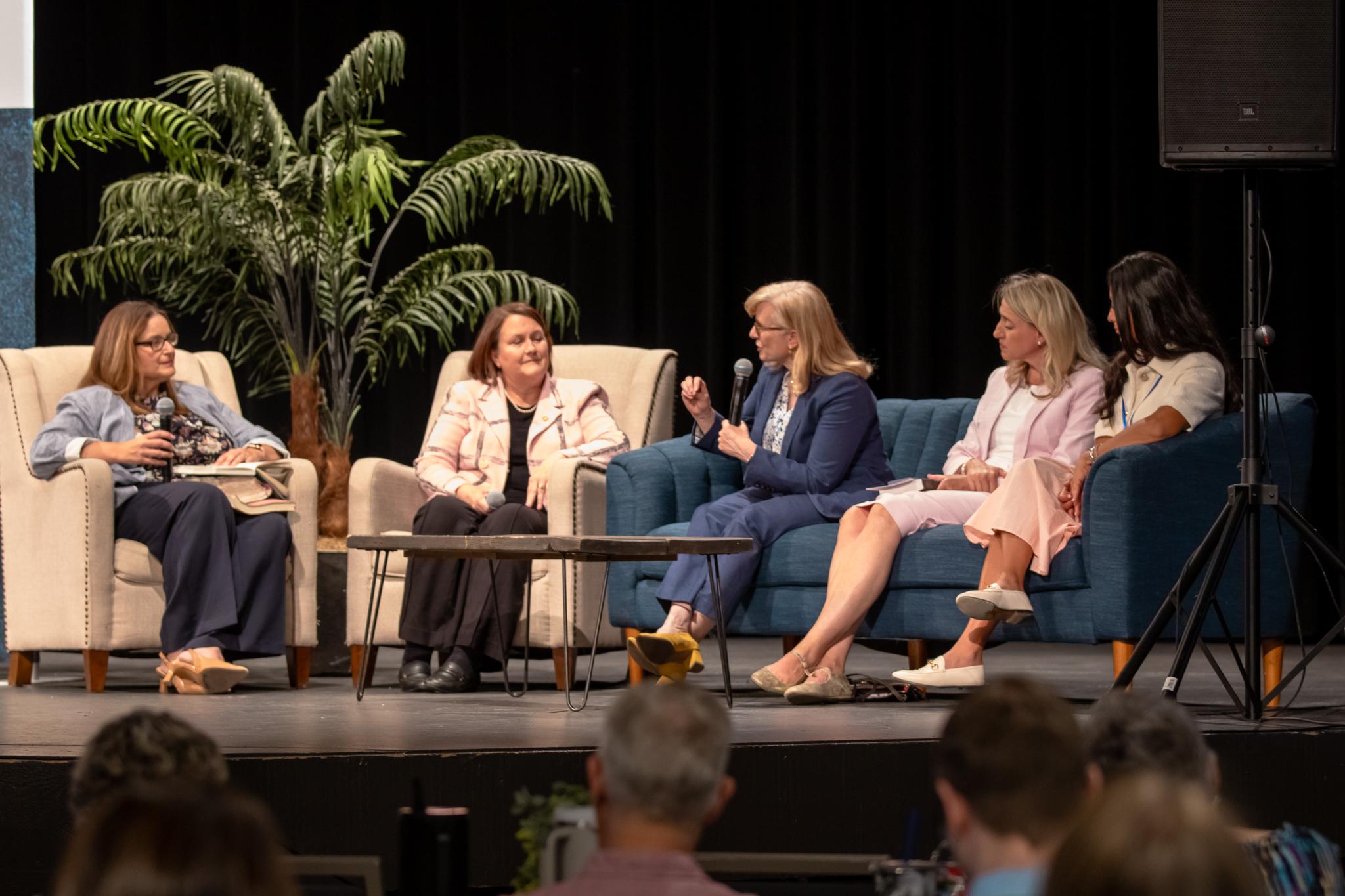
So, if I can have Sarah Jane Weaver and Brigitte Madrian and Jenet Erickson and Shima Baughman, if you would please come to the stage. Thank you.
These are four incredible women. I have the greatest respect for every one of them. I’m going to take this seat right here and then the rest of you can come here.
Introductions
We don’t have a lot of time to be doing our introductions. So, I’m going to do this briefly and then we can learn more about them in their conversation. Shima Buffman is a professor of law. Jenet Erickson is a professor of religion. There’s so much more I could be saying. Family, mother, children, all that stuff that is important too for the right timing in the right place.
Brigitte Madrian is the dean of the BYU law school. And Sarah, what’s your exact title? I always mess this up with you.
SARAH:
Editor.
BARBARA:
Editor of the Deseret News.
So, I just have a couple of questions that I’m going to sit over here with them and I’m going to ask them. We actually only are going to have time for two or three. We recognized that as we were talking because we could talk forever. So, I’m going to come over, sit with them, and we’re going to have a discussion.
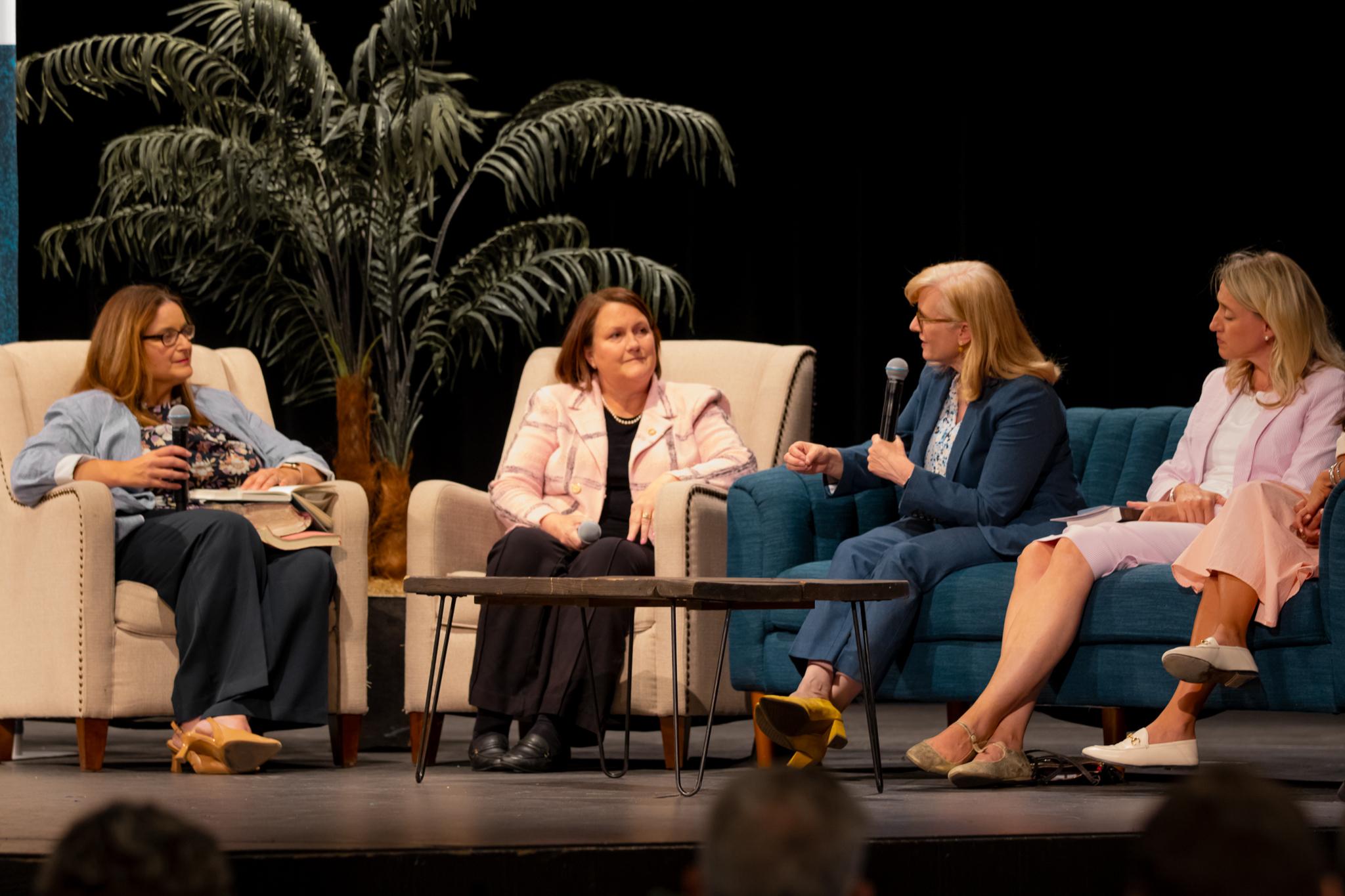
The Panel Discussion Begins
Okay. I hope you really enjoy this. And I want to make it clear also, we could have many people up here. I have chosen these incredible women for who they are, what they stand for, priorities, aligning their wills with the Lord. And because sometimes we get the idea that we can’t be all that we need to be as women, as LDS women. And I just would like to have a discussion about some of these things.
First Question
So the first one: what have you seen in the church or even in your lives—whether it’s occupation, family—that has been helpful? And then the second part of that question is what suggestions do you have?
And Shima, if it’s okay, I’m going to start with you because I want you to explain something that we talked about a little bit, and it’s the “laboratories of democracy”. Can you guide us through the laboratories of democracy? And then we’ll answer that question. 
The Laboratories of Democracy
SHIMA:
Sure. We—we were talking before this panel about how we see our role as women in the church. And the way I like to see it as a lawyer and a law professor is – when you think about federalism, right? We have this federal, centralized government and then we have states that kind of govern themselves.
And as you think about the church with wards and stakes and regions, and then we have a central, you know, church governing body, I think the church gives the local regions, stakes, and wards so much authority and independence.
If you read in the handbook, right, there’s a lot of things discussed within the stake or discussed within the ward, and the bishop and the stake presidency and other stake leaders and ward leaders can decide amongst themselves what works.
And I think that’s really neat—the way our church organizes things in that way, like we do our government in America. That’s ‘laboratories of democracy’, where they can figure out and fine-tune within their region what works. And of course the handbook sets bars as to what is inappropriate and what’s appropriate, but I think in a lot of ways it elevates conversations and the role of women as we do that.
Multi-cultural Examples
So, for instance, the culture I come from in the Middle East, you know, women are naturally to inherit less than men. They’re to inherit less property than their brothers. You know, women don’t have a lot of rights in divorce and things like that. And of course, people that join the church are elevated as co-equals with their spouses.
Similarly, in Africa, where I’ve worked for several years, there’s a cultural tradition that the man walks ten steps ahead of his wife. And of course, when you join the church, that’s not the case, and you’re now co-equals with your wife.
Regional Discussions
And I think in the U.S., we talked about—there’s some interesting things that can happen within regions. I’ll just tell one story because I know we have a lot of us to talk about this, but in a recent conversation I had with a friend who serves in an inner-city ward, she talked about—her husband is in the stake, and there was some discussion amongst the stake presidency and high council of how do we divide our stake boundaries.
And her husband suggested at this meeting—he said, “What if we invited, you know, the stake Relief Society, Primary, and Young Women’s leaders before we make any final decisions about our stake boundaries?” And it turned out once they invited the stake leaders—and they were eager to come, they were excited to come—they were able to kind of fine-tune some of the suggestions.
Women Bring Insight
So the suggestions didn’t consider the school districts. And when the female leaders came, they were able to just say, “Oh, well this cuts in the—you know—half the school would go to this ward and the other half would go to the other ward. That doesn’t really work well.”
And so I think that kind of “laboratories” model works well if we can think about what works. And I know some women are excited to go to stake council meetings and other women aren’t. And so working within your jurisdiction on what works for the women in your ward and in that jurisdiction.
It turned out the women were very excited to join these meetings. And I know other friends that are happy to avoid any meetings as much as possible at church. So it just—there’s so many variables there.
BARBARA:
Thank you, Shima. It’s such a great intro to that.
So to the rest of you—all of you—what have you seen that is helpful? What is successful? And then in a second we’re going to talk about suggestions that you have.
BRIGITTE:
So, I’ve got an interesting background. I came to BYU to become the dean of the Marriott School in January of 2019 after having spent 30 years at other institutions, most recently before that at the Harvard Kennedy School of Government.
Put Issues in Perspective
And no institution is perfect, and I am acutely aware of that. And I—on occasion—get the opportunity to talk to people who are more than happy to point out the things that BYU needs to work on. And I am acutely aware of all of those things. And they seem to think that, you know, we’re behind the rest of the world.
And one thing that has worked for me is, in those conversations, to draw on my own background and to say, “Look, no institution is perfect. And I am here to tell you that I will take the problems that I am dealing with right now than the problems that the other institutions I have been at have been dealing with.”
I will take those hands down, any day of the week.
So are there issues in the church and—and how women feel—you discussed some of those in your remarks—yes. But I will say on a university campus, alcohol is a real problem, and it creates more problems for women than it does for men. And I don’t have to deal with that problem in the same way.
Appreciating What You Have
So you can look at the—you can look at the world, you know, is the glass half empty or is the glass half full? And I think looking for what you have rather than looking for what you don’t have, I think that lifts everyone. And you can do that in a way where you’re not dismissing the problems and the things that need to change.
We’re all engaged in a process of repentance: as individuals, as families, as organizations. Elder Bednar talked a few years ago about the church gathering together in one all things in Christ, and how the church just keeps on adopting and moving in ways to draw us closer to the Savior.
More temples, a church that’s home-centered and church-supported, home MTC—I mean, we could go on a whole long, long list of things. And that’s a process of repentance.
So I don’t know – what works for me? What works for me is to focus on what I’m doing and what I need to change. And—and kind of being less—less critical and—and trying to find the reasons my grass is greener than the reasons why someone else’s grass is greener.
BARBARA:
Thank you, Brigitte. Thank you, Brigitte. That was great. Yeah. 
JENET:
Barb, I—just a few months ago, I had a conversation with a developmental evolutionary biologist who is an atheist and spent lots of years at a very prestigious university teaching about the distinction between men and women, male and female in particular.
We Are Literal Children of God
And we were just having a conversation. She asked, “What are things like at BYU in terms of teaching about gender?” I teach the Eternal Family class like Barb does, so we get into some of those topics. And I looked at her, and the thought that came to my mind was clear as could be—our doctrine.
And I just said, “We believe that we literally are the children of a divine mother and a divine father. And that we are their children. They are embodied like we are.” And as I’m talking, I see tears just streaming out her eyes. And she stopped me and she said, “That is the most beautiful thing I’ve ever heard.”
Recognize the Radical Doctrine We Have About Women
And one of the things I think, when we talk about what works, is to appreciate the absolute radical nature of the doctrine that we have about women.
I remember being on a panel at Princeton University and all of these different religions were represented. And when it came to my turn to talk about our belief in family, I realized I am the only person here who believes in a doctrine that women are resurrected as women. That we are resurrected—embodied women—distinct from men. And it is an unbelievably powerful doctrine for womanhood.
We talk about glass ceilings sometimes, and it can feel like, in a church where you maintain leadership that is gendered by men and in a workplace that doesn’t do that, there can be this sense of discrepancy, perhaps.
But just thinking about – a couple of thoughts. One being that what the gospel of Jesus Christ offers to women is a limitless vision of what we can become, which is all that God—Father and Mother—is and are. And it’s an unlimited potential that’s offered to us.
This is a Woman’s Church
I’m sure that’s why Sister Eubank tells that story of the woman in Ghana. And one of the Relief Society council were there doing trainings, and this Ghanaian woman came out of the training for the church and she just grabbed Sister Eubank’s hands and said—or this friend of Sister Eubank’s—and said, “This is a woman’s church.”
And then she proceeded to talk about how, in this room, you’ve told me that the children that I have had who have died will be mine forever. And in the other room, you were teaching my husband about what it means to be an equal partner, to not abuse or do violence to his family. And you continue to teach doctrines that are so empowering for me, that offer the very core of what I desire in my life.
The Potential for Relationship and Connection
I think that’s what we find in the data that you were quoting, is that religion—Latter-day Saint faith—has incredible power to give women what they desire most, which is deep connection, meaning, and purpose, with a vision for limitless potential in deep relationships—not as an individual that’s autonomous, but in the deepest form of relationships.
And that is, after all, what we yearn for as human beings.
BARBARA:
Thank you so much, Jenet.
Sarah Jane’s Global Experience
SARAH JANE:
My perspective as a Latter-day Saint women has been shaped by my experience… Before working for—for Deseret News for the past year, I was employed as a reporter and then editor of the Church News. And that job took me to almost 50 nations where I had the opportunity to meet and talk to women around the globe. And I saw how the gospel shaped their lives, and it was powerful.
And you can think of a million examples of how the church has elevated the lives of women across the globe and how women have risen to that potential. You know, I have seen women weather storms in Tonga and lead their families through them. I’ve seen women organize refugee responses in England and what that meant.
And as we were talking, I was thinking of some work I did in Japan after a terrible tsunami devastated the northern coast of that nation. And it was the women who rose up in response to that disaster and started finding people and organizing ways. It was the Relief Society that provided that structure.
“His watch care of me made me know that God loved me.”
But in one northern city there were two women who were the only members of their family. And their branch president lived a long way over a mountain. And in this Kessanuma, the tsunami came, and one of those sisters got in the car when she heard the alarms for the tsunami. And she got in one car, her daughter got in another car. Their husband and father was out on a fishing boat.
And as—as this dear sister, who was the only Latter-day Saint in her family, crested the hill, she looked back and realized she could see nothing behind her. She didn’t know where her daughter was. The car that had been following her was no longer there. 
And in the days that followed, her branch president got a scooter. In the lack of electricity and power—there was no phone service, there was no cell coverage, food and water were scarce—and he traveled over a mountain on earthquake- and tsunami-devastated roads to find the two women in one city. And he went to evacuation center, to evacuation center, to evacuation center.
At the end of the first day he learned that they were safe but had not made contact with them. He went home, and the next day he made the journey again.
And when I spoke to one of those women whose branch president found her at her brother-in-law’s home after enormous effort, she said, “His watch care of me made me know that God loved me.”
Now, the thing that was so interesting is that the journey home for this branch president was horrible. The roads broke down. He got a flat tire. He drove on the rim. Ultimately he ended up hitchhiking back to his own town. And in that journey he said, “God was with me.”
And that’s what the church does. It brings everyone. It lifts and strengthens everyone—men and women alike—as we serve and watch and care for one another. But what a sweet message to women of the world that are two in a city, that someone cares enough to spend days seeking them out. He delivered a bag of rice and a notice that the church cared about them. And that was enough.
BARBARA:
Thank you everyone for these experiences.
This next question is—it’s part of the same question, and I recognize that we could go on and on on both of these, but it’s just:
- What suggestions—what have you seen that you could say, “You know what? I’ve seen a couple of really good things that have happened here,”
- and maybe just what quick suggestions do you have
- that we could help empowering women, empowering men together,
- but really just helping people fulfill the measure of their creation?
But just—maybe if you could each give one or two.
SARAH JANE:
Do you want me to—I was just— Take it?
BARBARA:
Take it, Sarah Jane. Take it.
SARAH JANE:
A few years ago I was writing about President Russell M. Nelson’s ministry.
President Nelson’s Interview with Sergio Rubine
He was in Uruguay. And during the time he was in Uruguay, he did an interview with Sergio Rubine, who’s the Pope’s biographer. A few of us were so excited that this very famous, amazing journalist was interviewing our prophet and asked if we could sit in and observe that interview.
In the process of the interview, he answered every question you can think of about families and LGBTQ and church finances and everything. Nothing was off the table. 
And then Mr. Rubine asked President Nelson—he said,
“Oftentimes, churches are run by men at the exclusion of women. Is that the case with your church?”
And President Nelson could have answered that question, right? He has nine daughters. He has great experience. He’s spoken lots and lots. He had some responsibility for the Relief Society in different times of his apostolic ministry. But he did not.
Instead, he looked around the room. Sister Sheri Dew, who is a former member of the Relief Society General Presidency, was there. And he said to Mr. Rubine, “Why don’t we hear from a woman about that?” And he got her a chair, and he invited her into the interview. And she gave a very, very powerful answer.
A Live Testimony
But it wasn’t the thing that stuck in my heart. It was that when asked about the women of the church, our prophet allowed a woman to speak for herself. Mr. Rubine actually called that a live testimony.
And so I think, as women in the church, we’ve been given the trust of our leaders. And we should speak out. We should speak for ourselves. We shouldn’t let anyone else define how we feel about our place in this faith or in God’s kingdom.
BARBARA:
Well said. Thank you so much, Sarah Jane.
 JENET:
Just quickly, Barb. I love—Sarah Jane teaches us so much by her experiences.
The Male Leadership Need Women’s Voices
I think the model I know from my own experience in stake and ward callings—and even some councils at the higher church level—there’s a very clear sense from my stake president, my bishop, that I can’t go forward without your help, without your wisdom, without your insight, without your experience. And that I have to have the—the women’s voices in order for the Lord to even guide me in any way.
And so it—that manifests itself in so many beautiful ways. When the stake president is worried about something—when I was stake Relief Society president—he would call me in and say, “This is what I’m worried about. What counsel do you have based on your experience with the women? What could we do and should we do?” And I was right beside him in that work.
And I think bishops as well—and there were specific kind of projects that we worked on in that way. And there were a lot of things I didn’t do with them. But there was a very clear sense that the Lord could not give them the direction that was needed in their stewardship without that sharing counsel together of the voices of women.
Adam and Eve as a Model
And I think we see that so modeled with Adam and Eve. There’s no question that the plan of heaven is that men and women work alongside one another as equals. Just as the rib metaphor illustrates—not one is ahead and not one is behind—but they are equals in guarding the very essence of life.
And of course, that’s what the temple brings us to. But it also is the pattern to be modeled in the way that we do church help for one another—is this working together to seek inspiration through one another’s voices.
BRIGITTE:
Jenet talked earlier about the doctrine of family. There’s another really powerful doctrine that I think has important implications for the roles of women and women—men—in the church, and that’s the doctrine around agency, responsibility, and accountability. 
Agency, Responsibility, and Accountability
And, you know, on the kind of positive side, where I think we don’t give ourselves enough credit, is that we have agency. And we’ve made covenants, and with those covenants comes responsibilities. And a lot of the covenant responsibilities that we have have nothing to do with positional authority in the church.
You know, we’re to consecrate everything we have to the Lord. We’re to be obedient. We’re to serve and bless others. And we’ve been commanded that we should do many good things of our own free will and choice. And so we have tremendous capacity to do good. That’s what President Nelson was talking about, quoting President Kimball.
And I think sometimes as women, we think we need to be asked to come to the table. And there are, you know, ways that things get done and appropriate and inappropriate things; but I think many women in the church are more deferential than they need to be. And they’re waiting for an invitation rather than saying, “What can I do? How can I serve? Let me go about fulfilling the covenant promises that I’ve made.”
So—that’s one thought on agency, responsibility, and accountability.
Let’s Stop Judging Other’s Choices
The other thought is one of the things that makes me the most sad. This is not just something related to the church but to gender more generally. It’s when we judge each other because someone has made a different choice about how to live their lives. And for women that often comes out in, “well, are you working or are you staying home with your kids?” Things like that.
And, you know, we’ve been told that we’re not supposed to judge. We’re all entitled to our own personal revelation. But often I think that tendency to judge ties back into agency, responsibility and accountability, with people not wanting to take full accountability for the choices that they’ve made.
A Damaging Dynamic
And because they have some reservations about the choices that they’ve made, they’re trying to make themselves feel better by passing judgment on someone else who’s made a different choice. And it’s a damaging dynamic. It creates contention, which we’re not supposed to do. But, you know, at the heart it’s absolving yourself of the accountability that you have for the choices that you’ve made.
And those are the choices that we all need to focus on. We need to focus on our own choices, not on other people’s choices.
BARBARA:
Thank you. 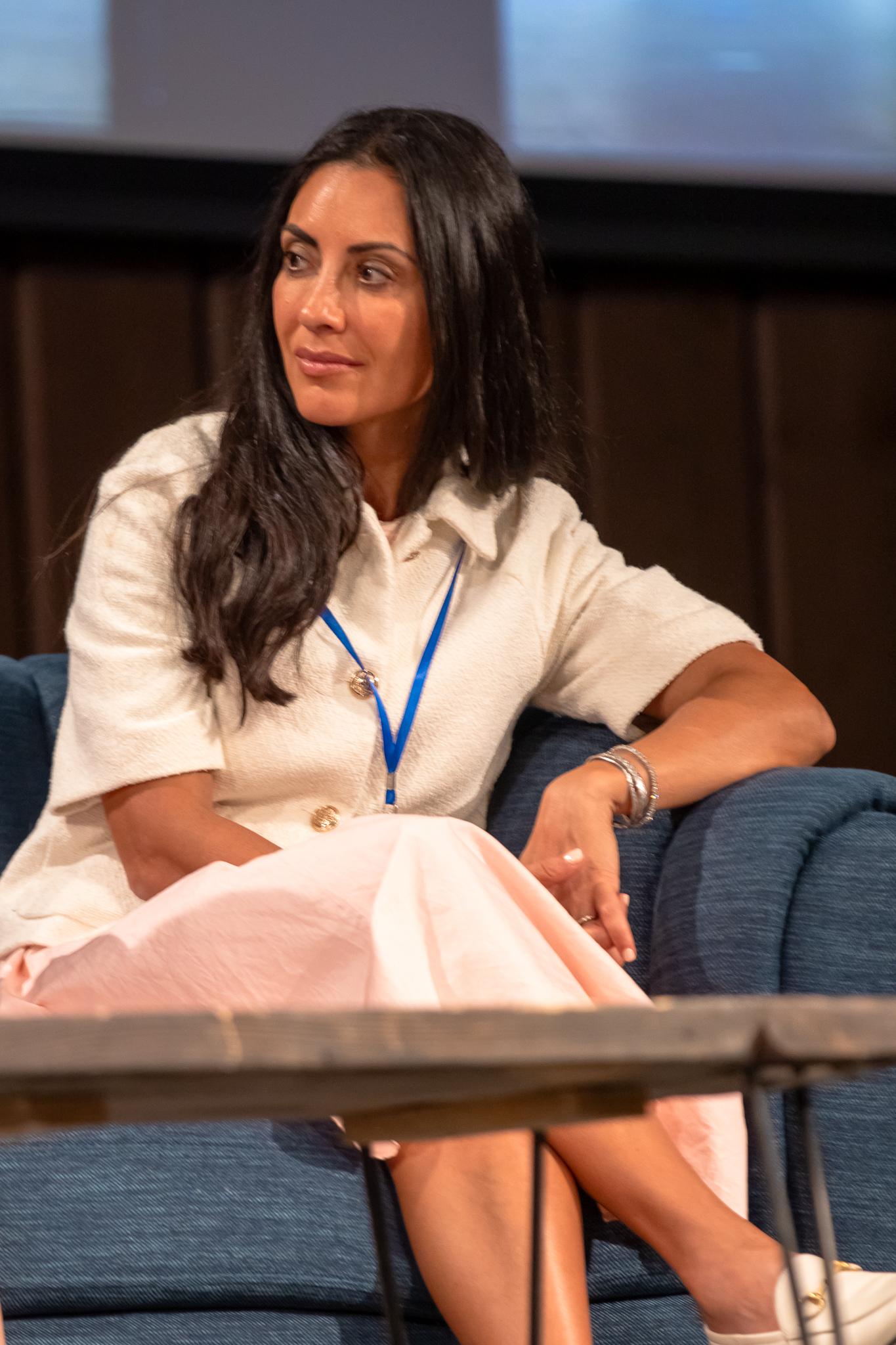
Shima’s Experience as Relief Society President
SHIMA:
I think, you know, sometimes that kind of individual discussion piece as far as, you know, what’s helpful on the ward or stake cases… I think one experience I had is—I remember when I was called once to be a Relief Society president, and I was surprised because I had two young kids, I’m working full-time at BYU, and I’m seeing all these other women that aren’t working, and I’m thinking, you know, why am I getting called to this big calling that takes a lot of time when I have little kids?
And I just remember being so taken back by my bishop who was maybe 15 years younger than me. He was really young. And I think when we got to sit down together, he was like—kind of like Jenet expressed—like, “I need you to help me. I need you to help see a different demographic” of—you know—there were some working women in our ward, some women that stayed home, a lot of people that he thought maybe I could connect with that he couldn’t.
The Experience Then Helped Me Get Where I Am Now
And it just really made me think—at different times—I think sometimes we question leadership, we question our roles as women, or, you know, what’s best. But I do think—and I look back at the point when I was called and what I was able to accomplish in that period—I really gained a strong testimony of our church’s welfare system and our—and the ability of faith to be able to strengthen people’s lives, which fast-forward now, how many years later—you know—15 years later—I’m now at the Wheatley Institute studying this issue.
And if I hadn’t had that firsthand experience in helping with welfare and helping people get off drugs through the church, I just wouldn’t have gotten there. So I do think there’s this importance of bishops and Relief Society presidents particularly working together, but all female leaders and male leaders being able to work together and strengthen each other where we don’t have the same strengths.
There’s just so many good examples, but I know we have other questions, so I’ll just leave it at that.
BARBARA:
Thank you, every one of you.
Elaine Jack and the Proclamation on the Family
You reminded me of a moment with Elaine Jack, who recently passed away. She was a General Relief Society President of the church, and I was talking to her about The Proclamation on the Family, the document. We’re coming up here soon on the 30th anniversary of that document. 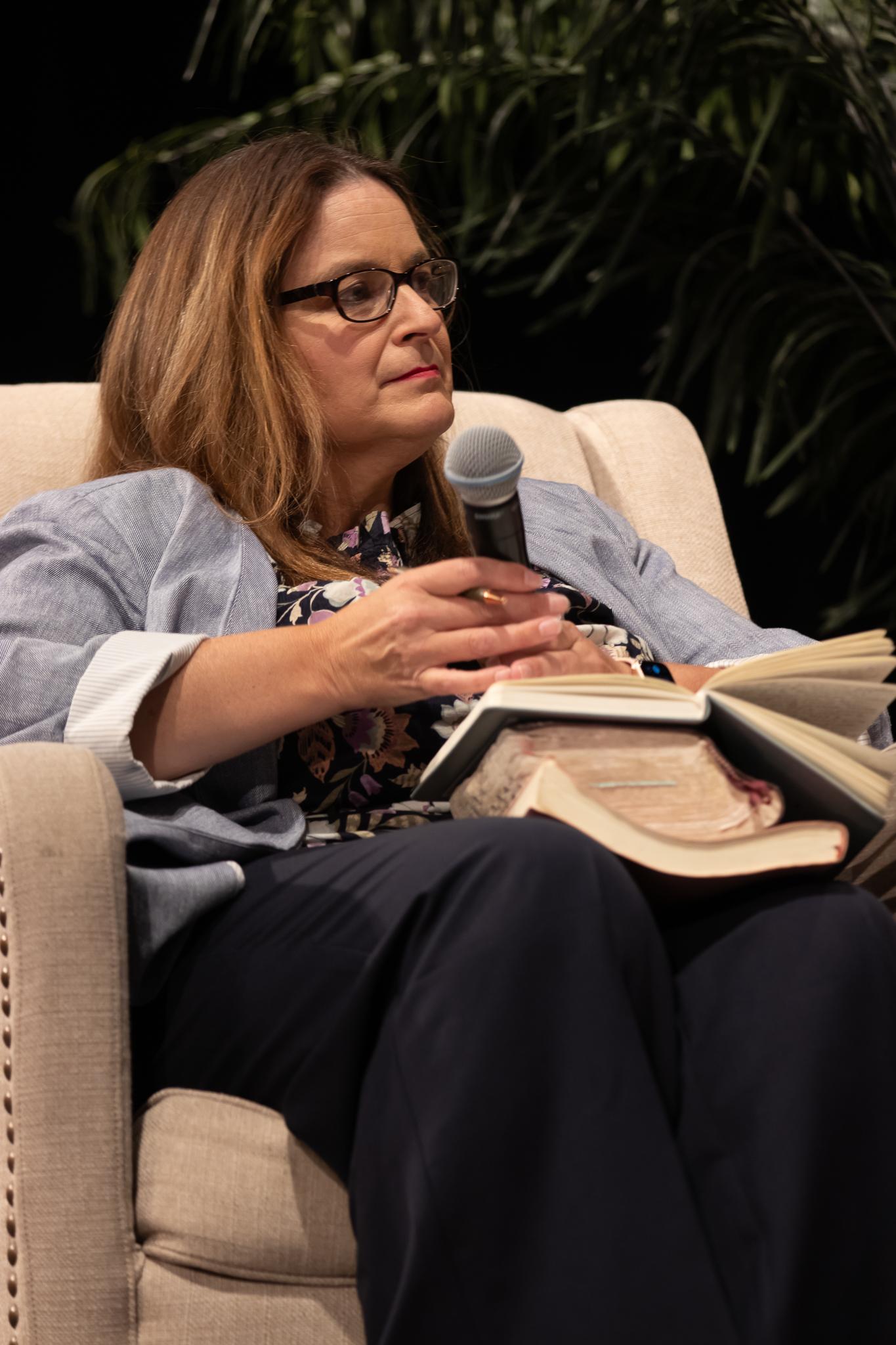
And so we were just talking, and I expressed to her that there had been some confusion regarding her involvement in that document and the document being read at this Relief Society meeting that she was presiding in. And I just asked her, you know, “I understand that some people may think that you were not as involved or you—it wasn’t your choice.” I kind of threw some of these ideas at her.
And she stopped me and she said, “Barb, what do they think I am? A shrinking violet?” And she said, “Of course I can think for myself. Of course the prophet cared about my opinion. Of course the First Presidency talked to me. Of course I was listened to. Of course I was treated well.”
And she said, “Sometimes I wish people wouldn’t put words in the mouth of somebody who hasn’t had a chance or hasn’t been invited to speak.”
And it was such an important moment for me personally to hear her say that she was strong and solid and she wanted to be understood. She asked me specifically to clarify some things.
Being ‘Authentic’ Isn’t Just Being Negative
I think that’s one thing—sometimes when we talk about being authentic, we tend to try to talk about and try to get people to talk about more of the negative. Authentic is also the positive. Being vulnerable is speaking. Sometimes it’s harder to tell the positive stories than the negative because the negative stories sometimes seem to be much more intriguing and exciting.
So I appreciate that in this discussion – that’s not saying that there aren’t difficulties. That’s not saying (as Brigitte was saying) that there aren’t struggles. But it is saying there is a lot of good, and we can use that agency.
Empowering Doctrines and Principles
Brigitte mentioned—and actually a couple of you mentioned—these doctrines, and this was the topic of our next question that you’ve brought up. But I’m going to throw it again to you:
- What doctrine or what doctrines,
- and even what principles of the gospel of Jesus Christ,
- have empowered you as women
- and can empower others as women?
JENET:
I’m just going to highlight something Brigitte taught us that I thought was so beautiful in our discussion before—about the power of learning two forms of leadership in the church: capital L and small l. And you referenced that the Savior did not have an official ecclesiastical position during his mortal ministry. He did not actually have a position formalized in that Jewish culture. But he acted and served—led small l, if you will—in the most remarkable ways.
Formal vs Informal Leadership
And I think one of the things that you feel as a woman is that if you are in a position of leadership—capital L leadership—you are always having to learn how to lead as a servant. That’s what men are also trying to learn to do. And to be a servant-leader, in learning the principles in section 121 to lead with persuasion and gentleness and meekness and love unfeigned. All of that list of how God’s power (Barb, as you teach so powerfully) is used.
But do we diminish the small l leadership that happens in ministering visits across the world one-on-one, that change the course of people’s lives? To say nothing of the influence of a mother on her children that is immeasurable in its intergenerational impact. Nothing compares to it.
And so I think it’s hard in a world that measures influence in one way but obscures what the Master himself did in his remarkable leadership—unprecedented, unparalleled leadership—which was ministering in many ways like women do: to feed and clothe and serve and heal and minister in those very sacred ways. And the honest truth is I don’t know that there’s anything of greater influence than that in the long term.
BARBARA:
If I may jump in as—as a moderator, I want to throw in—you’re talking about this lowercase l perhaps. When I was speaking in the Kirtland Temple, I was talking about those visitors who came: Elijah, Elias, Moses, and Jesus Christ being most significant here.
Barbara’s Insight in the Kirtland Temple
And in this moment of teaching while in the temple and looking to the pulpit of where Christ himself came, I had this moment of understanding. And I think it was a significant lowercase l moment of the influence of—and power of—women.
I had this thought: Who was Moses’s—the women that we would associate with Moses? And of course I went to Zipporah. I went to his mother.
And if we went to Elijah and said, “Who was the woman who had the power and the influence of Elijah?” And I naturally went to the widow of Zarephath and her great power and her faith and her strength and the influence on her son.
And then I thought, Who—who do we tie to the gospel of Abraham? And I couldn’t help but go to Sarah. And I thought: the incredible influence of these women.
And then Jesus Christ himself—who do we naturally go to? His mother, and perhaps Mary.
We cannot minimize the role and the influence and the power of these solid women—maybe lowercase l’s if we want to call it that—on these men. And with Jesus Christ himself, how powerful it is for us to recognize that and realize that they are doing exactly what they need to do, and they are changing the world. They changed the world.
Sarah Jane’s Experience in Fiji
SARAH JANE:
I want to jump in here because I have an example of what lowercase l leadership looks like. I had been in Fiji to cover the rededication of the temple there as a Church News writer when a huge storm hit the nation.
And so in the days after that storm hit, I was able to go with a welfare couple that was serving a humanitarian mission, the local stake president, and go into the villages.
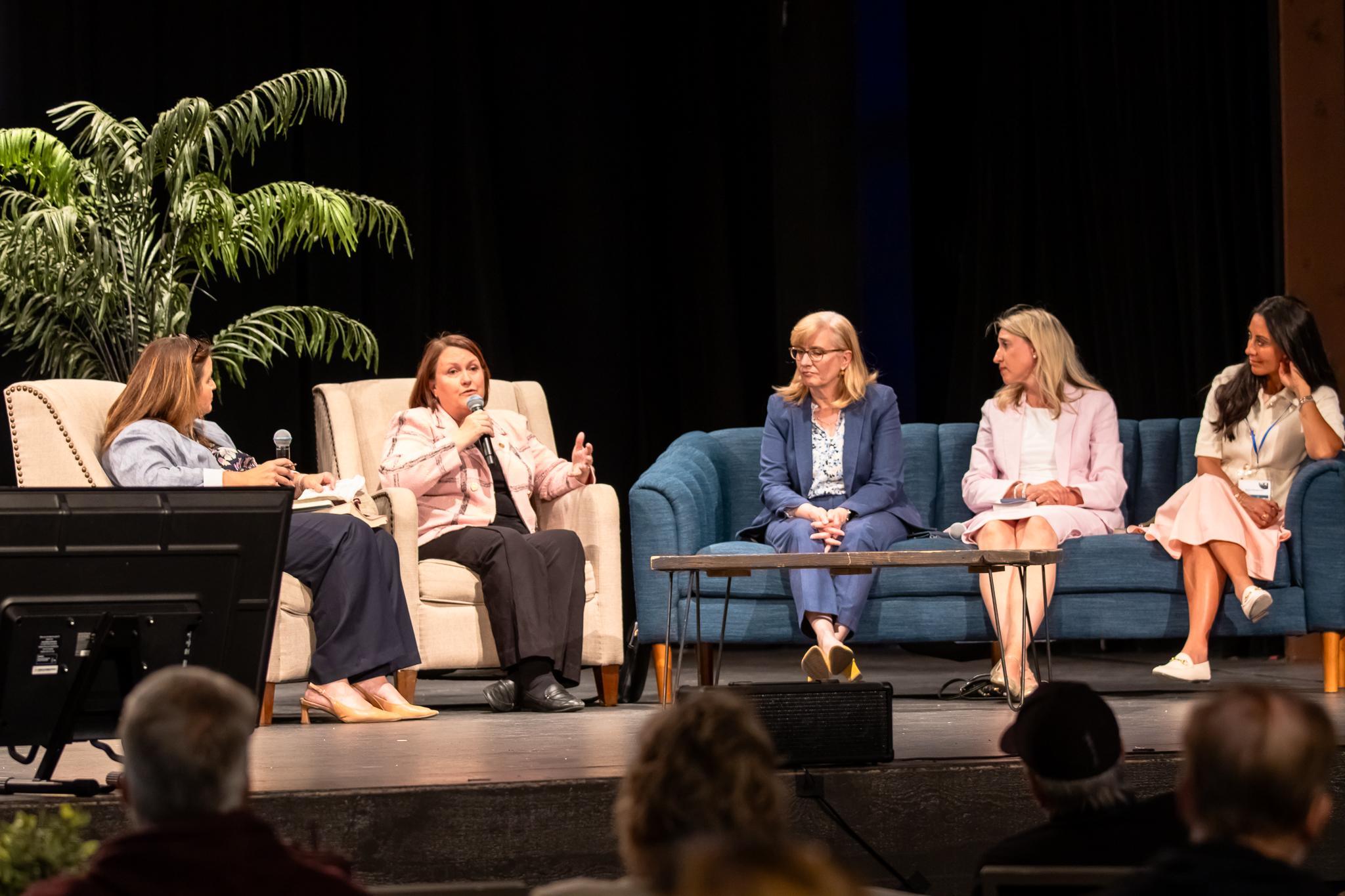 And in one village, I had climbed up this hill to take a picture and do some interviews. And I had a perspective that changed my life as a Latter-day Saint woman. Because from this perspective on this hill in this little village on the shore of Fiji, I could see the local Latter-day Saints stake president. He’d organized all of the men in this little village and he was asking them to rebuild and gather up all the materials. And he was literally organizing and putting a structure upon the response that was needed in that village at that immediate moment.
And the brother who was the humanitarian missionary—he was talking to the village chief and he was gathering all the statistics: Who’s died? Do you need clean water? Were your crops destroyed? How many members are sick and lost homes? How many members of other faith traditions need help that the church can assist with? And what he was doing was so needed in the moment so that the church could have an appropriate response.
Ministering One to One
And then I looked to the sister who was functioning as a member of the Relief Society and as a leader in the Relief Society. And she was going door-to-door to door, and she was hugging the families, and she had candy in her pocket for the children, and she was offering hope and comfort and healing.
And it occurred to me that the things that the Savior did in his lifetime—taking care of the poor and needy and ministering and teaching. Those are the things and the responsibilities that the Lord has given women in his true church.
And I think that if the Savior had been in that village that day, where the church was functioning in every way to lift and strengthen every member of that village, he would have been right there with that sister—ministering one-on-one and sharing his love.
BRIGITTE:
That’s beautiful.
Brigitte’s Experience as a Temple Worker
Barb, you’d asked what other doctrines are really impactful. And about two and a half years ago, I went in to my bishop and I said, I’d like to serve as an ordinance worker in the Mount Timpanogos Temple. So I’ve been doing that first on Thursday nights and then for the last year on Saturday afternoons.
And it is different to work in the temple than it is to go to the temple regularly. You know, it’s just a different experience. And if any of you are interested in it, I would highly recommend it.
But there is—I would say there is nothing like serving in the temple to really deepen your understanding of how God loves all of his children, men and women equally. And in the temple, we are making the same covenants. We are given the same promises. We are participating in the same ordinances. And it’s just really beautiful.
Spend More Time in the Temple
I mean, if you want to understand your place as a daughter of God, I can bear you my testimony of President Nelson’s plea to spend more time in the temple and of his promise that spending more time in the temple will help you with every single problem you are facing in your life.
And I think if the women and the men in the church would spend more time in the temple, the divisions and the misunderstandings would dramatically shrink.
BARBARA:
Amen.
SHIMA:
Amen. I was—I have a slightly different take, but maybe the same conclusion, just to get to the bottom of it. A personal story for me is: I got married. I was divorced, single, and then I got married. And my parents-in-law are here.
Shima’s Experiences in Temple Learning
And I was 35, you know, older. My husband was 38, never married. We got married, and we were having some marital—just difficulty. We had a hard time getting along because I had ideas about life and my kids, and he had his own ideas. I know—two strong personalities.
And he had this really inspired thought, and he said, “What if we went to the temple once a week?” Because we were fighting a lot. Like no one was having a great time here. And we started going to the temple.
And it’s funny, because as I grew up, I kind of had put my questions about women in—in the church or in the gospel kind of on a shelf—like, Oh, I’ll deal with that later. And I wasn’t actually trying to deal with that issue. I was trying to deal with a present issue, which is like saving my second marriage and not ending up in another divorce.
And I ended up going to the temple, and we went weekly. And the—what really helped me transform my life and my understanding of women and our role in the kingdom is the doctrines that we learn in the House of the Lord.
And ever since I started going regularly—and this is why you think our prophet tells us every conference, “Let’s spend more time in the temple”—is because as I spend time in the House of the Lord, I am tutored in my role. And as I understand as a woman in God’s kingdom, I have so much power.
The Powerful Role of Women in God’s Kingdom
I look at our first mother Eve and her brave choice to bring forth the plan of happiness, to allow us the covenant with our Savior Jesus Christ, to wear the holy garment that protects us from Satan. And then on and on we think about how important men and women together are. And it kind of solved that shelf issue as well as healed my marriage.
And as my parents-in-law are here 10 years later, I can say that, you know, my marriage is doing great. And it wasn’t at the time. But I think about some of the questions—one of the things we talked about in our discussion was some of the women having trouble with the church and how things are done as far as big L leadership, right? We’ll say, “Well, take it up with the brethren,” or, “Take it up with the stake leaders.”
But for me, what really was effective was taking it up to my Heavenly Father. And when you want to talk to someone about something important, where do you go? Well, you go to their house. And I find—you go to the House of the Lord and take it up with him. Talk to him about your role in the kingdom of God as a woman and a man. And I promise you, he will tell you exactly your role.
And I think that’s why the prophet knows that as we go to the House of the Lord, we will receive that revelation for ourselves to know how important our role is as women, as men, and that we can kind of further his work that way.
BARBARA:
Thank you. This—this has been a fantastic discussion. And we’re right here at the end of our time. I wanted to give a moment, as we all discussed and wanted to do, on our Savior Jesus Christ.
So if it’s okay, I’m going to end this just with some thoughts, as you have shared. Section 93, that we’ll be teaching, we’ll be learning and reading shortly in the Come, Follow Me program—but it’s the Doctrine and Covenants.
Jesus Christ receives—as it says in verse 17 of that section—“And he receiveth all power, both in heaven and on earth. And the glory of the Father was with him, for he dwelt in him.”
And then he says in verse 20, “For if you keep my commandments, you shall receive of his fulness, and be glorified in me, as I am in the Father; therefore I say unto you, ye shall receive grace for grace.”
The Power is God’s
I think it’s critical that we understand that the power is God’s. There is no man or woman who can give away God’s power. The power is God’s. And then the question is, are we willing to receive his power? And are we willing to be yoked with him in receiving his power? But no man can keep power from women, and no man can give power to women. No woman can give power to women. The power is God’s, and God gives the power.
And I want to also tie into section 132—as we make and keep those sacred covenants with God. And this is specifically in reference to the temple and men and women working together, united. Part of this promise is that “they shall receive thrones and kingdoms and principalities and powers and dominions,” etc., “and they shall pass by the angels.”
And I love the they—and “the gods which are set there”—to “their exaltation and glory in all things, as hath been sealed upon their heads, which glory shall be a fulness and a continuation of the seeds forever and ever.”
“And then shall they be gods, because they have no end. Therefore shall they be from everlasting to everlasting.”
I think it’s fascinating that Adam and Eve—the emphasis was on they. And at the end, in this next realm, the emphasis again is on they—because they continue.
“Then shall they be above all, because all things are subject unto them. Then shall they be gods, because they have all power, and the angels are subject unto them.”
And then finally verse 24: “This is eternal lives—to know the only wise and true God, and Jesus Christ, whom he hath sent. I am he. Receive ye therefore my law.”
Our power comes from the Savior
As I started this conversation before I sat here, but as I was talking, I mentioned the power of one plus one. Our power comes from the Savior. He is the God of all power. He is the one who makes it possible for us to have eternal happiness now and in the future. He makes it possible for us to receive all that we want—which again is section 84 of the Doctrine and Covenants—that we receive all the Father has. It’s impossible to receive all the Father has without becoming like him and our Heavenly Mother, together united.
Any final phrases? Any final things you’d like to say as we finish off?
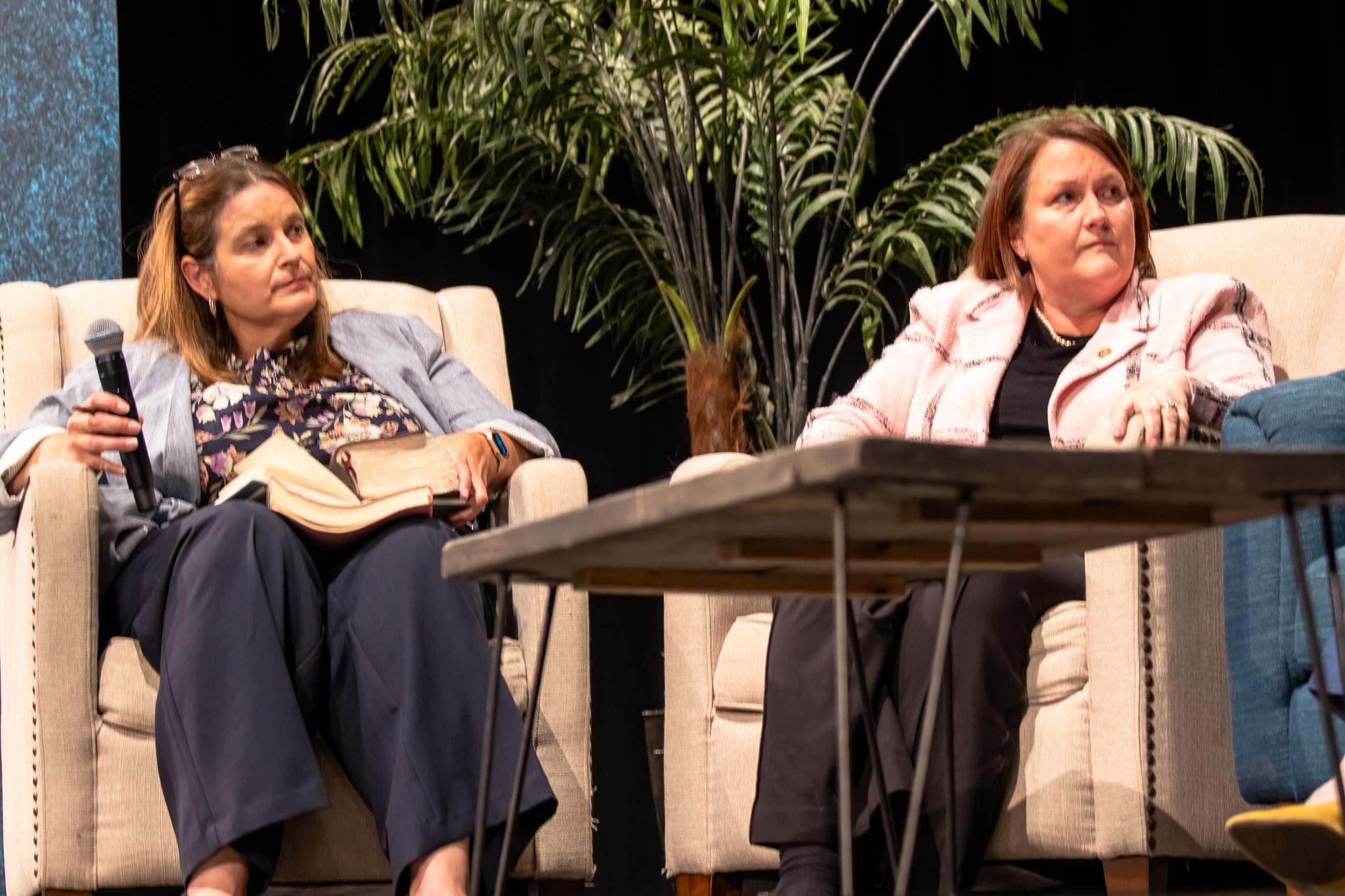 JENET:
I—just really fast. I was speaking with a former leader this morning, and she referenced that she’s been stuck in Jacob 1 through 4. And she said the Lord is deeply displeased when his daughters weep or suffer. And that is absolutely true. Jacob spent this effort to help people understand how wrong it was to hurt women and children.
And then she just took me to—to Jacob chapter 4, where it ends with his powerful witness of Jesus Christ. And he says—he warns of becoming overanxious that we would set aside the Savior as the stone.
And it just feels like that is the answer to all that we wrestle with: that he truly is the Rock of our Salvation, and the Stone on which we will build our lives. And he knows all the suffering. He knows all the gaps. He knows all the challenges and will walk beside us. He is the sure way for all of us as women.
SARAH JANE:
I just want to share my testimony that I know this is a woman’s church. I am so grateful to sit with strong testimony, covenanted women like these and share our witness that Jesus is the Christ and that this is his true church on earth. And we, as we conclude today, we do that in the name of Jesus Christ. Amen.
ALL:
Amen.
