Presentation
Jennifer Roach Lees
So, this afternoon we are going to do a panel with these lovely ladies. They are involved in apologetics online. I think your podcast is about a year old.
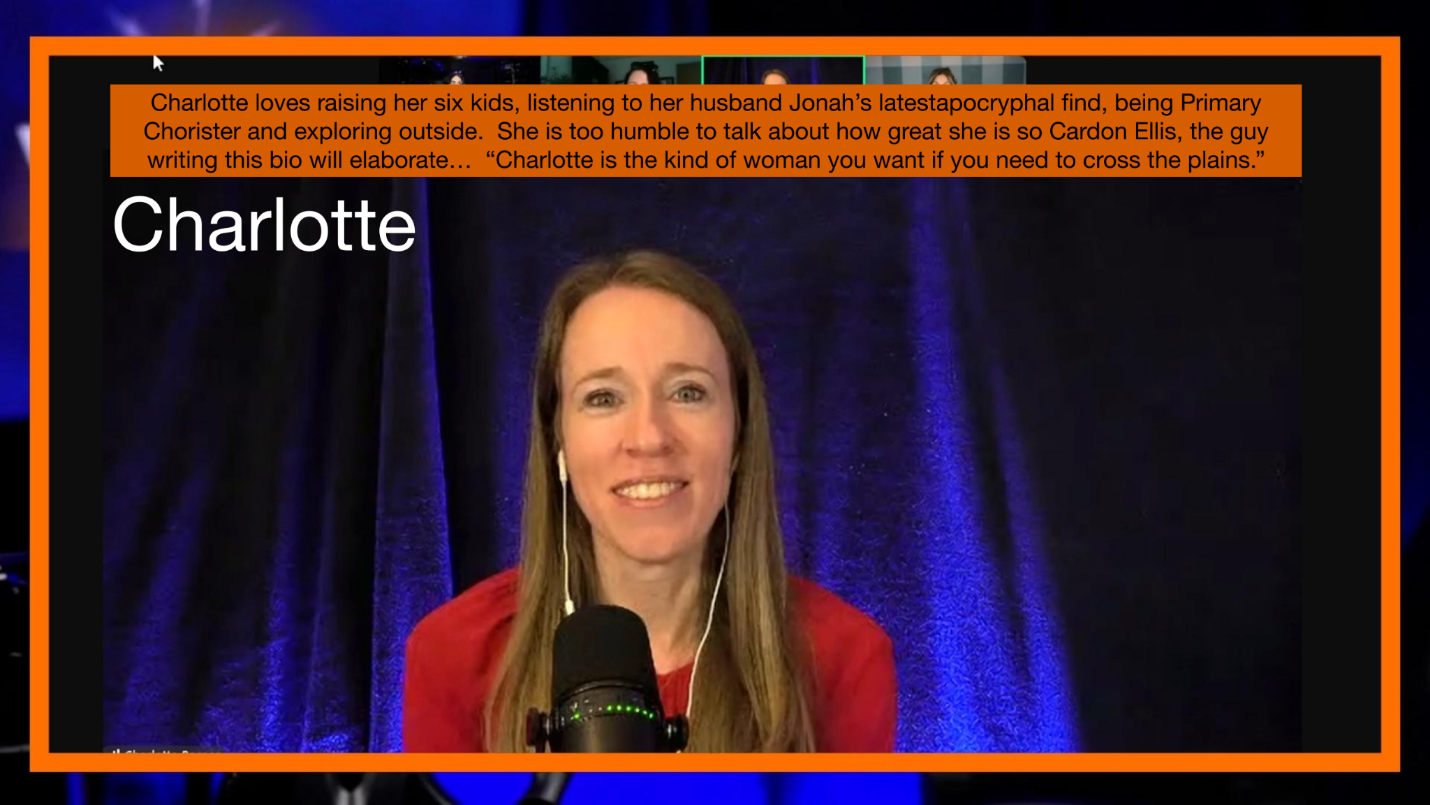
Charlotte
We started last March.
Jennifer
So, we have some questions for them. Please enjoy our conversation.
How Did You Get to be Apologists?
First of all, how in the world did you guys get to the point of being able to say, “I can talk about apologetics?” How did you get there?
Standing as Witnesses: A Latter-day Saint Woman Responds to Criticism
Charlotte
Well, it’s an interesting story for all of us. We all have our own little path that we got here, and this is actually the first time we’ve all met in person. It’s been awesome.
So yes, I often ask myself, as I’m sure many of us do, what am I doing here? And how can I do this? And it is definitely the Lord that has led us here.
When I think, what am I doing? How did I get here? I think, “I’m just an LDS mom who’s trying to raise my children, support my husband, and build my community. And what is my part in this?”
I’ve realized if I can just—in this sea of really depressing anti-Mormon claims and stuff online saying that women are repressed or that we’re brainwashed or that we’re so unhappy—if I can just step out of my happy little LDS woman life and say, you know, actually we’re great.
We’re doing great, and we’re all doing great. So don’t listen to them. Then that is an important voice to be heard.
When I was in Young Women’s back in the 2000s, when in part of the motto it said—and I’m sure all of us are similar ages said—“we will stand as witnesses of God at all times and in all things and in all places,” and I feel like that is what we’re doing right now.
This just plopped on our laps and we’re doing our part to stand as a witness.
 Authority, Impostor Syndrome, and Faithful Latter-day Saint Women Online

Now, in a question you had asked, do we ever think, you know, “who gave us authority and are we imposters?”
Well, no one gave us authority. We didn’t get a certificate, a degree in this. And unfortunately, we did not get a personal phone call from President Nelson asking us to do this.
So, what authority do we have? We haven’t been given authority. We have become an authority on what it is to be an active LDS woman who is trying her best.
A few days ago, Rachael messaged, “Are you guys struggling with impostor syndrome?”
In my mind I thought “yes,” but I had this response which I truly believe—you are a happy active LDS woman who loves Jesus Christ and loves his church; and you are going online to say I am a happy active LDS woman who loves Jesus Christ and loves his church.
You are not an impostor. You are the real deal and that’s what we feel that we are.
Who Gave you the Authority?
Jennifer
Yeah, Charlotte, that’s amazing. Thank you. And any of the rest of you, right? How do you answer that question? Who gave you authority to do this? Who gives you authority to talk in apologetics?
Personal Testimony and Authority to Share Faith
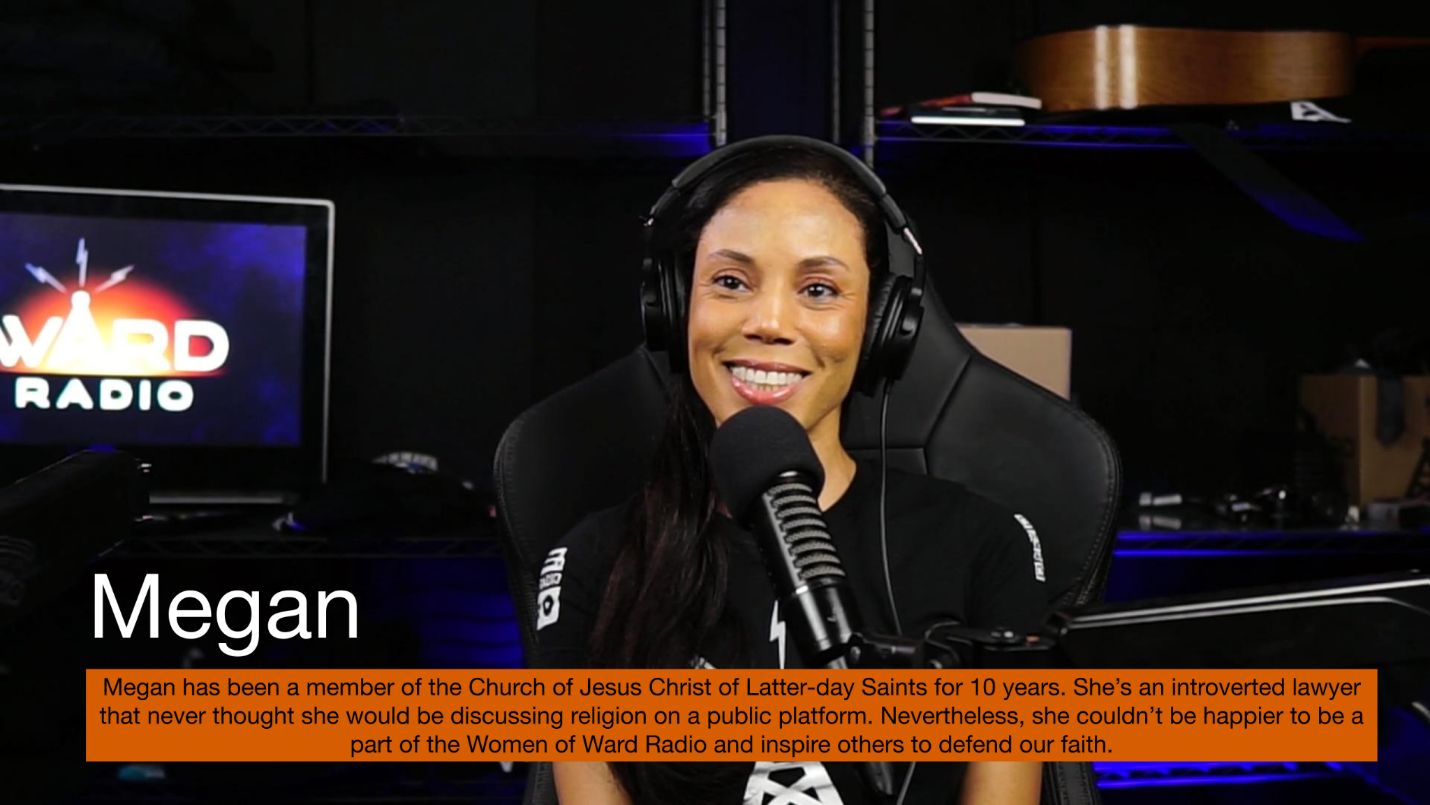
Megan
Hi. So, who gave me the authority?
My Father did, by just being born and being given a testimony from the Holy Spirit and being led to baptism—that gives me the authority.
I never, or at least I try not to ever, display myself as an expert.
But what I can do is share my story in a very vulnerable way so that perhaps someone who looks like me may feel a little bit more included in the flock.
Jennifer
Yeah, absolutely. I love that. Thank you, Megan.

Authenticity and Speaking as Faithful Latter-day Saint Women
Brittany
In regards to the impostor syndrome that Charlotte brought up, I’ve told this so many times. I’ve always said I’m not a scholar. I’m not a scriptorian, but I’m a lifelong member of the Church of Jesus Christ who loves Jesus, and I’ve never claimed to be anything else.
I just—I don’t know—we’re just women spouting our opinions online, and we are authentic.
I think that’s what this world is craving, especially the new generation. They don’t want rehearsed answers. They just want authenticity.
I think that comes out in the way that we do our podcasts.
Jennifer
If you haven’t guessed, their podcast is called Women of Ward Radio. I think it’s the companion show to Ward Radio. This one existed first, right?
Brittany
Oh, no. Ward Radio existed first.
Jennifer
Oh, sorry. Ward Radio existed first. All right.
Addressing Emotional Arguments
Next question. Many arguments against the Church are presented with really emotional language that frankly women fall for, right? How have you guys addressed that in your work?

Using Emotional Narratives to Communicate Truth
Tikla
So, I think this is true, and I do think that the emotional arguments do resonate with women even more. I do think that’s a big problem.
But there’s a tendency that I find myself having when I come across an emotional argument. I’ll try and give an example instead of just talking about it.
For example, you hear a story about a woman who describes her home growing up, how they had family prayer and every night her dad was in charge and he would pick who got to say the family prayer and her mom would just kind of like nod, and she just felt like her mom was so silent. That she had no voice.
She as a young girl felt like ‘I am less than, I should be quiet, I don’t have a say in this patriarchal Church.’
That’s an emotional argument in a story, and it’s her real experience.
The instinct is to say, “well actually” and come in with some facts and some logic—fathers, strong fathers in the home protect young girls—and all of these facts, right?
But we can actually use emotional language to tell the true story in a way that might resonate better.
For example, my mom is a convert to the Church.
And in a moment of tearful vulnerability, uncharacteristic to her honestly, she came to me and she said, “You know, I never once had a family prayer growing up. Not once. And every child should get to have a family prayer.”
I defend the Church because every child deserves the opportunity to be surrounded by the love, protection, and opportunity to pray for others that comes from a family prayer.
And so that’s maybe an example of how that could be done.
Addressing Emotional Arguments While Seeking Truth
Jennifer
Yeah, Tikla, thank you.
How about someone else?
How are you helping your women listeners especially, like cut through the emotion, find the facts, without completely dismission the emotion?

Women Responding to Criticism of Latter-day Saint Men and Families
Rachael
Hi, I’m Rachael.
So I think one of the most interesting things about us being LDS women defending our faith is that there are emotional arguments that are being made out there that only really women can speak to.
I would say like the number one accusation is that, you know, Mormon men are oppressive, abusive, condescending, they don’t respect women.
But Mormon men can’t defend themselves against that.
And that’s where I think we’ve been able to simply say, “look, that has not been my experience.”
That hasn’t been my experience and that isn’t the experience of most of the people I know.
Understanding Faith Crisis and Responding with Compassion
Rachael
I also think it’s important to keep in mind—I hold on to this—I have a really close family member who’s very cynical.
And I heard a quote in trying to understand this family member, that “a cynic is really just a heartbroken idealist.”
So when you encounter a faith crisis about the Church or the gospel, and you feel like you’ve lost the gospel, the gospel offers so much hope for families being together forever and seeing people you’ve lost.
That when you lose that, you really do go through heartbreak.
When women are making emotional claims or in the comment section, I do try to remember that, and it’s led to some really amazing exchanges.
This is where the meat of the impact we can have is; even though we’re on a macro scale, we can have these one-on-one personal exchanges with listeners.
Personal Conversations and Rebuilding Faith
Rachael
I’ve had emails from people who have said, “I was really surprised that you were so kind in your response to me because what I said in the comment section was really mean.”
And I just tried to keep that concept of, like I just know this is a heartbroken idealist.
It’s led to some really meaningful email exchanges with people who are really sad about losing their testimony and they’re actually coming to us for a believable explanation, a reason to have faith again.
Why Women’s Voices Matter in Latter-day Saint Apologetics
Jennifer
This is exactly why we need women in apologetics.
Because there is a way in which, sorry brothers, but sometimes you can’t address the issues that women have because they feel like they have been so oppressed.
And so to have a place where women can come and do that, get a compassionate shoulder, but also get truth.
Rachael, I love that answer.
Discussing Pop Culture and Faith on the Podcast
Jennifer
On your guys’ show, one of the things that you do is kind of identify some pop culture things that are going on.
Help the listener deconstruct them.
Could you talk about that a little bit? What’s that been like for you?
Maybe give some examples of that.
Brooke

Responding to Pop Culture Portrayals of Latter-day Saints
Brooke
Hi, I’m Brooke. And I’ll address that.
So often pop culture depicts LDS members as older, rigid, and not looking like me—but they do.
We have so many different styles, different cultures, and from different backgrounds.
And it isn’t exactly what you might think it would look like online.
So they’re talking about all kinds of things that don’t really even describe who we are as LDS members.
It just doesn’t.
We teach women to identify when a narrative is being shaped more for entertainment or shock purposes, to not fall into that.
We also remind them that Jesus Christ himself was misrepresented, mocked, and misunderstood.
And yet he didn’t spend time arguing.
That’s not what we’re doing here.
We’re sharing and caring and giving virtual hugs to people who maybe need it.
Critics’ Backstories
Charlotte
A lot of our debunking episodes involve listening to what people who are against the Church, have left the Church, are saying about us, our culture, us as women, and it’s depressing. But the more I do this, the more I realize every critic online has a hard story in their past.
Alyssa Grenfell is one of them. She wrote an autobiography, How to Leave the Mormon Church. And in it I’ve learned why she really struggles with the Church. I mean severe mental issues. I mean she’s self-harmed and just a hard growing up and not understanding God. And that has helped me realize why she and others are so excited about being critical and bagging on the Church. They just have had hard experiences.
So, I like to point that out in episodes, which is “Okay, this is a little bit of their backstory.” And it’s been interesting over time, hearing from family members of vocal anti-Mormons online saying, “Okay, this is their story.” And then it makes sense.
Anti-Mormon Online Paid Content
And then, a lot of anti-Mormon stuff out there is paid content. So I remind listeners—my little phrase is “lie and subscribe” instead of “like and subscribe.”
Because they are financially incentivized to exaggerate things of the Church, the people in the Church, the history and the doctrine, to make us look wacky so that more people watch their videos and they’ll get more engagement and thus more money.
So, I love pointing those two things out about pop culture.

Joy
Thank you, Charlotte. I’m Joy.
Something about these pop culture arguments and these things people have to say against the Church. Some of them, I hope that most of our audience can recognize that they are blatantly wrong. So, we don’t necessarily have to lay out every single detail of why this is wrong. But sometimes we’re just the kind of the voice to say “You’re not crazy. These people are saying things that are absolutely wild, and we see it too.”
Charlotte
It’s so powerful to just laugh at something. And if they see us laughing then they’ll realize, “Oh, okay, this isn’t as scary. I can handle this criticism. I can respond.”
Fear
Jennifer
Is there ever any fear in you guys of kind of debunking some of these popular influencers, people who have their own Hulu show or whatever?

Brooke
I’m very fearful because I teach and coach a lot of children and I’m afraid they are going to see me out there just defending and defending and defending. And I don’t want to be googleable—but I am now and I’m afraid that the kids are going to go, “What is that? What does that mean?”
And I’m at a school and I can’t have those discussions where I’m at. But what I can do is pull aside a young man or a young woman I’m coaching and say, “Hey, listen. Even though we’re in a situation where we’re not allowed to pray, I’m giving you permission, because you can.”
And it gives us an opportunity to do those things. And so, for that, I guess we’ll do it. And maybe I need to not be so fearful about that.
Contention
Megan
Hi, I’m Megan. One thing that I’m really afraid of, not so much anymore because we had a chance to discuss it in depth, but I didn’t want to come across as just as contentious as the people we are trying to debunk. So it’s a fine line.
If anybody has any tips as to how I can do it better, you can find me. But do you know what I’m saying, friends? I don’t want to add fuel to the fire. I just want to say, “This isn’t right.” And so sometimes I’m afraid I’m coming across as bullying when I’m really not trying to do that. I’m just trying to defend our Church.
Jennifer
Yeah, two thoughts on that.
- One, women in our Church are very, very, very nervous about coming across as contentious. Like, I think that is all of us.
- Two, tomorrow, just a little plug, one of our young scholars, Zachary, is giving a talk on contending for the gospel without being contentious.
Other thoughts on the ‘pop culture’ question?

Being a Peacemaker
Charlotte
Oh man, so many thoughts about contention.
We were just talking up there about being a peace “maker,” not a peace “faker.” A peace “maker” is an active role. And what anti-Mormons are doing online is not peaceful. They are putting up barriers for people to get blessings from Jesus Christ and the Church. They are telling lies and preventing people from getting Jesus Christ.
And so, in clarifying things, and in exposing their lies, and in showing the other side, we are promoting peace. We are promoting the goodness of the gospel to get to the hearts of online listeners.
Jennifer
Yeah, Rachael, I think you had some thoughts about that, too.
Defending the Gospel as Peacemaking
Rachael
Thanks, Charlotte. Well, I guess we’re all excited about this.
I am actually from a military family. I’m a military wife. My husband’s in the special forces.
One of the things that I have said since the talk with President Nelson talking about being a peacemaker, is peace is not surrender.
I think that’s a good principle that I like—peace is not surrender.
If you really believe that the gospel of Jesus Christ brings peace to people’s lives, and you see that there are other people out there who are dissuading them from following the gospel of Jesus Christ, then to be a true peacemaker, you need to defend the gospel of Jesus Christ.
Countering Online Narratives About the Gospel
What is so interesting about the medium that we work in – YouTube– is that it is a passive listening medium.
What’s happened with all these naysayers—
(And giving some credit to some of the lovely Instagrammers who are pushing back on the garment narrative, they’re doing a great job.)
People are accepting this passive narrative that is coming from Alyssa Grenfell or Girls Camp podcast. These very convincing young women who are pretty, they have the whole package. They’re pretty, they’re articulate, they’re likable.
There’s this kind of like, “Oh, the gospel is so silly,” you know, “why would you ever want to do that? It’s oppressive to women.” They give these same talking points and people just passively accept them.
What we’re putting out there is the counternarrative.
Some people passively accept that too, but at least it’s a narrative that if they will accept will lead them to peace, that will lead them to Christ.
Jennifer
Yeah. Thank you. Brooke?
Following the Example of Jesus Christ When Sharing the Gospel
Brooke
Yeah. I just wanted to point out that we do this, it’s not easy, but we do this because we believe that this is a way to counter all of the ugliness that’s out there.
Also, Jesus Christ made a lot of people mad with the things that he was saying.
He talked to people that he was told that he wasn’t supposed to talk to.
He shared the message with anyone who would listen.
And it didn’t make warm and fuzzies for everyone who was listening or could hear about what was happening with Jesus of Nazareth.
Speaking Boldly While Striving to Gather Israel
For those reasons, I continue to come and continue to speak and continue to sit with these young ladies who all go through the same thing.
Because we’re not going to make everybody warm and fuzzy.
We’re not going to make everybody happy.
But we are striving to lead a Christlike life and we’re striving to gather Israel.
We are striving to help those to Jesus Christ and to his message.
And I’m going to land my plane on that one.
Jennifer
Thank you, Brooke.

Sharing the Other Side of Criticisms About the Church
Charlotte
Something that I love that we do is that we show the flip side to criticisms. This has given me so much encouragement.
Last March there was a girl, Kelsey, who recorded a video who said,
I had heard all these anti-Mormon claims. I was so convinced I’d left the Church. I didn’t even know there were answers. I didn’t know there was a response or a flip side or a different way of seeing things until I came across this whole YouTube world—Ward Radio, Thoughtful Faith, Stick of Joseph—like those who are debunking and clarifying these anti-Mormon claims.”
She says, “It was the first time that I even realized there was another side.”
Helping Others Discover Faithful Responses
I love that we can do that.
You all can do that too.
As you learn about how amazing this Church is and learn about all these apologetics from FAIR and whatnot, and you share them, you are helping people see the other side.
They can consider things that they’ve never considered before.
Jennifer
Yeah. I love that.
Making Apologetics Accessible to Everyday Latter-day Saints
One of the things that I really appreciate that you guys are doing is you’re not saying, “I have to become this great scholar”, “I have to go get a graduate degree before I can do this.”
A lot of the work is already done.
Read Sarah Allen, right?
Popularize what Sarah is saying, and you put together an audience, and all of a sudden it’s not just a bunch of nerds sitting around reading each other our papers right?
It’s people who need an answer then, and they frequent YouTube, not intellectual conferences.
How The Women of Ward Radio Began
We have the time — this question was not on our list, but I would love it if one of you just kind of gave the quick story of how all of this came to be.
How did you become The Women of Ward Radio?

How The Women of Ward Radio Came Together
Brittany
Here we go. Shout out to my husband, Cardon Ellis, the founder of Ward Radio. I don’t even know where he is. Oh, hey, got it.
Ward Radio started in 2019 with Cardon, Kwaku and Brad Witbeck, and then it’s morphed into even more hosts and co-hosts.
Cardon had the idea to start a women’s segment because, like Jennifer was saying, there were not a lot of women in the online space defending our church.
So, Cardon and I put our brains together and he said, “You need to be on it.”
And I said, “No, I do not.”
I went on it and we started to think about who else could join.
Building the Women of Ward Radio Panel
We started with just the wives of the men that are affiliated with Ward Radio.
Charlotte’s married to Jonah.
Joy’s married to Luke Hanson.
Riley, she’s not here, but she’s married to Brad Witbeck.
Then it morphed into, “Okay, who else do we know?”
Then we got Tikla, who is Charlotte’s best friend. So that’s how she came to be.
Rachael has her own YouTube podcast, Women and Priesthood. You should check that out.
So, we joined forces with her.
Expanding the Team and Finding New Voices
Megan is actually my favorite story.
Cardon and I went to stake conference, and her boyfriend, at the time, was speaking about his conversion story.
We were so blown away by it that Cardon went up to him and said, “Hey, would you be willing to resay this on our podcast?”
He said yes and he brought his then girlfriend, Megan, at the time.
Megan brought me a cake, and it said “Ward Radio” on it.
So, she was in for sure because she brought me a cake. (laughter)
Who else am I forgetting?
Oh, Erica. She’s married to Jacob Hanson. She’s not here.
Oh, and Brooke. Brooke came because, if you remember Ed Thomas, Bodyguard Ed from Ward Radio, Ed is in Brooke’s ward, and he told us that Brooke would be an amazing asset to The Women of Ward Radio.
Meeting for the First Time in Person
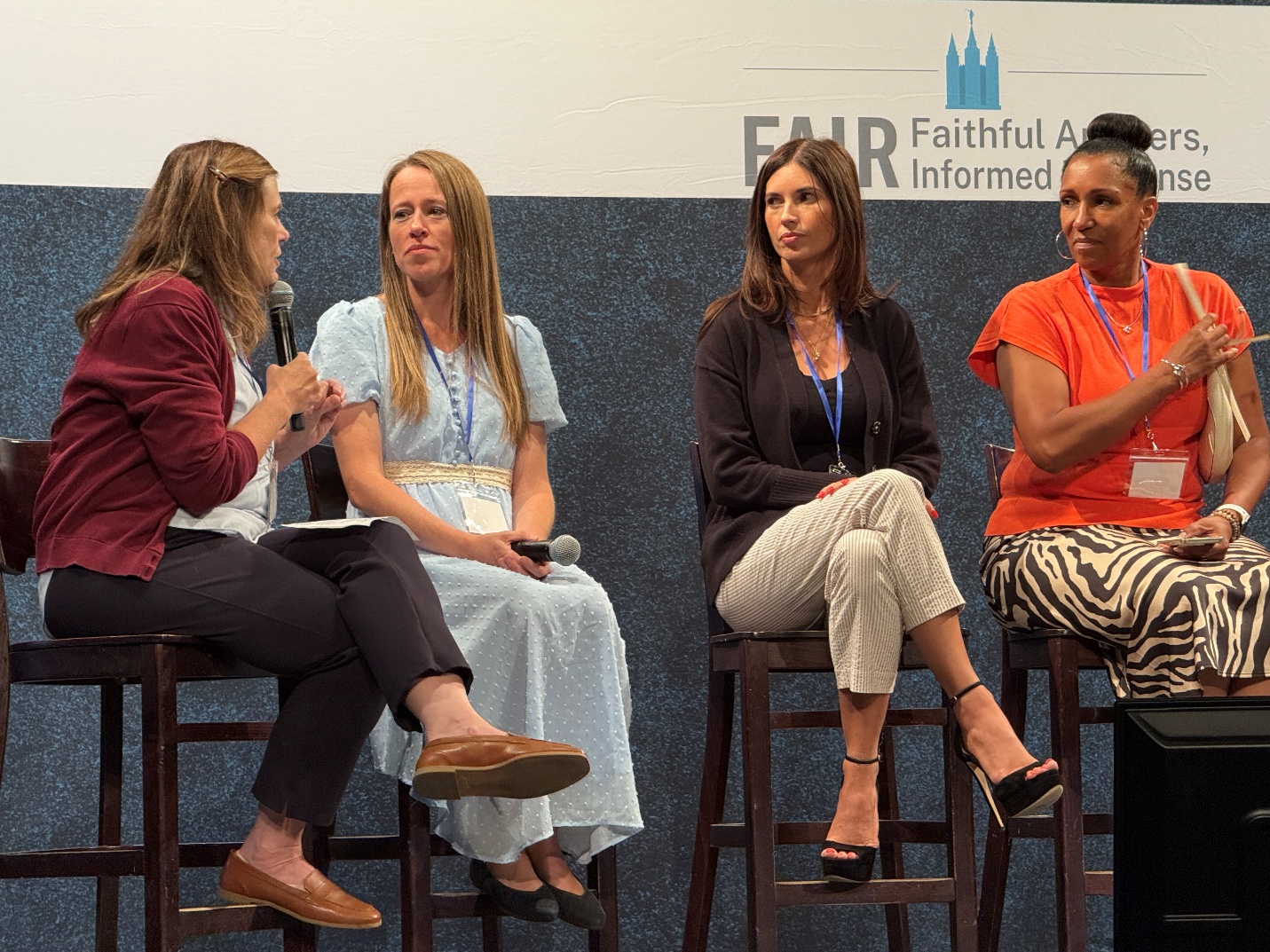
That’s how it all came to be. Now we’ve been podcasting together for about a year.
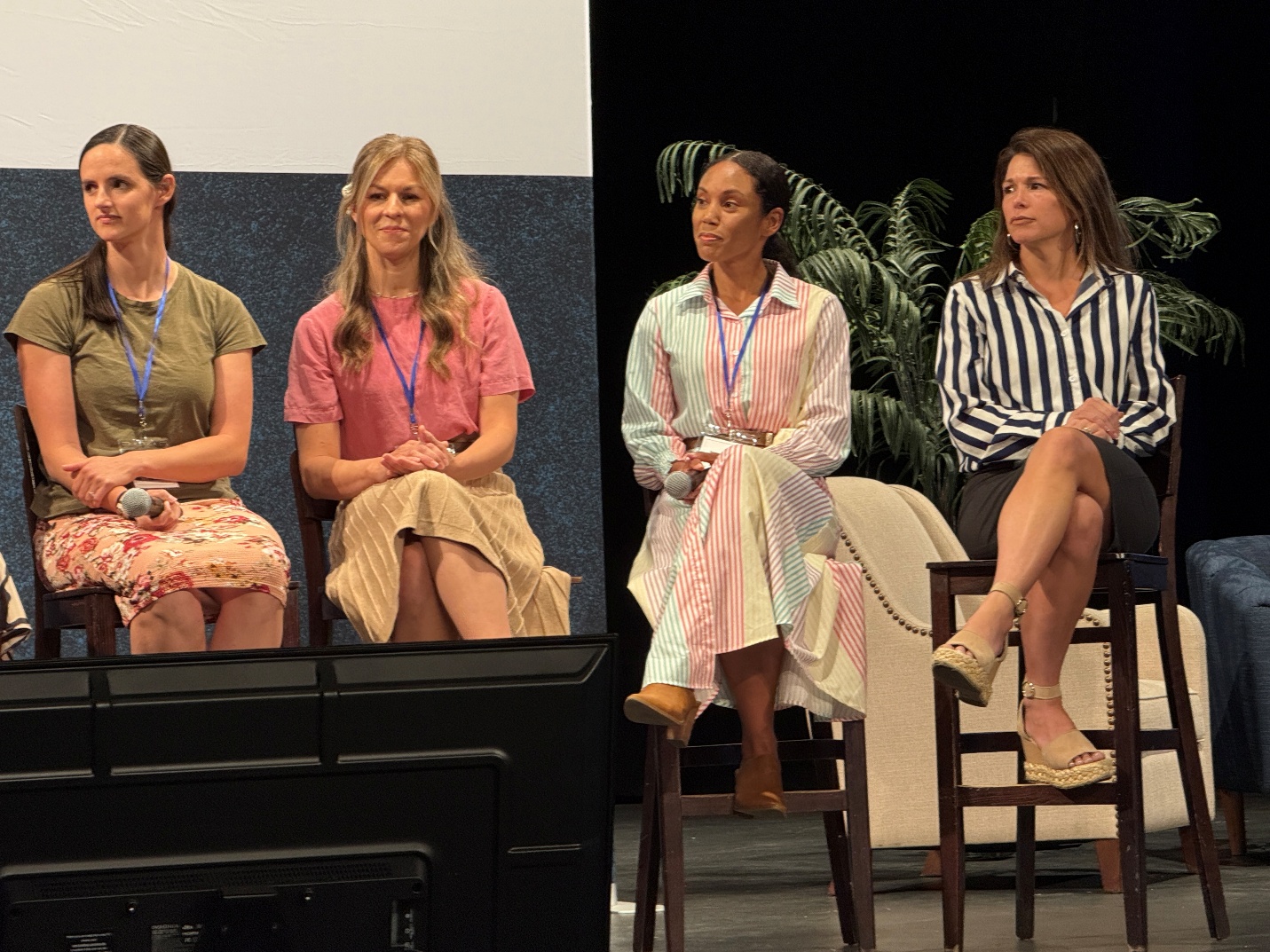
Like we said, this is our first time all together meeting, not just little spaces on a Zoom call for a podcast.
So yeah, that’s the story.
Jennifer
Thank you so much. So allegedly there’s a quote from Hugh Nimbley, I tried to track it down and could not find an original source. You can find people who say he said this.
The sentiment of it is still true. Supposedly he said something like,
We have men who are scholars and we have women who are saints, and we need more women who are scholars and more men who are saints.”
If you know of a source of that, I would love to see it, because I’ve never been able to find the original source. Anyway, there is this idea that even words like defending and contending for the gospel, if you asked an average woman in your ward what apologetics is, she don’t know, right?
Any Pushback?
Have you gotten push back, like in your own life, women in your ward, friends that you have of like, why are you doing this? Why aren’t you leaving it to the brothers?
Joy
To be honest, I’ve been blown away by how welcomed we’ve been into this space. It has been lovely. To this idea of, you know, women are the saints and men are the scholars. Men and women are different. Surprise. So, if we approach it differently, great. Good.
Different But on the Same Team
God made us different, and we’re all on the same team. We’re all trying to support faith in Jesus Christ. And we need as much variety to reach as many people as possible. So, we’re going to approach things differently. And I think that’s great.
That’s why I love having a panel of women. And we are all so different and we have different ideas on many different things, but we join together and say we are faithful members of the Church of Jesus Christ of Latter-day Saints, and this is why we’re here.
Jennifer
Yeah, Joy, thank you so much.
Someone else?
Preparing the Meal: A Different Role in Apologetics
Tikla
Okay, so I do think there’s this temperament difference that you’re talking about, right?
We have—you know, a sweeping generality here—there’s a certain energy that’s required to become an expert at something that isn’t always found in great quantities among women, right?
The ability to go from start to finish in a straight line without interruptions, without multitasking, just really focused attention on one area of study.
I’m thinking of the Don Bradley’s of the world, who has scoured every piece of paper that ever shared the state of Missouri with Joseph Smith, right?
Or we’ve got Josh Coats coming up later, who has taken all the time to do the calculations of all the probable sizes of the gold plates, right?
“Hunter Energy” and the Work of Discovery
This kind of level—I’m going to call this hunter energy.
This is like the patience that it takes to go out and stalk something to bring home for dinner.
You bring it home and it’s in its raw form, right?
It’s just a trophy, right? And you did it.
But unless you have somebody to prepare the meal, nobody’s ever going to eat that trophy.
Turning Scholarship into Something People Can Use
And so, I think a place that women fit very, very naturally in apologetics is preparing the meal. I think that’s what we’re doing here.
We take what we can glean from all of these incredible scholars who have become experts.
- We synthesize it.
- We collaborate.
- We apply it to real life.
- We put some feelings with it.
And we’re creating a meal that we hope we can share with a lot of people.
Sometimes we burn the meal. Sometimes we add a little too much salt. And we’re really sorry to all of the hunters when we do that to your trophy.
But that’s what we’re attempting to do. And that is not a less noble cause.

The Learning Process and Podcasting
Jennifer
Yeah. Speaking of burning the meal, you ladies have been in a learning process on this like all of us are in many things. Has every single one of your episodes gone perfectly?
Charlotte
No. Well, there’s definitely times where I’ve said things that as soon as I said them, I thought, “Why did I say that? Oh, I should tell Cardon to edit that out.” And then I just don’t, and then it comes out and it was fine.
Tikla
Or you do and it comes out anyway. (Laughter)
Speaking Honestly and Learning in Public
Charlotte
Yes. Or we do freak out when it comes out, and we’re like, “I hope a lot of people don’t listen to this one.”
So, I think a big part of this whole experience is putting yourself out there.
Jonah, my husband, will always say, “I am a fool for Christ.” We will say things and we will do things that are stupid sometimes, and we’ll just wish we could just put it right back in—but it’s out there.
So, we ask for charity and patience from all of our listeners.
Authentic Conversation, Not Scripted Answers
What we share is not scripted. We prepare—sometimes more than other times—but we are just talking.
Sometimes gold comes out.
Sometimes it really does feel like the Spirit of the Lord speaking through us.
Other times we’re just excited because we’ve thought something through so carefully and then—oh!—out it comes and it works and it’s great.
And other times we just want to hide.
Doing Our Best to Point People to Christ
So, it’s all out there.
But we’re doing our best, again, to bring people to Christ.
Different Responses to Public Apologetics
Joy
Since both my husband and I are kind of in this apologetics world, it has been interesting to see that we are different in the way that we respond to how our episodes go.
Sometimes it’s a lot easier for him to kind of brush it off and say, “Yeah, that didn’t come out the way I thought it would, but oh well, it’s out there.”
Whereas I’m much more of the, “Oh, that did not come out, and people are going to take that the wrong way. That’s not what I meant.”
A Challenge Many Women Feel
And so, I think that’s one of the challenges—and one of the reasons why there aren’t as many women in apologetics.
Jennifer
Ladies, thank you so much for your wisdom. I highly encourage everyone to check them out. You have an episode about once a week and they can find you where?
Brittany
On YouTube @wardradiowomen.
Jennifer
Or just search Women of Ward Radio on YouTube. Thank you, ladies.
