Testing What We Know About History
DARIUS AIDAN GRAY: Well, here we are in the afternoon of the second day, and I think we need to find out how well you people have been paying attention. You look like a fairly bright group! Yeah, a fairly bright group, so we’re going to have a test.
Now, this test is very simple, very straightforward. There are no trick answers expected. The obvious answer is the answer I’m looking for. So here we go with the test. Now you’ll see how simple and basic this is:
GRAY: For what invention was Alexander Graham Bell known? — AUDIENCE: The telephone.
GRAY: Who invented the lightbulb? — AUDIENCE: Thomas Edison.
GRAY: And this came up with a speaker we had just a short bit ago: For what is Samuel Morse known? — AUDIENCE: Telegraph.
GRAY: Morse code. Any radio amateurs here, ham operators? All right. We know what that means—you know code.
GRAY: For what was James Watt known? — AUDIENCE: Steam engine.
GRAY: See, I told you you were a fairly bright group. I had confidence.
GRAY: Who invented the cotton gin? — AUDIENCE: Eli Whitney.
From Ancient History to American History
GRAY: Well, maybe these are too easy. Let me make it a little more difficult. Let’s go to some ancient history.
GRAY: In ancient Greece, they were divided into city-states, and there were two primary heavyweight city-states, and they were always contending with each other. What were they? — AUDIENCE: Athens and Sparta.
GRAY: All right. Try this one. In ancient Egypt there was a city of great learning that had a great library. The city was? — AUDIENCE: Alexandria.
GRAY: Okay. You’re going to play like that, are ya? [Laughter]
GRAY: Well then, let’s come to some more recent history. Who lost at the Battle of Waterloo? — AUDIENCE: Napoleon.
GRAY: Wow. Extra points if you can say who won? — AUDIENCE: The Duke of Wellington.
GRAY: Now that one got a little harder. Good, I feel better.
GRAY: What happened in the year 1066? — AUDIENCE: The Norman Conquest—the Battle of Hastings.
Questions About Black American History
GRAY: Well, since you’re doing so well with all those, let’s come back to U.S. history. See how you’re going to do on some more history here.
GRAY: What year was Dr. Martin Luther King assassinated? — AUDIENCE: 1968.
GRAY: Date? — AUDIENCE: April 4.
GRAY: What was Plessy v. Ferguson, and what was its significance? — AUDIENCE: The Supreme Court decision in 1896 that formally gave legal sanction to segregation.
GRAY: By whom? You said it, but to make sure—the case was before the…? — AUDIENCE: The Supreme Court.
GRAY: The United States Supreme Court.
Now, we’ve got one young man up here who’s very in tune to this. But I noticed there were fewer of you with the answer on that one.
GRAY: Let’s try this one: Who was Marcus Garvey, and what was his principal position? — AUDIENCE MEMBER: Evangelist—early 1920s—favors a separate nation for the Negro people; moved to Cuba to establish a community which failed.
GRAY: Whoever has five bucks, I want it to go to this young man! [Laughter]
Brown v. Board of Education
GRAY: All right. What was Brown v. Board of Education, when was it, and what did it overturn—and you don’t get to answer! [Groan] — AUDIENCE: The Topeka, Kansas, Board of Education, 1954—overturned the “separate but equal” doctrine—
GRAY: Which came in what ruling? — AUDIENCE: Plessy v. Ferguson.
Yes! All right. It overturned Plessy v. Ferguson, which was in 1896, which is the year my father was born. So you see, some of these things have been right smack dab in the middle of my family from the get-go.
So we’re not talking too ‘ancient history’ here. But let’s try a few more… well, no, let’s not. Let’s move forward.
A Society Teaches What It Values
I notice that there are significantly fewer hands and answers coming to these last few questions—things about civil rights and the United States of America.
Now, some people would say, well, knowing the Battle of Hastings and Waterloo and all of those sorts of things are far more significant than Marcus Garvey. To which I would ask the question: How many of you have ever used a cotton gin? [Laughter]
How many of you have even seen a cotton gin?
Yet we know about Eli Whitney and the cotton gin, and we know of these other points of history. Why?
Because a society teaches that which it values.
We have not valued the contributions of persons of color in this country. We’ve not valued that portion of our own history in this country.
Black Latter-day Saints in Early Church History
Let’s make this a little bit more personal in terms of the LDS Church.
GRAY: What year was the LDS Church established? — AUDIENCE: 1830.
GRAY: When do we have record of the first Black member in the LDS Church?
The year was 1832. Just two years after the founding of this faith. And the individual was a man we’ll talk about a little bit more later—his name was Elijah Abel.
Elijah Abel and the Priesthood
GRAY: What year did Blacks receive the Priesthood? — AUDIENCE: 1978.
What year did Blacks receive the Priesthood? Elijah Abel was ordained to the Priesthood in 1836. Okay.
GRAY: When did the Saints migrate from the East to the Salt Lake Valley? — AUDIENCE: 1847.
GRAY: Got here in the Salt Lake Valley in ’47. They were a little slow back then; transportation wasn’t what it is now.
GRAY: When did the first Blacks with the Saints come into the Valley? — AUDIENCE: 1847.
The First Black Pioneers in the Salt Lake Valley
The very first wagon train into this valley was preceded by some Black servants, which my eminent partner and co-author Margaret Young will now speak to.
Ladies and gentlemen, Margaret Blair Young.
Green Flake and Bringing History to Life
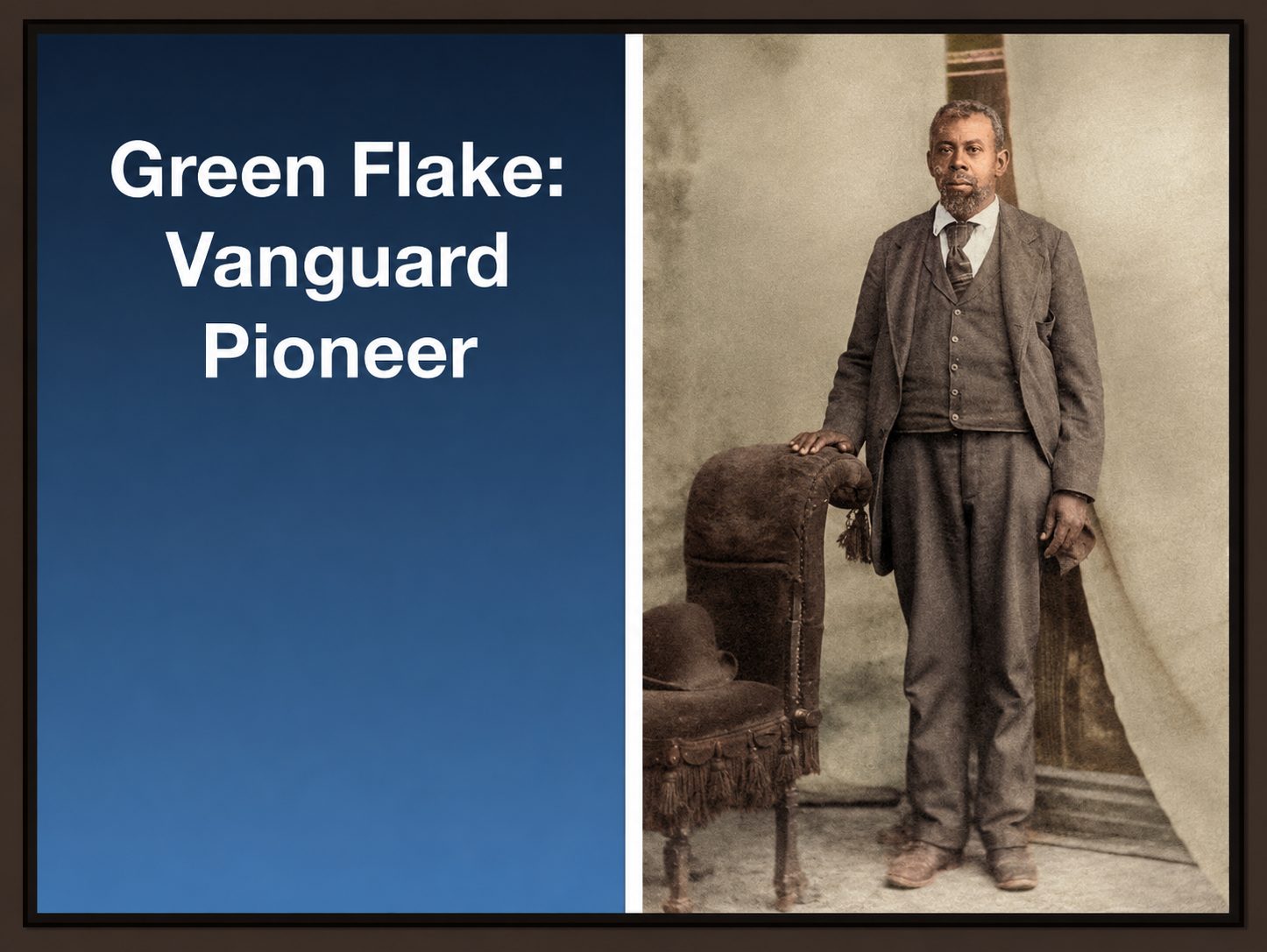
MARGARET BLAIR YOUNG: This is Green Flake, one of the three—on the Brigham Young statue they’re referred to as “coloured servants.” It’s Green Flake, Hark Lay, and Oscar Crosby. But according to the best records we can find, the words Brigham Young spoke, “This is the right place. Drive on,” were probably spoken to this man.
In this crowd, a good many of you have probably heard of him. In a lot of crowds, he’s a name that nobody knows at all. A remarkable man—and we’ll talk just a little bit about him.
But mostly, when Renee introduced me—introduced Darius and me—she talked about us as writing fiction, which doesn’t seem to qualify us at all to be speaking to people with the kind of knowledge that you people have.
Writing Standing on the Promises
But we would like to justify ourselves in your eyes, because there’s something really interesting about choosing to do a fictional account of history, but with supporting endnotes.
And when people have asked me about the amount of work that went into writing the trilogy, I’ve said it was three dissertations—because for us to get things accurate, we needed to do the amount of work that was really like a dissertation for each book.
But the whole idea was to bring them to life, to bring these characters to life—to find out things that Green Flake had said about his time as a slave.
The fact that Green Flake had been told that his mother had died, which was not true. He was told that, according to his granddaughter, because if a slave knew that his mother was alive, he might run away and try and find her.
Green Flake’s Family and Legacy
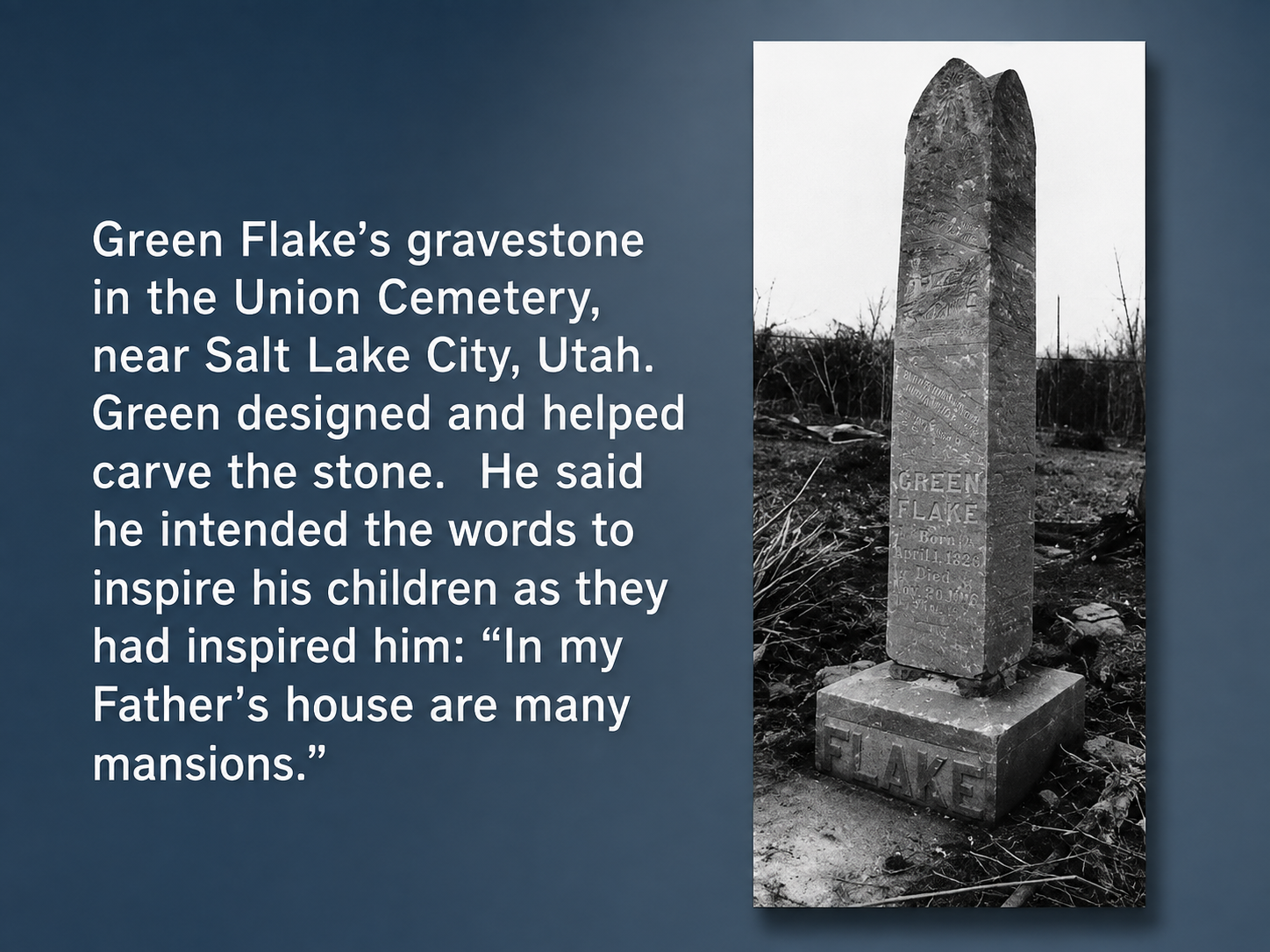
Family meant a tremendous amount to Green. This is his gravestone. He chose the epitaph and helped carve it. It says, “In my father’s house are many mansions.”
This is a place that has great meaning for me, for Darius, for many of our members of the Genesis Group, who sometimes just find this a place of solace if they’re feeling some trials and tribulations in their lives.
To come and sit by the grave of a man who they know came across the plains twice, actually; came across, built a cabin for the Flake family, then went back and led them to it.
But the whole idea of choosing to imagine what their lives were like:
- to not be limited to “these are facts,”
- “these are the dates”
but to really try (as much as possible using their own words and their own writings when available) to really try to imagine:
- This is what they felt.
Empathetic Imagination
And what this goes into is the whole idea of opening our worlds and learning to appreciate the worlds of those around us. And that’s kind of where we’re going to be heading.
We’ve titled this “Empathetic Imagination: Reading Between the Lines in Standing on the Promises.” But we’re not going to be restraining ourselves to just our books.
Learning Another Language and Another World
I want to tell you my parents are here, which is wonderful. I only get to see my parents once or twice a year. They tend to live outside the country. They’re (right now) from China. But they are here to celebrate their 50th anniversary, and then they’ll go back.
My father’s a linguist. So I grew up surrounded by books in other languages, people from other cultures. And when I was 19, Dad took us to live in Guatemala.
Now, any of you who have been to foreign countries and you’ve thought that you spoke any of that language. (I was under no illusion that I spoke the language at all.) But after a little while, it really feels like an international conspiracy to make you feel like an idiot.
When you listen to people talk and you know that there’s no way that what they’re saying could possibly make sense. It’s—you know they’ve gotten together and figured that when you’re around, they will just talk gibberish to frustrate you to no end!
Learning Cakchiquel in Guatemala
Well, I remember being terribly, terribly frustrated. I was in a little place called Patzún, Guatemala, and people spoke a language. Let me just give you a sample of the language.
Children would just laugh and laugh when I would try and say the word for yellow, which is Q’än. It’s not a sound we even have—Q’än. We don’t make that sound in English. And I would try and say it. I’d try and duplicate it. It was one of the most lovely bonding experiences because I couldn’t do it.
But the time came when, little by little, I started understanding a word, and then a few words, and then things would sort of fit together.
It came so that I returned. I ended up loving this place that initially I hated. I kind of had the people reduced to Cakchiquel Indians:
- they’re this color,
- they wear this kind of clothes, and
- they talk that language.
Living With a Cakchiquel Family
And then I returned a couple of other times and actually lived with an Indian family, a Cakchiquel Indian family.
- I slept on a mat.
- I helped the hermana make tortillas on a comal.
- I lived their life
and I came to a remarkable appreciation.
I learned. I don’t know if you’ve seen the Star Trek: The Next Generation episode—my husband loves it—where people talk in metaphors. In order to understand the metaphors, you have to know their culture. You have to understand the stories that they are drawing their metaphors from.
Well, Cakchiquel Indians speak in metaphors. A door is ruchi’ jay, “the mouth of the house.” And all of it is like that.
So as you move into the language, it’s a whole mindset. And if you do it with love, it becomes the most beautiful transformation. Because you start recognizing new ways of looking at things.
Learning to See Through Another Person’s Experience
That same principle—when I was quite young, I read a book that maybe many of you have read called Black Like Me by Howard Griffin.
Now, I remember my grandmother finding that book on my bookshelf—I was probably twelve—and saying,
“Oh, Margaret, I think you can find something much more uplifting than this.”
But that became an important book. I still remember a lot of it. But especially now as I look back, because so much of the work
- that Darius and I did in moving towards the trilogy,
- in giving life to the people we were going to write about,
- and in my learning to work with Darius,
was learning about being Black. Learning about what things were like that I had never experienced.
Experiences I Had Never Known
Now, I have been a redhead, and that comes with its own challenges. But I’ve never had my mother explain to me that I couldn’t talk to somebody of the white race. Because she could lose her job.
I can’t go back two generations to slave years.
Truly Seeing the Other
So it was a whole concept.
One of our little conflicts was over somebody re-wrote a beautiful preface that Darius had written. Because they were afraid that the way he had written it was a little too strong.
I went along with the rewrite. That was one of the strongest arguments that we ever had. And I take full responsibility for that. Because I had not understood that they were taking his life and suggesting,
“Let’s revise this to fit the paradigm we really want.”
It doesn’t work that way.
For us to fully move into that other world involves truly seeing the other. And in this I need to quote my husband’s very favorite philosopher. I’m not actually quoting the philosopher himself. I’m quoting Bruce’s paraphrasing of him. The philosopher’s name is Immanuel Levinas.
I’ll try and read this slowly. We’ve gotten it as accessible as I think we can, but it’s a gorgeous idea:
Immanuel Levinas and the Face of the Other
“If it were not for the face of the other person, I might indeed maintain the illusion that everything I experience and enjoy—food, landscapes, the complete collection of Beatles music which my husband has—is mine.
“But once I encounter the other, I must realize that there is something absolutely and irreducibly other than myself and that the world also belongs to the other. But this does not limit my freedom, for freedom would have no meaning in a world that belonged entirely to me.
“The other invests my freedom, gives it meaning, makes it possible for me to make moral choices. I become responsible for the other, invites me simply by his or her presence to respond.
“The other, through his or her neediness and vulnerability, invites me to offer myself and what I have in service and sustenance. At the same time, the other commands not by words but simply by the vulnerability of his or her face, ‘Thou shalt not kill.’”
Immanuel Levinas is a philosopher I highly recommend.
Expanding the History We Know
But as we’ve talked about the history that we were taught in elementary and high school and middle school—I learned about Eli Whitney. I never learned about Marcus Garvey until I was working with Darius.
There are other names, Medgar Evers, who I didn’t learn about until five years ago.
All of these remarkable names. Sojourner Truth is pretty recent in my historical knowledge. All of that history was not included in my textbooks.
These faces that now have become precious to me, the history that they’ve given has become precious, but it was not included in the textbooks.
And that’s one reason that we feel so strongly about expanding LDS history to include these remarkable faces that we’ve been able to write about. It expands our sense of responsibility. It enriches the world that we have.
Darius Gray’s Family History
We want to talk a little bit about Darius’s own ancestors. There were a couple of times when, as we were writing the books, we actually wept. And one was when we were writing about Louis Gray and his wife, Gracie Gray.
I’ll let Darius introduce them, and then I’m going to read a passage from Bound for Canaan.
“I Am Darius Gray”
GRAY: I am Darius Gray.
Darius Gray was born in 1896.
It’s not just that I’m Black and I age gracefully, but we’re talking about my father. My father was Darius McKinley Gray. Named McKinley because that was the year President McKinley was elected.
My father’s father, my grandfather, was James Louis Gray. He was born in 1859 in the state of Missouri as a slave.
History isn’t that far back, really. My granddad was born a year before Lincoln was elected and two years before the beginning of the Civil War.
As a child, I grew up hearing stories about “back in slave days—such and such and such and such….” And so that was a part of my heritage, and it gives me a sense for those people that I don’t know that many others here would have.
From Maria Gaines to Louis Gray
My granddad had a father and a mother, and my granddad’s father was Louis Gray, born about 1827. And he was the son of a woman by the name of Maria Gaines.
Maria Gaines was born approximately 1796—that’s just 20 years after the founding of this nation in 1776.
We were here. We were slaves, but we contributed to the fabric of this nation.
But if we go forward from Maria Gaines to her son Louis, and to his marriage to my great-grandmother, we have an interesting story which Margaret will now read from.
I tell you this because I hope it gives you a sense of my history. Because my history is actually our history. It’s American history. We share it.
Louis and Gracie Gray in Bound for Canaan
YOUNG: We did a lot of research on what slave auctions were actually like in order to do this. I’m just going to read a few sections.
This is Louis going with his master, Mortimer Gaines, to an auction where the woman who will be his wife, Gracie, is being offered.
Whoever had sent this woman to auction had gone to some trouble making her look good. Her hair was braided down both sides and tied in colorful ribbons. Her blue dress and muslin apron were not new, but they were clean. He wondered why anyone would sell her off.
Well, sometimes folks just needed money. He understood that and knew that if his own massa should find himself in straits, the slaves would likely get sold before the furniture would.
(Of course, the massa would never sell off all his slaves. That household couldn’t run itself, and nobody but the colored help knew how to keep it running. If some slaves got sold, the remaining ones would simply get more work.)
He thanked God his massa was living well off, with hogs to process and meat to sell. Louis Gray had known his mama, Maria Gaines, all his born days, and he had never seen an auction until now. 1
Louis and Gracie Gray
YOUNG: Moving forward to the auction, the master to Louis:
“What do you think?”
“Sir?”
“Take a good look.”
Louis obeyed. “She sad but not sick.”
“How about her arms?”
“They fine, massa.”
“Tolerable strong, from what I can see. Legs?”
“Can’t say cause I can’t see.”
“She’ll need to walk for us. I won’t have a cripple. What else do we need to look at, Louis?”
It was then, in a cold sweep of realization, that Louis understood why the massa had brought him on this trip and to this auction.
“Massa, this my first time. You knows your way around.”
“I want to view the teeth. No need to buy a mouthful of trouble. You pay enough for a slave, and you’d better get your money’s worth. I paid considerable for your mama. Found her at a fine auction over in Kentucky. And she’s been worth my investment. I won’t settle for less than the best. I’ll need to check the teeth on that woman before I turn over a penny.” 2
“My Name Gracie”
We move forward to them making the purchase and then going back to the Gaines home:
It wasn’t until a week later that they were back in Marshall at the Gaines slave quarters, that the woman told her name—not to Louis but to his mama, Maria.
“My name Gracie,” she said. 3
I remember as Darius and I were at the computer, reading—we would read the words out loud to make sure we had the voice right and all of that. But reading that phrase, “My name Gracie.” Realizing that this was his ancestor and what her life had been like, and just that realization of:
She was real.
No matter how close we got to what her life actually was, she was real. And we’re going to do our best to pay tribute to that, to the life that she led.
Elijah Abel: An Early Black Latter-day Saint
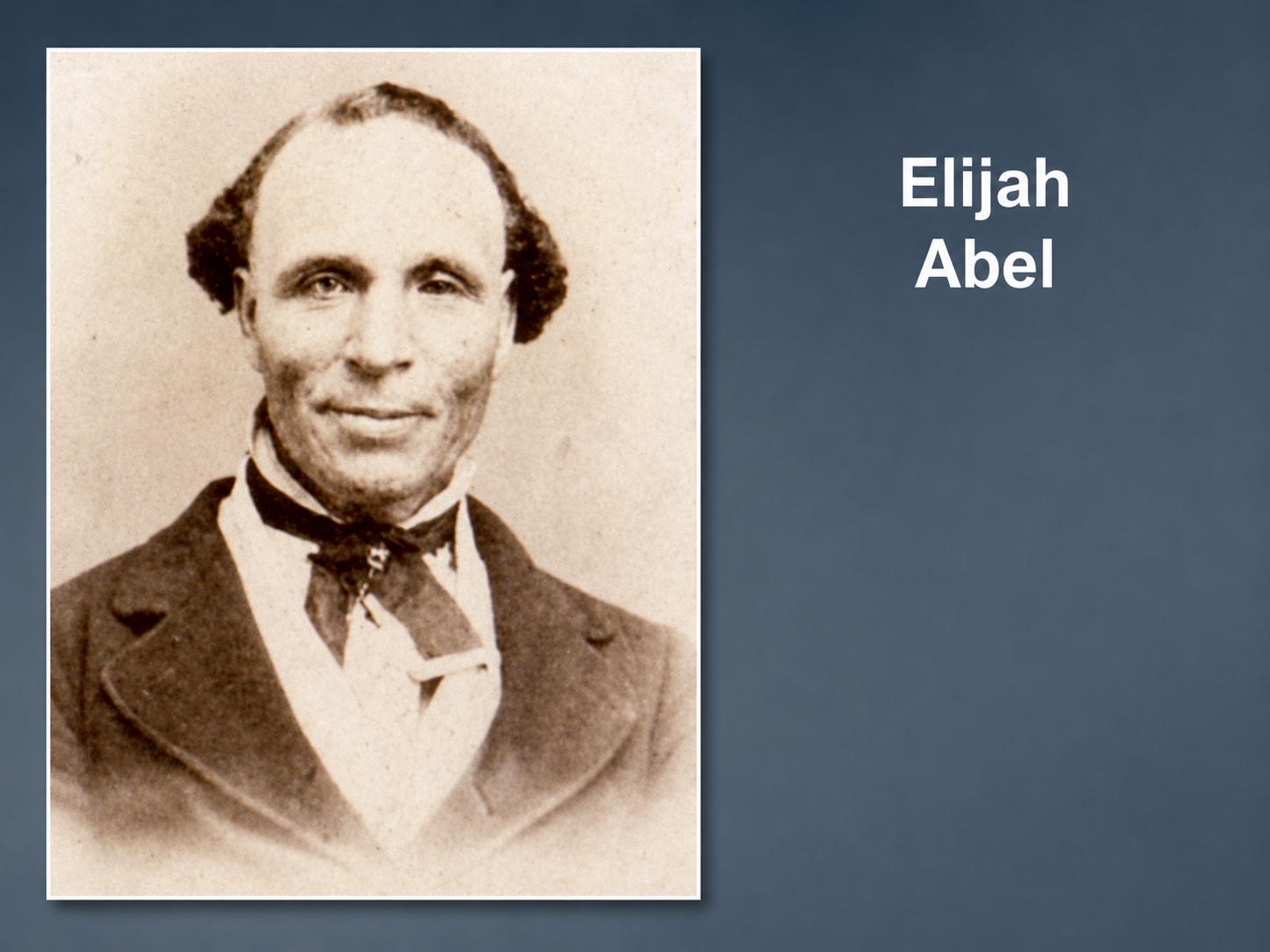
I think we’ll move now to Elijah Abel. Let me just turn to his picture and have Darius explain just a little who he was, and then the idea of imagining why he made petitions for temple blessings. What it meant to him to ask for those petitions.
“This Is One of My Heroes”
GRAY: This is one of my heroes. This is quite a man.
Brother Elijah Abel joined the Church in 1832, ordained to the LDS priesthood in 1836. He served three full-time missions for the Church to the eastern States and Canada. He came back from his latest mission in time to die.
But he also worked on three of the first temples—not the very first—but he worked on the Kirtland, the Nauvoo, and the Salt Lake temples.
Yesterday, I had occasion to be with two of our Genesis members, two sisters, and we were at the funeral for Elder Haight at the Tabernacle. And when we had finished with that, I said to the sisters as we walked by the Temple.
“Come on over. We need to go over and pay our respects.”
There is a corner on the east side of the Temple, a stone, that whenever I am in the area I go by and I give a rub and I pat it and say, “Brother Elijah, that’s for you.”
I remember that good man and his contributions to this faith.
I’ve also had the honor and the pleasure of doing the very same thing in Kirtland and in Nauvoo. So this man is a part of our history. He was a significant part in the early Smith home, and Sister Young will add to that now.
Elijah Abel’s Patriarchal Blessing
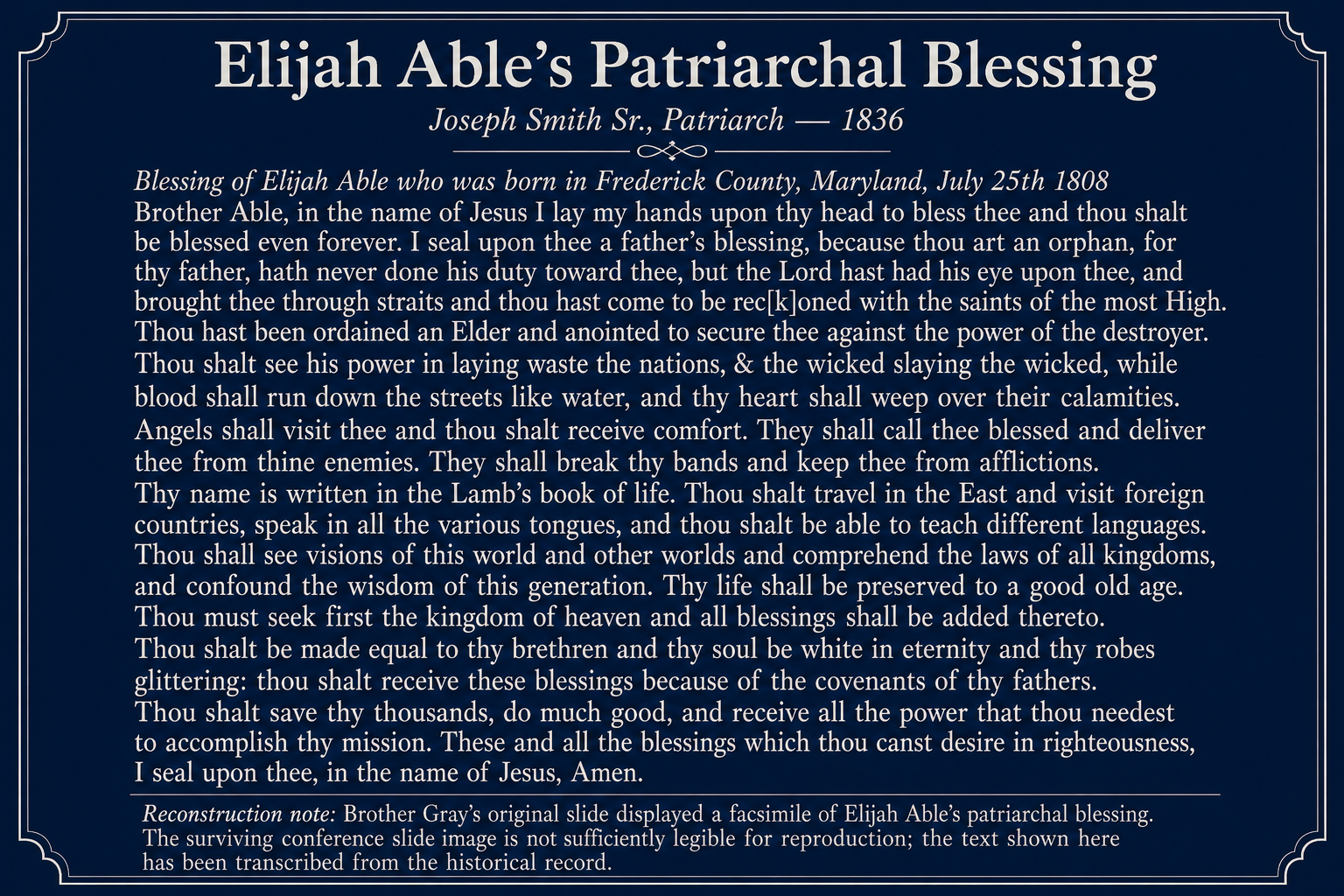
YOUNG: Go to his patriarchal blessing. This is a facsimile. 4
This was given to him by Father Smith, and Father Smith tells him he’s like an orphan. He actually did have a biological father, but he says, “thy father hath not done his duty towards thee.”
But imagine what it felt like to Elijah Abel, who history suggests had used the Underground Railroad, had probably spent some time as a slave.
Imagine what it felt like to him to be told,
“thou hast been ordained an elder and shalt be protected against the powers of the destroyer,”
and then to be washed and anointed in the Kirtland Temple, to serve the missions, then to go to Salt Lake.
And by this time the policy had been set, and he petitioned to go to the Salt Lake Temple and was turned down.
Petitioning for Temple Blessings
But then President Brigham Young died in 1877. As Darius and I researched what was happening in Elijah’s life and looked at the dates, we understood why that petition would be raised again—because his wife was very ill.
For us to imagine what their relationship was like, and the thought that he knew sealing ordinances were happening in that temple, and how desperately he must’ve wanted to be sealed to Mary Ann, his wife.
And so the petition was raised again.
He was told he still had priesthood. In fact, his obituary is fascinating because it says he died of “old age and debility,” in consequence of serving his third mission for the Church.
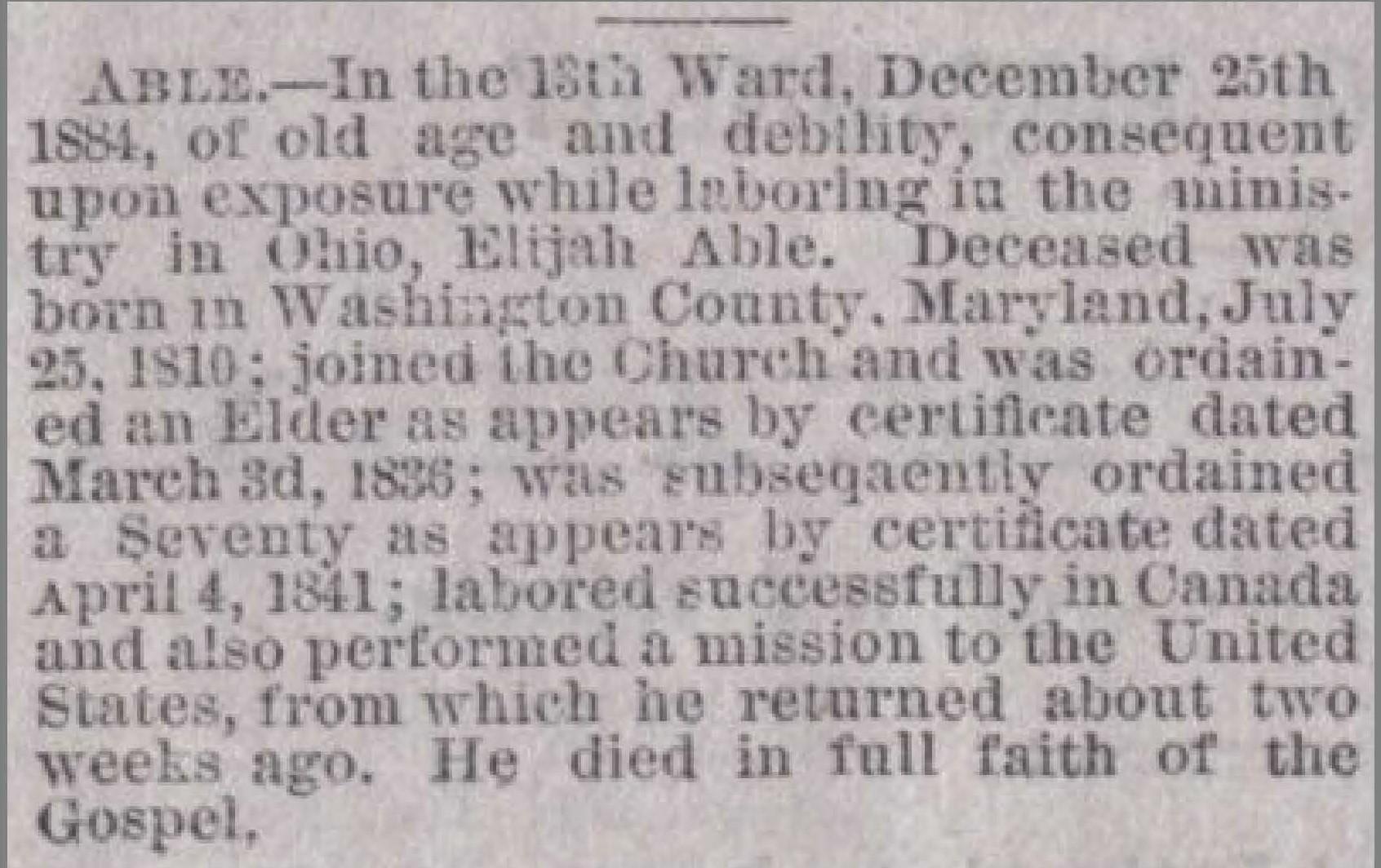
The deceased held the Melchizedek Priesthood, and then it gives the certificate of ordination, the number. He was ordained a Seventy, as is shown in—and then it gives the certificate.
So the person writing the obituary was quite aware of the controversy about Elijah Abel’s priesthood.
Jane James and the Desire for Sealing
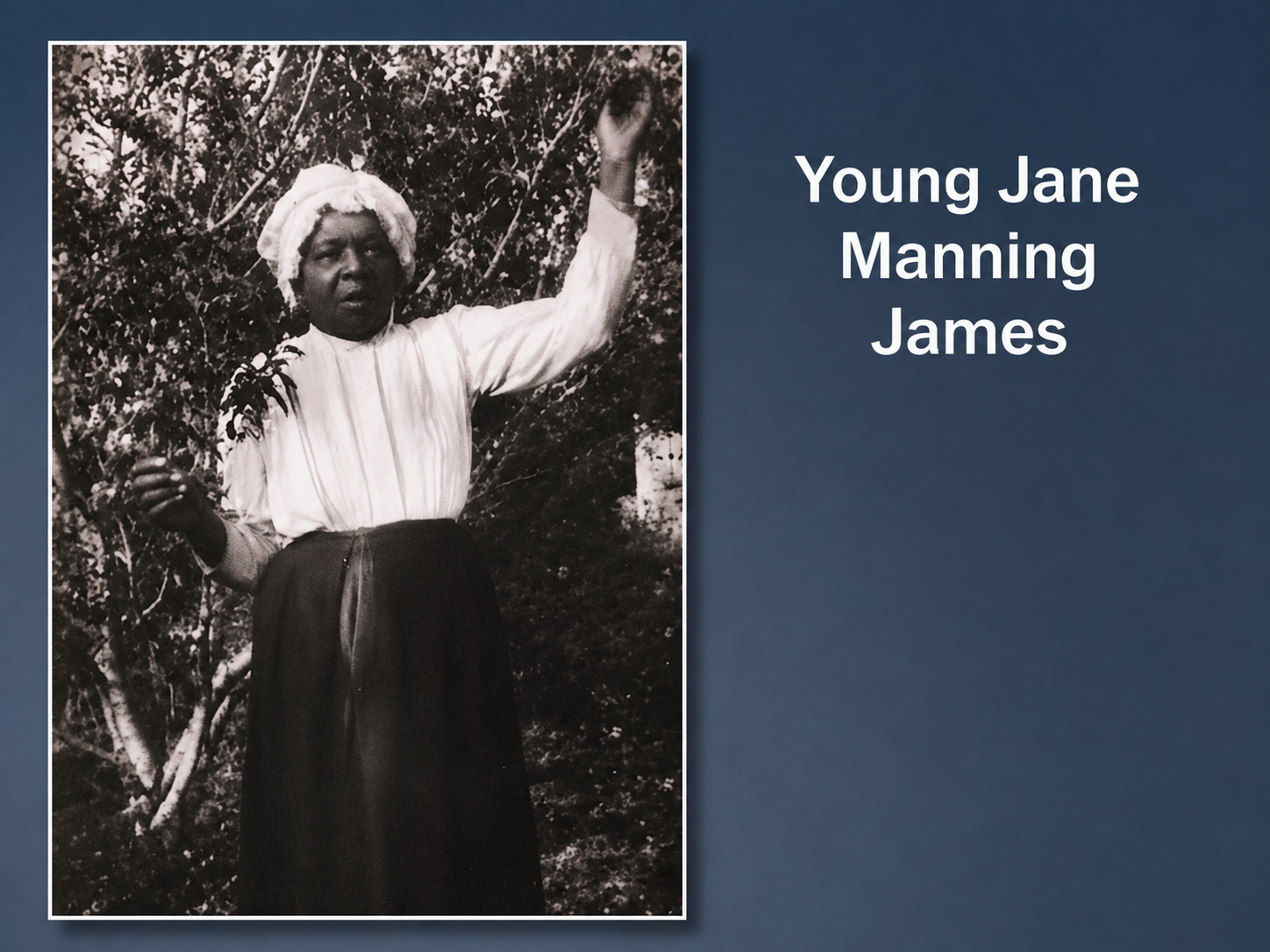
But the idea that Elijah Abel had desperately wanted to be sealed to his wife—and then what became even more interesting was—and by the way, this is a picture that I show with a whole lot of care.
This was given to us by a great-great-great-grandson of Jane James, who is very nervous that if people get ahold of it, they’ll make T-shirts out of it and all sorts of things.
I show it here. I do not give it to anybody for any use whatsoever. Louis Duffy is copyrighting it and will probably put it in a book at some point.
But you can just see Jane James.
Jane Manning James and Temple Blessings
As we were looking at when Jane James began petitioning for temple blessings, her first letter to John Taylor is dated December 27th, but it refers to “last Thursday”, which was December 25th, 1884—the date Elijah Abel died.
So he died on Christmas Day 1884. That day, according to Jane James’s letter, she went to President Taylor’s home. The letter itself, dated the day of Elijah Abel’s funeral, December 27th, says this:
“Dear brother, I called at your house last Thursday to have some conversation with you concerning my future salvation. I realize my race and color and cannot expect to receive my endowments as others who are white. Still inasmuch as this is the fulness of time and through Abraham all mankind may be blessed, is there no blessing for me?”
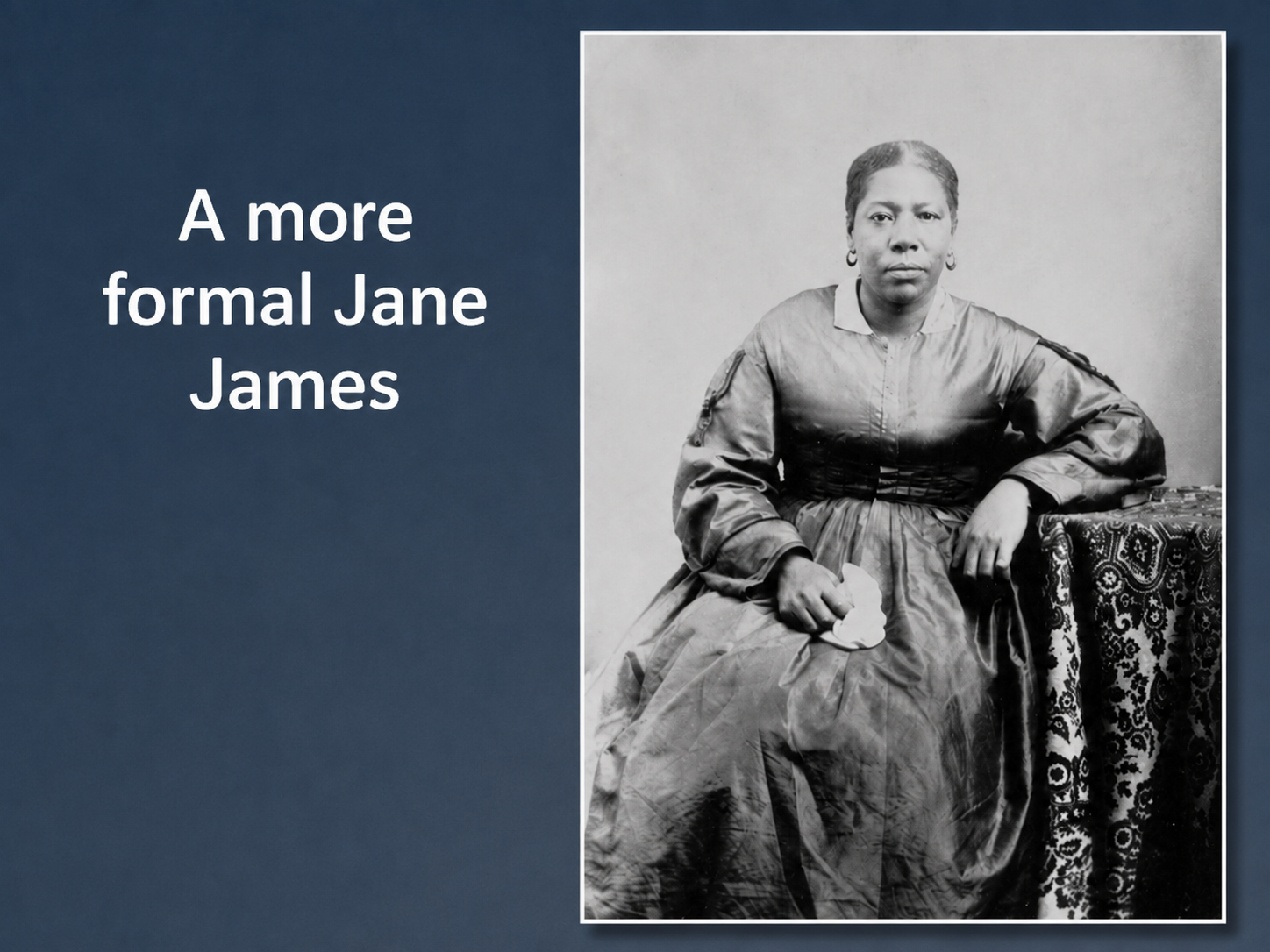
We’ve talked about the importance of connecting with a human face. Now let me show you a little bit more of Jane James’s face. And I’ll have Darius tell you more about who she was.
This one I love because it’s not posed. The next one is posed. Wasn’t she beautiful? The dignity of that carriage, the dignity of who she was. And we’ll let Darius tell you a little bit of her history.
Jane Manning James in Her Own Words
GRAY: Fortunately, we have her history in her own words. She dictated them, and I’ll just read two short paragraphs here.
When a child only six years old, I left my home and went to live with a family of white people. Their names were Mr. and Mrs. Joseph Fitch. They were aged people and quite wealthy. I was raised by their daughter.
When about fourteen years old, I joined the Presbyterian Church—yet I did not feel satisfied. It seemed to me there was something more that I was looking for. I had belonged to the [Presbyterian] Church about eighteen months when an Elder of the Church of Jesus Christ of Latter-day Saints, [who] was traveling through our country, preached there.
The pastor of the Presbyterian Church forbade me going to hear them as he had heard I had expressed a desire to hear them; nevertheless I went on a Sunday and was fully convinced that it was the true gospel he presented and I must embrace it. The following Sunday I was baptized and confirmed a member of the Church of Jesus Christ of Latter-day Saints. 5
A remarkable woman in her own words. And we have far more of her words. Another one of my heroes, Sister Jane Manning James.
“My Faith in the Gospel…Is as Strong Today”
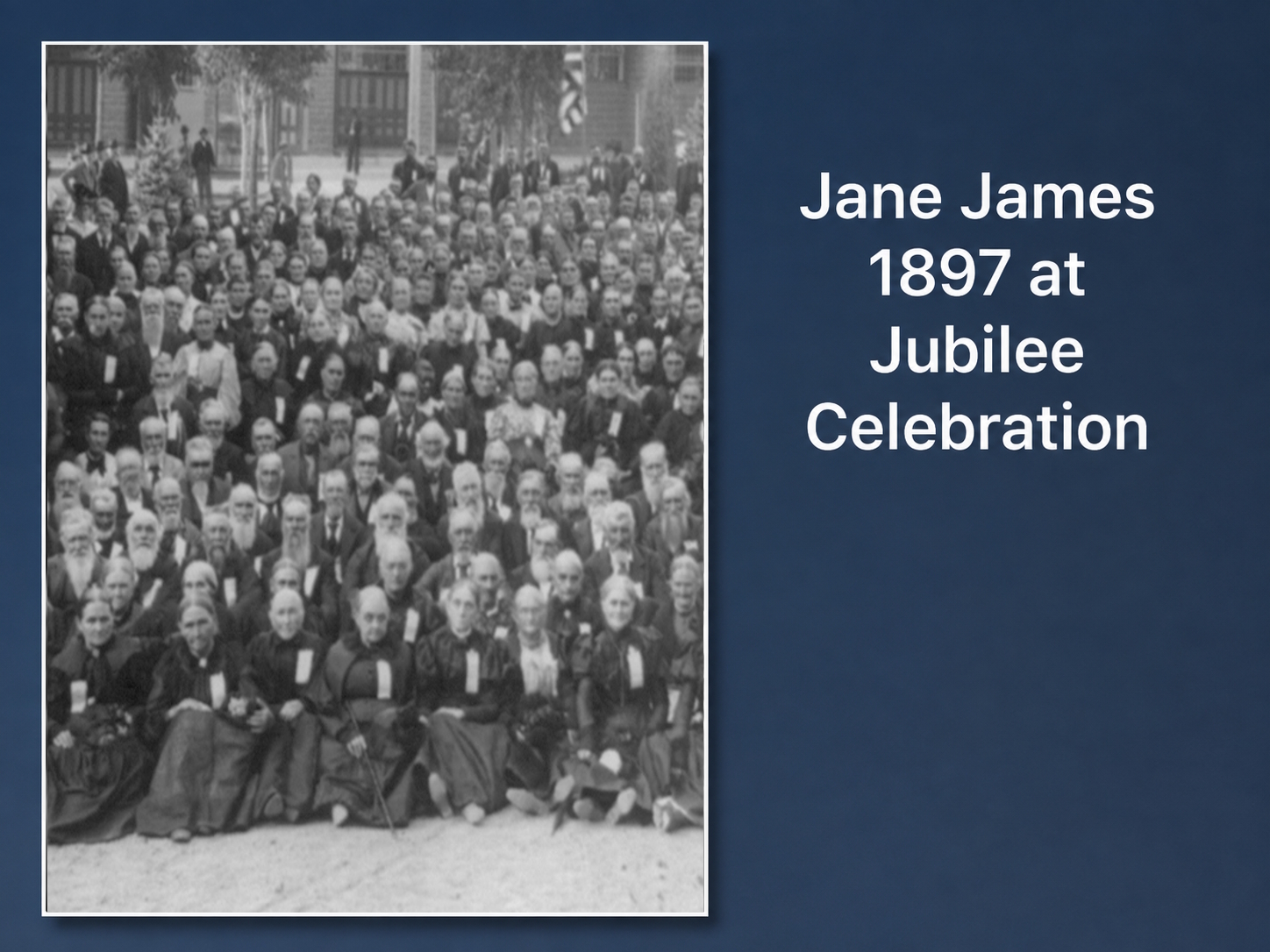
YOUNG: Let me just show you a few other shots of Jane’s face, and I’m putting an emphasis on that face. She’s there in the midst of the pioneers celebrating the Jubilee.
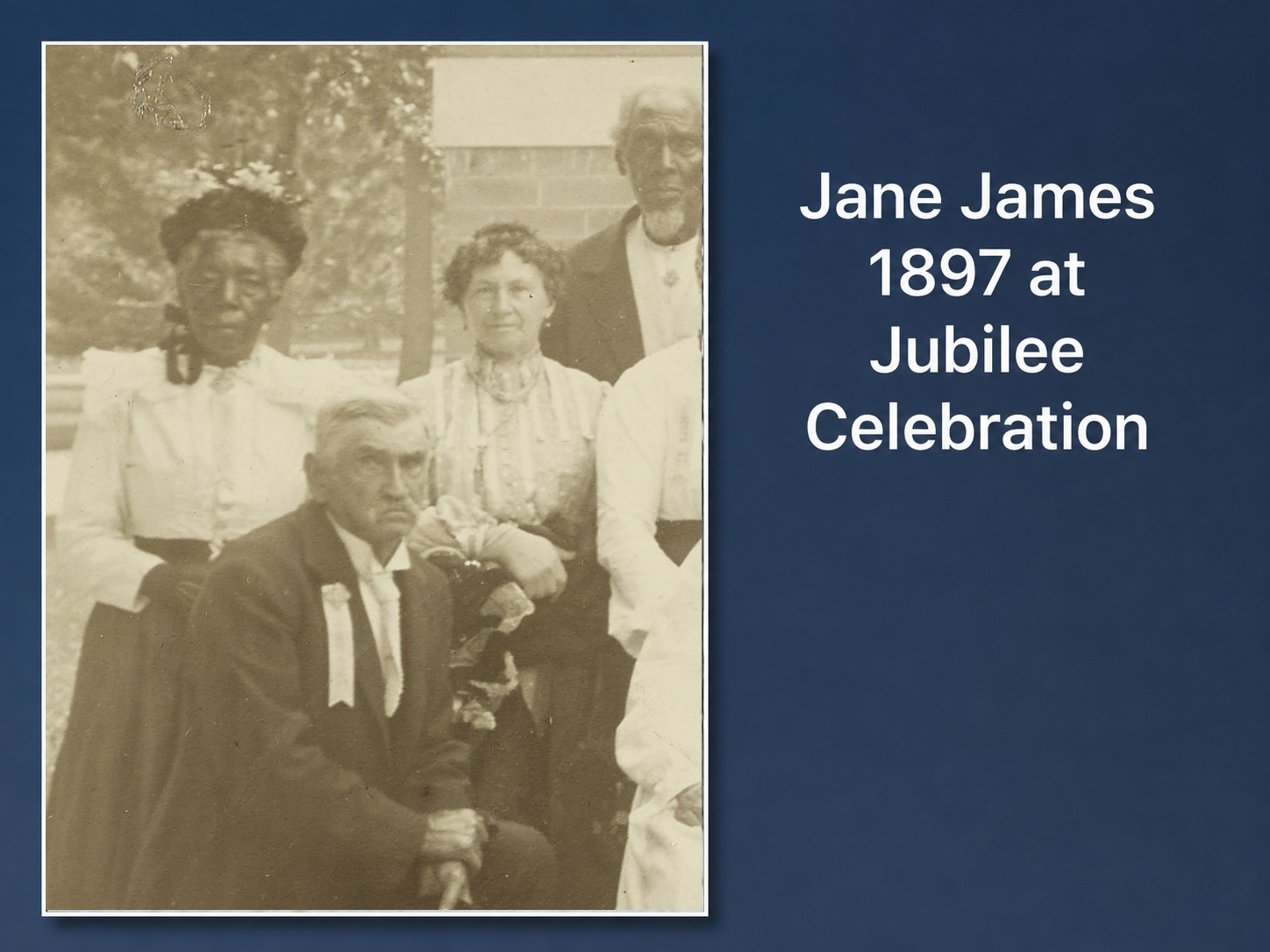
This is a woman who walked 800 miles with her family from Wilton, Connecticut, to Nauvoo, Illinois. Who talked about how the soles of their shoes wore out and you could see the whole footprint of their shoes in blood on the ground—from their feet and blood on the ground. And they knelt in prayer and asked God the Eternal Father to heal their feet, and their prayers were answered and their feet were healed.
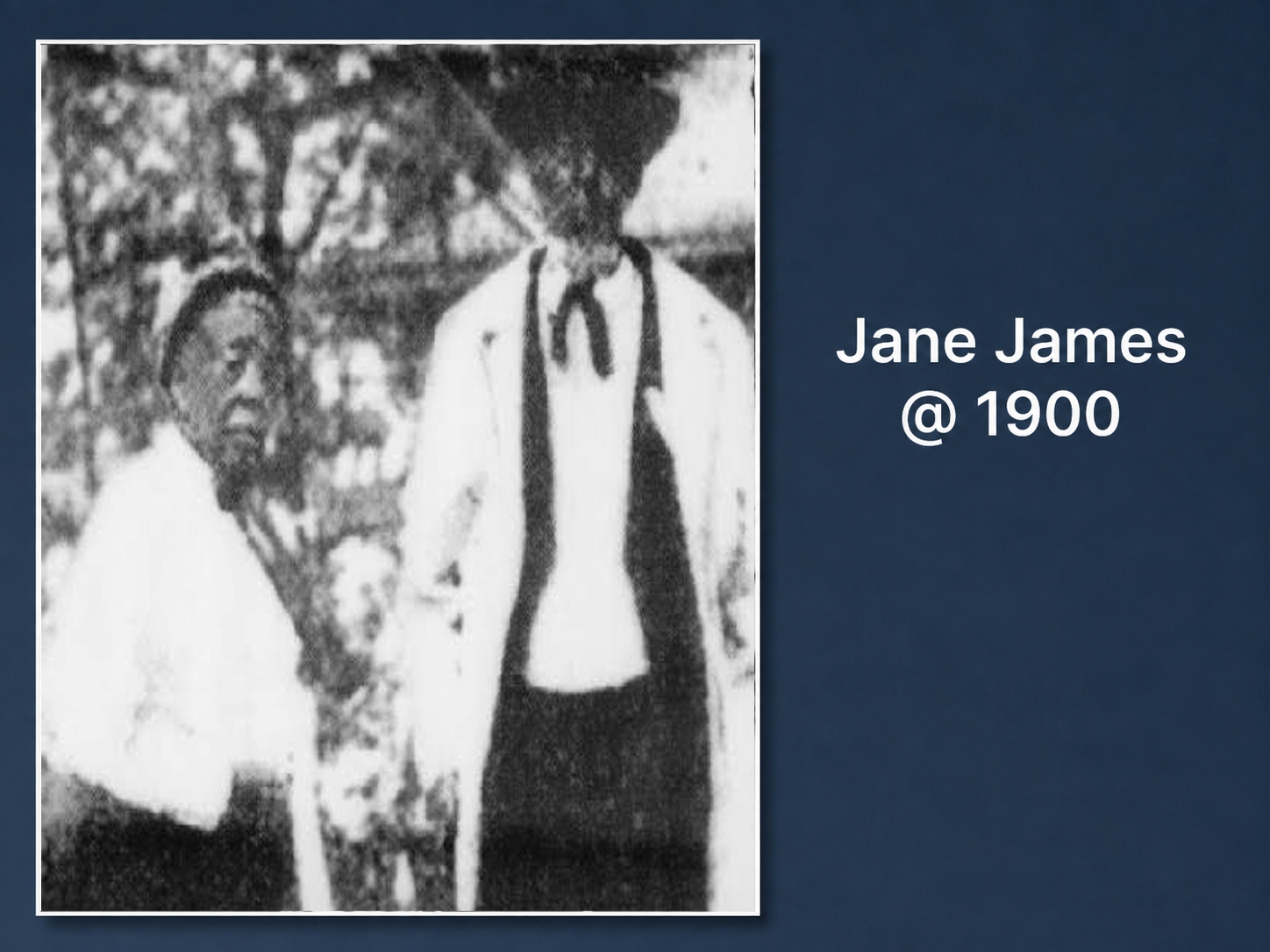
Here she is, as an older woman who closed her life story, despite everything she had endured, and the temple blessings—the petitions were answered with a recommend to do baptisms for the dead, but not with her firmest desire to receive her endowment and to have the work done for her family as well.
She closes her life story with the words:
“. . . my faith in the gospel of Jesus Christ of Latter-day Saints is as strong today—nay it is if possible stronger—than it was the day I was first baptized. I pay my tithes and offerings, keep the Word of Wisdom. I go to bed early and arise early. I try in my feeble way to set a good example to all.” 6
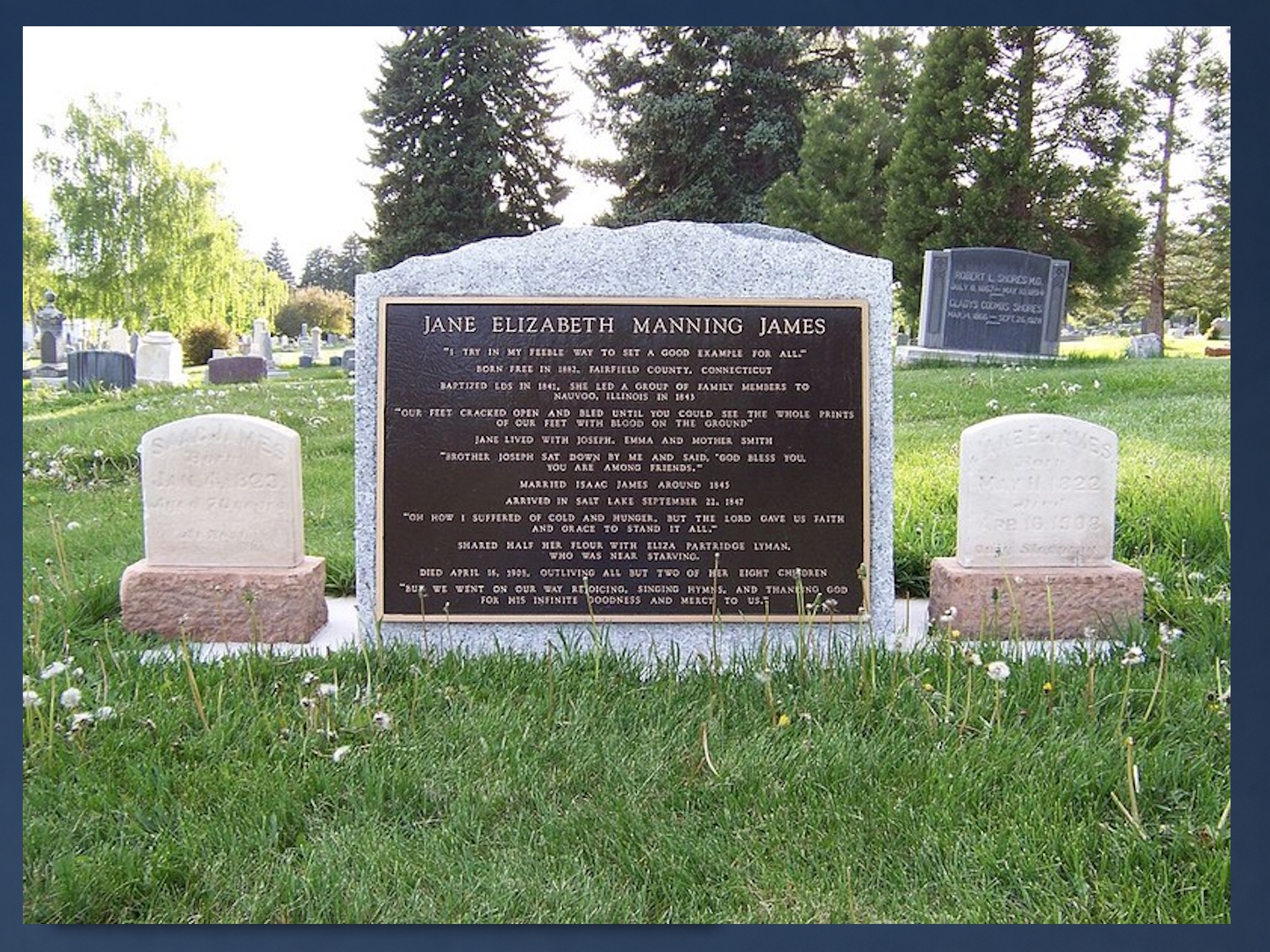
Remembering Jane Manning James
This is her tombstone next to her husband Isaac. They actually were divorced. He left her for 20 years and then came back, and she allowed him to return, and his funeral was held in her home.
But from this—from showing you the faces of the people who have become so dear to us as we’ve written about them and tried to imagine their lives—we don’t restrain ourselves to the history. That’s not to suggest anything against historians who do pure history. I’m looking at Davis Bitton, who does such wonderful work, and I’ve used his work as sources for my own work. But we take a few liberties by going, as much as we can, to the hearts of these people and imagining what life was like.
The Book of Mormon as a Call to Empathy
In this same idea:
- with what I’ve read to you of the philosophies of Immanuel Levinas,
- of letting the face of the other human being call us to responsibility,
I want to talk about the Book of Mormon as a call to empathy.
The Book of Mormon has been criticized by some as a racist document. Some of the best links I’ve seen to talk about that are on the FAIR website.
I highly recommend that you go to just the FAIR website. Look at:
- what John Tvedtnes has said,
- what Armand Mauss has said,
- what Marcus Martins has said,
- Renee Olson.
If you go to blacklds.org, it takes you right to particular discussions on this. I’m not going to repeat anything that’s already there because you can look that up.
But as I look at the Book of Mormon, I see the antidote for racism that we’re experiencing today. Because we do. And I want to tell you just a couple of experiences that I’ve had in my own life as I’ve not only worked in Genesis but also taught Institute to Hispanics.
Ammon and the Lamanites
First of all, if you have scriptures, you can turn there. You don’t need to . . . but if you go to Alma 26, Ammon refused to see the Lamanites as enemies, or less than, but always as his brethren.
And if you look—if you just do a vocabulary search—when they’re referred to as enemies and when they’re referred to as brethren, it becomes very interesting.
In fact, all of the sons of Mosiah went against the persistent traditions of their own people, who viewed the Lamanites—let’s move forward here—
“as stiffnecked . . . whose hearts delight in the shedding of blood; whose days have been spent in the grossest iniquity; whose ways have been the ways of a transgressor from the beginning?” (Alma 26:24)
Seeing the Lamanites as Brethren
YOUNG: So basically saying,
“You know, from the moment they were born, so probably ancestrally, they’ve been a cursed and wicked people.”
And then the next idea is,
“Don’t preach to them. Kill them. Destroy them from off the face of the earth. Destroy them and their iniquity.”
That’s a huge temptation, I believe, in all generations—ours not excepted.
However, the response of these remarkable missionaries—there’s the instruction to destroy them in verse 25—the response:
“But behold, my beloved brethren, we came into the wilderness not with the intent to destroy our brethren, but with the intent that perhaps we might save some few of their souls.” (Alma 26:26)
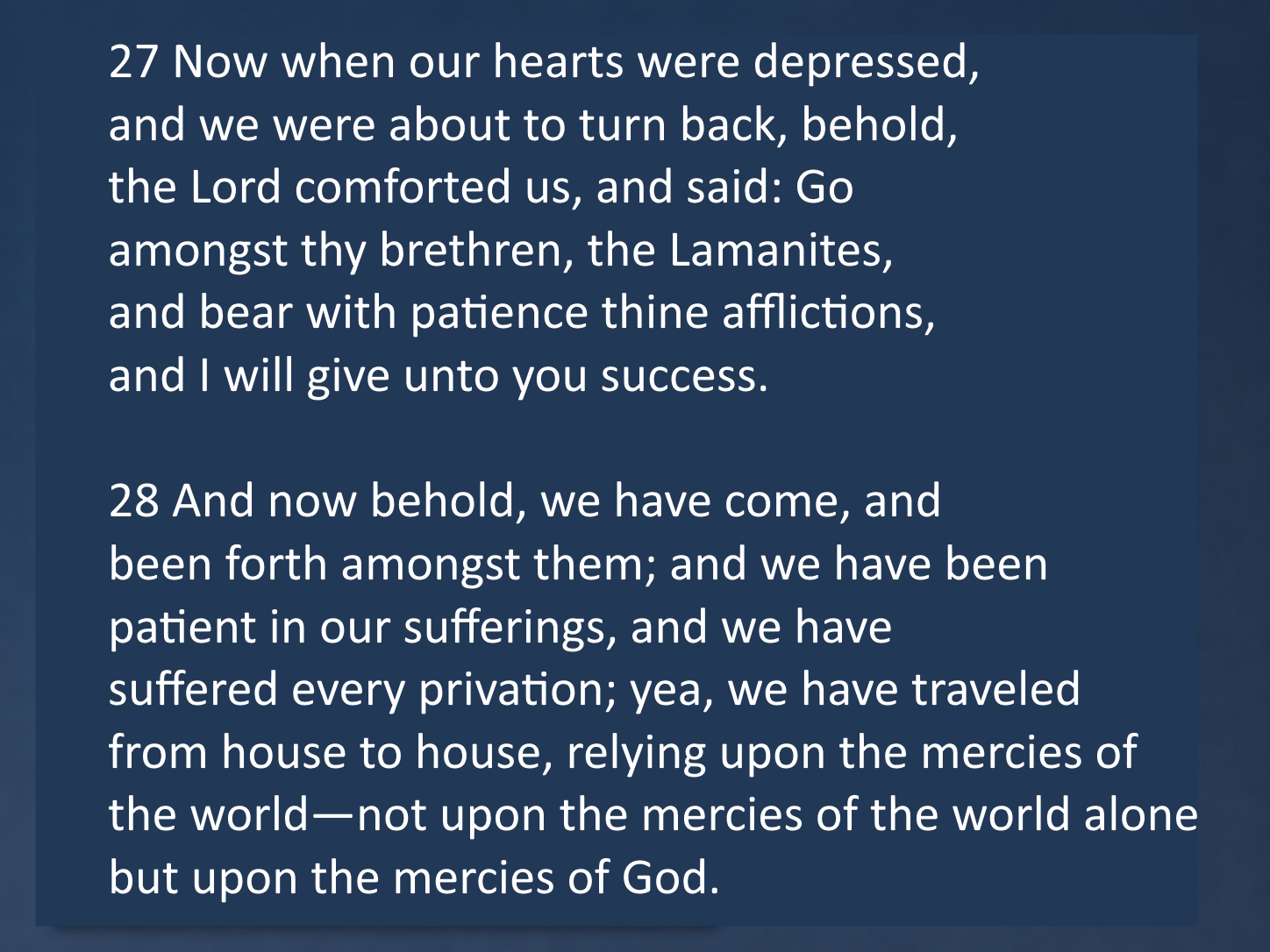
They were strengthened in this endeavor by the Lord, who told them—and again, listen to the word thy brethren:
“Go amongst thy brethren, the Lamanites, and bear with patience thine afflictions, and I will give unto you success.” (Alma 26:27)
Entering Into Their World
And how do they do it? They don’t set up a fortress that says, “Come and learn the truth.” They enter into their houses, to teach them in their streets and upon their hills. (Alma 26:29)
It reminds me of the huge change of heart. I just remember so well hating Guatemala. And then learning, as I literally lived in the homes of the Cakchiquel Indians, learning to love and adore who they were. To get a sense of their joy, to get a sense of their spirituality.
One really interesting thing, when I lived in South America. This is when I was married and my daughter had to go back to the States for an operation. And I started crying.
And one of the ladies said,
“You’re crying. The way we think of gringos is they’re so cold, that they don’t cry, but you’re crying.”
Did you know that you were considered cold people by some? Because in the countries, crying is a natural thing, abrazos and lágrimas, all of these are natural expressions.
That was a fascinating insight for me. But to enter into their temples and their synagogues, to be willing to endure ridicule and persecution. It’s always a temptation to defend ourselves and to not acknowledge our reactions.
Recognizing When We Have Caused Hurt
I want to talk very briefly—and we’re already running out of time—but the whole idea of recognizing if we have offended somebody, even if we’ve done it negligently.
And I’m going to get very personal, and some of it is so personal that I can’t talk about it without crying, and so I will have Darius help me.
This past year I’ve had a son who has just gradually been stepping out of the Church and stepping out of our family standards, and has been sometimes quite abusive in doing so.
Several months ago, I was privileged to meet a remarkable man, an AME—African Methodist Episcopal—pastor, who I just felt such a connection with. And I decided to write him about these huge struggles I was having with my son and to see what counsel he would give me.
Now, I had gotten good counsel from other people. There was something about Pastor Chip Murray that I just—I felt that he would have insights.
Counsel From Pastor Chip Murray
And he sent me an email that I’m going to have Darius read to you. But to me, this is
- an answer to marital problems,
- it’s an answer to problems between parents and children, and
- it is an answer between anytime that there has been any division, whatever the basis has been.
I’ll have Darius read that.
GRAY:
“My dear son, I want to take this opportunity to ask your forgiveness. Forgive me for whatever things I have done or failed to do that cause you such anger and anguish of spirit. Forgive me for the months and years and for feeling your hostility and knowing that in some way, you were responding to me—convinced that I trigger these negative feelings in you.
“Forgive me for not having asked forgiveness before. Forgive me for not being able to sit with you and ask your pain.
“Yes, I know there are two sides to every question, but my side is not important right now. You will see a change in me from this moment on. I ask no change in you, just that you notice a change in me. I accept you just as you are. If at any time you would like counseling, I am on your program to go with you or separately from you.
“Now I shall sit and listen to you. I love you.”
Looking at the Individual Soul
YOUNG: I think that’s some of the best counsel I’ve ever been given.
I had a marvelous Institute student. I’ve had all sorts of marvelous Institute students, but let me tell you about two very quickly, and then we’ll open to questions.
Janet’s Experience With the Savior
One named Janet had had an experience when she was a teenager where she was quite ill, and she was sick enough to die.
Her father gave her a priesthood blessing, and she was carried away in a dream or a vision. But she saw the Savior leading her through a curtain and embracing her and calling her by a different name.
It was years later that Janet decided to serve a mission, and as she went to the Temple and received her new name, it was the name that she had been given in that dream.
And she—the way she described it to me, she said, “[inaudible]—what? What is that name?” Because she remembered that that’s the name that had been given.
“I Don’t Associate With Mexicans”
Imagine my grief of heart as she would report to me things like trying to make friends with somebody in the hospital where she worked and having them say, “I’m sorry, I don’t associate with Mexicans.”
“I’m sorry, I don’t like Mexicans.”
The whole idea of attaching a concept instead of looking at the individual soul. And I know there is healing available.
Serving Despite Prejudice
Another of my Institute students served in the Provo Temple as an ordinance worker. And she knew—she was doing initiatory—and knew that the person she was serving hated her because of her race.
And she prayed and prayed that she would be able to do what she needed to do without being affected by the obvious feelings this woman had for her.
A Change of Heart
YOUNG: She finished the ordinances, and as she was turning around, the woman who she knew hated her was standing in front, weeping, and told her,
“You must forgive me. I have sinned. Heavenly Father has told me, ‘This is my daughter. You are to love her.’ I’ve had feelings in my heart which are not right.”
Now that tells me that any of us are capable of having a change of heart if we’re doing all that we need to be doing.
We had a marvelous change in Church policy in 1978. Sadly, we still deal with some folklore that keeps us from our brothers and sisters. It’s one of the essential things that we get the folklore out of our systems and that all of us who are here recognize it for what it is.
Rejecting Folklore About Race
- Were Blacks less valiant in the pre-existence? Absolutely not.
- Are they cursed because they’re descendants of Cain? Well, we’d have to dispense with a number of scriptures if we wanted to believe that.
- Are they cursed because they were descendants of Ham? Darius could tell you a whole lot more about that.
The basic truth is: We are all of one blood, and the commandment to love one another as Christ has loved us has never been rescinded. That’s nothing that you don’t already know.
But as we stand as witnesses of Christ, at all times and in all things and in all places, one of the most paramount lessons of the Book of Mormon must shine through our countenances and come through our words, which is that all are alike unto God and all are invited to partake. 7
The Book of Mormon and Racial Unity
That, I believe, is one of the paramount messages. As I’ve looked at the Book of Mormon—and I actually went through one time to see, okay, when is this not dealing with race?—I couldn’t find very much that wasn’t.
The Atonement, of course, is the paramount message. But the Book of Mormon is essentially the story of two races who, through the Atonement and testimony of Jesus Christ, come to unity.
Otherwise, why talk about the wars? Why talk about all the missionary work from one race to another? Why spend the time talking about what the Atonement actually accomplished in bringing people together, and then the tragedy of their returning to the traditions of division and not living the gospel?
I believe that’s why the Book of Mormon is a book for our day.
And we’ll open it to questions.
Questions and Answers
Did Latter-day Saints Have Slaves?
QUESTION: It was said that the slaves were some of the first to come to the Salt Lake Valley. Did the members of the Church have slaves?
YOUNG: Yes. Why? They were Americans, they were Southerners. What more do you need? It was—that was the time.
People had slaves during that time, and when the Mississippi Saints came, they brought about 60 slaves with them. That’s American history. That’s LDS history.
GRAY: The City County Building, down in Salt Lake City—that piece of property was purchased from the proceeds of the sale of two slaves.
Why Were Black Latter-day Saints Not Allowed to Receive Their Endowments?
QUESTION: Why were these people not allowed to receive their endowments?
YOUNG: The priesthood restriction was in force by the time that happened, by the time they were petitioning for their endowments.
Elijah Abel was not in Nauvoo when the endowment was given. He had moved to Cincinnati. When the endowment was ready in Salt Lake, the priesthood restriction was in place, and so it didn’t happen until 1978.
And it’s been a wonderful thing for us to look at the records of those who took the names of Jane, and Isaac, and all of the Black pioneers that we’ve talked about. When I’ve gone back over the records to see, was his work done? Was her work done? I haven’t found anybody whose work hasn’t been done by proxy.
Exceptions to the General Restriction
GRAY: However, while that was the general rule, it wasn’t the hard-fast rule. I had an interesting conversation yesterday.
Elijah Abel wasn’t the only Black man to hold the priesthood. There were others, and in fact, of his contemporaries: Walker Lewis, Pete McLeary, and then one of Elijah’s sons and one of his grandsons also held the priesthood.
And there’s a story of a Black African woman who married a white brother while he was in South Africa, and they came back to the States. She and he wished to be sealed together, and for that, of course, she needed to receive the endowment.
This was in the late 1800s, and in her patriarchal blessing it mentioned that she was of Ephraim. At that time it was determined that she, a Black African woman, could receive the endowment, and they were indeed sealed.
So, it’s sort of a moving target out there.
Why Did the Priesthood Restriction Continue Until 1978?
QUESTION: If Elijah Abel was able to receive the priesthood in 1836, why was the priesthood not given to men of his race later or until 1978?
YOUNG: Well, what a good time for me to finish the presentation! [Laughter]
Joseph—you know, why was he allowed to sit and wait in prison for seven years? I don’t know that there’s a hard-and-fast answer to that, and I’m sure during those seven years he must’ve wondered a whole lot.
But the whole idea that the time came when he delivered his brothers, when they looked on him and he was able—initially he did not even speak to them in their language and was not recognized—but then was able to say, “Brethren, I am Joseph.” (Genesis 45:3)
Receiving the Gifts of Our Brothers and Sisters
And, oh shucks, may as well go on.
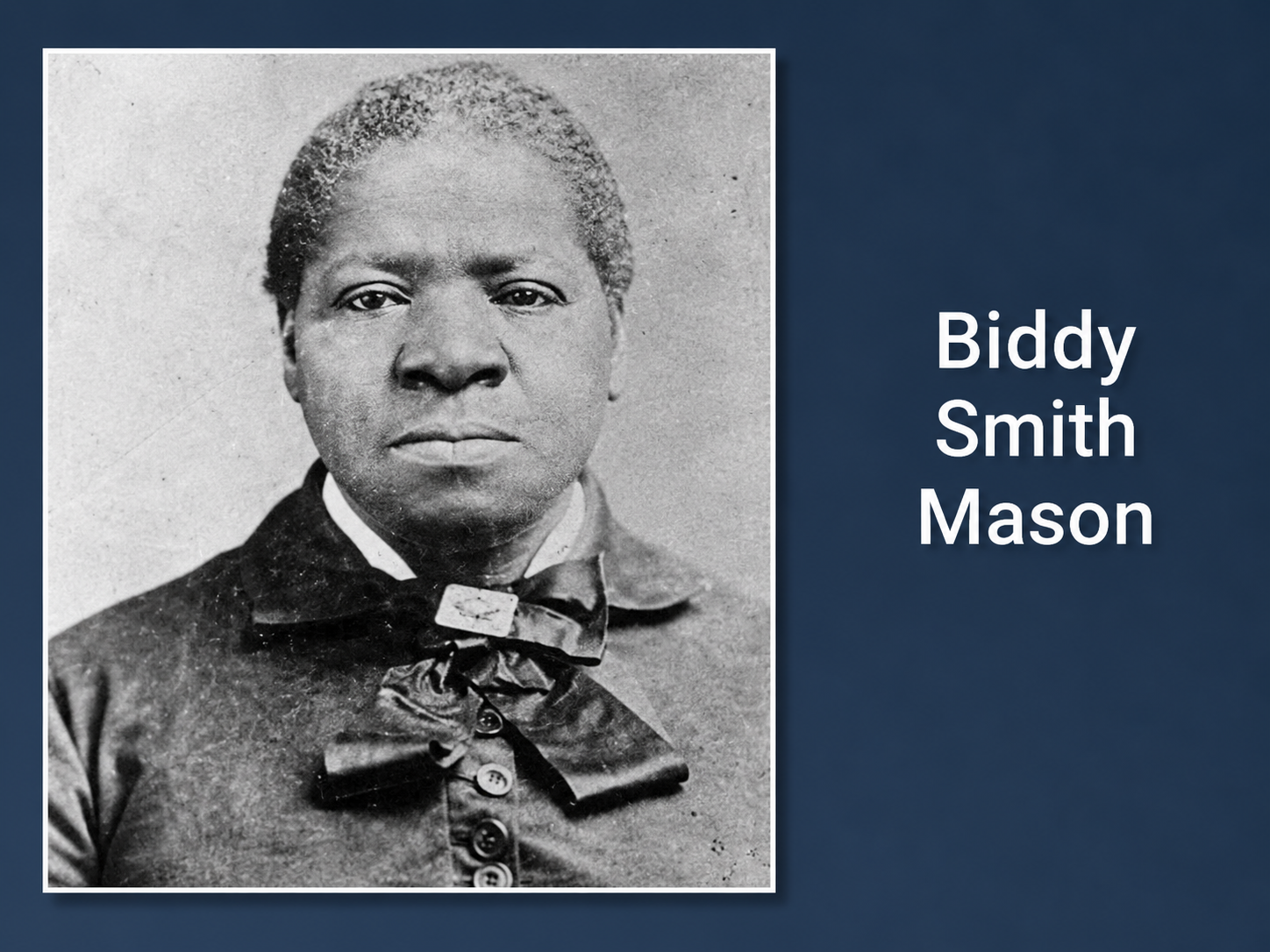
“Biddy” Smith Mason, after she was emancipated by a judge in California, a month later she rescued the son of that judge. He was about to be run over by horses, by leaping under the carriage and rescuing him.
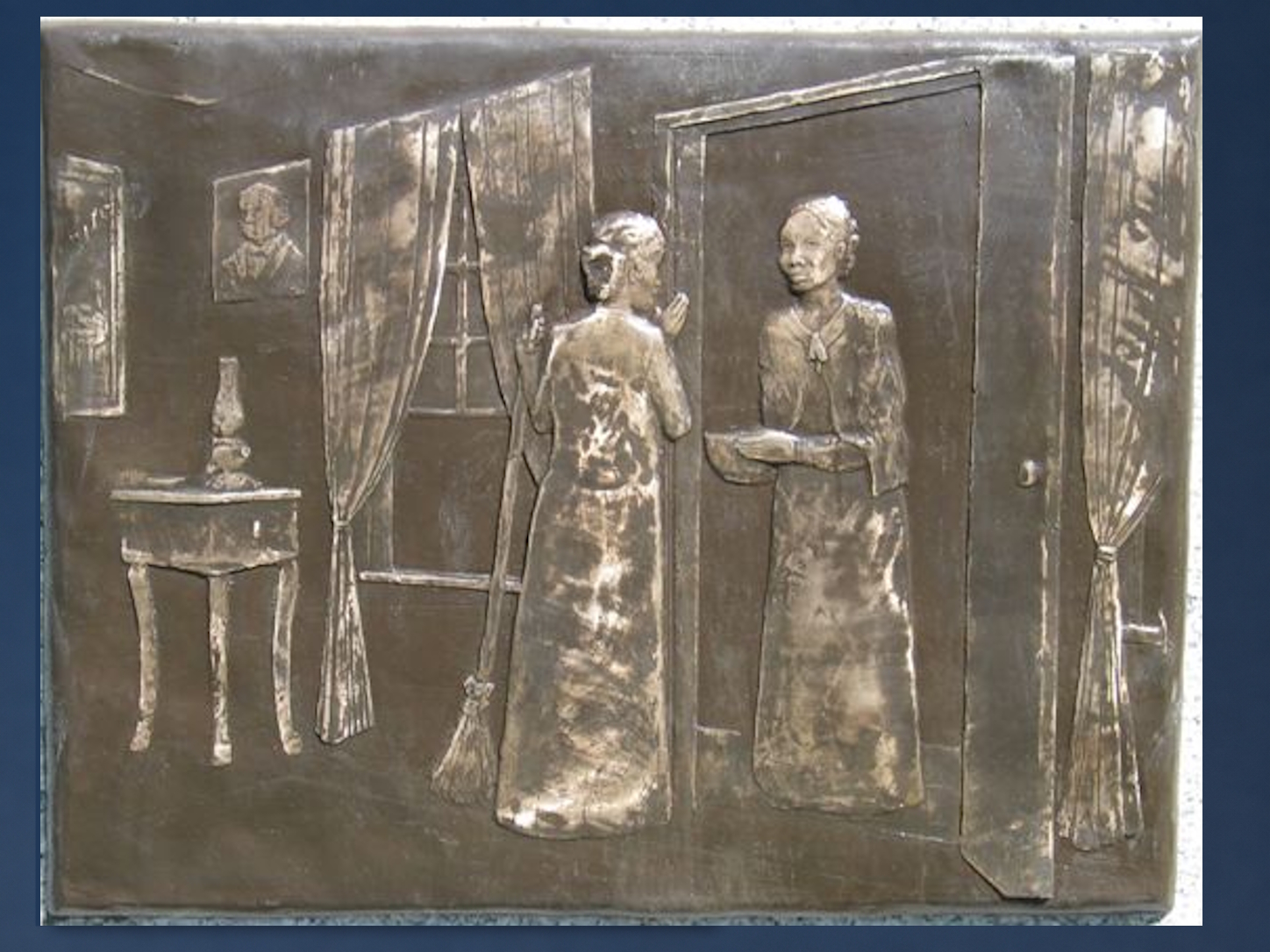
This is the Jane James monument. Jane is presenting two pounds of flour to Eliza Partridge Lyman. It’s from Eliza’s journal that—they were starving—and it says, “Jane James the colored woman brought me two pounds of flour it being half she had.”
Coming Together as the Body of Christ
My solid belief is that now everybody in this room, for the most part—minus Alex, Renee, Darius, I’m seeing a few other faces of color—but for the most part we’re Caucasian—I truly believe that there are gifts we must have for our own deliverance.
We need to come together as a body in Christ, and there are gifts in all of the cultures that will enhance who we are as members of the body of Christ. And I don’t think we can get there as one particular race.
I think we have to have the gifts of the others and be delivered by what God has given them to give to us.
It took some time. It took some waiting. But we are here now, and our calling is to recognize our brothers and sisters and receive their gifts.
[Applause]
Darius Gray’s Testimony
GRAY: I’d like to do something, and I don’t know if it’s appropriate—I want to bear testimony.
In just a couple of months, in December, I will celebrate my fortieth year as a Latter-day Saint. And I want to say to those of you who are of this faith, and those of you who are not, that I know this to be the restored gospel.
I don’t say I believe it to be. I know it to be the restored gospel of Jesus Christ.
It is a remarkable thing to have that gospel upon the earth. Whatever this organization does to help defend that gospel, I thank the participants in the organization.
But I say to you as individuals: Know the worth of what you have. The worth of what’s before you.
It is indeed of God.
