Summary
Jenet Erickson discusses how the updated version of For the Strength of Youth shifts from a behavior-focused, compliance-based approach to one that emphasizes integrity and personal accountability rooted in eternal truths and covenant relationships.
Introduction
Scott Gordon: Jenet Erickson is an associate professor in Religious Education at Brigham Young University, where she teaches the Eternal Family religion course as well as an Introduction to Family Process course for the School of Family Life. She has a PhD in Family Social Science from the University of Minnesota, after completing a bachelor’s degree in nursing and a master’s degree in linguistics. She’s a research fellow for both the Wheatley Institute and The Institute of Family Studies and has been a columnist on family issues for the Deseret News since 2013. So, with that, I’ll turn the time over to Jenet.
Presentation
Jenet: I am so grateful to be here. I’m humbled and really touched by the feeling of faithfulness in this room. I know that I’m surrounded by people who have devoted their lives to seeking, articulating, and defending truth to bless the children of God, to bless our brothers and sisters. So, I’m very grateful for the privilege of being here.
I’m going to talk today about something I am working on, something I am just a beginner in, in many ways. I think we are wrestling with coming to understand what God’s intent is for us as a Church, and I’m so grateful for a loving Father in Heaven and His Son, Jesus Christ, who mentor and tutor us in this journey of life, whereby we learn by experience and by the power of the Holy Ghost of their truths.
My husband was born in 1975, like I was. It was kind of the height of the divorce revolution, which had launched in the late 1960s and taken off all across the 1970s. His parents also divorced. He went to college not having grown up with any kind of faith in his home, though he had devoted parents. When he got to college in 1993, dating had all but disappeared on the college campus at the University of Texas. Drug use was high, and we were in the height of the sexual revolution of promiscuity, drug use, and alcoholism—all the things we know. And when he found the gospel of Jesus Christ as a young student, one of the things that struck him was For the Strength of Youth.
For the Strength of Youth
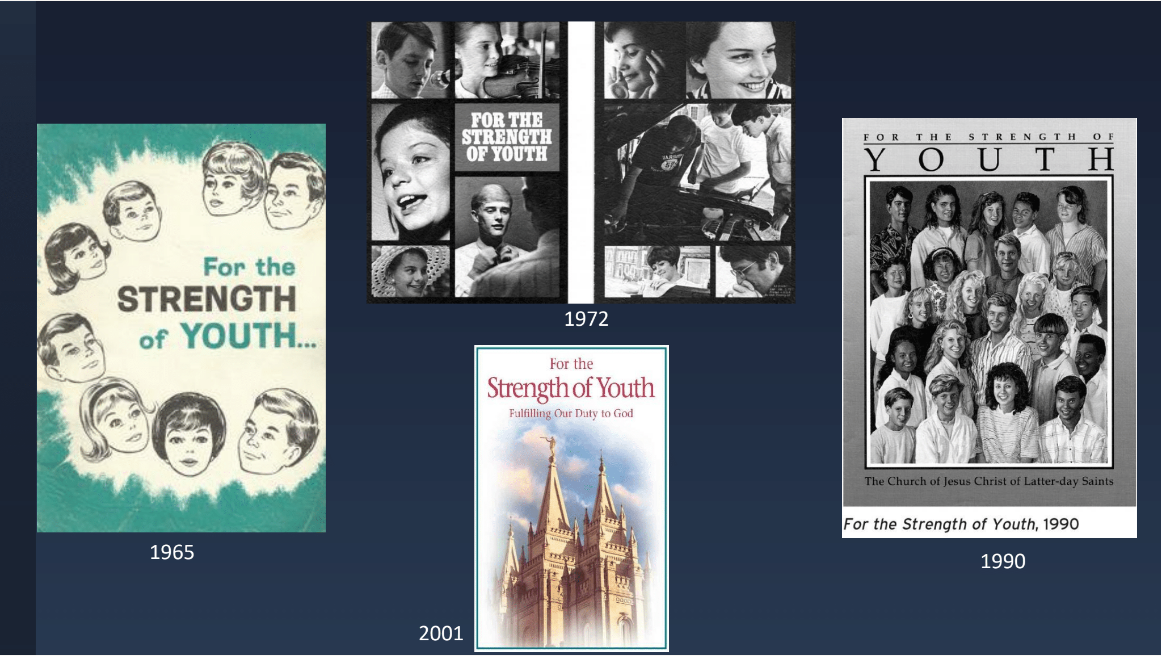
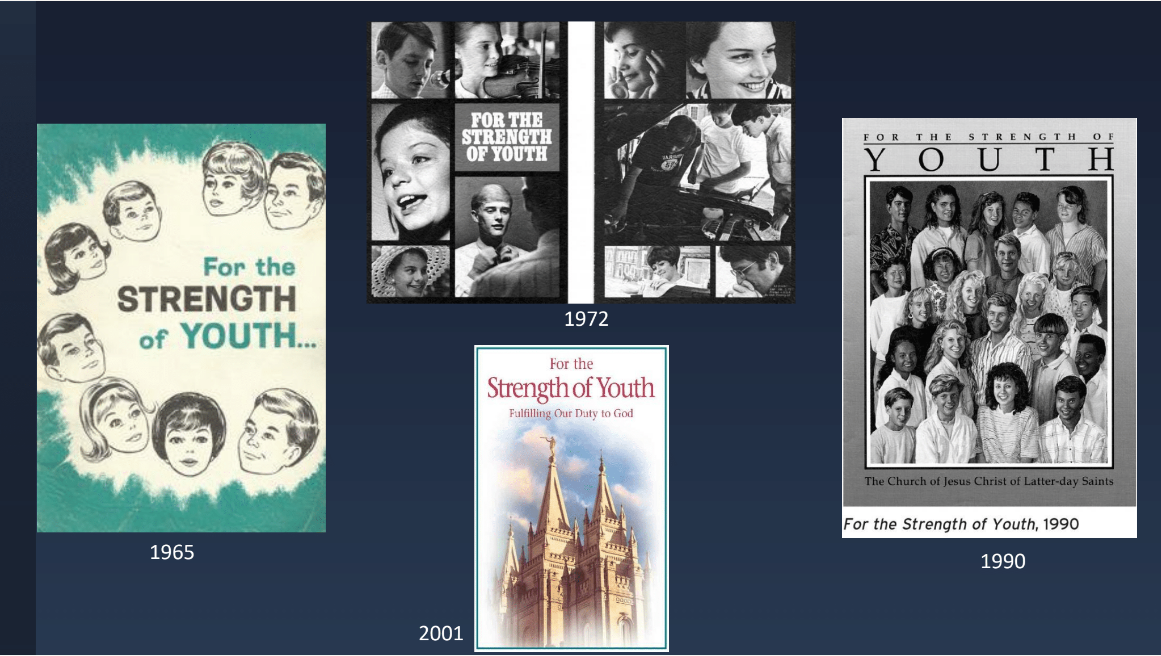
I’ll show you some images of what the pamphlet he would have seen looked like, the one on the far right. Later, after we were married, he described to me how he felt that pamphlet was one of the greatest gifts that could be given. Oh, that every youth could have a standard in a time of confusion!

Not unlike what happens in battle, when there is tumult, confusion, and difficulty in knowing where to go or where to rally, it helped him understand the feelings he had in his heart about what was right and wrong. Those feelings were clarified, bolstered, and held in that beautiful pamphlet—and he honored it.
In the years since, the proportion of young adults who reported marijuana use in 2021 reached 43% within the past year. Pornography use among married men is one in three on a weekly or daily basis, and the same proportion applies to dating men. Premarital sexual relations, as you know, have increased dramatically, with all the consequent effects on out-of-wedlock childbearing and the sexualization of women. In 2019, 26.4% of undergraduate women reported non-consensual sexual contact by force or inability to consent. Just last year, we were all horrified by the CDC findings that 30% of adolescent girls had experienced suicidal ideation, and one in five reported sexual violence within the past year.
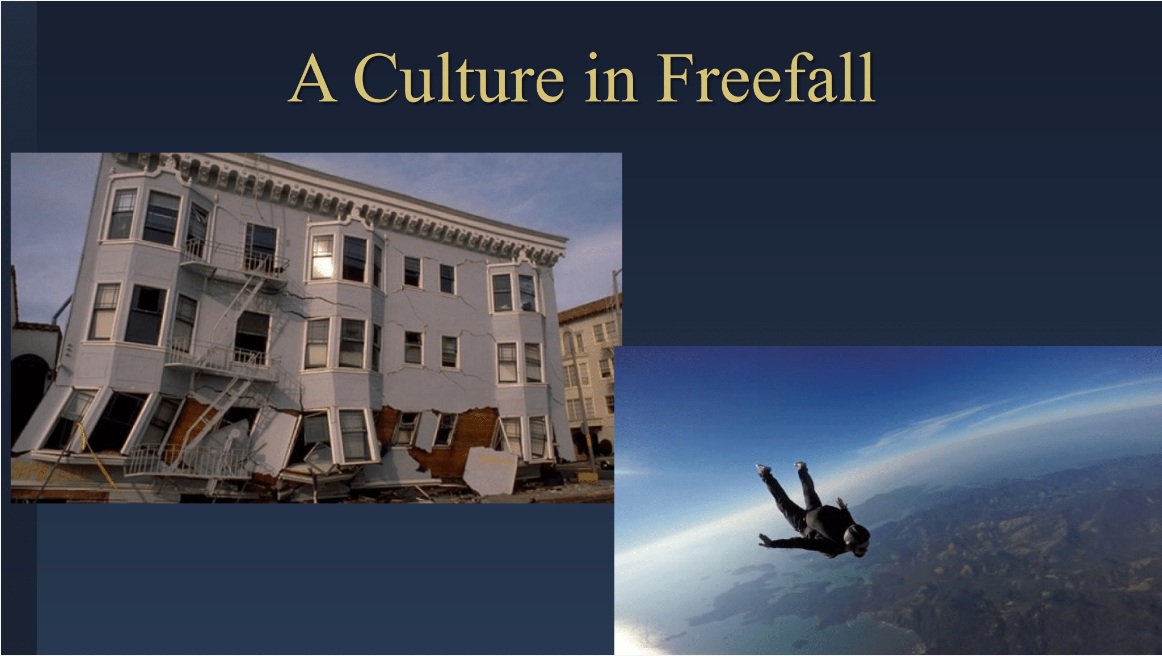
We know that we are in a time of freefall. This is a culture in freefall.
Into this culture of freefall, you may wonder: why would there be seemingly less direct clarity about standards in the newest For the Strength of Youth? And yet, I feel deeply that God is answering this freefall in the truest way—by inviting a deep internalization, grounded in Him, of His ways and truths.
Problems With Behavioristic Orientation
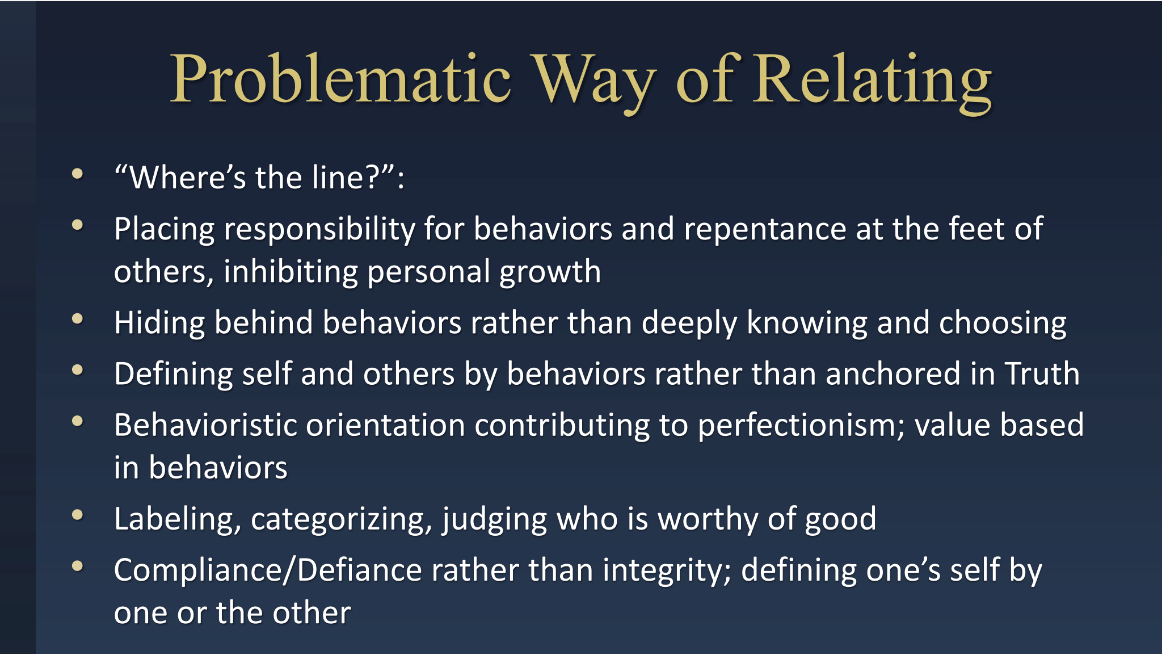
As a teacher, I’ll never forget the first time I was teaching about healthy sexuality. I teach students at BYU in the class on the Proclamation (Religion 200) as well as in the School of Family Life, where every class I teach includes sexuality integrated into our curriculum. I’ll never forget my first time teaching, when students articulated that question: “Well, where’s the line? Where have I passed that line?” What I’m going to do here is help us understand what I have found to be problematic ways of relating to For the Strength of Youth in the past—ways that are addressed in the newest changes to For the Strength of Youth.
Where is the Line?
These are significant concerns that have been addressed, beginning with that question of “Where’s the line?” where youth were placing responsibility—and all of us, to some degree, may be tempted to place responsibility for our behaviors and repentance—at the feet of others. I remember students talking about how, on their missions, they would compare with one another how a bishop responded to their indiscretions, creating a comparison around behaviors with the bishop having responsibility for directing what repentance looked like for that person.
The temptation to hide behind behaviors rather than deeply knowing and choosing for oneself, and the temptation to define oneself and others by behaviors rather than being anchored in truth, are common struggles. This is an obedient person, or this is not an obedient person; I’m defined by being compliant or defiant—a behavioristic orientation where there are lists of dos and don’ts.
Worthiness based on Behavior
There can be a behavioristic orientation that implies I can somehow perfect myself through my behaviors, contributing to the challenging perfectionism that young adults are struggling with and rejecting. This approach suggests that value could be determined by behaviors: that I might value another person as more or less important to God, trusted by God, or worthy based on their behaviors—a labeling, categorizing, and judging of who is “worthy” or “good.”
Rather than using the law in the work of love, the law has sometimes been used as a means of judging and evaluating worthiness or goodness. I think it’s tempting for youth, and for us, to define ourselves as either compliant—hiding behind behaviors—or defiant. That I might act out to show I’m an independent person, or comply to show I’m a “good” person, as opposed to deeply choosing what is true and right for the right reasons. This still operates within a framework of validation.
Intimacy
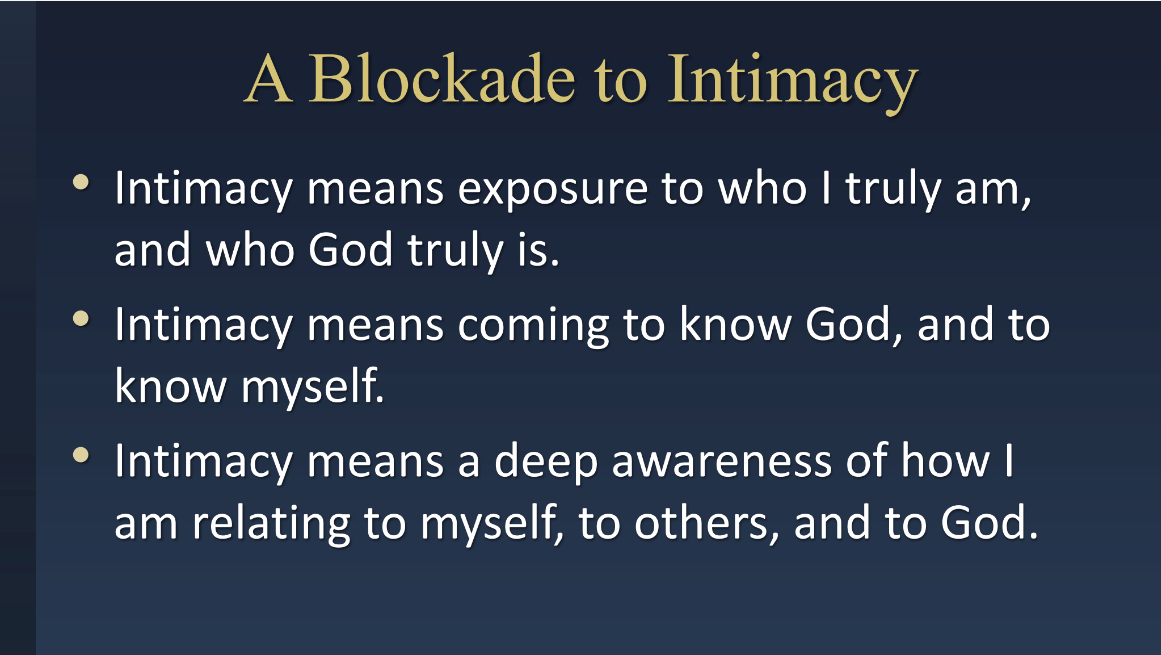
Most painfully of all, a behavioristic orientation can create a blockade to intimacy. This is important to me—intimacy. Hiding behind behaviors or judging based on behaviors can prevent us from truly being seen for who we are and knowing who God is. Intimacy means coming to know God and knowing myself; God, who is love, whose entire intent in the Plan of Salvation is to bring us into ever-deeper connection and relationship forever with Him and with each other. Lists of behaviors, rankings, and judging can keep us from experiencing a deep awareness of how I am relating to myself, to others, and to God.
Fully Known and Truly Loved
A quote that I’ve come to love, shared at the FAIR Conference last year by Ty Mansfield, is Timothy Keller’s quote (he passed away just a few months ago), a great Christian minister and teacher: “To be loved but not known is comforting but superficial. To be known but not loved is our greatest fear. But to be fully known and truly loved is, well, a lot like being loved by God. It is what we need more than anything. It liberates us from pretense, humbles us out of our self-righteousness, and fortifies us for any difficulty.”
We know from a family science perspective that development has to come from healthy relationships, and that healthy relationships are grounded in the capacity for intimacy—to know, see, and love; to be known, to be seen, and to receive love. A behavioristic orientation can be a powerful blockade to really experiencing this growth in intimacy.
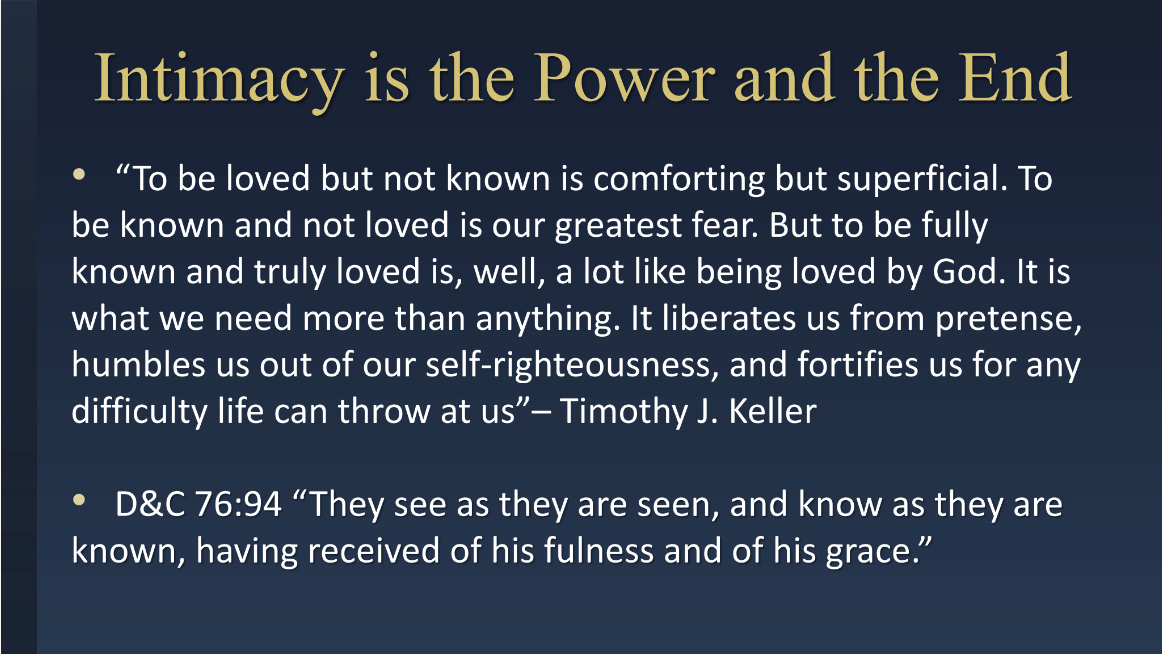
Having said that, then, if we believe the purpose of the Plan of Salvation is to cultivate intimacy with God and each other, I believe intimacy is both the purpose, the way, and the end; it is the power and the end. This process of us becoming deeply connected to God is why Section 76 has that powerful description of the celestial sphere: “They see as they are seen, and know as they are known, having received of His fullness and His grace.” Every commandment given is intended to help us grow in our capacity for eternal intimacy with God and with one another.
The True Purpose of Youth Efforts
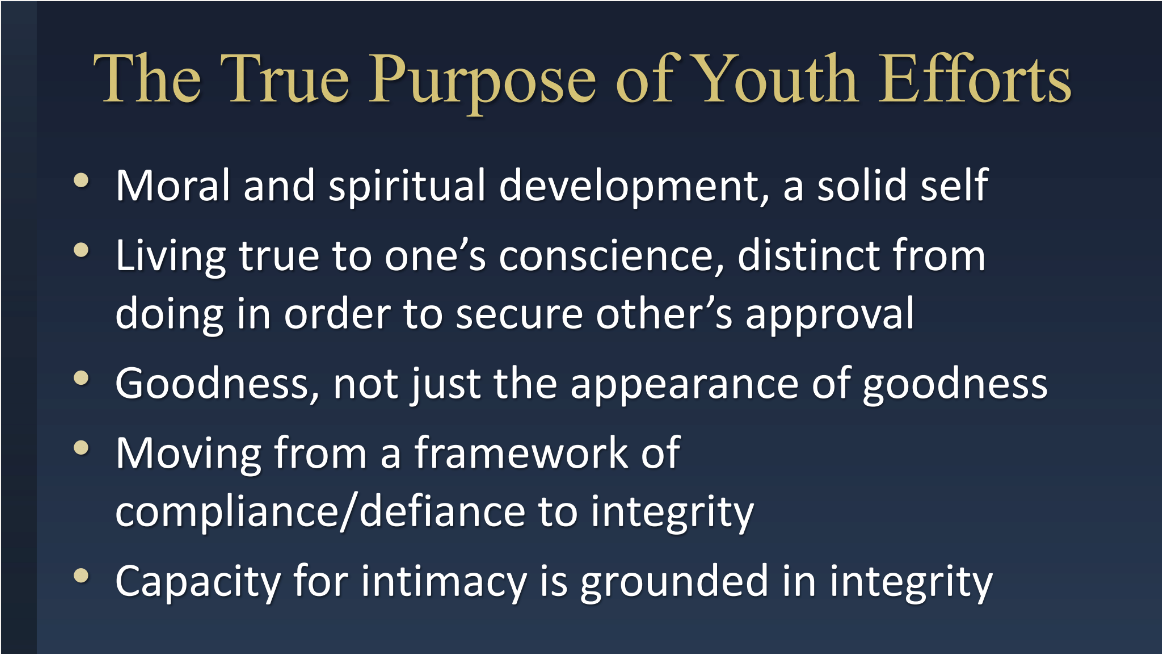
When we think about the true purpose of For the Strength of Youth, and all we do with our youth activities, FSY, and intensive investments in youth, what is it for? It is to help them develop what I will call a solid self—grounded moral and spiritual development. Not a borrowed self, not a pseudo self, but a solid self; one who is living true to their conscience. This is distinct from living and making choices to secure others’ approval; it’s doing the right thing for the right reasons in situations where others may not validate it. It’s goodness—godness—not just the appearance of goodness. It’s moving from a framework of compliance (doing what the list tells me) to choosing to live with integrity to what one knows is right, deeply within one’s soul.
When we send our children to college, when we send them outside of our home, our deepest yearning is that they will act from a place of integrity—that they won’t do things others pressure them into doing, that they won’t rebel simply because they gain some autonomy, but will make choices they know are right and in alignment with their truest and best self. This is a process—one we are all working on, one I’m working on every day and imagine I’ll be working on for a long, long time.
Most importantly, that solid self is the only self that can be in intimate connection with others. Otherwise, we’re trying to establish intimacy with a pseudo self, a borrowed self that cannot bring one to full connection with others.
Integrity
This word “integrity” is so interesting; Jennifer Finlayson-Fife uses it powerfully in describing this movement from compliance and defiance to integrity. It comes from the meaning of the word “integer,” which means one—not divided, not a broken number, but whole. It’s “soundness” in Webster’s 1828 dictionary, or purity, uprightness—not a schism in the self, not acting one way against what one knows, but acting in coherence, in wholeness, which means honesty.
Oneness
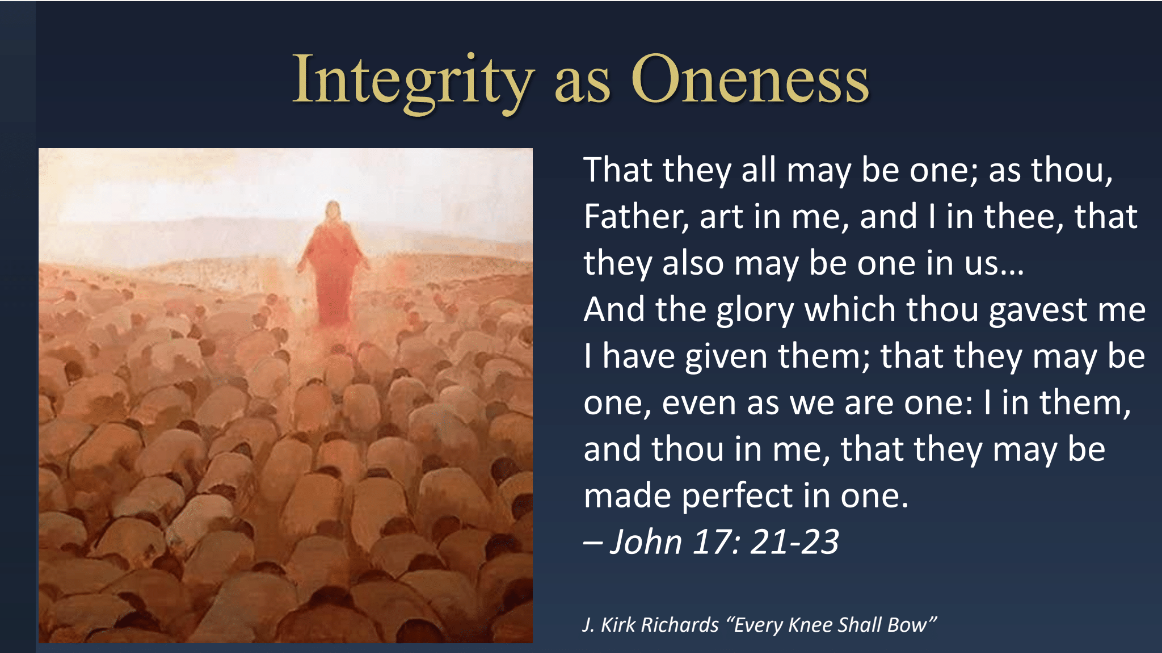
I think it’s beautiful to consider that the Lord ends His ministry with the powerful language of oneness: “That they may all be one, as thou, Father, art in me, and I in thee, that they may also be one in us.” Our work is to help one another come to oneness with oneself, with the divine within, and with the divine without.
So, what does a youth need in order to develop integrity, and how does For the Strength of Youth provide that?
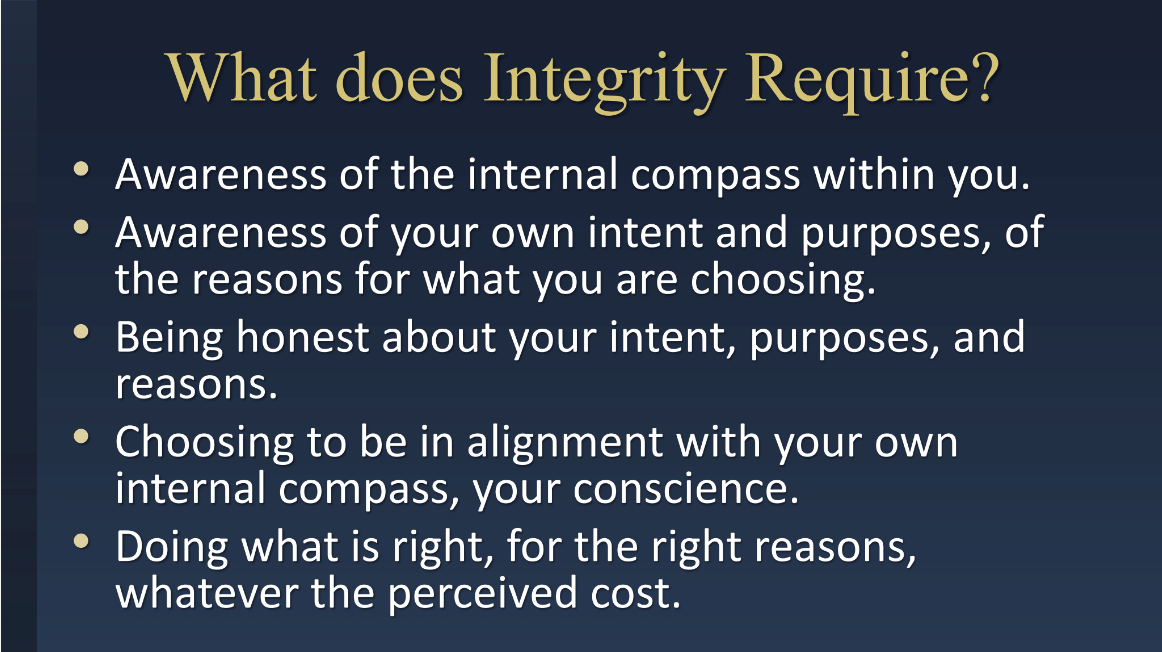
First, they need an awareness of the internal compass within—the light of Christ, or conscience. This inner light within their spirit guides them in knowing right from wrong. It’s also an awareness of why they are doing what they are doing. Why am I choosing what I’m choosing? Am I doing this to be compliant and receive validation? Am I doing it to separate myself from others, to distinguish myself? Or am I doing it from my highest desires, what I know is right?
It means being honest—not only knowing God’s intent and purposes but being honest about them—and then making the choice to be in alignment with my compass, that internal compass and light. It is doing what is right for the right reasons, whatever the cost. Just think, then, about the kind of teaching we need to provide to enable that awareness to develop. What kind of way of relating do we need for that to happen?
The Process of Moral Development
Moral Development as a Pathway
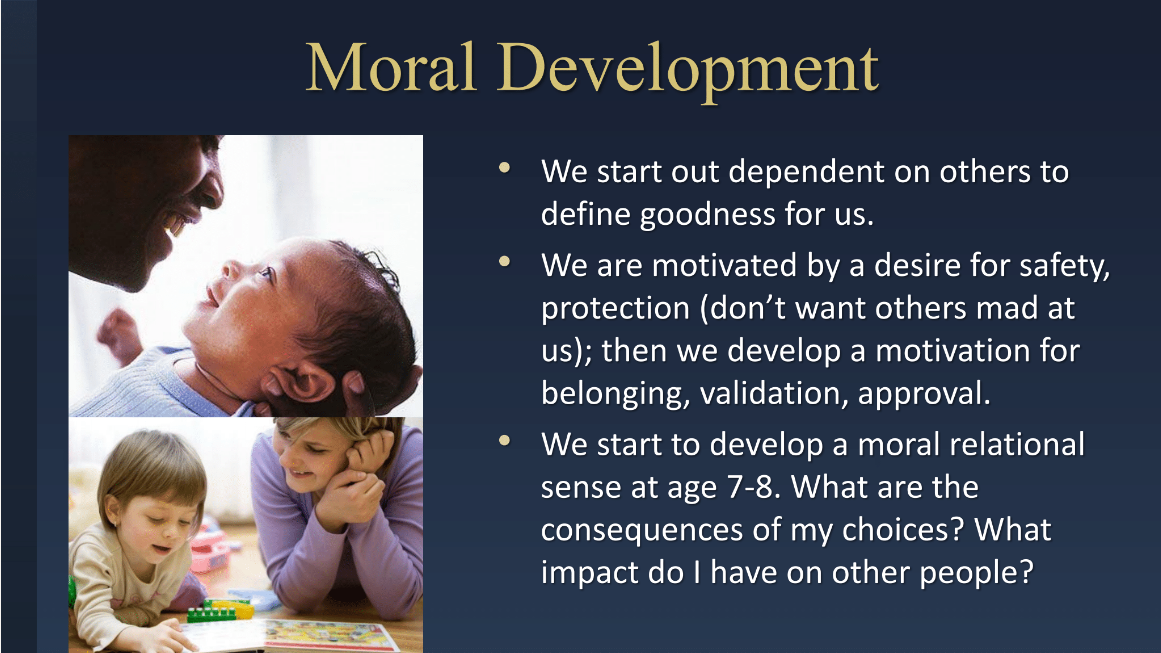
It’s important in this process to recognize that moral development follows a pathway. It begins with infancy, where a child starts to understand, even though an infant cannot yet have an awareness of themselves outside of relationships with others. We start out dependent on others to define what goodness is, and in this developmental stage, we are motivated by a desire for protection and safety—we don’t want others mad at us. This becomes an important way to understand what goodness truly is in our world.
Then, as we grow into adolescence, our motivation becomes belonging, validation, and approval. We’re still in the process of moral development, starting to understand consequences, how we relate to others, and the fact that our actions have consequences that can harm or help others. By age seven or eight—the age at which we can choose to be baptized—we begin to see these connections more clearly.
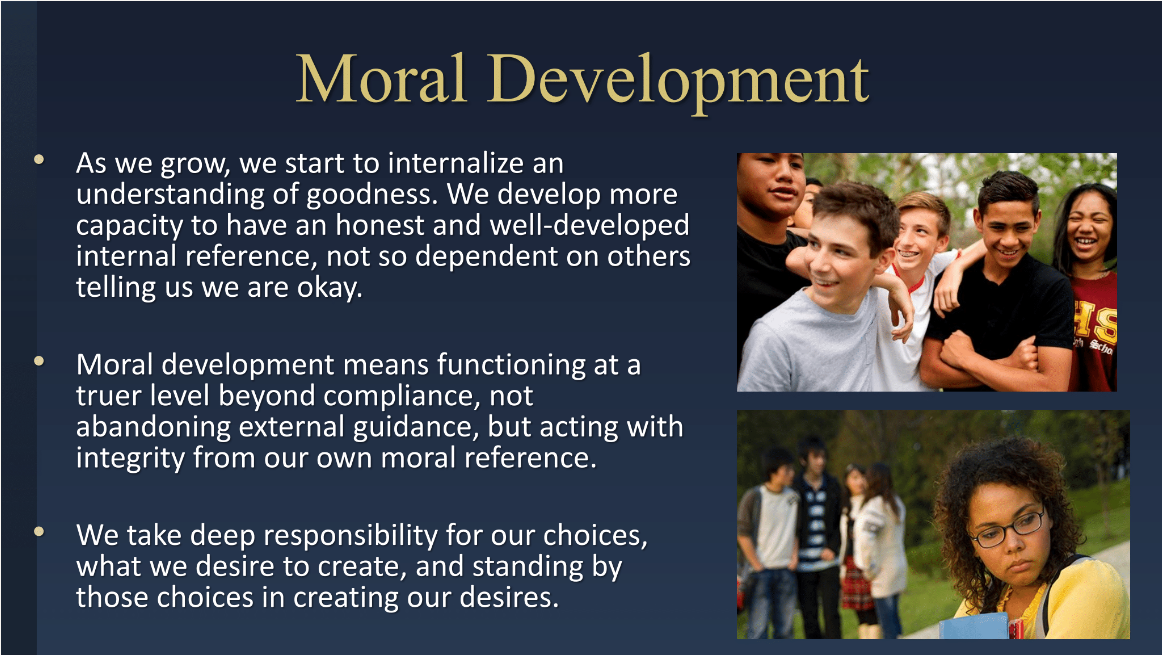
Moral Development
In adolescence, we start to internalize an understanding of what goodness actually is, what it looks like, and how it feels. We develop a greater capacity for an honest, well-developed internal reference: What do I feel is right? What is true? And how does that align with the light within me? This is a shift from depending on others to define goodness and affirm that we are okay. Moral development means that we grow in our capacity to live at a deeper level beyond compliance. We don’t abandon external guidelines, but we act from integrity with our own moral reference.
This growth means we develop the capacity to take responsibility for our choices, to confront the falseness within ourselves, to be willing to acknowledge, see, and recognize it, and to create desires aligned with our true selves. Such a person becomes capable of intimacy with others, cultivating ever-deeper levels of intimacy based on their capacity for moral development.
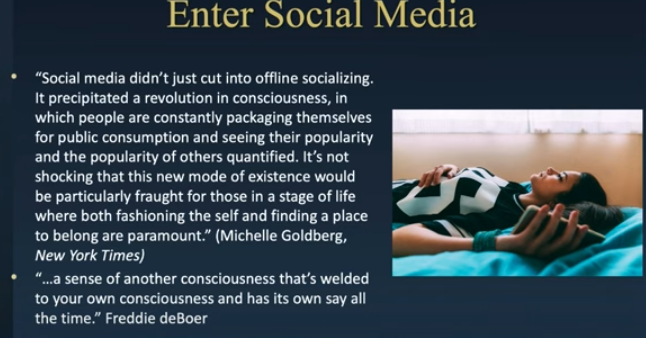
Enter Social Media
Now, thinking about this, we see why this question is so challenging. Just consider what social media has done in this process of coming to clarity about who one is, what the light within oneself tells them to do, and how they relate to others. It’s fascinating to watch both progressive and conservative orientations align on their concerns about social media.
Here is writer Michelle Goldberg from The New York Times, making a powerful statement after seeing the CDC findings on girls and depression: Social media, she said, didn’t just cut into offline socializing—going out with friends, dating in person, interacting with others. It precipitated a revolution in consciousness in which people are constantly packaging themselves for public consumption and seeing their popularity—and the popularity of others—quantified.
Social Media Affects the Youth
It’s not shocking that this new mode of existence would be particularly fraught. Who would this be most challenging for? For those in a stage of life where fashioning the self and finding a place to belong are paramount: our young adults and adolescents. Freddie deBoer adds this very powerful statement about social media, saying, “It is a sense of another consciousness that’s welded to your own consciousness and has its own say all the time.” No wonder it is hard to develop a core, solid understanding of oneself.
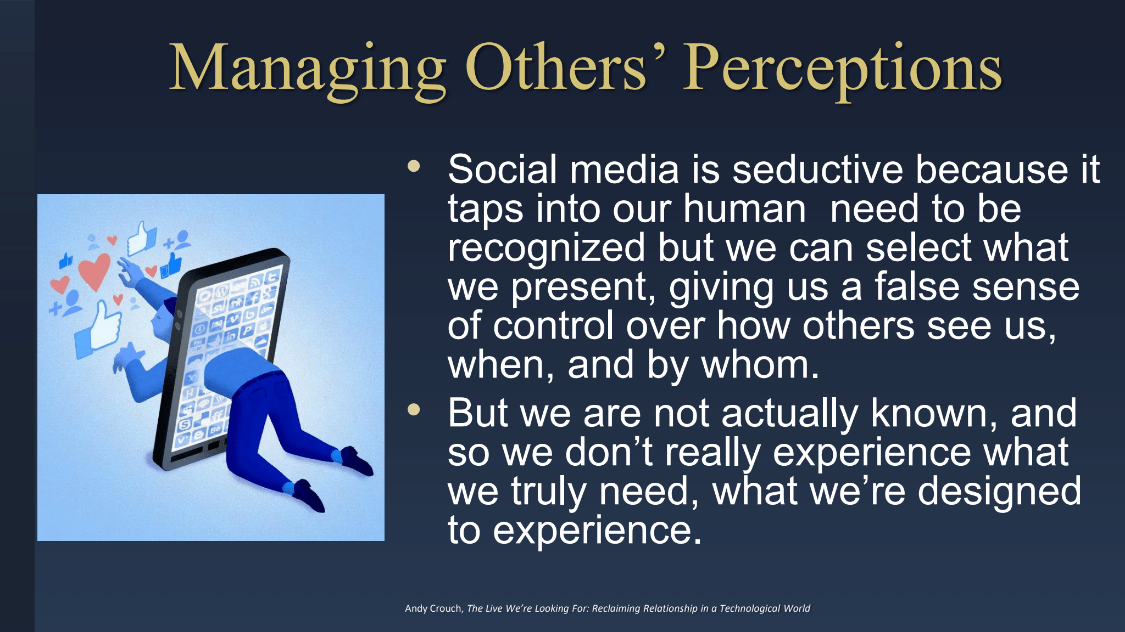
This is Andy Crouch, who has done such wonderful work in writing and providing guidelines for families. He notes that social media is seductive because it taps into our human need to be recognized. But we select, as do others, what we present, giving us a false sense of control over how others see us, when, and by whom. Yet we are not actually seen or known, and so we don’t experience what we truly need, what we are designed to experience.
New Strength of Youth Focus
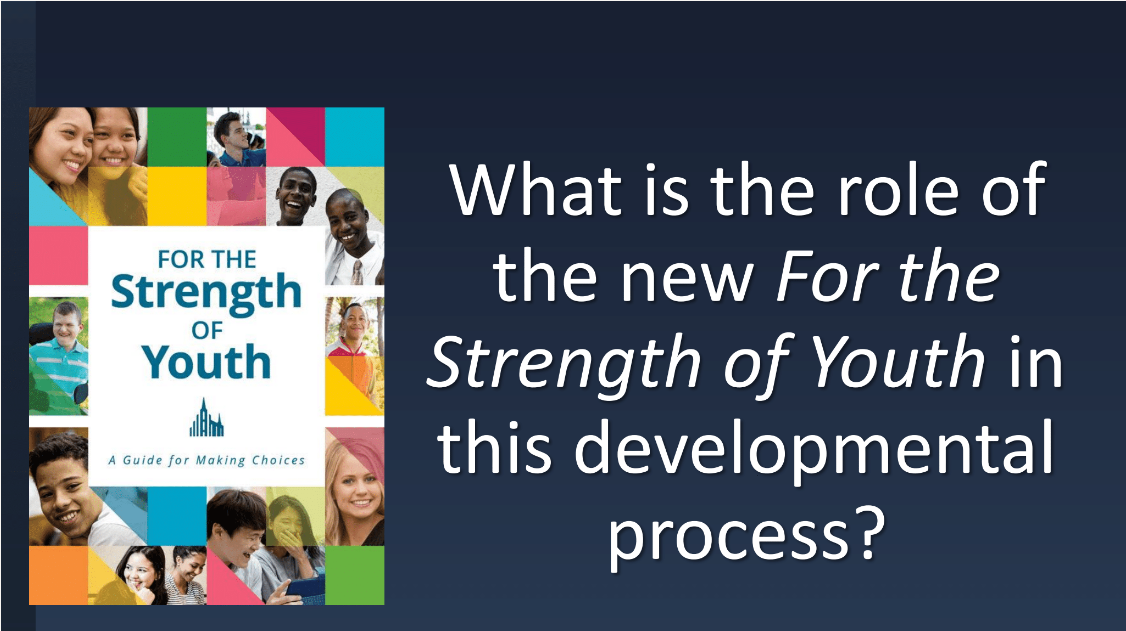
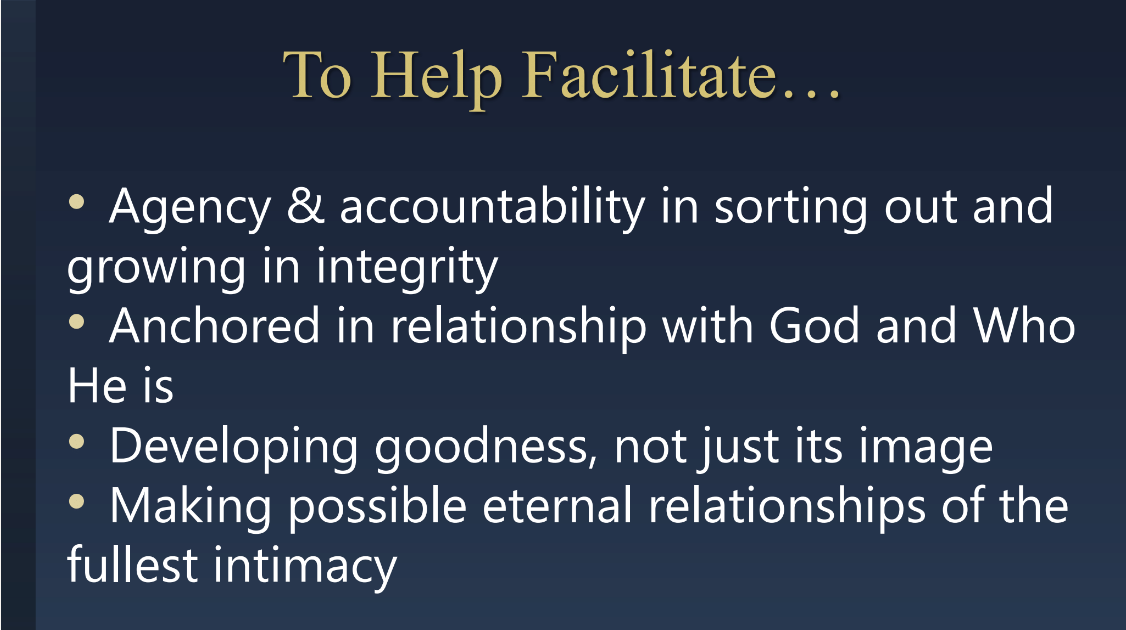
Enter For the Strength of Youth. Its overall goal is to help us develop agency and accountability in sorting out and growing in integrity. At its core, it establishes an anchor for youth in their relationship with God and who He is. The purpose is developing goodness, not just its image, making possible relationships of the fullest intimacy—forever.
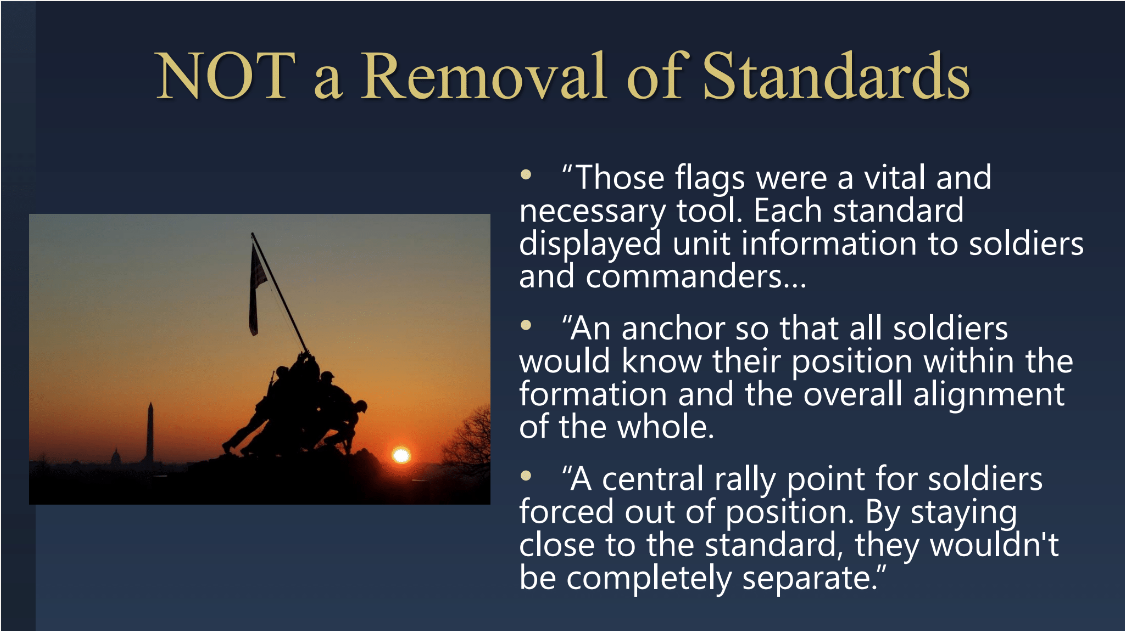
Not a removal of Standards
I was on campus after the presentation of For the Strength of Youth, and hearing the reactions of students was so interesting. Some of them doubled down, saying, “Everybody’s going to go crazy now that we don’t have those guidelines!” Others said, “Finally, I can do what I want.” Still others said, “Oh, I see the vision in this.” There were lots of different reactions, all of which were indicative of where we were developmentally, whether in a validation framework or not.
It’s so interesting; some said, “Oh, this is a removal of standards.” In fact, this is not a removal of standards. Standards, as they have throughout all time, play a very powerful role in giving information, helping us know our position, and the overall alignment of the whole—a rallying point.

By staying close to the standard in war, they would not be completely separate, but these standards as taught now point us to a higher and holier way.
The Higher and Holier Way
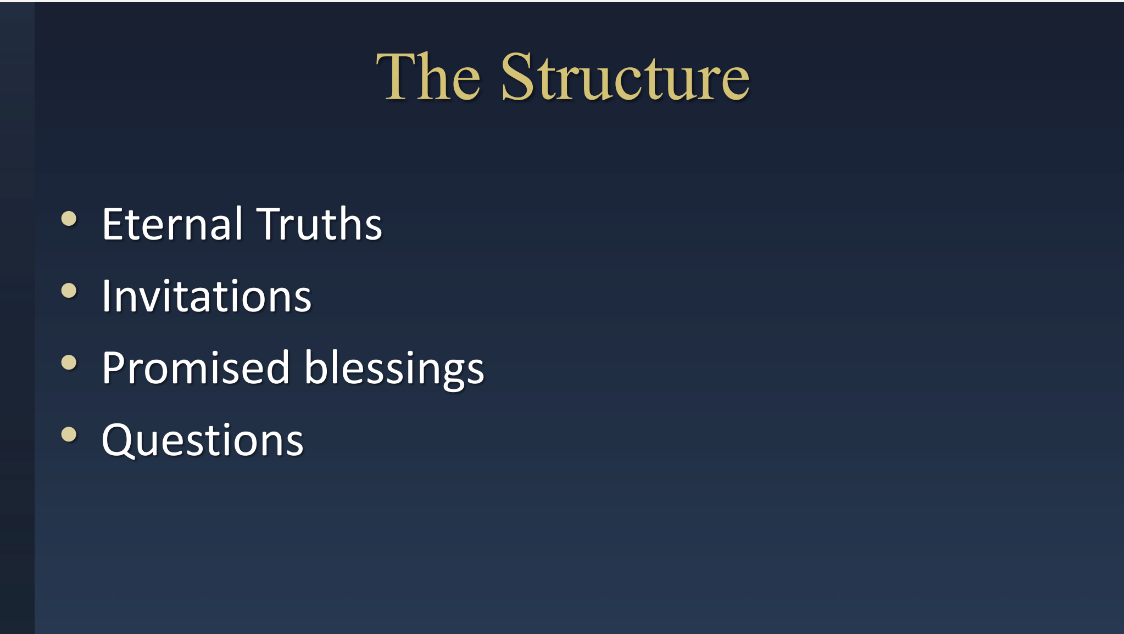
The structure of For the Strength of Youth is this: eternal truths are presented first—truths about who God is and what His ways are. Then come invitations: What does that truth invite in me? I loved reading a couple of years ago how President Nelson said, “I don’t even like the word should.” He was sensitive to using that word, protective of one’s agency, and instead offered an invitation to see and know the truth. It’s powerful to know that God does not coerce us into change; He never says to us, “You must change for me to love you.” His love invites in us the desire to change and be ever more with Him, to abide in His love.
The same is true of our youth. For the Strength of Youth is structured with eternal truths, invitations, the blessings that come from adherence to those invitations, and questions that we might have in trying to sort out what those invitations mean in our lives.
Covenant leads to Growth
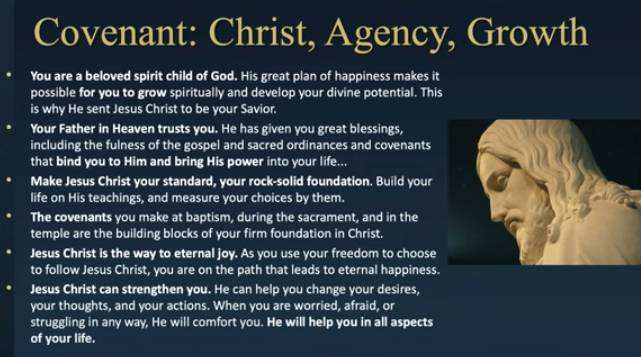
At the very beginning, core throughout the entire framework, is covenant—covenant with Christ, your agency, and the Lord’s intent for your growth. It begins: You are a beloved child of God. His great plan of happiness makes it possible for you to grow. This is not a set of mandates to measure who is worthy or who merits His goodness or His love; this is about a relationship with Him through which one can grow because of His profound love.
This is followed by: Your Father in Heaven trusts you. Your covenants have bound Him to you and you to Him. Make Him your rock-solid foundation. Then again, covenants and Jesus Christ, with the most beautiful promise: Jesus Christ can strengthen you. He can help change your desires, your thoughts, and your actions. It ends with: He will help you in all aspects of your life.
This is what covenant means.

From Transaction to Relationship
As a child growing up, I would have told someone that “keep your covenants” and “keep the commandments” meant the exact same thing. Not until President Russell M. Nelson, by revelation, has the truth about covenants been fully opened to us, drawing on truths throughout scripture that we might not have fully seen before—that covenant is a relationship. It’s God establishing an ever-deeper relationship with us, because from the very beginning, our Heavenly Parents have wanted to be with us, to be with us in a way that cannot be until we have become as they are. It is all driven by a deep, unspeakable love.
Covenant vs Transaction
- Covenant is the opposite of transaction; relationship is the opposite of “I do this so that I can get this.”
- Covenant tells me I am invited into the experience of God—to experience Him, to know who He is, what He feels like, how He sees things.
- In that connection with Him, abiding in His love, I experience the process of being reborn.
- Covenant tells me I am safe to expose myself in my weaknesses to Him, to be known and seen in my flawed self that I am often aware of and hide behind.
- Covenant tells me, “You are safe to know yourself in your weakness and be loved and grow out of it through My love.”
- Covenant relationship pushes me to a more honest place; I experience God, and I can see my own distortion.
Transaction
In transaction, think of that process you might have as an adolescent: “Will this choice get me what I want? If I do this thing they’ve told me to do, will it get me what I want?” And when it doesn’t, you may feel betrayed. You might have been modest throughout your years, expecting validation, and not received it. As you grow, you realize the purpose was to experience an ever-greater closeness with Him, to know His love and goodness.
God loves me anyway
Nor is it the feeling of “No matter what I do, He’s okay with me.” A mother told me the other day that her 13-year-old daughter had prayed about whether she could wear sleeveless tops—a concern important to the mother as part of For the Strength of Youth. After praying, the daughter came out and said, “He’s totally okay with whatever I want to do; He loves me.” And we shift out of that. That’s also a transaction—a way of relating to God that keeps us from really coming to know Him.
Instead, it becomes a feeling of, “I yearn to know Your ways because I have experienced and tasted of Your love.”
I want to know that ever more and more—not motivated, as so many missionaries know, by rules. How natural it is at that developmental stage to be motivated by fear, obligation, or the desire for approval. We can be very much in that developmental stage. This is about coming to know who God really is through honest relationship with Him.
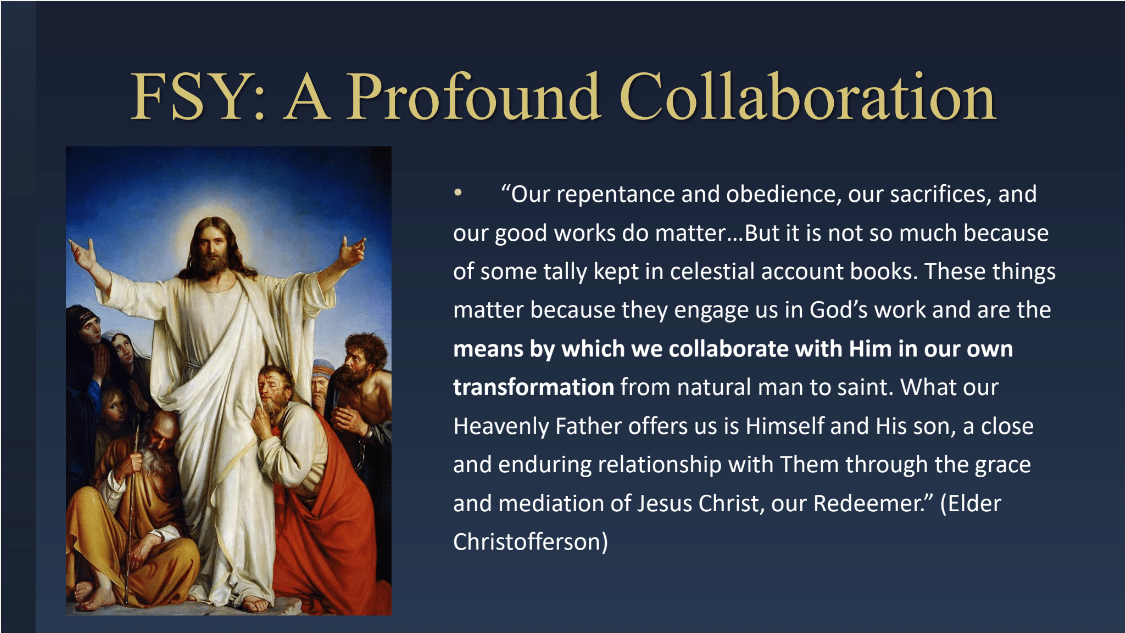
That’s why I think For the Strength of Youth is a profound collaboration with our youth, with them and God coming to know Him and His ways.
As Elder Christofferson said, “Our obedience and repentance, our sacrifices, our good works—they matter, but it’s not so much for a tally to be kept in celestial account books. These things matter because they engage us in God’s work and are the means by which we collaborate with Him in our own transformation from natural man to saint.” What that means is we have to move from perfectionism to a desire for intimacy.
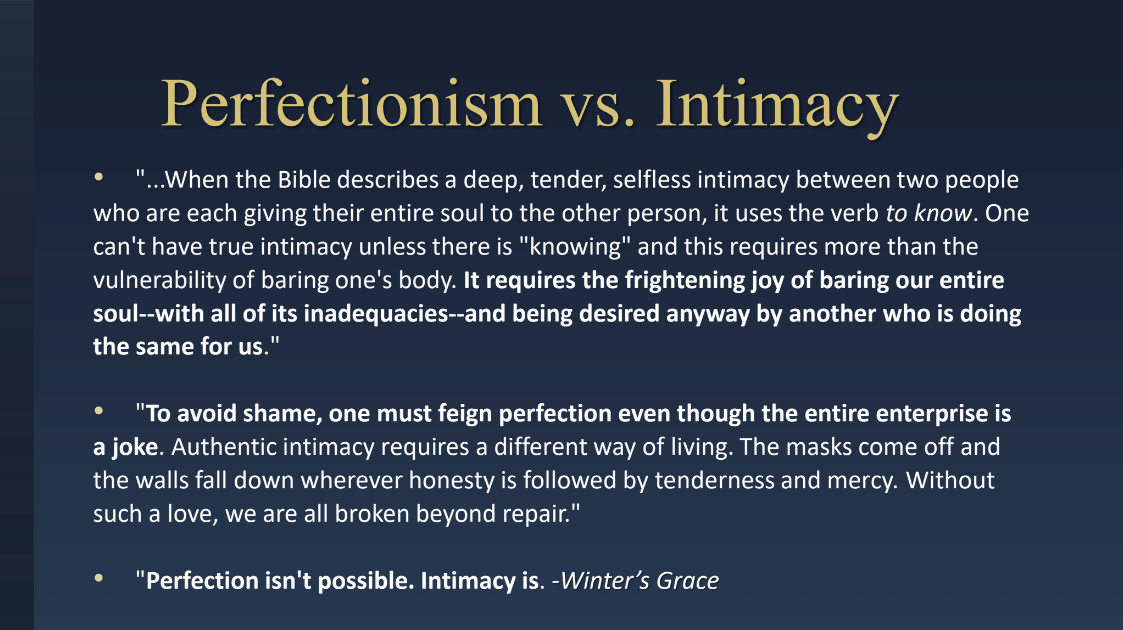
Perfectionism vs Intimacy
This quote from William Coats has become very powerful to me. He’s not a Latter-day Saint, but a writer. He says, “When the Bible describes a deep, tender, selfless intimacy”—which is the meaning of hesed, covenant, “between two people who are giving their entire soul to the other person, it uses the word to know. One can’t have true intimacy unless there is a knowing, and this requires more than the vulnerability of bearing one’s body. It requires the frightening joy of bearing our entire soul, with all of its inadequacies, and being desired anyway by another who is doing the same for us.”
Avoiding Shame
Most of us struggle, wrestle with this feigning of perfection to avoid shame in ourselves, even though, as he says, “the entire enterprise is a joke.”
Oh, to have Elders Quorum and Relief Society meetings where we could feel safe to acknowledge our weaknesses, knowing that those in the room will mourn with us, bear with us, strengthen and comfort us, rather than hiding behind our perfectionism, thinking that we can somehow prove to everyone that we are worth something and that we belong. Perfection isn’t possible. Intimacy is—and intimacy with Christ, as we learn from Moroni, is perfection.
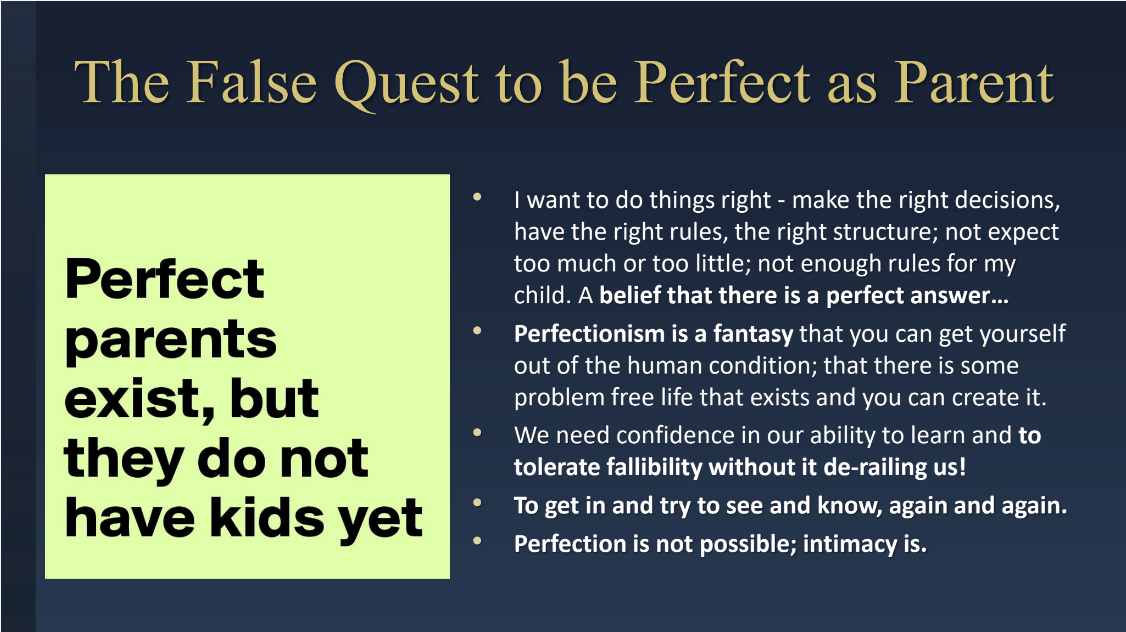
The Perfect Parent
Now, this has to do with parenting. I’m the first to say it: I started parenting with a magnificent list of all the things I was going to do well. After all, I had a PhD in family science and came from a family with much strength and capacity. So, I intended to unload all of my “wisdom” and shape these little people into just what I wanted—not realizing that, in my perfectionistic ordeal, I was blockading intimacy, seeing and knowing them, and allowing them to see and know me.
The truth is, we all want to do things just perfectly. We want to have the right rules, the right structure. We don’t want to expect too much, nor do we want to expect too little. It’s horrible, isn’t it? There’s this belief that there is some perfect answer out there. But perfectionism is a fantasy that you can actually escape the human condition—that there exists some problem-free life, a perfect parent, perfect family, and perfect life that, if I just did everything perfectly, I could create. What a denial of a Redeemer!
Tolerate Fallibility
We need confidence in our ability to everyday, self-confront the weakness we have, even in the presence of our children. To tolerate that fallibility without it derailing us. To get in the ring and try again, and again, to see and to know them. Again, perfection is not possible, intimacy is.
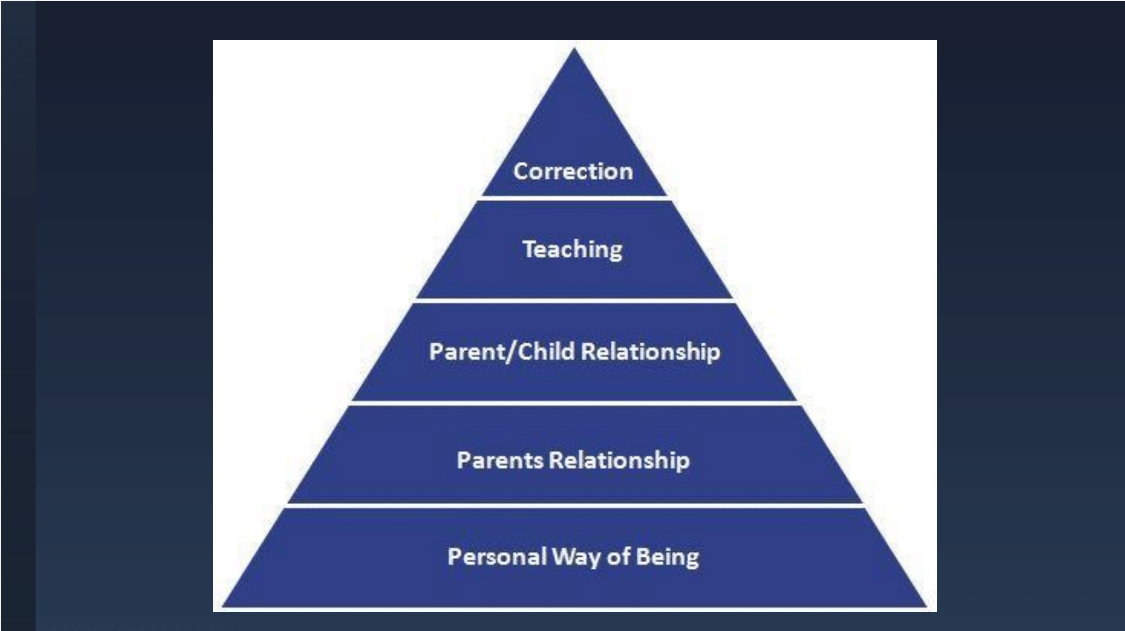
That’s why the Arbinger Institute has been so powerful in telling us that parenting is grounded in relationships, and those relationships help us determine what to do. When a child needs correction, we are encouraged to go to the place beneath it to find out what’s really going on. What is your relationship with them like? What is your relationship with your spouse like? And at the core of it all, what is your way of being?
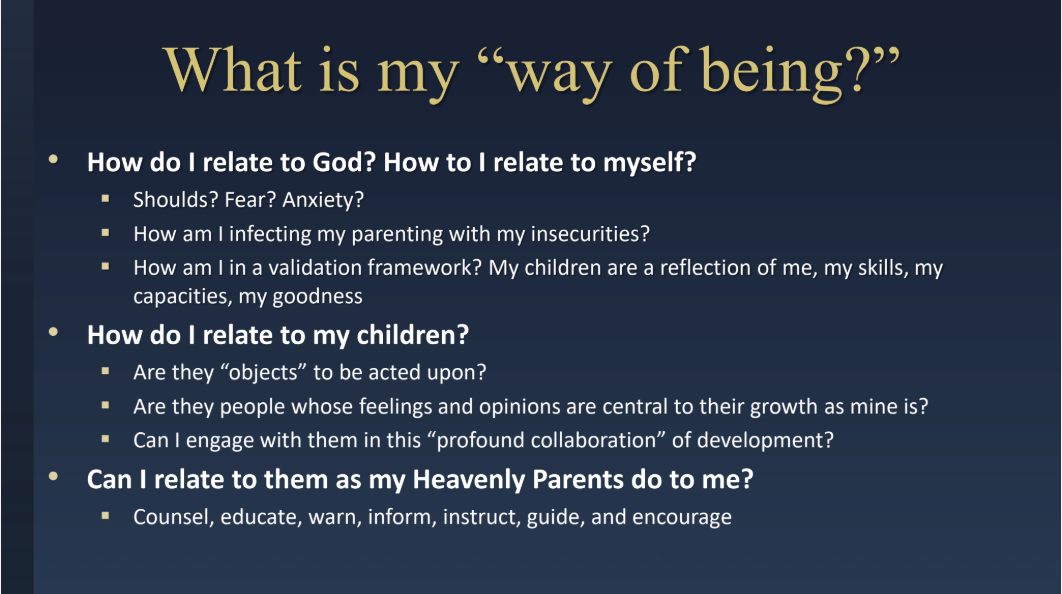
Way of Being
I’ve thought a lot about this concept of way of being. I think it’s asking questions like, “How do I relate to God? How do I relate to myself?” Am I bound up in shoulds, fear, and anxiety? I’ll be the first to raise my hand and say, “Yes, I am; I do tend toward that.” How am I affecting my own parenting with my insecurities and desire for control to manage my own anxiety? How am I in a validation framework, seeing my children as reflections of me—perhaps the most powerful reflection of me? I assume they reflect my skills, capacities, goodness, graduate work, and teaching. In that mindset, I feel I have to control them to manage my image of myself.
Do I relate to them as objects to be acted upon, or do I see them as people whose feelings and opinions are central to their growth, whose process of moral development is like mine? Can I engage with them as God engages with me—counseling, educating, warning, informing—and in attunement based on my openness to who they are?
Higher & Holier Way in Parenting
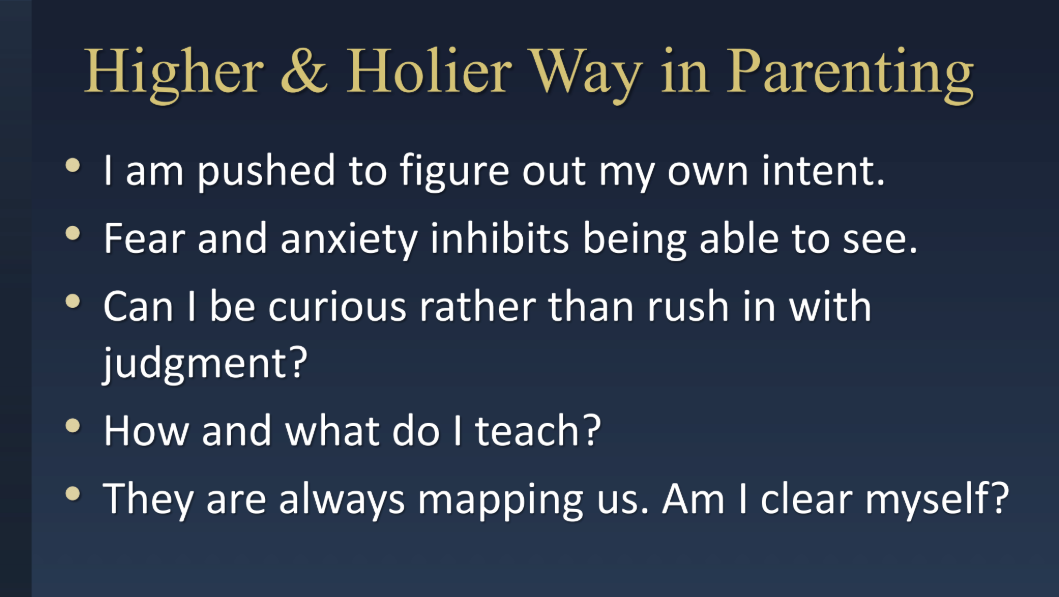
This is what For the Strength of Youth is doing, ironically, perhaps, it is inviting higher and holier parenting, and higher and holier leadership with our youth.
It’s pushed me that way. I have to ask myself, as I have debates about modesty or discussions about what’s right or wrong, I must get very clear about my intent. Is this about my own image, or fear, or control? My fear and anxiety will always inhibit my ability to see clearly. By nature, when a child does something I think is wrong, my tendency is to rush in with judgment and fear, but that reaction blinds me from being able to truly see them and understand what is needed.
The far better approach is to be curious. Why? What is their behavior telling me about them, their needs, and desires? And then I ask, how and what, then, do I teach? The tragic part of it all is that children are always mapping us; they map us very well, from beginning to end.
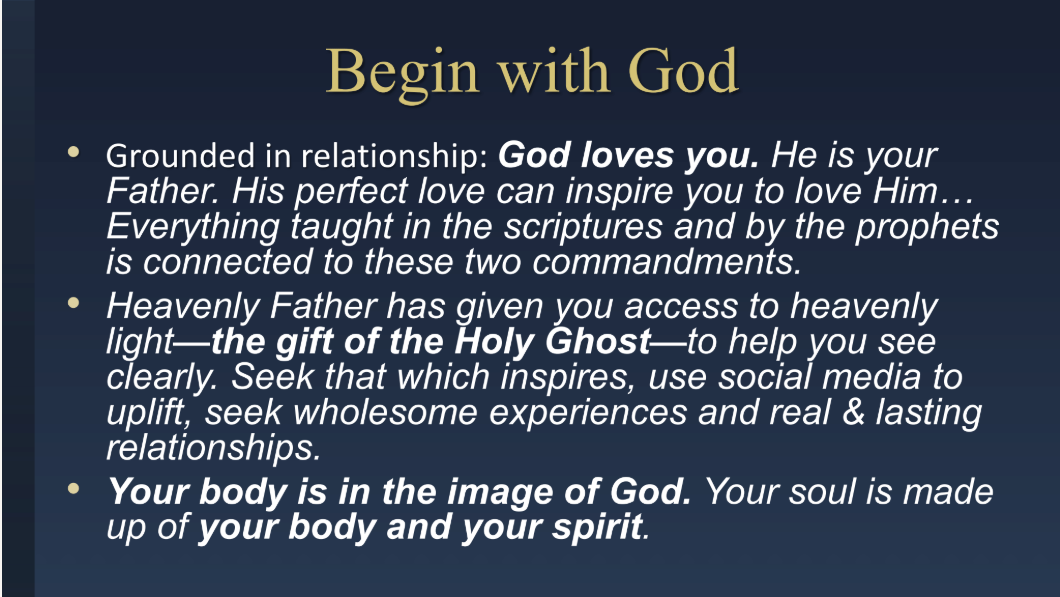
Begin With God
Am I clear myself? That clarity begins with this truth: in every instruction, I must begin with God. It’s grounded in the truth that God loves them, grounded in the powerful principles articulated in For the Strength of Youth: that they have been given the gift of the Holy Ghost because God wants to be with them, and that the Holy Ghost is the medium on Earth through which we can be with God always. He has given them access to His holy light out of love.
Another beautiful statement in the guide emphasizes, “Your body”, if we get more specific, “is in the image of God; your soul is made up of your body and your spirit.” These are the truths that a child must be deeply grounded in.
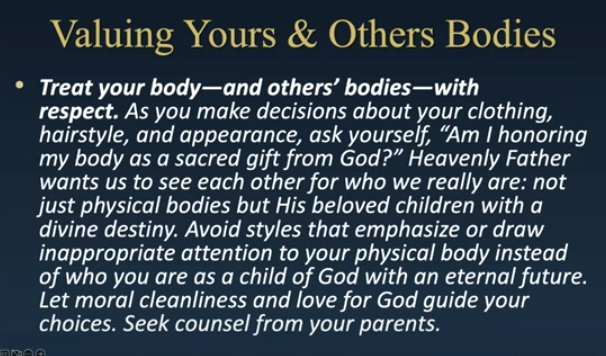
Valuing the Body
This understanding means that they are invited to treat their body, and the bodies of others, with respect out of love.
I love this beautiful statement and how it grounds us in a true understanding of intimacy: “Am I honoring my body as a sacred gift? Heavenly Father wants us to see each other for who we really are—not just a body, but His beloved children with a divine destiny.” And then it says, “Avoid styles that emphasize or draw inappropriate attention to your body instead of who you are.”
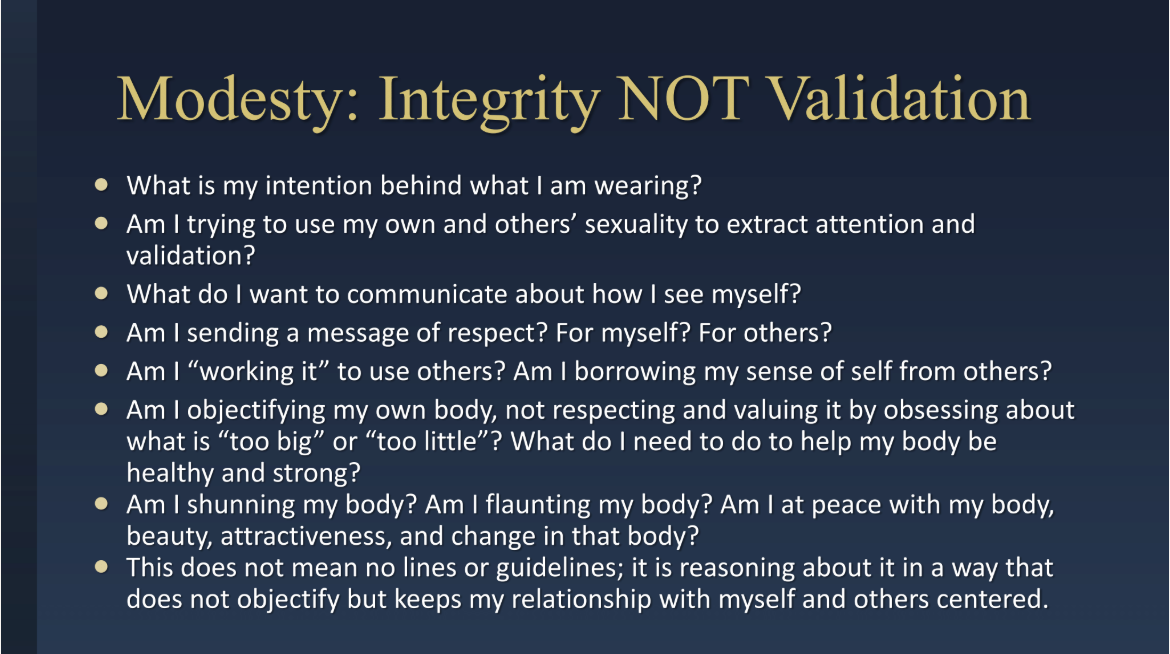
Modesty is Integrity not Validation
What that means is that when we’re teaching modesty, we’re approaching it not from a validation framework but by asking deep questions. For a young girl or boy, we invite them to think about questions like:
- What is my intention behind what I’m wearing?
- Am I using my own or others’ sexuality to extract attention and validation?
- What do I want to communicate about myself and how I see myself?
- Am I sending a message of respect for myself and for others?
- Am I using the gift of my body to manipulate or use others?
- Am I borrowing my sense of self from others?
- Am I objectifying my own body by obsessing over what is “too big” or “too little,” rather than asking what I need to do to help my body be healthy and strong?
- Am I shunning my body, or am I flaunting it? Am I at peace with my body, its attractiveness, and the changes a woman, in particular, will experience in her body?
This does not mean there are no lines or guidelines—patterns are very important; children need patterns to learn from. What it does mean is that the focus is always on what my relationship is like with myself and with others. What is my relationship like with God?
Boys and Modesty

Perhaps even more important than girls and modesty is how we address boys. I’ve watched many of my male students struggle deeply with anxiety about their own sexuality—experiencing deep anxiety and even shame about it. How am I anxious about my own sexuality? How am I anxious about women’s sexuality? What do I do with the fact that I notice feminine beauty and feel wired to respond to what I see? Am I “bad” for that?
What am I doing with this potentially very generous trait? Male sexuality has a beautiful gift of generosity in it—the capacity to find joy in looking at the beloved. Can I notice her sexuality and respond with respect for her, or am I indulging in self-serving sexual desire? Am I using another person to gratify something in myself?
Understanding clearly that it is natural and right—this section begins with the statement: “Sexuality is a gift from God.”
It’s an important part of God’s plan. It is natural and right to feel physically attracted, but when I indulge those feelings by dwelling on them or fantasizing about them, my natural and appropriate feelings can lead to harm by objectifying the other person for my own gratification. I am strong when I hold her dignity at my core. I am a guardian of virtue.
Women and Modesty
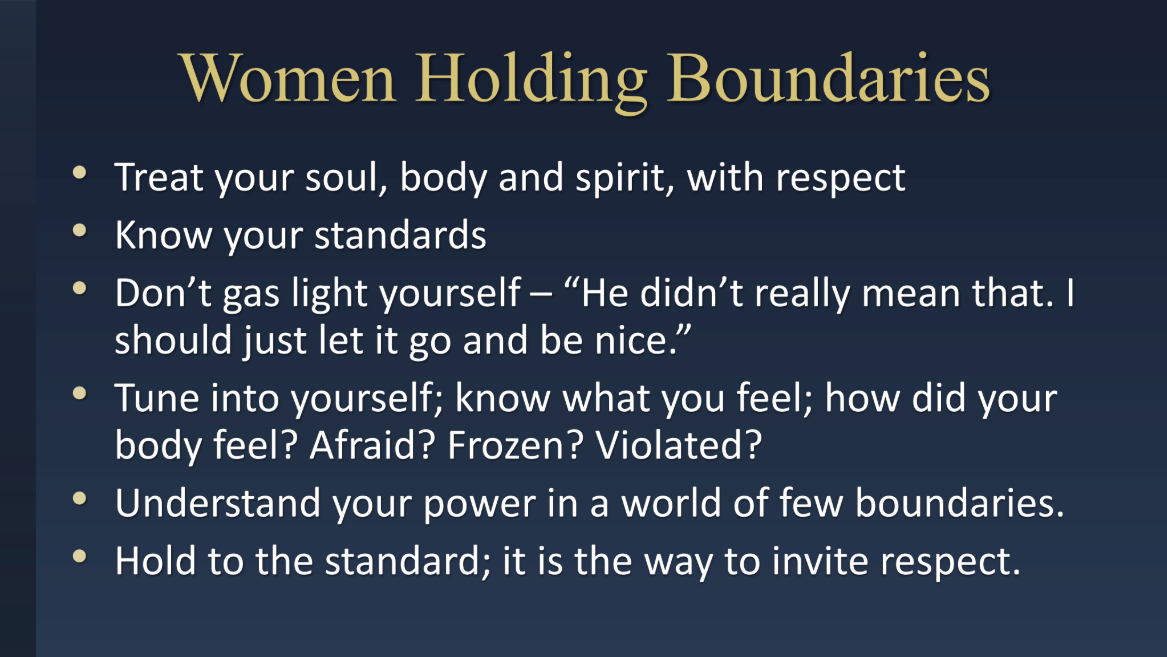
For our young women, if nearly 30% of our adolescents are experiencing some kind of sexual violence or intrusiveness, our girls need to know who they are—treating their soul, body, and spirit with respect. When they are touched inappropriately, it is essential to be clear about what they felt. How did my body feel? Did I feel afraid, frozen, or violated? God desires me to tune into that, not to gaslight myself by saying, “He didn’t really mean that; I should just let it go and be nice,” but to hold to who I am and, in doing so, invite the respect of others.
Important Patterns

I’ll just end with what I think is true about parenting: patterns are very important. What are the important patterns? For me, that has involved some instruction about what I believe modesty looks like—not just telling her to go out and do what she feels like, or what feels good to her, but helping our youth grow up with patterns of what that looks like and means. It means being deeply grounded in the understanding that you are valued as an eternal soul, a divine child of God. You are not a measured behavior or a list of behaviors; you are a soul.
It means
- exposure to good, to create a feeling for what is good.
- teaching them by my example, by respecting their boundaries, so they can understand who they are as individuals.
- it means teaching modesty in the full sense of the word.
I heard a beautiful message from a stake president about For the Strength of Youth, where he described the Savior, Jesus Christ, as the example of modesty—never drawing attention to Himself. In that moment, I recalled many times I had used my body or clothing to draw attention to myself. This is something we grow in. We’re all learning to be more modest, more meek, more humble, more like the Redeemer.
The beautiful truth is that He walks with us in covenant relationship the entire way to help us know what that looks like and to give us the power, through His love, to become it. I bear testimony of that. I know that love and connection are the goal.
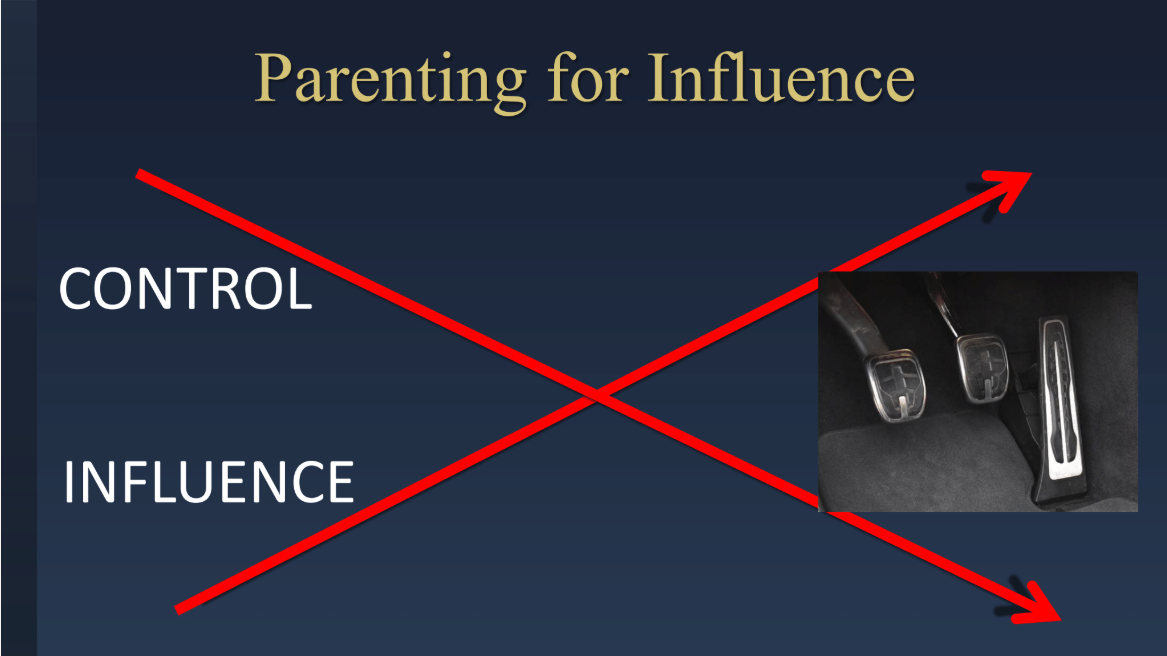
Parenting for Influence
This example from a wonderful therapist describes how, when children are young, there is a need for control—they need direction and guidelines. As they develop, the need for control goes down, while the influence we have over them goes up. The most meaningful example of influence is when an adult child comes to ask your opinion: “What do you think, Mom? What do you think I should do?” Then you know there is a relationship solid enough that they trust you and seek out your influence.
It’s not unlike that stick shift where we pull up on the clutch and push down on the gas at just the right time, not to stall the car in their development.
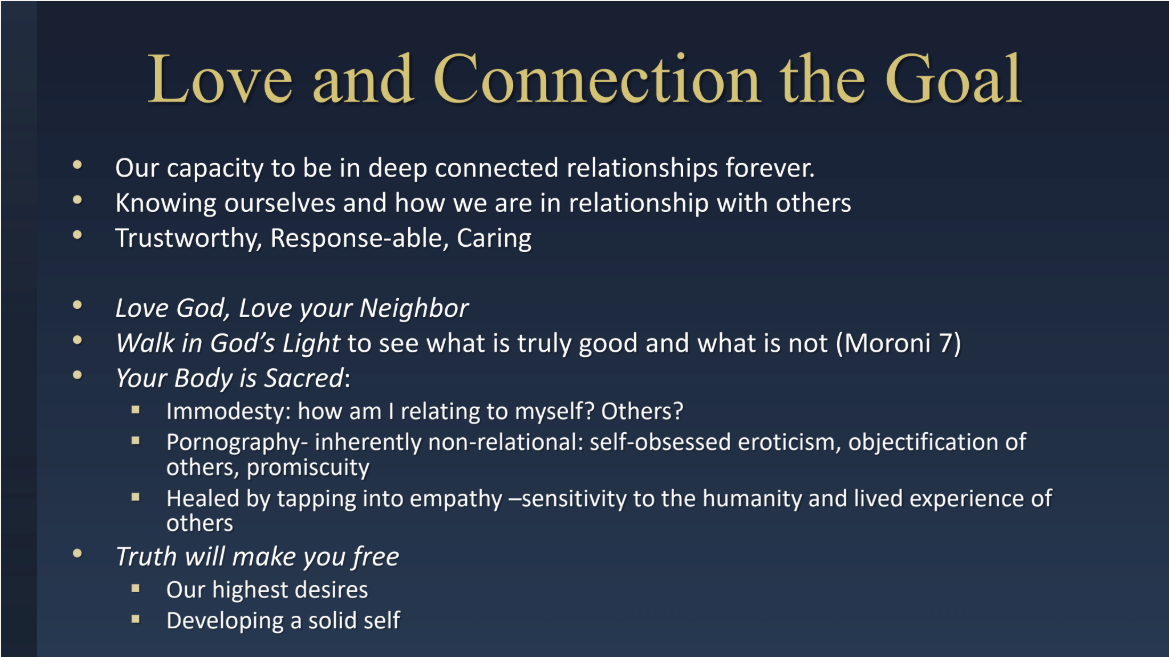
I believe love and connection are what God intends for us—that the design is for us to develop the capacity for a solid self, one who can be in a deep, intimate relationship with our Father in Heaven, our Mother in Heaven, and our brothers and sisters for eternity. I believe For the Strength of Youth is pushing us in that most powerful direction. It is revelatory, and as we study it, we will find that truth. In the name of Jesus Christ, amen.
Q&A
Is the New Standard only for those who are already strong?
Scott: Okay, we have a few questions now. Some of these came in early in your talk, so you may have covered them earlier. It seems like the current For the Strength of Youth guidelines were designed for the strongest of the strong, whereas the old guidelines were designed for the weakest of the weak. I worry about those who come from broken homes, with less active parents, non-member homes where they aren’t taught what chastity is, where behaviors like listening to appropriate music and entertainment aren’t modeled by parents, and where spirituality doesn’t exist in the home.
Jenet: Yeah, such a powerful question. I think any of us that come from a fear orientation might feel, “We’ve got to get out and save the people; they don’t have it!”
I think what you all know from experience is that the decision to live one’s life in alignment with light and truth is grounded in a true understanding of who I am, God’s love for me, and who He is. That’s why For the Strength of Youth grounds us in those principles. Nothing could be more powerful to help a young person who doesn’t know who they are than to learn who they are. And then, I think we, as my husband would say from his experience of having no sense of guidelines around some things, what a gift it is to give some direction and say, “This is what it looks like for me.”
For example, the garment provides a pattern to help us understand what modesty looks like, and even being explicit about those kinds of things, but grounding it in truth about who we are, who they are, and who God is.
How do we know what modesty means?
Scott: So, this one came in earlier: I’m a little confused. How is a 13-year-old supposed to know she shouldn’t wear only straps if it’s not written or taught by her parents that we wear modest clothes? Would she even know what modesty means?
Jenet: That’s a fantastic question because we live in a highly sexualizing culture. That’s why I think we have to take this seriously. We’re not just in a vacuum; children aren’t just developing these truths in a vacuum. They are being taught all kinds of other things around them all the time. And that’s why I think it’s important to realize, this was not a diminishment of standards; it wasn’t a removal of standards. It was grounding it in truths that are beyond standards. And from those truths, we come to a clarity about what those standards should be.
Scott: Is it still appropriate for Church leaders to set standards, like modesty standards, for church activities?
Jenet: I know that we’ve been instructed in Young Women and other meetings not to mention that kind of thing at Girls Camp. Not to bring it up or say anything about someone’s dress. And I think what we’re learning is that there are times and places that are better for maybe describing some of those standards. Grounded in relationships and in the truth about who we are in relation to God. This doesn’t mean there’s no place for those kinds of instructions to be given, but we need to be thoughtful about how to best help that youth internalize those truths.
Scott: I’ve seen times when youth have been embarrassed at an activity. And so it’s like, why would they want to come just to be embarrassed? That’s not good.
General Misunderstanding about sexual purity and modesty
I have observed that, increasingly, resistance or misunderstandings about teaching sexual purity and modesty aren’t always coming from the girls. Sometimes, it’s from their mothers and Young Women’s leaders. Perhaps they’re weary. How might we teach modesty through the lens of covenants and prepare our young women to attend the temple? When sacred garments help bolster parents and leaders who may not be on board?
Jenet: Yes, I think we have to appreciate that our mothers have also grown up in a highly sexualizing culture. Many of us are struggling with a clear sense of self, our bodies, and our self-image. So, this is not just for youth; it’s for parents, too, to come to clarity about who they are. Am I using myself in a way to extract validation? Am I trying to figure out the line and just cross over it? Or acting from a place where I’m making choices based on what I truly believe is right and good for my highest desires? It’s a journey for parents as well.
At odds with understanding righteousness
Scott: Two more quick questions here. People laughed when you told about the 13-year-old who prayed and concluded that God would love her no matter what she did. But what is the resolution when people feel that integrity to themselves puts them at odds with our understanding of righteousness?
Jenet: Yes, I think all of us, in some ways, are at odds with righteousness, if the truth be told. We are all on a journey in covenant relationship with Christ, moving toward ever greater purity. I know that’s true about me; I know that must be true about all of us. I’m so thankful for a God whose love will not end. He will not leave us. If we are willing, He will reveal Himself to us in His purity and goodness and invite that purification in us. I believe the closer we draw to Him, the more we come to know Him. That’s what happens.
Scott: Okay, I’m not going to read this. I’ll just let you read that. It says: Not a question.
Jenet: “Thank you. Not a question, but I felt peace through your talk.”
Scott: Yes, that’s very good. All right, thank you very much for your time.
TOPICS
For the Strength of Youth
Modesty
Parenting
Youth
Chastity
