About Following Al Carraway
Well, it’s very good to be with you all today. I’m excited to be here. It’s a little daunting following Al Carraway and speaking. I think, in terms of energy levels, she’s kind of like the legendary rock group AC/DC, and then I’m kind of like the adult contemporary icon Kenny G. So, you have that to look forward to with this presentation.
A Historian’s Background
I also—usually when I speak—I’m a historian, and I have specialized in two disparate areas. One is Joseph Smith—I worked on the Joseph Smith Papers for a long time—and the other is the beet sugar industry of Utah, which I probably shouldn’t have said because now you’re all thinking, why aren’t you talking about the beet sugar industry of Utah?
And I apologize that I’m not—but I’m not today. Usually, when I talk about that, there’s about two people in the audience, so it’s fun to actually have a crowd here today to be speaking. And I hope you’ll indulge me, because what I’m talking about today is much more personal than what I would usually do in an academic paper.
A Heritage of Faith
So, to begin here—I come from a long line of Latter-day Saint ancestors on both my mother and my father’s side. They converted to The Church of Jesus Christ of Latter-day Saints in the 19th century, and they gathered to Zion thereafter. Their faith and devotion to the Church have been a great strength to me in my life.
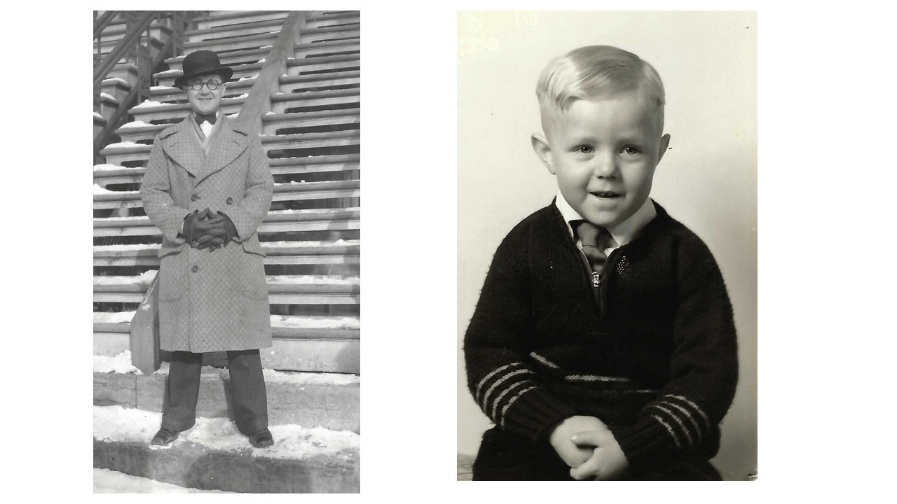
I enjoy reading about their experiences. Growing up, I heard family stories about being touched by the Spirit. My grandfather Godfrey—pictured here as a missionary—talked about going on his mission to Canada. When he went on his mission, he did not believe that he really knew that the Church was true. So, he made a point, when he was bearing his testimony, of not saying “I know.” Instead, he would say, “I believe.”
A Missionary Experience
One evening, as he spoke in a sacrament meeting, he had a spiritual experience. He said the Spirit stopped him from talking and shook him. He heard a spiritual voice in his ear say, You know it’s true. Tell these people you know it’s true. He said, “I did, and I will always remember that wonderful feeling I had.”
My Father’s Faith
When I was young, I often attended firesides that my father, Kenneth—who was in Church education his entire career and who was a popular and dynamic speaker—gave. One story that he liked to tell was about an experience that he had when he was just a young boy. This was him about the age of three—I think this experience happened when he was five.
He and his pet dog were out with his father one day, and they were on their farm repairing an irrigation ditch. Well, my grandfather was—I don’t think my five-year-old father was much help there—and so he and the dog were playing as my grandpa did this. As they did so, they lost track of time.
A Child’s Prayer
Suddenly, Kenneth realized that he could no longer see his father. Not knowing what else to do, he knelt down on the ground and decided to pray. And I love this part—he instructed his dog to kneel too. He said that his dog had his front knees on the ground and his back feet sticking straight up. Doing this, Kenneth then said aloud a prayer: “Heavenly Father, help us find our father.”
His father, who was just in the bottom of the ditch and heard the prayer, straightened up so that Kenneth could see him. At that moment, Kenneth said he realized that Heavenly Father answers prayers—and quickly too.

My Grandmother’s Struggle to Feel the Spirit
As I grew older, I realized that not all of my family members had such strong spiritual experiences. My grandmother Godfrey, for example, was a devoted Latter-day Saint but struggled to feel the Spirit.
In 1979, at the age of sixty-nine, she and my grandfather were called on a mission to New Jersey. At the time, my grandmother was just in the beginning stages of Alzheimer’s disease, a disease that would eventually take her life—but not for another fifteen years. After this, in 1979, however, she still had most of her mental faculties, and so she was deemed fit to serve with my grandfather on this mission.
The Sacred Grove
One day, toward the end of their mission, my grandfather and grandmother went to Palmyra, New York, and visited the Sacred Grove. At twilight, they knelt down and they prayed together. As they started to leave the grove, my grandfather noticed that my grandmother was crying. He asked her what was wrong. She answered, “I’ve heard you talk all my life about that warm, good feeling in the heart—and now I feel it.”
It was only at the age of seventy that she believed she had finally felt the Spirit. But she had not let that stop her from living a life as a dedicated member of the Church. She had persevered for decades before finally receiving that comforting feeling.
Facing Spiritual Silence
My grandmother’s experience speaks to me because I have had many moments in my life where God has seemed distant and where I’ve struggled to feel the Spirit. I don’t know the reasons why my grandmother and I experienced these kinds of moments, but they are definitely real.
So today, I’d like to focus on how I have dealt with moments—and extended time periods—of spiritual silence. In doing so, I’m using examples from a book that I recently wrote, published by Deseret Book, called God Knows You.
You Are in Good Company
In approaching this subject, I would first like to acknowledge that if you—like my grandmother and me—struggle to feel the Spirit, you are in good company. Even the Prophet Joseph Smith had moments where God did not answer his questions immediately, which I’ll talk about in a few minutes. Struggling to feel the Spirit does not mean that you are unworthy, lack faith, or are not loved by God.
It does not mean that He regards you as something less than those who regularly feel directed by the Holy Ghost. It just means that, for whatever reason, it takes greater effort for you to feel God’s presence—and that’s okay. Sometimes it is in the struggle that we achieve the most spiritual growth.
As I have dealt with these moments of spiritual silence, there have been several things that have helped, which I’d like to talk about today.
Checking Expectations About Revelation
One of these is to try to check my expectations about revelation. Sometimes in the Church we make it seem as though if we are worthy and have enough faith, revelation will just flow from God to us without any effort on our part. We can also think that God will answer every question we have—and will do so quickly.
But I’ve learned in my life that these expectations are not realistic, at least not for me. Let me share some examples and thoughts along these lines.

A Difficult Decision
About fourteen years ago, I had an experience that was a little unsettling. My family and I—pictured around this time—had been living in Montana for several years. I worked as a historian for a historical and archaeological consulting firm.
We loved where we lived. It was a beautiful place, and we thought we were going to be there forever. Then a new opportunity arrived. I was offered a position with the Joseph Smith Papers in the Church History Library in Salt Lake City. The position seemed exciting to me, but it would require an entire upheaval of my family. So, my wife and I fasted and prayed about it.
We discussed it. We prayed some more. Sometimes I felt really good about accepting the position, and sometimes I didn’t. It depended on the day—and sometimes on the hour—as to how I felt about it. This lasted for a couple of weeks. Finally, we had to make a decision, but neither my wife nor I felt really good one way or the other.
Moving Ahead with No Clear Answer
We didn’t feel like we had a clear answer. Even so, we moved forward. I accepted the position, and we prepared for the move. Over the three months between accepting and moving, I continued to vacillate between feeling good about what we were doing and feeling unsettled about it. Things seemed to fall into place with our move, but I still wanted some reassurance from God that we had made the right decision.
That reassurance never came—at least not in a way that I recognized. I still wonder about this today. Why didn’t the Lord just give my wife and me clear guidance? We had done what I had been taught to do all my life: fast, pray, study things out, make a decision, and go to the Lord for confirmation. But I didn’t get a burning in the bosom, a voice in my head, or even a clear feeling of peace.
Elder Oaks’s Counsel
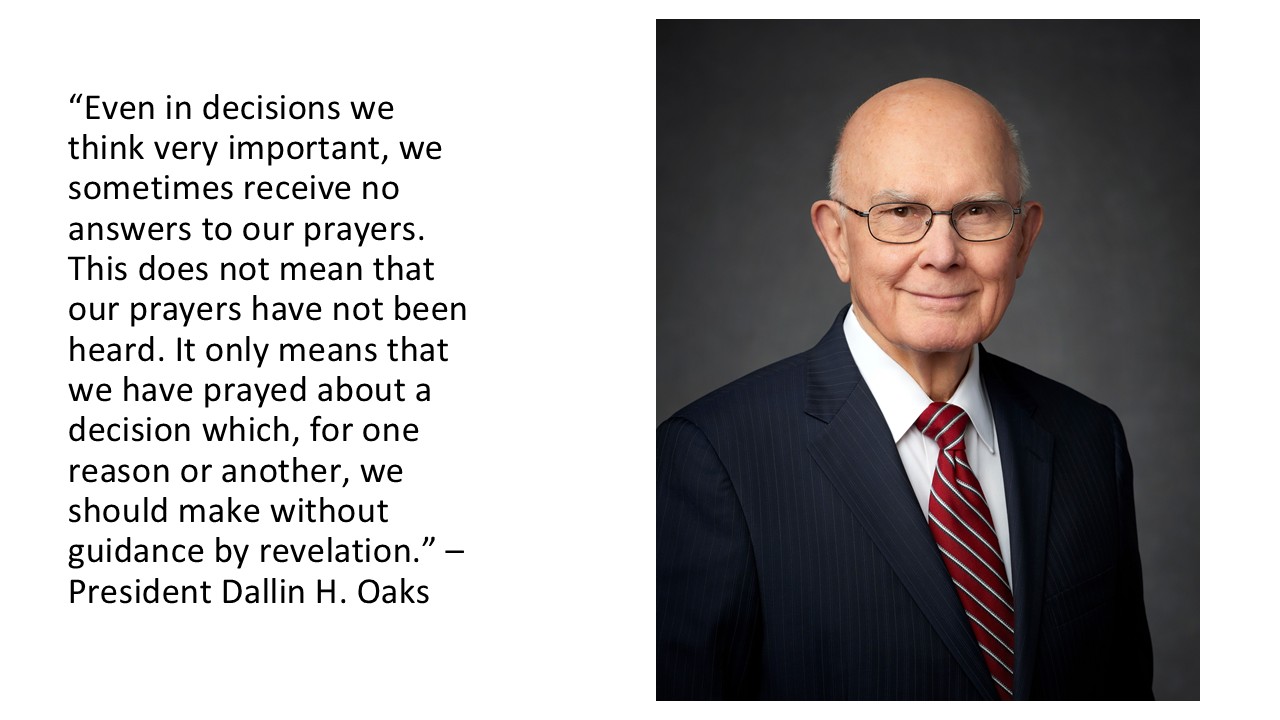
Many years later, I listened to a talk that Dallin H. Oaks gave at a Brigham Young University devotional in 1981, when he was a member of the Utah Supreme Court. This talk helped me gain a little more understanding into this experience. President Oaks taught:
“Even in decisions we think very important, we sometimes receive no answers to our prayers.
This does not mean that our prayers have not been heard. It only means that we have prayed about a decision which, for one reason or another, we should make without guidance by revelation.”
These words ring true to me. Sometimes God just trusts us to make a good decision. But that doesn’t mean that these words are easy to accept.
It’s sometimes challenging to think that God will not guide our every decision, especially ones that feel important and of great consequence. Sometimes, though, we just have to press forward—especially when we have done all we can to seek the Lord’s direction—and trust that He won’t let us go astray.
Revelation Takes Work
That brings me to another point. I’ve learned in my life that revelation takes work—and this is sometimes a hard concept for me. We live in a world where we can search for something on the internet, or ask a question of Alexa or Siri or AI assistants, and receive immediate answers. It doesn’t require much work on our part, so I sometimes feel like I should be able to ask God a question and He should just tell me the answer immediately.
But that’s not how God always works. Here are a couple of experiences that illustrate this.

Joseph Smith and the First Vision
The first deals with Joseph Smith and the First Vision. Sometimes when we talk about what led Joseph to the Sacred Grove, we condense the timeline. We tell it like this: Joseph went to a couple of revivals. He became confused about which church to join. He read James 1:5–6 in the Bible and he went into the woods to pray. And then Heavenly Father and Jesus Christ appeared—and it all seems like it happened within a couple of weeks, maybe.
But in reality, Joseph wrestled with questions about forgiveness, sin, and mercy for a long time before the First Vision happened. In fact, Joseph started to wonder about these spiritual things when he was just twelve years old.
He started pondering at that time how he could be forgiven of his sins and which church could help him with that. For the next two years he studied his scriptures.
- He thought about these questions.
- He talked to people—religious leaders, parents, probably his brothers and sisters.
- He put in work.
And because of that, he was prepared to receive inspiration about what to do when he read James 1:5–6.
Alma the Younger’s Effort
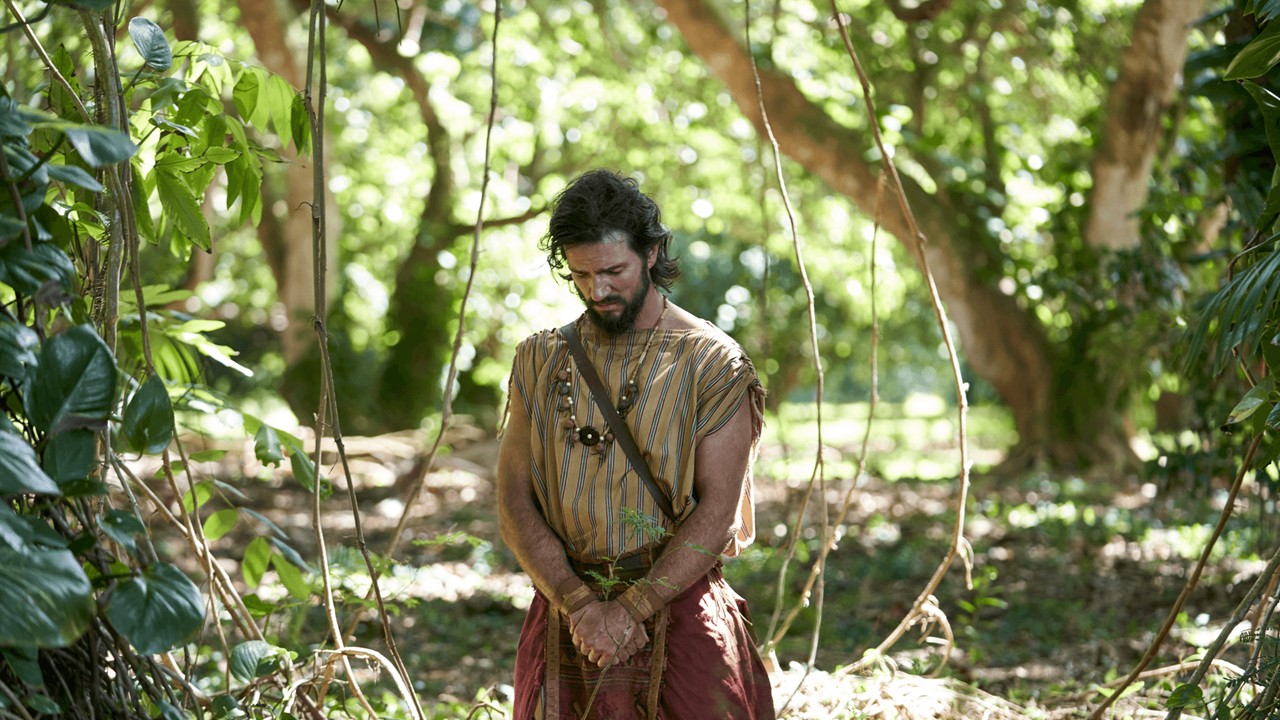
Another example comes from the Book of Mormon and Alma the Younger. You remember the story. Alma was the son of the Nephite prophet Alma. His father was loved by the Nephites and had helped many come unto Christ. But Alma the Younger was not like his father. He didn’t believe in Jesus Christ. He didn’t believe in the gospel. In fact, he spent most of his time trying to convince people that the Church wasn’t true.
The Book of Mormon says that Alma was a great hindrance to members of the Church. His whole purpose in life was to destroy faith in Jesus Christ. Being concerned about his son, the prophet Alma prayed and fasted. So did many members of the Church. Because of their prayers, an angel appeared to Alma and his friends and called them to repentance.
He told Alma that he needed to stop trying to destroy the Church and remember the great things that the Lord had done for his ancestors. Now, in the past, I always thought, this is where Alma gained his testimony. It would be pretty difficult for me to not believe if an angel called me to repentance. But that experience was not enough for Alma to truly believe.
Alma tells us that he got his testimony after he, quote, “fasted and prayed many days.” End quote. He put in work—and because of that work, he received a testimony by the Holy Spirit of God.
Nourishing the Seed
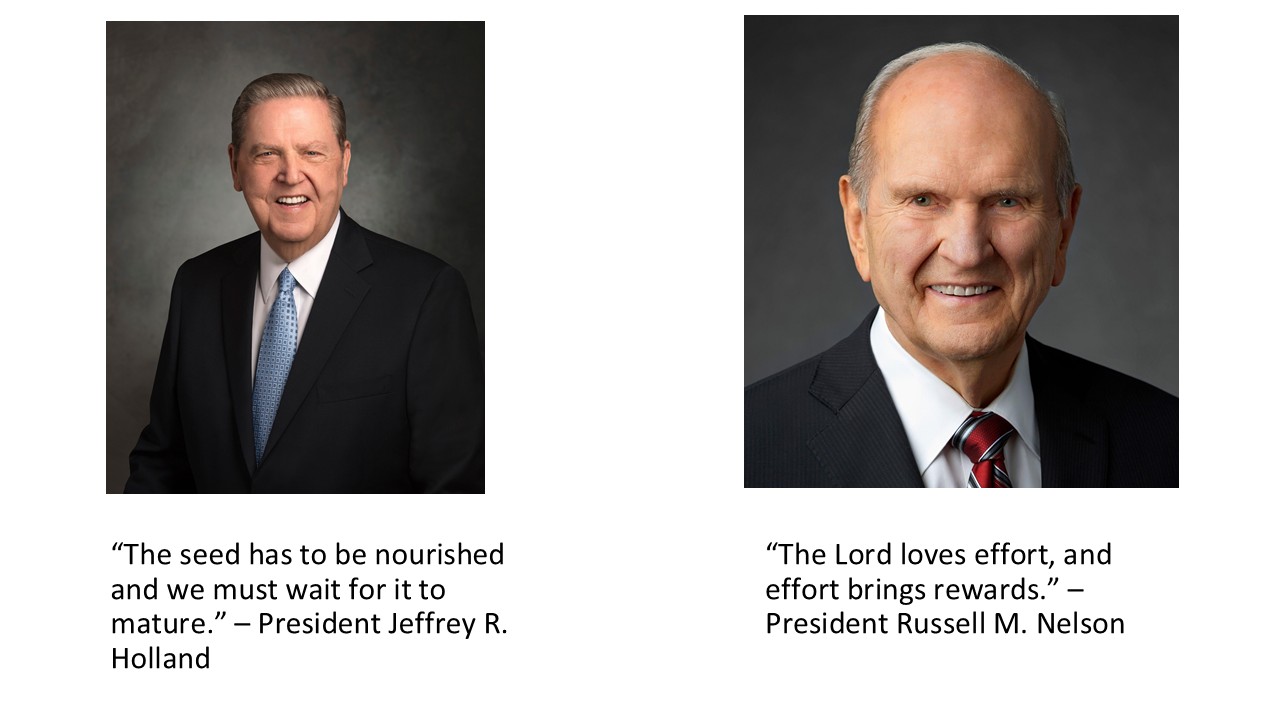
This makes me think of some things that our prophets and apostles have taught. President Jeffrey R. Holland said, “The seed has to be nourished, and we must wait for it to mature.” When we plant a garden, we don’t throw a seed in the ground and immediately see a plant.
- It takes time.
- It takes sunlight and water.
- It takes work.
It’s the same thing with receiving revelation. In the words of President Russell M. Nelson, “The Lord loves effort—and effort brings rewards.” And when you think about it, that applies to pretty much anything that we try to do.
Effort Brings Results
About a year ago, I decided that I needed to start doing something to build up my upper body strength. Aside from high school, I hadn’t ever really lifted weights before, so I started to go to the gym on a regular basis. And here we are a year later—and you can tell I am ripped, right? I’m jacked right now, right?
(Makes me sad that you’re laughing at that.) So—no, I’m kidding. At times it’s a little frustrating because I don’t necessarily see visually the results I would like to see, but I know that I am stronger now than I was a year ago—and it’s all because of the effort that I’ve put in.
So similarly, when it comes to receiving revelation, we have to put in work. Sometimes, if I’m feeling as though God is distant and that He is not giving me direction and guidance, I try to look at what I’m doing to receive that guidance. Am I studying things out in my mind? Or am I pondering? Am I writing down spiritual impressions? Or am I just asking the question and expecting God to answer me without any real effort on my part?
Waiting on the Lord
Another important principle is that just as we have to wait for a plant to grow from a seed or to see a muscle develop from lifting weights, we sometimes have to wait for answers from the Lord. Answers come according to God’s timetable, and He waits until we’re ready.
Now, it’s not easy for me to wait for answers. I’m a very impatient person. My family will tell you that—especially when they’re with me in the car and we’re in traffic. I am not patient at all. But I’ve learned over time, and especially through the work that I did on the Joseph Smith Papers, that even Joseph Smith sometimes had to wait for answers from the Lord. So it’s not unusual if we have to wait for answers.
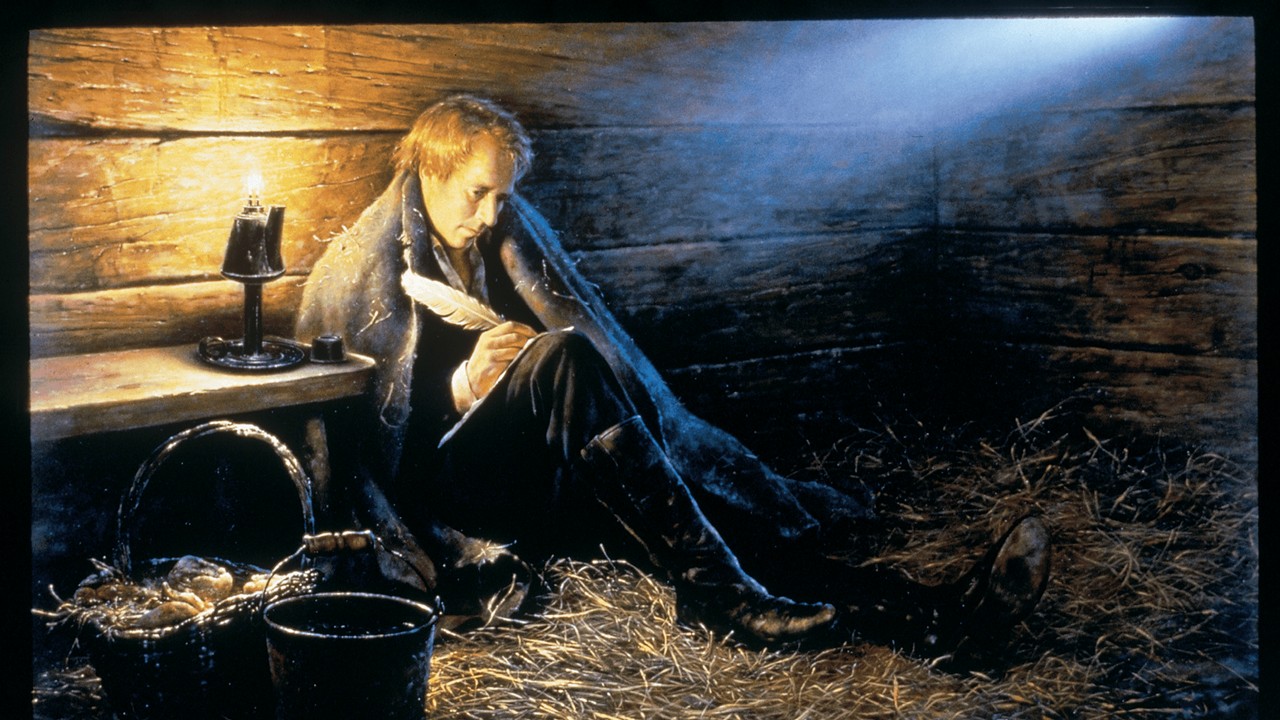
Joseph Smith in Liberty Jail
One experience—when Joseph was in Liberty Jail in the winter of 1838 to 1839—the Saints had just been kicked out of the state of Missouri under the extermination order issued by Governor Boggs. Joseph had been arrested.
- He faced an unknown future.
- He didn’t know what was going to happen to him.
- He didn’t know what was going to happen to his family.
- He didn’t know what was going to happen to the Saints.
And Liberty Jail was not a great place. If you’ve been there and seen it, you know that it was not comfortable. It was cold and drafty. The food was so bad Joseph could barely eat it. And in these conditions, Joseph searched for comfort. He wanted God to explain to him why these things had happened—but the answers weren’t necessarily coming.
After he’d been in jail over three months, Joseph cries out, O God, where art thou? And where is the pavilion that covereth thy hiding place?
Now, I haven’t ever experienced what Joseph did in Liberty Jail, but I have had moments where I’ve wondered where God was. There are times when life seems unfair—when we find ourselves trying to deal with hard things.
At those times, we may also cry out, O God, where art thou? Do You know what’s going on in my life? Why aren’t You helping me now? These moments can be difficult when we feel God isn’t answering us. It’s hard.
But even if we have to wait for a period of time, the comfort and answers we need will eventually come. They came to Joseph in Liberty Jail—and I’ll talk in just a couple of minutes about how those answers came about. The Lord eventually told him, My son, peace be unto thy soul. So we can also feel that same comfort as we pray for it and seek it.
Again, from President Holland—he taught us that faith…
Trusting God in All Circumstances
President Jeffrey R. Holland taught that faith means trusting God in good times and bad—even if that includes some suffering until we see His arm revealed in our behalf. So when we’re going through suffering, when we’re feeling as though we’re not getting through to God in these moments, I’ve found it’s important to rely on the support of family and friends.
Their love can be a key factor in helping us feel the Spirit again.
How Section 121 Came to Be
Now, kind of going along with this, let me remind you about how we got Section 121 in the Doctrine and Covenants. This section was put together by Apostle Orson Pratt in 1876 under Brigham Young’s direction. Orson took parts of a letter Joseph had written to the Saints in March 1839 from Liberty Jail and put those parts together.
So, when you read the section today, it looks like a revelation that God gave to Joseph Smith all at once. But in reality, it is bits and pieces of revelation that the Lord gave to Joseph, over time, in the jail.
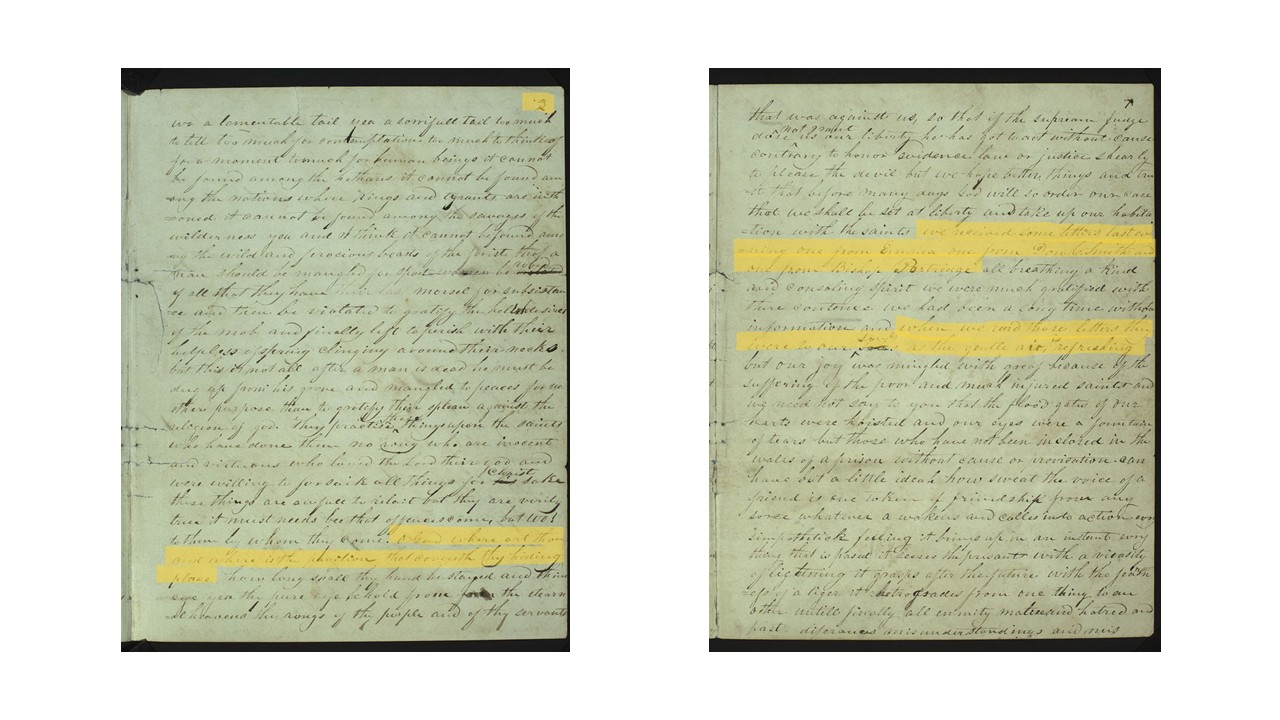
I already mentioned how God tells Joseph Smith in the jail, “Peace be unto thy soul,” after he cries out, “O God, where art thou?” When you read Section 121 today, it seems like God immediately gave him that peace. But when you look at the full letter—not just what’s in the section—you’ll see that the answer wasn’t immediate.
In fact, there are several pages between Joseph’s plea of “O God, where art thou?”—highlighted here in the letter—and the Lord’s reply, “My son, peace be unto thy soul.”
Comfort Delayed, Then Delivered
In fact, I think there’s roughly four or five pages in between Joseph’s question and the Lord speaking peace to his soul. So, this means that even in Joseph’s moment of intense despair, the Lord did not send him that comfort and peace right away. Or perhaps God tried, and Joseph was not in the right state of mind to receive that comfort and peace.
So, what got Joseph to a place where God could speak peace to his mind? According to the full March letter, it was because Joseph received letters from his family—his wife Emma, his brother Don Carlos, and from friends such as Edward Partridge—in between the time he cried out to God and the time that God answered him with peace.
These letters, Joseph declared, “were to our souls as the gentle air is refreshing.” Receiving these letters put Joseph in a place where he could feel God’s comfort. Friends and family were essential to Joseph receiving the peace that he needed. Likewise, the support and love of friends and family can help us feel the Spirit.
Spiritual Perfectionism
Now, my ability to feel the Spirit is sometimes also affected by my spiritual perfectionism. I have a perfectionist streak in me that affects a lot of what I do. It’s not necessarily a bad thing, but it can sometimes be paralyzing in terms of spirituality.
My perfectionism sometimes makes me feel that the Lord can’t be with me unless I am perfect—that if I mess up, even in small ways, He won’t be there. Unfortunately, I don’t think I’m alone in that feeling.
But in truth, we do not have to be perfect for the Spirit to be with us. If that were the case, no one would have the constant companionship of the Holy Ghost—because no one is perfect.
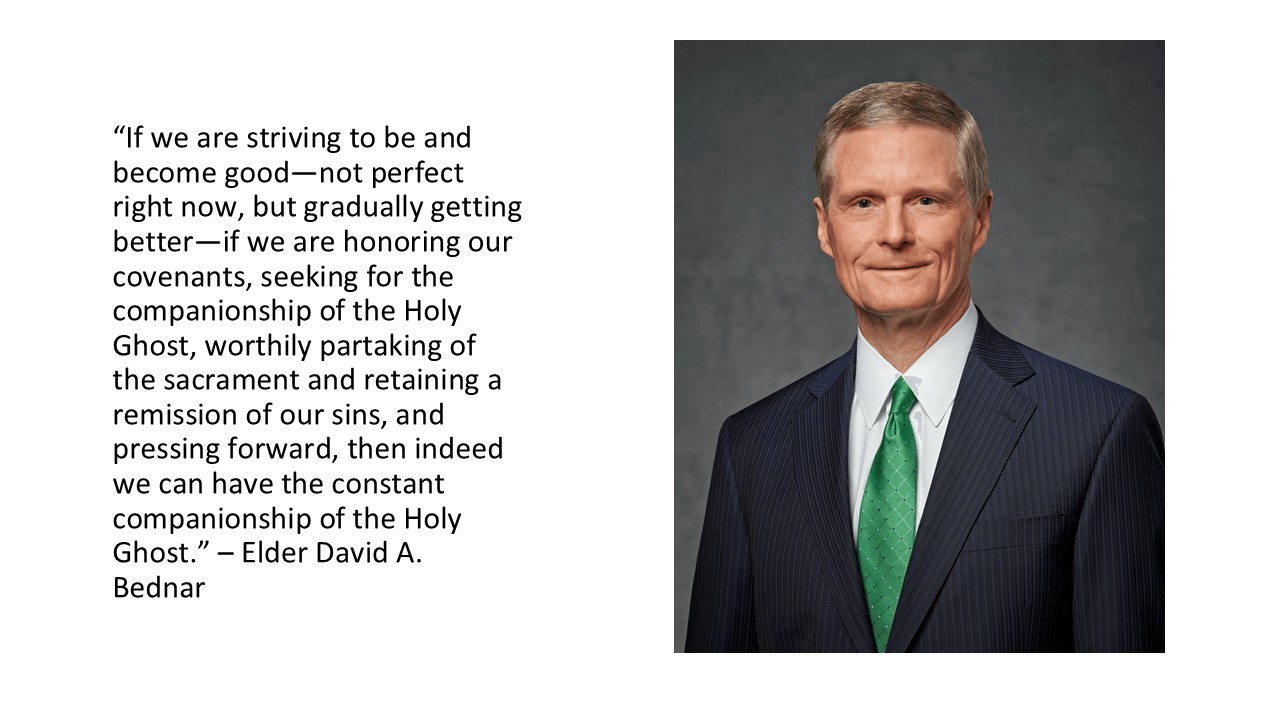
Elder Bednar on Striving
Elder David A. Bednar has taught:
“If we are striving to be and become good—not perfect right now, but gradually getting better—
If we are honoring our covenants, seeking for the companionship of the Holy Ghost, worthily partaking of the sacrament, and retaining a remission of our sins, and pressing forward, then indeed we can have the constant companionship of the Holy Ghost.”
It is not in perfection that the Holy Ghost comes—it’s in the striving to be better. When we do that—when we strive to be better every day—Elder Bednar says, that’s when we are living in revelation.
A Lesson from the Sacrament
I had an experience that helped me see the truth of Elder Bednar’s words. When COVID was raging in the spring of 2020, I was in the middle of an extended period where I did not feel like God was with me. I couldn’t feel Him.
At that time, we could not meet in person for sacrament meetings, but we were able to administer the sacrament in our homes. One Sunday, as I knelt by one of my sons and we blessed the bread, the words “that they may always have His Spirit to be with them” from the sacrament prayer really hit me, and a thought came to my mind:
Matt, you’re not perfect, but you’re doing your best to be a good person. You’re trying to obey the commandments. You’re trying to repent and get better. The Lord has promised that you’ll have His Spirit with you because of your covenants. So just know that the Holy Ghost is there.
And with that thought, I felt the Spirit more strongly with me than I had for weeks. I realized that I did not have to do anything special for God to be with me. I’d made covenants. I was trying to keep those covenants—and because of that, He was there. In this case, I just had to recognize it.
A Moment of Overwhelming Love
At another time, I was having difficulty feeling like God was communicating with me. I again could not feel Him with me—you’ll see this is kind of a pattern in my life. In the midst of this, I took a walk one morning. It was still dark outside.
I was listening to a podcast about how sometimes God is silent, and suddenly I felt this powerful love for my Heavenly Father—that He was my Father, that He cared for me. The feeling was almost overwhelming. I hadn’t ever really experienced anything like that before in my life.
It didn’t last long, but it emphasized to me that God loves me for who I am. I don’t need to earn His love. It doesn’t matter what my job title is, what my calling is in the Church, whether I’ve made mistakes and stepped off the covenant path—His love is always there, no matter what.

As President Holland has taught, however many mistakes you feel you have made, or talents you think you don’t have, or however far from home and family and God you feel you may have traveled…
The Reach of Divine Love
I testify that you have not traveled beyond the reach of divine love. It is not possible for you to sink lower than the infinite light of Christ’s Atonement shines.
So for me, one of the most important things that I can remember when I feel spiritual silence is that Jesus Christ can help me through these moments—when I feel alone, when I feel like God isn’t there, when I cry out, O God, where art thou?
This is when I need the Savior the most. I need to remember that He has experienced everything that I will ever feel—even the feeling that God isn’t there.
The Savior’s Loneliness
When Christ was suffering on the cross, God withdrew His Spirit for a time. And President Holland explained that this, quote, “may have been the most difficult moment in all of this solitary journey to Atonement—that concluding descent into the paralyzing despair of divine withdrawal—when He cries in ultimate loneliness, ‘My God, my God, why hast thou forsaken me?’”
But Christ willingly experienced this precisely so He could help us in our moments of feeling abandoned. The prophet Alma taught that Jesus experienced pains and afflictions and temptations of every kind, so that “He may know according to the flesh how to succor His people.” He can help us through these difficult moments because He has experienced them Himself.
In fact, the Lord has endured more than any of us will ever have to go through. He told Joseph Smith that He had “descended below” even the worst of trials—so He can support us in all of our trials. He knows what it feels like to fail at an important assignment, to be overlooked or lonely, to feel anxious, afraid, or depressed, or to experience any other painful thing.
He’s felt it—and He did it because He loves us and wants to help us get through these times.

The Savior Is Near, Even When Unseen
There are several examples in the scriptures of God being there for people in their time of need—even if they did not recognize His presence. One of these moments comes when Mary Magdalene goes to the tomb after Jesus Christ’s crucifixion.
She gets there and sees that Christ’s body is gone. This breaks her. She’s already gone through the trauma of seeing the Savior killed. Now she thinks someone has stolen His body. It’s too much to take for her. She begins to cry.
In that moment of suffering, the Savior comes to Mary—but she doesn’t recognize Him. Even so, He tries to comfort her by asking her what’s wrong. She still doesn’t know who He is. Then He speaks her name. Hearing that one word, her eyes are opened and she sees that this is the risen Lord.
He was there, even when she didn’t recognize that He was there.

Later, Jesus walked to Emmaus with two of His disciples, and they didn’t recognize Him either. They even talked to Him about the rumors of the Resurrection, and Jesus explained some of the scriptures to them.
The disciples ate a meal with Him—but only after He took some bread, broke it, and gave it to them did they realize He was Jesus. “Did not our heart burn within us while He talked with us by the way?” they asked each other. Yet they didn’t recognize at the time that Christ was with them, even though He was.
Recognizing Him in Our Own Lives
It’s easy for me to look at Mary, to look at those two disciples, and think, How could they not recognize the Savior? He was right there. But sometimes I do this in my own life. I feel alone—even though He is right there.
I love that the Savior didn’t abandon Mary Magdalene in her moment of great sadness. He was there—she just didn’t recognize Him at first. And it’s the same for us. Christ won’t ever leave us, especially when we need Him the most, but we may not notice Him because of our emotional state or for other reasons.
If we just hold on, we’ll be able to hear Him calling us by name.
When the two disciples were with the Savior, they felt the Spirit, though they didn’t recognize it. And there have been moments in my life where I haven’t recognized God’s guidance or Spirit—but when I look back on the event, I see how clearly He was there.
So maybe, if there are times when I feel like God isn’t with me, maybe He really is—and I just need to recognize that He is.
When We Can’t Feel Him
If that’s the case, though, it can raise a difficult question: if I sometimes can’t feel God’s presence or the presence of Jesus Christ, what’s the point of Him being there? Wouldn’t He want me to know He was there?
I don’t know the exact answer to this—but I do believe that the Savior does want us to know He is with us. Unfortunately, sometimes circumstances prevent us from feeling that—whether it’s anxiety, depression, feelings of low self-worth, or other barriers.
For me, this is where faith and my covenants really come into play. I try to remember that I’ve made covenants with God, and that He will honor those covenants.
Remembering Him Through the Sacrament
Some other things I can do to try to recognize His presence come out of the story of the disciples on the way to Emmaus. Remember—they didn’t recognize the Savior until He broke bread and gave it to them. And that reminds me of the sacrament.
So maybe one way I can feel God more strongly is by taking the sacrament each week. Our Church leaders have taught us how significant this ordinance is—it binds us to the Savior, it helps us access His atoning power and support, and it can help us feel more connected to Him.
Sometimes when I feel invisible to God, I try to remember times in the past where He has helped me.
One of my favorite General Conference talks is President Henry B. Eyring’s “O Remember, Remember,” given in the October 2007 General Conference. President Eyring talked about how, at the end of each day, he would write down how he had seen God’s hand in his life.
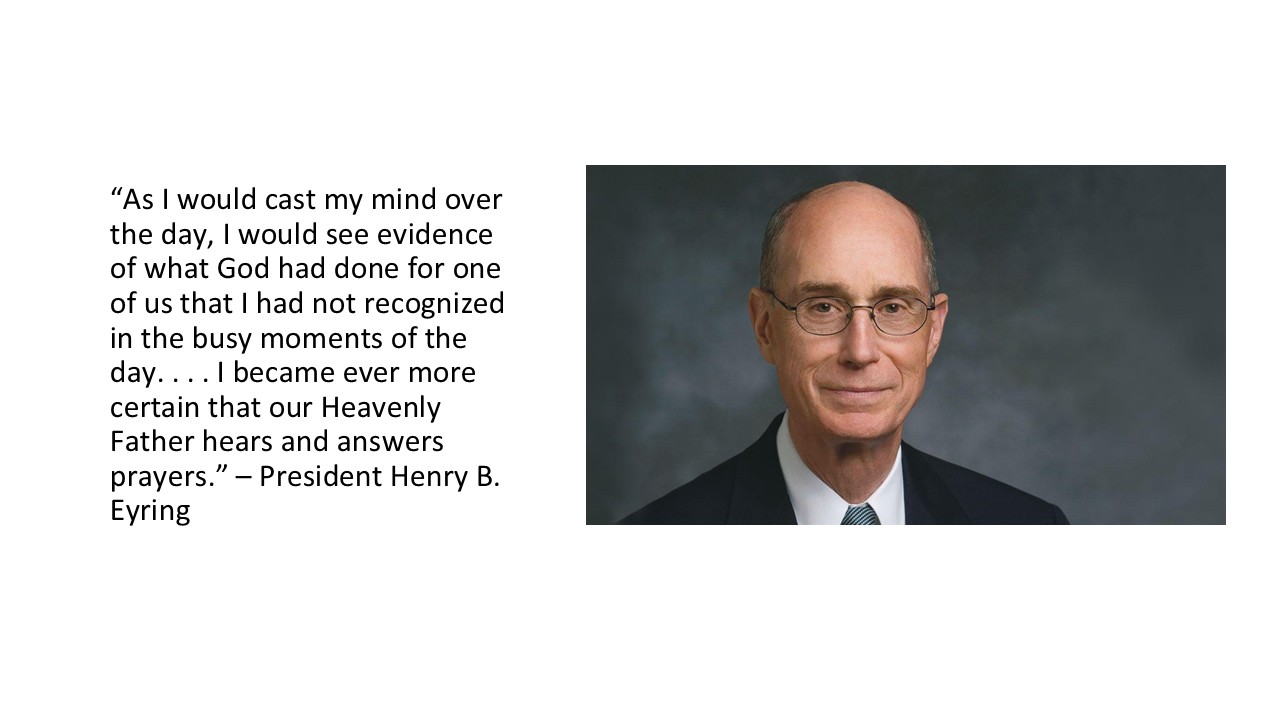
Remembering God’s Hand
As President Eyring did this, he became ever more certain that our Heavenly Father hears and answers prayers. He could feel God with him more strongly.
Now, I’ve kept some kind of a journal for most of my life—even when I was in elementary school. In high school, I’m actually currently making a typescript of one that I kept in middle school and high school.
And I’ve noticed that these journals don’t really show how God was operating in my life. They mainly showed what girls I liked, what girls didn’t like me—much more than the girls that I liked. There were many more girls that didn’t like me—and what music I was listening to. Music is really important to me.
So for some reason, I felt the need to make lists of, like, my favorite groups and list out every single cassette tape (that’s how old I am) I had purchased that week. So—really interesting stuff, you know—stuff that my posterity will be thrilled to read.
Anyway, after hearing President Eyring’s talk, I tried to follow his example and I started to create what I called a Spiritual Experiences Journal.
I wasn’t super consistent, but I did record several experiences where I saw God guiding, directing, and supporting me. This inevitably helped me feel closer to God. Plus, when I’m having a rough time, reading those experiences reminds me that God is with me.
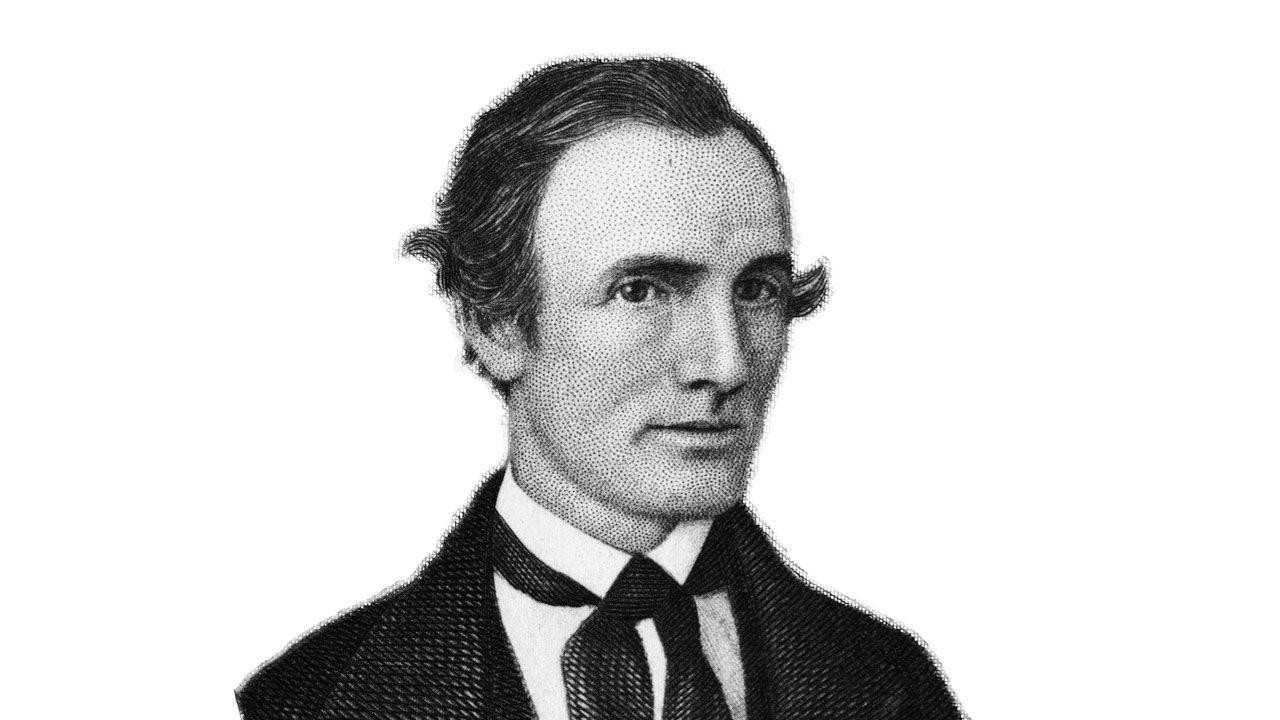
“Remember the Night You Cried Unto Me”
The Lord gave the same advice to Oliver Cowdery after Oliver began helping Joseph with the translation of the Book of Mormon.
Though this was a great spiritual experience, Oliver still had questions about whether all of it was true. The Lord told him to remember earlier spiritual experiences:
“Cast your mind upon the night that you cried unto me in your heart, that you might know concerning the truth of these things,” the Lord declared. “Did I not speak peace to your mind concerning the matter?”
Revelation Comes in Different Ways
Now here’s another principle—along with remembering spiritual experiences—and it’s something that I’ve had to learn over time. Sometimes revelation comes in ways that I don’t expect.
When I was younger, I thought God answered prayers only in certain ways. A lot of times in fast and testimony meetings, when people are bearing their testimonies, they cry. And so I thought, when I was a teenager, if I wasn’t crying, the Spirit wasn’t speaking to me.
And this is all ironic because now I cry like that. I have crying genes in me that my father has passed down to me. But at the time, when I was a teenager, I didn’t cry a whole lot.
I also thought if I didn’t have a burning in the bosom like the Lord described to Oliver Cowdery, I wasn’t feeling the Spirit. And to be honest, I don’t think I really understood what a burning in the bosom even was.
But I’ve learned that God speaks to us each in different and personal ways.
The Spirit Speaks in Our Language
In the New Testament, Paul taught about how the Spirit can make us feel. He said, “The fruit of the Spirit is love, joy, peace, longsuffering, gentleness, goodness, faith, meekness, temperance.”
The Holy Ghost can use all of these feelings—or any of these feelings—to communicate with us.
The Lord also taught in Doctrine and Covenants section 1, verse 24, that He “speaks to humans after the manner of their language.” And I think this means, in part, that He communicates to us in ways that make sense to us.
So, as I mentioned, I love music—I listen to it a lot—and I tend to feel the Spirit most strongly when I’m listening to music. It speaks to my soul. The Lord knows that and can communicate with me through music.
A Still, Small Voice
I love how Joseph Smith described the Spirit as well. In 1832, he compared it to “a still small voice which whispereth.” He then reiterated this description several times, including in a dream to Brigham Young that happened in February 1847—a couple of months before Brigham would leave for the final stage of the journey into the Great Basin.
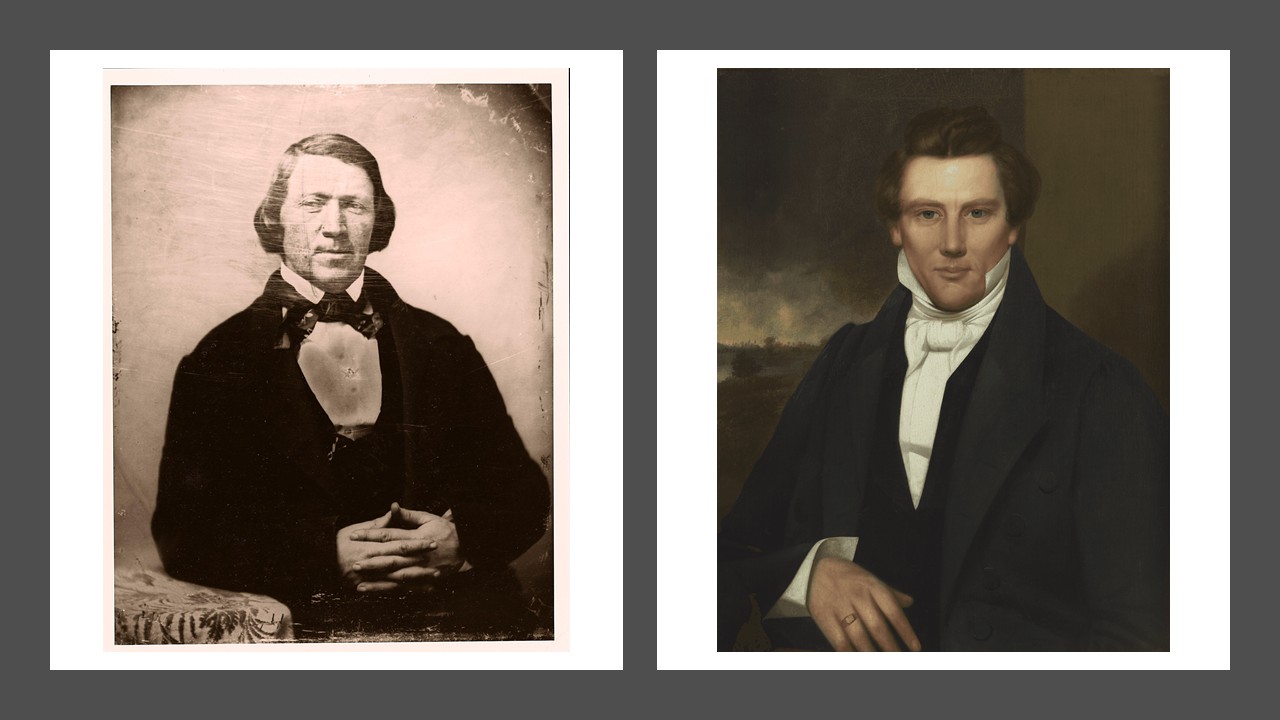
In this dream, according to Brigham, Joseph told him:
“Tell the people to be humble and faithful and sure to keep the Spirit of the Lord, and it will lead them right.”
He described the Spirit as “the still small voice which would teach you what to do and where to go.”
Joseph then told Brigham that people could tell the Spirit from all other spirits:
“It will whisper peace and joy to their souls. It will take malice, hatred, envy, and strife, and all evil from their hearts. And their whole desire will be to do good, bring forth righteousness, and build up the kingdom of God.”
That description by Joseph has helped me to understand better what the Spirit feels like—which, in turn, helps me realize when the Spirit is speaking to me.
Waiting for His Voice
Now, eventually—even in times when I’ve faced spiritual silence—they eventually end. It may take a long time, but eventually I do hear His voice.
I love this principle that Jesus Christ taught. He said that God wants to bless us with instruction and answers.
He said:
“If ye then, being evil, know how to give good gifts unto your children, how much more shall your Father which is in heaven give good things to them that ask Him?”
He said God will not give us a serpent when we ask for a fish, or a stone when we ask for bread. But I think sometimes we need to realize that it takes time for the fish to be caught and time for the bread to bake before we can receive that.
In the meantime, we can remember an experience that Joseph Smith had in 1833.
That year, the Saints had faced a crushing blow when they were driven from Jackson County, Missouri, where they were trying to build the city of Zion. And this was a hard thing for Joseph and the Saints to take.
Joseph said that he petitioned the Lord for answers to two specific questions: why God had suffered so great a calamity to come upon Zion, and by what means He would return her back to her inheritance.
Be Still and Know That I Am God
But Joseph could not get direction. “The Lord has kept the answers hid from my eyes,” he told Edward Partridge. “They are not plainly shown unto me.” Instead, God was just giving him a reassuring prompting: Be still, and know that I am God.
On December 16, 1833, Joseph finally received his answers to those two questions through a revelation—that’s Section 101 in the Doctrine and Covenants. The first part of that revelation explained why the Lord allowed the Saints to be expelled from Jackson County—the first question Joseph had asked.
The second part told a parable about a nobleman whose land had been overrun by his enemies, and about how the strength of his house went out to take the land back. That was the answer to Joseph’s second question.
In Joseph Smith’s case, he did not panic when God didn’t immediately answer him. He trusted that God would eventually—and God did.
Likewise, if we are patient and put in the necessary work, we will receive answers to our prayers. Until those answers come, we can follow the counsel that the Lord gave to Joseph Smith: Be still and know that I am God.
Trust in Him. Know that He loves us. And know that He will see us through these times when we feel like He is not speaking.
And I say that in the name of Jesus Christ, Amen.
