FAIR Resources for Come, Follow Me – Restoration Scripture
Week 21: May 18 - 24: "Be Strong and of a Good Courage"

Joshua 1-8; 23-24

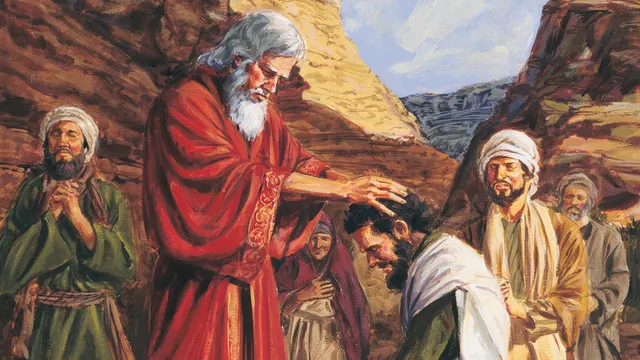
Joshua addressing the people of Israel, emphasizing the choice to serve the Lord faithfully.

Doctrinal Focus

  • Key doctrines addressed in this week’s reading

As Joshua assumes leadership after Moses, the Lord repeatedly commands him to “be strong and of a good courage,” linking courage not to personal confidence but to divine support (Joshua 1:6–9). This teaches that courage grows as we trust God’s presence and promises, especially when facing unfamiliar or intimidating responsibilities. The same assurance applies to disciples today as they confront moral, spiritual, or personal challenges.

The Lord instructs Joshua to meditate on the law “day and night,” promising prosperity and success through faithful obedience (Joshua 1:7–8). This shows that courage is not merely emotional bravery but spiritual steadiness rooted in living God’s commandments. Obedience anchors disciples when fear or uncertainty arises.

The miraculous crossing of the Jordan River mirrors earlier deliverance through the Red Sea, demonstrating that the Lord fulfills His covenant promises when Israel moves forward in faith (Joshua 3:13–17; 4:23–24). These events reinforce that God’s power is revealed as His people trust Him enough to act. Remembering fulfilled promises strengthens faith for future challenges.

The twelve stones taken from the Jordan serve as a memorial so future generations would know the Lord’s power and faithfulness (Joshua 4:6–7). This teaches the importance of intentionally remembering and teaching spiritual experiences within families and faith communities. Memorials—both physical and spiritual—help anchor covenant identity.

Joshua’s declaration, “Choose you this day whom ye will serve,” emphasizes agency and personal responsibility in discipleship (Joshua 24:15). Covenant faithfulness is not inherited automatically but chosen repeatedly. This principle applies to every generation and every stage of life.

Joshua warns Israel to put away false gods and cleave unto the Lord (Joshua 23:6–8; 24:23). True discipleship involves wholehearted devotion, not divided allegiance. This doctrine invites learners to examine modern “idols” that may compete with loyalty to God.

Historical & Contextual Insights

  • Insights in this week’s study
  • The events of Joshua 1–8; 23–24 take place shortly after the death of Moses, as the Israelites stand on the eastern edge of the Jordan River preparing to enter the promised land of Canaan.

Israel is transitioning from a nomadic wilderness people into a settled covenant nation. Joshua, newly called as prophet and military leader, must lead Israel in conquest, covenant renewal, and spiritual consolidation while surrounded by established Canaanite cultures with deeply rooted religious practices.

  • This moment marks the fulfillment of promises made to Abraham, Isaac, Jacob, and Moses. It is also a critical test of whether Israel will remain faithful to the Lord when blessings, land, and security replace dependence forged in the wilderness.
  • Times of transition and blessing often require as much faith and commitment as times of trial. Like Israel, modern disciples must learn to remain spiritually vigilant when entering seasons of success, change, or stability.
  • The Lord’s counsel to Joshua emphasizes obedience to the law and constant reliance on God rather than tactical skill alone (Joshua 1:6–9). Leadership over Israel required moral courage—to enforce covenant standards, resist cultural assimilation, and guide a spiritually diverse people. Strength, in this context, is rooted in faithfulness rather than force.
  •  
  • Joshua was stepping into the role of Moses, a towering prophetic figure, which would naturally provoke fear or uncertainty. The Lord’s reassurance acknowledges the emotional and spiritual burden of leading God’s covenant people during a foundational moment.
  •  
  • The command to meditate on the law “day and night” shows that spiritual leadership depends on constant alignment with God’s word. Courage grows as leaders act in harmony with divine instruction rather than personal confidence.
  • By the time of Joshua 23–24, Israel has experienced military victories and settled portions of the land. Joshua warns that prosperity and proximity to surrounding nations increase the temptation to adopt foreign gods and practices. His final address reframes covenant loyalty as an intentional, lifelong choice rather than a single act of faith.
  •  
  • Joshua recounts Israel’s history to remind them that their identity and success are rooted in God’s actions, not their own strength. Remembering divine deliverance becomes a safeguard against pride and forgetfulness.
  •  
  • The challenge to “choose you this day” underscores agency and accountability. Each generation—and each individual—must consciously reaffirm loyalty to the Lord, especially when alternative values appear attractive or socially accepted.

If you have questions on this week’s reading, please email your questions to us here.

Apologetic Application

  1. Claim: “Israel fabricated the story of Joshua to legitimize territorial expansion.”
  2.  
  3. Response:
  4. Historical Evidence: The book of Joshua preserves early geographic details, city names, and boundary descriptions that align with Late Bronze Age Canaan. Archaeological patterns show a gradual settlement process consistent with the biblical narrative rather than a mythic invention centuries later.
  5.  
  6. Eyewitness Support: The text repeatedly presents Joshua as addressing firsthand witnesses (“ye have seen all that the Lord your God hath done,” Joshua 23:3). Covenant renewal ceremonies imply a living community capable of affirming or rejecting Joshua’s claims.
  7.  
  8. Spiritual Confirmation: Israel’s religious memory consistently attributes success to divine intervention rather than military superiority. This theological consistency across generations supports sincere belief rather than propaganda.
  9.  
  10. Logical Analysis: Fabricated national myths usually glorify the people, yet Joshua includes failures, warnings, and conditional blessings. Such honesty argues against simple political invention.
  • Claim: “Joshua portrays God as violent and unjust.”
  •  
  • Response:
  • Historical Evidence: Canaanite societies practiced extreme religious corruption, including ritual violence, which the biblical record consistently condemns. Divine judgment is presented as limited, purposeful, and preceded by long periods of patience.
  •  
  • Eyewitness Support: Joshua frames conquest as the Lord’s action, not Israel’s entitlement, repeatedly warning Israel they could face the same judgment if they became corrupt (Joshua 23:12–16).
  •  
  • Spiritual Confirmation: Modern readers may struggle with these accounts, but many testify that prayerful study reveals God’s justice balanced with mercy and moral accountability.
  •  
  • Logical Analysis: If God is just, He must address systemic evil; if He is patient, judgment will not be arbitrary. Joshua presents divine justice within a covenant framework rather than unchecked violence.
  • Claim: “Joshua forces obedience through fear rather than genuine choice.”
  •  
  • Response:
  • Historical Evidence: Ancient Near Eastern covenants commonly emphasized obligation, yet Joshua uniquely emphasizes voluntary commitment (“choose you this day,” Joshua 24:15).
  •  
  • Eyewitness Support: The people verbally respond and covenant publicly, suggesting communal consent rather than imposed belief (Joshua 24:21–24).
  •  
  • Spiritual Confirmation: Readers today often feel personally invited—not forced—by Joshua’s appeal, recognizing the dignity God grants human agency.
  •  
  • Logical Analysis: Coerced faith collapses over time, yet Israel’s covenant tradition endured for centuries. This longevity supports the presence of authentic commitment rather than fear-based compliance.

Practical Applications

Practical solutions for someone in faith crisis:

Action Step: Establish a consistent habit of daily scripture study and reflection.

The Lord promised Joshua strength, courage, and success as he meditated on the law continually (Joshua 1:7–8). Regular engagement with scripture invites the Spirit, clarifies decisions, and builds spiritual resilience when challenges arise. Over time, God’s word becomes a source of confidence rather than obligation.

  1. – Choose a consistent time and place for daily scripture study.
  2. – Read a small portion slowly, looking for what it teaches about God’s character.
  3. – Ask, “What does this invite me to do today?”
  4. – Write one brief impression or action in a journal.

Encouraging Thought:

“Have not I commanded thee? Be strong and of a good courage… for the Lord thy God is with thee whithersoever thou goest” (Joshua 1:9).

Action Step: Create personal or family reminders of spiritual experiences.

Israel’s memorial stones helped future generations remember how the Lord delivered them (Joshua 4:6–7). Remembering past spiritual experiences builds gratitude and trust, especially during times of doubt or transition. Reflection turns memory into faith.

  1. – Recall a moment when you felt God’s help or guidance.
  2. – Record it in a journal, note, or digital document.
  3. – Share it with a family member or trusted friend.
  4. – Revisit these reminders during difficult moments.

Encouraging Thought:

Remembering what God has already done makes it easier to trust what He has promised to do.

  • Action Step: Identify and remove influences that compete with loyalty to God.

Joshua taught that discipleship requires intentional choice, not passive belief (Joshua 24:15). Removing competing priorities creates space for deeper devotion and spiritual clarity. Small daily choices shape lifelong faithfulness.

  1. – Prayerfully evaluate how time, attention, and priorities are spent.
  2. – Identify one habit or influence that weakens spiritual focus.
  3. – Replace it with a Christ-centered practice (prayer, service, study).
  4. – Reaffirm your commitment to the Lord in prayer.

Encouraging Thought:

  • “Choose you this day whom ye will serve… but as for me and my house, we will serve the Lord” (Joshua 24:15).

Ideas for Teaching

Objective: Help learners understand that true strength and courage come from trusting and obeying God.

Scriptures, whiteboard or paper, marker or pen

Activity Steps:

  1. Introduction (5 min): Ask learners to think of a time they felt nervous about doing something right. Invite a few to share briefly, then write the words fear and faith on the board.
  2.  
  3. Scripture Discussion (5 min): Read Joshua 1:6–9 together. Ask what the Lord connects courage to (His presence, obedience, scripture). Discuss how this definition of courage differs from the world’s view.
  4.  
  5. Application (5 min): Invite learners to write one situation where they need courage and one way they can rely on the Lord this week. Encourage silent reflection or brief sharing.

Follow-Up Question: How does knowing that the Lord is “with thee whithersoever thou goest” change the way we face challenges?

Objective: Encourage learners to remember and recognize God’s hand in their lives.

Small stones or paper cutouts, pens or markers

Activity Steps:

Introduction (5 min): Show a stone and ask what kinds of things people use to help them remember important events. Briefly discuss memorials.

Scripture Discussion (5 min): Read Joshua 4:6–7. Discuss why the Lord wanted Israel to create a physical reminder of their experience crossing the Jordan.

Application (5 min): Invite learners to write on the stone or paper a word or phrase representing a time God helped them. Encourage them to keep it somewhere meaningful as a reminder.

Follow-Up Question: How can remembering past spiritual experiences help us when our faith is tested?

Objective: Help learners recognize that discipleship requires intentional daily choices.

Scriptures, two signs labeled Serve the Lord and Other Choices (or verbal options)

Activity Steps: 

Introduction (5 min): Present simple everyday choices (e.g., homework vs. phone, kindness vs. anger) and ask learners how choices shape outcomes.

Scripture Discussion (5 min): Read Joshua 24:15. Discuss what Joshua is asking the people to do and why he makes his own commitment clear.

Application (5 min): Invite learners to quietly identify one daily choice that reflects serving the Lord more fully. Encourage them to set a specific intention for the week.

Follow-Up Question: What does it look like to “serve the Lord” in small, everyday decisions?

QUICK REFERENCE

God honors agency and invites commitment rather than forcing belief.
Joshua 24:15; Joshua 24:19–22; 2 Nephi 2:27
The covenant renewal shows God’s respect for moral agency and informed consent

  • Why trust modern prophets?
  • God has consistently led His people through prophets during times of transition and uncertainty, as seen with Moses and Joshua. Joshua’s leadership shows that prophetic authority does not rest on perfection but on divine calling, obedience, and alignment with God’s word—patterns that continue with modern prophets.
  •  
  • Why does God allow mistakes?
  • God works through imperfect people to accomplish perfect purposes. The record of Joshua includes both successes and warnings, showing that human weakness does not negate divine guidance; instead, it highlights God’s patience, respect for agency, and ability to teach through experience.