FAIR Resources for Come, Follow Me – Restoration Scripture
Week 46: November 9 - 15: "There Is No Other God That Can Deliver"

Daniel 1-7

Doctrinal Focus

  • Key doctrines addressed in this week’s reading

Daniel, Shadrach, Meshach, and Abed-nego lived in Babylon, a culture with values very different from their own, yet they remained faithful to God. Daniel 1:8 shows Daniel’s determination not to defile himself with the king’s provisions, while Daniel 3:15–18 demonstrates that Shadrach, Meshach, and Abed-nego trusted God even when they did not know whether He would deliver them from the furnace. Their example teaches that covenant faithfulness is not dependent upon knowing the outcome of a trial.

Daniel 6:10 shows Daniel continuing to pray even after a law was established specifically to prevent him from doing so. His willingness to pray despite the threat of death demonstrates that trusting God sometimes requires courageous consistency. The lesson resource connects these experiences with the Savior’s invitation, “Be not afraid, only believe” (Mark 5:36), reminding us that faith can give us courage even when circumstances remain frightening.

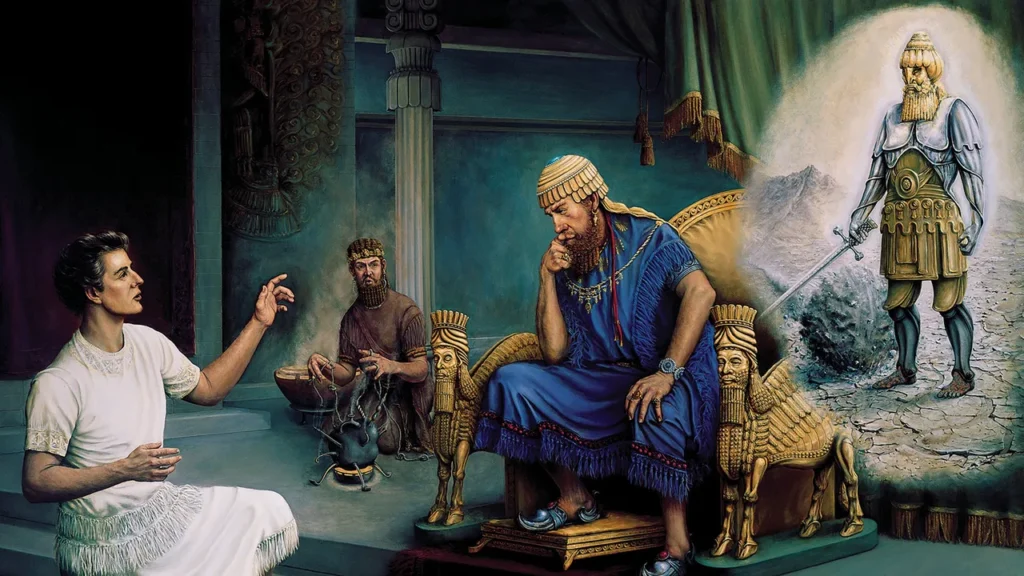
  • When King Nebuchadnezzar demanded that his wise men reveal both his dream and its interpretation, Daniel recognized that the answer could not come through human wisdom alone. Daniel 2:16–19 records that Daniel sought additional time and then prayed with his companions, after which the mystery was revealed to him in a vision. The lesson specifically emphasizes that receiving revelation requires spiritual preparation, pointing to Daniel 1:17 as evidence that God had already prepared Daniel to receive divine knowledge.

After receiving the revelation, Daniel did not claim credit for himself. In Daniel 2:27–28, he explained that the mystery could not be revealed by the king’s wise men but that “there is a God in heaven that revealeth secrets.” Daniel then used the revelation to help Nebuchadnezzar understand the dream (Daniel 2:29–45). His example teaches us to seek God’s wisdom humbly and to use spiritual knowledge in ways that strengthen the faith of others.

Daniel 7:13–14 describes “one like the Son of man” coming with the clouds of heaven and receiving an everlasting dominion, glory, and a kingdom. The lesson explains that many Jews understood the title “Son of man” as referring to the coming Messiah, and Jesus Himself frequently used this title during His mortal ministry (see Matthew 25:31; Mark 9:31; 10:45).

  • Daniel 2:34–35, 44–45 describes a stone “cut out without hands” that becomes a great mountain and fills the earth, symbolizing the latter-day kingdom of God. The lesson identifies this kingdom with The Church of Jesus Christ of Latter-day Saints and emphasizes that it is established by God rather than by human beings. Daniel 7:13–14 likewise teaches that Christ’s dominion is everlasting, giving disciples confidence that God’s purposes will ultimately prevail.

Historical & Contextual Insights

  • Insights in this week’s study
  • Daniel 1–7 is set primarily during the Babylonian captivity, when Daniel and other young Israelites were taken from Jerusalem and brought into Babylon. The lesson notes that Daniel, Shadrach, Meshach, and Abed-nego were taken captive by the powerful Babylonian Empire and were consequently surrounded by an unfamiliar culture with different values and religious practices.

Daniel and his companions faced repeated attempts to pressure them into abandoning their religious convictions. Daniel 1 presents the initial challenge involving the king’s food and wine; Daniel 3 describes Shadrach, Meshach, and Abed-nego’s refusal to worship Nebuchadnezzar’s image; and Daniel 6 records Daniel continuing his prayers despite the king’s decree. These episodes are followed by accounts of divine revelation and deliverance, including Daniel’s interpretation of Nebuchadnezzar’s dream and his survival in the lions’ den.

  • The historical circumstances make the faithfulness of Daniel and his companions particularly meaningful. They were not simply practicing their beliefs in a familiar environment surrounded by supportive people—they were young Israelites living in captivity in a powerful foreign empire. Their experiences demonstrate that covenant faithfulness is possible even when cultural, political, and social pressures encourage a person to compromise.
  • We may not face the same circumstances as Daniel, but the lesson teaches that “in a sense, we all live in Babylon.” Modern disciples likewise encounter pressures to compromise standards, minimize faith, or prioritize popular values over covenants. Daniel’s example encourages us to establish patterns of prayer, choose good influences, trust God, and remain a light to others before difficult trials arrive.
  • Daniel’s remarkable faith in moments of crisis was connected to his consistent obedience in ordinary circumstances.
  •  
  • The lesson emphasizes that Daniel and his companions remained faithful through “small and simple things God asks of all of us—praying, fasting, choosing good friends, trusting in Him, and being a light to others.” Daniel’s later courage did not suddenly appear when he entered the lions’ den. His faith had been developed through earlier choices, including his decision in Daniel 1:8 to refuse to compromise his standards and his continued reliance upon God. The pattern suggests that spiritual strength in major trials is often developed through repeated faithfulness in seemingly ordinary decisions.
  •  
  • Daniel 1:8 shows that Daniel made a decision about his standards before he faced the more dramatic challenges recorded later in the book. His early commitment helped establish the spiritual foundation he would rely upon when the consequences became much more serious.
  •  
  • Daniel 6:10 illustrates this pattern particularly well because Daniel continued his established practice of praying even when doing so became dangerous. His prayer life was not something he invented in a crisis; it was an established relationship with God that gave him strength when the crisis came.
  • True faith trusts God even when we cannot predict how He will answer our prayers.
  •  
  • Shadrach, Meshach, and Abed-nego provide one of the clearest examples of this principle in Daniel 3:13–18. They declared their confidence that God could deliver them from the fiery furnace, but they also stated that they would remain faithful even if He did not. Their faith was therefore centered on God Himself, rather than on a guarantee of a particular outcome. The lesson invites learners to consider what happens when faith does not lead to the miracle they seek and points to the example of these three young men as a model for approaching trials.
  •  
  • Daniel 3:17–18 demonstrates that faith can include both confidence in God’s power and submission to His will. Shadrach, Meshach, and Abed-nego knew God was able to save them, but they did not make their obedience conditional upon being saved.
  •  
  • This principle can change how we understand difficult experiences today. Rather than viewing an unanswered prayer or difficult outcome as evidence that God has abandoned us, we can follow the example of Daniel’s friends by continuing to trust Him while allowing Him to determine the outcome.

If you have questions on this week’s reading, please email your questions to us here.

Apologetic Application

  1. Claim: Believing in God requires abandoning reason and accepting things without evidence.
  2.  
  3. Response:
  4. Historical Evidence: Daniel lived in Babylon, a sophisticated center of learning, law, and philosophy, and was educated in the king’s court. President Uchtdorf describes Daniel as someone who sought understanding and wisdom rather than simply accepting beliefs without thought.
  5.  
  6. Eyewitness Support: Daniel’s experience with Nebuchadnezzar’s dream illustrates faith working together with knowledge: Daniel and his companions prayed for help, the revelation came, and Daniel then explained the dream and its interpretation to the king.
  7.  
  8. Spiritual Confirmation: President Uchtdorf teaches that belief involves spiritual experiences that may be too sacred to explain in purely worldly terms, but that does not make those experiences unreal. He encourages people to seek God personally through faith, prayer, an open heart, and an open mind.
  9.  
  10. Logical Analysis: Rejecting something simply because it cannot be demonstrated through ordinary physical observation is itself an assumption about what constitutes knowledge. Daniel presents another model: investigate, seek understanding, pray, receive revelation, and then act upon what God reveals.
  • Claim: Daniel and his friends could not genuinely have trusted God in these circumstances, because such deliverance would be impossible.
  •  
  • Response:
  • Historical Evidence: The reading block places Daniel, Shadrach, Meshach, and Abed-nego in the historical setting of the Babylonian captivity, where they faced real political and religious pressure. The Come, Follow Me material emphasizes that these young Israelites were surrounded by an unfamiliar culture and were tempted to abandon their beliefs.
  •  
  • Eyewitness Support: The scriptural accounts portray Daniel’s companions refusing to worship the king’s image and Daniel continuing to pray despite the decree against him. Their faith was demonstrated through observable choices rather than merely through private claims of belief.
  •  
  • Spiritual Confirmation: The central spiritual witness of these accounts is that God is capable of delivering His covenant people. At the same time, the lesson asks what we should do when faith does not lead to the miracle we seek, emphasizing that faith ultimately rests in God rather than in a guaranteed outcome.
  •  
  • Logical Analysis: The strongest point of the accounts is not merely that God can perform miracles, but that faithful disciples can trust Him even when they cannot predict the result. Shadrach, Meshach, and Abed-nego’s example makes faith stronger, not weaker, because their obedience was not conditional upon receiving the outcome they wanted.
  • Claim: Daniel and his companions could not realistically maintain their beliefs while living in Babylon.
  •  
  • Response:
  • Historical Evidence: Daniel and his companions were taken captive by the Babylonian Empire and educated within an unfamiliar culture. President Uchtdorf specifically describes Daniel as being pressured to abandon his beliefs while living in Babylon.
  •  
  • Eyewitness Support: Daniel’s behavior demonstrates repeated consistency rather than a single isolated act of courage. He maintained his standards concerning the king’s provisions, sought God through prayer, and later continued praying even when doing so placed his life at risk.
  •  
  • Spiritual Confirmation: The lesson teaches that Daniel’s faithfulness was strengthened through “small and simple things” such as praying, choosing good friends, trusting God, and being a light to others. These practices prepared him to remain faithful when larger trials came.
  •  
  • Logical Analysis: Daniel’s example demonstrates that convictions can survive intense cultural pressure when they are reinforced by consistent practice. His story therefore challenges the assumption that social conformity is inevitable.

Practical Applications

Practical solutions for someone in faith crisis:

Action Step: Identify one simple daily practice that will strengthen your relationship with God.

Daniel’s courage in major trials was supported by habits he had already developed. The lesson specifically identifies prayer, fasting, choosing good friends, trusting God, and being a light to others as “small and simple things” that helped Daniel and his friends remain faithful.

  1. – Choose one spiritual practice you want to strengthen.
  2. – Connect it to a consistent time or activity in your day.
  3. – Practice it even when you do not feel especially motivated.
  4. – At the end of the week, consider how the practice affected your faith.

Encouraging Thought:

Daniel did not wait for the lions’ den to decide whether he would pray. His daily faith prepared him for his extraordinary trial.

Action Step: Take a specific question or concern to the Lord through prayer and scripture study.

Daniel 2 shows that when Daniel faced a problem beyond his own ability, he turned to God rather than relying solely on human wisdom. The lesson explicitly teaches that receiving revelation requires spiritual preparation.

  1. – Write down the question or concern.
  2. – Study relevant scriptures and teachings.
  3. – Pray specifically for guidance.
  4. – Record impressions or insights that come.
  5. – Patiently continue seeking and act on appropriate spiritual promptings.

Encouraging Thought:

  • President Uchtdorf teaches that belief requires “an experiment upon the word of God” and that seeking revelation requires patience and an open heart and mind.
  • Action Step: When facing a trial, deliberately replace one fear-based thought with an expression of trust in God.

Daniel’s friends did not know exactly how God would answer their crisis, yet they remained committed to Him. The lesson encourages us to consider how their example can change the way we approach our own trials, particularly when faith does not immediately produce the miracle we hope for.

  1. – Identify what you are afraid might happen.
  2. – Ask, “What do I know about God despite this uncertainty?”
  3. – Pray for strength rather than only for a particular outcome.
  4. – Decide what faithful action you can take today.
  5. – Leave the final outcome in the Lord’s hands.

Encouraging Thought:

  • The Savior’s message, echoed in President Uchtdorf‘s address, is simple: “Be not afraid, only believe.” Choosing belief does not mean pretending that fear is absent; it means refusing to let fear become stronger than faith.

Ideas for Teaching

Objective: Help learners understand that faith is developed through everyday choices before major trials arrive.

Scripture sets or printed passages; three cards labeled Daniel 1, Daniel 3, and Daniel 6; paper and pens.

Activity Steps:

  1. Introduction (5 min): Ask learners, “If you knew a major trial was coming next week, what could you do today to prepare spiritually?” Write several responses on the board.
  2.  
  3. Scripture Discussion (5 min): Divide learners among Daniel 1:8–17, Daniel 3:16–18, and Daniel 6:10. Ask them to identify what Daniel or his friends did before the crisis and how those choices prepared them.
  4.  
  5. Application (5 min): Have each person write one small spiritual choice they can make consistently this week. Connect the activity to the lesson’s teaching that prayer, fasting, good friends, trusting God, and being a light can prepare us for trials.

Follow-Up Question: What small choice can you make today that might give you greater spiritual courage when a larger trial comes?

Objective: Teach learners that receiving revelation involves preparation, prayer, seeking, patience, and acting on what God reveals.

Paper; pens; scriptures; a container or envelope labeled “What I Need to Know.”

Activity Steps:

Introduction (5 min): Give learners a question or puzzle they cannot reasonably answer without additional information. Ask how they feel when they lack the information needed to solve a problem.

Scripture Discussion (5 min): Read Daniel 2:16–23 and 27–30. Identify what Daniel did when human wisdom was insufficient. Emphasize that he turned to God with his companions and then gave God credit when the answer came.

Application (5 min): Invite learners to write one question they want to take to the Lord. Discuss practical ways to prepare spiritually, seek revelation, remain patient, and recognize answers.

Follow-Up Question: What can you change about the way you seek revelation so that you are more spiritually prepared to recognize God’s answers?

Objective: Help learners distinguish between trusting God and expecting God to give us a specific outcome.

Two signs labeled “God Can” and “I Will Trust Him”; scriptures; paper.

Activity Steps: 

Introduction (5 min): Present a hypothetical situation in which someone prays for a difficult problem to disappear but it does not. Ask, “Does an unanswered prayer mean that faith failed?”

Scripture Discussion (5 min): Read Daniel 3:16–18. Focus on the distinction between knowing that God can deliver and knowing exactly what God will do. The Come, Follow Me lesson specifically asks learners to consider what happens when faith does not lead to the miracle they seek.

Application (5 min): Ask learners to write a difficult circumstance in general terms and complete the sentence: “I don’t know what God will do, but I know I can…” Discuss faithful actions that remain possible regardless of the outcome.

Follow-Up Question: How can trusting God remain an expression of faith even when He does not answer our prayers in the way or timing we hoped?

QUICK REFERENCE

  • Faithfulness during trials: Daniel, Shadrach, Meshach, and Abed-nego remained true to God despite pressure to compromise their beliefs and traditions (Daniel 1:8–17; 3:15–18; 6:10).
  •  
  • God can deliver His people: The experiences of the fiery furnace and lions’ den demonstrate the Lord’s power and invite us to trust Him even when we do not know how He will answer (Daniel 3:16–18; 6:19–23).
  •  
  • Revelation requires preparation: Daniel sought the Lord through prayer when human wisdom could not provide the answer, teaching that spiritual preparation helps us receive revelation (Daniel 2:16–23, 27–30).
  •  
  • God’s kingdom will endure: Daniel’s interpretation of Nebuchadnezzar’s dream teaches that God would establish a kingdom that would ultimately overcome the kingdoms of the world (Daniel 2:31–35, 44–45).
  •  
  • Jesus Christ is the Son of Man: Daniel’s vision of the “Son of man” receiving everlasting dominion points to Jesus Christ and His eternal kingdom (Daniel 7:13–14).
  • Why trust modern prophets?
  • Modern prophets fit the biblical pattern of God guiding His people through authorized servants. The Church teaches that God continues to call prophets and that the President of the Church, together with the First Presidency and Quorum of the Twelve, receives revelation to guide the Church. Daniel provides a useful biblical parallel: God revealed His will through a prophet who sought Him, received revelation, and then helped others understand God’s purposes (Daniel 2:16–30). We can seek our own spiritual confirmation through prayer, scripture study, and the Holy Ghost rather than relying solely on another person’s testimony.
  •  
  • Why does God allow mistakes?
  • The existence of mortal weakness does not mean God has abandoned His people. Official Church materials acknowledge that Church leaders are not infallible and can make mistakes, while also teaching that God works through mortal prophets and corrects His servants when necessary. Daniel’s story reinforces the distinction between trusting God and expecting His servants to be flawless. Our ultimate faith belongs in Jesus Christ; prophets are called to testify of Him, teach His gospel, and guide the Church through revelation.

  1. Daniel 3:16–18 — Shadrach, Meshach, and Abed-nego demonstrate faith in God’s power while remaining faithful even if deliverance does not come as expected.
  2. Daniel 7:13–14 — Daniel’s vision of the Son of Man receiving an everlasting kingdom points to Jesus Christ and His eternal dominion.
  1. Come, Follow Me—For Home and Church: Old Testament 2026, Daniel 1–7 — Provides the official lesson framework and teaching suggestions for this scripture block. Come, Follow Me—Daniel 1–7
  2. “The Role of Prophets” — Gospel Topics — Explains continuing revelation, prophetic authority, mortal weakness, and how Church doctrine is established. The Role of Prophets
  1. President Dieter F. Uchtdorf, “Be Not Afraid, Only Believe” — Uses Daniel as an example of courage, faith, spiritual knowledge, and trusting God in difficult circumstances. Be Not Afraid, Only Believe
  2. “Revelation” — Gospel Topics — Explains how God communicates with His children through prophets and personal revelation. Revelation