
Week 1
December 29– January 4
Introduction to the Old Testament
Today’s Assignment
“The Answer Is Always Jesus Christ” by President Russell M. Nelson April 2023 general conference
Today’s Assignment
“The Miracle of the Holy Bible” By Elder M. Russell Ballard April 2007 general conference
Today’s Assignment
“Jesus Christ Is the Treasure” By Elder Dale G. Renlund October 2023 general conference
Today’s Assignment
“The Teachings of Jesus Christ” By President Dallin H. Oaks April 2023 general conference
"We can confidently gain insights from multiple translations [of the Bible], in part because ‘we also believe the Book of Mormon to be the word of God.’ Latter-day scripture, including the teachings of living prophets, is a good standard for evaluating any doctrinal discrepancies that might come up in different Bible translations."
-Dale G. Renlund
Given the Church’s use of the King James Version and its teaching that the Bible is true ‘as far as it is translated correctly,’ how do Latter-day Saints view the Old Testament’s authority and the use of other Bible translations?”
We believe the Old Testament is scripture and the word of God, but we interpret that belief through the lens of the eighth Article of Faith, which states, “We believe the Bible to be the word of God as far as it is translated correctly.” This means the Church acknowledges that translations can affect how accurately the original Hebrew and other texts are conveyed to modern readers. Joseph Smith taught that the Bible’s original messages are true, even though the available texts reflect centuries of copying and translation.
The Church officially uses the King James Version (KJV) of the Bible in English because of historical continuity with early Church leaders and because it has been the standard for doctrine and teaching in the Restoration. The Church’s preferred editions of scripture are chosen to align with doctrine found in the Book of Mormon and modern revelation, and the KJV remains the official English Bible of the Church.
At the same time, Church guidance notes that members may benefit from other translations that are doctrinally clear and easier to understand, such as ESV, NRSV, NIV, NKJV, NLT, NIrV, and these can be useful for personal study or gaining deeper insight alongside the KJV.
Sources:
FAIR Why the Church uses the King James Version
Church Newsroom: New Guidance on Bible Translations for Latter-day Saints

Week 2
January 5-11
Moses 1; Abraham 3
“God showed Moses the workmanship of His hands, granting him a glimpse of His work and glory. When the vision ended, Moses fell to the earth for the space of many hours. When his strength finally returned, he realized something that, in all his years in Pharaoh’s court, had never occurred to him before. “I know,” he said, “that man is nothing.”
Dieter F. Uchtdorf
Do members of The Church of Jesus Christ of Latter-day Saints believe God lives on a planet called "Kolob"?
Kolob is described in the Book of Abraham (Abraham 3:3) as the star closest to the throne of God. It serves as a symbolic reference to illustrate a hierarchy in the universe, emphasizing the supremacy of God. The text uses Kolob to teach that just as there are many stars, one is “closest” to God, paralleling the idea that there are many intelligences, with God being the most intelligent.
Kolob is not a focal point in our doctrine or practice. Its mention in the Book of Abraham is brief and serves a symbolic purpose. The only other notable reference is in the 19th-century hymn “If You Could Hie to Kolob,” which uses the term metaphorically to describe the eternal nature of life and glory.
The concept of Kolob is not intended to be a literal astronomical body. The Book of Abraham describes Kolob’s revolution time as one “day” equaling 1,000 Earth years, which is not meant to correspond with physical science but to convey theological principles about God’s eternal nature and the measurement of time in a divine context.
Sources:
FAIR Question: Do Mormons believe that God lives on a planet called “Kolob”?
How do the teachings in Abraham 3 on pre-mortal “noble and great ones” influence our view of foreordination and personal purpose?
Abraham 3:22–23 teaches that certain spirits were “noble and great” before this life and were chosen for specific roles in mortality. This aligns with the Latter-day Saint doctrine of foreordination, which holds that God, based on foreknowledge, appointed individuals to carry out particular missions on Earth—not as a form of predestination, but as part of a divine plan that still preserves moral agency.
Foreordination does not guarantee that individuals will receive certain callings or blessings but means they were given the opportunity based on their premortal faithfulness. They must still choose righteousness to fulfill those roles. Latter-day Saints reject predestination in the Reformed sense. Instead, LDS theology teaches that God’s foreordination respects individual agency. People are not compelled by divine decree but are trusted by God with responsibilities they are capable of fulfilling through their choices.
The doctrine inspires a sense of divine purpose while reinforcing personal responsibility and the central role of agency in God’s plan.
Sources:
Topics and Questions: Foreordination
Liahona October 2023: What Is the Relationship between Foreordination and Agency?
What is the historical origin of the Pearl of Great Price, and how did its contents come to be accepted as scripture in the LDS Church?
The Pearl of Great Price originated in the mid-19th century as a collection of inspired writings and translations by Joseph Smith. Its core includes the Book of Moses (a revelation and inspired expansion of Genesis), the Book of Abraham (translated from Egyptian papyri acquired in 1835), Joseph Smith—Matthew (a revision of Matthew 24), Joseph Smith—History (an autobiographical account of early visions and the coming forth of the Book of Mormon), and the Articles of Faith.
In 1851, Elder Franklin D. Richards published the first edition in England to make these revelations more accessible to British Saints. This edition gathered revelations and inspired translations that were otherwise scattered across periodicals and pamphlets.
The Book of Abraham in particular was tied to the Joseph Smith Papyri, fragments of which still exist. While debates continue about translation methods and historicity, Latter-day Saints affirm its doctrinal richness and inspired nature.
The Pearl of Great Price was accepted as scripture by the Church in 1880, canonized alongside the Bible, Book of Mormon, and Doctrine and Covenants. Since then, it has been valued for its teachings on the Creation, the plan of salvation, priesthood, and Joseph Smith’s prophetic calling.
Sources:
The Joseph Smith Papyri
Historicity: Not By Scholarship Alone
Joseph Smith Papers: The Pearl of Great Price

Week 3
January 12-18
Genesis 1–2; Moses 2–3; Abraham 4–5
"Knowing why we left the presence of our Heavenly Father and what it takes to return and be exalted with Him, it becomes very clear that nothing relative to our time on earth can be more important than physical birth and spiritual rebirth, the two prerequisites of eternal life."
D. Todd Christofferson
How do the Book of Moses and the Book of Abraham deepen or clarify our understanding of God's nature compared to the Genesis account?
The Book of Moses and the Book of Abraham, as revealed through the Prophet Joseph Smith, expand upon the Genesis account to provide a more detailed understanding of God’s nature. In Moses 2:1, God declares, “I am the Beginning and the End, the Almighty God; by mine Only Begotten I created these things,” emphasizing the role of Jesus Christ in the Creation. The Book of Abraham introduces the concept of a divine council, stating, “the Gods organized and formed the heavens and the earth” (Abraham 4:1), suggesting a plurality of divine beings involved in creation. These insights align with Latter-day Saint beliefs about the Godhead and the premortal existence, offering a richer perspective than the Genesis account alone.
Sources:
FAIR Answers: The Book of Abraham and Genesis
FAIR Seeking Divine Guidance: Finding Answers to Spiritual Questions in an Age of Doubt
Old Testament Seminary Teacher Resource Manual: The Books of Genesis, Moses, and Abraham
Gospel Topics Essays: Translation and Historicity of the Book of Abraham
FAIR Question: Does the doctrine that God has a physical body contradict the Bible?
Do the Creation accounts in Moses, Abraham, and Joseph Smith’s Translation of Genesis, suggest that the 'days' of Creation were literal 24-hour periods or symbolic of longer phases of time?
The Creation accounts in Genesis, Moses, and Abraham suggest that the “days” of Creation are symbolic of longer periods rather than literal 24-hour days. In Genesis and Moses, the term “day” is used, while the Book of Abraham refers to these periods as “times,” indicating a more flexible understanding of the timeframe. Elder Russell M. Nelson explained that day, time, or age represent phases between two identifiable events, serving as divisions of eternity rather than strict calendar days. This perspective aligns with the view that the Creation was a process involving ordered periods of time. The scriptures are not intended to provide scientific information about the Earth’s age or the exact duration of the Creation periods. Therefore, Latter-day Saint teachings accommodate a non-literal interpretation of the Creation timeframe, focusing on the purpose and order of the Creation rather than specific durations.
Sources:
FAIR Answers: Age of the Earth
Old Testament Seminary Teacher Manual – Lesson 8: Moses 2 (Genesis 1; Abraham 4)
If the Bible already contains the Creation story in Genesis, why do we need additional Creation accounts in the Book of Moses and the Book of Abraham?
We believe in a principle of continuing revelation, where God restores plain and precious truths that were lost or obscured over time. The book of Moses expands what Genesis provides by restoring prophetic insight and context. For example, it includes Moses’s dialogue with God about premortal life and divine purpose, which is not present in the Bible.
Similarly, the Book of Abraham enriches our understanding of the Creation by revealing a divine council and premortal spirit children. It clarifies doctrines such as the plurality of gods and the premortal existence which are concepts only hinted at in Genesis.
Having multiple scriptural Creation accounts is similar to New Testament harmony studies. Different prophets provide varied but complementary perspectives, not contradictions. Just as Matthew, Mark, and Luke offer distinct views of Christ’s ministry, Genesis, Moses, and Abraham together reveal a richer, fuller picture of divine truth.
These restored accounts are not rewrites. They are revelatory complements that deepen doctrine and reaffirm that God continues to speak through prophets.
Sources:
Week 4
January 19–25
“They could not fulfill the Father’s first commandment without transgressing the barrier between the bliss of the Garden of Eden and the terrible trials and wonderful opportunities of mortal life.”
Dallin H. Oaks
Why does the Book of Moses teach that Satan sought to ‘redeem all mankind’ and was cast out for it, when this account isn’t found in Genesis? Doesn’t this contradict the Bible’s narrative of the Fall?
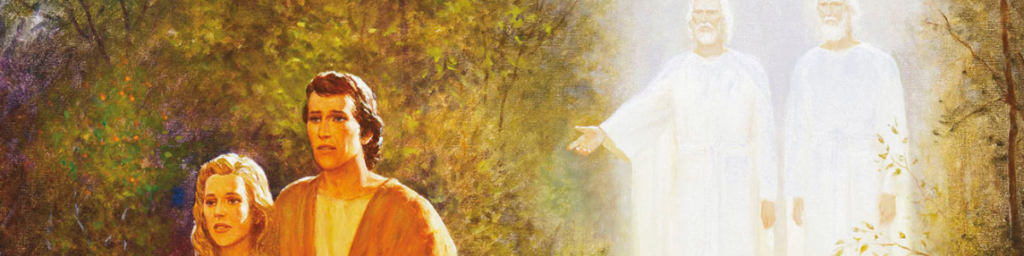
The Book of Moses provides important insights about Satan’s premortal rebellion that go beyond the Genesis account. In this scripture, Satan proposes a plan to “redeem all mankind, that one soul should not be lost,” but his plan was to force obedience and destroy agency. God rejected this plan because it denied the fundamental principle of agency, the freedom to choose and grow through experience. Instead, God presented His own plan of salvation, which Jesus Christ willingly volunteered to fulfill by offering Himself as the Savior and Redeemer.
This premortal council highlights two opposing plans: God’s plan centered on agency, growth, and mercy through Jesus Christ’s atoning sacrifice, and Satan’s plan which sought control and universal salvation without choice. This teaching clarifies why Satan was cast out of heaven and became the adversary in mortality.
These additional details enrich and complement the Genesis narrative rather than contradict it. They deepen our understanding of the eternal conflict between good and evil and emphasize that the Plan of Salvation is a loving, just, and purposeful design, restored through modern revelation.
Sources:
FAIR The Mormon understanding of Satan/Relationship to God
If Adam and Eve were commanded to multiply and also not to eat the fruit, why would God give two seemingly conflicting commandments?
At first glance, God’s command to Adam and Eve to both “multiply and replenish the earth” and to avoid eating the fruit of the tree of knowledge may seem contradictory. However, these commandments serve different purposes in God’s plan. The command not to eat the fruit was a test of agency, inviting Adam and Eve to choose obedience and exercise faith. It was not a trick or a setup to fail but an essential part of mortal growth and progression.
The Fall allowed humanity to enter mortality, experience opposition, and develop attributes like faith, knowledge, and empathy. The Gospel Topics essay on the Fall explains that through this experience, humankind gains the opportunity to learn, repent, and progress. Far from setting them up to fail, God’s commandments emphasize choice and agency as essential to His plan. Obedience in mortality is framed as an act of faith leading to growth and eventual return to God.
Sources:
Come, Follow Me 2022: The Fall of Adam and Eve (January 3–9)
Moses 5 teaches that Adam offered sacrifices before understanding their meaning. Why would God require obedience without explanation?
The account of Adam obeying The Lord’s commands despite not knowing the reason shows an important principle about obedience in the gospel. God often gives commandments before full understanding comes because obedience is an act of faith that opens our hearts to greater knowledge. Obedience without immediate explanation is not blind faith; rather, it is trust in a loving Heavenly Father who sees what we cannot. Faith and obedience are meant to work together because when we trust God enough to act, He reveals more light and truth.
In Adam’s case, his sacrifice pointed to Christ’s atoning sacrifice, which he could only fully understand once he showed willingness to obey. Obedience builds spiritual capacity to receive revelation. God’s pattern of requiring obedience first invites us to grow closer to Him, trust His wisdom, and receive personal witness of His plan.
Sources:
FAIR Mormon teachings/Obedience
This guide is not meant to replace the Come, Follow Me curriculum by the Church of Jesus Christ of Latter-day Saints. This is merely a study tool and a helpful guide to aid in your study as you follow along the church’s curriculum. If there are any questions feel free to reach out to us.
We cover some frequently asked questions, include some criticisms that occur often, as well as the answers to them with some helpful resources from our website and of course, the Church’s website. While we cannot address every question and criticism and cannot provide every resource, we hope what we have included in this guide will be helpful to you.
