
Week 5
January 26–Febuary 1
Genesis 5; Moses 6
“Adam and Eve taught the gospel to their children. Today, men and women still have that worthy work to do. But before you can teach, you must first learn of your premortal existence, the Creation, the Fall, the atonement of Christ, and the reason for mortality. Study the scriptures and internalize them.”
-Russell M. Nelson
Why do we not believe in the concept of original sin like mainstream Christianity? Doesn’t the Fall’s consequences imply inherited guilt on all mankind?
Mainstream Christianity teaches that everyone is born with inherited sin from Adam, or more specifically, born into a condition similar to that of anyone who knowingly commits a personal sin. However, this doctrine stems from a mistranslation of Romans 5:12. The Greek text (ἐφʼ ᾧ πάντες ἥμαρτον) translates as “because all have sinned,” referring to humanity’s general fallen nature. The Latin translation (in quō omnes peccaverunt) suggested “in whom all have sinned,” implying we all sinned with Adam—a misreading that shaped future developments in Christian doctrine towards the idea of Original Sin.
Latter-day Saints maintain a high view of human potential and free will (2 Nephi 2:25-27, Moses 6:55) while acknowledging our fallen nature and need for Christ (2 Nephi 2:8, Mosiah 2:21, 3:19, Alma 34:9). We would agree with Paul in the Greek text of Romans 5: Adam’s fall created a fallen, mortal state that included sin and ended in death (v.12-14), but Christ’s atonement reconciles us to the Father, overcoming death and enabling sanctification through grace (v. 17-21). Latter-day Saints hold that each person is accountable only for their own sins, and not for Adam’s transgression (Ezekiel 18:1-4, D&C 101:78, Articles of Faith 1:2).
Sources:
FAIR Answers: Mormon perspectives regarding original sin
FAIR Question: What is the origin of the doctrine of original sin?
Did Adam and his descendants literally live for hundreds of years? Doesn’t this contradict what we know about human biology and the lifespans of ancient peoples?
The Biblical Texts, particularly the Old Testament, can be quite complicated when attempting to discern whether something is “literal” (as in, literal history) and scientific in the modern sense. While we might not know for sure if the ages provided in Genesis 5 are accurate in a modern historical sense, we can at least glean the message of the chapter by considering what long ages for those who lived in the primeval history would have meant to an ancient audience.
For example, it could be that attributing long lifespans to the primeval patriarchs would have communicated to ancient people their great wisdom, righteousness, and authority. Perhaps the numbers of their ages carried symbolism as well. The genealogy as a whole might have indicated to the Israelite audience that they were eventually connected to God at the end of a long chain of great ancestors (see Luke 3:36-38). If we read the scriptures (particularly Genesis) the way that Ancient Israelites would have heard them, rather than with a need to harmonize scripture through modern lenses, we have a much richer capacity to understand the message it conveyed about God and His interactions with his covenant people.
Sources:
FAIR Primary Sources: “The Earth and Man”
By James E. Talmage
Old Testament 2026 Come, Follow Me Manual: Thoughts to Keep in Mind: Reading the Old Testament
If we are all sons and daughters of God, then what does it mean for God to wish all people to “become” his sons (Moses 6:68)?
The scriptures and modern-day prophets expound the significance of “sons and daughters of god” in two primary ways:
- We are children of Heavenly Father: God is the father of our spirits (see Acts 17:29, Hebrews 12:9). The Family Proclamation emphasizes that we were His children, and that “we knew and worshipped God as their Eternal Father and accepted His plan.”
- We can become heirs of God: More often taught explicitly in the scriptures is the potential of us all in mortality to become children of God, “and if children, then heirs; heirs of God, and joint-heirs with Christ” (Romans 8:17). This is deeply related to the title of “firstborn” both held by Jesus and offered to those who follow in his footsteps (see Romans 8:29, D&C 93:21-22), along with “heir” also indicating the right to inheritance from the Father. By means of sanctification through the Atonement of Christ, we’re enabled in mortality to become worthy of those promises extended to us by God (D&C 76:51-59, Abraham 3:26). In this sense, we become “the children of Christ” through the covenant and His Atonement (see Mosiah 5:6-9).
Sources:
The Family: A Proclamation to the World
April 2017 General Conference: Elder Timothy J. Dyches

Week 6
February 2–8
“Come, but come to remain. Come with conviction and endurance. Come permanently, for your sake and the sake of all the generations who must follow you, and we will help each other be strong to the very end...Christ is everything to us, and we are to “abide” in Him permanently, unyieldingly, steadfastly, forever.”
-Jeffery R. Holland
In Moses 7, Enoch gathers people into the city of Zion, but the people there are also called Zion (v. 18). Is Zion a place that we need to go today, or is it a people?
Much like with the later term Israel, the concept of Zion in Moses 7 is equally applicable to a group of people or a society, and to a physical place. Joseph Smith equated the two definitions often, and was once recorded as having said:
“Anyplace where the Saints gather is Zion, which every righteous man will build up for a place of safety for his children.” (recorded by Martha Jane Knowlton Coray, July 19, 1840)
Today, church leaders strongly emphasize the gathering of Israel through encouraging people to participate in the stakes and wards of Zion around the world. This can be done through missionary work, family history, temple work, service, exemplifying church callings, and becoming “of one heart and one mind, and dwel[ling] in righteousness” (v. 18)
Sources:
Why are the Canaanites described as “black” in verses 8 and 22?
The terminology for “blackness” used in Moses 7 seems reminiscent of the usage of skin as a metaphor in the Book of Mormon and the Bible for countenance and purity. After all, human skin isn’t strictly “white” or “black”, but rather varying shades of pigments. In ancient societies, people weren’t divided by skin color nearly as much as they were divided based on group, or ethnicity/ancestry. Skin color might be an identifier for some ethnicities in the Ancient Near East, but so is also vocal accent, culture, architecture/pottery style, language, writing script style, religion, and other day-to-day practices.
Job describes his skin turning or being black in the context of his descriptions of mourning and becoming uncivilized due to his afflictions and pains (Job 30: 27-31). The same metaphor is also used in Lamentations 5:10, where the blackness is caused by heat and famine. This seems to be a very similar scenario as in Moses 7:8, where the Canaanites suffer dispersion and famine as a result of their conquest against the people of Shum. Because of these events, the Canaanites became despised, not because they literally had their skin turned black. Rather, there was a cultural separation in light of previous events and the famine, which separated the people based on social group, not skin color.
This is more clearly stated in Moses 7:22 which states that the rest of the people who weren’t joined to the people of Zion were “black” and “had no place among them.” This could very easily mean that they willingly distanced themselves from the people of Zion, and they remained “black” metaphorically because of their afflictions, moral alignment with Satan (see Moses 1:15), and therefore their separation from God. No one is barred from membership in the Church based on race. Moses 7 shows that it is the free-will actions of individuals to reject God that always results in separation from His covenant people.
Sources:
FAIR Answers: Racism and the Scriptures
FAIR Conference 2002: Dispelling the Black Myth
Perspectives on Church History: A Personal Essay on Race and the Priesthood
Does the fact of God weeping (Moses 7:28) imply that He isn’t fully in control of the world? Is it precarious for God to be susceptible to such strong emotions?
Some critics of the LDS church will claim that God having a body or/therefore having emotions makes God less powerful and less able to act in the world. The ideal of aseity holds a stronger position in mainstream Christianity than a God who can feel truly human emotions. Latter-Day Saints teach first and foremost that God the Father is “perfect, has all power, and knows all things” even despite having a resurrected body of flesh and bones. The scriptures are replete with depictions of God as having a body (see Genesis 1:27, Exodus 33:11, Isaiah 6:1, and Ezekiel 1:26-28), and are permeated by repeated emphasis of God’s sovereignty (see Genesis 18:14, Alma 26:35, and D&C 19:1-3).
Latter-day Saints see great value in the idea that God has such strong feelings. In the way that love is expressed in the scriptures, we can be assured that He loves us perfectly, which motivates us to emulate that perfect love. Similarly, it’s taught in Moses that God is truly sad when people fall into sin (Moses 7:36-40). Rather than limiting God, the idea that God feels such strong human emotions teaches us that he wishes people to repent, to return to a relationship with Him, and ultimately to find true happiness.
Sources:
FAIR Question: Does the doctrine that God has a physical body contradict the Bible?
FAIR Bookstore: The God Who Weeps: How Mormonism Makes Sense of Life

Week 7
February 9–15
“We need to calmly continue to move ahead and to prepare for what will surely come. We need not panic or fear, for if we are prepared, spiritually and temporally, we and our families will survive any flood. Our arks will float on a sea of faith if our works have been steadily and surely preparing for the future.”
Elder W. Don Ladd
Do Latter-day Saints believe that the Flood was a global, historical event?
Latter-day Saints are free individually to hold differing perspectives about the Flood, and many different perspectives have been voiced over the years. Many have viewed it as either global or local, and in the wake of both scientific advancements and Ancient Near Eastern archaeological discoveries, viewing the Flood as “cosmological” is also an option. Latter-day Saints aren’t required to hold a particular perspective, but understanding the Genesis flood in its cultural context is worth considering for ascertaining the story’s message.
Now, how could the flood be described as “cosmological?” What should give people pause when reading the Genesis flood story (and all of the Bible, for that matter), is the fact that the Israelite view of the universe (cosmology) was radically different from ours. Their model consisted of a flat earth suspended above the underworld (or sheol) and the waters of the deep by the pillars of the earth, and covered by a solid dome (the firmament) to keep out the waters of the heavens. It looked something like this:
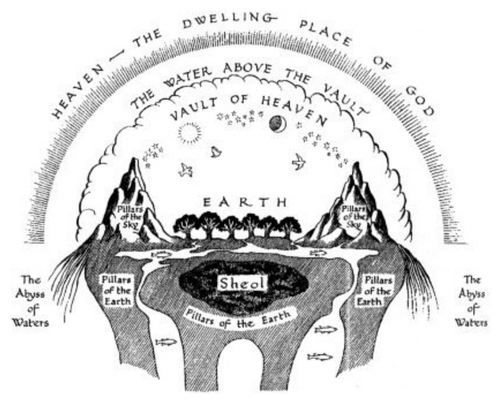
In the flood story, the physical “windows of heaven” opened and “the fountains of the deep” swelled upward, flooding the earth. The imagery is extremely vivid for the ancient Israelite audience. Understanding the flood this way, the flood occurs as a function of how the Israelites viewed the world. Because of the cosmology that the Flood story presupposes, understanding the flood through a modern scientific lens will always run into difficulties.
What matters most of all is understanding what the Flood story was meant to teach hearers. In other ancient Near-Eastern flood stories, the flood was often caused by the gods being annoyed by humanity. For example, in the Akkadian myths “Atrahasis” and “Gilgamesh”, the people on earth get too numerous and too noisy, so the gods decide to wipe them out through various calamities, and eventually a flood. Compare that with the Genesis story, where God is motivated to flood the earth because of wickedness and violence on the earth (Gen 6-11-13). When an Israelite would hear this kind of a flood story, the ultimate message of the Genesis flood story (compared against other flood stories) would be that God cares deeply about the righteousness of humanity and what people do in mortality.
Sources:
FAIR A nswers: Does the Church teach that the flood was a global event?
FAIR Conference 2017: Truth, Scripture, and Interpretation: Some Precursors to Reading Genesis
Why is Canaan cursed because of Ham’s actions? Why has this passage been used as a proof-text for slavery and segregation?
Genesis 9:20-25 is a notoriously difficult passage for commentators of the Bible. There have been several proposals for what Ham did to Noah, but it is incredibly unclear what act the author of Genesis 9 had in mind. Even more unclear is why Canaan was cursed by Noah instead of Ham, which the text is silent on. It’s possible that Canaan was a participant in Ham’s act and that the text assumes ancient listeners would be able to make the connection, as well as make sense of Ham’s ambiguous act.
In the absence of access to archaeological research of the Ancient Near East, most people up until the mid-1800’s were limited to the Bible for understanding ancient history and genealogy. Early members of the church could only work with that information, and they often connected that with their prior Christian assumptions about what the curse of Cain was and how it was passed through Ham and Canaan. In the years to come, that curse was asserted to have been a restriction of priesthood and temple to black Africans. Today, we can recognize those faulty assumptions that informed the reasons behind the priesthood and temple restrictions. As with the theory of Cain’s or Canaan’s cursed lineage, the Church states that “Over time, Church leaders and members advanced many theories to explain the priesthood and temple restrictions. None of these explanations is accepted today as the official doctrine of the Church.”
Sources:
FAIR Gospel Doctrine 2018 Was Noah Drunk or in a Vision?
FAIR Blog: Dispelling the Myth of the “Curse of Cain”
Gospel Topics Essays: Race and the Priesthood
Official Church Statement: Race and the Church: All Are Alike Unto God
Both Genesis 11 and Abraham 1 place Abraham in Ur, but isn’t it located in Mesopotamia? How could his culture have Egyptian connections, as implied in the Book of Abraham, if Abraham lived so far east from Egypt?
The precise location of Abraham’s “Ur of the Chaldeans” (Gen 11:28) is still debated amongst scholars. Some scholars believe that the southern Mesopotamian location for Ur makes the most sense because it provides a literary context for the story in light of the babylonian exile. This, of course, assumes a much later dating of the Pentateuch so that themes of exile are readily available to the authors or compilers.
Other scholars (like Cyrus Gordon and Gary Rendsburg) disagree. Those who disagree might claim that there is a more plausible location for Ur in a northern Syrian-Turkish area just northeast of Haran, and that the Abraham story doesn’t represent anything thematically close to an exile. The new proposed location makes sense of both the Canaanite/Ugaritic literary affinities of Genesis as well as the syncretic Egyptian elements of the Book of Abraham, and it provides a much more plausible route for Abraham’s family traveling from “Ur” through Canaan and into Egypt.
Since there is currently no evidence for Egyptian influence upon the alternative location for Ur in southern Mesopotamia, for Latter-day Saints, the northern Syrian-Turkey location for Abraham’s “Ur of the Chaldees” is the more favorable location.
Sources:
FAIR Bookstore: A Guide to the Book of Abraham (BYU Studies Vol 61:4)

Week 8
February 16–22
Genesis 12–17; Abraham 1–2
“A covenant is not only about a contract, although that is important. It’s about a relationship... We must remember: it’s not the course alone that will exalt us; it’s the companion—our Savior. And this is the why of covenant relationship.”
Emily Belle Freeman
The covenants made between Abraham and God had almost entirely to do with lineage. How is it possible that people can be a part of that covenant today?
The covenants made in Genesis 12 indeed have a lot to do with lineage (See Gen 13:14-17). Abraham and his future descendants were specifically promised to be made into a great nation, be blessed and prospered, and be a means for the blessing of “all families of the earth” (Gen 12:3). The covenant is later expanded in Genesis 17 under the name “the everlasting covenant” to include blessings for all of Abraham’s offspring, ensuring the transfer of rights to the land from generation to generation.
In modern revelation given through the Book of Abraham, we learn that the blessings to and from Abraham would also be with regard to the priesthood and the gospel. “For as many as receive this Gospel shall be called after thy name, and shall be accounted thy seed, and shall rise up and bless thee, as their father” (see Abr 2:10-11). Just like there’s a sense in which we are adopted as sons and daughters of God when we enter and keep the covenants associated with the gospel, we are counted among Abraham’s seed whether or not we’re literally descended from him when we belong to the covenant path (see Romans 4:16-25). Russel M. Nelson stated:
“When you and I also enter that path, we have a new way of life. We thereby create a relationship with God that allows Him to bless and change us. The covenant path leads us back to Him. If we let God prevail in our lives, that covenant will lead us closer and closer to Him. All covenants are intended to be binding. They create a relationship with everlasting ties.” (“The Everlasting Covenant,” October 2022)
Sources:
FAIR Conference 2020: The Covenant Path in the Bible and The Book of Mormon
Why does the Book of Abraham heading state that it was written by Abraham's "own hand upon papyrus" if the papyri in Joseph Smith’s possession date to hundreds of years later than when Abraham lived?
It is absolutely true that the Kirtland manuscript as well as modern copies of the Book of Abraham include the heading, “written by his own hand upon papyrus,” and the papyri we have date from around 300 BC. It’s probably true that some early church members believed the papyri to be as old as Abraham himself, but that might have been an assumption that was well-intentioned, yet inaccurate. For example, most early church members also assumed a hemispheric model for the Book of Mormon, but it’s more likely that the Book of Mormon took place over a smaller geographical area. That doesn’t diminish the authenticity of the Book of Mormon, but it demonstrates that assumptions made about a text have nothing to do with the text’s authenticity.
The phrase “written upon his own hand” could be an Egyptian idiom to denote simply authorship or a way to say “in the authority of” Abraham. So in the Book of Abraham heading, the phrase simply refers to the fact that Abraham was the one who ultimately wrote the book, and what Joseph Smith received was a copy of a more ancient document, or a document that represented the thoughts and traditions of Abraham which was then translated by inspiration similar to the Book of Mormon.
Sources:
https://www.fairlatterdaysaints.org/answers/Book_of_Abraham/By_his_own_hand
FAIR Answers: Question: Is the phrase “by his own hand upon papyrus” an Egyptian title?
Abraham 1:27 indicates that Pharaoh and his lineage was “cursed. . . as pertaining to the Priesthood.” Is this a basis for the priesthood and temple ban on black Africans?
There are a couple of serious difficulties with this reading of Abraham 1:27 that make a reading of the text compatible with the priesthood and temple ban strained. Firstly, the scripture doesn’t explicitly indicate why Pharaoh and his lineage was cursed. It could be implied from verse 26 that it was because of his imitation of the real priesthood held by the patriarchs, but regardless, that reading doesn’t match the particular circumstances of the later priesthood and temple ban. Additionally, the ancient Egyptians aren’t the ancestors of modern-day black Africans; they’re associated with northern africa and the middle east, a different ethnicity altogether.
While theories can be put together about the origins or reasons of the priesthood ban, scripture and folklore tradition about scripture cannot easily explain why the ban was put into place. Theories also require that the priesthood ban is presupposed and imposed upon prior scriptures. The priesthood ban wasn’t a current policy around the time that books like Abraham, the Doctrine and Covenants, and the Book of Mormon were received, so no one passage of scripture can teach the idea or serve as its basis. The scriptures need to be understood in their own context, and in this case, the authorial intent behind the descriptions of Pharaoh’s cursed lineage pertaining to the priesthood is strikingly brief and unclear. What we do know from the preponderance of scriptural witness is that “all men are privileged the one like unto the other, and none are forbidden” from salvation (see 2 Nephi 26:27-28).
Sources:
FAIR Conference 2003: The LDS Church and the Race Issue: A Study in Misplaced Apologetics
FAIR Bookstore: A Guide to the Book of Abraham (BYU Studies Vol 61:4)

This guide is not meant to replace the Come, Follow Me curriculum by the Church of Jesus Christ of Latter-day Saints. This is merely a study tool and a helpful guide to aid in your study as you follow along the church’s curriculum. If there are any questions feel free to reach out to us.
We cover some frequently asked questions, include some criticisms that occur often, as well as the answers to them with some helpful resources from our website and of course, the Church’s website. While we cannot address every question and criticism and cannot provide every resource, we hope what we have included in this guide will be helpful to you.
